VOLUME XI SLICE VIII Germany to Gibson, William (continued 9)
Reading edition
Under the judicious regulations of his new tutor a methodical course of reading was marked out, and most ardently prosecuted; the pupil’s progress was proportionably rapid. With the systematic study of the Latin, and to a slight extent also of the Greek classics, he conjoined that of logic in the prolix system of Crousaz; and he further invigorated his reasoning powers, as well as enlarged his knowledge of metaphysics and jurisprudence, by the perusal of Locke, Grotius and Montesquieu. He also read largely, though somewhat indiscriminately, in French literature, and appears to have been particularly struck with Pascal’s Provincial Letters, which he tells us he reperused almost every year of his subsequent life with new pleasure, and which he particularly mentions as having been, along with Bleterie’s Life of Julian and Giannone’s History of Naples, a book which probably contributed in a special sense to form the historian of the Roman empire. The comprehensive scheme of study included mathematics also, in which he advanced as far as the conic sections in the treatise of L’Hôpital. He assures us that his tutor did not complain of any inaptitude on the pupil’s part, and that the pupil was as happily unconscious of any on his own; but here he broke off. He adds, what is not quite clear from one who so frankly acknowledges his limited acquaintance with the science, that he had reason to congratulate himself that he knew no more. “As soon,” he says, “as I understood the principles, I relinquished for ever the pursuit of the mathematics; nor can I lament that I desisted before my mind was hardened by the habit of rigid demonstration, so destructive of the finer feelings of moral evidence, which must, however, determine the action and opinions of our lives.”
Under the new influences which were brought to bear on him, he in less than two years resumed his Protestantism. “He is willing,” he says, to allow M. Pavilliard a “handsome share in his reconversion,” though he maintains, and no doubt rightly, that it was principally due “to his own solitary reflections.” He particularly congratulated himself on having discovered the “philosophical argument” against transubstantiation, “that the text of Scripture which seems to inculcate the real presence is attested only by a single sense—our sight, while the real presence itself is disproved by three of our senses—the sight, the touch, and the taste.” Before a similar mode of reasoning, all the other distinctive articles of the Romish creed “disappeared like a dream”; and “after a full conviction,” on Christmas day, 1754, he received the sacrament in the church of Lausanne. Although, however, he adds that at this point he suspended his religious inquiries, “acquiescing with implicit belief in the tenets and mysteries which are adopted by the general consent of Catholics and Protestants,” his readers will probably do him no great injustice if they assume that even then it was rather to the negations than to the affirmations of Protestantism that he most heartily assented.
With all his devotion to study at Lausanne2 (he read ten or twelve hours a day), he still found some time for the acquisition of some of the lighter accomplishments, such as riding, dancing, drawing, and also for mingling in such society as the place had to offer. In September 1755 he writes to his aunt: “I find a great many agreeable people here, see them sometimes, and can say upon the whole, without vanity, that, though I am the Englishman here who spends the least money, I am he who is most generally liked.” Thus his “studious and sedentary life” passed pleasantly enough, interrupted only at rare intervals by boyish excursions of a day or a week in the neighbourhood, and by at least one memorable tour of Switzerland, by Basel, Zürich, Lucerne and Bern, made along with Pavilliard in the autumn of 1755. The last eighteen months of this residence abroad saw the infusion of two new elements—one of them at least of considerable importance—into his life. In 1757 Voltaire came to reside at Lausanne; and although he took but little notice of the young Englishman of twenty, who eagerly sought and easily obtained an introduction, the establishment of the theatre at Monrepos, where the brilliant versifier himself declaimed before select audiences his own productions on the stage, had no small influence in fortifying Gibbon’s taste for the French theatre, and in at the same time abating that “idolatry for the gigantic genius of Shakespeare which is inculcated from our infancy as the first duty of an Englishman.” In the same year—apparently about June—he saw for the first time, and forthwith loved, the beautiful, intelligent and accomplished Mademoiselle Susan Curchod, daughter of the pasteur of Crassier. That the passion which she inspired in him was tender, pure and fitted to raise to a higher level a nature which in some respects was much in need of such elevation will be doubted by none but the hopelessly cynical; and probably there are few readers who can peruse the paragraph in which Gibbon “approaches the delicate subject of his early love” without discerning in it a pathos much deeper than that of which the writer was himself aware. During the remainder of his residence at Lausanne he had good reason to “indulge his dream of felicity”; but on his return to England, “I soon discovered that my father would not hear of this strange alliance, and that without his consent I was myself destitute and helpless. After a painful struggle I yielded to my fate; I sighed as a lover, I obeyed as a son; my wound was insensibly healed by time, absence, and the habits of a new life.”3
In 1758 he returned with mingled joy and regret to England, and was kindly received at home. But he found a stepmother there; and this apparition on his father’s hearth at first rather appalled him. The cordial and gentle manners of Mrs Gibbon, however, and her unremitting care for his happiness, won him from his first prejudices, and gave her a permanent place in his esteem and affection. He seems to have been much indulged, and to have led a very pleasant life of it; he pleased himself in moderate excursions, frequented the theatre, mingled, though not very often, in society; was sometimes a little extravagant, and sometimes a little dissipated, but never lost the benefits of his Lausanne exile; and easily settled into a sober, discreet, calculating Epicurean philosopher, who sought the summum bonum of man in temperate, regulated and elevated pleasure. The first two years after his return to England he spent principally at his father’s country seat at Buriton, in Hampshire, only nine months being given to the metropolis. He has left an amusing account of his employments in the country, where his love of study was at once inflamed by a large and unwonted command of books and checked by the necessary interruptions of his otherwise happy domestic life. After breakfast “he was expected,” he says, to spend an hour with Mrs Gibbon; after tea his father claimed his conversation; in the midst of an interesting work he was often called down to entertain idle visitors; and, worst of all, he was periodically compelled to return the well-meant compliments. He mentions that he dreaded the “recurrence of the full moon,” which was the period generally selected for the more convenient accomplishment of such formidable excursions.
His father’s library, though large in comparison with that he commanded at Lausanne, contained, he says, “much trash”; but a gradual process of reconstruction transformed it at length into that “numerous and select” library which was “the foundation of his works, and the best comfort of his life both at home and abroad.” No sooner had he returned home than he began the work of accumulation, and records that, on the receipt of his first quarter’s allowance, a large share was appropriated to his literary wants. “He could never forget,” he declares, “the joy with which he exchanged a bank note of twenty pounds for the twenty volumes of the Memoirs of the Academy of Inscriptions,” an Academy which has been well characterized (by Sainte-Beuve) as Gibbon’s intellectual fatherland. It may not be uninteresting here to note the principles which guided him both now and afterwards in his literary purchases. “I am not conscious,” says he, “of having ever bought a book from a motive of ostentation; every volume, before it was deposited on the shelf, was either read or sufficiently examined”; he also mentions that he soon adopted the tolerating maxim of the elder Pliny, that no book is ever so bad as to be absolutely good for nothing.
In London he seems to have seen but little select society—partly from his father’s taste, “which had always preferred the highest and lowest company,” and partly from his own reserve and timidity, increased by his foreign education, which had made English habits unfamiliar, and the very language in some degree strange. And thus he was led to draw that interesting picture of the literary recluse among the crowds of London: “While coaches were rattling through Bond Street, I have passed many a solitary evening in my lodging with my books. My studies were sometimes interrupted with a sigh, which I breathed towards Lausanne; and on the approach of spring I withdrew without reluctance from the noisy and extensive scene of crowds without company, and dissipation without pleasure.” He renewed former acquaintance, however, with the “poet” Mallet, and through him gained access to Lady Hervey’s circle, where a congenial admiration, not to say affectation, of French manners and literature made him a welcome guest. It ought to be added that in each of the twenty-five years of his subsequent acquaintance with London “the prospect gradually brightened,” and his social as well as his intellectual qualities secured him a wide circle of friends. In one respect Mallet gave him good counsel in those early days. He advised him to addict himself to an assiduous study of the more idiomatic English writers, such as Swift and Addison—with a view to unlearn his foreign idiom and recover his half-forgotten vernacular—a task, however, which he never perfectly accomplished. Much as he admired these writers, Hume and Robertson were still greater favourites, as well from their subject as for their style. Of his admiration of Hume’s style, of its nameless grace of simple elegance, he has left us a strong expression, when he tells us that it often compelled him to close the historian’s volumes with a mixed sensation of delight and despair.
In 1761 Gibbon, at the age of twenty-four, after many delays, and with many flutterings of hope and fear, gave to the world, in French, his maiden publication, an Essai sur l’étude de la littérature, which he had composed two years before. It was published partly in compliance with his father’s wishes, who thought that the proof of some literary talent might introduce him favourably to public notice, and secure the recommendation of his friends for some appointment in connexion with the mission of the English plenipotentiaries to the congress at Augsburg which was at that time in contemplation. But in yielding to paternal authority, Gibbon frankly owns that he “complied, like a pious son, with the wish of his own heart.”
The subject of this youthful effort was suggested, its author says, by a refinement of vanity—“the desire of justifying and praising the object of a favourite pursuit,” namely, the study of ancient literature. Partly owing to its being written in French, partly to its character, the Essai excited more attention abroad than at home. Gibbon has criticized it with the utmost frankness, not to say severity; but, after every abatement, it is unquestionably a surprising effort for a mind so young, and contains many thoughts which would not have disgraced a thinker or a scholar of much maturer age. His account of its first reception and subsequent fortunes in England deserves to be cited as a curious piece of literary history. “In England,” he says, “it was received with cold indifference, little read, and speedily forgotten. A small impression was slowly dispersed; the bookseller murmured, and the author (had his feelings been more exquisite) might have wept over the blunders and baldness of the English translation. The publication of my history fifteen years afterwards revived the memory of my first performance, and the essay was eagerly sought in the shops. But I refused the permission which Becket solicited of reprinting it; the public curiosity was imperfectly satisfied by a pirated copy of the booksellers of Dublin; and when a copy of the original edition has been discovered in a sale, the primitive value of half-a-crown has risen to the fanciful price of a guinea or thirty shillings.”4
Some time before the publication of the essay, Gibbon had entered a new and, one might suppose, a very uncongenial scene of life. In an hour of patriotic ardour he became (June 12, 1759) a captain in the Hampshire militia, and for more than two years (May 10, 1760, to December 23, 1762) led a wandering life of “military servitude.” Hampshire, Kent, Wiltshire and Dorsetshire formed the successive theatres of what he calls his “bloodless and inglorious campaigns.” He complains of the busy idleness in which his time was spent; but, considering the circumstances, so adverse to study, one is rather surprised that the military student should have done so much, than that he did so little; and never probably before were so many hours of literary study spent in a tent. In estimating the comparative advantages and disadvantages of this wearisome period of his life, he has summed up with the impartiality of a philosopher and the sagacity of a man of the world. Irksome as were his employments, grievous as was the waste of time, uncongenial as were his companions, solid benefits were to be set off against these things; his health became robust, his knowledge of the world was enlarged, he wore off some of his foreign idiom, got rid of much of his reserve; he adds—and perhaps in his estimate it was the benefit to be most prized of all—“the discipline and evolutions of a modern battalion gave me a clearer notion of the phalanx and the legion, and the captain of the Hampshire grenadiers (the reader may smile) has not been useless to the historian of the Roman empire.”
It was during this period that he read Homer and Longinus, having for the first time acquired some real mastery of Greek; and after the publication of the Essai, his mind was full of projects for a new literary effort. The Italian expedition of Charles VIII. of France, the crusade of Richard I., the wars of the barons, the lives and comparisons of Henry V. and the emperor Titus, the history of the Black Prince, the life of Sir Philip Sidney, that of Montrose, and finally that of Sir W. Raleigh, were all of them seriously contemplated and successively rejected. By their number they show how strong was the impulse to literature, and by their character, how determined the bent of his mind in the direction of history; while their variety makes it manifest also that he had then at least no special purpose to serve, no preconceived theory to support, no particular prejudice or belief to overthrow.
The militia was disbanded in 1762, and Gibbon joyfully shook off his bonds; but his literary projects were still to be postponed. Following his own wishes, though with his father’s consent, he had early in 1760 projected a Continental tour as the completion “of an English gentleman’s education.” This had been interrupted by the episode of the militia; now, however, he resumed his purpose, and left England in January 1763. Two years were “loosely defined as the term of his absence,” which he exceeded by half a year—returning June 1765. He first visited Paris, where he saw a good deal of d’Alembert, Diderot, Barthélemy, Raynal, Helvétius, Baron d’Holbach and others of that circle, and was often a welcome guest in the saloons of Madame Geoffrin and Madame du Deffand.5 Voltaire was at Geneva, Rousseau at Montmorency, and Buffon he neglected to visit; but so congenial did he find the society for which his education had so well prepared him, and into which some literary reputation had already preceded him, that he declared, “Had I been rich and independent, I should have prolonged and perhaps have fixed my residence at Paris.”
From France he proceeded to Switzerland, and spent nearly a year at Lausanne, where many old friendships and studies were resumed, and new ones begun. His reading was largely designed to enable him fully to profit by the long-contemplated Italian tour which began in April 1764 and lasted somewhat more than a year. He has recorded one or two interesting notes on Turin, Genoa, Florence and other towns at which halt was made on his route; but Rome was the great object of his pilgrimage, and the words in which he has alluded to the feelings with which he approached it are such as cannot be omitted from any sketch of Gibbon, however brief. “My temper is not very susceptible of enthusiasm, and the enthusiasm which I do not feel I have ever scorned to affect. But at the distance of twenty-five years I can neither forget nor express the strong emotions which agitated my mind as I first approached and entered the Eternal City. After a sleepless night, I trod with a lofty step the ruins of the forum; each memorable spot, where Romulus stood, or Tully spoke, or Caesar fell, was at once present to my eye; and several days of intoxication were lost or enjoyed before I could descend to a cool and minute investigation.” Here at last his long yearning for some great theme worthy of his historic genius was gratified. The first conception of the Decline and Fall arose as he lingered one evening amidst the vestiges of ancient glory. “It was at Rome, on the 15th of October 1764, as I sat musing amidst the ruins of the Capitol, while the barefooted friars were singing vespers in the temple of Jupiter, that the idea of writing the decline and fall of the city first started to my mind.”
The five years and a half which intervened between his return from this tour, in June 1765, and the death of his father, in November 1770, seem to have formed the portion of his life which “he passed with the least enjoyment and remembered with the least satisfaction.” He attended every spring the meetings of the militia at Southampton, and rose successively to the rank of major and lieutenant-colonel commandant; but was each year “more disgusted with the inn, the wine, the company, and the tiresome repetition of annual attendance and daily exercise.” From his own account, however, it appears that other and deeper causes produced this discontent. Sincerely attached to his home, he yet felt the anomaly of his position. At thirty, still a dependant, without a settled occupation, without a definite social status, he often regretted that he had not “embraced the lucrative pursuits of the law or of trade, the chances of civil office or India adventure, or even the fat slumbers of the church.” From the emoluments of a profession he “might have derived an ample fortune, or a competent income instead of being stinted to the same narrow allowance, to be increased only by an event which he sincerely deprecated.” Doubtless the secret fire of a consuming, but as yet ungratified, literary ambition also troubled his repose. He was still contemplating “at an awful distance” The Decline and Fall, and meantime revolved some other subjects, that seemed more immediately practicable. Hesitating for some time between the revolutions of Florence and those of Switzerland, he consulted M. Deyverdun, a young Swiss with whom he had formed a close and intimate friendship during his first residence at Lausanne, and finally decided in favour of the land which was his “friend’s by birth” and “his own by adoption.” He executed the first book in French; it was read (in 1767), as an anonymous production, before a literary society of foreigners in London, and condemned. Gibbon sat and listened unobserved to their strictures. It never got beyond that rehearsal; Hume, indeed, approved of the performance, only deprecating as unwise the author’s preference for French; but Gibbon sided with the majority.
In 1767 also he joined with M. Deyverdun in starting a literary journal under the title of Mémoires littéraires de la Grande-Bretagne. But its circulation was limited, and only the second volume had appeared (1768) when Deyverdun went abroad. The materials already collected for a third volume were suppressed. It is interesting, however, to know, that in the first volume is a review by Gibbon of Lord Lyttelton’s History of Henry II., and that the second volume contains a contribution by Hume on Walpole’s Historic Doubts.
The next appearance of the historian made a deeper impression. It was the first distinct print of the lion’s foot. “Ex ungue leonem” might have been justly said, for he attacked, and attacked successfully, the redoubtable Warburton. Of the many paradoxes in the Divine Legation, few are more extravagant than the theory that Virgil, in the sixth book of his Aeneid, intended to allegorize, in the visit of his hero and the Sibyl to the shades, the initiation of Aeneas, as a lawgiver, into the Eleusinian mysteries. This theory Gibbon completely exploded in his Critical Observations (1770)—no very difficult task, indeed, but achieved in a style, and with a profusion of learning, which called forth the warmest commendations both at home and abroad. Warburton never replied; and few will believe that he would not, if he had not thought silence more discreet. Gibbon, however, regrets that the style of his pamphlet was too acrimonious; and this regret, considering his antagonist’s slight claims to forbearance, is creditable to him. “I cannot forgive myself the contemptuous treatment of a man who, with all his faults, was entitled to my esteem; and I can less forgive, in a personal attack, the cowardly concealment of my name and character.”
Soon after his “release from the fruitless task of the Swiss revolution” in 1768, he had gradually advanced from the wish to the hope, from the hope to the design, from the design to the execution of his great historical work. His preparations were indeed vast. The classics, “as low as Tacitus, Pliny the Younger and Juvenal,” had been long familiar. He now “plunged into the ocean of the Augustan history,” and “with pen almost always in hand,” pored over all the original records, Greek and Latin, between Trajan and the last of the Western Caesars. “The subsidiary rays of medals and inscriptions, of geography and chronology, were thrown on their proper objects; and I applied the collections of Tillemont, whose inimitable accuracy almost assumes the character of genius, to fix and arrange within my reach the loose and scattered atoms of historical information.” The Christian apologists and their pagan assailants; the Theodosian Code, with Godefroy’s commentary; the Annals and Antiquities of Muratori, collated with “the parallel or transverse lines” of Sigonius and Maffei, Pagi and Baronius, were all critically studied. Still following the wise maxim which he had adopted as a student, “multum legere potius quam multa,” he reviewed again and again the immortal works of the French and English, the Latin and Italian classics. He deepened and extended his acquaintance with Greek, particularly with his favourite authors Homer and Xenophon; and, to crown all, he succeeded in achieving the third perusal of Blackstone’s Commentaries.
The course of his study was for some time seriously interrupted by his father’s illness and death in 1770, and by the many distractions connected with the transference of his residence from Buriton to London. It was not, indeed, until October 1772 that he found himself at last independent, and fairly settled in his house and library, with full leisure and opportunity to set about the composition of the first volume of his history. Even then it appears from his own confession that he long brooded over the chaos of materials he had amassed before light dawned upon it. At the commencement, he says, “all was dark and doubtful”; the limits, divisions, even the title of his work were undetermined; the first chapter was composed three times, and the second and third twice, before he was satisfied with his efforts. This prolonged meditation on his design and its execution was ultimately well repaid by the result: so methodical did his ideas become, and so readily did his materials shape themselves, that, with the above exceptions, the original MS. of the entire six quartos was sent uncopied to the printers. He also says that not a sheet had been seen by any other eyes than those of author and printer, a statement indeed which must be taken with a small deduction; or rather we must suppose that a few chapters had been submitted, if not to the “eyes,” to the “ears” of others; for he elsewhere tells us that he was “soon disgusted with the modest practice of reading the manuscript to his friends.” Such, however, were his preliminary difficulties that he confesses he was often “tempted to cast away the labour of seven years”; and it was not until February 1776 that the first volume was published. The success was instant, and, for a quarto, probably unprecedented. The entire impression was exhausted in a few days; a second and a third edition were scarcely adequate to the demand. The author might almost have said, as Lord Byron after the publication of Childe Harold, that “he awoke one morning and found himself famous.” In addition to public applause, he was gratified by the more select praises of the highest living authorities in that branch of literature: “the candour of Dr Robertson embraced his disciple”; Hume’s letter of congratulation “overpaid the labour of ten years.” The latter, however, with his usual sagacity, anticipated the objections which he saw could be urged against the famous fifteenth and sixteenth chapters. “I think you have observed a very prudent temperament; but it was impossible to treat the subject so as not to give grounds of suspicion against you, and you may expect that a clamour will arise.”
The “clamour” thus predicted was not slow to make itself heard. Within two years the famous chapters had elicited what might almost be called a library of controversy. The only attack, however, to which Gibbon deigned to make any reply was that of Davies, who had impugned his accuracy or good faith. His Vindication appeared in February 1779; and, as Milman remarks, “this single discharge from the ponderous artillery of learning and sarcasm laid prostrate the whole disorderly squadron” of his rash and feeble assailants.6
Two years before the publication of this first volume Gibbon was elected member of parliament for Liskeard (1774). His political duties did not suspend his prosecution of his history, except on one occasion, and for a little while, in 1779, when he undertook, on behalf of the ministry, a task which, if well performed, was also, it must be added, well rewarded. The French government had issued a manifesto preparatory to a declaration of war, and Gibbon was solicited by Chancellor Thurlow and Lord Weymouth, secretary of state, to answer it. In compliance with this request he produced the able Mémoire justificatif, composed in French, and delivered to the courts of Europe; and shortly afterwards he received a seat at the Board of Trade and Plantations—little more than a sinecure in itself, but with a very substantial salary of nearly £800 per annum. His acceptance displeased some of his former political associates, and he was accused of “deserting his party.” In his Memoir, indeed, Gibbon denies that he had ever enlisted with the Whigs. A note of Fox, however, on the margin of a copy of The Decline and Fall records a very distinct remembrance of the historian’s previous vituperation of the ministry; within a fortnight of the date of his acceptance of office, he is there alleged to have said that “there was no salvation for this country until six heads of the principal persons in administration were laid upon the table.” Lord Sheffield merely replies, somewhat weakly it must be said, that his friend never intended the words to be taken literally. More to the point is the often-quoted passage from Gibbon’s letter to Deyverdun, where the frank revelation is made: “You have not forgotten that I went into parliament without patriotism and without ambition, and that all my views tended to the convenient and respectable place of a lord of trade.”
In April 1781 the second and third quartos of his History were published. They excited no controversy, and were comparatively little talked about—so little, indeed, as to have extorted from him a half murmur about “coldness and prejudice.” The volumes, however, were bought and read with silent avidity. Meanwhile public events were developing in a manner that had a considerable influence upon the manner in which the remaining years of the historian’s life were spent. At the general election in 1780 he had lost his seat for Liskeard, but had subsequently been elected for Lymington. The ministry of Lord North, however, was tottering, and soon after fell; the Board of Trade was abolished by the passing of Burke’s bill in 1782, and Gibbon’s salary vanished with it—no trifle, for his expenditure had been for three years on a scale somewhat disproportionate to his private fortune. He did not like to depend on statesmen’s promises, which are proverbially uncertain of fulfilment; he as little liked to retrench; and he was wearied of parliament, where he had never given any but silent votes. Urged by such considerations, he once more turned his eyes to the scene of his early exile, where he might live on his decent patrimony in a style which was impossible in England, and pursue unembarrassed his literary studies. He therefore resolved to fix himself at Lausanne.
A word only is necessary on his parliamentary career. Neither nature nor acquired habits qualified him to be an orator; his late entrance on public life, his natural timidity, his feeble voice, his limited command of idiomatic English, and even, as he candidly confesses, his literary fame, were all obstacles to success. “After a fleeting, illusive hope, prudence condemned me to acquiesce in the humble station of a mute.7 ... I was not armed by nature and education with the intrepid energy of mind and voice—‘Vincentem strepitus et natum rebus agendis.’ Timidity was fortified by pride, and even the success of my pen discouraged the trial of my voice.” His repugnance to public life had been strongly expressed to his father in a letter of a very early date, in which he begged that the money which a seat in the House of Commons would cost might be expended in a mode more agreeable to him. Gibbon was eight-and-thirty when he entered parliament; and the obstacles which even at an earlier period he had not had courage to encounter were hardly likely to be vanquished then. Nor had he much political sagacity. He was better skilled in investigating the past than in divining the future. While Burke and Fox and so many great statesmen proclaimed the consequences of the collision with America, Gibbon saw nothing but colonies in rebellion, and a paternal government justly incensed. His silent votes were all given on that hypothesis. In a similar manner, while he abhorred the French Revolution when it came, he seems to have had no apprehension, like Chesterfield, Burke, or even Horace Walpole, of its approach; nor does he appear to have at all suspected that it had had anything to do with the speculations of the philosophic coteries in which he had taken such delight. But while it may be doubted whether his presence in parliament was of any direct utility to the legislative business of the country, there can be no question of the present advantage which he derived from it in the prosecution of the great work of his life—an advantage of which he was fully conscious when he wrote: “The eight sessions that I sat in parliament were a school of civil prudence, the first and most essential virtue of an historian.”
Having sold all his property except his library—to him equally a necessary and a luxury—Gibbon repaired to Lausanne in September 1783, and took up his abode with his early friend Deyverdun, now a resident there. Perfectly free from every engagement but those which his own tastes imposed, easy in his circumstances, commanding just as much society, and that as select, as he pleased, with the noblest scenery spread out at his feet, no situation can be imagined more favourable for the prosecution of his literary enterprise; a hermit in his study as long as he chose, he found the most delightful recreation always ready for him at the threshold. “In London,” says he, “I was lost in the crowd; I ranked with the first families in Lausanne, and my style of prudent expense enabled me to maintain a fair balance of reciprocal civilities.... Instead of a small house between a street and a stable-yard, I began to occupy a spacious and convenient mansion, connected on the north side with the city, and open on the south to a beautiful and boundless horizon. A garden of four acres had been laid out by the taste of M. Deyverdun: from the garden a rich scenery of meadows and vineyards descends to the Leman Lake, and the prospect far beyond the lake is crowned by the stupendous mountains of Savoy.” In this enviable retreat, it is no wonder that a year should have been suffered to roll round before he vigorously resumed his great work—and with many men it would never have been resumed in such a paradise. We may remark in passing that the retreat was often enlivened, or invaded, by friendly tourists from England, whose “frequent incursions” into Switzerland our recluse seems half to lament as an evil. Among his more valued visitors were M. and Mme Necker; Mr Fox also gave him two welcome “days of free and private society” in 1788. Differing as they did in politics, Gibbon’s testimony to the genius and character of the great statesman is highly honourable to both: “Perhaps no human being,” he says, “was ever more perfectly exempt from the taint of malevolence, vanity, or falsehood.”
When once fairly reseated at his task, he proceeded in this delightful retreat leisurely, yet rapidly, to its completion. The fourth volume, partly written in 1782, was completed in June 1784; the preparation of the fifth volume occupied less than two years; while the sixth and last, begun 18th May 1786, was finished in thirteen months. The feelings with which he brought his labours to a close must be described in his own inimitable words: “It was on the day, or rather night, of the 27th of June 1787, between the hours of eleven and twelve, that I wrote the last lines of the last page in a summer house in my garden. After laying down my pen, I took several turns in a berceau or covered walk of acacias, which commands a prospect of the country, the lake, and the mountains. The air was temperate, the sky was serene, the silver orb of the moon was reflected from the waters, and all nature was silent. I will not dissemble the first emotions of joy on the recovery of my freedom, and, perhaps, the establishment of my fame. But my pride was soon humbled, and a sober melancholy was spread over my mind by the idea that I had taken an everlasting leave of an old and agreeable companion, and that whatsoever might be the future date of my History, the life of the historian must be short and precarious.”
Taking the manuscript with him, Gibbon, after an absence of four years, once more visited London in 1787; and the 51st anniversary of the author’s birthday (27th April 1788) witnessed the publication of the last three volumes of The Decline and Fall. They met with a quick and easy sale, were very extensively read, and very liberally and deservedly praised for the unflagging industry and vigour they displayed, though just exception, if only on the score of good taste, was taken to the scoffing tone he continued to maintain in all passages where the Christian religion was specially concerned, and much fault was found with the indecency of some of his notes.8
He returned to Switzerland in July 1788, cherishing vague schemes of fresh literary activity; but genuine sorrow caused by the death of his friend Deyverdun interfered with steady work, nor was it easy for him to fix on a new subject which should be at once congenial and proportioned to his powers; while the premonitory mutterings of the great thunderstorm of the French Revolution, which reverberated in hollow echoes even through the quiet valleys of Switzerland, further troubled his repose. For some months he found amusement in the preparation of the delightful Memoirs (1789) from which most of our knowledge of his personal history is derived; but his letters to friends in England, written between 1788 and 1793 occasionally betray a slight but unmistakable tone of ennui. In April 1793 he unexpectedly received tidings of the death of Lady Sheffield; and the motive of friendship thus supplied combined with the pressure of public events to urge him homewards. He arrived in England in the following June, and spent the summer at Sheffield Place, where his presence was even more highly prized than it had ever before been. Returning to London early in November, he found it necessary to consult his physicians for a symptom which, neglected since 1761, had gradually become complicated with hydrocele, and was now imperatively demanding surgical aid; but the painful operations which had to be performed did not interfere with his customary cheerfulness, nor did they prevent him from paying a Christmas visit to Sheffield Place. Here, however, fever made its appearance; and a removal to London (January 6, 1794) was considered imperative. Another operation brought him some relief; but a relapse occurred during the night of the 15th, and on the following day he peacefully breathed his last. His remains were laid in the burial place of the Sheffield family, Fletching, Sussex, where an epitaph by Dr Parr describes his character and work in the language at once of elegance, of moderation and of truth.
The personal appearance of Gibbon as a lad of sixteen is brought before us somewhat dimly in M. Pavilliard’s description of the “thin little figure, with a large head, disputing and arguing, with the greatest ability, all the best arguments that had ever been used in favour of popery.” What he afterwards became has been made more vividly familiar by the clever silhouette prefixed to the Miscellaneous Works (Gibbon himself, at least, we know, did not regard it as a caricature), and by Sir Joshua Reynolds’s portrait so often engraved. It is hardly fair perhaps to add a reference to Suard’s highly-coloured description of the short Silenus-like figure, not more than 56 in. in height, the slim legs, the large turned-in feet, the shrill piercing voice; but almost every one will remember, from Croker’s Boswell, Colman’s account of the great historian “tapping his snuff-box, smirking and smiling, and rounding his periods” from that mellifluous mouth. It has already been seen that Gibbon’s early ailments all left him on the approach of manhood; thenceforward, “till admonished by the gout,” he could truly boast of an immunity well-nigh perfect from every bodily complaint; an exceptionally vigorous brain, and a stomach “almost too good,” united to bestow upon him a vast capacity alike for work and for enjoyment. This capacity he never abused so as to burden his conscience or depress his spirits. “The madness of superfluous health I have never known.” To illustrate the intensity of the pleasure he found alike in the solitude of his study and in the relaxations of genial social intercourse, almost any page taken at random, either from the Life or from the Letters, would suffice; and many incidental touches show that he was not a stranger to the delights of quiet contemplation of the beauties and grandeurs of nature. His manners, if formal, were refined; his conversation, when he felt himself at home, interesting and unaffected; and that he was capable alike of feeling and inspiring a very constant friendship there are many witnesses to show. That his temperament at the same time was frigid and comparatively passionless cannot be denied; but neither ought this to be imputed to him as a fault; hostile criticisms upon the grief for a father’s death, that “was soothed by the conscious satisfaction that I had discharged all the duties of filial piety,” seem somewhat out of place. His most ardent admirers, however, are constrained to admit that he was deficient in large-hearted benevolence; that he was destitute of any “enthusiasm of humanity”; and that so far as every sort of religious yearning or aspiration is concerned, his poverty was almost unique. Gibbon was such a man as Horace might have been, had the Roman Epicurean been fonder of hard intellectual work, and less prone than he was to the indulgence of emotion.
(H. Ro.; J. S. Bl.)
Gibbon’s literary art, the sustained excellence of his style, his piquant epigrams and his brilliant irony, would perhaps not secure for his work the immortality which it seems likely to enjoy, if it were not also marked by ecumenical grasp, extraordinary accuracy and striking acuteness of judgment. It is needless to say that in many points his statements and conclusions must now be corrected. He was never content with secondhand accounts when the primary sources were accessible; “I have always endeavoured,” he says, “to draw from the fountainhead; my curiosity, as well as a sense of duty, has always urged me to study the originals; and if they have sometimes eluded my search, I have carefully marked the secondary evidence on whose faith a passage or a fact were reduced to depend.” Since he wrote, new authorities have been discovered or rendered accessible; works in Greek, Latin, Slavonic, Armenian, Syriac, Arabic and other languages, which he was unable to consult, have been published. Again, many of the authorities which he used have been edited in superior texts. The relative weights of the sources have been more nicely determined by critical investigation. Archaeology has become a science. In the immense region which Gibbon surveyed there is hardly a section which has not been submitted to the microscopic examination of specialists.
But apart from the inevitable advances made in the course of a century during which historical research entered upon a new phase, the reader of Gibbon must be warned against one capital defect. In judging the Decline and Fall it should carefully be observed that it falls into two parts which are heterogeneous in the method of treatment. The first part, a little more than five-eighths of the work, supplies a very full history of 460 years (A.D. 180-641); the second and smaller part is a summary history of about 800 years (A.D. 641-1453) in which certain episodes are selected for fuller treatment and so made prominent. To the first part unstinted praise must be accorded; it may be said that, with the materials at the author’s disposition, it hardly admitted of improvement, except in trifling details. But the second, notwithstanding the brilliancy of the narrative and the masterly art in the grouping of events, suffers from a radical defect which renders it a misleading guide. The author designates the story of the later empire at Constantinople (after Heraclius) as “a uniform tale of weakness and misery,” a judgment which is entirely false; and in accordance with this doctrine, he makes the empire, which is his proper subject, merely a string for connecting great movements which affected it, such as the Saracen conquests, the Crusades, the Mongol invasions, the Turkish conquests. He failed to bring out the momentous fact that up to the 12th century the empire was the bulwark of Europe against the East, nor did he appreciate its importance in preserving the heritage of Greek civilization. He compressed into a single chapter the domestic history and policy of the emperors from the son of Heraclius to Isaac Angelus; and did no justice to the remarkable ability and the indefatigable industry shown in the service of the state by most of the sovereigns from Leo III. to Basil II. He did not penetrate into the deeper causes underlying the revolutions and palace intrigues. His eye rested only on superficial characteristics which have served to associate the name “Byzantine” with treachery, cruelty, bigotry and decadence. It was reserved for Finlay to depict, with greater knowledge and a juster perception, the lights and shades of Byzantine history. Thus the later part of the Decline and Fall, while the narrative of certain episodes will always be read with profit, does not convey a true idea of the history of the empire or of its significance in the history of Europe. It must be added that the pages on the Slavonic peoples and their relations to the empire are conspicuously insufficient; but it must be taken into account that it was not till many years after Gibbon’s death that Slavonic history began to receive due attention, in consequence of the rise of competent scholars among the Slavs themselves.
The most famous chapters of the Decline and Fall are the fifteenth and sixteenth, in which the historian traces the early progress of Christianity and the policy of the Roman government towards it. The flavour of these chapters is due to the irony which Gibbon has employed with consummate art and felicity. There was a practical motive for using this weapon. An attack on Christianity laid a writer open to prosecution and penalties under the statutes of the realm (9 and 10 William III. c. 22, still unrepealed). Gibbon’s stylistic artifice both averted the peril of prosecution and rendered the attack more telling. In his Autobiography he alleges that he learned from the Provincial Letters of Pascal “to manage the weapon of grave and temperate irony, even on subjects of ecclesiastical solemnity.” It is not easy, however, to perceive much resemblance between the method of Pascal and that of Gibbon, though in particular passages we may discover the influence which Gibbon acknowledges. For instance, the well-known description (in chap. xlvii.) of the preposition “in” occurring in a theological dogma as a “momentous particle which the memory rather than the understanding must retain” is taken directly from the first Provincial Letter. The main points in the general conclusions of these chapters have been borne out by subsequent research. The account of the causes of the expansion of Christianity is chiefly to be criticized for its omissions. There were a number of important contributory conditions (enumerated in Harnack’s Mission und Ausbreitung des Christentums) which Gibbon did not take into account. He rightly insisted on the facilities of communication created by the Roman empire, but did not emphasize the diffusion of Judaism. And he did not realize the importance of the kinship between Christian doctrine and Hellenistic syncretism, which helped to promote the reception of Christianity. He was ignorant of another fact of great importance (which has only in recent years been fully appreciated through the researches of F. Cumont), the wide diffusion of the Mithraic religion and the close analogies between its doctrines and those of Christianity. In regard to the attitude of the Roman government towards the Christian religion, there are questions still sub judice; but Gibbon had the merit of reducing the number of martyrs within probable limits.
Gibbon’s verdict on the history of the middle ages is contained in the famous sentence, “I have described the triumph of barbarism and religion.” It is important to understand clearly the criterion which he applied; it is frequently misapprehended. He was a son of the 18th century; he had studied with sympathy Locke and Montesquieu; no one appreciated more keenly than he did political liberty and the freedom of an Englishman. This is illustrated by his love of Switzerland, his intense interest in the fortunes of that country, his design of writing “The History of the Liberty of the Swiss”—a theme, he says “from which the dullest stranger would catch fire.” Such views and sentiments are incompatible with the idealization of a benevolent despotism. Yet in this matter Gibbon has been grossly misapprehended and misrepresented. For instance, Mirabeau wrote thus to Sir Samuel Romilly: “I have never been able to read the work of Mr Gibbon without being astounded that it should ever have been written in English; or without being tempted to turn to the author and say, ‘You an Englishman? No, indeed.’ That admiration for an empire of more than two hundred millions of men, where not one had the right to call himself free; that effeminate philosophy which has more praise for luxury and pleasures than for all the virtues; that style always elegant and never energetic, reveal at the most the elector of Hanover’s slave.” This criticism is based on a perverse misreading of the historian’s observations on the age of Trajan, Hadrian and the Antonines. He enlarges, as it was his business to do, on the tranquillity and prosperity of the empire in that period, but he does not fail to place his finger on the want of political liberty as a fatal defect. He points out that under this benevolent despotism, though men might be happy, their happiness was unstable, because it depended on the character of a single man; and the highest praise he can give to those virtuous princes is that they “deserved the honour of restoring the republic, had the Romans of their days been capable of a rational freedom.” The criterion by which Gibbon judged civilization and progress was the measure in which the happiness of men is secured, and of that happiness he considered political freedom an essential condition. He was essentially humane; and it is worthy of notice that he was in favour of the abolition of slavery, while humane men like his friend Lord Sheffield, Dr Johnson and Boswell were opposed to the anti-slavery movement.
Bibliography.—Of the original quarto edition of The Decline and Fall, vol. i. appeared, as has already been stated, in 1776, vols. ii. and iii. in 1781 and vols. iv.-vi. (inscribed to Lord North) in 1788. In later editions vol. i. was considerably altered by the author; the others hardly at all. The number of modern reprints has been very considerable. For many years the most important and valuable English edition was that of Milman (1839 and 1845), which was reissued with many critical additions by Dr W. Smith (8 vols. 8vo, 1854 and 1872). This has now been superseded by the edition, with copious notes, by Professor J. B. Bury (7 vols. 8vo, 1896-1900). The edition in Bohn’s British Classics (7 vols., 1853) deserves mention. See also the essay on Gibbon in Sir Spencer Walpole’s Essays and Biographies (1907). As a curiosity of literature Bowdler’s edition, “adapted to the use of families and young persons,” by the expurgation of “the indecent expressions and all allusions of an improper tendency” (5 vols. 8vo, 1825), may be noticed. The French translation of Le Clerc de Septchênes, continued by Démeunier, Boulard and Cantwell (1788-1795), has been frequently reprinted in France. It seems to be certain that the portion usually attributed to Septchênes was, in part at least, the work of his distinguished pupil, Louis XVI. A new edition of the complete translation, prefaced by a letter on Gibbon’s life and character, from the pen of Suard, and annotated by Guizot, appeared in 1812 (and again in 1828). There are at least two German translations of The Decline and Fall, one by Wenck, Schreiter and Beck (1805-1807), and a second by Johann C. Sporschil (1837, new ed. 1862). The Italian translation (alluded to by Gibbon himself) was, along with Spedalieri’s Confutazione, reprinted at Milan in 1823. There is a Russian translation by Neviedomski (7 parts, Moscow, 1883-1886), and an Hungarian version of cc. 1-38 by K. Hegyessy (Pest, 1868-1869). Gibbon’s Miscellaneous Works, with Memoirs of his Life and Writings, composed by himself; illustrated from his Letters, with occasional Notes and Narrative, published by Lord Sheffield in two volumes in 1796, has been often reprinted. The new edition in five volumes (1814) contained some previously unpublished matter, and in particular the fragment on the revolutions of Switzerland. A French translation of the Miscellaneous Works by Marigné appeared at Paris in 1798. There is also a German translation (Leipzig, 1801). It may be added that a special translation of the chapter on Roman Law (Gibbon’s historische Übersicht des römischen Rechts) was published by Hugo at Göttingen in 1839, and has frequently been used as a text-book in German universities. This chapter has also appeared in Polish (Cracow, 1844) and Greek (Athens, 1840). The centenary of Gibbon’s death was celebrated in 1894 under the auspices of the Royal Historical Society: Proceedings of the Gibbon Commemoration, 1794-1894, by R. H. T. Ball (1895).
(J. B. B.)
1 The celebrated William Law had been for some time the private tutor of this Edward Gibbon, who is supposed to have been the original of the rather clever sketch of “Flatus” in the Serious Call.
2 The Journal for 1755 records that during that year, besides writing and translating a great deal in Latin and French, he had read, amongst other works, Cicero’s Epistolae ad familiares, his Brutus, all his Orations, his dialogues De amicitia and De seneciute, Terence (twice), and Pliny’s Epistles. In January 1756 he says: “I determined to read over the Latin authors in order, and read this year Virgil, Sallust, Livy, Velleius Paterculus, Valerius Maximus, Tacitus, Suetonius, Quintus Curtius, Justin, Florus, Plautus, Terence and Lucretius. I also read and meditated Locke Upon the Understanding.” Again in January 1757 he writes: “I began to study algebra under M. de Traytorrens, went through the elements of algebra and geometry, and the three first books of the Marquis de l’Hôpital’s Conic Sections. I also read Tibullus, Catullus, Propertius, Horace (with Dacier’s and Torrentius’s notes), Virgil, Ovid’s Epistles, with Meziriac’s commentary, the Ars amandi and the Elegies; likewise the Augustus and Tiberius of Suetonius, and a Latin translation of Dion Cassius from the death of Julius Caesar to the death of Augustus. I also continued my correspondence, begun last year, with M. Allamand of Bex, and the Professor Breitinger of Zürich, and opened a new one with the Professor Gesner of Göttingen. N.B.—Last year and this I read St John’s Gospel, with part of Xenophon’s Cyropaedia, the Iliad, and Herodotus; but, upon the whole, I rather neglected my Greek.”
3 The affair, however, was not finally broken off till 1763. Mdlle Curchod soon afterwards became the wife of Necker, the famous financier; and Gibbon and the Neckers frequently afterwards met on terms of mutual friendship and esteem.
4 The Essai, in a good English translation, now appears in the Miscellaneous Works. Villemain finds in it “peu de vues, nulle originalité surtout, mais une grande passion littéraire, l’amour des recherches savantes et du beau langage.” Sainte-Beuve’s criticism is almost identical with Gibbon’s own; but though he finds that “la lecture en est assez difficile et parfois obscure, la liaison des idées échappe souvent par trop de concision et par le désir qu’a eu le jeune auteur d’y faire entrer, d’y condenser la plupart de ses notes,” he adds, “il y a, chemin faisant, des vues neuves et qui sentent l’historien.”
5 Her letters to Walpole about Gibbon contain some interesting remarks by this “aveugle clairvoyante,” as Voltaire calls her; but they belong to a later period (1777).
6 For a very full list of publications in answer to Gibbon’s attack on Christianity reference may be made to the Bibliographer’s Manual, pp. 885-886 (1858). Of these the earliest were Watson’s Apology (1776), Salisbury’s Strictures (1776) and Chelsum’s (anonymous) Remarks (1776). In 1778 the Few Remarks by a Gentleman (Francis Eyre), the Reply of Loftus, the Letters of Apthorpe and the Examination of Davies appeared. Gibbon’s Vindication (1779) called forth a Reply by Davies (1779), and A Short Appeal to the Public by Francis Eyre (1779). Laughton’s polemical treatise was published in 1780, and those of Milner and Taylor in 1781. Chelsum returned to the attack in 1785 (A Reply to Mr Gibbon’s Vindication), and Sir David Dalrymple (An Inquiry into the Secondary Causes, &c.) made his first appearance in the controversy in 1786, Travis’s Letters on I John v. 7 are dated 1784; and Spedalieri’s Confutazione dell’ esame del Cristianismo fatto da Gibbon was published at Rome (2 vols. 4to) in the same year. It is impossible not to concur in almost every point with Gibbon’s own estimate of his numerous assailants. Their crude productions, for the most part, were conspicuous rather for insolence and abusiveness than for logic or learning. Those of Bishop Watson and Lord Hailes were the best, but simply because they contented themselves with a dispassionate exposition of the general argument in favour of Christianity. The most foolish and discreditable was certainly that of Davies; his unworthy attempt to depreciate the great historian’s learning, and his captious, cavilling, acrimonious charges of petty inaccuracies and discreditable falsification gave the object of his attack an easy triumph.
7 In 1775 he writes to Holroyd: “I am still a mute; it is more tremendous than I imagined; the great speakers fill me with despair; the bad ones with terror.”
8 An anonymous pamphlet, entitled Observations on the three last volumes of the Roman History, appeared in 1788; Disney’s Sermon, with Strictures, in 1790; and Whitaker’s Review, in 1791. With regard to the second of the above complaints, surprise will probably be felt that it was not extended to portions of the text as well as to the notes.
GIBBON, the collective title of the smaller man-like apes of the Indo-Malay countries, all of which may be included in the single genus Hylobates. Till recently these apes have been generally included in the same family (Simiidae) with the chimpanzee, gorilla and orang-utan, but they are now regarded by several naturalists as representing a family by themselves—the Hylobatidae. One of the distinctive features of this family is the presence of small naked callosities on the buttocks; another being a difference in the number of vertebrae and ribs as compared with those of the Simiidae. The extreme length of the limbs and the absence of a tail are other features of these small apes, which are thoroughly arboreal in their habits, and make the woods resound with their unearthly cries at night. In agility they are unsurpassed; in fact they are stated to be so swift in their movements as to be able to capture birds on the wing with their paws. When they descend to the ground—which they must often do in order to obtain water—they frequently walk in the upright posture, either with the hands crossed behind the neck, or with the knuckles resting on the ground. Their usual food consists of leaves and fruits. Gibbons may be divided into two groups, the one represented by the siamang, Hylobates (Symphalangus) syndactylus, of Sumatra and the Malay Peninsula, and the other by a number of closely allied species. The union of the index and middle fingers by means of a web extending as far as the terminal joints is the distinctive feature of the siamang, which is the largest of the group, and black in colour with a white frontal band. Black or puce-grey is the prevailing colour in the second group, of which the hulock (H. hulock) of Assam, H. lar of Arakan and Pegu, H. entellöides of Tenasserim (fig.), and H. agilis of Sumatra are well-known representatives. A female of the Hainan gibbon (H. hainanus) in confinement changed from uniform sooty-black (without the white frontal band of the black phase of the hulock) to puce-grey; but it is probable that this was only an individual, or at most a sexual, peculiarity. The range of the genus extends from the southern bank of the Bramaputra in Assam to southern China, the Malay Peninsula, Java, Sumatra and Borneo.
(R. L.*)
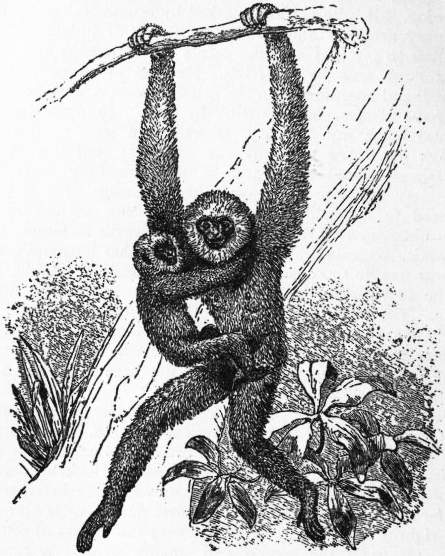
The Tenasserim Gibbon (Hylobates entellöides).
GIBBONS, GRINLING (1648-1721), English wood-carver, was born in 1648, according to some authorities of Dutch parents at Rotterdam, and according to others of English parents at London. By the former he is said to have come to London after the great fire in 1666. He early displayed great cleverness and ingenuity in his art, on the strength of which he was recommended by Evelyn to Charles II., who employed him in the execution both of statuary and of ornamental carving in wood. In the early part of the 18th century he worked for Sir Christopher Wren. In statuary one of his principal works is a life-size bronze statue in the court of Whitehall, representing James II. in the dress of a Roman emperor, and he also designed the base of the statue of Charles I. at Charing Cross. It is, however, chiefly as a sculptor in wood that he is famous. He was employed to execute the ornamental carving for the chapel at Windsor, the foliage and festoons in the choir of St Paul’s, the baptismal fonts in St James’s, and an immense quantity of ornamental work at Burleigh, Chatsworth, and other aristocratic mansions. The finest of all his productions in this style is believed to be the ceiling which he devised for a room at Petworth. His subjects are chiefly birds, flowers, foliage, fruit and lace, and many of his works, for delicacy and elaboration of details, and truthfulness of imitation, have never been surpassed. He, however, sometimes wasted his ingenuity on trifling subjects; many of his flowers used to move on their stems like their natural prototypes when shaken by a breeze. In 1714 Gibbons was appointed master carver in wood to George I. He died at London on the 3rd of August 1721.
GIBBONS, JAMES (1834- ), American Roman Catholic cardinal and archbishop, was born in Baltimore, Maryland, on the 23rd of July 1834, and was educated at St Charles College, Ellicott City, Maryland, and St Mary’s Seminary, Baltimore, where he finished his theological training and was ordained priest on the 30th of June 1861. After a short time spent on the missions of Baltimore, he was called to be secretary to Archbishop Martin J. Spalding and assistant at the cathedral. When in 1866 the Second Plenary Council of Baltimore considered the matter of new diocesan developments, he was selected to organize the new Vicariate Apostolic of North Carolina; and was consecrated bishop in August 1868. During the four successful years spent in North Carolina he wrote, for the benefit of his mission work, The Faith of our Fathers, a brief presentation of the doctrines of the Roman Catholic Church, especially intended to reach Protestants; the books passed through more than forty editions in America and about seventy in England, and an answer was made to it in Faith of our Forefathers (1879), by Edward J. Stearns. Gibbons was transferred to the see of Richmond, Virginia, in 1872, and in 1877 was made coadjutor, with the right of succession, to the Archbishop (James R. Bayley) of Baltimore. In October of the same year he succeeded to the archbishopric. Pope Leo XIII. in 1883 selected him to preside over the Third Plenary Council in Baltimore (1884), and on the 30th of June 1886 created him a cardinal priest, with the title of Santa Maria Trastevere. His simplicity of life, foresight and prudence made him a power in the church. Thoroughly American, and a lover of the people, he greatly altered the attitude of the Roman Catholic Church toward the Knights of Labor and other labour organizations, and his public utterances displayed the true instincts of a popular leader. He contributed frequently to periodicals, but as an author is known principally by his works on religious subjects, including Our Christian Heritage (1889) and The Ambassador of Christ (1896). For many years an ardent advocate of the establishment of a Catholic university, at the Third Plenary Council of Baltimore (1884) he saw the realization of his desires in the establishment of the Catholic University of America at Washington, of which he became first chancellor and president of the board of trustees.
GIBBONS, ORLANDO (1583-1625), English musical composer, was the most illustrious of a family of musicians all more or less able. We know of at least three generations, for Orlando’s father, William Gibbons, having been one of the waits of Cambridge, may be assumed to have acquired some proficiency in the art. His three sons and at least one of his grandsons inherited and further developed his talent. The eldest, Edward, was made bachelor of music at Cambridge, and successively held important musical appointments at the cathedrals of Bristol and Exeter; Ellis, the second son, was organist of Salisbury cathedral, and is the composer of two madrigals in the collection known as the The Triumphs of Oriana. Orlando Gibbons, the youngest and by far the most celebrated of the brothers, was born at Cambridge in 1583. Where and under whom he studied is not known, but in his twenty-first year he was sufficiently advanced and celebrated to receive the important post of organist of the Chapel Royal. His first published composition “Fantasies in three parts, composed for viols,” appeared in 1610. It seems to have been the first piece of music printed in England from engraved plates, or “cut in copper, the like not heretofore extant.” In 1622 he was created doctor of music by the university of Oxford. For this occasion he composed an anthem for eight parts, O clap your Hands, still extant. In the following year he became organist of Westminster Abbey. Orlando Gibbons died before the beginning of the civil war, or it may be supposed that, like his eldest brother, he would have been a staunch royalist. In a different sense, however, he died in the cause of his master; for having been summoned to Canterbury to produce a composition written in celebration of Charles’s marriage, he there fell a victim to smallpox on the 5th of June 1625.
For a full list of his compositions, see Grove’s Dictionary of Music. His portrait may be found in Hawkins’s well-known History. His vocal pieces, madrigals, motets, canons, &c., are admirable, and prove him to have been a great master of pure polyphony. We have also some specimens of his instrumental music, such as the six pieces for the virginals published in Parthenia, a collection of instrumental music produced by Gibbons in conjunction with Dr Bull and Byrd.
GIBBS, JOSIAH WILLARD (1839-1903), American mathematical physicist, the fourth child and only son of Josiah Willard Gibbs (1790-1861), who was professor of sacred literature in Yale Divinity School from 1824 till his death, was born at New Haven on the 11th of February 1839. Entering Yale College in 1854 he graduated in 1858, and continuing his studies there was appointed tutor in 1863. He taught Latin in the first two years, and natural philosophy in the third. He then went to Europe, studying in Paris in 1866-1867, in Berlin in 1867 and in Heidelberg in 1868. Returning to New Haven in 1869, he was appointed professor of mathematical physics in Yale College in 1871, and held that position till his death, which occurred at New Haven on the 28th of April 1903. His first contributions to mathematical physics were two papers published in 1873 in the Transactions of the Connecticut Academy on “Graphical Methods in the Thermodynamics of Fluids,” and “Method of Geometrical Representation of the Thermodynamic Properties of Substances by means of Surfaces.” His next and most important publication was his famous paper “On the Equilibrium of Heterogeneous Substances” (in two parts, 1876 and 1878), which, it has been said, founded a new department of chemical science that is becoming comparable in importance to that created by Lavoisier. This work was translated into German by W. Ostwald (who styled its author the “founder of chemical energetics”) in 1891 and into French by H. le Chatelier in 1899. In 1881 and 1884 he printed some notes on the elements of vector analysis for the use of his students; these were never formally published, but they formed the basis of a text-book on Vector Analysis which was published by his pupil, E. B. Wilson, in 1901. Between 1882 and 1889 a series of papers on certain points in the electromagnetic theory of light and its relation to the various elastic solid theories appeared in the American Journal of Science, and his last work, Elementary Principles in Statistical Mechanics, was issued in 1902. The name of Willard Gibbs, who was the most distinguished American mathematical physicist of his day, is especially associated with the “Phase Rule,” of which some account will be found in the article Energetics. In 1901 the Copley medal of the Royal Society of London was awarded him as being “the first to apply the second law of thermodynamics to the exhaustive discussion of the relation between chemical, electrical and thermal energy and capacity for external work.”
A biographical sketch will be found in his collected Scientific Papers (2 vols., 1906).
GIBBS, OLIVER WOLCOTT (1822-1908), American chemist, was born at New York on the 21st of February 1822. His father, Colonel George Gibbs, was an ardent mineralogist; the mineral gibbsite was named after him, and his collection was finally bought by Yale College. Entering Columbia College in 1837, Wolcott (the Oliver he dropped at an early date) graduated in 1841, and, having assisted Robert Hare at Pennsylvania University for several months, he next entered the College of Physicians and Surgeons in New York, qualifying as a doctor of medicine in 1845. Leaving America he studied in Germany with K. F. Rammelsberg, H. Rose and J. von Liebig, and in Paris with A. Laurent, J. B. Dumas, and H. V. Regnault, returning in 1848. In that year he became professor of chemistry at the Free Academy, now the College of the City of New York, and in 1863 he obtained the Rumford professorship in Harvard University, a post retained until his retirement in 1887 as professor emeritus. He died on the 9th of December 1908. Gibbs’ researches were mainly in analytical and inorganic chemistry, the cobaltammines, platinum metals and complex acids being especially investigated. He was an excellent teacher, and contributed many articles to scientific journals.
See the Memorial Lecture by F. W. Clarke in the J.C.S. (1909), p. 1299.
GIBEON, a town in Palestine whose inhabitants wrested a truce from Joshua by a trick (Josh. ix., x.); where the champions of David fought those of Ish-bosheth (2 Sam. ii. 12-32); where Joab murdered Amasa (ib. xx. 8-10); and where Johanan went against Ishmael to avenge the murder of Gedaliah (Jer. xli. 12). Here was an important high place (1 Kings iii. 4) where for a time the tabernacle was deposited (2 Chron. i. 3). The present name is El-Jīb; this is a small village about 5 m. N.W. of Jerusalem, standing on an isolated hill above a flat corn valley. The village is famous for its springs, and the reputation seems ancient (cf. 2 Sam. ii. 13; Jer. xli. 12). The principal spring issues from under a cliff on the south-east side of the hill, and the water runs to a reservoir lower down. The sides of the hill are rocky, and remarkable for the regular stratification of the limestone, which gives the hill at a distance the appearance of being terraced. Scattered olive groves surround the place.
(R. A. S. M.)
GIBEONITES, the inhabitants of Gibeon, an Amorite or Hivite stronghold, the modern El-Jīb, 5 m. N.W. from Jerusalem. According to Joshua xviii. 25 it was one of the cities of Benjamin. When the Israelites, under Joshua, invaded Canaan, the Gibeonites by a crafty ruse escaped the fate of Jericho and Ai and secured protection from the invaders (Joshua ix.). Cheyne thinks this story the attempt of a later age to explain the long independence of Gibeon and the use of the Gibeonites as slaves in Solomon’s temple. An attempt on the part of Saul to exterminate the clan is mentioned in 2 Sam. xxi., and this slaughter may possibly be identified with the massacre at Nob recorded in 1 Sam. xxii. 17-19 (see Ency. Bib. col. 1717). The place is also associated with the murders of Asahel (2 Sam. ii. 12), Amasa (2 Sam. xx. 8) and Gedaliah (Jer. xli. 12), and with the wrathful intervention of Yahweh referred to by Isaiah (xxviii. 21), which we may identify with the memorable victory of David over the Philistines recorded in 2 Sam. v. 25 (reading Gibeon for Geba). Gibeon was the seat of an old Canaanitish sanctuary afterwards used by the Israelites; it was here that Solomon, immediately after his coronation, went to consult the oracles and had the dream in which he chose the gift of wisdom (1 Kings iii.).
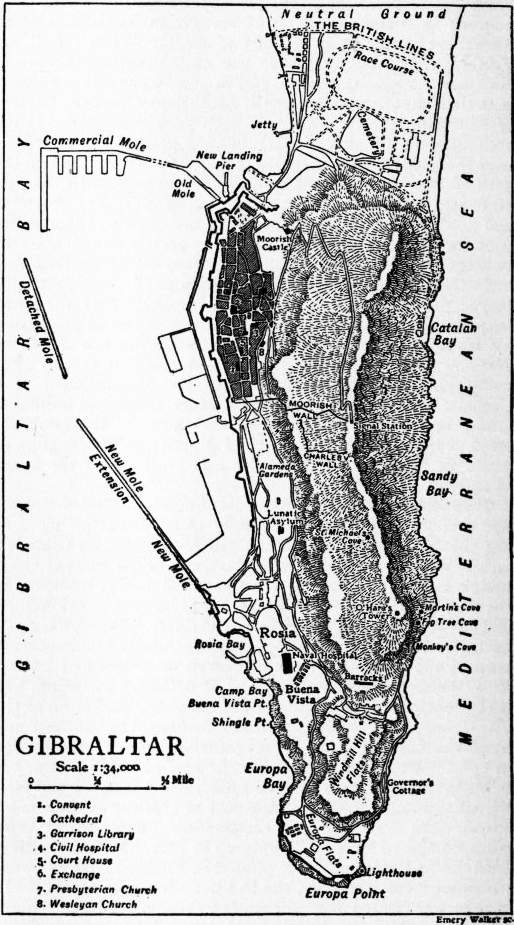
GIBRALTAR, a British fortress and crown colony at the western entrance to the Mediterranean. The whole territory is rather less than 3 m. in length from north to south and varies in width from ¼ to ¾ m. Gibraltar is called after Tariq (or Tarik) ben Zaid, its name being a corruption of Jebel Tariq (Mount Tariq). Tariq invaded Andalusia in A.D. 711 with an army of 12,000 Arabs and Berbers, and in the last days of July of that year destroyed the Gothic power in a three days’ fight on the banks of the river Guadalete near where Jerez de la Frontera now stands. In order to secure his communications with Africa he ordered the building of a strong castle upon the Rock, known to the Romans as Mons Calpe. This work, begun in the year of the great battle, was completed in 742. It covered a wide area, reaching from the shores of the bay to a point half-way up the north-western slope of the rock; here the keep, a massive square tower, still stands and is known as the Moorish castle.
The Rock itself is about 2½ m. in length, and at its northern end rises almost perpendicularly from the strip of flat sandy ground which connects it with the Spanish mainland. At the north end, on the crest of the Rock 1200 ft. above sea-level, is the Rock gun, famous in the great siege. Some six furlongs to the south is the signal station (1255 ft.), through which the names and messages of passing ships are cabled to all parts of the world. Rather less than ¾ m. south of the signal station is O’Hara’s Tower (1408 ft.), the highest point of the Rock. South of O’Hara’s Tower the ground falls steeply to Windmill Hill, a fairly even surface about 1⁄8 of a sq. m. in area, and sloping from 400 to 300 ft. above the sea-level. South of Windmill Hill are Europa Flats, a wall-like cliff 200 ft. or more in height dividing them. Europa Flats, sloping south, end in cliffs 50 ft. high, which at and around Europa Point plunge straight down into deep water. Europa Point is the most southern point of the Rock, and is distant 11½ nautical miles from the opposite African coast. On Europa Point is the lighthouse in 5° 21′ W. and 36° 6′ 30″ N. On the Mediterranean side the Rock is almost as steep and inaccessible as it is from the north. Below the signal station, at the edge of the Mediterranean, lies Catalan Bay, where there is a little village chiefly inhabited by fishermen and others who make their living upon the waters; but Catalan Bay can only be approached by land from the north or by a tunnel through the Rock from the dockyard; from Catalan Bay to Europa Point the way is barred by impassable cliffs. On the west side of the Rock the slopes are less steep, especially as they near the sea, and on this side lie the town, the Alameda or public gardens, the barracks and the dockyard.
Geology.—The rock of Gibraltar consists, for the most part, of pale grey limestone of compact and sometimes crystalline structure, generally stratified but in places apparently amorphous. Above the limestone are found layers of dark grey-blue shales with intercalated beds of grit, mudstone and limestone. Both limestone and shales are of the Lower Jurassic age. Professors A. C. Ramsay and James Geikie (Quarterly Journal of the Geological Society, London, August 1878) found also in the superficial formations of the Rock various features of interest to the students of Pleistocene geology, including massive accumulations of limestone breccia or agglomerate, bone breccias, deposits of calcareous sandstone, raised beaches and loose sands. The oldest of these superficial formations is the limestone breccia of Buena Vista, devoid of fossils and apparently formed under the stress of hard frosts, indicating conditions of climate of great severity. To account for frosts like these, it is suggested that the surface of the Rock must have been raised to an elevation much greater than its present height. In that case Europe and Africa would probably have been connected by an isthmus across some part of the present site of the Straits, and there would have been a wider area of low ground round the base of the Rock. The low ground at this, and probably at a later period, must have been clothed with a rich vegetation, necessary for the support of a varied mammalian fauna, whose remains have been found in the Genista caves. After this there would seem to have been a subsidence to a depth of some 700 ft. below the existing level. This would account for the ledges and platforms which have been formed by erosion of the sea high above the present sea-level, and for the deposits of calcareous sandstone containing sea shells of existing Mediterranean species. The extent of some of these eroded ledges shows that pauses of long duration intervened between the periods of depression. The Rock seems after this to have been raised to a level considerably above that at which it now stands; Europe and Africa would then again have been united. At a later date still the Rock sank once more to its present level.
Many caves, some of them of great extent, penetrate the interior of the rock; the best known of these are the Genista and St Michael’s caves. St Michael’s cave, about 1100 ft. above sea-level at its mouth, slopes rapidly down and extends over 400 ft. into the Rock; its extreme limits have not, however, been fully explored. It consists of a series of five or more chambers of considerable extent, connected by narrow and crooked passages. The outermost cave is 70 ft. in height and 200 in length, with massive pillars of stalactite reaching from roof to floor. The second cave was named the Victoria cave by its discoverer Captain Brome; beyond these are three caves known as the Leonora caves. “Nothing,” writes Captain Brome, “can exceed the beauty of the stalactites; they form clusters of every imaginable shape—statuettes, pillars, foliages, figures,” and he adds that American visitors have admitted that even the Mammoth cave itself could not rival these giant stalactites in picturesque beauty.
The mammalian remains of the Genista cave have been described by G. Busk (“Quaternary Fauna of Gibraltar” in Trans. of Zool. Soc. vol. x. p. 2, 1877). They were found to contain remains of a bear, probably Ursus fossilis of Goldfuss; of a hyena, H. crocuta or spelaea; of cats varying from a leopard to a wild cat in size; of a rhinoceros, resembling in species remains found in the Thames valley; two forms of ibex; the hare and rabbit. No trace has been found as yet of Rhinoceros tichorinus, of Ursus spelaeus or of the reindeer; and of the elephant only a molar tooth of Elephas antiquus.
Further details may be found in the Quarterly Journ. of Geol. Soc. (James Smith of Jordanhill), vol. ii. and in vol. xxi. (Fossil Contents of the Genista Cave, G. Busk and Hugh Falconer; reprinted in Palaeontological Memoirs, H. Falconer, London, 1868).
Flora.—The upper part of the Rock is in summer burnt up and brown, but after the first autumn rains and during the winter, spring and early summer, it abounds in wild flowers and shrubs. In the public and other gardens on the lower ground, where there is a greater depth of soil, the vegetation is luxuriant and is only limited by the supply of water available for summer irrigation. Dr E. F. Kelaart (Flora Calpensis, London, 1846) enumerates more than four hundred varieties of plants and ferns indigenous to Gibraltar, and about fifty more which have been introduced from abroad. Of the former a few are said to be species peculiar to the Rock. The stone-pine and wild-olive are perhaps the only trees found growing in a natural state. In the public and private gardens and by the roadside may be seen the pepper tree, the plane, the white poplar, the acacia, the bella-sombra (Phytolacca dioica), the eucalyptus or blue gum tree, and palms of different species; and, of fruit trees, the orange, lemon, fig, pomegranate, loquat and almond. The aloe, flowering aloe and prickly pear are common, and on the eastern side of the Rock the palmito or dwarf palm (Chamaerops humilis) is abundant.
Fauna.—The fauna of Gibraltar, from want of space, is necessarily scanty. The Barbary apes, said to be the only wild monkeys in Europe, are still to be found on the upper part of the Rock, but in very reduced numbers; about the beginning of the 20th century four or five only remained, which were said to be all females; a young male, however, was brought from Africa. The last male of the original stock, an old patriarch, who had died shortly before this, is believed to have killed and, it is said, eaten all the young ones. A small variety of pigeon breeds in the steep cliffs at the north end of the Rock. A few red-legged partridges, some rabbits, two or three foxes and a badger or two will complete the list.
Climate.—The climate of Gibraltar is pleasant and healthy, mild in winter, and only moderately hot in summer; but the heat, though not excessive, is lasting. The three months of June, July and August are almost always without rain, and it is not often that rain falls in the months of May and September. The first autumn rains, however, which sometimes begin in September, are usually heavy. From October to May the climate is for the most part delightful, warm sunshine prevailing, tempered by cool breezes; the spells of bad weather, although blustering enough at times, are seldom of more than a few days’ duration. The thermometer in summer does not often reach 90° F. in the shade; from 83° to 85° may be taken to be the average maximum for July and August, and these are the hottest months of the year. The average yearly rainfall is 34.4 in., and in fifty years from 1857 to 1906 the greatest recorded rainfall was 59.35 in., and the smallest 16.75 in. The water-supply for drinking and cooking purposes is almost wholly derived from rain-water stored chiefly in underground tanks; there are very few good wells. Many of the better class of houses have their own rain-water tanks, and there are large tanks belonging to the naval and military authorities. Large storage tanks have been constructed by the sanitary commissioners with specially prepared collecting areas high up the Rock. The collecting areas cover 16 acres, and the storage tanks have a capacity of over six million gallons. The tanks are excavated in the solid rock, whereby the water is kept in the dark and cool. A large quantity of brackish water for flushing purposes and baths is pumped from the sandy flats of the north front on the Spanish side of the Rock.
The Town.—The modern town of Gibraltar is of comparatively recent date, nearly all the older buildings having been destroyed during the great siege (1779-1783). The town lies, with most of its buildings crowded together, at the north-western corner of the Rock, and covers only about one-ninth part of the whole area; only a small part of it is on level ground, and those of its narrow streets and lanes which are at right angles to the line wall, or sea front, are for the most part, except at their western ends, little more than ramps or rough stairs formed of rubble stones, contracting in places into stone steps.
The public buildings present few, if any, features of general interest. The “Convent” rebuilt upon the remains of an old Franciscan monastery is the official residence of the governor. The Anglican cathedral is a poor imitation of Moorish architecture. The garrison library has excellent reading rooms and a large number of volumes of miscellaneous interest. The civil hospital is a well-planned and roomy modern building. The courthouse and exchange buildings are suited to the needs of the town. The antiquary may here and there find the remains of a Moorish bath forming part of a stable, or fragments of a sculptured stone gateway bearing the arms of Castile or of Aragon built into the wall of a modern barrack. In a small disused graveyard, near Southport gate, lie buried a number of those who fell at Trafalgar. To the south of the town are the Alameda parade and gardens, a lunatic asylum, the dockyard, graving docks and the naval and military hospitals.
Population.—The inhabitants of Gibraltar are of mixed race; after the capture of the town by the British nearly the whole of the former Spanish population emigrated in a body and founded, 6 m. away, the little town of San Roque. Most of the native inhabitants are of Italian or Genoese descent; there are also a number of Maltese, and between two and three thousand Jews. The Jews never intermarry with other races and form a distinct society of their own. The language of the people is Spanish, not very correctly spoken. English is learnt as a foreign language and is rarely, if ever, spoken by the people in their own homes. Gibraltar being primarily a fortress and naval base, every effort, in view of war contingencies, is made by the authorities to prevent the natural increase of the population. Sanitary and building regulations, modelled upon English statutes designed with quite different objects, are administered with some ingenuity and not a little severity. In this way the house room available for the poorer classes is steadily reduced. The poor are thus being gradually pushed across the frontier into the neighbouring Spanish town of La Linea de la Concepcion, itself a mere suburb of Gibraltar, whose population, however, is nearly double that of the parent city. A large army of workers come daily from “the Lines” into Gibraltar, returning at “first evening gunfire” shortly after sunset, at which time the gates are closed and locked for the night. Aliens are not allowed to reside in Gibraltar without a special permit, which must be renewed at short intervals. By an order in council, taking effect from November 1900, the like disabilities were extended to British subjects not previously resident.
The recorded births, marriages and deaths over a period of 23 years are as follows:—
Yearly Average. Births. Marriages. Deaths.
1883-1885 621 177 513
1886-1890 603 167 514
1891-1895 626 186 460
1896-1900 641 201 498
1901-1905 629 201 472
The numbers of the population from causes which have been referred to are almost stationary, showing a slight tendency to decrease. There are no available statistics later than those of a census taken in 1901, from which it appeared that the population then numbered 27,460, of whom the garrison and its families amounted to 6595, the civil population, being British subjects, to 17,818, and aliens resident under permits to 3047. The latter are chiefly working men and domestic servants.
Constitution.—Gibraltar is a crown colony. Of local government properly so called there is none. There is a sanitary commission which is vested with large powers of spending and with the control of buildings and streets and other matters managed by local authorities in England. Its members are appointed by the governor. An appeal from their decisions, so far as they affect individuals, lies to the supreme court. Apart from the garrison and civil officials there are comparatively few members of the Anglican Church. The great majority of the people belong to the Church of Rome. The Jews have four synagogues. The Protestant dissenters have two places of worship, Presbyterian and Wesleyan. Education is not compulsory for the civil population, but most of the children, if not all, receive a fair education in private or private aided schools. The number of the children on the rolls of the private and private aided schools was in 1905: boys, 1504; girls, 1733; total 3237.
Commerce.—Except in respect of alcoholic liquors and tobacco Gibraltar has been a free port since the year 1705—a distinction due, it is said, to the refusal of a sultan of Morocco to allow of much-needed exports from Morocco to Gibraltar if full liberty of trade were not granted to his subjects. During the great wars of the beginning of the 19th century trade was most active in Gibraltar, and some large fortunes were made; but trade on a large scale has almost disappeared. At the point of contact of two continents, on the direct line of ocean trade with the far East, in regular steam communication with all the great ports of Europe and with North and South America, Gibraltar, by its position, is fitted to be a trade centre of the world, but the unrest and suspicion engendered in Morocco by the intrigues and designs of the European powers, and excessive protective duties and maladministration in Spain, have done much to extinguish the trade of Gibraltar. There are, however, no trustworthy statistics of imports and exports. Before the year 1898 wine, beer and spirits were the only goods which paid duty. In that year a duty of 1d. per ℔ was for the first time put upon tobacco and produced £1444; the duty was, however, in force only for a part of the year; in 1899 the duty, at the same rate, produced £7703. In 1902 the duty on tobacco was raised to 2d. per ℔ and produced £29,311. In 1905 this duty produced £24,575. The chief business of Gibraltar is the coaling of passing steamers; this gives work to several thousand men. Goods are also landed for re-export to Morocco, but the bulk of the Morocco trade, much of which formerly came to Gibraltar, is now done by lines of steamers trading to and from Morocco direct to British, German or French ports. Nearly all the fresh meat consumed in Gibraltar comes from Morocco, also large quantities of poultry and eggs. A fair amount of retail business is done with the passengers of ocean steamers which call on their way to and from the East and from North and South America.
The steam-tonnage cleared annually since 1883 is shown in the following table:—
Yearly Average. British. Foreign. Total.
1883-1885 3,525,135 817,926 4,343,061
1886-1890 4,507,101 908,419 5,415,520
1891-1895 3,710,856 975,390 4,686,246
1896-1900 3,281,165 1,063,367 4,344,532
1901-1905 2,810,849 1,309,649 4,120,498
The main sources of revenue are (i.) duties upon wine, spirits, malt liquors and tobacco; (ii.) port and harbour dues; (iii.) tavern and other licences; (iv.) post and telegraph; (v.) ground and other rents; (vi.) stamps and miscellaneous. The returns before 1898 were made in pesetas (5 = $1). In the following table these have been converted into sterling at an average of exchange 30 = £1.
Yearly Average. i. ii. iii. iv. v. vi. Total.
1886-1890 9,692 17,070 5387 6,805 6485 2,873 48,312
1891-1895 9,250 13,157 4275 7,833 6208 10,113 50,836
1896-1900 14,071 8,435 4136 10,016 5924 14,460 57,042
1901-1905 35,900 6,028 3905 12,091 6945 15,859 80,728
Year 1905 36,554 5,872 4050 16,551 7489 17,007 87,523
The money, weights and measures in legal use are British. Before 1898 Spanish money only was in use. The great depreciation of the Spanish currency during the war with the United States led in 1898 to the reintroduction of British currency as the legal tender money of Gibraltar. Notwithstanding this change the Spanish dollar still remains in current use; much of the retail business of the town being done with persons resident in Spain, the dollar fully holds its own.
Harbour and Fortifications.—Great changes were made in the defences of Gibraltar early in the 20th century. Guns of the newest types replaced those of older patterns. The heavier pieces instead of being at or near the sea-level, are now high up, many of them on the crest line of the Rock; their lateral range and fire area has thereby been greatly increased and their efficiency improved in combination with an elaborate system of range finding.
With the completion of the new dockyard works the value of Gibraltar as a naval base has greatly increased. It can now undertake all the ordinary repairs and coaling of a large fleet. There is an enclosed harbour in which a fleet can safely anchor secure from the attacks of torpedo boats. A mole, at first intended for commercial purposes, closes the north end of the new harbour. The Admiralty, however, soon found that their needs had outgrown the first design and the so-called Commercial Mole has been taken over for naval purposes, plans for a new commercial mole being prepared. The funds for these extensive works were provided by the Naval Works Loan Acts of 1895 and subsequent years.
The land space available for the purposes of dockyard extension being very limited, a space of about 64 acres was reclaimed from the sea in front of the Alameda and the road to Rosia; some of the land reclaimed was as much as 40 ft. under water. The large quantity of material required for this purpose was obtained by tunnelling the Rock from W. to E. and from quarries above Catalan Bay village, to which access was gained through the tunnel. The graving docks occupy the dug-out site of the former New Mole Parade. There are three of these docks, 850, 550 and 450 ft. in length respectively. The largest dock is divisible by a central caisson so that four ships can be docked at one time. The docks are all 95 ft. wide at the entrance with 35½ ft. of water over the sills at low-water spring tides. The pumping machinery can empty the largest dock, 105,000 tons of water, in five hours. There are two workshops for the chief constructor’s and chief engineer’s departments, each 407 ft. long and 322 broad. For the staff captain’s department and stores there are buildings with 250,000 ft. of floor space. At the north end of the yard are the administrative offices, slipways for destroyers, a slip for small craft, an ordnance wharf and a boat camber. The reclaimed area is faced with a wharf wall of concrete blocks for an unbroken length of 1600 ft. with 33 ft. of water alongside at low tide; on this wharf are powerful shears and cranes.
The enclosed harbour covers 440 acres, 250 of which have a minimum depth of 30 ft. at low water. It is closed on the S. and S.W. by the New Mole (1400 ft.) and the New Mole extension (2700 ft.), together 4100 ft.; on the W. by the Detached Mole (2720 ft.) and on the N. by the Commercial Mole.