VOLUME XI SLICE VIII Germany to Gibson, William (continued 7)
Reading edition
See the introductions and notes in W. Stubbs’s edition of the Historical Works of Gervase of Canterbury (Rolls edition, 2 vols., 1879-1880).
(H. W. C. D.)
GERVASE OF TILBURY (fl. 1211), Anglo-Latin writer of the late 12th and early 13th centuries, was a kinsman and schoolfellow of Patrick, earl of Salisbury, but lived the life of a scholarly adventurer, wandering from land to land in search of patrons. Before 1177 he was a student and teacher of law at Bologna; in that year he witnessed the meeting of the emperor Frederic I. and Pope Alexander III. at Venice. He may have hoped to win the favour of Frederic, who in the past had found useful instruments among the civilians of Bologna. But Frederic ignored him; his first employer of royal rank was Henry fitz Henry, the young king of England (d. 1183), for whom Gervase wrote a jest-book which is no longer extant. Subsequently we hear of Gervase as a clerk in the household of William of Champagne, cardinal archbishop of Reims (d. 1202). Here, as he himself confesses, he basely accused of heretical opinions a young girl, who had rejected his advances, with the result that she was burned to death. He cannot have remained many years at Reims; before 1189 he attracted the favour of William II. of Sicily, who had married Joanna, the sister of Henry fitz Henry. William took Gervase into his service and gave him a country-house at Nola. After William’s death the kingdom of Sicily offered no attractions to an Englishman. The fortunes of Gervase suffered an eclipse until, some time after 1198, he found employment under the emperor Otto IV., who by descent and political interest was intimately connected with the Plantagenets. Though a clerk in orders Gervase became marshal of the kingdom of Arles, and married an heiress of good family. For the delectation of the emperor he wrote, about 1211, his Otia Imperialia in three parts. It is a farrago of history, geography, folklore and political theory—one of those books of table-talk in which the literature of the age abounded. Evidently Gervase coveted but ill deserved a reputation for encyclopaedic learning. The most interesting of his dissertations are contained in the second part of the Otia, where he discusses, among other topics, the theory of the Empire and the geography and history of England. We do not know what became of Gervase after the downfall of Otto IV. But he became a canon; and may perhaps be identified with Gervase, provost of Ebbekesdorf, who died in 1235.
See the Otia Imperialia in G. Leibnitz’s Scriptores rerum Brunsvicensium, vols. i. and ii. (Hanover, 1707); extracts in J. Stevenson’s edition of Coggeshall (Rolls series, 1875). Of modern accounts the best are those by W. Stubbs in his edition of Gervase of Canterbury, vol. i. introd. (Rolls series, 1879), and by R. Pauli in Nachrichten der Gesellschaft der Wissenschaften zu Göttingen (1882). In the older biographers the Dialogus de scaccario of Richard Fitz Neal (q.v.) is wrongly attributed to Gervase.
(H. W. C. D.)
GERVEX, HENRI (1852- ), French painter, was born in Paris on the 10th of December 1852, and studied painting under Cabanel, Brisset and Fromentin. His early work belonged almost exclusively to the mythological genre which served as an excuse for the painting of the nude—not always in the best of taste; indeed, his “Rolla” of 1878 was rejected by the jury of the Salon pour immoralité. He afterwards devoted himself to representations of modern life and achieved signal success with his “Dr Péan at the Salpétrière,” a modernized paraphrase, as it were, of Rembrandt’s “Anatomy Lesson.” He was entrusted with several important official paintings and the decoration of public buildings. Among the first are “The Distribution of Awards (1889) at the Palais de l’Industrie” (now in the Versailles Museum), “The Coronation of Nicolas II.” (Moscow, May 14, 1896), “The Mayors’ Banquet” (1900), and the portrait group “La République Française”; and among the second, the ceiling for the Salle des Fêtes at the hôtel de ville, Paris, and the decorative panels painted in conjunction with Blanchon for the mairie of the 19th arrondissement, Paris. He also painted, with Alfred Stevens, a panorama, “The History of the Century” (1889). At the Luxembourg is his painting “Satyrs playing with a Bacchante” as well as the large “Members of the Jury of the Salon” (1885). Other pictures of importance, besides numerous portraits in oils and pastel, are “Communion at Trinity Church,” “Return from the Ball,” “Diana and Endymion,” “Job,” “Civil Marriage,” “At the Ambassadeurs,” “Yachting in the Archipelago,” “Nana” and “Maternity.”
GERVINUS, GEORG GOTTFRIED (1805-1871), German literary and political historian, was born on the 20th of May 1805 at Darmstadt. He was educated at the gymnasium of the town, and intended for a commercial career, but in 1825 he became a student of the university of Giessen. In 1826 he went to Heidelberg, where he attended the lectures of the historian Schlosser, who became henceforth his guide and his model. In 1828 he was appointed teacher in a private school at Frankfort-on-Main, and in 1830 Privatdozent at Heidelberg. A volume of his collected Historische Schriften procured him the appointment of professor extraordinarius; while the first volume of his Geschichte der poëtischen Nationallitteratur der Deutschen (1835-1842, 5 vols., subsequently entitled Geschichte der deutschen Dichtung; 5th edition, by K. Bartsch, 1871-1874) brought him the appointment to a regular professorship of history and literature at Göttingen. This work is the first comprehensive history of German literature written both with scholarly erudition and literary skill. In the following year he wrote his Grundzüge der Historik, which is perhaps the most thoughtful of his philosophico-historical productions. The same year brought his expulsion from Göttingen in consequence of his manly protest, in conjunction with six of his colleagues, against the unscrupulous violation of the constitution by Ernest Augustus, king of Hanover and duke of Cumberland. After several years in Heidelberg, Darmstadt and Rome, he settled permanently in Heidelberg, where, in 1844, he was appointed honorary professor. He zealously took up in the following year the cause of the German Catholics, hoping it would lead to a union of all the Christian confessions, and to the establishment of a national church. He also came forward in 1846 as a patriotic champion of the Schleswig-Holsteiners, and when, in 1847, King Frederick William IV. promulgated the royal decree for summoning the so-called “United Diet” (Vereinigter Landtag), Gervinus hoped that this event would form the basis of the constitutional development of the largest German state. He founded, together with some other patriotic scholars, the Deutsche Zeitung, which certainly was one of the best-written political journals ever published in Germany. His appearance in the political arena secured his election as deputy for the Prussian province of Saxony to the National Assembly sitting in 1848 at Frankfort. Disgusted with the failure of that body, he retired from all active political life.
Gervinus now devoted himself to literary and historical studies, and between 1849 and 1852 published his work on Shakespeare (4 vols., 4th ed. 2 vols., 1872; Eng. trans. by F. E. Bunnett, 1863, new ed. 1877). He also revised his History of German Literature, for a fourth edition (1853), and began at the same time to plan his Geschichte des neunzehnten Jahrhunderts (8 vols., 1854-1860), which was preceded by an Einleitung in die Geschichte des neunzehnten Jahrhunderts (1853). The latter caused some stir in the literary and political world, owing to the circumstance that the government of Baden imprudently instituted a prosecution against the author for high treason. In 1868 appeared Händel und Shakespeare, zur Ästhetik der Tonkunst, in which he drew an ingenious parallel between his favourite poet and his favourite composer, showing that their intellectual affinity was based on the Teutonic origin common to both, on their analogous intellectual development and character. The ill-success of this publication, and the indifference with which the latter volumes of his History of the 19th Century were received by his countrymen, together with the feeling of disappointment that the unity of Germany had been brought about in another fashion and by other means than he wished to see employed, embittered his later years. He died at Heidelberg on the 18th of March 1871.
Gervinus’s autobiography (G. G. Gervinus’ Leben, von ihm selbst) was published by his widow in 1893. It does not, however, go beyond the year 1836. See E. Lehmann, Gervinus, Versuch einer Charakteristik (1871); R. Gosche, Gervinus (1871); J. Dörfel, Gervinus als historischer Denker (1904).
GERYON (Geryones, Geryoneus), in Greek mythology, the son of Chrysaor and Callirrhoë, daughter of Oceanus, and king of the Island of Erytheia. He is represented as a monster with three heads or three bodies (triformis, trigeminus), sometimes with wings, and as the owner of herds of red cattle, which were tended by the giant shepherd Eurytion and the two-headed dog Orthrus. To carry off these cattle to Greece was one of the twelve “labours” imposed by Eurystheus upon Heracles. In order to get possession of them, Heracles travelled through Europe and Libya, set up the two pillars in the Straits of Gibraltar to show the extent of his journey, and reached the great river Oceanus. Having crossed Oceanus and landed on the island, Heracles slew Orthrus together with Eurytion, who in vain strove to defend him, and drove off the cattle. Geryon started in pursuit, but fell a victim to the arrows of Heracles, who, after various adventures, succeeded in getting the cattle safe to Greece, where they were offered in sacrifice to Hera by Eurystheus. The geographical position of Erytheia is unknown, but all ancient authorities agree that it was in the far west. The name itself (= red) and the colour of the cattle suggest the fiery aspect of the disk of the setting sun; further, Heracles crosses Oceanus in the golden cup or boat of the sun-god Helios. Geryon (from γηρύω, the howler or roarer) is supposed to personify the storm, his father Chrysaor the lightning, his mother Callirrhoë the rain. The cattle are the rain-clouds, and the slaying of their keepers typifies the victory of the sun over the clouds, or of spring over winter. The euhemeristic explanation of the struggle with the triple monster was that Heracles fought three brothers in succession.
See Apollodorus ii. 5. 10; Hesiod, Theogony, 287; Diod. Sic. iv. 17; Herodotus iv. 8; F. Wieseler in Ersch and Gruber, Allgemeine Encyclopädie; F. A. Voigt in Roscher’s Lexikon der Mythologie; L. Preller, Griechische Mythologie; article “Hercules” in Daremberg and Saglio, Dictionnaire des antiquités.
GESENIUS, HEINRICH FRIEDRICH WILHELM (1786-1842), German orientalist and biblical critic, was born at Nordhausen, Hanover, on the 3rd of February 1786. In 1803 he became a student of philosophy and theology at the university of Helmstädt, where Heinrich Henke (1752-1809) was his most influential teacher; but the latter part of his university course was taken at Göttingen, where J. G. Eichhorn and T. C. Tychsen (1758-1834) were then at the height of their popularity. In 1806, shortly after graduation, he became Repetent and Privatdozent in that university; and, as he was fond of afterwards relating, had Neander for his first pupil in Hebrew. In 1810 he became professor extraordinarius in theology, and in 1811 ordinarius, at the university of Halle, where, in spite of many offers of high preferment elsewhere, he spent the rest of his life. He taught with great regularity for upward of thirty years, the only interruptions being that of 1813-1814 (occasioned by the War of Liberation, during which the university was closed) and those occasioned by two prolonged literary tours, first in 1820 to Paris, London and Oxford with his colleague Johann Karl Thilo (1794-1853) for the examination of rare oriental manuscripts, and in 1835 to England and Holland in connexion with his Phoenician studies. He soon became the most popular teacher of Hebrew and of Old Testament introduction and exegesis in Germany; during his later years his lectures were attended by nearly five hundred students. Among his pupils the most eminent were Peter von Bohlen (1796-1840), A. G. Hoffmann (1769-1864), Hermann Hupfeld, Emil Rödiger (1801-1874), J. F. Tuch (1806-1867), W. Vatke (1806-1882) and Theodor Benfey (1809-1881). In 1827, after declining an invitation to take Eichhorn’s place at Göttingen, Gesenius was made a Consistorialrath; but, apart from the violent attacks to which he, along with his friend and colleague Julius Wegscheider, was in 1830 subjected by E. W. Hengstenberg and his party in the Evangelische Kirchenzeitung, on account of his rationalism, his life was uneventful. He died at Halle on the 23rd of October 1842. To Gesenius belongs in a large measure the credit of having freed Semitic philology from the trammels of theological and religious prepossession, and of inaugurating the strictly scientific (and comparative) method which has since been so fruitful. As an exegete he exercised a powerful, and on the whole a beneficial, influence on theological investigation.
Of his many works, the earliest, published in 1810, entitled Versuch über die maltesische Sprache, was a successful refutation of the widely current opinion that the modern Maltese was of Punic origin. In the same year appeared the first volume of the Hebräisches u. Chaldäisches Handwörterbuch, completed in 1812. Revised editions of this appear periodically in Germany, e.g. that of H. Zimmern and F. Buhl (1905). The publication of a new English edition was started in 1892 under the editorship of Professors C. A. Briggs, S. R. Driver and F. Brown. The Hebräische Grammatik, published in 1813 (27th edition by E. Kautzsch; English translation from 25th and 26th German editions by G. W. Collins and A. E. Cowley, 1898), was followed in 1815 by the Geschichte der hebräischen Sprache (now very rare), and in 1817 by the Ausführliches Lehrgebäude der hebräischen Sprache. The first volume of his well-known commentary on Isaiah (Der Prophet Jesaja), with a translation, appeared in 1821; but the work was not completed until 1829. The Thesaurus philologico-criticus linguae Hebraicae et Chaldaicae V. T., begun in 1829, he did not live to complete; the latter part of the third volume is edited by E. Rödiger (1858). Other works: De Pentateuchi Samaritani origine, indole, et auctoritate (1815), supplemented in 1822 and 1824 by the treatise De Samaritanorum theologia, and by an edition of Carmina Samaritana; Paläographische Studien über phönizische u. punische Schrift (1835), a pioneering work which he followed up in 1837 by his collection of Phoenician monuments (Scripturae linguaeque Phoeniciae monumenta quotquot supersunt); an Aramaic lexicon (1834-1839); and a treatise on the Himyaritic language written in conjunction with E. Rödiger in 1841. Gesenius also contributed extensively to Ersch and Gruber’s Encyclopädie, and enriched the German translation of J. L. Burckhardt’s Travels in Syria and the Holy Land with valuable geographical notes. For many years he also edited the Halle Allgemeine Litteraturzeitung. A sketch of his life was published anonymously in 1843 (Gesenius: eine Erinnerung für seine Freunde), and another by H. Gesenius, Wilhelm Gesenius, ein Erinnerungsblatt an den hundertjährigen Geburtstag, in 1886. See also the article in the Allgemeine deutsche Biographie.
GESNER, ABRAHAM (1797-1864), Canadian geologist, was born in Nova Scotia in 1797. He qualified as a doctor of medicine in London in 1827. Returning to the Dominion, he published in 1836 Remarks on the Geology and Mineralogy of Nova Scotia, and continuing his researches he was enabled in 1843 to bring before the Geological Society of London “A Geological Map of Nova Scotia, with an accompanying Memoir” (Proc. Geol. Soc. iv. 186). In 1849 he issued a volume on the industrial resources of the country. He dealt also with the geology and mineralogy of New Brunswick and Prince Edward’s Island. Devoting himself to the economic side of geology in various parts of North America, he was enabled to bring out in 1861 A Practical Treatise on Coal, Petroleum and other Distilled Oils. He died at Halifax, N.S., on the 29th of April 1864.
GESNER, JOHANN MATTHIAS (1691-1761), German classical scholar and schoolmaster, was born at Roth near Ansbach on the 9th of April 1691. He studied at the university of Jena, and in 1714 published a work on the Philopatris ascribed to Lucian. In 1715 he became librarian and conrector (vice-principal) at Weimar, in 1729 rector of the gymnasium at Ansbach, and in 1730 rector of the Thomas school at Leipzig. On the foundation of the university of Göttingen he became professor of rhetoric (1734) and subsequently librarian. He died at Göttingen on the 3rd of August 1761. His special merit lies in the attention he devoted to the explanation and illustration of the subject matter of the classical authors.
His principal works are: editions of the Scriptores rei rusticae, of Quintilian, Claudian, Pliny the Younger, Horace and the Orphic poems (published after his death); Primae lineae isagoges in eruditionem universalem (1756); an edition of B. Faber’s Thesaurus eruditionis scholasticae (1726), afterwards continued under the title Novus linguae et eruditionis Romanae thesaurus (1749); Opuscula minora varii argumenti (1743-1745); Thesaurus epistolicus Gesnerianus (ed. Klotz, 1768-1770); Index etymologicus latinitatis (1749). See J. A. Ernesti, Opuscula oratoria (1762), p. 305; H. Sauppe, Göttinger Professoren (1872); C. H. Pöhnert, J. M. Gesner und sein Verhältnis zum Philanthropinismus und Neuhumanismus (1898), a contribution to the history of pedagogy in the 18th century; articles by F. A. Eckstein in Allgemeine deutsche Biographie ix.; and Sandys, Hist. of Class. Schol. iii. (1908), 5-9.
GESNER [improperly Gessner; in Latin, Gesnerus], KONRAD VON (1516-1565), German-Swiss writer and naturalist, called “the German Pliny” by Cuvier, was born at Zürich on the 26th of March 1516. The son of a poor furrier, he was educated in that town, but fell into great need after the death of his father at the battle of Kappel (1531). He had good friends, however, in his old master, Myconius, and subsequently in Heinrich Bullinger, and he was enabled to continue his studies at the universities of Strassburg and Bourges (1532-1533); he found also a generous patron in Paris (1534), in the person of Joh. Steiger of Berne. In 1535 the religious troubles drove him back to Zürich, where he made an imprudent marriage. His friends again came to his aid, enabled him to study at Basel (1536), and in 1537 procured for him the professorship of Greek at the newly founded academy of Lausanne (then belonging to Berne). Here he had leisure to devote himself to scientific studies, especially botany. In 1540-1541 he visited the famous medical university of Montpellier, took his degree of doctor of medicine (1541) at Basel, and then settled down to practise at Zürich, where he obtained the post of lecturer in physics at the Carolinum. There, apart from a few journeys to foreign countries, and annual summer botanical journeys in his native land, he passed the remainder of his life. He devoted himself to preparing works on many subjects of different sorts. He died of the plague on the 13th of December 1565. In the previous year he had been ennobled.
To his contemporaries he was best known as a botanist, though his botanical MSS. were not published till long after his death (at Nuremberg, 1751-1771, 2 vols, folio), he himself issuing only the Enchiridion historiae plantarum (1541) and the Catalogus plantarum (1542) in four tongues. In 1545 he published his remarkable Bibliotheca universalis (ed. by J. Simler, 1574), a catalogue (in Latin, Greek and Hebrew) of all writers who had ever lived, with the titles of their works, &c. A second part, under the title of Pandeclarium sive partitionum universalium Conradi Gesneri Ligurini libri xxi., appeared in 1548; only nineteen books being then concluded. The 21st book, a theological encyclopaedia, was published in 1549, but the 20th, intended to include his medical work, was never finished. His great zoological work, Historia animalium, appeared in 4 vols. (quadrupeds, birds, fishes) folio, 1551-1558, at Zürich, a fifth (snakes) being issued in 1587 (there is a German translation, entitled Thierbuch, of the first 4 vols., Zürich, 1563): this work is the starting-point of modern zoology. Not content with such vast works, Gesner put forth in 1555 his book entitled Mithridates de differentiis linguis, an account of about 130 known languages, with the Lord’s Prayer in 22 tongues, while in 1556 appeared his edition of the works of Aelian. To non-scientific readers, Gesner will be best known for his love of mountains (below the snow-line) and for his many excursions among them, undertaken partly as a botanist, but also for the sake of mere exercise and enjoyment of the beauties of nature. In 1541 he prefixed to a singular little work of his (Libellus de lacte et operibus lactariis) a letter addressed to his friend, J. Vogel, of Glarus, as to the wonders to be found among the mountains, declaring his love for them, and his firm resolve to climb at least one mountain every year, not only to collect flowers, but in order to exercise his body. In 1555 Gesner issued his narrative (Descriptio Montis Fracti sive Montis Pilati) of his excursion to the Gnepfstein (6299 ft.), the lowest point in the Pilatus chain, and therein explains at length how each of the senses of man is refreshed in the course of a mountain excursion.
Lives by J. Hanhart (Winterthur, 1824) and J. Simler (Zürich, 1566); see also Lebert’s Gesner als Arzt (Zürich, 1854). A part of his unpublished writing, edited by Prof. Schmiedel, was published at Nuremberg in 1753.
GESSNER, SOLOMON (1730-1788), Swiss painter and poet, was born at Zürich on the 1st of April 1730. With the exception of some time (1749-1750) spent in Berlin and Hamburg, where he came under the influence of Ramler and Hagedorn, he passed the whole of his life in his native town, where he carried on the business of a bookseller. He died on the 2nd of March 1788. The first of his writings that attracted attention was his Lied eines Schweizers an sein bewaffnetes Mädchen (1751). Then followed Daphnis (1754), Idyllen (1756 and 1772), Inkel and Yariko (1756), a version of a story borrowed from the Spectator (No. 11, 13th of March 1711) and already worked out by Gellert and Bodmer, and Der Tod Abels (1758), a sort of idyllic pastoral. It is somewhat difficult for us now to understand the reason of Gessner’s universal popularity, unless it was the taste of the period for the conventional pastoral. His writings are marked by sweetness and melody, qualities which were warmly appreciated by Lessing, Herder and Goethe. As a painter Gessner represented the conventional classical landscape.
Collected editions of Gessner’s works were repeatedly published (2 vols. 1777-1778, finally 2 vols. 1841, both at Zürich). They were translated into French (3 vols., Paris, 1786-1793), and versions of the Idyllen appeared in English, Dutch, Portuguese, Spanish, Swedish and Bohemian. Gessner’s life was written by Hottinger (Zürich, 1796), and by H. Wölfflin (Frauenfeld, 1889); see also his Briefwechsel mit seinem Sohn (Bern and Zürich, 1801).
GESSO, an Italian word (Lat. gypsum), for “plaster of Paris” especially when used as a ground for painting, or for modelling or sculpture.
GESTA ROMANORUM, a Latin collection of anecdotes and tales, probably compiled about the end of the 13th century or the beginning of the 14th. It still possesses a twofold literary interest, first as one of the most popular books of the time, and secondly as the source, directly or indirectly, of later literature, in Chaucer, Gower, Shakespeare and others. Of its authorship nothing certain is known; and there is little but gratuitous conjecture to associate it either with the name of Helinandus or with that of Petrus Berchorius (Pierre Bercheure). It is even a matter of debate whether it took its rise in England, Germany or France. The work was evidently intended as a manual for preachers, and was probably written by one who himself belonged to the clerical profession. The name, Deeds of the Romans, is only partially appropriate to the collection in its present form, since, besides the titles from Greek and Latin history and legend, it comprises fragments of very various origin, oriental and European. The unifying element of the book is its moral purpose. The style is barbarous, and the narrative ability of the compiler seems to vary with his source; but he has managed to bring together a considerable variety of excellent material. He gives us, for example, the germ of the romance of “Guy of Warwick”; the story of “Darius and his Three Sons,” versified by Occleve; part of Chaucer’s “Man of Lawes’ Tale”; a tale of the emperor Theodosius, the same in its main features as that of Shakespeare’s Lear; the story of the “Three Black Crows”; the “Hermit and the Angel,” well known from Parnell’s version, and a story identical with the Fridolin of Schiller. Owing to the loose structure of the book, it was easy for a transcriber to insert any additional story into his own copy, and consequently the MSS. of the Gesta Romanorum exhibit considerable variety. Oesterley recognizes an English group of MSS. (written always in Latin), a German group (sometimes in Latin and sometimes in German), and a group which is represented by the vulgate or common printed text. The earliest editions are supposed to be those of Ketelaer and de Lecompt at Utrecht, of Arnold Ter Hoenen at Cologne, and of Ulrich Zell at Cologne; but the exact date is in all three cases uncertain.
An English translation, probably based directly on the MS. Harl. 5369, was published by Wynkyn de Worde about 1510-1515, the only copy of which now known to exist is preserved in the library of St John’s College, Cambridge. In 1577 Richard Robinson published a revised edition of Wynkyn de Worde, and the book proved highly popular. Between 1648 and 1703 at least eight impressions were issued. In 1703 appeared the first vol. of a translation by B. P., probably Bartholomew Pratt, “from the Latin edition of 1514.” A translation by the Rev. C. Swan, first published in 2 vols. in 1824, forms part of Bonn’s antiquarian library, and was re-edited by Wynnard Hooper in 1877 (see also the latter’s edition in 1894). The German translation was first printed at Augsburg, 1489. A French version, under the title of Le Violier des histoires romaines moraliséz, appeared in the early part of the 16th century, and went through a number of editions; it has been reprinted by G. Brunet (Paris, 1858). Critical editions of the Latin text have been produced by A. Keller (Stuttgart, 1842) and Oesterley (Berlin, 1872). See also Warton, “On the Gesta Romanorum,” dissertation iii., prefixed to the History of English Poetry; Douce, Illustrations of Shakespeare, vol. ii.; Frederick Madden, Introduction to the Roxburghe Club edition of The Old English Versions of the Gesta Romanorum (1838).
GETA, PUBLIUS SEPTIMIUS (189-212), younger son of the Roman emperor Septimius Severus, was born at Mediolanum (Milan). In 198 he received the title of Caesar, and in 209 those of Imperator and Augustus. Between him and his brother Caracalla there existed from their early years a keen rivalry and antipathy. On the death of their father in 211 they were proclaimed joint emperors; and after the failure of a proposed arrangement for the division of the empire, Caracalla pretended a desire for reconciliation. He arranged a meeting with his brother in his mother’s apartments, and had him murdered in her arms by some centurions.
Dio Cassius lxxvii. 2; Spartianus, Caracalla, 2; Herodian iv. 1.
GETAE, an ancient people of Thracian origin, closely akin to the Daci (see Dacia). Their original home seems to have been the district on the right bank of the Danube between the rivers Oescus (Iskr) and Iatrus (Yantra). The view that the Getae were identical with the Goths has found distinguished supporters, but it is not generally accepted. Their name first occurs in connexion with the expedition of Darius Hystaspis (515 B.C.) against the Scythians, in the course of which they were brought under his sway, but they regained their freedom on his return to the East. During the 5th century, they appear as furnishing a contingent of cavalry to Sitalces, king of the Odrysae, in his attack on Perdiccas II., king of Macedon, but the decay of the Odrysian kingdom again left them independent. When Philip II. of Macedon in 342 reduced the Odrysae to the condition of tributaries, the Getae, fearing that their turn would come next, made overtures to the conqueror. Their king Cothelas undertook to supply Philip with soldiers, and his daughter became the wife of the Macedonian. About this time, perhaps being hard pressed by the Triballi and other tribes, the Getae crossed the Danube. Alexander the Great, before transporting his forces into Asia, decided to make his power felt by the Macedonian dependencies. His operations against the Triballi not having met with complete success, he resolved to cross the Danube and attack the Getae. The latter, unable to withstand the phalanx, abandoned their chief town, and fled to the steppes (Γετία ἡ ἔρημος, north of the Danube delta), whither Alexander was unwilling to follow them. About 326, an expedition conducted by Zopyrion, a Macedonian governor of Thrace, against the Getae, failed disastrously. In 292, Lysimachus declared war against them, alleging as an excuse that they had rendered assistance to certain barbarous Macedonian tribes. He penetrated to the plains of Bessarabia, where his retreat was cut off and he was forced to surrender. Although the people clamoured for his execution, Dromichaetes, king of the Getae, allowed him to depart unharmed, probably on payment of a large ransom, great numbers of gold coins having been found near Thorda, some of them bearing the name of Lysimachus. When the Gauls made their way into eastern Europe, they came into collision with the Getae, whom they defeated and sold in large numbers to the Athenians as slaves. From this time the Getae seem to have been usually called Daci; for their further history see Dacia.
The Getae are described by Herodotus as the most valiant and upright of the Thracian tribes; but what chiefly struck Greek inquirers was their belief in the immortality of the soul (hence they were called ἀθανατίζοντες) and their worship of Zalmoxis (or Zamolxis), whom the euhemerists of the colonies on the Euxine made a pupil of Pythagoras. They were very fond of music, and it was the custom for their ambassadors the priests to present themselves clad in white, playing the lyre and singing songs. They were experts in the use of the bow and arrows while on horseback.
See E. R. Rösler, “Die Geten und ihre Nachbarn,” in Sitzungsberichte der k. Akad. der Wissenschaften, philosophisch-historische Classe, xliv. (1863), and Romänische Studien (Leipzig, 1871); W. Tomaschek, “Die alten Thraker,” in above Sitzungsberichte, cxxviii. (Vienna, 1893); W. Bessel, De rebus Geticis (Göttingen, 1854); C. Müllenhoff in Ersch and Gruber’s Allgemeine Encyclopädie; T. Mommsen, Hist. of Rome (Eng. trans.), bk. v. ch. 7.
GETHSEMANE (Hebr. for “oil-press”), the place to which Jesus and His disciples withdrew on the eve of the Crucifixion. It was evidently an enclosed piece of ground, a plantation rather than a garden in our sense of the word. It lay east of the Kidron and on the lower slope of the mount of Olives, at the foot of which is the traditional site dating from the 4th century and now possessed by the Franciscans. The Grotto of the Agony, a few hundred yards farther north, is an ancient cave-cistern, now a Latin sanctuary. (See further Jerusalem.)
GETTYSBURG, a borough and the county-seat of Adams county, Pennsylvania, U.S.A., about 35 m. S.W. of Harrisburg. Pop. (1900) 3495; (1910) 4030. It is served by the Western Maryland and the Gettysburg & Harrisburg railways. The site of the borough is a valley about 1½ m. wide; the neighbouring country abounds in attractive scenery. Katalysine Spring in the vicinity was once a well-known summer resort; its waters contain lithia in solution. Gettysburg has several small manufacturing establishments and is the seat of Pennsylvania College (opened in 1832, and the oldest Lutheran college in America), which had 312 students (68 in the preparatory department) in 1907-1908, and of a Lutheran theological seminary, opened in 1826 on Seminary Ridge; but the borough is best known as the scene of one of the most important battles of the Civil War. Very soon after the battle a soldiers’ national cemetery was laid out here, in which the bodies of about 3600 Union soldiers have been buried; and at the dedication of this cemetery, in November 1863, President Lincoln delivered his celebrated “Gettysburg Address.” In 1864 the Gettysburg Battle-Field Memorial Association was incorporated, and the work of this association resulted in the conversion of the battle-field into a National Park, an act for the purpose being passed by Congress in 1895. Within the park the lines of battle have been carefully marked, and about 600 monuments, 1000 markers, and 500 iron tablets have been erected by states and regimental associations. Hundreds of cannon have been mounted, and five observation towers have been built. From 1816 to 1840 Gettysburg was the home of Thaddeus Stevens. Gettysburg was settled about 1740, was laid out in 1787, was made the county-seat in 1800, and was incorporated as a borough in 1806.
Battle of Gettysburg.—The battle of the 1st, 2nd and 3rd of July 1863 is often regarded as the turning-point of the American Civil War (q.v.) although it arose from a chance encounter. Lee, the commander of the Confederate Army of Northern Virginia, had merely ordered his scattered forces to concentrate there, while Meade, the Federal commander, held the town with a cavalry division, supported by two weak army corps, to screen the concentration of his Army of the Potomac in a selected position on Pipe Creek to the south-eastward. On the 1st of July the leading troops of General A. P. Hill’s Confederate corps approached Gettysburg from the west to meet Ewell’s corps, which was to the N. of the town, whilst Longstreet’s corps followed Hill. Lee’s intention was to close up Hill, Longstreet and Ewell before fighting a battle. But Hill’s leading brigades met a strenuous resistance from the Federal cavalry division of General John Buford, which was promptly supported by the infantry of the I. corps under General J. F. Reynolds. The Federals so far held their own that Hill had to deploy two-thirds of his corps for action, and the western approaches of Gettysburg were still held when Ewell appeared to the northward. Reynolds had already fallen, and the command of the Federals, after being held for a time by Gen. Abner Doubleday, was taken over by Gen. O. O. Howard, the commander of the XI. corps, which took post to bar the way to Ewell on the north side. But Ewell’s attack, led by the fiery Jubal Early, swiftly drove back the XI. corps to Gettysburg; the I. corps, with its flank thus laid open, fell back also, and the remnants of both Federal corps retreated through Gettysburg to the Cemetery Hill position. They had lost severely in the struggle against superior numbers, and there had been some disorder in the retreat. Still a formidable line of defence was taken up on Cemetery Hill and both Ewell and Lee refrained from further attacks, for the Confederates had also lost heavily during the day and their concentration was not complete. In the meanwhile Meade had sent forward General W. S. Hancock, the commander of the Federal II. corps, to examine the state of affairs, and on Hancock’s report he decided to fight on the Cemetery Hill position. Two corps of his army were still distant, but the XII. arrived before night, the III. was near, and Hancock moved the II. corps on his own initiative. Headquarters and the artillery reserve started for Gettysburg on the night of the 1st. On the other side, the last divisions of Hill’s and Ewell’s corps formed up opposite the new Federal position, and Longstreet’s corps prepared to attack its left.
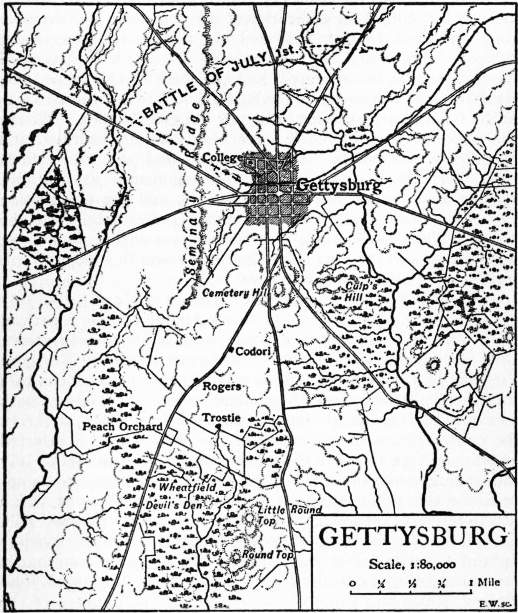
Owing, however, to misunderstandings between Lee and Longstreet (q.v.), the Confederates did not attack early on the morning of the 2nd, so that Meade’s army had plenty of time to make its dispositions. The Federal line at this time occupied the horse-shoe ridge, the right of which was formed by Culp’s Hill, and the centre by the Cemetery hill, whence the left wing stretched southward, the III. corps on the left, however, being thrown forward considerably. The XII. held Culp’s, the remnant of the I. and XI. the Cemetery hills. On the left was the II., and in its advanced position—the famous “Salient”—the III., soon to be supported by the V.; the VI., with the reserve artillery, formed the general reserve. It was late in the day when the Confederate attack was made, and valuable time had been lost, but Longstreet’s troops advanced with great spirit. The III. corps Salient was the scene of desperate fighting; and the “Peach Orchard” and the “Devil’s Den” became as famous as the “Bloody Angle” of Spottsylvania or the “Hornets’ Nest” of Shiloh. While the Confederate attack was developing, the important positions of Round Top and Little Round Top were unoccupied by the defenders—an omission which was repaired only in the nick of time by the commanding engineer of the army, General G. K. Warren, who hastily called up troops of the V. corps. The attack of a Confederate division was, after a hard struggle, repulsed, and the Federals retained possession of the Round Tops. The III. corps in the meantime, furiously attacked by troops of Hill’s and Longstreet’s corps, was steadily pressed back, and the Confederates actually penetrated the main line of the defenders, though for want of support the brigades which achieved this were quickly driven out. Ewell, on the Confederate left, waited for the sound of Longstreet’s guns, and thus no attack was made by him until late in the day. Here Culp’s Hill was carried with ease by one of Ewell’s divisions, most of the Federal XII. corps having been withdrawn to aid in the fight on the other wing; but Early’s division was repulsed in its efforts to storm Cemetery Hill, and the two divisions of the centre (one of Hill’s, one of Ewell’s corps) remained inactive.
That no decisive success had been obtained by Lee was clear to all, but Ewell’s men on Culp’s Hill, and Longstreet’s corps below Round Top, threatened to turn both flanks of the Federal position, which was no longer a compact horseshoe but had been considerably prolonged to the left; and many of the units in the Federal army had been severely handled in the two days’ fighting. Meade, however, after discussing the eventuality of a retreat with his corps commanders, made up his mind to hold his ground. Lee now decided to alter his tactics. The broken ground near Round Top offered so many obstacles that he decided not to press Longstreet’s attack further. Ewell was to resume his attack on Meade’s extreme right, while the decisive blow was to be given in the centre (between Cemetery Hill and Trostle’s) by an assault delivered in the Napoleonic manner by the fresh troops of Pickett’s division (Longstreet’s corps). Meade, however, was not disposed to resign Culp’s Hill, and with it the command of the Federal line of retreat, to Ewell, and at early dawn on the 3rd a division of the XII. corps, well supported by artillery, opened the Federal counter-attack; the Confederates made a strenuous resistance, but after four hours’ hard fighting the other division of the XII. corps, and a brigade of the VI., intervened with decisive effect, and the Confederates were driven off the hill. The defeat of Ewell did not, however, cause Lee to alter his plans. Pickett’s division was to lead in the great assault, supported by part of Hill’s corps (the latter, however, had already been engaged). Colonel E. P. Alexander, Longstreet’s chief of artillery, formed up one long line of seventy-five guns, and sixty-five guns of Hill’s corps came into action on his left. To the converging fire of these 140 guns the Federals, cramped for space, could only oppose seventy-seven. The attacking troops formed up before 9 A.M., yet it was long before Longstreet could bring himself to order the advance, upon which so much depended, and it was not till about 1 P.M. that the guns at last opened fire to prepare the grand attack. The Federal artillery promptly replied, but after thirty minutes’ cannonade its commander, Gen. H. J. Hunt, ordered his batteries to cease fire in order to reserve their ammunition to meet the infantry attack. Ten minutes later Pickett asked and received permission to advance, and the infantry moved forward to cross the 1800 yds. which separated them from the Federal line. Their own artillery was short of ammunition, the projectiles of that day were not sufficiently effective to cover the advance at long ranges, and thus the Confederates, as they came closer to the enemy, met a tremendous fire of unshaken infantry and artillery.
The charge of Pickett’s division is one of the most famous episodes of military history. In the teeth of an appalling fire from the rifles of the defending infantry, who were well sheltered, and from the guns which Hunt had reserved for the crisis, the Virginian regiments pressed on, and with a final effort broke Meade’s first line. But the strain was too great for the supporting brigades, and Pickett was left without assistance. Hancock made a fierce counterstroke, and the remnant of the Confederates retreated. Of Pickett’s own division over three-quarters, 3393 officers and men out of 4500, were left on the field, two of his three brigadiers were killed and the third wounded, and of fifteen regimental commanders ten were killed and five wounded. One regiment lost 90% of its numbers. The failure of this assault practically ended the battle; but Lee’s line was so formidable that Meade did not in his turn send forward the Army of the Potomac. By the morning of the 5th of July Lee’s army was in full retreat for Virginia. He had lost about 30,000 men in killed, wounded and missing out of a total force of perhaps 75,000. Meade’s losses were over 23,000 out of about 82,000 on the field. The main body of the cavalry on both sides was absent from the field, but a determined cavalry action was fought on the 3rd of July between the Confederate cavalry under J. E. B. Stuart and that of the Federals under D. McM. Gregg some miles E. of the battlefield, and other Federal cavalry made a dashing charge in the broken ground south-west of Round Top on the third day, inflicting thereby, though at great loss to themselves, a temporary check on the right wing of Longstreet’s infantry.
GEULINCX, ARNOLD (1624-1669), Belgian philosopher, was born at Antwerp on the 31st of January 1624. He studied philosophy and medicine at the university of Louvain, where he remained as a lecturer for several years. Having given offence by his unorthodox views, he left Louvain, and took refuge in Leiden, where he appears to have been in the utmost distress. He entered the Protestant Church, and in 1663, through the influence of his friend Abraham Heidanus, who had assisted him in his greatest need, he obtained a poorly paid lectureship at the university. He died at Leiden in November 1669. His most important works were published posthumously. The Metaphysica vera (1691), and the Γνῶθι σεαυτόν, sive Ethica (under the pseudonym “Philaretus,” 1675), are the works by which he is chiefly known. Mention may also be made of Physica vera (1688), Logica restituta (1662) and Annotata in Principia philosophiae R. Cartesii (1691).
Geulincx principally deals with the question, left in an obscure and unsatisfactory state by Descartes, of the relation between soul and body. Whereas Descartes made the union between them a violent collocation, Geulincx practically called it a miracle. Extension and thought, the essences of corporeal and spiritual natures, are absolutely distinct, and cannot act upon one another. External facts are not the causes of mental states, nor are mental states the causes of physical facts. So far as the physical universe is concerned, we are merely spectators; the only action that remains for us is contemplation. The influence we seem to exercise over bodies by will is only apparent; volition and action only accompany one another. Since true activity consists in knowing what one does and how one does it, I cannot be the author of any state of which I am unconscious; I am not conscious of the mechanism by which bodily motion is produced, hence I am not the author of bodily motion (“Quod nescis quomodo fiat, id non facis”). Body and mind are like two clocks which act together, because both have been set together by God. A physical occurrence is but the occasion (opportunity, occasional cause) on which God excites in me a corresponding mental state; the exercise of my will is the occasion on which God moves my body. Every operation in which mind and matter are both concerned is an effect of neither, but the direct act of God. Geulincx was thus the first definitely to systematize the theory called Occasionalism, which had already been propounded by Gérauld de Cordemoy (d. 1684), a Parisian lawyer, and Louis de la Forge, a physician of Saumur. But the principles on which the theory was founded compelled a further advance. God, who is the cause of the concomitance of bodily and mental facts, is in truth the sole cause in the universe. No fact contains in itself the ground of any other; the existence of the facts is due to God, their sequence and coexistence are also due to him. He is the ground of all that is. My desires, volitions and thoughts are thus the desires, volitions and thoughts of God. Apart from God, the finite being has no reality, and we only have the idea of it from God. Descartes had left untouched, or nearly so, the difficult problem of the relation between the universal element or thought and the particular desires or inclinations. All these are regarded by Geulincx as modes of the divine thought and action, and accordingly the end of human endeavour is the end of the divine will or the realization of reason. The love of right reason is the supreme virtue, whence flow the cardinal virtues, diligence, obedience, justice and humility. Since it is impossible for us to make any alteration in the world of matter, all we can do is to submit. Chief of the cardinal virtues is humility, a confession of our own helplessness and submission to God. Geulincx’s idea of life is “a resigned optimism.”
Geulincx carried out to their extreme consequences the irreconcilable elements in the Cartesian metaphysics, and his works have the peculiar value attaching to the vigorous development of a one-sided principle. The abrupt contradictions to which such development leads of necessity compels revision of the principle itself. He was thus important as the precursor of Malebranche and Spinoza.
Edition of his philosophical works by J. P. N. Land (1891-1893, for which a recently discovered MS. was consulted); see also the same editor’s Arnold Geulincx und seine Philosophie (1895), and article (translated) in Mind, xvi. 223 seq.; V. van der Haeghen, Geulincx. Étude sur sa vie, sa philosophie, et ses ouvrages (Ghent, 1886); E. Grimm, A. Geulincx’ Erkenntnisstheorie und Occasionalismus (1875); E. Pfleiderer, A. G. als Hauptvertreter der okkasionalistischen Metaphysik und Ethik (1882); G. Samtleben, Geulincx, ein Vorgänger Spinozas (1885); also Falckenberg, Hist. of Mod. Philos. (Eng. trans., 1895), ch. iii.; G. Monchamp, Hist. du Cartésianisme en Belgique (Brussels, 1886); H. Höffding, Hist. of Mod. Philos. (Eng. trans., 1900), i. 245.
GEUM, in botany, a genus of hardy perennial herbs (natural order Rosaceae) containing about thirty species, widely distributed in temperate and arctic regions. The erect flowering shoots spring from a cluster of radical leaves, which are deeply cut or lobed, the largest division being at the top of the leaf. The flowers are borne singly on long stalks at the end of the stem or its branches. They are white, yellow or red in colour, and shallowly cup-shaped. The fruit consists of a number of dry achenes, each of which bears a hook formed from the persistent lower portion of the style, and admirably adapted for ensuring distribution. Two species occur in Britain under the popular name “avens.” G. urbanum is a very common hedge-bank plant with small yellow flowers; G. rivale (water avens) is a rarer plant found by streams, and has larger yellow flowers an inch or more across. The species are easy to cultivate and well adapted for borders or the rock-garden. They are propagated by seeds or by division. The most popular garden species are G. chiloense and its varieties, G. coccineum and G. montanum.
GEVELSBERG, a town of Germany, in the Prussian Rhine Province, 6 m. S.W. from Hagen, on the railway to Düsseldorf. It has two churches, schools and a hospital, and considerable manufactures of cutlery. Pop. (1905) 15,838.
GEX, a town of eastern France, chief town of an arrondissement in the department of Ain, 10 m. N.W. of Geneva and 3 m. from the Swiss frontier. Pop. (1906) town, 1385; commune, 2727. The town is beautifully situated 2000 ft. above sea-level at the base of the most easterly and highest chain of the Jura. It is the seat of a subprefect and has a tribunal of first instance, and carries on considerable trade in wine, cheese and other provisions, chiefly with Geneva. It gives its name to the old Pays de Gex, situated between the Alps and the Jura, which was at various times under the protection of the Swiss, the Genevese and the counts of Savoy, until in 1601 it came into the possession of France, retaining, however, until the Revolution its old independent jurisdiction, with Gex as its chief town. The Pays de Gex is isolated by the Jura from the rest of French territory, and comes within the circumscription of the Swiss customs, certain restrictions being imposed on its products by the French customs.
GEYSER, Geiser, or Geisir, a natural spring or fountain which discharges into the air, at more or less regular intervals of time, a column of heated water and steam; it may consequently be regarded as an intermittent hot spring. The word is the Icelandic geysir, gusher or rager, from the verb geysa, a derivative of gjosa, to gush. In native usage it is the proper name of the Great Geyser, and not an appellative—the general term hver, a hot spring, making the nearest approach to the European sense of the word (see Cleasby and Vigfusson, Icelandic English Dictionary, s.v.).
Any hot spring capable of depositing siliceous material by the evaporation of its water may in course of time transform itself into a geyser, a tube being gradually built up as the level of the basin is raised, much in the same manner as a volcanic cone is produced. Every geyser continuing to deposit siliceous material is preparing its own destruction; for as soon as the tube becomes deep enough to contain a column of water sufficiently heavy to prevent the lower strata attaining their boiling points, the whole mechanism is deranged. The deposition of the sinter is due in part to the cooling and evaporation of the siliceous waters, and in part to the presence of living algae. In geyser districts it is easy to find thermal springs busy with the construction of the tube; warm pools, or laugs, as the Icelanders call them, on the top of siliceous mounds, with the mouth of the shaft still open in the middle; and dry basins from which the water has receded with their shafts now choked with rubbish.
Geysers exist at the present time in many volcanic regions, as in the Malay Archipelago, Japan and South America; but the three localities where they attain their highest development are Iceland, New Zealand and the Yellowstone Park, U.S.A. The very name by which we call them indicates the historical priority of the Iceland group.
The Iceland geysers, mentioned by Saxo Grammaticus, are situated about 30 m. N.W. of Hecla, in a broad valley at the foot of a range of hills from 300 to 400 ft. in height. Within a circuit of about 2 m., upwards of one hundred hot springs may be counted, varying greatly both in character and dimensions. The Great Geyser in its calm periods appears as a circular pool about 60 ft. in diameter and 4 ft. in depth, occupying a basin on the summit of a mound of siliceous concretion; and in the centre of the basin is a shaft, about 10 ft. in diameter and 70 ft. in depth, lined with the same siliceous material. The clear sea-green water flows over the eastern rim of the basin in little runnels. On the surface it has a temperature of from 76° to 89° C., or from 168° to 188° F. Within the shaft there is of course a continual shifting both of the average temperature of the column and of the relative temperatures of the several strata. The results of the observations of Bunsen and A. L. O. Descloizeaux in 1847 were as follows (cf. Pogg. Ann., vol. 72 and Comptes rendus, vol. 19): About three hours after a great eruption on July 6, the temperature 6 metres from the bottom of the shaft was 121.6° C; at 9.50 metres, 121.1°; at 16.50 metres, 109° (?); and at 19.70 metres, 95° (?). About nine hours after a great eruption on July 6, at about 0.3 metres from the bottom, it was 123°; at 4.8 metres it was 122.7°; at 9.6 metres, 113°; at 14.4 metres, 85.8°; at 19.2 metres, 82.6°. On the 7th, there having been no eruption since the previous forenoon, the temperature at the bottom was 127.5°; at 5 metres from the bottom, 123°; at 9 metres, 120.4°; at 14.75 metres, 106.4°; and at 19 metres, 55°. About three hours after a small eruption, which took place at forty minutes past three o’clock in the afternoon of the 7th, the temperature at the bottom was 126.5°; at 6.85 metres up it was 121.8°; at 14.75 metres, 110°; and at 19 metres, 55°. Thus, continues Bunsen, it is evident that the temperature of the column diminishes from the bottom upwards; that, leaving out of view small irregularities, the temperature in all parts of the column is found to be steadily on the increase in proportion to the time that has elapsed since the previous eruption; that even a few minutes before the great eruption the temperature at no point of the water column reached the boiling point corresponding to the atmospheric pressure at that part; and finally, that the temperature about half-way up the shaft made the nearest approach to the appropriate boiling point, and that this approach was closer in proportion as an eruption was at hand. The Great Geyser has varied very much in the nature and frequency of its eruptions since it began to be observed. In 1809 and 1810, according to Sir W. J. Hooker and Sir George S. Mackenzie, its columns were 100 or 90 ft. high, and rose at intervals of 30 hours, while, according to Henderson, in 1815 the intervals were of 6 hours and the altitude from 80 to 150 ft.
About 100 paces from the Great Geyser is the Strokkr or churn, which was first described by Stanlay in 1789. The shaft in this case is about 44 ft. deep, and, instead of being cylindrical, is funnel-shaped, having a width of about 8 ft. at the mouth, but contracting to about 10 in. near the centre. By casting stones or turf into the shaft so as to stopper the narrow neck, eruptions can be accelerated, and they often exceed in magnitude those of the Great Geyser itself. During quiescence the column of water fills only the lower part of the shaft, its surface usually lying from 9 to 12 ft. below the level of the soil. Unlike that of the Great Geyser, it is always in ebullition, and its temperature is subject to comparatively slight differences. On the 8th of July 1847 Bunsen found the temperature at the bottom 112.9° C; at 3 metres from the bottom, 111.4°; and at 6 metres, 108°; the whole depth of water was on that occasion 10.15 metres. On the 6th, at 2.90 metres from the bottom it was 114.2°; and at 6.20 metres, 109.3°. On the 10th, at 0.35 metres from the bottom, the reading gave 113.9°; at 4.65 metres, 113.7°; and at 8.85 metres, 99.9°.
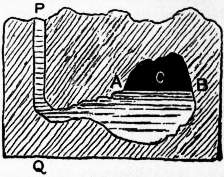
Fig. 1.
The great geyser-district of New Zealand is situated in the south of the province of Auckland in or near the upper basin of the Waikato river, to the N.E. of Lake Taupo. The scene presented in various parts of the districts is far more striking and beautiful than anything of the same kind to be found in Iceland, but this is due not so much to the grandeur of the geysers proper as to the bewildering profusion of boiling springs, steam-jets and mud-volcanoes, and to the fantastic effects produced on the rocks by the siliceous deposits and by the action of the boiling water. In about 1880 the geysers were no longer active, and this condition prevailed until the Tarawera eruption of 1886, when seven gigantic geysers came into existence; water, steam, mud and stones were discharged to a height of 600 to 800 ft. for a period of about four hours, when quieter conditions set in. Waikite near Lake Rotorua throws the column to a height of 30 or 35 ft.
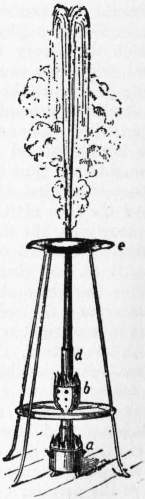
Fig. 2.
In the Yellowstone National Park, in the north-west corner of Wyoming, the various phenomena of the geysers can be observed on the most portentous scale. The geysers proper are about one hundred in number; the non-eruptive hot springs are much more numerous, there being more than 3000. The dimensions and activity of several of the geysers render those of Iceland and New Zealand almost insignificant in comparison. The principal groups are situated along the course of that tributary of the Upper Madison which bears the name of Fire Hole River. Many of the individual geysers have very distinctive characteristics in the form and colour of the mound, in the style of the eruption and in the shape of the column. The “Giantess” lifts the main column to a height of only 50 or 60 ft., but shoots a thin spire to no less than 250 ft. The “Castle” varies in height from 10 or 15 to 250 ft.; and on the occasions of greatest effort the noise is appalling, and shakes the ground like an earthquake. “Old Faithful” owes its name to the regularity of its action. Its eruptions, which raise the water to a height of 100 or 150 ft., last for about five minutes, and recur every hour or thereabouts. The “Beehive” sometimes attains a height of 219 it.; and the water, instead of falling back into the basin, is dissipated in spray and vapour. Very various accounts are given of the “Giant.” F. V. Hayden saw it playing for an hour and twenty minutes, and reaching a height of 140 ft., and Doane says it continued in action for three hours and a half, and had a maximum of 200 ft.; but at the earl of Dunraven’s visit the eruption lasted only a few minutes.
Theory of Geysers.—No satisfactory explanation of the phenomena of geysers was advanced till near the middle of the 19th century, when Bunsen elucidated their nature. Sir George Mackenzie, in his Travels in Iceland (2nd ed., 1812), submitted a theory which partially explained the phenomena met with. “Let us suppose a cavity C (fig. 1), communicating with the pipe PQ, filled with boiling water to the height AB, and that the steam above this line is confined so that it sustains the water to the height P. If we suppose a sudden addition of heat to be applied under the cavity C, a quantity of steam will be produced which, owing to the great pressure, will be evolved in starts, causing the noises like discharges of artillery and the shaking of the ground.” He admitted that this could be only a partial explanation of the facts of the case, and that he was unable to account for the frequent and periodical production of the necessary heat; but he has the credit of hitting on what is certainly the proximate cause—the sudden evolution of steam. By Bunsen’s theory the whole difficulty is solved, as is beautifully demonstrated by the artificial geyser designed by J. H. J. Müller of Freiburg (fig. 2). If the tube ab be filled with water and heated at two points, first at a and then at b, the following succession of changes is produced. The water at a beginning to boil, the superincumbent column is consequently raised, and the stratum of water which was on the point of boiling at b being raised to d is there subjected to a diminished pressure; a sudden evolution of steam accordingly takes place at d, and the superincumbent water is violently ejected. Received in the basin c, the air-cooled water sinks back into the tube, and the temperature of the whole column is consequently lowered; but the under strata of water are naturally those which are least affected by the cooling process; the boiling begins again at a, and the same succession of events is the result (see R. Bunsen, “Physikalische Beobachtungen über die hauptsächlichsten Geisire Islands,” Pogg. Ann., 1847, vol. 72; and Müller, “Über Bunsen’s Geysertheorie,” ibid., 1850, vol. 79).
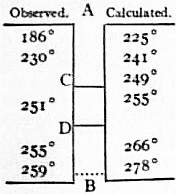
The principal difference between the artificial and the natural geyser-tube is that in the latter the effect is not necessarily produced by two distinct sources of heat like the two fires of the experimental apparatus, but by the continual influx of heat from the bottom of the shaft, and the differences between the boiling-points of the different parts of the column owing to the different pressures of the superincumbent mass. This may be thus illustrated: AB is the column of water; on the right side the figures represent approximately the boiling-points (Fahr.) calculated according to the ordinary laws, and the figures on the left the actual temperature of the same places. Both gradually increase as we descend, but the relation between the two is very different at different heights. At the top the water is still 39° from its boiling-point, and even at the bottom it is 19°; but at D the deficiency is only 4°. If, then, the stratum at D be suddenly lifted as high as C, it will be 2° above the boiling-point there, and will consequently expend those 2° in the formation of steam.
GEZER (the Kazir of Tethmosis [Thothmes] III.’s list of Palestinian cities and the Gazri of the Amarna tablets), a royal Canaanite city on the boundary of Ephraim, in the maritime plain (Josh. xvi. 3-10), and near the Philistine border (2 Sam. v. 25). It was allotted to the Levites, but its original inhabitants were not driven out until the time of Solomon, when “Pharaoh, king of Egypt” took the city and gave it as a dowry to his daughter, Solomon’s wife (1 Kings ix. 16). Under the form Gazera it is mentioned (1 Macc. iv. 15) as being in the neighbourhood of Emmaus-Nicopolis (’Amwās) and Jamnia (Yebnah). Throughout the history of the Maccabean wars Gezer or Gazara plays the part of an important frontier post. It was first taken from the Syrians by Simon the Asmonean (1 Macc. xiv. 7). Josephus also mentions that the city was “naturally strong” (Antiq. viii. 6. 1). The position of Gezer is defined by Jerome (Onomasticon, s.v.) as four Roman miles north (contra septentrionem) of Nicopolis (‘Amwās). This points to the mound of debris called Tell-el-Jezari near the village of Abū Shūsheh. The site is naturally very strong, the town standing on an isolated hill, commanding the western road to Jerusalem just where it begins to enter the mountains of Judea. This identification has been confirmed by the discovery of a series of boundary inscriptions, apparently marking the limit of the city’s lands, which have been found cut in rock—outcrops partly surrounding the site. They read in every case in נור תחמ1, “the boundary of Gezer,” with the name Alkios in Greek, probably that of the governor under whom the inscriptions were cut. The site has been partially excavated by the Palestine Exploration Fund, and an enormous mass of material for the history of Palestine recovered from it, including remains of a pre-Semitic aboriginal race, a remarkably perfect High Place, the castle built by Simon, and other remains of the first importance.
See R. A. S. Macalister’s reports in Palestine Exploration Fund Quarterly Statement (October 1902 onwards). Also Bible Sidelights from the Mound of Gezer, by the same writer.
(R. A. S. M.)
1 So written, with a medial mem (מ) instead of the final (ם).
GFRÖRER, AUGUST FRIEDRICH (1803-1861), German historian, was born at Calw, Württemberg, on the 5th of March 1803, and at the close of his preliminary studies at the seminary of Blaubeuren entered the university of Tübingen in 1821 as a student of evangelical theology. After passing his final examinations in 1825, he spent a year in Switzerland, during part of the time acting as companion and secretary to C. von Bonstetten (1745-1832); the year 1827 was spent chiefly in Rome. Returning to Württemberg in 1828, he first undertook the duties of repetent or theological tutor in Tübingen, and afterwards accepted a curacy in Stuttgart; but having in 1830 received an appointment in the royal public library at Stuttgart, he thenceforth gave himself exclusively to literature and historical science. His first work on Philo (Philo u. die jüdisch-alexandrinische Theosophie, Stuttgart, 1831) was rapidly followed by an elaborate biography, in two volumes, of Gustavus Adolphus (Gustav Adolf, König von Schweden, und seine Zeit, Stuttgart, 1835-1837), and by a critical history of primitive Christianity (Kritische Geschichte des Urchristenthums, 3 vols., Stuttgart, 1838). Here Gfrörer had manifested opinions unfavourable to Protestantism, which, however, were not openly avowed until fully developed in his church history (Allgemeine Kirchengeschichte bis Beginn des 14ten Jahrhunderts, Stuttgart, 1841-1846). In the autumn of 1846 he was appointed to the chair of history in the university of Freiburg, where he continued to teach until his death at Carlsbad on the 6th of July 1861. In 1848 he sat as a representative in the Frankfort parliament, where he supported the “High German” party, and in 1853 he publicly went over to the Church of Rome. He was a bitter opponent of Prussia and an ardent controversialist.
Among his later historical works the most important is the Geschichte der ost- u. westfränkischen Karolinger (Freiburg, 1848); but those on the pseudo-Isidorian Decretals (Untersuchung über Alter, Ursprung, u. Werth der Decretalen des falschen Isidorus, 1848), on the primitive history of mankind (Urgeschichte des menschlichen Geschlechts, 1855), on Hildebrand (Papst Gregorius VII. u. sein Zeitalter, 7 vols., 1859-1861), on the history of the 18th century (Geschichte des 18ten Jahrhunderts, 1862-1873), on German popular rights (Zur Geschichte deutscher Volksrechte im Mittelalter, Basel, 1865-1866) and on Byzantine history (Byzantinische Geschichten, 1872-1874), are also of real value.
GHADAMES, Gadames or Rhadāmes, a town in an oasis of the same name, in that part of the Sahara which forms part of the Turkish vilayet of Tripoli. It is about 300 m. S.W. of the city of Tripoli and some 10 m. E. of the Algerian frontier. According to Gerhard Rohlfs, the last form given to the word most correctly represents the Arabic pronunciation, but the other forms are more often used in Europe. The streets of the town are narrow and vaulted and have been likened to the bewildering galleries of a coalpit. The roofs are laid out as gardens and preserved for the exclusive use of the women. The Ghadamsi merchants have been known for centuries as keen and adventurous traders, and their agents are to be found in the more important places of the western and central Sudan, such as Kano, Katsena, Kanem, Bornu, Timbuktu, as well as at Ghat and Tripoli. Ghadames itself is the centre of a large number of caravan routes, and in the early part of the 19th century about 30,000 laden camels entered its markets every year. The caravan trade was created by the Ghadamsi merchants who, aided by their superior intelligence, capacity and honesty, long enjoyed a monopoly. In 1873 Tripolitan merchants began to compete with them. In 1893 came the invasion of Bornu by Rabah, and the total stoppage of this caravan route for nearly ten years to the great detriment of the merchants of Ghadames. The caravans from Kano were also frequently pillaged by the Tuareg, so that the prosperity of the town declined. Later on, the opening of rapid means of transport from Kano and other cities to the Gulf of Guinea also affected Ghadames, which, however, maintains a considerable trade. The chief articles brought by the caravans are ostrich feathers, skins and ivory and one of the principal imports is tea. In 1845 the population was estimated at 3000, of whom about 500 were slaves and strangers, and upwards of 1200 children; in 1905 it amounted in round numbers to 7000. The inhabitants are chiefly Berbers and Arabs. A Turkish garrison is maintained in the town.
Before the Christian era Ghadames was a stronghold of the Garamantes whose power was overthrown in the days of Augustus by L. Cornelius Balbus Minor, who captured Ghadames (Cydamus). It is not unlikely that Roman settlers may have been attracted to the spot by the presence of the warm springs which still rise in the heart of the town, and spread fertility in the surrounding gardens. In the 7th century Ghadames was conquered by the Arabs. It appears afterwards to have fallen under the power of the rulers of Tunisia, then to a native dynasty which reigned at Tripoli, and in the 16th century it became part of the Turkish vilayet of Tripoli. It has since then shared the political fortunes of that country. In the first half of the 19th century it was visited by several British explorers and later by German and French travellers.
See J. Richardson, Travels in the Great Desert of Sahara in 1845-1846 ... including a Description of ... Ghadames (London, 1848); G. Rohlfs, Reise durch Marokko ... und Reise durch die Grosse Wüste über Rhadames nach Tripoli (Bremen, 1868).
GHAT, or Rhat, an oasis and town, forming part of the Turkish vilayet of Tripoli. Ghat is an important centre of the caravan trade between the Nigerian states and the seaports of the Mediterranean (see Tripoli).
GHATS, or Ghauts (literally “the Landing Stairs” from the sea, or “Passes”), two ranges of mountains extending along the eastern and western shores of the Indian peninsula. The word properly applies to the passes through the mountains, but from an early date was transferred by Europeans to the mountains themselves.
The Eastern Ghats run in fragmentary spurs and ranges down the Madras coast. They begin in the Orissa district of Balasore, pass southwards through Cuttack and Puri, enter the Madras presidency in Ganjam, and sweep southwards through the districts of Vizagapatam, Godavari, Nellore, Chingleput, South Arcot, Trichinopoly and Tinnevelly. They run at a distance of 50 to 150 m. from the coast, except in Ganjam and Vizagapatam, where in places they almost abut on the Bay of Bengal. Their geological formation is granite, with gneiss and mica slate, with clay slate, hornblende and primitive limestone overlying. The average elevation is about 1500 ft., but several hills in Ganjam are between 4000 and 5000 ft. high. For the most part there is a broad expanse of low land between their base and the sea, and their line is pierced by the Godavari, Kistna and Cauvery rivers.
The Western Ghats (Sahyadri in Sanskrit) start from the south of the Tapti valley, and run south through the districts of Khandesh, Nasik, Thana, Satara, Ratnagiri, Kanara and Malabar, and the states of Cochin and Travancore, meeting the Eastern Ghats at an angle near Cape Comorin. The range of the Western Ghats extends uninterruptedly, with the exception of a gap or valley 25 m. across, known as the Palghat gap, through which runs the principal railway of the south of India. The length of the range is 800 m. from the Tapti to the Palghat gap, and south of this about 200 m. to the extreme south of the peninsula. In many parts there is only a narrow strip of coast between the hills and the sea; at one point they rise in magnificent precipices and headlands out of the ocean. The average elevation is 3000 ft., precipitous on the western side facing the sea, but with a more gradual slope on the east to the plains below. The highest peaks in the northern section are Kalsubai, 5427 ft.; Harischandragarh, 4691 ft.; and Mahabaleshwar, where is the summer capital of the government of Bombay, 4700 ft. South of Mahabaleshwar the elevation diminishes, but again increases, and attains its maximum towards Coorg, where the highest peaks vary from 5500 to 7000 ft., and where the main range joins the interior Nilgiri hills. South of the Palghat gap, the peaks of the Western Ghats rise as high as 8000 ft. The geological formation is trap in the northern and gneiss in the southern section.
GHAZĀLĪ [Muḥammad ibn Muḥammad Abū Ḥāmid al-Ghazālī] (1058-1111), Arabian philosopher and theologian, was born at Tūs, and belonged to a family of Ghazāla (near Tūs) distinguished for its knowledge of canon law. Educated at first in Tūs, then in Jorjān, and again in Tūs, he went to college at Nīshāpūr, where he studied under Juwainī (known as the Imām ul-Ḥaramain) until 1085, when he visited the celebrated vizier Nizām ul-Mulk, who appointed him to a professorship in his college at Bagdad in 1091. Here he was engaged in writing against the Isma’ilites (Assassins). After four years of this work he suddenly gave up his chair, left home and family and gave himself to an ascetic life. This was due to a growing scepticism, which caused him much mental unrest and which gradually gave way to mysticism. Having secured his chair for his brother he went to Damascus, Jerusalem, Hebron, Mecca, Medina and Alexandria, studying, meditating and writing in these cities. In 1106 he was tempted to go to the West, where the Moravid (Almoravid) reformation was being led by Yūsuf ibn Tāshfīn, with whom he had been in correspondence earlier. Yūsuf, however, died in this year, and Ghazālī abandoned his idea. At the wish of the sultan Malik Shah he again undertook professorial work, this time in the college of Nizām ul-Mulk at Nīshāpūr, but returned soon after to Tūs, where he died in December 1111.
Sixty-nine works are ascribed to Ghazālī (cf. C. Brockelmann’s Gesch. d. arabischen Litteratur, i. 421-426, Weimar, 1898). The most important of those which have been published are: a treatise on eschatology called Ad-durra ul-fākhira (“The precious pearl”), ed. L. Gautier (Geneva, 1878); the great work, Ihyā ul-`Ulūm (“Revival of the sciences”) (Bulaq, 1872; Cairo, 1889); see a commentary by al-Murtada called the Itḥāf, published in 13 vols. at Fez, 1885-1887, and in 10 vols. at Cairo, 1893; the Bidayat ul-Hidāya (Bulaq, 1870, and often at Cairo); a compendium of ethics, Mizān ul-‘Amal, translated into Hebrew, ed. J. Goldenthal (Paris, 1839); a more popular treatise on ethics, the Kimīya us-Sa‘āda, published at Lucknow, Bombay and Constantinople, ed. H. A. Homes as The Alchemy of Happiness (Albany, N.Y., 1873); the ethical work O Child, ed. by Hammer-Purgstall in Arabic and German (Vienna, 1838); the Destruction of Philosophers (Tahafūt ul-Falāsifa) (Cairo, 1885, and Bombay, 1887). Of this work a French translation was begun by Carra de Vaux in Muséon, vol. xviii. (1899); the Maqāṣid ul-Falāsifa, of which the first part on logic was translated into Latin by Dom. Gundisalvi (Venice, 1506), ed. with notes by G. Beer (Leiden, 1888); the Kitāb ul-Munqid, giving an account of the changes in his philosophical ideas, ed. by F. A. Schmölders in his Essai sur les écoles philosophiques chez les Arabes (Paris, 1842), also printed at Constantinople, 1876, and translated into French by Barbier de Meynard in the Journal asiatique (1877, i. 1-93); answers to questions asked of him ed. in Arabic and Hebrew, with German translation and notes by H. Malter (Frankfort, 1896); Eng. trans., Confessions of al-Ghazzali, by Claud Field (1909).
For Ghazālī’s life see McG. de Slane’s translation of Ibn Khallikān, ii. 621 ff.; R. Gösche’s Über Ghazzali’s Leben und Werke (Berlin, 1859); D. B. Macdonald’s “Life of al-Ghazzali,” in Journal of American Oriental Society, vol. xx. (1899), and Carra de Vaux’s Gazali (Paris, 1902); see Arabian Philosophy.
(G. W. T.)
GHAZI (an Arabic word, from ghazā, to fight), the name given to Mahommedans who have vowed to exterminate unbelievers by the sword. It is also used as a title of honour, generally translated “the Victorious,” in the Ottoman empire for military officers of high rank, who have distinguished themselves in the field against non-Moslem enemies; thus it was conferred on Osman Pasha after his famous defence of Plevna.
GHAZIABAD, a town of British India in Meerut district of the United Provinces, 12 m. from Delhi and 28 m. from Meerut. Pop. (1901) 11,275. The town was founded in 1740 by Ghazi-ud-din, son of Azaf Jah, first nizam of the Deccan, and takes its name from its founder. It has considerably risen in importance as the point of junction of the East Indian, the North-Western and the Oudh & Rohilkhand railway systems. The town has a trade in grain and hides.
GHAZIPUR, a town and district of British India, in the Benares division of the United Provinces. The town stands on the left bank of the Ganges, 44 m. E. of Benares. It is the headquarters of the government opium department, where all the opium from the United Provinces is collected and manufactured under a monopoly. There are also scent distilleries, using the produce of the rose-gardens in the vicinity. Lord Cornwallis, governor-general of India, died at Ghazipur in 1805, and a domed monument and marble statue (by Flaxman) are erected over his grave. Pop. (1901) 39,429.
The district of Ghazipur has an area of 1389 sq. m. It forms part of the great alluvial plain of the Ganges, which divides it into two unequal portions. The northern subdivision lies between the Gumti and the Gogra, whose confluences with the main stream mark its eastern and western limits respectively. The southern tract is a much smaller strip of country, enclosed between the Karamnasa and the great river itself. There are no hills in the district. A few lakes are scattered here and there, formed where the rivers have deserted their ancient channels. The largest is that of Suraha, once a northern bend of the Ganges, but now an almost isolated sheet of water, 5 m. long by about 4 broad. Ghazipur is said to be one of the hottest and dampest districts in the United Provinces. In 1901 the population was 913,818, showing a decrease of 11% in the decade. Sugar refining is the chief industry, and provides the principal article of export. The main line of the East Indian railway traverses the southern portion of the district, with a branch to the Ganges bank opposite Ghazipur town; the northern portion is served by the Bengal & North-Western system.
GHAZNI, a famous city in Afghanistan, the seat of an extensive empire under two medieval dynasties, and again of prominent interest in the modern history of British India. Ghazni stands on the high tableland of central Afghanistan, in 68° 18′ E. long., 33° 44′ N. lat., at a height of 7280 ft. above the sea, and on the direct road between Kandahar and Kabul, 221 m. by road N.E. from the former, and 92 m. S.W. from the latter. A very considerable trade in fruit, wool, skins, &c., is carried on between Ghazni and India by the Povindah kafilas, which yearly enter India in the late autumn and pass back again to the Afghan highlands in the early spring. The Povindah merchants invariably make use of the Gomal pass which leads to the British frontier at Dera Ismail Khan. The opening up of this pass and the British occupation of Wana, by offering protection to the merchants from Waziri blackmailing, largely increased the traffic.
Ghazni, as it now exists, is a place in decay, and probably does not contain more than 4000 inhabitants. It stands at the base of the terminal spur of a ridge of hills, an offshoot from the Gul-Koh, which forms the watershed between the Arghandáb and Tarnak rivers. The castle stands at the northern angle of the town next the hills, and is about 150 ft. above the plain. The town walls stand on an elevation, partly artificial, and form an irregular square, close on a mile in circuit (including the castle), the walls being partly of stone or brick laid in mud, and partly of clay built in courses. They are flanked by numerous towers. There are three gates. The town consists of dirty and very irregular streets of houses several stories high, but with two straighter streets of more pretension, crossing near the middle of the town. Of the strategical importance of Ghazni there can hardly be a question. The view to the south is extensive, and the plain in the direction of Kandahar stretches to the horizon. It is bare except in the vicinity of the river, where villages and gardens are tolerably numerous. Abundant crops of wheat and barley are grown, as well as of madder, besides minor products. The climate is notoriously cold,—snow lying 2 or 3 ft. deep for about three months, and tradition speaks of the city as having been more than once overwhelmed by snowdrift. Fuel is scarce, consisting chiefly of prickly shrubs. In summer the heat is not like that of Kandahar or Kabul, but the radiation from the bare heights renders the nights oppressive, and constant dust-storms occur. It is evident that the present restricted walls cannot have contained the vaunted city of Mahmud. Probably the existing site formed the citadel only of his city. The remarks of Ibn Batuta (c. 1332) already suggest the present state of things, viz. a small town occupied, a large space of ruin; for a considerable area to the N.E. is covered with ruins, or rather with a vast extent of shapeless mounds, which are pointed out as Old Ghazni. The only remains retaining architectural character are two remarkable towers rising to the height of about 140 ft., and some 400 yds. apart from each other. They are similar, but whether identical, in design, is not clearly recorded. They belong, on a smaller and far less elaborate scale, to the same class as the Kutb Minar at Delhi (q.v.). Arabic inscriptions in Cufic characters show the most northerly to have been the work of Mahmud himself, the other that of his son Masa’ud. On the Kabul road, a mile beyond the Minaret of Mahmud, is a village called Rauzah (“the Garden,” a term often applied to garden-mausoleums). Here, in a poor garden, stands the tomb of the famous conqueror. It is a prism of white marble standing on a plinth of the same, and bearing a Cufic inscription praying the mercy of God on the most noble Amir, the great king, the lord of church and state, Abul Kasim Mahmud, son of Sabuktagin. The tomb stands in a rude chamber, covered with a dome of clay, and hung with old shawls, ostrich eggs, tiger-skins and so forth. The village stands among luxuriant gardens and orchards, watered by a copious aqueduct. Sultan Baber celebrates the excellence of the grapes of Rauzah.
There are many holy shrines about Ghazni surrounded by orchards and vineyards. Baber speaks of them, and tells how he detected and put a stop to the imposture of a pretended miracle at one of them. These sanctuaries make Ghazni a place of Moslem pilgrimage, and it is said that at Constantinople much respect is paid to those who have worshipped at the tomb of the great Ghazi. To test the genuineness of the boast, professed pilgrims are called on to describe the chief notabilia of the place, and are expected to name all those detailed in certain current Persian verses.
History.—The city is not mentioned by any narrator of Alexander’s expedition, nor by any ancient author so as to admit of positive recognition. But it is very possibly the Gazaca which Ptolemy places among the Paropamisadae, and this may not be inconsistent with Sir H. Rawlinson’s identification of it with Gazos, an Indian city spoken of by two obscure Greek poets as an impregnable place of war. The name is probably connected with the Persian and Sanskrit ganj and ganja, a treasury (whence the Greek and Latin Gaza). We seem to have positive evidence of the existence of the city before the Mahommedan times (644) in the travels of the Chinese pilgrim, Hsuan Tsang, who speaks of Ho-si-na (i.e. probably Ghazni) as one of the capitals of Tsaukuta or Arachosia, a place of great strength. In early Mahommedan times the country adjoining Ghazni was called Zābul. When the Mahommedans first invaded that region Ghazni was a wealthy entrepot of the Indian trade. Of the extent of this trade some idea is given by Ibn Haukal, who states that at Kabul, then a mart of the same trade, there was sold yearly indigo to the value of two million dinars (£1,000,000). The enterprise of Islam underwent several ebbs and flows over this region. The provinces on the Helmund and about Ghazni were invaded as early as the caliphate of Moaiya (662-680). The arms of Yaqub b. Laith swept over Kabul and Arachosia (Al-Rukhaj) about 871, and the people of the latter country were forcibly converted. Though the Hindu dynasty of Kabul held a part of the valley of Kabul river till the time of Mahmud, it is probably to the period just mentioned that we must refer the permanent Mahommedan occupation of Ghazni. Indeed, the building of the fort and city is ascribed by a Mahommedan historian to Amr b. Laith, the brother and successor of Ya‘kub (d. 901), though the facts already stated discredit this. In the latter part of the 9th century the family of the Samanid, sprung from Samarkand, reigned in splendour at Bokhara. Alptagin, originally a Turkish slave, and high in the service of the dynasty, about the middle of the 10th century, losing the favour of the court, wrested Ghazni from its chief (who is styled Abu Bakr Lawik, wali of Ghazni), and established himself there. His government was recognized from Bokhara, and held till his death. In 977 another Turk slave, Sabuktagin, who had married the daughter of his master Alptagin, obtained rule in Ghazni. He made himself lord of nearly all the present territory of Afghanistan and of the Punjab. In 997 Mahmud, son of Sabuktagin, succeeded to the government, and with his name Ghazni and the Ghaznevid dynasty have become perpetually associated. Issuing forth year after year from that capital, Mahmud (q.v.) carried fully seventeen expeditions of devastation through northern India and Gujarat, as well as others to the north and west. From the borders of Kurdistan to Samarkand, from the Caspian to the Ganges, his authority was acknowledged. The wealth brought back to Ghazni was enormous, and contemporary historians give glowing descriptions of the magnificence of the capital, as well as of the conqueror’s munificent support of literature. Mahmud died in 1030, and some fourteen kings of his house came after him; but though there was some revival of importance under Ibrahim (1059-1099), the empire never reached anything like the same splendour and power. It was overshadowed by the Seljuks of Persia, and by the rising rivalry of Ghor (q.v.), the hostility of which it had repeatedly provoked. Bahram Shah (1118-1152) put to death Kutbuddin, one of the princes of Ghor, called king of the Jibal or Hill country, who had withdrawn to Ghazni. This prince’s brother, Saifuddin Suri, came to take vengeance, and drove out Bahram. But the latter recapturing the place (1149) paraded Saifuddin and his vizier ignominiously about the city, and then hanged them on the bridge. Ala-uddin of Ghor, younger brother of the two slain princes, then gathered a great host, and came against Bahram, who met him on the Helmund. The Ghori prince, after repeated victories, stormed Ghazni, and gave it over to fire and sword. The dead kings of the house of Mahmud, except the conqueror himself and two others, were torn from their graves and burnt, whilst the bodies of the princes of Ghor were solemnly disinterred and carried to the distant tombs of their ancestors. It seems certain that Ghazni never recovered the splendour that perished then (1152). Ala-uddin, who from this deed became known in history as Jahān-soz (Brûlemonde), returned to Ghor, and Bahram reoccupied Ghazni; he died in 1157. In the time of his son Khusru Shah, Ghazni was taken by the Turkish tribes called Ghuzz (generally believed to have been what are now called Turkomans). The king fled to Lahore, and the dynasty ended with his son. In 1173 the Ghuzz were expelled by Ghiyasuddin sultan of Ghor (nephew of Ala-uddin Jahansoz), who made Ghazni over to his brother Muizuddin. This famous prince, whom the later historians call Mahommed Ghori, shortly afterwards (1174-1175) invaded India, taking Multan and Uchh. This was the first of many successive inroads on western and northern India, in one of which Lahore was wrested from Khusru Malik, the last of Mahmud’s house, who died a captive in the hills of Ghor. In 1192 Prithvi Rai or Pithora (as the Moslem writers call him), the Chauhan king of Ajmere, being defeated and slain near Thanewar, the whole country from the Himalaya to Ajmere became subject to the Ghori king of Ghazni. On the death of his brother Ghiyasuddin, with whose power he had been constantly associated, and of whose conquests he had been the chief instrument, Muizuddin became sole sovereign over Ghor and Ghazni, and the latter place was then again for a brief period the seat of an empire nearly as extensive as that of Mahmud the son of Sabuktagin. Muizuddin crossed the Indus once more to put down a rebellion of the Khokhars in the Punjab, and on his way back was murdered by a band of them, or, as some say, by one of the Mulāhidah or Assassins. The slave lieutenants of Muizuddin carried on the conquest of India, and as the rapidly succeeding events broke their dependence on any master, they established at Delhi that monarchy of which, after it had endured through many dynasties, and had culminated with the Mogul house of Baber, the shadow perished in 1857. The death of Muizuddin was followed by struggle and anarchy, ending for a time in the annexation of Ghazni to the empire of Khwarizm by Mahommed Shah, who conferred it on his famous son, Jelaluddin, and Ghazni became the headquarters of the latter. After Jenghiz Khan had extinguished the power of his family in Turkestan, Jelaluddin defeated the army sent against him by the Mongol at Parwan, north of Kabul. Jenghiz then advanced and drove Jelaluddin across the Indus, after which he sent Ogdai his son to besiege Ghazni. Henceforward Ghazni is much less prominent in Asiatic history. It continued subject to the Mongols, sometimes to the house of Hulagu in Persia, and sometimes to that of Jagatai in Turkestan. In 1326, after a battle between Amir Hosain, the viceroy of the former house in Khorasan, and Tarmashirin, the reigning khan of Jagatai, the former entered Ghazni and once more subjected it to devastation, and this time the tomb of Mahmud to desecration.
Ibn Batuta (c. 1332) says the greater part of the city was in ruins, and only a small part continued to be a town. Timur seems never to have visited Ghazni, but we find him in 1401 bestowing the government of Kabul, Kandahar, and Ghazni on Pir Mahommed, the son of his son Jahangir. In the end of the century it was still in the hands of a descendant of Timur, Ulugh Beg Mirza, who was king of Kabul and Ghazni. The illustrious nephew of this prince, Baber, got peaceful possession of both cities in 1504, and has left notes on both in his own inimitable Memoirs. His account of Ghazni indicates how far it had now fallen. “It is,” he says, “but a poor mean place, and I have always wondered how its princes, who possessed also Hindustan and Khorasan, could have chosen such a wretched country for the seat of their government, in preference to Khorasan.” He commends the fruit of its gardens, which still contribute largely to the markets of Kabul. Ghazni remained in the hands of Baber’s descendants, reigning at Delhi and Agra, till the invasion of Nadir Shah (1738), and became after Nadir’s death a part of the new kingdom of the Afghans under Ahmad Shah Durani. We know of but two modern travellers who have recorded visits to the place previous to the war of 1839. George Forster passed as a disguised traveller with a qafila in 1783. “Its slender existence,” he says, “is now maintained by some Hindu families, who support a small traffic, and supply the wants of the few Mahommedan residents.” Vigne visited it in 1836, having reached it from Multan with a caravan of Lohani merchants, travelling by the Gomal pass. The historical name of Ghazni was brought back from the dead, as it were, by the news of its capture by the British army under Sir John Keane, 23rd July 1839. The siege artillery had been left behind at Kandahar; escalade was judged impracticable; but the project of the commanding engineer, Captain George Thomson, for blowing in the Kabul gate with powder in bags, was adopted, and carried out successfully, at the cost of 182 killed and wounded. Two years and a half later the Afghan outbreak against the British occupation found Ghazni garrisoned by a Bengal regiment of sepoys, but neither repaired nor provisioned. They held out under great hardships from the 16th of December 1841 to the 6th of March 1842, when they surrendered. In the autumn of the same year General Nott, advancing from Kandahar upon Kabul, reoccupied Ghazni, destroyed the defences of the castle and part of the town, and carried away the famous gates of Somnath (q.v.).
GHEE (Hindustani ghi), a kind of clarified butter made in the East. The best is prepared from butter of the milk of cows, the less esteemed from that of buffaloes. The butter is melted over a slow fire, and set aside to cool; the thick, opaque, whitish, and more fluid portion, or ghee, representing the greater bulk of the butter, is then removed. The less liquid residue, mixed with ground-nut oil, is sold as an inferior kind of ghee. It may be obtained also by boiling butter over a clear fire, skimming it the while, and, when all the water has evaporated, straining it through a cloth. Ghee which is rancid or tainted, as is often that of the Indian bazaars, is said to be rendered sweet by boiling with leaves of the Moringa pterygosperma or horse-radish tree. In India ghee is one of the commonest articles of diet, and indeed enters into the composition of everything eaten by the Brahmans. It is also extensively used in Indian religious ceremonies, being offered as a sacrifice to idols, which are at times bathed in it. Sanskrit treatises on therapeutics describe ghee as cooling, emollient and stomachic, as capable of increasing the mental powers, and of improving the voice and personal appearance, and as useful in eye-diseases, tympanitis, painful dyspepsia, wounds, ulcers and other affections. Old ghee is in special repute among the Hindus as a medicinal agent, and its efficacy as an external application is believed by them to increase with its age. Ghee more than ten years old, the purāna ghrita of Sanskrit materia medicas, has a strong odour and the colour of lac. Some specimens which have been much longer preserved—and “clarified butter a hundred years old is often heard of”—have an earthy look, and are quite dry and hard, and nearly inodorous. Medicated ghee is made by warming ordinary ghee to remove contained water, melting, after the addition of a little turmeric juice, in a metal pan at a gentle heat, and then boiling with the prepared drugs till all moisture is expelled, and straining through a cloth.