VOLUME X SLICE I Evangelical Church Conference to Fairbairn, Sir William (continued 10)
Reading edition
See Human Embryology, by C.S. Minot (New York); Quain’s Anatomy, vol. i. (1908); “Entwickelung des Auges der Wirbeltiere,” by A. Froriep, in Handbuch der vergleichenden und experimentellen Entwickelungslehre der Wirbeltiere (O. Hertwig, Jena, 1905).
Comparative Anatomy.—The Acrania, as represented by Amphioxus (the lancelet), have a patch of pigment in the fore part of the brain which is regarded as the remains of a degenerated eye. In the Cyclostomata the hag (Myxine) and larval lamprey (Ammocoetes) have ill-developed eyes lying beneath the skin and devoid of lens, iris, cornea and sclerotic as well as eye muscles. In the adult lamprey (Petromyzon) these structures are developed at the metamorphosis, and the skin becomes transparent, rendering sight possible. Ocular muscles are developed, but, unlike most vertebrates, the inferior rectus is supplied by the sixth nerve while all the others are supplied by the third. In all vertebrates the retina consists of a layer of senso-neural cells, the rods and cones, separated from the light by the other layers which together represent the optic ganglia of the invertebrates; in the latter animals, however, the senso-neural cells are nearer the light than the ganglia.
In fishes the eyeball is flattened in front, but the flat cornea is compensated by a spherical lens, which, unlike that of other vertebrates, is adapted for near vision when at rest. The iris in some bony fishes (Teleostei) is not contractile. In the Teleostei, too, there is a process of the choroid which projects into the vitreous chamber and runs forward to the lens; it is known as the processus falciformis, and, besides nourishing the lens, is concerned in accommodation. This specialized group of fishes is also remarkable for the possession of a so-called choroid gland, which is really a rete mirabile (see Arteries) between the choroid and sclerotic. The sclerotic in fishes is usually chondrified and sometimes calcified or ossified. In the retina the rods and cones are about equal in number, and the cones are very large. In the cartilaginous fishes (Elasmobranchs) there is a silvery layer, called the tapetum lucidum, on the retinal surface of the choroid.
In the Amphibia the cornea is more convex than in the fish, but the lens is circular and the sclerotic often chondrified. There is no processus falciformis or tapetum lucidum, but the class is interesting in that it shows the first rudiments of the ciliary muscle, although accommodation is brought about by shifting the lens. In the retina the rods outnumber the cones and these latter are smaller than in any other animals. In some Amphibians coloured oil globules are found in connexion with the cones, and sometimes two cones are joined, forming double or twin cones.
In Reptilia the eye is spherical and its anterior part is often protected by bony plates in the sclerotic (Lacertilia and Chelonia). The ciliary muscle is striated, and in most reptiles accommodation is effected by relaxing the ciliary ligament as in higher vertebrates, though in the snakes (Ophidia) the lens is shifted as it is in the lower forms. Many lizards have a vascular projection of the choroid into the vitreous, foreshadowing the pecten of birds and homologous with the processus falciformis of fishes. In the retina the rods are scarce or absent.
In birds the eye is tubular, especially in nocturnal and raptorial forms: this is due to a lengthening of the ciliary region, which is always protected by bony plates in the sclerotic. The pecten, already mentioned in lizards, is a pleated vascular projection from the optic disk towards the lens which in some cases it reaches. In Apteryx this structure disappears. In the retina the cones outnumber the rods, but are not as numerous as in the reptiles. The ciliary muscle is of the striped variety.
In the Mammalia the eye is largely enclosed in the orbit, and bony plates in the sclerotic are only found in the monotremes. The cornea is convex except in aquatic mammals, in which it is flattened. The lens is biconvex in diurnal mammals, but in nocturnal and aquatic it is spherical. There is no pecten, but the numerous hyaloid arteries which are found in the embryo represent it. The iris usually has a circular pupil, but in some ungulates and kangaroos it is a transverse slit. In the Cetacea this transverse opening is kidney-shaped, the hilum of the kidney being above. In many carnivores, especially nocturnal ones, the slit is vertical, and this form of opening seems adapted to a feeble light, for it is found in the owl, among birds. The tapetum lucidum is found in Ungulata, Cetacea and Carnivora. The ciliary muscle is unstriped. In the retina the rods are more numerous than the cones, while the macula lutea only appears in the Primates in connexion with binocular vision.
Among the accessory structures of the eye the retractor bulbi muscle is found in amphibians, reptiles, birds and many mammals; its nerve supply shows that it is probably a derivative of the external or posterior rectus. The nictitating membrane or third eyelid is well-developed in amphibians, reptiles, birds and some few sharks; it is less marked in mammals, and in Man is only represented by the little plica semilunaris. When functional it is drawn across the eye by special muscles derived from the retractor bulbi, called the bursalis and pyramidalis. In connexion with the nictitating membrane the Harderian gland is developed, while the lachrymal gland secretes fluid for the other eyelids to spread over the conjunctiva. These two glands are specialized parts of a row of glands which in the Urodela (tailed amphibians) are situated along the lower eyelid; the outer or posterior part of this row becomes the lachrymal gland, which in higher vertebrates shifts from the lower to the upper eyelid, while the inner or anterior part becomes the Harderian gland. Below the amphibians glands are not necessary, as the water keeps the eye moist.
The lachrymal duct first appears in the tailed amphibians; in snakes and gecko lizards, however, it opens into the mouth.
For literature up to 1900 see R. Wiedersheim’s Vergleichende Anatomie der Wirbeltiere (Jena, 1902). Later literature is noticed in the catalogue of the Physiological Series of the R. College of Surgeons of England Museum, vol. iii. (London, 1906).
(F. G. P.)
Eye Diseases.—The specially important diseases of the eye are those which temporarily or permanently interfere with sight. In considering the pathology of the eye it may be remembered that (1) it is a double organ, while (2) either eye may have its own trouble.
1. The two eyes act together, under normal conditions, for all practical purposes exactly as if there were but one eye placed in the middle of the face. All impressions made upon either retina, to the one side of a vertical line through the centre, the fovea centralis, before giving rise to conscious perception cause a stimulation of the same area in the brain. Impressions formed simultaneously, for instance, on the right side of the right retina and on corresponding areas of the right side of the left retina, are conveyed to the same spots in the right occipital lobe of the brain. Pathological processes, therefore, which are localized in the right or left occipital lobes, or along any part of the course of the fibres which pass from the right or left optic tracts to these “visual centres,” cause defects in function of the right or left halves of the two retinae. Hemianopia, or half-blindness, arising from these pathological changes, is of very varying degrees of severity, according to the nature and extent of the particular lesion. The blind areas in the two fields of vision, corresponding to the outward projection of the paralysed retinal areas, are always symmetrical both in shape and degree. The central lesion may for instance be very small, but at the same time destructive to the nerve tissue. This will be revealed as a sector-shaped or insular symmetrical complete blindness in the fields of vision to the opposite side. Or a large central area, or an area comprising many or all of the nerve fibres which pass to the visual centre on one side, may be involved in a lesion which causes impairment of function, but no actual destruction of the nerve tissue. There is thus caused a symmetrical weakening of vision (amblyopia) in the opposite fields. In such cases the colour vision is so much more evidently affected than the sense of form that the condition has been called hemiachromatopsia or half-colour blindness. Hemianopia may be caused by haemorrhage, by embolism, by tumour growth which either directly involves the visual nerve elements or affects them by compression and by inflammation. Transitory hemianopia is rare and is no doubt most frequently of toxic origin.
The two eyes also act as if they were one in accommodating. It is impossible for the two eyes to accommodate simultaneously to different extents, so that where there is, as occasionally happens, a difference in focus between them, this difference remains the same for all distances for which they are adapted. In such cases, therefore, both eyes cannot ever be accurately adapted at the same time, though either may be alone. It often happens as a consequence that the one eye is used to receive the sharpest images of distant, and the other of near objects. Any pathological change which leads to an interference in the accommodating power of one eye alone must have its origin in a lesion which lies peripherally to the nucleus of the third cranial nerve. Such a lesion is usually one of the third nerve itself. Consequently, a unilateral accommodation paresis is almost invariably associated with pareses of some of the oculo-motor muscles. A bilateral accommodation paresis is not uncommon. It is due to a nuclear or more central cerebral disturbance. Unlike a hemianopia, which is mostly permanent, a double accommodation paresis is frequently transitory. It is often a post-diphtheritic condition, appearing alone or associated with other paresis.
Both eyes are also normally intimately associated in their movements. They move in response to a stimulus or a combination of stimuli, emanating from different centres of the brain, but one which is always equally distributed to the corresponding muscles in both eyes, so that the two lines of fixation meet at the succession of points on which attention is directed. The movements are thus associated in the same direction, to the right or left, upwards or downwards, &c. In addition, owing to the space which separates the two eyes, convergent movements, caused by stimuli equally distributed between the two internal recti, are required for the fixation of nearer and nearer-lying objects. These movements would not be necessary in the case of a single eye. It would merely have to accommodate. The converging movements of the double eye occur in association with accommodation, and thus a close connexion becomes established between the stimuli to accommodation and convergence. All combinations of convergent and associated movements are constantly taking place normally, just as if a single centrally-placed eye were moved in all directions and altered its accommodation according to the distance, in any direction, of the object which is fixed.
Associated and convergent movements may be interfered with pathologically in different ways. Cerebral lesions may lead to their impairment or complete abolition, or they may give rise to involuntary spasmodic action, as the result of paralysing or irritating the centres from which the various co-ordinated impulses are controlled or emanate. Lesions which do not involve the centres may prevent the response to associated impulses in one eye alone by interfering with the functional activity of one or more of the nerves along which the stimuli are conveyed. Paralysis of oculo-motor nerves is thus a common cause of defects of association in the movements of the double eye. The great advantage of simultaneous binocular vision—viz. the appreciation of depth, or stereoscopic vision—is thus lost for some, or it may be all directions of fixation. Instead of seeing singly with two eyes, there is then double-vision (diplopia). This persists so long as the defect of association continues, or so long as the habit of mentally suppressing the image of the faultily-directed eye is not acquired.
In the absence of any nerve lesions, central or other, interfering with their associated movements, the eyes continue throughout life to respond equally to the stimuli which cause these movements, even when, owing to a visual defect of the one eye, binocular vision has become impossible. It is otherwise, however, with the proper co-ordination of convergent movements. These are primarily regulated by the unconscious desire for binocular vision, and more or less firmly associated with accommodation. When one eye becomes blind, or when binocular vision for other reasons is lost, the impulse is gradually, as it were, unlearnt. This is the cause of divergent concomitant squint. Under somewhat similar conditions a degree of convergence, which is in excess of the requirements of fixation, may be acquired from different causes. This gives rise to convergent concomitant squint.
For Astigmatism, &c., see the article Vision.
2. Taking each eye as a single organ, we find it to be subject to many diseases. In some cases both eyes may be affected in the same way, e.g. where the local disease is a manifestation of some general disturbance. Apart from the fibrous coat of the eye, the sclera, which is little prone to disease, and the external muscles and other adnexa, the eye may be looked upon as composed of two elements, (a) the dioptric media, and (b) the parts more or less directly connected with perception. Pathological conditions affecting either of these elements may interfere with sight.
The dioptric media, or the transparent portions which are concerned in the transmission of light to, and the formation of images upon, the retina, are the following: the cornea, the aqueous humour, the crystalline lens and the vitreous humour. Loss of transparency in any of these media leads to blurring of the retinal images of external objects. In addition to loss of transparency the cornea may have its curvature altered by pathological processes. This necessarily causes imperfection of sight. The crystalline lens, on the other hand, may be dislocated, and thus cause image distortion.
The Cornea.—The transparency of the cornea is mainly lost by imflammation (keratitis), which causes either an infiltration of its tissues with leucocytes, or a more focal, more destructive ulcerative process.
Inflammation of the cornea may be primary or secondary, i.e. the inflammatory changes met with in the corneal tissue may be directly connected with one or more foci of inflammation in the cornea itself or the focus or foci may be in some other part of the eye. Only the very superficial forms of primary keratitis, those confined to the epithelial layer, leave no permanent change; there is otherwise always a loss of tissue resulting from the inflammation and this loss is made up for by more or less densely intransparent connective tissue (nebula, leucoma). These according to their site and extent cause greater or less visual disturbance. Primary keratitis may be ulcerative or non-ulcerative, superficial or deep, diffuse or circumscribed, vascularized or non-vascularized. It may be complicated by deeper inflammations of the eye such as iritis and cyclitis. In some cases the anterior chamber is invaded by pus (hypopyon). The healing of a corneal ulcer is characterized by the disappearance of pain where this has been a symptom and by the rounding off of its sharp margins as epithelium spreads over them from the surrounding healthy parts. Ulcers tend to extend either in depth or superficially, rarely in both manners at the same time. A deep ulcer leads to perforation with more or less serious consequences according to the extent of the perforation. Often an eye bears permanent traces of a perforation in adhesion of the iris to the back of a corneal scar or in changes in the lens capsule (capsular cataract). In other cases the ulcerated cornea may yield to pressure from within, which causes it to bulge forwards (staphyloma).
The principal causes of primary keratitis are traumata and infection from the conjunctiva. Traumata are most serious when the body causing the wound is not aseptic or when micro-organisms from some other source, often the conjunctiva and tear-sac, effect a lodgment before healing of the wound has sufficiently advanced. In infected cases a complication with iritis is not uncommon owing to the penetration of toxines into the anterior chamber.
Inflammations of the cornea are the most important diseases of the eye, because they are among the most frequent, because of the value of the cornea to vision and because much good can often be done by judicious treatment and much harm result from wrong interference and neglect. The treatment of primary keratitis must vary according to the cause. Generally speaking the aim should be to render the ulcerated portions as aseptic as possible without using applications which are apt to cause a great deal of irritation and thus interfere with healing. On this account it is important to be able to recognize when healing is taking place, for as soon as this is the case, rest, along with frequent irrigation of the conjunctiva with sterilized water at the body temperature, and occasionally mild antiseptic irrigation of the nasal mucous membrane is all that is required. It is a common and dangerous mistake to over treat.
Of local antiseptics which are of use may be mentioned the actual cautery, chlorine water, freshly prepared silver nitrate or protargol, and the yellow oxide of mercury. These different agents are of course not all equally applicable in any given case; it depends upon the severity as well as upon the nature of the inflammation which is the most suitable. For instance, the actual cautery is employed only in the case of the deeper septic or malignant ulcers, in which the destruction of tissue is already considerable and tending to spread further. Again the yellow oxide of mercury should only be used in the more superficial, strumous forms of inflammation. Many other substances are also in use, but need not here be referred to.
Secondary keratitis takes the form of an interstitial deposit of leucocytes between the layers of the cornea as well as often of vascularization, sometimes intense, from the deeper network of vessels (anterior ciliary) surrounding the cornea. The duration of a secondary keratitis is usually prolonged, often lasting many months. More or less complete restoration of transparency is the rule, however, eventually.
No local treatment is called for except the shading of the eyes and in most cases the use of a mydriatic to prevent synechiae when the iris is involved. Often it is advisable to do something for the general health. In young people there is probably nothing better than cod-liver oil and syrup of the iodide of iron. Inherited syphilis, tuberculous and other inflammations are the causes of secondary keratitis.
Neuro-paralytic Keratitis.—When the fifth nerve is paralysed there is a tendency for the cornea to become inflamed. Different forms of inflammation may then occur which all, besides anaesthesia, show a marked slowness in healing. The main cause of neuro-paralytic keratitis lies in the greater vulnerability of the cornea. The prognosis is necessarily bad. The treatment consists in as far as possible protecting the eye from external influences, by keeping it tied up, and by frequently irrigating with antiseptic lotions.
Certain non-inflammatory and degenerative changes are met with in the cornea. Of these may be mentioned keratoconus or conical cornea, in which, owing to some disturbance of vitality, the nature of which has not been discovered, the normal curvature of the cornea becomes altered to something more of a hyberboloid of revolution, with consequent impairment of vision: arcus senilis, a whitish opacity due to fatty degeneration, extending round the corneal margin, varying in thickness in different subjects and usually only met with in old people: transverse calcareous film, consisting of a finely punctiform opacity extending, in a tolerably uniformly wide band, occupying the zone of the cornea which is left uncovered when the lids are half closed.
Tumours of the cornea are not common. Those chiefly met with are dermoids, fibromata, sarcomata and epitheliomata.
Scleritis.—Inflammation of the sclera is confined to its anterior part which is covered by conjunctiva. Scleritis may occur in circumscribed patches or may be diffused in the shape of a belt round the cornea. The former is usually more superficial and uncomplicated, the latter deeper and complicated with corneal infiltration, irido-cyclitis and anterior choroiditis. Superficial scleritis or, as it is often called, episcleritis, is a long-continued disease which is associated with very varying degrees of discomfort. The chronic nature of the affection depends mainly upon the tendency that the inflammation has to recur in successive patches at different parts of the sclera. Often only one eye at a time is affected. Each patch lasts for a month or two and is succeeded by another after an interval of varying duration. Months or years may elapse between the attacks. The cicatricial site of a previous patch is rarely again attacked. The scleral infiltration causes a firm swelling, often sensitive to touch, over which the conjunctiva is freely movable. The overlying conjunctiva is always injected. The infiltration itself at the height of the process is densely vascularized. Seen through the conjunctiva its vessels have a darker, more purplish hue than the superficial ones. The swelling caused by the infiltration gradually subsides, leaving a cicatrix to which the overlying conjunctiva becomes adherent. The cicatrix has a slaty porcellanous-looking colour. Superficial scleritis occurs in both sexes with about equal frequency. No definite cause for the inflammation is known. The treatment on the whole is unsatisfactory. Burning down the nodules with the actual cautery, and subsequently a visit to such baths as Harrogate, Buxton, Homburg and Wiesbaden, may be recommended.
Deep scleritis with its attendant complications is altogether a more serious disease. Etiologically it is equally obscure. Both eyes are almost always attacked. It more generally occurs in young people, mostly in young women. Deep scleritis is more persistent and less subject to periods of intermission than episcleritis. The deeper and more wide-spread inflammatory infiltrations of the sclera lead eventually to weakening of that coat, and cause it to yield to the intra-ocular pressure. Vision suffers from extension of the infiltration to the cornea, or from iritis with its attendant synechiae, or from anterior choroiditis, and sometimes also from secondary glaucoma. The treatment is on the whole unsatisfactory. Iridectomy, especially if done early in the process, may be of use.
The Aqueous Humour.—Intransparency of the aqueous humour is always due to some exudation. This comes either from the iris or the ciliary processes, and may be blood, pus or fibrin. An exudation in this situation tends naturally to gravitate to the most dependent part, and, in the case of blood or pus, is known as kyphaema or hypopyon.
The Crystalline Lens Cataract.—Intransparency of the crystalline lens is technically known as cataract. Cataract may be idiopathic and uncomplicated, or traumatic, or secondary to disease in the deeper parts of the eye. The modified epithelial structure of which the lens is composed is always being added to throughout life. The older portions of the lens are consequently the more central. They are harder and less elastic. This arrangement seems to predispose to difficulties of nutrition. In many people, in the absence altogether of general or local disease, the transparency of the lens is lost owing to degeneration of the incompletely-nourished fibres. This idiopathic cataract mostly occurs in old people; hence the term senile cataract. So-called senile cataract is not, however, necessarily associated with any general senile changes. An idiopathic uncomplicated cataract is also met with as a congenital defect due to faulty development of the crystalline lens. A particular and not uncommon form of this kind of cataract, which may also develop during infancy, is lamellar or zonular cataract. This is a partial and stationary form of cataract in which, while the greater part of the lens retains its transparency, some of the lamellae are intransparent. Traumatic cataract occurs in two ways: by laceration or rupture of the lens capsule, or by nutritional changes consequent upon injuries to the deeper structures of the eye. The transparency of the lens is dependent upon the integrity of its capsule. Penetrating wounds of the eye involving the capsule, or rupture of the capsule from severe blows on the eye without perforation of its coats, are followed by rapidly developing cataract. Severe non-penetrating injuries, which do not cause rupture of the capsule, are sometimes followed, after a time, by slowly-progressing cataract. Secondary cataract is due to abnormalities in the nutrient matter supplied to the lens owing to disease of the ciliary body, choroid or retina. In some diseases, as diabetes, the altered general nutrition tells in the same way on the crystalline lens. Cataract is then rapidly formed. All cases of cataract in diabetes are not, however, necessarily true diabetic cataracts in the above sense. Dislocations of the lens are traumatic or congenital. In old-standing disease of the eye the suspensory ligament may yield in part, and thus lead to lens dislocation. The lens is practically always cataractous before this takes place.
The Vitreous Humour.—The vitreous humour loses its transparency owing to exudation from the inflamed ciliary body or choroid. The exudation may be fibrinous or purulent; the latter only as a result of injuries by which foreign bodies or septic matter are introduced into the eye or in metastatic choroiditis. Blood may also be effused into the vitreous from rupture of retinal, ciliary or choroidal vessels. The pathological significance of the various effusions into the vitreous depends greatly upon the cause. In many cases effusion and absorption are constantly taking place simultaneously. The extent of possible clearing depends greatly upon the preponderance of the latter process.
Diseases of the Iris and Ciliary Body.—Inflammation of the iris, iritis, arises from different causes. The various idiopathic forms have relations to constitutional disturbances such as rheumatism, gout, albuminuria, tuberculosis, fevers, syphilis, gonorrhoea and others, or they may come from cold alone. Traumatic and infected cases are attributable to accidents, the presence of foreign bodies, operations, &c. In addition, iritis may be secondary to keratitis, scleritis or choroiditis. The beginning of an attack of inflammation of the iris is characterized by alterations in its colour due to hyperaemia and by circumcorneal injection. Later on, exudation takes place into the substance of the iris, causing thickening and also a loss of gloss of its surface. According to the nature and severity of the exudation there may be deposits formed on the back of the cornea, attachments between the iris and lens capsule (synechiae), or even gelatinous-looking coagulations or pus in the anterior chamber.
The subjective symptoms to which the inflammation may give rise are dread of light (photophobia), pain, generally most severe at night and often very great, also more or less impairment of sight. Along with the pain and photophobia there is lacrymation. An acute attack of iritis usually lasts about six weeks. Some cases become chronic and last much longer. Others are chronic from the first, and in one clinical type of iritis, in which the ciliary body is also at the same time affected, viz. iritis serosa, there is usually comparatively little injection of the eye or pain, so that the patient’s attention may only be directed to the eye owing to the gradual impairment of sight which results. In some cases, and more particularly in men, there is a tendency to the recurrence at longer or shorter intervals of attacks of iritis (recurrent iritis). In these cases, as well as in all cases of plastic iritis which have not been properly treated, serious consequences to sight are apt to follow from the binding down of the iris to the lens capsule and the occlusion of the pupil by exudation.
Inflammation of the ciliary body, cyclitis, is frequently associated with iritis. This association is probable in all cases where there are deposits on the posterior surface of the cornea. It is certain where there are changes in the intra-ocular tension. Often in cyclitis there is a very marked diminution in tension. Cyclitis is also present when the degree of visual disturbance is greater than can be accounted for by the visible changes in the pupil and anterior chamber. The exudation may, as in iritis, be serous, plastic or purulent. It passes from the two free surfaces of the ciliary body into the posterior aqueous, and into the vitreous, chambers. This produces, what is a constant sign of cyclitis, more or less intransparency of the vitreous humour. Where there has been excessive exudation into the vitreous, subsequent shrinking and liquefaction take place, leading to detachment of the retina and consequent blindness.
The treatment of iritis necessarily differs to some extent according to the cause. The general treatment applicable to all cases need only be here considered. What should be aimed at, at the time of the inflammation, is to put the eye as far as possible at rest, to prevent the formation of synechiae and alleviate the pain. An attempt should be made to get the pupil thoroughly dilated with atropine. The dilatation should be kept up as long as any circumcorneal injection lasts. If a case of iritis be left to itself or treated without the use of a mydriatic, posterior synechiae almost invariably form. Some fibrinous exudation may even organize into a membrane stretching across, and more or less completely occluding, the pupil. Synechiae, though not of themselves causing impairment of vision, increase the risk that the eye runs from subsequent attacks of iritis. It should however be remembered that as the main call for a mydriatic is to prevent synechiae, the raison d’être for its use no longer exists when, having been begun too late, the pupil cannot properly be dilated by it. Under these conditions it may even do harm. The eyes should also be kept shaded from the light by the use of a shade or neutral-tinted glasses. During an attack any use of the eyes for reading or sewing or work of any kind calling for accommodation must be prohibited. This applies equally to the case of inflammation in one eye alone and in both.
Pain is best relieved by hot fomentations, cocain, and in many cases the internal use of salicin or phenacetin. The treatment sometimes required for cases of old iritis is iridectomy. The operation is called for in two different classes of cases. In the first place, to improve vision where the pupil is small, and to a great extent occluded, though the condition has not so far led to serious nutritive changes; and in the second place, with the object as well of preventing the complete destruction of vision which either the existing condition or the danger of recurrence of the inflammation has threatened. Iridectomy for iritis should be performed when the inflammation has entirely subsided. The portion of iris excised should be large. The operation is urgently called for where the condition of iris bombans exists.
Iris tumours, either simple or malignant, are of rare occurrence.
A frequent result of a severe blow on the eye is a separation of a portion of the iris from its peripheral attachment (iridodialysis). Of congenital anomalies the most commonly met with are coloboma and more or less persistence of the foetal pupillary membrane. The most serious form of irido-cyclitis is that which may follow penetrating wounds of the eye. Under certain conditions this leads to a similar inflammation in the other eye. This so-called sympathetic ophthalmitis is of a malignant type, causing destruction of the sympathizing eye.
The Retina.—Choroidal inflammations are generally patchy, various foci of inflammation being scattered over the choroid. These patches may in course of time become more or less confluent. The effect upon vision depends upon the extent to which the external or percipient elements of the retina become involved. It is especially serious when the more central portions of the retina, are thus affected (choroido-retinitis centralis).
A peculiar and grave pathological condition of the eye is what is known as glaucoma. A characteristic of this condition is increase of the intra-ocular tension, which has a deleterious effect on the optic nerve end and its ramifications in the retina. The cause of the rise of tension is partly congestive, partly mechanical. The effect of glaucoma, when untreated, is to cause ever-increasing loss of sight, although the time occupied by the process before it leads to complete blindness varies within such extraordinary wide limits as from a few hours to many years. The uveal tract may be the site of sarcoma.
The retina is subject to inflammation, to detachment from the choroid, to haemorrhages from the blood-vessels and to tumour. Retinal inflammation may primarily affect either the nerve elements or the connective tissue framework. The former is usually associated with some general disease such as albuminuria or diabetes and is bilateral. The tissue changes are oedema, the formation of exudative patches, and haemorrhage. Where the connective tissue elements are primarily affected, the condition is a slow one, similar to sclerosis of the central nervous system. The gradual blindness which this causes is due to compression of the retinal nerve elements by the connective tissue hyperplasia, which is always associated with characteristic changes in the disposition of the retinal pigment. This retinal sclerosis is consequently generally known as retinitis pigmentosa, a disease to which there is a hereditary predisposition. Besides occurring during inflammation, haemorrhages into the retina are met with in phlebitis of the central retinal vein, which is almost invariably unilateral, and in certain conditions of the blood, as pernicious anaemia, when they are always bilateral.
The optic nerve is subject to inflammation (optic neuritis) and atrophy. Double optic neuritis, affecting, however, only the intra-ocular ends of the nerves, is an almost constant accompaniment of brain tumour. Unilateral neuritis has a different causation, depending upon an inflammation, mainly perineuritic, of the nerve in the orbit. It is analogous to peripheral inflammation of other nerves, such as the third, fourth, sixth and seventh cranial nerves.
Diseases of the Conjunctiva.—These are the most frequent diseases of the eye with which the surgeon has to deal. They generally lead to more or less interference with the functional activity of the eye and often indeed to great impairment of vision owing to the tendency which there is for the cornea to become implicated.
Many different micro-organisms are of pathogenetic importance in connexion with the conjunctiva. Microbes exist in the normal conjunctival sac. These are mostly harmless, though it is usual to find at any rate a small proportion of others which are known to be pyogenetic. This fact is of great importance in connexion both with problems of etiology and the practical question of operations on the eye.
Hyperaemia.—When the conjunctiva becomes hyperaemic its colour is heightened and its transparency lessened. Sometimes too it becomes thickened and its surface altered in appearance. The often marked heightening of colour is due to the very superficial position of the dilated vessels. This is specially the case with that part of the membrane which forms the transition fold between the palpebral and the ocular conjunctiva. Consequently it is there that the redness is most marked, while it is seen to diminish towards the cornea. An important diagnostic mark is thus furnished between purely conjunctival hyperaemia and what is called circumcorneal congestion, which is always an indication of more deep-seated vascular dilatation. It also differs materially from a scleral injection, in which there is a visible dilatation of the superficial scleral vessels.
When a conjunctival hyperaemia has existed for some time the papillae become swollen, and small blebs form on the surface of the membrane: sometimes too, lymph follicles begin to show. The enlargement and compression of adjacent papillae give rise to a velvety appearance of the surface.
Hyperaemia of the conjunctiva where not followed by inflammation causes more or less lacrymation but no alteration in the character of its secretion. The hyperaemia may be acute and transitory or chronic. Much depends upon the cause as well as upon the persistence of the irritation which sets it up.
Traumata, the presence of foreign bodies in the conjunctival sac, or the irritations of superficial chalky infarcts in the Meibomian ducts, cause more or less severe transitory congestion. Continued subjection to irritating particles such as flour, stones, dust, &c. , causes a more continued hyperaemia which is often circumscribed and less pronounced. Bad air in schools, barracks, workhouses, &c. , also causes a chronic hyperaemia in which it is common to find a follicular hyperplasia. Long exposure to too intense light, astigmatism and other ocular defects which cause asthenopia lead also to chronic hyperaemia. Anaemic individuals are often subject to discomfort from hyperaemia of this nature.
The treatment of conjunctival hyperaemia consists first in the removal of the cause when it can be discovered. Often this is difficult. In addition the application of hot sterilized water is useful and soothing.
Conjunctivitis.—When the conjunctiva is actually inflamed the congested membrane is brought into a condition of heightened secreting action. The secretions become more copious and more or less altered in character. A sufficiently practical though by no means sharply defined clinical division of cases of conjunctivitis is arrived at by taking into consideration the character of the secretion from the inflamed membrane and the visible tissue alterations which the membrane undergoes. The common varieties of conjunctivitis which may thus be distinguished are the following: (α) Catarrhal conjunctivitis, (β) Purulent conjunctivitis, (γ) Phlyctenular conjunctivitis, (δ) Granular conjunctivitis and (ε) Diphtheritic conjunctivitis.
However desirable a truly etiological classification might appear to be, it is doubtful whether such could satisfactorily be made. So much is certain at all events, that not only can identically the same clinical appearance result from the actions of quite different pathogenetic organisms, but that various concomitant circumstances may lead to very different clinical signs being set up by one and the same microbe. As regards contagion there is no doubt that the secretion in the case of a true conjunctivitis (i.e. not merely a hyperaemia) is always more or less contagious. The degree of virulence varies not only in different cases, but the effect of contagion from the same source may be different in different individuals. Healthy conjunctivae may thus react differently, not only as regards the degree of severity, but even according to different clinical types, when infected by secretion from the same source. There are no doubt different reasons for this, such as the stage at which the inflammation has arrived in the eye from which the secretion is derived, differences in the surroundings and in the susceptibility of the infected individuals, the presence of dormant microbes of a virulent type in the healthy conjunctiva which has been infected, &c. Many points in this connexion are very difficult to investigate and much remains to be elucidated. Contagion usually takes place directly and not through the air. Often in this way one eye is first affected and may in some cases, when sufficient care is afterwards taken, be the only one to suffer.
The treatment in all severer forms of conjunctivitis should be undertaken with the primary object in view of preventing any implication of the cornea.
Catarrhal conjunctivitis, which is characterized by an increased mucoid secretion accompanying the hyperaemia, is usually bilateral and may be either acute or chronic. Acute conjunctivitis lasts as a rule only for a week or two: the chronic type may persist, with or without occasional exacerbations, for years. The subjective symptoms vary in intensity with the severity of the inflammation. There is always more or less troublesome “burning” in the eyes with a tired heavy feeling in the lids. This is aggravated by reading, which is most distressing in a close or smoky atmosphere and by artificial light. In acute cases, indeed, reading is altogether impossible. In all cases of catarrhal conjunctivitis the symptoms are also more marked if the eyes have been tied up, even though this may produce a temporary relief.
A curious variety of acute catarrhal conjunctivitis, in which the hyperaemia and lacrymation are the predominant features, is the so-called hay-fever. In this condition the mucous membrane of the nose and throat are similarly affected, and there is at the same time more or less constitutional disturbance. Hay-fever is due to irritation from the pollen of many plants, but principally from that of the different grasses. Some people are so susceptible to it that they invariably suffer every year during the early summer months. Here it is difficult to remove the cause, but many cases can be cured and almost all are alleviated be means of a special antitoxin applied locally.
Other ectogenetic causes of catarrhal conjunctivitis which have been studied are mostly microbic. Of these the most common are the Morax-Axenfeld and the Koch-Weeks conjunctivitis.
The Morax-Axenfeld bacillus sets up a conjunctivitis which affects individuals of all ages and conditions and which is contagious. The inflammation is usually chronic, at most subacute. It is often sufficiently characteristic to be recognized without a microscopical examination of the secretions. In typical cases the lid margin, palpebral conjunctiva, and it may be a patch of ocular conjunctiva at the outer or inner angle are alone hyperaemic: the secretion is not copious and is mostly found as a greyish coagulum lying at the inner lid-margin. The subjective symptoms are usually slight. Complications with other varieties of catarrhal conjunctivitis are not uncommon. This mild form of conjunctivitis generally lasts for many months, subject to more or less complete disappearance followed by recurrences. It can be rapidly cured by the use of an oxide of zinc ointment, which should be continued for some time after the appearances have altogether passed off.
The conjunctivitis caused by the Koch-Weeks microbe is still more common. It is a more acute type, affects mostly children, and is very contagious and often epidemic. Here the hyperaemia involves both the ocular and the palpebral conjunctiva, and usually there is considerable swelling of the lids and a copious secretion. Both eyes are always affected. Occasionally the engorged conjunctival vessels give way, causing numerous small extravasations (ecchymoses). Complications with phlyctenulae (vide infra) are common in children. The acute symptoms last for a week or ten days, after which the course is more chronic. Treatment with nitrate of silver in solution is generally satisfactory. Other less frequent microbic causes of catarrhal conjunctivitis yield to the same treatment.
A form of epidemic muco-purulent conjunctivitis is not uncommon, in which the swelling of the conjunctival folds and lids is much more marked and the secretions copious. It is less amenable to treatment and also apt to be complicated by corneal ulceration. The microbe which gives rise to this condition has not been definitely established. This inflammation is also known as school ophthalmia. This is extremely contagious, so that isolation of cases becomes necessary. The treatment with weak solutions of sub-acetate of lead during the acute stage, provided there be no corneal complication, and subsequently with a weak solution of tannic acid, may be recommended.
Purulent Conjunctivitis.—Some of the severer forms of catarrhal conjunctivitis are accompanied not only by a good deal of swelling of both conjunctiva and lids but also by a decidedly muco-purulent secretion. Nevertheless there is a sufficiently sharply-defined clinical difference between the catarrhal and purulent types of inflammation. In purulent conjunctivitis the oedema of the lids is always marked, often excessive, the hyperaemia of the whole conjunctiva is intense: the membrane is also infiltrated and swollen (chemosis), the papillae enlarged and the secretion almost wholly purulent. Although this variety of conjunctivitis is principally due to infection by gonococci, other microbes, which more frequently set up a catarrhal type, may lead to the purulent form.
All forms are contagious, and transference of the secretion to other eyes usually sets up the same type of severe inflammation. The way in which infection mostly takes place is by direct transference by means of the hands, towels, &c. , of secretions containing gonococci either from the eye or from some other mucous membrane. The poison may also sometimes be carried by flies. The dried secretion loses its virulence.
In new-born children (ophthalmia neonatorum) infection takes place from the maternal passages during birth. Notwithstanding the great changes which occur during the progress of a purulent conjunctivitis, there is on recovery a complete restitutio ad integrum so far as the conjunctiva is concerned. Owing to the tendency to severe ulceration of the cornea, more or less serious destructions of that membrane, and consequently more or less interference with sight, may result before the inflammation has passed off. This is a special danger in the case of adults. For this reason when only one eye is affected the first point to be attended to in the treatment is to secure the second eye from contagion by efficient occlusion. The appliance known as Buller’s shield, a watch-glass strapped down by plaster, is the best for this purpose. It not only admits of the patient seeing with the sound eye, but allows the other to remain under direct observation. The treatment otherwise consists in frequent removal of the secretions from the affected eye, and the use of nitrate of silver solution as a bactericide applied directly to the conjunctival surface; sometimes it is necessary to cut away the chemotic conjunctiva immediately surrounding the cornea. When the cornea has become affected efforts may be made with the thermo-cautery or otherwise to limit the area of destruction and thus admit of something being done to improve the vision after all inflammation has subsided. The greatest cleanliness as well as proper antiseptic precautions should of course be observed by every one in any way connected with the treatment of such cases.
Phlyctenular conjunctivitis is an acute inflammation of the ocular conjunctiva, in which little blebs or phlyctenules form, more particularly in the vicinity of the corneal margin, as well as on the epithelial continuation of the conjunctiva which covers the cornea. The inflammation is characterized by being distributed in little circumscribed foci and not diffused as in all other forms of conjunctivitis. In it the conjunctival secretion is not altered, unless there should exist at the same time a complication with some other form of conjunctivitis. This condition is most frequent in children, particularly such as are ill-nourished or are recovering from some illness, e.g. measles. The susceptibility occurs in fact mainly where there exists what used to be called a “strumous” diathesis. In many cases, therefore, there is some kind of tubercular basis for the manifestations. This basis has to do with the susceptibility only, at all events to begin with. The local changes are not tuberculous; their exact origin has not been clearly established. They are in all probability produced by staphylococci.
Many children suffering from phlyctenular conjunctivitis get after a short time an eczematous excoriation of the skin of the nostrils. This excoriated, scabby area contains crowds of staphylococci which find a nidus here, where the copious tear-flow down the nostrils has excoriated and irritated the skin. Lacrymation is indeed a very common concomitant of phlyctenular conjunctivitis. Another frequently distressing symptom is a pronounced dread of light (photophobia), which often leads to convulsive and very persistent closing of the lids (blepharospasm). Indeed the relief of the photophobia is often the most important point to be considered in the treatment of phlyctenular conjunctivitis. The photophobia may be very severe when the local changes are slight. The eyes should be shaded but not bandaged. Cocain may be freely used. The best local application is the yellow oxide of mercury used as an ointment.
Phlyctenular conjunctivitis, and the corneal complications with which it is so often associated, constitute a large proportion (from ¼ to 1⁄3) of all eye affections with which the surgeon has to deal.
Granular Conjunctivitis.—This disease, which also goes by the name of trachoma, is characterized by an inflammatory infiltration of the adenoid tissue of the conjunctiva. The inflammation is accompanied by the formation of so-called granules, and at the same time by a hyperplasia of the papillae. The changes further lead in the course of time to cicatricial transformations, so that a gradual and progressive atrophy of the conjunctiva results. The disease takes its origin most frequently in the conjunctival fold of the upper lid, but eventually as a rule involves the corna and the deeper tissues of the lid, particularly the tarsus.
The etiology of trachoma is unknown. Though a perfectly distinctive affection when fully established, the differential diagnosis from other forms of conjunctivitis, particularly those associated with much follicular enlargement or which have begun as purulent inflammation, may be difficult. Trachoma is mostly chronic. When occurring in an acute form it is more amenable to treatment and less likely to end in cicatricial changes. Fully half the cases of trachoma which occur are complicated by pannus, which is the name given to the affection when it has spread to the cornea. Pannus is a superficial vascularized infiltration of the cornea. The veiling which it produces causes more or less defect of sight.
Various methods of treatment are in use for trachoma. Expression by means of roller-forceps or repeated grattage are amongst the more effective means of surgical treatment, while local applications of copper sulphate or of alum are certainly useful in suitable cases.
Diphtheritic conjunctivitis is characterized by an infiltration into the conjunctival tissues which, owing to great coagulability, rapidly interferes with the nutrition of the invaded area and thus leads to necrosis of the diphtheritic membrane. Conjunctival diphtheria may or may not be associated with diphtheria of the throat. It is essentially a disease of early childhood, not more than 10% of all cases occurring after the age of four. The cornea is exposed to great risk, more particularly during the first few days, and may be lost by necrosis. Subsequent ulceration is not uncommon, but may often be arrested before complete destruction has taken place. The disease is generally confined to one eye, and complicated by swelling of the preauricular glands of that side. It may prove fatal. In true conjunctival diphtheria the exciting cause is the Klebs-Löffler bacillus. The inflammation occurs in very varying degrees of severity. The secretion is at first thin and scant, afterwards purulent and more copious. In severe cases there is great chemosis with much tense swelling of the lids, which are often of an ashy-grey colour. A streptococcus infection produces somewhat similar and often quite as disastrous results.
The treatment must be both general with antitoxin and local with antiseptics. Of rarer forms of conjunctivitis may be mentioned Parinaud’s conjunctivitis and the so-called spring catarrh.
Non-inflammatory Conjunctival Affections.—These are of less importance than conjunctivitis, either on account of their comparative infrequency or because of their harmlessness. The following conditions may be shortly referred to.
Amyloid degeneration, in which waxy-looking masses grow from the palpebral conjunctiva of both lids, often attaining very considerable dimensions. The condition is not uncommon in China and elsewhere in the East.
Essential Shrinking of the Conjunctiva.—This is the result of pemphigus, in which the disease has attacked the conjunctiva and led to its atrophy.
Pterygium is a hypertrophic thickening of the conjunctiva of triangular shape firmly attached by its apex to the superficial layers of the cornea. It is a common condition in warm climates owing to exposure to sun and dust, and often calls for operative interference.
Tumours of the Conjunctiva.—These may be malignant or benign, also syphilitic and tubercular.
(G. A. Be.)
1 Some embryologists regard the vitreous body as formed from the ectoderm (see Quain’s Anatomy, vol. i., 1908).
EYEMOUTH, a police burgh of Berwickshire, Scotland. Pop. (1901) 2436. It is situated at the mouth of the Eye, 7½ m. N.N.W. of Berwick-on-Tweed by the North British railway via Burnmouth. Its public buildings are the town hall, library and masonic hall. The main industry is the fishing and allied trades. The harbour was enlarged in 1887, and the bay is easily accessible and affords good anchorage. Owing to the rugged character of the coast and its numerous ravines and caves the whole district was once infested with smugglers. The promontory of St Abb’s Head is 3 m. to the N.W.
EYLAU (Preussisch-Eylau), a town of Germany, in east Prussia, on the Pasmar, 23 m. S. by E. of Königsberg by rail on the line Pillau-Prostken. It has an Evangelical church, a teachers’ seminary, a hospital, foundries and saw mills. Pop. 3200. Eylau was founded in 1336 by Arnolf von Eilenstein, a knight of the Teutonic Order. It is famous as the scene of a battle between the army of Napoleon and the Russians and Prussians commanded by General Bennigsen, fought on the 8th of February 1807.
The battle was preceded by a severe general engagement on the 7th. The head of Napoleon’s column (cavalry and infantry), advancing from the south-west, found itself opposed at the outlet of the Grünhöfchen defile by a strong Russian rearguard which held the (frozen) lakes on either side of the Eylau road, and attacked at once, dislodging the enemy after a sharp conflict. The French turned both wings of the enemy, and Bagration, who commanded the Russian rearguard, retired through Eylau to the main army, which was now arrayed for battle east of Eylau. Barclay de Tolly made a strenuous resistance in Eylau itself, and in the churchyard, and these localities changed hands several times before remaining finally in possession of the French. It is very doubtful whether Napoleon actually ordered this attack upon Eylau, and it is suggested that the French soldiers were encouraged to a premature assault by the hope of obtaining quarters in the village. There is, however, no reason to suppose that this attack was prejudicial to Napoleon’s chance of success, for his own army was intended to pin the enemy in front, while the outlying “masses of manoeuvre” closed upon his flanks and rear (see Napoleonic Campaigns). In this case the vigour of the “general advanced guard” was superfluous, for Bennigsen stood to fight of his own free will.
The foremost line of the French bivouacs extended, from Rothenen to Freiheit, but a large proportion of the army spent the night in quarters farther back. The Russian army on the other hand spent the night bivouacked in order of battle, the right at Schloditten and the left at Serpallen. The cold was extreme, 2° F. being registered in the early morning, and food was scarce in both armies. The ground was covered at the time of battle with deep snow, and all the lakes and marshes were frozen, so that troops of all arms could pass everywhere, so far as the snow permitted. Two of Napoleon’s corps (Davout and Ney) were still absent, and Ney did not receive his orders until the morning of the 8th. His task was to descend upon the Russian right, and also to prevent a Prussian corps under Lestocq from coming on to the battlefield. Davout’s corps advancing from the south-east on Mollwitten was destined for the attack of Bennigsen’s left wing about Serpallen and Klein Sausgarten. In the meantime Napoleon with his forces at and about Eylau made the preparations for the frontal attack. His infantry extended from the windmill, through Eylau, to Rothenen, and the artillery was deployed along the whole front; behind each infantry corps and on the wings stood the cavalry. The Guard was in second line south of Eylau, and an army reserve stood near the Waschkeiten lake. Bennigsen’s army was drawn up in line from Schloditten to Klein Sausgarten, the front likewise covered by guns, in which arm he was numerically much superior. A detachment occupied Serpallen.
The battle opened in a dense snowstorm. About 8 A.M. Bennigsen’s guns opened fire on Eylau, and after a fierce but undecided artillery fight the French delivered an infantry attack from Eylau. This was repulsed with heavy losses, and the Russians advanced towards the windmill in force. Thereupon Napoleon ordered his centre, the VII. corps of Augéreau to move forward from the church against the Russian front, the division of St Hilaire on Augéreau’s right participating in the attack. If we conceive of this first stage of the battle as the action of the “general advanced guard,” Augéreau must be held to have overdone his part. The VII. corps advanced in dense masses, but in the fierce snowstorm lost its direction. St Hilaire attacked directly and unsupported; Augéreau’s corps was still less fortunate. Crossing obliquely the front of the Russian line, as if making for Schloditten, it came under a feu d’enfer and was practically annihilated. In the confusion the Russian cavalry charged with the utmost fury downhill and with the wind behind them. Three thousand men only out of about fourteen thousand appeared at the evening parade of the corps. The rest were killed, wounded, prisoners or dispersed. The marshal and every senior officer was amongst the killed and wounded, and one regiment, the 14th of the Line, cut off in the midst of the Russians and refusing to surrender, fell almost to a man. The Russian counterstroke penetrated into Eylau itself and Napoleon himself was in serious danger. With the utmost coolness, however, he judged the pace of the Russian advance and ordered up a battalion of the Guard at the exact moment required. In the streets of Eylau the Guard had the Russians at their mercy, and few escaped. Still the situation for the French was desperate and the battle had to be maintained at all costs. Napoleon now sent forward the cavalry along the whole line. In the centre the charge was led by Murat and Bessières, and the Russian horsemen were swept off the field. The Cuirassiers under D’Hautpoult charged through the Russian guns, broke through the first line of infantry and then through the second, penetrating to the woods of Anklappen.
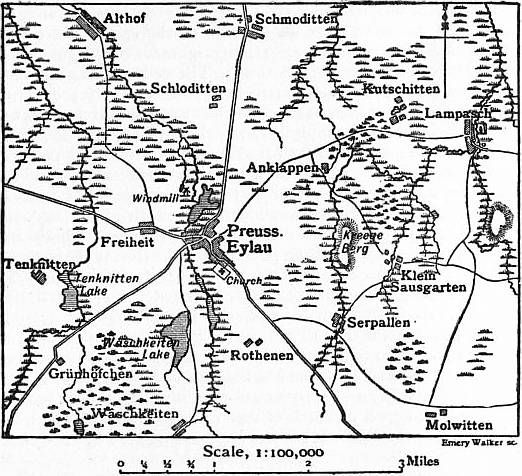
The shock of a second wave of cavalry broke the lines again, and though in the final retirement the exhausted troopers lost terribly, they had achieved their object. The wreck of Augéreau’s and other divisions had been reformed, the Guard brought up into first line, and, above all, Davout’s leading troops had occupied Serpallen. Thence, with his left in touch with Napoleon’s right (St Hilaire), and his right extending gradually towards Klein Sausgarten, the marshal pressed steadily upon the Russian left, rolling it up before him, until his right had reached Kutschitten and his centre Anklappen. By that time the troops under Napoleon’s immediate command, pivoting their left on Eylau church, had wheeled gradually inward until the general line extended from the church to Kutschitten. The Russian army was being driven westward, when the advance of Lestocq gave them fresh steadiness. The Prussian corps had been fighting a continuous flank-guard action against Marshal Ney to the north-west of Althof, and Lestocq had finally succeeded in disengaging his main body, Ney being held up at Althof by a small rearguard, while the Prussians, gathering as they went the fugitives of the Russian army, hastened to oppose Davout. The impetus of these fresh troops led by Lestocq and his staff-officer Scharnhorst was such as to check even the famous divisions of Davout’s corps which had won the battle of Auerstädt single-handed. The French were now gradually forced back until their right was again at Sausgarten and their centre on the Kreege Berg.
Both sides were now utterly exhausted, for the Prussians also had been marching and fighting all day against Ney. The battle died away at nightfall, Ney’s corps being unable effectively to intervene owing to the steadiness of the Prussian detachment left to oppose him, and the extreme difficulty of the roads. A severe conflict between the Russian extreme right and Ney’s corps which at last appeared on the field at Schloditten ended the battle. Bennigsen retreated during the night through Schmoditten, Lestocq through Kutschitten. The numbers engaged in the first stage of the battle may be taken as—Napoleon, 50,000, Bennigsen, 67,000, to which later were added on the one side Ney and Davout, 29,000, on the other Lestocq, 7000. The losses were roughly, 15,000 men to the French, 18,000 to the Allies, or 21 and 27% respectively of the troops actually engaged. The French lost 5 eagles and 7 other colours, the Russians 16 colours and 24 guns..
EYRA (Felis eyra), a South American wild cat, of weasel-like build, and uniform coloration, varying in different individuals from reddish-yellow to chestnut. It is found in Brazil, Guiana and Paraguay, and extends its range to the Rio del Norte, but is rare north of the isthmus of Panama. Little is known of its habits in a wild state, beyond the fact that it is a forest-dweller, active in movement and fierce in disposition. Several have been exhibited in the London Zoological Gardens, and some have grown gentle in captivity. Don Felix de Azara wrote of one which he kept on a chain that it was “as gentle and playful as any kitten could be.” The name is sometimes applied to the jaguarondi.
EYRE, EDWARD JOHN (1815-1901), British colonial governor, the son of a Yorkshire clergyman, was born on the 5th of August 1815. He was intended for the army, but delays having arisen in producing a commission, he went out to New South Wales, where he engaged in the difficult but very necessary undertaking of transporting stock westward to the new colony of South Australia, then in great distress, and where he became magistrate and protector of the aborigines, whose interests he warmly advocated. Already experienced as an Australian traveller, he undertook the most extensive and difficult journeys in the desert country north and west of Adelaide, and after encountering the greatest hardships, proved the possibility of land communication between South and West Australia. In 1845 he returned to England and published the narrative of his travels. In 1846 he was appointed lieutenant-governor of New Zealand, where he served under Sir George Grey. After successively governing St Vincent and Antigua, he was in 1862 appointed acting-governor of Jamaica and in 1864 governor. In October 1865 a negro insurrection broke out and was repressed with laudable vigour, but the unquestionable severity and alleged illegality of Eyre’s subsequent proceedings raised a storm at home which induced the government to suspend him and to despatch a special commission of investigation, the effect of whose inquiries, declared by his successor, Sir John Peter Grant, to have been “admirably conducted,” was that he should not be reinstated in his office. The government, nevertheless, saw nothing in Eyre’s conduct to justify legal proceedings; indictments preferred by amateur prosecutors at home against him and military officers who had acted under his direction, resulted in failure, and he retired upon the pension of a colonial governor. As an explorer Eyre must be classed in the highest rank, but opinions are always likely to differ as to his action in the Jamaica rebellion. He died on the 30th of November 1901.
EYRE, SIR JAMES (1734-1799), English judge, was the son of the Rev. Thomas Eyre, of Wells, Somerset. He was educated at Winchester College and at St John’s College, Oxford, which, however, he left without taking a degree. He was called to the bar at Gray’s Inn in 1755, and commenced practice in the lord mayor’s and sheriffs’ courts, having become by purchase one of the four counsel to the corporation of London. He was appointed recorder of London in 1763. He was counsel for the plaintiff in the case of Wilkes v. Wood, and made a brilliant speech in condemnation of the execution of general search warrants. His refusal to voice the remonstrances of the corporation against the exclusion of Wilkes from parliament earned him the recognition of the ministry, and he was appointed a judge of the exchequer in 1772. From June 1792 to January 1793 he was chief commissioner of the great seal. In 1793 he was made chief justice of the common pleas, and presided over the trials of Horne Tooke, Thomas Crosfield and others, with great ability and impartiality. He died on the 1st of July 1799 and was buried at Ruscombe, Berkshire.
See Howell, State Trials, xix. (1154—1155); Foss, Lives of the Judges.
EYRIE, the alternative English form of the words Aerie or Aery, the lofty nest of a bird of prey, especially of an eagle, hence any lofty place of abode; the term is also used of the brood of the bird. The word derives from the Fr. aire, of the same meaning, which comes from the Lat. area, an open space, but was early connected with aërius, high in the air, airy, a confusion that has affected the spelling of the word. The forms “eyrie” or “eyry” date from a 17th century attempt to derive the word from the Teutonic ey, an egg.
EZEKIEL (יחזקאל, “God strengthens” or “God is strong”; Sept. Ἰεζεκιήλ; Vulg. Ezechiel), son of Buzi, one of the most vigorous and impressive of the older Israelite thinkers. He was a priest of the Jerusalem temple, probably a member of the dominant house of Zadok, and doubtless had the literary training of the cultivated priesthood of the time, including acquaintance with the national historical, legal and ritual traditions and with the contemporary history and customs of neighbouring peoples. In the year 597 (being then, probably, not far from thirty years of age) he was carried off to Babylonia by Nebuchadrezzar with King Jehoiachin and a large body of nobles, military men and artisans, and there, it would seem, he spent the rest of his life. His prophecies are dated from this year (“our captivity,” xl. 1), except in i. 1, where the meaning of the date “thirtieth year” is obscure; it cannot refer to his age (which would be otherwise expressed in Hebrew), or to the reform of Josiah, 621 (which is not elsewhere employed as an epoch); possibly the reference is to the era of Nabopolassar (626 according to the Canon of Ptolemy), if chronological inexactness be supposed (34 or 33 years instead of 30), a supposition not at all improbable. That the word “thirtieth” is old, appears from the fact that a scribe has added a gloss (vv. 2, 3) to bring this statement into accord with the usual way of reckoning in the book: the “thirtieth” year, he explains, is the fifth year of the captivity of Jehoiachin. The exiles dwelt at Tell-abib (“Hill of the flood”), one of the mounds or ruins made by the great floods that devastated the country,1 near the “river” Chebar (Kebar), probably a large canal not far south of the city of Babylon. Here they had their own lands, and some form of local government by elders, and appear to have been prosperous and contented; probably the only demand made on them by the Babylonian government was the payment of taxes.
Ezekiel was married (xxiv. 18), had his own house, and comported himself quietly as a Babylonian subject. But he was a profoundly interested observer of affairs at home and among the exiles: as patriot and ethical teacher he deplored alike the political blindness of the Jerusalem government (King Zedekiah revolted in 588) and the immorality and religious superficiality and apostasy of the people. He, like Jeremiah, was friendly to Nebuchadrezzar, regarding him as Yahweh’s instrument for the chastisement of the nation. Convinced that opposition to Babylonian rule was suicidal, and interpreting historical events, in the manner of the times, as indications of the temper of the deity, he held that the imminent political destruction of the nation was proof of Yahweh’s anger with the people on account of their moral and religious depravity; Jerusalem was hopelessly corrupt and must be destroyed (xxiv.). On the other hand, he was equally convinced that, as his predecessors had taught (Hos. xi. 8, 9; Isa. vii. 3 al.), Yahweh’s love for his people would not suffer them to perish utterly—a remnant would be saved, and this remnant he naturally found in the exiles in Babylonia, a little band plucked from the burning and kept safe in a foreign land till the wrath should have passed (xi. 14 ff.). This conception of the exiles as the kernel of the restored nation he further set forth in the great vision of ch. i., in which Yahweh is represented as leaving Jerusalem and coming to take up his abode among them in Babylonia for a time, intending, however, to return to his own city (xliii. 7).
This, then, was Ezekiel’s political creed—destruction of Jerusalem and its inhabitants, restoration of the exiles, and meantime submission to Babylon. His arraignment of the Judeans is violent, almost malignant (vi. xvi. al.). The well-meaning but weak king Zedekiah he denounces with bitter scorn as a perjured traitor (xvii). He does not discuss the possibility of successful resistance to the Chaldeans; he simply assumes that the attempt is foolish and wicked, and, like other prophets, he identifies his political programme with the will of God. Probably his judgment of the situation was correct; yet, in view of Sennacherib’s failure at Jerusalem in 701 and of the admitted strength of the city, the hope of the Jewish nobles could not be considered wholly unfounded, and in any case their patriotism (like that of the national party in the Roman siege) was not unworthy of admiration. The prophet’s predictions of disaster continued, according to the record, up to the investment of the city by the Chaldean army in 588 (i.-xxiv.); after the fall of the city (586) his tone changed to one of consolation (xxxiii.-xxxix.)—the destruction of the wicked mass accomplished, he turned to the task of reconstruction. He describes the safe and happy establishment of the people in their own land, and gives a sketch of a new constitution, of which the main point is the absolute control of public religion by the priesthood (xl.-xlviii.).
The discourses of the first period (i.-xxiv.) do not confine themselves to political affairs, but contain much interesting ethical and religious material. The picture given of Jerusalemite morals is an appalling one. Society is described as honeycombed with crimes and vices; prophets, priests, princes and the people generally are said to practise unblushingly extortion, oppression, murder, falsehood, adultery (xxii.). This description is doubtless exaggerated. It may be assumed that the social corruption in Jerusalem was such as is usually found in wealthy communities, made bolder in this case, perhaps, by the political unrest and the weakness of the royal government under Zedekiah. No such charges are brought by the prophet against the exiles, in whose simple life, indeed, there was little or no opportunity for flagrant violation of law. Ezekiel’s own moral code is that of the prophets, which insists on the practice of the fundamental civic virtues. He puts ritual offences, however, in the same category with offences against the moral law, and he does not distinguish between immorality and practices that are survivals of old recognized customs: in ch. xxii. he mentions “eating with the blood”2 along with murder, and failure to observe ritual regulations along with oppression of the fatherless and the widow; the old customary law permitted marriage with a half-sister (father’s daughter), with a daughter-in-law, and with a father’s wife (Gen. xx. 12, xxxviii. 26; 2 Sam. xvi. 21, 22), but the more refined feeling of the later time frowned on the custom, and Ezekiel treats it as adultery.3 However, notwithstanding the insistence on ritual, natural in a priest, his moral standard is high; following the prescription of Ex. xxii. 21 [20] he regards oppression of resident aliens (a class that had not then received full civil rights) as a crime (xxii. 7), and in his new constitution (xlvii. 22, 23) gives them equal rights with the homeborn. His strongest denunciation is directed against the religious practices of the time in Judea—the worship of the Canaanite local deities (the Baals), the Phoenician Tammuz, and the sun and other Babylonian and Assyrian gods (vi., viii., xvi., xxiii.); he maintained vigorously the prophetic struggle for the sole worship of Yahweh. Probably he believed in the existence of other gods, though he does not express himself clearly on this point; in any case he held that the worship of other deities was destructive to Israel. His conception of Yahweh shows a mingling of the high and the low. On the one hand, he regards him as supreme in power, controlling the destinies of Babylonia and Egypt as well as those of Israel, and as inflexibly just in dealing with ordinary offences against morality. But he conceives of him, on the other hand, as limited locally and morally—as having his special abode in. the Jerusalem temple, or elsewhere in the midst of the Israelite people, and as dealing with other nations solely in the interests of Israel. The bitter invectives against Ammon, Moab, Edom, Philistia, Tyre, Sidon and Egypt, put into Yahweh’s mouth, are based wholly on the fact that these peoples are regarded as hostile and hurtful to Israel; Babylonia, though nowise superior to Egypt morally, is favoured and applauded because it is believed to be the instrument for securing ultimately the prosperity of Yahweh’s people. The administration of the affairs of the world by the God of Israel is represented, in a word, as determined not by ethical considerations but by personal preferences. There is no hint in Ezekiel’s writings of the grandiose conception of Isa. xl.-lv., that Israel’s mission is to give the knowledge of religious truth to the other nations of the world; he goes so far as to say that Yahweh’s object in restoring the fortunes of Israel is to establish his reputation among the nations as a powerful deity (xxxvi. 20-23, xxxvii. 28, xxxix. 23). The prophet regards Yahweh’s administrative control as immediate: he introduces no angels or other subordinate supernatural agents—the cherubs and the “men” of ix. 2 and xl. 3 are merely imaginative symbols or representations of divine activity. His high conception of God’s transcendence, it may be supposed, led him to ignore intermediary agencies, which are common in the popular literature, and later, under the influence of this same conception of transcendence, are freely employed.
The relations between the writings of Ezekiel and those of Jeremiah is not clear. They have so much in common that they must have drawn from the same current bodies of thought, or there must have been borrowing in one direction or the other. In one point, however,—the attitude toward the ritual—the two men differ radically. The finer mind of the nation, represented mainly by the prophets from Amos onward, had denounced unsparingly the superficial non-moral popular cult. The struggle between ethical religion and the current worship became acute toward the end of the 7th century. There were two possible solutions of the difficulty. The ritual books of our Pentateuch were not then in existence, and the sacrificial cult might be treated with contempt as not authoritative. This is the course taken by Jeremiah, who says boldly that God requires only obedience (Jer. vii. 21 ff.). On the other hand the better party among the priests, believing the ritual to be necessary, might undertake to moralize it; of such a movement, begun by Deuteronomy, Ezekiel is the most eminent representative. Priest and prophet, he sought to unify the national religious consciousness by preserving the sacrificial cult, discarding its abuses and vitalizing it ethically. The event showed that he judged the situation rightly—the religious scheme announced by him, though not accepted in all its details, became the dominant policy of the later time, and he has been justly called “the father of Judaism.” He speaks as a legislator, citing no authority; but he formulates, doubtless, the ideas and perhaps the practices of the Jerusalem priesthood. His ritual code (xliii.-xlvi.), which in elaborateness stands midway between that of Deuteronomy and that of the middle books of the Pentateuch (resembling most nearly the code of Lev. xvii.-xxvi.) shows good judgment. Its most noteworthy features are two. Certain priests of idolatrous Judean shrines (distinguished by him as “Levites”) he deprives of priestly functions, degrading them to the rank of temple menials; and he takes from the civil ruler all authority over public religion, permitting him merely to furnish material for sacrifices. He is, however, much more than a ritual reformer. He is the first to express clearly the conception of a sacred nation, isolated by its religion from all others, the guardian of divine law and the abode of divine majesty. This kingdom of God he conceives of as moral: Yahweh is to put his own spirit into the people,4 creating in them a disposition to obey his commandments, which are moral as well as ritual (xxxvi. 26, 27). The conception of a sacred nation controlled the whole succeeding Jewish development; if it was narrow in its exclusive regard for Israel, its intensity saved the Jewish religion to the world.
Text and Authorship.—The Hebrew text of the book of Ezekiel is not in good condition—it is full of scribal inaccuracies and additions. Many of the errors may be corrected with the aid of the Septuagint (e.g. the 430—390 + 40—of iv. 5, 6 is to be changed to 190), and none of them affect the general thought. The substantial genuineness of the discourses is now accepted by the great body of critics. The Talmudic tradition (Baba Bathra 14b) that the men of the Great Synagogue “wrote” Ezekiel, may refer to editorial work by later scholars.5 There is no validity in the objections of Zunz (Gottesdienstl. Vortr.) that the specific prediction concerning Zedekiah (xii. 12 f.) is non-Prophetic, and that the drawing-up of a new constitution soon after the destruction of the city and the mention of Noah, Daniel, Job and Persia are improbable. The prediction in question was doubtless added by Ezekiel after the event; the code belongs precisely in his time, and the constitution was natural for a priest; Noah, Daniel and Job are old legendary Hebrew figures; and it is not probable that the prophet’s “Paras” is our “Persia.” Havet’s contention (in La Modernité des prophètes) that Gog represents the Parthians (40 B.C.) has little or nothing in its support. There are additions made post eventum, as in the case mentioned above and in xxix. 17-20, and the description of the commerce of Tyre (xxvii. 9b-25a), which interrupts the comparison of the city to a ship, looks like an insertion whether by the prophet or by some other; but there is no good reason to doubt that the book is substantially the work of Ezekiel. Ezekiel’s style is generally impetuous and vigorous, somewhat smoother in the consolatory discourses (xxxiv., xxxvi., xxxvii.); he produces a great effect by the cumulation of details, and is a master of invective; he is fond of symbolic pictures, proverbs and allegories; his “visions” are elaborate literary productions, his prophecies show less spontaneity than those of any preceding prophet (he receives his revelations in the form of a book, ii. 9), and in their present shape were hardly pronounced in public—a fact that seems to be hinted at in the statement that he was “dumb” till the fall of Jerusalem (iii. 26, xxxiii. 22); in private interviews the people did not take him seriously (xxxiii. 30-33). His book was accepted early as part of the sacred literature: Ben-Sira (c. 180 B.C.) mentions him along with Isaiah and Jeremiah (Ecclus. xlix. 8); he is not quoted directly in the New Testament, but his imagery is employed largely in the Apocalypse and elsewhere. His divergencies from the Pentateuchal code gave rise to serious doubts, but, after prolonged study, the discrepancies were explained, and the book was finally canonized (Shab. 13b). According to Jerome (Preface to Comm. on Ezek.) the Jewish youth were forbidden to read the mysterious first chapter (called the markaba, the “chariot”) and the concluding section (xl.-xlviii.) till they reached the age of thirty years.
The book divides itself naturally into three parts: the arraignment of Jerusalem (i.-xxiv.); denunciation of foreign enemies (xxv.-xxxii.); consolatory construction of the future (xxxiii.-xlviii.). The opening “vision” (i.), an elaborate symbolic picture, is of the nature of a general preface, and was composed probably late in the prophet’s life. Out of the north (the Babylonian sacred mountain) comes a bright cloud, wherein appear four Creatures (formed on the model of Babylonian composite figures), each with four faces (man, lion, bull, eagle) and attended by a wheel; the wheels are full of eyes, and move straight forward, impelled by the spirit dwelling in the Creatures (the spirit of Yahweh). Supported on their heads is something like a crystalline firmament, above which is a form like a sapphire throne (cf. Ex. xxiv. 10), and on the throne a man-like form (Yahweh) surrounded by a rainbow brightness. The wheels symbolize divine omniscience and control, and the whole vision represents the coming of Yahweh to take up his abode among the exiles. The prophet then receives his call (ii., iii.) in the shape of a roll of a book, which he is required to eat (an indication of the literary form now taken by prophecy). He is informed that the people to whom he is sent are rebellious and stiff-necked (this indicates his opinion of the people, and gives the keynote of the following discourses); he is appointed watchman to warn men when they sin, and is to be held responsible for the consequences if he fail in this duty. To this high conception of a preacher’s function the prophet was faithful throughout his career. Next follow minatory discourses (iv.-vii.) predicting the siege and capture of Jerusalem-perhaps revised after the event. There are several symbolic acts descriptive of the siege. One of these (iv. 4 ff.) gives the duration of the national punishment in loose chronological reckoning: 40 years (a round number) for Judah, and 150 more (according to the corrected text) for Israel, the starting-point, probably, being the year 722, the date of the capture of Samaria; the procedure described in v. 8 is not to be understood literally. In vi. the idolatry of the nation is pictured in darkest colours. Next follows (viii.-xi.) a detailed description, in the form of a vision, of the sin of Jerusalem: within the temple-area elders and others are worshipping beast-forms, Tammuz and the sun (probably actual cults of the time); 6 men approach to defile the temple and slay the inhabitants of the city (ix.). In ch. x. the imagery of ch. i. reappears, and the Creatures are identified with the cherubs of Solomon’s temple. This appears to be an independent form of the vision, which has been brought into connexion with that of i. by a harmonizing editor. There follow a symbolic prediction of the exile (xii.) and a denunciation of non-moral prophets and prophetesses (xiii.)—though Yahweh deceive a prophet, yet he and those who consult him will be punished; and so corrupt is the nation that the presence of a few eminently good men will not save it (xiv.).7 After a comparison of Israel to a worthless wild vine (xv.) come two allegories, one portraying idolatrous Jerusalem as the unfaithful spouse of Yahweh (xvi.), the other describing the fate of Zedekiah (xvii.). The fine insistence on individual moral responsibility in xviii. (cf. Deut. xxiv. 16, Jer. xxxi. 29 f.), while it is a protest against a superficial current view, is not to be understood as a denial of all moral relations between successive generations. This latter question had not presented itself to the prophet’s mind; his object was simply to correct the opinion of the people that their present misfortunes were due not to their own faults but to those of their predecessors. A more sympathetic attitude appears in two elegies (xix.), one on the kings Jehoahaz and Jehoiachin, the other on the nation. These are followed by a scathing sketch of Israel’s religious career (xx. 1-26), in which, contrary to the view of earlier prophets, it is declared that the nation had always been disobedient. From this point to the end of xxiv. there is a mingling of threat and promise.8 The allegory of xxiii. is similar to that of xvi., except that in the latter Samaria is relatively treated with favour, while in the former it (Aholah) is involved in the same condemnation as that of Jerusalem. At this point is introduced (xxv.-xxxii.) the series of discourses directed against foreign nations. The description of the king of Tyre (xxviii. 11-19) as dwelling in Eden, the garden of God, the sacred mountain, under the protection of the cherub, bears a curious resemblance to the narrative in Gen. ii., iii., of which, however, it seems to be independent, using different Babylonian material; the text is corrupt. The section dealing with Egypt is one of remarkable imaginative power and rhetorical vigour: the king of Egypt is compared to a magnificent cedar of Lebanon (in xxxi. 3 read: “there was a cedar in Lebanon”) and to the dragon of the Nile, and the picture of his descent into Sheol is intensely tragic. Whether these discourses were all uttered between the investment of Jerusalem and its fall, or were here inserted by Ezekiel or by a scribe, it is not possible to say. In xxxiii. the function of the prophet as watchman is described at length (expansion of the description in iii.) and the news of the capture of the city is received. The following chapters (xxxiv.-xxxix.) are devoted to reconstruction: Edom, the detested enemy of Israel, is to be crushed; the nation, politically raised from the dead, with North and South united (xxxvii.), is to be established under a Davidide king; a final assault, made by Gog, is to be successfully met,9 and then the people are to dwell in their own land in peace for ever; this Gog section is regarded by some as the beginning of Jewish apocalyptic writing. In the last section (xl.-xlviii.), put as a vision, the temple is to be rebuilt, in dimensions and arrangements a reproduction of the temple of Solomon (cf. I Kings vi., vii.), the sacrifices and festivals and the functions of priests and prince are prescribed, a stream issuing from under the temple is to vivify the Dead Sea and fertilize the land (this is meant literally), the land is divided into parallel strips and assigned to the tribes. The prophet’s thought is summed up in the name of the city: Yahweh Shammah, “Yahweh is there,” God dwelling for ever in the midst of his people.
Literature.—For the older works see the Introductions of J.G. Carpzov (1757) and C.H.H. Wright (1890). For legends: Pseud.-Epiphan., De vit. prophet.; Benjamin of Tudela, Itin.; Hamburger, Realencycl.; Jew. Encycl. On the Hebrew text; C.H. Cornill, Ezechiel (1886) (very valuable for text and ancient versions); H. Graetz, Emendationes (1893).; C.H. Toy, “Text of Ezek.” (1899) in Haupt’s Sacred Books of the Old Test. Commentaries: F. Hitzig (1847); H. Ewald (1868); E. Reuss (French ed., 1876; Germ, ed., 1892); Currey (1876) in Speaker’s Comm.; R. Smend (revision of Hitzig) (1880) in Kurzgefasst. exeget. Handbuch; A.B. Davidson (1882) in Cambr. Bible for Schools; J. Skinner (1895) in Expos. Bible; A. Bertholet (1897) in Marti’s Kurz. Hand-Comm.; C.H. Toy (1899) in Haupt’s Sacr. Bks. (Eng. ed.); R. Kraetzschmar (1900) in W. Nowack’s Handkommentar. See also Duhm, Theol. d. Propheten (1875); A. Kuenen, Prophets and Prophecy (1877); Gautier, La Mission du prophète Ezéchiel (1891); Montefiore, Hibbert Lectures (1892); A. Bertholet, Der Verfassungsentwurf des Hesekiel (1896); articles in Herzog-Hauck, Realencykl.; Hastings, Bibl. Dict.; Cheyne, Encycl. Bibl., Jew. Encycl.; F. Bleek, Introd. (Eng. tr., 1875), and Bleek-Wellhausen (Germ.) (1878); Wildeboer, Letterkunde d. Oud. Verbonds (1893), and Germ, transl., Litt. d. Alt. Test.; Perrot and Chipiez, Hist. de l’art, &c. , in which, however, the restoration of Ezekiel’s temple (by Chipiez) is probably untrustworthy.
(C. H. T.*)
1 The Assyrian term abubu is used of the great primeval deluge (in the Gilgamesh epic), and also of the local floods common in the country.
2 So we must read (as Robertson Smith has pointed out) in xxii. 9 and xviii. 6, instead of “eating on the mountains.”
3 The stricter marriage law is formulated in Lev. xviii. 8-15, xx. 11 ff.
4 Yahweh’s spirit, thought of as Yahweh’s vital principle, as man’s spirit is man’s vital principle, is to be breathed into them, as, in Gen. ii. 7, Yahweh breathes his own breath into the lifeless body. The spirit in the Old Testament is a refined material thing that may come or be poured out on men.
5 The “Great Synagogue” is semi-mythical.
6 In viii. 17 the unintelligible expression “they put the branch to their nose” is the rendering of a corrupt Hebrew text; a probable emendation is: “they are sending a stench to my nostrils.”
7 The legendary figure of Daniel (xiv. 14) is later taken by the author of the book of Daniel as his hero.
8 For a reconstruction of the poem in xxi. 10, 11, see the English Ezekiel in Haupt’s Sacred Books.
9 Gog probably represents a Scythian horde (though such an invasion never took place)—certainly not Alexander the Great, who would have been called “king of Greece,” and would have been regarded not as an enemy but as a friend.
EZRA (from a Hebrew word meaning “help”), in the Bible, the famous scribe and priest at the time of the return of the Jews in the reign of the Persian king Artaxerxes I. (458 B.C.). His book and that of Nehemiah form one work (see Ezra and Nehemiah, Books of), apart from which we have little trustworthy evidence as to his life. Even in the beginning of the 2nd century B.C., when Ben Sira praises notable figures of the exilic and post-exilic age (Zerubbabel, Jeshua and Nehemiah), Ezra is passed over (Ecclesiasticus xlix. 11-13), and he is not mentioned in a still later and somewhat fanciful description of Nehemiah’s work (2 Macc. i. 18-36). Already well known as a scribe, Ezra’s labours were magnified by subsequent tradition. He was regarded as the father of the scribes and the founder of the Great Synagogue. According to the apocryphal fourth book of Ezra (or 2 Esdras xiv.) he restored the law which had been lost, and rewrote all the sacred records (which had been destroyed) in addition to no fewer than seventy apocryphal works. The former theory recurs elsewhere in Jewish tradition, and may be associated with the representation in Ezra-Nehemiah which connects him with the law. But the story of his many literary efforts, like the more modern conjecture that he closed the canon of the Old Testament, rests upon no ancient basis.
See Bible, sect. Old Testament (Canon and Criticism); Jews (history, §21 seq.). The apocryphal books, called 1 and 2 Esdras (the Greek form of the name) in the English Bible, are dealt with below as Ezra, Third Book of, and Ezra, Fourth Book of, while the canonical book of Ezra is dealt with under Ezra and Nehemiah.
EZRA, THIRD BOOK OF [1 Esdras]. The titles of the various books of the Ezra literature are very confusing. The Greek, the Old Latin, the Syriac, and the English Bible from 1560 onwards designate this book as 1 Esdras, the canonical books Ezra and Nehemiah being 2 Esdras in the Greek. In the Vulgate, however, our author was, through the action of Jerome, degraded into the third place and called 3 Esdras, whereas the canonical books Ezra and Nehemiah (see Ezra and Nehemiah, Books of, below) were called 1 and 2 Esdras, and the Apocalypse of Ezra 4 Esdras. Thus the nomenclature of our book follows, and possibly wrongly, the usage of the Vulgate.1 In the Ethiopic version a different usage prevails. The Apocalypse is called 1 Esdras, our author 2 Esdras, and Ezra and Nehemiah 3 Esdras, or 3 and 4 Esdras. Throughout this article we shall use the best attested designation of this book, i.e. 1 Esdras.
Contents.—With the exception of one original section, namely, that of Darius and the three young men, our author contains essentially the same materials as the canonical Ezra and some sections of 2 Chronicles and Nehemiah. To the various explanations of this phenomenon we shall recur later. The book may be divided as follows (the verse division is that of the Cambridge LXX):—
Chap. i. = 2 Chron. xxxv. 1-xxxvi. 21.—Great passover of Josiah; his death at Megiddo. His successors down to the destruction of Jerusalem and the Captivity. (Verses i. 21-22 are not found elsewhere, though the LXX of 2 Chron. xxxv. 20 exhibits a very distant parallel.)
Chap. ii. 1-14 = Ezra i.—The edict of Cyrus. Restoration of the sacred vessels through Sanabassar to Jerusalem.
Chap. ii. 15-25 = Ezra iv. 6-24.—First attempt to rebuild the Temple: opposition of the Samaritans. Decree of Artaxerxes: work abandoned till the second year of Darius.
Chap. iii. 1-v. 6.—This section is peculiar to our author. The contest between the three pages waiting at the court of Darius and the victory of the Jewish youth “Zerubbabel,” to whom as a reward Darius decrees the return of the Jews and the restoration of the Temple and worship. Partial list of those who returned with “Joachim, son of Zerubbabel.”
Chap. v. 7-70 = Ezra ii.-iv. 5.—List of exiles who returned with Zerubbabel. Work on the Temple begun. Offer of the Samaritans’ co-operation rejected. Suspension of the work through their intervention till the reign of Darius.
Chap. vi. 1-vii. 9 = Ezra v. 1-vi. 18.—Work resumed in the second year of Darius. Correspondence between Sisinnes and Darius with reference to the building of the Temple. Darius’ favourable decree. Completion of the work by Zerubbabel.
Chap. vii. 10-15 =Ezra vi. 19-22.—Celebration of the completion of the Temple.
Chap. viii. 1-ix. 36 = Ezra vii.-x.—Return of the exiles under Ezra. Mixed marriages forbidden.
Chap. ix. 37-55 = Nehemiah vii. 73-viii. 12.—The reading of the Law.
Thus, apart from iii. 1-v. 3, which gives an account of the pages’ contest, the contents of the book are doublets of the canonical Ezra and portions of 2 Chronicles and Nehemiah. The beginning of the book seems imperfect, with its abrupt opening “And Josiah held the passover”: its conclusion is mutilated, as it breaks off in the middle of a sentence. As Thackeray suggests, it probably continued the history of the feast of Tabernacles described in Neh. viii.—a view that is supported by Joseph. Ant. xi. 5. 5, “who describes that feast using an Esdras word ἐπανόρθωσις and ... having hitherto followed Esdras as his authority passes on to the Book of Nehemiah.”
Claims to Canonicity.—It would seem that even greater value was attached to 1 Esdras than to the Hebrew Ezra. (1) For in the best MSS. (BA) it stands before 2 Esdras—the verbal translation of the Hebrew Ezra and Nehemiah. (2) It is used by Josephus, who in fact does not seem aware of the existence of 2 Esdras. (3) 1 Esdras is frequently quoted by the Greek fathers—Clem. Alex., Origen, Eusebius, and by the Latin—Tertullian, Cyprian, Augustine. The adverse judgment of the church is due to Jerome, who, from his firm attachment to the Hebrew Old Testament, declined to translate the “dreams” of 3 and 4 Esdras. This judgment influenced alike the Council of Trent and the Lutheran church in Germany; for Luther also refused to translate Esdras and the Apocalypse of Ezra.
Origin and Relation to the Canonical Ezra.—Various theories have been given as to the relation of the book and the canonical Ezra.
1. Some scholars, as Keil, Bissell and formerly Schürer, regarded 1 Esdras as a free compilation from the Greek of 2 Esdras (2 Chron. and Ezra-Nehemiah). This theory has now given place to others more accordant with the facts of the case.
2. Others, as Ewald, Hist. of Isr. v. 126-128, and Thackeray in Hastings’ Bible Dictionary, assume a lost Greek version of Chronicles, Ezra and Nehemiah, from which were derived 1 Esdras—a free redaction of the former and 2 Esdras. Thackeray claims that we have “a satisfactory explanation of the coincidences in translation and deviation from the Hebrew in 1 Esdras and 2 Esdras, if we suppose both are to some extent dependent on a lost Greek original.” But later in the same article Thackeray is compelled to modify this view and admit that 1 Esdras is not a mere redaction of a no longer extant version of the canonical books, but shows not only an independent knowledge of the Hebrew text but also of a Hebrew text superior in not a few passages to the Massoretic text, where 2 Esdras gives either an inaccurate version or a version reproducing the secondary Massoretic text.