VOLUME VII SLICE X David, St to Demidov (continued 11)
Reading edition
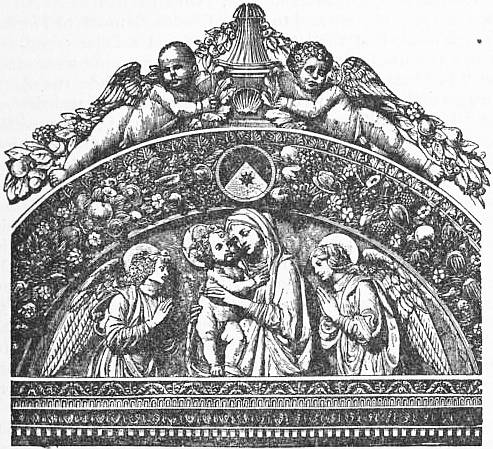
Fig. 3.—Relief of Madonna and Angels in the tympanum of the lavabo (S. Maria Novella, Florence), by Giovanni.
Giovanni lacked the original talent of Luca and Andrea, and so he not only copied their work but even reproduced in clay the marble sculpture of Pollaiuolo, Da Settignano, Verrocchio and others. A relief by him, evidently taken from Mino da Fiesole, exists in the Palazzo Castracane Staccoli. Among the very numerous other works of Giovanni are a relief in the wall of a suppressed convent in the Via Nazionale at Florence, and two reliefs in the Bargello dated 1521 and 1522. That dated 1521 is a many-coloured relief of the Nativity, and was taken from the church of S. Girolamo in Florence; it is a too pictorial work, marred by the use of many different planes. Its predella has a small relief of the Adoration of the Magi, and is inscribed “Hoc opus fecit Ioaes Andee de Robia, ac a posuit hoc in tempore die ultima lulli ANO. DNI. M.D. XXI.” At Pisa in the Campo Santo is a relief in Giovanni’s later and poorer manner dated 1520; it is a Madonna surrounded by angels, with saints below—the whole overcrowded with figures and ornaments. Giovanni’s largest and perhaps finest work is the polychromatic frieze on the outside of the Del Ceppo hospital at Pistoia, for which he received various sums of money between 1525 and 1529, as is recorded in documents which still exist among the archives of the hospital.18 The subjects of this frieze are the Seven Works of Mercy, forming a continuous band of sculpture in high relief, well modelled and designed in a very broad sculpturesque way, but disfigured by the crudeness of some of its colouring. Six of these reliefs are by Giovanni, namely, Clothing the Naked, Washing the Feet of Pilgrims, Visiting the Sick, Visiting Prisoners, Burying the Dead, and Feeding the Hungry. The seventh, Giving drink to the Thirsty, was made by Filippo Paladini of Pistoia in 1585; this last is simply made of painted stucco. The large figures of the virtues placed between the scenes, and the medallions between the pillars, are the work of assistants or imitators.
A large octagonal font of enamelled clay, with pilasters at the angles and panels between them with scenes from the life of the Baptist, in the church of S. Leonardo at Cerreto Guidi, is a work of the school of Giovanni; the reliefs are pictorial in style and coarse in execution. Giovanni’s chief pupil was a man named Benedetto Buglioni (1461-1521), and a pupil of his, one Santi Buglioni (b. 1494), entered the Robbia workshops in 1521, and assisted in the later works of Giovanni.
VII. Girolamo della Robbia (1488-1566), another of Andrea’s sons, was an architect and a sculptor in marble and bronze as well as in enamelled clay. During the first part of his life he, like his brothers, worked with his father, but in 1528 he went to France and spent nearly forty years in the service of the French Royal family. Francis I. employed him to build a palace in the Bois de Boulogne called the Château de Madrid. This was a large well-designed building, four storeys high, two of them having open loggie in the Italian fashion. Girolamo decorated it richly with terra-cotta medallions, friezes and other architectural features.19 For this purpose he set up kilns at Suresnes. Though the palace itself has been destroyed, drawings of it exist.20
The best collections of Robbia ware are in the Florentine Bargello, Accademia and Museo del Duomo; the Victoria and Albert Museum (the finest out of Italy); the Louvre, the Cluny and the Berlin Museums; while fine examples are to be found in New York, Boston, St Petersburg and Vienna. Many fine specimens exist in private collections in England, France, Germany and the United States. The greater part of the Robbia work still remains in the churches and other buildings of Italy, especially in Florence, Fiesole, Arezzo, La Verna, Volterra, Barga, Montepulciano, Lucca, Pistoia, Prato and Siena.
Literature.—H. Barbet de Jouy, Les della Robbia (Paris, 1855); W. Bode, Die Künstlerfamilie della Robbia (Leipzig, 1878); “Luca della Robbia ed i suoi precursori in Firenze,” Arch. stor. dell’ arte (1899); “Über Luca della Robbia,” Sitzungsbericht von der Berliner kunstgeschichtlichen Gesellschaft (1896); Florentiner Bildhauer der Renaissance (Berlin, 1902); G. Carocci, I Dintorni de Firenze (Florence, 1881); “Il Monumento di Benozzo Federighi,” Arte e Storia (1894); “Opere Robbiane poco noti,” Arte e storia (1898, 1899); Cavallucci et Molinier, Les della Robbia (Paris, 1884); Maud Crutwell, Luca and Andrea della Robbia and their Successors (London, 1902); A. du Cerceau, Les plus excellents bastiments de France (Paris, 1586); G. Milanesi, Le Vite scritte da Vasari (Florence, 1878); M. Reymond, Les della Robbia (Florence, 1897); La Sculpture Florentine (Florence, 1898); I. B. Supino, Catalogo del R. Museo di Firenze (Rome 1898); Vasari (see Milanesi’s edition).
(J. H. M.; W. B.*)
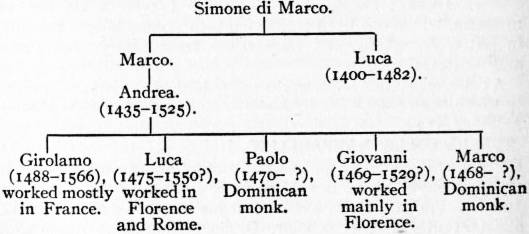
1 Genealogical tree of Della Robbia sculptors:—
2 Not 1388, as Vasari says. See a document printed by Gaye, Carteggio inedito, i. pp. 182-186.
3 Vasari is not quite right in his account of these reliefs: he speaks of Euclid and Ptolemy as being in different panels.
4 See Cavallucci, S. Maria del Fiore, pt. ii. p. 137.
5 The Victoria and Albert Museum possesses what seem to be fine replicas of these statues.
6 The document in which the order for this and the price paid for it are recorded is published by Yriarte, Gaz. d. beaux arts, xxiv. p. 143.
7 One of these medallions, that of the Physicians, is now removed to the inside of the church.
8 It is fully described by Filarete in his Trattato dell’ architectura, written in 1464, and therefore was finished before that date; see also Vasari, ed. Milanesi (Florence, 1880), ii. p. 174.
9 His will, dated 19th February 1471, is published by Gaye, Cart. ined. i. p. 185.
10 In the works of Perkins and others on Italian sculpture these Perugian reliefs are wrongly stated to be of enamelled clay.
11 Professor Marquand has discovered, beneath 1451, the inscription Prete Benino, and, under 1495, De Benini; probably the names of the governors of the hospital at these dates.
12 See Gualandi, Memorie risguardanti le belle arti (Bologna, 1845), vi. pp. 33-35, where original documents are printed recording the dates and prices paid for these and other works of Andrea.
13 See a document printed by Milanesi in his Vasari, ii. p. 180.
14 It appears certain that this Luca was a layman and not the Fra Luca referred to above.
15 It is illustrated by Gruner, Fresco Decorations of Italy (London, 1854), pl. iv.; see also Müntz, Raphaël, sa vie, &c. (Paris, 1881), p. 452, note i., and Vasari, ed. Milanesi, ii. p. 182.
16 See a document printed by Milanesi in his Vasari, ii. 193.
17 Examples of these imitations are a retable in S. Lucchese near Poggibonsi dated 1514, another of the Madonna and Saints at Monte San Savino of 1525, and a third in the Capuchin church of Arceria near Sinigaglia; they are all inferior to the best works of the Robbia family, though some of them may have been made by assistants trained in the Robbia workshops.
18 The hospital itself was begun in 1514.
19 The Sèvres Museum possesses some fragments of these decorations.
20 See Laborde, Château de Madrid (Paris, 1853), and Comptes des bâtiments du roi (Paris, 1877-1880), in which a full account is given of Girolamo’s work in connexion with this palace.
DELMEDIGO, a Cretan Jewish family, of whom the following are the most important:
Elijah Delmedigo (1460-1497), philosopher, taught in several Italian centres of learning. He translated some of Averroes’ commentaries into Latin at the instigation of Pico di Mirandola. In the sphere of religion, Delmedigo represents the tendency to depart from the scholastic attitude in which religion and philosophy were identified. His most important work was devoted to this end; it was entitled Behinath ha-Dath (Investigation of Religion).
Joseph Solomon Delmedigo (1591-1655), pupil of Galileo, wrote many books on science and philosophy, and bore a considerable part in initiating the critical movement in Judaism. He belonged to the sceptical school, and though his positive contributions to literature were not of lasting worth, Graetz includes him among the important formative influences within the synagogue of the 17th century.
(I. A.)
DELMENHORST, a town of Germany, grand duchy of Oldenburg, on the Delme, 8 m. by rail W. from Bremen, at the junction of a line to Vechta. Pop. (1905) 20,147. It has a Protestant and a Roman Catholic church, and is the seat of considerable industries; notably wool-combing, weaving, jute-spinning and the manufacture of linoleum. Delmenhorst was founded in 1230, and from 1247 to 1679, when it was destroyed by the French, was protected by a strong castle.
DELOLME, JEAN LOUIS (1740-1806), Swiss jurist and constitutional writer, was born at Geneva in 1740. He studied for the bar, and had begun to practise when he was obliged to emigrate on account of a pamphlet entitled Examen de trois parts de droit, which gave offence to the authorities of the town. He took refuge in England, where he lived for several years on the meagre and precarious income derived from occasional contributions to various journals. In 1775 he found himself compelled to accept aid from a charitable society to enable him to return home. He died at Sewen, a village in the canton of Schwyz, on the 16th of July 1806.
During his protracted exile in England Delolme made a careful study of the English constitution, the results of which he published in his Constitution de l’Angleterre (Amsterdam, 1771), of which an enlarged and improved edition in English appeared in 1772, and was several times reprinted. The work excited much interest as containing many acute observations on the causes of the excellence of the English constitution as compared with that of other countries. It is, however, wanting in breadth of view, being written before the period when constitutional questions were treated in a scientific manner. Along with a translation of Hume’s History of England it supplied the philosophes with most of their ideas about the English constitution. It thus was used somewhat as a political pamphlet. Several editions were published after the author’s death. Delolme also wrote in English Parallel between the English Government and the former Government of Sweden (1772); A History of the Flagellants (1782), based upon a work of Boileau’s; An Essay on the Union of Scotland with England (1787), and one or two smaller works.
DELONEY (or Delone), THOMAS, English ballad-writer and pamphleteer, produced his earliest indisputable work in 1586, and died about 1600. In 1596 Thomas Nashe, in his Have with you to Saffron Walden, wrote: “Thomas Deloney, the ballating silk-weaver, hath rime enough for all myracles, and wit to make a Garland of Good Will more than the premisses ... and this deare yeare, together with the silencing of his looms, scarce that, he being constrained to betake himself to carded ale; whence it proceedeth that since Candlemas, or his jigge, John for the king, not one merrie dittie will come from him, but, the Thunderbolt against Swearers,—Repent, England, Repent—and, the strange Judgements of God.” In 1588 the coming of the Armada inspired him for three broadsides, which were reprinted (1860) by J. O. Halliwell-Phillipps. They are entitled “The Queenes visiting of the Campe at Tilsburie with her entertainment there,” “A Joyful new Ballad, declaring the happie obtaining of the great Galleazzo ...,” and “A new Ballet of the straunge and Most cruell Whippes which the Spaniards had prepared.” A collection of Strange Histories (1607) consists of historical ballads by Deloney, with some poems from other hands. This collection, known in later and enlarged editions as The Royal Garland of Love and Delight and The Garland of Delight, contains the ballad of Fair Rosamond. J. H. Dixon in his preface to The Garland of Good Will (Percy Society, 1851) ascribes to Deloney The Blind Beggar of Bednall Green, and The Pleasant and sweet History of Patient Grissel, in prose, with the whole of the Garland of Good Will, including some poems such as “The Spanish Lady’s Love” generally supposed to be by other hands. His other works include The Gentle Craft (1597) in praise of shoemakers, The Pleasant Historie of John Winchecombe (8th ed., 1619), and Thomas of Reading or the Sixe Worthie Yeomen of the West (earliest extant edition, 1612). Kempe, the actor, jeers at these histories in his Nine Daies Wonder, but they were very popular, being reprinted as penny chap-books.
DE LONG, GEORGE WASHINGTON (1844-1881), American explorer, was born in New York city on the 22nd of August 1844. He graduated at the U.S. Naval Academy in 1865, and spent the next fourteen years in naval service in various parts of the world, attaining the rank of lieutenant in 1869, and lieutenant-commander in 1879. In 1873 he took part in the voyage of the “Juniata,” sent to search for and relieve the American Arctic expedition under Hall in the “Polaris,” commanding a steam launch which was sent out from Upernivik, Greenland, to make a thorough search of Melville Bay. On his return to New York the same year he proposed to James Gordon Bennett, of The New York Herald, that the latter should fit out a Polar expedition. It was not until 1879 that the final arrangements were made, the “Pandora,” a yacht which had already made two Arctic voyages under Sir Allen Young, being purchased and rechristened the “Jeannette” for this voyage. The story of this expedition (see Polar Regions) is chiefly remarkable on account of the long and helpless drifting of the “Jeannette” with the polar ice-pack in which she was caught (September 5, 1879) and by which she was finally crushed and sunk on the 13th of June 1881. The members of the expedition set out in three boats, one of which was lost in a gale, while another boat-load under De Long died from starvation after reaching the mouth of the Lena river. He was the last survivor of his party. His journal, in which he made regular entries up to the day on which he died (October 30, 1881) was edited by his wife and published in 1883 under the title Voyage of the “Jeannette”; and an account of the search which was made for him and his comrades by his heroic companion George W. Melville, who was chief engineer of the expedition and commanded the third of the retreating parties, was published a year later under the title of In the Lena Delta. The fate of the “Jeannette” was still more remarkable in its sequel. Three years after she had sunk several articles belonging to her crew were found on an ice-floe near Julianshaab on the south-west coast of Greenland; thus adding fresh evidence to the theory of a continuous ocean current passing across the unknown Polar regions, which was to be finally demonstrated by Nansen’s voyage in the “Fram.” By direction of the United States government, the remains of De Long and his companions were brought home and interred with honour in his native city.
DELORME, MARION (c. 1613-1650), French courtesan, was the daughter of Jean de Lou, sieur de l’Orme, president of the treasurers of France in Champagne, and of Marie Chastelain. She was born at her father’s château near Champaubert. Initiated into the philosophy of pleasure by the epicurean and atheist Jacques Vallée, sieur Desbarreaux, she soon left him for Cinq Mars, at that time at the height of his popularity, and succeeded, it is said, in marrying him in secret. From this time Marion Delorme’s salon became one of the most brilliant centres of elegant Parisian society. After the execution of Cinq Mars she is said to have numbered among her lovers Charles de St Evremond (1610-1703) the wit and littérateur, Buckingham (Villiers), the great Condé, and even Cardinal Richelieu. Under the Fronde her salon became a meeting place for the disaffected, and Mazarin is said to have sent to arrest her when she suddenly died. Her last years have been adorned with considerable legend (cf. Merecourt, Confessions de Marie Delorme, Paris, 1856). It seems established that she died in 1650. But she was believed to have lived until 1706 or even 1741, after having had the most fantastic adventures, including marriage with an English lord, and an old age spent in poverty in Paris. Her name has been popularized by various authors, especially by Alfred de Vigny in his novel Cinq Mars, by Victor Hugo in the drama Marion Delorme, and by G. Bottesini in an opera of the same title.
See P. J. Jacob, Marion Delorme et Ninon Lenclos (Paris, 1859); J. Peladan, Histoire et légende de Marion de Lorme (Paris, 1882).
DE L’ORME, PHILIBERT (c. 1510-1570), French architect, one of the great masters of the Renaissance, was born at Lyons, the son of Jehan de L’Orme, who practised the same art and brought his son up to it. At an early age Philibert was sent to Italy to study (1533-1536) and was employed there by Pope Paul III. Returning to France he was patronized by Cardinal du Bellay at Lyons, and was sent by him about 1540 to Paris, where he began the Château de St Maur, and enjoyed royal favour; in 1545 he was made architect to Francis I. and given the charge of works in Brittany. In 1548 Henry II. gave him the supervision of Fontainebleau, Saint-Germain and the other royal buildings; but on his death (1559) Philibert fell into disgrace. Under Charles IX., however, he returned to favour, and was employed to construct the Tuileries, in collaboration with Jean Brillant. He died in Paris on the 8th of January 1570. Much of his work has disappeared, but his fame remains. An ardent humanist and student of the antique, he yet vindicated resolutely the French tradition in opposition to Italian tendencies; he was a man of independent mind and a vigorous originality. His masterpiece was the Château d’Anet (1552-1559), built for Diane de Poitiers, the plans of which are preserved in Du Cerceau’s Plus excellens bastimens de France, though part of the building alone remains; and his designs for the Tuileries (also given by Du Cerceau), begun by Catherine de’ Medici in 1565, were magnificent. His work is also seen at Chenonceaux and other famous châteaux; and his tomb of Francis I. at St Denis remains a perfect specimen of his art. He wrote two books on architecture (1561 and 1567).
See Marius Vachon, Philibert de L’Orme (1887); Chevalier, Lettres et devis relatifs à la construction de Chenonceaux (1864); Pfror, Monographie du château d’Anet (1867); Herbet, Travaux de P. de L’Orme à Fontainebleau (1890).
DELOS (mod. Mikra Dili, or Little Delos, to distinguish it from Megali Dili, or Great Delos), an island in the Aegean, the smallest but most famous of the Cyclades, and, according to the ancient belief, the spot round which the group arranged itself in a nearly circular form. It is a rugged mass of granite, about 3 m. long and 1 m. to ½ m. broad, about ½ m. E. of Megali Dili or Rheneia, and 2 m. W. of Myconus. Towards the centre it rises to its greatest height of 350 ft. in the steep and rocky peak of Mount Cynthus, which, though overtopped by several eminences in the neighbouring islands, is very conspicuous from the surrounding sea. It is now completely destitute of trees, but it abounds with brushwood of lentisk and cistus, and here and there affords a patch of corn-land to the occasional sower from Myconus.
I. Archaeology.—Excavations have been made by the French School at Athens upon the island of Delos since 1877, chiefly by Th. Homolle. They have proceeded slowly but systematically, and the method adopted, though scientific and economical, left the site in some apparent confusion, but the débris have more recently been cleared away to a considerable extent. The complete plan of the sacred precinct of Apollo has been recovered, as well as those of a considerable portion of the commercial quarter of Hellenistic and Roman times, of the theatre, of the temples of the foreign gods, of the temples on the top of Mount Cynthus, and of several very interesting private houses. Numerous works of sculpture of all periods have been found, and also a very extensive series of inscriptions, some of them throwing much light upon the subject of temple administration in Greece.
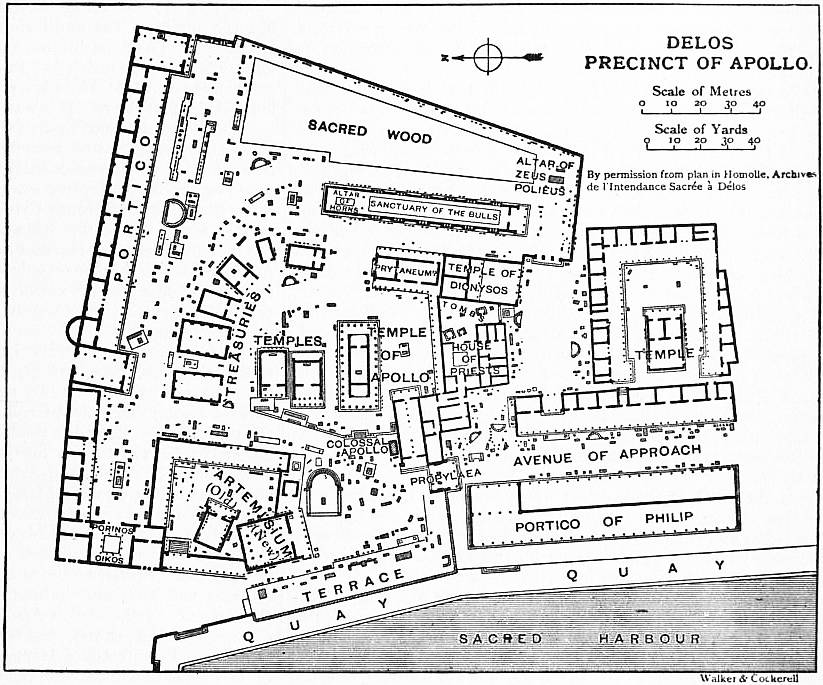
The most convenient place for landing is protected by an ancient mole; it faces the channel between Delos and Rheneia, and is about opposite the most northerly of the two little islands now called Ῥευματιάρι. From this side the sacred precinct of Apollo is approached by an avenue flanked by porticoes, that upon the seaside bearing the name of Philip V. of Macedon, who dedicated it about 200 B.C. This avenue must have formed the usual approach for sacred embassies and processions; but it is probable that the space to the south was not convenient for marshalling them, since Nicias, on the occasion of his famous embassy, built a bridge from the island of Hecate (the Greater Rhevmatiari) to Delos, in order that the imposing Athenian procession might not miss its full effect. Facing the avenue were the propylaea that formed the chief entrance of the precinct of Apollo. They consisted of a gate faced on the outside with a projecting portico of four columns, on the inside with two columns in antis. Through this one entered a large open space, filled with votive offerings and containing a large exedra. The sacred road continued its course to the north-east corner of this open space, with the precinct of Artemis on its west side, and, on its east side, a terrace on which stood three temples. The southernmost of these was the temple of Apollo, but only its back was visible from this side. Though there is no evidence to show to whom the other two were dedicated, the fact that they faced west seems to imply that they were either dedicated to heroes or minor deities, or that they were treasuries. Beyond them a road branches to the right, sweeping round in a broad curve to the space in front of the temple of Apollo. The outer side of this curve is bounded by a row of treasuries, similar to those found at Delphi and Olympia, and serving to house the more costly offerings of various islands or cities. The space to the east and south of the temple of Apollo could also be approached directly from the propylaea of entrance, by turning to the right through a passage-like building with a porch at either end. Just to the north of this may be seen the basis of the colossal statue of Apollo dedicated by the Naxians, with its well-known archaic inscription; two large fragments of the statue itself may still be seen a little farther to the north.
The temple of Apollo forms the centre of the whole precinct, which it dominates by the height of its steps as well as of the terrace already mentioned; its position must have been more commanding in ancient times than it is now that heaps of earth and débris cover so much of the level. The temple was of Doric style, with six columns at the front and back and thirteen at the sides; it was built early in the 4th century B.C.; little if any traces have been found of the earlier building which it superseded. Its sculptural decoration appears to have been but scanty; the metopes were plain. The groups which ornamented, as acroteria, the two gables of the temple have been in part recovered, and may now be seen in the national museum at Athens; at the one end was Boreas carrying off Oreithyia, at the other Eos and Cephalus, the centre in each case being occupied by the winged figure that stood out against the sky—a variation on the winged Victories that often occupy the same position on temples.
To the east of the space in front of the temple was an oblong building of two chambers, with a colonnade on each side but not in front; this may have been the Prytaneum or some other official building; beyond it is the most interesting and characteristic of all the monuments of Delphi. This is a long narrow hall, running from north to south, and entered by a portico at its south end. At the north end was the famous altar, built out of the horns of the victims, which was sometimes reckoned among the seven wonders of the world. The rest of the room is taken up by a paved space, surrounded by a narrow gangway; and on this it is supposed that the γέρανος or stork-dance took place. The most remarkable architectural feature of the building is the partition that separated the altar from this long gallery; it consists of two columns between antae, with capitals of a very peculiar form, consisting of the fore parts of bulls set back to back; from these the whole building is sometimes called the sanctuary of the bulls. Beyond it, on the east, was a sacred wood filling the space up to the wall of the precinct; and at the south end of this was a small open space with the altar of Zeus Polieus.
At the north of the precinct was a broad road, flanked with votive offerings and exedrae, and along the boundary were porticoes and chambers intended for the reception of the θεωρίαι or sacred embassies; there are two entrances on this side, each of them through extensive propylaea.
At the north-west corner of the precinct is a building of limestone, the πώρινος οἶκος often mentioned in the inventories of the treasures of the Delian shrine. South of it is the precinct of Artemis, containing within it the old temple of the goddess; her more recent temple was to the south of her precinct, opening not into it but into the open space entered through the southern propylaea of the precinct of Apollo. The older temple is mentioned in some of the inventories as “the temple in which were the seven statues”; and close beside it was found a series of archaic draped female statues, which was the most important of its kind until the discovery of the finer and better preserved set from the Athenian Acropolis.
Within the precinct there were found many statues and other works of art, and a very large number of inscriptions, some of them giving inventories of the votive offerings and accounts of the administration of the temple and its property. The latter are of considerable interest, and give full information as to the sources of the revenue and its financial administration.
Outside the precinct of Apollo, on the south, was an open place; between this and the precinct was a house for the priests, and within it, in a kind of court, a set of small structures that may perhaps be identified as the tombs of the Hyperborean maidens. Just to the east was the temple of Dionysus, which is of peculiar plan, and faces the open place; on the other side of it is a large rectangular court, surrounded by colonnades and chambers which served as offices, the whole forming a sort of commercial exchange; in the middle of it was a temple dedicated to Aphrodite and Hermes.
To the north of the precinct of Apollo, between it and the sacred lake, there are very extensive ruins of the commercial town of Delos; these have been only partially cleared, but have yielded a good many inscriptions and other antiquities. The most extensive building is a very large court surrounded by chambers, a sort of club or exchange. Beyond this, on the way to the east coast, are the remains of the new and the old palaestra, also partially excavated.
The shore of the channel facing Rheneia is lined with docks and warehouses, and behind them, as well as elsewhere in the island, there have been found several private houses of the 2nd or 3rd century B.C. Each of these consists of a single court surrounded by columns and often paved with mosaic; various chambers open out of the court, including usually one of large proportions, the ἀνδρών or dining-room for guests.
The theatre, which is set in the lower slope of Mount Cynthus, has the wings of the auditorium supported by massive substructures. The most interesting feature is the scena, which is unique in plan; it consisted of an oblong building of two storeys, surrounded on all sides by a low portico or terrace reaching to the level of the first floor. This was supported by pillars, set closer together along the front than at the sides and back. An inscription found in the theatre showed that this portico, or at least the front portion of it, was called the proscenium or logeum, two terms of which the identity was previously disputed.
On the summit of Mount Cynthus, above the primitive cave-temple which has always been visible, there have been found the remains of a small precinct dedicated to Zeus Cynthius and Athena Cynthia. Some way down the slope of the hill, between the cave-temple and the ravine of the Inopus, is a terrace with the temples of the foreign gods, Isis and Serapis, and a small odeum.
II. History.—Many alternative names for Delos are given by tradition; one of these, Ortygia, is elsewhere also assigned to an island sacred to Artemis. Of the various traditions that were current among the ancient Greeks regarding the origin of Delos, the most popular describes it as drifting through the Aegean till moored by Zeus as a refuge for the wandering Leto. It supplied a birthplace to Apollo and Artemis, who were born beneath a palm tree beside its sacred lake, and became for ever sacred to these twin deities. The island first appears in history as the seat of a great Ionic festival to which the various Ionic states, including Athens, were accustomed annually to despatch a sacred embassy, or Theoria, at the anniversary of the birth of the god on the 7th of Thargelion (about May). In the 6th century B.C. the influence of the Delian Apollo was at its height; Polycrates of Samos dedicated the neighbouring island of Rheneia to his service and Peisistratus of Athens caused all the area within sight of the temple to be cleared of the tombs by which its sanctity was impaired. After the Persian wars, the predominance of Athens led to the transformation of the Delian amphictyony into the Athenian empire. (See Delian League.) In 426 B.C., in connexion with a reorganization of the festival, which henceforth was celebrated in the third year of every Olympiad, the Athenians instituted a more elaborate lustration, caused every tomb to be removed from the island, and established a law that ever after any one who was about to die or to give birth to a child should be at once conveyed from its shores. And even this was not accounted sufficient, for in 422 they expelled all its secular inhabitants, who were, however, permitted to return in the following year. At the close of the Peloponnesian War the Spartans gave to the people of Delos the management of their own affairs; but the Athenian predominance was soon after restored, and survived an appeal to the amphictyony of Delphi in 345 B.C. During Macedonian times, from 322 to 166 B.C., Delos again became independent; during this period the shrine was enriched by offerings from all quarters, and the temple and its possessions were administered by officials called ἱεροποιοί. After 166 B.C. the Romans restored the control of Delian worship to Athens, but granted to the island various commercial privileges which brought it great prosperity. In 87 B.C. Menophanes, the general of Mithradates VI. of Pontus, sacked the island, which had remained faithful to Rome. From this blow it never recovered; the Athenian control was resumed in 42 B.C., but Pausanias (viii. 33. 2) mentions Delos as deserted but for a few Athenian officials; and several epigrams of the 1st or 2nd century A.D. attest the same fact, though the temple and worship were probably kept up until the official extinction of the ancient religion. A museum has now been built to contain the antiquities found in the excavations; otherwise Delos is now uninhabited, though during the summer months a few shepherds cross over with their flocks from Myconus or Rheneia. As a religious centre it is replaced by Tenos and as a commercial centre by the flourishing port of Syra.
See Lebègue, Recherches sur Délos (Paris, 1876). Numerous articles in the Bulletin de correspondance hellénique record the various discoveries at Delos as they were made. See also Th. Homolle, Les Archives de l’intendance sacrée à Délos (with plan). The best consecutive account is given in the Guide Joanne, Grèce, ii. 443-464. For history, see Sir R. C. Jebb, Journal of Hellenic Studies, i. (1889), pp. 7-62. For works of art found at Delos see Greek Art.
(E. Gr.)
DE LOUTHERBOURG, PHILIP JAMES (1740-1812), English artist, was born at Strassburg on the 31st of October 1740, where his father, the representative of a Polish family, practised miniature painting; but he spent the greater part of his life in London, where he was naturalized, and exerted a considerable influence on the scenery of the English stage, as well as on the artists of the following generation. De Loutherbourg was intended for the Lutheran ministry, and was educated at the university of Strassburg. As the calling, however, was foreign to his nature, he insisted on being a painter, and placed himself under Vanloo in Paris. The result was an immediate and precocious development of his powers, and he became a figure in the fashionable society of that day. In 1767 he was elected into the French Academy below the age required by the law of the institution, and painted landscapes, sea storms, battles, all of which had a celebrity above those of the specialists then working in Paris. His début was made by the exhibition of twelve pictures, including “Storm at Sunset,” “Night,” “Morning after Rain.” He is next found travelling in Switzerland, Germany and Italy, distinguishing himself as much by mechanical inventions as by painting. One of these, showing quite new effects produced in a model theatre, was the wonder of the day. The exhibition of lights behind canvas representing the moon and stars, the illusory appearance of running water produced by clear blue sheets of metal and gauze, with loose threads of silver, and so on, were his devices. In 1771 he came to London, and was employed by Garrick, who offered him £500 a year to apply his inventions to Drury Lane, and to superintend the scene-painting, which he did with complete success, making a new era in the adjuncts of the stage. Garrick’s own piece, the Christmas Tale, and the pantomime, 1781-1782, introduced the novelties to the public, and the delight not only of the masses, but of Reynolds and the artists, was unbounded. The green trees gradually became russet, the moon rose and lit the edges of passing clouds, and all the world was captivated by effects we now take little notice of. A still greater triumph awaited him on his opening an entertainment called the “Eidophusicon,” which showed the rise, progress and result of a storm at sea—that which destroyed the great Indiaman, the “Halsewell,”—and the Fallen Angels raising the Palace of Pandemonium. De Loutherbourg has been called the inventor of the panorama, but this honour does not belong to him, although it first appeared about the same time as the eidophusicon. The first panorama was painted and exhibited by Robert Barker.
All this mechanism did not prevent De Loutherbourg from painting. “Lord Howe’s Victory off Ushant” (1794), and other large naval pictures were commissioned for Greenwich Hospital Gallery, where they still remain. His finest work was the “Destruction of the Armada.” He painted also the Great Fire of London, and several historical works, one of these being the “Attack of the Combined Armies on Valenciennes” (1793). He was made R.A., in addition to other distinctions, in 1781, shortly after which date we find an entirely new mental impulse taking possession of him. He joined Balsamo, comte de Cagliostro, and travelled about with this extraordinary person—leaving him, however, before his condemnation to death. We do not hear that Mesmer had attracted De Loutherbourg, nor do we find an exact record of his connexion with Cagliostro. A pamphlet published in 1789, A List of a few Cures performed by Mr and Mrs De Loutherbourg without Medicine, shows that he had taken up faith-healing, and there is a story that a successful projection of the philosopher’s stone was only spoiled by the breaking of the crucible by a relative. He died on the 11th of March 1812. His publications are few—some sets of etchings, and English Scenery (1805).
DELPHI (the Pytho of Homer and Herodotus; in Boeotian inscriptions Βελφοί, on coins Δαλφοί), a place in ancient Greece in the territory of Phocis, famous as the seat of the most important temple and oracle of Apollo. It was situated about 6 m. inland from the shores of the Corinthian Gulf, in a rugged and romantic glen, closed on the N. by the steep wall-like under-cliffs of Mount Parnassus known as the Phaedriades or Shining Rocks, on the E. and W. by two minor ridges or spurs, and on the S. by the irregular heights of Mount Cirphis. Between the two mountains the Pleistus flowed from east to west, and opposite the town received the brooklet of the Castalian fountain, which rose in a deep gorge in the centre of the Parnassian cliff. About 7 m. to the north, on the side of Mount Parnassus, was the famous Corycian cave, a large grotto in the limestone rock, which afforded the people of Delphi a refuge during the Persian invasion. It is now called in the district the Sarant’ Aulai or Forty Courts, and is said to be capable of holding 3000 people.
I. The Site.—The site of Delphi was occupied by the modern village of Castri until it was bought by the French government in 1891, and the peasant proprietors expropriated and transferred to the new village of Castri, a little farther to the west. Excavations had been made previously in some parts of the precinct; for example, the portico of the Athenians was laid bare in 1860. The systematic clearing of the site began in the spring of 1892, and it was rapidly cleared of earth by means of a light railway. The plan of the precinct is now easily traced, and with the help of Pausanias many of the buildings have been identified.
The ancient wall running east and west, commonly known as the Hellenico, has been found extant in its whole length, and the two boundary walls running up the hill at each end of it, traced. In the eastern of these was the main entrance by which Pausanias went in along the Sacred Way. This paved road is easily recognized as it zigzags up the hill, with treasuries and the bases of various offerings facing it on both sides. It mounts first westwards to an open space, then turns eastwards till it reaches the eastern end of the terrace wall that supports the temple, and then turns again and curves up north and then west towards the temple. Above this, approached by a stair, are the Lesche and the theatre, occupying respectively the north-east and north-west corner of the precinct. On a higher level still, a little to the west, is the stadium. There are several narrow paths and stairs that cut off the zigzags of the Sacred Way.
In describing the monuments discovered by the French excavators, the simplest plan is to follow the route of Pausanias. Outside the entrance is a large paved court of Roman date, flanked by a colonnade. On the north side of the Sacred Way, close to the main entrance, stood the offering dedicated by the Lacedaemonians after the battle of Aegospotami. It was a large quadrangular building of conglomerate, with a back wall faced with stucco, and stood open to the road. On a stepped pedestal facing the open stood the statues of the gods and the admirals, perhaps in rows above one another.
The statues of the Epigoni stood on a semicircular basis on the south side of the way. Opposite them stood another semicircular basis which carried the statues of the Argive kings, whose names are cut on the pedestal in archaic characters, reading from right to left. Farther west was the Sicyonian treasury on the south of the way. It was in the form of a small Doric temple in antis, and had its entrance on the east. The present foundations are built of architectural fragments, probably from an earlier building of circular form on the same site. The sculptures from this treasury are in the museum, as are the other sculptures found on the site. These sculptures, which are in rough limestone, most likely belong to the earlier building, as their surface is in a better state of preservation than could be possible if they had been long exposed to the air. The earlier treasury was probably destroyed either by earthquake or by the percolation of water through the terracing.
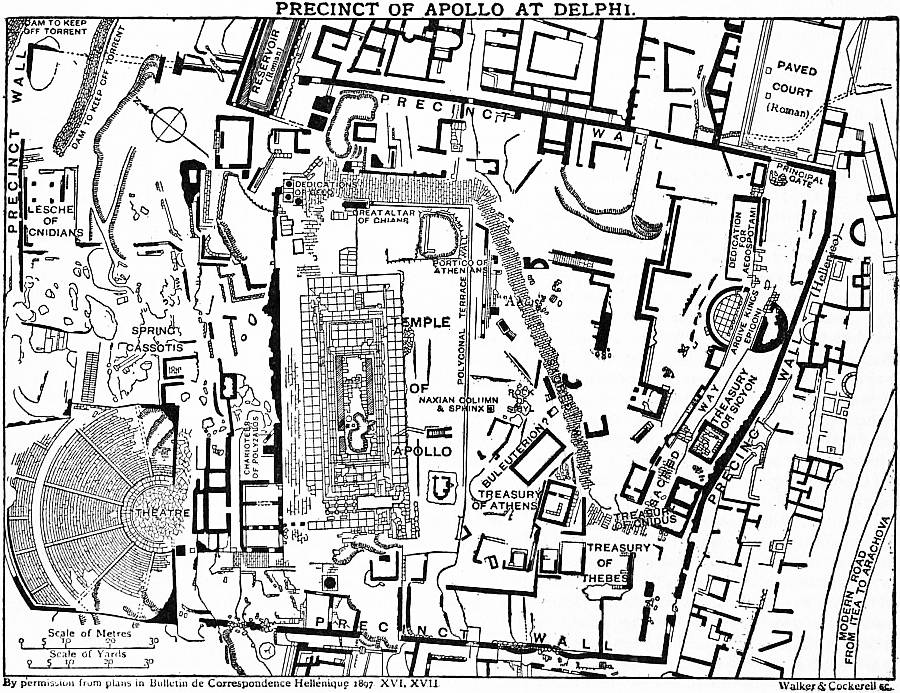
The Cnidian treasury stands on the south side of the way farther west. This building was originally surmised by the excavators to be the treasury of Siphnos, but further evidence led them to change their opinion. The treasury was raised on a quadrangular structure, supported on its south side by the Hellenico, and built of tufa. The lower courses are left rough and were most likely hidden. A small Ionic temple of marble with two caryatids between antae stood on this substructure. The sculpture from this treasury, which ornamented its frieze and pediment, is of great interest in the history of the development of the art, and the fragments of architectural mouldings are of great delicacy and beauty. The whole work is perhaps the most perfect example we possess of the transitional style of the early 5th century. Standing back somewhat from the path just as it bends round up the hill is the Theban treasury. Farther north, where the path turns again, is the Athenian treasury. This structure, which was in the form of a small Doric temple in antis, appears to have suffered from the building above it having been shaken down by an earthquake. It has now been rebuilt with the original blocks. There can be no doubt about the identity of the building, for the basis on which it stands bears the remains of the dedicatory inscription, stating that it was erected from the spoils of Marathon. Almost all the sculptured metopes are in the museum, and are of the highest interest to the student of archaic art. The famous inscriptions with hymns to Apollo accompanied by musical notation were found on stones belonging to this treasury.
Above the Athenian treasury is an open space, in which is a rock which has been identified as the Sybil’s rock. It has steps hewn in it, and has a cleft. The ground round it has been left rough like the space on the Acropolis at Athens identified as the ancient altar of Athena. Here too was placed the curious column, with many flutes and an Ionic capital, on which stood the colossal sphinx, dedicated by the Naxians, that has been pieced together and placed in the museum.
A little farther on, but below the Sacred Way, is another open space, of circular form, which is perhaps the ἅλως or sacred threshing-floor on which the drama of the slaying of the Python by Apollo was periodically performed. Opposite this space, and backed against the beautifully jointed polygonal wall which has for some time been known, and which supports the terrace on which the temple stands, is the colonnade of the Athenians. A dedicatory inscription runs along the face of the top step, and has been the subject of much dispute. Both the forms of the letters and the style of the architecture show that the colonnade cannot date, as Pausanias says, from the time of the Peloponnesian War; Th. Homolle now assigns it to the end of the 6th century. The polygonal terrace wall at the back, on being cleared, proves to be covered with inscriptions, most of them concerning the manumission of slaves.
After rounding the east end of the terrace wall, the Sacred Way turns northward, leaving the Great Altar, dedicated by the Chians, on the left. After passing the altar, it turns to the left again at right angles, and so enters the space in front of the temple. Remains of offerings found in this region include those dedicated by the Cyrenians and by the Corinthians. The site of the temple itself carries the remains of successive structures. Of that built by the Alcmaeonids in the 6th century B.C. considerable remains have been found, some in the foundations of the later temple and some lying where they were thrown by the earthquake. The sculptures found have been assigned to this building, probably to the gables, as they are archaic in character, and show a remarkable resemblance to the sculptures from the pediment of the early temple of Athena at Athens. The existing foundations are these of the temple built in the 4th century. They give no certain information as to the sacred cleft and other matters relating to the oracle. Though there are great hollow spaces in the structure of the foundations, these appear merely to have been intended to save material, and not to have been put to any religious or other use. Up in the north-eastern corner of the precinct, standing at the foot of the cliffs, are the remains of the interesting Cnidian Lesche or Clubhouse. It was a long narrow building accessible only from the south, and the famous paintings were probably disposed around the walls so as to meet in the middle of the north side. Some scanty fragments of the lower part of the frescoed walls have survived; but they are not enough to give any information as to the work of Polygnotus.
At the north-western corner of the precinct is the theatre, one of the best preserved in Greece. The foundations of the stage are extant, as well as the orchestra, and the walls and seats of the auditorium. There are thirty-three tiers of seats in seven sets, and a paved diazoma. The sculptures from the stage front, now in the museum, have the labours of Heracles as their subject. The date of the theatre is probably early 2nd century B.C.
The stadium lies, as Pausanias says, in the highest part of the city to the north-west. It stands on a narrow plateau of ground supported on the south-east by a terrace wall. The seats have been cleared, and are in a state of extraordinary preservation. A few of those at the east end are hewn in the rock. No trace of the marble seats mentioned by Pausanias has been found, but they have probably been carried off for lime or building, as they could easily be removed. An immense number of inscriptions have been found in the excavations, and many works of art, including a bronze charioteer, which is one of the most admirable statues preserved from ancient times.
II. History.—Our information as to the oracle at Delphi and the manner in which it was consulted is somewhat confused; there probably was considerable variation at different periods. The tale of a hole from which intoxicating “mephitic” vapour arose has no early authority, nor is it scientifically probable (see A. P. Oppé in Journal of Hellenic Studies, xxiv. 214). The questions had to be given in writing, and the responses were uttered by the Pythian priestess, in early times a maiden, later a woman over fifty attired as a maiden. After chewing the sacred bay and drinking of the spring Cassotis, which was conducted into the temple by artificial channels, she took her seat on the sacred tripod in the inner shrine. Her utterances were reduced to verse and edited by the prophets and the “holy men” (ὅσιοι). For the influence and history of the oracle see Oracle.
Delphi also contained the “Omphalos,” a sacred stone bound with fillets, supposed to mark the centre of the earth. It was said Zeus had started two eagles from the opposite extremities and they met there. Other tales said the stone was the one given by Rhea to Cronus as a substitute for Zeus.
For the history of the Delphic Amphictyony see under Amphictyony. The oracle at Delphi was asserted by tradition to have existed before the introduction of the Apolline worship and to have belonged to the goddess Earth (Ge or Gaia). The Homeric Hymn to Apollo evidently combines two different versions, one of the approach of Apollo from the north by land, and the other of the introduction of his votaries from Crete. The earliest stone temple was said to have been built by Trophonius and Agamedes. This was destroyed by fire in 548 B.C., and the contract for rebuilding was undertaken by the exiled Alcmaeonidae from Athens, who generously substituted marble on the eastern front for the poros specified (see Cleisthenes, ad init.). Portions of the pediments of this temple have been found in the excavations; but no sign has been found of the pediments mentioned by Pausanias, representing on the east Apollo and the Muses, and on the west Dionysus and the Thyiades (Bacchantes), and designed by Praxias, the pupil of Calanias. The temple which was seen by Pausanias, and of which the foundations were found by the excavators, was the one of which the building is recorded in inscriptions of the 4th century. A raid on Delphi attempted by the Persians in 480 B.C. was said to have been frustrated by the god himself, by means of a storm or earthquake which hurled rocks down on the invaders; a similar tale is told of the raid of the Gauls in 279 B.C. But the sacrilege thus escaped at the hands of foreign invaders was inflicted by the Phocian defenders of Delphi during the Sacred War, 356-346 B.C., when many of the precious votive offerings were melted down. The Phocians were condemned to replace their value to the amount of 10,000 talents, which they paid in instalments. In 86 B.C. the sanctuary and its treasures were put under contribution by L. Cornelius Sulla for the payment of his soldiers; Nero removed no fewer than 500 bronze statues from the sacred precincts; Constantine the Great enriched his new city by the sacred tripod and its support of intertwined snakes dedicated by the Greek cities after the battle of Plataea. This still exists, with its inscription, in the Hippodrome at Constantinople. Julian afterwards sent Oribasius to restore the temple; but the oracle responded to the emperor’s enthusiasm with nothing but a wail over the glory that had departed.
Provisional accounts of the excavations have appeared during the excavations in the Bulletin de correspondance hellénique. A summary is given in J. G. Frazer, Pausanias, vol. v. The official account is entitled Fouilles de Delphes. For history see Hiller von Gärtringen in Pauly-Wissowa, Realencyclopädie, s.v. “Delphi.” For cult see L. R. Farnell, Cults of the Creek States, iv. 179-218. For the works of art discovered see Greek Art.
(E. Gr.)
DELPHINIA, a festival of Apollo Delphinius held annually on the 6th (or 7th) of the month Munychion (April) at Athens. All that is known of the ceremonies is that a number of girls proceeded to his temple (Delphinium) carrying suppliants’ branches and seeking to propitiate Apollo, probably as a god having influence on the sea. It was at this time of year that navigation began again after the storms of winter. According to the story in Plutarch (Theseus, 18), Theseus, before setting out to Crete to slay the Minotaur, repaired to the Delphinium and deposited, on his own behalf and that of his companions on whom the lot had fallen, an offering to Apollo, consisting of a branch of consecrated olive, bound about with white wool; after which he prayed to the god and set sail. The sending of the maidens to propitiate the god during the Delphinia commemorates this event in the life of Theseus.
See A. Mommsen, Festeder Stadt Athen (1898); L. Preller, Griechische Mythologie (4th ed., 1887); P. Stengel, Die griechische Kultusaltertümer (1898); Daremberg and Saglio, Dictionnaire des antiquités; G. F. Schömann, Griechische Altertümer (4th ed., 1897-1902).
DELPHINUS (“The Dolphin”), in astronomy, a constellation of the northern hemisphere, mentioned by Eudoxus (4th century B.C.) and Aratus (3rd century B.C.); and catalogued by Ptolemy (10 stars), Tycho Brahe (10 stars), and Hevelius (14 stars), Γ Delphini is a double star: a yellowish of magnitude 4, and a bluish of magnitude 5.
DELTA (from the shape of the Gr. letter Δ, delta, originally used of the mouth of the Nile), a tract of land enclosed by the diverging branches of a river’s mouth and the seacoast, and traversed by other branches of the stream. This triangular tract is formed from the fine silt brought down in suspension by a muddy river and deposited when the river reaches the sea. When tidal currents are feeble, the delta frequently advances some distance seawards, forming a local prolongation of the coast.
DELUC, JEAN ANDRÉ (1727-1817), Swiss geologist and meteorologist, born at Geneva on the 8th of February 1727, was descended from a family which had emigrated from Lucca and settled at Geneva in the 15th century. His father, François Deluc, was the author of some publications in refutation of Mandeville and other rationalistic writers, which are best known through Rousseau’s humorous account of his ennui in reading them; and he gave his son an excellent education, chiefly in mathematics and natural science. On completing it he engaged in commerce, which principally occupied the first forty-six years of his life, without any other interruption than that which was occasioned by some journeys of business into the neighbouring countries, and a few scientific excursions among the Alps. During these, however, he collected by degrees, in conjunction with his brother Guillaume Antoine, a splendid museum of mineralogy and of natural history in general, which was afterwards increased by his nephew J. André Deluc (1763-1847), who was also a writer on geology. He at the same time took a prominent part in politics. In 1768 he was sent to Paris on an embassy to the duc de Choiseul, whose friendship he succeeded in gaining. In 1770 he was nominated one of the Council of Two Hundred. Three years later unexpected reverses in business made it advisable for him to quit his native town, which he only revisited once for a few days. The change was welcome in so far as it set him entirely free for scientific pursuits, and it was with little regret that he removed to England in 1773. He was made a fellow of the Royal Society in the same year, and received the appointment of reader to Queen Charlotte, which he continued to hold for forty-four years, and which afforded him both leisure and a competent income. In the latter part of his life he obtained leave to make several tours in Switzerland, France, Holland and Germany. In Germany he passed the six years from 1798 to 1804; and after his return he undertook a geological tour through England. When he was at Göttingen, in the beginning of his German tour, he received the compliment of being appointed honorary professor of philosophy and geology in that university; but he never entered upon the active duties of a professorship. He was also a correspondent of the Academy of Sciences at Paris, and a member of several other scientific associations. He died at Windsor on the 7th of November 1817.
His favourite studies were geology and meteorology. The situation of his native country had naturally led him to contemplate the peculiarities of the earth’s structure, and the properties of the atmosphere, as particularly displayed in mountainous countries, and as subservient to the measurement of heights. According to Cuvier, he ranked among the first geologists of his age. His principal geological work, Lettres physiques et morales sur les montagnes el sur l’histoire de la terre et de l’homme, first published in 1778, and in a more complete form in 1779, was dedicated to Queen Charlotte. It dealt with the appearance of mountains and the antiquity of the human race, explained the six days of the Mosaic creation as so many epochs preceding the actual state of the globe, and attributed the deluge to the filling up of cavities supposed to have been left void in the interior of the earth. He published later an important series of volumes on geological travels in the north of Europe (1810), in England (1811), and in France, Switzerland and Germany (1813). These were translated into English.
Deluc’s original experiments relating to meteorology were valuable to the natural philosopher; and he discovered many facts of considerable importance relating to heat and moisture. He noticed the disappearance of heat in the thawing of ice about the same time that J. Black founded on it his ingenious hypothesis of latent heat. He ascertained that water was more dense about 40° F. (4° C.) than at the temperature of freezing, expanding equally on each side of the maximum; and he was the originator of the theory, afterward readvanced by John Dalton, that the quantity of aqueous vapour contained in any space is independent of the presence or density of the air, or of any other elastic fluid.
His Recherches sur les modifications de l’atmosphère (2 vols. 4to, Geneva, 1772; 2nd ed., 4 vols. 8vo, Paris, 1784) contains many accurate and ingenious experiments upon moisture, evaporation and the indications of hygrometers and thermometers, applied to the barometer employed in determining heights. In the Phil. Trans., 1773, appeared his account of a new hygrometer, which resembled a mercurial thermometer, with an ivory bulb, which expanded by moisture, and caused the mercury to descend. The first correct rules ever published for measuring heights by the barometer were those he gave in the Phil. Trans., 1771, p. 158. His Lettres sur l’histoire physique de la terre (8vo, Paris, 1798), addressed to Professor Blumenbach, contains an essay on the existence of a General Principle of Morality. It also gives an interesting account of some conversations of the author with Voltaire and Rousseau. Deluc was an ardent admirer of Bacon, on whose writings he published two works—Bacon tel qu’il est (8vo, Berlin, 1800), showing the bad faith of the French translator, who had omitted many passages favourable to revealed religion, and Précis de la philosophie de Bacon (2 vols. 8vo, Paris, 1802), giving an interesting view of the progress of natural science. Lettres sur le Christianisme (Berlin and Hanover, 1801, 1803) was a controversial correspondence with Dr Teller of Berlin in regard to the Mosaic cosmogony. His Traité élémentaire de géologie (8vo, Paris, 1809, also in English, by de la Fite, the same year) was principally intended as a refutation of the Vulcanian system of Hutton and Playfair, who deduced the changes of the earth’s structure from the operation of fire, and attributed a higher antiquity to the present state of the continents than is required in the Neptunian system adopted by Deluc after D. Dolomieu. He sent to the Royal Society, in 1809, a long paper on separating the chemical from the electrical effect of the pile, with a description of the electric column and aerial electroscope, in which he advanced opinions so little in unison with the latest discoveries of the day, that the council deemed it inexpedient to admit them into the Transactions. The paper was afterwards published in Nicholson’s Journal (xxvi.), and the dry column described in it was constructed by various experimental philosophers. This dry pile or electric column has been regarded as his chief discovery.
Many other of his papers on subjects kindred to those already mentioned are to be found in the Transactions and in the Philosophical Magazine. See Philosophical Magazine (November 1817).
DELUGE, THE (through the Fr. from Lat. diluvium, flood, diluere, to wash away), a great flood or submersion of the earth (so far as the earth was known to the narrators), or of heaven and earth, or simply of heaven, by which, according to primitive and semi-primitive races, chaos was restored. It is, of course, not meant that all the current flood stories, as they stand, answer to this description. There are flood stories which, at first sight, may plausibly be held to be only exaggerated accounts of some ancient historical occurrences. The probability of such traditions being handed down is, however, extremely slight. If some flood stories are apparently local, and almost or quite without mythical colouring, it may be because the original myth-makers had a very narrow conception of the earth, and because in the lapse of time the original mythic elements had dwindled or even disappeared. The relics of the traditional story may then have been adapted by scribes and priests to a new theory. Many deluge stories may in this way have degenerated. It is at any rate undeniable that flood stories of the type described above, and even with similar minor details, are fairly common. A conspectus of illustrative flood stories from different parts of the world would throw great light on the problems before us; see the article Cosmogony, especially for the North American tales, which show clearly enough that the deluge is properly a second creation, and that the serpent is as truly connected with the second chaos as with the first. One of them, too, gives a striking parallel to the Babylonian name Ḫasis-andra (the Very Wise), whence comes the corrupt form Xisuthrus; the deluge hero of the Hare Indians is called Kunyan, “the intelligent.” Polynesia also gives us most welcome assistance, for its flood stories still present clear traces of the primitive imagination that the sky was a great blue sea, on which the sun, moon and stars (or constellations) were voyagers. Greece too supplies some stimulus to thought, nor are Iran and Egypt as unproductive as some have supposed. But the only pauses that we can allow ourselves are in Hindustan, Babylonia and Canaan. The peoples of these three countries, which are religiously so prominent in antiquity, have naturally connected their name equally with thoughts about earth production and earth destruction.
The Indian tradition exists in several forms.1 The earliest is preserved in the Satapatha Brahmana. It is there related that Manu, the first man, the son of the sun-god Vivasvat, found, in bathing, a small fish, which asked to be Indian Tradition. tended, and in reward promised to save him in the coming flood. The fish grew, and at last had to be carried to the sea, where it revealed to Manu the time of the flood, and bade him construct a ship for his deliverance. When the time came, Manu, unaccompanied, went on board; the grateful fish towed the ship through the water to the summit of the northern mountain, where it bade Manu bind the vessel to a tree. Gradually, as the waters fell, Manu descended the mountain; he then sacrificed and prayed. In a year’s time his prayer was granted. A woman appeared, who called herself his daughter Idā (goddess of fertility). It is neither stated, nor even hinted, that sin was the cause of the flood.
Another version occurs in the great epic, the Mahābhārata. The lacunae of the earlier story are here supplied. Manu, for instance, embarks with the seven “rishis” or wise men, and takes with him all kinds of seed. The fish announces himself as the God Brahman, and enables Manu to create both gods and men. A third account is given in the Bhāgavata Purāna. It contains the details of the announcement of the flood seven days beforehand (cf. Gen. vii. 4) and of the taking of pairs of all kinds of animals (cf. Gen. vi. 19), besides the seeds of plants (as the epic; cf. Gen. vi. 21). This story, however, is a late composition, not earlier than the 12th century A.D. A first glance at these stories is somewhat bewildering. We shall return, however, to this problem later with a good hope of mastering it.
The Israelite (Biblical) and the Babylonian deluge-stories remain to be considered. Neither need be described here in detail; for the former see Gen. vi. 5-ix. 17, and for the latter Gilgamesh. As most students are aware, the Israelite and Babylonian. Biblical deluge-story is composite, being made up of two narratives, the few lacunae in which are due to the ancient redactor who worked them together.2 The narrators are conventionally known as J. (= the Yahwist, from the divine name Yahweh) and P. (= the Priestly Writer) respectively. It is important to notice that P., though chronologically later than J., reproduces certain elements which must be archaic. For instance, while J. speaks only of a rain-storm, P. states that “all the fountains of the great ocean were broken up, and the windows of heaven opened” (Gen. vii. 11), i.e. the lower and the upper waters met together and produced the deluge. It is also P. who tells the story of the appointment of the rainbow (Gen ix. 12-17), which is evidently ancient, though only paralleled in a Lithuanian flood-story, and near it we find the divine declaration (Gen. ix. 2-6) that the golden age of universal peace (cf. Gen. i. 29, 30), already sadly tarnished, is over.3 Surely this too has a touch of the archaic; nor can we err in connecting it with the tradition of man’s first home in Paradise, where no enemy could come, because, in the original form of the tradition, Paradise was the abode of God. (See Paradise.)
The Babylonian tradition exists in two main forms,4 nor can we affirm that the shorter form, due to Berōssus, is superseded by the larger one in the Gilgamesh epic, for it communicates four important points: (1) Xisuthrus, the hero Berōssus: four points. of the deluge, was also the tenth Babylonian king; cf. Noah, in P., the tenth patriarch as well as the survivor from the deluge; (2) the destination of Xisuthrus is said to be “to the gods,” a statement which virtually records his divine character. In accordance with this, the final reward of the hero is declared to be “living with the gods.” This suggests that Noah (?) may originally have been represented as a supernatural man, a demigod. True, Gen. ix. 20, 21 is not consistent with this, but it is very possible that Noah was substituted by a scribe’s error for Enoch,5 who, like Xisuthrus, “walked with God (learning the heavenly wisdom) and disappeared, for God had taken him” (Gen. v. 22, 24); (3) the birds, when sent out by Xisuthrus the second time, return with mud on their feet. This detail reminds us of points in some archaic North American myths which probably supply the key to its meaning;6 (4) in the time of Berōssus the mountain on which the ark grounded was considered to be in Armenia.
We pass on to the relation of J. and P. to the Babylonian story. (1) The polytheistic colouring of the latter contrasts strongly with the far simpler religious views of J. and P. Note the capricious character of the god Bel who sends the Details on relation of Israelite story to Babylonian. deluge, while at the end of the story the catastrophe is represented as a judgment upon human sins. It is the latter view which is adopted by J. and P. We cannot, however, infer from this that the narratives which doubtless underlie J. and P. were directly taken from some such story as that in the Gilgamesh epic. The theory of an indirect and unconscious borrowing on the part of the Israelitish compilers will satisfy all the conditions of the case. (2) In the general scheme the three accounts very nearly agree, for J. must originally have contained directions as to the building of the vessel, and a notice that the ark grounded on a certain mountain. P.’s omission of the sacrifice at the close seems to be arbitrary. His theory of religious history forbade a reference to an altar so early, but his document must have contained it. J. expressly mentions it (Gen. viii. 20, 21), though not in such an original way as the cuneiform text. (3) As to the directions for building the ship (epic) or chest (J. and P.). Here the Babylonian story and P. have a strong general resemblance; note, e.g., the mention of bitumen in both. Whether the Hebrew reference to a chest (tēbah) is, or is not, more archaic than the Babylonian reference to a ship (elippu) is a question which admits of different answers. (4) As to the material cause of the deluge. According to P. (see above) the water came both from above and from below; J. only speaks of continuous rain. The Gilgamesh epic, however, mentions besides thunder, lightning and rain, a hurricane which drove the sea upon the land. We can hardly regard this as more original than P.’s representation. (5) As to the extent of the flood. From the opening of the story in the epic we should naturally infer that only a single S. Babylonian city was affected. The sequel, however, implies that the flood extended all over Babylonia and the region of Niṣir. More than this can hardly be claimed. Similarly the earlier story which underlies J. and P. need only have referred to the region of the myth-framers, i.e. either Canaan or N. Arabia. (6) As to the duration of the flood the traditions differ. P. reckons it at 365 days, i.e. a solar year, which is parallel to the 365 years of the life of Enoch (who, as we have seen, may have been the original hero of the flood). It is probable (see below) that P.’s ultimate authority, far back in the centuries, represented the deluge as a celestial occurrence. The origin of J.’s story is not quite so clear, owing to the lacunae in the narrative. If the text may be followed, this narrator made the flood last forty days and nights, after which two periods of seven days elapse, and then the patriarch leaves the ark. The epic shortens the duration of the flood to seven days, after which the ship remains another seven days (more strictly six full days) on the mountain of the land of Niṣir (P., the mountains of Ararat; J., unrecorded). (7) As to the despatch of the birds. J. begins, the epic closes, with the raven. Clearly the epic is more original. Besides, one of the two missions of the dove is evidently superfluous. Dove, swallow, raven, as in the epic, must be more primitive than raven, dove, dove.
That the Hebrew deluge-story in both its forms has been at least indirectly influenced by the Babylonian is obvious. We cannot indeed reconstruct the form either of the Canaanitish (or N. Arabian) story, which was recast partly at least under the influence of a recast Babylonian myth, nor can we conjecture where the sanctuary was, the priests of which, yielding to a popular impulse, adopted and modified the fascinating story. But the fact of the ultimate Babylonian origin of the Israelitish narratives cannot seriously be questioned. The Canaanites or the N. Arabians handed on at least a portion of their myths to the Israelites, and the creation and deluge stories were among these. That the Israelitish priests gradually recast them is an easy and altogether satisfactory conjecture.
It remains to ask, What is the history and significance of the deluge-myth? The question carries us into far-off times. We have no version of the Babylonian myth which goes back to about 2100 B.C., while its text was apparently History and significance of deluge-myths. derived from a still older tablet. But even this is not primitive; behind it there must have been a much shorter and simpler myth. The recast represented by the existing versions of the myth must have been produced partly by the insertion, partly by the omission or modification, of mythic details, and by the application to the story thus produced of a particular mythic theory respecting the celestial world. The shorter myth referred to may—if we take hints from the very primitive myths of N. America—have run somewhat thus, omitting minor details: “The earth (a small enough earth, doubtless) and its inhabitants proved so imperfect that the beneficent superhuman Being, who had created it, or perhaps another such Being, determined to remake it. He, therefore, summoned the serpent or dragon who controlled the cosmic ocean, and had been subjugated at creation, to overwhelm the earth, after which the creator remade it better,7 and the survivor and his family became the ancestors of a new human race.”
This, however, is only one possible representation. It may have been said that the serpent of his own accord, not having been killed by the creator, maliciously flooded the earth (cf. the Algonquian myth), but was again overcome in battle, or that the serpent, after filling the earth with violence and wrong, was at length slain by the Good Being, and that his blood, streaming, out, produced a deluge.8 In any case it is unnatural to hold that the first flood (that which preceded creation) had a dragon, but not the second. An old cuneiform text, recopied late, however, appears to call the year of the deluge (i.e. of what we here call the second flood) “the year of the raging (or red-shining) serpent,”9 and certainly the N. American myths distinctly connect serpents with the deluges.
Among the probable minor details (omitted above) of the presumed shorter and older myth we may include: (1) the warning of “Very-Wise,”10 either by friendly animals or by a dream; (2) the construction of a chest to contain “Very-Wise,” his wife and his sons, together with animals;11 (3) the despatch of three birds with a special object (see below); (4) the landing of the survivors on a mountain. As to (1), Berōssus suggests that the notice came to Xisuthrus in a dream; in the Indian myth it is the sacred fish which warns Manu. In the archaic N. American myths, however, it is some animal which gives the notice—an eagle or a coyote (a kind of wolf). As to (2), nothing is more common than the story of a divine child cast into the sea in a box.12 The ship-motive is also found,13 but it is not too rash to assume that the box-motive is the earlier, and, in accordance with the parallels, that the hero of the deluge was originally a god or a demigod. The translation of the hero to be with the gods is a transparent modification of the original tradition. As to (3), the original object of sending out the birds was probably not to find out where dry land was, but to use them as helpers in the work of re-creation. Take the story of the Tlatlasik Indians, where the diving-bird (one of three sent out) comes back with a branch of a fir-tree, out of which O’meatl made mountains, earth and heaven;14 so, too, the Caingangs relate15 that those who escaped from the flood, as they tarried on a mountain, heard the song of the saracura birds, who came carrying earth in baskets, and threw it into the waters, which slowly subsided. As to (4), the mountain would naturally be thought of as a place of refuge even in the old, simple flood-story. But when Babylonian mythology effected an entrance, the mountain would receive a new and much grander significance. It would then come to represent the summit of that great and most holy mountain, which, save by the special favour of the gods, no human eye has seen.
That a didactic element entered the deluge-tradition but slowly, may be surmised, not only from the genuinely old N. American stories, but from the inconsistent statements, to which Jastrow has already referred, in the Babylonian story. We may imagine that between the creation and the deluge some great and wise Being had initiated the early men, not only in the necessary arts of life, but in the “ways” that were pleasing to the heavenly powers. The Babylonians apparently think of neglected sacrifices, the Australians of a desecrated mystery as the cause of the flood. Some such violation of a sacred rule is the origin that naturally occurs to an adapter or expander of primitive myths.
And now as to the application of the celestial mythic theory to the early deluge-story. In the agricultural stage it was natural that men should take a deeper interest than before in the appearance of the sky, and especially of the sun Celestial myth theory. and moon, and of the constellations, even though an astrological science or quasi-science would very slowly, if at all, grow up. That the Polynesian myths (which show no vestige of science) originally referred to the supposed celestial ocean, seems to be plain. Schirren16 regarded the New Zealand cosmogonies as myths of sunrise, and the deluge-stories as myths of sunset. We may at any rate plausibly hold, with the article “Deluge” (by Cheyne) in the ninth edition of this work17 (1877), that the deluge-stories of Polynesia and early Babylonia (we may now probably add India) were accommodated to an imaginative conception of the sun and moon as voyagers on the celestial ocean. “When this story had been told and retold a long time, rationalism suggested that the sea was not in heaven but on earth, and observation of the damage wrought in winter by excessive rains and the inundations of great rivers suggested the introduction of corresponding details into the new earthly deluge-myth.” “This accounts for the strongly mythological character of Par-napishti (Ut-napishti) in Babylonia and Maui in New Zealand, who are in fact solar personages. Enoch, too, must be classed in this category, his perfect righteousness and superhuman wisdom now first become intelligible. Moreover, we now comprehend how the goddess Sabitu (the guardian of the entrance to the sea) can say to Gilgamesh (himself a solar personage), ‘Shamash the mighty (i.e. the sun-god) has crossed the sea; besides (?) Shamash, who can cross it?’ For though the sea in the epic is no doubt the earth-circling ocean, it was hardly this in the myth from which the words were taken.”18 And, what is still more important, we can understand better how, in the Gilgamesh epic (lines 115-116), the gods, after cowering like dogs, go up to the “heaven of Ana.” They, too, fear the deluge, and only in the highest heaven can they feel themselves secure.
Such an explanation seems indispensable if the wide influence of the Babylonian form of the deluge-myth is to be accounted for. As Gunkel well remarks,19 neither the tenacity and self-propagating character of this myth, nor the solemn utterance of Yahweh (who corresponds to the Babylonian Marduk) in Gen. viii. 21b (J.) and ix. 8-17 (P.) can be understood, if the deluge-story is nothing more than an exaggerated account of a historical, earthly occurrence. We, therefore, venture to hold that it is an insufficient account to give of the story in the Gilgamesh epic that it is a combination of a local tradition of the destruction of a single city with a myth of the destruction of mankind—a myth exaggerated in its present form, but based on accurate knowledge of the yearly recurring phenomenon of the overflow of the Euphrates.20 There are no doubt points in the story as it now stands which indicate a composite origin, but it is probable that even the tradition which apparently limits the destruction to a single city, equally with many other local flood-stories, has a basis in what we may fairly call a celestial myth.
We can now return with some confidence to the Indian deluge-story. It is unlikely that so richly gifted a race as the Aryans of India should not have produced their own flood-story out of the same primeval germs which grew up into the Indian myth reconsidered. earliest Babylonian flood-story,21 and almost inconceivable that in its second form the Indian story should not have become adapted to what may be called the celestial mythic theory. The phrase “the northern mountain” for the place where the ship grounded may quite well be the name of an earthly substitute (the epic has “the highest summit of the Himalaya”) for the mythic mountain of heaven. Nor is it unimportant that Manu is the son of the sun-god, and that the phrase “the seven rishis” in classical Sanskrit is a designation of the seven stars of the Great Bear. For such problems all that we can hope for is a probable solution. The opposite view22 that the deluge is a historical occurrence implies a self-propagating power in early tradition which is not justified by critical research, and leaves out of sight many important facts revealed by comparative study.
For a conspectus of deluge-stories see Andree, Die Flutsagen, ethnographisch betrachtet (1891), by a competent anthropologist; E. Suess, Face of the Earth, i. 17 (1904); also Elwood Worcester, Genesis in the Light of Modern Knowledge (New York, 1901), Appendix ii., in tabular form, from Schwarz’s Sintfluth und Völkerwanderungen. Dr Worcester’s work is popular, but based on well-chosen authorities. The article “Flood” in Hastings’ D. B. is comprehensive; it represents the difficult view that flood-stories, &c., are generally highly-coloured traditions of genuine facts.
(T. K. C.)
1 See Muir, Sanscrit Texts, i. 182, 206 ff.
2 Cf. Carpenter and Harford-Battersby, The Hexateuch, ii. 9, where the documents are printed separately in a tabular form.
3 Isa. xi. 6-8 prophesies that one day this idyllic state shall be restored.
4 For a discussion of the Babylonian version of the Deluge Legend, recently discovered among the tablets from Nippur, see Nippur.
5 The genealogy in Gen. v. is hardly in its original form. Enoch is probably misplaced, and Noah inserted in error.
6 Cf. Cosmogony, and Cheyne’s Traditions and Beliefs of Ancient Israel (on deluge-story).
7 Cf. the myths of the Pawnees and the Quichés of Guatemala.
8 See the cuneiform text described in KAT3, pp. 498-499.
9 Zimmern, KAT3, p. 554.
10 i.e. Atraḫasīs (Xisuthrus).
11 To have omitted the animals would have been an offence against primitive views of kinship.
12 Usener, Die Sintflutsagen, pp. 80-108, 115-127.
13 Ib. p. 254.
14 Stucken, Astralmythen, pp. 233-234.
15 Amer. Journ. of Folklore, xviii. 223 ff.
16 Schirren, Wandersagen der Neuseeländer (1856), p. 193.
17 Referring for Polynesia to Gerland in Waitz-Gerland, Anthropologie der Naturvölker, vi. 270-273 (1872). After a long interval, this theory has been taken up by Zimmern, KAT³, p. 355, and by Jensen, Das Gilgamesch-Epos (1906), p. 120; Winckler (AOF, 3rd series, i. 96) also speaks of the deluge as a “celestial occurrence.” For other forms of this view see Jeremias, ATAO, pp. 134-136; Usener, p. 239.
18 Cheyne, Ency. Bib. cols. 1063-1064.
19 Genesis, p. 67.
20 Jastrow, Religion of Babylonia and Assyria (1898), pp. 502, 506.
21 The view here adopted is that of Lindner and Usener. On the opposite side are Zimmern, Tiele, Jensen, Oldenberg, Nöldeke, Stucken, Lenormant.
22 Held by Franz Delitzsch, Dillmann and Lenormant.
DELYANNI, THEODOROS (1826-1905), Greek statesman, was born at Kalavryta, Peloponnesus, in 1826. He studied law at Athens, and in 1843 entered the ministry of the interior, of which department he became permanent secretary in 1859. In 1862, on the deposition of King Otho, he became minister for foreign affairs in the provisional government. In 1867 he was minister at Paris. On his return to Athens he became a member of successive cabinets in various capacities, and rapidly collected a party around him consisting of those who opposed his great rival, Tricoupi. In the so-called “Oecumenical Ministry” of 1877 he voted for war with Turkey, and on its fall he entered the cabinet of Koumoundoros as minister for foreign affairs. He was a representative of Greece at the Berlin Congress in 1878. From this time forward, and particularly after 1882, when Tricoupi again came into power at the head of a strong party, the duel between these two statesmen was the leading feature of Greek politics. (See Greece: History.) Delyanni first formed a cabinet in 1885; but his warlike policy, the aim of which was, by threatening Turkey, to force the powers to make concessions in order to avoid the risk of a European war, ended in failure. For the powers, in order to stop his excessive armaments, eventually blockaded the Peiraeus and other ports, and this brought about his downfall. He returned to power in 1890, with a radical programme, but his failure to deal with the financial crisis produced a conflict between him and the king, and his disrespectful attitude resulted in his summary dismissal in 1892. Delyanni, by his demagogic behaviour, evidently expected the public to side with him; but at the elections he was badly beaten. In 1895, however, he again became prime minister, and was at the head of affairs during the Cretan crisis and the opening of the war with Turkey in 1897. The humiliating defeat which ensued—though Delyanni himself had been led into the disastrous war policy to some extent against his will—caused his fall in April 1897, the king again dismissing him from office when he declined to resign. Delyanni kept his own seat at the election of 1899, but his following dwindled to small dimensions. He quickly recovered his influence, however, and he was again president of the council and minister of the interior when, on the 13th of June 1905, he was murdered in revenge for the rigorous measures taken by him against gambling houses.
The main fault of Delyanni as a statesman was that he was unable to grasp the truth that the prosperity of a state depends on its adapting its ambitions to its means. Yet, in his vast projects, which the powers were never likely to endorse, and without their endorsement were vain, he represented the real wishes and aspirations of his countrymen, and his death was the occasion for an extraordinary demonstration of popular grief. He died in extreme poverty, and a pension was voted to the two nieces who lived with him.
DEMADES (c. 380-318 B.C.), Athenian orator and demagogue. He was originally of humble position, and was employed at one time as a common sailor, but he rose partly by his eloquence and partly by his unscrupulous character to a prominent position at Athens. He espoused the cause of Philip in the war against Olynthus, and was thus brought into bitter and life-long enmity with Demosthenes, whom he at first supported. He fought against the Macedonians in the battle of Chaeroneia, and was taken prisoner. Having made a favourable impression upon Philip, he was released together with his fellow-captives, and was instrumental in bringing about a treaty of peace between Macedonia and Athens. He continued to be a favourite of Alexander, and, prompted by a bribe, saved Demosthenes and the other obnoxious Athenian orators from his vengeance. It was also chiefly owing to him that Alexander, after the destruction of Thebes, treated Athens so leniently. His conduct in supporting the Macedonian cause, yet receiving any bribes that were offered by the opposite party, caused him to be heavily fined more than once; and he was finally deprived of his civil rights. He was reinstated (322) on the approach of Antipater, to whom he was sent as ambassador. Before setting out he persuaded the citizens to pass sentence of death upon Demosthenes and his followers, who had fled from Athens. The result of his embassy was the conclusion of a peace greatly to the disadvantage of the Athenians. In 318 (or earlier), having been detected in an intrigue with Perdiccas, Antipater’s opponent, he was put to death by Antipater at Pella, when entrusted with another mission by the Athenians. Demades was avaricious and unscrupulous; but he was a highly gifted and practised orator.
A fragment of a speech (Περὶ δωδεκαετίας), bearing his name, in which he defends his conduct, is to be found in C. Müller’s Oratores Attici, ii. 438, but its genuineness is exceedingly doubtful.
DEMAGOGUE (Gr. δημαγωγός, from ἄγειν, to lead, and δῆμος, the people), a leader of the popular as opposed to any other party. Being particularly used with an invidious sense of a mob leader or orator, one who for his own political ends panders to the passions and prejudices of the people, the word has come to mean an unprincipled agitator.
DEMANTOID, the name given by Nils Gustaf Nordenskiöld to a green garnet, found in the Urals and used as a gem stone. As it possesses high refractive and dispersive power, it presents when properly cut great brilliancy and “fire,” and the name has reference to its diamond-like appearance. It is sometimes known as “Uralian emerald,” a rather unfortunate name inasmuch as true emerald is found in the Urals, whilst it not infrequently passes in trade as olivine. Demantoid is regarded as a lime-iron garnet, coloured probably by a small proportion of chromium. The colour varies in different specimens from a vivid green to a dull yellowish-green, or even to a brown. The specific gravity of an emerald-green demantoid was found to be 3.849, and that of a greenish-yellow specimen 3.854 (A. H. Church). The hardness is only 6.5, or lower even than that of quartz—a character rather adverse to the use of demantoid as a gem. This mineral was originally discovered as pebbles in the gold-washings at Nizhne Tagilsk in the Ural Mountains, and was afterwards found in the stream called Bobrovka, in the Sysertsk district on the western slope of the Urals. It occurs not only as pebbles but in the form of granular nodules in a serpentine rock, and occasionally, though very rarely, shows traces of crystal faces.
(F. W. R.*)
DEMARATUS (Doric Δαμάρατος, Ionic Δημάρητος), king of Sparta of the Eurypontid line, successor of his father Ariston. He is known chiefly for his opposition to his colleague Cleomenes I. (q.v.) in his attempts to make Isagoras tyrant in Athens and afterwards to punish Aegina for medizing. He did his utmost to bring Cleomenes into disfavour at home. Thereupon Cleomenes urged Leotychides, a relative and personal enemy of Demaratus, to claim the throne on the ground that the latter was not really the son of Ariston but of Agetus, his mother’s first husband. The Delphic oracle, under the influence of Cleomenes’ bribes, pronounced in favour of Leotychides, who became king (491 B.C.). Soon afterwards Demaratus fled to Darius, who gave him the cities of Pergamum, Teuthrania and Halisarna, where his descendants were still ruling at the beginning of the 4th century (Xen. Anabasis, ii. 1. 3, vii. 8. 17; Hellenica, iii. 1. 6); to these Gambreum should perhaps be added (Athenaeus i. 29 f). He accompanied Xerxes on his expedition to Greece, but the stories told of the warning and advice which on several occasions he addressed to the king are scarcely historical.
See Herodotus v. 75, vi. 50-70, vii.; later writers either reproduce or embellish his narrative (Pausanias iii. 4, 3-5, 7, 7-8; Diodorus xi. 6; Polyaenus ii. 20; Seneca, De beneficiis, vi. 31, 4-12). The story that he took part in the attack on Argos which was repulsed by Telesilla, the poetess, and the Argive women, can hardly be true (Plutarch, Mul. virt. 4; Polyaenus, Strat. viii. 33; G. Busolt, Griechische Geschichte, ii.2 563, note 4).
(M. N. T.)
DEMERARA, one of the three settlements of British Guiana, taking its name from the river Demerara. See Guiana.
DEMESNE (Demeine, Demain, Domain, &c.),1 that portion of the lands of a manor not granted out in freehold tenancy, but (a) retained by the lord of the manor for his own use and occupation or (b) let out as tenemental land to his retainers or “villani.” This demesne land, originally held at the will of the lord, in course of time came to acquire fixity of tenure, and developed into the modern copyhold (see Manor). It is from demesne as used in sense (a) that the modern restricted use of the word comes, i.e. land immediately surrounding the mansion or dwelling-house, the park or chase. Demesne of the crown, or royal demesne, was that part of the crown lands not granted out to feudal tenants, but which remained under the management of stewards appointed by the crown. These crown lands, since the accession of George III., have been appropriated by parliament, the sovereign receiving in return a fixed annual sum (see Civil List). Ancient demesne signified lands or manors vested in the king at the time of the Norman Conquest. There were special privileges surrounding tenancies of these lands, such as freedom from tolls and duties, exemption from danegeld and amercement, from sitting on juries, &c. Hence, the phrase “ancient demesne” came to be applied to the tenure by which the lands were held. Land held in ancient demesne is sometimes also called customary freehold. (See Copyhold.)
1 The form “demesne” is an Anglo-French spelling of the Old Fr. demeine or demaine, belonging to a lord, from Med. Lat. dominicus, dominus, lord; dominicum in Med. Lat. meant proprietas (see Du Cange). From the later Fr. domaine, which approaches more nearly the original Lat., comes the other Eng. form “domain,” which is chiefly used in a non-legal sense of any tract of country or district under the rule of any specific sovereign state, &c. “Domain” is, however, the form kept in the legal phrase “Eminent Domain” (q.v.).
DEMETER, in Greek mythology, daughter of Cronus and Rhea and sister of Zeus, goddess of agriculture and civilized life. Her name has been explained as (1) “grain-mother,” from δηαί, the Cretan form of ζειαί, “barley,” or (2) “earth-mother,” or rather “mother earth,” δᾶ being regarded as the Doric form of λῆ. She is rarely mentioned in Homer, nor is she included amongst the Olympian gods.
The central fact of her cult was the story of her daughter Persephone (Proserpine), a favourite subject in classical poetry. According to the Homeric Hymn to Demeter, Persephone, while gathering flowers on the Nysian plain (probably here a purely mythical locality), was carried off by Hades (Pluto), the god of the lower world, with the connivance of Zeus (see also Proserpine). The incident has been assigned to various other localities—Crete, Eleusis, and Enna in Sicily, the last being most generally adopted. This rape is supposed to point to an original ἰερὸς λάμος, an annual holy marriage of a god and goddess of vegetation. Wandering over the earth in search of her daughter, Demeter learns from Helios the truth about her disappearance. In the form of an old woman named Deo (= the “seeker,” or simply a diminutive form), she comes to the house of Celeus at Eleusis, where she is hospitably received. Having revealed herself to the Eleusinians, she departs, in her wrath having visited the earth with a great dearth. At last Zeus appeases her by allowing her daughter to spend two-thirds of the year with her in the upper world. Demeter then returns to Olympus, but before her final departure from earth, in token of her gratitude, she instructs the rulers of Eleusis in the art of agriculture and in the solemnities and rites whereby she desires in future to be honoured.