VOLUME VII SLICE X David, St to Demidov (continued 10)
Reading edition
The siege which followed forms one of the memorable incidents of the British history of India. On the 8th June, four weeks after the outbreak, Sir H. Barnard, who had succeeded as commander-in-chief on the death of General Anson, routed the mutineers with a handful of Europeans and Sikhs, after a severe action at Badliki-Serai, and encamped upon the Ridge that overlooks the city. The force was too weak to capture the city, and he had no siege train or heavy guns. All that could be done was to hold the position till the arrival of reinforcements and of a siege train. During the next three months the little British force on the Ridge were rather the besieged than the besiegers. Almost daily sallies, which often turned into pitched battles, were made by the rebels upon the over-worked handful of Europeans, Sikhs and Gurkhas. A great struggle took place on the centenary of the battle of Plassey (June 23), and another on the 25th of August; but on both occasions the mutineers were repulsed with heavy loss. General Barnard died of cholera in July, and was succeeded by General Archdale Wilson. Meanwhile reinforcements and siege artillery gradually arrived, and early in September it was resolved to make the assault. The first of the heavy batteries opened fire on the 8th of September, and on the 13th a practicable breach was reported.
On the morning of the 14th Sept. the assault was delivered, the points of attack being the Kashmir bastion, the Water bastion, the Kashmir gate, and the Lahore gate. The assault was thoroughly successful, although the column which was to enter the city by the Lahore gate sustained a temporary check. The whole eastern part of the city was retaken, but at a cost of 66 officers and 1104 men killed and wounded, out of the total strength of 9866. Fighting continued more or less during the next six days, and it was not till the 20th of September that the entire city and palace were occupied, and the reconquest of Delhi was complete. During the siege, the British force sustained a loss of 1012 officers and men killed, and 3837 wounded. Among the killed was General John Nicholson, the leader of one of the storming parties, who was shot through the body in the act of leading his men, in the first day’s fighting. He lived, however, to learn that the whole city had been recaptured, and died on the 23rd of September. On the flight of the mutineers, the king and several members of the royal family took refuge at Humayun’s tomb. On receiving a promise that his life would be spared, the last of the house of Timur surrendered to Major Hodson; he was afterwards banished to Rangoon. Delhi, thus reconquered, remained for some months under military authority. Owing to the murder of several European soldiers who strayed from the lines, the native population was expelled the city. Hindus were soon afterwards readmitted, but for some time Mahommedans were rigorously excluded. Delhi was made over to the civil authorities in January 1858, but it was not till 1861 that the civil courts were regularly reopened. The shattered walls of the Kashmir gateway, and the bastions of the northern face of the city, still bear the marks of the cannonade of September 1857. Since that date Delhi has settled down into a prosperous commercial town, and a great railway centre. The lines which start from it to the north, south, east and west bring into its bazaars the trade of many districts. But the romance of antiquity still lingers around it, and Delhi was selected for the scene of the Imperial Proclamation on the 1st of January 1877, and for the great Durbar held in January 1903 for the proclamation of King Edward VII. as emperor of India.
Authorities.—The best modern account of the city is Delhi, Past and Present (1901), by H. C. Fanshawe, a former commissioner of Delhi. Other authoritative works are Cities of India (1903) and The Mutiny Papers (1893), both by G. W. Forrest, and Forty-one Years in India (1897), by Lord Roberts; while some impressionistic sketches will be found in Enchanted India (1899), by Prince Bojidar Karageorgevitch. See also the chapter on Delhi in H. G. Keene, Hist. of Hindustan ... to the fall of the Mughol Empire (1885). For the Delhi Durbar of 1903 see Stephen Wheeler, Hist. of the Delhi Coronation Durbar, compiled from official papers by order of the viceroy of India (London, 1904), which contains numerous portraits and other illustrations.
1 See the paper by V. A. Smith in the Journal of the Royal Asiatic Soc. (1897), p. 13.
DELIA, a festival of Apollo held every five years at the great panegyris in Delos (Homeric Hymn to Apollo, 147). It included athletic and musical contests, at which the prize was a branch of the sacred palm. This festival was said to have been established by Theseus on his way back from Crete. Its celebration gradually fell into abeyance and was not revived till 426 B.C., when the Athenians purified the island and took so prominent a part in the maintenance of the Delia that it came to be regarded almost as an Athenian festival (Thucydides iii. 104). Ceremonial embassies (θεωρίαι) from all the Greek cities were present.
See G. Gilbert, Deliaca (1869); J. A. Lebègue, Recherches sur Délos (1876); A. Mommsen, Feste der Stadt Athen (1898); E. Pfuhl, De Atheniensium pompis sacris (1900); G. F. Schömann, Griechische Altertümer (4th ed., 1897-1902); P. Stengel, Die griechischen Kultusaltertümer (1898); T. Homolle in Daremberg and Saglio’s Dictionnaire des antiquités.
DELIAN LEAGUE, or Confederacy of Delos, the name given to a confederation of Greek states under the leadership of Athens, with its headquarters at Delos, founded in 478 B.C. shortly after the final repulse of the expedition of the Persians under Xerxes I. This confederacy, which after many modifications and vicissitudes was finally broken up by the capture of Athens by Sparta in 404, was revived in 378-7 (the “Second Athenian Confederacy”) as a protection against Spartan aggression, and lasted, at least formally, until the victory of Philip II. of Macedon at Chaeronea. These two confederations have an interest quite out of proportion to the significance of the detailed events which form their history. (See Greece: Ancient History.) They are the first two examples of which we have detailed knowledge of a serious attempt at united action on the part of a large number of self-governing states at a relatively high level of conscious political development. The first league, moreover, in its later period affords the first example in recorded history of self-conscious imperialism in which the subordinate units enjoyed a specified local autonomy with an organized system, financial, military and judicial. The second league is further interesting as the precursor of the Achaean and Aetolian Leagues.
History.—Several causes contributed to the formation of the first Confederacy of Delos. During the 6th century B.C. Sparta had come to be regarded as the chief power, not only in the Peloponnese, but also in Greece as a whole, including the islands of the Aegean. The Persian invasions of Darius and Xerxes, with the consequent importance of maritime strength and the capacity for distant enterprise, as compared with that of purely military superiority in the Greek peninsula, caused a considerable loss of prestige which Sparta was unwilling to recognize. Moreover, it chanced that at the time the Spartan leaders were not men of strong character or general ability. Pausanias, the victor of Plataea, soon showed himself destitute of the high qualities which the situation demanded. Personal cupidity, discourtesy to the allies, and a tendency to adopt the style and manners of oriental princes, combined to alienate from him the sympathies of the Ionian allies, who realized that, had it not been for the Athenians, the battle of Salamis would never have been even fought, and Greece would probably have become a Persian satrapy. The Athenian contingent which was sent to aid Pausanias in the task of driving the Persians finally out of the Thraceward towns was under the command of the Athenians, Aristides and Cimon, men of tact and probity. It is not, therefore, surprising that when Pausanias was recalled to Sparta on the charge of treasonable overtures to the Persians, the Ionian allies appealed to the Athenians on the grounds of kinship and urgent necessity, and that when Sparta sent out Dorcis to supersede Pausanias he found Aristides in unquestioned command of the allied fleet. To some extent the Spartans were undoubtedly relieved, in that it no longer fell to them to organize distant expeditions to Asia Minor, and this feeling was strengthened about the same time by the treacherous conduct of their king Leotychides (q.v.) in Thessaly. In any case the inelastic quality of the Spartan system was unable to adapt itself to the spirit of the new age. To Aristides was mainly due the organization of the new league and the adjustment of the contributions of the various allies in ships or in money. His assessment, of the details of which we know nothing, was so fair that it remained popular long after the league of autonomous allies had become an Athenian empire. The general affairs of the league were managed by a synod which met periodically in the temple of Apollo and Artemis at Delos, the ancient centre sanctified by the common worship of the Ionians. In this synod the allies met on an equality under the presidency of Athens. Among its first subjects of deliberation must have been the ratification of Aristides’ assessment. Thucydides lays emphasis on the fact that in these meetings Athens as head of the league had no more than presidential authority, and the other members were called σύμμαχοι (allies), a word, however, of ambiguous meaning and capable of including both free and subject allies. The only other fact preserved by Thucydides is that Athens appointed a board called the Hellenotamiae (ταμίας, steward) to watch over and administer the treasury of the league, which for some twenty years was kept at Delos, and to receive the contributions (φόρος) of the allies who paid in money.
The league was, therefore, specifically a free confederation of autonomous Ionian cities founded as a protection against the common danger which threatened the Aegean basin, and led by Athens in virtue of her predominant naval power as exhibited in the war against Xerxes. Its organization, adopted by the common synod, was the product of the new democratic ideal embodied in the Cleisthenic reforms, as interpreted by a just and moderate exponent. It is one of the few examples of free corporate action on the part of the ancient Greek cities, whose centrifugal yearning for independence so often proved fatal to the Hellenic world. It is, therefore, a profound mistake to regard the history of the league during the first twenty years of its existence as that of an Athenian empire. Thucydides expressly describes the predominance of Athens as ἡγεμονία (leadership, headship), not as ἀρχή (empire), and the attempts made by Athenian orators during the second period of the Peloponnesian War to prove that the attitude of Athens had not altered since the time of Aristides are manifestly unsuccessful.
Of the first ten years of the league’s history we know practically nothing, save that it was a period of steady, successful activity against the few remaining Persian strongholds in Thrace and the Aegean (Herod, i. 106-107, see Athens, Cimon). In these years the Athenian sailors reached a high pitch of training, and by their successes strengthened that corporate pride which had been born at Salamis. On the other hand, it naturally came to pass that certain of the allies became weary of incessant warfare and looked for a period of commercial prosperity. Athens, as the chosen leader, and supported no doubt by the synod, enforced the contributions of ships and money according to the assessment. Gradually the allies began to weary of personal service and persuaded the synod to accept a money commutation. The Ionians were naturally averse from prolonged warfare, and in the prosperity which must have followed the final rout of the Persians and the freeing of the Aegean from the pirates (a very important feature in the league’s policy) a money contribution was only a trifling burden. The result was, however, extremely bad for the allies, whose status in the league necessarily became lower in relation to that of Athens, while at the same time their military and naval resources correspondingly diminished. Athens became more and more powerful, and could afford to disregard the authority of the synod. Another new feature appeared in the employment of coercion against cities which desired to secede. Athens might fairly insist that the protection of the Aegean would become impossible if some of the chief islands were liable to be used as piratical strongholds, and further that it was only right that all should contribute in some way to the security which all enjoyed. The result was that, in the cases of Naxos and Thasos, for instance, the league’s resources were employed not against the Persians but against recalcitrant Greek islands, and that the Greek ideal of separate autonomy was outraged. Shortly after the capture of Naxos (c. 467 B.C.) Cimon proceeded with a fleet of 300 ships (only 100 from the allies) to the south-western and southern coasts of Asia Minor. Having driven the Persians out of Greek towns in Lycia and Caria, he met and routed the Persians on land and sea at the mouth of the Eurymedon in Pamphylía. In 463 after a siege of more than two years the Athenians captured Thasos, with which they had quarrelled over mining rights in the Strymon valley. It is said (Thuc. i. 101) that Thasos had appealed for aid to Sparta, and that the latter was prevented from responding only by earthquake and the Helot revolt. But this is both unproved and improbable. Sparta had so far no quarrel with Athens. Athens thus became mistress of the Aegean, while the synod at Delos had become practically, if not theoretically, powerless. It was at this time that Cimon (q.v.), who had striven to maintain a balance between Sparta, the chief military, and Athens, the chief naval power, was successfully attacked by Ephialtes and Pericles. During the ensuing years, apart from a brief return to the Cimonian policy, the resources of the league, or, as it has now become, the Athenian empire, were directed not so much against Persia as against Sparta, Corinth, Aegina and Boeotia. (See Athens; Sparta, &c.) A few points only need be dealt with here. The first years of the land war brought the Athenian empire to its zenith. Apart from Thessaly, it included all Greece outside the Peloponnese. At the same time, however, the Athenian expedition against the Persians in Egypt ended in a disastrous defeat, and for a time the Athenians returned to a philo-Laconian policy, perhaps under the direction of Cimon (see Cimon and Pericles). Peace was made with Sparta, and, if we are to believe 4th-century orators, a treaty, the Peace of Callias or of Cimon, was concluded between the Great King and Athens in 449 after the death of Cimon before the walls of Citium in Cyprus. The meaning of this so-called Peace of Callias is doubtful. Owing to the silence of Thucydides and other reasons, many scholars regard it as merely a cessation of hostilities (see Cimon and Callias, where authorities are quoted). At all events, it is significant of the success of the main object of the Delian League, the Athenians resigning Cyprus and Egypt, while Persia recognized the freedom of the maritime Greeks of Asia Minor.
During this period the power of Athens over her allies had increased, though we do not know anything of the process by which this was brought about. Chios, Lesbos and Samos alone furnished ships; all the rest had commuted for a money payment. This meant that the synod was quite powerless. Moreover in 454 (probably) the changed relations were crystallized by the transference (proposed by the Samians) of the treasury to Athens (Corp. Inscr. Attic. i. 260). Thus in 448 B.C. Athens was not only mistress of a maritime empire, but ruled over Megara, Boeotia, Phocis, Locris, Achaea and Troezen, i.e. over so-called allies who were strangers to the old pan-Ionian assembly and to the policy of the league, and was practically equal to Sparta on land. An important event must be referred probably to the year 451,—the law of Pericles, by which citizenship (including the right to vote in the Ecclesia and to sit on paid juries) was restricted to those who could prove themselves the children of an Athenian father and mother (ἐξ ἀμφοῖν ἀστοῖν). This measure must have had a detrimental effect on the allies, who thus saw themselves excluded still further from recognition as equal partners in a league (see Pericles). The natural result of all these causes was that a feeling of antipathy rose against Athens in the minds of those to whom autonomy was the breath of life, and the fundamental tendency of the Greeks to disruption was soon to prove more powerful than the forces at the disposal of Athens. The first to secede were the land powers of Greece proper, whose subordination Athens had endeavoured to guarantee by supporting the democratic parties in the various states. Gradually the exiled oligarchs combined; with the defeat of Tolmides at Coroneia, Boeotia was finally lost to the empire, and the loss of Phocis, Locris and Megara was the immediate sequel. Against these losses the retention of Euboea, Nisaea and Pegae was no compensation; the land empire was irretrievably lost.
The next important event is the revolt of Samos, which had quarrelled with Miletus over the city of Priene. The Samians refused the arbitration of Athens. The island was conquered with great difficulty by the whole force of the league, and from the fact that the tribute of the Thracian cities and those in Hellespontine district was increased between 439 and 436 we must probably infer that Athens had to deal with a widespread feeling of discontent about this period. It is, however, equally noticeable on the one hand that the main body of the allies was not affected, and on the other that the Peloponnesian League on the advice of Corinth officially recognized the right of Athens to deal with her rebellious subject allies, and refused to give help to the Samians.
The succeeding events which led to the Peloponnesian War and the final disruption of the league are discussed in other articles. (See Athens: History, and Peloponnesian War.) Two important events alone call for special notice. The first is the raising of the allies’ tribute in 425 B.C. by a certain Thudippus, presumably a henchman of Cleon. The fact, though not mentioned by Thucydides, was inferred from Aristophanes (Wasps, 660), Andocides (de Pace, § 9), Plutarch (Aristides, c. 24), and pseudo-Andocides (Alcibiad. 11); it was proved by the discovery of the assessment list of 425-4 (Hicks and Hill, Inscrip. 64). The second event belongs to 411, after the failure of the Sicilian expedition. In that year the tribute of the allies was commuted for a 5% tax on all imports and exports by sea. This tax, which must have tended to equalize the Athenian merchants with those of the allied cities, probably came into force gradually, for beside the new collectors called πορισταί we still find Hellenotamiae (C.I.A. iv. [i.] p. 34).
The Tribute.—Only a few problems can be discussed of the many which are raised by the insufficient and conflicting evidence at our disposal. In the first place there is the question of the tribute. Thucydides is almost certainly wrong in saying that the amount of the original tribute was 460 talents (about £106,000); this figure cannot have been reached for at least twelve, probably twenty years, when new members had been enrolled (Lycia, Caria, Eion, Lampsacus). Similarly he is probably wrong, or at all events includes items of which the tribute lists take no account, when he says that it amounted to 600 talents at the beginning of the Peloponnesian War. The moderation of the assessment is shown not only by the fact that it was paid so long without objection, but also by the individual items. Even in 425 Naxos and Andros paid only 15 talents, while Athens had just raised an eisphora (income tax) from her own citizens of 200 talents. Moreover it would seem that a tribute which yielded less than the 5% tax of 411 could not have been unreasonable.
The number of tributaries is given by Aristophanes as 1000, but this is greatly in excess of those named in the tribute lists. Some authorities give 200; others put it as high as 290. The difficulty is increased by the fact that in some cases several towns were grouped together in one payment (συντελεῖς). These were grouped into five main geographical divisions (from 443 to 436; afterwards four, Caria being merged in Ionia). Each division was represented by two elective assessment commissioners (τακταί), who assisted the Boulē at Athens in the quadrennial division of the tribute. Each city sent in its own assessment before the τακταί, who presented it to the Boulē. If there was any difference of opinion the matter was referred to the Ecclesia for settlement. In the Ecclesia a private citizen might propose another assessment, or the case might be referred to the law courts. The records of the tribute are preserved in the so-called quota lists, which give the names of the cities and the proportion, one-sixtieth, of their several tributes, which was paid to Athens. No tribute was paid by members of a cleruchy (q.v.), as we find from the fact that the tribute of a city always decreased when a cleruchy was planted in it. This highly organized financial system must have been gradually evolved, and no doubt reached its perfection only after the treasury was transferred to Athens.
Government and Jurisdiction.—There is much difference of opinion among scholars regarding the attitude of imperial Athens towards her allies. Grote maintained that on the whole the allies had little ground for complaint; but in so doing he rather seems to leave out of account the Greek’s dislike of external discipline. The very fact that the hegemony had become an empire was enough to make the new system highly offensive to the allies. No very strong argument can be based on the paucity of actual revolts. The indolent Ionians had seen the result of secession at Naxos and rebellion at Thasos; the Athenian fleet was perpetually on guard in the Aegean. On the other hand among the mainland cities revolt was frequent; they were ready to rebel καὶ παρὰ δύναμιν. Therefore, even though Athenian domination may have been highly salutary in its effects, there can be no doubt that the allies did not regard it with affection.
To judge only by the negative evidence of the decree of Aristoteles which records the terms of alliance of the second confederacy (below), we gather that in the later period at least of the first league’s history the Athenians had interfered with the local autonomy of the allies in various ways—an inference which is confirmed by the terms of “alliance” which Athens imposed on Erythrae, Chalcis and Miletus. Though it appears that Athens made individual agreements with various states, and therefore that we cannot regard as general rules the terms laid down in those which we possess, it is undeniable that the Athenians planted garrisons under permanent Athenian officers (φρούραρχοι) in some cities. Moreover the practice among Athenian settlers of acquiring land in the allied districts must have been vexatious to the allies, the more so as all important cases between Athenians and citizens of allied cities were brought to Athens. Even on the assumption that the Athenian dicasteries were scrupulously fair in their awards, it must have been peculiarly galling to the self-respect of the allies and inconvenient to individuals to be compelled to carry cases to Athens and Athenian juries. Furthermore we gather from the Aristoteles inscription and from the 4th-century orators that Athens imposed democratic constitutions on her allies; indeed Isocrates (Paneg., 106) takes credit for Athens on this ground, and the charter of Erythrae confirms the view (cf. Arist. Polit., viii., vi. 9 1307 b 20; Thuc. viii. 21, 48, 64, 65). Even though we admit that Chios, Lesbos and Samos (up to 440) retained their oligarchic governments and that Selymbria, at a time (409 B.C.) when the empire was in extremis, was permitted to choose its own constitution, there can be no doubt that, from whatever motive and with whatever result, Athens did exercise over many of her allies an authority which extended to the most intimate concerns of local administration.
Thus the great attempt on the part of Athens to lead a harmonious league of free Greek states for the good of Hellas degenerated into an empire which proved intolerable to the autonomous states of Greece. Her failure was due partly to the commercial jealousy of Corinth working on the dull antipathy of Sparta, partly to the hatred of compromise and discipline which was fatally characteristic of Greece and especially of Ionian Greece, and partly also to the lack of tact and restraint shown by Athens and her representatives in her relations with the allies.
The Second League.—The conditions which led to the second Athenian or Delian Confederacy were fundamentally different, not only in virtue of the fact that the allies had learned from experience the dangers to which such a league was liable, but because the enemy was no longer an oriental power of whose future action there could be no certain anticipation, but Sparta, whose ambitious projects since the fall of Athens had shown that there could be no safety for the smaller states save in combination.
There can be no reasonable doubt that as soon as the Athenians began to recover from the paralysing effect of the victory of Lysander and the internal troubles in which they were involved by the government of the Thirty, their thoughts turned to the possibility of recovering their lost empire. The first step in the direction was the recovery of their sea-power, which was effected by the victory of Conon at Cnidus (August 394 B.C.). Gradually individual cities which had formed part of the Athenian empire returned to their alliance with Athens, until the Spartans had lost Rhodes, Cos, Nisyrus, Teos, Chios, Mytilene, Ephesus, Erythrae, Lemnos, Imbros, Scyros, Eretria, Melos, Cythera, Carpathus and Delos. Sparta had only Sestos and Abydos of all that she had won by the battle of Aegospotami. At the same time no systematic constructive attempt at a renewal of empire can as yet be detected. Athenian relations were with individual states only, and the terms of alliance were various. Moreover, whereas Persia had been for several years aiding Athens against Sparta, the revolt of the Athenian ally Evagoras (q.v.) of Cyprus set them at enmity, and with the secession of Ephesus, Cnidus and Samos in 391 and the civil war in Rhodes, the star of Sparta seemed again to be in the ascendant. But the whole position was changed by the successes of Thrasybulus, who brought over the Odrysian king Medocus and Seuthes of the Propontis to the Athenian alliance, set up a democracy in Byzantium and reimposed the old 10% duty on goods from the Black Sea. Many of the island towns subsequently came over, and from inscriptions at Clazomenae (C.I.A. ii. 14b) and Thasos (C.I.A. iv. 11b) we learn that Thrasybulus evidently was deliberately aiming at a renewal of the empire, though the circumstances leading to his death at Aspendus when seeking to raise money suggest that he had no general backing in Athens.
The peace of Antalcidas or the King’s Peace (see Antalcidas; Sparta) in 386 was a blow to Athens in the interests of Persia and Sparta. Antalcidas compelled the Athenians to give their assent to it only by making himself master of the Hellespont by stratagem with the aid of Dionysius the Elder of Syracuse. By this peace all the Greek cities on the mainland of Asia with the islands of Cyprus and Clazomenae were recognized as Persian, all other cities except Imbros, Lemnos and Scyros as autonomous. Directly, this arrangement prevented an Athenian empire; indirectly, it caused the sacrificed cities and their kinsmen on the islands to look upon Athens as their protector. The gross selfishness of the Spartans, herein exemplified, was emphasized by their capture of the Theban citadel, and, after their expulsion, by the raid upon Attica in time of peace by the Spartan Sphodrias, and his immunity from punishment at Sparta (summer of 378 B.C.). The Athenians at once invited their allies to a conference, and the Second Athenian Confederacy was formed in the archonship of Nausinicus on the basis of the famous decree of Aristoteles. Those who attended the conference were probably Athens, Chios, Mytilene, Methymna, Rhodes, Byzantium, Thebes, the latter of which joined Athens soon after the Sphodrias raid. In the spring of 377 invitations were sent out to the maritime cities. Some time in that year Tenedos, Chios, Chalcis in Euboea, and probably the Euboean cities Eretria, Carystus and Arethusa gave in their adherence, followed by Perinthus, Peparethus, Sciathus and other maritime cities.
At this point Sparta was roused to a sense of the significance of the new confederacy, and the Athenian corn supply was threatened by a Spartan fleet of sixty triremes. The Athenians immediately fitted out a fleet under Chabrias, who gained a decisive victory over the Spartans between Naxos and Paros (battle of Naxos 376 B.C.), both of which were added to the league. Proceeding northwards in 375 Chabrias brought over a large number of the Thraceward towns, including Abdera, Thasos and Samothrace. It is interesting to notice that a garrison was placed in Abdera in direct contravention of the terms of the new confederacy (Meyer, Gesch. d. Alt., v. 394). About the same time the successes of Timotheus in the west resulted in the addition to the league of Corcyra and the cities of Cephallenia, and his moderation induced the Acarnanians and Alcetas, the Molossian king, to follow their example. Once again Sparta sent out a fleet, but Timotheus in spite of financial embarrassment held his ground. By this time, however, the alliance between Thebes and Athens was growing weaker, and Athens, being short of money, concluded a peace with Sparta (probably in July 374), by which the peace of Antalcidas was confirmed and the two states recognized each other as mistress of sea and land respectively. Trouble, however, soon arose over Zacynthus, and the Spartans not only sent help to the Zacynthian oligarchs but even besieged Corcyra (373). Timotheus was sent to relieve the island, but shortness of money compelled him to search for new allies, and he spent the summer of 373 in persuading Jason of Pherae (if he had not already joined), and certain towns in Thrace, the Chersonese, the Propontis and the Aegean to enrol themselves. This delay in sending help to Corcyra was rightly or wrongly condemned by the Athenians, who dismissed Timotheus in favour of Iphicrates. The expedition which followed produced negative successes, but the absence of any positive success and the pressure of financial difficulty, coupled with the defection of Jason (probably before 371), and the high-handed action of Thebes in destroying Plataea (373), induced Athens to renew the peace with Sparta which Timotheus had broken. With the support of Persia an agreement was made by a congress at Sparta on the basis of the autonomy of the cities, Amphipolis and the Chersonese being granted to Athens. The Thebans at first accepted the terms, but on the day after, realizing that they were thus balked of their pan-Boeotian ambition, withdrew and finally severed themselves from the league.
The peace of 371 may be regarded as the conclusion of the first distinct period in the league’s existence. The original purpose of the league—the protection of the allies from the ambitions of Sparta—was achieved. Athens was recognized as mistress of the sea; Sparta as the chief land power. The inherent weakness of the coalition had, however, become apparent. The enthusiasm of the allies (numbering about seventy) waned rapidly before the financial exigencies of successive campaigns, and it is abundantly clear that Thebes had no interest save the extension of her power in Boeotia. Though her secession, therefore, meant very little loss of strength, there were not wanting signs that the league was not destined to remain a power in the land.
The remaining history may be broken up into two periods, the first from 371 to 357, the second from 357 to 338. Throughout these two periods, which saw the decline and final dissolution of the alliance, there is very little specific evidence for its existence. The events seem to belong to the histories of the several cities, and examples of corporate action are few and uncertain. None the less the known facts justify a large number of inferences as to the significance of events which are on the surface merely a part of the individual foreign policy of Athens.
Period 371-357.—The first event in this period was the battle of Leuctra (July 371), in which, no doubt to the surprise of Athens, Thebes temporarily asserted itself as the chief land power in Greece. To counterbalance the new power Athens very rashly plunged into Peloponnesian politics with the ulterior object of inducing the states which had formerly recognized the hegemony of Sparta to transfer their allegiance to the Delian League. It seems that all the states adopted this policy with the exception of Sparta (probably) and Elis. The policy of Athens was mistaken for two reasons: (1) Sparta was not entirely humiliated, and (2) alliance with the land powers of Peloponnese was incalculably dangerous, inasmuch as it involved Athens in enterprises which could not awake the enthusiasm of her maritime allies. This new coalition naturally alarmed Sparta, which at once made overtures to Athens on the ground of their common danger from Thebes. The alliance was concluded in 369. About the same time Iphicrates was sent to take possession of Amphipolis according to the treaty of 371. Some success in Macedonia roused the hostility of Thebes, and the subsequent attempts on Amphipolis caused the Chalcidians to declare against the league. It would appear that the old suspicion of the allies was now thoroughly awakened, and we find Athens making great efforts to conciliate Mytilene by honorific decrees (Hicks and Hill, 109). This suspicion, which was due primarily, no doubt, to the agreement with Sparta, would find confirmation in the subsequent exchange of compliments with Dionysius I. of Syracuse, Sparta’s ally, who with his sons received the Athenian citizenship. It is not clear that the allies officially approved this new friendship; it is certain that it was actually distasteful to them. The same dislike would be roused by the Athenian alliance with Alexander of Pherae (368-367). The maritime allies naturally had no desire to be involved in the quarrels of Sicily, Thessaly and the Peloponnese.
In 367 Athens and Thebes sent rival ambassadors to Persia, with the result that Athens was actually ordered to abandon her claim to Amphipolis, and to remove her navy from the high seas. The claim to Amphipolis was subsequently affirmed, but the Greek states declined to obey the order of Persia. In 366 Athens lost Oropus, a blow which she endeavoured to repair by forming an alliance with Arcadia and by an attack on Corinth. At the same time certain of the Peloponnesian states made peace with Thebes, and some hold that Athens joined this peace (Meyer, Gesch. d. Alt. v. 449). Timotheus was sent in 366-365 to make a demonstration against Persia. Finding Samos in the hands of Cyprothemis, a servant of the satrap Tigranes, he laid siege to it, captured it after a ten months’ siege and established a cleruchy. Though Samos was not apparently one of the allies, this latter action could not but remind the allies of the very dangers which the second confederacy had set out to avoid.
The next important event was the serious attempt on the part of Epaminondas to challenge the Athenian naval supremacy. Though Timotheus held his ground the confederacy was undoubtedly weakened. In 362 Athens joined in the opposition to the Theban expedition which ended in the battle of Mantineia (July). In the next year the Athenian generals failed in the north in their attempt to control the Hellespont. In Thessaly Alexander of Pherae became hostile and after several successes even attacked the Peiraeus. Chares was ordered to make reprisals, but instead sailed to Corcyra, where he made the mistake of siding with the oligarchs. The last event of the period was a success, the recovery of Euboea (357), which was once more added to the league.
During these fourteen years the policy of Athens towards her maritime allies was, as we have seen, shortsighted and inconsistent. Alliances with various land powers, and an inability to understand the true relations which alone could unite the league, combined to alienate the allies, who could discover no reason for the expenditure of their contributions on protecting Sparta or Corinth against Thebes. The Συνέδριον of the league is found taking action in several instances, but there is evidence (cf. the expedition of Epaminondas in 363) that there was ground for suspecting disloyalty in many quarters. On the other hand, though the Athenian fleet became stronger and several cities were captured, the league itself did not gain any important voluntary adherents. The generals were compelled to support their forces by plunder or out of their private resources, and, frequently failing, diverted their efforts from the pressing needs of the allies to purely Athenian objects.
Period 357-338.—The latent discontent of the allies was soon fanned into hostility by the intrigues of Mausolus, prince of Cardia, who was anxious to extend his kingdom. Chios, Rhodes, Cos, Byzantium, Erythrae and probably other cities were in revolt by the spring of 356, and their attacks on loyal members of the confederacy compelled Athens to take the offensive. Chabrias had already been killed in an attack on Chios in the previous autumn, and the fleet was under the command of Timotheus, Iphicrates and Chares, who sailed against Byzantium. The enemy sailed north from Samos and in a battle off Embata (between Erythrae and Chios) defeated Chares, who, without the consent of his colleagues, had ventured to engage them in a storm. The more cautious generals were accused of corruption in not supporting Chares. Iphicrates was acquitted and Timotheus condemned. Chares sought to replenish his resources by aiding the Phrygian satrap Artabazus against Artaxerxes Ochus, but a threat from the Persian court caused the Athenians to recall him, and peace was made by which Athens recognized the independence of the revolted towns. The league was further weakened by the secession of Corcyra, and by 355 was reduced to Athens, Euboea and a few islands. By this time, moreover, Philip II. of Macedon had begun his career of conquest, and had shattered an embryonic alliance between the league and certain princes of Thrace (Cetriporis), Paeonia (Lyppeius) and Illyria (Grabus). In 355 his advance temporarily ceased, but, as we learn from Isocrates and Xenophon, the financial exhaustion of the league was such that its destruction was only a matter of time. Resuming operations in 354, Philip, in spite of temporary checks at the hands of Chares, and the spasmodic opposition of a few barbarian chiefs, took from the league all its Thracian and Macedonian cities (Abdera, Maronea, Neapolis, Methone.) In 352-351 Philip actually received help from former members of the confederacy. In 351 Charidemus, Chares and Phocion were sent to oppose him, and we find that the contributions of the Lesbian cities were assigned to them for supplies, but no successes were gained. In 349 Euboea and Olynthus were lost to the league, of which indeed nothing remained but an empty form, in spite of the facts that the expelled Olynthians appealed to it in 348 and that Mytilene rejoined in 347. In 346 the peace of Philocrates was made between the league and Philip on terms which were accepted by the Athenian Boulē. It is very remarkable that, in spite of the powerlessness of the confederacy, the last recorded event in its history is the steady loyalty of Tenedos, which gave money to Athens about 340 (Hicks and Hill, 146). The victory of Philip at Chaeronea in 338 finally destroyed the league.
In spite of the precautions taken by the allies to prevent the domination of Athens at their expense, the policy of the league was almost throughout directed rather in the interests of Athens. Founded with the specific object of thwarting the ambitious designs of Sparta, it was plunged by Athens into enterprises of an entirely different character which exhausted the resources of the allies without benefiting them in any respect. There is no doubt that, with very few exceptions, the cities were held to their allegiance solely by the superior force of the Athenian navy. The few instances of its action show that the Συνέδριον was practically only a tool in the hands of Athens.
Authorities.—The First League.—The general histories of Greece, especially those of A. Holm (Eng. trans., London, 1894), G. Busolt (2nd ed., Gotha, 1893), J. Beloch (Strassburg, 1893 foll.), and G. Grote (the one-vol. ed. of 1907 has some further notes on later evidence). E. Meyer’s Gesch. des Altertums (Stuttgart, 1892 foll.) and Forschungen (Halle, 1892 foll.) are of the greatest value. For inscriptions, G. F. Hill, Sources of Greek History, 478-431 (2nd ed., 1907); E. L. Hicks and G. F. Hill, Greek Hist. Inscr. (Oxford, 1901). On the tribute see also U. Köhler in Abhandlungen d. Berliner Akademie (1869) and U. Pedroli, “I Tributi degli alleati d’ Atene” in Beloch’s Studi di storia antica. See also articles Aristides; Themistocles; Pericles; Cimon, &c., and Greece: History, with works quoted. For the last years of the league see also Peloponnesian War.
The Second League.—The chief modern works are G. Busolt, “Der zweite athenische Bund” in Neue Jahrbücher für classische Philologie (supp. vol. vii., 1873-1875, pp. 641-866), and F. H. Marshall, The Second Athenian Confederacy (1905), one of the Cambridge Historical Essays (No. xiii.). The latter is based on Busolt’s monograph and includes subsequent epigraphic evidence, with a full list of authorities. For inscriptions see Hicks and Hill, op. cit., and the Inscriptiones Atticae, vol. ii. pt. 5. The meagre data given by ancient writers are collected by Busolt and Marshall.
(J. M. M.)
DELIBES, CLÉMENT PHILIBERT LÉO (1836-1891), French composer, was born at Saint Germain du Val on the 21st of February 1836. He studied at the Paris Conservatoire under Adolphe Charles Adam, through whose influence he became accompanist at the Théâtre Lyrique. His first essay in dramatic composition was his Deux sous de charbon (1853), and during several years he produced a number of operettas. His cantata Alger was heard at the Paris opera in 1865. Having become second chorus master at the Grand Opéra, he wrote the music of a ballet entitled La Source for this theatre, in collaboration with Minkous, a Polish composer. La Source was produced with great success in 1866. The composer returned to the operetta style with Malbrouk s’en va-t-en guerre,—written in collaboration with Georges Bizet, Émile Jonas and Legouix, and given at the Théâtre de l’Athénée in 1867. Two years later came L’Écossais de Chatou, a one-act piece, and La Cour du roi Pétaud, a three-act opera-bouffe. The ballet Coppélia was produced at the Grand Opéra on the 25th of May 1870 with enormous success.
Delibes gave up his post as second chorus master at the Grand Opéra in 1872 when he married the daughter of Mademoiselle Denain, formerly an actress at the Comédie Française. In this year he published a collection of graceful melodies including Myrto, Les Filles de Cadiz, Bonjour, Suzon and others. His first important dramatic work was Le Roi l’a dit, a charming comic opera, produced on the 24th of May 1873 at the Opéra Comique. Three years later, on the 14th of June 1876, Sylvia, a ballet in three acts, one of the composer’s most delightful works, was produced at the Grand Opéra. This was followed by La Mort d’Orphée, a grand scena produced at the Trocadéro concerts in 1878; by Jean de Nivelle, a three-act opera brought out at the Opéra Comique on the 8th of March 1880; and by Lakmé, an opera in three acts produced at the same theatre on the 14th of April 1883. Lakmé has remained his most popular opera. The composer died in Paris on the 16th of January 1891, leaving Kassya, a four-act opera, in an unfinished state. This work was completed by E. Guiraud, and produced at the Opéra Comique on the 21st of March 1893. In 1877 Delibes became a chevalier of the Legion of Honour; in 1881 he became a professor of advanced composition at the Conservatoire; in 1884 he took the place of Victor Massé at the Institut de France.
Leo Delibes was a typically French composer. His music is light, graceful and refined. He excelled in ballet music, and Sylvia may well be considered a masterpiece. His operas are constructed on a conventional pattern. The harmonic texture, however, is modern, and the melodic invention abundant, while the orchestral treatment is invariably excellent.
DELILAH, in the Bible, the heroine of Samson’s last love-story and the cause of his downfall (Judg. xvi.). She was a Philistine of Sorek (mod. Sūrīk), west of Zorah, and when her countrymen offered her an enormous bribe to betray him, she set to work to find out the source of his strength. Thrice Samson scoffingly told her how he might be bound, and thrice he readily broke the bonds with which she had fettered him in his sleep; seven green bow-strings, new ropes, and even the braiding of his hair into the frame of the loom failed to secure him. At length he disclosed the secret of his power. Delilah put him to sleep upon her lap, called in a man to shave off his seven locks, and this time he was easily captured. See Samson.
DELILLE, JACQUES (1738-1813), French poet, was born on the 22nd of June 1738 at Aigue-Perse in Auvergne. He was an illegitimate child, and was descended by his mother from the chancellor De l’Hôpital. He was educated at the college of Lisieux in Paris and became an elementary teacher. He gradually acquired a reputation as a poet by his epistles, in which things are not called by their ordinary names but are hinted at by elaborate periphrases. Sugar becomes “le miel américain que du suc des roseaux exprima l’Africain.” The publication (1769) of his translation of the Georgics of Virgil made him famous. Voltaire recommended the poet for the next vacant place in the Academy. He was at once elected a member, but was not admitted until 1774 owing to the opposition of the king, who alleged that he was too young. In his Jardins, ou l’art d’embellir les paysages (1782) he made good his pretensions as an original poet. In 1786 he made a journey to Constantinople in the train of the ambassador M. de Choiseul-Gouffier.
Delille had become professor of Latin poetry at the Collège da France, and abbot of Saint-Sévérin, when the outbreak of the Revolution reduced him to poverty. He purchased his personal safety by professing his adherence to revolutionary doctrine, but eventually quitted Paris, and retired to St Dié, where he completed his translation of the Aeneid. He emigrated first to Basel and then to Glairesse in Switzerland. Here he finished his Homme des champs, and his poem on the Trois règnes de la nature. His next place of refuge was in Germany, where he composed his La Pitié; and finally, he passed some time in London, chiefly employed in translating Paradise Lost. In 1802 he was able to return to Paris, where, although nearly blind, he resumed his professorship and his chair at the Academy, but lived in retirement. He fortunately did not outlive the vogue of the descriptive poems which were his special province, and died on the 1st of May 1813.
Delille left behind him little prose. His preface to the translation of the Georgics is an able essay, and contains many excellent hints on the art and difficulties of translation. He wrote the article “La Bruyère” in the Biographie universelle. The following is the list of his poetical works:—Les Géorgiques de Virgile, traduites en vers français (Paris, 1769, 1782, 1785, 1809); Les Jardins, en quatre chants (1780; new edition, Paris, 1801); L’Homme des champs, ou les Géorgiques françaises (Strassburg, 1802); Poésies fugitives (1802); Dithyrambe sur l’immortalité de l’âme, suivi du passage du Saint Gothard, poëme traduit de l’Anglais de Madame la duchesse de Devonshire (1802); La Pitié, poëme en quatre chants (Paris, 1802); L’Énéide de Virgile, traduite en vers français (4 vols., 1804); Le Paradis perdu (3 vols., 1804); L’Imagination, poëme en huit chants (2 vols., 1806); Les trois règnes de la nature (2 vols., 1808); La Conversation (1812). A collection given under the title of Poésies diverses (1801) was disavowed by Delille.
His Œuvres (16 vols.) were published in 1824. See Sainte-Beuve, Portraits littéraires, vol. ii.
DELIRIUM (a Latin medical term for madness, from delirare, to be mad, literally to wander from the lira, or furrow), a temporary form of brain disorder, generally occurring in connexion with some special form of bodily disease. It may vary in intensity from slight and occasional wandering of the mind and incoherence of expression, to fixed delusions and violent maniacal excitement, and again it may be associated with more or less of coma or insensibility. (See Insanity, and Neuropathology.) Delirium is apt to occur in most diseases of an acute nature, such as fevers or inflammatory affections, in injuries affecting the brain, in blood diseases, in conditions of exhaustion, and as the result of the action of certain specific poisons, such as opium, Indian hemp, belladonna, chloroform and alcohol.
Delirium tremens is one of a train of symptoms of what is termed in medical nomenclature acute alcoholism, or excessive indulgence in alcohol. It must, however, be observed that this disorder, although arising in this manner, rarely comes on as the result of a single debauch in a person unaccustomed to the abuse of stimulants, but generally occurs in cases where the nervous system has been already subjected for a length of time to the poisonous action of alcohol, so that the complaint might be more properly regarded as acute supervening on chronic alcoholism. It is equally to be borne in mind that many habitual drunkards never suffer from delirium tremens.
It was long supposed, and is indeed still believed by some, that delirium tremens only comes on when the supply of alcohol has been suddenly cut off; but this view is now generally rejected, and there is abundant evidence to show that the attack comes on while the patient is still continuing to drink. Even in those cases where several days have elapsed between the cessation from drinking and the seizure, it will be found that in the interval the premonitory symptoms of delirium tremens have shown themselves, one of which is aversion to drink as well as food—the attack being in most instances preceded by marked derangement of the digestive functions. Occasionally the attack is precipitated in persons predisposed to it by the occurrence of some acute disease, such as pneumonia, by accidents, such as burns, also by severe mental strain, and by the deprivation of food, even where the supply of alcohol is less than would have been likely to produce it otherwise. Where, on the other hand, the quantity of alcohol taken has been very large, the attack is sometimes ushered in by fits of an epileptiform character.
One of the earliest indications of the approaching attack of delirium tremens is sleeplessness, any rest the patient may obtain being troubled by unpleasant or terrifying dreams. During the day there is observed a certain restlessness and irritability of manner, with trembling of the hands and a thick or tremulous articulation. The skin is perspiring, the countenance oppressed-looking and flushed, the pulse rapid and feeble, and there is evidence of considerable bodily prostration. These symptoms increase each day and night for a few days, and then the characteristic delirium is superadded. The patient is in a state of mental confusion, talks incessantly and incoherently, has a distressed and agitated or perplexed appearance, and a vague notion that he is pursued by some one seeking to injure him. His delusions are usually of transient character, but he is constantly troubled with visual hallucinations in the form of disagreeable animals or insects which he imagines he sees all about him. He looks suspiciously around him, turns over his pillows, and ransacks his bedclothes for some fancied object he supposes to be concealed there. There is constant restlessness, a common form of delusion being that he is not in his own house, but imprisoned in some apartment from which he is anxious to escape to return home. In these circumstances he is ever wishing to get out of bed and out of doors, and, although in general he may be persuaded to return to bed, he is soon desiring to get up again. The trembling of the muscles from which the name of the disease is derived is a prominent but not invariable symptom. It is most marked in the muscles of the hands and arms and in the tongue. The character of the delirium is seldom wild or noisy, but is much more commonly a combination of busy restlessness and indefinite fear. When spoken to, the patient can answer correctly enough, but immediately thereafter relapses into his former condition of incoherence. Occasionally maniacal symptoms develop themselves, the patient becoming dangerously violent, and the case thus assuming a much graver aspect than one of simple delirium tremens.
In most cases the symptoms undergo abatement in from three to six days, the cessation of the attack being marked by the occurrence of sound sleep, from which the patient awakes in his right mind, although in a state of great physical prostration, and in great measure if not entirely oblivious of his condition during his illness.
Although generally the termination of an attack of delirium tremens is in recovery, it occasionally proves fatal by the supervention of coma and convulsions, or acute mania, or by exhaustion, more especially when any acute bodily disease is associated with the attack. In certain instances delirium tremens is but the beginning of serious and permanent impairment of intellect, as is not infrequently observed in confirmed drunkards who have suffered from frequent attacks of this disease. The theory once widely accepted, that delirium tremens was the result of the too sudden breaking off from indulgence in alcohol, led to its treatment by regular and often large doses of stimulants, a practice fraught with mischievous results, since however much the delirium appeared to be thus calmed for the time, the continuous supply of the poison which was the original source of the disease inflicted serious damage upon the brain, and led in many instances to the subsequent development of insanity. The former system of prescribing large doses of opium, with the view of procuring sleep at all hazards, was no less pernicious. In addition to these methods of treatment, mechanical restraint of the patient was the common practice.
The views of the disease which now prevail, recognizing the delirium as the effect at once of the poisonous action of alcohol upon the brain and of the want of food, encourage reliance to be placed for its cure upon the entire withdrawal, in most instances, of stimulants, and the liberal administration of light nutriment, in addition to quietness and gentle but firm control, without mechanical restraint. In mild attacks this is frequently all that is required. In more severe cases, where there is great restlessness, sedatives have to be resorted to, and many substances have been recommended for the purpose. Opiates administered in small quantity, and preferably by hypodermic injection, are undoubtedly of value; and chloral, either alone or in conjunction with bromide of potassium, often answers even better. Such remedies, however, should be administered with great caution, and only under medical supervision.
Stimulants may be called for where the delirium assumes the low or adynamic form, and the patient tends to sink from exhaustion, or when the attack is complicated with some other disease. Such cases are, however, in the highest degree exceptional, and do not affect the general principle of treatment already referred to, which inculcates the entire withdrawal of stimulants in the treatment of ordinary attacks of delirium tremens.
DELISLE, JOSEPH NICOLAS (1688-1768), French astronomer, was born at Paris on the 4th of April 1688. Attracted to astronomy by the solar eclipse of the 12th of May 1706, he obtained permission in 1710 to lodge in the dome of the Luxembourg, procured some instruments, and there observed the total eclipse of the 22nd of May 1724. He proposed in 1715 the “diffraction-theory” of the sun’s corona, visited England and was received into the Royal Society in 1724, and left Paris for St Petersburg on a summons from the empress Catherine, towards the end of 1725. Having founded an observatory there, he returned to Paris in 1747, was appointed geographical astronomer to the naval department with a salary of 3000 livres, and installed an observatory in the Hôtel Cluny. Charles Messier and J. J. Lalande were among his pupils. He died of apoplexy at Paris on the 12th of September 1768. Delisle is chiefly remembered as the author of a method for observing the transits of Venus and Mercury by instants of contacts. First proposed by him in a letter to J. Cassini in 1743, it was afterwards perfected, and has been extensively employed. As a preliminary to the transit of Mercury in 1743, which he personally observed, he issued a map of the world showing the varied circumstances of its occurrence. Besides many papers communicated to the academy of sciences, of which he became a member in 1714, he published Mémoires pour servir à l’histoire et au progrès de l’astronomie (St Petersburg, 1738), in which he gave the first method for determining the heliocentric co-ordinates of sun-spots; Mémoire sur les nouvelles découvertes au nord de la mer du sud (Paris, 1752), &c.
See Mémoires de l’acad. des sciences (Paris, 1768), Histoire, p. 167 (G. de Fouchy); J. B. J. Delambre, Hist. de l’astronomie au XVIIIe siècle, pp. 319, 533; Max. Marie, Hist. des sciences, vii. 254; Lalande, Bibl. astr. p. 385; and Le Nécrologe des hommes célèbres de France (1770). The records of Delisle’s observations at St Petersburg are preserved in manuscript at the Pulkowa observatory. A report upon them was presented to the St Petersburg academy of sciences by O. Struve in 1848, and those relating to occultations of the Pleiades were discussed by Carl Linsser in 1864. See also S. Newcomb, Washington Observations for 1875, app. ii. pp. 176-189.
(A. M. C.)
DELISLE, LÉOPOLD VICTOR (1826- ), French bibliophile and historian, was born at Valognes (Manche) on the 24th of October 1826. At the École des Chartes, where his career was remarkably brilliant, his valedictory thesis was an Essai sur les revenus publics en Normandie au XIIe siècle (1849), and it was to the history of his native province that he devoted his early works. Of these the Études sur la condition de la classe agricole et l’état de l’agriculture en Normandie au moyen âge (1851), condensing an enormous mass of facts drawn from the local archives, was reprinted in 1905 without change, and remains authoritative. In November 1852 he entered the manuscript department of the Bibliothèque Impériale (Nationale), of which in 1874 he became the official head in succession to Jules Taschereau. He was already known as the compiler of several invaluable inventories of its manuscripts. When the French government decided on printing a general catalogue of the printed books in the Bibliothèque, Delisle became responsible for this great undertaking and took an active part in the work; in the preface to the first volume (1897) he gave a detailed history of the library and its management. Under his administration the library was enriched with numerous gifts, legacies and acquisitions, notably by the purchase of a part of the Ashburnham MSS. Delisle proved that the bulk of the MSS. of French origin which Lord Ashburnham had bought in France, particularly those bought from the bookseller Barrois, had been purloined by Count Libri, inspector-general of libraries under King Louis Philippe, and he procured the repurchase of the MSS. for the library, afterwards preparing a catalogue of them entitled Catalogue des MSS. des fonds Libri et Barrois (1888), the preface of which gives the history of the whole transaction. He was elected member of the Académie des Inscriptions et Belles Lettres in 1859, and became a member of the staff of the Recueil des historiens de la France, collaborating in vols. xxii. (1865) and xxiii. (1876) and editing vol. xxiv. (1904), which is valuable for the social history of France in the 13th century. The jubilee of his fifty years’ association with the Bibliothèque Nationale was celebrated on the 8th of March 1903. After his retirement (February 21, 1905) he brought out in two volumes a catalogue and description of the printed books and MSS. in the Musée Condé at Chantilly, left by the due d’Aumale to the French Institute. He produced many valuable official reports and catalogues and a great number of memoirs and monographs on points connected with palaeography and the study of history and archaeology (see his Mélanges de paléographie et de bibliographie (1880) with atlas; and his articles in the Album paléographique (1887). Of his purely historical works special mention must be made of his Mémoire sur les actes d’Innocent III (1857), and his Mémoire sur les opérations financières des Templiers (1889), a collection of documents of the highest value for economic history. The thirty-second volume of the Histoire littéraire de la France, which was partly his work, is of great importance for the study of 13th and 14th century Latin chronicles. Delisle was undoubtedly the most learned man in Europe with regard to the middle ages; and his knowledge of diplomatics, palaeography and printing was profound. His output of work, in catalogues, &c., was enormous, and his services to the Bibliothèque Nationale in this respect cannot be overestimated. His wife, a daughter of Eugène Burnouf, was for many years his collaborator.
The Bibliographie des travaux de L. Delisle (1902), by Paul Lacombe, may be consulted for a full list of his numerous works.
DELITZSCH, FRANZ (1813-1890), German Lutheran theologian and orientalist, of Jewish descent, was born at Leipzig on the 23rd of February 1813. He studied theology and oriental languages in the university of his native town, and in 1850 was appointed professor ordinarius of theology at Erlangen, where the school of theologians became almost as famous as that of Tübingen. In 1867 he accepted a call to Leipzig, where he died on the 4th of March 1890. Delitzsch was a strict Lutheran. “By the banner of our Lutheran confession let us stand,” he said in 1888; “folding ourselves in it, let us die” (T. K. Cheyne, Founders, p. 160). Greatly interested in the Jews, he longed ardently for their conversion to Christianity; and with a view to this he edited the periodical Saat auf Hoffnung from 1863, revived the “Institutum Judaicum” in 1880, founded a Jewish missionary college for the training of theologians, and translated the New Testament into Hebrew. He acquired such a mastery of post-biblical, rabbinic and talmudic literature that he has been called the “Christian Talmudist.” Though never an advanced critic, his article on Daniel in the second edition of Herzog’s Realencyklopädie, his New Commentary on Genesis and the fourth edition of his Isaiah show that as years went on his sympathy with higher criticism increased—so much so indeed that Prof. Cheyne has included him among its founders.
He wrote a number of very valuable commentaries on Habakkuk (1843), Genesis (1852, 4th ed. 1872), Neuer Kommentar über die Genesis (1887, Eng. trans. 1888, &c.), Psalms (4th ed. 1883, Eng. trans. 1886, &c.), Job (2nd ed., 1876), Isaiah (4th ed. 1889, Eng. trans. 1890, &c.), Proverbs (1873), Epistle to the Hebrews (1857, Eng. trans. 1865, &c.), Song of Songs and Ecclesiastes (4th ed., 1875). Other works are Geschichte der jüd. Poesie (1836); Jesus und Hillel (1867, 3rd ed. 1879); Handwerkerleben zur Zeit Jesu (1868, 3rd ed. 1878, Eng. trans. in the “Unit Library,” 1902); Ein Tag in Kapernaum (1871, 3rd ed. 1886); Poesieen aus vormuhammedanischer Zeit (1874); Iris, Farbenstudien und Blumenstücke (1888, Eng. trans. 1889); Messianische Weissagungen in geschichtlicher Folge (1890, 2nd ed. 1898). His Hebrew New Testament reached its eleventh edition in 1891, and his popular devotional work Das Sakrament des wahren Leibes und Blutes Jesu Christi its seventh edition in 1886.
His son, Friedrich Delitzsch (b. 1850), became well known as professor of Assyriology in Berlin, and the author of many books of great research and learning, especially on oriental philology. Among other works of importance he wrote Wo lag das Paradies? (1881), and Babel und Bibel (1902, 1903, Eng. trans. 1903).
DELITZSCH, a town of Germany, in the Prussian province of Saxony, on the Lober, an affluent of the Mulde, 12 m. north of Leipzig at the junction of the railways, Bitterfeld-Leipzig and Halle-Cottbus. Pop. (1905) 10,479. Its public buildings comprise an old castle of the 14th century now used as a female penitentiary, a Roman Catholic and three Protestant churches, a normal college (Schullehrerseminar) established in 1873 and several other educational institutions. Besides Kuhschwanz, a peculiar kind of beer, it manufactures tobacco, cigars, shoes and hosiery; and coal-mining is carried on in the neighbourhood, It was the birthplace of the naturalist Christian Gottfried Ehrenberg (1795-1876), and the political economist Hermann Schulze-Delitzsch (1808-1883), to the latter of whom a statue has been erected. Originally a settlement of the Sorbian Wends, and in the 12th century part of the possessions of the bishops of Merseburg, Delitzsch ultimately passed to the Saxe-Merseburg family, and, on their extinction in 1738, was incorporated with Electoral Saxony.
DELIUS, NIKOLAUS (1813-1888), German philologist and Shakespearean scholar, was born at Bremen on the 19th of September 1813. He was educated at Bonn and Berlin, and took the degree of doctor in philosophy in 1838. After travelling for some time in England, France and Germany, he returned to Bonn in 1846, where in 1855 he was appointed professor of Sanskrit, Provençal and English literature, a post he held until his death, which took place at Bonn on the 18th of November 1888. His greatest literary achievement was his scholarly edition of Shakespeare (1854-1861). He also edited Wace’s St Nicholas (1850), a volume of Provençal songs (1853), and published a Shakspere-Lexikon (1852). His original works include: Über das englische Theaterwesen zu Shaksperes Zeit (1853), Gedichte (1853), Der sardinische Dialekt des dreizehnten Jahrhunderts (1868), and Abhandlungen zu Shakspere (two series, 1878 and 1888). As a critic of Shakespeare’s text he stands in the first rank.
See the biographical notice by J. Schipper in Englische Studien, vol. 14.
DELLA BELLA, STEFANO (1610-1664), Italian engraver, was born at Florence. He was apprenticed to a goldsmith; but some prints of Callot having fallen into his hands, he began to turn his attention entirely towards engraving, and studied the art under Canta Gallina, who had also been the instructor of Callot. By the liberality of Lorenzo de’ Medici he was enabled to spend three years in study at Rome. In 1642 he went to Paris, where Cardinal Richelieu engaged him to go to Arras and make drawings of the siege and taking of that town by the royal army. After residing a considerable time at Paris he returned to Florence, where he obtained a pension from the grand duke, whose son, Cosmo, he instructed in drawing. His productions were very numerous, amounting to over 1400 separate pieces.
DELLA CASA, GIOVANNI (1503-1556), Italian poet, was born at Mugillo, in Tuscany, in 1503. He studied at Bologna, Florence and Rome, and by his learning attracted the patronage of Alexander Farnese, who, as Pope Paul III., made him nuncio to Florence, where he received the honour of being elected a member of the celebrated academy, and then to Naples, where his oratorical ability brought him considerable success. His reward was the archbishopric of Benevento, and it was believed that it was only his openly licentious poem, Capitoli del forno, and the fact that the French court seemed to desire his elevation, which prevented him from being raised to a still higher dignity. He died in 1556. Casa is chiefly remarkable as the leader of a reaction in lyric poetry against the universal imitation of Petrarch, and as the originator of a style, which, if less soft and elegant, was more nervous and majestic than that which it replaced. His prose writings gained great reputation in their own day, and long afterwards, but are disfigured by apparent straining after effect, and by frequent puerility and circumlocution. The principal are—in Italian, the famous Il Galateo (1558), a treatise of manners, which has been translated into several languages, and in Latin, De officiis, and translations from Thucydides, Plato and Aristotle.
A complete edition of his works was published at Florence in 1707, to which is prefixed a life by Casotti. The best edition is that of Venice, 1752.
DELLA COLLE, RAFFAELLINO, Italian painter, was born at Colle, near Borgo San Sepolcro, in Tuscany, about 1490. A pupil of Raphael, whom he is held to have assisted in the Farnesina and the Vatican, Della Colle, after his master’s death, was the assistant of his chief scholar, Giulio Romano, at Rome and afterwards at Mantua. In 1536, on the occasion of the entry of Charles V. into Florence, he took service in that city under Vasari. In his later years Della Colle resided at Borgo San Sepolcro, where he kept a school of design; among his many pupils of note may be mentioned Gherardi and Vecchi. His works, which are to be found at Urbino, at Perugia, at Pesaro and at Gubbio, are fine examples of the Roman school of Raphael. The best are a painting of the Almighty supported by angels, a Resurrection and an Assumption, all preserved in churches at Borgo San Sepolcro.
DELLA GHERARDESCA, UGOLINO (c. 1220-1289), count of Donoratico, was the head of the powerful family of Gherardesca, the chief Ghibelline house of Pisa. His alliance with the Visconti, the leaders of the Guelph faction, through the marriage of his sister with Giovanni Visconti, judge of Gallura, aroused the suspicions of his party, and the Ghibellines being then predominant in Pisa, the disorders in the city caused by Ugolino and Visconti in 1271-1274 led to the arrest of the former and the banishment of the latter. Visconti died soon afterwards, and Ugolino, no longer regarded as dangerous, was liberated and banished. But he immediately began to intrigue with the Guelph towns opposed to Pisa, and with the help of Charles I. of Anjou (q.v.) attacked his native city and forced it to make peace on humiliating terms, pardoning him and all the other Guelph exiles. He lived quietly in Pisa for some years, although working all the time to extend his influence. War having broken out between Pisa and Genoa in 1284, Count Ugolino was given the command of a division of the Pisan fleet. It was by his flight—usually attributed to treachery—that the fortunes of the day were decided and the Pisans totally defeated at La Meloria (October 1284). But the political ability which he afterwards displayed led to his being appointed podestà for a year and capitano del popolo for ten years. Florence and Lucca took advantage of the Pisan defeat to attack the republic, but Ugolino succeeded in pacifying them by ceding certain castles. He was however less anxious to make peace with Genoa, for the return of the Pisan prisoners, including most of the leading Ghibellines, would have diminished his power. He was now the most influential man in Pisa, and was preparing to establish his absolute sovereignty, when for some reason not clearly understood he was forced to share his power with his nephew Nino Visconti, son of Giovanni. The duumvirate did not last, and the count and Nino soon quarrelled. Then Ugolino tried to consolidate his position by entering into negotiations with the archbishop, Ruggieri degli Ubaldini, the leader of the Ghibellines. But that party having revived once more, the archbishop obliged both Nino and Ugolino to leave the city, and had himself elected podestà and capitano del popolo. However, he allowed Ugolino to return soon afterwards, and was even ready to divide the government of the city with him, although he refused to admit his armed followers. The count, determined to be sole master, attempted to get his followers into the city by way of the Arno, and Ruggieri, realizing the danger, aroused the citizens, accusing Ugolino of treachery for having ceded the castles, and after a day’s street fighting (July 1, 1288), Gherardesca was captured and immured together with his sons Gaddo and Uguccione, and his grandsons Nino (surnamed il Brigata) and Anselmuccio, in the Muda, a tower belonging to the Gualandi family; here they were detained for nine months, and then starved to death.
The historic details of the episode are still involved in some obscurity, and although mentioned by Villani and other writers, it owes its fame entirely to Dante, who placed Ugolino and Ruggieri in the second ring (Antenora) of the lowest circle of the Inferno (canto xxxii. 124-140 and xxxiii. 1-90). This terrible but magnificent passage, which includes “thirty lines unequalled by any other thirty lines in the whole dominion of poetry” (Landor), has been paraphrased by Chaucer in the “Monk’s Tale” and more recently by Shelley. But the reason why Dante placed Ugolino among the traitors is not by any means clear, as the flight from La Meloria was not regarded as treachery by any writer earlier than the 16th century, although G. del Noce, in Il Conte U. della Gherardesca (Città di Castello, 1894), states that that was the only motive; Bartoli, in vol. vi. of his Storia della Letteratura italiana, suggests Ugolino’s alliance with the Ghibellines as the motive. The cession of the castles was not treachery but an act of necessity, owing to the desperate conditions of Pisa.
Bibliography.—Besides the above-quoted works see P. Tronci, Annali Pisani (2 vols., Pisa, 1868-1871); S. de Sismondi, Histoire des républiques italiennes (Brussels, 1838); also the various annotated editions of Dante, especially W. W. Vernon’s Readings from the Inferno, vol. ii. (2nd ed., London, 1905).
(L. V.*)
DELLA PORTA, GIOVANNI BATTISTA (c. 1538-1615), Italian natural philosopher, was born of a noble and ancient family at Naples about the year 1538. He travelled extensively not only in Italy but also in France and Spain, and he was still a youth when he published Magia naturalis, sive de miraculis rerum naturalium lib. IV. (1558), the first draft of his Magia naturalis, in twenty books, published in 1589. He founded in Naples the Academia Secretorum Naturae, otherwise known as the Accademia dei Oziosi; and in 1610 he became a member of the Accademia dei Lincei at Rome. He died at Naples on the 4th of February 1615.
The following is a list of his principal writings:—De miraculis rerum naturalium, in four books (1558); De furtivis litterarum notis, in five books (1563, and frequently afterwards, entitling him to high rank among the early writers on cryptography); Phytognomonica (1583, a bulky treatise on the physiology of plants as then understood); Magia naturalis (1589, and often reprinted); De humana physiognomonia, in six books (1591); Villa, in twelve books (1592, an interesting practical treatise on farming, gardening and arboriculture, based upon his own observations at his country-seat near Naples); De refractione, optices parte, in nine books (1593); Pneumatica, in three books (1601); De coelesti physiognomonia, in six books (1601); Elementa curvilinea (1601); De distillatione, in nine books (1604); De munitione, in three books (1608); and De aëris transmutationibus, in four books (1609). He also wrote several Italian comedies Olimpia (1589); La Fantesca (1592); La Trappolaria (1597); I’ Due Fratelli rivali (1601); La Sorella (1607); La Chiappinaria (1609); La Carbonaria (1628); La Cintia (1628). Among all the above-mentioned works the chief interest attaches to the Magia naturalis, in which a strange medley of subjects is discussed, including the reproduction of animals, the transmutation of metals, pyrotechny, domestic economy, statics, hunting, the preparation of perfumes. In book xvii. he describes a number of optical experiments, including a description of the camera obscura (q.v.).
DELLA QUERCIA, or Della Fonte, JACOPO (1374-1438), Italian sculptor, was born at Siena. He was the son of a goldsmith of repute, Pietro d’Agnolo, to whom he doubtless owed much of his training. There are no records of his early life until the year 1394, when he made an equestrian statue of Gian Tedesco. He is next heard of at Florence in 1402, when he was one of six artists who submitted designs for the great gates of the baptistery, in which competition Ghiberti was the victor. From Florence he seems to have gone to Lucca, where in 1406 he executed one of his finest works, the monument of Ilaria del Caretto, wife of Paolo Guinigi. It is uncertain if he visited Ferrara in 1408; but at the end of that year he was engaged in negotiations which resulted in his acceptance of the commission for the famous Fonte Gaia, at Siena, early in 1409. This work was not seriously begun by him until 1414, and was only finished in 1419. In 1858 the remains of the fountain were removed to the Opera del Duomo, where they are now preserved; a copy of the original by Sarrocchi being erected on the site. After another visit to Lucca in 1422, he returned to Siena, and in March 1425 undertook the contract for the doors of S. Petronio, Bologna. He is known, in following years, to have been to Milan, Verona, Ferrara and Venice; but the rest of his life was chiefly divided between his native city and Bologna. In 1430 he finished the great font of S. Giovanni at Siena, which he had begun in 1417, contributing himself only one of the bas-reliefs, “Zacharias in the Temple,” the others being by Ghiberti, Donatello and other sculptors. Among the work known to have been done by Jacopo, may be mentioned also the reliefs of the predella of the altar of S. Frediano at Lucca (1422); and the Bentivoglio monument which was unfinished at the time of his death on the 20th of October 1438. Jacopo della Quercia’s work exercised a powerful influence on that of the artists of the later Italian Renaissance. He himself reflects not a little of the Gothic spirit, admirably intermixed with some of the best qualities of neo-classicism. He was an artist whose powers have hardly yet received the recognition they undoubtedly deserve.
See C. Cornelius, Jacopo della Quercia: eine Kunsthistorische Studie (1896), and works relating generally to the arts in Siena.
(E. F. S.)
DELLA ROBBIA, the name of a family of great distinction in the annals of Florentine art. Its members are enumerated in chronological order below.1
I. Luca della Robbia (1399 or 14002-1482) was the son of a Florentine named Simone di Marco della Robbia. According to Vasari, whose account of Luca’s early life is little to be trusted, he was apprenticed to the silversmith Leonardo di Ser Giovanni, who from 1355 to 1371 was working on the grand silver altar frontal for the cathedral at Pistoia (q.v.); this, however, appears doubtful from the great age which it would give to Leonardo, and it is more probable that Luca was the pupil of Ghiberti. During the early part of his life Luca executed many important and exceedingly beautiful pieces of sculpture in marble and bronze. In technical skill he was quite the equal of Ghiberti, and, while possessing all Donatello’s vigour, dramatic power and originality, he very frequently excelled him in grace of attitude and soft beauty of expression. No sculptured work of the great 15th century ever surpassed the singing gallery which Luca made for the cathedral at Florence between 1431 and 1440, with its ten magnificent panels of singing angels and dancing boys, far exceeding in beauty those which Donatello in 1433 sculptured for the opposite gallery in the same choir. This splendid work is now to be found in the Museo del Duomo. The general effect of the whole can also be seen at the Victoria and Albert Museum, where a complete cast is fixed to the wall. The same museum possesses a study in gesso duro for one of the panels, which appears to be the original sketch by Luca’s own hand.
In May 1437 Luca received a commission from the signoria of Florence to execute five reliefs for the north side of the campanile, to complete the series begun by Giotto and Andrea Pisano. These panels are so much in the earlier style of Giotto that we must conclude that he had left drawings from which Luca worked. They have representative figures chosen to typify grammar, logic, philosophy, music, and science,—the last represented by Euclid and Ptolemy.3 In 1438 Luca in association with Donatello received an order for two marble altars for chapels in the cathedral. The reliefs from one of them—St Peter’s Deliverance from Prison and his Crucifixion—are now in the Bargello. It is probable that these altars were never finished. A tabernacle for the host, made by Luca in 1442, is now at Peretola, near Florence, in the church of S. Maria. A document in the archives of S. Maria Nuova at Florence shows that he received for this 700 florins 1 lira 16 soldi (about £1400 of modern money). In 1437 Donatello received a commission to cast a bronze door for one of the sacristies of the cathedral; but, as he delayed to execute this order, the work was handed over to Luca on the 28th of February 1446, with Michelozzo and Maso di Bartolomeo as his assistants. Part of this wonderful door was cast in 1448, and the last two panels were finished by Luca in 1467, with bronze which was supplied to him by Verrocchio.4 The door is divided into ten square panels, with small heads in the style of Ghiberti projecting from the framing. The two top subjects are the Madonna and Child and the Baptist, next come the four Evangelists, and below are the four Latin Doctors, each subject with attendant angels. The whole is modelled with perfect grace and dignified simplicity; the heads throughout are full of life, and the treatment of the drapery in broad simple folds is worthy of a Greek sculptor of the best period of Hellenic art. These exquisite reliefs are perfect models of plastic art, and are quite free from the over-elaboration and too pictorial style of Ghiberti. Fig. 1 shows one of the panels.
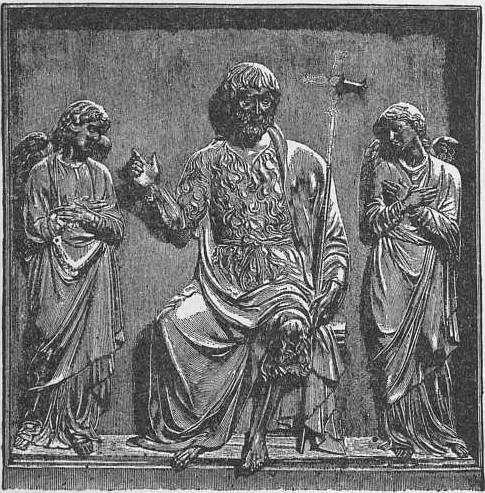
Fig. 1.—Bronze Relief of one of the Latin Doctors, from the sacristy door in the cathedral of Florence, by Luca.
The most important existing work in marble by Luca (executed in 1454-1456) is the tomb of Benozzo Federighi, bishop of Fiesole, originally placed in the church of S. Pancrazio at Florence, but removed to S. Francesco di Paola on the Bellosguardo road outside the city in 1783. In 1898 it was again removed to the church of SS. Trinita in Florence. A very beautiful effigy of the bishop in a restful pose lies on a sarcophagus sculptured with graceful reliefs of angels holding a wreath which contains the inscription. Above are three-quarter length figures of Christ between St John and the Virgin, of conventional type. The whole is surrounded by a rectangular frame formed of painted tiles of exquisite beauty, but out of keeping with the memorial. On each tile is painted, with enamel pigments, a bunch of flowers and fruit in brilliant realistic colours, the loveliness of which is very hard to describe. Though the bunch of flowers on each is painted on one slab, the ground of each tile is formed of separate pieces, fitted together like a kind of mosaic, probably because the pigment of the ground required a different degree of heat in firing from that needed for the enamel painting of the centre. The few other works of this class which exist do not approach the beauty of this early essay in tile painting, on which Luca evidently put forth his utmost skill and patience.
In the latter part of his life Luca was mainly occupied with the production of terra-cotta reliefs covered with enamel, a process which he improved upon, but did not invent, as Vasari asserts. The rationale of this process was to cover the clay relief with an enamel formed of the ordinary ingredients of glass (marzacotto), made white and opaque by oxide of tin. (See Ceramics: Italian Majolica.) Though Luca was not the inventor of the process, yet he extended its application to fine sculptured work in terra-cotta, so that it is not unnaturally known now as Della Robbia ware; it must, however, be remembered that by far the majority of these reliefs which in Italy and elsewhere are ascribed to Luca are really the work of some of the younger members of the family or of the atelier which they founded. Comparatively few exist which can with certainty be ascribed to Luca himself. Among the earliest of these are medallions of the four Evangelists in the vault of Brunelleschi’s Pazzi chapel in S. Croce. These fine reliefs are coloured with various metallic oxides in different shades of blue, green, purple, yellow and black. It has often been asserted that the very polychromatic reliefs belong to Andrea or his sons, and that Luca’s were all in pure white, or in white and blue; this, however, is not the case; colours were used as freely by Luca as by his successors. A relief in the Victoria and Albert Museum furnishes a striking example of this and is of especial value from its great size, and also because its date is known. This is an enormous medallion containing the arms of René of Anjou and other heraldic devices; it is surrounded by a splendidly modelled wreath of fruit and flowers, especially apples, lemons, oranges and fir cones, all of which are brilliantly coloured. This medallion was set up on the façade of the Pazzi Palace to commemorate René’s visit to Florence in 1442. Other reliefs by Luca, also in glazed terra-cotta, are those of the Ascension and Resurrection in the tympani of the doors of the sacristies in the cathedral, executed in 1443 and 1446. Other existing works of Luca in Florence are the tympanum reliefs of the Madonna between two Angels in the Via dell’ Agnolo, a work of exquisite beauty, and another formerly over the door of S. Pierino del Mercato Vecchio, but now removed to the Bargello (No. 29). The only existing statues by Luca are two lovely enamelled figures of kneeling angels holding candlesticks, now in the canons’ sacristy.5 A very fine work by Luca, executed between 1449 and 1452, is the tympanum relief of the Madonna and four Monastic Saints over the door of S. Domenico at Urbino.6 Luca also made the four coloured medallions of the Virtues set in the vault over the tomb of the young cardinal-prince of Portugal in a side chapel of S. Miniato in Florence (see Rossellino). By Luca also are various polychromatic medallions outside Or San Michele.7 One of his chief decorative works which no longer exists was a small library or study for Piero de’ Medici, wholly lined with enamelled plaques and reliefs.8 The Victoria and Albert Museum possesses twelve circular plaques of majolica ware painted in blue and white with the Occupations of the Months; these have been attributed to Luca, under the idea that they formed part of the decoration of this room, but their real origin is doubtful.
In 1471 Luca was elected president of the Florentine Gild of Sculptors, but he refused this great honour on account of his age and infirmity. It shows, however, the very high estimation in which he was held by his contemporaries. He died on the 20th of February 1482, leaving his property to his nephews Andrea and Simone.9 His chief pupil was his nephew Andrea, and Agostino di Duccio, who executed many pieces of sculpture at Rimini, and the graceful but mannered marble reliefs of angels on the façade of S. Bernardino at Perugia, may have been one of his assistants.10 Vasari calls this Agostino Luca’s brother, but he was not related to him at all.
II. Andrea della Robbia (1435-1525), the nephew and pupil of Luca, carried on the production of the enamelled reliefs on a much larger scale than his uncle had ever done; he also extended its application to various architectural uses, such as friezes and to the making of lavabos (lavatories), fountains and large retables. The result of this was that, though the finest reliefs from the workshop of Andrea were but little if at all inferior to those from the hand of Luca, yet some of them, turned out by pupils and assistants, reached only a lower standard of merit. Only one work in marble by Andrea is known, namely, an altar in S. Maria delle Grazie near Arezzo, mentioned by Vasari (ed. Milanesi, ii. p. 179), and still well preserved.
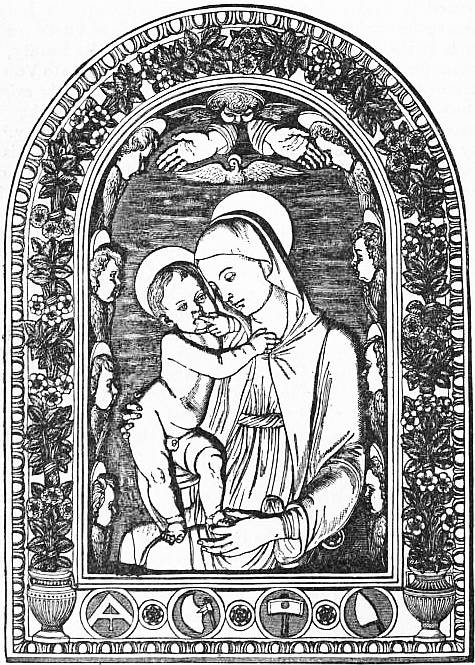
Fig. 2.—Enamelled Clay Relief of Virgin and Child, by Andrea.
One variety of method was introduced by Andrea in his enamelled work; sometimes he omitted the enamel on the face and hands (nude parts) of his figures, especially in those cases where he had treated the heads in a realistic manner; as, for example, in the noble tympanum relief of the meeting of St Domenic and St Francis in the loggia of the Florentine hospital of S. Paolo,—a design suggested by a fresco of Fra Angelico’s in the cloister of St Mark’s. One of the most remarkable works by Andrea is the series of medallions with reliefs of Infants in white on a blue ground set on the front of the foundling hospital at Florence. These lovely child-figures are modelled with wonderful skill and variety, no two being alike. Andrea produced, for gilds and private persons, a large number of reliefs of the Madonna and Child varied with much invention, and all of extreme beauty of pose and sweetness of expression. These are frequently framed with realistic yet decorative garlands of fruit and flowers painted with coloured enamels, while the main relief is left white. Fig. 2 shows a good example of these smaller works. The hospital of S. Paolo, near S. Maria Novella, has also a number of fine medallions with reliefs of saints, two of Christ Healing the Sick, and two fine portraits, under which are white plaques inscribed—“DALL ANNO 1451 ALL ANNO 1495”11; the first of these dates is the year when the hospital was rebuilt owing to a papal brief sent to the archbishop of Florence. Arezzo possesses a number of fine enamelled works by Andrea and his sons—a retable in the cathedral with God holding the Crucified Christ, surrounded by angels, and below, kneeling figures of S. Donato and S. Bernardino; also in the chapel of the Campo Santo is a fine relief of the Madonna and Child with four saints at the sides. In S. Maria in Grado is a very noble retable with angels holding a crown over a standing figure of the Madonna; a number of small figures of worshippers take refuge in the folds of the Virgin’s mantle, a favourite motive for sculpture dedicated by gilds or other corporate bodies. Perhaps the finest collection of works of this class is at La Verna, not far from Arezzo (see Vasari, ed. Milanesi, ii. p. 179). The best of these, three large retables with representations of the Annunciation, the Crucifixion, and the Madonna giving her Girdle to St Thomas, are probably the work of Andrea himself, the others being by his sons. In 1489 Andrea made a beautiful relief of the Virgin and two Angels, now over the archive-room door in the Florentine Opera del Duomo; for this he was paid twenty gold florins (see Cavallucci, S. Maria del Fiore). In the same year he modelled the fine tympanum relief over a door of Prato cathedral, with a half-length figure of the Madonna between St Stephen and St Lawrence, surrounded by a frame of angels’ heads.
In 1491 he was still working at Prato, where many of his best reliefs still exist. A fine bust of S. Lino exists over the side door of the cathedral at Volterra, which is attributed to Andrea. Other late works of known date are a magnificent bust of the Protonotary Almadiano, made in 1510 for the church of S. Giovanni de’ Fiorentini at Viterbo, now preserved in the Palazzo Communale there, and a medallion of the Virgin in Glory, surrounded by angels, made in 1505 for Pistoia cathedral.12 The latest work attributed to Andrea, though apparently only a workshop production of 1515, is a relief representing the Adoration of the Magi, made for a little church, St Maria, in Pian di Mugnone, near Florence.13 Portions of this work are still in the church, but some fragments of it are at Oxford.
III., IV. Five of Andrea’s seven sons worked with their father, and after his death carried on the Robbia fabrique; the dates of their birth are shown in the table on p. 838 ante. Early in life two of them came under the influence of Savonarola, and took monastic orders at his Dominican convent; these were Marco, who adopted the name of Fra Luca, and Paolo, called Fra Ambrogio. One relief by the latter, a Nativity with four life-sized figures of rather poor work, is in the Cappella degli Spagnuoli in the Sienese convent of S. Spirito; a MS. in the convent archives records that it was made in 1504.
V. The chief existing work known to be by the second Luca14 is the very rich and beautiful tile pavement in the uppermost story of Raphael’s loggie at the Vatican, finely designed and painted in harmonious majolica colours. This was made by Luca at Raphael’s request and under his supervision in 1518.15 It is still in very fine preservation.
VI. Giovanni della Robbia (1460-1529?) during a great part of his life worked as assistant to his father, Andrea, and in many cases the enamelled sculpture of the two cannot be distinguished. Some of Giovanni’s independent works are of great merit, especially the earlier ones; during the latter part of his life his reliefs deteriorated in style, owing mainly to the universal decadence of the time. A very large number of pieces of Robbia ware which are attributed to Andrea, and even to the elder Luca, were really by the hand of Giovanni. One of his finest works is a large retable at Volterra in the church of S. Girolamo, dated 1501; it represents the Last Judgment, and is remarkable for the fine modelling of the figures, especially that of the archangel Michael, and a nude kneeling figure of a youth who has just risen from his tomb. Quite equal in beauty to anything of his father’s, from whom the design of the figures was probably taken, is the washing-fountain in the sacristy of S. Maria Novella at Florence, made in 1497.16 It is a large arched recess with a view of the seashore, not very decorative in style, painted on majolica tiles at the back. There are also two very beautiful painted majolica panels of fruit-trees let into the lower part. In the tympanum of the arch is a very lovely white relief of the Madonna between two Adoring Angels (see fig. 3). Long coloured garlands of fruit and flowers are held by nude boys reclining on the top of the arch and others standing on the cornice. All this part is of enamelled clay, but the basin of the fountain is of white marble. Neither Luca nor Andrea was in the habit of signing his work, but Giovanni often did so, usually adding the date, probably because other potters had begun to imitate the Robbia ware.17