VOLUME VII SLICE V Cosway to Coucy (continued 5)
Reading edition
American organization display intense specialism, but of a type different from that in England, where businesses are specialized by processes; in America they are specialized by products but hardly at all by processes. Independent spinning, independent manufacturing, independent bleaching, dyeing and finishing are the significant features of English industry to the bird’s-eye view; in the United States the typical firm will spin, make up its own yarn, and perhaps complete its fabrics for the market; but the mills, it must be remembered, are intensely specialized as to the range of their product, so that the statement that American mills are less specialized than English mills must be received with caution. For some reasons we should expect to find the American method applied even in England for fabrics of the highest qualities, because in their case the adaptation of the yarn to the fabric, and finishing to the fabric, are of great importance, and actually where the American plan is followed in England the explanation is frequently the speciality of the product which is associated with the particular firm producing it. When a firm manufactures a speciality of this kind it cannot always trust bought yarn, or the finishing applied to fabrics in the ton. But for other reasons specialized processes might be looked for where qualities were highest, as by specialism alone can the greatest excellence be attained. The final selection of method depends upon the relative importance for high qualities in the finished product of the connectedness of processes and the perfection of parts; and to these considerations must be added cost of transport between the works devoted to distinct processes, and the development of the commercial functions by which specialized process businesses are kept functioning as a whole. Probably it is the high development of British industry on the commercial side which chiefly explains the arrangements found in England. Attention should also be directed to the huge magnitude of American businesses. This is partly a consequence of American ambition in business, and partly a consequence of the undeveloped commercial ligaments by which producing businesses are brought into union. American producers in both North and South are too widely scattered for one town, like Manchester in the English cotton district, to be visited frequently by them for the purpose of making purchases and effecting sales. Even if the Americans did possess a convenient commercial centre, the high cost of transport between works distributed over a very wide area would prevent much specialism of businesses by processes from appearing. Writing capital letters for industrial processes and small letters and Greek letters for commercial functions, the possible arrangements in the cotton industry may be represented broadly as follows, brackets indicating the scope of businesses:60
I. (a,A,B,C,d)
II. (a)(A,B,C)(d).
III. (aAα)(bBβ)(cCγ).
IV. (a)(A)(α,b)(B)(β,c)(C)(γ).
The American industry approximates to the first type, while the English approximates rather to the last. Differences in respect of specialism by range of product are not shown in the formulae.
Other Parts of America.—Little need be said of the cotton industry in other parts of the New World. In Canada in 1909 there were, approximately, 855,000 Spindles, and in Mexico in 1906, where the first factory was established in 1834, 450,000 Spindles. In Brazil also there is an appreciable number of spindles, distributed (in 1895) among 134 factories, which are located chiefly in Rio de Janeiro and Minas Geraes, and are run for the most part by turbines and water-wheels.
Germany.—In Germany the cotton industry is by no means so intensely localized as in England, but three large districts may be distinguished:—
1. The north-west district, which consists of the Rhine Province and Westphalia and contained 1¾ million spindles in 1901.
2. The country north of the mountain ranges of northern Bohemia comprises the middle district, which contained 2½ million spindles in 1901. In Saxony the industry has been carried on for four centuries.
3. Alsace, Baden, Württemberg and Bavarian Swabia make up the south-west district, to which some 3½ million spindles were assigned. It is in close proximity to the cotton districts of east France, Switzerland and Vorarlberg.
According to Oppel (1902) the German spinning industry is chiefly localized in—
Prussia with 2020 thousand spindles Saxony with 1870 thousand spindles Alsace with 1600 thousand spindles Bavaria with 1390 thousand spindles
The spindles of Württemberg, which stands next, do not much exceed half a million. Only sixteen places in Germany (shown in tabular form on p. 169) contained as many as 100,000 spindles in 1901.
Spindles in Thousands. Spindles in Thousands.
Mülhausen 471 Chemnitz 195
Augsburg 373 Gebweiler 187
Gronau 274 Leipzig 182
Werdau 249 Crimmitzschau 168
Rheydt 248 Logelbach 141
München-Gladbach 216 Bocholt 128
Rheine 198 Bamberg 125
Hof 196 Bayreuth 100
The history of the hand industry in Germany runs back some centuries. At the time when it flourished in the Netherlands we may be sure that it was prosecuted to some extent farther north and east. The start with the machine industry was not long delayed after its economies had been learnt in England. It was fostered by protection against the cheap products of Lancashire, and in the course of time stimulated by every step taken towards the economic unity of the German States which broke down local barriers and therefore enlarged the German market. Duties upon cotton goods, however, were not immoderately high until the measure of 1879, the policy of which was carried to a further stage in 1885. Slight reactions were brought about in 1888 and 1891, largely by the complaints, not only of the consumers of finished goods, but also of manufacturers whose costs of production were kept up by the high prices of home-spun yarns and the tax on imported substitutes. According to the investigations made by the Board of Trade, the general ad valorem impact of German duties on British goods stood somewhat as follows in 1902:—
Statement showing the Average Incidence (ad valorem) of the Import Duties levied by Germany on British Cotton Goods.
Average Value of Exports from the United Kingdom to all Countries in 1902. Rate of Duty estimated Equivalent. Approximate Equivalent Rate of Duty ad valorem.
Cotton manufactures— Per Cent.
Piece goods, unbleached 2.01d. per yd. 0.87d. per yd. 43
” ” bleached 2.46d. ” 1.09d. ” 44
” ” printed 2.68d. ” 1.31d. ” 49
” ” dyed, &c. 3.46d. ” 1.31d. ” 38
Cotton thread for sewing 26.89d. per ℔ 3.81d. per ℔ 15
Cotton yarn—
Grey 10.49d. ” 0.98d. ” 9
Bleached or dyed 11.23d. ” 1.63d. ” 15
The duties are not prohibitive—they are much less than those of the United States at the same time—but they are heavy on the classes of goods which come into competition with home-made goods. The general principle of the tariff is to treat easiest commodities which are made with least success at home, or are in the highest degree raw material for a home manufacture. Therefore yarns are not taxed very heavily, and of these the finest counts escape with slight discouragement.
In the cotton industry, as well as in numerous other industries of Germany, almost feverish activity was shown after the Franco-German War. Previously great advance had been made, but it was not until the last quarter of the 19th century that Germany forced herself into the first rank. As measured by the annual consumption of cotton the German industry increased as follows:—
Metric Tons of Cotton per Annum.
(In Thousands.)
1836-1840 9
1856-1860 46
1876-1880 124
1886-1890 201
1899-1903 324
It must be remembered that the spindles and looms of Alsace and Lorraine were reckoned as German after the war: they amounted in 1895 to one and a half million spindles and nearly forty thousand looms.
In the ’seventies there was no dispute as to England’s substantial lead in respect of efficiency. Alexander Redgrave, the chief factory inspector, made inquiries on the continent both in 1873, when Lancashire was anxious as to the comparative cost of production abroad because of the short-time bill then before parliament, and previously, and reported most unfavourably upon the state of the industry in Germany. Hours were long, the skill of the hands was inferior, speeds were low and time was wasted. In several important respects his views were corroborated by M. Taine in his Notes on England, and by the evidence adduced before the German commission upon the cotton and linen industries in 1878. A marked contrast is noticeable between the sketches drawn of this period and the careful picture presented by Professor Schulze-Gaevernitz of the early “’nineties,” but even in the latter the advantage of England is represented as substantial in every essential respect. The gap which existed has narrowed, but it is still unmistakable. To give one example, according to Dr Huber’s figures there were in Saxony at the end of the 19th century 106 spindles to an operative and about as many weavers as looms, whereas in England there were about twice as many spindles to an operative and twice as many looms as persons engaged in weaving sheds.61 As regards manufacturing, the character of the product may partly explain the difference, but it will not entirely. The reader need hardly be warned that the comparison drawn is exceedingly rough. German cotton operatives taken all round are certainly less efficient than English labour of the same kind. The reason is partly that the proportion of the German workpeople who have been for long specialized to the industry, and look forward to continuing in it all their lives, is not high. Complaint is constantly made of the number of vacancies created in the mills each year by operatives leaving, and of the impossibility of filling them with experienced hands. Many of the vacancies are caused by the return of workpeople to the country parts. Sometimes the mills are in the country, or within easy reach of it, and labour is obtained from the unoccupied members of peasants’ families. In these cases the factories do not always succeed in attracting the most capable people, and work in the factory is not infrequently looked upon as a makeshift to supplement a family’s earnings. Among Lancashire operatives far more pride of occupation may be met with. In many of the industrial parts of Germany English conditions are evolving, but they are not generally the rule. An American consul may be taken to report to his own country without prejudice as to the rival merits of German and English conditions: one such wrote in 1901:—“The task of educating labour up to a high degree of efficiency is difficult, and many generations are necessary to achieve that result. The English cotton spinners have attained such a degree of skill and intelligence that, for the most part, no supervision is necessary. In Germany the presence of a technical overseer is indispensable. Another advantage which England enjoys is the cheap price of machinery. Germany imports the major part of her machinery from England, and German wholesale dealers in these machines have not been able, by placing large orders, to overcome the difference caused by freight and tariff.” Wages reflect the efficiencies of countries, not of course perfectly, but in some degree. They are much higher in Lancashire than in Germany, as is made evident by an article from the pen of Professor Hasbach in Schmollers Jahrbuch (vol. ii., 1903). The author tries to show that Germany is not so far behind England industrially as is generally believed, and the contrast drawn by him, greatly to the advantage of Lancashire, is not likely to exaggerate the superiority of English conditions. It is calculated by Professor Hasbach that the daily wages of spinners are about 5/10 to 6/10 at Oldham, 6/6 at Bolton and 5/6 in Stalybridge and neighbouring places. With these he compares the 3.70 to 3.80 marks paid in the Rhine Province and Leipzig, and the 3 to 3.15 marks paid in the Vogtland, Bavaria and Alsace, and mentions an exceptionally high wage of 42⁄3 marks, which was earned by an operative who worked a new and long doubling mule. The wage paid to the big piecer in England, Dr Hasbach goes on to show, is not much greater than that received by a good assistant in Germany. This comparison as it stands will probably give some readers an idea that English advantages are greater than they actually are, because it may be overlooked that the great difference between wages in the case of English and German spinners is not repeated among the piecers. Taking a spinner and his first assistant as the unit, we should have a joint average daily wage of about 8/6 in England and 6/6 in Germany. In the case of weavers, comparison of wages is more difficult to draw, but the advantage of England would seem to be but little less. However, in instituting a comparison between two countries, as regards the relative efficiency of labour in some industries, we should do well to remind ourselves that efficiency is a somewhat transitory thing, dependent upon education and experience as much as upon aptitude. In respect of the capacity of labour for the task required in the cotton industry, we could not (writing in 1907) make the statement that England leads significantly with the assurance with which we can assert her superiority in respect of present attainments. The cotton industry has not been prosecuted on a large scale in Germany so long as in England, and the Germans have not, therefore, had the same opportunity for developing their latent powers. But the thoughtfulness and carefulness of the German workman are beyond dispute, and these qualities will procure for him a leading place where work is not mechanical. Already in the cotton industry it is said that the operatives are displaying quite striking powers of undertaking a wide range of work and changing easily from one pattern to another. Hence German firms feel little hesitation in taking small orders on special designs; they do not experience any great difficulty in getting their factors accommodated to produce the required articles.
Apart from the efficiency of labour, reasons exist for the lower real cost of production in England in the organization of the industry. The German industry is not only less localized, but, as we might perhaps infer from that circumstance, less specialized. A German factory will turn out scores of patterns where an English firm will confine itself to a few specialities. Time is wasted in accommodating machinery to changes and in accustoming the hands to new work. The German producer suffers from the undeveloped state of the market. In England specialized markets with specialized dealers have greatly assisted producers both in their buying and selling. A German manufacturer may have to find his customers as the English manufacturer need not; at least, so Professor Schulze-Gaevernitz has assured us, and conditions have not been wholly transformed since he made his careful analysis. He wrote:—“But especially disadvantageous is the decentralization in respect to the sale. Here also the German manufacturer stands under the same disadvantages with which the English had to struggle in the ’thirties. The German manufacturer still seeks his customers through travellers and agents, and in many instances through retail sellers, whose financial standing is often questionable, whose necessity for credit is always certain. Hence the complaints about the bad conditions of payment in Germany which crop up continually in the enquête. The manufacturers had to wait three, four or six months, and even twelve months and longer for payment. In reality there existed ‘termless terms,’ a ‘complete anarchy in the method of payment.’ ... The manufacturer cannot be at the same time commission agent, banker, merchant and retail dealer; he needs sound customers capable of paying. He fares best if the sale is concentrated in one market, and ‘change’ prices simplify the struggle between buyer and seller. The search for customers, foreign as well as home, and the bearing of all possible risks of disposal, are in any case difficult enough to necessitate the whole strength of a man. The wholesale merchant alone is in a position to pay the manufacturer in cash or on sure, short terms. But especially where export is in question is the dispersal of sales an extreme impediment. The manufacturer cannot follow the fashions in Australia and South America; the foreign buyer cannot travel from mill to mill.”
It is the want of commercial development in Germany which accounts for the more frequent combination of weaving and spinning there than in England. But in Germany to-day economic enterprise is flourishing, and commercial development may confidently be looked for together with advance in other directions. It is not many years since the typical German cotton factory was comparatively primitive; now mills can be exhibited which might have been erected recently in Oldham. Between the early ’eighties and the ’nineties the expansion of the German industry was enormous—the imports of cotton-wool rose by nearly 70%—yet the number of spinning-mills was actually reduced from 6750 to 2450, while the number of weaving-sheds fell from 56,200 to 32,750. At the same time the factories devoted to mixed goods declined from 25,200 to less than 16,350. From these figures we may gather how rapidly the average size of mills and weaving-sheds enlarged in the period. One cause, no doubt, was that improved economies in the new businesses forced antiquated factories to shut down and make way for still newer erections. There were recently about twice as many persons engaged in weaving as in spinning, but the largest numbers of all—slightly in excess of those in weaving-sheds—were the persons occupied in the manufacture of cotton-lace, trimmings, &c. As we might imagine, Germany’s exports of cotton goods are not high. Including yarns they amounted to £13.7 million per annum in 1899-1903. In order of value their largest exports are (1) coloured goods, (2) hosiery, (3) lace and embroidery, (4) yarns, and (5) trimmings, &c.
France.—Into the industrial conditions of the two leading rivals of England we have entered in some detail; the state of affairs in the rest of the world must be dealt with more briefly. Of France more ought to be said than we can find place for, though in respect of the magnitude of her cotton industry, as measured by the quantity of spindles, she stands now not fourth, but fifth, Russia taking precedence. But the work of the French is incomparably superior to anything that is turned out from Russia. France suffered a severe blow when the industry of Alsace and Lorraine was lost to Germany, but the inexhaustible originality of French design will always secure for her goods a place in the first rank. As regards artistic results France leads, but the real cost of her spinning and weaving cannot approach in lowness that of Lancashire. After costly strikes the French workmen have succeeded in shortening their hours to ten and a half a day; and here it may be remarked that the International Association of Textile Operatives tends to equate continental industrial conditions to those of England. The French industry has been fostered by tariffs. When the Board of Trade calculation was made, French tariffs were found to bear upon British cotton goods with about the same severity as those of Germany, except that the former treated more hardly yarns and cotton thread for sewing. French protectionism has kept down her exports; such as they are the majority proceed now to her colonies. Normandy, the north and east, in order, are the chief seats of the industry. In Normandy the leading city is Rouen, and Darnétal, Maromme, Sotteville, Havre, Yvetot, Dieppe, Évreux, Gisors, Falaise and Flers are important places. The north contains the important towns of Lille, Tourcoing, Roubaix, St Quentin, Amiens and Hellemmes. The Vosges is the chief district of the east, and the leading towns are Epinal, St Dié, Remiremont, Senones, Val d’Ajol, Cornimont and La Bresse. The following towns which are not included in any of the districts mentioned above are also noteworthy:—Troyes, Nantes, Cholet, Laval, Tarare, Roanne, Thizy and Villefranche upon the Saône. Cotton arrives at Havre and Marseilles; at the latter chiefly the product of Egypt and the East. Havre used to be the most important cotton port in continental Europe, but to-day more spindles are fed from Bremen than from Havre. France’s consumption of cotton annually in the period 1899-1903 was 215,000 metric tons.
Russia.—Power-spinning was carried into Russia by Ludwig Knoop, who had learnt the trade in Manchester, and to his efforts its early success was due. The growth, largely the result of very heavy protectionism—according to the Board of Trade report, from 50 to more than 100% more severe than that of Germany,—has been rapid, as the following table bears witness:—
Average yearly Importation of Cotton wool and Yarn into Russia.
Raw Cotton in thousand tons. Cotton Yarn in thousand tons.
1824-1826 .9 5.4
1836-1838 4.6 10.1
1842-1844 8.4 9.5
1848-1850 21.4 4.5
1889-1891 117.4 3.4
1899-1903 180.0 2.9
Table showing approximately the Growth of Spindles and Looms in Russia.
Spindles. Looms.
1857 1,000,000 · ·
1877 · · 55,000
1887 4,000,000 85,000
1900 6,000,000 146,000
1909 7,800,000 · ·
The chief districts were the following in 1900:—
Government. Factories. Spindles (in thousands). Looms (in thousands).
Moscow 56 1295 33
Vladimir 67 1224 42
Piotrkov 25 745 20
St Petersburg 24 1074 11
Jaroslaw 4 347 2
Kostroma 25 274 20
Tver 6 348 9
Esthonia 1 440 2
Ryazan 4 146 3
Elsewhere 15 198 4
Total 227 6091 146
Fine spinning has been attempted only recently. Generally speaking 70’s used to be the upper limit, but now counts up to 140’s are tried, though the bulk of the output is coarse yarn. The inefficiency of the labour was made abundantly plain by Dr Schulze-Gaevernitz in his economic study of Russia, and conditions have not greatly altered for the better since. Roughly, 170,000 operatives worked 6,000,000 spindles in 1900, which means 35 spindles per head as compared with more than 100 in Saxony and more than 200 in England. In weaving the ratio of operatives to machinery worked out at about one loom to each weaver, which is comparatively much less unfavourable to Russia. The proportion in Saxony is about the same, but in England the average approaches two looms to a weaver. The speed of machinery cannot be compared, and we must remember that the above contrasts are rough only, and made without regard to differences of product. Russia is encouraging the growth of cotton at home. It is of very inferior quality, but 100,000 tons from the provinces of central Asia and Trans-Caucasia were used in 1900: her imports in the same year were about 170,000 tons.
Switzerland.—Swiss spindles advanced until the early “’seventies,” but a decline followed. Details are:—
1830 400,000
1850 950,000
1876 1,854,000
1883 1,809,000
1898 1,704,000
1909 (estimated) 1,500,000
The falling off is occasioned mainly by (a) the developing industrialism of the rest of Europe, notably Germany, and (b) the diminishing importance of the natural advantage of water-power with the improvement of steam-engines. Swiss yarns have been kept out of continental markets in the interests of home spinning. Now fancy cotton goods, laces and trimmings are the leading specialities of the Swiss textile workers. About half the Swiss spindles are in the canton of Zürich, between a quarter and a third in Glarus, about the same in St Gall and 9% in Aargau. Figures show that the average size of the Swiss mill is small. The average spindles to a mill were 22,000, and very few mills held more than 50,000 spindles. Some 9000 of the power-looms are in Zürich, some 4500 in Glarus and 4000 in St Gall. Wald in the south-east of the canton of Zürich is an important centre of the muslin manufacture.
Austria.—Austria contains about 4,200,000 spindles and more yarn is consumed than it produces, as on balance there is an excess of imports of yarn. Bohemia, lower Austria, Tirol and Vorarlberg account for the mass of Austrian spinning. The following details relating to these districts recently are of interest:—
Mills. Spindles. Average spindles to a mill.
Bohemia 82 1,870,000 22,800
Lower Austria 23 460,000 20,000
Tirol and Vorarlberg 20 435,000 21,700
Reichenberg and the surrounding district is the chief manufacturing place: here are more than 80,000 looms, nearly a half of which are hand-looms.
Italy.—Recent industrial growth in Italy is remarkable: statistics of spindles since 1870 are as follows, but the percentage of error is probably high:—
1870 500,000
1888 900,000
1898 2,100,000
1909 4,000,000
The distribution of spindles is roughly as follows:—
Lombardy 1,850,000
Piedmont 1,000,000
Venetia 550,000
Campania 250,000
Liguria 250,000
Tuscany 100,000
The distribution of spindles and power-looms in the chief manufacturing towns in Italy is shown in the following table:—
Spindles. Spindles.
Turin 470,000 Genoa 210,000
Bergamo 450,000 Salerno 150,000
Como 250,000 Brescia 310,000
Milan 660,000 Naples 100,000
Novara 410,000 Udine 240,000
Power- Power-
Looms. Looms.
Milan 40,000 Pisa 2,500
Turin 22,000 Como 6,000
Novara 13,000 Bergamo 13,000
Genoa 6,000 Udine 3,500
The district between Milan and Lago Maggiore contains numerous villages devoted to the cotton industry. Many of the factories in the province of Bergamo are situated in the Valle Seriana, which is endowed with abundant water-power. In this district coarse and medium yarns and grey cloth are the chief products. In the province of Milan there are several small towns, notably Gallarate, Busto Arsizio and Monza, in which the manufacture of coloured and fancy goods is extensively carried on. The finest spinning in Italy is done in Turin. The coarsest spinning is done in Venetia.
The Netherlands.—In 1805 the cotton industry was reintroduced into the Netherlands from England in its factory form. Seventeen mules bearing 16,000 spindles are said to have been smuggled across the channel, while forty Englishmen were enticed over to work them, in spite of English legal prohibitions. Liévin Bauwens was the prime mover of the achievement. Expansion rapidly followed, and in 1892 Belgian spindles numbered nearly a million. Since then a decline has set in. Ghent, with about 600,000 spindles, is the only really important place: no other place has as many as 50,000. Holland possesses about 417,000 spindles: the leading district is Twente and the leading town Enschede; Twente contains also about 20,000 power-looms. Rotterdam is the chief cotton port; Amsterdam, always a far-away second, has lost place still further of late.
Spain and Portugal.—The greatness of Spain in the cotton industry lies buried in the remote past, but of late she has awakened somewhat, with the result that her spindles now number about 1,853,000. Catalonia is the chief province where the industry is carried on, and Barcelona surpasses all other centres. Portugal possesses nearly half a million spindles (the bulk in Lisbon and Oporto), many of which have appeared since 1894.
The Rest of Europe.—Of Sweden, Norway, Denmark, Greece and Macedonia no special mention need be made, nor of other parts where the cotton industry may just exist. It may be mentioned here that among the scattered rural populations of many parts of the continent, even in such advanced countries as France and Germany, hand-looms are still to be found in large numbers.
India.—The hand-cotton-industry has been carried on in India since the earliest times, and for many years English fabrics were protected against the all-cottons of India. Soon after the introduction of spinning by rollers, English all-cottons began to rival the Indian in quality as well as in cost. A large export trade to India has grown up, but Indian hand-loom weavers still ply their craft. In 1851 power-spinning was started, and by 1876 there were in India 1,000,000 spindles. Since then they have nearly reached six millions and importations of yarn have been significantly affected. The growth of Indian power-spinning, which is almost entirely of the ring variety, was attributed by some to the depreciation of the rupee after 1873, but the fall in the value of the rupee was stopped in 1893 and the competition continued. The real explanation, no doubt, is that at the cost of Indian labour it is found cheaper to import machinery and coal than to export or cease to grow cotton and import yarn. This was the conclusion of the majority report of the committee of the Manchester Chamber of Commerce, which made an inquiry into Bombay and Lancashire spinning in 1888. Besides, as regards Indian exports to China, the remission in 1875 of the 3% export duty on yarns must be borne in mind. The efficiency of labour in India is only a small fraction of that of Lancashire operatives. Recently complaint has been made that Indian mills are being run inhumanely long hours with the same set of labour, and that child-labour is being abused, both legally and illegally—legally as regards children over fourteen who are classed as adults. The working of heavy hours began with the electric lighting of the mills; previously all shut down at sunset largely because of the cost of illumination. The outcry which has been raised is, perhaps, sufficient guarantee that the worst evils will be remedied. Indian spinning, it must be remembered, is still very coarse as a rule, though some fine work is attempted and the average of counts spun is rising. Though there are about a ninth as many spindles in India as in the United Kingdom, there are only about one-fifteenth as many power-looms, 46,400 in all, to which figure they rose between 1891 and 1904 from 24,700. The reason for the paucity of power-looms is probably two-fold, (1) the low cost of production of Lancashire weavers, and (2) the habit of hand-loom weaving which is fixed in the Indian people. A rapid increase of power-looms is, however, observable. The hand-loom industry is gigantic, particularly in the Madras Presidency and the Central Provinces; in the latter district alone there were estimated to be 150,000 hand-looms in 1883. The following details relating to the Indian cotton industry are supplied officially:—
Cotton Mills in India, including Mills in Native States and French India.
Mills. 1897-1898. 1903-1904.
Mills (number) 164 204
Capital (thousand £s) 648 1,067
Looms (number) 36,946 46,421
Spindles (thousands) 4,219 5,213
Persons employed (daily average) 148,753 186,271
Yarn produced:—
Counts (1 to 20 thousand ℔) 400,384 474,509
Counts (above ” ” ”) 62,212 104,250
Total ℔ 462,596 578,759
Yarn produced:—
Bombay (thousand ℔) 324,649 414,932
Bengal ” ” 44,807 46,487
Madras ” ” 32,516 28,714
United Provinces (including Ajmere-Merwara) (thousand ℔) 26,747 29,930
Central Provinces (thousand ℔) 18,334 24,549
Punjab ” ” ” 6,607 11,578
Elsewhere ” ” ” 8,936 22,569
Total ℔ 462,596 578,759
Woven Goods:—
Grey (thousand ℔) 83,136 111,494
Others ” ” 8,152 26,550
Total ℔ 91,288 138,044
China.—In China spinning has not met with the same success as India, and power-manufacturing has not yet obtained a sure footing. The ingrained conservatism of the Chinese temperament is no doubt a leading cause. Of the spindles in China—about 600,000 in all—from a half to three-fifths are in Shanghai. The following details relating to the inception of the power-industry are quoted from a Diplomatic and Consular Report of 1905:—
“The initial experiment on modern lines was made in 1891, when a semi-official Chinese syndicate started at Shanghai—the Chinese Cotton Cloth Mill and the Chinese Cotton Spinning Company. Its originators claimed for themselves a quasi-monopoly, and prohibited outsiders who were not prepared to pay a fixed royalty for the privilege from engaging in similar undertakings. Although certain Chinese accepted this onerous condition, foreigners resented it as an undue interference with their treaty rights, and it was only when Japan, in 1895, after her war with China, inserted in the treaty of Shimonoseki an article providing for the freedom of Japanese subjects to engage in all kinds of manufacturing industries in the open ports of China, and permitting them to import machinery for such purposes, that outsiders were afforded an opportunity of exploiting the rich field for commercial development thereby thrown open. Accordingly, so soon as the Japanese treaty came into force no time was lost in turning this particular clause to account, and the erection of no less than 11 mills—Chinese and foreign—was taken in hand. At that time the pioneer mill, which was burnt to the ground in October 1893, but subsequently rebuilt, and other Chinese-owned mills were together working some 120,000 spindles and 850 looms.”
By 1905 the mills increased to 17, the spindles to 620,000 and the looms to 2250, but there is little inclination to expansion. Yarns for the hand-looms are obtained primarily from India and secondarily from Japan. The following are the recent figures relating to imported yarns:—
In million ℔
1898. 1899. 1900. 1901. 1902. 1903.
℔ ℔ ℔ ℔ ℔ ℔
British 9.1 7.8 4.1 7.0 4.3 2.2
Indian 186.7 254.2 131.5 228.9 251.6 250.8
Japanese 64.7 104.0 62.9 66.4 69.7 110.9
Hong-Kong · · · · · · .7 .8 1.2
Tongkinese · · · · · · · · · · .01
Total 260.5 366.0 198.5 303.0 326.4 365.1
Japan.—If in China the factory cotton industry reveals no prospects as yet of a great future, the same cannot be said of Japan.
The chief centres of spinning with their outputs in value of yarn for a year at the beginning of the 20th century are stated beneath:
Thousands. Thousands.
£ s. £ s.
Osaka 1226.5 Nara 111.5
Hyogo 495.5 Hiroshima 91.3
Okayama 374.4 Kyoto 82.2
Miye 238.1 Wakayama 79.2
Tokyo 227.9 Ehime 70.5
Aichi 224.3 Kajawa 36.4
Fukuoka 168.1
The following table gives other valuable information:—
Year Gross Amount of Capital invested. Average Number of Spindles used daily. Quantity of Raw and Ginned Cotton demanded. Total Production of Cotton Yarn. Average Number of Male Operatives daily employed. Average Number of Female Operatives daily employed. Annual Working Days. Daily Working Hours. Average Daily Wage of Male Operatives Average Daily Wage of Female Operatives
1892-1894 1123 420 112.9 97.9 6,916 21,695 290 22 4d. to 4¼d. 2d. to 2¼d.
1900-1902 3569 1209 335.3 288.0 13,373 50,271 312 19 7½d. 4½d. to 5d.
1903 3441 1290 375.5 322.7 13,160 57,166 308 20 7½d. to 8d. 4½d. to 5d.
1904 3470 1306 332.1 285.9 10,967 52,115 309 20 8d. 5d.
With amazing adaptability the Japanese have assumed the methods of Western civilization as a whole. But hand-weaving more than holds its own, and power-weaving has as yet met with little success. The custom already mentioned as a cause of the continued triumph of the hand-loom in India and China is strong also in Japan, and the economy of the factory system is greater relatively in spinning than in manufacturing. In Japan it is ring-spinning which prevails: 95% of the spindles are on ring-frames. Ring-spinning entails less skill on the part of the operative, and ring-yarn is quite satisfactory for the sort of fabrics used most largely in the Far East. The counts produced are low as a rule. Generally mills run day and night with double shifts, and the system seems to pay, though night-work is found to be less economical than day-work there as elsewhere. More operatives are placed on a given quantity of machinery in Japan than in Lancashire—possibly more “labour” as well as more operatives, because labour as well as operatives may be cheaper. On the same work the output per spindle per hour is less in Japan than in England, even when day-shifts only are taken into account. Japanese work has been severely criticized, but the recency of the introduction of the cotton industry must not be forgotten.
Bibliography.—The literature relating to the cotton industry is enormous. The most complete bibliographies will be found in Chapman’s Lancashire Cotton Industry (where short descriptions of the several works included, which relate only to the United Kingdom, are given); Hammond’s Cotton Culture and Trade; and Oppel’s Die Baumwolle. The list of books set forth here must be select only.
The development of the English industry can be traced through the following:—Aikin, A Description of the Country from Thirty to Forty Miles round Manchester (1795); Andrew, Fifty Years’ Cotton Trade (1887); Baines, History of the Cotton Manufacture in Great Britain (1835); Banks, A Short Sketch of the Cotton Trade of Preston for the last Sixty-Seven Years (1888); Butterworth, Historical Sketches of Oldham (1847 or 1848); Butterworth, An Historical Account of the Towns of Ashton-under-Lyne, Stalybridge and Dukinfield (1842); Chapman, The Lancashire Cotton Industry (1904); Cleland, Description of the City of Glasgow (1840); A Complete History of the Cotton Trade, &c., by a person concerned in trade (1823); Ellison, The Cotton Trade of Great Britain including a History of the Liverpool Cotton Market and of the Liverpool Cotton Brokers’ Association (1886); Léon Faucher, Études sur Angleterre (1845); French, The Life and Times of Samuel Crompton (1859); Guest, A Compendious History of the Cotton-manufacture, with a Disproval of the Claim of Sir Richard Arkwright to the Invention of its Ingenious Machinery (1823); Guest, The British Cotton Manufacture and a Reply to the Article on Spinning Machinery, contained in a recent Number of the Edinburgh Review (1828); Helm, Chapters in the History of the Manchester Chamber of Commerce (1902); Kennedy, Miscellaneous Papers on Subjects connected with the Manufactures of Lancashire (1849); Ogden, A Description of Manchester ... with a Succinct History of its former original Manufactories, and their Gradual Advancement to the Present State of Perfection at which they are arrived, by a Native of the Town (1783); Radcliffe, Origin of the New System of Manufacture, commonly called “Power-Loom Weaving” and the Purposes for which this System was invented and brought into use, fully explained in a Narrative concerning William Radcliffe’s Struggles through Life to remove the Cause which has brought this Country to its Present Crisis (1828); Rees’ Cyclopaedia, articles on Cotton (1808), Spinning (1816) and Weaving (1818); Ure, The Cotton Manufacture of Great Britain, investigated and illustrated, with an Introductory View of its Comparative State in Foreign Countries (2 vols.); Ure, The Philosophy of Manufacture; or An Exposition of the Scientific, Moral and Commercial Economy of the Factory System of Great Britain (1835); Watts, Facts of the Cotton Famine (1866); Wheeler, Manchester: its Political, Social and Commercial History, Ancient and Modern (1836).
In addition there are many short papers in the Manchester public library. Much valuable information may be obtained from parliamentary papers; a list of relevant ones is printed as an appendix to Chapman’s Lancashire Cotton Industry, but it is too lengthy to repeat here. The most important are the reports relating to the hand-loom weavers, those on the employment of children in factories (of which a list will be found in Hutching and Harrison’s History of the Factory Legislation), and the state of trade and the annual reports of the factory inspectors. On labour questions there is a list of authorities in Chapman’s Lancashire Cotton Industry and also of parliamentary papers containing useful material. Printed copies of the “Wages Lists” are issued by the trade unions. The Factory Acts are dealt with in Hutchins and Harrison’s History, mentioned above, as well as the literature relating to them; while the handbooks by Redgrave and by Abraham and Davies are specially useful.
On the industry abroad the following are the fullest authorities:—Besso, The Cotton Industry in Switzerland, Vorarlberg and Italy (1910) (a report made as a Gartside Scholar of the University of Manchester); Chapman’s Cotton Industry and Trade (1905); Hammond, The Cotton Industry; Hasbach’s article, “Zur Characteristik der englischen Industrie,” in Schmollers Jahrbuch, vol. ii. (1903); Leconte, Le Coton; Lochmüller, Zur Entwicklung der Baumwollindustrie in Deutschland (1906); Montgomery, The Cotton Manufacture of the United States of America contrasted and compared with that of Great Britain (1840); Oppel, Die Baumwolle (1902); Schulze-Gaevernitz, Der Grossbetrieb: ein wirtschaftlicher und socialer Fortschritt: eine Studie auf dem Gebiete der Baumwollindustrie (1892; translated as The Cotton Trade in England and on the Continent); T. M. Young, American Cotton Industry (1902); Uttley, Cotton Spinning and Manufacturing in the United States of North America (1905; a report of a tour as Gartside scholar of the university of Manchester); and the Gartside reports on the cotton industries of France and Germany by Forrester and Dehn respectively. Information will also be found in Diplomatic and Consular Reports, and fragments may be gathered from other books such as G. Drage’s Russian Affairs, Dyer’s Dai Nippon, and Huber’s Deutschland als Industriestaat. Japan has published since 1901 a very full financial and economical annual, and the British government issues annually a good statistical abstract for India. The American census contains much detailed information, and there are, in addition to the statistics issued by the Federal government, those of Massachusetts, the Bureau of Statistics of which has also reported the results of an investigation into the industry in the Southern states. Among official matter the semi-official Bombay and Lancashire cotton spinning inquiry of the Manchester Chamber of Commerce may be included. The census of production of the United Kingdom must be mentioned, and the reports of the International Congresses of Cotton Spinners and Manufacturers. As to labour, see the reports of the International Textile Congresses.
The periodical literature is of good quality and much of it is filed in the Patent Office library. We may notice particularly the Cotton Factory Times; Textile Journal; Textile Manufacturer; Textile Mercury; Textile Recorder; Textile World Record (American); Der Leipzige Monatsschrift für Textilindustrie; and the French Textile Journal. Shepperson’s Cotton Facts is an annual which relates chiefly, though not entirely, to raw cotton, as does also Cotton, the periodical of the Manchester Cotton Association. For technical works we may refer here to the well-known treatises of Brooks, Guest, Marsden, Nasmith and Walmsley, and to Johannsen’s ponderous two-volumed Handbuch der Baumwollspinnerei, Rohweissweberei und Fabrikanlagen.
(S. J. C.)
COTTON-SPINNING MACHINERY. The earliest inventors of spinning machinery (see Spinning) directed their energies chiefly to the improvement of the final stage of the operation, but no sooner were these machines put to practical use than it became apparent that success depended upon mechanically conducting the operations preliminary to spinning. Later inventors were, therefore, called upon not only to improve the inventions of their predecessors, but to devise machinery for preparing the fibres to be spun. Arkwright quickly perceived the importance of this aspect of the problem, and he devoted even more energy to it than to the invention with which his name is more intimately associated. But, given a complete series of machines for preparing and spinning, the cotton industry (see Cotton Manufacture) must have remained unprogressive without the co-operation of cotton growers, for by the then existing methods of separating cotton lint from seed it would have been impossible to provide an adequate supply of raw material. By inventing the saw gin, Eli Whitney, an American, in the year 1792, did for cotton planters what Paul, Arkwright, Crompton, Cartwright, Watt and others did for textile manufacturers, for he provided them with the means for increasing their output almost indefinitely.
Plate I.
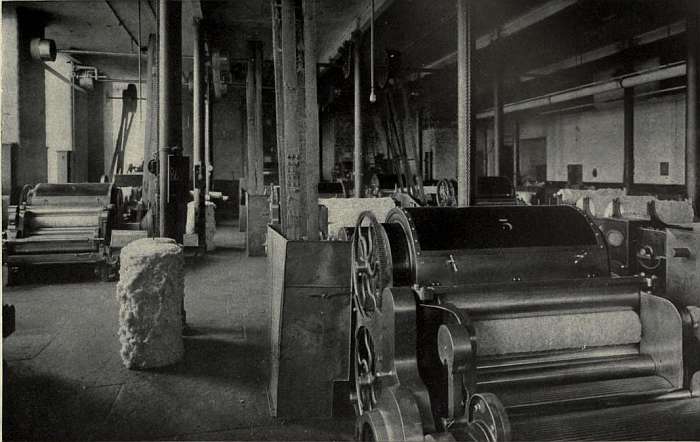
Fig. 10.—BLOWING ROOM.
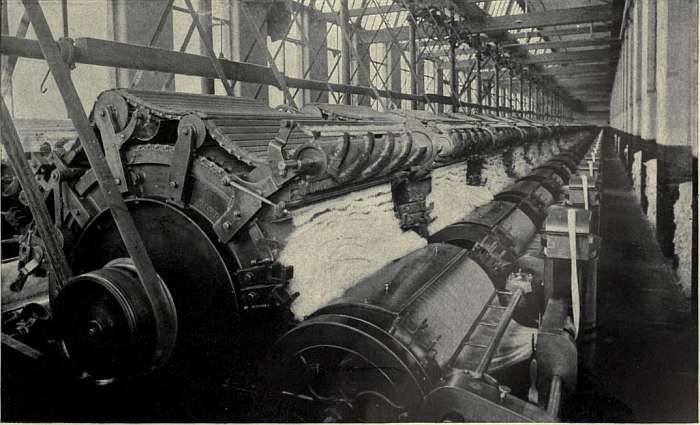
Fig. 11.—CARDING ROOM. (From Photographs taken in a Manchester Fine Cotton-spinning Mill, by R. Banks.)
Plate II.
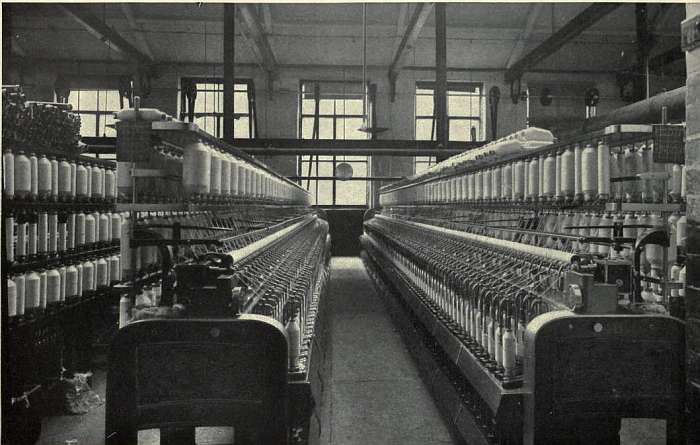
Fig. 12.—JACK-FRAME ROOM.
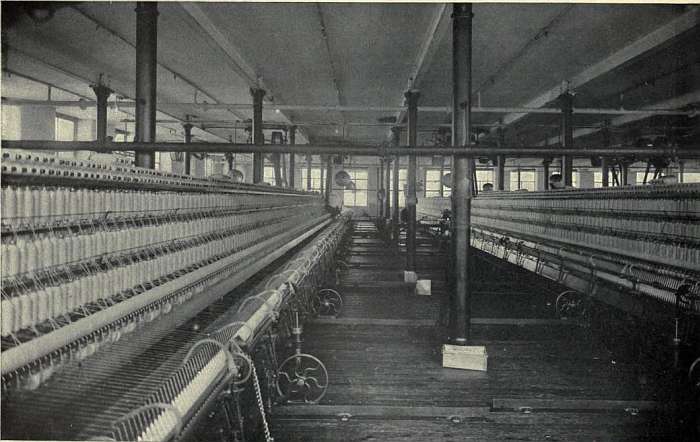
Fig. 13.—SPINNING-ROOM. (From Photographs taken in a Manchester Fine Cotton-spinning Mill, by R. Banks.)
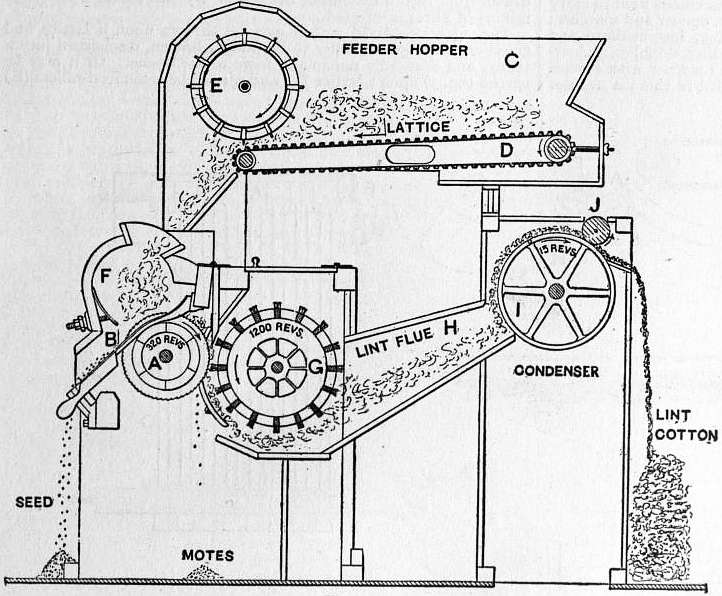
Fig. 1.
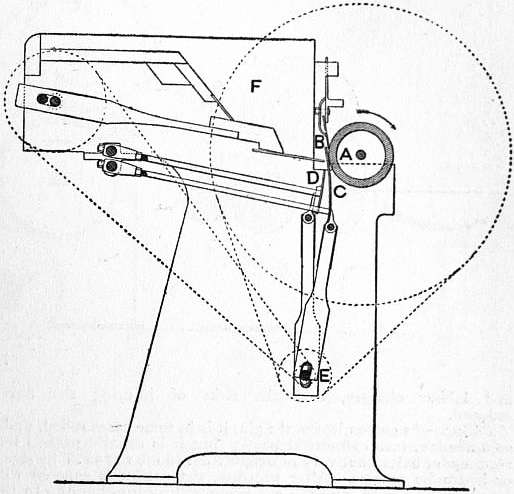
Fig. 2.
Cotton-ginning is the process by which cotton seeds are separated from the adhering fibres. The most primitive machine employed in India and China for this purpose is the churka, which consists of two wooden rollers fixed in a frame and revolving in contact. Seed cotton is fed into these rollers and the fibres pass forward but the seeds remain behind. It is a device which does not injure the fibres, but no improvement has been found by which the churka can be converted into a sufficiently productive machine for modern requirements. In a modified form Whitney’s saw gin is still used to clean a large portion of the annual crop of short and medium stapled cottons. It consists of from 60 to 70 saws (A, fig. 1), which are mounted upon a shaft and revolve between the interstices of an iron grid (B); against this grid the seed cotton is held whilst the fibres are drawn through, the seeds being left behind. The operation is as follows:—seed cotton is fed into the hopper (C), and conveyed by a lattice (D) to a spiked roller (E), which regulates the supply to the hopper (F). Whilst in (F) the cotton is engaged by the teeth of the saws (A), and drawn through the grid (B), but the bars are too close to permit the seeds to pass. A brush (G) strips the cotton lint from the saws, after which it is drawn through a flue (H) to the surface of a perforated roller (I) by pneumatic action; it then passes between (I) and (J) out of the machine. The Macarthy gin is the only other type in extensive use; it is employed to clean both long and short stapled cottons. In this gin the fibres are drawn by a leather-covered roller (A, fig. 2) over the edge of a stationary blade (B) called a doctor, which is fixed tangential to the roller. Two cranks (E) move two other blades (C, D) up and down immediately behind, and parallel to, the fixed blade (B). The cotton is thrown into the hopper (F) and the fibres are drawn by the roller (A) until the seeds are against the edge of the doctor (B), when the beaters (C, D) strike them off, but permit the fibres to go forward with the roller. Attempts continue to be made so to improve both machines, that production may be increased, and labour charges, and the risks of injuring the fibres, reduced.
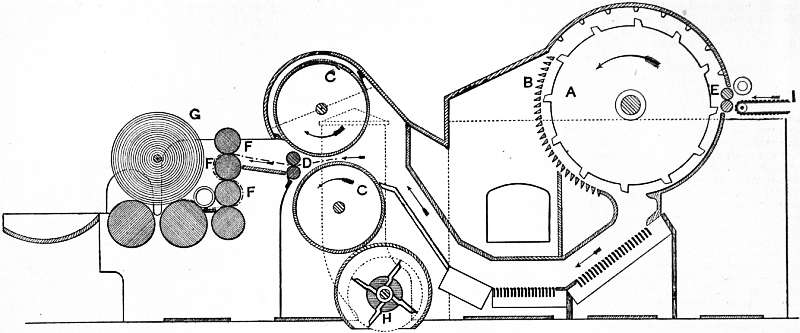
Fig. 3.
Baling.—As cotton leaves the gin, it is in some cases rolled, under compression, into cylindrical bales; but it is usually packed into rectangular bales, that vary in weight from 160 ℔ to 750 ℔, by steam or hydraulic presses. After pressing, the cotton is covered with coarse jute bagging, and the whole secured by iron bands. In this form it arrives at the spinning mills.
In the mill treatment of cotton it soon became an established practice to divide the work into the following operations, namely (1) Mixing the fibres into a homogeneous mass; (2) removing impurities; (3) combing out entanglements in, and ranging the fibres in parallel lines; (4) simultaneous combination and attenuation of groups of parallel fibres; (5) completing the combination and attenuation, and twisting the fibres into a thread; (6) compounding, finishing and making-up of threads. These remain the essential conditions of cotton-spinning. The principal machines used to carry out the foregoing stages are: The bale breaker, opener and scutcher; the card and comber; the drawing, slubbing, intermediate and roving frames; ring and mule spinning; winding, doubling; clearing and gassing the reel, and bundling press, together with several auxiliary machines. All the operations included in this list are not necessarily employed in the production of all kinds of yarn; low counts require fewer, and high counts more processes.
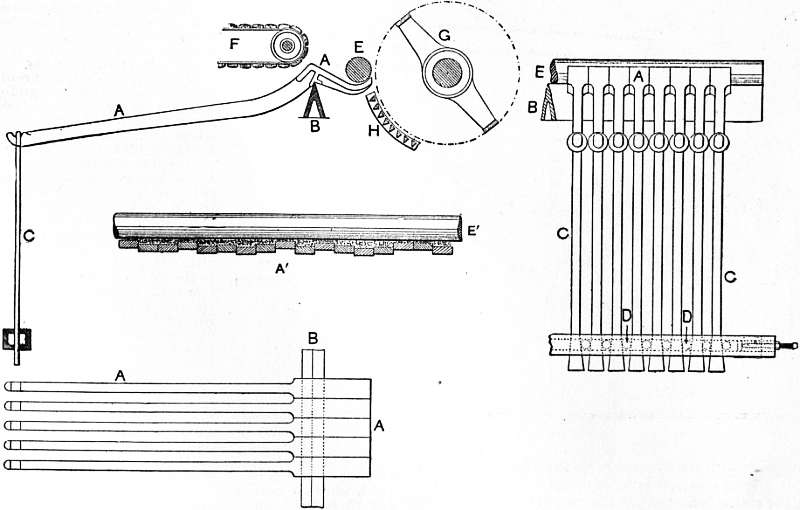
Fig. 4.
A bale breaker is used to disentangle fibres which have been, by hydraulic or steam presses, converted into hard masses that resist manual efforts to disentangle them. It may consist of three pairs of spiked and one pair of fluted rollers. If so, the matted cotton is fed into the first pair, seized by the second pair, which have a higher surface velocity, and pulled, while the third pair reduce the whole to a more or less fluffy mass, and the fluted rollers deliver it upon a travelling lattice by which it is conveyed to, and deposited upon, the floor of the mixing room. Instead of rollers, a hopper breaker may be used. In this machine the cotton is carried by a horizontal lattice into contact with a sloping spiked one, whose spikes tear away small tufts and deposit them upon a second lattice for removal to the mixing room. A stack of pulled cotton is formed by superposing thin layers from different bales, and when completed the cotton is drawn from top to bottom of the stack. By this means a thorough mixing of fibres is effected.
The Opener.—Mixed cotton may be thrown upon a lattice and conveyed to a spiked roller to be pulled, beaten, discharged into a trunk, and drawn by pneumatic force to the opener. Or it may be spread (fig. 3) upon a lattice (I), and carried between feed-rollers (E) to be subjected to the action of a beater (A) whose teeth first seize tufts of cotton and then fling them upon a grid (B), to be subsequently seized by other teeth and again flung off until dirt and other impurities pass between the grating. The beater may be cylindrical (as at A) or in the form of a truncated cone: in either event, from four to twelve rows of teeth project from its surface. It is from 18 in. to upwards of 36 in. in diameter, approximately 40 in. wide, and the largest cylindrical beaters make from 300 to 700 revolutions; whilst conical beaters make about 1000, and small ones make from 1000 to 1500 revolutions per minute. The opened cotton is carried, in the direction indicated by the arrows, upon a strong blast of air which is generated by a fan (H), and this deposits it in patches upon the surfaces of two perforated zinc or wire cylinders (C), but dust and foreign particles pass through the interstices. As these cylinders revolve towards each other the cotton passes between them in the form of a sheet to a pair of feed-rollers (D), which may again deliver it to a beater with two or three blades; if so, from this beater the cotton is next borne on an air current to, and between, a second pair of perforated cylinders. In either event, the final cages (C, C) deliver the cotton to feed-rollers (D) and they pass it to calender-rollers (F), by which it is compressed into a sheet, and finally coiled into a lap (G). Various kinds of openers have been patented, all of which differ in some important respects; for example, a hopper feed may be substituted for the trunk or the lattice feed, in which event the cotton from the mixing room is conveyed mechanically upon lattices, and deposited in a hopper affixed to an opener. In this hopper a sloping spiked lattice elevates the cotton to an evening roller, whose office is to sweep back the surplus supply from the spikes, but allow the requisite quantity to pass forward to the beater. A regular supply of cotton to an opener is of great importance, and in order to insure it a table is often formed by substituting for the lower roller (E) a series of levers (A, fig. 4) all mounted upon a fulcrum (B), and having their free arms weighted by wedge-shaped pendents (C), that are separated by bowls (D). A fluted feed-roller (E) is fixed above this table and the cotton is led over the lever but beneath the roller. If the cotton is unequally distributed, thick places will press down the levers and thin ones will permit them to rise (as at A’, E’). The rise of one pendent may be cancelled by the fall of another, but any balance of their movements is transmitted to a belt fork which governs a belt running upon a pair of inverted cones, and by this means the belt is traversed to and fro to drive the feed-roller (E) at a superior speed when the supply of cotton is insufficient, and at an inferior speed when the supply is excessive.
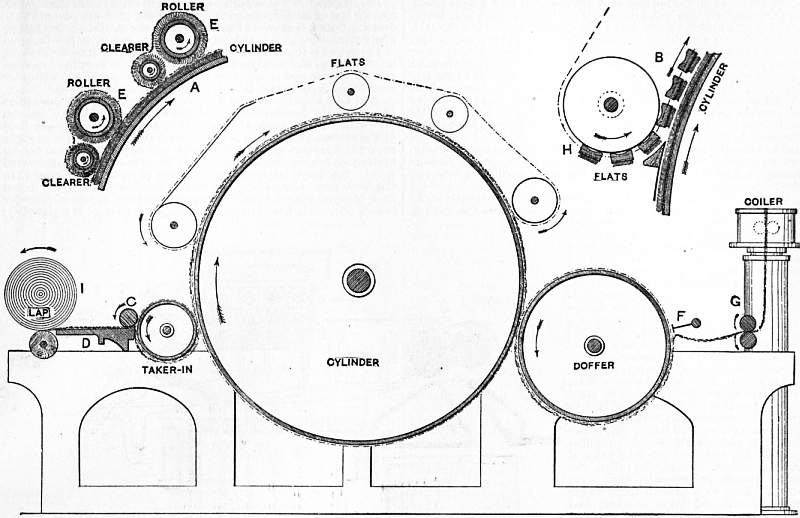
Fig. 5.
The Scutcher.—In many respects a scutcher resembles an opener; its function is to continue the cleaning and form laps of uniform weight and density for the carding engine. Occasionally the scutcher is the first cleaning machine, in which event cotton, in a loose fleece, is spread evenly upon a lattice. But in order to carry the combination of fibres one stage further, three or four opener laps are generally placed upon the feeder, so that, as the laps unroll, three or four sheets of cotton will be superposed, and in this form are passed by the lattice (F, fig. 4) and the feed-roller (E) to either one or two beaters, which are furnished with two or three blades. The beater (G) flings the cotton against the bars of a grid (H) to loosen, and cause the dirt to pass between the bars, after which the cotton is carried forward upon an air current, in the same manner as in an opener, and formed into a lap. In case two scutchers are required, the laps from the first are fed into the second, where they are similarly treated; in both machines the lever and pendent mechanism furnishes the means by which uniformity is attained. A beater may consist of a straight, smooth blade (as at G), or of a blade provided with stout teeth; in the latter event the operation resembles combing rather than beating. Two-bladed beaters revolve from 1200 to 1500 times per minute; those with three blades from 900 to 1000 times per minute.
Carding Engine.—The functions of a card (see Carding) are: to place the fibres parallel; to remove remaining impurities and immature fibres; and to form mature fibres into a porous band, called a sliver. A carding engine consists of three cylinders which are covered with cards; the first, or taker-in (see fig. 5), is the smallest; the second and largest is the main cylinder; and the third is the doffer. If the main cylinder is surmounted with a series of small ones (as at A), the engine is called a roller and clearer card. If a series of fixed strips of card are placed above the main cylinder, the engine is known as a stationary flat card. But if the strips move forward (as at B), it is a revolving flat card. In a roller and clearer card the small cylinders (E) are also covered with cards, but their teeth are bent to oppose those on the main cylinder, and they revolve with a different velocity. The taker-in is covered with saw teeth cut in a strip of steel which is fixed in the surface of that cylinder; it receives the cotton (I) from a feed-roller (C) that turns above a smooth iron table (D) called the feed plate, and strikes out the heaviest particles of remaining dirt. In passing through the fringe of lap, the teeth comb the attached fibres but deliver the loose ones to the main cylinder. The latter carries them into contact with the teeth on the rollers (E), by whose lower surface velocity combing is again effected. Short fibres become fixed amongst the teeth of (A) and (E), but those lying crosswise are transferred from (A) to (E) and from (E) to the clearer, which again presents them to the cylinder.
When long fibres are turned to point in the direction of rotation they advance upon the cylinder A to the doffer teeth, where the scattered fibres on the surface of A are collected into a light fleece. In this condition they are stripped by a vibrating comb (F), drawn together by a funnel, formed into a sliver, and deposited in a can (G). This machine is now chiefly used to card waste and low-class cotton. If such a card is made with two main cylinders, a connecting cylinder called a tummer collects the fibres from the first and passes them on to a second main cylinder, where they are again treated as already described. In a stationary flat card the teeth in the flats are bent to oppose those on the main cylinder, and by this means the fibres are combed and straightened. In a revolving flat card the flats (H) are formed into an endless chain, and they travel slowly in the same direction as the cylinder. In other respects both flat cards are similar to a roller and clearer card. Formerly double carding, namely, two passages of the fibres through separate cards, or one passage through a double card, was general, but single carding is now employed for most purposes.
Combing.—For counts from 60s upward, and for exceptionally good yarn of lower counts, from 14 to 20 cans from the carding engine are taken to a sliver lap machine where the slivers are drawn alongside each other, passed between three pairs of drawing rollers and two pairs of calender rollers, and formed into laps that vary in width from 7½ in. to 12 in. This machine is provided with mechanical devices for stopping it on the failure of a sliver, and on the completion of a predetermined length of lap. When the sliver lap machine furnishes laps for the comber, the slivers are previously put through one head of drawing, namely, between four lines of drawing rollers, to straighten out the fibres. The more general practice is to pass sliver laps to a ribbon lap machine, at the back of which six laps are placed, end facing end, in one long line and simultaneously unrolled to feed each web between four pairs of drawing rollers. From the rollers the cotton passes in separate films over curved plates to a smooth table where one is superposed upon another, and in the combined state it is led between two pairs of calender rollers and formed into a lap from 7½ to 10½ in. wide. In the cotton industry the Heilmann comber, or some modification of that machine, is used to straighten thoroughly the fibres of carded cotton, to cast out all below a certain length, and leave only those that are perfectly clean and approximate to uniformity in length. For fine yarns of medium quality only part of the slivers required to form a thread are combed. But for fine yarns of good quality all slivers are once combed, and those for superfine yarns are twice, or “double combed.” This machine is made with six or eight heads, each of which is supplied with a ribbon lap. One end of every lap is fed by a pair of rollers between the open jaws of a nipper which immediately closes upon the sheet of cotton, but a fringe is left protruding into the path of a cylinder, on whose periphery either one set of 17, or two sets of 13, graduated needle combs, and one, or two, fluted segments are secured. The first comb to reach the cotton may have as few as 16, and the last 90 teeth per inch. After the combs have passed successively through the overhanging fringe of fibres, the nipper opens and a fresh length of about 3⁄16 to 4⁄10 of an inch is fed in. Meanwhile, a fluted segment on the cylinder has moved up to support the fringe; a top comb, which was inoperative when the cylinder combs were acting, has descended into the fringe, and three rollers first return a portion of the material already combed so that it may overlap that last treated. The rollers then reverse the direction of their rotation; one of them and the segment engage the fringe, and draw the tail ends of all free fibres through the teeth of the top comb. The product of all the heads is next united, condensed, formed into a continuous sliver, and deposited in a can. One cycle of movements, therefore, only combs from 8⁄16 to 4⁄10 of an inch of each fibre; the top comb deals with the tail ends, and the major portion of the work is done by the cylinder combs. The foregoing operations are repeated at the rate of from 85 to 90 times per minute, during which from 15% to upwards of 25% of carded material is removed; but this is capable of being spun into coarse yarns. A comber invented by John W. Nasmith is a modification of the foregoing. In his machine the cylinder combs act upon the forward ends of the fibres whilst under the control of the nipper, after which two pairs of rollers return a sufficient portion of the previously combed film to overlap, and to enable the front rollers to engage the fringe. The rollers then draw a part of the fringe through the teeth of the top comb, which, as a sequence, treats all but the forward ends of the fibres. Since one passage through the cylinder and top combs completes the operation for one set of fibres, this machine gives a higher production; it also gives a wider range of adaptability, and a lower percentage of waste than the Heilmann machine.
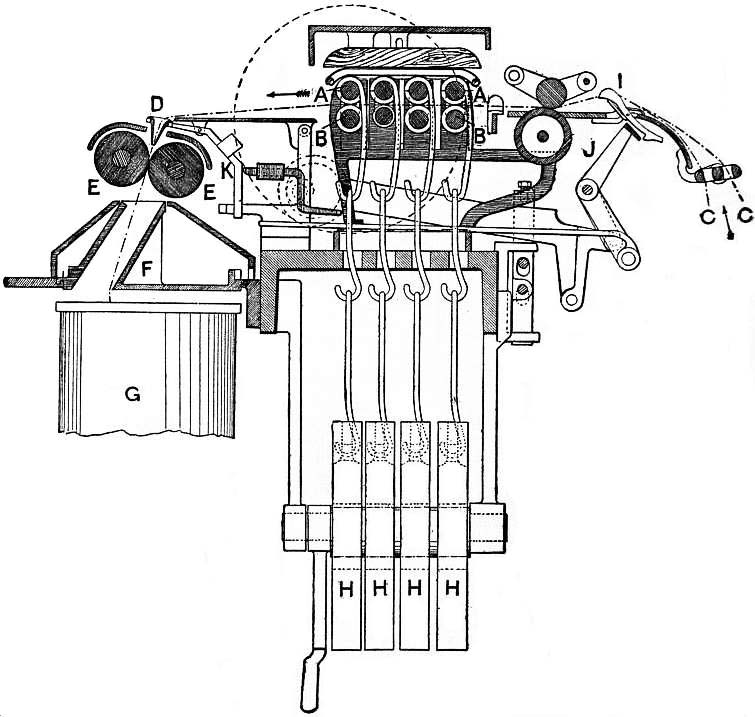
Fig. 6.
The Drawing Frame.—For fine counts the slivers from the comber, and for low or medium counts those from the card, are passed to the drawing frame, because in both conditions the material is irregularly distributed throughout the several slivers, and it is the function of the drawing frame to eliminate all such irregularities by drawing several slivers down to the dimensions of one, for here the processes of combination and attenuation are carried further than in any other machine. A drawing frame consists of three or four heads, each of four pairs of drawing rollers (A, B, fig. 6). The lower rollers (B) are fluted longitudinally and the upper ones (A) are covered with leather, and weighted as at (H) to give the two a proper hold of the cotton. Each head contains several deliveries. Six or eight slivers (C) are put up to each delivery and drawn down into one by causing succeeding lines of rollers (A, B) to move at an accelerated speed; the front one revolving about six or eight times faster than the back one. On leaving the front roller the sliver is conducted to a trumpet-shaped tube (D), thence between a pair of calender rollers (E), and, finally, through a diagonal passage in a plate (F); the latter coils the sliver into a rotating can (G). Back and front devices are provided to arrest motion in this machine when a sliver fails. At the back, each sliver passes over and depresses a separate spoon-shaped lever (I), thereby lifting the hooked lower end of (I) high enough to allow an arm (J) to vibrate. On the failure of a sliver the hook of (I) engages with (J) and dislocates the driving gear. In front, the trumpet-shaped tube (D) is mounted on a lever (K), and so long as a sliver presses down the mouth of (D), the machine continues in motion, but when a sliver fails, the lever (K) causes the driving gear to stop the machine. Six or eight cans containing once drawn slivers are put up to the second head and similarly drawn, and finally, a similar number of twice drawn slivers are fed into the third head and again drawn, giving in all 6 × 6 × 6 = 216 doublings; or 8 × 8 × 8 = 512 doublings. Occasionally four heads of drawings are used and eight slivers drawn into one, which gives 8 × 8 × 8 × 8 = 4096 doublings; hence, irregularities in an original sliver have been minimized by successive combination and attenuation.
Flyer Frames.—Cotton in cans, from the final head of drawing, is transferred to the slubbing frame, by which it is attenuated, slightly twisted, and wound upon spools. Each sliver is drawn out by means of three pairs of rollers, and as it emerges from the front pair, a flyer (A, fig. 7), which revolves uniformly upon a spindle (B), carries the sliver (C) round with it to twist the fibres axially. This flyer coils the twisted material upon a wooden tube (D) in close-wound spirals and in successive layers. The tube is loosely mounted upon, but driven independently of, the spindle, in order that as the tube increases in diameter the number of revolutions it makes may be reduced to suit the constant delivery of the roving. This is effected by a differential motion which usually consists of a large wheel, within which two other wheels are made to work; the interior wheels have a regular motion, but the large wheel is driven from a pair of cone drums at a decreasing speed.
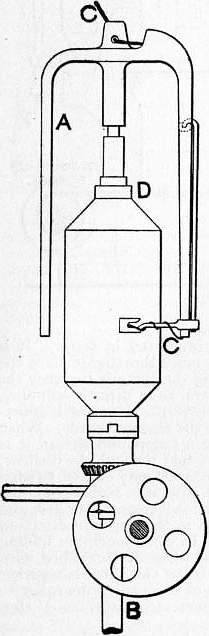
Fig. 7.
The intermediate frame comes between the slubbing and roving frames and is of similar construction to the slubber, but has a larger number of spindles and smaller tubes. Instead of having cans put at the back, the slubbing tubes are mounted vertically in a creel, passed in pairs through the rollers, and drawn down to a smaller diameter than a single slubbing. In this machine, therefore, the fourfold processes of combination, attenuation, twisting and winding are effected consecutively and continuously.
The roving frame is similar in principle to the slubber and intermediate machines, but it contains a greater number of spindles, and the tubes are smaller than either. It receives the rovings from the intermediate frame, draws two into one, twists them and winds them upon tubes. This machine is usually the last employed to prepare cotton for spinning, but for spinning fine yarns from the best Egyptian and Sea Islands cottons, a second roving, or Jack frame may be required, in which event pairs of rovings from the first machine are similarly treated in the second in order to render the final product sufficiently fine for spinning yarns of the requisite counts.
Spinning (see Spinning).—Improvements upon the Saxony wheel caused continuous spinning to become a mechanical art at an earlier date than intermittent spinning. Arkwright’s water-twist frame was gradually changed to the throstle, which was a duplex machine furnished with one set of drawing rollers, and one set of spindles and flyers at each side of the frame-work. All the bosses of one line of rollers were connected so that one driving gear would serve for the whole length, and all the spindles were driven by bands from a central cylinder. The roving spools were placed vertically in a creel between the two sets of rollers, and the rovings reduced to the requisite fineness by the latter; after which each was passed through a coiled eye at the lower end of a flyer leg, and attached to a double-flanged spool which was loosely mounted upon a spindle. At each revolution of a flyer a twist was put into the attenuated roving, and the flyer wrapped as much thread upon a spool as the rollers delivered. The spools rested upon a piece of woollen cloth stretched over a rail, and this rail rose and fell through a space equal to the length of the spool barrel. On account of a thread having to pull a spool round, it was not possible to spin finer counts than 60^s, and since each flyer was mounted upon the top of an unsupported spindle, vibration increased with speed. In order to avoid such vibration Mr Danforth, in or about 1829, placed an inverted cup upon the top of a stationary spindle, and upon the spindle a freely fitting sleeve and wharve; the former to receive a spool, the latter to rotate both. By a traverse motion all the spools were simultaneously raised or depressed, so as to have their barrels, when at the highest point, entirely within the cup, and when at the lowest entirely below it. A thread passed from the drawing rollers, outside the cup, to a spool. As a spool rotated its thread was uniformly twisted, the lower edge of the cup built the yarn equally on every part of the spool barrel, and the requisite drag resulted from friction set up by the thread rubbing against the surface of the cup. The throstle has almost disappeared from the cotton industry, and Danforth’s cap frame entirely so, but the latter is still used to spin worsted.
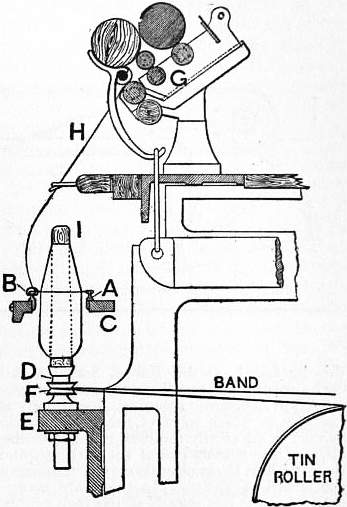
Fig. 8.
Ring spinning is practically the only system of continuous spinning used in the cotton industry; it was first patented in the United States of America by J. Thorpe, in 1828, and in that country was extensively used long before it became established in England. Its chief feature consists in the substitution for the flyer, or the cap, of a smooth annular ring (A, fig. 8) formed with a flange at the upper edge, over which a light C-shaped piece of wire (B), called a traveller, is sprung. The rings are secured in a rail (C) that rises quickly and falls slowly, but at each succeeding ascent and descent it attains a higher point than that previously reached. A spindle (D) is supported by, and turns in a bolster secured to a fixed rail (E). If the bolster only provides a bearing for the centre of the spindle, and so leaves the foot free to find its own position of steadiness, it is known as a self-balancing or gravity spindle. A recess in the bolster is filled with oil to automatically lubricate the bearing. A spindle is placed in the centre of each ring; it has a sleeve fitted upon it which carries a wharve (F) that covers the upper part of the bolster, and a band from a pair of drums is drawn round the wharve to drive the spindle. So perfect is the construction of these spindles that they can be run without appreciable vibration at speeds far beyond the ability of operatives to attend them; although a speed of 11,000 revolutions per minute is a practicable one. After passing the drawing rollers (G), the roving (H) is twisted, hooked into the traveller (B), and made fast to a spool (I) placed upon the spindle. As spinning proceeds the traveller is pulled round the ring by the thread; it thus puts a drag upon, and holds the thread at the winding point. In all continuous spinning the number of twists inserted into a given length of thread is governed by the surface speed of the front roller, relatively to the revolutions of the flyer, or to the speed of the winding surface.
Intermittent Spinning.—The essential difference between continuous and intermittent spinning is that the former draws and twists consecutively, whilst the latter draws and twists simultaneously. In the mule, a creel (A, fig. 9), fixed at the back of the machine, is designed to hold the rovings (B) in three or four tiers, from whence they pass between three lines of drawing rollers (C) and two faller wires (D). They are next led to spindles (E) mounted in a carriage (F) whose wheels run upon rails (G) called slips. As the rollers (C) feed the partially attenuated rovings the carriage recedes from the rollers a little faster than the rovings are delivered, thus completing the attenuation. Meanwhile, the spindles are revolved rapidly by bands passing from a tinned cylinder (H) and the threads are twisted. This twist goes first to the thin places where least resistance is offered to it, leaving thick places almost untwisted; the pull of the carriage, therefore, causes the fibres to slip most readily where there are fewest twists, and gives to a thread an approximation to uniformity in diameter. For fine yarns the rollers cease to rotate slightly before the carriage has attained the end of its outward run, or stretch, and at such times all attenuation is due to the pull of the spindles upon the threads. On the termination of a stretch the carriage stops, the twisting is completed, the spindles reverse the direction of their rotation to back off, or remove the yarn which is coiled round the spindles above the winding point, and whilst one faller wire (D), operating on all the threads at once, descends to the winding position of each spindle, the other rises to take up the yarn delivered by the spindles. This completed, the carriage returns to the roller beam, and in doing so the spindles revolve in their normal direction to wind the stretch of 48 to 66 in. of yarn spun in the outward journey. All the foregoing movements are regulated to succeed each other in their proper order, the termination of one operation being the initiation of the next.
Crompton’s original machine was controlled manually throughout, but later he devised means for moving the carriage out mechanically, for stopping the rollers at the proper time, and for locking the carriage whilst the spindles added the final twist to the threads. After which all parts became stationary and the manual operations commenced. These consisted in backing off, operating the faller wire, rotating the spindles and pushing the carriage home. In the year 1785 the first steam-engine was employed for cotton spinning, and in 1792 William Kelly placed the headstock of a mule, in which the chief mechanism is situated, in the middle of the carriage, instead of at one end. By this device one machine was doubled in length, and shortly afterwards two mules, each of 300 to 400 spindles, were allotted to one spinner and his assistants. Kelly also attempted to control all parts of the machine mechanically, but in this he failed, as did Eaton, Smith and many others, although each contributed something towards the solution of the problems involved in automatic spinning. Eventually the hand mule became a machine in which most of the work was done automatically; the spinner being chiefly required to regulate the velocity of the backing off, and the inward run of the carriage, and to actuate the fallers. As a result of these alterations the machine was made almost double the length of Kelly’s. In this state many mules continued to be used until the last decade of the 19th century, and a few are still in use. Between the years 1824 and 1830 Richard Roberts invented mechanism that rendered all parts of the mule self-acting, the chief parts of which are shown at (I, J), and they regulate the rotation of the spindles during the inward run of the carriage. At first his machine was only used to spin coarse and low-medium counts, but it is now employed to spin all counts of yarn. Although numerous changes have since been made in the self-acting mule, the machine still bears indelible marks of the genius of Roberts.
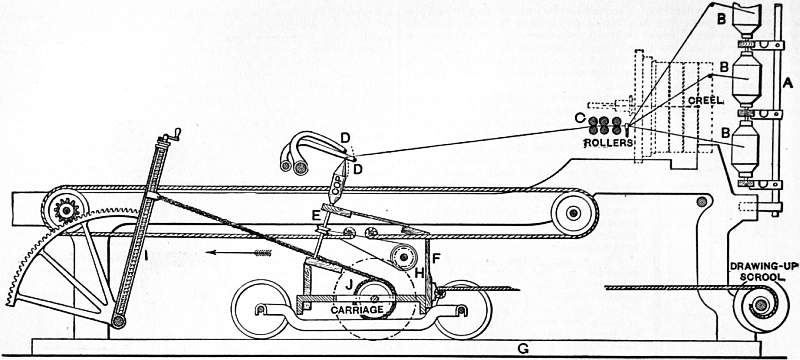
Fig. 9.
For many purposes the threads as spun by the ring frame or the mule are ready for the manufacturer; but where extra strength or smoothness is required, as in threads for sewing, crocheting, hosiery, lace and carpets; also where multicoloured effects are needed, as in Grandrelle, or some special form of irregularity, as in corkscrewed, and knopped yarns, two or more single threads are compounded and twisted together. This operation is known as doubling. In order to prepare threads for doubling it may be necessary to wind side by side upon a flanged bobbin, or upon a straight or a tapering spool, from two to six threads before twisting them into one.
Winding machines for this purpose are of various kinds. There are those in which the threads are laid evenly between the flanges of a bobbin, and those that coil the threads upon a straight or a tapering tube to form “cheeses.” In the latter the tubes may be laid upon diagonally split drums and rotated by frictional contact. By placing each group of threads to be wound in the slit of a rotating drum, it is drawn quickly to and fro and coiled upon a spool. If solid instead of split drums be used, the guides for all the threads on one side of a machine are attached to a bar, which is traversed by a cam placed at one end of the frame. Or independent mechanism may be provided throughout for treating each group of threads to be wound. The bobbins or tubes may be filled from cops, ring spools or hanks, but a stop motion is required for each thread, which will come into operation immediately a fracture occurs.
Doublers.—In action doublers are continuous and intermittent. The former resemble throstle and ring spinning machines, but since they do not attenuate the material, only one line of rollers is provided. The folded material is placed in a creel and led through the rollers to the spindles to be twisted in a wet or dry condition. If wet, the moisture flattens down most of the protruding ends of the fibres and produces a comparatively smooth thread; if dry, the doubled yarn retains some of its furry character. There are two types of continuous doublers, which are known respectively as English and Scotch. By the English system of dry doubling the yarn from the creel may be treated, on its way to the spindle, in various ways to obtain the desired tension. It may be led under a rod, over a guide, round and between the rollers, and round a glass peg. For wet doubling, a trough containing water is placed behind the rollers, and the yarn passes beneath a glass rod in the water, thence over a guide, beneath, between and over the rollers to the spindles. By the Scotch system the trough is placed below the rollers, and the bottom roller is partly immersed in water. It is claimed that this system wets the fibres more thoroughly than the English one. For the purpose of twisting the strands together the spindles may be provided either with flyers, as in throstle spinning, or with rings and travellers, as in ring spinning. The twist is generally in the opposite direction to that in the single threads. When more than three strands are required in a compound thread it is customary to pass the material more than once through the doubler, as, for example, in a sixfold thread, two strands may be first twisted together in the same or in the opposite direction to the spinning twist; after which the once-doubled thread is “cleared,” folded, and three strands of twofold yarn are twisted in the opposite direction to that employed in the first operation. In some machines folding and twisting proceed simultaneously, and some are furnished with an automatic stop motion. But when twisting two threads together to oppose the spinning twist, the failure of one causes the other to untwist and break, therefore, under such circumstances a stop motion is unnecessary.
Intermittent doublers are known as twinners, and these are of two kinds, namely, English and French. In the former the spindles are fitted in a stationary rail, but the creel, containing the cops or ring spools, is mounted upon a carriage and moves in and out, as in Hargreaves’ spinning jenny (see Spinning). French twinners have a stationary creel, and the spindles move in and out with the carriage, as in the spinning mule. The material to be folded is often subjected to the action of steam in order to render it less resilient, after which it is mounted upon skewers in the creel, and two or three threads are passed to each spindle to be twisted together and formed into a cop. Between the creel and the spindles all the strands are kept equally tense by drawing them over flannel-covered boards and under porcelain weights. For wet doubling, the strands pass through a trough containing water, and the flannel surfaces are also wet.
Clearing.—After the first, or the final, doubling it is often necessary to remove lumps, imperfect knots and loose fibres from a thread. This is accomplished by passing each through a slit, or clearer, whose width is adjusted to the diameter of the thread to be treated. By this means anything which gives a thread abnormal bulk will be prevented from passing the slit. Once through the slit, a thread is coiled upon a friction-driven, double or single-headed bobbin. If the former, the coils are evenly laid; if the latter, they are disposed into a bottle shape. Or, again, cheeses may be wound.
Gassing.—In cases where a thread with a smooth surface is required the extending ends of fibres must be burned off. Thus: each thread from a creel is drawn over a tension rod to two freely mounted pulleys, having parallel grooves cut in their surfaces and axes in the same horizontal plane. After bending a thread forward and backward in the grooves of both pulleys, it passes through a Bunsen flame and is coiled upon a tube, which is held against the face of a rotating drum, while a vibrating guide distributes the thread across the tube. The gas-burner is situated midway between the grooved pulleys, and so mounted beneath the thread that it will automatically swivel sideways and thus move the flame away from a stationary thread. Winding begins slightly before the flame moves beneath a thread, and the rapid motion of the latter permits the flame to burn off undesirable matters without injuring the thread.
Reeling.—Doubled or gassed yarn may be wound upon warpers’ bobbins and made into warps for the loom, or it may be reeled into hanks for the preparing and finishing processes. But a reel hanks yarns for bleaching, dyeing, printing, polishing and bundling, and is adapted for cops, ring spools, doubling bobbins or cheeses. From cops, ring spools and cheeses the yarn is usually drawn over one end, but flanged bobbins are mounted upon spindles and the yarn is drawn from the side. A reel has a circumference of 54 in., and after making 80 or 560 revolutions it automatically stops; the first gives a lea of 120 yds. and the last a hank of 840 yds. For grant reeling, however, a hank may be from 5000 to 10,000 yds. long. Reeling is of two kinds, namely, open and crossed. Open reeling forms lease, and seven of these are united in one hank by a lease band which retains the divisions. In cross reeling a thread is traversed over a portion of the reel surface by a reciprocating guide to form a hank without divisions. On the completion of a set of hanks the reel is made to collapse and thus facilitate the removal of the yarn.
Bundling Press.—Hanks are made into short or long bundles, each weighing 5 or 10 ℔. In short bundles it is usual to form groups of ten hanks, and these are twisted together, folded and compressed into bundles; but in long bundles the hanks are compressed without being folded. A press consists of a strong table upon which a box, with open ends, is formed. The bottom of this box is grooved transversely and made to rise and fall by wheel gearing or by eccentrics. The sides and top are made of vertical and horizontal bars, set to coincide with the grooves in the bottom. To one set of vertical bars a similar number of horizontal top pieces are hinged, and to the other set levers are jointed, which hold the horizontal bars in position. When the hinged bars are turned up, strings are drawn through the grooves, and the bottom is covered with stout paper. The hanks are then laid in the box, another paper is placed above them, and the hinged bars are drawn down and locked. The bottom then rises a predetermined distance, and automatically stops. While in this position the strings are tied, the bottom of the press next descends, and the bundle is removed.
(T. W. F.)
COTYS, a name common to several kings of Thrace. The most important of them, a cruel and drunken tyrant, who began to reign in 382 B.C., was involved with the Athenians in a dispute for the possession of the Thracian Chersonese. In this he was assisted by the Athenian Iphicrates, to whom he had given his daughter in marriage. On the revolt of Ariobarzanes from Persia, Cotys opposed him and his ally, the Athenians. In 358 he was murdered by the sons of a man whom he had wronged.
See Cornelius Nepos, Iphicrates, Timotheus; Xenophon, Agesilaus; Demosthenes, Contra Aristocratem; Theopompus in Müller, Fragmenta Historicorum Graecorum, i.
COUCH, DARIUS NASH (1822-1897), American soldier, was born at South East, Putnam county, N.Y., on the 23rd of July 1822, and graduated from West Point in 1846, serving in the Mexican war and in the war against the Seminole Indians. He left the army in 1855, but soon after the outbreak of the civil war he was made a brigadier-general U.S.V. He served as a divisional commander in the battles of the Army of the Potomac in 1862, and at Fredericksburg (December 1862) and Chancellorsville (May 1863) he commanded the II. corps. He had been made a major-general U.S.V. in July 1862. During the Gettysburg campaign he was employed in organizing the Pennsylvanian militia, and he subsequently served in the West, taking part in the battle of Nashville, and in the final operations in the Carolinas. He left the army after the war. General Couch died on the 12th of February 1897 at Norwalk, Connecticut.
COUCY, LE CHÂTELAIN DE, French trouvère of the 12th century. He is probably the Guy de Couci who was castellan of the castle of that name from 1186 to 1203. Some twenty-six songs are attributed to him, and about fifteen or sixteen are undoubtedly authentic. They are modelled very closely on Provençal originals, but are saved from the category of mere imitations by a grace and simplicity peculiar to the author. The legend of the love of the Châtelain de Coucy and the Lady of Fayel, in which there figures a jealous husband who makes his wife eat the heart of her lover, has no historical basis, and dates from a late 13th century romance by Jakemon Sakesep. It is worth noting that the story, which seems to be Breton in origin, has been also told of a Provençal troubadour, Guilhem de Cabestaing, and of the minnesinger Reinmar von Brennenberg. Pierre de Belloy, who wrote some account of the family of Couci, made the story the subject of his tragedy Gabrielle de Vergy.
The songs of the Châtelain de Coucy were edited by Fritz Fath (Heidelberg, 1883). For the romance see Gaston Paris, in the Hist. litt. de la France (vol. 28, pp. 352-360). An exquisite song, “Chanterai por mon courage,” expressing a woman’s regrets for her lover at the Crusade, is attributed in one MS., probably erroneously, to the Lady of Fayel (Hist. litt. xxiii. 556). An English metrical romance of “The Knight of Curtesy,” and the “Fair Lady of Faguell,” was printed by William Copland, and reprinted in Ritson’s Eng. Metrical Romances (ed. E. Goldsmid, vol. iii., 1885).