VOLUME VII SLICE V Cosway to Coucy (continued 2)
Reading edition
The date of cotton-planting varies from March 1 to June 1, according to situation. Planting begins early in March in Southern Texas, and the first blooms will appear there about May 15. Planting may be done as late as April 15 in the Piedmont region of North Carolina, and continue as late as the end of May. The first blooms will appear in this region about July 15. Picking may begin on July 10 in Southern Texas, and continue late into the winter, or until the rare frost kills the plants. It may not begin until September 10 in Piedmont, North Carolina. It is a peculiarity of the cotton-plant to lose a great many of its blooms and bolls. When the weather is not favourable at the fruiting stage, the otherwise hardy cotton plant displays its great weakness in this way. It sheds its “forms” (as the buds are called), blooms, and even half-grown bolls in great numbers. It has frequently been noted that even well-fertilized plants upon good soil will mature only 15 or 20% of the bolls produced. No means are known so far for preventing this great waste. Experts are at an entire loss to form a correct idea of the cause, or to apply any effective remedy.
Cotton-picking is at once the most difficult and most expensive operation in cotton production. It is paid for at the rate of from 45 to 50 cents per cwt. of seed cotton. The work is light, and is effectually performed by women and even children, as well as men; but it is tedious and requires care. The picking season will average 100 days. It is difficult to get the hands to work until the cotton is fully opened, and it is hard to induce them to pick over 100 ℔ a day, though some expert hands are found in every cotton plantation who can pick twice as much. The loss resulting from careless work is very serious. The cotton falls out easily or is dropped. The careless gathering of dead leaves and twigs, and the soiling of the cotton by earth or by the natural colouring matter from the bolls, injure the quality. It has been commonly thought that the production of cotton in the south is limited by the amount that can be picked, but this limit is evidently very remote. The negro population of the towns and villages of the cotton country is usually available for a considerable share in cotton-picking. There is in the cotton states a rural population of over 7,000,000, more or less occupied in cotton-growing, and capable, at the low average of 100 ℔ a day, of picking daily nearly 500,000 bales. It is evident, therefore, that if this number could work through the whole season of 100 days, they could pick three or four times as much cotton as the largest crop ever made. Great efforts have been made to devise cotton-picking machines, but, as yet, complete success has not been attained. Lowne’s machine is useful in specially wide-planted fields and when the ground is sufficiently hard.
Cotton Ginning.—The crop having been picked, it has to be prepared for purpose of manufacture. This comprises separating the fibre or lint from the seeds, the operation being known as “ginning.” When this has been accomplished the weight of the crop is reduced to about one-third, each 100 ℔ of seed cotton as picked yielding after ginning some 33 ℔ of lint and 66 ℔ of cotton seed. The actual amounts differ with different varieties, conditions of cultivation, methods of ginning, &c.; a recent estimate in the United States gives 35% of lint for Upland cotton and 25% for Sea Island cotton as more accurate.
The separation of lint from seed is accomplished in various ways. The most primitive is hand-picking, the fibre being laboriously pulled from off each seed, as still practised in parts of Africa. In modern commercial cotton production ginning machines are always used. Very simple machines are used in some parts of Africa. The simplest cotton gin in extensive use is the “churka,” used from early times, and still largely employed in India and China. It consists essentially of two rollers either both of wood, or one of wood and one of iron, geared to revolve in contact in opposite directions; the seed cotton is fed to the rollers, the lint is drawn through, and the seed being unable to pass between the rollers is rejected. With this primitive machine, worked by hand, about 5 ℔ of lint is the daily output. In the Macarthy roller gin, the lint, drawn by a roller covered with leather (preferably walrus hide), is drawn between a metal plate called the “doctor” (fixed tangentially to the roller and very close to it) and a blade called the “beater” or knife, which rapidly moves up and down immediately behind, and parallel to, the fixed plate. The lint is held by the roughness of the roller, and the blade of the knife or beater readily detaches the seed from the lint; the seed falls through a grid, while the lint passes over the roller to the other side of the machine. A hand Macarthy roller gin worked by two men will clean about 4 to 6 ℔ of lint per hour. A similar, but larger machine, requiring about 1½ horse-power to run it, will turn out 50 to 60 ℔ of Egyptian or 60 to 80 ℔ of Sea Island cleaned cotton per hour. By simple modifications the Macarthy gin can be used for all kinds of cotton. Various attempts have been made to substitute a comb for the knife or beater, and one of the latest productions is the “Universal fibre gin,” in which a series of blunt combs working horizontally replace the solid beater and so-called knife of the Macarthy gin.
Opposed to the various types of roller gins is the “saw gin,” invented by Eli Whitney, an American, in 1792. This machine, under various modifications, is employed for ginning the greater portion of the cotton grown in the Southern States of America. It consists essentially of a series of circular notched disks, the so-called saws, revolving between the interstices of an iron bed upon which the cotton is placed: the teeth of the “saws”. catch the lint and pull it off from the seeds, then a revolving brush removes the detached lint from the saws, and creates sufficient draught to carry the lint out of the machine to some distance. Saw gins do considerable damage to the fibre, but for short-stapled cotton they are largely used, owing to their great capacity. The average yield of lint per “saw” in the United States, when working under perfect conditions, is about 6 ℔ per hour. Some of the American ginners are very large indeed, a number (Bulletin of the Bureau of the Census on Cotton Production) being reported as containing on the average 1156 saws with an average production of 4120 bales of cotton. Saw gins are not adapted to long-stapled cottons, such as Sea Island and Egyptian, which are generally ginned by machines of the Macarthy type.
The machine which will gin the largest quantity in the shortest time is naturally preferred, unless such injury is occasioned as materially to diminish the market value of the cotton. This has sometimes been to the extent of 1d. or 2d. per ℔ and even more as regards Sea Island and other long-stapled cottons. The production, therefore, of the most perfect and efficient cotton-cleaning machinery is of importance alike to the planter and manufacturer.
Baling.—The cotton leaves the ginning machine in a very loose condition, and has to be compressed into bales for convenience of transport. Large baling presses are worked by hydraulic power; the operation needs no special description. Bales from different countries vary greatly in size, weight and appearance. The American bale has been described in a standard American book on cotton as “the clumsiest, dirtiest, most expensive and most wasteful package, in which cotton or any other commodity of like value is anywhere put up.” Suggestions for its improvement, which if carried out would (it is estimated) result in a monetary saving of £1,000,000 annually, were made by the Lancashire Private Cotton Investigation Commission which visited the Southern States of America in 1906.
The approximate weights of some of the principal bales on the English market are as follows:—
United States 500 ℔
Indian 400 ℔
Egyptian 700 ℔
Peruvian 200 ℔
Brazilian 200 to 300 ℔
With baling the work of the producer is concluded.
Cultivation in Egypt.—Climatic conditions in Egypt differ radically from those in the United States, the rainfall being so small as to be quite insufficient for the needs of the plant, very little rain indeed falling in the Nile Delta during the whole growing season of the crop: yet Egypt is in order the third cotton-producing country of the world, elaborate irrigation works supplying the crop with the requisite water. The area devoted to cotton in Egypt is about 1,800,000 acres, and nine-tenths of it is in the Nile Delta. The delta soil is typically a heavy, black, alluvial clay, very fertile, but difficult to work; admixture of sand is beneficial, and the localities where this occurs yield the best cotton. Formerly in Egypt the cotton was treated as a perennial, but this practice has been generally abandoned, and fresh plants are raised from seed each year, as in America; one great advantage is that more than one crop can thus be obtained each year. The following rotation is frequently adopted. It should be noted that in Egypt the year is divided into three seasons—winter, summer and “Nili.” The two first explain themselves; Nili is the season in which the Nile overflows its banks.
Winter. Summer. Nili.
First year Clover Cotton ..
Second year Beans or wheat .. Corn or fallow
For cotton cultivation the land is ploughed, carefully levelled, and then thrown up into ridges about 3 ft. apart. Channels formed at right angles to the cultivation ridges provide for the access of water to the crop. The seeds, previously soaked, are sown, usually in March, on the sides of the ridges, and the land watered. After the seedlings appear, thinning is completed in usually three successive hoeings, the plants being watered after thinning, and subsequently at intervals of from twelve to fifteen days, until about the end of August when picking commences. The total amount of water given is approximately equivalent to a rainfall of about 35 in. The crop is picked, ginned and baled in the usual way, the Macarthy style action roller gins being almost exclusively employed.
Cotton Seed.—The history of no agricultural product contains more of interest and instruction for the student of economics than does that of cotton seed in the United States. The revolution in its treatment is a real romance of industry. Up till 1870 or thereabouts, cotton seed was regarded as a positive nuisance upon the American plantation. It was left to accumulate in vast heaps about ginhouses, to the annoyance of the farmer and the injury of his premises. Cotton seed in those days was the object of so much aversion that the planter burned it or threw it into running streams, as was most convenient. If the seed were allowed to lie about, it rotted, and hogs and other animals, eating it, often died. It was very difficult to burn, and when dumped into rivers and creeks was carried out by flood water to fill the edges of the flats with a decaying and offensive mass of vegetable matter. Although used in the early days to a limited extent as a food for milch cows and other stock, and to a larger extent as a manure, no systematic efforts were made anywhere in the South to manufacture the seed until the later ’fifties, when the first cotton seed mills were established. It is said that there were only seven cotton oil mills in the South in 1860. The cotton-growing industry was interrupted by the Civil War, and the seed-milling business did not begin again until 1868. After that time the number of mills rapidly increased. There were 25 in the South in 1870, 50 in 1880, 120 in 1890, and about 500 in 1901, about one-third being in Texas.
Experience shows that 1000 ℔ of seed are produced for every 500 ℔ of cotton brought to market. On the basis, therefore, of a cotton crop of 10,000,000 bales of 500 ℔ each, there are produced 5,000,000 tons of cotton seed. If about 3,000,000 tons only are pressed, there remain to be utilized on the farm 2,000,000 tons of cotton seed, which, if manufactured, would produce a total of $100,000,000 from cotton seed. In contrast with the farmers of the ’sixties, the southern planter of the 20th century appreciates the value of his cotton seed, and farmers, too remote from the mills to get it pressed, now feed to their stock all the cotton seed they conveniently can, and use the residue either in compost or directly as manure. The average of a large number of analyses of Upland cotton seed gives the following figures for its fertilizing constituents:—Nitrogen, 3.07%; phosphoric acid, 1.02%; potash, 1.17%; besides small amounts of lime, magnesia and other valuable but less important ingredients. Sea Island cotton seed is rather more valuable than Upland: the corresponding figures for the three principal constituents being nitrogen 3.51, phosphoric acid 1.69, potash 1.59%. Using average prices paid for nitrogen, phosphoric acid and potash when bought in large quantities and in good forms, these ingredients, in a ton of cotton seed, amount to $9.00 worth of fertilizing material. Compared with the commercial fertilizer which the farmer has to buy, cotton seed possesses, therefore, a distinct value.
The products of cotton seed have become important elements in the national industry of the United States. The main product is the refined oil, which is used for a great number of purposes, such as a substitute for olive oil, mixed with beef products for preparation of compound lard, which is estimated to consume one-third of cotton seed oil produced in the States. The poorer grades are employed in the manufacture of soap, candles and phonograph records. Miners’ lamp oil consists of the bleached oil mixed with kerosene. Cotton seed cake or meal (the residue after the oil is extracted) is one of the most valuable of feeding stuffs, as the following simple comparison between it and oats and corn will show:—
Average Analyses. Proteins or Flesh Formers. Carbohydrates or Fuel and Fat Suppliers. Fats. Ash or Bone Makers.
Cotton seed meal 43.26 22.31 13.45 7.02
Corn 10.5 70.0 5.5 1.02
Oats 17.0 65.0 8.0 1.2
Cotton seed meal, though poor in carbohydrates, the fat- and energy-supplying ingredients, is exceedingly rich in protein, the nerve- and muscle-feeding ingredients. But it still contains a large amount of oil, which forms animal fat and heat, and thus makes up for part of its deficiency in carbohydrates. The meal, in fact, is so rich in protein that it is best utilized as a food for animals when mixed with some coarse fodder, thus furnishing a more evenly-balanced ration. In comparative valuations of feeding stuffs it has been found that cotton seed meal exceeds corn meal by 62%, wheat by 67%, and raw cotton seed by 26%. Cotton seed meal, in the absence of sufficient stock to consume it, is also used extensively as a fertilizer, and for this purpose it is worth, determining the price on the same basis as used above for the seed, from $19 to $20 per ton. But it has seldom reached this price, except in some of the northern states, where it is used for feeding purposes. A more rational proceeding would be to feed the meal to animals and apply the resulting manure to the soil. When this is done, from 80 to 90% of the fertilizing material of the meal is recovered in the manure, only 10 to 20% being converted by the animal into meat and milk. The profit derived from the 20% thus removed is a very large one. These facts indicate that we have here an agricultural product the market price of which is still far below its value as compared, on the basis of its chemical composition, either with other feeding stuffs or with other fertilizers. Though it is probably destined to be used even more extensively as a fertilizer before the demand for it as a feeding stuff becomes equal to the supply, practically all the cotton seed meal of the south will ultimately be used for feeding. One explanation of this condition of things is that there is still a large surplus of cotton seed which cannot be manufactured by the mills. Another reason is found in the absence of cattle in the south to eat it.
With the consideration of cotton seed oil and meal we have not, however, exhausted its possibilities. Cotton seed hulls constitute about half the weight of the ginned seed. After the seed of Upland cotton has been passed through a fine gin, which takes off the short lint or linters left upon it by the farmer, it is passed through what is called a sheller, consisting of a revolving cylinder, armed with numerous knives, which cut the seed in two and force the kernels or meats from the shells. The shells and kernels are then separated in a winnowing machine. This removal of the shell makes a great difference in the oilcake, as the decorticated cake is more nutritious than the undecorticated. For a long time these shells or hulls, as they are called, were burned at oil mills for fuel, 2½ tons being held equal to a cord of wood, and 41⁄3 tons to a ton of coal. The hulls thus burned produced an ash containing an average of 9% of phosphoric acid and 24% of potash—a very valuable fertilizer in itself, and one eagerly sought by growers of tobacco and vegetables. It was not long, however, before the stock-feeder in the South found that cotton seed hulls were an excellent substitute for hay. They are used on a very large scale in the vicinity of oil mills in southern cities like Memphis, New Orleans, Houston, and Little Rock, from 500 to 5000 cattle being often collected in a single yard for this purpose. No other feed is required, the only provision necessary being an adequate supply of water and an occasional allowance of salt. Many thousands of cattle are fattened annually in this way at remarkably low cost.
Careful attention is now given to the employment of the seed in new cotton countries, and oil expression is practised in the West Indies. Hull is the principal seat of the industry in Great Britain, and enormous quantities of Indian and Egyptian cotton seed are imported and worked up.
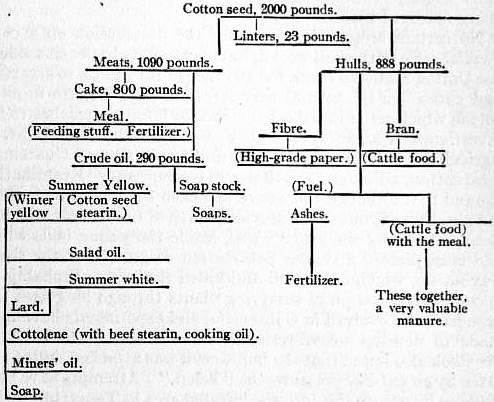
The following diagram, modified from one by Grimshaw, in accordance with the results obtained by the better class of modern mills, gives an interesting résumé of the products obtained from a ton of cotton seed:—
Products from a Ton of Cotton Seed.
Pests and Diseases of the Cotton Plant.
Insect Pests.—It is common knowledge that when any plant is cultivated on a large scale various diseases and pests frequently appear. In some cases the pest was already present but of minor importance. As the supply of its favourite food plant is increased, conditions of life for the pest are improved, and it accordingly multiplies also, possibly becoming a serious hindrance to successful cultivation. At other times the pest is introduced, and under congenial conditions (and possibly in the absence of some other organism which keeps it in check in its native country) increases accordingly. Some idea of the enormous damage wrought by the collective attacks of individually small and weak animals may be gathered from the fact that a conservative estimate places the loss due to insect attacks on cotton in the United States at the astounding figure of $60,000,000 (£12,000,000) annually. Of this total no less than $40,000,000 (£8,000,000) is credited to a small beetle, the cotton boll weevil, and to two caterpillars. The best means of combating these attacks depends on a knowledge of the life-histories and habits of the pests. The following notes deal only with the practical side of the question, and as the United States produce some seven-tenths of the world’s cotton crop attention is especially directed to the principal cotton pests of that country. Those of other regions are only referred to when sufficiently important to demand separate notice.
The cotton boll weevil (Anthonomus grandis), a small grey weevil often called the Mexican boll weevil, is the most serious pest of cotton in the United States, where the damage done by it in 1907 was estimated at about £5,000,000. It steadily increased in destructiveness during the preceding eight years. Attention was drawn to it in 1862, when it caused the abandonment of cotton cultivation about Monclova in Mexico. About 1893 it appeared in Texas, and then rapidly spread. It is easily transported from place to place in seed-cotton, and for this reason the Egyptian government in 1904 prohibited the importation of American cotton seed. Not only is the pest carried from place to place, but it also migrates, and in 1907 it crossed from Louisiana, where it first appeared in 1905, to Mississippi. That the insect is likely to prove adaptable is perhaps indicated by the fact that in 1906 it made a northward advance of about 60 m. in a season with no obvious special features favouring the pest. Its eastern progress was also rapid. “The additional territory infested during 1904 aggregates about 15,000,000 sq. m., representing approximately an area devoted to the culture of cotton of 900,000 acres” (Year-book, U.S. Dept. Agriculture, 1904). In 1906 the additional area invaded amounted to 1,500,000 acres (Ibid., 1906).
The adult weevils puncture the young flower-buds and deposit eggs; and as the grubs from the eggs develop, the bud drops. They also lay eggs later in the year in the young bolls. These do not drop, but as the grubs develop the cotton is ruined and the bolls usually become discoloured and crack, their contents being rendered useless.
No certain remedy is known for the destruction on a commercial scale of the boll weevil, but every effort has been made in the United States to check the advance of the insect, to ascertain and encourage its natural enemies, and to propagate races of cotton which resist its attacks. Special interest attaches to the investigations made by Mr O. F. Cook, of the U.S. Dept. of Agriculture, in Guatemala. The Indians in part of Guatemala raise cotton, although the boll weevil is abundant. Examination showed that although the weevil attacked the young buds these did not drop off, but that a special growth of tissue inside the bud frequently killed the grub. Also, inside the young bolls which had been pierced a similar proliferation or growth of the tissue was set up, which enveloped and killed the pest. Probably by unconscious selection of surviving plants through long ages this type has been evolved in Guatemala, and experiments have been made to develop weevil-resistant races in the United States. Mr Cook also found that the boll weevil was attacked, killed and eaten by an ant-like creature, the “kelep.” Attempts have been made to introduce this into the infested area in Texas; but owing to the winter proving fatal to the “kelep” its usefulness may be restricted to tropical and subtropical regions.
The cotton boll worm (Chloridea obsoleta, also known as Heliothis armiger) is a caterpillar. The parent moth lays eggs, from which the young “worms” hatch out. They bore holes and penetrate into flower-buds and young bolls, causing them to drop. Fortunately the “worms” prefer maize to cotton, and the inter-planting at proper times of maize, to be cut down and destroyed when well infested, is a method commonly employed to keep down this pest. Paris green kills it in its young stages before it has entered the buds or bolls. The boll worm is most destructive in the south-western states, where the damage done is said to vary from 2 to 60% of the crop. Taking a low average of 4%, the annual loss due to the pest is estimated at about £2,500,000, and it occupies second place amongst the serious cotton pests of the U.S.A. The boll worm is widely spread through the tropical and temperate zones. It may occur in a country without being a pest to cotton, e.g. in India it attacks various plants but not cotton. It has not yet been reported as a cotton pest in the West Indies.
The Egyptian boll worm (Earias insulana) is the most important insect pest in Egypt and occurs also in other parts of Africa. Indian boll worms include the same species, and the closely related Earias fabia, which also occurs in Egypt.
The cotton worm (Aletia argillacea)—also called cotton caterpillar, cotton army worm, cotton-leaf worm—is also one stage in the life-history of a moth. It is a voracious creature, and unchecked will often totally destroy a crop. In former years the annual damage done by it in the United States was assessed at £4,000,000 to £6,000,000. Dusting with Paris green is, however, an efficient remedy if promptly applied at the outset of the attack. The annual damage was in 1906 reduced to £1,000,000 to £2,000,000, and this on a larger area devoted to cotton than in the case of the estimate given above. It is the most serious pest of cotton in the West Indies. The Egyptian cotton worm is Prodenia littoralis.
The caterpillars (“cut worms”) of various species of Agrotis and other moths occur in all parts of the world and attack young cotton. They can be killed by spreading about cabbage leaves, &c., poisoned with Paris green.
Locusts, green-fly, leaf-bugs, blister mites, and various other pests also damage cotton, in a similar way to that in which they injure other crops.
The “cotton stainers,” various species of Dysdercus, are widely distributed, occurring for example in America, the West Indies, Africa, India, &c. The larvae suck the sap from the young bolls and seeds, causing shrivelling and reduction in quantity of fibre. They are called “stainers” because their excrement is yellow and stains the fibre; also if crushed during the process of ginning they give the cotton a reddish coloration. The Egyptian cotton seed bug or cotton stainer belongs to another genus, being Oxycarenus hyalinipennis. Other species of this genus occur on the west coast of Africa. They do considerable damage to cotton seed.
Fungoid Diseases.—“Wilt disease,” or “frenching,” perhaps the most important of the fungoid disease of cotton in the United States, is due to Neocosmospora vasinfecta. Young plants a few inches high are usually attacked; the leaves, beginning with the lower ones, turn yellow, and afterwards become brown and drop. The plants remain very dwarf and generally unhealthy, or die. The roots also are affected, and instead of growing considerably in length, branch repeatedly and give rise to little tufts of rootlets. There is no method known of curing this disease, and all that can be done is to take every precaution to eradicate it, by pulling up and burning diseased plants, isolating the infected area by means of trenches, and avoiding growing cotton, or an allied plant such as the ochro (Hibiscus esculentus), in the field. Fortunately the careful work of the U.S. Department of Agriculture and of planters such as Mr E. L. Rivers of James Island, South Carolina, has resulted in the production of disease-resistant races. In one instance Mr Rivers found one healthy plant in a badly affected field. The seed was saved and gave rise to a row of plants all of which grew healthily in an infected field, whereas 95% of ordinary Sea Island cotton plants from seed from a non-infected field planted alongside as a control were killed. The resistance was well maintained in succeeding generations, and races so raised form a practical means of combating this serious disease.
In “Root rot,” as the name implies, the roots are attacked, the fungus being a species of Ozonium, which envelops the roots in a white covering of mould or mycelium. The roots are prevented from fulfilling their function of taking up water and salts from the soil; the leaves accordingly droop, and the whole plant wilts and in bad attacks dies. It has yearly proved a more serious danger in Texas and other parts of the south-west of the United States, and the damage due to it in Texas during 1905 was estimated at about £750,000. No remedy is known for the disease, and cotton should not be planted on infected land for at least three or four years.
“Boll rot,” or “Anthracnose,” is a disease which may at times be sufficiently serious to destroy from 10 to 50% of the crop. The fungus which causes it (Colletotrichum gossypii) is closely related to one of the fungi attacking sugar-cane in various parts of the world. Small red-brown spots appear on the bolls, gradually enlarge, and develop into irregular black and grey patches. The damage may be only slight, or the entire boll may ripen prematurely and become dry and dead.
Many other diseases occur, but the above are sufficient to indicate some of the principal ones in the most important cotton countries of the world.
Improvement of Cotton by Seed Selection.
In the cotton belt of the United States it would be possible to put a still greater acreage under this crop, but the tendency is rather towards what is known as “diversified” or mixed farming than to making cotton the sole important crop. Cotton, however, is in increasing demand, and the problem for the American cotton planter is to obtain a better yield of cotton from the same area,—by “better yield” meaning an increase not only in quantity but also in quality of lint. This ideal is before the cotton grower in all parts of the world, but practical steps are not always taken to realize it. Some of the United States planters are alert to take advantage of the application of science to industry, and in many cases even to render active assistance, and very successful results have been attained by the co-operation of the United States Department of Agriculture and planters. With the improvement of cotton the name of Mr Herbert J. Webber is prominently associated, and a full discussion of methods and results will be found in his various papers in the Year-books of the U.S. Department of Agriculture. The principle on which the work is based is that plants have their individualities and tend to transmit them to their progeny. Accordingly a selection of particular plants to breed from, because they possess certain desirable characteristics, is as rational as the selection of particular animals for breeding purposes in order to maintain the character of a herd of cattle or of a flock of sheep.
Inspection of a field of cotton shows that different plants vary as regards productiveness, length, and character of the lint, period of ripening, power of resistance to various pests and of withstanding drought. A simple method of increasing the yield is that practised with success by some growers in the States. Pickers are trained to recognize the best plants, “that is, those most productive, earliest in ripening, and having the largest, best formed and most numerous bolls.” These pickers go carefully over the field, usually just before the second picking, and gather ripe cotton from the best plants only; this selected seed cotton is ginned separately, and the seed used for sowing the next year’s crop.
A more elaborate method of selection is practised by some of the Sea Island cotton planters in the Sea Islands, famous for the quality of their cotton. A field is gone over carefully, and perhaps some 50 of the best plants selected; a second examination in the field reduces these perhaps to one half, and each plant is numbered. The cotton from each is collected and kept separately, and at the end of the season carefully examined and weighed, and a final selection is then made which reduces the number to perhaps five; the cotton from each of these plants is ginned separately and the seed preserved for sowing. The simplest possible case in which only one plant is finally selected is illustrated in the diagram.
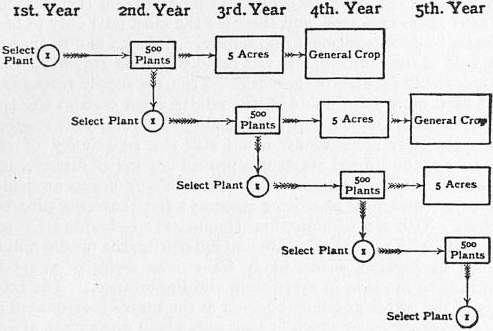
After Webber, Year-book, U.S. Dept. of Agriculture, 1902.
Improvement of Cotton by Seed Selection.
From the seeds of the selected plant of the 1st year about 500 plants can be raised in the next year. One plant is selected again from these 500, and the general crop of seed is used to sow about five acres for the 3rd year, from which seed is obtained for the general crop in the 4th year. One special plant is selected each year from the 500 raised from the previous season’s test plant, and in four years’ time the progeny of this plant constitutes the “general crop.” The practice may be modified according to the size of estate by selecting more than one plant each year, but the principle remains unaltered. This method is in actual use by growers of Sea Island cotton in America and in the islands off the coast of S. Carolina; the greatest care is taken to enhance the quality of the lint, which has been gradually improved in length, fineness and silkiness. Mr Webber, in summing up, says, “When Sea Island cotton was first introduced into the United States from the West Indies, it was a perennial plant, unsuited to the duration of the season of the latitude of the Sea Islands of S. Carolina; but, through the selection of seed from early maturing individual plants, the cotton has been rendered much earlier, until now it is thoroughly adapted to the existing conditions. The fibre has increased in length from about 1¾ to 2½ in., and the plants have at the same time been increased in productiveness. The custom of carefully selecting the seed has grown with the industry and may be said to be inseparable from it. It is only by such careful and continuous selection that the staple of these high-bred strains can be kept up to its present superiority, and if for any reason the selection is interrupted there is a general and rapid decline in quality.”
When selection is being made for several characters at the same time, and also in hybridization experiments, where it is important to have full records of the characters of individual plants and their progeny, “score cards,” such as are used in judging stock, with a scale of points, are used.
The improvements desired in cotton vary to some degree in different countries, according to the present character of the plants, climatic conditions, the chief pests, special market requirements, and other circumstances. Amongst the more important desiderata are:—
1. Increased Yield.
2. Increase in Length of Lint.—Webber records the case of Stamm Egyptian cotton imported into Columbia, in which by simple selection, as outlined above, during two years plants were obtained uniformly earlier, more productive, and yielding longer and better lint.
3. Uniformity in Length of the Lint.—This is important especially in the long-stapled cottons, unevenness leading to waste in manufacture, and consequently to a lower price for the cotton.
4. Strength of Fibre.—Long-stapled cottons have been produced in the States by crossing Upland and Sea Island cotton. These hybrids produce a lint which is long and silky, but often deficient in strength: selection for strength amongst the hybrids, with due regard to length, may overcome this.
5. Season of Maturing.—Seed should be selected from early and late opening bolls, according to requirements. Earliness is especially important in countries where the season is short.
6. Adaptation to Soil and Climate.—High-class cottons often do not flourish if introduced into a new country. They are adapted to special conditions which are lacking in their new surroundings, but a few will probably do fairly well the first year, and the seeds from these probably rather better the next, and so on, so that in a few years’ time a strain may be available which is equal or even superior to the original one introduced.
7. Resistance to Disease.—The method employed is to select, for seed purposes, plants which are resistant to the particular disease. Thus sometimes a field of cotton is attacked by some disease, perhaps “wilt,” and a comparatively few plants are but very slightly affected. These are propagated, and there are instances as described above of very successful and commercially important results having been attained. Special interest attaches to experiments made in the United States to endeavour to raise races of cotton resistant to the boll weevil.
8. Resistance to Weather.—Strong winds and heavy rains do much damage to cotton by blowing or beating the lint out of the bolls. In some instances a slight difference in the shape, mode of opening, &c., of the boll prevents this, and accordingly seed is selected from bolls which suffer least under the particular adverse conditions.
Attention has been paid in the West Indies to seed selection, by the officers of the imperial Department of Agriculture, with the object of retaining for West Indian Sea Island cotton its place as the most valuable cotton on the British market.
In India, where conditions are much more diversified and it is more difficult to induce the native cultivator to adopt new methods, attention has also been directed during recent years to the improvement of the existing races. Efforts have been made in the same direction in Egypt, West Africa, &c.
The World’s Commercial Cotton Crop.
It is impossible to give an exact return of the total amount of cotton produced in the world, owing to the fact that in China, India and other eastern countries, in Mexico, Brazil, parts of the Russian empire, tropical Africa, &c., considerable—in some eases very large—quantities of cotton are made up locally into wearing apparel, &c., and escape all statistical record. It is estimated that the amount thus used in India exclusive of the consumption of mills is equivalent to about 400,000 bales. Neglecting, however, these quantities, which do not affect the world’s market, the annual supplies of cotton are approximately as follows:—
Country. Approximate Production. Bales of 500 ℔. Percentage.
United States of America 11,000,000 68.75
India 3,000,000 18.75
Egypt 1,000,000 6.25
All other countries 1,000,000 6.25
Total 16,000,000 100.00
In 1905 the world’s crop closely approximated to 16,000,000 bales, whilst in 1904 it was nearly 19,000,000 bales and in 1906 nearly 20,000,000 bales. The United States produced very nearly seven-tenths of the total “visible” cotton crops of the world. This, however, is quite a modern development, comparatively speaking. “During the period from 1786 to 1790 the West Indies furnished about 70% of the British supply, the Mediterranean countries 20%, and Brazil 8%; whilst the quantity contributed by the United States and India was less than 1% and Egypt contributed none. In 1906 the United States contributed 65% of the commercial cotton, British India 19%, Egypt 7%, and Russia 3%. Of the countries which were prominent in the production of cotton in 1790, Brazil and Asiatic Turkey alone remain” (U.S.A. Bureau of the Census, Bulletin No. 76). The actual figures for the chief countries for 1904-1906, taken from the same source, are as follows:—
The World’s Commercial Cotton Crop. (In 500 ℔ Bales.)
Country. 1904. 1905. 1906.
United States 13,085,000 10,340,000 13,016,000
British India 2,843,000 2,519,000 3,708,000
Egypt 1,258,000 1,181,000 1,400,000
Russia 554,000 585,000 675,000
China 468,000 415,000 418,000
Brazil 210,000 258,000 275,000
Mexico 114,000 125,000 130,000
Peru 40,000 55,000 55,000
Turkey 100,000 107,000 107,000
Persia 45,000 47,000 47,000
Japan 16,000 15,000 11,000
Other countries 70,000 100,000 100,000
Total 18,803,000 15,747,000 19,942,000
This title serves to indicate the principal countries contributing to the world’s supply of cotton. The following notes afford a summary of the position of the industry in the more important countries.
States and Territories. Upland Cotton. Sea Island Cotton. Total Value.
Quantity. Value. Quantity. Value.
℔ $ ℔ $ $
Alabama 603,651,989 60,425,564 .. .. 60,425,564
Arkansas 450,991,361 45,144,235 .. .. 45,144,235
Florida 17,876,133 1,789,401 9,031,896 2,587,638 4,377,039
Georgia 750,762,910 75,151,367 9,950,634 2,850,857 78,002,224
Indian Territory 196,648,765 19,684,542 .. .. 19,684,542
Kansas 9,844 985 .. .. 985
Kentucky 1,008,290 100,930 .. .. 100,930
Louisiana 473,222,310 47,369,553 .. .. 47,369,553
Mississippi 732,755,978 73,348,874 .. .. 73,348,874
Missouri 26,040,093 2,606,613 .. .. 2,606,613
New Mexico 74,340 7,442 .. .. 7,442
North Carolina 276,215,506 27,649,172 .. .. 27,649,172
Oklahoma 233,396,905 23,363,030 .. .. 23,363,030
South Carolina 415,386,362 41,580,175 2,723,859 999,656 42,579,831
Tennessee 146,569,434 14,671,600 .. .. 14,671,600
Texas 2,001,181,289 200,318,247 .. .. 200,318,247
Virginia 6,609,963 661,657 .. .. 661,657
Total—United States 6,332,401,472 633,873,387 21,706,389 6,438,151 640,311,538
( = 12,644,803 .. ( = 43,413 .. ..
bales) .. bales) .. ..
United States of America.—The cultivation of cotton as a staple crop in the United States dates from about 1770,1 although efforts appear to have been made in Virginia as far back as 1621. The supplies continued to be small up to the end of the century. In 1792 the quantity exported from the United States was only equivalent to 275 bales, but by the year 1800 it had increased to nearly 36,000 bales. At the close of the war in 1815 the revival of trade led to an increased demand, and the progress of cotton cultivation in America became rapid and continuous, until at length about 85% of the raw material used by English manufacturers was derived from this one source. With a capacity for the production of cotton almost boundless, the crop which was so insignificant when the century began had in 1860 reached the enormous extent of 4,824,000 bales. This great source of supply, when apparently most abundant and secure, was shortly after suddenly cut off, and thousands were for a time deprived of employment and the means of subsistence. In this period of destitution the cotton-growing resources of every part of the globe were tested to the utmost; and in the exhibition of 1862 the representatives of every country from which supplies might be expected met to concert measures for obtaining all that was wanted without the aid of America. The colonies and dependencies of Great Britain, including India, seemed well able to grow all the cotton that could be required, whilst numerous other countries were ready to afford their co-operation. A powerful stimulus was thus given to the growth of cotton in all directions; a degree of activity and enterprise never witnessed before was seen in India, Egypt, Turkey, Greece, Italy, Africa, the West Indies, Queensland, New South Wales, Peru, Brazil, and in short wherever cotton could be produced; and there seemed no room to doubt that in a short time there would be abundant supplies independently of America. But ten years afterwards, in the exhibition of 1872, which was specially devoted to cotton, a few only of the thirty-five countries which had sent their samples in 1862 again appeared, and these for the most part only to bear witness to disappointment and failure. America had re-entered the field of competition, and was rapidly gaining ground so as to be able to bid defiance to the world. True, the supply from India had been more than doubled, the adulteration once so rife had been checked, and the improved quality and value of the cotton had been fully acknowledged, but still the superiority of the produce of the United States was proved beyond all dispute, and American cotton was again king. Slave labour disappeared, and under new and more promising auspices a fresh career of progress began. With rare combination of facilities and advantages, made available with remarkable skill and enterprise, the production of cotton in America seems likely for a long series of years to continue to increase in magnitude and importance. The total area of the cotton-producing region in the States is estimated at 448,000,000 acres, of which in 1906 only about one acre in fifteen was devoted to cotton. The potentialities of the region are thus enormous.
Cotton is now the second crop of the United States, being surpassed in value only by Indian corn (maize). The area devoted to this crop in 1879 was 14,480,019 acres, and the total commercial crop was 5,755,359 bales. In 1899 the acreage had increased to 24,275,101 and the crop to 9,507,786 bales. In 1906 the total area was 28,686,000 acres and the crop 13,305,265 bales.
The preceding table gives the quantity, value and character of the crop for each of the cotton-growing states in 1906, as reported by the Bureau of the Census.
Mexico.—Cotton is extensively grown in Mexico, and large quantities are used for home consumption. The cultivation is of very old standing. Cortes in 1519 is said to have received cotton garments as presents from the natives of Yucatan, and to have found the Mexicans using cotton extensively for clothing. From 1900 to 1905 the crop was about 100,000 bales per annum; the whole is consumed in local mills, and cotton is imported also from the United States.
Brazil.—The cotton-growing region in Brazil comprises a belt some 200 m. in width, in the north-eastern portion of the country, and a strip along the valley of the San Francisco, where a large amount of the present crop is produced. The cotton is known in commerce under the name of the place of export, e.g. Maceio, Pernambuco or Pernam, Ceãra, Rio Grande, &c. The export fluctuates greatly.
Bales of 500 ℔. Approx. Value.
1901 53,002 £500,000
1902 143,963 1,200,000
1903 126,896 1,300,000
1904 59,413 800,000
1905 107,887 1,000,000
1906 142,972 1,500,000
The total production in 1906 was estimated at about 275,000 bales, but only a portion was available for export, there being an increasing consumption in Brazil itself.
Peru.—Cotton is an important crop in Peru, where it has long been cultivated. Most of the crop is grown in the irrigated coastal valleys. With more water available, the output could be considerably increased, e.g. in the Piura district. “Rough Peruvian,” the produce of one of the tree cottons, has a special use, as being rather harsh and wiry it is well adapted for mixing with wool. Egyptian cotton is also grown. The annual export is about 30,000 bales.
Cotton Production in the British West Indies: 1905-1906.2
Island. Area in Acres. Yield = Bales of 500 ℔. Average Price in Pence per ℔. Value of Lint and Seed.
Barbados. 2,000 959 15.2 £33,557
St Vincent. 790 330 18.0 13,557
Grenada (mostly Marie galante cotton). 3,600 623 5.0 8,400
St Kitts 1,000 241 15.0 8,380
Nevis 1,700 240 13.0 8,364
Anguilla 1,000 161 15.0 5,280
Antigua 700 200 14.2 6,522
Montserrat 770 196 15.0 6,789
Virgin Islands 40 14 .. 400
Jamaica 1,500 123 .. 4,025
Total 12,900 3087 .. £95,274
British West Indies.—Cotton was cultivated as a minor crop in parts of the West Indies as long ago as the 17th century, and at the opening of the 18th century the islands supplied about 70% of all the cotton used in Great Britain. Greater profits obtained from sugar caused the industry to be abandoned, except in the small island of Carriacou. In 1900 the Imperial Department of Agriculture and private planters began experiments with the object of reintroducing the cultivation, owing to the decline in value of sugar. The department was actively assisted by the British Cotton Growing Association, and the results have been very successful, as was shown at an exhibition held in Manchester in 1908. A supply of seed of a high grade of Sea Island cotton was obtained from Colonel Rivers’s estate in the Sea Islands, S. Carolina, and so successful has the cultivation been that from some of the islands West Indian Sea Island cotton obtains a higher price than the corresponding grade of cotton from the Sea Islands themselves.
In 1902 the total area under cotton cultivation in the British West Indies was 500 acres. The industry made rapid progress. In 1903 it was 4000; in 1905-1906 it was 12,900; and for 1906-1907 it was 18,166 acres. The table indicates the chief cotton-producing islands, the acreage in each, yield, average value per pound and total value of the crop in 1905-1906.
The whole of this crop was Sea Island cotton, with the exception of the “Marie galante” grown in Carriacou. Marie galante is a harsh cotton of the Peruvian or Brazilian type. The low yield per acre in this island, and also the low value of the lint per ℔ compared with the Sea Island cotton, is clearly apparent.
In 1906-1907 the acreage was substantially increased in many of the islands, e.g. Barbados from 2000 to 5000; St Vincent 790 to 1533; St Kitts and Anguilla 1000 to 1500 each; Antigua 700 to 1883. In Jamaica, on the other hand, it was reduced from 1500 to 300 acres.
Spain.—Cotton was formerly grown in southern Spain on an extensive scale, and as recently as during the American Civil War a crop of 8000 to 10,000 bales was obtained. It is considered that with facilities for irrigation Andalusia could produce 150,000 bales annually. The former industry was abandoned as other crops became more remunerative. The government is encouraging recent efforts to re-establish the cultivation.
Malta.—Cotton has long been cultivated in Malta, but the acreage diminished from 1750 acres in 1899 to 670 acres in 1906. A considerable quantity of the produce is spun and woven locally; e.g. in 1904 the export was equivalent to about 120 bales out of a total production of 330 bales, and in 1905 to 258 out of 333 bales (of 500 ℔ each).
Cyprus has a soil and climate suited to cotton, which was formerly grown here on a large scale. The rainfall is uncertain and low, however, never exceeding 40 in., and on the supply of water by irrigation the future of the industry mainly depends. The exports dwindled from 3600 bales in 1865 to 946 in 1905; great fluctuations occur, the export in 1904, for example, being only 338 bales. The cotton grown is rather short-stapled and goes mainly to Marseilles and Trieste. Some is used locally in the manufacture of cloth.
Egypt.—The position of Egypt as the third cotton-producing country of the world has already been pointed out, and the varieties grown and the mode of cultivation described. The introduction of the exotic varieties dates from the beginning of the 19th century. The industry was actively promoted by a Frenchman named Jumel, in the service of Mehemet Ali, from 1820 onwards with great success. The area under cotton is about 1,800,000 acres.
Cotton Production in Egypt.
1850 87,200 bales of 500 ℔.
1865 439,000 ” ”
1890 798,000 ” ”
1904 1,258,000 ” ”
1905 1,250,000 ” ”
1906 1,400,000 ” ”
The Egyptian Sudan.—Egyptian cotton was cultivated in the Sudan to the extent of 21,788 acres in 1906 chiefly on non-irrigated land. The exports, however, are small, almost all the crop being used locally. The chief difficulties are the supply of water, labour and transport facilities. Lord Cromer in his report on the Sudan for 1906 remarks that: “There seems to be some reason for thinking that the future—or at all events the immediate future—of Sudan agriculture lies more in the direction of cultivating wheat and other cereals than in that of cultivating cotton.”
West Africa.—Cotton has long been grown in the various countries on the west coast of Africa, ginned by hand or by very primitive means, spun into yarn, and woven on simple looms into “country cloths”; these are often only a few inches wide, so that any large cloths have to be made by sewing the narrow strips together. These native cloths are exceedingly durable, and many of them are ornamented by using dyed yarns and in other ways.
Southern Nigeria (Lagos) and northern Nigeria are the most important cotton countries amongst the British possessions on the coast. From the former there has been an export trade for many years which fluctuates remarkably according to the demand. Northern Nigeria is the seat of a very large native cotton industry, to supply the demand for cotton robes for the Mahommedan races inhabiting the country. The province of Zaria alone is estimated to produce annually 30,000 to 40,000 bales, all of which is used locally. Northern Nigeria contributes to the cotton exported from Lagos. The country offers a fairly promising field for development, especially now that arrangements have been made for providing the necessary means of transport by the construction of the new railways. The profits obtained from ground-nuts (Arachis hypogea) in Gambia, gold mining in the Gold Coast, and from products of the oil palm (Elaeis guineensis) in the palm-oil belt serve to prevent much attention being given to cotton in these districts.
Exports of Cotton from Lagos.
1865 868 bales of 500 ℔.
1869 1785 ” ”
1900 48 ” ”
1901 15 ” ”
1902 25 ” ”
1903 582 ” ”
1904 1725 ” ”
1905 2578 ” ”
Exports of Cotton from British West Africa, 1904, 1905 and 1906.
1904. 1905. 1906.
Bales Bales Bales
(500 ℔). (500 ℔). (500 ℔).
Gambia 120 5 0
Sierra Leone 56 139 176
Gold Coast 115 50 186
Southern Nigeria and Lagos 2296 2771 5392
Northern Nigeria 574 250* 712
Total 3161 3215 6466
*Approximately.
Nyasaland (British Central Africa).—The cultivation of cotton on a commercial scale is quite new in Nyasaland, and although general conditions of soil and climate appear favourable the question of transport is serious and labour is not abundant. The exports were equivalent to 2 bales of 500 ℔ in 1902-1903, 114 bales in 1903-1904, 570 bales in 1904-1905, 1553 bales in 1905-1906 and 1052 bales in 1906-1907. In the lower river lands Egyptian cotton has been the most successful, whilst Upland cotton is more suited to the highlands.
British East Africa and Uganda.—In these adjoining protectorates wild cottons occur, and suitable conditions exist in certain localities. Experimental work has been carried on, and in 1904 Uganda exported about 43 bales of cotton, and British East Africa about 177 bales. In 1906 the combined exports had risen to 362 bales, including a little from German East Africa. In 1904-1905 there were some 300 acres under cotton in British East Africa. Lack of direct transport facilities is a difficulty. Some of the native cottons are of fair quality, but Egyptian cotton appears likely to be best suited for growing for export.
India is probably the most ancient cotton-growing country. For five centuries before the Christian era cotton was largely used in the domestic manufactures of India; and the clothing of the inhabitants then consisted, as now, chiefly of garments made from this vegetable product. More than two thousand years before Europe or England had conceived the idea of applying modern industry to the manufacture of cotton, India had matured a system of hand-spinning, weaving and dyeing which during that vast period received no recorded improvement. The people, though remarkable for their intelligence whilst Europe was in a state of barbarism, made no approximation to the mechanical operations of modern times, nor was the cultivation of cotton either improved or considerably extended. Possessing soil, climate and apparently all the requisite elements from nature for the production of cotton to an almost boundless extent, and of a useful and acceptable quality, India for a long series of years did but little towards supplying the manufactures of other countries with the raw material which they required. Between the years 1788 and 1850 numerous attempts were made by the East India Company to improve the cultivation and to increase the supply of cotton in India, and botanists and American planters were engaged for the purpose. One great object of their experiments was to introduce and acclimatize exotic cottons. Bourbon, New Orleans, Upland, Georgia, Sea Island, Pernambuco, Egyptian, &c., were tried but with little permanent success. The results of these and similar attempts led to the conclusion that efforts to improve the indigenous cottons were most likely to be rewarded with success. Still more recently, however, experiments have been made to grow Egyptian cotton in Sind with the help of irrigation. Abassi has given the best results, and the experiments have been so successful that in 1904-1905 an out-turn of not less than 100,000 bales “was prophesied in the course of a few years” (Report of Director, Land Records and Agriculture). The average annual production in India approximates to 3,000,000 bales. The area under cotton in all British India is about 20,000,000 acres, the crop being grown in a very primitive manner. The bulk of the cotton is of very short staple, about three-quarters of an inch, and is not well suited to the requirements of the English spinner, but very large mills specially fitted to deal with short-stapled cottons have been erected in India and consume about one-half the total crop, the remainder being exported to Germany and other European countries, Japan and China. In 1906 the United Kingdom took less than 5% of the cotton exported.
Cotton Production in British India.3
1859 1,316,800 bales of 500 ℔.
1904 3,172,800 ” ”
1905 2,848,800 ” ”
1906 4,038,400 ” ”
About 50% of the cotton produced is consumed in Indian mills and the remainder is exported.
China.—Cotton has not been cultivated in China from such early times as in India, and although cotton cloths are mentioned in early writings it was not until about A.D. 1300 that the plant was grown on any considerable scale. There are no figures obtainable as to the production, but it must be very large, considering that the crop provides clothing for a large proportion of the population of China. During recent years a considerable quantity of cotton has been exported, but more than a compensating amount of raw cotton, yarns and textiles, is imported. An estimate of the crop puts it at about 1,500,000 bales.
Korea is stated to have originally received its cotton plants from China some 500 years ago. Conditions are well adapted to the cultivation of the plant, and since the cessation of the Russo-Japanese War the Japanese have undertaken the development of the industry. Figures are difficult to obtain, but an official report from the Japanese Residency General in 1907 estimated the crop at about 214,000 bales, all being used locally. In the future Korea may become an important source of supply for Japan, especially if, as appears likely, Korea proves suited to the cultivation of American cotton.
Japan received cotton from India before China, and the plant is extensively grown, especially in West and Middle Japan. The production is not sufficient to meet the home demand; during the five years of normal trade before the war with Russia Japan imported annually about 800,000 bales of cotton, chiefly from British India, China and the United States, and during the same period exported each year some 2000 bales, mainly to Korea.
Dutch East Indies.—In Java and other Dutch possessions in the East cotton is cultivated. A considerable amount is used locally, and during the six years ending in 1907 the surplus exported ranged from about 24,000 to 40,000 bales per annum.
Russia.—Some cotton is produced in European Russia in the southern Caucasus, but Turkestan in central Asia is by far the more important source of Russian-grown cotton. In this region cotton has been cultivated from very early times to supply local demands, and to a minor degree for export. Since about 1875 the Russians have fostered the industry, introducing American Upland varieties, distributing seed free, importing gins, providing instruction, and guaranteeing the purchase of the crops. The Trans-Caspian railway has been an important factor; almost all the cotton exported passes over this line, and the statistics of this trade indicate the progress made. The shipments increased from 250,978 bales in 1896-1897 to 495,962 bales in 1901-1902—part, however, being Persian cotton. The production of cotton in Russia in 1906 was estimated at 675,000 bales of 500 ℔ each. About one-third of the cotton used in Russian mills is grown on Russian territory, the remainder coming chiefly from the United States.
Asia Minor.—Smyrna is the principal centre of cotton cultivation in this region. A native variety known as “Terli,” and American cotton, are grown. The general conditions are favourable. According to the Liverpool Cotton Gazette, Asiatic Turkey produced in 1906 about 100,000 bales, and Persia about 47,000 bales. Cotton was formerly cultivated profitably in Palestine.
Australasia.—The quantity of cotton now produced in Australasia is extremely small. Queensland, New South Wales and South Australia possess suitable climatic conditions, and in the first-named state the cotton has been grown on a commercial scale in past years, the crop in 1897 being about 450 bales. Considerable interest attaches to the “Caravonica” cotton raised in South Australia, which has been experimented with in Australia, Ceylon and elsewhere. It is probably a hybrid between Sea Island and rough Peruvian cotton, but lacks most of the essential features of Sea Island.
In Fiji the cotton exported in the ’sixties and ’seventies was worth £93,000 annually; but the cultivation has been practically abandoned. In 1899 about 60 bales, and in 1900 about 6 bales, were exported. During 1901-1903 there were no exports of cotton, and in 1904 only 70 bales were sent out.
Into the Society Islands Sea Island cotton was introduced about 1860-1870. Up to the year 1885 there was an average yearly export equivalent to about 2140 bales of 500 ℔, after which date the export practically ceased. The industry has, however, been revived, and in 1906 over 100 bales, valued at £1052, were exported.
(W. G. F.)
Marketing and Supply
In the days of slave-grown cotton, the American planters, being men of wealth farming on a large scale, consigned the bulk of their produce as a rule direct to the ports. Now, however, a large proportion of the crop is sold to local Moving the harvest to the ports. store-keepers who transfer it to exporting firms in neighbouring cities. The cultivators, whether owners of the plantations, as is usual in some districts, or tenants, as is customary in others, are financed as a rule by commission agents. The decline of “spot” sales at the ports, partly but not entirely in consequence of the appearance of the small cultivator, has proceeded steadily. Hammond4 has constructed a table from information supplied by the secretaries of the cotton exchanges at New York, Charleston, Savannah, Mobile, New Orleans and Galveston, showing the sales of “spot” cotton at those ports for the twenty-two years between 1874-1875 and 1895-1896, and in all cases an absolute decline is evident. The receipts of cotton in the season 1904-1905 at the leading interior towns and ports of the United States are given below.
Receipts of Cotton at 28 Interior Towns. (In Thousand Statistical Bales of 500 ℔ each.)
Brenham, Tex. 17 Memphis, Tenn. 984
Dallas, Tex. 96 Nashville, Tenn. 19
Shreveport, La. 256 Selma, Ala. 126
Little Rock, Ark. 219 Montgomery, Ala. 211
Helena, Ark. 91 Eufaula, Ala. 29
Vicksburg, Miss. 100 Columbus, Ga. 74
Columbus, Miss. 57 Macon, Ga. 87
Natchez, Miss. 76 Albany, Ga. 35
Atlanta, Ga. 134 Houston, Tex. 2,423
Rome, Ga. 72 Meridian, Miss. 133
Augusta, Ga. 446 Cincinnati, Ohio 167
Columbia, S.C. 68 Yazoo City, Miss. 65
Newberry, S.C. 17 ——
Charlotte, N.C. 21 Total 6712
Raleigh, N. C. 19 —-—-
St Louis, Mo. 672 Crop. 13,565
Receipts of Cotton at American Ports. (In Thousand Statistical Bales of 500 ℔ each.)
Galveston, Tex. 2,879 Boston, Mass. 84
New Orleans, La. 2,690 Philadelphia, Pa. 14
Mobile, Ala. 330 Brunswick, Ga. 200
Savannah, Ga. 1,877 Pensacola, Fla. 187
Charleston, S.C. 225 Minor Ports 518
Wilmington, N.C. 375 ———
Norfolk, Va. 820 Total 10,295
Baltimore, Md. 62 ———
New York 34 Crop 13,565
Galveston and Savannah have risen considerably in relative importance of late years.
Before the Civil War each planter would have his own gin-house. Now, however, ginning is a distinct business, and one gin will serve on an average about thirty farmers. Moveable gins were tried for a time in some places; they were Ginning and packing. dragged by traction engines from farm to farm, like threshing machines in parts of England, but the plan proved uneconomical because, among other reasons, farmers were not prepared to meet the cost of providing facilities for storing their cotton. In addition to the small country ginneries, large modern ginneries have now been set up in all the leading Southern market towns. The cotton is pressed locally and afterwards “compressed” into a very small compass. The bales are usually square, but cylindrical bales are becoming more common, though their cost is greater. In the latter, the cotton is arranged in the form of a rolled sheet or “lap.” Owing to complaints of the careless packing of American cotton, attention has been devoted of late to the improvement of the square bale.
London used to be the chief cotton port of England, but Liverpool had assumed undisputed leadership before the 19th century began. Some arrivals have been diverted to Manchester since the opening of the Manchester ship English ports of entry. canal; shipments through the canal from the 1st of September to the 30th of August in each year for the decade 1894-1895 to 1904-1905 are appended—six to eight times as much is still unloaded at Liverpool.
A Manchester cotton-importing company was recently formed for increasing deliveries direct to Manchester, and establishing a “spot” market there, an end to which the Manchester Cotton Association had directed its efforts for some time past. The latter association was established at the end of 1894, with a membership of 265, in the interests of those spinners who desired importations direct to Manchester. The objects of the association are officially stated to be: (1) to frame suitable and authoritative forms of contract, and to make rules and regulations for the proper conduct of the trade; (2) to supervise and facilitate the delivery of the importations of cotton at the Manchester docks to the various consignees; (3) to provide and maintain trustworthy standards of classification; (4) to procure and disseminate useful information on all subjects pertaining to the trade; (5) to act in concert with chambers of commerce and other bodies throughout the world for mutual protection; (6) to establish a market for cotton at Manchester. Spinning members preponderate, but almost all the Manchester cotton merchants and cotton brokers have also joined the association. The importance of the original spinners’ representation on the association is shown by the fact that they worked over 14,000,000 spindles: in December 1905 the spindles represented by members had risen to nearly 20,000,000. Some 73,000 looms are also represented. As most of the Lancashire cotton mills lie far from Manchester, direct importations to that city do not usually dispense with a “handling,” and frequently save little or nothing in freight rates, though in some cases the economy derived from direct importation is considerable. One gain accruing to Lancashire from the Canal, however, is that its competition has brought down railway rates.
Fundamental alterations have been made in the structure of the leading cotton markets, and in methods of buying and selling cotton, in the last hundred years. We shall not attempt to trace the changes as they appeared in every market Cotton market methods. of importance, but shall confine our attention to one only, and that perhaps the most important of all, namely, the market at Liverpool. This selection of one market for detailed examination does not rob our sketch of generality, as might at first be thought, since broadly the history of the development of one market is the history of the development of all, and on the whole the economic explanation of the evolution that has taken place may be universalized.
Cotton landed at the Port of Manchester since the Canal was opened. (In thousand Bales.) The season is from the 1st of September to the 31st of August each year.
Jan. 1894 to Aug. 31, 1894. Season 1894-1895. Season 1895-1896. Season 1896-1897. Season 1897-1898. Season 1898-1899.
American 21 32 121 211 245 311
Egyptian 1.4 34 68 88 98 84
East Indian · · · · · · · · · · · ·
West African · · · · · · · · · · · ·
Total 22 66 189 299 344 395
Total American Crop* 7,549 9,901 7,157 8,757 11,199 11,274
Total Egyptian Crop (in
bales of 7½ cantars)** 657 615 703 783 872 745
Season 1899-1900. Season 1900-1901. Season 1901-1902. Season 1902-1903. Season 1903-1904. Season 1904-1905.
American 415 442 421 478 365 552
Egyptian 136 107 125 145 148 183
East Indian · · · · · · 2.5 6 1.3
West African · · · · · · · · · · .1
Total 551 549 546 626 519 736
Total American Crop* 9,436 10,383 10,680 11,011 13,565 10,727
Total Egyptian Crop (in
bales of 7½ cantars)** 868 723 849 867 846 778
* Commercial crop.
** A cantar is 99.05 ℔ avoirdupois.
Originally cotton was imported by the Liverpool dealer as an agent for American firms or at his own risk, and then sold by private treaty, auction, or through brokers, to Manchester dealers, who retailed it to the spinners. Evolution of broking. This statement is, of course, only roughly correct. Some Manchester dealers imported themselves, and some spinners bought direct from Liverpool importers, but the rule was the arrangement first described. Early in the 19th century it became customary for Manchester dealers and Liverpool importers to carry on business with one another through representatives known as “buying” and “selling” brokers. About this time the broker of cotton only began to specialize from the ranks of the brokers who dealt in all kinds of colonial produce. Previously there had not been enough business done in cotton to make it worth any person’s while to devote himself to the buying and selling on commission of cotton only. The evolution of the distinct business of cotton broking is readily comprehensible when we remind ourselves that the requirements, as regards raw material, of all spinners are much alike generally, and that no spinner could afford to pay an expert to devote himself entirely to purchasing cotton for his mill.
So far change had been gradual, but the success of the Manchester and Liverpool railway undermined beyond repair the old system of doing business. Spinners could easily run over to Liverpool and buy their cotton from the large stocks displayed at that port. Before the railway was opened some spinners had been in the habit of making their purchases of raw material in Liverpool, but the great inconveniences of the journey, combined with less easy terms for payment than were usual in Manchester, prevented any great numbers from departing from the beaten track. Cotton dealers up to this time had regularly financed the spinners, who were frequently men of little capital, by allowing long credit, and had even employed them to spin on commission. As men of substance increased among the ranks of the spinners, the Manchester cotton dealers found it impossible to retard a movement set on foot by the prospects of such appreciable advantages. Ultimately many of the old Manchester cotton dealers became brokers for their old customers. In 1875 there were said to be upwards of 100 cotton dealers in Manchester, but from that time onward their members steadily declined. It is interesting to observe that a later development of transport between Manchester and Liverpool, namely, the Manchester Ship Canal, has drawn back into Manchester a part of the cotton market which was attracted from Manchester into Liverpool by the famous improvement in transport opened to the public three-quarters of a century ago.
The centralization of the cotton market in Liverpool fixed firmly the system of buying through brokers, for the Liverpool importer, or his broker, was in no sense a professional adviser to the spinners, informally pledged to advance the latter’s interests, as the old Manchester dealers had been. The system was rendered comparatively inexpensive by the drop in commissions from 1 to ½ % which had followed the adoption of selling by sample. This custom of buying and selling through brokers continued unshaken until the laying of the Atlantic cable tempted selling brokers occasionally, and even some buying brokers, to buy direct from American factors by telegraph and thus transform themselves into quasi-importers. The temptation was made the more difficult to resist by the development of “future” dealings. When the agents of the spinners, that is, the buying brokers, by becoming principals in some transactions, had acquired interests diametrically opposed to those of their customers, the consequent feeling of distrust among spinners gave birth to the Cotton Buying Company, which, constituted originally of twenty to thirty limited cotton-spinning companies, represents to-day nearly 6,000,000 spindles distributed among nearly one hundred firms. Its object was to squeeze out some middlemen and economize for its members on brokerage. This company, it is said, helped to attract the brokers back to the spinners, and an informal understanding was arrived at that the buying broker should not figure both as agent and principal in the same transaction.
By 1876 “forward” operations had become so vast and complicated that a cotton-clearing house had to be established to deal with the confusing networks of debits and credits created by them. Its principle was exactly Cotton-Clearing house, Cotton Bank and periodic settlement of “differences.” that of the clearing houses used by the railways and the banks, the cancellation of indebtedness and discharge simply of balances. The final settlement of a “future” contract involved usually a crowd of persons, and the passage of large sums of money backwards and forwards, so that the amount of cash required for circulation on the exchange became unreasonably excessive and an annoying waste of time was entailed. The cotton-clearing house substituted book-keeping for the bulk of these payments. The establishment of the Cotton Bank naturally followed. Now debts are discharged in the first instance by vouchers. Dealers pass their debit and credit vouchers into the Cotton Bank and pay or receive the balances which they owe or are entitled to. In order to protect dealers against the losses due to the insolvency of those with whom they have had transactions, weekly settlements on the exchange have been made compulsory; between brokers and their clients they are also usual. At the settlement, every member of the exchange receives the “differences” owing to him and pays those which he has incurred. Thus if a person holds futures for 10,000 bales which stood at 5.20 on the last settlement day and now stand at 5.30, and in the course of the previous week has sold 5000 bales of “futures” at 5.10, he receives 10,000 × 10⁄100d. on his old holding, and has to pay 5000 × 20⁄200d. on his sales, and therefore on balance neither receives nor pays. Differences may be very large sums. The unit of a “future” being 100 bales, an alteration in the price of cotton of .01d. causes a difference on each unit of £2. Periodic settlements are obviously periodic tests of the solvency of dealers. If the test of the settlement were not frequently applied, speculators who were unfortunate would be tempted to plunge deeper until finally some became insolvent for large sums. As it is, the speculator who has incurred losses beyond his means tends to be discovered before his creditors are heavily involved. Settlement days fall on Thursday, and the closing prices on the preceding Monday are taken as the basis of the settlement. From all differences interest at 5% is deducted for the time between settlement day and the tenth day of the second month on which the “future” elapses, since settlement terms mean that money is paid in instalments before it is actually due. To the admission of periodic settlements there was for a time vehement opposition on the ground that the door would be opened to gambling on “differences.” Hence at first, in 1882, they were used only by a section of the market constituted of members who had voluntarily agreed to do business with one another upon these terms alone. By 1884, however, the advantages of “settlement terms” became so evident that they were adopted by the Cotton Association, at first for fortnightly periods, with the saving clause originally that they should not be compulsory.
As soon as the clearing house was set up it became evident that “futures” were an impossibility away from it. At the same time “futures” were becoming an increasing necessity to importers, because through “futures” alone could they Origin of Liverpool Cotton Association. hedge on their purchases of cotton, or buy when the market seemed favourable, and they were not prepared to assume heavy risks. Now from the clearing house importers were rigorously excluded, and on invoking the aid of “futures,” therefore, they were penalized to the extent of double broker’s commission, one commission being charged on the sale of the “futures” and one on their purchase back. The importers, therefore, found it necessary to establish a club of their own, the Liverpool Cotton Exchange, which they as rigorously guarded against brokers. The split in the market so caused was so damaging to both parties that a satisfactory arrangement was eventually agreed upon, and both institutions were absorbed in the Liverpool Cotton Association.
A condition of specialist dealers working to the public service is that they should not act in the dark. They must watch demand, be able to form reasonable anticipations of its movements, and at the same time know the existing stocks of cotton, Publication of information relating to demand and supply. the sales taking place from day to day, and the best forecasts of the coming supplies. A man accustomed to devote the whole of his time to the study of demand and supply in relation to cotton, after some years of experience, will be qualified ordinarily to form fairly accurate judgments of the prices to be expected. His success depends upon his ability to interpret rightly the facts and intangible signs with which he is brought in contact. The information at the disposal of dealers has steadily enlarged in volume and improved in trustworthiness, though some of it is not yet invariably above suspicion, and the time elapsing between an event and the knowledge of it becoming common property has been reduced to a fraction of what it used to be, in consequence chiefly of the telegraph and cables. All sales that take place on the Exchange must be returned. Estimates are published of the area under cotton cultivation, and conditions of the American crop are issued by the American agricultural bureau at the beginning of the months of June, July, August, September and October of each year. To represent the standard of perfect healthiness and exemption from injury due to insects, or drought, or any other causes, one hundred is taken. The estimates for 1901 to 1905 are given, to illustrate their variations:—
Year. June 1st. July 1st. Aug. 1st. Sept. 1st. Oct. 1st.
1901 81.5 81.1 77.2 71.4 61.4
1902 95.1 84.7 81.9 64.0 58.3
1903 74.1 77.1 79.7 81.2 65.1
1904 83 88 91.6 84.1 75.8
1905 77.2 77 74.9 72.1 71.2
These estimates are the averages of separate estimates which are published for the states of North Carolina, South Carolina, Georgia, Florida, Alabama, Mississippi, Louisiana, Texas, Arkansas, Tennessee. The official figures are supplemented from time to time by numerous private forecasts, for instance those in “Neild’s circular.” Ellison, in his work on the cotton trade of Great Britain, traces in detail the increase in the volume of information collected and made public. At the close of the 18th century there was a tacit understanding among brokers to supply one another with information. There were no printed circulars, except the monthly prices current of all kinds of produce, but brokers used to send particulars of business done to their customers in letters. These letters were the origin of circulars. Messrs Ewart and Rutson pioneered in 1805 by issuing a weekly account of the sales and imports of cotton, and three years later three such circulars were on the market, though Hope’s alone was confined to cotton. For the first associated circular of any importance, the market had to wait until 1832. The issue of this circular by subscribing firms, on the basis of particulars collected by brokers appointed at a weekly meeting, gave rise in 1841 to the Cotton Brokers’ Association, to which the development of the market by the systematizing of procedure is largely due. The rest of the tale may be told in Mr Ellison’s own words:—
“Down to 1864 the leading firms continued to issue weekly market reports, but in that year the association commenced the publication of an associated circular. This was followed in the same year by the Daily Table of sales and imports, which in 1874 was succeeded by the present more complete Daily Circular. To these publications were at various times added the annual report, issued in December, the American crop report, issued in September, and the daily advices by cable from America, issued every morning.”5
We shall now enter upon a detailed analysis of “forward” operations. The term “futures” is used broadly and narrowly: broadly it is a generic term denoting “futures” in the narrow sense, and also “options” and “straddles”; Futures. narrowly it implies merely contracts for future delivery at a price fixed in the present. Again we must distinguish between the “future” contracts for the delivery of a particular kind of cotton, which may be entered into by spinners and their brokers, and are real purchases in the sense that the spinners want delivery of the cotton referred to, and the “futures,” which always relate to the same grade of cotton, and are drawn up according to certain forms and circulate on the exchange as media for the shifting of risks connected with purchase and sale. The latter are not “real” purchases in the sense given to that term above, but fictitious because delivery of the cotton is not desired. It will no doubt aid the understanding of the functions of the latter if some explanation is offered of the needs met by the former, which are sometimes known technically as “deferred deliveries.”
When a spinner is required to quote prices of yarn for delivery in the future he is fixed on the horns of a dilemma. If he does not at once buy cotton, but quotes on the assumption that price will remain steady, he may be involved in serious The spinner’s risks. loss through his estimate being mistaken. If he determines to buy cotton at once, others who risk more, and trust their judgment of the future, may secure the contract. On first thoughts it would seem desirable that all spinners should buy cotton outright to cover their contracts, but on second thoughts the social disadvantage of their doing so becomes apparent. Much buying might take place when stocks were scanty, with the result that prices would be needlessly forced up; and when stocks were plentiful demand might be weak and prices, therefore, be unduly depressed. It is evident that the buying of cotton on the principles suggested would be calculated to cause great unsteadiness of prices, especially as cotton is not continuously forthcoming, but is produced periodically in harvests. Demands for yarn cannot be expected to come always at the most favourable time socially for the distribution of the cotton. One way out of the difficulty is that the spinner should exercise his judgment and buy his raw material at what seems to him the most suitable times. But to this course there are three objections. The first is that spinners would be performing the two functions of industrial management and cotton buying (together with others perhaps), and that in consequence the best industrial men would not necessarily be able to maintain their position in the trade because as buyers of cotton they might be unfortunate. The second is that spinners being required to give attention to two distinct classes of problems would be less likely as a body to become complete masters of either. The third, which is not distinct in principle from the two preceding, is that such limited speculation in cotton buying on the part of spinners worried with other matters would not be likely to steady the cotton market in any high degree. It may be assumed as desirable that the demand for cotton should be so spread as to keep its price as steady as possible—“steadiness” will be defined more exactly later—and that to this end it is essential that specialists should devote themselves to the task of spreading it. Such specialists have appeared in the cotton brokers and dealers who make their living out of bearing the risks connected with anticipating demand and supply in relation to cotton. To-day a spinner who is asked to quote for deliveries of yarn for, say, the next six months, may obtain from a broker quotations for deliveries of the cotton that he needs, in quantities as he needs it, for the next six months, and upon these quotations he may base his own for yarn. If a spinner is pressed by a shipper to make quotations with refusal for two or three days to give time for business to be settled by cable, it is evidently not impossible for the spinner to shift the risk involved by getting in turn from his broker refusal quotations for cotton. But spinners do not try always to take the safest course.
Now it is evident that brokers in turn require some means of passing on the risks that they are bearing, or some portion of them from one to another, or of sharing them with other market experts, as they find themselves overburdened, Method of distributing risks. and as their judgment of the situation changes. The means have been provided in the “futures” which circulate on the Cotton Exchange. The risks of anticipating are carried by those who create or hold “futures” without a hedge. In order to facilitate business, “futures” are all drawn in the same unit (100 bales), and are all based on the same class of cotton, namely Upland cotton of middling grade of “no staple” (i.e. with a fibre of about ¾ in.) and of the worst growth. American cotton, we may remind the reader, is graded into a number of classes, both on the Liverpool and New York Exchanges, and an attempt is made in each market to keep the grades as fixed as possible. But what, it may be inquired, is the value of “futures” relating to “middling” cotton to a broker whose contracts with spinners are not in “middling” cotton? The answer is that though the ratios between the prices of the various grades alter, the prices of all of them move generally together, and that the “futures” of the Exchange at least provide a hedge against the latter movements. Other things being equal, the broker would be better off if he could hedge with equal ease against all his risks. But other things are not equal: the market would be more confusing and quotations would be complicated if “futures” were in use for all grades.
We may now examine the exchange “futures” in minuter detail. They are quoted as a rule for about ten months ahead. Thus in January the futures quoted will be January (technically termed “current,” “present month” or Characteristics of “futures.” “near month,” “futures”), January-February, February-March, March-April, April-May, May-June, June-July, July-August, and perhaps two or three more. Each group, it will be observed, except “current futures,” culminates in two defined months. The rule is that on the first of the two months the seller of “futures” may, and before the last day of the second month must, deliver cotton against them, or, what comes to the same thing, buy back the “futures” on the basis of the price of “spot” cotton of middling grade. Various grades of cotton are tenderable against “futures”: if this were not so “futures” would be in danger of defeating their object, because the price of the grade upon which they were founded would probably at times be thrown widely out of relation to the general level of prices in the cotton market. The lowest grade tenderable used to be “low middling,” but since October 1901 “good ordinary” has also been accepted. Arbitrators report on deliveries and award allowances on those of grades above “middling” and deductions of price from those below. A sample is taken from each bale and the “points on or off” are fixed for each bale separately. If either party is dissatisfied with the award, he may appeal to an appeals committee on paying £3:3:0: which is refunded to him by the other party if the appeal be upheld. The detailed arrangements described above are those of the Liverpool market. The great bulk of “futures,” however, are bought back and not delivered against.
Beneath are the official Liverpool quotations of Quotations. “futures,” as they appeared on the morning of the 19th of April 1906:—
American Deliveries, any port, basis of middling, good ordinary clause (the fractions are given in 100ths of a penny).
Yesterday’s Close. To-day’s Early Sales. Values 12.15.
April 6.05 6.03
April-May 6.05 6.03
May-June 6.05 6.06, 5, 4, 3, 2, 1, 2, 3 6.03
June-July 6.05 6.05, 2,* 3 6.03
July-August 6.04 6.05, 4, 3, 2 6.03
Aug.-Sept. 5.98 5.99, 8, 6 5.97
Sept.-Oct. 5.34 5.85, 4 5.84
Oct.-Nov. 5.76 5.77, 6 5.76
Nov.-Dec. 5.75 5.75, 4* 5.75
Dec.-Jan. 5.74 5.75* 5.75
Jan.-Feb. 5.75 5.75* 5.75
Late Business. Closing Values.
April 6.03* 5.98
April-May 6.03 5.98
May-June 6.03, 4, 3, 2, 1, 2, 0 5.99
June-July 6.04, 3, 2 5.99
July-Aug. 6.03, 4, 3, 2, 1, 0,* 1, 2,* 1, 0
5.99, 6.0,* 5.99, 6.0, 5.99, 8 5.98
Aug.-Sept. 5.98,* 6, 5, 4, 5 5.92
Sept.-Oct. 5.84, 2* 5.78
Oct.-Nov. 5.76,* 5,* 4, 3, 4, 3,* 2, 1, 0 5.70
Nov.-Dec. 5.70* 5.69
Dec.-Jan. 5.72, 1, 2* 5.69
Jan.-Feb. 5.69
* Transactions of 100 bales only.
Egyptian Deliveries, fully good fair (in 64ths of a penny).
Yesterday’s Close. Business before Noon. To-day’s Business Afternoon. Closing Values.
April 10-11 · · · · 10-1
May 10-12 9-62, 3, 10-0 10-2* 10-1
9-63, 2, 10-0
June 10-11 · · · · 10-0
July 10-9 9-60, 1, 0* 9-63,* 10-0,* 9-62
9-63, 2
Aug. 10-0 · · · · 9-54
Sept. 9-58 · · · · 9-48
Oct. 9-24 · · · · 9-18
Nov. 8-58 8-52,* 0, 49 · · 8-52
Dec. 8-50 8-39* · · 8-42
Jan. 8-44 8-36 · · 8-35
* Transactions of 100 bales only.
Egyptian futures, it will be observed, run out in single months. As the cost of dealing in “futures” is only one shilling on each transaction for a member of the Cotton Exchange (the outsider is charged in addition a commission by his broker), it is not surprising that the transactions taking place in “futures” number legion.
The methods of dealing in cotton are very intricate, and it is necessary here to interpolate an explanation of the relations between the prices paid by spinners for cotton and the quoted “spot” prices. We begin by giving the official quotations of “spot,” and statement of business done, published on the morning of the 19th of April 1906.
Quotations.
G.O. L.M. Mid. G.M. F.G.M. M.F.
American 5.87 6.05 6.21 6.41 6.49 6.71
Mid Fair. Fair. Gd. Fair.
Pernam 5.95 6.35 6.61
Ceara 6.02 6.40 6.62
Paraiba 5.94 6.32 6.56
Maceio 5.96n 6.34n 6.56n
Fair. Gd. Fair. F.G.F. Good. Fine.
Egyptian br’n 87⁄8 97⁄8 101⁄4 11 115⁄8
Egyptian Upper 93⁄16 95⁄8 97⁄8n 10n
Gd. Fr. F.G.F. Gd. G.F. Fine. S’fine.
M. G. Broach. · · · · 57⁄16 519⁄32 53⁄4 · ·
Bhownuggar 49⁄16n 411⁄16n 413⁄16n 415⁄16n 51⁄16n · ·
No. 1 Comra 49⁄16n 411⁄16n 413⁄16n 415⁄16n 51⁄16n · ·
Bengal 325⁄32 329⁄32 41⁄32 45⁄32 45⁄16 4¼
Tinnevelly 5¼ 57⁄16 59⁄16 · · · · · ·
Cotton Ships arrived. Boston: Canadian S. Hamburg: Iceland S.
Sales. Speculation and Export. Imports including Hull, &c.
To-day. Previous this Week. To-day. Previous this Week. To-day. Week’s Total.
American 6330 18,050 500 1500 17,665 53,684
Pernam, &c. 150 200 · · · · · · · ·
Paraiba, &c. 460 130 · · · · · · 2
Ceara and Arac’ty · · 30 · · · · · · · ·
Egyptian 500 1200 · · · · 321 7,983
Peruvian 460 350 · · · · 32 32
W. I. and African 50 20 · · · · · · · ·
Surat · · · · · · · · 3,664 3,829
Madras 50 20 · · · · · · · ·
Bengal · · · · · · · · 608 608
Sundries · · · · · · · · · · · ·
Total 8000 20,000 500 1500 2,290 66,138
8,000 500
Since Wednesday 28,000 2000
Purchases for “speculation” remain in the market and therefore figure again in the sales. These official prices are sometimes prices actually paid, and sometimes prices settled by a committee according to their notions of the prices that would “Points on or off.” have been realized at the close of the market had business been done. The work of the committee is by no means simple, as frequently very few transactions take place in the kinds of cotton of which quotations are given. As regards “middling” American, the committee fixes “spot” by allowing so many “points on or off” present month futures. The variations of the gaps between “spot” and “present month futures” are somewhat mysterious, a matter to which we shall recur. “Spot” quotations, the reader will now understand, are partly nominal, and must therefore be taken as affording a general idea only of movements in the prices of cotton. While quoted “spot” remained low, the prices paid by most spinners for the special kinds of cotton that they needed might rise. When the spinner has informed the dealer exactly what quality of cotton he needs, the dealer quotes so many “points on or off” the “future” quotations prevailing in Liverpool at the time of the purchase, which refer to Upland cotton of “middling grade,” of “no staple” and of the worst growth. Then, according as the spinner wants immediate delivery or delivery in some future month, he pays the price of current “futures,” or of “futures” of the month in which he requires delivery, plus or minus the “points on or off” previously fixed.
The considerations which determine the “points on or off” charged to the spinner may be taken roughly as three:—
1. The grade, i.e. the colour, cleanliness, &c., of the cotton. These are of importance to the spinner owing to the necessity of his cleaning machinery being adapted to the condition of the cotton. The lower the grade the more elaborate and expensive is the machinery required to clean it, and consequently a spinner is willing to pay a certain amount extra for high grade cotton in order to save expenditure on preparatory machinery.
2. The length of the staple. This determines to a large extent the fineness of the yarn which can be spun. Only the very lowest counts can be spun from cotton with “no staple,” that is, with a fibre of about three-quarters of an inch. The longer the staple above the minimum the higher the counts that can be spun.
3. The growth. The best American cotton (Sea Island and Florida cotton are always considered quite apart) is grown in the Mississippi valley, the next best in Texas, and the poorest on the Uplands (i.e. in Georgia and Alabama). Considerations of growth determine to a great extent the hardness or softness, and strength or weakness, of the fibre, and thus, indirectly, whether the cotton is suitable for warp or weft.