VOLUME VI SLICE VIII Conduction, Electric (continued 3)
Reading edition
Blue. Yellow. Orange. Red.
Rb .16 .64 .33 .039
Na .37 .36 .14 .009
K .57 .07 .04 .002
The table shows that the absorption of light by the metal has great influence on the photo-electric effect, for while potassium is more sensitive in blue light than sodium, the strong absorption of yellow light by sodium makes it more than five times more sensitive to this light than potassium. Stoletow, at an early period, called attention to the connexion between strong absorption and photo-electric effects. He showed that water, which does not absorb to any great extent either the ultra-violet or visible rays, does not show any photo-electric effect, while strongly coloured solutions, and especially solutions of fluorescent substances such as methyl green or methyl violet, do so to a very considerable extent; indeed, a solution of methyl green is more sensitive than zinc. Hallwachs (Wied. Ann. 37, p. 666) proved that in liquids showing photo-electric effects there is always strong absorption; we may, however, have absorption without these effects. Phosphorescent substances, such as calcium sulphide show this effect, as also do various specimens of fluor-spar. As phosphorescence and fluorescence are probably accompanied by a very intense absorption by the surface layers, the evidence is strong that to get the photo-electric effects we must have strong absorption of some kind of light, either visible or ultra-violet.
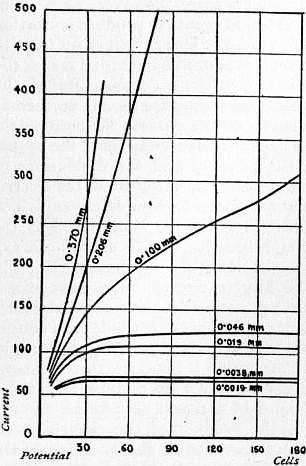
Fig. 14.
If a conductor A is placed near a conductor B exposed to ultra-violet light, and if B is made the negative electrode and a difference of potential established between A and B, a current of electricity will flow between the conductors. The relation between the magnitude of the current and the difference of potential when A and B are parallel plates has been investigated by Stoletow (Journal de physique, 1890, 11, p. 469), von Schweidler (Wien. Ber., 1899, 108, p. 273) and Varley (Phil. Trans. A., 1904, 202, p. 439). The results of some of Varley’s experiments are represented in the curves shown in fig. 14, in which the ordinates are the currents and the abscissae the potentials. It will be seen that when the pressure is exceedingly low the current is independent of the potential difference and is equal to the negative charge carried off in unit time by the corpuscles emitted from the surface exposed to the light. At higher pressures the current rises far above these values and increases rapidly with the potential difference. This is due to the corpuscles emitted by the illuminated surface acquiring under the electric field such high velocities that when they strike against the molecules of the gas through which they are passing they ionize them, producing fresh ions which can carry on additional current. The relation between the current and the potential difference in this case is in accordance with the results of the theory of ionization by collision. The corpuscles emitted from a body under the action of ultra-violet light start from the surface with a finite velocity. The velocity is not the same for all the corpuscles, nor indeed could we expect that it should be: for as Ladenburg has shown (Ann. der Phys., 1903, 12, p. 558) the seat of their emission is not confined to the surface layer of the illuminated metal but extends to a layer of finite, though small, thickness. Thus the particles which start deep down will have to force their way through a layer of metal before they reach the surface, and in doing so will have their velocities retarded by an amount depending on the thickness of this layer. The variation in the velocity of the corpuscles is shown in the following table, due to Lenard (Ann. der Phys., 1902, 8, p. 149).
Carbon. Platinum. Aluminium.
Corpuscles emitted with velocities
between 12 and 8×107 cm sec. 0.000 0.000 0.004
between 8 and 4×107 cm sec. 0.049 0.155 0.151
between 4 and 0×107 cm sec. 0.67 0.65 0.49
Corpuscles only emitted with the help
of an external electric field. 0.28 0.21 0.35
1.00 1.00 1.00
If the illuminated surface is completely surrounded by an envelope of the same metal insulated from and completely shielded from the light, the emission of the negative corpuscles from the illuminated surface would go on until the potential difference V between this surface and the envelope became so great that the corpuscles with the greatest velocity lost their energy before reaching the envelope, i.e. if m is the mass, e the charge on a corpuscle, v the greatest velocity of projection, until Ve = ½mv². The values found for V by different observers are not very consistent. Lenard found that V for aluminium was about 3 volts and for platinum 2. Millikan and Winchester (Phil. Mag., July 1907) found for aluminium V = .738. The apparatus used by them was so complex that the interpretation of their results is difficult.
An extremely interesting fact discovered by Lenard is that the velocity with which the corpuscles are emitted from the metal is independent of the intensity of the incident light. The quantity of corpuscles increases with the intensity, but the velocity of the individual corpuscles does not. It is worthy of notice that in other cases when negative corpuscles are emitted from metals, as for example when the metals are exposed to cathode rays, Canal-strahlen, or Röntgen rays, the velocity of the emitted corpuscles is independent of the intensity of the primary radiation which excites them. The velocity is not, however, independent of the nature of the primary rays. Thus when light is used to produce the emission of corpuscles the velocity, as Ladenburg has shown, depends on the wave length of the light, increasing as the wave length diminishes. The velocity of corpuscles emitted under the action of cathode rays is greater than that of those ejected by light, while the incidence of Röntgen rays produces the emission of corpuscles moving much more rapidly than those in the cases already mentioned, and the harder the primary rays the greater is the velocity of the corpuscles.
The importance of the fact that the velocity and therefore the energy of the corpuscles emitted from the metal is independent of the intensity of the incident light can hardly be overestimated. It raises the most fundamental questions as to the nature of light and the constitution of the molecules. What is the source of the energy possessed by these corpuscles? Is it the light, or in the stores of internal energy possessed by the molecule? Let us follow the consequences of supposing that the energy comes from the light. Then, since the energy is independent of the intensity of the light, the electric forces which liberate the corpuscles must also be independent of that intensity. But this cannot be the case if, as is usually assumed in the electromagnetic theory, the wave front consists of a uniform distribution of electric force without structure, for in this case the magnitude of the electric force is proportional to the square root of the intensity. On the emission theory of light a difficulty of this kind would not arise, for on that theory the energy in a luminiferous particle remains constant as the particle pursues its flight through space. Thus any process which a single particle is able to effect by virtue of its energy will be done just as well a thousand miles away from the source of light as at the source itself, though of course in a given space there will not be nearly so many particles to do this process far from the source as there are close in. Thus, if one of the particles when it struck against a piece of metal caused the ejection of a corpuscle with a given velocity, the velocity of emission would not depend on the intensity of the light. There does not seem any reason for believing that the electromagnetic theory is inconsistent with the idea that on this theory, as on the emission theory, the energy in the light wave may instead of being uniformly distributed through space be concentrated in bundles which occupy only a small fraction of the volume traversed by the light, and that as the wave travels out the bundles get farther apart, the energy in each remaining undiminished. Some such view of the structure of light seems to be required to account for the fact that when a plate of metal is struck by a wave of ultra-violet light, it would take years before the corpuscles emitted from the metal would equal in number the molecules on the surface of the metal plate, and yet on the ordinary theory of light each one of these is without interruption exposed to the action of the light. The fact discovered by E. Ladenburg (Verh. d. deutsch. physik. Ges. 9, p. 504) that the velocity with which the corpuscles are emitted depends on the wave length of the light suggests that the energy in each bundle depends upon the wave length and increases as the wave length diminishes.
These considerations illustrate the evidence afforded by photo-electric effects on the nature of light; these effects may also have a deep significance with regard to the structure of matter. The fact that the energy of the individual corpuscles is independent of the intensity of the light might be explained by the hypothesis that the energy of the corpuscles does not come from the light but from the energy stored up in the molecules of the metal exposed to the light. We may suppose that under the action of the light some of the molecules are thrown into an unstable state and explode, ejecting corpuscles; the light in this case acts only as a trigger to liberate the energy in the atom, and it is this energy and not that of the light which goes into the corpuscles. In this way the velocity of the corpuscles would be independent of the intensity of the light. But it may be asked, is this view consistent with the result obtained by Ladenburg that the velocity of the corpuscles depends upon the nature of the light? If light of a definite wave length expelled corpuscles with a definite and uniform velocity, it would be very improbable that the emission of the corpuscles is due to an explosion of the atoms. The experimental facts as far as they are known at present do not allow us to say that the connexion between the velocity of the corpuscles and the wave length of the light is of this definite character, and a connexion such as a gradual increase of average velocity as the wave length of the light diminishes, would be quite consistent with the view that the corpuscles are ejected by the explosion of the atom. For in a complex thing like an atom there may be more than one system which becomes unstable when exposed to light. Let us suppose that there are two such systems, A and B, of which B ejects the corpuscles with the greater velocity. If B is more sensitive to the short waves, and A to the long ones, then as the wave length of the light diminishes the proportion of the corpuscles which come from B will increase, and as these are the faster, the average velocity of the corpuscles emitted will also increase. And although the potential acquired by a perfectly insulated piece of metal when exposed to ultra-violet light would depend only on the velocity of the fastest corpuscles and not upon their number, in practice perfect insulation is unattainable, and the potential actually acquired is determined by the condition that the gain of negative electricity by the metal through lack of insulation, is equal to the loss by the emission of negatively electrified corpuscles. The potential acquired will fall below that corresponding to perfect insulation by an amount depending on the number of the faster corpuscles emitted, and the potential will rise if the proportion of the rapidly moving corpuscles is increased, even though there is no increase in their velocity. It is interesting to compare other cases in which corpuscles are emitted with the case of ultra-violet light. When a metal or gas is bombarded by cathode rays it emits corpuscles and the velocity of these is found to be independent of the velocity of the cathode rays which excite them; the velocity is greater than for corpuscles emitted under ultra-violet light. Again, when bodies are exposed to Röntgen rays they emit corpuscles moving with a much greater velocity than those excited by cathode rays, but again the velocity does not depend upon the intensity of the rays although it does to some extent on their hardness. In the case of cathode and Röntgen rays, the velocity with which the corpuscles are emitted seems, as far as we know at present, to vary slightly, but only slightly, with the nature of the substance on which the rays fall. May not this indicate that the first effect of the primary rays is to detach a neutral doublet, consisting of a positive and negative charge, this doublet being the same from whatever system it is detached? And that the doublet is unstable and explodes, expelling the negative charge with a high velocity, and the positive one, having a much larger charge, with a much smaller velocity, the momentum of the negative charge being equal to that of the positive.
Up to now we have been considering the effects produced when light is incident on metals. Lenard found (and the result has been confirmed by the experiments of J. J. Thomson and Lyman) that certain kinds of ultra-violet light ionize a gas when they pass through. The type of ultra-violet light which produces this effect is so easily absorbed that it is stopped by a layer a few millimetres thick of air at atmospheric pressure.
Ionization by Collision.—When the ionization of the gas is produced by external agents such as Röntgen rays or ultra-violet light, the electric field produces a current by setting the positive ions moving in one direction, and the negative ones in the opposite; it makes use of ions already made and does not itself give rise to ionization. In many cases, however, such as in electric sparks, there are no external agents to produce ionization and the electric field has to produce the ions as well as set them in motion. When the ionization is produced by external means the smallest electric field is able to produce a current through the gas; when, however, these external means are absent no current is produced unless the strength of the electric field exceeds a certain critical value, which depends not merely upon the nature of the gas but also upon the pressure and the dimensions of the vessel in which it is contained. The variation of the electric field required to produce discharge can be completely explained if we suppose that the ionization of the gas is produced by the impact with its molecules of corpuscles, and in certain cases of positive ions, which under the influence of the electric field have acquired considerable kinetic energy. We have direct evidence that rapidly moving corpuscles are able to ionize molecules against which they strike, for the cathode rays consist of such corpuscles, and these when they pass through a gas produce large amounts of ionization. Suppose then that we have in a gas exposed to an electric field a few corpuscles. These will be set in motion by the field and will acquire an amount of energy in proportion to the product of the electric force, their charge, and the distance travelled in the direction of the electric field between two collisions with the molecules of the gas. If this energy is sufficient to give them the ionizing property possessed by cathode rays, then when a corpuscle strikes against a molecule it will detach another corpuscle; this under the action of the electric field will acquire enough energy to produce corpuscles on its own account, and so as the corpuscles move through the gas their number will increase in geometrical progression. Thus, though there were but few corpuscles to begin with, there may be great ionization after these have been driven some distance through the gas by the electric field.
The number of ions produced by collisions can be calculated by the following method. Let the electric force be parallel to the axis of x, and let n be the number of corpuscles per unit volume at a place fixed by the co-ordinate x; then in unit time these corpuscles will make nu/λ collisions with the molecules, if u is the velocity of a corpuscle and λ the mean free path of a corpuscle. When the corpuscles are moving fast enough to produce ions by collision their velocities are very much greater than those they would possess at the same temperature if they were not acted on by electrical force, and so we may regard the velocities as being parallel to the axis of x and determined by the electric force and the mean free path of the corpuscles. We have to consider how many of the nu/λ collisions which take place per second will produce ions. We should expect that the ionization of a molecule would require a certain amount of energy, so that if the energy of the corpuscle fell below this amount no ionization would take place, while if the energy of the corpuscle were exceedingly large, every collision would result in ionization. We shall suppose that a certain fraction of the number of collisions result in ionization and that this fraction is a function of the energy possessed by the corpuscle when it collides against the molecules. This energy is proportional to Xeλ when X is the electric force, e the charge on the corpuscle, and λ the mean free path. If the fraction of collisions which produce ionization is ∫ (Xeλ), then the number of ions produced per cubic centimetre per second is ∫ (Xeλ)nu/λ. If the collisions follow each other with great rapidity so that a molecule has not had time to recover from one collision before it is struck again, the effect of collisions might be cumulative, so that a succession of collisions might give rise to ionization, though none of the collisions would produce an ion by itself. In this case ∫ would involve the frequency of the collisions as well as the energy of the corpuscle; in other words, it might depend on the current through the gas as well as upon the intensity of the electric field. We shall, however, to begin with, assume that the current is so small that this cumulative effect may be neglected.
Let us now consider the rate of increase, dn/dt, in the number of corpuscles per unit volume. In consequence of the collisions, ∫ (Xeλ)nu/λ corpuscles are produced per second; in consequence of the motion of the corpuscles, the number which leave unit volume per second is greater than those which enter it by d/dx · (nu); while in a certain number of collisions a corpuscle will stick to the molecule and will thus cease to be a free corpuscle. Let the fraction of the number of collisions in which this occurs be β. Thus the gain in the number of corpuscles is ∫ (Xeλ)nu/λ, while the loss is d/dx·(nu) + β·nu/λ hence
dn ∫(Xeλ) nu − d (nu) − βnu .
dt λ dx λ
When things are in a steady state dn/dt = 0, and we have
d (nu) = 1 (∫(Xeλ) − β) nu.
dx λ
If the current is so small that the electrical charges in the gas are not able to produce any appreciable variations in the field, X will be constant and we get nu = Cεαx, where α = {∫ (Xeλ) − β}/λ. If we take the origin from which we measure x at the cathode, C is the value of nu at the cathode, i.e. it is the number of corpuscles emitted per unit area of the cathode per unit time; this is equal to i0/e if i0 is the quantity of negative electricity coming from unit area of the cathode per second, and e the electric charge carried by a corpuscle. Hence we have nue = i0εαx. If l is the distance between the anode and the cathode, the value of nue, when x = l, is the current passing through unit area of the gas, if we neglect the electricity carried by negatively electrified carriers other than corpuscles. Hence i = i0εα l. Thus the current between the plates increases in geometrical progression with the distance between the plates.
By measuring the variation of the current as the distance between the plates is increased, Townsend, to whom we owe much of our knowledge on this subject, determined the values of α for different values of X and for different pressures for air, hydrogen and carbonic acid gas (Phil. Mag. [6], 1, p. 198). Since λ varies inversely as the pressure, we see that α may be written in the form pφ(X/p) or α/X = F(X/p). The following are some of the values of α found by Townsend for air.
X Volts per cm. Pressure .17 mm. Pressure .38 mm. Pressure 1.10 mm. Pressure 2.1 mm. Pressure 4.1 mm.
20 .24
40 .65 .34
80 1.35 1.3 .45 .13
120 1.8 2.0 1.1 .42 .13
160 2.1 2.8 2.0 .9 .28
200 3.4 2.8 1.6 .5
240 2.45 3.8 4.0 2.35 .99
320 2.7 4.5 5.5 4.0 2.1
400 5.0 6.8 6.0 3.6
480 3.15 5.4 8.0 7.8 5.3
560 5.8 9.3 9.4 7.1
640 3.25 6.2 10.6 10.8 8.9
We see from this table that for a given value of X, α for small pressures increases as the pressure increases; it attains a maximum at a particular pressure, and then diminishes as the pressure increases. The increase in the pressure increases the number of collisions, but diminishes the energy acquired by the corpuscle in the electric field, and thus diminishes the change of any one collision resulting in ionization. If we suppose the field is so strong that at some particular pressure the energy acquired by the corpuscle is well above the value required to ionize at each collision, then it is evident that increasing the number of collisions will increase the amount of ionization, and therefore α, and α cannot begin to diminish until the pressure has increased to such an extent that the mean free path of a corpuscle is so small that the energy acquired by the corpuscle from the electric field falls below the value when each collision results in ionization.
The value of p, when X is given, for which α is a maximum, is proportional to X; this follows at once from the fact that α is of the form X·F(X/p). The value of X/p for which F(X/p) is a maximum is seen from the preceding table to be about 420, when X is expressed in volts per centimetre and p in millimetres of mercury. The maximum value of F(X/p) is about 1⁄60. Since the current passing between two planes at a distance l apart is i0εαl or i0εXlF(X/p), and since the force between the plates is supposed to be uniform, Xl is equal to V, the potential between the plates; hence the current between the plates is i0εV·F(X/p), and the greatest value it can have is i0εV/60. Thus the ratio between the current between the plates when there is ionization and when there is none cannot be greater than εV/60, when V is measured in volts. This result is based on Townsend’s experiments with very weak currents; we must remember, however, that when the collisions are so frequent that the effects of collisions can accumulate, α may have much larger values than when the current is small. In some experiments made by J. J. Thomson with intense currents from cathodes covered with hot lime, the increase in the current when the potential difference was 60 volts, instead of being e times the current when there was no ionization, as the preceding theory indicates, was several hundred times that value, thus indicating a great increase in α with the strength of the current.
Townsend has shown that we can deduce from the values of α the mean free path of a corpuscle. For if the ionization is due to the collisions with the corpuscles, then unless one collision detaches more than one corpuscle the maximum number of corpuscles produced will be equal to the number of collisions. When each collision results in the production of a corpuscle, α = 1/λ and is independent of the strength of the electric field. Hence we see that the value of α, when it is independent of the electric field, is equal to the reciprocal of the free path. Thus from the table we infer that at a pressure of 17 mm. the mean free path is 1⁄325 cm.; hence at 1 mm. the mean free path of a corpuscle is 1⁄19 cm. Townsend has shown that this value of the mean free path agrees well with the value 1⁄21 cm. deduced from the kinetic theory of gases for a corpuscle moving through air. By measuring the values of α for hydrogen and carbonic acid gas Townsend and Kirby (Phil. Mag. [6], 1, p. 630) showed that the mean free paths for corpuscles in these gases are respectively 1⁄11.5 and 1⁄29 cm. at a pressure of 1 mm. These results again agree well with the values given by the kinetic theory of gases.
If the number of positive ions per unit volume is m and v is the velocity, we have nue + mve = i, where i is the current through unit area of the gas. Since nue = i0εnx and i = i0εnl, when l is the distance between the plates, we see that
nu / mv = εnx / (εnl − εnx),
n = v · εnx .
m u εne − εnx
Since v/u is a very small quantity we see that n will be less than m except when εnl - εnx is small, i.e. except close to the anode. Thus there will be an excess of positive electricity from the cathode almost up to the anode, while close to the anode there will be an excess of negative. This distribution of electricity will make the electric force diminish from the cathode to the place where there is as much positive as negative electricity, where it will have its minimum value, and then increase up to the anode.
The expression i = i0εαl applies to the case when there is no source of ionization in the gas other than the collisions; if in addition to this there is a source of uniform ionization producing q ions per cubic centimetre, we can easily show that
i = i0εαl + qe (eαl − 1).
α
With regard to the minimum energy which must be possessed by a corpuscle to enable it to produce ions by collision, Townsend (loc. cit.) came to the conclusion that to ionize air the corpuscle must possess an amount of energy equal to that acquired by the fall of its charge through a potential difference of about 2 volts. This is also the value arrived at by H. A. Wilson by entirely different considerations. Stark, however, gives 17 volts as the minimum for ionization. The energy depends upon the nature of the gas; recent experiments by Dawes and Gill and Pedduck (Phil. Mag., Aug. 1908) have shown that it is smaller for helium than for air, hydrogen, or carbonic acid gas.
If there is no external source of ionization and no emission of corpuscles from the cathode, then it is evident that even if some corpuscles happened to be present in the gas when the electric field were applied, we could not get a permanent current by the aid of collisions made by these corpuscles. For under the electric field, the corpuscles would be driven from the cathode to the anode, and in a short time all the corpuscles originally present in the gas and those produced by them would be driven from the gas against the anode, and if there was no source from which fresh corpuscles could be introduced into the gas the current would cease. The current, however, could be maintained indefinitely if the positive ions in their journey back to the cathode also produced ions by collisions, for then we should have a kind of regenerative process by which the supply of corpuscles could be continually renewed. To maintain the current it is not necessary that the ionization resulting from the positive ions should be anything like as great as that from the negative, as the investigation given below shows a very small amount of ionization by the positive ions will suffice to maintain the current. The existence of ionization by collision with positive ions has been proved by Townsend. Another method by which the current could be and is maintained is by the anode emitting corpuscles under the impact of the positive ions driven against it by the electric field. J. J. Thomson has shown by direct experiment that positively electrified particles when they strike against a metal plate cause the metal to emit corpuscles (J. J. Thomson, Proc. Camb. Phil. Soc. 13, p. 212; Austin, Phys. Rev. 22, p. 312). If we assume that the number of corpuscles emitted by the plate in one second is proportional to the energy in the positive ions which strike the plate in that second, we can readily find an expression for the difference of potential which will maintain without any external ionization a current of electricity through the gas. As this investigation brings into prominence many of the most important features of the electric discharge, we shall consider it in some detail.
Let us suppose that the electrodes are parallel plates of metal at right angles to the axis of x, and that at the cathode x = 0 and at the anode x = d, d being thus the distance between the plates. Let us also suppose that the current of electricity flowing between the plates is so small that the electrification between the plates due to the accumulation of ions is not sufficient to disturb appreciably the electric field, which we regard as uniform between the plates, the electric force being equal to V/d, where V is the potential difference between the plates. The number of positive ions produced per second in a layer of gas between the planes x and x + dx is αnu·dx. Here n is the number of corpuscles per unit volume, α the coefficient of ionization (for strong electric field α = 1/λ′, where λ′ is the mean free path of a corpuscle), and u the velocity of a corpuscle parallel to x. We have seen that nu = i0εαx, where i0 is the number of corpuscles emitted per second by unit area of the cathode. Thus the number of positive ions produced in the layer is αi0εαx dx. If these went straight to the cathode without a collision, each of them would have received an amount of kinetic energy Vex/d when they struck the cathode, and the energy of the group of ions would be Vex/d·αi0εdx dx. The positive ions will, however, collide with the molecules of the gas through which they are passing, and this will diminish the energy they possess when they reach the cathode.
The diminution in the energy will increase in geometrical proportion with the length of path travelled by the ion and will thus be proportional to ε−βx, β will be proportional to the number of collisions and will thus be proportional to the pressure of the gas. Thus the kinetic energy possessed by the ions when they reach the cathode will be
ε−βx·V(ex/d) · α i0εαx dx,
and E, the total amount of energy in the positive ions which reach the cathode in unit time, will be given by the equation
E = ∫d0 ε−βx · V(ex/d) · α i0εαx dx = Veα i0 ∫d0 ε−(β−α)x x dx
d
= Veα i0 { 1 − ε−(β−α)d{ 1 + d }} (1).
d (β − α)² (β − α)² (β − α)
If the number of corpuscles emitted by the cathode in unit time is proportional to this energy we have i0 = kE, where k is a constant; hence by equation (1) we have
V = (β − α)² · d ,
ke α I
where
I = 1 − ε−(β−α)d (1 + d (β − α)).
Since both β and α are proportional to the pressure, I and (β − α)²d/α are both functions of pd, the product of the pressure and the spark length, hence we see that V is expressed by an equation of the form
V = 1 ∫ (pd) (2),
ke
where ∫ (pd) denotes a function of pd, and neither p nor d enter into the expression for V except in this product. Thus the potential difference required to produce discharge is constant as long as the product of the pressure and spark length remains constant; in other words, the spark potential is constant as long as the mass of the gas between the electrodes is constant. Thus, for example, if we halve the pressure the same potential difference will produce a spark of twice the length. This law, which was discovered by Paschen for fairly long sparks (Annalen, 37, p. 79), and has been shown by Carr (Phil. Trans., 1903) to hold for short ones, is one of the most important properties of the electric discharge.
We see from the expression for V that when (β − α)d is very large
V = (β − α)²d/keα.
Thus V becomes infinite when d is infinite. Again when (β − α)d is very small we find
V = 1/keαd;
thus V is again infinite when d is nothing. There must therefore be some value of d intermediate between zero and infinity for which V is a minimum. This value is got by finding in the usual way the value of d, which makes the expression for V given in equation (1) a minimum. We find that d must satisfy the equation
1 = ε−(β−α)d {1 + (β − α)d + (β − α·d)²}.
We find by a process of trial and error that (β − α)d = 1.8 is approximately a solution of this equation; hence the distance for minimum potential is 1.8/(β − α). Since β and α are both proportional to the pressure, we see that the critical spark length varies inversely as the pressure. If we substitute this value in the expression for V we find that V, the minimum spark potential, is given by
V = β − α · 2.2 .
α ke
Since β and α are each proportional to the pressure, the minimum potential is independent of the pressure of the gas. On this view the minimum potential depends upon the metal of which the cathode is made, since k measures the number of corpuscles emitted per unit time by the cathode when struck by positive ions carrying unit energy, and unless β bears the same ratio to α for all gases the minimum potential will also vary with the gas. The measurements which have been made of the “cathode fall of potential,” which as we shall see is equal to the minimum potential required to produce a spark, show that this quantity varies with the material of which the cathode is made and also with the nature of the gas. Since a metal plate, when bombarded by positive ions, emits corpuscles, the effect we have been considering must play a part in the discharge; it is not, however, the only effect which has to be considered, for as Townsend has shown, positive ions when moving above a certain speed ionize the gas, and cause it to emit corpuscles. It is thus necessary to take into account the ionization of the positive ions.
Let m be the number of positive ions per unit volume, and w their velocity, the number of collisions which occur in one second in one cubic centimetre of the gas will be proportional to mwp, where p is the pressure of the gas. Let the number of ions which result from these collisions be γmw; γ will be a function of p and of the strength of the electric field. Let as before n be the number of corpuscles per cubic centimetre, u their velocity, and αnu the number of ions which result in one second from the collisions between the corpuscles and the gas. The number of ions produced per second per cubic centimetre is equal to αnu + γmw; hence when things are in a steady state
d (nu) = αnu + γ mw,
dx
and
e(nu + mw) = i,
where e is the charge on the ion and i the current through the gas. The solution of these equations when the field is uniform between the plates, is
enu = Cε(α−γ)x − γi / (α − γ), emw = -Cε(α−γ)x + αi / (α − γ),
where C is a constant of integration. If there is no emission of positive ions from the anode enu = i, when x = d. Determining C from this condition we find
enu = i {αε (α−γ) (x−d) − γ }, emw = αi {1 − ε (α−γ) (x−d) }.
α − γ α − γ
If the cathode did not emit any corpuscles owing to the bombardment by positive ions, the condition that the charge should be maintained is that there should be enough positive ions at the cathode to carry the current i.e. that emw = i; when x = 0, the condition gives
i { αε−(α−γ)d − γ} = 0
α − γ
or
ε αd/α = ε γd/γ.
Since α and γ are both of the form p∫ (X/p) and X = V/d, we see that V will be a function of pd, in agreement with Paschen’s law. If we take into account both the ionization of the gas and the emission of corpuscles by the metal we can easily show that
α − γε(α−γ)d = kαVe [ 1 − ε−(β+γ−α)d{ 1 + d }],
α − γ d (β + γ − α)² (β + γ − α)² β + γ − α
where k and β have the same meaning as in the previous investigation. When d is large, ε(α−γ)d is also large; hence in order that the left-hand side of this equation should not be negative γ must be less than α/ε(α−γ)d; as this diminishes as d increases we see that when the sparks are very long discharge will take place, practically as soon as γ has a finite value, i.e. as soon as the positive ions begin to produce fresh ions by their collisions.
In the preceding investigation we have supposed that the electric field between the plates was uniform; if it were not uniform we could get discharges produced by very much smaller differences of potential than are necessary in a uniform field. For to maintain the discharge it is not necessary that the positive ions should act as ionizers all along their path; it is sufficient that they should do so in the neighbourhood of cathode. Thus if we have a strong field close to the cathode we might still get the discharge though the rest of the field were comparatively weak. Such a distribution of electric force requires, however, a great accumulation of charged ions near the cathode; until these ions accumulate the field will be uniform. If the uniform field existing in the gas before the discharge begins were strong enough to make the corpuscles produce ions by collision, but not strong enough to make the positive ions act as ionizers, there would be some accumulation of ions, and the amount of this accumulation would depend upon the number of free corpuscles originally present in the gas, and upon the strength of the electric field. If the accumulation were sufficient to make the field near the cathode so strong that the positive ions could produce fresh ions either by collision with the cathode or with the gas, the discharge would pass though the gas; if not, there will be no continuous discharge. As the amount of the accumulation depends on the number of corpuscles present in the gas, we can understand how it is that after a spark has passed, leaving for a time a supply of corpuscles behind it, it is easier to get a discharge to pass through the gas than it was before.
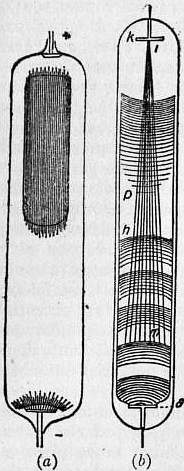
Fig. 15.
The inequality of the electric field in the gas when a continuous discharge is passing through it is very obvious when the pressure of the gas is low. In this case the discharge presents a highly differentiated appearance of which a type is represented in fig. 15. Starting from the cathode we have a thin velvety luminous glow in contact with the surface; this glow is often called the “first cathode layer.” Next this we have a comparatively dark space whose thickness increases as the pressure diminishes; this is called the “Crookes’s dark space,” or the “second cathode layer.” Next this we have a luminous position called the “negative glow” or the “third cathode layer.” The boundary between the second and third layers is often very sharply defined. Next to the third layer we have another dark space called the “Faraday dark space.” Next to this and reaching up to the anode is another region of luminosity, called the “positive column,” sometimes (as in fig. 15, a) continuous, sometimes (as in fig. 15, b) broken up into light or dark patches called “striations.” The dimensions of the Faraday dark space and the positive column vary greatly with the current passing through the gas and with its pressure; sometimes one or other of them is absent. These differences in appearances are accompanied by great difference in the strength of the electric field. The magnitude of the electric force at different parts of the discharge is represented in fig. 16, where the ordinates represent the electric force at different parts of the tube, the cathode being on the right. We see that the electric force is very large indeed between the negative glow and the cathode, much larger than in any other part of the tube. It is not constant in this region, but increases as we approach the cathode. The force reaches a minimum either in the negative glow itself or in the part of the Faraday dark space just outside, after which it increases towards the positive column. In the case of a uniform positive column the electric force along it is constant until we get quite close to the anode, when a sudden change, called the “anode fall,” takes place in the potential.
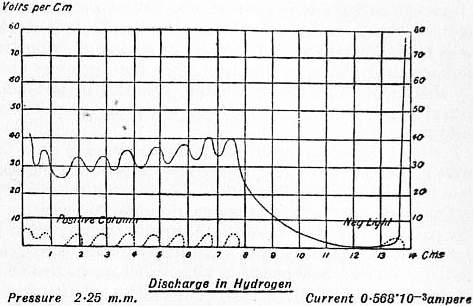
Fig. 16.
The difference of potential between the cathode and the negative glow is called the “cathode potential fall” and is found to be constant for wide variations in the pressure of the gas and the current passing through. It increases, however, considerably when the current through the gas exceeds a certain critical value, depending among other things on the size of the cathode. This cathode fall of potential is shown by experiment to be very approximately equal to the minimum potential difference. The following table contains a comparison of the measurements of the cathode fall of potentials in various gases made by Warburg (Wied. Ann., 1887, 31, p. 545, and 1890, 40, p. 1), Capstick (Proc. Roy. Society, 1898, 63, p. 356), and Strutt (Phil. Trans., 1900, 193, p. 377), and the measurements by Strutt of the smallest difference of potential which will maintain a spark through these gases.
Gas. Cathode fall in Volts. Least potential difference required to maintain a Spark.
Platinum Electrodes. Aluminium Electrodes.
Warburg. Capstick. Strutt. Warburg. Strutt.
Air 340-350 .. .. .. 341
H2 about 300 298 .. 168 302-308
O2 .. 369 .. .. ..
N2 230 if free 232 .. 207 251
from oxygen
Hg vapour 340 .. .. .. ..
Helium .. .. 226 .. 261-326
H2O .. 469 .. .. ..
NH3 .. 582 .. .. ..
Thus in the cases in which the measurements could be made with the greatest accuracy the agreement between the cathode fall and the minimum potential difference is very close. The cathode fall depends on the material of which the terminals are made, as is shown by the following table due to Mey (Verh. deutsch. physik. Gesell., 1903, 5, p. 72).
Gas. Electrode.
Pt Hg Ag Cu Fe Zn Al Mg Na Na-K K
O2 369 .. .. .. .. .. .. .. .. .. ..
H2 300 .. 295 280 230 213 190 168 185 169 172
N2 232 226 .. .. .. .. .. 207 178 125 170
He 226 .. .. .. .. .. .. .. 80 78.5 69
Argon 167 .. .. .. .. .. 100 .. .. .. ..
The dependence of the minimum potential required to produce a spark upon the metal of which the cathode is made has not been clearly established, some observers being unable to detect any difference between the potential required to spark between electrodes of aluminium and those of brass, while others thought they had detected such a difference. It is only with sparks not much longer than the critical spark length that we could hope to detect this difference. When the current through the gas exceeds a certain critical value depending among other things on the size of the cathode, the cathode fall of potential increases rapidly and at the same time the thickness of the dark spaces diminishes. We may regard the part of the discharge between the cathode and the negative glow as a discharge taking place under minimum potential difference through a distance equal to the critical spark length. An inspection of fig. 16 will show that we cannot regard the electric field as constant even for this small distance; it thus becomes a matter of interest to know what would be the effect on the minimum potential difference required to produce a spark if there were sufficient ions present to produce variations in the electric field analogous to those represented in fig. 16. If the electric force at a distance x from the cathode were proportional to ε-px we should have a state of things much resembling the distribution of electric force near the cathode. If we apply to this distribution the methods used above for the case when the force was uniform, we shall find that the minimum potential is less and the critical spark length greater than when the electric force is uniform.
Potential Difference required to produce a Spark of given Length.—We may regard the region between the cathode and the negative glow as a place for the production of corpuscles, these corpuscles finding their way from this region through the negative glow. The parts of this glow towards the anode we may regard as a cathode, from which, as from a hot lime cathode, corpuscles are emitted. Let us now consider what will happen to these corpuscles shot out from the negative glow with a velocity depending on the cathode fall of potential and independent of the pressure. These corpuscles will collide with the molecules of the gas, and unless there is an external electric field to maintain their velocity they will soon come to rest and accumulate in front of the negative glow. The electric force exerted by this cloud of corpuscles will diminish the strength of the electric field in the region between the cathode and the negative glow, and thus tend to stop the discharge. To keep up the discharge we must have a sufficiently strong electric field between the negative glow and the anode to remove the corpuscles from this region as fast as they are sent into it from the cathode. If, however, there is no production of ions in the region between the negative glow and the anode, all the ions in this region will have come from near the cathode and will be negatively charged; this negative electrification will diminish the electric force on the cathode side of it and thus tend to stop the discharge. This back electric field could, however, be prevented by a little ionization in the region between the anode and glow, for this would afford a supply of positive ions, and thus afford an opportunity for the gas in this region to have in it as many positive as negative ions; in this case it would not give rise to any back electromotive force. The ionization which produces these positive ions may, if the field is intense, be due to the collisions of corpuscles, or it may be due to radiation analogous to ultra-violet, or soft Röntgen rays, which have been shown by experiment to accompany the discharge. Thus in the most simple conditions for discharge we should have sufficient ionization to keep up the supply of positive ions, and an electric field strong enough to keep the velocity of the negative corpuscle equal to the value it has when it emerges from the negative glow. Thus the force must be such as to give a constant velocity to the corpuscle, and since the force required to move an ion with a given velocity is proportional to the pressure, this force will be proportional to the pressure of the gas. Let us call this force ap; then if l is the distance of the anode from the negative glow the potential difference between these points will be alp. The potential difference between the negative glow and the cathode is constant and equals c; hence if V is the potential difference between the anode and cathode, then V = c + alp, a relation which expresses the connexion between the potential difference and spark length for spark lengths greater than the critical distance. It is to be remembered that the result we have obtained applies only to such a case as that indicated above, where the electric force is constant along the positive column. Experiments with the discharge through gases at low pressure show the discharge may take other forms. Thus the positive column may be striated when the force along it is no longer uniform, or the positive column may be absent; the discharge may be changed from one of these forms to another by altering the current. The relation between the potential and the distance between the electrodes varies greatly, as we might expect, with the current passing through the gas.
The connexion between the potential difference and the spark length has been made the subject of a large number of experiments. The first measurements were made by Lord Kelvin in 1860 (Collected Papers on Electrostatics and Magnetism, p. 247); subsequent experiments have been made by Baille (Ann. de chimie et de physique, 5, 25, p. 486), Liebig (Phil. Mag. [5], 24, p. 106), Paschen (Wied. Ann. 37, p. 79), Peace (Proc. Roy. Soc., 1892, 52, p. 99), Orgler (Ann. der Phys. 1, p. 159), Strutt (Phil. Trans. 193, p. 377), Bouty (Comptes rendus, 131, pp. 469, 503), Earhart (Phil. Mag. [6], 1, p. 147), Carr (Phil. Trans., 1903), Russell (Phil. Mag. [5], 64, p. 237), Hobbs (Phil. Mag. [6], 10, p. 617), Kinsley (Phil. Mag. [6], 9, 692), Ritter (Ann. der Phys. 14, p. 118). The results of their experiments show that for sparks considerably longer than the critical spark length, the relation between the potential difference V and the spark length l may be expressed when the electrodes are large with great accuracy by the linear relation V = c + blp, where p is the pressure and c and b are constants depending on the nature of the gas. When the sparks are long the term blp is the most important and the sparking potential is proportional to the spark length. Though there are considerable discrepancies between the results obtained by different observers, these indicate that the production of a long spark between large electrodes in air at atmospheric pressure requires a potential difference of 30,000 volts for each centimetre of spark length. In hydrogen only about half this potential difference is required, in carbonic acid gas the potential difference is about the same as in air, while Ritter’s experiments show that in helium only about one-tenth of this potential difference is required.
In the case when the electric field is not uniform, as for example when the discharge takes place between spherical electrodes, Russell’s experiments show that the discharge takes place as soon as the maximum electric force in the field between the electrodes reaches a definite value, which he found was for air at atmospheric pressure about 38,000 volts per centimetre.
Very Short Sparks.—Some very interesting experiments on the potential difference required to produce exceedingly short sparks have been made by Earhart, Hobbs and Kinsley; the length of these sparks was comparable with the wave length of sodium light. With sparks of these lengths it was found that it was possible to get a discharge with less than 330 volts, the minimum potential difference in air. The results of these observers show that there is no diminution in the minimum potential difference required to produce discharge until the spark length gets so small that the average electric force between the electrodes amounts to about one million volts per centimetre. When the force rises to this value a discharge takes place even though the potential difference is much less than 330 volts; in some of Earhart’s experiments it was only about 2 volts. This kind of discharge is determined not by the condition that the potential difference should have a given value, but that the electric force should have a given value. Another point in which this discharge differs from the ordinary one is that it is influenced entirely by the nature of the electrodes and not by the nature or pressure of the gas between them, whereas the ordinary discharge is in many cases not affected appreciably by changes in the metal of the electrodes, but is always affected by changes in the pressure and character of the gas between them. Kinsley found that when one of these small sparks passed between the electrodes a kind of metallic bridge was formed between them, so that they were in metallic connexion, and that the distance between them had to be considerably increased before the bridge was broken. Almy (Phil. Mag., Sept. 1908), who used very small electrodes, was unable to get a discharge with less than the minimum spark potential even when the spark length was reduced to one-third of the wave length of sodium light. He suggests that the discharges obtained with larger electrodes for smaller voltages are due to the electrodes being dragged together by the electrostatic attraction between them.
Constitution of the Electric Spark.—Schuster and Hemsalech (Phil. Trans. 193, p. 189), Hemsalech (Comptes Rendus, 130, p. 898; 132, p. 917; Jour. de Phys. 3. 9, p. 43, and Schenck, Astrophy. Jour. 14, p. 116) have by spectroscopic methods obtained very interesting results about the constitution of the spark. The method employed by Schuster and Hemsalech was as follows: Suppose we photograph the spectrum of a horizontal spark on a film which is on the rim of a wheel rotating about a horizontal axis with great velocity. If the luminosity travelled with infinite speed from one electrode to the other, the image on the film would be a horizontal line. If, however, the speed with which the luminosity travelled between the electrodes was comparable with the speed of the film, the line would be inclined to the horizontal, and by measuring the inclinations we could find the speed at which the luminosity travelled. In this way Schuster and Hemsalech showed that when an oscillating discharge passed between metallic terminals in air, the first spark passes through the air alone, no lines of the metal appearing in its spectrum. This first spark vaporizes some of the metal and the subsequent sparks passing mainly through the metallic vapour; the appearance of the lines in the film shows that the velocity of the luminous part of the vapour was finite. The velocity of the vapour of metals of low atomic weight was in general greater than that of the vapour of heavier metals. Thus the velocity of aluminium vapour was 1890 metres per second, that of zinc and cadmium only about 545. Perhaps the most interesting point in the investigation was the discovery that the velocities corresponding to different lines in the spectrum of the same metal were in some cases different. Thus with bismuth some of the lines indicated a velocity of 1420 metres per second, others a velocity of only 550, while one (λ = 3793) showed a still smaller velocity. These results are in accordance with a view suggested by other phenomena that many of the lines in a spectrum produced by an electrical discharge originate from systems formed during the discharge and not from the normal atom or molecule. Schuster and Hemsalech found that by inserting a coil with large self induction in the primary circuit they could obliterate the air lines in the discharge.
Schenck, by observing the appearance presented when an alternating current, produced by discharging Leyden jars, was examined in a rapidly rotating mirror, found it showed the following stages: (1) a thin bright line, followed in some cases at intervals of half the period of the discharge by fainter lines; (2) bright curved streamers starting from the negative terminal, and diminishing rapidly in speed as they receded from the cathode; (3) a diffused glow lasting for a much longer period than either of the preceding. These constituents gave out quite different spectra.
The structure of the discharge is much more easily studied when the pressure of the gas is low, as the various parts which make up the discharge are more widely separated from each other. We have already described the general appearance of the discharge through gases at low pressures (see p. 657). There is, however, one form of discharge which is so striking and beautiful that it deserves more detailed consideration. In this type of discharge, known as the striated discharge, the positive column is made up of alternate bright and dark patches known as striations. Some of these are represented in fig. 17, which is taken from a paper by De la Rue and Müller (Phil. Trans., 1878, Pt. 1). This type of discharge only occurs when the current and the pressure of the gas are between certain limits. It is most beautifully shown when a Wehnelt cathode is used and the current is produced by storage cells, as this allows us to use large currents and to maintain a steady potential difference between the electrodes. The striations are in consequence very bright and steady. The facts which have been established about these striations are as follows: The distance between the bright parts of the striations is greater at low pressures than at high; it depends also upon the diameter of the tube, increasing as the diameter of the tube increases. If the discharge tube is wide at one place and narrow in another the striations will be closer together in the narrow parts than in the wide. The distance between the striations depends on the current through the tube. The relation is not a very simple one, as an increase of current sometimes increases while under other circumstances it decreases the distance between the striations (see Willows, Proc. Camb. Phil. Soc. 10, p. 302). The electric force is not uniform along the striated discharge, but is greater in the bright than in the dark parts of the striation. An example is shown in fig. 16, due to H. A. Wilson, which shows the distribution of electric force at every place in a striated discharge. In experiments made by J. J. Thomson (Phil. Mag., Oct. 1909), using a Wehnelt cathode, the variations in the electric force were more pronounced than those shown in fig. 16. The electric force in this case changed so greatly that it actually became negative just on the cathode side of the bright part of the striation. Just inside the striation on the anode side it rose to a very high value, then continually diminished towards the bright side of the next striation when it again increased. This distribution of electric force implies that there is great excess of negative electricity at the bright head of the striation, and a small excess of positive everywhere else. The temperature of the gas is higher in the bright than in the dark parts of the striations. Wood (Wied. Ann. 49, p. 238), who has made a very careful study of the distribution of temperature in a discharge tube, finds that in those tubes the temperature varies in the same way as the electric force, but that this temperature (which it must be remembered is the average temperature of all the molecules and not merely of those which are taking part in the discharge) is by no means high; in no part of the discharge did the temperature in his experiments exceed 100° C.
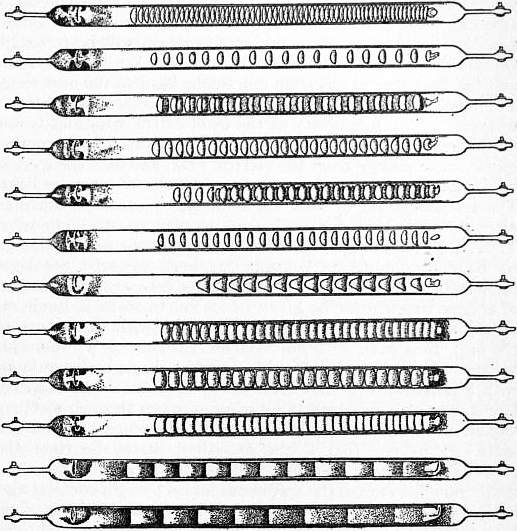
Fig. 17.
Theory of the Striations.—We may regard the heaping up of the negative charges at intervals along the discharge as the fundamental feature in the striations, and this heaping up may be explained as follows. Imagine a corpuscle projected with considerable velocity from a place where the electric field is strong, such as the neighbourhood of the cathode; as it moves towards the anode through the gas it will collide with the molecules, ionize them and lose energy and velocity. Thus unless the corpuscle is acted on by a field strong enough to supply it with the energy it loses by collision, its speed will gradually diminish. Further, when its energy falls below a certain value it will unite with a molecule and become part of a negative ion, instead of a corpuscle; at this stage there will be a sudden and very large diminution in its velocity. Let us now follow the course of a stream of corpuscles starting from the cathode and approaching the anode. If the speed falls off as the stream proceeds, the corpuscles in the rear will gain on those in front and the density of the stream in the front will be increased. If at a certain place the velocity receives a sudden check by the corpuscles becoming loaded with a molecule, the density of the negative electricity will increase at this place with great rapidity, and here there will be a great accumulation of negative electricity, as at the bright head on the cathode side of a striation. Now this accumulation of negative electricity will produce a large electric force on the anode side; this will drive corpuscles forward with great velocity and ionize the gas. These corpuscles will behave like those shot from the cathode and will accumulate again at some distance from their origin, forming the bright head of the next striation, when the process will be repeated. On this view the bright heads of the striations act like electrodes, and the discharge passes from one bright head to the next as by a number of stepping stones, and not directly from cathode to anode. The luminosity at the head of the striations is due to the recombination of the ions. These ions have acquired considerable energy from the electric field, and this energy will be available for supplying the energy radiated away as light. The recombination of ions which do not possess considerable amounts of energy does not seem to give rise to luminosity. Thus, in an ionized gas not exposed to an electric field, although we have recombination between the ions, we need not have luminosity. We have at present no exact data as to the amount of energy which must be given to an ion to make it luminous on recombination; it also certainly varies with the nature of the ion; thus even with hot Wehnelt cathodes J. J. Thomson has never been able to make the discharge through air luminous with a potential less than from 16 to 17 volts. The mercury lamps, however, in which the discharge passes through mercury vapour are luminous with a potential difference of about 12 volts. It follows that if the preceding theory be right the potential difference between two bright striations must be great enough to make the corpuscles ionize by collision and also to give enough energy to the ions to make them luminous when they recombine. The difference of potential between the bright parts of successive striations has been measured by Hohn (Phys. Zeit. 9, p. 558); it varies with the pressure and with the gas. The smallest value given by Hohn is about 15 volts. In some experiments made by J. J. Thomson, when the pressure of the gas was very low, the difference of potential between two adjacent dark spaces was as low as 3.75 volts.
The Arc Discharge.—The discharges we have hitherto considered have been characterized by large potential differences and small currents. In the arc discharge we get very large currents with comparatively small potential differences. We may get the arc discharge by taking a battery of cells large enough to give a potential difference of 60 to 80 volts, and connecting the cells with two carbon terminals, which are put in contact, so that a current of electricity flows round the circuit. If the terminals, while the current is on, are drawn apart, a bright discharge, which may carry a current of many amperes, passes from one to the other. This arc discharge, as it is called, is characterized by intense heat and by the brilliant luminosity of the terminals. This makes it a powerful source of light. The temperature of the positive terminal is much higher than that of the negative. According to Violle (Comptes Rendus, 115, p. 1273) the temperature of the tip of the former is about 3500° C, and that of the latter 2700° C. The temperature of the arc itself he found to be higher than that of either of its terminals. As the arc passes, the positive terminal gets hollowed out into a crater-like shape, but the negative terminal remains pointed. Both terminals lose weight.
The appearance of the terminals is shown in fig. 18, given by Mrs Ayrton (Proc. Inst. Elec. Eng. 28, p. 400); a, b represent the terminals when the arc is quiet, and c when it is accompanied by a hissing sound. The intrinsic brightness of the positive crater does not increase with an increase in the current; an increased current produces an increase in the area of the luminous crater, but the amount of light given out by each unit of area of luminous surface is unaltered. This indicates that the temperature of the crater is constant; it is probably that at which carbon volatilizes. W. E. Wilson (Proc. Roy. Soc. 58, p. 174; 60, p. 377) has shown that at pressures of several atmospheres the intrinsic brightness of the crater is considerably diminished.
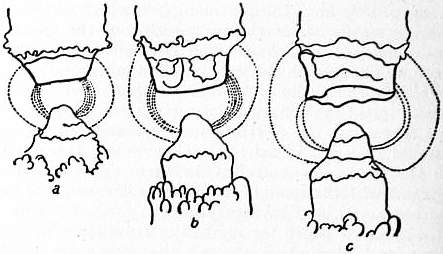
Fig. 18.
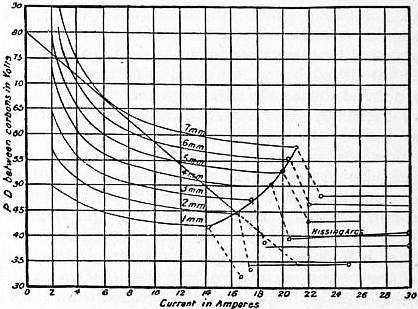
Fig. 19.
The connexion between V, the potential difference between the terminals, and l, the length of the arc, is somewhat analogous to that which holds for the spark discharge. Fröhlich (Electrotech. Zeit. 4, p. 150) gives for this connexion the relation V = m + nl, where m and n are constants. Mrs Ayrton (The Electric Arc, chap. iv.) finds that both m and n depend upon the current passing between the terminals, and gives as the relation between V and l, V = α + β/I + (γ + δ/I)l, where α, β, γ, δ are constants and I the current. The relation between current and potential difference was made the subject of a series of experiments by Ayrton (Electrician, 1, p. 319; xi. p. 418), some of whose results are represented in fig. 19. For a quiet arc an increase in current is accompanied by a fall in potential difference, while for the hissing arc the potential difference is independent of the current. The quantities m and n which occur in Fröhlich’s equation have been determined by several experimenters. For carbon electrodes in air at atmospheric pressure m is about 39 volts, varying somewhat with the size and purity of the carbons; it is diminished by soaking the terminals in salt solution. The value of n given by different observers varies considerably, ranging from .76 to 2 volts when l is measured in millimetres; it depends upon the current, diminishing as the current increases. When metallic terminals are used instead of carbons, the value of m depends upon the nature of the metal, m in general being larger the higher the temperature at which the metal volatilizes. Thus v. Lang (Wied. Ann. 31, p. 384) found the following values for m in air at atmospheric pressure:—C = 35; Pt = 27.4; Fe = 25; Ni = 26.18; Cu = 23.86; Ag = 15.23; Zn = 19.86; Cd = 10.28. Lecher (Wied. Ann. 33, p. 609) gives Pt = 28, Fe = 20, Ag = 8, while Arons (Wied. Ann. 31, p. 384) found for Hg the value 12.8; in this case the fall of potential along the arc itself was abnormally small. In comparing these values it is important to remember that Lecher (loc. cit.) has shown that with Fe or Pt terminals the arc discharge is intermittent. Arons has shown that this is also the case with Hg terminals, but no intermittence has been detected with terminals of C, Ag or Cu. The preceding measurements refer to mean potentials, and no conclusions as to the actual potential differences at any time can be drawn when the discharge is discontinuous, unless we know the law of discontinuity. The ease with which an arc is sustained depends greatly on the nature of the electrodes; when they are brass, zinc, cadmium, or magnesium it is exceedingly difficult to get the arc.
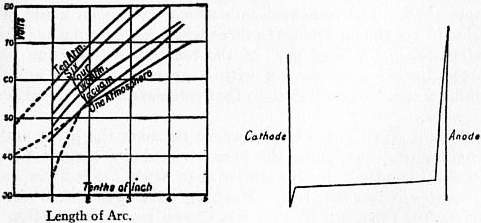
Fig. 20. Fig. 21.
The potential difference between the terminals is affected by the pressure of the gas. The most extensive series of experiments on this point is that made by Duncan, Rowland, and Tod (Electrician, 31, p. 60), whose results are represented in fig. 20. We see from these curves that for very short arcs the potential difference increases continuously with the pressure, but for longer ones there is a critical pressure at which the potential difference is a minimum, and that this critical pressure seems to increase with the length of arc. The nature of the gas also affects the potential difference. The magnitude of this effect may be gathered from the following values given by Arons (Ann. der Phys. 1, p. 700) for the potential difference required to produce an arc 1.5 mm. long, carrying a current of 4.5 amperes, between terminals of different metals in air and pure nitrogen.
Terminal. Air. Nitrogen. Terminal. Air. Nitrogen.
Ag 21 ? Pt 36 30
Zn 23 21 Al 39 27
Cd 25 21 Pb .. 18
Cu 27 30 Mg .. 22
Fe 29 20
Thus, with the discharge for an arc of given length and current, the nature of the terminals is the most important factor in determining the potential difference. The effects produced by the pressure and nature of the surrounding gas, although quite appreciable, are not of so much importance, while in the spark discharge the nature of the terminals is of no importance, everything depending upon the nature and pressure of the gas.
The potential gradient in the arc is very far from being uniform. With carbon terminals Luggin (Wien. Ber. 98, p. 1192) found that, with a current of 15 amperes, there was a fall of potential of 33.7 close to the anode, and one 8.7 close to the cathode, so that the curve representing the distribution of potential between the terminals would be somewhat like that shown in fig. 21. We have seen that a somewhat analogous distribution of potential holds in the case of conduction through flames, though in that case the greatest drop of potential is in general at the cathode and not at the anode. The difference between the changes of potential at the anode and cathode is not so large with Fe and Cu terminals as with carbon ones; with mercury terminals, Arons (Wied. Ann. 58, p. 73) found the anode fall to be 7.4 volts, the cathode fall 5.4 volts.
The case of the arc when the cathode is a pool of mercury and the anode a metal wire placed in a vessel from which the air has been exhausted is one which has attracted much attention, and important investigations on this point have been made by Hewitt (Electrician, 52, p. 447), Wills (Electrician, 54, p. 26), Stark, Retschinsky and Schnaposnikoff (Ann. der Phys. 18, p. 213) and Pollak (Ann. der Phys. 19, p. 217). In this arrangement the mercury is vaporized by the heat, and the discharge which passes through the mercury vapour gives an exceedingly bright light, which has been largely used for lighting factories, &c. The arrangement can also be used as a rectifier, for a current will only pass through it when the mercury pool is the cathode. Thus if such a lamp is connected with an alternating current circuit, it lets through the current in one direction and stops that in the other, thus furnishing a current which is always in one direction.
Theory of the Arc Discharge.—An incandescent body such as a piece of carbon even when at a temperature far below that of the terminals in an arc, emits corpuscles at a rate corresponding to a current of the order of 1 ampere per square centimetre of incandescent surface, and as the rate of increase of emission with the temperature is very rapid, it is probably at the rate of many amperes per square centimetre at the temperature of the negative carbon in the arc. If then a piece of carbon were maintained at this temperature by some external means, and used as a cathode, a current could be sent from it to another electrode whether the second electrode were cold or hot. If, however, these negatively electrified corpuscles did not produce other ions either by collision with the gas through which they move or with the anode, the spaces between cathode and anode would have a negative charge, which would tend to stop the corpuscles leaving the cathode and would require a large potential difference between anode and cathode to produce any considerable current. If, however, there is ionization either in the gas or at the anode, the positive ions will diffuse into the region of the discharge until they are sensibly equal in number to the negative ions. When this is the case the back electromotive force is destroyed and the same potential difference will carry a much larger current. The arc discharge may be regarded as analogous to the discharge between incandescent terminals, the only difference being that in the arc the terminals are maintained in the state of incandescence by the current and not by external means. On this view the cathode is bombarded by positive ions which heat it to such a temperature that negative corpuscles sufficient to carry the current are emitted by it. These corpuscles bombard the anode and keep it incandescent. They ionize also, either directly by collision or indirectly by heating the anode, the gas and vapour of the metal of which the anode is made, and produce in this way the supply of positive ions which keep the cathode hot.
Discharge from a Point.—A very interesting case of electric discharge is that between a sharply pointed electrode, such as a needle, and a metal surface of considerable area. At atmospheric pressures the luminosity is confined to the immediate neighbourhood of the point. If the sign of the potential of the point does not change, the discharge is carried by ions of one sign—that of the charge on the pointed electrode. The velocity of these ions under a given potential gradient has been measured by Chattock (Phil. Mag. 32, p. 285), and found to agree with that of the ions produced by Röntgen or uranium radiation, while Townsend (Phil. Trans. 195, p. 259) has shown that the charge on these ions is the same as that on the ions streaming from the point. If the pointed electrode be placed at right angles to a metal plane serving as the other electrode, the discharge takes place when, for a given distance of the point from the plane, the potential difference between the electrodes exceeds a definite value depending upon the pressure and nature of the gas through which the discharge passes; its value also depends upon whether, beginning with a small potential difference, we gradually increase it until discharge commences, or, beginning with a large potential difference, we decrease it until the discharge stops. The value found by the latter method is less than that by the former. According to Chattock’s measurements the potential difference V for discharge between the point and the plate is given by the linear relation V = a + bl, where l is the distance of the point from the plate and a and b are constants. From v. Obermayer’s (Wien. Ber. 100, 2, p. 127) experiments, in which the distance l was greater than in Chattock’s, it would seem that the potential for larger distances does not increase quite so rapidly with l as is indicated by Chattock’s relation. The potential required to produce this discharge is much less than that required to produce a spark of length l between parallel plates; thus from Chattock’s experiments to produce the point discharge when l = .5 cm. in air at atmospheric pressure requires a potential difference of about 3800 volts when the pointed electrode is positive, while to produce a spark at the same distance between plane electrodes would require a potential difference of about 15,000 volts. Chattock showed that with the same pointed electrode the value of the electric intensity at the point was the same whatever the distance of the point from the plane. The value of the electric intensity depended upon the sharpness of the point. When the end of the pointed electrode is a hemisphere of radius a, Chattock showed that for the same gas at the same pressure the electric intensity ∫ when discharge takes place is roughly proportioned to a−0.8. The value of the electric intensity at the pointed electrode is much greater than its value at a plane electrode for long sparks; but we must remember that at a distance from a pointed electrode equal to a small multiple of the radius of curvature of its extremity the electric intensity falls very far below that required to produce discharge in a uniform field, so that the discharge from a pointed electrode ought to be compared with a spark whose length is comparable with the radius of curvature of the point. For such short sparks the electric intensity is very high. The electric intensity required to produce the discharge from a gas diminishes as the pressure of the gas diminishes, but not nearly so rapidly as the electric intensity for long sparks. Here again the discharge from a point is comparable with short sparks, which, as we have seen, are much less sensitive to pressure changes than longer ones. The minimum potential at which the electricity streams from the point does not depend upon the material of which the point is made; it varies, however, considerably with the nature of the gas. The following are the results of some experiments on this point. Those in the first two columns are due to Röntgen, those in the third and fourth to Precht:—
Gas. Discharge Potential. Point +. Pressure 760.
Pressure 205. Pressure 110. Point +. Point −.
Volts. Volts. Volts. Volts.
H2 1296 1174 2125 1550
O2 2402 1975 2800 2350
CO 2634 2100 .. ..
CH4 2777 2317 .. ..
NO 3188 2543 .. ..
CO2 3287 2655 3475 2100
N2 .. .. 2600 2000
Air .. .. 2750 2050
We see from this table that in the case of the discharge from a positively electrified point the greater the molecular weight of the gas the greater the potential required for discharge. Röntgen concluded from his experiments that the discharging potential from a positive point in different gases at the same pressure varies inversely as the mean free path of the molecules of the gas. In the same gas, however, at different pressures the discharging potential does not vary so quickly with the pressure as does the mean free path. In Precht’s experiments, in which different gases were used, the variations in the discharging potential are not so great as the variations in the mean free path of the gases.
The current of electrified air flowing from the point when the electricity is escaping—the well-known “electrical wind”—is accompanied by a reaction on the point which tends to drive it backwards. This reaction has been measured by Arrhenius (Wied. Ann. 63, p. 305), who finds that when positive electricity is escaping from a point in air the reaction on the point for a given current varies inversely as the pressure of the gas, and for different gases (air, hydrogen and carbonic acid) inversely as the square root of the molecular weight of the gas. The reaction when negative electricity is escaping is much less. The proportion between the reactions for positive and negative currents depends on the pressure of the gas. Thus for equal positive and negative currents in air at a pressure of 70 cm. the reaction for a positive point was 1.9 times that of a negative one, at 40 cm. pressure 2.6 times, at 20 cm. pressure 3.2 times, at 10.3 cm. pressure 7 times, and at 5.1 cm. pressure 15 times the reaction for the negative point. Investigation shows that the reaction should be proportional to the quotient of the current by the velocity acquired by an ion under unit potential gradient. Now this velocity is inversely proportional to the pressure, so that the reaction should on this view be directly proportional to the pressure. This agrees with Arrhenius’ results when the point is positive. Again, the velocities of an ion in hydrogen, air and carbonic acid at the same pressure are approximately inversely proportional to the square roots of their molecular weights, so that the reaction should be directly proportional to this quantity. This also agrees with Arrhenius’ results for the discharge from a positive point. The velocity of the negative ion is greater than that of a positive one under the same potential gradient, so that the reaction for the negative point should be less than that for a positive one, but the excess of the positive reaction over the negative is much greater than that of the velocity of the negative ion over the velocity of the positive. There is, however, reason to believe that a considerable condensation takes place around the negative ion as a nucleus after it is formed, so that the velocity of the negative ion under a given potential gradient will be greater immediately after the ion is formed than when it has existed for some time. The measurements which have been made of the velocities of the ions relate to those which have been some time in existence, but a large part of the reaction will be due to the newly-formed ions moving with a greater velocity, and thus giving a smaller reaction than that calculated from the observed velocity.
With a given potential difference between the point and the neighbouring conductor the current issuing from the point is greater when the point is negative than when it is positive, except in oxygen, when it is less. Warburg (Sitz. Akad. d. Wissensch. zu Berlin, 1899, 50, p. 770) has shown that the addition of a small quantity of oxygen to nitrogen produces a great diminution in the current from a negative point, but has very little effect on the discharge from a positive point. Thus the removal of a trace of oxygen made a leak from a negative point 50 times what it was before. Experiments with hydrogen and helium showed that impurities in these gases had a great effect on the current when the point was negative, and but little when it was positive. This suggests that the impurities, by condensing round the negative ions as nuclei, seriously diminish their velocity. If a point is charged up to a high and rapidly alternating potential, such as can be produced by the electric oscillations started when a Leyden jar is discharged, then in hydrogen, nitrogen, ammonia and carbonic acid gas a conductor placed in the neighbourhood of the point gets a negative charge, while in air and oxygen it gets a positive one. There are two considerations which are of importance in connexion with this effect. The first is the velocity of the ions in the electric field, and the second the ease with which the ions can give up their charges to the metal point. The greater velocity of the negative ions would, if the potential were rapidly alternating, cause an excess of negative ions to be left in the surrounding gas. This is the case in hydrogen. If, however, the metal had a much greater tendency to unite with negative than with positive ions, such as we should expect to be the case in oxygen, this would act in the opposite direction, and tend to leave an excess of positive ions in the gas.
The Characteristic Curve for Discharge through Gases.—When a current of electricity passes through a metallic conductor the relation between the current and the potential difference is the exceedingly simple one expressed by Ohm’s law; the current is proportional to the potential difference. When the current passes through a gas there is no such simple relation. Thus we have already mentioned cases where the current increased as the potential increased although not in the same proportion, while as we have seen in certain stages of the arc discharge the potential difference diminishes as the current increases. Thus the problem of finding the current which a given battery will produce when part of the circuit consists of a gas discharge is much more complicated than when the circuit consists entirely of metallic conductors. If, however, we measure the potential difference between the electrodes in the gas when different currents are sent through it, we can plot a curve, called the “characteristic curve,” whose ordinates are the potential differences between the electrodes in the gas and the abscissae the corresponding currents. By the aid of this curve we can calculate the current produced when a given battery is connected up to the gas by leads of known resistance.
For let E0 be the electromotive force of the battery, R the resistance of the leads, i the current, the potential difference between the terms in the gas will be E0 − Ri. Let ABC (fig. 22) be the “characteristic curve,” the ordinates being the potential difference between the terminals in the gas, and the abscissae the current. Draw the line LM whose equation is E = E0 − Ri, then the points where this line cuts the characteristic curves will give possible values of i and E, the current through the discharge tube and the potential difference between the terminals. Some of these points may, however, correspond to an unstable position and be impossible to realize. The following method gives us a criterion by which we can distinguish the stable from the unstable positions. If the current is increased by δi, the electromotive force which has to be overcome by the battery is Rδi + (dE/di)δi. If R + dE/di is positive there will be an unbalanced electromotive force round the circuit tending to stop the current. Thus the increase in the current will be stopped and the condition will be a stable one. If, however, R + dE/di is negative there will be an unbalanced electromotive force tending to increase the current still further; thus the current will go on increasing and the condition will be unstable. Thus for stability R + dE/di must be positive, a condition first given by Kaufmann (Ann. der Phys. 11, p. 158). The geometrical interpretation of this condition is that the straight line LM must, at the point where it cuts the characteristic curve, be steeper than the tangent to characteristic curve. Thus of the points ABC where the line cuts the curve in fig. 22, A and C correspond to stable states and B to an unstable one. The state of things represented by a point P on the characteristic curve when the slope is downward cannot be stable unless there is in the external circuit a resistance greater than that represented by the tangent of the inclination of the tangent to the curve at P to the horizontal axis.
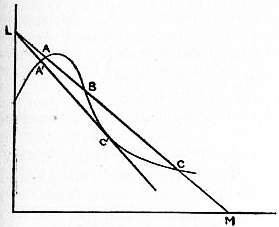
Fig. 22.
If we keep the external electromotive force the same and gradually increase the resistance in the leads, the line LM will become steeper and steeper. C will move to the left so that the current will diminish; when the line gets so steep that it touches the curve at C’, any further increase in the resistance will produce an abrupt change in the current; for now the state of things represented by a point near A’ is the only stable state. Thus if the BC part of the curve corresponded to a luminous discharge and the A part to a dark discharge, we see that if the electromotive force is kept constant there is a minimum value of the current for the luminous discharge. If the current is reduced below this value, the discharge ceases to be luminous, and there is an abrupt diminution in the current.
Cathode Rays.—When the gas in the discharge tube is at a very low pressure some remarkable phenomena occur in the neighbourhood of the cathode. These seem to have been first observed by Plücker (Pogg. Ann. 107, p. 77; 116, p. 45) who noticed on the walls of the glass tube near the cathode a greenish phosphorescence, which he regarded as due to rays proceeding from the cathode, striking against the sides of the tube, and then travelling back to the cathode. He found that the action of a magnet on these rays was not the same as the action on the part of the discharge near the positive electrode. Hittorf (Pogg. Ann. 136, p. 8) showed that the agent producing the phosphorescence was intercepted by a solid, whether conductor or insulator, placed between the cathode and the sides of the tube. He regarded the phosphorescence as caused by a motion starting from the cathode and travelling in straight lines through the gas. Goldstein (Monat. der Berl. Akad., 1876, p. 24) confirmed this discovery of Hittorf’s, and further showed that a distinct, though not very sharp, shadow is cast by a small object placed near a large plane cathode. This is a proof that the rays producing the phosphorescence must be emitted almost normally from the cathode, and not, like the rays of light from a luminous surface, in all directions, for such rays would not produce a perceptible shadow if a small body were placed near the plane. Goldstein regarded the phosphorescence as due to waves in the ether, for whose propagation the gas was not necessary. Crookes (Phil. Trans., 1879, pt. i. p. 135; pt. ii. pp. 587, 661), who made many remarkable researches in this subject, took a different view. He regarded the rays as streams of negatively electrified particles projected normally from the cathode with great velocity, and, when the pressure is sufficiently low, reaching the sides of the tube, and by their impact producing phosphorescence and heat. The rays on this view are deflected by a magnet, because a magnet exerts a force on a charged moving body.
These rays striking against glass make it phosphorescent. The colour of the phosphorescence depends on the kind of glass; thus the light from soda glass is a yellowish green, and that from lead glass blue. Many other bodies phosphoresce when exposed to these rays, and in particular the phosphorescence of some gems, such as rubies and diamonds, is exceedingly vivid. The spectrum of the phosphorescent light is generally continuous, but Crookes showed that the phosphorescence of some of the rare earths, such as yttrium, gives a spectrum of bright bands, and he founded on this fact a spectroscopic method of great importance. Goldstein (Wied. Ann. 54, p. 371) discovered that the haloid salts of the alkali metals change colour under the rays, sodium chloride, for example, becoming violet. The coloration is a surface one, and has been traced by E. Wiedemann and Schmidt (Wied. Ann. 54, p. 618) to the formation of a subchloride. Chlorides of tin, mercury and lead also change colour in the same way. E. Wiedemann (Wied. Ann. 56, p. 201) discovered another remarkable effect, which he called thermo-luminescence; he found that many bodies after being exposed to the cathode rays possess for some time the power of becoming luminous when their temperature is raised to a point far below that at which they become luminous in the normal state. Substances belonging to the class called by van ’t Hoff solid solutions exhibit this property of thermo-luminescence to a remarkable extent. They are formed when two salts, one greatly in excess of the other, are simultaneously precipitated from a solution. A trace of MnSO4 in CaSO4 shows very brilliant thermo-luminescence. The impact of cathode rays produces after a time perceptible changes in the glass. Crookes (Phil. Trans. pt. ii. 1879, p. 645) found that after glass has been phosphorescing for some time under the cathode rays it seems to get tired, and the phosphorescence is not so bright as it was initially. Thus, for example, when the shadow of a Maltese cross is thrown on the walls of the tube as in fig. 23, if after the discharge has been going on for some time the cross is shaken down or a new cathode used whose line of fire does not cut the cross, the pattern of the cross will still be seen on the glass, but it will now be brighter instead of darker than the surrounding portion. The portions shielded by the cross, not being tired by being made to phosphoresce for a long time, respond more vigorously to the stimulus than those portions which have not been protected. Skinner (Proc. Camb. Phil. Soc. ix. p. 371) and Thomson found on the glass which had been exposed to the rays gelatinous filaments, apparently silica, resulting from the reduction of the glass. A reducing action was also noticed by Villard (Journ. de phys. 3, viii. p. 140) and Wehnelt (Wied. Ann. 67, p. 421). It can be well shown by letting the rays fall on a plate of oxidized copper, when the part struck by the rays will become bright. The rays heat bodies on which they fall, and if they are concentrated by using as a cathode a portion of a spherical surface, the heat at the centre becomes so great that a piece of platinum wire can be melted or a diamond charred. Measurements of the heating effects of the rays have been made by Thomson (Phil. Mag. [5], 44, p. 293) and Cady (Ann. der Phys. 1, p. 678). Crookes (Phil. Trans., 1879, pt. i. p. 152) showed that a vane mounted as in a radiometer is set in rotation by the rays, the direction of the rotation being the same as would be produced by a stream of particles proceeding from the cathode. The movement is not due to the momentum imparted to the vanes by the rays, but to the difference in temperature between the sides of the vanes, the rays making the side against which they strike hotter than the other.