VOLUME VI SLICE VIII Conduction, Electric (continued 2)
Reading edition
When the ions are not removed from the gas, they will increase until the number of ions of one sign which combine with ions of the opposite sign in any time is equal to the number produced by the ionizing agent in that time. We can easily calculate the number of free ions at any time after the ionizing agent has commenced to act.
Let q be the number of ions (positive or negative) produced in one cubic centimetre of the gas per second by the ionizing agent, n1, n2, the number of free positive and negative ions respectively per cubic centimetre of the gas. The number of collisions between positive and negative ions per second in one cubic centimetre of the gas is proportional to n1n2. If a certain fraction of the collisions between the positive and negative ions result in the formation of an electrically neutral system, the number of ions which disappear per second on a cubic centimetre will be equal to αn1 n2, where α is a quantity which is independent of n1, n2; hence if t is the time since the ionizing agent was applied to the gas, we have
dn1/dt = q − αn1 n2, dn2/dt = q − αn1 n2.
Thus n1 − n2 is constant, so if the gas is uncharged to begin with, n1 will always equal n2. Putting n1 = n2 = n we have
dn/dt = q − αn2 (1),
the solution of which is, since n = 0 when t = 0,
n = k(ε2kαt − 1) (2),
ε2kαt + 1
if k2 = q/α. Now the number of ions when the gas has reached a steady state is got by putting t equal to infinity in the preceding equation, and is therefore given by the equation
n0 = k = √ (q/α).
We see from equation (1) that the gas will not approximate to its steady state until 2kαt is large, that is until t is large compared with ½kα or with ½√ (qα). We may thus take ½√ (qα) as a measure of the time taken by the gas to reach a steady state when exposed to an ionizing agent; as this time varies inversely as √q we see that when the ionization is feeble it may take a very considerable time for the gas to reach a steady state. Thus in the case of our atmosphere where the production of ions is only at the rate of about 30 per cubic centimetre per second, and where, as we shall see, α is about 10-6, it would take some minutes for the ionization in the air to get into a steady state if the ionizing agent were suddenly applied.
We may use equation (1) to determine the rate at which the ions disappear when the ionizing agent is removed. Putting q=0 in that equation we get dn/αt = -αn2.
Hence
n = n0/(1 + n0 αt) (3),
where n0 is the number of ions when t = 0. Thus the number of ions falls to one-half its initial value in the time 1/n0α. The quantity α is called the coefficient of recombination, and its value for different gases has been determined by Rutherford (Phil. Mag. 1897 [5], 44, p. 422), Townsend (Phil. Trans., 1900, 193, p. 129), McClung (Phil. Mag., 1902 [6], 3, p. 283), Langevin (Ann. chim. phys. [7], 28, p. 289), Retschinsky (Ann. d. Phys., 1905, 17, p. 518), Hendred (Phys. Rev., 1905, 21, p. 314). The values of α/e, e being the charge on an ion in electrostatic measure as determined by these observers for different gases, is given in the following table:—
Townsend. McClung. Langevin. Retschinsky. Hendred.
Air 3420 3380 3200 4140 3500
O2 3380
CO2 3500 3490 3400
H2 3020 2940
The gases in these experiments were carefully dried and free from dust; the apparent value of α is much increased when dust or small drops of water are present in the gas, for then the ions get caught by the dust particles, the mass of a particle is so great compared with that of an ion that they are practically immovable under the action of the electric field, and so the ions clinging to them escape detection when electrical methods are used. Taking e as 3.5×10⁻¹⁰, we see that α is about 1.2×10⁻⁶, so that the number of recombinations in unit time between n positive and n negative ions in unit volume is 1.2×10⁻⁶n2. The kinetic theory of gases shows that if we have n molecules of air per cubic centimetre, the number of collisions per second is 1.2×10⁻¹⁰n2 at a temperature of 0° C. Thus we see that the number of recombinations between oppositely charged ions is enormously greater than the number of collisions between the same number of neutral molecules. We shall see that the difference in size between the ion and the molecule is not nearly sufficient to account for the difference between the collisions in the two cases; the difference is due to the force between the oppositely charged ions, which drags ions into collisions which but for this force would have missed each other.
Several methods have been used to measure α. In one method air, exposed to some ionizing agent at one end of a long tube, is slowly sucked through the tube and the saturation current measured at different points along the tube. These currents are proportional to the values of n at the place of observation: if we know the distance of this place from the end of the tube when the gas was ionized and the velocity of the stream of gas, we can find t in equation (3), and knowing the value of n we can deduce the value of α from the equation
1/n1 − 1/n2 = α(t1 − t2),
where n1, n2 are the values of n at the times t1, t2 respectively. In this method the tubes ought to be so wide that the loss of ions by diffusion to the sides of the tube is negligible. There are other methods which involve the knowledge of the speed with which the ions move under the action of known electric forces; we shall defer the consideration of these methods until we have discussed the question of these speeds.
In measuring the value of α it should be remembered that the theory of the methods supposes that the ionization is uniform throughout the gas. If the total ionization throughout a gas remains constant, but instead of being uniformly distributed is concentrated in patches, it is evident that the ions will recombine more quickly in the second case than in the first, and that the value of α will be different in the two cases. This probably explains the large values of α obtained by Retschinsky, who ionized the gas by the α rays from radium, a method which produces very patchy ionization.
Variation of α with the Pressure of the Gas.—All observers agree that there is little variation in α with the pressures for pressures of between 5 and 1 atmospheres; at lower pressures, however, the value of α seems to diminish with the pressure: thus Langevin (Ann. chim. phys., 1903, 28, p. 287) found that at a pressure of 1⁄5 of an atmosphere the value of α was about 1⁄5 of its value at atmospheric pressure.
Variation of α with the Temperature.—Erikson (Phil. Mag., Aug. 1909) has shown that the value of α for air increases as the temperature diminishes, and that at the temperature of liquid air -180° C., it is more than twice as great as at +12° C.
Since, as we have seen, the recombination is due to the coming together of the positive and negative ions under the influence of the electrical attraction between them, it follows that a large electric force sufficient to overcome this attraction would keep the ions apart and hence diminish the coefficient of recombination. Simple considerations, however, will show that it would require exceedingly strong electric fields to produce an appreciable effect. The value of α indicates that for two oppositely charged ions to unite they must come within a distance of about 1.5×10⁻⁶ centimetres; at this distance the attraction between them is e2×1012/2.25, and if X is the external electric force, the force tending to pull them apart cannot be greater than Xe; if this is to be comparable with the attraction, X must be comparable with e×1012/2.25, or putting e = 4×10⁻¹⁰, with 1.8×10²; this is 54,000 volts per centimetre, a force which could not be applied to gas at atmospheric pressure without producing a spark.
Diffusion of the Ions.—The ionized gas acts like a mixture of gases, the ions corresponding to two different gases, the non-ionized gas to a third. If the concentration of the ions is not uniform, they will diffuse through the non-ionized gas in such a way as to produce a more uniform distribution. A very valuable series of determinations of the coefficient of diffusion of ions through various gases has been made by Townsend (Phil. Trans., 1900, A, 193, p. 129). The method used was to suck the ionized gas through narrow tubes; by measuring the loss of both the positive and negative ions after the gases had passed through a known length of tube, and allowing for the loss by recombination, the loss by diffusion and hence the coefficient of diffusion could be determined. The following tables give the values of the coefficients of diffusion D on the C.G.S. system of units as determined by Townsend:—
Table I.—Coefficients of Diffusion (D) in Dry Gases.
Gas. D for +ions. D for -ions. Mean Value of D. Ratio of D for - to D for +ions.
Air .028 .043 .0347 1.54
O2 .025 .0396 .0323 1.58
CO2 .023 .026 .0245 1.13
H2 .123 .190 .156 1.54
Table II.—Coefficients of Diffusion in Moist Gases.
Gas. D for +ions. D for -ions. Mean Value of D. Ratio of D for - to D for +ions.
Air .032 .037 .0335 1.09
O2 .0288 .0358 .0323 1.24
CO2 .0245 .0255 .025 1.04
H2 .128 .142 .135 1.11
It is interesting to compare with these coefficients the values of D when various gases diffuse through each other. D for hydrogen through air is .634, for oxygen through air .177, for the vapour of isobutyl amide through air .042. We thus see that the velocity of diffusion of ions through air is much less than that of the simple gas, but that it is quite comparable with that of the vapours of some complex organic compounds.
The preceding tables show that the negative ions diffuse more rapidly than the positive, especially in dry gases. The superior mobility of the negative ions was observed first by Zeleny (Phil. Mag., 1898 [5], 46, p. 120), who showed that the velocity of the negative ions under an electric force is greater than that of the positive. It will be noticed that the difference between the mobility of the negative and the positive ions is much more pronounced in dry gases than in moist. The difference in the rates of diffusion of the positive and negative ions is the reason why ionized gas, in which, to begin with, the positive and negative charges were of equal amounts, sometimes becomes electrified even although the gas is not acted upon by electric forces. Thus, for example, if such gas be blown through narrow tubes, it will be positively electrified when it comes out, for since the negative ions diffuse more rapidly than the positive, the gas in its passage through the tubes will lose by diffusion more negative than positive ions and hence will emerge positively electrified. Zeleny snowed that this effect does not occur when, as in carbonic acid gas, the positive and negative ions diffuse at the same rates. Townsend (loc. cit.) showed that the coefficient of diffusion of the ions is the same whether the ionization is produced by Röntgen rays, radioactive substances, ultra-violet light, or electric sparks. The ions produced by chemical reactions and in flames are much less mobile; thus, for example, Bloch (Ann. chim. phys., 1905 [8], 4, p. 25) found that for the ions produced by drawing air over phosphorus the value of α/e was between 1 and 6 instead of over 3000, the value when the air was ionized by Röntgen rays.
Velocity of Ions in an Electric Field.—The velocity of ions in an electric field, which is of fundamental importance in conduction, is very closely related to the coefficient of diffusion. Measurements of this velocity for ions produced by Röntgen rays have been made by Rutherford (Phil. Mag. [5], 44, p. 422), Zeleny (Phil. Mag. [5], 46, p. 120), Langevin (Ann. Chim. Phys., 1903, 28, p. 289), Phillips (Proc. Roy. Soc. 78, A, p. 167), and Wellisch (Phil. Trans., 1909, 209, p. 249). The ions produced by radioactive substance have been investigated by Rutherford (Phil. Mag. [5], 47, p. 109) and by Franck and Pohl (Verh. deutsch. phys. Gesell., 1907, 9, p. 69), and the negative ions produced when ultra-violet light falls on a metal plate by Rutherford (Proc. Camb. Phil. Soc. 9, p. 401). H. A. Wilson (Phil. Trans. 192, p. 4O9), Marx (Ann. de Phys. 11, p. 765), Moreau (Journ. de Phys. 4, 11, p. 558; Ann. Chim. Phys. 7, 30, p. 5) and Gold (Proc. Roy. Soc. 79, p. 43) have investigated the velocities of ions produced by putting various salts into flames; McClelland (Phil. Mag. 46, p. 29) the velocity of the ions in gases sucked from the neighbourhood of flames and arcs; Townsend (Proc. Camb. Phil. Soc. 9, p. 345) and Bloch (loc. cit.) the velocity of ions produced by chemical reaction; and Chattock (Phil. Mag. [5], 48, p. 401) the velocity of the ions produced when electricity escapes from a sharp needle point into a gas.
Several methods have been employed to determine these velocities. The one most frequently employed is to find the electromotive intensity required to force an ion against the stream of gas moving with a known velocity parallel to the lines of electric force. Thus, of two perforated plane electrodes vertically over each other, suppose the lower to be positively, the upper negatively electrified, and suppose that the gas is streaming vertically downwards with the velocity V; then unless the upward velocity of the positive ion is greater than V, no positive electricity will reach the upper plate. If we increase the strength of the field between the plates, and hence the upward velocity of the positive ion, until the positive ions just begin to reach the upper plate, we know that with this strength of field the velocity of the positive ion is equal to V. By this method, which has been used by Rutherford, Zeleny and H. A. Wilson, the velocity of ions in fields of various strengths has been determined.
The arrangement used by Zeleny is represented in fig. 8. P and Q are square brass plates. They are bored through their centres, and to the openings the tubes R and S are attached, the space between the plates being covered in so as to form a closed box. K is a piece of wire gauze completely covering the opening in Q; T is an insulated piece of wire gauze nearly but not quite filling the opening in the plate P, and connected with one pair of quadrants of an electrometer E. A plug of glass wool G filters out the dust from a stream of gas which enters the vessel by the tube D and leaves it by F; this plug also makes the velocity of the flow of the gas uniform across the section of the tube. The Röntgen rays to ionize the gas were produced by a bulb at O, the bulb and coil being in a lead-covered box, with an aluminium window through which the rays passed. Q is connected with one pole of a battery of cells, P and the other pole of the battery are put to earth. The changes in the potential of T are due to ions giving up their charges to it. With a given velocity of air-blast the potential of T was found not to change unless the difference of potential between P and Q exceeded a critical value. The field corresponding to this critical value thus made the ions move with the known velocity of the blast.
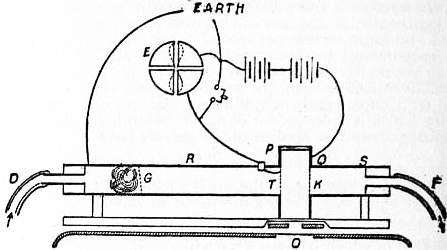
Fig. 8.
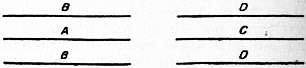
Fig. 9.
Another method which has been employed by Rutherford and McClelland is based on the action of an electric field in destroying the conductivity of gas streaming through it. Suppose that BAB, DCD (fig. 9) are a system of parallel plates boxed in so that a stream of gas, after flowing between BB, passes between DD without any loss of gas in the interval. Suppose the plates DD are insulated, and connected with one pair of quadrants of an electrometer, by charging up C to a sufficiently high potential we can drive all the positive ions which enter the system DCD against the plates D; this will cause a deflexion of the electrometer, which in one second will be proportional to the number of positive ions which have entered the system in that time. If we charge A up to a high potential, B being put to earth, we shall find that the deflexion of the electrometer connected with DD is less than it was when A and B were at the same potential, because some of the positive ions in their passage through BAB are driven against the plates B. If u is the velocity along the lines of force in the uniform electric field between A and B, and t the time it takes for the gas to pass through BAB, then all the positive ions within a distance ut of the plates B will be driven up against these plates, and thus if the positive ions are equally distributed through the gas, the number of positive ions which emerge from the system when the electric field is on will bear to the number which emerge when the field is off the ratio of 1 − ut/l to unity, where l is the distance between A and B. This ratio is equal to the ratio of the deflexions in one second of the electrometer attached to D, hence the observations of this instrument give 1 − ut/l. If we know the velocity of the gas and the length of the plates A and B, we can determine t, and since l can be easily measured, we can find u, the velocity of the positive ion in a field of given strength. By charging A and C negatively instead of positively we can arrive at the velocity of the negative ion. In practice it is more convenient to use cylindrical tubes with coaxial wires instead of the systems of parallel plates, though in this case the calculation of the velocity of the ions from the observations is a little more complicated, inasmuch as the electric field is not uniform between the tubes.
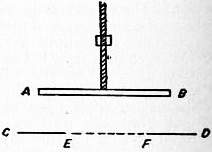
Fig. 10.
A method which gives very accurate results, though it is only applicable in certain cases, is the one used by Rutherford to measure the velocity of the negative ions produced close to a metal plate by the incidence on the plate of ultra-violet light. The principle of the method is as follows:—AB (fig. 10) is an insulated horizontal plate of well-polished zinc, which can be moved vertically up and down by means of a screw; it is connected with one pair of quadrants of an electrometer, the other pair of quadrants being put to earth. CD is a base-plate with a hole EF in it; this hole is covered with fine wire gauze, through which ultra-violet light passes and falls on the plate AB. The plate CD is connected with an alternating current dynamo, which produces a simply-periodic potential difference between AB and CD, the other pole being put to earth. Suppose that at any instant the plate CD is at a higher potential than AB, then the negative ions from AB will move towards CD, and will continue to do so as long as the potential of CD is higher than that of AB. If, however, the potential difference changes sign before the negative ions reach CD, these ions will go back to AB. Thus AB will not lose any negative charge unless the distance between the plates AB and CD is less than the distance traversed by the negative ion during the time the potential of CD is higher than that of AB. By altering the distance between the plates until CD just begins to lose a negative charge, we find the velocity of the negative ion under unit electromotive intensity. For suppose the difference of potential between AB and CD is equal to a sin pt, then if d is the distance between the plates, the electric intensity is equal to a sin pt/d; if we suppose the velocity of the ion is proportional to the electric intensity, and if u is the velocity for unit electric intensity, the velocity of the negative ion will be ua sin pt/d. Hence if x represent the distance of the ion from AB
dx = ua sin pt
dT d
x = ua (1 − cos pt), if x = 0 when t = 0.
pd
Thus the greatest distance the ion can get from the plate is equal to 2au/pd, and if the distance between the plates is gradually reduced to this value, the plate AB will begin to lose a negative charge; hence when this happens
d = 2au/pd, or u = pd2/2a,
an equation by means of which we can find u.
In this form the method is not applicable when ions of both signs are present. Franck and Pohl (Verh. deutsch. physik. Gesell. 1907, 9, p. 69) have by a slight modification removed this restriction. The modification consists in confining the ionization to a layer of gas below the gauze EF. If the velocity of the positive ions is to be determined, these ions are forced through the gauze by applying to the ionized gas a small constant electric force acting upwards; if negative ions are required, the constant force is reversed. After passing through the gauze the ions are acted upon by alternating forces as in Rutherford’s method.
Langevin (Ann. chim. phys., 1903, 28, p. 289) devised a method of measuring the velocity of the ions which has been extensively used; it has the advantage of not requiring the rate of ionization to remain uniform. The general idea is as follows. Suppose that we expose the gas between two parallel plates A, B to Röntgen rays or some other ionizing agent, then stop the rays and apply a uniform electric field to the region between the plates. If the force on the positive ion is from A to B, the plate B will receive a positive charge of electricity. After the electric force has acted for a time T reverse it. B will now begin to receive negative electricity and will go on doing so until the supply of negative ions is exhausted. Let us consider how the quantity of positive electricity received by B will vary with T. To fix our ideas, suppose the positive ions move more slowly than the negative; let T2 and T1 be respectively the times taken by the positive and negative ions to move under the electric field through a distance equal to AB, the distance between the planes. Then if T is greater than T2 all the ions will have been driven from between the plates before the field is reversed, and therefore the positive charge received by B will not depend upon T. Next let T be less than T2 but greater than T1; then at the time when the field is reversed all the negative ions will have been driven from between the plates, so that the positive charge received by B will not be neutralized by the arrival of fresh ions coming to it after the reversal of the field. The number of positive ions driven against the plate B will be proportional to T. Thus if we measure the value of the positive charge on B for a series of values of T, each value being less than the preceding, we shall find that until T reaches a certain value the charge remains constant, but as soon as we reduce the time below this value the charge diminishes. The value of T when the diminution in the field begins is T2, the time taken for a positive ion to cross from A to B under the electric field; thus from T2 we can calculate the velocity of the positive ion in this field. If we still further diminish T, we shall find that we reach a value when the diminution of the positive charge on B with the time suddenly becomes much more rapid; this change occurs when T falls below T1 the time taken for the negative ions to go from one plate to the other, for now when the field is reversed there are still some negative ions left between the plates, and these will be driven against B and rob it of some of the positive charge it had acquired before the field was reversed. By observing the time when the increase in the rate of diminution of the positive charge with the time suddenly sets in we can determine T1, and hence the velocity of the negative ions.
The velocity of the ions produced by the discharge of electricity from a fine point was determined by Chattock by an entirely different method. In this case the electric field is so strong and the velocity of the ion so great that the preceding methods are not applicable. Suppose P represents a vertical needle discharging electricity into air, consider the force acting on the ions included between two horizontal planes A, B. If P is the density of the electrification, and Z the vertical component of the electric intensity, F the resultant force on the ions between A and B is vertical and equal to
∫∫∫ Zρ dxdydz.
Let us suppose that the velocity of the ion is proportional to the electric intensity, so that if w is the vertical velocity of the ions, which are supposed all to be of one sign, w = RZ.
Substituting this value of Z, the vertical force on the ions between A and B is equal to
1 ∫∫∫ wρ dxdydz.
R
But ∫∫ wρdxdy = ι, where ι is the current streaming from the point. This current, which can be easily measured by putting a galvanometer in series with the discharging point, is independent of z, the vertical distance of a plane between A and B below the charging point. Hence we have
F = ι ∫dz = ι · z.
R R
This force must be counterbalanced by the difference of gaseous pressures over the planes A and B; hence if pB and pA denote respectively the pressures over B and A, we have
pB − pA = ι z.
R
Hence by the measurement of these pressures we can determine R, and hence the velocity with which an ion moves under a given electric intensity.
There are other methods of determining the velocities of the ions, but as these depend on the theory of the conduction of electricity through a gas containing charged ions, we shall consider them in our discussion of that theory.
By the use of these methods it has been shown that the velocities of the ions in a given gas are the same whether the ionization is produced by Röntgen rays, radioactive substances, ultra-violet light, or by the discharge of electricity from points. When the ionization is produced by chemical action the ions are very much less mobile, moving in the same electric field with a velocity less than one-thousandth part of the velocity of the first kind of ions. On the other hand, as we shall see later, the velocity of the negative ions in flames is enormously greater than that of even the first kind of ion under similar electric fields and at the same pressure. But when these negative ions get into the cold part of the flame, they move sluggishly with velocities of the order of those possessed by the second kind. The results of the various determinations of the velocities of the ions are given in the following table. The velocities are in centimetres per second under an electric force of one volt per centimetre, the pressure of the gas being 1 atmosphere. V+ denotes the velocity of the positive ion, V- that of the negative. V is the mean velocity of the positive and negative ions.
Velocities of Ions.—Ions produced by Röntgen Rays.
Gas. V+. V-. V. Observer.
Air .. .. 1.6 Rutherford
Air (dry) 1.36 1.87 .. Zeleny
” 1.60 1.70 .. Langevin
” 1.39 1.78 .. Phillips
” 1.54 1.78 .. Wellisch
Air (moist) 1.37 1.81 .. Zeleny
Oxygen (dry) 1.36 1.80 .. ”
Oxygen (moist) 1.29 1.52 .. ”
Carbonic acid (dry) 0.76 0.81 .. ”
” ” 0.86 0.90 .. Langevin
” ” 0.81 0.85 .. Wellisch
Carbonic acid (moist) 0.82 0.75 .. Zeleny
Hydrogen (dry) 6.70 7.95 .. ”
Nitrogen .. .. 1.6 Rutherford
Sulphur dioxide 0.44 0.41 .. Wellisch
Hydrochloric acid .. .. 1.27 Rutherford
Chlorine .. .. 1.0 ”
Helium (dry) 5.09 6.31 .. Franck and Pohl
Carbon monoxide 1.10 1.14 .. Wellisch
Nitrous oxide 0.82 0.90 .. ”
Ammonia 0.74 0.80 .. ”
Aldehyde 0.31 0.30 .. ”
Ethyl alcohol 0.34 0.27 .. ”
Acetone 0.31 0.29 .. ”
Ethyl chloride 0.33 0.31 .. ”
Pentane 0.36 0.35 .. ”
Methyl acetate 0.33 0.36 .. ”
Ethyl formate 0.30 0.31 .. ”
Ethyl ether 0.29 0.31 .. ”
Ethyl acetate 0.31 0.28 .. ”
Methyl bromide 0.29 0.28 .. ”
Methyl iodide 0.21 0.22 .. ”
Carbon tetrachloride 0.30 0.31 .. ”
Ethyl iodide 0.17 0.16 .. ”
Ions produced by Ultra-Violet Light.
Air 1.4 Rutherford
Hydrogen 3.9 Rutherford
Carbonic acid 0.78 Rutherford
Ions in Gases sucked from Flames.
Velocities varying from .04 to .23 McClelland
Ions in Flames containing Salts.
Negative ions 12.9 cm./sec. Gold
+ions for salts of Li, Na, K, Rb, Cs 62 H. A. Wilson
” 200 Marx
” 80 Moreau
Ions liberated by Chemical Action.
Velocities of the order of 0.0005 cm./sec. Bloch
Ions from Point Discharge.
Hydrogen 5.4 7.43 6.41 Chattock
Carbonic acid 0.83 0.925 0.88 Chattock
Air 1.32 1.80 1.55 Chattock
Oxygen 1.30 1.85 1.57 Chattock
It will be seen from this table that the greater mobility of the negative ions is very much more marked in the case of the lighter and simpler gases than in that of the heavier and more complicated ones; with the vapours of organic substances there seems but little difference between the mobilities of the positive and negative ions, indeed in one or two cases the positive one seems slightly but very slightly the more mobile of the two. In the case of the simple gases the difference is much greater when the gases are dry than when they are moist. It has been shown by direct experiment that the velocities are directly proportional to the electric force.
Variation of Velocities with Pressure.—Until the pressure gets low the velocities of the ions, negative as well as positive, vary inversely as the pressure. Langevin (loc. cit.) was the first to show that at very low pressures the velocity of the negative ions increases more rapidly as the pressure is diminished than this law indicates. If the nature of the ion did not change with the pressure, the kinetic theory of gases indicates that the velocity would vary inversely as the pressure, so that Langevin’s results indicate a change in the nature of the negative ion when the pressure is diminished below a certain value. Langevin’s results are given in the following table, where p represents the pressure measured in centimetres of mercury, V+ and V- the velocities of the positive and negative ions in air under unit electrostatic force, i.e. 300 volts per centimetre:—
Negative Ions. Positive Ions.
p. V-. pV-/76. p. V+. pV+/76.
7.5 6560 647 7.5 4430 437
20.0 2204 580 20.0 1634 430
41.5 994 530 41.5 782 427
76.0 510 510 76.0 480 420
142.0 270 505 142.0 225 425
The increase in the case of pV- indicates that the structure of the negative ion gets simpler as the pressure is reduced. Wallisch in some experiments made at the Cavendish Laboratory found that the diminution in the value of pV- at low pressures is much more marked in some gases than in others, and in some gases he failed to detect it; but it must be remembered that it is difficult to get measurements at pressures of only a few millimetres, as the amount of ionization is so exceedingly small at such pressures that the quantities to be observed are hardly large enough to admit of accurate measurements by the methods available at higher pressures.
Effect of Temperature on the Velocity of the Ions.—Phillips (Proc. Roy. Soc., 1906, 78, p. 167) investigated, using Langevin’s method, the velocities of the + and − ions through air at atmospheric pressure at temperatures ranging from that of boiling liquid air to 411° C.; R1 and R2 are the velocities of the + and − ions respectively when the force is a volt per centimetre.
R1. R2. Temperature Absolute.
2.00 2.495 411°
1.95 2.40 399°
1.85 2.30 383°
1.81 2.21 373°
1.67 2.125 348°
1.60 2.00 333°
1.39 1.785 285°
0.945 1.23 209°
0.235 0.235 94°
We see that except in the case of the lowest temperature, that of liquid air, where there is a great drop in the velocity, the velocities of the ions are proportional to the absolute temperature. On the hypothesis of an ion of constant size we should, from the kinetic theory of gases, expect the velocity to be proportional to the square root of the absolute temperature, if the charge on the ion did not affect the number of collisions between the ion and the molecules of the gas through which it is moving. If the collisions were brought about by the electrical attraction between the ions and the molecules, the velocity would be proportional to the absolute temperature. H. A. Wilson (Phil. Trans. 192, p. 499), in his experiments on the conduction of flames and hot gases into which salts had been put, found that the velocity of the positive ions in flames at a temperature of 2000° C. containing the salts of the alkali metals was 62 cm./sec. under an electric force of one volt per centimetre, while the velocity of the positive ions in a stream of hot air at 1000° C. containing the same salts was only 7 cm./sec. under the same force. The great effect of temperature is also shown in some experiments of McClelland (Phil. Mag. [5], 46, p. 29) on the velocities of the ions in gases drawn from Bunsen flames and arcs; he found that these depended upon the distance the gas had travelled from the flame. Thus, the velocity of the ions at a distance of 5.5 cm. from the Bunsen flame when the temperature was 230° C. was .23 cm./sec. for a volt per centimetre; at a distance of 10 cm. from the flame when the temperature was 160° C. the velocity was .21 cm./sec; while at a distance of 14.5 cm. from the flame when the temperature was 105° C. the velocity was only .04 cm./sec. If the temperature of the gas at this distance from the flame was raised by external means, the velocity of the ions increased.
We can derive some information as to the constitution of the ions by calculating the velocity with which a molecule of the gas would move in the electric field if it carried the same charge as the ion. From the theory of the diffusion of gases, as developed by Maxwell, we know that if the particles of a gas A are surrounded by a gas B, then, if the partial pressure of A is small, the velocity u with which its particles will move when acted upon by a force Xe is given by the equation
u = Xe D,
(p1/N1)
where D represents the coefficient of inter-diffusion of A into B, and N1 the number of particles of A per cubic centimetre when the pressure due to A is p1. Let us calculate by this equation the velocity with which a molecule of hydrogen would move through hydrogen if it carried the charge carried by an ion, which we shall prove shortly to be equal to the charge carried by an atom of hydrogen in the electrolysis of solutions. Since p1/N1 is independent of the pressure, it is equal to Π/N, where Π is the atmospheric pressure and N the number of molecules in a cubic centimetre of gas at atmospheric pressure. Now Ne = 1.22×10¹⁰, if e is measured in electrostatic units; Π = 106 and D in this case is the coefficient of diffusion of hydrogen into itself, and is equal to 1.7. Substituting these values we find
u = 1.97×10⁴X.
If the potential gradient is 1 volt per centimetre, X = 1⁄300. Substituting this value for X, we find u = 66 cm./sec, for the velocity of a hydrogen molecule. We have seen that the velocity of the ion in hydrogen is only about 5 cm./sec, so that the ion moves more slowly than it would if it were a single molecule. One way of explaining this is to suppose that the ion is bigger than the molecule, and is in fact an aggregation of molecules, the charged ion acting as a nucleus around which molecules collect like dust round a charged body. This view is supported by the effect produced by moisture in diminishing the velocity of the negative ion, for, as C. T. R. Wilson (Phil. Trans. 193, p. 289) has shown, moisture tends to collect round the ions, and condenses more easily on the negative than on the positive ion. In connexion with the velocities of ions in the gases drawn from flames, we find other instances which suggest that condensation takes place round the ions. An increase in the size of the system is not, however, the only way by which the velocity might fall below that calculated for the hydrogen molecule, for we must remember that the hydrogen molecule, whose coefficient of diffusion is 1.7, is not charged, while the ion is. The forces exerted by the ion on the other molecules of hydrogen are not the same as those which would be exerted by a molecule of hydrogen, and as the coefficient of diffusion depends on the forces between the molecules, the coefficient of diffusion of a charged molecule into hydrogen might be very different from that of an uncharged one.
Wellisch (loc. cit.) has shown that the effect of the charge on the ion is sufficient in many cases to explain the small velocity of the ions, even if there were no aggregation.
Mixture of Gases.—The ionization of a mixture of gases raises some very interesting questions. If we ionize a mixture of two very different gases, say hydrogen and carbonic acid, and investigate the nature of the ions by measuring their velocities, the question arises, shall we find two kinds of positive and two kinds of negative ions moving with different velocities, as we should do if some of the positive ions were positively charged hydrogen molecules, while others were positively charged molecules of carbonic acid; or shall we find only one velocity for the positive ions and one for the negative? Many experiments have been made on the velocity of ions in mixtures of two gases, but as yet no evidence has been found of the existence of two different kinds of either positive or negative ions in such mixtures, although some of the methods for determining the velocities of the ions, especially Langevin’s, ought to give evidence of this effect, if it existed. The experiments seem to show that the positive (and the same is true for the negative) ions in a mixture of gases are all of the same kind. This conclusion is one of considerable importance, as it would not be true if the ions consisted of single molecules of the gas from which they are produced.
Recombination.—Several methods enable us to deduce the coefficient of recombination of the ions when we know their velocities. Perhaps the simplest of these consists in determining the relation between the current passing between two parallel plates immersed in ionized gas and the potential difference between the plates. For let q be the amount of ionization, i.e. the number of ions produced per second per unit volume of the gas, A the area of one of the plates, and d the distance between them; then if the ionization is constant through the volume, the number of ions of one sign produced per second in the gas is qAd. Now if i is the current per unit area of the plate, e the charge on an ion, iA/e ions of each sign are driven out of the gas by the current per second. In addition to this source of loss of ions there is the loss due to the recombination; if n is the number of positive or negative ions per unit volume, then the number which recombine per second is αn2 per cubic centimetre, and if n is constant through the volume of the gas, as will approximately be the case if the current through the gas is only a small fraction of the saturation current, the number of ions which disappear per second through recombination is αn2·Ad. Hence, since when the gas is in a steady state the number of ions produced must be equal to the number which disappear, we have
qAd = iA/e + αn2·Ad, q = i/ed + αn2.
If u1 and u2 are the velocities with which the positive and negative ions move, nu1e and nu2e are respectively the quantities of positive electricity passing in one direction through unit area of the gas per second, and of negative in the opposite direction, hence
i = nu1e + nu2e.
If X is the electric force acting on the gas, k1 and k2 the velocities of the positive and negative ions under unit force, u1 = k1X, u2 = k2X; hence
n = i/(k1 + k2)Xe,
and we have
q = i + αi2 .
ed (k1 + k2)2 e2X2
But qed is the saturation current per unit area of the plate; calling this I, we have
I − i = dαi2
e(k1 + k2)2X2
or
X2 = i2·dα .
e(I − i) (k1 + k2)2
Hence if we determine corresponding values of X and i we can deduce the value of α/e if we also know (k1 + k2). The value of I is easily determined, as it is the current when X is very large. The preceding result only applies when i is small compared with I, as it is only in this case that the values of n and X are uniform throughout the volume of the gas. Another method which answers the same purpose is due to Langevin (Ann. Chim. Phys., 1903, 28, p. 289); it is as follows. Let A and B be two parallel planes immersed in a gas, and let a slab of the gas bounded by the planes a, b parallel to A and B be ionized by an instantaneous flash of Röntgen rays. If A and B are at different electric potentials, then all the positive ions produced by the rays will be attracted by the negative plate and all the negative ions by the positive, if the electric field were exceedingly large they would reach these plates before they had time to recombine, so that each plate would receive N0 ions if the flash of Röntgen rays produced N0 positive and N0 negative ions. With weaker fields the number of ions received by the plates will be less as some of them will recombine before they can reach the plates. We can find the number of ions which reach the plates in this case in the following way:—In consequence of the movement of the ions the slab of ionized gas will broaden out and will consist of three portions, one in which there are nothing but positive ions,—this is on the side of the negative plate,—another on the side of the positive plate in which there are nothing but negative ions, and a portion between these in which there are both positive and negative ions; it is in this layer that recombination takes place, and here if n is the number of positive or negative ions at the time t after the flash of Röntgen rays,
n = n0/(1 + αn0t).
With the same notation as before, the breadth of either of the outer layers will in time dt increase by X(k1 + k2)dt, and the number of ions in it by X(k1 + k2)ndt; these ions will reach the plate, the outer layers will receive fresh ions until the middle one disappears, which it will do after a time l/X(k1 + k2), where l is the thickness of the slab ab of ionized gas; hence N, the number of ions reaching either plate, is given by the equation
N = ∫0l/X(k1+k2) n0X(k1 + k2) dt = X(k1 + k2) log (1 + n0αl ).
1 + n0αt α X(k1 + k2)
If Q is the charge received by the plate,
Q = Ne = X log(1 + Q0ε ),
4πε 4πX
where Q0 = n0le is the charge received by the plate when the electric force is large enough to prevent recombination, and ε = α4πe(R1 + R2). We can from this result deduce the value of ε and hence the value of α when R1 + R2 is known.
Distribution of Electric Force when a Current is passing through an Ionized Gas.—Let the two plates be at right angles to the axis of x; then we may suppose that between the plates the electric intensity X is everywhere parallel to the axis of x. The velocities of both the positive and negative ions are assumed to be proportional to X. Let k1X, k2X represent these velocities respectively; let n1, n2 be respectively the number of positive and negative ions per unit volume at a point fixed by the co-ordinate x; let q be the number of positive or negative ions produced in unit time per unit volume at this point; and let the number of ions which recombine in unit volume in unit time be αn1n2; then if e is the charge on the ion, the volume density of the electrification is (n1 − n2)e, hence
dX = 4π(n1 − n2)e (1).
dx
If I is the current through unit area of the gas and if we neglect any diffusion except that caused by the electric field,
n1ek1X + n2ek2X = I (2).
From equations (1) and (2) we have
n1e = 1 ( I + k2 dX ) (3),
k1 + k2 X 4π dx
n1e = 1 ( I - k2 dX ) (4),
k1 + k2 X 4π dx
and from these equations we can, if we know the distribution of electric intensity between the plates, calculate the number of positive and negative ions.
In a steady state the number of positive and negative ions in unit volume at a given place remains constant, hence neglecting the loss by diffusion, we have
d (k1n1X) = q − αn1n2 (5).
dx
- d (k2n2X) = q − αn1n2 (6).
dx
If k1 and k2 are constant, we have from (1), (5) and (6)
d²X² = 8πe(q − αn1n2)( 1 + 1 ) (7).
dx² k1 k2
an equation which is very useful, because it enables us, if we know the distribution of X², to find whether at any point in the gas the ionization is greater or less than the recombination of the ions. We see that q − αn1n2, which is the excess of ionization over recombination, is proportional to d²X²/dx². Thus when the ionization exceeds the recombination, i.e. when q − αn1n2 is positive, the curve for X² is convex to the axis of x, while when the recombination exceeds the ionization the curve for X² will be concave to the axis of x. Thus, for example, fig. 11 represents the curve for X² observed by Graham (Wied. Ann. 64, p. 49) in a tube through which a steady current is passing. Interpreting it by equation (7), we infer that ionization was much in excess of recombination at A and B, slightly so along C, while along D the recombination exceeded the ionization. Substituting in equation (7) the values of n1, n2 given in (3), (4), we get
d²X² 8πe[q - α (I + k2 dX² )(I - k2 dX² )]( 1 + 1 ) (8).
dx² e²X²(k1 + k2)² 8π dx 8π dx k1 k2
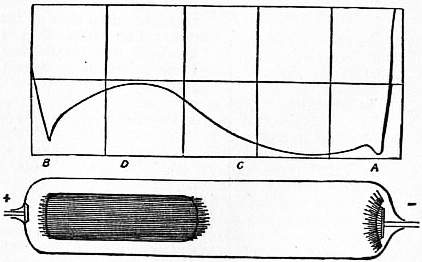
Fig. 11.
This equation can be solved (see Thomson, Phil. Mag. xlvii. P. 253), when q is constant and k1 = k2. From the solution it appears that if X1 be the value of x close to one of the plates, and X0 the value midway between them,
X1/X0 = 1
β2 − 2/β
where β = 8πek1/α.
Since e = 4×10⁻¹⁰, α = 2×10⁻⁶, and k1 for air at atmospheric pressure = 450, β is about 2.3 for air at atmospheric pressure and it becomes much greater at lower pressures.
Thus X1/X0 is always greater than unity, and the value of the ratio increases from unity to infinity as β increases from zero to infinity. As β does not involve either q or I, the ratio of X1 to X0 is independent of the strength of the current and of the intensity of the ionization.
No general solution of equation (8) has been found when k1 is not equal to k2, but we can get an approximation to the solution when q is constant. The equations (1), (2), (3), (4) are satisfied by the values—
n1 = n2 = (q/α)1/2
k1n1Xe = k1 I,
k1 + k2
k2n2Xe = k2 I,
k1 + k2
X =( α )1/2 I .
q e(k1 + k2)
These solutions cannot, however, hold right up to the surface of the plates, for across each unit of area, at a point P, k1I/(k1 + k2)e positive ions pass in unit time, and these must all come from the region between P and the positive plate. If λ is the distance of P from this plate, this region cannot furnish more than qλ positive ions, and only this number if there are no recombinations. Hence the solution cannot hold when qλ is less than k1I/(k1 + k2)e, or where λ is less than k1I/(k1 + k2)qe.
Similarly the solution cannot hold nearer to the negative plate than the distance k2I/(k1 + k2)qe.
The force in these layers will be greater than that in the middle of the gas, and so the loss of ions by recombination will be smaller in comparison with the loss due to the removal of the ions by the current. If we assume that in these layers the loss of ions by recombination can be neglected, we can by the method of the next article find an expression for the value of the electric force at any point in the layer. This, in conjunction with the value X0 = (α/q)1/2 · I/e(k1 + k2) for the gas outside the layer, will give the value of X at any point between the plates. It follows from this investigation that if X1 and X2 are the values of X at the positive and negative plates respectively, and X0 the value of X outside the layer,
X1 = X0(1 + k1 1 )1/2, X2 = X0(1 + k2 1 )1/2,
k2 ε k1 ε
where ε = α/4πe(k1 + k2). Langevin found that for air at a pressure of 152 mm. ε = 0.01, at 375 mm. ε = 0.06, and at 760 mm. ε = 0.27. Thus at fairly low pressures 1/ε is large, and we have approximately
X1 = X0( k1 )1/2 1 , X2 = X0( k2 )1/2 1 .
k2 √ε k1 √ε
Therefore
X1/X2 = k1/k2,
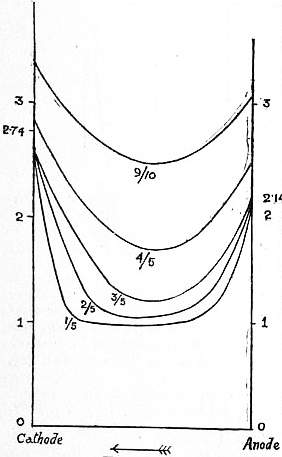
Fig. 12.
or the force at the positive plate is to that at the negative plate as the velocity of the positive ion is to that of the negative ion. Thus the force at the negative plate is greater than that at the positive. The falls of potential V1, V2 at the two layers when 1/ε is large can be shown to be given by the equations
V1 = 8π²( ε )3/2k1( k1 )1/2i²,
qα k2
V2 = 8π²( ε )3/2k2( k2 )1/2i²,
qα k1
hence
V1/V2 = k1²/k2²,
so that the potential falls at the electrodes are proportional to the squares of the velocities of the ions. The change in potential across the layers is proportional to the square of the current, while the potential change between the layers is proportional to the current, the total potential difference between the plates is the sum of these changes, hence the relation between V and i will be of the form
V = Ai + Bi².
Mie (Ann. der. Phys., 1904, 13, P. 857) has by the method of successive approximations obtained solutions of equation (8) (i.) when the current is only a small fraction of the saturation current, (ii.) when the current is nearly saturated. The results of his investigations are represented in fig. 12, which represents the distribution of electric force along the path of the current for various values of the current expressed as fractions of the saturation current. It will be seen that until the current amounts to about one-fifth of the maximum current, the type of solution is the one just indicated, i.e. the electric force is constant except in the neighbourhood of the electrodes when it increases rapidly.
Though we are unable to obtain a general solution of the equation (8), there are some very important special cases in which that equation can be solved without difficulty. We shall consider two of these, the first being that when the current is saturated. In this case there is no loss of ions by recombination, so that using the same notation as before we have
d (n1k1X) = q,
dx
d (n2k2X) = -q.
dx
The solutions of which if q is constant are
n1k1X = qx,
n2k2X = I/e − qx = q(l − x),
if l is the distance between the plates, and x = 0 at the positive electrode. Since
dX/dx = 4π(n1 − n2)e,
we get
1 dX² = qx{ 1 + 1 }- q l ,
8π d²x k1 k2 k2
or
X² = q x² ( 1 + 1 )- q lx + C,
8π 2 k1 k2 k2
where C is a quantity to be determined by the condition that ∫l0 Xdx = V, where V is the given potential difference between the plates. When the force is a minimum dX/dx = 0, hence at this point
x = l k1 , l − x = l k2 .
k1 + k2 k1 + k2
Hence the ratio of the distances of this point from the positive and negative plates respectively is equal to the ratio of the velocities of the positive and negative ions.
The other case we shall consider is the very important one in which the velocity of the negative ion is exceedingly large compared with the positive; this is the case in flames where, as Gold (Proc. Roy. Soc. 97, p. 43) has shown, the velocity of the negative ion is many thousand times the velocity of the positive; it is also very probably the case in all gases when the pressure is low. We may get the solution of this case either by putting k1/k2 = 0 in equation (8), or independently as follows:—Using the same notation as before, we have
i = n1k1Xe + n2k2Xe,
d (n2k2X) = q − αn1n2,
dx
dX = 4π (n1 − n2)e.
dx
In this case practically all the current is carried by the negative ions so that i = n2k2Xe, and therefore q = αn1n2.
Thus
n2 = i/k2Xe, n1 = qk2Xe/αi.
Thus
dX = 4πe²k2qX - 4πi ,
dx αi k2X
or
dX² - 8πe²k2qX² = - 8πi .
dx αi k2
The solution of this equation is
X² = α i² + Cε 8πe² k2qx/αi.
q k²2e²
Here x is measured from the positive electrode; it is more convenient in this case, however, to measure it from the negative electrode. If x be the distance from the negative electrode at which the electric force is X, we have from equation (7)
X² = α i² + C¹ε 8πe² k2qx/αi.
q k²2e²
To find the value of C¹ we see by equation (7) that
d²X² k1k2 1 = q − αn1n2;
dX² k1 + k2 8πe
hence
[ dX² k1k2 1 ]x1 = ∫x10 (q − αn1n2)dx.
dX k1 + k2 8πe
The right hand side of this equation is the excess of ionization over recombination in the region extending from the cathode to x1; it must therefore, when things are in a steady state, equal the excess of the number of negative ions which leave this region over those which enter it. The number which leave is i/e and the number which enter is i0/e, if it is the current of negative ions coming from unit area of the cathode, as hot metal cathodes emit large quantities of negative electricity i0 may in some cases be considerable, thus the right hand side of equation is (i − i0)/e. When x1 is large dX²/dx = 0; hence we have from equation
C¹ = αi(i − i0) k1 + k2 ,
qk1k2e² k2
and since k1 is small compared with k2, we have
X² = α i² (1 + k2 i − i0 ε -8πe² k2 · qx/α · i ).
qk²2 e² k1 i
From the values which have been found for k2 and α, we know that 8πek2/α is a large quantity, hence the second term inside the bracket will be very small when eqx is equal to or greater than i; thus this term will be very small outside a layer of gas next the cathode of such thickness that the number of ions produced on it would be sufficient, if they were all utilized for the purpose, to carry the current; in the case of flames this layer is exceedingly thin unless the current is very large. The value of the electric force in the uniform part of the field is equal to i/k2e · √a/q, while when i0 = 0, the force at the cathode itself bears to the uniform force the ratio of (k1 + k2)1/2 to k11/2. As k1 is many thousand times k2 the force increases with great rapidity as we approach the cathode; this is a very characteristic feature of the passage of electricity through flames and hot gases. Thus in an experiment made by H. A. Wilson with a flame 18 cm. long, the drop of potential within 1 centimetre of the cathode was about five times the drop in the other 17 cm. of the tube. The relation between the current and the potential difference when the velocity of the negative ion is much greater than the positive is very easily obtained. Since the force is uniform and equal to i/k2e · √a/q, until we get close to the cathode the fall of potential in this part of the discharge will be very approximately equal to i/k2e · √(a/q) l, where l is the distance between the electrodes. Close to the cathode, the electric force when i0 is not nearly equal to i is approximately given by the equation
X = i ( α )1/2 ε −4π e²k2 qx / αi,
e(k1k2)1/2 q
and the fall of potential at the cathode is equal approximately to ∫∞0 Xdx, that is to
i ( α )1/2 α i .
e(k1k2)1/2 q 4πe²k2q
The potential difference between the plates is the sum of the fall of potential in the uniform part of the discharge plus the fall at the cathode, hence
V =( α )1/2 i (il + i α² 1 ).
q ek2 4πe²q √(k1k2)
The fall of potential at the cathode is proportional to the square of the current, while the fall in the rest of the circuit is directly proportional to the current. In the case of flames or hot gases, the fall of potential at the cathode is much greater than that in the rest of the circuit, so that in such cases the current through the gas varies nearly as the square root of the potential difference. The equation we have just obtained is of the form
V = Ai + Bi²,
and H. A. Wilson has shown that a relation of this form represents the results of his experiments on the conduction of electricity through flames.
The expression for the fall of potential at the cathode is inversely proportional to q3/2, q being the number of ions produced per cubic centimetre per second close to the cathode; thus any increase in the ionization at the cathode will diminish the potential fall at the cathode, and as practically the whole potential difference between the electrodes occurs at the cathode, a diminution in the potential fall there will be much more important than a diminution in the electric force in the uniform part of the discharge, when the force is comparatively insignificant. This consideration explains a very striking phenomenon discovered many years ago by Hittorf, who found that if he put a wire carrying a bead of a volatile salt into the flame, it produced little effect upon the current, unless it were placed close to the cathode where it gave rise to an enormous increase in the current, sometimes increasing the current more than a hundredfold. The introduction of the salt increases very largely the number of ions produced, so that q is much greater for a salted flame than for a plain one. Thus Hittorf’s result coincides with the conclusions we have drawn from the theory of this class of conduction.
The fall of potential at the cathode is proportional to i − i0, where i0 is the stream of negative electricity which comes from the cathode itself, thus as i0 increases the fall of potential at the cathode diminishes and the current sent by a given potential difference through the gas increases. Now all metals give out negative particles when heated, at a rate which increases very rapidly with the temperature, but at the same temperature some metals give out more than others. If the cathode is made of a metal which emits large quantities of negative particles, (i − i0) will for a given value of i be smaller than if the metal only emitted a small number of particles; thus the cathode fall will be smaller for the metal with the greater emissitivity, and the relation between the potential difference and the current will be different in the two cases. These considerations are confirmed by experience, for it has been found that the current between electrodes immersed in a flame depends to a great extent upon the metal of which the electrodes are made. Thus Pettinelli (Acc. dei Lincei [5], v. p. 118) found that, ceteris paribus, the current between two carbon electrodes was about 500 times that between two iron ones. If one electrode was carbon and the other iron, the current when the carbon was cathode and the iron anode was more than 100 times the current when the electrodes were reversed. The emission of negative particles by some metallic oxides, notably those of calcium and barium, has been shown by Wehnelt (Ann. der Phys. 11, p. 425) to be far greater than that of any known metal, and the increase of current produced by coating the cathodes with these oxides is exceedingly large; in some cases investigated by Tufts and Stark (Physik. Zeits., 1908, 5, p. 248) the current was increased many thousand times by coating the cathode with lime. No appreciable effect is produced by putting lime on the anode.
Conduction when all the Ions are of one Sign.—There are many important cases in which the ions producing the current come from one electrode or from a thin layer of gas close to the electrode, no ionization occurring in the body of the gas or at the other electrode. Among such cases may be mentioned those where one of the electrodes is raised to incandescence while the other is cold, or when the negative electrode is exposed to ultra-violet light. In such cases if the electrode at which the ionization occurs is the positive electrode, all the ions will be positively charged, while if it is the negative electrode the ions will all be charged negatively. The theory of this case is exceedingly simple. Suppose the electrodes are parallel planes at right angles to the axis of x; let X be the electric force at a distance x from the electrode where the ionization occurs, n the number of ions (all of which are of one sign) at this place per cubic centimetre, k the velocity of the ion under unit electric force, e the charge on an ion, and i the current per unit area of the electrode. Then we have dX/dx = 4πne, and if u is the velocity of the ion neu = i. But u = kX, hence we have kX/4π · dX/dx = i, and since the right hand side of this equation does not depend upon x, we get kX²/8π = ix + C, where C is a constant to be determined. If l is the distance between the plates, and V the potential difference between them,
V =∫l 0 Xdx = 1 √ 8π [(il + C)3/2 − C3/2 ].
i k
We shall show that when the current is far below the saturation value, C is very small compared with il, so that the preceding equation becomes
V² = 8πl³ i/k (1).
To show that for small currents C is small compared with il, consider the case when the ionization is confined to a thin layer, thickness d close to the electrode, in that layer let n0 be the value of n, then we have q = αn0² + i/ed. If X0 be the value of X when x = 0, kX0n0e = i, and,
C = kX0² = i² = α · i² (2).
8π n0²ke·8π 8πke² q + i/ed
Since α/8πke is, as we have seen, less than unity, C will be small compared with il, if i/(eq + i/d) is small compared with l. If I0 is the saturation current, q = I0/ed, so that the former expression = id/(I0 + i), if i is small compared with I0, this expression is small compared with d, and therefore a fortiori compared with l, so that we are justified in this case in using equation (1).
From equation (2) we see that the current increases as the square of the potential difference. Here an increase in the potential difference produces a much greater percentage increase than in conduction through metals, where the current is proportional to the potential difference. When the ionization is distributed through the gas, we have seen that the current is approximately proportional to the square root of the potential, and so increases more slowly with the potential difference than currents through metals. From equation (1) the current is inversely proportional to the cube of the distance between the electrodes, so that it falls off with great rapidity as this distance is increased. We may note that for a given potential difference the expression for the current does not involve q, the rate of production of the ions at the electrode, in other words, if we vary the ionization the current will not begin to be affected by the strength of the ionization until this falls so low that the current is a considerable fraction of the saturation current. For the same potential difference the current is proportional to k, the velocity under unit electric force of the ion which carries the current. As the velocity of the negative ion is greater than that of the positive, the current when the ionization is confined to the neighbourhood of one of the electrodes will be greater when that electrode is made cathode than when it is anode. Thus the current will appear to pass more easily in one direction than in the opposite.
Since the ions which carry the current have to travel all the way from one electrode to the other, any obstacle which is impervious to these ions will, if placed between the electrodes, stop the current to the electrode where there is no ionization. A plate of metal will be as effectual as one made of a non-conductor, and thus we get the remarkable result that by interposing a plate of an excellent conductor like copper or silver between the electrode, we can entirely stop the current. This experiment can easily be tried by using a hot plate as the electrode at which the ionization takes place: then if the other electrode is cold the current which passes when the hot plate is cathode can be entirely stopped by interposing a cold metal plate between the electrodes.
Methods of counting the Number of Ions.—The detection of the ions and the estimation of their number in a given volume is much facilitated by the property they possess of promoting the condensation of water-drops in dust-free air supersaturated with water vapour. If such air contains no ions, then it requires about an eightfold supersaturation before any water-drops are formed; if, however, ions are present C. T. R. Wilson (Phil. Trans. 189, p. 265) has shown that a sixfold supersaturation is sufficient to cause the water vapour to condense round the ions and to fall down as raindrops. The absence of the drops when no ions are present is due to the curvature of the drop combined with the surface tension causing, as Lord Kelvin showed, the evaporation from a small drop to be exceeding rapid, so that even if a drop of water were formed the evaporation would be so great in its early stages that it would rapidly evaporate and disappear. It has been shown, however (J. J. Thomson, Application of Dynamics to Physics and Chemistry, p. 164; Conduction of Electricity through Gases, 2nd ed. p. 179), that if a drop of water is charged with electricity the effect of the charge is to diminish the evaporation; if the drop is below a certain size the effect the charge has in promoting condensation more than counterbalances the effect of the surface tension in promoting evaporation. Thus the electric charge protects the drop in the most critical period of its growth. The effect is easily shown experimentally by taking a bulb connected with a piston arranged so as to move with great rapidity. When the piston moves so as to increase the volume of the air contained in the bulb the air is cooled by expansion, and if it was saturated with water vapour before it is supersaturated after the expansion. By altering the throw of the piston the amount of supersaturation can be adjusted within very wide limits. Let it be adjusted so that the expansion produces about a sixfold supersaturation; then if the gas is not exposed to any ionizing agents very few drops (and these probably due to the small amount of ionization which we have seen is always present in gases) are formed. If, however, the bulb is exposed to strong Röntgen rays expansion produces a dense cloud which gradually falls down and disappears. If the gas in the bulb at the time of its exposure to the Röntgen rays is subject to a strong electric field hardly any cloud is formed when the gas is suddenly expanded. The electric field removes the charged ions from the gas as soon as they are formed so that the number of ions present is greatly reduced. This experiment furnishes a very direct proof that the drops of water which form the cloud are only formed round the ions.
This method gives us an exceedingly delicate test for the presence of ions, for there is no difficulty in detecting ten or so raindrops per cubic centimetre; we are thus able to detect the presence of this number of ions. This result illustrates the enormous difference between the delicacy of the methods of detecting ions and those for detecting uncharged molecules; we have seen that we can easily detect ten ions per cubic centimetre, but there is no known method, spectroscopic or chemical, which would enable us to detect a billion (1012) times this number of uncharged molecules. The formation of the water-drops round the charged ions gives us a means of counting the number of ions present in a cubic centimetre of gas; we cool the gas by sudden expansion until the supersaturation produced by the cooling is sufficient to cause a cloud to be formed round the ions, and the problem of finding the number of ions per cubic centimetre of gas is thus reduced to that of finding the number of drops per cubic centimetre in the cloud. Unless the drops are very few and far between we cannot do this by direct counting; we can, however, arrive at the result in the following way. From the amount of expansion of the gas we can calculate the lowering produced in its temperature and hence the total quantity of water precipitated. The water is precipitated as drops, and if all the drops are the same size the number per cubic centimetre will be equal to the volume of water deposited per cubic centimetre, divided by the volume of one of the drops. Hence we can calculate the number of drops if we know their size, and this can be determined by measuring the velocity with which they fall under gravity through the air.
The theory of the fall of a heavy drop of water through a viscous fluid shows that v = 2⁄9ga²/μ, where a is the radius of the drop, g the acceleration due to gravity, and μ the coefficient of viscosity of the gas through which the drop falls. Hence if we know v we can deduce the value of a and hence the volume of each drop and the number of drops.
Charge on Ion.—By this method we can determine the number of ions per unit volume of an ionized gas. Knowing this number we can proceed to determine the charge on an ion. To do this let us apply an electric force so as to send a current of electricity through the gas, taking care that the current is only a small fraction of the saturating current. Then if u is the sum of the velocities of the positive and negative ions produced in the electric field applied to the gas, the current through unit area of the gas is neu, where n is the number of positive or negative ions per cubic centimetre, and e the charge on an ion. We can easily measure the current through the gas and thus determine neu; we can determine n by the method just described, and u, the velocity of the ions under the given electric field, is known from the experiments of Zeleny and others. Thus since the product neu, and two of the factors n, u are known, we can determine the other factor e, the charge on the ion. This method was used by J. J. Thomson, and details of the method will be found in Phil. Mag. [5], 46, p. 528; [5], 48, p. 547; [6], 5, p. 346. The result of these measurements shows that the charge on the ion is the same whether the ionization is by Röntgen rays or by the influence of ultra-violet light on a metal plate. It is the same whether the gas ionized is hydrogen, air or carbonic acid, and thus is presumably independent of the nature of the gas. The value of e formed by this method was 3.4×10⁻¹⁰ electrostatic units.
H. A. Wilson (Phil. Mag. [6], 5, p. 429) used another method. Drops of water, as we have seen, condense more easily on negative than on positive ions. It is possible, therefore, to adjust the expansion so that a cloud is formed on the negative but not on the positive ions. Wilson arranged the experiments so that such a cloud was formed between two horizontal plates which could be maintained at different potentials. The charged drops between the plates were acted upon by a uniform vertical force which affected their rate of fall. Let X be the vertical electric force, e the charge on the drop, v1 the rate of fall of the drop when this force acts, and v the rate of fall due to gravity alone. Then since the rate of fall is proportionate to the force on the drop, if a is the radius of the drop, and ρ its density, then
Xe + 4⁄3πρ ga³ = v1 ,
4⁄3π ρga³ v
or
Xe = 4⁄3π ρga³ (v1 − v)/v.
But
v = 2⁄9ga²ρ/μ,
so that
Xe = √ 2 · 9π√ μ3 · v32(v1 − v) .
g ρ v
Thus if X, v, v1 are known e can be determined. Wilson by this method found that e was 3.1×10⁻¹⁰ electrostatic units. A few of the ions carried charges 2e or 3e.
Townsend has used the following method to compare the charge carried by a gaseous ion with that carried by an atom of hydrogen in the electrolysis of solution. We have
u/D = Ne/Π,
where D is the coefficient of diffusion of the ions through the gas, u the velocity of the ion in the same gas when acted on by unit electric force, N the number of molecules in a cubic centimetre of the gas when the pressure is Π dynes per square centimetre, and e the charge in electrostatic units. This relation is obtained on the hypothesis that N ions in a cubic centimetre produce the same pressure as N uncharged molecules.
We know the value of D from Townsend’s experiments and the values of u from those of Zeleny. We get the following values for Ne×10-10:—
Gas. Moist Gas. Moist Gas.
Positive Ions. Positive Ions. Positive Ions. Positive Ions.
Air 1.28 1.29 1.46 1.31
Oxygen 1.34 1.27 1.63 1.36
Carbonic acid 1.01 .87 .99 .93
Hydrogen 1.24 1.18 1.63 1.25
Mean 1.22 1.15 1.43 1.21
Since 1.22 cubic centimetres of hydrogen at the temperature 15° C. and pressure 760 mm. of mercury are liberated by the passage through acidulated water of one electromagnetic unit of electricity or 3×10¹⁰ electrostatic units, and since in one cubic centimetre of the gas there are 2.46 N atoms of hydrogen, we have, if E is the charge in electrostatic units, on the atom of hydrogen in the electrolysis of solutions
2.46NE = 3×10¹⁰,
or
NE = 1.22×10¹⁰.
The mean of the values of Ne in the preceding table is 1.24×10¹⁰. Hence we may conclude that the charge of electricity carried by a gaseous ion is equal to the charge carried by the hydrogen atom in the electrolysis of solutions. The values of Ne for the different gases differ more than we should have expected from the probable accuracy of the determination of D and the velocity of the ions: Townsend (Proc. Roy. Soc. 80, p. 207) has shown that when the ionization is produced by Röntgen rays some of the positive ions carry a double charge and that this accounts for the values of Ne being greater for the positive than for the negative ions. Since we know the value of e, viz. 3.5×10⁻¹⁰, and, also Ne, = 1.24×10¹⁰, we find N the number of molecules in a cubic centimetre of gas at standard temperature and pressure to be equal to 3.5×10¹⁹. This method of obtaining N is the only one which does not involve any assumption as to the shape of the molecules and the forces acting between them.
Another method of determining the charge carried by an ion has been employed by Rutherford (Proc. Roy. Soc. 81, pp. 141, 162), in which the positively electrified particles emitted by radium are made use of. The method consists of: (1) Counting the number of α particles emitted by a given quantity of radium in a known time. (2) Measuring the electric charge emitted by this quantity in the same time. To count the number of the α particles the radium was so arranged that it shot into an ionization chamber a small number of α particles per minute; the interval between the emission of individual particles was several seconds. When an α particle passed into the vessel it ionized the gas inside and so greatly increased its conductivity; thus, if the gas were kept exposed to an electric field, the current through the gas would suddenly increase when an α particle passed into the vessel. Although each α particle produces about thirty thousand ions, this is hardly large enough to produce the conductivity appreciable without the use of very delicate apparatus; to increase the conductivity Rutherford took advantage of the fact that ions, especially negative ones, when exposed to a strong electric field, produce other ions by collision against the molecules of the gas through which they are moving. By suitably choosing the electric field and the pressure in the ionization chamber, the 30,000 ions produced by each α particle can be multiplied to such an extent that an appreciable current passes through the ionization chamber on the arrival of each α particle. An electrometer placed in series with this vessel will show by its deflection when an α particle enters the chamber, and by counting the number of deflections per minute we can determine the number of α particles given out by the radium in that time. Another method of counting this number is to let the particles fall on a phosphorescent screen, and count the number of scintillations on the screen in a certain time. Rutherford has shown that these two methods give concordant results.
The charge of positive electricity given out by the radium was measured by catching the α particles in a Faraday cylinder placed in a very highly exhausted vessel, and measuring the charge per minute received by this cylinder. In this way Rutherford showed that the charge on the α particle was 9.4×10⁻¹⁰ electrostatic units. Now e/m for the α particle = 5 ×10³, and there is evidence that the α particle is a charged atom of helium; since the atomic weight of helium is 4 and e/m for hydrogen is 104, it follows that the charge on the helium atom is twice that on the hydrogen, so that the charge on the hydrogen atom is 4.7×10⁻¹⁰ electrostatic units.
Calculation of the Mass of the Ions at Low Pressures.—Although at ordinary pressures the ion seems to have a very complex structure and to be the aggregate of many molecules, yet we have evidence that at very low pressures the structure of the ion, and especially of the negative one, becomes very much simpler. This evidence is afforded by determination of the mass of the atom. We can measure the ratio of the mass of an ion to the charge on the ion by observing the deflections produced by magnetic and electric forces on a moving ion. If an ion carrying a charge e is moving with a velocity v, at a point where the magnetic force is H, a mechanical force acts on the ion, whose direction is at right angles both to the direction of motion of the ion and to the magnetic force, and whose magnitude is evH sin θ, where θ is the angle between v and H. Suppose then that we have an ion moving through a gas whose pressure is so low that the free path of the ion is long compared with the distance through which it moves whilst we are experimenting upon it; in this case the motion of the ion will be free, and will not be affected by the presence of the gas.
Since the force is always at right angles to the direction of motion of the ion, the speed of the ion will not be altered by the action of this force; and if the ion is projected with a velocity v in a direction at right angles to the magnetic force, and if the magnetic force is constant in magnitude and direction, the ion will describe a curve in a plane at right angles to the magnetic force. If ρ is the radius of curvature of this curve, m the mass of the ion, mv²/ρ must equal the normal force acting on the ion, i.e. it must be equal to Hev, or ρ = mv/He. Thus the radius of curvature is constant; the path is therefore a circle, and if we can measure the radius of this circle we know the value of mv/He. In the case of the rapidly moving negative ions projected from the cathode in a highly exhausted tube, which are known as cathode rays, the path of the ions can be readily determined since they make many substances luminous when they impinge against them. Thus by putting a screen of such a substance in the path of the rays the shape of the path will be determined. Let us now suppose that the ion is acted upon by a vertical electric force X and is free from magnetic force, if it be projected with a horizontal velocity v, the vertical deflection y after a time t is ½×et²/m, or if l is the horizontal distance travelled over by the ion in this time we have since l = vt,
y = ½ Xe l² .
m v²
Thus if we measure y and l we can deduce e/mv². From the effect of the magnetic force we know e/mv. Combining these results we can find both e/m and v.
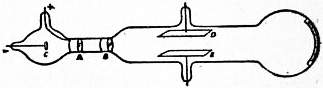
Fig. 13.
The method by which this determination is carried out in practice is illustrated in fig. 13. The cathode rays start from the electrode C in a highly exhausted tube, pass through two small holes in the plugs A and B, the holes being in the same horizontal line. Thus a pencil of rays emerging from B is horizontal and produces a bright spot at the far end of the tube. In the course of their journey to the end of the tube they pass between the horizontal plates E and D, by connecting these plates with an electric battery a vertical electric field is produced between E and D and the phosphorescent spot is deflected. By measuring this deflection we determine e/mv². The tube is now placed in a uniform magnetic field, the lines of magnetic force being horizontal and at right angles to the plane of the paper. The magnetic force makes the rays describe a circle in the plane of the paper, and by measuring the vertical deflection of the phosphorescent patch at the end of the tube we can determine the radius of this circle, and hence the value of e/mv. From the two observations the value of e/m and v can be calculated.
Another method of finding e/m for the negative ion which is applicable in many cases to which the preceding one is not suitable, is as follows: Let us suppose that the ion starts from rest and moves in a field where the electric and magnetic forces are both uniform, the electric force X being parallel to the axis of x, and the magnetic force Z parallel to the axis of z; then if x, y, are the co-ordinates of the ion at the time t, the equations of motion of the ion are—
m d²x = Xe − He dy ,
dt² dt
m d²y = He dx .
dt² dt
The solution of these equations, if x, y, dx/dt, dy/dt all vanish when t = 0, is
x = Xm {1 − cos( e Ht)}
eH² m
y = Xm { e Ht − sin( e Ht)}.
eH² m m
These equations show that the path of the ion is a cycloid, the generating circle of which has a diameter equal to 2Xm/eH², and rolls on the line x = 0.
Suppose now that we have a number of ions starting from the plane x = 0, and moving towards the plane x = a. The particles starting from x = 0 describe cycloids, and the greatest distance they can get from the plane is equal to the diameter of the generating circle of the cycloid, i.e. to 2Xm/eH². (After reaching this distance they begin to approach the plane.) Hence if a is less than the diameter of the generating circle, all the particles starting from x = 0 will reach the plane x = a, if this is unlimited in extent; while if a is greater than the diameter of the generating circle none of the particles which start from x = 0 will reach the plane x = a. Thus, if x = 0 is a plane illuminated by ultra-violet light, and consequently the seat of a supply of negative ions, and x = a a plane connected with an electrometer, then if a definite electric intensity is established between the planes, i.e. if X be fixed, so that the rate of emission of negative ions from the illuminated plate is given, and if a is less than 2Xm/eH², all the ions which start from x = 0 will reach x = a. That is, the rate at which this plane receives an electric charge will be the same whether there is a magnetic field between the plate or not, but if a is greater than 2Xm/eH², then no particle which starts from the plate x = 0 will reach the plate x = a, and this plate will receive no charge. Thus the supply of electricity to the plate has been entirely stopped by the magnetic field. Thus, on this theory, if the distance between the plates is less than a certain value, the magnetic force should produce no effect on the rate at which the electrometer plate receives a charge, while if the distance is greater than this value the magnetic force would completely stop the supply of electricity to the plate. The actual phenomena are not so abrupt as this theory indicates. We find that when the plates are very near together the magnetic force produces a very slight effect, and this an increase in the rate of charging of the plate. On increasing the distance we come to a stage where the magnetic force produces a great diminution in the rate of charging. It does not, however, stop it abruptly, there being a considerable range of distance, in which the magnetic force diminishes but does not destroy the current. At still greater distances the current to the plate under the magnetic force is quite inappreciable compared with that when there is no magnetic force. We should get this gradual instead of abrupt decay of the current if some of the particles, instead of all starting from rest, started with a finite velocity; in that case the first particles stopped would be those which started from rest. This would be when a = 2Xm/eH². Thus if we measure the value of a when the magnetic force first begins to affect the leak to the electrometer we determine 2Xm/eH², and as we can easily measure X and H, we can deduce the value of m/e.
By these methods Thomson determined the value of e/m for the negative ions produced when ultra-violet light falls on a metal plate, as well as for the negative ions produced by an incandescent carbon filament in an atmosphere of hydrogen (Phil. Mag. [5], 48, p. 547) as well as for the cathode rays. It was found that the value of e/m for the negative ions was the same in all these cases, and that it was a constant quantity independent of the nature of the gas from which the ions are produced and the means used to produce them. It was found, too, that this value was more than a thousand times the value of e/M, where e is the charge carried by an atom of hydrogen in the electrolysis of solutions, and M the mass of an atom of hydrogen. We have seen that this charge is the same as that carried by the negative ion in gases; thus since e/m is more than a thousand times e/M, it follows that M must be more than a thousand times m. Thus the mass of the negative ion is exceedingly small compared with the mass of the atom of hydrogen, the smallest mass recognized in chemistry. The production of negative ions thus involves the splitting up of the atom, as from a collection of atoms something is detached whose mass is less than that of a single atom. It is important to notice in connexion with this subject that an entirely different line of argument, based on the Zeeman effect (see Magneto-Optics), leads to the recognition of negatively electrified particles for which e/m is of the same order as that deduced from the consideration of purely electrical phenomena. These small negatively electrified particles are called corpuscles. The latest determinations of e/m for corpuscles available are the following:—
Observer. e/m.
Classen (Ber. deut. phys. Ges. 6, p. 700) 1.7728×10⁷
Bucherer (Ann. der Phys., 28, p. 513) 1.763×10⁷
It follows from electrical theory that when the corpuscles are moving with a velocity comparable with that of light their masses increase rapidly with their velocity. This effect has been detected by Kauffmann (Gött. Nach., Nov. 8, 1901), who used the corpuscles shot out from radium, some of which move with velocities only a few per cent less than that of light. Other experiments on this point have been made by Bucherer (Ann. der Phys. 28, p. 513).
Conductivity Produced by Ultra-Violet Light.—So much use has been made in recent times of ultra-violet light for producing ions that it is desirable to give some account of the electrical effects produced by light. The discovery by Hertz (Wied. Ann. 31, p. 983) in 1887, that the incidence of ultra-violet light on a spark gap facilitates the passage of a spark, led to a series of investigations by Hallwachs, Hoor, Righi and Stoletow, on the effect of ultra-violet light on electrified bodies. These researches have shown that a freshly cleaned metal surface, charged with negative electricity, rapidly loses its charge, however small, when exposed to ultra-violet light, and that if the surface is insulated and without charge initially, it acquires a positive charge under the influence of the light. The magnitude of this positive charge may be very much increased by directing a blast of air on the plate. This, as Zeleny (Phil. Mag. [5], 45, p. 272) showed, has the effect of blowing from the neighbourhood of the plate negatively electrified gas, which has similar properties to the charged gas obtained by the separation of ions from a gas exposed to Röntgen rays or uranium radiation. If the metal plate is positively electrified, there is no loss of electrification caused by ultra-violet light. This has been questioned, but a very careful examination of the question by Elster and Geitel (Wied. Ann. 57, p. 24) has shown that the apparent exceptions are due to the accidental exposure to reflected ultra-violet light of metal surfaces in the neighbourhood of the plate negatively electrified by induction, so that the apparent loss of charge is due to negative electricity coming up to the plate, and not to positive electricity going away from it. The ultra-violet light may be obtained from an arc-lamp, the effectiveness of which is increased if one of the terminals is made of zinc or aluminium, the light from these substances being very rich in ultra-violet rays; it may also be got very conveniently by sparking with an induction coil between zinc or cadmium terminals. Sunlight is not rich in ultra-violet light, and does not produce anything like so great an effect as the arc light. Elster and Geitel, who have investigated with great success the effects of light on electrified bodies, have shown that the more electro-positive metals lose negative charges when exposed to ordinary light, and do not need the presence of the ultra-violet rays. Thus they found that amalgams of sodium or potassium enclosed in a glass vessel lose a negative charge when exposed to daylight, though the glass stops the small amount of ultra-violet light left in sunlight after its passage through the atmosphere. If sodium or potassium be employed, or, what is more convenient, the mercury-like liquid obtained by mixing sodium and potassium in the proportion of their combining weights, they found that negative electricity was discharged by an ordinary petroleum lamp. If the still more electro-positive metal rubidium is used, the discharge can be produced by the light from a glass rod just heated to redness; but there is no discharge till the glass is luminous. Elster and Geitel arrange the metals in the following order for the facility with which negative electrification is discharged by light: rubidium, potassium, alloy of sodium and potassium, sodium, lithium, magnesium, thallium, zinc. With copper, platinum, lead, iron, cadmium, carbon and mercury the effects with ordinary light are too small to be appreciable. The order is the same as that in Volta’s electro-chemical series. With ultra-violet light the different metals show much smaller differences in their power of discharging negative electricity than they do with ordinary light. Elster and Geitel found that the ratio of the photo-electric effects of two metals exposed to approximately monochromatic light depended upon the wave-length of the light, different metals showing a maximum sensitiveness in different parts of the spectrum. This is shown by the following table for the alkaline metals. The numbers in the table are the rates of emission of negative electricity under similar circumstances. The rate of emission under the light from a petroleum lamp was taken as unity:—