VOLUME VI SLICE IV Cincinnatus to Cleruchy (continued 6)
Reading edition
Meanwhile Clarendon’s influence and direction had been predominant in nearly all departments of state. He supported the exception of the actual regicides from the Indemnity, but only ten out of the twenty-six condemned were executed, and Clarendon, with the king’s support, prevented the passing of a bill in 1661 for the execution of thirteen more. He upheld the Act of Indemnity against all the attempts of the royalists to upset it. The conflicting claims to estates were left to be decided by the law. The confiscations of the usurping government accordingly were cancelled, while the properly executed transactions between individuals were necessarily upheld. There can be little doubt that the principle followed was the only safe one in the prevailing confusion. Great injustice was indeed suffered by individuals, but the proper remedy of such injustice was the benevolence of the king, which there is too much reason to believe proved inadequate and partial. The settlement of the church lands which was directed by Clarendon presented equal difficulties and involved equal hardships. In settling Scotland Clarendon’s aim was to make that kingdom dependent upon England and to uphold the Cromwellian union. He proposed to establish a council at Whitehall to govern Scottish affairs, and showed great zeal in endeavouring to restore episcopacy through the medium of Archbishop Sharp. His influence, however, ended with the ascendancy of Lauderdale in 1663. He was, to some extent at least, responsible for the settlement in Ireland, but, while anxious for an establishment upon a solid Protestant basis, urged “temper and moderation and justice” in securing it. He supported Ormonde’s wise and enlightened Irish administration, and in particular opposed persistently the prohibition of the import of Irish cattle into England, incurring thereby great unpopularity. He showed great activity in the advancement of the colonies, to whom he allowed full freedom of religion. He was a member of the council for foreign plantations, and one of the eight lords proprietors of Carolina in 1663; and in 1664 sent a commission to settle disputes in New England. In the department of foreign affairs he had less influence. His policy was limited to the maintenance of peace “necessary for the reducing [the king’s] own dominions into that temper of subjection and obedience as they ought to be in.”13 In 1664 he demanded, on behalf of Charles, French support, and a loan of £50,000 against disturbance at home, and thus initiated that ignominious system of pensions and dependence upon France which proved so injurious to English interests later. But he was the promoter neither of the sale of Dunkirk on the 27th of October 1662, the author of which seems to have been the earl of Sandwich,14 nor of the Dutch War. He attached considerable value to the possession of the former, but when its sale was decided he conducted the negotiations and effected the bargain. He had zealously laboured for peace with Holland, and had concluded a treaty for the settlement of disputes on the 4th of September 1662. Commercial and naval jealousies, however, soon involved the two states in hostilities. Cape Corso and other Dutch possessions on the coast of Africa, and New Amsterdam in America, were seized by squadrons from the royal navy in 1664, and hostilities were declared on the 22nd of February 1665. Clarendon now gave his support to the war, asserted the extreme claims of the English crown over the British seas, and contemplated fresh cessions from the Dutch and an alliance with Sweden and Spain. According to his own account he initiated the policy of the Triple Alliance,15 but it seems clear that his inclination towards France continued in spite of the intervention of the latter state in favour of Holland; and he took part in the negotiations for ending the war by an undertaking with Louis XIV. implying a neutrality, while the latter seized Flanders. The crisis in this feeble foreign policy and in the general official mismanagement was reached in June 1667, when the Dutch burnt several ships at Chatham and when “the roar of foreign guns were heard for the first and last time by the citizens of London.”16
The whole responsibility for the national calamity and disgrace, and for the ignominious peace which followed it, was unjustly thrown on the shoulders of Clarendon, though it must be admitted that the disjointed state of the administration and want of control over foreign policy were largely the causes of the disaster, and for these Clarendon’s influence and obstruction of official reforms were to some extent answerable. According to Sir William Coventry, whose opinion has weight and who acknowledges the chancellor’s fidelity to the king, while Clarendon “was so great at the council board and in the administration of matters, there was no room for anybody to propose any remedy to what was remiss ... he managing all things with that greatness which will now be removed.”17 He disapproved of the system of boards and committees instituted during the Commonwealth, as giving too much power to the parliament, and regarded the administration by the great officers of state, to the exclusion of pure men of business, as the only method compatible with the dignity and security of the monarchy. The lowering of the prestige of the privy council, and its subordination first to the parliament and afterwards to the military faction, he considered as one of the chief causes of the fall of Charles I. He aroused a strong feeling of hostility in the Commons by his opposition to the appropriation of supplies in 1665, and to the audit of the war accounts in 1666, as “an introduction to a commonwealth” and as “a new encroachment,” and by his high tone of prerogative and authority, while by his advice to Charles to prorogue parliament he incurred their resentment and gave colour to the accusation that he had advised the king to govern without parliaments. He was unpopular among all classes, among the royalists on account of the Act of Indemnity, among the Presbyterians because of the Act of Uniformity. It was said that he had invented the maxim “that the king should buy and reward his enemies and do little for his friends, because they are his already.”18 Every kind of maladministration was currently ascribed to him, of designs to govern by a standing army, and of corruption. He was credited with having married Charles purposely to a barren queen in order to raise his own grandchildren to the throne, with having sold Dunkirk to France, and his magnificent house in St James’s was nicknamed “Dunkirk House,” while on the day of the Dutch attack on Chatham the mob set up a gibbet at his gate and broke his windows. He had always been exceedingly unpopular at court, and kept severely aloof from the revels and licence which reigned there. Evelyn names “the buffoons and the misses to whom he was an eyesore.”19 He was intensely disliked by the royal mistresses, whose favour he did not condescend to seek, and whose presence and influence were often the subject of his reproaches.20 A party of younger men of the king’s own age, more congenial to his temperament, and eager to drive the old chancellor from power and to succeed him in office, had for some time been endeavouring to undermine his influence by ridicule and intrigue. Surrounded by such general and violent animosity, Clarendon’s only hope could be in the support of the king. But the chancellor had early and accurately gauged the nature and extent of the king’s attachment to him, which proceeded neither from affection nor gratitude but “from his aversion to be troubled with the intricacies of his affairs,” and in 1661 he had resisted the importunities of Ormonde to resign the great seal for the lord treasurership with the rank of “first minister,” “a title newly translated out of French into English,” on account of the obloquy this position would incur and the further dependence which it entailed upon the inconstant king.21 Charles, long weary of the old chancellor’s rebukes, was especially incensed at this time owing to his failure in securing Frances Stuart (la Belle Stuart) for his seraglio, a disappointment which he attributed to Clarendon, and was now alarmed by the hostility which his administration had excited. He did not scruple to sacrifice at once the old adherent of his house and fortunes. “The truth is,” he wrote Ormonde, “his behaviour and humour was grown so insupportable to myself and all the world else that I could no longer endure it, and it was impossible for me to live with it and do these things with the Parliament that must be done, or the government will be lost.”22 By the direction of Charles, James advised Clarendon to resign before the meeting of parliament, but in an interview with the king on the 26th of August Clarendon refused to deliver up the seal unless dismissed, and urged him not to take a step ruinous to the interests both of the chancellor himself and of the crown.23 He could not believe his dismissal was really intended, but on the 30th of August he was deprived of the great seal, for which the king received the thanks of the parliament on the 16th of October. On the 12th of November his impeachment, consisting of various charges of arbitrary government, corruption and maladministration, was brought up to the Lords, but the latter refused to order his committal, on the ground that the Commons had only accused him of treason in general without specifying any particular charge. Clarendon wrote humbly to the king asking for pardon, and that the prosecution might be prevented, but Charles had openly taken part against him, and, though desiring his escape, would not order or assist his departure for fear of the Commons. Through the bishop of Hereford, however, on the 29th of November he pressed Clarendon to fly, promising that he should not during his absence suffer in his honour or fortune. Clarendon embarked the same night for Calais, where he arrived on the 2nd of December. The Lords immediately passed an act for his banishment and ordered the petition forwarded by him to parliament to be burnt.
The rest of Clarendon’s life was passed in exile. He left Calais for Rouen on the 25th of December, returning on the 21st of January 1668, visiting the baths of Bourbon in April, thence to Avignon in June, residing from July 1668 till June 1671 at Montpellier, whence he proceeded to Moulins and to Rouen again in May 1674. His sudden banishment entailed great personal hardships. His health at the time of his flight was much impaired, and on arriving at Calais he fell dangerously ill; and Louis XIV., anxious at this time to gain popularity in England, sent him peremptory and repeated orders to quit France. He suffered severely from gout, and during the greater part of his exile could not walk without the aid of two men. At Evreux, on the 23rd of April 1668, he was the victim of a murderous assault by English sailors, who attributed to him the non-payment of their wages, and who were on the point of despatching him when he was rescued by the guard. For some time he was not allowed to see any of his children; even correspondence with him was rendered treasonable by the Act of Banishment; and it was not apparently till 1671, 1673 and 1674 that he received visits from his sons, the younger, Lawrence Hyde, being present with him at his death.
Clarendon bore his troubles with great dignity and fortitude. He found consolation in religious duties, and devoted a portion of every day to the composition of his Contemplations on the Psalms, and of his moral essays. Removed effectually from the public scene, and from all share in present politics, he turned his attention once more to the past and finished his History and his Autobiography. Soon after reaching Calais he had written, on the 17th of December 1667, to the university of Oxford, desiring as his last request that the university should believe in his innocence and remember him, though there could be no further mention of him in their public devotions, in their private prayers.24 In 1668 he wrote to the duke and duchess of York to remonstrate on the report that they had turned Roman Catholic, to the former urging “You cannot be without zeal for the Church to which your blessed father made himself a sacrifice,” adding that such a change would bring a great storm against the Romanists. He entertained to the last hopes of obtaining leave to return to England. He asked for permission in June 1671 and in August 1674. In the dedication of his Brief View of Mr Hobbes’s Book Leviathan he repeats “the hope which sustains my weak, decayed spirits that your Majesty will at some time call to your remembrance my long and incorrupted fidelity to your person and your service”; but his petitions were not even answered or noticed. He died at Rouen on the 9th of December 1674. He was buried in Westminster Abbey at the foot of the steps at the entrance to Henry VII.’s chapel. He left two sons, Henry, 2nd earl of Clarendon, and Lawrence, earl of Rochester, his daughter Anne, duchess of York, and a third son, Edward, having predeceased him. His male descendants became extinct on the death of the 4th earl of Clarendon and 2nd earl of Rochester in 1753, the title of Clarendon being revived in 1776 in the person of Thomas Villiers, who had married the granddaughter and heir of the last earl.
As a statesman Clarendon had obvious limitations and failings. He brought to the consideration of political questions an essentially legal but also a narrow mind, conceiving the law, “that great and admirable mystery,” and the constitution as fixed, unchangeable and sufficient for all time, in contrast to Pym, who regarded them as living organisms capable of continual development and evolution; and he was incapable of comprehending and governing the new conditions and forces created by the civil wars. His character, however, and therefore to some extent his career, bear the indelible marks of greatness. He left the popular cause at the moment of its triumph and showed in so doing a strict consistency. In a court degraded by licence and self-indulgence, he maintained his self-respect and personal dignity regardless of consequences, and in an age of almost universal corruption and self-seeking he preserved a noble integrity and patriotism. At the Restoration he showed great moderation in accepting rewards. He refused a grant of 10,000 acres in the Fens from the king on the ground that it would create an evil precedent, and amused Charles and James by his indignation at the offer of a present of £10,000 from the French minister Fouquet, the only present he accepted from Louis XIV. being a set of books printed at the Louvre. His income, however, as lord chancellor was very large, and Clarendon maintained considerable state, considering it due to the dignity of the monarchy that the high officers should carry the external marks of greatness. The house built by him in St James’s was one of the most magnificent ever seen in England, and was filled with a collection of portraits, chiefly those of contemporary statesmen and men of letters. It cost Clarendon £50,000, involved him deeply in debt and was considered one of the chief causes of the “gust of envy” that caused his fall.25 He is described as “a fair, ruddy, fat, middle-statured, handsome man,” and his appearance was stately and dignified. He expected deference from his inferiors, and one of the chief charges which he brought against the party of the young politicians was the want of respect with which they treated himself and the lord treasurer. His industry and devotion to public business, of which proofs still remain in the enormous mass of his state papers and correspondence, were exemplary, and were rendered all the more conspicuous by the negligence, inferiority in business, and frivolity of his successors. As lord chancellor Clarendon made no great impression in the court of chancery. His early legal training had long been interrupted, and his political preoccupations probably rendered necessary the delegation of many of his judicial duties to others. According to Speaker Onslow his decrees were always made with the aid of two judges. Burnet praises him, however, as “a very good chancellor, only a little too rough but very impartial in the administration of justice,” and Pepys, who saw him presiding in his court, perceived him to be “a most able and ready man.”26 According to Evelyn, “though no considerable lawyer” he was “one who kept up the fame and substance of things in the nation with ... solemnity.” He made good appointments to the bench and issued some important orders for the reform of abuses in his court.27 As chancellor of Oxford University, to which office he was elected on the 27th of October 1660, Clarendon promoted the restoration of order and various educational reforms. In 1753 his manuscripts were left to the university by his great-grandson Lord Cornbury, and in 1868 the money gained by publication was spent in erecting the Clarendon Laboratory, the profits of the History having provided in 1713 a building for the university press adjoining the Sheldonian theatre, known since the removal of the press to its present quarters as the Clarendon Building.
Clarendon had risen to high office largely through his literary and oratorical gifts. His eloquence was greatly admired by Evelyn and Pepys, though Burnet criticises it as too copious. He was a great lover of books and collected a large library, was well read in the Roman and in the contemporary histories both foreign and English, and could appreciate Carew, Ben Jonson and Cowley. As a writer and historian Clarendon occupies a high place in English literature. His great work, the History of the Rebellion, is composed in the grand style. A characteristic feature is the wonderful series of well-known portraits, drawn with great skill and liveliness and especially praised by Evelyn and by Macaulay. The long digressions, the lengthy sentences, and the numerous parentheses do not accord with modern taste and usage, but it may be observed that these often follow more closely the natural involutions of the thought, and express the argument more clearly, than the short disconnected sentences, now generally employed, while in rhythm and dignity Clarendon’s style is immeasurably superior. The composition, however, of the work as a whole is totally wanting in proportion, and the book is overloaded with state papers, misplaced and tedious in the narrative. In considering the accuracy of the history it is important to remember the dates and circumstances of the composition of its various portions. The published History is mainly a compilation of two separate original manuscripts, the first being the history proper, written between 1646 and 1648, with the advantage of a fresh memory and the help of various documents and authorities, and ending in March 1644, and the second being the Life, extending from 1609 to 1660, but composed long afterwards in exile and without the aid of papers between 1668 and 1670. The value of any statement, therefore, in the published History depends chiefly on whether it is taken from the History proper or the Life. In 1671 these two manuscripts were united by Clarendon with certain alterations and modifications making Books i.-vii. of the published History, while Books viii.-xv. were written subsequently, and, being composed for the most part without materials, are generally inaccurate, with the notable exception of Book ix., made up from two narratives written at Jersey in 1646, and containing very little from the Life. Sincerity and honest conviction are present on every page, and the inaccuracies are due not to wilful misrepresentation, but to failure of memory and to the disadvantages under which the author laboured in exile. But they lessen considerably the value of his work, and detract from his reputation as chronicler of contemporary events, for which he was specially fitted by his practical experience in public business, a qualification declared by himself to be the “genius, spirit and soul of an historian.” In general, Clarendon, like many of his contemporaries, failed signally to comprehend the real issues and principles at stake in the great struggle, laying far too much stress on personalities and never understanding the real aims and motives of the Presbyterian party. The work was first published in 1702-1704 from a copy of a transcript made by Clarendon’s secretary, with a few unimportant alterations, and was the object of a violent attack by John Oldmixon for supposed changes and omissions in Clarendon and Whitelocke compared (1727) and again in a preface to his History of England (1730), repelled and refuted by John Burton in the Genuineness of Lord Clarendon’s History Vindicated (1744). The history was first published from the original in 1826; the best edition being that of 1888 edited by W.D. Macray and issued by the Clarendon Press. The Lord Clarendon’s History ... Compleated, a supplement containing portraits and illustrative papers, was published in 1717, and An Appendix to the History, containing a life, speeches and various pieces, in 1724. The Sutherland Clarendon in the Bodleian library at Oxford contains several thousand portraits and illustrations of the History. The Life of Edward, earl of Clarendon ... [and the] Continuation of the History ... , the first consisting of that portion of the Life not included in the History, and the second of the account of Clarendon’s administration and exile in France, begun in 1672, was published in 1759, the History of the Reign of King Charles II. from the Restoration ..., published about 1755, being a surreptitious edition of this work, of which the latest and best edition is that of the Clarendon Press of 1857.
Clarendon was also the author of The Difference and Disparity between the Estate and Condition of George, duke of Buckingham and Robert, earl of Essex, a youthful production vindicating Buckingham, printed in Reliquiae Wottonianae (1672), i. 184; Animadversions on a Book entitled Fanaticism (1673); A Brief View ... of the dangerous ... errors in ... Mr Hobbes’s book entitled “Leviathan” (1676); The History of the Rebellion and Civil War in Ireland (1719); A Collection of Several Pieces of Edward, earl of Clarendon, containing reprints of speeches from the journals of the House of Lords and of the History of the Rebellion in Ireland (1727); A Collection of Several Tracts containing his Vindication in answer to his impeachment, Reflections upon several Christian Duties, Two Dialogues on Education and on the want of Respect due to age, and Contemplations on the Psalms (1727); Religion and Policy (1811); Essays moral and entertaining on the various faculties and passions of the human mind (1815, and in British Prose Writers, 1819, vol. i.); Speeches in Rushworth’s Collections (1692), pt. iii. vol. i. 230, 333; Declarations and Manifestos (Clarendon being the author of nearly all on the king’s side between March 1642 and March 1645, the first being the answer to the Grand Remonstrance in January 1642, but not of the answer to the XIX. Propositions or the apology for the King’s attack upon Brentford) in the published History, Rushworth’s Collections, E. Husband’s Collections of Ordinances and Declarations (1646), Old Parliamentary History (1751-1762), Somers Tracts, State Tracts, Harleian Miscellany, Thomasson Tracts (Brit. Mus.), E. 157 (14); and a large number of anonymous pamphlets aimed against the parliament, including Transcendent and Multiplied Rebellion and Treason (1645), A Letter from a True and Lawful Member of Parliament ... to one of the Lords of his Highness’s Council (1656), and Two Speeches made in the House of Peers on Monday 19th Dec. [1642] ... (Somers Tracts, Scott, vi. 576); Second Thoughts (n.d., in favour of a limited toleration) is ascribed to him in the Catalogue in the British Museum; A Letter ... to one of the Chief Ministers of the Nonconforming Party ... (Saumur, 7th May 1674) has been attributed to him on insufficient evidence.
Clarendon’s correspondence, amounting to over 100 volumes, is in the Bodleian library at Oxford, and other letters are to be found in Additional MSS. in the British Museum. Selections have been published under the title of State Papers Collected by Edward, earl of Clarendon (Clarendon State Papers) between 1767 and 1786, and the collection has been calendared up to 1657 in 1869, 1872, 1876. Other letters of Clarendon are to be found in Lister’s Life of Clarendon, iii.; Nicholas Papers (Camden Soc., 1886); Diary of J. Evelyn, appendix; Sir R. Fanshaw’s Original Letters (1724); Warburton’s Life of Prince Rupert (1849): Barwick’s Life of Barwick (1724); Hist. MSS. Comm. 10th Rep. pt. vi. pp. 193-216, and in the Harleian Miscellany.
Bibliography.—Clarendon’s autobiographical works and Letters enumerated above, and the MS. Collection in the Bodleian library. The Lives of Clarendon by T.H. Lister (1838), and by C.H. Firth in the Dict. of Nat. Biography (with authorities there collected), completely supersede all earlier accounts including that in Lives of All the Lord Chancellors (1708), in Macdiarmid’s Lives of British Statesmen (1807), and in the different Lives by Wood in Athenae Oxonienses (Bliss), iii. 1018; while those in J.H. Browne’s Lives of the Prime Ministers of England (1858), in Lodge’s Portraits, in Lord Campbell’s Lives of the Chancellors, iii. 110 (1845), and in Foss’s Judges, supply no further information. In Historical Inquiries respecting the Character of Edward Hyde, earl of Clarendon, various charges against Clarendon were collected by G.A. Ellis (1827) and answered by Lister, vol. ii. 529, and by Lady Th. Lewis in Lives of the Contemporaries of Lord Clarendon (1852), i. preface pt. i. For criticisms of the History see Gardiner’s Civil Wars (1893), iii. 121; Ranke’s Hist. of England, vi. 3-29; Die Politik Karls des Ersten ... und Lord Clarendon’s Darstellung, by A. Buff (1868); article in the Dict. of Nat. Biog. by C.H. Firth, and especially a series of admirable articles by the same author in the Eng. Hist. Review (1904). For description of the MS., Macray’s edition of the History (1888), Lady Th. Lewis’s Lives from the Clarendon Gallery, i. introd. pt. ii.; for list of earlier editions, Ath. Oxon. (Bliss) iii. 1017. Lord Lansdowne defends Sir R. Granville against Clarendon’s strictures in the Vindication (Genuine Works of G. Granville, Lord Lansdowne, i. 503 [1732]), and Lord Ashburnham defends John Ashburnham in A Narrative by John Ashburnham (1830). See also Notes at Meetings of the Privy Council between Charles II. and the Earl of Clarendon (Roxburghe Club. 1896); General Orders of the High Court of Chancery, by J. Beames (1815), 147-221; S.R. Gardiner’s Hist. of England, of the Civil War and of the Commonwealth; Lord Clarendon, by A. Chassant (account of the assault at Evreux) (1891); Annals of the Bodleian Library, by W.D. Macray (1868); Masson’s Life of Milton; Life of Sir G. Savile, by H.C. Foxcroft (1898); Cal. of St. Pap. Dom., esp. 1667-1668, 58, 354, 370; Hist. MSS. Comm. Series, MSS. of J.M. Heathcote and Various Collections, vol. ii.; Add. MSS. in the British Museum; Notes and Queries, 6 ser. v. 283, 9 ser. xi. 182, 1 ser. ix. 7; Pepys’s Diary; J. Evelyn’s Diary and Correspondence; Gen. Catalogue in British Museum; Edward Hyde, earl of Clarendon (1909), a lecture delivered at Oxford during the Clarendon centenary by C.H. Firth.
(P. C. Y.)
CLARENDON, GEORGE WILLIAM FREDERICK VILLIERS, 4th Earl of (in the Villiers line) (1800-1870), English diplomatist and statesman, was born in London on the 12th of January 1800. He was the eldest son of Hon. George Villiers (1750-1827), youngest son of the 1st earl of Clarendon (second creation), by Theresa, only daughter of the first Lord Boringdon, and granddaughter of the first Lord Grantham. The earldom of the lord chancellor Clarendon became extinct in the Hyde line by the death of the 4th earl, his last male descendant. Jane Hyde, countess of Essex, the sister of that nobleman (she died in 1724), left two daughters; of these the eldest, Lady Charlotte, became heiress of the Hyde family. She married Thomas Villiers (1709-1786), second son of the 2nd earl of Jersey, who served with distinction as English minister in Germany, and in 1776 the earldom of Clarendon was revived in his favour. The connexion with the Hyde family was therefore in the female line and somewhat remote. But a portion of the pictures and plate of the great chancellor was preserved to this branch of the family, and remains at The Grove, their family seat at Hertfordshire. The 2nd and 3rd earls were sons of the 1st, and, neither of them having sons, the title passed, on the death of the 3rd earl (John Charles) in 1838, to their younger brother’s son.
Young George Villiers entered upon life in circumstances which gave small promise of the brilliancy of his future career. He was well born; he was heir presumptive to an earldom; and his mother was a woman of great energy, admirable good sense, and high feeling. But the means of his family were contracted; his education was desultory and incomplete; he had not the advantages of a training either at a public school or in the House of Commons. He went up to Cambridge at the early age of sixteen, and entered St John’s College on the 29th of June 1816. In 1820, as the eldest son of an earl’s brother with royal descent, he was enabled to take his M.A. degree under the statutes of the university then in force. In the same year he was appointed attaché to the British embassy at St Petersburg, where he remained three years, and gained that practical knowledge of diplomacy which was of so much use to him in after-life. He had received from nature a singularly handsome person, a polished and engaging address, a ready command of languages, and a remarkable power of composition.
Upon his return to England in 1823 he was appointed to a commissionership of customs, an office which he retained for about ten years. In 1831 he was despatched to France to negotiate a commercial treaty, which, however, led to no result. On the 16th of August 1833 he was appointed minister at the court of Spain. Ferdinand VII. died within a month of his arrival at Madrid, and the infant queen Isabella, then in the third year of her age, was placed by the old Spanish law of female inheritance on her contested throne. Don Carlos, the late king’s brother, claimed the crown by virtue of the Salic law of the House of Bourbon which Ferdinand had renounced before the birth of his daughter. Isabella II. and her mother Christina, the queen regent, became the representatives of constitutional monarchy, Don Carlos of Catholic absolutism. The conflict which had divided the despotic and the constitutional powers of Europe since the French Revolution of 1830 broke out into civil war in Spain, and by the Quadruple Treaty, signed on the 22nd of April 1834, France and England pledged themselves to the defence of the constitutional thrones of Spain and Portugal. For six years Villiers continued to give the most active and intelligent support to the Liberal government of Spain. He was accused, though unjustly, of having favoured the revolution of La Granja, which drove Christina, the queen mother, out of the kingdom, and raised Espartero to the regency. He undoubtedly supported the chiefs of the Liberal party, such as Espartero, against the intrigues of the French court; but the object of the British government was to establish the throne of Isabella on a truly national and liberal basis and to avert those complications, dictated by foreign influence, which eventually proved so fatal to that princess. Villiers received the grand cross of the Bath in 1838 in acknowledgment of his services, and succeeded, on the death of his uncle, to the title of earl of Clarendon; in the following year, having left Madrid, he married Katharine, eldest daughter of James Walter, first earl of Verulam.
In January 1840 he entered Lord Melbourne’s administration as lord privy seal, and from the death of Lord Holland in the autumn of that year Lord Clarendon also held the office of chancellor of the duchy of Lancaster until the dissolution of the ministry in 1841. Deeply convinced that the maintenance of a cordial understanding with France was the most essential condition of peace and of a liberal policy in Europe, he reluctantly concurred in the measures proposed by Lord Palmerston for the expulsion of the pasha of Egypt from Syria; he strenuously advocated, with Lord Holland, a more conciliatory policy towards France; and he was only restrained from sending in his resignation by the dislike he felt to break up a cabinet he had so recently joined.
The interval of Sir Robert Peel’s great administration (1841-1846) was to the leaders of the Whig party a period of repose; but Lord Clarendon took the warmest interest in the triumph of the principles of free trade and in the repeal of the corn-laws, of which his brother, Charles Pelham Villiers (q.v.), had been one of the earliest champions. For this reason, upon the formation of Lord John Russell’s first administration, Lord Clarendon accepted the office of president of the Board of Trade. Twice in his career the governor-generalship of India was offered him, and once the governor-generalship of Canada;—these he refused from reluctance to withdraw from the politics of Europe. But in 1847 a sense of duty compelled him to take a far more laborious and uncongenial appointment. The desire of the cabinet was to abolish the lord-lieutenancy of Ireland, and Lord Clarendon was prevailed upon to accept that office, with a view to transform it ere long into an Irish secretaryship of state. But he had not been many months in Dublin before he acknowledged that the difficulties then existing in Ireland could only be met by the most vigilant and energetic authority, exercised on the spot. The crisis was one of extraordinary peril. Agrarian crimes of horrible atrocity had increased threefold. The Catholic clergy were openly disaffected. This was the second year of the Irish famine, and extraordinary measures were required to regulate the bounty of the government and the nation. In 1848 the revolution in France let loose fresh elements of discord, which culminated in an abortive insurrection, and for a lengthened period Ireland was a prey to more than her wonted symptoms of disaffection and disorder. Lord Clarendon remained viceroy of Ireland till 1852, and left behind him permanent marks of improvement. His services were expressly acknowledged in the queen’s speech to both Houses of Parliament on the 5th of September 1848—this being the first time that any civil services obtained that honour; and he was made a knight of the Garter (retaining also the grand cross of the Bath by special order) on the 23rd of March 1849.
Upon the formation of the coalition ministry between the Whigs and the Peelites, in 1853, under Lord Aberdeen, Lord Clarendon became foreign minister. The country was already “drifting” into the Crimean War, an expression of his own which was never forgotten. Clarendon was not responsible for the policy which brought war about; but when it occurred he employed every means in his power to stimulate and assist the war departments, and above all he maintained the closest relations with the French. The tsar Nicholas had speculated on the impossibility of the sustained joint action of France and England in council and in the field. It was mainly by Lord Clarendon at Whitehall and by Lord Raglan before Sevastopol that such a combination was rendered practicable, and did eventually triumph over the enemy. The diplomatic conduct of such an alliance for three years between two great nations jealous of their military honour and fighting for no separate political advantage, tried by excessive hardships and at moments on the verge of defeat, was certainly one of the most arduous duties ever performed by a minister. The result was due in the main to the confidence with which Lord Clarendon had inspired the emperor of the French, and to the affection and regard of the empress, whom he had known in Spain from her childhood.
In 1856 Lord Clarendon took his seat at the congress of Paris convoked for the restoration of peace, as first British plenipotentiary. It was the first time since the appearance of Lord Castlereagh at Vienna that a secretary of state for foreign affairs had been present in person at a congress on the continent. Lord Clarendon’s first care was to obtain the admission of Italy to the council chamber as a belligerent power, and to raise the barrier which still excluded Prussia as a neutral one. But in the general anxiety of all the powers to terminate the war there was no small danger that the objects for which it had been undertaken would be abandoned or forgotten. It is due entirely to the firmness of Lord Clarendon that the principle of the neutralization of the Black Sea was preserved, that the Russian attempt to trick the allies out of the cession in Bessarabia was defeated, and that the results of the war were for a time secured. The congress was eager to turn to other subjects, and perhaps the most important result of its deliberations was the celebrated Declaration of the Maritime Powers, which abolished privateering, defined the right of blockade, and limited the right of capture to enemy’s property in enemy’s ships. Lord Clarendon has been accused of an abandonment of what are termed the belligerent rights of Great Britain, which were undoubtedly based on the old maritime laws of Europe. But he acted in strict conformity with the views of the British cabinet, and the British cabinet adopted those views because it was satisfied that it was not for the benefit of the country to adhere to practices which exposed the vast mercantile interests of Britain to depredation, even by the cruisers of a secondary maritime power, and which, if vigorously enforced against neutrals, could not fail to embroil her with every maritime state in the world.
Upon the reconstitution of the Whig administration in 1859, Lord John Russell made it a condition of his acceptance of office under Lord Palmerston that the foreign department should be placed in his own hands, which implied that Lord Clarendon should be excluded from office, as it would have been inconsistent alike with his dignity and his tastes to fill any other post in the government. The consequence was that from 1859 till 1864 Lord Clarendon remained out of office, and the critical relations arising out of the Civil War in the United States were left to the guidance of Earl Russell. But he re-entered the cabinet in May 1864 as chancellor of the duchy of Lancaster; and upon the death of Lord Palmerston in 1865, Lord Russell again became prime minister, when Lord Clarendon returned to the foreign office, which was again confided to him for the third time upon the formation of Mr Gladstone’s administration in 1868. To the last moment of his existence, Lord Clarendon continued to devote every faculty of his mind and every instant of his life to the public service; and he expired surrounded by the boxes and papers of his office on the 27th of June 1870. No man owed more to the influence of a generous, unselfish and liberal disposition. If he had rivals he never ceased to treat them with the consideration and confidence of friends, and he cared but little for the ordinary prizes of ambition in comparison with the advancement of the cause of peace and progress.
He was succeeded as 5th earl by his eldest son, Edward Hyde Villiers (b. 1846), who became lord chamberlain in 1900.
See also the article (by Henry Reeve) in Fraser’s Magazine, August 1876.
CLARENDON, HENRY HYDE, 2nd Earl of (1638-1709), English statesman, eldest son of the first earl, was born on the 2nd of June 1638. He accompanied his parents into exile and assisted his father as secretary, returning with them in 1660. In 1661 he was returned to parliament for Wiltshire as Lord Cornbury. He became secretary in 1662 and lord chamberlain to the queen in 1665. He took no part in the life of the court, and on the dismissal of his father became a vehement opponent of the administration, defended his father in the impeachment, and subsequently made effective attacks upon Buckingham and Arlington. In 1674 he became earl of Clarendon by his father’s death, and in 1679 was made a privy councillor. He was not included in Sir W. Temple’s council of that year, but was reappointed in 1680. In 1682 he supported Halifax’s proposal of declaring war on France. On the accession of James in 1685 he was appointed lord privy seal, but shortly afterwards, in September, was removed from this office to that of lord-lieutenant of Ireland. Clarendon was embarrassed in his estate, and James required a willing agent to carry out his design by upsetting the Protestant government and the Act of Settlement. Clarendon arrived in Dublin on the 9th of January 1686. He found himself completely in the power of Tyrconnel, the commander-in-chief; and though, like his father, a staunch Protestant, elected this year high steward of Oxford University, and detesting the king’s policy, he obeyed his orders to introduce Roman Catholics into the government and the army and upon the bench, and clung to office till after the dismissal of his brother, the earl of Rochester, in January 1687, when he was recalled and succeeded by Tyrconnel. He now supported the church in its struggle with James, opposed the Declaration of Indulgence, wrote to Mary an account of the resistance of the bishops,1 and visited and advised the latter in the Tower. He had no share, however, in inviting William to England. He assured James in September that the Church would be loyal, advised the calling of the parliament, and on the desertion of his son, Lord Cornbury, to William on the 14th of November, expressed to the king and queen the most poignant grief. In the council held on the 27th, however, he made a violent and unseasonable attack upon James’s conduct, and on the 1st of December set out to meet William, joined him on the 3rd at Berwick near Salisbury, and was present at the conference at Hungerford on the 8th, and again at Windsor on the 16th. His wish was apparently to effect some compromise, saving the crown for James. According to Burnet, he advised sending James to Breda, and according to the duchess of Marlborough to the Tower, but he himself denies these statements.2 He opposed vehemently the settlement of the crown upon William and Mary, voted for the regency, and refused to take the oaths of the new sovereigns, remaining a non-juror for the rest of his life. He subsequently retired to the country, engaged in cabals against the government, associated himself with Richard Graham, Lord Preston, and organizing a plot against William, was arrested on the 24th of June 1690 by order of his niece, Queen Mary, and placed in the Tower. Liberated on the 15th of August, he immediately recommenced his intrigues. On Preston’s arrest on the 31st of December, a compromising letter from Clarendon was found upon him, and he was named by Preston as one of his accomplices. He was examined before the privy council and again imprisoned in the Tower on the 4th of January 1691, remaining in confinement till the 3rd of July. This closed his public career. In 1702, on Queen Anne’s accession, he presented himself at court, “to talk to his niece,” but the queen refused to see him till he had taken the oaths. He died on the 31st of October 1709, and was buried in Westminster Abbey.
His public career had been neither distinguished nor useful, but it seems natural to ascribe its failure to small abilities and to the conflict between personal ties and political convictions which drew him in opposite directions, rather than, following Macaulay, to motives of self-interest. He was a man of some literary taste, a fellow of the Royal Society (1684), the author of The History and Antiquities of the Cathedral Church of Winchester ... continued by S. Gale (1715), and he collaborated with his brother Rochester in the publication of his father’s History (1702-1704). He married (1) in 1660, Theodosia, daughter of Lord Capel, and (2) in 1670, Flower, daughter of William Backhouse of Swallowfield in Berkshire, and widow of William Bishopp and of Sir William Backhouse, Bart. He was succeeded by his only son, Edward (1661-1724), as 3rd earl of Clarendon; and, the latter having no surviving son, the title passed to Henry, 2nd earl of Rochester (1672-1753), at whose death without male heirs it became extinct in the Hyde line.
CLARENDON, CONSTITUTIONS OF, a body of English laws issued at Clarendon in 1164, by which Henry II. endeavoured to settle the relations between Church and State. Though they purported to declare the usages on the subject which prevailed in the reign of Henry I. they were never accepted by the clergy, and were formally renounced by the king at Avranches in September 1172. Some of them, however, were in part at least, as they all purported to be, declaratory of ancient usage and remained in force after the royal renunciation. Of the sixteen provisions the one which provoked the greatest opposition was that which declared in effect that criminous clerks were to be summoned to the king’s court, and from there, after formal accusation and defence, sent to the proper ecclesiastical court for trial. If found guilty they were to be degraded and sent back to the king’s court for punishment. Another provision, which in spite of all opposition obtained a permanent place in English law, declared that all suits even between clerk and clerk concerning advowsons and presentations should be tried in the king’s court. By other provisions appeals to Rome without the licence of the king were forbidden. None of the clergy were to leave the realm, nor were the king’s tenants-in-chief and ministers to be excommunicated or their lands interdicted without the royal permission. Pleas of debt, whether involving a question of good faith or not, were to be in the jurisdiction of the king’s courts. Two most interesting provisions, to which the clergy offered no opposition, were: (1) if a dispute arose between a clerk and a layman concerning a tenement which the clerk claimed as free-alms (frankalmoign) and the layman as a lay-fee, it should be determined by the recognition of twelve lawful men before the king’s justice whether it belonged to free-alms or lay-fee, and if it were found to belong to free-alms then the plea was to be held in the ecclesiastical court, but if to lay-fee, in the court of the king or of one of his magnates; (2) a declaration of the procedure for election to bishoprics and royal abbeys, generally considered to state the terms of the settlement made between Henry I. and Anselm in 1107.
Authorities.—J.C. Robertson, Materials for History of Thomas Becket, Rolls Series (1875-1885); Sir F. Pollock and F.W. Maitland, History of English Law before the Time of Ed. I. (Cambridge, 1898), and F.W. Maitland, Roman Canon Law in the Church of England (1898); the text of the Constitutions is printed by W. Stubbs in Select Charters (Oxford, 1895).
(G. J. T.)
CLARES, POOR, otherwise Clarisses, Franciscan nuns, so called from their foundress, St Clara (q.v.). She was professed by St Francis in the Portiuncula in 1212, and two years later she and her first companions were established in the convent of St Damian’s at Assisi. The nuns formed the “Second Order of St Francis,” the friars being the “First Order,” and the Tertiaries (q.v.) the “Third.” Before Clara’s death in 1253, the Second Order had spread all over Italy and into Spain, France and Germany; in England they were introduced c. 1293 and established in London, outside Aldgate, where their name of Minoresses survives in the Minories; there were only two other English houses before the Dissolution. St Francis gave the nuns no rule, but only a “Form of Life” and a “Last Will,” each only five lines long, and coming to no more than an inculcation of his idea of evangelical poverty. Something more than this became necessary as soon as the institute began to spread; and during Francis’s absence in the East, 1219, his supporter Cardinal Hugolino composed a rule which made the Franciscan nuns practically a species of unduly strict Benedictines, St Francis’s special characteristics being eliminated. St Clara made it her life work to have this rule altered, and to get the Franciscan character of the Second Order restored; in 1247 a “Second Rule” was approved which went a long way towards satisfying her desires, and finally in 1253 a “Third,” which practically gave what she wanted. This rule has come to be known as the “Rule of the Clares”; it is one of great poverty, seclusion and austerity of life. Most of the convents adopted it, but several clung to that of 1247. To bring about conformity, St Bonaventura, while general (1264), obtained papal permission to modify the rule of 1253, somewhat mitigating its austerities and allowing the convents to have fixed incomes,—thus assimilating them to the Conventual Franciscans as opposed to the Spirituals. This rule was adopted in many convents, but many more adhered to the strict rule of 1253. Indeed a counter-tendency towards a greater strictness set in, and a number of reforms were initiated, introducing an appalling austerity of life. The most important of these reforms were the Coletines (St Colette, c. 1400) and the Capucines (c. 1540; see Capuchins). The half-dozen forms of the Franciscan rule for women here mentioned are still in use in different convents, and there are also a great number of religious institutes for women based on the rule of the Tertiaries. By the term “Poor Clares” the Coletine nuns are now commonly understood; there are various convents of these nuns, as of other Franciscans, in England and Ireland. Franciscan nuns have always been very numerous; there are now about 150 convents of the various observances of the Second Order, in every part of the world, besides innumerable institutions of Tertiaries.
See Helyot, Hist. des ordres religieux (1792), vii. cc. 25-28 and 38-42; Wetzer and Welte, Kirchenlexikon (2nd ed.), art. “Clara”; Max Heimbucher, Orden und Kongregationen (1896), i. §§ 47, 48, who gives references to all the literature. For a scientific study of the beginnings see Lempp, “Die Anfänge des Klarissenordens” in Zeitschrift für Kirchengeschichte, xiii. (1892), 181 ff.
(E. C. B.)
CLARET (from the Fr. vin claret, mod. clairet, wine of a light clear colour, from Lat. clarus, clear), the English name for the red Bordeaux wines. The term was originally used in France for light-yellow or light-red wines, as distinguished from the vins rouges and the vins blancs; later it was applied to red wines generally, but is rarely used in French, and never with the particular English meaning (see Wine).
CLARETIE, JULES ARSÈNE ARNAUD (1840- ), French man of letters and director of the Théâtre Français, was born at Limoges on the 3rd of December 1840. After studying at the lycée Bonaparte in Paris, he became an active journalist, achieving great success as dramatic critic to the Figaro and to the Opinion nationale. He was a newspaper correspondent during the Franco-German War, and during the Commune acted as staff-officer in the National Guard. In 1885 he became director of the Théâtre Français, and from that time devoted his time chiefly to its administration. He was elected a member of the Academy in 1888, and took his seat in February 1889, being received by Ernest Renan. The long list of his works includes Histoire de la révolution de 1870-1871 (new ed., 5 vols., 1875-1876); Cinq ans après; l’Alsace et la Lorraine depuis l’annexion (1876); some annual volumes of reprints of his articles in the weekly press, entitled La Vie à Paris; La Vie moderne au théâtre (1868-1869); Molière, sa vie et son œuvre (1871); Histoire de la littérature française, 900-1900 (2nd ed. 1905); Candidat! (1887), a novel of contemporary life; Brichanteau, comédien français (1896); several plays, some of which are based on novels of his own—Les Muscadins (1874), Le Régiment de Champagne (1877), Les Mirabeau (1879), Monsieur le ministre (1883), and others; and the opera, La Navarraise, based on his novel La Cigarette, and written with Henri Cain to the music of Massenet. La Navarraise was first produced at Covent Garden (June 1894) with Mme Calvé in the part of Anita. His Œuvres complètes were published in 1897-1904.
CLARI, GIOVANNI CARLO MARIA, Italian musical composer, chapel-master at Pistoia, was born at Pisa about the year 1669. The time of his death is unknown. He was the most celebrated pupil of Colonna, chapel-master of S. Petronio, at Bologna. He became maestro di cappella at Pistoia about 1712, at Bologna in 1720, and at Pisa in 1736. He is supposed to have died about 1745. The works by which Clari distinguished himself pre-eminently are his vocal duets and trios, with a basso continuo, published between 1740 and 1747. These compositions, which combine graceful melody with contrapuntal learning, were much admired by Cherubini. They appear to have been admired by Handel also, since he did not hesitate to make appropriations from them. Clari composed one opera, Il Savio delirante, produced at Bologna in 1695, and a large quantity of church music, several specimens of which were printed in Novello’s Fitzwilliam Music.
CLARINA, a comparatively new instrument of the wood-wind class (although actually made of metal), a hybrid possessing characteristics of both oboe and clarinet. The clarina was invented by W. Heckel of Biebrich-am-Rhein, and has been used since 1891 at the Festspielhaus, Bayreuth, in Tristan und Isolde, as a substitute for the Holztrompete made according to Wagner’s instructions. The clarina has been found more practical and more effective in producing the desired tone-colour. The clarina is a metal instrument with the conical bore and fingering of the oboe and the clarinet single-reed mouthpiece. The compass of the instrument is as shown, and it stands in the key of B♭. Like the clarinet, the clarina is a transposing instrument, for which the music must be written in a key a tone higher than that of the composition. The timbre resulting from the combination of conical bore and single-reed mouthpiece has in the lowest register affinities with the cor anglais, in the middle with the saxophone, and in the highest with the clarinet. Other German orchestras have followed the example of Bayreuth. The clarina has also been found very effective as a solo instrument.
(K. S.)

CLARINET, or Clarionet (Fr. clarinette; Ger. Clarinette, Klarinett; Ital. clarinetto, chiarinetto), a wood-wind instrument having a cylindrical bore and played by means of a single-reed mouthpiece. The word “clarinet” is said to be derived from clarinetto, a diminutive of clarino, the Italian for (1) the soprano trumpet, (2) the highest register of the instrument, (3) the trumpet played musically without the blare of the martial instrument. The word “clarionet” is similarly derived from “clarion,” the English equivalent of clarino. It is suggested that the name clarinet or clarinetto was bestowed on account of the resemblance in timbre between the high registers of the clarino and clarinet. By adding the speaker-hole to the old chalumeau, J.C. Denner gave it an additional compass based on the overblowing of the harmonic twelfth, and consisting of an octave and a half of harmonics, which received the name of clarino, while the lower register retained the name of chalumeau. There is something to be said also in favour of another suggested derivation from the Italian chiarina, the name for reed instruments and the equivalent for tibia and aulos. At the beginning of the 18th century in Italy clarinetto, the diminutive of clarino, would be masculine, whereas chiarinetta or clarinetta would be feminine,1 as in Doppelmayr’s account of the invention written in 1730. The word “clarinet” is sometimes used in a generic sense to denote the whole family, which consists of the clarinet, or discant corresponding to the violin, oboe, &c; the alto clarinet in E; the basset horn in F (q.v.); the bass clarinet (q.v.), and the pedal clarinet (q.v.).
The modern clarinet consists of five (or four) separate pieces: (1) the mouthpiece; (2) the bulb; (3) the upper middle joint, or left-hand joint; (4) the lower middle joint, or right-hand joint2; (5) the bell; which (the bell excepted) when joined together, form a tube with a continuous cylindrical bore, 2 ft. or more in length, according to the pitch of the instrument. The mouthpiece, including the beating or single-reed common to the whole clarinet family, has the appearance of a beak with the point bevelled off and thinned at the edge to correspond with the end of the reed shaped like a spatula. The under part of the mouthpiece (fig. 2) is flattened in order to form a table for the support of the reed which is adjusted thereon with great nicety, allowing just the amount of play requisite to set in vibration the column of air within the tube.

Fig. 1.—Clarinet (Albert Model).
The mouthpiece, which is subject to continual fluctuations of dampness and dryness, and to changes of temperature, requires to be made of a material having great powers of resistance, such as cocus wood, ivory or vulcanite, which are mostly used for the purpose in England. A longitudinal aperture 1 in. long and ½ in. wide, communicating with the bore, is cut in the table and covered by the reed. The aperture is thus closed except towards the point, where, for the distance of 1⁄3 to ¼ in., the reed is thinned and the table curves backwards towards the point, leaving a gap between the ends of the mouthpiece and of the reed of 1 mm. or about the thickness of a sixpence for the B flat clarinet. The curve of the table and the size of the gap are therefore of considerable importance. The reed is cut from a joint of the Arundo donax or sativa, which grows wild in the regions bordering on the Mediterranean. A flat slip of the reed is cut, flattened on one side and thinned to a very delicate edge on the other. At first the reed was fastened to the table by means of many turns of a fine waxed cord. The metal band adjusted by means of two screws, known as the “ligature,” was introduced about 1817 by Ivan Müller. The reed is set in vibration by the breath of the performer, and being flexible it beats against the table, opening and closing the gap at a rate depending on the rate of the vibrations it sets up in the air column, this rate varying according to the length of the column as determined by opening the lateral holes and keys. A cylindrical tube played by means of a reed has the acoustic properties of a stopped pipe, i.e. the fundamental tone produced by the tube is an octave lower than the corresponding tone of an open pipe of the same length, and overblows a twelfth; whereas tubes having a conical bore like the oboe, and played by means of a reed, speak as open pipes and overblow an octave. This forms the fundamental difference between the instruments of the oboe and clarinet families. Wind instruments depending upon lateral holes for the production of their scale must either have as many holes pierced in the bore as they require notes, or make use of the property possessed by the air-column of dividing into harmonics or partials of the fundamental tones. Twenty to twenty-two holes is the number generally accepted as the practical limit for the clarinet; beyond that number the fingering and mechanism become too complicated. The compass of the clarinet is therefore extended through the medium of the harmonic overtones. In stopped pipes a node is formed near the mouthpiece, and they are therefore only able to produce the uneven harmonics, such as the 1st, 3rd, 5th, 7th, &c, corresponding to the fundamental, and the diatonic intervals of the 5th one octave above, and of the 3rd and 7th two octaves above the fundamental. By pressing the reed with the lip near the base where it is thicker and stiffer, and increasing the pressure of the breath, the air-column is forced to divide and to sound the harmonics, a principle well understood by the ancient Greeks and Romans in playing upon the aulos and tibia.3 This is easier to accomplish with the double reed than with the beating reed; in fact with a tube of wide diameter, such as that of the modern clarinet, it would not be possible by this means alone to do justice to the tone of the instrument or to the music now written for it. The bore of the aulos was very much narrower than that of the clarinet.
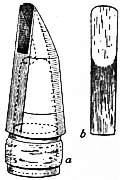
Fig. 2.—Clarinet Mouthpiece. a, the mouthpiece showing the position of the bore inside; b, the single or beating reed.
In order to facilitate the production of the harmonic notes on the clarinet, a small hole, closed by means of a key and called the “speaker,” is bored near the mouthpiece. By means of this small hole the air-column is placed in communication with the external atmosphere, a ventral segment is formed, and the air-column divides into three equal parts, producing a triple number of vibrations resulting in the third note of the harmonic series, at an interval of a twelfth above the fundamental.4 In a wind instrument with lateral holes the fundamental note corresponding to any particular hole is produced when all the holes below that hole are open and it itself and all above it are closed, the effective length of the resonating tube being shortened as each of the closed holes is successively uncovered. In order to obtain a complete chromatic scale on the clarinet at least eighteen holes are required. This series produces with the bell-note a succession of nineteen semitones, giving the range of a twelfth and known as the fundamental scale or chalumeau register, so called, no doubt, because it was the compass (without chromatic semitones) of the more primitive predecessor of the clarinet, known as the chalumeau, which must not be confounded with the shawm or schalmey of the middle ages.
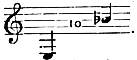
The fundamental scale of the modern clarinet in C extends from The next octave and a half is obtained by opening the speaker key, whereby each of the fundamental notes is reproduced a twelfth higher; the bell-note thus jumps from E to B♮, the first key gives instead of F its twelfth C♯, and so on, extending the compass to , which ends the natural compass of the instrument, although a skilful performer may obtain another octave by cross-fingering. The names of the holes and keys on the clarinet are derived not from the notes of the fundamental scale, but from the name of the twelfth produced by overblowing with the speaker key open; for instance, the first key near the bell is known not as the E key but as the B♮. The use of the speaker key forms the greatest technical difficulty in learning to play the clarinet, on account of the thumb having to do double duty, closing one hole and raising the lever of the speaker key simultaneously. In a clarinet designed by Richard Carte this difficulty was ingeniously overcome by placing the left thumb-hole towards the front, and closing it by a thumb-lever or with a ring action by the first or second finger of the left hand, thus leaving the thumb free to work the speaker key alone.

There is good reason to think that the ancient Greeks understood the advantage of a speaker-hole, which they called Syrinx, for facilitating the production of harmonics on the aulos. The credit of the discovery of this interesting fact is due to A.A. Howard,5 of Harvard University; it explains many passages in the classics which before were obscure (see Aulos). Plutarch relates6 that Telephanes of Megara was so incensed with the syrinx that he never allowed his instrument-makers to place one on any of his auloi; he even went so far as to absent himself, principally on account of the syrinx, from the Pythian games. Telephanes was a great virtuoso who scorned the use of a speaker-hole, being able to obtain his harmonics on the aulos by the mere control of lips and teeth.
The modern clarinet has from thirteen to nineteen keys, some being normally open and others closed. In order to understand why, when once the idea of adding keys to the chalumeau had been conceived, the number rose so slowly, keys being added one or two at a time by makers of various nationalities at long intervals, it is necessary to consider the effect of boring holes in the side of a cylindrical tube. If it were possible to proceed from an absolute theoretical basis, there would be but little difficulty; there are, however, practical reasons which make this a matter of great difficulty. According to V. Mahillon,7 the theoretical length of a B♭ clarinet (French pitch diapason normal A = 435 vibrations), is 39 cm. when the internal diameter of the bore measures exactly 1.4 cm. Any increase in the diameter of the cylindrical bore for a given length of tube raises the pitch proportionally and in the same way a decrease lowers it. A bore narrow in proportion to the length facilitates the production of the harmonics, which is no doubt the reason why the aulos was made with a very narrow diameter, and produced such deep notes in proportion to its length. In determining the position of the holes along the tube, the thickness of the wood to be pierced must be taken into consideration, for the length of the passage from the main bore to the outer air adds to the length of the resonating column; as, however, the clarinet tube is reckoned as a closed one, only half the extra length must be taken into account. When placed in its correct theoretical position, a hole should have its diameter equal to the diameter of the main bore, which is the ideal condition for obtaining a full, rich tone; it is, however, feasible to give the hole a smaller diameter, altering its position by placing it nearer the mouthpiece. These laws, which were likewise known to the Greeks and Romans,8 had to be rediscovered by experience in the 18th and 19th centuries, during which the mechanism of the key system was repeatedly improved. Due consideration having been given to these points, it will also be necessary to remember that the stopping of the seven open holes leaves only the two little fingers (the thumb of the right hand being in the ordinary clarinet engaged in supporting the instrument) free at all times for key service, the other fingers doing duty when momentarily disengaged. The fingering of the clarinet is the most difficult of any instrument in the orchestra, for it differs in all four octaves of its compass. Once mastered, however, it is the same for all clarinets, the music being always written in the key of C.
The actual tonality of the clarinet is determined by the diatonic scale produced when, starting with keys untouched and finger and thumb-holes closed, the fingers are raised one by one from the holes. In the B flat clarinet, the real sounds thus produced are

being part of the scale of B flat major. By the closing of two open keys, the lower E flat and D are added.
The following are the various sizes of clarinets with the key proper to each:
E flat, a minor third above the C clarinet.
B flat, a tone below the C clarinet.
The high F, 4 tones above the C clarinet.
The D, 1 tone above the C clarinet.
The low G, a fourth below the C clarinet.
The A, a minor third below the C clarinet.
The B♮ 1 semintone below the C clarinet.
The alto clarinet in E♭, a fifth below the B♭ clarinet.
The tenor or basset horn, in F, a fifth below the C clarinet.
The bass clarinet in B♭, an 8ve below that in B♭.
The pedal clarinet in B♭, an 8ve below the bass clarinet.
The clarinets in B♭ and A are used in the orchestra; those in C and E♭ in military bands.
History.—Although the single beating-reed associated with the instruments of the clarinet family has been traced in ancient Egypt, the double reed, characteristic of the oboe family, being of simpler construction, was probably of still greater antiquity. An ancient Egyptian pipe found in a mummy-case and now preserved in the museum at Turin was found to contain a beating-reed sunk 3 in. below the end of the pipe, which is the principle of the drone. It would appear that the double chalumeau, called arghoul (q.v.) by the modern Egyptians, was known in ancient Egypt, although it was not perhaps in common use. The Musée Guimet possesses a copy of a fresco from the tombs at Saqqarah (executed under the direction of Mariette Bey) assigned to the 4th or 5th dynasty, on which is shown a concert with dancing; the instruments used are two harps, the long oblique flute “nay,” blown from the end without any mouthpiece or embouchure, and an instrument identified as an arghoul9 from its resemblance to the modern instrument of the same name. This is believed to be the only illustration of the ancient double chalumeau yet found in Egypt, with the single exception of a hieroglyph occurring also once only, i.e. the sign read As-it, consisting of a cylindrical pipe with a beak mouthpiece bound round with a cord tied in a bow. The bow is taken to indicate the double parallel pipes bound together; the same sign without the bow occurs frequently and is read Ma-it,10 and is considered to be the generic name for reed wind instruments. The beating-reed was probably introduced into classic Greece from Egypt or Asia Minor. A few ancient Greek instruments are extant, five of which are in the British Museum. They are as nearly cylindrical as would be the natural growing reed itself. The probability is that both single and double reeds were at times used with the Greek aulos and the Roman tibia. V. Mahillon and A.A. Howard of Harvard have both obtained facsimiles of actual instruments, some found at Pompeii and now deposited in the museum at Naples, and others in the British Museum. Experiments made with these instruments, whose original mouthpieces have perished, show that with pipes of such narrow diameter the fundamental scale and pitch are the same whether sounded by means of a single or of a double reed, but the modern combination of single reed and cylindrical tube alone gives the full pure tone quality. The subject is more fully discussed in the article Aulos.11 The Roman tibia, if monuments can be trusted, sometimes had a beak-shaped mouthpiece, as for instance that attached to a pipe discovered at Pompeii, or that shown in a scene on Trajan’s column.12 It is probable that when, at the decline of the Roman empire, instrumental music was placed by the church under a ban—and the tibia more especially from its association with every form of licence and moral depravity—this instrument, sharing the common fate, survived chiefly among itinerant musicians who carried it into western Europe, where it was preserved from complete extinction. An instrument of difficult technique requiring an advanced knowledge of acoustics was not, however, likely to flourish or even to be understood among nations whose culture was as yet in its infancy.
The tide of culture from the Byzantine empire filtered through to the south and west, leaving many traces; a fresh impetus was received from the east through the Arabs; and later, as a result of the Crusades, the prototype of the clarinet, together with the practical knowledge necessary for making the instrument and playing upon it, may have been re-introduced through any one or all of these sources. However this may be, the instrument was during the Carolingian period identified with the tibia of the Romans until such time as the new western civilization ceased to be content to go back to classical Rome for its models, and began to express itself, at first naively and awkwardly, as the 11th century dawned. The name then changed to the derivatives of the Greek kalamos, assuming an almost bewildering variety of forms, of which the commonest are chalemie, chalumeau, schalmey, scalmeye, shawm, calemel, kalemele.13 The derivation of the name seems to point to a Byzantine rather than an Arab source for the revival of the instruments which formed the prototype of both oboe and clarinet, but it must not be forgotten that the instruments with a conical bore—more especially those played by a reed—are primarily of Asiatic origin. At the beginning of the 13th century in France, where the instrument remained a special favourite until it was displaced by the clarinet, the chalumeau is mentioned in some of the early romances:—“Tabars et chalemiaux et estrumens sonner” (Aye d’Avignon, v. 4137); “Grelles et chelimiaus et buisines bruians” (Gui de Bourgogne, v. 1374), &c. By the end of the 13th century, the German equivalent Schalmey appears in the literature of that country,—“Pusûnen und Schalmeyen schal moht niemen da gehoeren wal” (Frauendienst, 492, fol. 5, Ulrich von Lichtenstein). The schalmey or shawm is frequently represented in miniatures from the 13th century, but it must have been known long before, since it was at that period in use as the chaunter of the bag-pipe (q.v.), a fully-developed complex instrument which presupposes a separate previous existence for its component parts.
We have no reason to suppose that any distinction was drawn between the single and double reed instruments during the early middle ages—if indeed the single reed was then known at all—for the derivatives of kalamos were applied to a variety of pipes. The first clear and unmistakable drawing yet found of the single reed occurs in Mersenne’s Harmonie universelle (p. 282), where the primitive reed pipe is shown with the beating-reed detached from the tube of the instrument itself, by making a lateral slit and then splitting back a little tongue of reed towards a knot. Mersenne calls this the simplest form of chalumeau or wheat-stalk (tuyau de blé). It is evident that no significance was then attached to the form of the vibrating reed, whether single or double, for Mersenne and other writers of his time call the chaunters of the musette and cornemuse chalumeaux whether they are of cylindrical or of conical bore. The difference in timbre produced by the two kinds of reeds was, however, understood, for Mersenne states that a special kind of cornemuse was used in concert with the hautbois de Poitou (an oboe whose double reed was enclosed in an air chamber) and was distinguished from the shepherd’s cornemuse by having double reeds throughout, whereas the drones of the latter instrument were furnished with beating reeds. It is therefore evident that as late as 1636 (the date at which Mersenne wrote) in France the word “chalumeau” was not applied to the instrument transformed some sixty years later into the clarinet, nor was it applied exclusively to any one kind of pipe except when acting as the chaunter of the bagpipe, and that independently of any structural characteristics. The chaunter was still called chalumeau in 1737.14 Of the instrument which has been looked upon as the chalumeau, there is but little trace in Germany or in France at the beginning of the 17th century. A chalumeau with beak mouthpiece and characteristic short cylindrical tube pierced with six holes figures among the musical instruments used for the triumphal procession of the emperor Maximilian I., commemorated by a fine series of plates,15 engraved on wood by Hans Burgkmair, the friend and colleague of A. Dürer. On the same plate (No. 79) are five schalmeys with double reeds and five chalumeaux with single-reed beak mouthpieces; the latter instruments were in all probability made in the Netherlands, which excelled from the 12th century in the manufacture of all musical instruments. No single-reed instrument, with the exception of the regal (q.v.), is figured by S. Virdung,16 M. Agricola17 or M. Praetorius.18

(From Diderot and d’Alembert’s Encyclopédie.)
Fig. 3. Chalumeau, 1767. (a) Front, (b) Back view.
A good idea of the primitive chalumeau may be gained from a reproduction of one of the few specimens from the 16th or 17th century still extant, which belonged to Césare Snoeck and was exhibited at the Royal Military Exhibition in London in 1890.19 The tube is stopped at the mouthpiece end by a natural joint of the reed, and a tongue has been detached just under the joint; there are six finger-holes and one for the thumb. An instrument almost identical with the above, but with a rudimentary bell, and showing plainly the detached tongue, is figured by Jost Amman in 1589.20 A plate in Diderot and d’Alembert’s Encyclopédie21 shows a less primitive instrument, outwardly cylindrical and having a separate mouthpiece joint and a clarinet reed but no keys. A chalumeau without keys, but consisting apparently of three joints—mouthpiece, main tube and bell,—is figured on the title-page of a musical work22 dated 1690; it is very similar to the one represented in fig. 3, except that only six holes are visible.
In his biographical notice of J. Christian Denner (1655-1707), J.G. Doppelmayr23 states that at the beginning of the 18th century “Denner invented a new kind of pipe, the so-called clarinet, which greatly delighted lovers of music; he also made great improvements in the stock or rackett-fagottos, known in the olden time and finally also in the chalumeaux.” It is probable that the improvements in the chalumeau to which Doppelmayr alludes without understanding them consisted (a) in giving the mouthpiece the shape of a beak and adding a separate reed tongue as in that of the modern clarinet, unless this change had already taken place in the Netherlands, the country which the unremitting labours of E. van der Straeten24 have revealed as taking the lead in Europe from the 14th to the 16th century in the construction of musical instruments of all kinds; (b) in the boring of two additional holes for A and B near the mouthpiece and covering them with two keys; (c) in replacing the long cylindrical mouthpiece joint by a bulb, thus restoring one of the characteristic features of the tibia,25 known as the ὅλμος. There are a few of these improved chalumeaux in existence, two being in the Bavarian national museum at Munich, the one in high A, in a bad state of preservation, the second in C, marked J.C. Denner, of which V. Mahillon has made a facsimile26 for the museum of the Brussels Conservatoire. There are two keys and eight holes; the first consists of two small holes on the same level giving a semitone if only one be closed. If the thumb-key be left open, the sounds of the fundamental scale (shown in the black notes below) rise a twelfth to form the second register (the white notes).

This early clarinet or improved chalumeau has a clarinet mouthpiece, but no bulb; it measures 50 cm. (20 in.), whereas the one in A mentioned above is only 28 cm. in length, the long cylindrical tube between mouthpiece and key-joint, afterwards turned into the bulb, being absent. Mahillon was probably the first to point out that the so-called invention of the clarinet by J.C. Denner consisted in providing a device—the speaker-key—to facilitate the production of the harmonics of the fundamental. Can we be sure that the same result was not obtained on the old chalumeau before keys were added, by partially uncovering the hole for the thumb?
The Berlin museum possesses an early clarinet with two keys, marked J.B. Oberlender, derived from the Snoeck collection. Paul de Wit’s collection has a similar specimen by Enkelmer. The Brussels Conservatoire possesses clarinets with two keys by Flemish makers, G.A. Rottenburgh and J.B. Willems27; the latter, with a small bulb and bell, is in G a fifth above the C clarinet. The next improvements in the clarinet, made in 1720, are due to J. Denner, probably a son of J.C. Denner. They consisted in the addition of a bell and in the removal of the speaker-hole and key nearer the mouthpiece, involving the reduction of the diameter of the hole. The effect of this change of position was to turn the B♮ into B♭, for J. Denner introduced into the hole, nearly as far as the axis of the bore, a small metal drainage tube28 for the moisture of the breath. In the modern clarinet, the same result is attained by raising this little tube slightly above the surface of the main tube, placing a key on the top of it, and bending the lever. In order to produce the missing B♮, J. Denner lengthened the tube and pierced another hole, the low E, covered by an open key with a long lever which, when closed, gives the desired B as its twelfth, thus forming a connexion between the two registers. A clarinet with three keys, of similar construction (about 1750), marked J.W. Kenigsperger, is preserved in the Bavarian national museum, at Munich. Another in B♭ marked Lindner29 belongs to the collection at Brussels. About the middle of the 18th century, the number of keys was raised to five, some say30 by Barthold Fritz of Brunswick (1697-1766), who added keys for C♯ and D♯. According to Altenburg31 the E♭ or D♯ key is due to the virtuoso Joseph Beer (1744-1811). The sixth key was added about 1790 by the celebrated French virtuoso Xavier Lefébure (or Lefèvre), and produced G♯. Anton Stadler and his brother, both clarinettists in the Vienna court orchestra and instrument-makers, are said to have lengthened the tube of the B♭ clarinet, extending the compass down to C (real sound B♭). It was for the Stadler brothers that Mozart wrote his quintet for strings, with a fine obbligato for the clarinet in A (1789), and the clarinet concerto with orchestra in 1791.
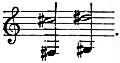

This, then, was the state of the clarinet in 1810 when Ivan Müller, then living in Paris, carried the number of keys up to thirteen, and made several structural improvements already mentioned, which gave us the modern instrument and inaugurated a new era in the construction and technique of the clarinet. Müller’s system is still adopted in principle by most clarinet makers. The instrument was successively improved during the 19th century by the Belgian makers Bachmann, the elder Sax, Albert and C. Mahillon, whose invention in 1862 of the C♯ key with double action is now generally adopted. In Paris the labours of Lefébure, Buffet-Crampon, and Goumas are pre-eminent. In 1842 H.E. Klosé conceived the idea of adapting to the clarinet the ingenious mechanism of movable rings, invented by Boehm for the flute, and he entrusted the execution of this innovation to Buffet-Crampon; this is the type of clarinet generally adopted in French orchestras. From this adaptation has sprung the erroneous notion that Klosé’s clarinet was constructed according to the Boehm system; Klosé’s lateral divisions of the tube do not follow those applied by Boehm to the flute.

Fig. 4.—Clarinet (Boehm model, Klussmann’s patent).
In England the clarinet has also passed through several progressive stages since its introduction about 1770, and first of all at the hands of Cornelius Ward. The principal improvements were due to Richard Carte, who took out a patent in 1858 for an improved Boehm clarinet which possessed some claim to the name, since Boehm’s principle of boring the holes at theoretically correct intervals and of venting the holes by means of open holes below was carried out. Carte made several modifications of his original patent, his chief endeavour being to so dispose the key-work as to reduce the difficulties in fingering. By the extension of the principle of the ring action, the work of the third and little fingers of the left hand was simplified and the fingering of certain difficult notes and shakes greatly facilitated. Messrs Rudall, Carte & Company have made further improvements in the clarinet, which are embodied in Klussmann’s patent (fig. 4); these consist in the introduction of the duplicate G♯ key, a note which has hitherto formed a serious obstacle to perfect execution. The duplicate key, operated by the third or second finger of the right hand, releases the fourth finger of the left hand. The old G♯ is still retained and may be used in the usual way if desired. The body of the instrument is now made in one joint, and the position of the G♯ hole is mathematically correct, whereby perfect intonation for C♯, G♯ and F♮ is secured. Other improvements were made in Paris by Messrs Evette & Schaeffer and by M. Paradis,32 a clarinet-player in the band of the Garde Républicaine, and very great improvements in boring and in key mechanism were effected by Albert of Brussels (see fig. 1).
The clarinet appears to have received appreciation in the Netherlands earlier than in its own native land. According to W. Altenburg (op. cit. p. 11),33 a MS. is preserved in the cathedral at Antwerp of a mass written by A.J. Faber in 1720, which is scored for a clarinet. Johann Mattheson,34 Kapellmeister at Hamburg, mentions clarinet music in 1713, although Handel, whose rival he was, does not appear to have known the instrument. Joh. Christ. Bach scored for the clarinet in 1763 in his opera Orione performed in London, and Rameau had already employed the instrument in 1751 in a theatre for his pastoral entitled Acante et Céphise.35 The clarinet was formally introduced into the orchestra in Vienna in 1767,36 Gluck having contented himself with the use of the chalumeau in Orfeo (1762) and in Alceste (1767).37 The clarinet had already been adopted in military bands in France in 1755, where it very speedily completely replaced the oboe. One of Napoleon Bonaparte’s bands is said to have had no less than twenty clarinets.
For further information on the clarinet at the beginning of the 19th century, consult the Methods by Ivan Müller and Xavier Lefébure, and Joseph Froehlich’s admirable work on the instruments of the orchestra; and Gottfried Weber’s articles in Ersch and Gruber’s Encyclopaedia. See also Basset Horn; Bass Clarinet and Pedal Clarinet.
(K. S.)
CLARK, SIR ANDREW, Bart. (1826-1893), British physician, was born at Aberdeen on the 28th of October 1826. His father, who also was a medical man, died when he was only a few years old. After attending school in Aberdeen, he was sent by his guardians to Dundee and apprenticed to a druggist; then returning to Aberdeen he began his medical studies in the university of that city. Soon, however, he went to Edinburgh, where in the extra-academical school he had a student’s career of the most brilliant description, ultimately becoming assistant to J. Hughes Bennett in the pathological department of the Royal Infirmary, and assistant demonstrator of anatomy to Robert Knox. But symptoms of pulmonary phthisis brought his academic life to a close, and in the hope that the sea might benefit his health he joined the medical department of the navy in 1848. Next year he became pathologist to the Haslar hospital, where T.H. Huxley was one of his colleagues, and in 1853 he was the successful candidate for the newly-instituted post of curator to the museum of the London hospital. Here he intended to devote all his energies to pathology, but circumstances brought him into active medical practice. In 1854, the year in which he took his doctor’s degree at Aberdeen, the post of assistant-physician to the hospital became vacant and he was prevailed upon to apply for it. He was fond of telling how his phthisical tendencies gained him the appointment. “He is only a poor Scotch doctor,” it was said, “with but a few months to live; let him have it.” He had it, and two years before his death publicly declared that of those who were on the staff of the hospital at the time of his selection he was the only one remaining alive. In 1854 he became a member of the College of Physicians, and in 1858 a fellow, and then went in succession through all the offices of honour the college has to offer, ending in 1888 with the presidency, which he continued to hold till his death. From the time of his selection as assistant physician to the London hospital, his fame rapidly grew until he became a fashionable doctor with one of the largest practices in London, counting among his patients some of the most distinguished men of the day. The great number of persons who passed through his consulting-room every morning rendered it inevitable that to a large extent his advice should become stereotyped and his prescriptions often reduced to mere stock formulae, but in really serious cases he was not to be surpassed in the skill and carefulness of his diagnosis and in his attention to detail. In spite of the claims of his practice he found time to produce a good many books, all written in the precise and polished style on which he used to pride himself. Doubtless owing largely to personal reasons, lung diseases and especially fibroid phthisis formed his favourite theme, but he also discussed other subjects, such as renal inadequacy, anaemia, constipation, &c. He died in London on the 6th of November 1893, after a paralytic stroke which was probably the result of persistent overwork.
CLARK, FRANCIS EDWARD (1851- ), American clergyman, was born of New England ancestry at Aylmer, Province of Quebec, Canada, on the 12th of September 1851. He was the son of Charles C. Symmes, but took the name of an uncle, the Rev. E.W. Clark, by whom he was adopted after his father’s death in 1853. He graduated at Dartmouth College in 1873 and at Andover Theological Seminary in 1876, was ordained in the Congregational ministry, and was pastor of the Williston Congregational church at Portland, Maine, from 1876 to 1883, and of the Phillips Congregational church, South Boston, Mass., from 1883 to 1887. On the 2nd of February 1881 he founded at Portland the Young People’s Society of Christian Endeavor, which, beginning as a small society in a single New England church, developed into a great interdenominational organization, which in 1908 had 70,761 societies and more than 3,500,000 members scattered throughout the United States, Canada, Great Britain, Australia, South Africa, India, Japan and China. After 1887 he devoted his time entirely to the extension of this work, and was president of the United Societies of Christian Endeavor and of the World’s Christian Endeavor Union, and editor of the Christian Endeavor World (originally The Golden Rule). Among his numerous publications are The Children and the Church (1882); Looking Out on Life (1883); Young People’s Prayer Meetings (1884); Some Christian Endeavor Saints (1889); World-Wide Endeavor (1895); A New Way Round an Old World (1900).
See his The Young People’s Christian Endeavor, where it began, &c. (Boston, 1895); Christian Endeavor Manual (Boston, 1903); and Christian Endeavor in All Lands: Record of Twenty-five Years of Progress (Philadelphia, 1907).
CLARK, GEORGE ROGERS (1752-1818), American frontier military leader, was born near Charlottesville, in Albemarle county, Virginia, on the 19th of November 1752. Early in life he became a land-surveyor; he took part in Lord Dunmore’s War (1774), and in 1775 went as a surveyor for the Ohio Company to Kentucky (then a district of Virginia), whither he removed early in 1776. His iron will, strong passions, audacious courage and magnificent physique soon made him a leader among his frontier neighbours, by whom in 1776 he was sent as a delegate to the Virginia legislature. In this capacity he was instrumental in bringing about the organization of Kentucky as a county of Virginia, and also obtained from Governor Patrick Henry a supply of powder for the Kentucky settlers. Convinced that the Indians were instigated and supported in their raids against the American settlers by British officers stationed in the forts north of the Ohio river, and that the conquest of those forts would put an end to the evil, he went on foot to Virginia late in 1777 and submitted to Governor Henry and his council a plan for offensive operations. On the 2nd of January 1778 he was commissioned lieutenant-colonel, received £1200 in depreciated currency, and was authorized to enlist troops; and by the end of May he was at the falls of the Ohio (the site of Louisville) with about 175 men. The expedition proceeded to Fort Kaskaskia, on the Mississippi, in what is now Illinois. This place and Cahokia, also on the Mississippi, near St Louis, were defended by small British garrisons, which depended upon the support of the French habitants. The French being willing to accept the authority of Virginia, both forts were easily taken. Clark gained the friendship of Father Pierre Gibault, the priest at Kaskaskia, and through his influence the French at Vincennes on the Wabash were induced (late in July) to change their allegiance. On the 17th of December Lieut.-Governor Henry Hamilton, the British commander at Detroit, recovered Vincennes and went into winter quarters. Late in February 1779 he was surprised by Clark and compelled to give up Vincennes and its fort, Fort Sackville, and to surrender himself and his garrison of about 80 men, as prisoners of war. With the exception of Detroit and several other posts on the Canadian frontier the whole of the North-West was thus brought under American influence; many of the Indians, previously hostile, became friendly, and the United States was put in a position to demand the cession of the North-West in the treaty of 1783. For this valuable service, in which Clark had freely used his own private funds, he received practically no recompense either from Virginia or from the United States, and for many years before his death he lived in poverty. To him and his men, however, the Virginia legislature granted 150,000 acres of land in 1781, which was subsequently located in what are now Clark, Floyd and Scott counties, Indiana; Clark’s individual share was 8049 acres, but from this he realized little. Clark built Fort Jefferson on the Mississippi, 4 or 5 m. below the mouth of the Ohio, in 1780, destroyed the Indian towns Chillicothe and Piqua in the same year, and in November 1782 destroyed the Indian towns on the Miami river. With this last expedition his active military service virtually ended, and in July 1783 he was relieved of his command by Virginia. Thereafter he lived on part of the land granted to him by Virginia or in Louisville for the rest of his life. In 1793 he accepted from Citizen Genet a commission as “major-general in the armies of France, and commander-in-chief of the French Revolutionary Legion in the Mississippi Valley,” and tried to raise a force for an attack upon the Spanish possessions in the valley of the Mississippi. The scheme, however, was abandoned after Genet’s recall. Disappointed at what he regarded as his country’s ingratitude, and broken down by excessive drinking and paralysis, he lost his once powerful influence and lived in comparative isolation until his death, near Louisville, Kentucky, on the 13th of February 1818.
See W.H. English, Conquest of the Country north-west of the River Ohio, 1778-1783, and Life of George Rogers Clark (2 vols., Indianapolis and Kansas City, 1896), an accurate and detailed work, which represents an immense amount of research among both printed and manuscript sources. Clark’s own accounts of his expeditions, and other interesting documents, are given in the appendix to this work.