VOLUME VI SLICE IV Cincinnatus to Cleruchy (continued 3)
Reading edition
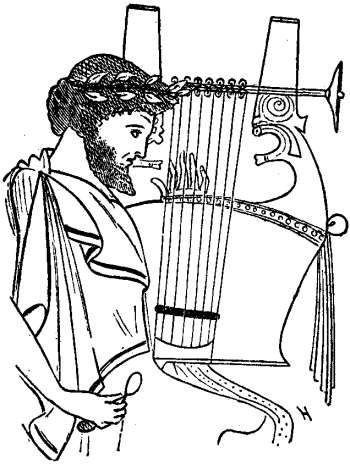
Fig. 4.—Cithara or Phorminx, from a vase in the British Museum.
The Pythian Games survived the classic Greek period and were continued under Roman sway until about A.D. 394. Not only were these games held at Delphi, but smaller contests, called Pythia, modelled on the great Pythian, were instituted in various provinces of the empire, and more especially in Asia Minor. The games lasted for several days, the first being devoted to music. To the games at Delphi came musicians from all parts of the civilized world; and the Spaniards, at the beginning of our era, had attained to such a marvellous proficiency in playing the cithara, an instrument which they had learnt to know from the Phoenician colonists before the conquest by the Romans, that some of their citharoedi easily carried off the honours at the musical contests. The consul Metellus was so charmed with the music of the Spanish competitors that he sent some to Rome for the festivals, where the impression created was so great that the Spanish citharoedi obtained a permanent footing in Rome. Aulus Gellius (Noct. Att.) describes an incident at a banquet which corroborates this statement.
The degeneration of music as an art among the Romans, and its gradual degradation by association with the sensual amusements of corrupt Rome, nearly brought about its extinction at the end of the 4th century, when the condemnation of the Church closed the theatres, and the great national games came to an end. Instrumental music was banished from civil life and from religious rites, and thenceforth the slender threads which connect the musical instruments of Greeks and Romans with those of the middle ages must be sought among the unconverted barbarians of northern and western Europe, who kept alive the traditions taught them by conquerors and colonists; but as civilization was in its infancy with them the instruments sent out from their workshops must have been crude and primitive. Asia, the cradle of the cithara, also became its foster-mother; it was among the Greeks of Asia Minor that the several steps in the transition from cithara into guitar13 (q.v.) took place.
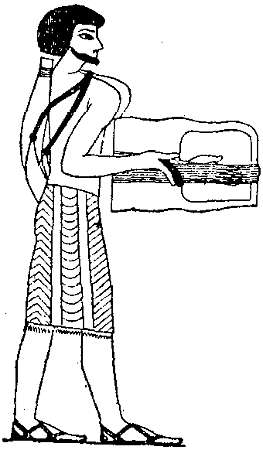
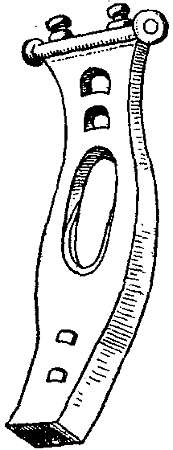
Fig. 5.—Asiatic Cithara in transition (or rotta). From a fresco at Beni-Hasan (c. 1700 B.C.). Fig. 6.—Roman Cithara in transition, of the Lycian Apollo (Rome Mus. Capit.).
The first of these steps produced the rotta (q.v.), by the construction of body, arms and transverse bar in one piece. The Semitic races used the rotta at a very remote period (1700 B.C.), as we know from a fresco at Beni-Hasan, dating from the reign of Senwosri II., which depicts a procession of strangers bringing tribute; among them is a bearded musician of Semitic type bearing a rotta which he holds horizontally in front of him in the Assyrian manner, and quite unlike the Greeks, who always played the lyre and cithara in an upright position. A unique specimen of this rectangular rotta was found in an Alamannic tomb of the 5th or 6th century at Oberflacht in the Black Forest. The instrument was clasped in the arms of an armed knight; it is now preserved in the Völker Museum in Berlin. This old German rotta is an exact counterpart of instruments pictured in illuminated MSS. of the 8th century, and is derived from the cithara with rectangular body, while from the cithara with a body having the curve of the lower half of the violin was produced a rotta with the outline of the body of the guitar. Both types were common in Europe until the 14th century, some played with a bow, others twanged by the fingers, and bearing indifferently both names, cithara and rotta. The addition of a finger-board, stretching like a short neck from body to transverse bar, leaving on each side of the finger-board space for the hand to pass through in order to stop the strings, produced the crwth or crowd (q.v.), and brought about the reduction in the number of the strings to three or four. The conversion of the rotta into the guitar (q.v.) was an easy transition effected by the addition of a long neck to a body derived from the oval rotta. When the bow was applied the result was the guitar or troubadour fiddle. At first the instrument called cithara in the Latin versions of the Psalms was glossed citran, citre in Anglo-Saxon, but in the 11th century the same instrument was rendered hearpan, and in French and English harpe or harp, and our modern versions have retained this translation. The cittern (q.v.), a later descendant of the cithara, although preserving the characteristic features of the cithara, the shallow sound-chest with ribs, adopted the pear-shaped outline of the Eastern instruments of the lute tribe.
(K. S.)
CITIUM (Gr. Kition), the principal Phoenician city in Cyprus, situated at the north end of modern Larnaca, on the bay of the same name on the S.E. coast of the island. Converging currents from E. and W. meet and pass seawards off Cape Kiti a few miles south, and greatly facilitated ancient trade. To S. and W. the site is protected by lagoons, the salt from which was one of the sources of its prosperity. The earliest remains near the site go back to the Mycenaean age (c. 1400-1100 B.C.) and seem to mark an Aegean colony.1 but in historic times Citium is the chief centre of Phoenician influence in Cyprus. That this was still a recent settlement in the 7th century is suggested by an allusion in a list of the allies of Assur-bani-pal of Assyria in 668 B.C. to a King Damasu of Ķartihadasti (Phoenician for “New-town”), where Citium would be expected. A Phoenician dedication to “Baal of Lebanon” found here, and dated also to the 7th century, suggests that Citium may have belonged to Tyre. The biblical name Kittim, derived from Citium, is in fact used quite generally for Cyprus as a whole;2 later also for Greeks and Romans in general.3 The discovery here of an official monument of Sargon II. suggests that Citium was the administrative centre of Cyprus during the Assyrian protectorate (700-668 B.C.).4 During the Greek revolts of 500, 386 foll. and 352 B.C., Citium led the side loyal to Persia and was besieged by an Athenian force in 449 B.C.; its extensive necropolis proves that it remained a considerable city even after the Greek cause triumphed with Alexander. But like other cities of Cyprus, it suffered repeatedly from earthquake, and in medieval times when its harbour became silted the population moved to Larnaca, on the open roadstead, farther south. Harbour and citadel have now quite disappeared, the latter having been used to fill up the former shortly after the British occupation; some gain to health resulted, but an irreparable loss to science. Traces remain of the circuit wall, and of a sanctuary with copious terra-cotta offerings; the large necropolis yields constant loot to illicit excavation.
Bibliography.—W.H. Engel, Kypros (Berlin, 1841), (classical allusions); J.L. Myres, Journ. Hellenic Studies, xvii. 147 ff. (excavations); Cyprus Museum Catalogue (Oxford, 1899), p. 5-6; 153-155; Index (Antiquities); G.F. Hill, Brit. Mus. Cat. Coins of Cyprus (London, 1904), (Coins).
(J. L. M.)
CITIZEN (a form corrupted in Eng., apparently by analogy with “denizen,” from O. Fr. citeain, mod. Fr. citoyen), etymologically the inhabitant of a city, cité or civitas (see City), and in England the term still used primarily of persons possessing civic rights in a borough; thus used also of a townsman as opposed to a countryman. The more extended use of the word, however, corresponding to civitas, gives “citizen” the meaning of one who is a constituent member of a state in international relations and as such has full national rights and owes a certain allegiance (q.v.) as opposed to an “alien”; in republican countries the term is then commonly employed as the equivalent of “subject” in monarchies of feudal origin. For the rules governing the obtaining of citizenship in this latter sense in the United States and elsewhere see Naturalization.
CITOLE, also spelled Sytole, Cythole, Gytolle, &c. (probably a Fr. diminutive form of cithara, and not from Lat. cista, a box), an obsolete musical instrument of which the exact form is uncertain. It is frequently mentioned by poetical writers of the 13th to the 15th centuries, and is found in Wycliffe’s Bible (1360) in 2 Samuel vi. 5, “Harpis and sitols and tympane.” The Authorized Version has “psaltiries,” and the Vulgate “lyrae.” It has been supposed to be another name for the psaltery (q.v.), a box-shaped instrument often seen in the illuminated missals of the middle ages.
CITRIC ACID, Acidum citricum, or Oxytricarballylic Acid, C3H4(OH) (CO·OH)3, a tetrahydroxytribasic acid, first obtained in the solid state by Karl Wilhelm Scheele, in 1784, from the juice of lemons. It is present also in oranges, citrons, currants, gooseberries and many other fruits, and in several bulbs and tubers. It is made on a large scale from lime or lemon juice, and also by the fermentation of glucose under the influence of Citromycetes pfefferianus, C. glaber and other ferments. Lemon juice is fermented for some time to free it from mucilage, then boiled and filtered, and neutralized with powdered chalk and a little milk of lime; the precipitate of calcium citrate so obtained is decomposed with dilute sulphuric acid, the solution filtered, evaporated to remove calcium sulphate and concentrated, preferably in vacuum pans. The acid is thus obtained in colourless rhombic prisms of the composition C6H8O7 + H2O. Crystals of a different form are deposited from a strong boiling solution of the acid. About 20 gallons of lemon juice should yield about 10 lb of crystallized citric acid. The acid may also be prepared from the juice of unripe gooseberries. Calcium citrate must be manufactured with care to avoid an excess of chalk or lime, which would precipitate constituents of the juice that cause the fermentation of the citrate and the production of calcium acetate and butyrate.
The synthesis of citric acid was accomplished by L.E. Grimaux and P. Adam in 1881. Glycerin when treated with hydrochloric acid gives propenyl dichlorhydrin, which may be oxidized to s-dichloracetone. This compound combines with hydrocyanic acid to form a nitrile which hydrolyses to dichlor-hydroxy iso-butyric acid. Potassium cyanide reacts with this acid to form the corresponding dinitrile, which is converted by hydrochloric acid into citric acid. This series of operations proves the constitution of the acid. A. Haller and C.A. Held synthesized the acid from ethyl chlor-acetoacetate (from chlorine and acetoacetic ester) by heating with potassium cyanide and saponifying the resulting nitrile. The acetone dicarboxylic acid, CO(CH2CO2H)2, so obtained combines with hydrocyanic acid, and this product yields citric acid on hydrolysis.
Citric acid has an agreeable sour taste. It is soluble in ¾ths of its weight of cold, and in half its weight of boiling water, and dissolves in alcohol, but not in ether. At 150°C. it melts, and on the continued application of heat boils, giving off its water of crystallization. At 175° C. it is resolved into water and aconitic acid, C6H6O6, a substance found in Equisetum fluviatile, monks-hood and other plants. A higher temperature decomposes this body into carbon dioxide and itaconic acid, C5H6C4, which, again, by the expulsion of a molecule of water, yields citraconic anhydride, C5H4O3. Citric acid digested at a temperature below 40°C. with concentrated sulphuric acid gives off carbon monoxide and forms acetone dicarboxylic acid. With fused potash it forms potassium oxalate and acetate. It is a strong acid, and dissolved in water decomposes carbonates and attacks iron and zinc.
The citrates are a numerous class of salts, the most soluble of which are those of the alkaline metals; the citrates of the alkaline earth metals are insoluble. Citric acid, being tribasic, forms either acid monometallic, acid dimetallic or neutral trimetallic salts; thus, mono-, di- and tri-potassium and sodium citrates are known. On warming citric acid with an excess of lime-water a precipitate of calcium citrate is obtained which is redissolved as the liquid cools.
The impurities occasionally present in commercial citric acid are salts of potassium and sodium, traces of iron, lead and copper derived from the vessels used for its evaporation and crystallization, and free sulphuric, tartaric and even oxalic acid. Tartaric acid, which is sometimes present in large quantities as an adulterant in commercial citric acid, may be detected in the presence of the latter, by the production of a precipitate of acid potassium tartrate when potassium acetate is added to a cold solution. Another mode of separating the two acids is to convert them into calcium salts, which are then treated with a perfectly neutral solution of cupric chloride, soluble cupric citrate and calcium chloride being formed, while cupric tartrate remains undissolved. Citric acid is also distinguished from tartaric acid by the fact that an ammonia solution of silver tartrate produces a brilliant silver mirror when boiled, whereas silver citrate is reduced only after prolonged ebullition.
Citric acid is used in calico printing, also in the preparation of effervescing draughts, as a refrigerant and sialogogue, and occasionally as an antiscorbutic, instead of fresh lemon juice. In the form of lime juice it has long been known as an antidote for scurvy. Several of the citrates are much employed as medicines, the most important being the scale preparations of iron. Of these iron and ammonium citrate is much used as a haematinic, and as it has hardly any tendency to cause gastric irritation or constipation it can be taken when the ordinary forms of iron are inadmissible. Iron and quinine citrate is used as a bitter stomachic and tonic. In the blood citrates are oxidized into carbonates; they therefore act as remote alkalis, increasing the alkalinity of the blood and thereby the general rate of chemical change within the body (see Acetic Acid).
CITRON, a species of Citrus (C. medica), belonging to the tribe Aurantieae, of the botanical natural order Rutaceae; the same genus furnishes also the orange, lime and shaddock. The citron is a small evergreen tree or shrub growing to a height of about 10 ft.; it has irregular straggling spiny branches, large pale-green broadly oblong, slightly serrate leaves and generally unisexual flowers purplish without and white within. The large fruit is ovate or oblong, protuberant at the tip, and from 5 to 6 in. long, with a rough, furrowed, adherent rind, the inner portion of which is thick, white and fleshy, the outer, thin, greenish-yellow and very fragrant. The pulp is sub-acid and edible, and the seeds are bitter. There are many varieties of the fruit, some of them of great weight and size. The Madras citron has the form of an oblate sphere; and in the “fingered citron” of China the lobes are separated into finger-like divisions formed by separation of the constituent carpels, as occurs sometimes in the orange.
The citron-tree thrives in the open air in China, Persia, the West Indies, Madeira, Sicily, Corsica, and the warmer parts of Spain and Italy; and in conservatories it is often to be seen in more northerly regions. Sir Joseph Hooker (Flora of British India, i. 514) regards it as a native of the valleys at the foot of the Himalaya, and of the Khasia hills and the Western Ghauts; Dr Bonavia, however, considers it to have originated in Cochin China or China, and to have been introduced into India, whence it spread to Media and Persia. It was described by Theophrastus as growing in Media, three centuries before Christ, and was early known to the ancients, and the fruit was held in great esteem by them; but they seem to have been acquainted with no other member of the Aurantieae, the introduction of oranges and lemons into the countries of the Mediterranean being due to the Arabs, between the 10th and 15th centuries. Josephus tells us that “the law of the Jews required that at the feast of tabernacles every one should have branches of palm-tree and citron-tree” (Antiq. xiii. 13. 5); and the Hebrew word tappuach, rendered “apples” and “apple-tree” in Cant. ii. 3, 5, Prov. xxv. 11, &c., probably signifies the citron-tree and its fruit. Oribasius in the 4th century describes the fruit, accurately distinguishing the three parts of it. About the 3rd century the tree was introduced into Italy; and, as Gallesio informs us, it was much grown at Salerno in the 11th century. In China citrons are placed in apartments to make them fragrant. The rind of the citron yields two perfumes, oil of cedra and oil of citron, isomeric with oil of turpentine; and when candied it is much esteemed as a dessert and in confectionery. The lemon (q.v.) is now generally regarded as a subspecies Limonum of Citrus medica.
Oribasii Sardiani, Collectorum Medicinalium Libri XVII. i. 64 (De citrio); Gallesio, Traité du citrus (1811); Darwin, Animals and Plants under Domestication, i. 334-336 (1868); Brandis, Forest Flora of North-West and Central India, p. 51 (1874); E. Bonavia, The Cultivated Oranges and Lemons, &c., of India and Ceylon (1890).
CITTADELLA, a town of Venetia, Italy, in the province of Padua, 20 m. N.W. by rail from the town of Padua; 160 ft. above sea-level. Pop. (1901) town, 3616; commune, 9686. The town was founded in 1220 by the Paduans to counterbalance the fortification of Castelfranco, 8 m. to the E., in 1218 by the Trevisans, and retains its well-preserved medieval walls, surrounded by a wet ditch. It was always a fortress of importance, and in modern times is a centre for the agricultural produce of the district, being the junction of the lines from Padua to Bassano and from Vicenza to Treviso.
CITTÀ DELLA PIEVE, a town and episcopal see of Umbria, Italy, in the province of Perugia, situated 1666 ft. above the sea, 3 m. N.E. of its station on the railway between Chiusi and Orvieto. Pop. (1901) 8381. Etruscan tombs have been found in the neighbourhood, but it is not certain that the present town stands on an ancient site. It was the birthplace of the painter Pietro Vannucci (Perugino), and possesses several of his works, but none of the first rank.
CITTÀ DI CASTELLO, a town and episcopal see of Umbria, Italy, in the province of Perugia, 38 m. E. of Arezzo by rail (18 m. direct), situated on the left bank of the Tiber, 945 ft. above sea-level. Pop. (1901) of town, 6096; of commune, 26,885. It occupies, as inscriptions show, the site of the ancient Tifernum Tiberinum, near which Pliny had a villa (Epist. v. 6; cf. H. Winnefeld in Jahrbuch des deutschen archäologischen Instituts, vi. Berlin, 1891, 203), but no remains exist above ground. The town was devastated by Totila, but seems to have recovered. We find it under the name of Castrum Felicitatis at the end of the 8th century. The bishopric dates from the 7th century. The town went through various political vicissitudes in the middle ages, being subject now to the emperor, now to the Church, until in 1468 it came under the Vitelli: but when they died out it returned to the allegiance of the Church. It is built in the form of a rectangle and surrounded by walls of 1518. It contains fine buildings of the Renaissance, especially the palaces of the Vitelli, and the cathedral, originally Romanesque. The 12th-century altar front of the latter in silver is fine. The Palazzo Comunale is of the 14th century. Some of Raphael’s earliest works were painted for churches in this town, but none of them remains there. There is, however, a small collection of pictures.
See Magherini Graziani, L’Arte a Città di Castello (1897).
CITTÀ VECCHIA, or Città Notabile, a fortified city of Malta, 7 m. W. of Valletta, with which it is connected by railway. Pop. (1901) 7515. It lies on high, sharply rising ground which affords a view of a large part of the island. It is the seat of a bishop, and contains an ornate cathedral, overthrown by an earthquake in 1693, but rebuilt, which is said by an acceptable tradition to occupy the site of the house of the governor Publius, who welcomed the apostle Paul. It contains some rich stalls of the 15th century and other objects of interest. In the rock beneath the city there are some remarkable catacombs in part of pre-Christian origin, but containing evidence of early Christian burial; and a grotto, reputed to have given shelter to the apostle, is pointed out below the church of San Paolo. Remains of Roman buildings have been excavated in the town. About 2 m. E. of the town is the residence of the English governor, known as the palace of S. Antonio; and at a like distance to the south is the ancient palace of the grand masters of the order of St John, with an extensive public garden called Il Boschetto. Città Vecchia was called Civitas Melita by the Romans and oldest writers, Medina (i.e. the city) by the Saracens, Notabile (locale notabile, et insigne coronae regiae, as it is called in a charter by Alphonso, 1428) under the Sicilian rule, and Città Vecchia (old city) by the knights. It was the capital of the island till its supersession by Valletta in 1570. (See also Malta.)
CITTERN (also Cithern, Cithron, Cythren, Citharen, &c.; Fr. citre, cistre, cithre, guitare allemande or anglaise; Ger. Cither, Zither (mit Hals, with neck); Ital. cetera, cetra), a medieval stringed instrument with a neck terminating in a grotesque and twanged by fingers or plectrum. The popularity of the cittern was at its height in England and Germany during the 16th and 17th centuries. The cittern consisted of a pear-shaped body similar to that of the lute but with a flat back and sound-board joined by ribs. The neck was provided with a fretted finger-board; the head was curved and surmounted by a grotesque head of a woman or of an animal.1 The strings were of wire in pairs of unisons, known as courses, usually four in number in England. A peculiarity of the cittern lay in the tuning of the courses, the third course known as bass being lower than the fourth styled tenor.
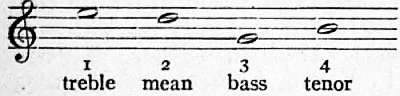
According to Vincentio Galilei (the father of the great astronomer) England was the birthplace of the cittern.2 Several lesson books for this popular instrument were published during the 17th century in England. A very rare book (of which the British Museum does not possess a copy), The Cittharn Schoole, written by Anthony Holborne in 1597, is mentioned in Sir P. Leycester’s manuscript commonplace book3 dated 1656, “For the little Instrument called a Psittyrne Anthony Holborne and Tho. Robinson were most famous of any before them and have both of them set out a booke of Lessons for this Instrument. Holborne has composed a Basse-parte for the Viole to play unto the Psittyrne with those Lessons set out in his booke. These lived about Anno Domini 1600.” Thomas Robinson’s New Citharen Lessons with perfect tunings for the same from Foure course of strings to Fourteene course, &c. (printed London, 1609, by William Barley), contains illustrations of both kinds of instruments. The fourteen-course cittern was also known in England as Bijuga; the seven courses in pairs were stretched over the finger-board, and the seven single strings, fastened to the grotesque head, were stretched as in the lyre à vide alongside the neck; all the strings rested on the one flat bridge near the tail-piece. Robinson gives instructions for learning to play the cittern and for reading the tablature. John Playford’s Musick’s Delight on the Cithren (London, 1666) also contains illustrations of the instrument as well as of the viol da Gamba and Pochette; he claims to have revived the instrument and restored it to what it was in the reign of Queen Mary.
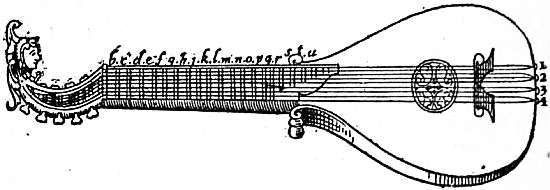
From Thomas Robinson’s New Citharen Lessons, 1609.
Four-course Cittern.
The cittern probably owed its popularity at this time to the ease with which it might be mastered and used to accompany the voice; it was one of four instruments generally found in barbers’ shops, the others being the gittern, the lute and the virginals. The customers while waiting took down the instrument from its peg and played a merry tune to pass the time.4 We read that when Konstantijn Huygens came over to England and was received by James I. at Bagshot, he played to the king on the cittern (cithara), and that his performance was duly appreciated and applauded. He tells us that, although he learnt to play the barbiton in a few weeks with skill, he had lessons from a master for two years on the cittern.5 On the occasion of a third visit he witnessed the performance of some fine musicians and was astonished to hear a lady, mother of twelve, singing in divine fashion, accompanying herself on the cittern; one of these artists he calls Lanivius, the British Orpheus, whose performance was really enchanting.
Michael Praetorius6 gives various tunings for the cittern as well as an illustration (sounded an octave higher than the notation).

During the 18th century the cittern, citra or English guitar, had twelve wire strings in six pairs of unisons tuned thus:
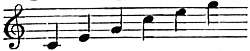
The introduction of the Spanish guitar, which at once leapt into favour, gradually displaced the English variety. The Spanish guitar had gut strings twanged by the fingers. The last development of the cittern before its disappearance was the addition of keys. The keyed cithara7 was first made by Claus & Co. of London in 1783. The keys, six in number, were placed on the left of the sound-board, and on being depressed they acted on hammers inside the sound-chest, which rising through the rose sound-hole struck the strings. Sometimes the keys were placed in a little box right over the strings, the hammers striking from above. M.J.B. Vuillaume of Paris possessed an Italian cetera (not keyed) by Antoine Stradivarius,8 1700 (now in the Museum of the Conservatoire, Paris), with twelve strings tuned in pairs of unisons to E, D, G, B, C, A, which was exhibited in London in 1871.
The cittern of the 16th century was the result of certain transitions which took place during the evolution of the violin from the Greek kithara (see Cithara).
Genealogical Table of the Cittern.
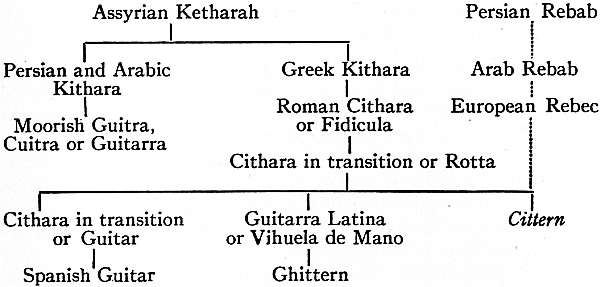
The cittern has retained the following characteristics of the archetype. (1) The derivation of the name, which after the introduction of the bow was used to characterize various instruments whose strings were twanged by fingers or plectrum, such as the harp and the rotta (both known as cithara), the citola and the zither. In an interlinear Latin and Anglo-Saxon version of the Psalms, dated A.D. 700 (Brit. Mus., Vesp. A. 1), cithara is translated citran, from which it is not difficult to trace the English cithron, citteran, cittarn, of the 16th century. (2) The construction of the sound-chest with flat back and sound-board connected by ribs. The pear-shaped outline was possibly borrowed from the Eastern instruments, both bowed as the rebab and twanged as the lute, so common all over Europe during the middle ages, or more probably derived from the kithara of the Greeks of Asia Minor, which had the corners rounded. These early steps in the transition from the cithara may be seen in the miniatures of the Utrecht Psalter,9 a unique and much-copied Carolingian MS. executed at Reims (9th century), the illustrations of which were undoubtedly adapted from an earlier psalter from the Christian East. The instruments which remained true to the prototype in outline as well as in construction and in the derivation of the name were the ghittern and the guitar, so often confused with the cittern. It is evident that the kinship of cittern and guitar was formerly recognized, for during the 18th century, as stated above, the cittern was known as the English guitar to distinguish it from the Spanish guitar. The grotesque head, popularly considered the characteristic feature of the cittern, was probably added in the 12th century at a time when this style of decoration was very noticeable in other musical instruments, such as the cornet or Zinck, the Platerspiel, the chaunter of the bagpipe, &c. The cittern of the middle ages was also to be found in oval shape. From the 13th century representations of the pear-shaped instrument abound in miniatures and carvings.10
A very clearly drawn cittern of the 14th century occurs in a MS. treatise on astronomy (Sloane MS. 3983, Brit. Mus.) translated from the Persian of Albumazar into Latin by Georgius Zothari Zopari Fenduli, priest and philosopher, with a prologue and numerous illustrations by his own hand; the cittern is here called giga in an inscription at the side of the drawing.
References to the cittern are plentiful in the literature of the 16th and 17th centuries. Robert Fludd11 describes it thus: “Cistrona quae quatuor tantum chordas duplicatas habet easque cupreas et ferreas de quibus aliquid dicemus quo loco.” Others are given in the New English Dictionary, “Cittern,” and in Godefroy’s Dict. de l’anc. langue franç. du IXe au XVe siècle.
(K. S.)
CITY (through Fr. cité, from Lat. civitas). In the United Kingdom, strictly speaking, “city” is an honorary title, officially applied to those towns which, in virtue of some preeminence (e.g. as episcopal sees, or great industrial centres), have by traditional usage or royal charter acquired the right to the designation. In the United Kingdom the official style of “city” does not necessarily involve the possession of municipal power greater than those of the ordinary boroughs, nor indeed the possession of a corporation at all (e.g. Ely). In the United States and the British colonies, on the other hand, the official application of the term “city” depends on the kind and extent of the municipal privileges possessed by the corporations, and charters are given raising towns to the rank of cities. Both in France and England the word is used to distinguish the older and central nucleus of some of the large towns, e.g. the Cité in Paris, and the “square mile” under the jurisdiction of the lord mayor which is the “City of London.”
In common usage, however, the word implies no more than a somewhat vague idea of size and dignity, and is loosely applied to any large centre of population. Thus while, technically, the City of London is quite small, London is yet properly described as the largest city in the world. In the United States this use of the word is still more loose, and any town, whether technically a city or not, is usually so designated, with little regard to its actual size or importance.
It is clear from the above that the word “city” is incapable of any very clear and inclusive definition, and the attempt to show that historically it possesses a meaning that clearly differentiates it from “town” or “borough” has led to some controversy. As the translation of the Greek πόλις or Latin civitas it involves the ancient conception of the state or “city-state,” i.e. of the state as not too large to prevent its government through the body of the citizens assembled in the agora, and is applied not to the place but to the whole body politic. From this conception both the word and its dignified connotation are without doubt historically derived. On the occupation of Gaul the Gallic states and tribes were called civitates by the Romans, and subsequently the name was confined to the chief towns of the various administrative districts. These were also the seats of the bishops. It is thus affirmed that in France from the 5th to the 15th century the name civitas or cité was confined to such towns as were episcopal sees, and Du Cange (Gloss. s.v. civitas) defines that word as urbs episcopalis, and states that other towns were termed castra or oppida. How far any such distinction can be sharply drawn may be doubted. With regard to England no definite line can be drawn between those towns to which the name civitas or cité is given in medieval documents and those called burgi or boroughs (see J.H. Round, Feudal England, p. 338; F.W. Maitland, Domesday Book and After, p. 183). It was, however, maintained by Coke and Blackstone that a city is a town incorporate which is or has been the see of a bishop. It is true, indeed, that the actual sees in England all have a formal right to the title; the boroughs erected into episcopal sees by Henry VIII. thereby became “cities”; but towns such as Thetford, Sherborne and Dorchester are never so designated, though they are regularly incorporated and were once episcopal sees. On the other hand, it has only been since the latter part of the 19th century that the official style of “city” has, in the United Kingdom, been conferred by royal authority on certain important towns which were not episcopal sees, Birmingham in 1889 being the first to be so distinguished. It is interesting to note that London, besides 27 boroughs, now contains two cities, one (the City of London) outside, the other (the City of Westminster) included in the administrative county.
For the history of the origin and development of modern city government see Borough and Commune: Medieval.
CIUDAD BOLÍVAR, an inland city and river port of Venezuela, capital of the state of Bolívar, on the right bank of the Orinoco river, 240 m. above its mouth. Pop. (1891) 11,686. It stands upon a small hill about 187 ft. above sea-level, and faces the river where it narrows to a width of less than half a mile. The city is largely built upon the hillside. It is the seat of the bishopric of Guayana (founded in 1790), and is the commercial centre of the great Orinoco basin. Among its noteworthy edifices are the cathedral, federal college, theatre, masonic temple, market, custom-house, and hospital. The mean temperature is 83°. The city has a public water-supply, a tramway line, telephone service, subfluvial cable communication with Soledad near the mouth of the Orinoco, where connexion is made with the national land lines, and regular steamship communication with the lower and upper Orinoco. Previous to the revolution of 1901-3 Ciudad Bolívar ranked fourth among the Venezuelan custom-houses, but the restrictions placed upon transit trade through West Indian ports have made her a dependency of the La Guaira custom-house to a large extent. The principal exports from this region include cattle, horses, mules, tobacco, cacáo, rubber, tonka beans, bitters, hides, timber and many valuable forest products. The town was founded by Mendoza in 1764 as San Tomás de la Nueva Guayana, but its location at this particular point on the river gave to it the popular name of Angostura, the Spanish term for “narrows.” This name was used until 1849, when that of the Venezuelan liberator was bestowed upon it. Ciudad Bolívar played an important part in the struggle for independence and was for a time the headquarters of the revolution. The town suffered severely in the struggle for its possession, and the political disorders which followed greatly retarded its growth.
CIUDAD DE CURA, an inland town of the state of Aragua, Venezuela, 55 m. S.W. of Carácas, near the Lago de Valencia. Pop. (1891) 12,198. The town stands in a broad, fertile valley, between the sources of streams running southward to the Guárico river and northward to the lake, with an elevation above sea-level of 1598 ft. Traffic between Puerto Cabello and the Guárico plains has passed through this town since early colonial times, and has made it an important commercial centre, from which hides, cheese, coffee, cacao and beans are sent down to the coast for export; it bears a high reputation in Venezuela for commercial enterprise. Ciudad de Cura was founded in 1730, and suffered severely in the war of independence.
CIUDAD JUAREZ, formerly El Paso del Norte, a northern frontier town of Mexico, in the state of Chihuahua, 1223 m. by rail N.N.W. of Mexico City. Pop. (1895) 6917. Ciudad Juarez stands 3800 ft. above sea-level on the right bank of the Rio Grande del Norte, opposite the city of El Paso, Texas, with which it is connected by two bridges. It is the northern terminus of the Mexican Central railway, and has a large and increasing transit trade with the United States, having a custom-house and a United States consulate. It is also a military post with a small garrison. The town has a straggling picturesque appearance, a considerable part of the habitations being small adobe or brick cabins. In the fertile neighbouring district cattle are raised, and wheat, Indian corn, fruit and grapes are grown, wine and brandy being made. The town was founded in 1681-1682; its present importance is due entirely to the railway. It was the headquarters of President Juarez in 1865, and was renamed in 1885 because of its devotion to his cause.
CIUDAD PORFIRIO DIAZ, formerly Piedras Negras, a northern frontier town of Mexico in the state of Coahuila, 1008 m. N. by W. from Mexico City, on the Rio Grande del Norte, 720 ft. above sea-level, opposite the town of Eagle Pass, Texas. Pop. (1900, estimate) 5000. An international bridge connects the two towns, and the Mexican International railway has its northern terminus in Mexico at this point. The town has an important transfer trade with the United States, and is the centre of a fertile district devoted to agriculture and stock-raising. Coal is found in the vicinity. The Mexican government maintains a custom-house and military post here. The town was founded in 1849.
CIUDAD REAL, a province of central Spain, formed in 1833 of districts taken from New Castile, and bounded on the N. by Toledo, E. by Albacete, S. by Jaen and Cordova and W. by Badajoz. Pop. (1900) 321,580; area, 7620 sq. m. The surface of Ciudad Real consists chiefly of a level or slightly undulating plain, with low hills in the north-east and south-west; but along the south-western frontier the Sierra de Alcudia rises in two parallel ridges on either side of the river Alcudia, and is continued in the Sierra Madrona on the east. The river Guadiana drains almost the entire province, which it traverses from east to west; only the southernmost districts being watered by tributaries of the Guadalquivir. Numerous smaller streams flow into the Guadiana, which itself divides near Herencia into two branches,—the northern known as the Giguela, the southern as the Zancara. The eastern division of Ciudad Real forms part of the region known as La Mancha, a flat, thinly-peopled plain, clothed with meagre vegetation which is often ravaged by locusts. La Mancha (q.v.) is sometimes regarded as coextensive with the whole province. Severe drought is common here, although some of the rivers, such as the Jabalon and Azuer, issue fully formed from the chalky soil, and from their very sources give an abundant supply of water to the numerous mills. Towards the west, where the land is higher, there are considerable tracts of forest.
The climate is oppressively hot in summer, and in winter the plains are exposed to violent and bitterly cold winds; while the cultivation of grain, the vine and the olive is further impeded by the want of proper irrigation, and the general barrenness of the soil. Large flocks of sheep and goats find pasture in the plains; and the swine which are kept in the oak and beech forests furnish bacon and hams of excellent quality. Coal is mined chiefly at Puertollano, lead in various districts, mercury at Almadén. There are no great manufacturing towns. The roads are insufficient and ill-kept, especially in the north-east where they form the sole means of communication; and neither the Guadiana nor its tributaries are navigable. The main railway from Madrid to Lisbon passes through the capital, Ciudad Real, and through Puertollano; farther east, the Madrid-Lináres line passes through Manzanares and Valdepeñas. Branch railways also connect the capital with Manzanares, and Valdepeñas with the neighbouring town of La Calzada.
The principal towns, Alcázar de San Juan (11,499), Almadén (7375), Almodóvar del Campo (12,525), Ciudad Real (15,255), Manzanares (11,229) and Valdepeñas (21,015), are described in separate articles. Almagro (7974) and Daimiel (11,825), in the district of La Mancha known as the Campo de Calatrava, belonged in the later middle ages to the knightly Order of Calatrava, which was founded in 1158 to keep the Moors in check. Almagro was long almost exclusively inhabited by monks and knights, and contains several interesting churches and monasteries, besides the castle of the knights, now used as barracks. Almagro is further celebrated for its lace, Daimiel for its medicinal salts. Tomelloso (13,929) is one of the chief market towns of La Mancha. Education is very backward, largely owing to the extreme poverty which has frequently brought the inhabitants to the verge of famine. (See also Castile.)
CIUDAD REAL, the capital formerly of La Mancha, and since 1833 of the province described above; 107 m. S. of Madrid, on the Madrid-Badajoz-Lisbon and Ciudad Real-Manzanares railways. Pop. (1900) 15,255. Ciudad Real lies in the midst of a wide plain, watered on the north by the river Guadiana, and on the south by its tributary the Jabalon. Apart from the remnants of its 13th-century fortifications, and one Gothic church of immense size, built without aisles, the town contains little of interest; its public buildings—town-hall, barracks, churches, hospital and schools—being in no way distinguished above those of other provincial capitals. There are no important local manufactures, and the trade of the town consists chiefly in the weekly sales of agricultrural produce and live-stock. Ciudad Real was founded by Alphonso X. of Castile (1252-1284), and fortified by him as a check upon the Moorish power. Its original name of Villarreal was changed to Ciudad Real by John VI. in 1420. During the Peninsular War a Spanish force was defeated here by the French, on the 27th of March 1809.
CIUDAD RODRIGO, a town of western Spain, in the province of Salamanca, situated 8 m. E. of the Portuguese frontier, on the right bank of the river Agueda, and the railway from Salamanca to Coimbra in Portugal. Pop. (1900) 8930. Ciudad Rodrigo is an episcopal see, and was for many centuries an important frontier fortress. Its cathedral dates from 1190, but was restored in the 15th century. The remnants of a Roman aqueduct, the foundations of a bridge across the Agueda, and other remains, seem to show that Ciudad Rodrigo occupies the site of a Roman settlement. It was founded in the 12th century by Count Rodrigo Gonzalez, from whom its name is derived. During the Peninsular War, it was captured by the French under Marshal Ney, in 1810; but on the 19th of January 1812 it was retaken by the British under Viscount Wellington, who, for this exploit, was created earl of Wellington, duke of Ciudad Rodrigo, and marquess of Torres Vedras, in Portugal.
CIVERCHIO, VINCENZO, an early 16th-century Italian painter, born at Crema. There are altar-pieces by him at Brescia, and at Crema the altar-piece at the duomo (1509). His “Birth of Christ” is in the Brera, Milan; and at Lovere are other of his works dating from 1539 and 1540.
CIVET, or properly Civet-cat, the designation of the more typical representatives of the mammalian family Viverridae (see Carnivora). Civets are characterized by the possession of a deep pouch in the neighbourhood of the genital organs, into which the substance known as civet is poured from the glands by which it is secreted. This fatty substance is at first semifluid and yellow, but afterwards acquires the consistency of pomade and becomes darker. It has a strong musky odour, exceedingly disagreeable to those unaccustomed to it, but “when properly diluted and combined with other scents it produces a very pleasing effect, and possesses a much more floral fragrance than musk, indeed it would be impossible to imitate some flowers without it.” The African civet (Viverra civetta) is from 2 to 3 ft. in length, exclusive of the tail, which is half the length of the body, and stands from 10 to 12 in. high. It is covered with long hair, longest on the middle line of the back, where it is capable of being raised or depressed at will, of a dark-grey colour, with numerous transverse black bands and spots. In habits it is chiefly nocturnal, and by preference carnivorous, feeding on birds and the smaller quadrupeds, in pursuit of which it climbs trees, but it is said also to eat fruits, roots and other vegetable matters. In a state of captivity the civet is never completely tamed, and only kept for the sake of its perfume, which is obtained in largest quantity from the male, especially when in good condition and subjected to irritation, being scraped from the pouch with a small spoon usually twice a week. The zibeth (Viverra zibetha) is a widely distributed species extending from Arabia to Malabar, and throughout several of the larger islands of the Indian Archipelago. It is smaller than the true civet, and wants the dorsal crest. In the wild state it does great damage among poultry, and frequently makes off with the young of swine and sheep. When hunted it makes a determined resistance, and emits a scent so strong as even to sicken the dogs, who nevertheless are exceedingly fond of the sport, and cannot be got to pursue any other game while the stench of the zibeth is in their nostrils. In confinement, it becomes comparatively tame, and yields civet in considerable quantity. In preparing this for the market it is usually spread out on the leaves of the pepper plant in order to free it from the hairs that have become detached from the pouch. On the Malabar coast this species is replaced by V. civettina. The small Indian civet or rasse (Viverricula malaccensis) ranges from Madagascar through India to China, the Malay Peninsula, and the islands of the Archipelago. It is almost 3 ft. long including the tail, and prettily marked with dark longitudinal stripes, and spots which have a distinctly linear arrangement. The perfume, which is extracted in the same way as in the two preceding species, is highly valued and much used by the Javanese. Although this animal is said to be an expert climber it usually inhabits holes in the ground. It is frequently kept in captivity in the East, and becomes tame. Fossil remains of extinct civets are found in the Miocene strata of Europe.
CIVIDALE DEL FRIULI (anc. Forum Iulii), a town of Venetia, Italy, in the province of Udine, 10 m. E. by N. by rail from the town of Udine; 453 ft. above sea-level. Pop. (1001) town, 4143; commune, 9061. It is situated on the river Natisone, which forms a picturesque ravine here. It contains some interesting relics of the art of the 8th century. The cathedral of the 15th century contains an octagonal marble canopy with sculptures in relief, with a font below it belonging to the 8th century, but altered later. The high altar has a fine silver altar front of 1185. The museum contains various Roman and Lombard antiquities, and valuable MSS. and works of art in gold, silver and ivory formerly belonging to the cathedral chapter. The small church of S. Maria in Valle belongs to the 8th century, and contains fine decorations in stucco which probably belong to the 11th or 12th century. The fine 15th-century Ponte del Diavolo leads to the church of S. Martino, which contains an altar of the 8th century with reliefs executed by order of the Lombard king Ratchis. At Cividale were born Paulus Diaconus, the historian of the Lombards in the time of Charlemagne, and the actress Adelaide Ristori (1822-1906).
The Roman town (a municipium) of Forum Iulii was founded either by Julius Caesar or by Augustus, no doubt at the same time as the construction of the Via Iulia Augusta, which passed through Utina (Udine) on its way north. After the decay of Aquileia and Iulium Carnicum (Zuglio) it became the chief town of the district of Friuli and gave its name to it. The patriarchs of Aquileia resided here from 773 to 1031, when they returned to Aquileia, and finally in 1238 removed to Udine. This last change of residence was the origin of the antagonism between Cividale and Udine, which was only terminated by their surrender to Venice in 1419 and 1420 respectively.
CIVILIS, CLAUDIUS, or more correctly, Julius, leader of the Batavian revolt against Rome (A.D. 69-70). He was twice imprisoned on a charge of rebellion, and narrowly escaped execution. During the disturbances that followed the death of Nero, he took up arms under pretence of siding with Vespasian and induced the inhabitants of his native country to rebel. The Batavians, who had rendered valuable aid under the early emperors, had been well treated in order to attach them to the cause of Rome. They were exempt from tribute, but were obliged to supply a large number of men for the army, and the burden of conscription and the oppressions of provincial governors were important incentives to revolt. The Batavians were immediately joined by several neighbouring German tribes, the most important of whom were the Frisians. The Roman garrisons near the Rhine were driven out, and twenty-four ships captured. Two legions under Mummius Lupercus were defeated at Castra Vetera (near the modern Xanten) and surrounded. Eight cohorts of Batavian veterans joined their countrymen, and the troops sent by Vespasian to the relief of Vetera threw in their lot with them. The result of these accessions to the forces of Civilis was a rising in Gaul. Hordeonius Flaccus was murdered by his troops (70), and the whole of the Roman forces were induced by two commanders of the Gallic auxiliaries—Julius Classicus and Julius Tutor—to revolt from Rome and join Civilis. The whole of Gaul thus practically declared itself independent, and the foundation of a new kingdom of Gaul was contemplated. The prophetess Velleda predicted the complete success of Civilis and the fall of the Roman Empire. But disputes broke out amongst the different tribes and rendered co-operation impossible; Vespasian, having successfully ended the civil war, called upon Civilis to lay down his arms, and on his refusal resolved to take strong measures for the suppression of the revolt. The arrival of Petillius Cerialis with a strong force awed the Gauls and mutinous troops into submission; Civilis was defeated at Augusta Treverorum (Trier, Trèves) and Vetera, and forced to withdraw to the island of the Batavians. He finally came to an agreement with Cerialis whereby his countrymen obtained certain advantages, and resumed amicable relations with Rome. From this time Civilis disappears from history.
The chief authority for the history of the insurrection is Tacitus, Historiae, iv., v., whose account breaks off at the beginning of Civilis’s speech to Cerialis; see also Josephus, Bellum Judaicum, vii. 4. There is a monograph by E. Meyer, Der Freiheitskrieg der Bataver unter Civilis (1856); see also Merivale, Hist. of the Romans under the Empire, ch. 58; H. Schiller, Geschichte der römischen Kaiserzeit, bk. ii. ch. 2, § 54 (1883).
CIVILIZATION. The word “civilization” is an obvious derivative of the Lat. civis, a citizen, and civilis, pertaining to a citizen. Etymologically speaking, then, it would be putting no undue strain upon the word to interpret it as having to do with the entire period of human progress since mankind attained sufficient intelligence and social unity to develop a system of government. But in practice “civilization” is usually interpreted in a somewhat narrower sense, as having application solely to the most recent and comparatively brief period of time that has elapsed since the most highly developed races of men have used systems of writing. This restricted usage is probably explicable, in part at least, by the fact that the word, though distinctly modern in origin, is nevertheless older than the interpretation of social evolution that now finds universal acceptance. Only very recently has it come to be understood that primitive societies vastly antedating the historical period had attained relatively high stages of development and fixity, socially and politically. Now that this is understood, however, nothing but an arbitrary and highly inconvenient restriction of meanings can prevent us from speaking of the citizens of these early societies as having attained certain stages of civilization. It will be convenient, then, in outlining the successive stages of human progress here, to include under the comprehensive term “civilization” those long earlier periods of “savagery” and “barbarism” as well as the more recent period of higher development to which the word “civilization” is sometimes restricted.
Adequate proof that civilization as we now know it is the result of a long, slow process of evolution was put forward not long after the middle of the 19th century by the students of palaeontology and of prehistoric archaeology. Savagery and barbarism. A recognition of the fact that primitive man used implements of chipped flint, of polished stone, and of the softer metals for successive ages, before he attained a degree of technical skill and knowledge that would enable him to smelt iron, led the Danish archaeologists to classify the stages of human progress under these captions: the Rough Stone Age; the Age of Polished Stone; the Age of Bronze; and the Age of Iron. These terms acquired almost universal recognition, and they retain popularity as affording a very broad outline of the story of human progress. It is obviously desirable, however, to fill in the outlines of the story more in detail. To some extent it has been possible to do so, largely through the efforts of ethnologists who have studied the social conditions of existing races of savages. A recognition of the principle that, broadly speaking, progress has everywhere been achieved along the same lines and through the same sequence of changes, makes it possible to interpret the past history of the civilized races of to-day in the light of the present-day conditions of other races that are still existing under social and political conditions of a more primitive type. Such races as the Maoris and the American Indians have furnished invaluable information to the student of social evolution; and the knowledge thus gained has been extended and fortified by the ever-expanding researches of the palaeontologist and archaeologist.
Thus it has become possible to present with some confidence a picture showing the successive stages of human development during the long dark period when our prehistoric ancestor was advancing along the toilsome and tortuous but on the whole always uprising path from lowest savagery to the stage of relative enlightenment at which we find him at the so-called “dawnings of history.” That he was for long ages a savage before he attained sufficient culture to be termed, in modern phraseology, a barbarian, admits of no question. Equally little in doubt is it that other long ages of barbarism preceded the final ascent to civilization. The precise period of time covered by these successive “Ages” is of course only conjectural; but something like one hundred thousand years may perhaps be taken as a safe minimal estimate. At the beginning of this long period, the most advanced race of men must be thought of as a promiscuous company of pre-troglodytic mammals, at least partially arboreal in habit, living on uncooked fruits and vegetables, and possessed of no arts and crafts whatever—nor even of the knowledge of the rudest implement. At the end of the period, there emerges into the more or less clear light of history a large-brained being, living in houses of elaborate construction, supplying himself with divers luxuries through the aid of a multitude of elaborate handicrafts, associated with his fellows under the sway of highly organized governments, and satisfying aesthetic needs through the practice of pictorial and literary arts of a high order. How was this amazing transformation brought about?
If an answer can be found to that query, we shall have a clue to all human progress, not only during the prehistoric but also during the historic periods; for we may well believe that recent progress has not departed from the scheme Crucial developments. of development impressed on humanity during that long apprenticeship. Ethnologists believe that an answer can be found. They believe that the metamorphosis from beast-like savage to cultured civilian may be proximally explained (certain potentialities and attributes of the species being taken for granted) as the result of accumulated changes that found their initial impulses in a half-dozen or so of practical inventions. Stated thus, the explanation seems absurdly simple. Confessedly it supplies only a proximal, not a final, analysis of the forces impelling mankind along the pathway of progress. But it has the merit of tangibility; it presents certain highly important facts of human history vividly: and it furnishes a definite and fairly satisfactory basis for marking successive stages of incipient civilization.
In outlining the story of primitive man’s advancement, upon such a basis, we may follow the scheme of one of the most philosophical of ethnologists, Lewis H. Morgan, who made a provisional analysis of the prehistoric period that still remains among the most satisfactory attempts in this direction. Morgan divides the entire epoch of man’s progress from bestiality to civilization into six successive periods, which he names respectively the Older, Middle and Later periods of Savagery, and the Older, Middle and Later periods of Barbarism.
The first of these periods, when mankind was in the lower status of savagery, comprises the epoch when articulate speech was being developed. Our ancestors of this epoch Speech. inhabited a necessarily restricted tropical territory, and subsisted upon raw nuts and fruits. They had no knowledge of the uses of fire. All existing races of men had advanced beyond this condition before the opening of the historical period.
The Middle Period of Savagery began with a knowledge of the uses of fire. This wonderful discovery enabled the developing race to extend its habitat almost indefinitely, and to include flesh, and in particular fish, in its regular Fire. dietary. Man could now leave the forests, and wander along the shores and rivers, migrating to climates less enervating than those to which he had previously been confined. Doubtless he became an expert fisher, but he was as yet poorly equipped for hunting, being provided, probably, with no weapon more formidable than a crude hatchet and a roughly fashioned spear. The primitive races of Australia and Polynesia had not advanced beyond this middle status of savagery when they were discovered a few generations ago. It is obvious, then, that in dealing with the further progress of nascent civilization we have to do with certain favoured portions of the race, which sought out new territories and developed new capacities while many tribes of their quondam peers remained static and hence by comparison seemed to retrograde.
The next great epochal discovery, in virtue of which a portion of the race advanced to the Upper Status of Savagery, was that of the bow and arrow,—a truly wonderful implement. The possessor of this device could bring down the Bow and arrow. fleetest animal and could defend himself against the most predatory. He could provide himself not only with food but with materials for clothing and for tent-making, and thus could migrate at will back from the seas and large rivers, and far into inhospitable but invigorating temperate and sub-Arctic regions. The meat diet, now for the first time freely available, probably contributed, along with the stimulating climate, to increase the physical vigour and courage of this highest savage, thus urging him along the paths of progress. Nevertheless many tribes came thus far and no further, as witness the Athapascans of the Hudson’s Bay Territory and the Indians of the valley of the Columbia.
We now come to the marvellous discovery that enabled our ancestor to make such advances upon the social conditions of his forbears as to entitle him, in the estimate of his remote descendants, to be considered as putting Pottery. savagery behind him and as entering upon the Lower Status of Barbarism. The discovery in question had to do with the practice of the art of making pottery (see Ceramics). Hitherto man had been possessed of no permanent utensils that could withstand the action of fire. He could not readily boil water except by some such cumbersome method as the dropping of heated stones into a wooden or skin receptacle. The effect upon his dietary of having at hand earthen vessels in which meat and herbs could be boiled over a fire must have been momentous. Various meats and many vegetables become highly palatable when boiled that are almost or quite inedible when merely roasted before a fire. Bones, sinews and even hides may be made to give up a modicum of nutriment in this way; and doubtless barbaric man, before whom starvation always loomed threateningly, found the crude pot an almost perennial refuge. And of course its use as a cooking utensil was only one of many ways in which the newly discovered mechanism exerted a civilizing influence.
The next great progressive movement, which carried man into the Middle Status of Barbarism, is associated with the domestication of animals in the Eastern hemisphere, and with the use of irrigation in cultivating the soil and Domestic animals. of adobe bricks and stone in architecture in the Western hemisphere. The dog was probably the first animal to be domesticated, but the sheep, the ox, the camel and the horse were doubtless added in relatively rapid succession, so soon as the idea that captive animals could be of service had been clearly conceived. Man now became a herdsman, no longer dependent for food upon the precarious chase of wild animals. Milk, procurable at all seasons, made a highly important addition to his dietary. With the aid of camel and horse he could traverse wide areas hitherto impassable, and come in contact with distant peoples. Thus commerce came to play an extended rôle in the dissemination of both commodities and ideas. In particular the nascent civilization of the Mediterranean region fell heir to numerous products of farther Asia,—gums, spices, oils, and most important of all, the cereals. The cultivation of the latter gave the finishing touch to a comprehensive and varied diet, while emphasizing the value of a fixed abode. For the first time it now became possible for large numbers of people to form localized communities. A natural consequence was the elaboration of political systems, which, however, proceeded along lines already suggested by the experience of earlier epochs. All this tended to establish and emphasize the idea of nationality, based primarily on blood-relationship; and at the same time to develop within the community itself the idea of property,—that is to say, of valuable or desirable commodities which have come into the possession of an individual through his enterprise or labour, and which should therefore be subject to his voluntary disposal. At an earlier stage of development, all property had been of communal, not of individual, ownership. It appears, then, that our mid-period barbarian had attained—if the verbal contradiction be permitted—a relatively high stage of civilization.
There remained, however, one master craft of which he had no conception. This was the art of smelting iron. When, ultimately, his descendants learned the wonderful secrets of that art, they rose in consequence to the Iron. Upper Status of Barbarism. This culminating practical invention, it will be observed, is the first of the great discoveries with which we have to do that was not primarily concerned with the question of man’s food supply. Iron, to be sure, has abundant uses in the same connexion, but its most direct and obvious utilities have to do with weapons of war and with implements calculated to promote such arts of peace as house-building, road-making and the construction of vehicles. Wood and stone could now be fashioned as never before. Houses could be built and cities walled with unexampled facility; to say nothing of the making of a multitude of minor implements and utensils hitherto quite unknown, or at best rare and costly. Nor must we overlook the aesthetic influence of edged implements, with which wood and stone could readily be sculptured when placed in the hands of a race that had long been accustomed to scratch the semblance of living forms on bone or ivory and to fashion crude images of clay. In a word, man, the “tool-making animal,” was now for the first time provided with tools worthy of his wonderful hands and yet more wonderful brain.
Thus through the application of one revolutionary invention after another, the most advanced races of men had arrived, after long ages of effort, at a relatively high stage of development. A very wide range of experiences had enabled man to evolve a complex body politic, based on a fairly secure social basis, and his brain had correspondingly developed into a relatively efficient and stable organ of thought. But as yet he had devised no means of communicating freely with other people at a distance except through the medium of verbal messages; nor had he any method by which he could transmit his experiences to posterity more securely than by fugitive and fallible oral traditions. A vague symbolization of his achievements was preserved from generation to generation in myth-tale and epic, but he knew not how to make permanent record of his history. Until he could devise a means to make such record, he must remain, in the estimate of his descendants, a barbarian, though he might be admitted to have become a highly organized and even in a broad sense a cultured being.
At length, however, this last barrier was broken. Some race or races devised a method of symbolizing events and ultimately of making even abstruse ideas tangible by means of graphic signs. In other words, a system of writing Writing. was developed. Man thus achieved a virtual conquest over time as he had earlier conquered space. He could now transmit the record of his deeds and his thoughts to remote posterity. Thus he stood at the portals of what later generations would term secure history. He had graduated out of barbarism, and become in the narrower sense of the word a civilized being. Henceforth, his knowledge, his poetical dreamings, his moral aspirations might be recorded in such form as to be read not merely by his contemporaries but by successive generations of remote posterity. The inspiring character of such a message is obvious. The validity of making this great culminating intellectual achievement the test of “civilized” existence need not be denied. But we should ill comprehend the character of the message which the earlier generations of civilized beings transmit to us from the period which we term the “dawning of history” did we not bear constantly in mind the long series of progressive stages of “savagery” and “barbarism” that of necessity preceded the final stage of “civilization” proper. The achievements of those earlier stages afforded the secure foundation for the progress of the future. A multitude of minor arts, in addition to the important ones just outlined, had been developed; and for a long time civilized man was to make no other epochal addition to the list of accomplishments that came to him as a heritage from his barbaric progenitor. Indeed, even to this day the list of such additions is not a long one, nor, judged in the relative scale, so important as might at first thought be supposed. Whoever considers the subject carefully must admit the force of Morgan’s suggestion that man’s achievements as a barbarian, considered in their relation to the sum of human progress, “transcend, in relative importance, all his subsequent works.”
Without insisting on this comparison, however, let us ask what discoveries and inventions man has made within the historical period that may fairly be ranked with the half-dozen great epochal achievements that have been put forward as furnishing the keys to all the progress of the prehistoric periods. In other words, let us sketch the history of progress during the ten thousand years or so that have elapsed since man learned the art of writing, adapting our sketch to the same scale which we have already applied to the unnumbered millenniums of the prehistoric period. The view of world-history thus outlined will be a very different one from what might be expected by the student of national history; but it will present the essentials of the progress of civilization in a suggestive light.
Without pretending to fix an exact date,—which the historical records do not at present permit,—we may assume that the most advanced race of men elaborated a system of writing not less than six thousand years before the Civilization proper. beginning of the Christian era. Holding to the terminology already suggested for the earlier periods, we may speak of man’s position during the ensuing generations as that of the First or Lowest Status of civilization. If we review the history of this period we shall find that it extends unbroken over a stretch of at least four or five thousand years. During the early part of this period such localized civilizations as those of the Egyptians, the Sumerians, the Babylonians and the Hittites rose, grew strong and passed beyond their meridian. This suggests that we must now admit the word “civilization” to yet another definition, within its larger meaning: we must speak of “a civilization,” as that of Egypt, of Babylonia, of Assyria, and we must understand thereby a localized phase of society bearing the same relation to civilization as a whole that a wave bears to the ocean or a tree to the forest. Such other localized civilizations as those of Phoenicia, Carthage, Greece, Rome, Byzantium, the Sassanids, in due course waxed and waned, leaving a tremendous imprint on national history, but creating only minor and transitory ripples in the great ocean of civilization. Progress in the elaboration of the details of earlier methods and inventions took place as a matter of course. Some nation, probably the Phoenicians, gave a new impetus to the art of writing by developing a phonetic alphabet; but this achievement, remarkable as it was in itself, added nothing fundamental to human capacity. Literatures had previously flourished through the use of hieroglyphic and syllabic symbols; and the Babylonian syllabics continued in vogue throughout western Asia for a long time after the Phoenician alphabet had demonstrated its intrinsic superiority.
Similarly the art of Egyptian and Assyrian and Greek was but the elaboration and perfection of methods that barbaric man had practised away back in the days when he was a cave-dweller. The weapons of warfare of Greek and Roman were the spear and the bow and arrow that their ancestors had used in the period of savagery, aided by sword and helmet dating from the upper period of barbarism. Greek and Roman government at their best were founded upon the system of gentes that barbaric man had profoundly studied,—as witness, for example, the federal system of the barbaric Iroquois Indians existing in America before the coming of Columbus. And if the Greeks had better literature, the Romans better roads and larger cities, than their predecessors, these are but matters of detailed development, the like of which had marked the progress of the more important arts and the introduction of less important ancillary ones in each antecedent period. The axe of steel is no new implement, but a mere perfecting of the axe of chipped flint. The Iliad represents the perfecting of an art that unnumbered generations of barbarians practised before their camp-fires.
Thus for six or seven thousand years after man achieved civilization there was rhythmic progress in many lines, but there came no great epochal invention to usher in a new ethnic period. Then, towards the close of what Great inventions of the middle ages. historians of to-day are accustomed to call the middle ages, there appeared in rapid sequence three or four inventions and a great scientific discovery that, taken together, were destined to change the entire aspect of European civilization. The inventions were gunpowder, the mariner’s compass, paper and the printing-press, three of which appear to have been brought into Europe by the Moors, whether or not they originated in the remote East. The scientific discovery which must be coupled with these inventions was the Copernican demonstration that the sun and not the earth is the centre of our planetary system. The generations of men that found themselves (1) confronted with the revolutionary conception of the universe given by the Copernican theory; (2) supplied with the new means of warfare provided by gunpowder; (3) equipped with an undreamed-of guide across the waters of the earth; and (4) enabled to promulgate knowledge with unexampled speed and cheapness through the aid of paper and printing-press—such generations of men might well be said to have entered upon a new ethnic period. The transition in their mode of thought and in their methods of practical life was as great as can be supposed to have resulted, in an early generation, from the introduction of iron, or in a yet earlier from the invention of the bow and arrow. So the Europeans of about the 15th century of the Christian era may be said to have entered upon the Second or Middle Status of civilization.
The new period was destined to be a brief one. It had compassed only about four hundred years when, towards the close of the 18th century, James Watt gave to the world the perfected steam-engine. Almost contemporaneously Steam machinery. Arkwright and Hargreaves developed revolutionary processes of spinning and weaving by machinery. Meantime James Hutton and William Smith and their successors on the one hand, and Erasmus Darwin, François Lamarck, and (a half-century later) Charles Darwin on the other, turned men’s ideas topsy-turvy by demonstrating that the world as the abiding-place of animals and man is enormously old, and that man himself instead of deteriorating from a single perfect pair six thousand years removed, has ascended from bestiality through a slow process of evolution extending over hundreds of centuries. The revolution in practical life and in the mental life of our race that followed these inventions and this new presentation of truth probably exceeded in suddenness and in its far-reaching effects the metamorphosis effected at any previous transition from one ethnic period to another. The men of the 19th century, living now in the period that may be termed the Upper Status of civilization, saw such changes effected in the practical affairs of their everyday lives as had not been wrought before during the entire historical period. Their fathers had travelled in vehicles drawn by horses, quite as their remoter ancestors had done since the time of higher barbarism. It may be doubted whether there existed in the world in the year 1800 a postal service that could compare in speed and efficiency with the express service of the Romans of the time of Caesar; far less was there a telegraph service that could compare with that of the ancient Persians. Nor was there a ship sailing the seas that a Phoenician trireme might not have overhauled. But now within the lifetime of a single man the world was covered with a network of steel rails on which locomotives drew gigantic vehicles, laden with passengers at an hourly speed almost equalling Caesar’s best journey of a day; over the land and under the seas were stretched wires along which messages coursed from continent to continent literally with the speed of lightning; and the waters of the earth were made to teem with gigantic craft propelled without sail or oar at a speed which the Phoenician captain of three thousand years ago and the English captain of the 18th century would alike have held incredible.
There is no need to give further details here of the industrial revolutions that have been achieved in this newest period of civilization, since in their broader outlines at least they are familiar to every one. Nor need we dwell Social and political organization. upon the revolution in thought whereby man has for the first time been given a clear inkling as to his origin and destiny. It suffices to point out that such periods of fermentation of ideas as this suggests have probably always been concomitant with those outbursts of creative genius that gave the world the practical inventions upon which human progress has been conditioned. The same attitude of receptivity to new ideas is pre-requisite to one form of discovery as to the other. Nor, it may be added, can either form of idea become effective for the progress of civilization except in proportion as a large body of any given generation are prepared to receive it. Doubtless here and there a dreamer played with fire, in a literal sense, for generations before the utility of fire as a practical aid to human progress came to be recognized in practice. And—to seek an illustration at the other end of the scale—we know that the advanced thinkers of Greece and Rome believed in the antiquity of the earth and in the evolution of man two thousand years before the coming of Darwin. We have but partly solved the mysteries of the progress of civilization, then, when we have pointed out that each tangible stage of progress owed its initiative to a new invention or discovery of science. To go to the root of the matter we must needs explain how it came about that a given generation of men was in mental mood to receive the new invention or discovery.
The pursuit of this question would carry us farther into the realm of communal and racial psychology—to say nothing of the realm of conjecture—than comports with the purpose of this article. It must suffice to point out that alertness of mind—that all mentality—is, in the last analysis, a reaction to the influences of the environment. It follows that man may subject himself to new influences and thus give his mind a new stimulus by changing his habitat. A fundamental secret of progress is revealed in this fact. Man probably never would have evolved from savagery had he remained in the Tropics where he doubtless originated. But successive scientific inventions enabled him, as has been suggested, to migrate to distant latitudes, and thus more or less involuntarily to become the recipient of new creative and progressive impulses. After migrations in many directions had resulted in the development of divers races, each with certain capacities and acquirements due to its unique environment, there was opportunity for the application of the principle of environmental stimulus in an indirect way, through the mingling and physical intermixture of one race with another. Each of the great localized civilizations of antiquity appears to have owed its prominence in part at least—perhaps very largely—to such intermingling of two or more races. Each of these civilizations began to decay so soon as the nation had remained for a considerable number of generations in its localized environment, and had practically ceased to receive accretions from distant races at approximately the same stage of development. There is a suggestive lesson for present-day civilization in that thought-compelling fact. Further evidence of the application of the principle of environmental stimulus, operating through changed habitat and racial intermixture, is furnished by the virility of the colonial peoples of our own day. The receptiveness to new ideas and the rapidity of material progress of Americans, South Africans and Australians are proverbial. No one doubts, probably, that one or another of these countries will give a new stimulus to the progress of civilization, through the promulgation of some great epochal discovery, in the not distant future. Again, the value of racial intermingling is shown yet nearer home in the long-continued vitality of the British nation, which is explicable, in some measure at least, by the fact that the Celtic element held aloof from the Anglo-Saxon element century after century sufficiently to maintain racial integrity, yet mingled sufficiently to give and receive the fresh stimulus of “new blood.” It is interesting in this connexion to examine the map of Great Britain with reference to the birthplaces of the men named above as being the originators of the inventions and discoveries that made the close of the 18th century memorable as ushering in a new ethnic era. It may be added that these names suggest yet another element in the causation of progress: the fact, namely, that, however necessary racial receptivity may be to the dynamitic upheaval of a new ethnic era, it is after all individual genius that applies its detonating spark.
Without further elaboration of this aspect of the subject it may be useful to recapitulate the analysis of the evolution of civilization above given, prior to characterizing it from another standpoint. It appears that the entire Nine periods of progress. period of human progress up to the present may be divided into nine periods which, if of necessity more or less arbitrary, yet are not without certain warrant of logic. They may be defined as follows: (1) The Lower Period of Savagery, terminating with the discovery and application of the uses of fire. (2) The Middle Period of Savagery, terminating with the invention of the bow and arrow. (3) The Upper Period of Savagery, terminating with the invention of pottery. (4) The Lower Period of Barbarism, terminating with the domestication of animals. (5) The Middle Period of Barbarism, terminating with the discovery of the process of smelting iron ore. (6) The Upper Period of Barbarism, terminating with the development of a system of writing meeting the requirements of literary composition. (7) The First Period of Civilization (proper) terminating with the introduction of gunpowder. (8) The Second Period of Civilization, terminating with the invention of a practical steam-engine. (9) The Upper Period of Civilization, which is still in progress, but which, as will be suggested in a moment, is probably nearing its termination.
It requires but a glance at the characteristics of these successive epochs to show the ever-increasing complexity of the inventions that delimit them and of the conditions of life that they connote. Were we to attempt to characterize in a few phrases the entire story of achievement thus outlined, we might say that during the three stages of Savagery man was attempting to make himself master of the geographical climates. His unconscious ideal was, to gain a foothold and the means of subsistence in every zone. During the three periods of Barbarism the ideal of conquest was extended to the beasts of the field, the vegetable world, and the mineral contents of the earth’s crust. During the three periods of Civilization proper the ideal of conquest has become still more intellectual and subtle, being now extended to such abstractions as an analysis of speech-sounds, and to such intangibles as expanding gases and still more elusive electric currents: in other words, to the forces of nature, no less than to tangible substances. Hand in hand with this growing complexity of man’s relations with the external world has gone a like increase of complexity in the social and political organizations that characterize man’s relations with his fellowmen. In savagery the family expanded into the tribe; in barbarism the tribe developed into the nation. The epoch of civilization proper is aptly named, because it has been a time in which citizenship, in the narrower national significance, has probably been developed to its apogee. Throughout this period, in every land, the highest virtue has been considered to be patriotism,—by which must be understood an instinctive willingness on the part of every individual to defend even with his life the interests of the nation into which he chances to be born, regardless of whether the national cause in which he struggles be in any given case good or bad, right or wrong. The communal judgment of this epoch pronounces any man a traitor who will not uphold his own nation even in a wrong cause—and the word “traitor” marks the utmost brand of ignominy.
But while the idea of nationality has thus been accentuated, there has been a never-ending struggle within the bounds of the nation itself to adjust the relations of one citizen to another. The ideas that might makes right, that the Nationality and cosmopolitanism. strong man must dominate the weak, that leadership in the community properly belongs to the man who is physically most competent to lead—these ideas were a perfectly natural, and indeed an inevitable, outgrowth of the conditions under which man fought his way up through savagery and barbarism. Man in the first period of civilization inherited these ideas, along with the conditions of society that were their concomitants. So throughout the periods when the oriental civilizations of Egypt and Babylonia and Assyria and Persia were dominant, a despotic form of government was accepted as the natural order of things. It does not appear that any other form was even considered as a practicality. A despot might indeed be overthrown, but only to make way for the coronation of another despot. A little later the Greeks and Romans modified the conception of a heaven-sent individual monarch; but they went no further than to substitute a heaven-favoured community, with specially favoured groups (Patricii) within the community. With this, national egoism reached its climax; for each people regarded its own citizens as the only exemplars of civilization, openly branding all the rest of the world as “barbarians,” fit subjects for the exaction of tribute or for the imposition of the bonds of actual slavery. During the middle ages there was a reaction towards individualism as opposed to nationalism: but the entire system of feudalism, with its clearly recognized conditions of over-lordship and of vassaldom, gave expression, no less clearly than oriental despotism and classical “democracy” had done, to the idea of individual inequality; of divergence of moral and legal status based on natural inheritance. Thus this idea, a reminiscence of barbarism, maintained its dominance throughout the first period of civilization.
But gunpowder, marking the transition to the second period of civilization, came as a great levelling influence. With its aid the weakest peasant might prove more than a match for the most powerful knight. Before its assaults the castle of the lord ceased to be an impregnable fortress. And while gunpowder thus levelled down the power of the mighty, the printing-press levelled up the intelligence, and hence the power and influence of the lowly. Meantime the mariner’s compass opened up new territories beyond the seas, and in due course men of lowly origin were seen to attain to wealth and power through commercial pursuits, thus tending to break in upon the established social order. In the colonial territories themselves all men were subjected more or less to the same perils and dependent upon their own efforts. Success and prominence in the community came not as a birthright, but as the result of demonstrated fitness. The great lesson that the interests of all members of a community are, in the last analysis, mutual could be more clearly distinguished in these small colonies than in larger and older bodies politic. Through various channels, therefore, in the successive generations of this middle period of civilization, the idea gained ground that intelligence and moral worth, rather than physical prowess, should be the test of greatness; that it is incumbent on the strong in the interests of the body politic to protect the weak; and that, in the long run, the best interests of the community are conserved if all its members, without exception, are given moral equality before the law. This idea of equal rights and privileges for all members of the community—for each individual “the greatest amount of liberty consistent with a like liberty of every other individual”—first found expression as a philosophical doctrine towards the close of the 18th century; at which time also tentative efforts were made to put it into practice. It may be said therefore to represent the culminating sociological doctrine of the middle period of civilization,—the ideal towards which all the influences of the period had tended to impel the race.
It will be observed, however, that this ideal of individual equality within the body politic in no direct wise influences the status of the body politic itself as the centre of a localized civilization that may be regarded as in a sense antagonistic to all other similarly localized civilizations. If there were any such influence, it would rather operate in the direction of accentuating the patriotism of the member of a democratical community, as against that of the subject of a despot, through the sense of personal responsibility developed in the former. The developments of the middle period of civilization cannot be considered, therefore, to have tended to decrease the spirit of nationality, with its concomitant penalty of what is sometimes called provincialism. The history of this entire period, as commonly presented, is largely made up of the records of international rivalries and jealousies, perennially culminating in bitterly contested wars. It was only towards the close of the epoch that the desirability of free commercial intercourse among nations began to find expression as a philosophical creed through the efforts of Quesnay and his followers; and the doctrine that both parties to an international commercial transaction are gainers thereby found its first clear expression in the year 1776 in the pages of Condillac and of Adam Smith.
But the discoveries that ushered in the third period of civilization were destined to work powerfully from the outset for the breaking down of international barriers, though, of course, their effects would not be at once manifest. Thus the substitution of steam power for water power, besides giving a tremendous impetus to manufacturing in general, mapped out new industrial centres in regions that nature had supplied with coal but not always with other raw materials. To note a single result, England became the manufacturing centre of the world, drawing its raw materials from every corner of the globe; but in so doing it ceased to be self-supporting as regards the production of food-supplies. While growing in national wealth, as a result of the new inventions, England has therefore lost immeasurably in national self-sufficiency and independence; having become in large measure dependent upon other countries both for the raw materials without which her industries must perish and for the foods to maintain the very life of her people.
What is true of England in this regard is of course true in greater or less measure of all other countries. Everywhere, thanks to the new mechanisms that increase industrial efficiency, there has been an increasing tendency to specialization; and since the manufacturer must often find his raw materials in one part of the world and his markets in another, this implies an ever-increasing intercommunication and interdependence between the nations. This spirit is obviously fostered by the new means of transportation by locomotive and steamship, and by the electric communication that enables the Londoner, for example, to transact business in New York or in Tokio with scarcely an hour’s delay; and that puts every one in touch at to-day’s breakfast table with the happenings of the entire world. Thanks to the new mechanisms, national isolation is no longer possible; globe-trotting has become a habit with thousands of individuals of many nations; and Orient and Occident, representing civilizations that for thousands of years were almost absolutely severed and mutually oblivious of each other, have been brought again into close touch for mutual education and betterment. The Western mind has learned with amazement that the aforetime Terra Incognita of the far East has nurtured a gigantic civilization having ideals in many ways far different from our own. The Eastern mind has proved itself capable, in self-defence, of absorbing the essential practicalities of Western civilization within a single generation. Some of the most important problems of world-civilization of the immediate future hinge upon the mutual relations of these two long-severed communities, branched at some early stage of progress to opposite hemispheres of the globe, but now brought by the new mechanisms into daily and even hourly communication.
While the new conditions of the industrial world have thus tended to develop a new national outlook, there has come about, as a result of the scientific discoveries already referred to, a no less significant broadening of the mental and Modern humanism. spiritual horizons. Here also the trend is away from the narrowly egoistic and towards the cosmopolitan view. About the middle of the 19th century Dr Pritchard declared that many people debated whether it might not be permissible for the Australian settlers to shoot the natives as food for their dogs; some of the disputants arguing that savages were without the pale of human brotherhood. To-day the thesis that all mankind are one brotherhood needs no defence. The most primitive of existing aborigines are regarded merely as brethren who, through some defect or neglect of opportunity, have lagged behind in the race. Similarly the defective and criminal classes that make up so significant a part of the population of even our highest present-day civilizations, are no longer regarded with anger or contempt, as beings who are suffering just punishment for wilful transgressions, but are considered as pitiful victims of hereditary and environmental influences that they could neither choose nor control. Insanity is no longer thought of as demoniac possession, but as the most lamentable of diseases.
The changed attitude towards savage races and defective classes affords tangible illustrations of a fundamental transformation of point of view which doubtless represents the most important result of the operation of new scientific knowledge in the course of the 19th century. It is a transformation that is only partially effected as yet, to be sure; but it is rapidly making headway, and when fully achieved it will represent, probably, the most radical metamorphosis of mental view that has taken place in the entire course of the historical period. The essence of the new view is this: to recognize the universality and the invariability of natural law; stated otherwise, to understand that the word “supernatural” involves a contradiction of terms and has in fact no meaning. Whoever has grasped the full import of this truth is privileged to sweep mental horizons wider by far than ever opened to the view of any thinker of an earlier epoch. He is privileged to forecast, as the sure heritage of the future, a civilization freed from the last ghost of superstition—an Age of Reason in which mankind shall at last find refuge from the hosts of occult and invisible powers, the fearsome galaxies of deities and demons, which have haunted him thus far at every stage of his long journey through savagery, barbarism and civilization. Doubtless here and there a thinker, even in the barbaric eras, may have realized that these ghosts that so influenced the everyday lives of his fellows were but children of the imagination. But the certainty that such is the case could not have come with the force of demonstration even to the most clear-sighted thinker until 19th-century science had investigated with penetrating vision the realm of molecule and atom; had revealed the awe-inspiring principle of the conservation of energy; and had offered a comprehensible explanation of the evolution of one form of life from another, from monad to man, that did not presuppose the intervention of powers more “supernatural” than those that operate about us everywhere to-day.
The stupendous import of these new truths could not, of course, make itself evident to the generality of mankind in a single generation, when opposed to superstitions of a thousand generations’ standing. But the new knowledge has made its way more expeditiously than could have been anticipated; and its effects are seen on every side, even where its agency is scarcely recognized. As a single illustration, we may note the familiar observation that the entire complexion of orthodox teaching of religion has been more altered in the past fifty years than in two thousand years before. This of course is not entirely due to the influence of physical and biological science; no effect has a unique cause, in the complex sociological scheme. Archaeology, comparative philology and textual criticism have also contributed their share; and the comparative study of religions has further tended to broaden the outlook and to make for universality, as opposed to insularity, of view. It is coming to be more and more widely recognized that all theologies are but the reflex of the more or less faulty knowledge of the times in which they originate, that the true and abiding purpose of religion should be the practical betterment of humanity—the advancement of civilization in the best sense of the word; and that this end may perhaps be best subserved by different systems of theology, adapted to the varied genius of different times and divers races. Wherefore there is not the same enthusiastic desire to-day that found expression a generation ago, to impose upon the cultured millions of the East a religion that seems to them alien to their manner of thought, unsuited to their needs and less distinctly ethical in teaching than their own religions.