VOLUME V SLICE VIII Chariot to Chatelaine (continued 10)
Reading edition
CHARTRES, a city of north-western France, capital of the department of Eure-et-Loir, 55 m. S.W. of Paris on the railway to Le Mans. Pop. (1906) 19,433. Chartres is built on the left bank of the Eure, on a hill crowned by its famous cathedral, the spires of which are a landmark in the surrounding country. To the south-east stretches the fruitful plain of Beauce, “the granary of France,” of which the town is the commercial centre. The Eure, which at this point divides into three branches, is crossed by several bridges, some of them ancient, and is fringed in places by remains of the old fortifications, of which the Porte Guillaume (14th century), a gateway flanked by towers, is the most complete specimen. The steep, narrow streets of the old town contrast with the wide, shady boulevards which encircle it and divide it from the suburbs. The Clos St Jean, a pleasant park, lies to the north-west, and squares and open spaces are numerous. The cathedral of Notre-Dame (see Architecture: Romanesque and Gothic Architecture in France; and Cathedral), one of the finest Gothic churches in France, was founded in the 11th century by Bishop Fulbert on the site of an earlier church destroyed by fire. In 1194 another conflagration laid waste the new building then hardly completed; but clergy and people set zealously to work, and the main part of the present structure was finished by 1240. Though there have been numerous minor additions and alterations since that time, the general character of the cathedral is unimpaired. The upper woodwork was consumed by fire in 1836, but the rest of the building was saved. The statuary of the lateral portals, the stained glass of the 13th century, and the choir-screen of the Renaissance are all unique from the artistic standpoint. The cathedral is also renowned for the beauty and perfect proportions of its western towers. That to the south, the Clocher Vieux (351 ft. high), dates from the 13th century; its upper portion is lower and less rich in design than that of the Clocher Neuf (377 ft.), which was not completed till the 16th century. In length the cathedral measures 440 ft., its choir measures 150 ft. across, and the height of the vaulting is 121 ft. The abbey church of St Pierre, dating chiefly from the 13th century, contains, besides some fine stained glass, twelve representations of the apostles in enamel, executed about 1547 by Léonard Limosin. Of the other churches of Chartres the chief are St Aignan (13th, 16th and 17th centuries) and St Martin-au-Val (12th century). The hôtel de ville, a building of the 17th century, containing a museum and library, an older hôtel de ville of the 13th century, and several medieval and Renaissance houses, are of interest. There is a statue of General F.S. Marceau-Desgraviers (b. 1769), a native of the town.
The town is the seat of a bishop, a prefecture, a court of assizes, and has tribunals of first instance and of commerce, a chamber of commerce, training colleges, a lycée for boys, a communal college for girls, and a branch of the Bank of France. Its trade is carried on chiefly on market-days, when the peasants of the Beauce bring their crops and live-stock to be sold and make their purchases. The game-pies and other delicacies of Chartres are well known, and the industries also include flour-milling, brewing, distilling, iron-founding, leather manufacture, dyeing, and the manufacture of stained glass, billiard requisites, hosiery, &c.
Chartres was one of the principal towns of the Carnutes, and by the Romans was called Autricum, from the river Autura (Eure), and afterwards civitas Carnutum. It was burnt by the Normans in 858, and unsuccessfully besieged by them in 911. In 1417 it fell into the hands of the English, from whom it was recovered in 1432. It was attacked unsuccessfully by the Protestants in 1568, and was taken in 1591 by Henry IV., who was crowned there three years afterwards. In the Franco-German War it was seized by the Germans on the 21st of October 1870, and continued during the rest of the campaign an important centre of operations. During the middle ages it was the chief town of the district of Beauce, and gave its name to a countship which was held by the counts of Blois and Champagne and afterwards by the house of Châtillon, a member of which in 1286 sold it to the crown. It was raised to the rank of a duchy in 1528 by Francis I. After the time of Louis XIV. the title of duke of Chartres was hereditary in the family of Orleans.
See M.T. Bulteau, Monographie de la cathédrale de Chartres (1887); A. Pierval, Chartres, sa cathédrale, ses monuments (1896); H.J.L.J. Massé, Chartres: its Cathedral and Churches (1900).
CHARTREUSE, a liqueur, so called from having been made at the famous Carthusian monastery, La Grande Chartreuse, at Grenoble (see below). In consequence of the Associations Law, the Chartreux monks left France in 1904, and now continue the manufacture of this liqueur in Spain. There are two main varieties of Chartreuse, the green and the yellow. The green contains about 57, the yellow about 43% of alcohol. There are other differences due to the varying nature and quantity of the flavouring matters employed, but the secrets of manufacture are jealously guarded. The genuine liqueur is undoubtedly produced by means of a distillation process.
CHARTREUSE, LA GRANDE, the mother house of the very severe order of Carthusian monks (see Carthusians). It is situated in the French department of the Isère, about 12½ m. N. of Grenoble, at a height of 3205 ft. above the sea, in the heart of a group of limestone mountains, and not far from the source of the Guiers Mort. The original settlement here was founded by St Bruno about 1084, and derived its name from the small village to the S.E., formerly known as Cartusia, and now as St Pierre de Chartreuse. The first convent on the present site was built between 1132 and 1137, but the actual buildings date only from about 1676, the older ones having been often burnt. The convent stands in a very picturesque position in a large meadow, sloping to the S.W., and watered by a tiny tributary of the Guiers Mort. On the north, fine forests extend to the Col de la Ruchère, and on the west rise well-wooded heights, while on the east tower white limestone ridges, culminating in the Grand Som (6670 ft.). One of the most famous of the early Carthusian monks was St Hugh of Lincoln, who lived here from 1160 to 1181, when he went to England to found the first Carthusian house at Witham in Somerset; in 1186 he became bishop of Lincoln, and before his death in 1200 had built the angel choir and other portions of the wonderful cathedral there.
The principal approach to the convent is from St Laurent du Pont, a village situated on the Guiers Mort, and largely built by the monks—it is connected by steam tramways with Voiron (for Grenoble) and St Béron (for Chambéry). Among the other routes may be mentioned those from Grenoble by Le Sappey, or by the Col de la Charmette, or from Chambéry by the Col de Couz and the village of Les Échelles. St Laurent is about 5½ m. from the convent. The road mounts along the Guiers Mort and soon reaches the hamlet of Fourvoirie, so called from forata via, as about 1510 the road was first pierced hence towards the convent. Here are iron forges, and here was formerly the chief centre of the manufacture of the famed Chartreuse liqueur. Beyond, the road enters the “Désert” and passes through most delightful scenery. Some way farther the Guiers Mort is crossed by the modern bridge of St Bruno, the older bridge of Parant being still visible higher up the stream. Here begins the splendid carriage road, constructed by M.E. Viaud between 1854 and 1856. It soon passes beneath the bold pinnacle of the Oeillette or Aiguillette, beyond which formerly women were not allowed to penetrate. After passing through four tunnels the road bends north (leaving the Guiers Mort which flows past St Pierre de Chartreuse), and the valley soon opens to form the upland hollow in which are the buildings of the convent. These are not very striking, the high roofs of dark slate, the cross-surmounted turrets and the lofty clock-tower being the chief features. But the situation is one of ideal peace and repose. Women were formerly lodged in the old infirmary, close to the main gate, which is now a hôtel. Within the conventual buildings are four halls formerly used for the reception of the priors of the various branch houses in France, Italy, Burgundy and Germany. The very plain and unadorned chapel dates from the 15th century, but the cloisters, around which cluster the thirty-six small houses for the fully professed monks, are of later date. The library contained before the Revolution a very fine collection of books and MSS., now mostly in the town library at Grenoble.
The monks were expelled in 1793, but allowed to return in 1816, but then they had to pay rent for the use of the buildings and the forests around, though both one and the other were due to the industry of their predecessors. They were again expelled in 1904, and are dispersed in various houses in England, at Pinerolo (Italy) and at Tarragona (Spain). It is at the last-named spot that the various pharmaceutical preparations are now manufactured for which they are famous (though sold only since about 1840)—the Elixir, the Boule d’acier (a mineral paste or salve), and the celebrated liqueur. The magnificent revenues derived from the profits of this manufacture were devoted by the monks to various purposes of benevolence, especially in the neighbouring villages, which owe to this source their churches, schools, hospitals, &c., &c., built and maintained at the expense of the monks.
See La Grande Chartreuse par un Chartreux (Grenoble, 1898); H. Ferrand, Guide à la Grande Chartreuse (1889); and Les Montagnes de la Chartreuse (1899)
(W. A. B. C.)
CHARWOMAN, one who is hired to do occasional household work. “Char” or “chare,” which forms the first part of the word, is common, in many forms, to Teutonic languages, meaning a “turn,” and, in this original sense, is seen in “ajar,” properly “on char,” of a door “on the turn” in the act of closing. It is thus applied to a “turn of work,” an odd job, and is so used, in the form “chore,” in America, and in dialects of the south-west of England.
CHASE, SALMON PORTLAND (1808-1873), American statesman and jurist, was born in Cornish township, New Hampshire, on the 13th of January 1808. His father died in 1817, and the son passed several years (1820-1824) in Ohio with his uncle, Bishop Philander Chase (1775-1852), the foremost pioneer of the Protestant Episcopal Church in the West, the first bishop of Ohio (1819-1831), and after 1835 bishop of Illinois. He graduated at Dartmouth College in 1826, and after studying law under William Wirt, attorney-general of the United States, in Washington, D.C., was admitted to the bar in 1829, and removed to Cincinnati, Ohio, in 1830. Here he soon gained a position of prominence at the bar, and published an annotated edition, which long remained standard, of the laws of Ohio. At a time when public opinion in Cincinnati was largely dominated by Southern business connexions, Chase, influenced probably by James G. Birney, associated himself after about 1836 with the anti-slavery movement, and became recognized as the leader of the political reformers as opposed to the Garrisonian abolitionists. To the cause he freely gave his services as a lawyer, and was particularly conspicuous as counsel for fugitive slaves seized in Ohio for rendition to slavery under the Fugitive Slave Law of 1793—indeed, he came to be known as the “attorney-general of fugitive slaves.” His argument (1847) in the famous Van Zandt case before the United States Supreme Court attracted particular attention, though in this as in other cases of the kind the judgment was against him. In brief he contended that slavery was “local, not national,” that it could exist only by virtue of positive State Law, that the Federal government was not empowered by the Constitution to create slavery anywhere, and that “when a slave leaves the jurisdiction of a state he ceases to be a slave, because he continues to be a man and leaves behind him the law which made him a slave.” In 1841 he abandoned the Whig party, with which he had previously been affiliated, and for seven years was the undisputed leader of the Liberty party in Ohio; he was remarkably skilful in drafting platforms and addresses, and it was he who prepared the national Liberty platform of 1843 and the Liberty address of 1845. Realizing in time that a third party movement could not succeed, he took the lead during the campaign of 1848 in combining the Liberty party with the Barnburners or Van Buren Democrats of New York to form the Free-Soilers. He drafted the famous Free-Soil platform, and it was largely through his influence that Van Buren was nominated for the presidency. His object, however, was not to establish a permanent new party organization, but to bring pressure to bear upon Northern Democrats to force them to adopt a policy opposed to the further extension of slavery.
In 1849 he was elected to the United States Senate as the result of a coalition between the Democrats and a small group of Free-Soilers in the state legislature; and for some years thereafter, except in 1852, when he rejoined the Free-Soilers, he classed himself as an Independent Democrat, though he was out of harmony with the leaders of the Democratic party. During his service in the Senate (1849-1855) he was pre-eminently the champion of anti-slavery in that body, and no one spoke more ably than he did against the Compromise Measures of 1850 and the Kansas-Nebraska Bill of 1854. The Kansas-Nebraska legislation, and the subsequent troubles in Kansas, having convinced him of the futility of trying to influence the Democrats, he assumed the leadership in the North-west of the movement to form a new party to oppose the extension of slavery. The “Appeal of the Independent Democrats in Congress to the People of the United States,” written by Chase and Giddings, and published in the New York Times of the 24th of January 1854, may be regarded as the earliest draft of the Republican party creed. He was the first Republican governor of Ohio, serving from 1855 to 1859. Although, with the exception of Seward, he was the most prominent Republican in the country, and had done more against slavery than any other Republican, he failed to secure the nomination for the presidency in 1860, partly because his views on the question of protection were not orthodox from a Republican point of view, and partly because the old line Whig element could not forgive his coalition with the Democrats in the senatorial campaign of 1849; his uncompromising and conspicuous anti-slavery record, too, was against him from the point of view of “availability.” As secretary of the treasury in President Lincoln’s cabinet in 1861-1864, during the first three years of the Civil War, he rendered services of the greatest value. That period of crisis witnessed two great changes in American financial policy, the establishment of a national banking system and the issue of a legal tender paper currency. The former was Chase’s own particular measure. He suggested the idea, worked out all of the important principles and many of the details, and induced Congress to accept them. The success of that system alone warrants his being placed in the first rank of American financiers. It not only secured an immediate market for government bonds, but it also provided a permanent uniform national currency, which, though inelastic, is absolutely stable. The issue of legal tenders, the greatest financial blunder of the war, was made contrary to his wishes, although he did not, as he perhaps ought to have done, push his opposition to the point of resigning.
Perhaps Chase’s chief defect as a statesman was an insatiable desire for supreme office. It was partly this ambition, and also temperamental differences from the president, which led him to retire from the cabinet in June 1864. A few months later (December 6, 1864) he was appointed chief justice of the United States Supreme Court to succeed Judge Taney, a position which he held until his death in 1873. Among his most important decisions were Texas v. White (7 Wallace, 700), 1869, in which he asserted that the Constitution provided for an “indestructible union composed of indestructible states,” Veazie Bank v. Fenno (8 Wallace, 533), 1869, in defence of that part of the banking legislation of the Civil War which imposed a tax of 10% on state bank-notes, and Hepburn v. Griswold (8 Wallace, 603), 1869, which declared certain parts of the legal tender acts to be unconstitutional. When the legal tender decision was reversed after the appointment of new judges, 1871-1872 (Legal Tender Cases, 12 Wallace, 457), Chase prepared a very able dissenting opinion. Toward the end of his life he gradually drifted back toward his old Democratic position, and made an unsuccessful effort to secure the nomination of the Democratic party for the presidency in 1872. He died in New York city on the 7th of May 1873. Chase was one of the ablest political leaders of the Civil War period, and deserves to be placed in the front rank of American statesmen.
The standard biography is A.B. Hart’s Salmon Portland Chase in the “American Statesmen Series” (1899). Less philosophical, but containing a greater wealth of detail, is J.W. Shuckers’ Life and Public Services of Salmon Portland Chase (New York, 1874). R.B. Warden’s Account of the Private Life and Public Services of Salmon Portland Chase (Cincinnati, 1874) deals more fully with Chase’s private life.
CHASE, SAMUEL (1741-1811), American jurist, was born in Somerset county, Maryland, on the 17th of April 1741. He was admitted to the bar at Annapolis in 1761, and for more than twenty years was a member of the Maryland legislature. He took an active part in the resistance to the Stamp Act, and from 1774 to 1778 and 1784 to 1785 was a member of the Continental Congress. With Benjamin Franklin and Charles Carroll he was sent by Congress in 1776 to win over the Canadians to the side of the revolting colonies, and after his return did much to persuade Maryland to advocate a formal separation of the thirteen colonies from Great Britain, he himself being one of those who signed the Declaration of Independence on the 2nd of August 1776. In this year he was also a member of the convention which framed the first constitution for the state of Maryland. After serving in the Maryland convention which ratified for that state the Federal Constitution, and there vigorously opposing ratification, though afterwards he was an ardent Federalist, he became in 1791 chief judge of the Maryland general court, which position he resigned in 1796 for that of an associate justice of the Supreme Court of the United States. His radical Federalism, however, led him to continue active in politics, and he took advantage of every opportunity, on the bench and off, to promote the cause of his party. His overbearing conduct while presiding at the trials of John Fries for treason, and of James Thompson Callender (d. 1813) for seditious libel in 1800, drove the lawyers for the defence from the court, and evoked the wrath of the Republicans, who were stirred to action by a political harangue on the evil tendencies of democracy which he delivered as a charge to a grand jury at Baltimore in 1803. The House of Representatives adopted a resolution of impeachment in March 1804, and on the 7th of December 1804 the House managers, chief among whom were John Randolph, Joseph H. Nicholson (1770-1817), and Caesar A. Rodney (1772-1824), laid their articles of impeachment before the Senate. The trial, with frequent interruptions and delays, lasted from the 2nd of January to the 1st of March 1805. Judge Chase was defended by the ablest lawyers in the country, including Luther Martin, Robert Goodloe Harper (1765-1825), Philip Barton Key (1757-1815), Charles Lee (1758-1815), and Joseph Hopkinson (1770-1842). The indictment, in eight articles, dealt with his conduct in the Fries and Callender trials, with his treatment of a Delaware grand jury, and (in article viii.) with his making “highly indecent, extra-judicial” reflections upon the national administration, probably the greatest offence in Republican eyes. On only three articles was there a majority against Judge Chase, the largest, on article viii., being four short of the necessary two-thirds to convict. “The case,” says Henry Adams, “proved impeachment to be an impracticable thing for partisan purposes, and it decided the permanence of those lines of constitutional development which were a reflection of the common law.” Judge Chase resumed his seat on the bench, and occupied it until his death on the 19th of June 1811.
See The Trial of Samuel Chase (2 vols., Washington, 1805), reported by Samuel H. Smith and Thomas Lloyd; an article in The American Law Review, vol. xxxiii. (St Louis, Mo., 1899); and Henry Adams’s History of the United States, vol. ii. (New York, 1889).
CHASE, WILLIAM MERRITT (1849- ), American painter, was born at Franklin, Indiana, on the 1st of November 1849. He was a pupil of B.F. Hays at Indianapolis, of J.O. Eaton in New York, and subsequently of A. Wagner and Piloty in Munich. In New York he established a school of his own, after teaching with success for some years at the Art Students’ League. A worker in all mediums—oils, water-colour, pastel and etching—painting with distinction the figure, landscape and still-life, he is perhaps best known by his portraits, his sitters numbering some of the most important men and women of his time. Mr Chase won many honours at home and abroad, became a member of the National Academy of Design, New York, and for ten years was president of the Society of American Artists. Among his important canvases are “Ready for the Ride” (Union League Club, N.Y.), “The Apprentice,” “Court Jester,” and portraits of the painters Whistler and Duveneck; of General Webb and of Peter Cooper.
CHASE. (1) (Fr. chasse, from Lat. captare, frequentative of capere, to take), the pursuit of wild animals for food or sport (see Hunting). The word is used of the pursuit of anything, and also of the thing pursued, as, in naval warfare, of a ship. A transferred meaning is that of park land reserved for the breeding and hunting of wild animals, in which sense it appears in various place-names in England, as Cannock Chase. It is also a term for a stroke in tennis (q.v.). (2) (Fr. châsse, Lat. capsa, a box, cf. caisse, and “chest”), an enclosure, such as the muzzle-end of a gun in front of the trunnions, a groove cut to hold a pipe, and, in typography, the frame enclosing the “forme.”
CHASING, or Enchasing, the art of producing figures and ornamental patterns, either raised or indented, on metallic surfaces by means of steel tools or punches. It is practised extensively for the ornamentation of goldsmith and silversmith work, electro-plate and similar objects, being employed to produce bold flutings and bosses, and in another manner utilized for imitating engraved surfaces. Minute work can be produced by this method, perfect examples of which may be seen in the watch-cases chased by G.M. Moser, R.A. (1704-1783). The chaser first outlines the pattern on the surface he is to ornament, after which, if the work involves bold or high embossments, these are blocked out by a process termed “snarling.” The snarling iron is a long iron tool turned up at the end, and made so that when securely fastened in a vise the upturned end can reach and press against any portion of the interior of the vase or other object to be chased. The part to be raised being held firmly against the upturned point of the snarling iron, the workman gives the shoulder or opposite end of the iron a sharp blow, which causes the point applied to the work to give it a percussive stroke, and thus throw up the surface of the metal held against the tool. When the blocking out from the interior is finished, or when no such embossing is required, the object to be chased is filled with molten pitch, which is allowed to harden. It is then fastened to a sandbag, and with hammer and a multitude of small punches of different outline the whole details of the pattern, lined, smooth or “matt,” are worked out. Embossing and stamping from steel dies and rolled ornaments have long since taken the place of chased ornamentations in the cheaper kinds of plated works. (See Embossing.)
CHASLES, VICTOR EUPHÉMIEN PHILARÈTE (1798-1873), French critic and man of letters, was born at Mainvilliers (Eure et Loir) on the 8th of October 1798. His father, Pierre Jacques Michel Chasles (1754-1826), was a member of the Convention, and was one of those who voted the death of Louis XVI. He brought up his son according to the principles of Rousseau’s Émile, and the boy, after a régime of outdoor life, followed by some years’ classical study, was apprenticed to a printer, so that he might make acquaintance with manual labour. His master was involved in one of the plots of 1815, and Philarète suffered two months’ imprisonment. On his release he was sent to London, where he worked for the printer Valpy on editions of classical authors. He wrote articles for the English reviews, and on his return to France did much to popularize the study of English authors. He was also one of the earliest to draw attention in France to Scandinavian and Russian literature. He contributed to the Revue des deux mondes, until he had a violent quarrel, terminating in a lawsuit, with François Buloz, who won his case. He became librarian of the Bibliothèque Mazarine, and from 1841 was professor of comparative literature at the Collège de France. During his active life he produced some fifty volumes of literary history and criticism, and of social history, much of which is extremely valuable. He died at Venice on the 18th of July 1873. His son, Émile Chasles (b. 1827), was a philologist of some reputation.
Among his best critical works is Dix-huitième Siècle en Angleterre ... (1846), one of a series of 20 vols. of Études de littérature comparée (1846-1875), which he called later Trente ans de critique. An account of his strenuous boyhood is given in his Maison de mon père. His Mémoires (1876-1877) did not fulfil the expectations based on his brilliant talk.
CHASSE (from the Fr., in full chasse-café, or “coffee-chaser”), a draught of spirit or liqueur, taken with or after coffee, &c.
CHASSÉ (Fr. for “chased”), a gliding step in dancing, so called since one foot is brought up behind or chases the other. The chassé croisé is a double variety of the step.
CHASSELOUP-LAUBAT, FRANÇOIS, Marquis de (1754-1833), French general and military engineer, was born at St Sernin (Lower Charente) on the 18th of August 1754, of a noble family, and entered the French engineers in 1774. He was still a subaltern at the outbreak of the Revolution, becoming captain in 1791. His ability as a military engineer was recognized in the campaigns of 1792 and 1793. In the following year he won distinction in various actions and was promoted successively chef de bataillon and colonel. He was chief of engineers at the siege of Mainz in 1796, after which he was sent to Italy. He there conducted the first siege of Mantua, and reconnoitred the positions and lines of advance of the army of Bonaparte. He was promoted general of brigade before the close of the campaign, and was subsequently employed in fortifying the new Rhine frontier of France. His work as chief of engineers in the army of Italy (1799) was conspicuously successful, and after the battle of Novi he was made general of division. When Napoleon took the field in 1800 to retrieve the disasters of 1799, he again selected Chasseloup as his engineer general. During the peace of 1801-1805 he was chiefly employed in reconstructing the defences of northern Italy, and in particular the afterwards famous Quadrilateral. His chef-d’oeuvre was the great fortress of Alessandria on the Tanaro. In 1805 he remained in Italy with Masséna, but at the end of 1806 Napoleon, then engaged in the Polish campaign, called him to the Grande Armée, with which he served in the campaign of 1806-07, directing the sieges of Colberg, Danzig and Stralsund. During the Napoleonic domination in Germany, Chasseloup reconstructed many fortresses, in particular Magdeburg. In the campaign of 1809 he again served in Italy. In 1810 Napoleon made him a councillor of state. His last campaign was that of 1812 in Russia. He retired from active service soon afterwards, though in 1814 he was occasionally engaged in the inspection and construction of fortifications. Louis XVIII. made him a peer of France and a knight of St Louis. He refused to join Napoleon in the Hundred Days, but after the second Restoration he voted in the chamber of peers against the condemnation of Marshal Ney. In politics he belonged to the constitutional party. The king created him a marquis. Chasseloup’s later years were employed chiefly in putting in order his manuscripts, a task which he had to abandon owing to the failure of his sight. His only published work was Correspondence d’un général français, &c. sur divers sujets (Paris, 1801, republished Milan, 1805 and 1811, under the title Correspondance de deux générals, &c., essais sur quelques parties d’artillerie et de fortification). The most important of his papers are in manuscript in the Depôt of Fortifications, Paris.
As an engineer Chasseloup was an adherent, though of advanced views, of the old bastioned system. He followed in many respects the engineer Bousmard, whose work was published in 1797 and who fell, as a Prussian officer, in the defence of Danzig in 1807 against Chasseloup’s own attack. His front was applied to Alessandria, as has been stated, and contains many elaborations of the bastion trace, with, in particular, masked flanks in the tenaille, which served as extra flanks of the bastions. The bastion itself was carefully and minutely retrenched. The ordinary ravelin he replaced by a heavy casemated caponier after the example of Montalembert, and, like Bousmard’s, his own ravelin was a large and powerful work pushed out beyond the glacis.
CHASSEPOT, officially “fusil modèle 1866,” a military breech-loading rifle, famous as the arm of the French forces in the Franco-German War of 1870-71. It was so called after its inventor, Antoine Alphonse Chassepot (1833-1905), who, from 1857 onwards, had constructed various experimental forms of breech-loader, and it became the French service weapon in 1866. In the following year it made its first appearance on the battle-field at Mentana (November 3rd, 1867), where it inflicted severe losses upon Garibaldi’s troops. In the war of 1870 it proved very greatly superior to the German needle-gun. The breech was closed by a bolt very similar to those of more modern rifles, and amongst the technical features of interest were the method of obturation, which was similar in principle to the de Bange obturator for heavy guns (see Ordnance), and the retention of the paper cartridge. The principal details of the chassepot are:—weight of rifle, 9 ℔ 5 oz.; length with bayonet, 6 ft. 2 in.; calibre, .433 in.; weight of bullet (lead), 386 grains; weight of charge (black powder), 86.4 grains; muzzle velocity, 1328 f.s.; sighted to 1312 yds. (1200 m.). The chassepot was replaced in 1874 by the Gras rifle, which had a metal cartridge, and all rifles of the older model remaining in store were converted to take the same ammunition (fusil modèle 1866/74).
CHASSÉSRIAU, THÉODORE (1819-1856), French painter, was born in the Antilles, and studied under Ingres at Paris and at Rome, subsequently falling under the influence of Paul Delaroche. He was a well-known painter of portraits and historical pieces, his “Tepidarium at Pompeii” (1853) being now in the Louvre.
CHASSIS (Fr. châssis, a frame, from the Late. Lat. capsum, an enclosed space), properly a window-frame, from which is derived the word “sash”; also the movable traversing frame of a gun, and more particularly that part of a motor vehicle consisting of the wheels, frame and machinery, on which the body or carriage part rests.
CHASTELARD, PIERRE DE BOCSOZEL DE (1540-1563), French poet, was born in Dauphiné, a scion of the house of Bayard. His name is inseparably connected with Mary, queen of Scots. From the service of the Constable Montmorency, Chastelard, then a page, passed to the household of Marshal Damville, whom he accompanied in his journey to Scotland in escort of Mary (1561). He returned to Paris in the marshal’s train, but left for Scotland again shortly afterward, bearing letters of recommendation to Mary from his old protector, Montmorency, and the Regrets addressed to the ex-queen of France by Pierre Ronsard, his master in the art of song. He undertook to transmit to the poet the service of plate with which Mary rewarded him. But he had fallen in love with the queen, who is said to have encouraged his passion. Copies of verse passed between them; she lost no occasion of showing herself partial to his person and conversation. The young man hid himself under her bed, where he was discovered by her maids of honour. Mary pardoned the offence, and the old familiar terms between them were resumed. Chastelard was so rash as again to violate her privacy. He was discovered a second time, seized, sentenced and hanged the next morning. He met his fate valiantly and consistently, reading, on his way to the scaffold, his master’s noble Hymne de la mort, and turning at the instant of doom towards the palace of Holyrood, to address to his unseen mistress the famous farewell—“Adieu, toi si belle et si cruelle, qui me tues et que je ne puis cesser d’aimer.” This at least is the version of the Mémoires of Brantôme, who is, however, notoriously untrustworthy. But for his madness of love, it is possible that Chastelard would have left no shadow or shred of himself behind. As it is, his life and death are of interest as illustrating the wild days in which his lot was cast.
CHASTELLAIN, GEORGES (d. 1475), Burgundian chronicler, was a native of Alost in Flanders. He derived his surname from the fact that his ancestors were burgraves or châtelains of the town; his parents, who belonged to illustrious Flemish families, were probably the Jean Chastellain and his wife Marie de Masmines mentioned in the town records in 1425 and 1432. A copy of an epitaph originally at Valenciennes states that he died on the 20th of March 1474-5 aged seventy. But since he states that he was so young a child in 1430 that he could not recollect the details of events in that year, and since he was “écolier” at Louvain in 1430, his birth may probably be placed nearer 1415 than 1405. He saw active service in the Anglo-French wars and probably elsewhere, winning the surname of L’adventureux. In 1434 he received a gift from Philip the Good, duke of Burgundy, for his military services, but on the conclusion of the peace of Arras in the next year he abandoned soldiering for diplomacy. The next ten years were spent in France, where he was connected with Georges de la Trémoille, and afterwards entered the household of Pierre de Brézé, at that time seneschal of Poitou, by whom he was employed on missions to the duke of Burgundy, in an attempt to establish better relations between Charles VII. and the duke. During these years Chastellain had ample opportunity of obtaining an intimate knowledge of French affairs, but on the further breach between the two princes, Chastellain left the French service to enter Philip’s household. He was at first pantler, then carver, titles which are misleading as to the nature of his services, which were those of a diplomatist; and in 1457 he became a member of the ducal council. He was continually employed on diplomatic errands until 1455, when, owing apparently to ill-health, he received apartments in the palace of the counts of Hainaut at Salle-le-Comte, Valenciennes, with a considerable pension, on condition that the recipient should put in writing “choses nouvelles et morales,” and a chronicle of notable events. That is to say, he was appointed Burgundian historiographer with a recommendation to write also on other subjects not strictly within the scope of a chronicler. From this time he worked hard at his Chronique, with occasional interruptions in his retreat to fulfil missions in France, or to visit the Burgundian court. He was assisted, from about 1463 onwards, by his disciple and continuator, Jean Molinet, whose rhetorical and redundant style may be fairly traced in some passages of the Chronique. Charles the Bold maintained the traditions of his house as a patron of literature, and showed special favour to Chastellain, who, after being constituted indiciaire or chronicler of the order of the Golden Fleece, was himself made a knight of the order on the 2nd of May 1473. He died at Valenciennes on the 13th of February (according to the treasury accounts), or on the 20th of March (according to his epitaph) 1475. He left an illegitimate son, to whom was paid in 1524 one hundred and twenty livres for a copy of the Chronique intended for Charles V.’s sister Mary, queen of Hungary. Only about one-third of the whole work, which extended from 1410 to 1474, is known to be in existence, but MSS. carried by the Habsburgs to Vienna or Madrid may possibly yet be discovered.
Among his contemporaries Chastellain acquired a great reputation by his poems and occasional pieces now little considered. The unfinished state of his Chronique at the time of his death, coupled with political considerations, may possibly account for the fact that it remained unprinted during the century that followed his death, and his historical work was only disinterred from the libraries of Arras, Paris and Brussels by the painstaking researches of M. Buchon in 1825. Chastellain was constantly engaged during the earlier part of his career in negotiations between the French and Burgundian courts, and thus had personal knowledge of the persons and events dealt with in his history. A partisan element in writing of French affairs was inevitable in a Burgundian chronicle. This defect appears most strongly in his treatment of Joan of Arc; and the attack on Agnes Sorel seems to have been dictated by the dauphin (afterwards Louis XI.), then a refugee in Burgundy, of whom he was afterwards to become a severe critic. He was not, however, misled, as his more picturesque predecessor Froissart had been, by feudal and chivalric tradition into misconception of the radical injustice of the English cause in France; and except in isolated instances where Burgundian interests were at stake, he did full justice to the patriotism of Frenchmen. Among his most sympathetic portraits are those of his friend Pierre de Brézé and of Jacques Cœur. His French style, based partly on his Latin reading, has, together with its undeniable vigour and picturesqueness, the characteristic redundance and rhetorical quality of the Burgundian school. Chastellain was no mere annalist, but proposed to fuse and shape his vast material to his own conclusions, in accordance with his political experience. The most interesting feature of his work is the skill with which he pictures the leading figures of his time. His “characters” are the fruit of acute and experienced observation, and abound in satirical traits, although the 42nd chapter of his second book, devoted expressly to portraiture, is headed “Comment Georges escrit et mentionne les louanges vertueuses des princes de son temps.”
The known extant fragments of Chastellain’s Chroniques with his other works were edited by Kervyn de Lettenhove for the Brussels Academy in 1863-1866 (8 vols., Brussels) as Œuvres de Georges Chastellain. This edition includes all that had been already published by Buchon in his Collection de chroniques and Choix de chroniques (material subsequently incorporated in the Panthéon littéraire), and portions printed by Renard in his Trésor national, vol. i. and by Quicherat in the Procès de la Pucelle vol. iv. Kervyn de Lettenhove’s text includes the portions of the chronicle covering the periods September 1419, October 1422, January 1430 to December 1431, 1451-1452, July 1454 to October 1458, July 1461 to July 1463, and, with omissions, June 1467 to September 1470; and three volumes of minor pieces of considerable interest, especially Le Temple de Boccace, dedicated to Margaret of Anjou, and the Déprécation for Pierre Brézé, imprisoned by Louis XI. In the case of these minor works the attribution to Chastellain is in some cases erroneous, notably in the case of the Livre des faits de Jacques de Lalain, which is the work of Lefèbvre de Saint-Remi, herald of the Golden Fleece. In the allegorical Oultré d’amour it has been thought a real romance between Brézé and a lady of the royal house is concealed.
See A. Molinier, Les Sources de l’histoire de France; as well as notices by Kervyn de Lettenhove prefixed to the Œuvres and in the Biographie nationale de Belgique; and an article (three parts) by Vallet de Viriville in the Journal des savants (1867).
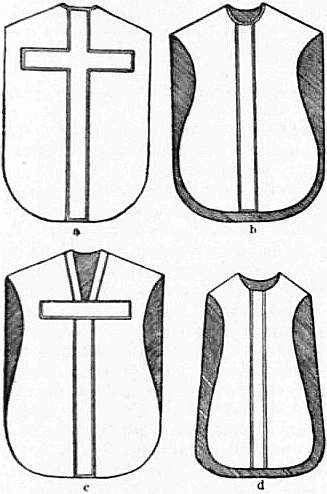
From Braun’s Liturgische Gewandung, by permission of the publisher, B. Herder. Fig. 1.—Comparative shape and size of Chasubles as now in use in various countries. a, b, German. c, Roman. d, Spanish.
CHASUBLE (Fr. chasuble, Ger. Kasel, Span. casulla; Late Lat. casula, a little house, hut, from casa), a liturgical vestment of the Catholic Church. It is the outermost garment worn by bishops and priests at the celebration of the Mass, forming with the alb (q.v.) the most essential part of the eucharistic vestments. Since it is only used at the Mass, or rarely for functions intimately connected with the sacrament of the altar, it may be regarded as the Mass vestment par excellence. The chasuble is thus in a special sense the sacerdotal vestment, and at the ordination of priests, according to the Roman rite, the bishop places on the candidate a chasuble rolled up at the back (planeta plicata), with the words, “Take the sacerdotal robe, the symbol of love,” &c.; at the end of the ordination Mass the vestment is unrolled. The chasuble or planeta (as it is called in the Roman missal), according to the prevailing model in the Roman Catholic Church, is a scapular-like cloak, with a hole in the middle for the head, falling down over breast and back, and leaving the arms uncovered at the sides. Its shape and size, however, differ considerably in various countries (see fig. 1), while some churches—e.g. those of certain monastic orders—have retained or reverted to the earlier “Gothic” forms to be described later. According to the decisions of the Congregation of Rites chasubles must not be of linen, cotton or woollen stuffs, but of silk; though a mixture of wool (or linen and cotton) and silk is allowed if the silk completely cover the other material on the outer side; spun glass thread, as a substitute for gold or silver thread, is also forbidden, owing to the possible danger to the priest’s health through broken fragments falling into the chalice.
The chasuble, like the kindred vestments (the φελόνιον, &c.) in the Eastern Churches, is derived from the Roman paenula or planeta, a cloak worn by all classes and both sexes in the Graeco-Roman world (see Vestments). Though early used in the celebration of the liturgy it had for several centuries no specifically liturgical character, the first clear instances of its ritual use being in a letter of St Germanus of Paris (d. 576), and the next in the twenty-eighth canon of the Council of Toledo (633). Much later than this, however, it was still an article of everyday clerical dress, and as such was prescribed by the German council convened by Carloman and presided over by St Boniface in 742. Amalarius of Metz, in his De ecclesiasticis officiis (ii. 19), tells us in 816 that the casula is the generale indumentum sacrorum ducum and “is proper generally to all the clergy.” It was not until the 11th century, when the cope (q.v.) had become established as a liturgical vestment, that the chasuble began to be reserved as special to the sacrifice of the Mass. As illustrating this process Father Braun (p. 170) cites an interesting correspondence between Archbishop Lanfranc of Canterbury and John of Avranches, archbishop of Rouen, as to the propriety of a bishop wearing a chasuble at the consecration of a church, Lanfranc maintaining as an established principle that the vestment should be reserved for the Mass. By the 13th century, with the final development of the ritual of the Mass, the chasuble became definitely fixed as the vestment of the celebrating priest; though to this day in the Roman Church relics of the earlier general use of the chasuble survive in the planeta plicata worn by deacons and subdeacons in Lent and Advent, and other penitential seasons.
At the Reformation the chasuble was rejected with the other vestments by the more extreme Protestants. Its use, however, survived in the Lutheran churches; and though in those of Germany it is no longer worn, it still forms part of the liturgical costume of the Scandinavian Evangelical churches. In the Church of England, though it was prescribed alternatively with the cope in the First Prayer-Book of Edward VI., it was ultimately discarded, with the other “Mass vestments,” the cope being substituted for it at the celebration of the Holy Communion in cathedral and collegiate churches; its use has, however, during the last fifty years been widely revived in connexion with the reactionary movement in the direction of the pre-Reformation doctrine of the eucharist. The difficult question of its legality is discussed in the article Vestments.
Form.—The chasuble was originally a tent-like robe which fell in loose folds below the knee (see Plate I. fig. 4). Its obvious inconvenience for celebrating the holy mysteries, however, caused its gradual modification. The object of the change was primarily to leave the hands of the celebrant freer for the careful performance of the manual acts, and to this end a process of cutting away at the sides of the vestment began, which continued until the tent-shaped chasuble of the 12th century had developed in the 16th into the scapular-like vestment at present in use. This process was, moreover, hastened by the substitution of costly and elaborately embroidered materials for the simple stuffs of which the vestment had originally been composed; for, as it became heavier and stiffer, it necessarily had to be made smaller. For the extremely exiguous proportions of some chasubles actually in use, which have been robbed of all the beauty of form they ever possessed, less respectable motives have sometimes been responsible, viz. the desire of their makers to save on the materials. The most beautiful form of the chasuble is undoubtedly the “Gothic” (see the figure of Bishop Johannes of Lübeck in the article Vestments), which is the form most affected by the Anglican clergy, as being that worn in the English Church before the Reformation.
Decoration.—Though planetae decorated with narrow orphreys are occasionally met with in the monuments of the early centuries, these vestments were until the 10th century generally quite plain, and even at the close of this century, when the custom of decorating the chasuble with orphreys had become common, there was no definite rule as to their disposition; sometimes they were merely embroidered borders to the neck-opening or hem, sometimes a vertical strip down the back, less often a forked cross, the arms of which turned upwards over the shoulders. From this time onward, however, the embroidery became ever more and more elaborate, and with this tendency the orphreys were broadened to allow of their being decorated with figures. About the middle of the 13th century, the cross with horizontal arms begins to appear on the back of the vestment, and by the 15th this had become the most usual form, though the forked cross also survived—e.g. in England, where it is now considered distinctive of the chasuble as worn in the Anglican Church. Where the forked cross is used it is placed both on the back and front of the vestment; the horizontal-armed cross, on the other hand, is placed only on the back, the front being decorated with a vertical strip extending to the lower hem (fig. 1, b, d). Sometimes the back of the chasuble has no cross, but only a vertical orphrey, and in this case the front, besides the vertical stripe, has a horizontal orphrey just below the neck opening (see Plate I. fig. 2). This latter is the type used in the local Roman Church, which has been adopted in certain dioceses in South Germany and Switzerland, and of late years in the Roman Catholic churches in England, e.g. Westminster cathedral (see Plate I. figs. 3 and 5).
Plate I.
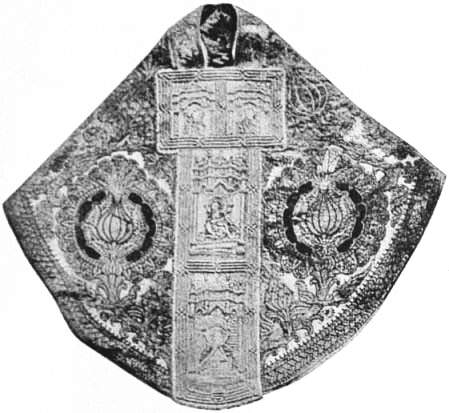
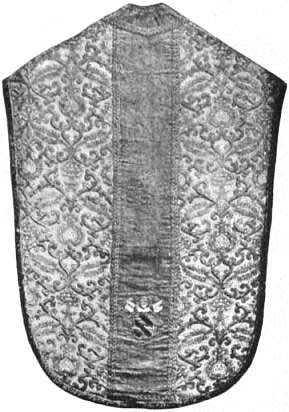
Fig. 2.—Chasuble of Pope Calixtus III. (15th century) preserved at Valencia. Fig. 3.—Chasuble of Pope Pius V. (late 15th century) at S. Maria Maggiore at Rome.
From a photograph by Father J.L. Braun in Die liturg Gewandung, by permission of the publisher, B. Herder. From a photograph by Father J.L. Braun in Die liturg Gewandung.
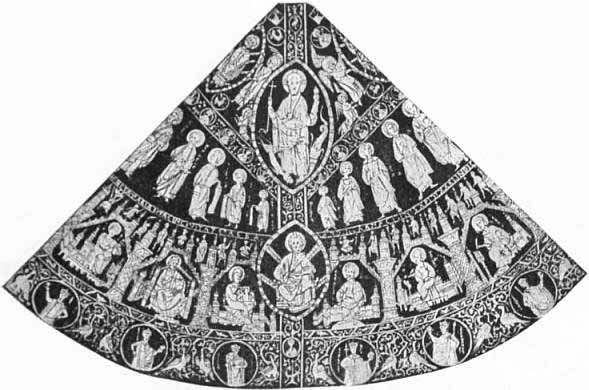
Fig. 4.—Chasuble dedicated by Stephen of Hungary (997-1038) and his wife Gisela, used as the Hungarian Coronation Robe.
(From Braun, Die liturg. Gewandung.)
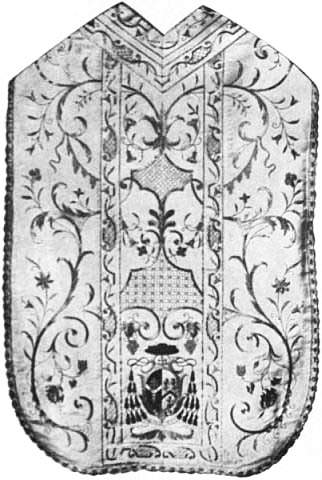
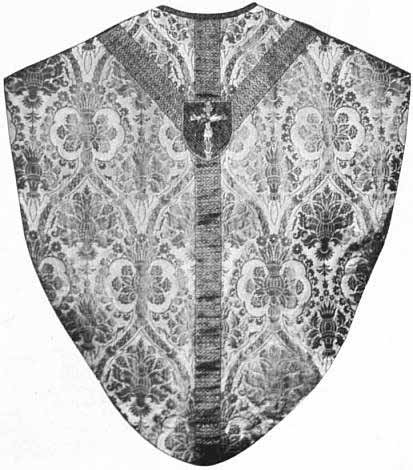
Fig. 5.—Modern Roman Chasuble of Archbishop Bourne of Westminster. Fig. 6.—Modern English Chasuble, used at St Paul’s Church, Knightsbridge, London.
Plate II.
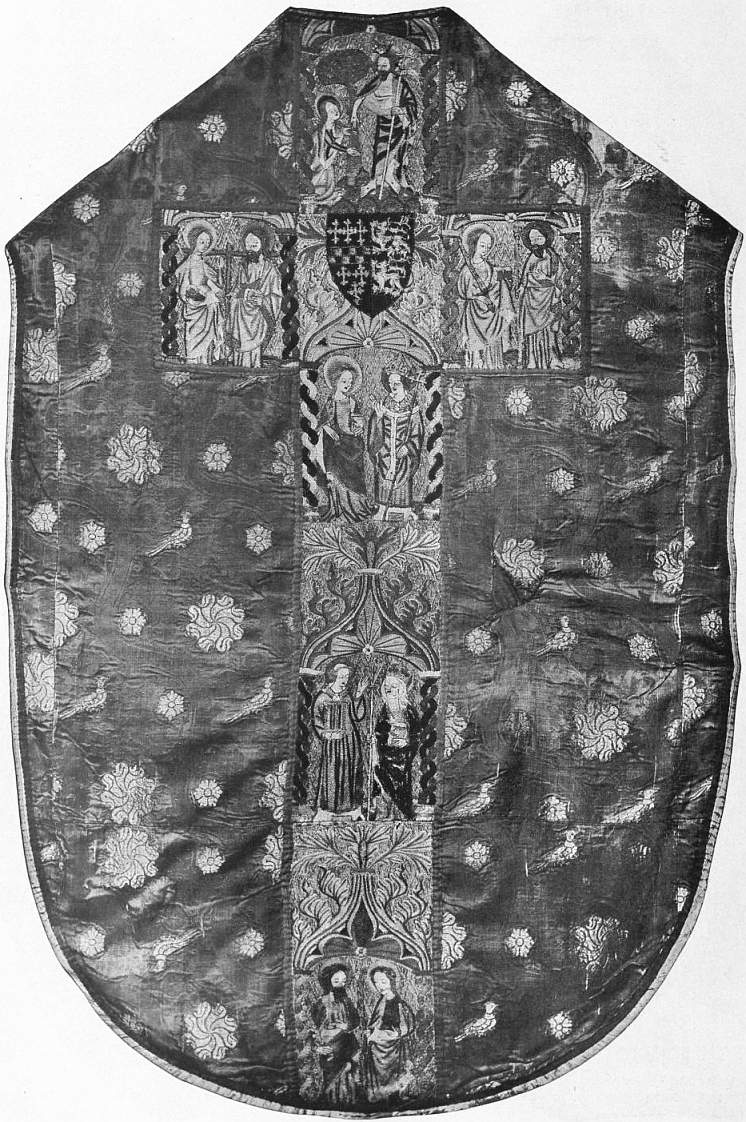
Fig. 7.—Back of a Chasuble of Italian Brocaded Damask (Red) with Embroidered Orphreys. The Vestment is of the early 16th century, the Orphreys of the late 14th century. (English. In the Victoria and Albert Museum.)
It has been widely held that the forked cross was a conscious imitation of the archiepiscopal pallium (F. Bock, Gesch. der liturg. Gewänder, ii. 107), and that the chasuble so decorated is proper to archbishops. Father Braun, however, makes it quite clear that this was not the case, and gives proof that this decoration was not even originally conceived as a cross at all, citing early instances of its having been worn by laymen and even by non-Christians (p. 210). It was not until the 13th century that the symbolical meaning of the cross began to be elaborated, and this was still further accentuated from the 14th century onward by the increasingly widespread custom of adding to it the figure of the crucified Christ and other symbols of the Passion. This, however, did not represent any definite rule; and the orphreys of chasubles were decorated with a great variety of pictorial subjects, scriptural or drawn from the stories of the saints, while the rest of the vestment was either left plain or, if embroidered, most usually decorated with arabesque patterns of foliage or animals. The local Roman Church, true to its ancient traditions, adhered to the simpler forms. The modern Roman chasuble pictured in Plate I. fig. 5, besides the conventional arabesque pattern, is decorated, according to rule, with the arms of the archbishop and his see.
The Eastern Church.—The original equivalent of the chasuble is the phelonion (φελόνιον, φελόνης, φαινόλιον, from paenula). It is a full vestment of the type of the Western bell chasuble; but, instead of being cut away at the sides, it is for convenience’ sake either gathered up or cut short in front. In the Armenian, Syrian, Chaldaean and Coptic rites it is cope-shaped. There is some difference of opinion as to the derivation of the vestment in the latter case; the Five Bishops (Report to Convocation, 1908) deriving it, like the cope, from the birrus, while Father Braun considers it, as well as the cope, to be a modification of the paenula.1 The phelonion (Arm. shurtshar, Syr. phaina, Chald. maaphra or phaina, Copt, burnos, felonion, kuklion) is confined to the priests in the Armenian, Syrian, Chaldaean and Coptic rites; in the Greek rite it is worn also by the lectors. It is not in the East so specifically a eucharistic vestment as in the West, but is worn at other solemn functions besides the liturgy, e.g. marriages, processions, &c.
Until the 11th century the phelonion is always pictured as a perfectly plain dark robe, but at this period the custom arose of decorating the patriarchal phelonion with a number of crosses, whence its name of πολυσταύριον. By the 14th century the use of these polystauria had been extended to metropolitans and later still to all bishops. The purple or black phelonion, however, remained plain in all cases. The Greeks and Greek Melchite metropolitans now wear the sakkos instead of the phelonion; and in the Russian, Ruthenian, Bulgarian and Italo-Greek churches this vestment has superseded the phelonion in the case of all bishops (see Dalmatic and Vestments).
See J. Braun, S.J., Die liturgische Gewandung (Freiburg im Breisgau, 1907), pp. 149-247, and the bibliography to the article Vestments.
(W. A. P.)
1 The writer is indebted to the courtesy of Father Braun for the following note:—“That the Syrian phaina was formerly a closed mantle of the type of the bell chasuble is clearly proved by the evidence of the miniatures of a Syrian pontifical (dated 1239) in the Bibliothèque Nationale at Paris (cf. Bild 16, 112, 284, in Die liturgische Gewandung). The liturgical vestments of the Armenians are derived, like their rite, from the Greek rite; so that in this case also there can be no doubt that the shurtshar was originally closed. The Coptic rite is in the same relation to the Syrian. Moreover, it would be further necessary to prove that the birrus, in contradistinction to the paenula, was always open in front; whereas, per contra, the paenula, both as worn by soldiers and in ordinary life, was, like the modern Arab burnus, often slit up the front to the neck. For the rest, it is obvious that if the Syrian phaina was still quite closed in the 13th century, and was only provided with a slit since that time, the same is very probable in the case of the Armenian chasuble. The absence of the hood might also be taken as additional proof of the derivation of the phaina from the paenula, but I should not lay particular stress upon it. The question is settled by the above-mentioned miniatures.”
CHÂTEAU (from Lat. castellum, fortress, through O. Fr. chastel, chasteau), the French word for castle (q.v.). The development of the medieval castle, in the 15th and 16th centuries, into houses arranged rather for residence than defence led to a corresponding widening of the meaning of the term château, which came to be applied to any seigniorial residence and so generally to all houses, especially country houses, of any pretensions (cf. the Ger. Schloss). The French distinguish the fortified castle from the residential mansion by describing the former as the château fort, the latter as the château de plaisance. The development of the one into the other is admirably illustrated by surviving buildings in France, especially in the châteaux scattered along the Loire. Of these Langeais, still in perfect preservation, is a fine type of the château fort, with its 10th-century keep and 13th-century walls. Amboise (1490), Blois (1500-1540), Chambord (begun 1526), Chenonceaux (1515-1560), Azay-le-Rideau (1521), may be taken as typical examples of the château de plaisance of the transition period, all retaining in greater or less degree some of the architectural characteristics of the medieval castle. Some description of these is given under their several headings. In English the word château is often used to translate foreign words (e.g. Schloss) meaning country house or mansion.
For the Loire châteaux see Theodore Andrea Cook, Old Touraine (1892).
CHATEAUBRIAND, FRANÇOIS RENÉ, Vicomte de (1768-1848), French author, youngest son of René Auguste de Chateaubriand, comte de Combourg,1 was born at St Malo on the 4th of September 1768. He was a brilliant representative of the reaction against the ideas of the French Revolution, and the most conspicuous figure in French literature during the First Empire. His naturally poetical temperament was fostered in childhood by picturesque influences, the mysterious reserve of his morose father, the ardent piety of his mother, the traditions of his ancient family, the legends and antiquated customs of the sequestered Breton district, above all, the vagueness and solemnity of the neighbouring ocean. His closest friend was his sister Lucile,2 a passionate-hearted girl, divided between her devotion to him and to religion. François received his education at Dol and Rennes, where Jean Victor Moreau was among his fellow-students. From Rennes he proceeded to the College of Dinan, and passed some years in desultory study in preparation for the priesthood. He finally decided, after a year’s holiday at the family château of Combourg, that he had no vocation for the Church, and was on the point of proceeding to try his fortune in India when he received (1786) a commission in the army. After a short visit to Paris he joined his regiment at Cambrai, and early in the following year was presented at court. In 1788 he received the tonsure in order to enter the order of the Knights of Malta. In Paris (1787-1789) he made acquaintance with the Parisian men of letters. He met la Harpe, Évariste Parny, “Pindare” Lebrun, Nicolas Chamfort, Pierre Louis Ginguené, and others, of whom he has left portraits in his memoirs.
Chateaubriand was not unfavourable to the Revolution in its first stages, but he was disturbed by its early excesses; moreover, his regiment was disbanded, and his family belonged to the party of reaction. His political impartiality, he says, pleased no one. These causes and the restlessness of his spirit induced him to take part in a romantic scheme for the discovery of the North-West Passage, in pursuance of which he departed for America in the spring of 1791. The passage was not found or even attempted, but the adventurer returned enriched with the—to him—more important discovery of his own powers and vocation, conscious of his marvellous faculty for the delineation of nature, and stored with the new ideas and new imagery, derived from the virgin forests and magnificent scenery of the western continent. That he actually lived among the Indians, however, is shown by Bedier to be doubtful, and the same critic has exposed the untrustworthiness of the autobiographical details of his American trip. His knowledge of America was mainly derived from the books of Charlevoix and others.
The news of the arrest of Louis XVI. at Varennes in June 1791 recalled him to France. In 1792 he married Mlle Céleste Buisson de Lavigne, a girl of seventeen, who brought him a small fortune. This enabled him to join the ranks of the emigrants, a course practically imposed on him by his birth and his profession as a soldier. After the failure of the duke of Brunswick’s invasion he contrived to reach Brussels, where he was left wounded and apparently dying in the street. His brother succeeded in obtaining some shelter for him, and sent him to Jersey. The captain of the boat in which he travelled left him on the beach in Guernsey. He was once more rescued from death, this time by some fishermen. After spending some time in the Channel Islands under the care of an emigrant uncle, the comte de Bédée, he made his way to London. In England he lived obscurely for several years, gaining an intimate acquaintance with English literature and a practical acquaintance with poverty. His own account of this period has been exposed by A. le Braz, Au pays d’exil de Chateaubriand (1909), and by E. Dick, Revue d’histoire littéraire de la France (1908), i. From his English exile dates the Natchez (first printed in his Œuvres complètes, 1826-1831), a prose epic designed to portray the life of the Red Indians. Two brilliant episodes originally designed for this work, Atala and René, are among his most famous productions. Chateaubriand’s first publication, however, was the Essai historique, politique et moral sur les révolutions ... (London, 1797), which the author subsequently retracted, but took care not to suppress. In this volume he appears as a mediator between royalist and revolutionary ideas, a free-thinker in religion, and a philosopher imbued with the spirit of Rousseau. A great change in his views was, however, at hand, induced, according to his own statement, by a letter from his sister Julie (Mme de Farcy), telling him of the grief his views had caused his mother, who had died soon after her release from the Conciergerie in the same year. His brother had perished on the scaffold in April 1794, and both his sisters, Lucile and Julie, and his wife had been imprisoned at Rennes. Mme de Farcy did not long survive her imprisonment.
Chateaubriand’s thoughts turned to religion, and on his return to France in 1800 the Génie du christianisme was already in an advanced state. Louis de Fontanes had been a fellow-exile with Chateaubriand in London, and he now introduced him to the society of Mme de Staël, Mme Récamier, Benjamin Constant, Lucien Bonaparte and others. But Chateaubriand’s favourite resort was the salon of Pauline de Beaumont, who was destined to fill a great place in his life, and gave him some help in the preparation of his work on Christianity, part of the book being written at her house at Savigny. Atala, ou les amours de deux sauvages dans le désert, used as an episode in the Génie du christianisme, appeared separately in 1801 and immediately made his reputation. Exquisite style, impassioned eloquence and glowing descriptions of nature gained indulgence for the incongruity between the rudeness of the personages and the refinement of the sentiments, and for the distasteful blending of prudery with sensuousness. Alike in its merits and defects the piece is a more emphatic and highly coloured Paul et Virginie; it has been justly said that Bernardin Saint-Pierre models in marble and Chateaubriand in bronze. Encouraged by his success the author resumed his Génie du christianisme, ou beautés de la religion chrétienne, which appeared in 1802, just upon the eve of Napoleon’s re-establishment of the Catholic religion in France, for which it thus seemed almost to have prepared the way. No coincidence could have been more opportune, and Chateaubriand came to esteem himself the counterpart of Napoleon in the intellectual order. In composing his work he had borne in mind the admonition of his friend Joseph Joubert, that the public would care very little for his erudition and very much for his eloquence. It is consequently an inefficient production from the point of view of serious argument. The considerations derived from natural theology are but commonplaces rendered dazzling by the magic of style; and the parallels between Christianity and antiquity, especially in arts and letters, are at best ingenious sophistries. The less polemical passages, however, where the author depicts the glories of the Catholic liturgy and its accessories, or expounds its symbolical significance, are splendid instances of the effect produced by the accumulation and judicious distribution of particulars gorgeous in the mass, and treated with the utmost refinement of detail. The work is a masterpiece of literary art, and its influence in French literature was immense. The Éloa of Alfred de Vigny, the Harmonies of Lamartine and even the Légende des siècles of Victor Hugo may be said to have been inspired by the Génie du christianisme. Its immediate effect was very considerable. It admirably subserved the statecraft of Napoleon, and Talleyrand in 1803 appointed the writer attaché to the French legation at Rome, whither he was followed by Mme de Beaumont, who died there.
When his insubordinate and intriguing spirit compelled his recall he was transferred as envoy to the canton of the Valais. The murder of the duke of Enghien (21st of March 1804) took place before he took up this appointment. Chateaubriand, who was in Paris at the time, showed his courage and independence by immediately resigning his post. In 1807 he gave great offence to Napoleon by an article in the Mercure de France (4th of July), containing allusions to Nero which were rightly taken to refer to the emperor. The Mercure, of which he had become proprietor, was temporarily suppressed, and was in the next year amalgamated with the Décade. Chateaubriand states in his Mémoires that his life was threatened, but it is more than possible that he exaggerated the danger. Before this, in 1806, he made a pilgrimage to Jerusalem, undertaken, as he subsequently acknowledged, less in a devotional spirit than in quest of new imagery. He returned by way of Tunis, Carthage, Cadiz and Granada. At Granada he met Mme de Mouchy, and the place and the meeting apparently suggested the romantic tale of Le Dernier Abencérage, which, for political reasons, remained unprinted until the publication of the Œuvres complètes (1826-1831). The journey also produced L’Itinéraire de Paris à Jérusalem ... (3 vols., 1811), a record of travel distinguished by the writer’s habitual picturesqueness; and inspired his prose epic, Les Martyrs, ou le triomphe de la religion chrétienne (2 vols., 1809). This work may be regarded as the argument of the Génie du christianisme thrown into an objective form. As in the Epicurean of Thomas Moore, the professed design is the contrast between Paganism and Christianity, which fails of its purpose partly from the absence of real insight into the genius of antiquity, and partly because the heathen are the most interesting characters after all. René had appeared in 1802 as an episode of the Génie du christianisme, and was published separately at Leipzig without its author’s consent in the same year. It was perhaps Chateaubriand’s most characteristic production. The connecting link in European literature between Werther and Childe Harold, it paints the misery of a morbid and dissatisfied soul. The representation is mainly from the life. Chateaubriand betrayed amazing egotism in describing his sister Lucile in the Amélie of the story, and much is obviously descriptive of his own early surroundings. With Les Natchez his career as an imaginative writer is closed. In 1831 he published his Études ou discours historiques ... (4 vols.) dealing with the fall of the Roman Empire.
As a politician Chateaubriand was equally formidable to his antagonists when in opposition and to his friends when in office. His poetical receptivity and impressionableness rendered him no doubt honestly inconsistent with himself; his vanity and ambition, too morbidly acute to be restrained by the ties of party allegiance, made him dangerous and untrustworthy as a political associate. He was forbidden to deliver the address he had prepared (1811) for his reception to the Academy on M.J. Chénier on account of the bitter allusions to Napoleon contained in it. From this date until 1814 Chateaubriand lived in seclusion at the Vallée-aux-loups, an estate he had bought in 1807 at Aulnay. His pamphlet De Bonaparte, des Bourbons, et de la nécessité de se rattier à nos princes légitimes, published on the 31st of March 1814, the day of the entrance of the allies into Paris, was as opportune in the moment of its appearance as the Génie du christianisme, and produced a hardly less signal effect. Louis XVIII. declared that it had been worth a hundred thousand men to him. Chateaubriand, as minister of the interior, accompanied him to Ghent during the Hundred Days, and for a time associated himself with the excesses of the royalist reaction. Political bigotry, however, was not among his faults; he rapidly drifted into liberalism and opposition, and was disgraced in September 1816 for his pamphlet De la monarchie selon la charte. He had to sell his library and his house of the Vallée-aux-loups.
After the fall of his opponent, the due Decazes, Chateaubriand obtained the Berlin embassy (1821), from which he was transferred to London (1822), and he also acted as French plenipotentiary at the Congress of Verona (1822). He here made himself mainly responsible for the iniquitous invasion of Spain—an expedition undertaken, as he himself admits, with the idea of restoring French prestige by a military parade. He next received the portfolio of foreign affairs, which he soon lost by his desertion of his colleagues on the question of a reduction of the interest on the national debt. After another interlude of effective pamphleteering in opposition, he accepted the embassy to Rome in 1827, under the Martignac administration, but resigned it at Prince Polignac’s accession to office. On the downfall of the elder branch of the Bourbons, he made a brilliant but inevitably fruitless protest from the tribune in defence of the principle of legitimacy. During the first half of Louis Philippe’s reign he was still politically active with his pen, and published a Mémoire sur la captivité de madame la duchesse de Berry (1833) and other pamphlets in which he made himself the champion of the exiled dynasty; but as years increased upon him, and the prospect of his again performing a conspicuous part diminished, he relapsed into an attitude of complete discouragement. His Congrès de Vérone (1838), Vie de Rancé (1844), and his translation of Milton, Le Paradis perdu de Milton (1836), belong to the writings of these later days. He died on the 4th of July 1848, wholly exhausted and thoroughly discontented with himself and the world, but affectionately tended by his old friend Madame Récamier, herself deprived of sight. For the last fifteen years of his life he had been engaged on his Mémoires, and his chief distraction had been his daily visit to Madame Récamier, at whose house he met the European celebrities. He was buried in the Grand Bé, an islet in the bay of St Malo. Shortly after his death his memory was revived, and at the same time exposed to much adverse criticism, by the publication, with sundry mutilations as has been suspected, of his celebrated Mémoires d’outre-tombe (12 vols., 1849-1850). These memoirs undoubtedly reveal his vanity, his egotism, the frequent hollowness of his professed convictions, and his incapacity for sincere attachment, except, perhaps, in the case of Madame Récamier. Though the book must be read with the greatest caution, especially in regard to persons with whom Chateaubriand came into collision, it is perhaps now the most read of all his works.
Chateaubriand ranks rather as a great rhetorician than as a great poet. Something of affectation or unreality commonly interferes with the enjoyment of his finest works. The Génie du christianisme is a brilliant piece of special pleading; Atala is marred by its unfaithfulness to the truth of uncivilized human nature, René by the perversion of sentiment which solicits sympathy for a contemptible character. Chateaubriand is chiefly significant as marking the transition from the old classical to the modern romantic school. The fertility of ideas, vehemence of expression and luxury of natural description, which he shares with the romanticists, are controlled by a discipline learnt in the school of their predecessors. His palette, always brilliant, is never gaudy; he is not merely a painter but an artist. He is also a master of epigrammatic and incisive sayings. Perhaps, however, the most truly characteristic feature of his genius is the peculiar magical touch which Matthew Arnold indicated as a note of Celtic extraction, which reveals some occult quality in a familiar object, or tinges it, one knows not how, with “the light that never was on sea or land.” This incommunicable gift supplies an element of sincerity to Chateaubriand’s writings which goes far to redeem the artificial effect of his calculated sophistry and set declamation. It is also fortunate for his fame that so large a part of his writings should directly or indirectly refer to himself, for on this theme he always writes well. Egotism was his master-passion, and beyond his intrepidity and the loftiness of his intellectual carriage his character presents little to admire. He is a signal instance of the compatibility of genuine poetic emotion, of sympathy with the grander aspects both of man and nature, and of munificence in pecuniary matters, with absorption in self and general sterility of heart.
Bibliography.—The Œuvres complétes of Chateaubriand were printed in 28 vols., 1826-1831; in 20 vols., 1829-1831; and in many later editions, notably in 1858-1861, in 20 volumes, with an introductory study by Sainte-Beuve. The principal authority for Chateaubriand’s biography is the Mémoires d’outre-tombe (1849-1850), of which there is an English translation, The Memoirs of ... Chateaubriand (6 vols., 1902), by A. Teixeira de Mattos, based on the admirable edition (4 vols., 1899-1901) of Edmond Biré. This work should be supplemented by the Souvenirs et correspondances tirés des papiers de Mme Récamier (2 vols., 1859, ed. Mme Ch. Lenormant). See also Comte de Marcellus, Chateaubriand et son temps (1859); the same editor’s Souvenirs diplomatiques; correspondance intime de Chateaubriand (1858); C.A. Sainte-Beuve, Chateaubriand et son groupe littéraire sous l’empire (2 vols., 1861, new and revised ed., 3 vols., 1872); other articles by Sainte-Beuve, who was in this case a somewhat prejudiced critic, in the Portraits contemporains, vols. i. and ii.; Causeries du lundi, vols. i., ii. and x.; Nouveaux Lundis, vol. iii.; Premiers Lundis, vol. iii.; A. Vinet, Études sur la litt. française au XIXe siècle (1849); M. de Lescure, Chateaubriand (1892) in the Grands écrivains français; Émile Faguet, Études littéraires sur le XIXe siècle (1887); and Essai d’une bio-bibliographie de Chateaubriand et de sa famille (Vannes, 1896), by René Kerviler. Joseph Bedier, in Études critiques (1903), deals with the American writings. Some correspondence with Sainte-Beuve was edited by Louis Thomas in 1904, and some letters to Mme de Staël appeared in the Revue des deux mondes (Oct. 1903).
1 For full details of the Chateaubriand family see R. Kerviler, Essai d’une bio-bibliographie de Chateaubriand et de sa famille (Vannes, 1895).
2 Her Œuvres were edited in 1879, with a memoir, by Anatole France.
CHÂTEAUBRIANT, a town of western France, capital of an arrondissement in the department of Loire-Inférieure, on the left bank of the Chère, 40 m. N.N.E. of Nantes by rail. Pop. (1906) 5969. Châteaubriant takes its name from a castle founded in the 11th century by Brient, count of Penthièvre, remains of which, consisting of a square donjon and four towers, still exist. Adjoining it is another castle, built in the first half of the 16th century by Jean de Laval, and famous in history as the residence of Françoise de Foix, mistress of Francis I. Of this the most beautiful feature is the colonnade running at right angles to the main building, and connecting it with a graceful pavilion. It is occupied by a small museum and some of the public offices. There is also an interesting Romanesque church dedicated to St Jean de Béré. Châteaubriant is the seat of a subprefect and has a tribunal of first instance. It is an important centre on the Ouest-État railway, and has trade in agricultural products. The manufacture of leather, agricultural implements and preserved angelica are carried on. In 1551 Henry II. signed an edict against the reformed religion at Châteaubriant.
CHÂTEAUDUN, a town of north central France, capital of an arrondissement in the department of Eure-et-Loir, 28 m. S.S.W. of Chartres by rail. Pop. (1906) 5805. It stands on an eminence near the left bank of the Loire. The streets, which are straight and regular, radiate from a central square, a uniformity due to the reconstruction of the town after fires in 1723 and 1870. The château, the most remarkable building in the town, was built in great part by Jean, count of Dunois, and his descendants. Founded in the 10th century, and rebuilt in the 12th and 15th centuries, it consists of a principal wing with a fine staircase of the 16th century, and, at right angles, a smaller wing adjoined by a chapel. To the left of the courtyard thus formed rises a lofty keep of the 12th century. The fine apartments and huge kitchens of the château are in keeping with its imposing exterior. The church of La Madeleine dates from the 12th century; the buildings of the abbey to which it belonged are occupied by the subprefecture, the law court and the hospital. The medieval churches of St Valérien and St Jean and the ruined chapel of Notre-Dame du Champdé, of which the façade in the Renaissance style now forms the entrance to the cemetery, are other notable buildings. The public institutions include a tribunal of first instance and a communal college. Flour-milling, tanning and leather-dressing, and the manufacture of blankets, silver jewelry, nails and machinery are the prominent industries. Trade is in cattle, grain, wool and hemp. Châteaudun (Castrodunum), which dates from the Gallo-Roman period, was in the middle ages the capital of the countship of Dunois.
CHÂTEAU-GONTIER, a town of western France, capital of an arrondissement in the department of Mayenne, on the Mayenne, 18 m. S. by E. of Laval by road. Pop. (1906) 6871. Of its churches, that of St Jean, a relic of the castle, dates from the 11th century. Château-Gontier is the seat of a subprefect and has a tribunal of first instance, a communal college for boys and a small museum. It carries on wool- and cotton-spinning, the manufacture of serge, flannel and oil, and is an agricultural market. There are chalybeate springs close to the town. Château-Gontier owes its origin and its name to a castle erected in the first half of the 11th century by Gunther, the steward of Fulk Nerra of Anjou, on the site of a farm belonging to the monks of St Aubin d’Angers. On the extinction of the family, the lordship was assigned by Louis XI. to Philippe de Comines. The town suffered severely during the wars of the League. In 1793 it was occupied by the Vendeans.
CHÂTEAUNEUF, LA BELLE, the name popularly given to Renée de Rieux, daughter of Jean de Rieux, seigneur de Châteauneuf, who was descended from one of the greatest families of Brittany. The dates both of her birth and death are not known. She was maid of honour to the queen-mother Catherine de’ Medici, and inspired an ardent passion in the duke of Anjou, brother of Charles IX. This intrigue deterred the duke from the marriage which it was desired to arrange for him with Elizabeth of England; but he soon abandoned La Belle Châteauneuf for Marie of Cleves (1571). The court then wished to find a husband for Renee de Rieux, whose singular beauty gave her an influence which the queen-mother feared, and matches were in turn suggested with the voivode of Transylvania, the earl of Leicester, with Du Prat, provost of Paris, and with the count of Brienne, all of which came to nothing. Ultimately, on the ground that she had been lacking in respect towards the queen, Louise of Lorraine-Vaudémont, Renée was banished from the court. She married a Florentine named Antinotti, whom she stabbed in a fit of jealousy (1577); then she remarried, her husband being Philip Altoviti, who in 1586 was killed in a duel by the Grand Prior Henry of Angoulême, who was himself mortally wounded.
CHÂTEAU-RENAULT, FRANÇOIS LOUIS DE ROUSSELET, Marquis de (1637-1716), French admiral, was the fourth son of the third marquis of Château-Renault. The family was of Breton origin, but had been long settled near Blois. He entered the army in 1658, but in 1661 was transferred to the navy, which Louis XIV. was eager to raise to a high level of strength. After a short apprenticeship he was made captain in 1666. His early services were mostly performed in cruises against the Barbary pirates (1672). In 1673 he was named chef d’escadre, and he was promoted lieutenant général des armées navales in 1687. During the wars up to this date he had few chances of distinction, but he had been wounded in action with the pirates, and had been on a cruise to the West Indies. When war broke out between England and France after the revolution of 1688, he was in command at Brest, and was chosen to carry the troops and stores sent by the French king to the aid of James II. in Ireland. Although he was watched by Admiral Herbert (Lord Torrington, q.v.), with whom he fought an indecisive action in Bantry Bay, he executed his mission with success. Château-Renault commanded a squadron under Tourville at the battle of Beachy Head in 1690. He was with Tourville in the attack of the Smyrna convoy in 1693, and was named grand cross of the order of Saint Louis in the same year. Though in constant service, the reduced state of the French navy (owing to the financial embarrassments of the treasury) gave him few openings for fighting at sea during the rest of the war.
On the death of Tourville in 1701 he was named to the vacant post of vice-admiral of France. On the outbreak of the War of the Spanish Succession he was named for the difficult task of protecting the Spanish ships which were to bring the treasure from America. It was a duty of extreme delicacy, for the Spaniards were unwilling to obey a foreigner, and the French king was anxious that the bullion should be brought to one of his own ports, a scheme which the Spanish officials were sure to resent if they were allowed to discover what was meant. With the utmost difficulty Château-Renault was able to bring the galleons as far as Vigo, to which port he steered when he learnt that a powerful English and Dutch armament was on the Spanish coast, and had to recognize that the Spanish officers would not consent to make for a French harbour or for Passages, which they thought too near France. His fleet of fifteen French and three Spanish war-ships, having under their care twelve galleons, had anchored on the 22nd of September in Vigo Bay. Obstacles, some of an official character, and others due to the poverty of the Spanish government in resources, arose to delay the landing of the treasure. There was no adequate garrison in the town, and the local militia was untrustworthy. Knowing that he would probably be attacked, Château-Renault strove to protect his fleet by means of a boom. The order to land the treasure was delayed, and until it came from Madrid nothing could be done, since according to law it should have been landed at Cadiz, which had a monopoly of the trade with America. At last the order came, and the bullion was landed under the care of the Gallician militia which was ordered to escort it to Lugo. A very large part, if not the whole, was plundered by the militiamen and the farmers whose carts had been commandeered for the service. But the bulk of the merchandise was on board of the galleons when the allied fleet appeared outside of the bay on the 22nd of October 1702. Sir George Rooke and his colleagues resolved to attack. The fleet was carrying a body of troops which had been sent out to make a landing at Cadiz, and had been beaten off. The fortifications of Vigo were weak on the sea side, and on the land side there were none. There was therefore nothing to offer a serious resistance to the allies when they landed soldiers. The fleet of twenty-four sail was steered at the boom and broke through it, while the troops turned the forts and had no difficulty in scattering the Gallician militia. In the bay the action was utterly disastrous to the French and Spaniards. Their ships were all taken or destroyed. The booty gained was far less than the allies hoped, but the damage done to the French and Spanish governments was great.
Château-Renault suffered no loss of his master’s favour by his failure to save the treasure. The king considered him free from blame, and must indeed have known that the admiral had been trusted with too many secrets to make it safe to inflict a public rebuke. The Spanish government declined to give him the rank of grandee which was to have been the reward for bringing home the bullion safe. But in 1703 he was made a marshal of France, and shortly afterwards lieutenant-general of Brittany. The fight in Vigo Bay was the last piece of active service performed by Château-Renault. In 1708 on the death of his nephew he inherited the marquisate, and on the 15th of November 1716 he died in Paris. He married in 1684 Marie-Anne-Renée de la Porte, daughter and heiress of the count of Crozon. His eldest son was killed at the battle of Malaga 1704, and another, also a naval officer, was killed by accident in 1708. A third son, who too was a naval officer, succeeded him in the title.
A life of Château-Renault was published in 1903 by M. Calmon-Maison. There is a French as well as an English account of the part played by him at Bantry Bay and Beachy Head, and the controversy still continues. For the French history of the navy under Louis XIV. see Léon Guerin, Histoire maritime de la France (1863), vols. iii., iv.; and his Les Marins illustres (1861). Also the naval history by Charles Bouzel de la Roncière.
(D. H.)
CHÂTEAUROUX, MARIE ANNE DE MAILLY-NESLE, Duchesse de (1717-1744), mistress of Louis XV. of France, was the fourth daughter of Louis, marquis de Nesle, a descendant of a niece of Mazarin. In 1740, upon the death of her husband, the marquis de la Tournelle, she attracted the attention of Louis XV.; and by the aid of the duc de Richelieu, who, dominated by Madame de Tencin, hoped to rule both the king and the state, she supplanted her sister, Madame de Mailly, as titular mistress in 1742. Directed by Richelieu, she tried to arouse the king, dragging him off to the armies, and negotiated the alliance with Frederick II. of Prussia, in 1744. Her political rôle, however, has been exaggerated. Her triumph after the passing disgrace provoked by the king’s illness at Metz did not last long, for she died on the 8th of December 1744.
See Ed. and J. de Goncourt, La Duchesse de Châteauroux et ses sœurs (Paris, 1879).
CHÂTEAUROUX, a town of central France, capital of the department of Indre, situated in a plain on the left bank of the Indre, 88 m. S. of Orleans on the main line of the Orleans railway. Pop. (1906) 21,048. The old town, close to the river, forms a nucleus round which a newer and more extensive quarter, bordered by boulevards, has grown up; the suburbs of St Christophe and Déols (q.v.) lie on the right bank of the Indre. The principal buildings of Châteauroux are the handsome modern church of St André, in the Gothic style, and the Château Raoul, of the 14th and 15th centuries; the latter now forms part of the prefecture. The hôtel de ville contains a library and a museum which possesses a collection of paintings of the Flemish school and some interesting souvenirs of Napoleon I. A statue of General Henri Bertrand (1773-1844) stands in one of the principal squares. Châteauroux is the seat of a prefect and of a court of assizes. It has tribunals of first instance and of commerce, a board of trade-arbitrators, a branch of the Bank of France, a chamber of commerce, a lycée, a college for girls and training colleges. The manufacture of coarse woollens for military clothing and other purposes, and a state tobacco-factory, occupy large numbers of the inhabitants. Wool-spinning, iron-founding, brewing, tanning, and the manufacture of agricultural implements are also carried on. Trade is in wool, iron, grain, sheep, lithographic stone and leather. The castle from which Châteauroux takes its name was founded about the middle of the 10th century by Raoul, prince of Déols, and during the middle ages was the seat of a seigniory, which was raised to the rank of countship in 1497, and in 1616, when it was held by Henry II., prince of Condé, to that of duchy. In 1736 it returned to the crown, and was given by Louis XV. in 1744 to his mistress, Marie Anne de Mailly-Nesle, duchess of Châteauroux.
CHÂTEAU-THIERRY, a town of northern France, capital of an arrondissement in the department of Aisne, 59 m. E.N.E. of Paris on the Eastern railway to Nancy. Pop. (1906) 6872. Château-Thierry is built on rising ground on the right bank of the Marne, over which a fine stone bridge leads to the suburb of Marne. On the quay stands a marble statue erected to the memory of La Fontaine, who was born in the town in 1621; his house is still preserved in the street that bears his name. On the top of a hill are the ruins of a castle, which is said to have been built by Charles Martel for the Frankish king, Thierry IV., and is plainly the origin of the name of the town. The chief relic is a gateway flanked by massive round towers, known as the Porte Saint-Pierre. A belfry of the 15th century and the church of St Crépin of the same period are of some interest. The town is the seat of a sub-prefect and has a tribunal of first instance and a communal college. The distinctive industry is the manufacture of mathematical and musical instruments. There is trade in the white wine of the neighbourhood, and in sheep, cattle and agricultural products. Gypsum, millstone and paving-stone are quarried in the vicinity. Château-Thierry was formerly the capital of the district of Brie Pouilleuse, and received the title of duchy from Charles IX. in 1566. It was captured by the English in 1421, by Charles V. in 1544, and sacked by the Spanish in 1591. During the wars of the Fronde it was pillaged in 1652; and in the campaign of 1814 it suffered severely. On the 12th of February of the latter year the Russo-Prussian forces were beaten by Napoleon in the neighbourhood.
CHÂTELAIN (Med. Lat. castellanus, from castellum, a castle), in France originally merely the equivalent of the English castellan, i.e. the commander of a castle. With the growth of the feudal system, however, the title gained in France a special significance which it never acquired in England, as implying the jurisdiction of which the castle became the centre. The châtelain was originally, in Carolingian times, an official of the count; with the development of feudalism the office became a fief, and so ultimately hereditary. In this as in other respects the châtelain was the equivalent of the viscount (q.v.) sometimes the two titles were combined, but more usually in those provinces where there were châtelains there were no viscounts, and vice versa. The title châtelain continued also to be applied to the inferior officer, or concierge châtelain, who was merely a castellan in the English sense. The power and status of châtelains necessarily varied greatly at different periods and places. Usually their rank in the feudal hierarchy was equivalent to that of the simple sire (dominus), between the baron and the chevalier; but occasionally they were great nobles with an extensive jurisdiction, as in the Low Countries (see Burgrave). This variation was most marked in the cities, where in the struggle for power that of the châtelain depended on the success with which he could assert himself against his feudal superior, lay or ecclesiastical, or, from the 12th century onwards, against the rising power of the communes. The châtellenie (castellania), or jurisdiction of the châtelain, as a territorial division for certain judicial and administrative purposes, survived the disappearance of the title and office of the châtelain in France, and continued till the Revolution.
See Achille Luchaire, Manuel des institutions françaises (Paris, 1892); Du Cange, Glossarium, s. “Castellanus.”
CHATELAINE (Fr. châtelaine, the feminine form of châtelain, a keeper of a castle), the mistress of a castle. From the custom of a châtelaine to carry the keys of the castle suspended from her girdle, the word is now applied to the collection of short chains, often worn by ladies, to which are attached various small articles of domestic and toilet use, as keys, penknife, needlecase, scissors, &c.