VOLUME V SLICE III Capefigue to Carneades (continued 4)
Reading edition
Early editors chose to republish this collection of Ansegisus and Benedictus as they found it. It was a distinguished French scholar, Étienne Baluze, who led the way to a fresh classification. In 1677 he brought out the Capitularia regum francorum, in two folio volumes, in which he published first the capitularies of the Merovingian kings, then those of Pippin, of Charles and of Louis the Pious, which he had found complete in various manuscripts. After the date of 840, he published as supplements the unreliable collection of Ansegisus and Benedictus Levita, with the warning that the latter was quite untrustworthy. He then gave the capitularies of Charles the Bald, and of other Carolingian kings, either contemporaries or successors of Charles, which he had discovered in various places. A second edition of Baluze was published in 1780 in 2 volumes folio by Pierre de Chiniac.
The edition of the Capitularies made in 1835 by George Pertz, in the Monumenta Germaniae (folio edition, vol. i., of the Leges) was not much advance on that of Baluze. A fresh revision was required, and the editors of the Monumenta decided to reissue it in their quarto series, entrusting the work to Dr Alfred Boretius. In 1883 Boretius published his first volume, containing all the detached capitularies up to 827, together with various appendices bearing on them, and the collection of Ansegisus. Boretius, whose health had been ruined by overwork, was unable to finish his work; it was continued by Victor Krause, who collected in vol. ii. the scattered capitularies of a date posterior to 828. Karl Zeumer and Albrecht Werminghoff drew up a detailed index of both volumes, in which all the essential words are noted. A third volume, prepared by Emil Seckel, was to include the collection of Benedictus Levita.
(2) Among the capitularies are to be found documents of a very varied kind. Boretius has divided them into several classes:—
(a) The Capitula legibus addenda.—These are additions made by the king of the Franks to the barbarian laws promulgated under the Merovingians, the Salic law, the Ripuarian or the Bavarian. These capitularies have the same weight as the law which they complete; they are particular in their application, applying, that is to say, only to the men subject to that law. Like the laws, they consist chiefly of scales of compensation, rules of procedure and points of civil law. They were solemnly promulgated in the local assemblies where the consent of the people was asked. Charlemagne and Louis the Pious seem to have made efforts to bring the other laws into harmony with the Salic law. It is also to be noted that by certain of the capitularies of this class, the king adds provisions affecting, not only a single law, but all the laws in use throughout the kingdom.
(b) The Capitula ecclesiastica.—These capitularies were elaborated in the councils of the bishops; the kings of the Franks sanctioned the canon of the councils, and made them obligatory on all the Christians in the kingdom.
(c) The Capitula per se scribenda.—These embodied political decrees which all subjects of the kingdom were bound to observe. They often bore the name of edictum or of constitutio, and the provisions made in them were permanent. These capitularies were generally elaborated by the king of the Franks in the autumn assemblies or in the committees of the spring assemblies. Frequently we have only the proposition made by the king to the committee, capitula tractanda cum comitibus, episcopis, et abbatibus, and not the final form which was adopted.
(d) The Capitula missorum, which are the instructions given by Charlemagne and his successors to the missi sent into the various parts of the empire. They are sometimes drawn up in common for all the missi of a certain year—capitula missorum generalia; sometimes for the missi sent only on a given circuit—capitula missorum specialia. These instructions sometimes hold good only for the circuit of the missus; they have no general application and are merely temporary.
(e) With the capitularies have been incorporated various documents; for instance, the rules to be observed in administering the king’s private domain (the celebrated capitulary de villis, which is doubtless a collection of the instructions sent at various times to the agents of these domains); the partitions of the kingdom among the king’s sons, as, the Divisio regnorum of 806, or the Ordinatio imperii of 817; the oaths of peace and brotherhood which were taken on various occasions by the sons of Louis the Pious, &c.
The merit of clearly establishing these distinctions belongs to Boretius. He has doubtless exaggerated the difference between the Capitula missorum and the Capitula per se scribenda; among the first are to be found provisions of a general and permanent nature, and among the second temporary measures are often included. But the idea of Boretius is none the less fruitful. In the capitularies there are usually permanent provisions and temporary provisions intermingled; and the observation of this fact has made it possible more clearly to understand certain institutions of Charlemagne, e.g. military service.
After the reign of Louis the Pious the capitularies became long and diffuse. Soon, from the 10th century onwards, no provision of general application emanates from the kings. Henceforth the kings only regulated private interests by charters; it was not until the reign of Philip Augustus that general provisions again appeared; but when they did so, they bore the name of ordinances (ordonnances).
There were also capitularies of the Lombards. These capitularies formed a continuation of the Lombard laws, and are printed as an appendix to these laws by Boretius in the folio edition of the Monumenta Germaniae, Leges, vol. iv.
Authorities.—-Boretius, Die Capitularien im Longobardenreich (Halle, 1864); and Beitrage zur Capitularienkritik (Leipzig, 1874); G. Seeliger, Die Kapitularien der Karolinger (Munich, 1893). See also the histories of institutions or of law by Waitz, Brunner, Fustel de Coulanges, Viollet, Esmein.
(C. Pf.)
CAPITULATION (Lat. capitulum, a little head or division; capitulare, to treat upon terms), an agreement in time of war for the surrender to a hostile armed force of a particular body of troops, a town or a territory. It is an ordinary incident of war, and therefore no previous instructions from the captor’s government are required before finally settling the conditions of capitulation. The most usual of such conditions are freedom of religion and security of private property on the one hand, and a promise not to bear arms within a certain period on the other. Such agreements may be rashly concluded with an inferior officer, on whose authority the enemy are not in the actual position of the war entitled to place reliance. When an agreement is made by an officer who has not the proper authority or who has exceeded the limits of his authority, it is termed a sponsion, and, to be binding, must be confirmed by express or tacit ratification. Article 35 of the Hague Convention (1899) on the laws and the customs of war lays down that “capitulations agreed on between the contracting parties must be in accordance with the rules of military honour. When once settled they must be observed by both the parties.”
In another sense, capitulation is the name given to an arrangement by which foreigners are withdrawn, for most civil and criminal purposes, from the jurisdiction of the state making the capitulation. Thus in Turkey arrangements termed capitulations (q.v.), and treaties confirmatory of them, have been made between the Porte and other states by which foreigners resident in Turkey are subject to the laws of their respective countries. The term is also applied by French writers to the oath which on his election the Holy Roman emperor used to make to the college of electors; this related chiefly to such matters as regalian rights, appeals from local jurisdictions, the rights of the pope, &c.
CAPITULATIONS (from Lat. caput, or its Low-Latin diminutive capitulum, as indicating the form in which these acts were set down in “chapters”; the Gr. equivalent cephaleosis, kephalaiosis, is occasionally used in works of the 17th century), treaties granted by a state and conferring the privilege of extra-territorial jurisdiction within its boundaries on the subjects of another state. Thus, in the 9th century, the caliph Harun-al-Rashid engaged to grant guarantees and commercial facilities to such Franks, subjects of the emperor Charlemagne, as should visit the East with the authorization of their emperor. After the break-up of the Frank empire, similar concessions were made to some of the practically independent Italian city states that grew up on its ruins. Thus, in 1098, the prince of Antioch granted a charter of this nature to the city of Genoa; the king of Jerusalem extended the same privilege to Venice in 1123 and to Marseilles in 1136. Salah-ud-din (Saladin), sultan of Babylon (Cairo), granted a charter to the town of Pisa in 1173. The Byzantine emperors followed this example, and Genoa, Pisa and Venice all obtained capitulations. The explanation of the practice is to be found in the fact that the sovereignty of the state was held in those ages to apply only to its subjects; foreigners were excluded from its rights and obligations. The privilege of citizenship was considered too precious to be extended to the alien, who was long practically an outlaw. But when the numbers, wealth and power of foreigners residing within the state became too great, it was found to be politic to subject them to some law, and it was held that this law should be their own. When the Turkish rule was substituted for that of the Byzantine emperors, the system already in existence was continued; the various non-Moslem peoples were allowed their semi-autonomy in matters affecting their personal status, and the Genoese of Galata were confirmed in their privileges. But the first capitulation concluded with a foreign state was that of 1535 granted to the French. Lest it should be imagined that this was a concession wrested by the victorious Christian monarch from the decadent Turk, it should be borne in mind that Turkey was then at the height of her power, and that Francis I. had shortly before sustained a disastrous defeat at Pavia. His only hope of assistance lay in Suleiman I., whose attack on Vienna had been checked by the victorious Charles V. The appeal to Suleiman on the ground of the common interest of France and Turkey in overcoming Charles V.’s overweening power was successful; the secret mission of Frangipani, an unofficial envoy who could be disowned in case of failure, paved the way for De la Forest’s embassy in 1534, and in 1536 the capitulations were signed.1 They amounted to a treaty of commerce and a treaty allowing the establishment of Frenchmen in Turkey and fixing the jurisdiction to be exercised over them: individual and religious liberty is guaranteed to them, the king of France is empowered to appoint consuls in Turkey, the consuls are recognized as competent to judge the civil and criminal affairs of French subjects in Turkey according to French law, and the consuls may appeal to the officers of the sultan for their aid in the execution of their sentences. This, the first of the capitulations, is practically the prototype of its successors. Five years later, similar capitulations were concluded with Venice. The capitulations were at first held to be in force only during the lifetime of the sultan by whom they were granted; thus in 1569 Sultan Selim II. renewed the French capitulations granted by his predecessor. In 1583 England obtained her first capitulation, until which time France had been the official protector of all Europeans established in Turkey. Later on, England claimed to protect the subjects of other nations, a claim which is rejected in the French capitulations of 1597, 1604 and 1607, the last-named of which explicitly lays down that the subjects of all nations not represented at Constantinople by an ambassador shall be under French protection. In 1613 Holland obtained her first capitulation, with the assistance of the French ambassador, anxious to help a commercial rival of England. In 1673 the French, represented by the marquis de Nointel, succeeded in obtaining the renewal of the capitulations which, for various reasons, had remained unconfirmed since 1607. Louis XIV. had been anxious to secure the protectorate of all Catholics in Turkey, but was obliged to content himself with the recognition of his right to protect all Latins of non-Turkish nationality; his claims for the restoration to the Catholics of the Holy Places usurped by the Greeks was also rejected, the sultan only undertaking to promise to restore their churches to the Jesuit Capuchins. An important commercial gain was the reduction of the import duties from 5 to 3%; and all suits the value of which exceeded 4000 aspres in which French subjects sued, or were sued by, an Ottoman subject, were to be heard not by the ordinary tribunals but at the Porte itself. Later, France’s friendship secured for Turkey a successful negotiation of the peace of Belgrade in 1739, and the result was the capitulation of 1740; this is no longer limited in duration to the sultan’s lifetime but is made perpetual, and, moreover, declares that it cannot be modified without the assent of the French. It conferred on the French ambassador precedence over his colleagues. Austria had obtained capitulations in 1718, modified in 1784; Russia secured similar privileges in 1784. In the course of the 18th century nearly every European power had obtained these, and such newly-established countries as the United States of America, Belgium and Greece followed in the 19th century.
The chief privileges granted under the capitulations to foreigners resident in Turkey are the following: liberty of residence, inviolability of domicile, liberty to travel by land and sea, freedom of commerce, freedom of religion, immunity from local jurisdiction save under certain safeguards, exclusive extra-territorial jurisdiction over foreigners of the same nationality, and competence of the forum of the defendant in cases in which two foreigners are concerned (though the Sublime Porte has long claimed to exercise jurisdiction in criminal cases in which two foreigners of different nationality are concerned—the capitulations are silent on the point and the claim is resisted by the powers).
The same system has been followed by such countries as Persia, China, Japan and Siam.
The practical result of the capitulations in Turkey is to form each separate foreign colony into a sort of imperium in imperio, and to hamper the local jurisdiction very considerably. As the state granting the capitulations progresses in civilization it chafes under these restraints in its sovereignty. Turkey’s former vassals, Rumania and Servia, though theoretically bound to respect the capitulations so long as they formed part of Turkey, had practically abrogated them long before securing their independence through the treaty of Berlin in 1878. The same may be said of Bulgaria. Japan was liberated from the burden of the capitulations some years ago.
The extra-territorial jurisdiction exercised by the foreign powers over their subjects in Turkey and other countries where capitulations exist is regulated by special legislative enactments; in the case of the United Kingdom by orders in council.
In Turkey the capitulations are practically the only treaties in force with the powers, since the expiration about 1889 of the commercial treaties concluded in 1861-1862. As they all contain the “most-favoured nation” clause, the privileges in any one apply to all the powers, though not always claimed. Thus America and Belgium claim under their treaties with Turkey the right to try all their subjects, even if accused of offences against Ottoman subjects—a claim recently made by Belgium in the case of the Belgian subject Joris, accused of participation in the bomb outrage of 1905 at Yildiz. One peculiar privilege granted in the capitulations of 1675 (Art. 74) authorizes the king of England to buy in Turkey with his own money two cargoes of figs and raisins, in fertile and abundant years and not in times of dearth or scarcity, and provides that after a duty of 3% has been paid thereon no obstacle or hindrance shall be given thereto.
1 La Forest, a knight of St John of Jerusalem, was the first resident ambassador of France at Constantinople. He died in 1537.
CAPIZ, a town and the capital of the province of Capiz, Panay, Philippine Islands, on the Capiz or Panay river, about 4 m. from its mouth on the N. coast. Pop. (1903) 18,525. Capiz has a large and beautiful Roman Catholic church (of stone), a Protestant church (with a hospital) and good government buildings, and is the seat of the provincial high school. Alcohol of a superior quality is manufactured in large quantities from the fermented juice of the nipa palm, which grows plentifully in the neighbouring swamps. Fishing and the weaving of fabrics of cotton, hemp and pineapple fibre are important industries. Rice and sugar are raised in abundance. Tobacco, Indian corn and cacao are produced to a limited extent; and rice, alcohol, sugar and copra are exported. Coasting vessels ascend the river to the town. The language is Visayan.
CAPMANY Y MONTPALAU, ANTONIO DE (1742-1813), Spanish polygraph, was born at Barcelona on the 24th of November 1742. He retired from the army in 1770, and was subsequently elected secretary of the Royal Academy of History at Madrid. His principal works are—Memorias históricas sobre la marina, commercio, y artes de la antigua ciudad de Barcelona (4 vols. 1779-1792); Teatro histórico-critico de la elocuencia Española (1786); Filiosofía de la elocuencia (1776), and Cuestiones críticas sobre varias puntos de historia ecónomica, política, y militar (1807). Capmany died at Barcelona on the 14th of November 1813. His monograph on the history of his birthplace still preserves much of its original value.
CAPO D’ISTRIA, GIOVANNI ANTONIO [Joannes],1 Count (1776-1831), Russian statesman and president of the Greek republic, was born at Corfu on the 11th of February 1776. He belonged to an ancient Corfiot family which had immigrated from Istria in 1373, the title of count being granted to it by Charles Emmanuel, duke of Savoy, in 1689. The father of Giovanni, Antonio Maria Capo d’Istria, was a man of considerable importance in the island, a stiff aristocrat of the old school, who in 1798, after the treaty of Campo Formio had placed the Ionian Islands under French rule, was imprisoned for his opposition to the new regime, his release next year being the earliest triumph of his son’s diplomacy. On the establishment in 1800, under Turkish suzerainty, of the septinsular republic—a settlement negotiated at Constantinople by the elder Capo d’Istria—Giovanni, who had meanwhile studied medicine at Padua, entered the government service as secretary to the legislative council, and in one capacity or another exercised for the next seven years a determining voice in the affairs of the republic. At the beginning of 1807 he was appointed “extraordinary military governor” to organize the defence of Santa Maura against Ali Pasha of Iannina, an enterprise which brought him into contact with Theodores Kolokotrones and other future chiefs of the war of Greek independence, and awoke in him that wider Hellenic patriotism which was so largely to influence his career.
Throughout the period of his official connexion with the Ionian government, Capo d’Istria had been a consistent upholder of Russian influence in the islands; and when the treaty of Tilsit (1807) dashed his hopes by handing over the Ionian republic to Napoleon, he did not relinquish his belief in Russia as the most reliable ally of the Greek cause. He accordingly refused the offers made to him by the French government, and accepted the invitation of the Russian chancellor Romanzov to enter the tsar’s service. He went to St Petersburg in 1809, and was appointed to the honorary post of attaché to the foreign office, but it was not till two years after, in 1811, that he was actually employed in diplomatic work as attaché to Baron Stackelberg, the Russian ambassador at Vienna. His knowledge of the near East was here of great service, and in the following year he was attached, as chief of his diplomatic bureau, to Admiral Chichagov, on his mission to the Danubian principalities to stir up trouble in the Balkan peninsula as a diversion on the flank of Austria, and to attempt to supplement the treaty of Bucharest by an offensive and defensive alliance with the Ottoman empire. The Moscow campaign of 1812 intervened; Chichagov was disgraced in consequence of his failure to destroy Napoleon at the passage of the Beresina; but Capo d’Istria was not involved, was made a councillor of state and continued in his diplomatic functions. During the campaign of 1813 he was attached to the staff of Barclay de Tolly and was present at the battles of Lützen, Bautzen, Dresden and Leipzig. With the advance of the allies he was sent to Switzerland to secure the withdrawal of the republic from the French alliance. Here, in spite of his instructions to guarantee the neutrality of Switzerland, he signed on his own responsibility the proclamation issued by Prince Schwarzenberg, stating the intention of the allied troops to march through the country. His motive was to prevent any appearance of disagreement among the allies. The emperor Alexander, to whom he hastened to make an explanation in person, endorsed his action.
Capo d’Istria was present with the allies in Paris, and after the signing of the first peace of Paris he was rewarded by the tsar with the order of St Vladimir and his full confidence. At the congress of Vienna his influence was conspicuous; he represented the tsar on the Swiss committee, was associated with Rasumovsky in negotiating the tangled Polish and Saxon questions, and was the Russian plenipotentiary in the discussions with the Baron vom Stein on the affairs of Germany. His Mémoire sur l’empire germanique, of the 9th of February 1815, presented to the tsar, was based on the policy of keeping Germany weak in order to secure Russian preponderance in its councils. It was perhaps from a similar motive that, after the Waterloo campaign, he strenuously opposed the proposals for the dismemberment of France. It was on his advice that the duc de Richelieu persuaded Louis XVIII. to write the autograph letter in which he declared his intention of resigning rather than submit to any diminution of the territories handed down to him by his ancestors.2 The treaty of the 20th of November 1815, which formed for years the basis of the effective concert of Europe, was also largely his work.
On the 26th of September 1815, after the proclamation of the Holy Alliance at the great review on the plain of Vertus, Capo d’Istria was named a secretary of state. On his return to St Petersburg, he shared the ministry of foreign affairs with Count Nesselrode, though the latter as senior signed all documents. Capo d’Istria, however, had sole charge of the newly acquired province of Bessarabia, which he governed conspicuously well. In 1818 he attended the emperor Alexander at the congress of Aix-la-Chapelle, and in the following year obtained leave to visit his home. He travelled by way of Venice, Rome and Naples, his progress exciting the liveliest apprehensions of the powers, notably of Austria. The “Jacobin” pose of the tsar was notorious, his all-embracing ambition hardly less so; and Russian travellers in Italy, notably the emperor’s former tutor, César de Laharpe, were little careful in the expression of their sympathy for the ideals of the Carbonari. In Metternich’s eyes Capo d’Istria, “the coryphaeus of liberalism,” was responsible for the tsar’s vagaries, the fount of all the ills of which the times were sick; and, for all the count’s diplomatic reticence, the Austrian spies who dogged his footsteps earned their salaries by reporting sayings that set the reactionary courts in a flutter. For Metternich the overthrow of Capo d’Istria’s influence became a necessity of political salvation. At Corfu Capo d’Istria became the repository of all the grievances of his countrymen against the robust administration of Sir Thomas Maitland. At the congress of Vienna the count had supported the British protectorate over the Ionian Islands, the advantages of which from the point of view of trade and security were obvious; but the drastic methods of “King Tom’s” government, symbolized by a gallows for pirates and other evil-doers in every popular gathering place, offended his local patriotism. He submitted a memorandum on the subject to the tsar, and before returning to Russia travelled via Paris to England to lay the grievances of the Ionians before the British government. His reception was a cold one, mainly due to his own disingenuousness, for he refused to show British ministers the memorandum which he had already submitted to the Russian emperor, on the ground that it was intended only for his own private use. The whole thing seemed, rightly or wrongly, an excuse for the intervention of Russia in affairs which were by treaty wholly British.
On his return to St Petersburg in the autumn of 1819, Capo d’Istria resumed his influence in the intimate counsels of the tsar. The murder of the Russian agent, Kotzebue, in March, had shaken but not destroyed Alexander’s liberalism, and it was Capo d’Istria who drew up the emperor’s protest against the Carlsbad decrees and the declaration of his adherence to constitutional views (see Alexander I.). In October 1820 Capo d’Istria accompanied the tsar to the congress at Troppau. The events of the year—the murder of the due de Berry in March, the Revolutions in Spain and in Naples—had produced their effect. Alexander was, in Metternich’s exultant language, “a changed man,” and Capo d’Istria apparently shared his conversion to reactionary principles. The Austrian chancellor now put forth all his powers to bring Alexander under his own influence, and to overthrow Capo d’Istria, whom he despised, distrusted and feared. In 1821 Alexander Ypsilanti’s misguided raid into the Danubian principalities gave him his opportunity. The news reached the tsar at the congress of Laibach, and to Capo d’Istria was entrusted the task of writing the letter to Ypsilanti in which the tsar repudiated his claim, publicly proclaimed that he had the sympathy and support of Russia. For a while the position of Capo d’Istria was saved; but it was known that he had been approached by the agent of the Greek Hetairia before Ypsilanti, and that he had encouraged Ypsilanti to take up the ill-fated adventure which he himself had refused; he was hated at the Russian court as an upstart Greek, and Metternich was never weary of impressing on all and sundry that he was “using Russian policy for Greek ends.” At last nothing but long habit and native loyalty to those who had served him well, prevented Alexander from parting with a minister who had ceased to possess his confidence. Capo d’Istria, anticipating his dismissal, resigned on the eve of the tsar’s departure for the congress of Verona (1822), and retired into private life at Geneva.
On the 11th of April 1827, the Greek national assembly at Troezene elected Capo d’Istria president of the republic. The vote was a triumph for the Russian faction, for the count, even after his fall, had not lost the personal regard of the emperor Alexander, nor ceased to consider himself a Russian official. He accepted the offer, but was in no hurry to take up the thankless task. In July he visited the emperor Nicholas I. at Tsarskoye Selo, receiving permission to proceed and instructions as to the policy he should adopt, and he next made a tour of the courts of Europe in search of moral and material support. The news of the battle of Navarino (20th of October 1827) hastened his arrival; the British frigate “Warspite” was placed at his disposal to carry him to Greece, and on the 19th of January 1828 he landed at Nauplia.
Capo d’Istria’s rule in Greece had to contend against immense difficulties—the utter poverty of the treasury, the barbarism of the people but recently emancipated, the continued presence of Ibrahim Pasha, with an unbroken army, in the south of the Morea. His strength lay in his experience of affairs and in the support of Russia; but he was by inheritance an aristocrat and by training an official, lacking in broad human sympathy, and therefore little fitted to deal with the wild and democratic elements of the society it was his task to control. The Greeks could understand the international status given to them by his presidency, and for a while the enthusiasm evoked by his arrival made him master of the situation. He thoroughly represented Greek sentiment, too, in his refusal to accept the narrow limits which the powers, in successive protocols, sought to impose on the new state (see Greece). But the Russian administrative system by which he sought to restrain the native turbulence was bound in the end to be fatal to him. The wild chiefs of the revolution won over at first by their inclusion in his government, were offended by his European airs and Russian uniform, and alienated by his preference for the educated Greeks of the Phanar and of Corfu, his promotion of his brothers Viaro and Agostino to high commands causing special offence. Dissatisfaction ended in open rebellion; the islands revolted; Capo d’Istria called in the aid of the Russian admiral; and Miaoulis, the hero of the Greek war at sea, blew up the warships under his command to prevent their falling into the hands of the government. On land, so far as the president was concerned, the climax was reached with the attempt to coerce the Mavromichales of the Maina, the bravest and most turbulent of the mountain clans, whose chief Petros Mavromichales, commonly known as Petrobey, had played a leading part in the War of Independence. The result was an insurrection in the Maina (Easter, 1830), and the imprisonment of those of the Mavromichales, including Petrobey, who happened to be in the power of the government. At the news of their chieftain’s imprisonment the Mainots, who had for a while been pacified, once more flew to arms and threatened to march on Nauplia; but negotiations were opened, and on the advice of the Russian minister Petrobey consented to make his submission to the president. Unhappily, when he was brought under guard to the appointed interview, Capo d’Istria, in a moment of irritation and weariness, refused to see him. Maddened with rage at this insult from a man who had not struck a blow for Greece, the proud old chief, on his way back to prison, called out to two of his kinsmen, his son George and his brother Constantino, “You see how I fare,” and passed on. According to the code of the Maina this was a command to take revenge. Next day, the 9th of October 1831, the two placed themselves at the door of the church where Capo d’Istria was accustomed to worship. As he passed in Constantine shot him down, and as he fell George thrust a dagger into his heart.
Authorities.—Carl W.P. Mendelssohn-Bartholdy’s Graf Johann Kapodistrias (Berlin, 1864) is based on all the sources, printed and unprinted, available at the time of publication, and contains an excellent guide to these. This may be supplemented by the historical sections of F. de Marten’s Recueil des traites condus par la Russie, &c. (1874, &c.). A sketch of Capo d’Istria’s activity as president will be found in W. Alison Phillips’s The War of Greek Independence (London, 1897). Many of Capo d’Istria’s despatches, &c., are published in the collections of diplomatic correspondence mentioned in the bibliography of the article Europe: History. Under the Russian title “Zapiska grapha Joanna Capodistrias” is published in the series of the Imperial Russian Historical Society, vol. iii. p. 163 (St Petersburg, 1868)the Aperçu de ma carriére publique, written by Capo d’Istria for presentation to the emperor Alexander, and dated at Geneva 12⁄24 December 1826. Of unpublished materials may be mentioned the letters of Capo d’Istria to Sir Richard Church, vol. xvi. of the Church Papers in the British Museum (Add. MSS. 36453-36571). See further bibliography to chapter vi. of vol. x. of the Cambridge Modern History (1907).
(W. A. P.)
1 After his election to the Greek presidency in 1827, Capo d’Istria, whose baptismal names were Giovanni Antonio, signed himself Joannes Capodistrias, the form by which he is very commonly known.
2 The letter was written by Michael Stourdza and copied by Louis.
CAPODISTRIA, a town and seaport of Austria, in Istria, 15 m. S.W. of Trieste by rail. Pop. (1900) 10,711, mostly Italians. It is situated on a small island, which occupies the end of a large bay in the Gulf of Trieste, and which is connected with the mainland by a causeway half a mile in length. Capodistria is an old town with small streets, and has preserved remarkably well its Italian, almost its Venetian character. The most noteworthy buildings are the cathedral, the town-hall and the Loggia or the old law-court, all situated in the principal square. In addition to the extraction of salt from the sea in the extensive salt works near the town, fishing and shipbuilding are the other principal occupations of the population. Trade is chiefly in sea-salt, wine and oil. Capodistria is usually identified with the town of Aegida, mentioned by Pliny, which appears by an inscription to have afterwards received (in the 6th century) the name of Justinopolis from Justin II. When at the beginning of the 13th century Istria fell into the hands of the patriarchs of Aquileia, they made this town the capital of the whole province. Thence it acquired its actual name, which means the capital of Istria. It was captured by the Venetians in 1279, and passed into Austrian possession in 1797.
CAPONIER (from the Fr. caponnière, properly a capon-cote or house), in fortification, a work constructed in the ditch of a fort. Its fire (musketry, machine-guns, case shot, &c.) sweeps the bottom of the ditch and prevents an enemy from establishing himself in it. The term is used in a military sense as early as in the late 17th century. In various bastioned systems of fortification a caponier served merely as a covered means of access to outworks, the bastion trace providing for the defence of the ditch by fire from the main parapet.
CAPPADOCIA, in ancient geography, an extensive inland district of Asia Minor. In the time of Herodotus the Cappadocians occupied the whole region from Mount Taurus to the Euxine. That author tells us that the name of the Cappadocians (Katpatouka) was applied to them by the Persians, while they were termed by the Greeks “Syrians,” or “White Syrians” (Leucosyri). Under the later kings of the Persian empire the were divided into two satrapies or governments, the one comprising the central and inland portion, to which the name of Cappadocia continued to be applied by Greek geographers, while the other was called Cappadocia κατὰ Πόντον, or simply Pontus (q.v.). This division had already come about before the time of Xenophon. As after the fall of the Persian government the two provinces continued to be separate, the distinction was perpetuated, and the name Cappadocia came to be restricted to the inland province (sometimes called Great Cappadocia), which alone will be considered in the present article.
Cappadocia, in this sense, was bounded S. by the chain of Mount Taurus, E. by the Euphrates, N. by Pontus, and W. vaguely by the great central salt “Desert” (Axylon). But it is impossible to define its limits with accuracy. Strabo, the only ancient author who gives any circumstantial account of the country, greatly exaggerated its dimensions; it was in reality about 250 m. in length by less than 150 in breadth. With the exception of a narrow strip of the district called Melitene, on the east, which forms part of the valley of the Euphrates, the whole of this region is a high upland tract, attaining to more than 3000 ft., and constituting the most elevated portion of the great tableland of Asia Minor (q.v.). The western parts of the province, where it adjoins Lycaonia, extending thence to the foot of Mount Taurus, are open treeless plains, affording pasture in modern as in ancient times to numerous flocks of sheep, but almost wholly desolate. But out of the midst of this great upland level rise detached groups or masses of mountains, mostly of volcanic origin, of which the loftiest are Mount Argaeus (still called by the Turks Erjish Dagh), (13,100 ft.), and Hassan Dagh to the south-west (8000 ft.).
The eastern portion of the province is of a more varied and broken character, being traversed by the mountain system called by the Greeks Anti-Taurus. Between these mountains and the southern chain of Taurus, properly so called, lies the region called in ancient times Cataonia, occupying an upland plain surrounded by mountains. This district in the time of Strabo formed a portion of Cappadocia and was completely assimilated; but earlier writers and the Persian military system regarded the Cataonians as a distinct people.
Cappadocia contained the sources of the Sarus and Pyramus rivers with their higher affluents, and also the middle course of the Halys (see Asia Minor), and the whole course of the tributary of Euphrates now called Tokhma Su. But as no one of these rivers was navigable or served to fertilize the lands along its torrential course, none has much importance in the history of the province.
The kingdom of Cappadocia, which was still in existence in the time of Strabo, as a nominally independent state, was divided, according to that geographer, into ten districts. Of these Cataonia has been described; the adjoining district of Melitene, which did not originally form part of Cappadocia at all, but was annexed to it by Ariarathes I., was a fertile tract adjoining the Euphrates; its chief town retains the name of Malatia. Cilicia was the name given to the district in which Caesarea, the capital of the whole country was situated, and in which rose the conspicuous Mount Argaeus. Tyanitis, the region of which Tyana was the capital, was a level tract in the extreme south, extending to the foot of Mount Taurus. Garsauritis appears to have comprised the western or south-western districts adjoining Lycaonia; its chief town was Archelais. Laviansene or Laviniane was the country south and south-east of Sivas, through which ran the road from Sebastea to Caesarea: Sargarausene lay south of the above, and included Uzun Yaila and the upper basin of the Tokhma Su; Saravene lay west of Laviansene and included the modern district of Ak Dagh; Chamanene lay west again of the above along the middle course of the Halys: Morimene was the north-western district extending along the edge of the central desert as far south as Melegob.
The only two cities of Cappadocia considered by Strabo to deserve that appellation were Mazaca, the capital of the kingdom under its native monarchs (see Caesarea-Mazaca); and Tyana, not far from the foot of the Taurus, the site of which is marked by a great mound at a place called Kiz (or Ekuz) Hissar, about 12 m. south-west of Nigdeh. Archelais, founded by Archelaus, the last king of the country, subsequently became a Roman colony, and a place of some importance. It is now Akserai.
Several localities in the Cappadocian country were the sites of famous temples. Among these the most celebrated were those of Comana (q.v.) and Venasa in Morimene, where a male god was served by over 3000 hieroduli. The local sanctity of Venasa has been perpetuated by the Moslem veneration for Haji Bektash, the founder of the order of dervishes to which the Janissaries used in great part to belong. Cappadocia was remarkable for the number of its slaves, which constituted the principal wealth of its monarchs. Large numbers were sent to Rome but did not enjoy a good reputation. The Cappadocian peasants are still in the habit of taking service in the West of the peninsula and only returning to their homes after long absences; their labour is now much valued by employers, as they are a strong sober folk. The province was celebrated for its horses, as well as for its vast flocks of sheep; but from its elevation above the sea, and the coldness of its climate, it could never have been rich and fertile.
History.—Nothing is known of the history of Cappadocia before it became subject to the Persian empire, except that the country was the home of a great “Hittite” power centred at Boghaz-Keui (see Pteria), which has left monuments at many places, e.g. Nevsheher, Fraktin, Gorun, Malatia, various points about Albistan and Derendeh, Bulgur Maden, Andaval and Tyana. Possibly the princes of the last named city were independent. With the decline of the Syro-Cappadocians after their defeat by Croesus, Cappadocia was left in the power of a sort of feudal aristocracy, dwelling in strong castles and keeping the peasants in a servile condition, which later made them apt for foreign slavery. It was included in the third Persian satrapy in the division established by Darius, but long continued to be governed by rulers of its own, none apparently supreme over the whole country and all more or less tributary to the Great King. Thoroughly subdued at last by the satrap Datames, Cappadocia recovered independence under a single ruler, Ariarathes (hence called Ariarathes I.), who was a contemporary of Alexander the Great, and maintained himself on the throne of Cappadocia after the fall of the Persian monarchy.
The province was not visited by Alexander, who contented himself with the tributary acknowledgment of his sovereignty made by Ariarathes before the conqueror’s departure from Asia Minor; and the continuity of the native dynasty was only interrupted for a short time after Alexander’s death, when the kingdom fell, in the general partition of the empire, to Eumenes. His claims were made good in 322 by the regent Perdiccas, who crucified Ariarathes; but in the dissensions following Eumenes’s death, the son of Ariarathes recovered his inheritance and left it to a line of successors, who mostly bore the name of the founder of the dynasty, Under the fourth of the name Cappadocia came into relations with Rome, first as a foe espousing the cause of Antiochus the Great, then as an ally against Perseus of Macedon. The kings henceforward threw in their lot with the Republic as against the Seleucids, to whom they had been from time to time tributary. Ariarathes V. marched with the Roman proconsul Crassus against Aristonicus, a claimant to the throne of Pergammum, and their forces were annihilated (130 b.c.). The imbroglio which followed his death ultimately led to interference by the rising power of Pontus and the intrigues and wars which ended in the failure of the dynasty. The Cappadocians, supported by Rome against Mithradates, elected a native lord, Ariobarzanes, to succeed (93 b.c.); but it was not till Rome had disposed at once of the Pontic and Armenian kings that his rule was established (63 b.c.). In the civil wars Cappadocia was now for Pompey, now for Caesar, now for Antony, now against him. The Ariobarzanes dynasty came to an end and a certain Archelaus reigned in its stead, by favour first of Antony, then of Octavian, and maintained tributary independence till a.d. 17, when the emperor Tiberius, on Archelaus’s death in disgrace, reduced Cappadocia at last to a province. Vespasian in a.d. 70 joined Armenia Minor to it and made the combined province a frontier bulwark. It remained, under various provincial redistributions, part of the Eastern Empire till late in the 11th century, though often ravaged both by Persians and Arabs. But before it passed into Seljuk hands (1074), and from them ultimately to the Osmanlis, it had already become largely Armenian in religion and speech; and thus we find the southern part referred to as “Hermeniorum terra” by crusading chroniclers. At this day the north-east and east parts of the province are largely inhabited by Armenians. The native kings had done much to Hellenize Cappadocia, which had previously received a strong Iranian colour; but it was left to Christianity to complete their work. Though pre-Hellenic usages long survived in the local cults and habits, a part of the people has remained more or less Hellenic to this day, in spite of its envelopment by Moslem conquerors and converts. The tradition of its early church, illuminated by the names of the two Gregories and Basil of Caesarea, has been perpetuated by the survival of a native Orthodox element throughout the west and north-west of the province; and in the remoter valleys Greek speech has never wholly died out. Its use has once more become general under Greek propagandist influence, and the Cappadocian “Greeks” are now a flourishing community.
Bibliography.—W. Wright, Empire of the Hittites (1884); G. Perrot and C. Chipiez, Hist. de l’art dans l’antiquité, vol. iv. (1886); A.H. Sayce, Hittites (1892) (see also Pteria); J.G. Droysen, Gesch. des Hellenismus (3rd ed., 1878); A. Holm, Gesch. Griech. (Eng. trans., 1886); Th. Reinach, Mithridate Eupator (1890); E.R. Bevan, House of Seleucus (1902); Th. Mommsen, Provinces of the Roman Empire (Eng. trans., 1886); J. Marquardt, Röm. Staatsverwaltung, i. (1874); W.M. Ramsey, Hist. Geog. of Asia Minor (1890); C. Ritter, Erdkunde, xviii. xix. (1858-1859); D.G. Hogarth and J.A.R. Munro, Mod. and Anc. Roads in E. Asia Minor (R.G.S. Supp. Papers, iii. 1893); G. Perrot, Souvenirs d’un voyage dans l’A. Mineure (1864); H.J. v. Lennep, Travels in Asia Minor (1870); E. Chantre, Mission en Cappadocie (1898); H.F. Tozer, Turkish Armenia (1881); H.C. Barkley, Ride Through A.M. and Armenia (1891); Lord Warkworth, Notes of a Diary in As. Turkey (1898); M. Sykes, Dar ul-Islam (1904).
(E. H. B.; D. G. H.)
CAPPEL, a French family which produced some distinguished jurists and theologians in the 15th and 16th centuries. In 1491, Guillaume Cappel, as rector of the university of Paris, protested against a tithe which Innocent VIII. claimed from that body. His nephew, Jacques Cappel (d. 1541), the real founder of the family, was himself advocate-general at the parlement of Paris, and in a celebrated address delivered before the court in 1537, against the emperor Charles V., claimed for Francis I. the counties of Artois, Flanders and Charolais. He left nine children, of whom three became Protestants. The eldest, Jacques (1529-1586), sieur du Tilloy, wrote several treatises on jurisprudence. Louis (1534-1586), sieur de Moriambert, the fifth son, was a most ardent Protestant. In 1570 he presented a confession of faith to Charles IX. in the name of his co-religionists. He disputed at Sedan before the duc de Bouillon with the Jesuit, Jean Maldouat (1534-1583), and wrote in defence of Protestantism. The seventh son, Ange (1537-1623), seigneur du Luat, was secretary to Henry IV., and enjoyed the esteem of Sully. Among those who remained Catholic should be mentioned Guillaume, the translator of Machiavelli. The eldest son Jacques also left two sons, famous in the history of Protestantism:—Jacques (1570-1624), pastor of the church founded by himself on his fief of le Tilloy and afterwards at Sedan, where he became professor of Hebrew, distinguished as historian, philologist and exegetical scholar; and Louis (see below).
On the protest of Guillaume Cappel, see Du Bellay, Historia Universitatis Parisiensis, vol. v. On the family, see the sketch by another Jacques Cappel, “De Capellorum gente,” in the Commentarii et notae criticae in Vetus Testamentum of Louis Cappel, his father (Amsterdam, 1689). Consult Eugène and Emile Haag, La France protestante, vol. iii. (new edition, 1881).
CAPPEL, LOUIS (1585-1658), French Protestant divine and scholar, a Huguenot whose descent is traced above, was born at St Elier, near Sedan, in 1585. He studied theology at Sedan and Saumur; and Arabic at Oxford, where he spent two years. At the age of twenty-eight he accepted the chair of Hebrew at Saumur, and twenty years afterwards was appointed professor of theology. Amongst his fellow lecturers were Moses Amyraut and Josué de la Place. As a Hebrew scholar he made a special study of the history of the Hebrew text, which led him to the conclusion that the vowel points and accents are not an original part of the Hebrew language, but were inserted by the Massorete Jews of Tiberias, not earlier than the 5th century a.d., and that the primitive Hebrew characters are those now known as the Samaritan, while the square characters are Aramaic and were substituted for the more ancient at the time of the captivity. These conclusions were hotly contested by Johannes Buxtorf, being in conflict with the views of his father, Johannes Buxtorf senior, notwithstanding the fact that Elias Levita had already disputed the antiquity of the vowel points and that neither Jerome nor the Talmud shows any acquaintance with them. His second important work, Critica Sacra, was distasteful from a theological point of view. He had completed it in 1634; but owing to the fierce opposition with which he had to contend, he was only able to print it at Paris in 1650, by aid of a son, who had turned Catholic. The various readings in the Old Testament text and the differences between the ancient versions and the Massoretic text convinced him that the idea of the integrity of the Hebrew text, as commonly held by Protestants, was untenable. This amounted to an attack on the verbal inspiration of Scripture. Bitter, however, as was the opposition to his views, it was not long before his results were accepted by scholars.
Cappel was also the author of Annotationes et Commentarii in Vetus Testamentum, Chronologia Sacra, and other biblical works, as well as of several other treatises on Hebrew, among which are the Arcanum Punctuationis revelatum (1624) and the Diatriba de veris et antiquis Ebraeorum literis (1645). His Commentarius de Capellorum gente, giving an account of the family to which he belonged, was published by his nephew James Cappel (1639-1722), who, at the age of eighteen, became professor of Hebrew at Saumur, but, on the revocation of the edict of Nantes, fled to England, where he died in 1722. See Herzog-Hauck, Realencyklopädie.
CAPPELLO, BIANCA (1548-1587), grand duchess of Tuscany, was the daughter of Bartolommeo Cappello, a member of one of the richest and noblest Venetian families, and was famed for her great beauty. At the age of fifteen she fell in love with Pietro Bonaventuri, a young Florentine clerk in the firm of Salviati, and on the 28th of November 1563 escaped with him to Florence, where they were married and she had a daughter named Pellegrina. The Venetian government made every effort to have Bianca arrested and brought back, but the grand duke Cosimo de’ Medici intervened in her favour and she was left unmolested. However she did not get on well with her husband’s family, who were very poor and made her do menial work, until at last her beauty attracted Francesco, the grand duke’s son, a vicious and unprincipled rake. Although already married to the virtuous and charming Archduchess Giovanna of Austria, he seduced the fair Venetian and loaded her with jewels, money and other presents. Bianca’s accommodating husband was given court employment, and consoled himself with other ladies; in 1572 he was murdered in the streets of Florence in consequence of some amorous intrigue, though possibly Bianca and Francesco were privy to the deed. On the death of Cosimo in 1574 Francesco succeeded to the grand duchy; he now installed Bianca in a fine palace close to his own and outraged his wife by flaunting his mistress before her. As Giovanna had borne Francesco no sons, Bianca was very anxious to present him with an heir, for otherwise her position would remain very insecure. But although she resorted to all sorts of expedients, even to that of trying to pass off a changeling as the grand duke’s child, she was not successful. In 1578 Giovanna died; a few days later Francesco secretly married Bianca, and on the 10th of June, 1579, the marriage was publicly announced. The Venetian government now put aside its resentment and was officially represented at the magnificent wedding festivities, for it saw in Bianca Cappello an instrument for cementing good relations with Tuscany. But the long expected heir failed to come, and Bianca realized that if her husband were to die before her she was lost, for his family, especially his brother Cardinal Ferdinand, hated her bitterly, as an adventuress and interloper. In October 1587 both the grand duke and his wife died of colic within a couple of days of each other. At the time poison was suspected, but documentary evidence has proved the suspicion to be unfounded.
See S. Romanin, Lezioni di storia Veneta, vol. ii. (Florence, 1875); G.E. Saltini, Tragedie Medicee domestiche (Florence, 1898).
(L. V.*)
CAPPERONNIER, CLAUDE (1671-1744), French classical scholar, the son of a tanner, was born at Montdidier on the 1st of May 1671. He studied at Amiens and Paris, and took orders in the Church of Rome, but devoted himself almost entirely to classical studies. He declined a professorship in the university of Bâle, and was afterwards appointed (1722) to the Greek chair in the Collège de France. He published an edition of Quintilian (1725) and left behind him at his death an edition of the ancient Latin Rhetoricians, which was published in 1756. He furnished much material for Robert Estienne’s Thesaurus Linguae Latinae. His nephew, Jean Capperonnier (1716-1775), his successor in the chair of Greek at the Collège de France, was also a distinguished scholar, and published valuable editions of classical authors—Caesar, Anacreon, Plautus, Sophocles.
CAPPONI, GINO, Marquis (1792-1876), Italian statesman and historian, was born on the 13th of September 1792. The Capponi family is one of the most illustrious Florentine houses, and is mentioned as early as 1250; it acquired great wealth as a mercantile and banking firm, and many of its members distinguished themselves in the service of the republic and the Medicis (see Capponi, Piero), and later in that of the house of Lorraine. Gino was the son of the Marquis Pier Roberto Capponi, a nobleman greatly attached to the reigning grand duke of Tuscany, Ferdinand III. When that prince was deposed by the French in 1799 the Capponi family followed him into exile at Vienna, where they remained until he exchanged his rights to the grand duchy for a German principality (1803). The Capponi then returned to Florence, and in 1811 Gino married the marchesina Giulia Riccardi. Although the family were very anti-French Gino was chosen with other notables to pay homage to Napoleon in Paris in 1813. On the fall of Napoleon Ferdinand returned to Tuscany (September 1814), but the restoration proved less reactionary there than in any other part of Italy. Young Capponi was well received at court, but not being satisfied with the life of a mere man of fashion, he devoted himself to serious study and foreign travel. After sundry journeys in Italy he again visited Paris in 1818, and then went to England. He became deeply interested in English institutions, and carefully studied the constitution, the electoral system, university life, industrial organization, &c. At Edinburgh he met Francis Jeffrey, the editor of the Edinburgh Review, and conceived a desire to found a similar review in Italy. Besides knowing Jeffrey he made the acquaintance of many prominent statesmen and men of letters, including Lord John Russell, the duke of Bedford, Dugald Stewart, Ugo Foscolo, &c. This visit had a great effect in forming his character, and while it made him an ardent Anglophil, he realized more and more the distressing conditions of his own country. He returned to Italy in 1820, and on reaching Florence he set to work to found a review on the lines of the Edinburgh, which should attract the best literary talent. This he achieved with the help of the Swiss G.P. Vieusseux, and the result was the Antologia. He contributed largely to its columns, as well as to those of the Archivio Storico, another of Vieusseux’s ventures. Capponi began to take a more active interest in politics, and entered into communication with the Liberals of all parts of Italy. He had discussed the possibility of liberating Italy with Prince Charles Albert of Savoy-Carignano, to whom he had introduced the Milanese revolutionist Count Confalonieri (q.v.). But the collapse of the rising of 1821 and the imprisonment of Confalonieri made Capponi despair of achieving anything by revolution, and he devoted himself to the economic development of Tuscany and to study. At his beautiful villa of Varramista he collected materials for a history of the Church; his work was interrupted by family troubles and by increasing blindness, but although by 1844 he had completely lost his sight he continued to work by means of amanuenses. In 1847 he again plunged into politics and discussed plans for an Italian alliance against Austria. When the grand duke Leopold II. decided in 1848 to grant his people a constitution, Capponi was made a member of the commission to draw it up, and he eventually became prime minister. During his short tenure of office he conducted foreign affairs with great skill, and made every effort to save the Italian situation after the defeat of Charles Albert on the Mincio. In October 1848 he resigned; soon afterwards the grand duke fled, anarchy followed, and then in 1849 he returned, but with an escort of Austrian soldiery. The blind statesman thanked God that he could not see the hated white uniforms in Florence. He returned to his studies and commenced his great Storia della Repubblica di Firenze; but he followed political affairs with great interest, and helped to convince Lord John Russell, who stayed with him in 1859, of the hopelessness of the grand duke’s position. On Leopold’s second flight (27th of April 1859) a Tuscan assembly was summoned, and Capponi elected member of it. He voted for the grand duke’s deposition and for the union of Tuscany with Piedmont. King Victor Emmanuel made him senator in 1860. His last years were devoted almost exclusively to his Florentine history, which was published in 1875 and achieved an immediate success. This was Capponi’s swan song, for on the 3rd of February 1876 he died at the age of eighty-four.
Capponi was one of the best specimens of the Tuscan landlord class. “He represents,” wrote his biographer Tabarrini, “one of the most striking personalities of a generation, now wholly passed away, which did not resign itself to the beatitudes of 1815, but wished to raise Italy from the humble state to which the European peace of that year had condemned her; and he succeeded by first raising the character of the Italians in the opinion of foreigners, so as to deserve their esteem and respect.” He knew nearly all the most interesting people in Italy, besides many distinguished foreigners: Giuseppe Giusti, the poet, A. Manzoni, the novelist, Niccolò Tommaseo, Richard Cobden, A. von Reumont, the historian, were among those whom he entertained at his palace or his villas, and many were the struggling students and revolutionists to whom he gave assistance. As a historian his reputation rests on his Storia della Repubblica di Firenze (Florence, 1875); it was the first comprehensive Italian book on the subject based on documents and written in a modern critical spirit, and if the chapters on the early history of the city are now obsolete in view of recent discoveries, yet, as a whole, it remains a standard work. Besides his history a large number of essays and pamphlets have been published in his Scritti Inediti.
See M. Tabarrini, Gino Capponi (Florence, 1879); and A. von Reumont, Gino Capponi (Gotha, 1880).
(L. V.*)
CAPPONI, PIERO (1447-1496), Florentine statesman and warrior. He was at first intended for a business career, but Lorenzo de’ Medici, appreciating his ability, sent him as ambassador to various courts, where he acquitted himself with distinction. On the death of Lorenzo (1492), who was succeeded by his son, the weak and incapable Piero, Capponi became one of the leaders of the anti-Medicean faction which two years later expelled him from Florence. Capponi was then made chief of the republic and conducted public affairs with great skill, notably in the difficult negotiations with Charles VIII. of France, who had invaded Italy in 1494 and in whose camp the exiled Medici had taken refuge. In November Charles, on his way to Naples, entered Florence with his army, and immediately began to behave as though he were the conqueror of the city, because he had entered it lance in rest. The signory was anxious to be on good terms with him, but when he spoke in favour of the Medici their temper changed at once, and the citizens were ordered to arm and be prepared for all emergencies. Tumults broke out between French soldiers and Florentine citizens, barricades were erected and stones began to fly from the windows. This alarmed Charles, who lowered his tone and said nothing more about conquered cities or the Medici. The Florentines were willing to pay him a large sum of money, but in settling the amount further disagreements arose. Charles, who was full of the Medici’s promises, made exorbitant demands, and finally presented an ultimatum to the signory, who rejected it. “Then we shall sound our trumpets,” said the king, to which Capponi replied “And we shall toll our bells,” and tore up the ultimatum in the king’s face. Charles, who did not relish the idea of house-to-house fighting, was forced to moderate his claims, and concluded a more equitable treaty with the republic. On the 28th of November he departed, and Capponi was appointed to reform the government of Florence. But being more at home in the camp than in the council chamber, he was glad of the opportunity of leading the armies of the republic against the Pisan rebels. He proved a most capable general, but while besieging the castle of Soiana, he was killed on the 25th of September 1496. His death was greatly regretted, for the Florentines recognized in him their ablest statesman and warrior.
See under Savonarola, Florence, Medici, Charles VIII. The “Vita di Piero di Gino Capponi,” by V. Acciaiuoli (published in the Archivio Storico Italiano, series 1, vol. iv. part 2a, 1853), is the chief contemporary authority; see also P. Villari, Savonarola, vol. i. (Florence, 1887), and Gino Capponi, Storia delta Repubblica di Firenze, vol. ii. (Florence, 1875).
(L. V.*)
CAPRAIA (anc. Capraria, from Lat. capra, wild-goat), an island of Italy, off the N.W. coast (the highest point 1466 ft. above sea-level), belonging to the province of Genoa, 42 m. S.S.E. of Leghorn by sea. Pop. (1901) 547. It is of volcanic origin, and is partly occupied by a penal agricultural colony. It produces wine, and is a centre of the anchovy fishery. It became Genoese in 1527 and was strongly fortified. In 1796 it was occupied for a short time by Nelson. About 20 m. to the north is the island of Gorgona (highest point 836 ft.), also famous for its anchovies.
CAPRERA, an island off the N.E. coast of Sardinia, about 1 m. in length. It is connected by a bridge with La Maddalena. Its chief interest lies in its connexion with Garibaldi, who first established himself there in 1854, and died there on the 2nd of June 1882. His tomb is visited on this anniversary by Italians from all parts. Roman remains, including a bust of Maximian, have been found upon the island.
CAPRI (anc. Capreae), an island on the S. side of the Bay of Naples, of which it commands a fine view; it forms part of the province of Naples, and is distant about 20 m. S. of the town of Naples. Pop. (1901) of the commune of Capri, 3890, of Anacapri, 2316. It divides the exits from the bay into two, the Bocca Grande, about 16 m. wide, between Capri and Ischia, and the Bocca Piccola, 3 m. wide between Capri and the extreme south-west point of the peninsula of Sorrento. It is 4 m. in length and the greatest width is 1½ m., the total area being 5½ sq. m. The highest point is the Monte Solaro (1920 ft.) on the west, while at the east end the cliffs rise to a height of 900 ft. sheer from the sea. The only safe landing-place is on the north side. There are two small towns, Capri (450 ft.) and Anacapri (980 ft.), which until the construction of a carriage road in 1874 were connected only by a flight of 784 steps (the substructures of which at least are ancient). The island lacks water, and is dusty during drought, but is fertile, producing fruit, wine and olive oil; the indigenous flora comprises 800 species. The fishing industry also is important. But the prosperity of the island depends mainly upon foreign visitors (some 30,000 annually), who are attracted by the remarkable beauty of the scenery (that of the coast being especially fine), the views of the sea and of the Bay of Naples, and the purity of the air. The famous Blue Grotto, the most celebrated of the many caves in the rocky shores of the island, was known in Roman times, but lost until 1826, when it was rediscovered. Another beautiful grotto has green instead of blue refractions; the effect in both cases is due to the light entering by a small entrance.
The high land in the west of the island and the somewhat less elevated region in the east are formed of Upper Tithonian and Lower Cretaceous limestones, the latter containing Rudistes. The intervening depression, which seems to be bounded on the west by a fault, is filled to a large extent by sandstones and marls of Eocene age. A superficial layer of recent volcanic tuffs occurs in several parts of the island. The Blue Grotto is in the Tithonian limestones; it shows indications of recent changes of level.
The earliest mythical inhabitants (though some have localized the Sirens here) are the Teleboi from Acarnania under their king Telon. Neolithic remains were found in 1882 in the Grotta delle Felci, a cave on the south coast. In historical times we find the island occupied by Greeks. It subsequently fell into the hands of Neapolis, and remained so until the time of Augustus, who took it in exchange for Aenaria (Ischia) and often resided there. Tiberius, who spent the last ten years of his life at Capri, built no fewer than twelve villas there; to these the great majority of the numerous and considerable ancient remains on the island belong. All these villas can be identified with more or less certainty, the best preserved being those on the east extremity, consisting of a large number of vaulted substructures and the foundations perhaps of a pharos (lighthouse). One was known as Villa Jovis, and the other eleven were probably named after other deities. The existence of numerous ancient cisterns shows that in Roman as in modern times rain-water was largely used for lack of springs. After Tiberius’s death the island seems to have been little visited by the emperors, and we hear of it only as a place of banishment for the wife and sister of Commodus. The island, having been at first the property of Neapolis, and later of the emperors, never had upon it any community with civic rights. Even in imperial times Greek was largely spoken there, for about as many Greek as Latin inscriptions have been found. The medieval town was on the north side at the chief landing-place (Marina Grande), and to it belonged the church of S. Costanzo, an early Christian building. It was abandoned in the 15th century on account of the inroads of pirates, and the inhabitants took refuge higher up at the two towns of Capri and Anacapri.
In 1806 the island was taken by the English fleet under Sir Sidney Smith, and strongly fortified, but in 1808 it was retaken by the French under Lamarque. In 1813 it was restored to Ferdinand I. of the Two Sicilies.
See J. Beloch, Campanien (Breslau, 1890), 278 seq.; G. Feola, Rapporto sullo stato dei ruderi Augusto-Tiberiani—MS. inedito, publicato dal Dott. Ignazio Cerio (Naples, 1894); F. Furchheim, Bibliografia dell’ Isola di Capri e della provincia Sorrentina (Naples, 1899); C. Weichhardt, Das Schloss des Tiberius und andere Römerbauten auf Capri (Leipzig, 1900).
(T. As.)
CAPRICCIO, or Caprice (Ital. for a sudden motion or fancy), a musical term for a lively composition of an original and fantastic nature, not following a set musical form, although the first known, written for the harpsichord, partook of the nature of a fugue. The word is also used for pieces of a fanciful type, in the nature of transcriptions and variations.
CAPRICORNUS (“The Goat”), in astronomy, the tenth sign of the zodiac (q.v.), represented by the symbol intended to denote the crooked horns of this animal. The word is derived from Lat. caper, a goat, and cornu, a horn. It is also a constellation of the southern hemisphere, mentioned by Eudoxus (4th century b.c.) and Aratus (3rd century b.c.); Ptolemy and Tycho Brahe catalogued 28 stars, Hevelius gave 29. It was represented by the ancients as a creature having the forepart a goat, and the hindpart a fish, or sometimes simply as a goat. An interesting member of this constellation is α-Capricorni, a pair of stars of 3rd and 4th magnitudes, each of which has a companion of the 9th magnitude.

CAPRIFOLIACEAE, a natural order of plants belonging to the sympetalous or higher division of Dicotyledons, that namely which is characterized by having the petals of the flower united. The plants are mainly shrubs and trees; British representatives are Sambucus (elder), Viburnum (guelder-rose and wayfaring tree), Lonicera (honeysuckle) (see fig.); Adoxa (moschatel), a small herb with a creeping stem and small yellowish-green flowers, is occasionally found on damp hedge-banks; Linnaea, a slender creeping evergreen with a thread-like stem and pink bell-shaped flower, a northern plant, occurs in fir-forests and plantations in the north of England and Scotland. The leaves are opposite, simple as in honeysuckle, or compound as in elder; they have usually no stipules. The flowers are regular as in Viburnum
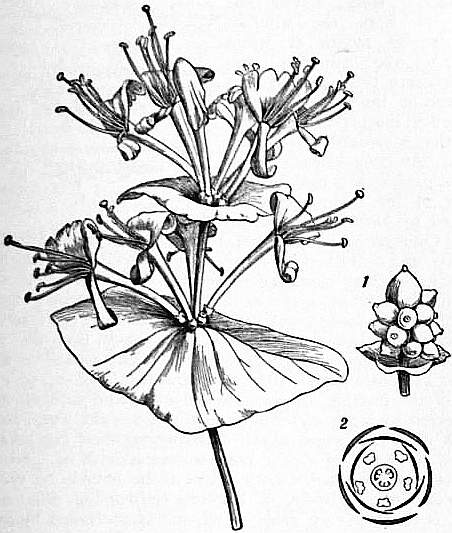
Flowering shoot of Lonicera Caprifolium, slightly reduced. 1, Fruit slightly reduced; 2, horizontal plan of arrangement of flower.
and Sambucus, more rarely two-lipped as in Lonicera; the sepals and petals are usually five in number and placed above the ovary, the five stamens are attached to the corolla-tube, there are three to five carpels, and the fruit is a berry as in honeysuckle or snowberry (Symphoricarpus), or a stone fruit, with several, usually three, stones, as in Sambucus.
In Sambucus and Viburnum the small white flowers are massed in heads; honey is secreted at the base of the styles and, the tube of the flower being very short, is exposed to the visits of flies and insects with short probosces. The flowers of Lonicera, which have a long tube, open in the evening, when they are sweet-scented and are visited by hawk-moths. The order contains about 250 species, chiefly natives of the north temperate zone and the mountains of the tropics. Several genera afford ornamental plants; such are Lonicera, erect shrubs or twiners with long-tubed white, yellow or red flowers; Symphoricarpus, a North American shrub, with small whitish pendulous flowers and white berries; Diervilla (also known as Weigelia), and Viburnum, including V. Opulus, guelder rose, in the cultivated forms of which the corolla has become enlarged at the expense of the essential organs and the flowers are neuter.
CAPRIVI DE CAPRERA DE MONTECUCCOLI, GEORG LEO VON, Count (1831-1899), German soldier and statesman, was born on the 24th of February 1831 at Charlottenburg. The family springs from Carniola, and the name was originally written Kopriva; in the 18th century one branch settled in Wernigerode, and several members entered the Prussian service; the father of the chancellor held a high judicial post, and was made a life member of the Prussian House of Lords. Caprivi was educated in Berlin, and entered the army in 1849; he took part in the campaign of 1866, being attached to the staff of the ist army. In 1870 he served as chief of the staff to the 10th army corps, which formed part of the 2nd army, and took part in the battles before Metz as well as in those round Orleans, in which he highly distinguished himself. One of the most delicate strategical problems of the whole war was the question of whether to change the direction of the 10th corps on the morning of the 16th of August before Vionville, and in this, as well as in the actual manoeuvres of the corps on that day, Caprivi, as representative of, and counsellor to, his chief, General v. Voigts-Rhetz, took a leading part. At the battle of Beaune-la-Rolande, the turning-point of the Orleans campaign, the 10th corps bore the brunt of the fighting. After the peace he held several important military offices, and in 1883 was made chief of the admiralty, in which post he had to command the fleet and to organize and represent the department in the Reichstag. He resigned in 1888, when the command was separated from the representation in parliament, and was appointed commander of the 10th army corps. Bismarck had already referred to him as a possible successor to himself, for Caprivi had shown great administrative ability, and was unconnected with any political party; and in March 1890 he was appointed chancellor, Prussian minister president and foreign minister. He was quite unknown to the public, and the choice caused some surprise, but it was fully justified. The chief events of his administration, which lasted for four years, are narrated elsewhere, in the article on Germany. He showed great ability in quickly mastering the business, with which he was hitherto quite unacquainted, as he himself acknowledged; his speeches in the Reichstag were admirably clear, dignified and to the point. His first achievement was the conclusion in July 1890 of a general agreement with Great Britain regarding the spheres of influence of the two countries in Africa. Bismarck had supported the colonial parties in Germany in pretensions to which it was impossible for Great Britain to give her consent, and the relations between the two powers were in consequence somewhat strained. Caprivi adopted a conciliatory attitude, and succeeded in negotiating terms with Lord Salisbury which gave to Germany all she could reasonably expect. But the abandonment of an aggressive policy in East Africa and in Nigeria, and in the withdrawal of German claims to Zanzibar (in exchange for Heligoland) aroused the hostility of the colonial parties, who bitterly attacked the new chancellor. Caprivi had, however, by making the frontiers of the Congo Free State and German East Africa meet, “cut” the Cape to Cairo connexion of the British, an achievement which caused much dismay in British colonial circles, regular treaties having been obtained from native chiefs over large areas which the chancellor secured for Germany. In Nigeria also Caprivi by the 1890 agreement, and by another concluded in 1893, made an excellent bargain for his country, while in South-West Africa he obtained a long but narrow extension eastward to the Zambezi of the German protectorate (this strip of territory being known as “Caprivi’s Finger”). In his African policy the chancellor proved far-sighted, and gained for the new protectorates a period for internal development and consolidation. The Anglo-German agreement of 1890 was followed by commercial treaties with Austria, Rumania, &c.; by concluding them he earned the express commendation of the emperor and the title of count, but he was from this time relentlessly attacked by the Agrarians, who made it a ground for their distrust that he was not himself a landed proprietor; and from this time he had to depend much on the support of the Liberals and other parties who had been formerly in opposition. The reorganization of the army caused a parliamentary crisis, but he carried it through successfully, only, however, to earn the enmity of the more old-fashioned soldiers, who would not forgive him for shortening the period of service. His position was seriously compromised by the failure in 1892 to carry an education bill which he had defended by saying that the question at issue was Christianity or Atheism, and he resigned the presidency of the Prussian ministry, which was then given to Count Eulenburg. In 1894, a difference arose between Eulenburg and Caprivi concerning the bill for an amendment of the criminal code (the Umsturz Vorlage), and in October the emperor dismissed both. Caprivi’s fall was probably the work of the Agrarians, but it was also due to the fact that, while he showed very high ability in conducting the business of the country, he made no attempt to secure his personal position by forming a party either in parliament or at court. He interpreted his position rather as a soldier; he did his duty, but did not think of defending himself. He suffered much from the attacks made on him by the followers of Bismarck, and he was closely associated with the social ostracism of that statesman; we do not know, however, in regard either to this or to the other events of his administration, to what extent Caprivi was really the author of the policy he carried out, and to what extent he was obeying the orders of the emperor. With a loyalty which cannot be too highly praised, he always refused, even after his abrupt dismissal, to justify himself, and he could not be persuaded even to write memoirs for later publication. The last years of his life were spent in absolute retirement, for he could not return even to the military duties which he had left with great reluctance at the orders of the emperor. He died unmarried on the 6th of February 1899, at the age of sixty-eight.
See R. Arndt, Die Reden des Grafen v. Caprivi (Berlin, 1894), with a biography.
(J. W. He.)
CAPRONNIER, JEAN BAPTISTE (1814-1891), Belgian stained-glass painter, was born in Brussels in 1814, and died there in 1891. He had much to do with the modern revival of glass-painting, and first made his reputation by his study of the old methods of workmanship, and his clever restorations of old examples, and copies made for the Brussels archaeological museum. He carried out windows for various churches in Brussels, Bruges, Amsterdam and elsewhere, and his work was commissioned also for France, Italy and England. At the Paris Exhibition of 1855 he won the only medal given for glass-painting.
CAPSICUM, a genus of plants, the fruits of which are used as peppers (see Cayenne Pepper for botany, &c.). As used in medicine, the ripe fruit of the capsicum mimum (or frutescans), containing the active principle capsaicin (capsacutin), first isolated by Thresh in 1876, has remarkable physiological properties. Applied locally to the skin or mucous membrane, it causes redness and later vesication. Internally in small doses it stimulates gastric secretions and causes dilatation of the vessels; but if used internally in excess for a long period it will cause subacute gastritis. In single doses in excess it causes renal irritation and inflammation and strangury. The administration of capsicum is valuable in atony of the stomach due to chronic alcoholism, its hot stimulating effect not only increasing the appetite but to a certain degree satisfying the craving for alcohol. It is also useful in the flatulency of the aged, where it prevents the development of gas, and has a marked effect on anorexia. It has been used in functional torpidity of the kidney. Externally capsicum plaster placed over the affected muscles is useful in rheumatism and lumbago. Capsicum wool, known as calorific wool, made by dissolving the oleoresin of capsicum in ether and pouring it on to absorbent cotton-wool, is useful in rheumatic affections.
CAPSTAN (also spelt in other forms, or as “capstock” and “cable stock,” connected with the O. Fr. capestan or cabestan, from Lat. capistrum, a halter, capere, to take hold of; the conjecture that it came from the Span. cabra, goat, and estanto, standing, is untenable), an appliance used on board ship and on dock walls, for heaving-in or veering cables and hawsers, whether of iron, steel or hemp. It differs from a windlass, which is used for the same purposes, in having the axis on which the rope is wound vertical instead of horizontal. The word seems to have come into English (14th century) from French or Spanish shipmen at the time of the Crusades. The earlier forms were of a comparatively simple character, made of wood with an iron spindle and worked by manual labour with wooden capstan bars. As heavier cables were supplied to ships, difficulty was found, when riding at anchor, in holding, checking and veering cable. A cable-holder (W.H. Harfield’s) was tested in H.M.S. “Newcastle” (wooden frigate) in 1870 and proved effective; its first development in 1876 was the application in the form of a windlass secured to the deck, driven by a messenger chain from the capstan, fitted in H.M.S. “Inflexible” (fig. 1).
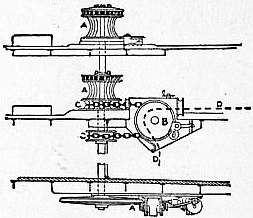
Fig. 1.
The capstans and engine are shown at A, A, A, and the windlass B is driven by messenger chains C, C. The four cables (dotted line D, D) lead to their respective cable-holders, fitted with a brake, and by these means each cable-holder can be connected to the main driving shaft, and any cable hove-in or veered independently of the other; by using steam power instead of manual, the previous slow motion was obviated. In H.M.S. “Collingwood” steam power was used to work the windlass directly by means of worm gearing; the windlass was divided into two parts, so that the one on the port side could be worked independently of that on the starboard, and vice versa. An independent capstan in both ships, arranged to take either of the cables, could be worked by hand or steam. In the “Collingwood’s” windlass the cables remained on their holders, and could be hove-in or veered without being touched.
Napier’s patent windlass for merchant ships (1906) resembles an appliance fitted in the earlier second-class cruisers of the British navy (1890 to 1900). Two cable wheels or cable-holders are mounted loose on a horizontal axle, one on each side of a worm wheel which is tightly keyed on the middle part of the axle. A vertical steam engine with two cylinders, placed one on each side of the framing, drives a second horizontal axle which is connected by a set of bevel gears to an upright worm shaft, which works the worm wheel. This worm wheel can be connected by means of sliding bolts to one or both of the cable wheels, enabling one or both cables to be hove-in or veered as necessary. A brake, of Napier’s self-holding differential type, is fitted to each cable wheel, and is controlled by hand wheels on the aft side of the windlass. For warping purposes, warping drums are fitted (made portable if required). A third central capstan, fitted forward of the windlass, is connected to the upright worm shaft by a horizontal shaft and bevel wheels. It can also be worked by manual labour with capstan bars. Fig. 2 represents the arrangement of the capstans on the forecastle of a battleship, fitted by Napier Brothers. Deep-bodied capstans have been superseded by low drum-headed ones, over which the guns may be fired. The three capstans or cable-holders of cast steel, capable of taking 211⁄16 in. cables, are fitted on vertical spindles, which pass down through the main and armoured decks to the platform one, where the steam engine and gearing are placed. The gearing consists of worm and wheel gears, so arranged that the three capstans can be worked singly or in conjunction, when heaving-in or veering, and the brakes (of the type previously mentioned) are controlled by a portable hand wheel fitted on the aft side of each. The cable-holders can be used for riding at anchor (see Cable). The middle line capstan E is keyed to vertical spindles and can be coupled up to the capstan engine, by clutch and drop bolts in the capstan engine room; it is fitted with a cable-holder, to take either the port or starboard cables, and in addition is provided with portable whelps, enabling it to be used for warping. It can also be worked by manual labour with capstan bars, a drum-head E’, fitted on the spindle on the main deck, enabling additional capstan bars to be used if required.
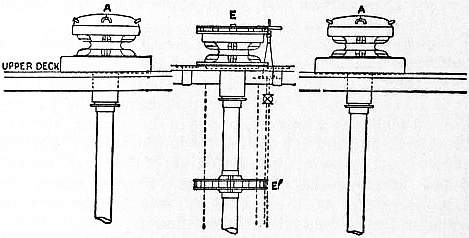
Fig. 2.—Elevation looking aft.
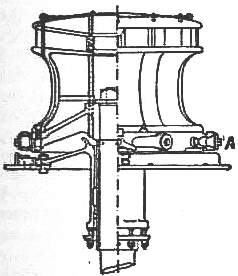
Fig. 3.— Napier Brothers’ capstan.
To avoid carrying steam pipes aft, the after capstan is worked by an electric motor which is kept below the water-line. Napier Brothers’ capstan (fig. 3) is for warping purposes, for working the stern anchor with wire hawser and for coaling. It is placed on the upper deck, and is fitted with a drum-head for capstan bars, with pawls and pawl rim on the deck plate, the pawls A being lifted and placed on their rests B when working with the motor. The upper portion of the capstan, together with its drum-head, is portable, being fixed to the centre boss with keys and gun-metal screws. The centre boss is keyed to the spindle, which passes through the deck and carries at its lower end a coupling for connecting to the worm wheel gear. For working by motor, the additional security of two drop bolts is provided. The gearing consists of a single worm and worm wheel, working in an oil-bath, the worm shaft being coupled direct to the motor spindle. The motor is of the semi-enclosed type, the working and live parts being protected by a perforated metallic covering; it is worked off a 100-volt circuit, at a speed under full load conditions of 300 revolutions per minute. The motor is of a 4-pole type and compound wound, the shunt winding limiting the speed on light load to not more than 1000 revolutions per minute. A frictional break is provided, pulled off by means of a shunt-excited magnet. The controller is of the reversing drum type, with not less than four steps in either direction, and is fitted with a magnetic blow-out. The control is effected by a removable hand wheel on a portable pedestal, fitted on top with a circular dial plate and indicating pointer; the hand wheel reverses the current as well as graduates the speed in either direction. All capstans of the British navy, after being fitted on board ship, are tested for lifting power and speed; with foremost (steam) capstans, the steam being at 150 ℔ pressure, the anchor is usually let go in 16 to 25 fathoms water, and the speed ascertained by observing the time taken to heave-in not less than a length of cable, 75 ft.; the length must be hove-in in three minutes, or at the rate of 25 ft. per minute. With the after capstan (motor) of first-class battleships and cruisers, a weight is used instead of an anchor, the test being to lift 9 tons at the rate of 25 ft. per minute. Capstans on dock walls in British government dockyards are usually driven by hydraulic or air pressure, conveyed through pipes to small engines underneath the capstans.
(J. W. D.)
CAPSULE (from the Lat. capsula, a small box), a term in botany for a dry seed vessel, as in the poppy, iris, foxglove, &c., containing one or more cells. When ripe the capsule opens and scatters the seed (see Botany). The word is used also for a small gelatinous case enclosing a dose of medicine, and for a metal cap or cover on bottles and jars. In anatomy the term is used to denote a cover or envelope partly or wholly surrounding a structure. Every diarthrodial joint possesses a fibrous or ligamentous capsule, lined with synovial membrane, attached to the adjacent ends of the articulating bones. The term is particularly applied to the sac which encloses the crystalline lens of the eye; to Glisson’s capsule, a thin areolar coat of fibrous tissue lying inside the tunica serosa of the liver; to the glomerular capsules in the kidney substance; to the suprarenal capsules, two small flattened organs in the epigastric region; and to the internal and external capsules of the brain (see Brain, fig. 14 and explanation).
CAPTAIN (derived from Lat. caput, head, through the Low Lat. capitanus), a chief or leader, in various connexions, but particularly a grade officer in the army or navy.
At sea the name of captain is given to all who command ships whether they belong to the military navy of their country or not, or whether they hold the substantive rank or not. Thus a lieutenant when in command of a vessel is addressed as captain. In France a naval lieutenant is addressed as mon capitaine because he has that comparative rank in the army. The master of a merchant ship is known as her captain. But the name is also used in the strict sense of foreman, or head man, to describe many of the minor or “petty” officers of a British or American man-of-war—the captain of a top, of the forecastle, or of a gun. The title “post captain” in the British navy means simply full captain, and is the equivalent of the French capitaine de vaisseau. It had its origin in the fact that captains appointed to a ship of twenty guns and upwards were included in, or “posted” on, the permanent list of captains from among whom the admirals were chosen. The captain of the fleet is an officer who acts as chief of the staff to an admiral commanding a large force. The position is equivalent to flag rank, but is held by a captain. Staff captain is the highest grade of the officers entrusted with the nayigation of a ship or fleet.
The military rank of captain (Fr. capitaine, Ger. Hauptmann, or in the cavalry, Rittmeister), which was formerly the title of an officer of high rank corresponding to the modern general officer or colonel, has with the gradual subdivision and articulation of armies, come to be applied to the commanders of companies or squadrons, and in general to officers of the grade equivalent to this command (see Officers).
The title of “captain-general” was formerly used in the general sense of a military commander-in-chief, and is still similarly used in Spain. In the Spanish army there are eight captains-general, each of whom has command of a “region” corresponding to an army corps district. The same title was formerly given to the Spanish governors of the colonial provinces in the New World. The official title of the governor of Jamaica is “captain-general and governor-in-chief.”
CAPTAL (Lat. capitalis, “first,” “chief”), a medieval feudal title in Gascony. According to Du Cange the designation captal (capital, captau, capitau) was applied loosely to the more illustrious nobles of Aquitaine, counts, viscounts, &c., probably as capitales domini, “principal lords,” though he quotes more fanciful explanations. As an actual title the word was used only by the lords of Trene, Puychagut, Epernon and Buch. It is best known in connexion with the famous soldier, Jean de Grailly, captal of Bush (d. 1376), the “captal de Buch” par excellence, immortalized by Froissart as the confidant of the Black Prince and the champion of the English cause against France. His active part in the war began in 1364, when he ravaged the country between Paris and Rouen, but was beaten by Bertrand du Guesclin at Cocherel and taken prisoner. Released next year, he received the seigniory of Nemours and took the oath of fealty to the French king, Charles V., but soon resigned his new fief and returned to his allegiance to the English king. In 1367 he took part in the battle of Navarette, in which Du Guesclin was taken prisoner, the captal being entrusted with his safe-keeping. In 1371 Jean de Grailly was appointed constable of Aquitaine, but was taken prisoner next year and interned in the Temple at Paris where, resisting all the tempting offers of the French king, he remained till his death five years later.
CAPTION (Lat. captio, a taking or catching), a term still used in law, especially Scots, for arrest or apprehension. From the obsolete sense of a catching at any possible plea or objection comes the adjective “captious,” i.e. sophistical or fault-finding. The term also has an old legal use, to signify the part of an indictment, &c., which shows where, when and by what authority it is taken, found or executed; so its opening or heading. From this is derived the modern sense of the heading of an article in a book or newspaper.
CAPTIVE (from Lat. capere, to take), one who is captured in warfare. As a term of International Law, it has been displaced by that of “prisoner of war.” The position and treatment of captives or prisoners of war is now dealt with fully in chapter ii. of the regulations annexed to the Hague Convention respecting the Laws and Customs of War on Land, of the 18th of October 1907.
See Peace Conference and War; also Sir T. Barclay, supplement to Problems of International Practice and Diplomacy, for comparison of texts of 1899 and 1907.
CAPTURE (from Lat. capere, to take; Fr. prise maritime; Ger. Wegnahme), in international law, the taking possession by a belligerent vessel of an enemy or neutral merchant or non-fighting ship. If an enemy ship is captured she becomes forthwith lawful prize (q.v.); when a neutral ship, the belligerent commander, in case her papers are not conclusive, has a right to search her. If he finds contraband on board or the papers or cargo or circumstances excite any serious suspicion in his mind, which the master of the ship has been unable to dispel, he places an officer and a few of his crew on board and sends her to the nearest port where there is a prize court for trial. The word is also used for the vessel thus captured (see Blockade, Contraband).
(T. Ba.)
CAPUA (anc. Casilinum), a town and archiepiscopal see of Campania, Italy, in the province of Caserta, 7 m. W. by rail from the town of Caserta. Pop. (1901) 14,285. It was erected in 856 by Bishop Landulf on the site of Casilinum (q.v.) after the destruction of the ancient Capua by the Saracens in 840, but it only occupies the site of the original pre-Roman town on the left (south) bank of the river.
The cathedral of S. Stefano, erected in 856, has a handsome atrium and a lofty Lombard campanile, and a (modernized) interior with three aisles; both it and the atrium have ancient granite columns. The Romanesque crypt, with ancient columns, has also been restored. It has a fine paschal candlestick, and the fragments of a pulpit with marble mosaic of the 13th century. There are also preserved in the cathedral a fine Exultet roll and an evangelarium of the end of the 12th century, bound in bronze decorated with gold filigree and enamels. The mosaics of the beginning of the 12th century in the apses of the cathedral and of S. Benedetto, were destroyed about 1720 and 1620 respectively. The small church of S. Marcello was also built in 856. In 1232-1240 Frederick II. erected a castle to guard the Roman bridge over the Volturno, composed of a triumphal arch with two towers. This was demolished in 1557. The statues with which it was decorated were contemporary imitations of classical sculptures. Some of them are still preserved in the Museo Campano (E. Bertaux, L’Art dans l’Italie méridionale, Paris, 1904, i. 707). The Museo Campano also contains a considerable collection of antiquities from the ancient Capua.
Capua changed hands frequently during the middle ages. One of the most memorable facts in its history is the terrible attack made on it in 1501 by Caesar Borgia, who had entered the town by treachery, in which 5000 lives were sacrificed. It remained a part of the kingdom of Naples until the 2nd of November 1860, when, a month after the battle of the Volturno, it surrendered to the Italian troops.