VOLUME V SLICE III Capefigue to Carneades (continued 3)
Reading edition
The relative importance of two harmonic disturbances depends upon their initial magnitudes, and upon the rate at which they grow. When the initial values are very small, the latter consideration is much the more important; for, if the disturbances be represented by α1eq1t, α2eq2t, in which q1 exceeds q2, their ratio is (α1/α2)e−(q1 − q2)t; and this ratio decreases without limit with the time, whatever be the initial (finite) ratio α2 : α1. If the initial disturbances are small enough, that one is ultimately preponderant for which the measure of instability is greatest. The smaller the causes by which the original equilibrium is upset, the more will the cylindrical mass tend to divide itself regularly into portions whose length is equal to 4.5 times the diameter. But a disturbance of less favourable wave-length may gain the preponderance in case its magnitude be sufficient to produce disintegration in a less time than that required by the other disturbances present.
The application of these results to actual jets presents no great difficulty. The disturbances by which equilibrium is upset are impressed upon the fluid as it leaves the aperture, and the continuous portion of the jet represents the distance travelled during the time necessary to produce disintegration. Thus the length of the continuous portion necessarily depends upon the character of the disturbances in respect of amplitude and wave-length. It may be increased considerably, as F. Savart showed, by a suitable isolation of the reservoir from tremors, whether due to external sources or to the impact of the jet itself in the vessel placed to receive it. Nevertheless it does not appear to be possible to carry the prolongation very far. Whether the residuary disturbances are of external origin, or are due to friction, or to some peculiarity of the fluid motion within the reservoir, has not been satisfactorily determined. On this point Plateau’s explanations are not very clear, and he sometimes expresses himself as if the time of disintegration depended only upon the capillary tension, without reference to initial disturbances at all.
Two laws were formulated by Savart with respect to the length of the continuous portion of a jet, and have been to a certain extent explained by Plateau. For a given fluid and a given orifice the length is approximately proportional to the square root of the head. This follows at once from theory, if it can be assumed that the disturbances remain always of the same character, so that the time of disintegration is constant. When the head is given, Savart found the length to be proportional to the diameter of the orifice. From (3) it appears that the time in which a disturbance is multiplied in a given ratio varies, not as d, but as d3/2. Again, when the fluid is changed, the time varies as ρ1/2T −1/2. But it may be doubted whether the length of the continuous portion obeys any very simple laws, even when external disturbances are avoided as far as possible.
When the circumstances of the experiment are such that the reservoir is influenced by the shocks due to the impact of the jet, the disintegration usually establishes itself with complete regularity, and is attended by a musical note (Savart). The impact of the regular series of drops which is at any moment striking the sink (or vessel receiving the water), determines the rupture into similar drops of the portion of the jet at the same moment passing the orifice. The pitch of the note, though not absolutely definite, cannot differ much from that which corresponds to the division of the jet into wave-lengths of maximum instability; and, in fact, Savart found that the frequency was directly as the square root of the head, inversely as the diameter of the orifice, and independent of the nature of the fluid—laws which follow immediately from Plateau’s theory.
From the pitch of the note due to a jet of given diameter, and issuing under a given head, the wave-length of the nascent divisions can be at once deduced. Reasoning from some observations of Savart, Plateau finds in this way 4.38 as the ratio of the length of a division to the diameter of the jet. The diameter of the orifice was 3 millims., from which that of the jet is deduced by the introduction of the coefficient .8. Now that the length of a division has been estimated a priori, it is perhaps preferable to reverse Plateau’s calculation, and to exhibit the frequency of vibration in terms of the other data of the problem. Thus
frequency = √(2gh) . (4)
4.508d
But the most certain method of obtaining complete regularity of resolution is to bring the reservoir under the influence of an external vibrator, whose pitch is approximately the same as that proper to the jet. H.G. Magnus (Pogg. Ann. cvi., 1859) employed a Neef’s hammer, attached to the wooden frame which supported the reservoir. Perhaps an electrically maintained tuning-fork is still better. Magnus showed that the most important part of the effect is due to the forced vibration of that side of the vessel which contains the orifice, and that but little of it is propagated through the air. With respect to the limits of pitch, Savart found that the note might be a fifth above, and more than an octave below, that proper to the jet. According to theory, there would be no well-defined lower limit; on the other side, the external vibration cannot be efficient if it tends to produce divisions whose length is less than the circumference of the jet. This would give for the interval defining the upper limit π : 4.508, which is very nearly a fifth. In the case of Plateau’s numbers (π : 4.38) the discrepancy is a little greater.
The detached masses into which a jet is resolved do not at once assume and retain a spherical form, but execute a series of vibrations, being alternately compressed and elongated in the direction of the axis of symmetry. When the resolution is effected in a perfectly periodic manner, each drop is in the same phase of its vibration as it passes through a given point of space; and thence arises the remarkable appearance of alternate swellings and contractions described by Savart. The interval from one swelling to the next is the space described by the drop during one complete vibration, and is therefore (as Plateau shows) proportional ceteris paribus to the square root of the head.
The time of vibration is of course itself a function of the nature of the fluid and of the size of the drop. By the method of dimensions alone it may be seen that the time of infinitely small vibrations varies directly as the square root of the mass of the sphere and inversely as the square root of the capillary tension; and it may be proved that its expression is
r = √ ( 3πρV ), (5)
8T
V being the volume of the vibrating mass.
In consequence of the rapidity of the motion some optical device is necessary to render apparent the phenomena attending the disintegration of a jet. Magnus employed a rotating mirror, and also a rotating disk from which a fine slit was cut out. The readiest method of obtaining instantaneous illumination is the electric spark, but with this Magnus was not successful. The electric spark had, however, been used successfully for this purpose some years before by H. Buff (Liebigs Ann. lxxviii. 1851), who observed the shadow of the jet on a white screen. Preferable to an opaque screen is a piece of ground glass, which allows the shadow to be examined from the farther side (Lord Rayleigh). Further, the jet may be very well observed directly, if the illumination is properly managed. For this purpose it is necessary to place it between the source of light and the eye. The best effect is obtained when the light of the spark is somewhat diffused by being passed (for example) through a piece of ground glass.
The spark may be obtained from the secondary of an induction coil, whose terminals are in connexion with the coatings of a Leyden jar. By adjustment of the contact breaker the series of sparks may be made to fit more or less perfectly with the formation of the drops. A still greater improvement may be effected by using an electrically maintained fork, which performs the double office of controlling the resolution of the jet and of interrupting the primary current of the induction coil. In this form the experiment is one of remarkable beauty. The jet, illuminated only in one phase of transformation, appears almost perfectly steady, and may be examined at leisure. In one experiment the jet issued horizontally from an orifice of about half a centimetre in diameter, and almost immediately assumed a rippled outline. The gradually increasing amplitude of the disturbance, the formation of the elongated ligament, and the subsequent transformation of the ligament into a spherule, could be examined with ease. In consequence of the transformation being in a more advanced stage at the forward than at the hinder end, the ligament remains for a moment connected with the mass behind, when it has freed itself from the mass in front, and thus the resulting spherule acquires a backwards relative velocity, which of necessity leads to a collision. Under ordinary circumstances the spherule rebounds, and may be thus reflected backwards and forwards several times between the adjacent masses. Magnus showed that the stream of spherules may be diverted into another path by the attraction of a powerfully electrified rod, held a little below the place of resolution.
Very interesting modifications of these phenomena are observed when a jet from an orifice in a thin plate (Tyndall has shown that a pinhole gas burner may also be used with advantage) is directed obliquely upwards. In this case drops which break away with different velocities are carried under the action of gravity into different paths; and thus under ordinary circumstances a jet is apparently resolved into a “sheaf,” or bundle of jets all lying in one vertical plane. Under the action of a vibrator of suitable periodic time the resolution is regularized, and then each drop, breaking away under like conditions, is projected with the same velocity, and therefore follows the same path. The apparent gathering together of the sheaf into a fine and well-defined stream is an effect of singular beauty.
In certain cases where the tremor to which the jet is subjected is compound, the single path is replaced by two, three or even more paths, which the drops follow in a regular cycle. The explanation has been given with remarkable insight by Plateau. If, for example, besides the principal disturbance, which determines the size of the drops, there be another of twice the period, it is clear that the alternate drops break away under different conditions and therefore with different velocities. Complete periodicity is only attained after the passage of a pair of drops; and thus the odd series of drops pursues one path, and the even series another.
Electricity, as has long been known, has an extraordinary influence upon the appearance of a fine jet of water ascending in a nearly perpendicular direction. In its normal state the jet resolves itself into drops, which even before passing the summit, and still more after passing it, are scattered through a considerable width. When a feebly electrified body (such as a stick of sealing-wax gently rubbed upon the coat sleeve) is brought into its neighbourhood, the jet undergoes a remarkable transformation and appears to become coherent; but under more powerful electrical action the scattering becomes even greater than at first. The second effect is readily attributed to the mutual repulsion of the electrified drops, but the action of feeble electricity in producing apparent coherence was long unexplained.
It was shown by W. von Beetz that the coherence is apparent only, and that the place where the jet breaks into drops is not perceptibly shifted by the electricity. By screening the various parts with metallic plates in connexion with earth, Beetz further proved that, contrary to the opinion of earlier observers, the seat of sensitiveness is not at the root of the jet where it leaves the orifice, but at the place of resolution into drops. An easy way of testing this conclusion is to excite the extreme tip of a glass rod, which is then held in succession to the root of the jet, and to the place of resolution. An effect is observed in the latter, and not in the former position.
The normal scattering of a nearly vertical jet is due to the rebound of the drops when they come into collision with one another. Such collisions are inevitable in consequence of the different velocities acquired by the drops under the action of the capillary force, as they break away irregularly from the continuous portion of the jet. Even when the resolution is regularized by the action of external vibrations of suitable frequency, as in the beautiful experiments of Savart and Plateau, the drops must still come into contact before they reach the summit of their parabolic path. In the case of a continuous jet, the equation of continuity shows that as the jet loses velocity in ascending, it must increase in section. When the stream consists of drops following one another in single file, no such increase of section is possible; and then the constancy of the total stream requires a gradual approximation of the drops, which in the case of a nearly vertical direction of motion cannot stop short of actual contact. Regular vibration has, however, the effect of postponing the collisions and consequent scattering of the drops, and in the case of a direction of motion less nearly vertical, may prevent them altogether.
Under moderate electrical influence there is no material change in the resolution into drops, nor in the subsequent motion of the drops up to the moment of collision. The difference begins here. Instead of rebounding after collision, as the unelectrified drops of clean water generally, or always, do, the electrified drops coalesce, and then the jet is no longer scattered about. When the electrical influence is more powerful, the repulsion between the drops is sufficient to prevent actual contact, and then, of course, there is no opportunity for amalgamation.
These experiments may be repeated with extreme ease, and with hardly any apparatus. The diameter of the jet may be about 1⁄20 in., and it may issue from a glass nozzle. The pressure may be such as to give a fountain about 2 ft. high. The change in the sound due to the falling drops as they strike the bottom of the sink should be noticed, as well as that in the appearance of the jet.
The actual behaviour of the colliding drops becomes apparent under instantaneous illumination, e.g. by sparks from a Leyden jar. The jet should be situated between the sparks and the eye, and the observation is facilitated by a piece of ground glass held a little beyond the jet, so as to diffuse the light; or the shadow of the jet may be received on the ground glass, which is then held as close as possible on the side towards the observer.
In another form of the experiment, which, though perhaps less striking to the eye, lends itself better to investigation, the collision takes place between two still unresolved jets issuing horizontally from glass nozzles in communication with reservoirs containing water. One at least of the reservoirs must be insulated. In the absence of dust and greasy contamination, the obliquely colliding jets may rebound from one another without coalescence for a considerable time. In this condition there is complete electrical insulation between the jets, as may be proved by the inclusion in the circuit of a delicate galvanometer, and a low electromotive force. But if the difference of potential exceed a small amount (1 or 2 volts), the jets instantaneously coalesce. There is no reason to doubt that in the case of the fountain also, coalescence is due to differences of potential between colliding drops.
If the water be soapy, and especially if it contain a small proportion of milk, coalescence ensues without the help of electricity. In the case of the fountain the experiment may be made by leading tap-water through a Woulfe’s bottle in which a little milk has been placed. As the milk is cleared out, the scattering of the drops is gradually re-established.
In attempting to explain these curious phenomena, it is well to consider what occurs during a collision. As the liquid masses approach one another, the intervening air has to be squeezed out. In the earlier stages of approximation the obstacle thus arising may not be important; but when the thickness of the layer of air is reduced to the point at which the colours of thin plates are visible, the approximation must be sensibly resisted by the viscosity of the air which still remains to be got rid of. No change in the capillary conditions can arise until the interval is reduced to a small fraction of a wave-length of light; but such a reduction, unless extremely local, is strongly opposed by the remaining air. It is true that this opposition is temporary. The question is whether the air can everywhere be squeezed out during the short time over which the collision extends.
It would seem that the forces of electrical attraction act with peculiar advantage. If we suppose that upon the whole the air cannot be removed, so that the mean distance between the opposed surfaces remains constant, the electric attractions tend to produce an instability whereby the smaller intervals are diminished while the larger are increased. Extremely local contacts of the liquids, while opposed by capillary tension which tends to keep the surfaces flat, are thus favoured by the electrical forces, which moreover at the small distances in question act with exaggerated power.
A question arises as to the mode of action of milk or soap turbidity. The observation that it is possible for soap to be in excess may here have significance. It would seem that the surfaces, coming into collision within a fraction of a second of their birth, would still be subject to further contamination from the interior. A particle of soap rising accidentally to the surface would spread itself with rapidity. Now such an outward movement of the liquid is just what is required to hasten the removal of intervening air. It is obvious that the effect would fail if the contamination of the surface had proceeded too far previously to the collision.
This view is confirmed by experiments in which other gases are substituted for air as the environment of colliding jets. Oxygen and coal-gas were found to be without effect. On the other hand, the more soluble gases, carbon dioxide, nitrous oxide, sulphur dioxide, and steam, at once caused union.]
Stability of the Catenoid.—When the internal pressure is equal to the external, the film forms a surface of which the mean curvature at every point is zero. The only surface of revolution having this property is the catenoid formed by the revolution of a catenary about its directrix. This catenoid, however, is in stable equilibrium only when the portion considered is such that the tangents to the catenary at its extremities intersect before they reach the directrix.
To prove this, let us consider the catenary as the form of equilibrium of a chain suspended between two fixed points A and B. Suppose the chain hanging between A and B to be of very great length, then the tension at A or B will be very great. Let the chain be hauled in over a peg at A. At first the tension will diminish, but if the process be continued the tension will reach a minimum value and will afterwards increase to infinity as the chain between A and B approaches to the form of a straight line. Hence for every tension greater than the minimum tension there are two catenaries passing through A and B. Since the tension is measured by the height above the directrix these two catenaries have the same directrix. Every catenary lying between them has its directrix higher, and every catenary lying beyond them has its directrix lower than that of the two catenaries.
Now let us consider the surfaces of revolution formed by this system of catenaries revolving about the directrix of the two catenaries of equal tension. We know that the radius of curvature of a surface of revolution in the plane normal to the meridian plane is the portion of the normal intercepted by the axis of revolution.
The radius of curvature of a catenary is equal and opposite to the portion of the normal intercepted by the directrix of the catenary. Hence a catenoid whose directrix coincides with the axis of revolution has at every point its principal radii of curvature equal and opposite, so that the mean curvature of the surface is zero.
The catenaries which lie between the two whose direction coincides with the axis of revolution generate surfaces whose radius of curvature convex towards the axis in the meridian plane is less than the radius of concave curvature. The mean curvature of these surfaces is therefore convex towards the axis. The catenaries which lie beyond the two generate surfaces whose radius of curvature convex towards the axis in the meridian plane is greater than the radius of concave curvature. The mean curvature of these surfaces is, therefore, concave towards the axis.
Now if the pressure is equal on both sides of a liquid film, and if its mean curvature is zero, it will be in equilibrium. This is the case with the two catenoids. If the mean curvature is convex towards the axis the film will move from the axis. Hence if a film in the form of the catenoid which is nearest the axis is ever so slightly displaced from the axis it will move farther from the axis till it reaches the other catenoid.
If the mean curvature is concave towards the axis the film will tend to approach the axis. Hence if a film in the form of the catenoid which is nearest the axis be displaced towards the axis, it will tend to move farther towards the axis and will collapse. Hence the film in the form of the catenoid which is nearest the axis is in unstable equilibrium under the condition that it is exposed to equal pressures within and without. If, however, the circular ends of the catenoid are closed with solid disks, so that the volume of air contained between these disks and the film is determinate, the film will be in stable equilibrium however large a portion of the catenary it may consist of.
The criterion as to whether any given catenoid is stable or not may be obtained as follows:—
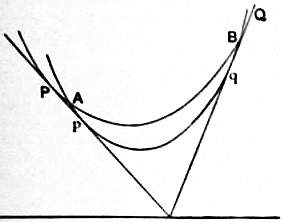
Fig. 14.
Let PABQ and ApqB (fig. 14) be two catenaries having the same directrix and intersecting in A and B. Draw Pp and Qq touching both catenaries, Pp and Qq will intersect at T, a point in the directrix; for since any catenary with its directrix is a similar figure to any other catenary with its directrix, if the directrix of the one coincides with that of the other the centre of similitude must lie on the common directrix. Also, since the curves at P and p are equally inclined to the directrix, P and p are corresponding points and the line Pp must pass through the centre of similitude. Similarly Qq must pass through the centre of similitude. Hence T, the point of intersection of Pp and Qq, must be the centre of similitude and must be on the common directrix. Hence the tangents at A and B to the upper catenary must intersect above the directrix, and the tangents at A and B to the lower catenary must intersect below the directrix. The condition of stability of a catenoid is therefore that the tangents at the extremities of its generating catenary must intersect before they reach the directrix.
Stability of a Plane Surface.—We shall next consider the limiting conditions of stability of the horizontal surface which separates a heavier fluid above from a lighter fluid below. Thus, in an experiment of F. Duprez (“Sur un cas particulier de l’équilibre des liquides,” Nouveaux Mém. del’ Acad. de Belgique, 1851 et 1853), a vessel containing olive oil is placed with its mouth downwards in a vessel containing a mixture of alcohol and water, the mixture being denser than the oil. The surface of separation is in this case horizontal and stable, so that the equilibrium is established of itself. Alcohol is then added very gradually to the mixture till it becomes lighter than the oil. The equilibrium of the fluids would now be unstable if it were not for the tension of the surface which separates them, and which, when the orifice of the vessel is not too large, continues to preserve the stability of the equilibrium.
When the equilibrium at last becomes unstable, the destruction of equilibrium takes place by the lighter fluid ascending in one part of the orifice and the heavier descending in the other. Hence the displacement of the surface to which we must direct our attention is one which does not alter the volume of the liquid in the vessel, and which therefore is upward in one part of the surface and downward in another. The simplest case is that of a rectangular orifice in a horizontal plane, the sides being a and b.
Let the surface of separation be originally in the plane of the orifice, and let the co-ordinates x and y be measured from one corner parallel to the sides a and b respectively, and let z be measured upwards. Then if ρ be the density of the upper liquid, and σ that of the lower liquid, and P the original pressure at the surface of separation, then when the surface receives an upward displacement z, the pressure above it will be P − ρgz, and that below it will be P − σgz, so that the surface will be acted on by an upward pressure (ρ − σ)gz. Now if the displacement z be everywhere very small, the curvature in the planes parallel to xz and yz will be d²z/dx² and d²z/dy² respectively, and if T is the surface-tension the whole upward force will be
T ( d²z + d²z ) + (ρ − σ)gz.
dx² dy²
If this quantity is of the same sign as z, the displacement will be increased, and the equilibrium will be unstable. If it is of the opposite sign from z, the equilibrium will be stable. The limiting condition may be found by putting it equal to zero. One form of the solution of the equation, and that which is applicable to the case of a rectangular orifice, is
z = C sin px sin qy.
Substituting in the equation we find the condition
(p² + q²)T − (ρ − σ)g = { +ve stable.
0 neutral.
−ve unstable.
That the surface may coincide with the edge of the orifice, which is a rectangle, whose sides are a and b, we must have
pa = mπ, qb = nπ,
when m and n are integral numbers. Also, if m and n are both unity, the displacement will be entirely positive, and the volume of the liquid will not be constant. That the volume may be constant, either n or m must be an even number. We have, therefore, to consider the conditions under which
π² ( m² + n² ) T − (ρ − σ)g
a² b²
cannot be made negative. Under these conditions the equilibrium is stable for all small displacements of the surface. The smallest admissible value of m²/a² + n²/b² is 4/a² + 1/b², where a is the longer side of the rectangle. Hence the condition of stability is that
π² ( 4 + 1 ) T − (ρ − σ)g
a² b²
is a positive quantity. When the breadth b is less than √[π²T/(ρ − σ)g] the length a may be unlimited.
When the orifice is circular of radius a, the limiting value of a is √[(T/gρ)z], where z is the least root of the equation
2 J1(z) = 1 − z2 + z4 + z6 + &c., = 0.
z 2·4 2·4²·6 2·4²·6²·8
The least root of this equation is
z = 3.83171.
If h is the height to which the liquid will rise in a capillary tube of unit radius, then the diameter of the largest orifice is
2a = 3.83171 √(2h) = 5.4188 √(h).
Duprez found from his experiments
2a = 5.485√(h).
[The above theory may be well illustrated by a lecture experiment. A thin-walled glass tube of internal diameter equal to 14½ mm. is ground true at the lower end. The upper end is contracted and is fitted with a rubber tube under the control of a pinch-cock. Water is sucked up from a vessel of moderate size, the rubber is nipped, and by a quick motion the tube and vessel are separated, preferably by a downward movement of the latter. The inverted tube, with its suspended water, being held in a clamp, a beaker containing a few drops of ether is brought up from below until the free surface of the water is in contact with ether vapour. The lowering of tension, which follows the condensation of the vapour, is then strikingly shown by the sudden precipitation of the water.]
Effect of Surface-tension on the Velocity of Waves.—When a series of waves is propagated on the surface of a liquid, the surface-tension has the effect of increasing the pressure at the crests of the waves and diminishing it in the troughs. If the wave-length is λ, the equation of the surface is
y = b sin 2π x .
λ
The pressure due to the surface tension T is
p = −T d²y = 4π² T y.
dx² λ²
This pressure must be added to the pressure due to gravity gρy. Hence the waves will be propagated as if the intensity of gravity had been
ƒ = g + 4π² T
λ² ρ
instead of g. Now it is shown in hydrodynamics that the velocity of propagation of waves in deep water is that acquired by a heavy body falling through half the radius of the circle whose circumference is the wave-length, or
v² = fλ = gλ + 2πT . (1)
2π 2π ρλ
This velocity is a minimum when
λ = 2π √ T ,
gρ
and the minimum value is
v = 4√ 4 T g .
ρ
For waves whose length from crest to crest is greater than λ, the principal force concerned in the motion is that of gravitation. For waves whose length is less than λ the principal force concerned is that of surface-tension. Lord Kelvin proposed to distinguish the latter kind of waves by the name of ripples.
When a small body is partly immersed in a liquid originally at rest, and moves horizontally with constant velocity V, waves are propagated through the liquid with various velocities according to their respective wave-lengths. In front of the body the relative velocity of the fluid and the body varies from V where the fluid is at rest, to zero at the cutwater on the front surface of the body. The waves produced by the body will travel forwards faster than the body till they reach a distance from it at which the relative velocity of the body and the fluid is equal to the velocity of propagation corresponding to the wave-length. The waves then travel along with the body at a constant distance in front of it. Hence at a certain distance in front of the body there is a series of waves which are stationary with respect to the body. Of these, the waves of minimum velocity form a stationary wave nearest to the front of the body. Between the body and this first wave the surface is comparatively smooth. Then comes the stationary wave of minimum velocity, which is the most marked of the series. In front of this is a double series of stationary waves, the gravitation waves forming a series increasing in wave-length with their distance in front of the body, and the surface-tension waves or ripples diminishing in wave-length with their distance from the body, and both sets of waves rapidly diminishing in amplitude with their distance from the body.
If the current-function of the water referred to the body considered as origin is ψ, then the equation of the form of the crest of a wave of velocity w, the crest of which travels along with the body, is
dψ = w ds
where ds is an element of the length of the crest. To integrate this equation for a solid of given form is probably difficult, but it is easy to see that at some distance on either side of the body, where the liquid is sensibly at rest, the crest of the wave will approximate to an asymptote inclined to the path of the body at an angle whose sine is w/V, where w is the velocity of the wave and V is that of the body.
The crests of the different kinds of waves will therefore appear to diverge as they get farther from the body, and the waves themselves will be less and less perceptible. But those whose wave-length is near to that of the wave of minimum velocity will diverge less than any of the others, so that the most marked feature at a distance from the body will be the two long lines of ripples of minimum velocity. If the angle between these is 2θ, the velocity of the body is w sec θ, where w for water is about 23 centimetres per second.
[Lord Kelvin’s formula (1) may be applied to find the surface-tension of a clean or contaminated liquid from observations upon the length of waves of known periodic time, travelling over the surface. If v = λ/τ we have
T = ρλ³ coth 2πh − gλ²ρ , (2)
2πτ² λ 4π²
h denoting the depth of the liquid. In observations upon ripples the factor involving h may usually be omitted, and thus in the case of water (ρ = 1)
T = λ³ − gλ² (3)
2πτ² 4π²
simply. The method has the advantage of independence of what may occur at places where the liquid is in contact with solid bodies.
The waves may be generated by electrically maintained tuning-forks from which dippers touch the surface; but special arrangements are needed for rendering them visible. The obstacles are (1) the smallness of the waves, and (2) the changes which occur at speeds too rapid for the eye to follow. The second obstacle is surmounted by the aid of the stroboscopic method of observation, the light being intermittent in the period of vibration, so that practically only one phase is seen. In order to render visible the small waves employed, and which we may regard as deviations of a plane surface from its true figure, the method by which Foucault tested reflectors is suitable. The following results have been obtained
Clean 74.0
Greasy to the point where camphor motions nearly cease 53.0
Saturated with olive oil 41.0
Saturated with sodium oleate 25.0
(Phil. Mag. November 1890) for the tensions of various water-surfaces at 18° C., reckoned in C.G.S. measure.
The tension for clean water thus found is considerably lower than that (81) adopted by Quincke, but it seems to be entitled to confidence, and at any rate the deficiency is not due to contamination of the surface.
A calculation analogous to that of Lord Kelvin may be applied to find the frequency of small transverse vibrations of a cylinder of liquid under the action of the capillary force. Taking the case where the motion is strictly in two dimensions, we may write as the polar equation of the surface at time t
r = a + αn cos nθ cos pt, (4)
where p is given by
p² = (n³ − n) T . (5)
ρa³
If n = 1, the section remains circular, there is no force of restitution, and p = 0. The principal vibration, in which the section becomes elliptical, corresponds to n = 2.
Vibrations of this kind are observed whenever liquid issues from an elliptical or other non-circular hole, or even when it is poured from the lip of an ordinary jug; and they are superposed upon the general progressive motion. Since the phase of vibration depends upon the time elapsed, it is always the same at the same point in space, and thus the motion is steady in the hydrodynamical sense, and the boundary of the jet is a fixed surface. In so far as the vibrations may be regarded as isochronous, the distance between consecutive corresponding points of the recurrent figure, or, as it may be called, the wave-length of the figure, is directly proportional to the velocity of the jet, i.e. to the square root of the head. But as the head increases, so do the lateral velocities which go to form the transverse vibrations. A departure from the law of isochronism may then be expected to develop itself.
The transverse vibrations of non-circular jets allow us to solve a problem which at first sight would appear to be of great difficulty. According to Marangoni the diminished surface-tension of soapy water is due to the formation of a film. The formation cannot be instantaneous, and if we could measure the tension of a surface not more than 1⁄100 of a second old, we might expect to find it undisturbed, or nearly so, from that proper to pure water. In order to carry out the experiment the jet is caused to issue from an elliptical orifice in a thin plate, about 2 mm. by 1 mm., under a head of 15 cm. A comparison under similar circumstances shows that there is hardly any difference in the wave-lengths of the patterns obtained with pure and with soapy water, from which we conclude that at this initial stage, the surface-tensions are the same. As early as 1869 Dupré had arrived at a similar conclusion from experiments upon the vertical rise of fine jets.
A formula, similar to (5), may be given for the frequencies of vibration of a spherical mass of liquid under capillary force. If, as before, the frequency be p/2Π, and a the radius of the sphere, we have
p² = n(n − 1) (n + 2) T , (6)
ρa³
n denoting the order of the spherical harmonic by which the deviation from a spherical figure is expressed. To find the radius of the sphere of water which vibrates seconds, put p = 2Π, T = 81, ρ = 1, n = 2. Thus a = 2.54 cms., or one inch very nearly.]
Tables of Surface-tension
In the following tables the units of length, mass and time are the centimetre, the gramme and the second, and the unit of force is that which if it acted on one gramme for one second would communicate to it a velocity of one centimetre per second:—
Table of Surface-Tension at 20° C. (Quincke).
Liquid. Specific Gravity. Tension of surface separating the liquid from Angle of contact with glass in presence of
Air. Water. Mercury. Air. Water. Mercury.
Water 1 81 · · 418 25° 32′ · · 25° 6′
Mercury 13.5432 540 418 · · 51° 8′ 26° 8′ · ·
Bisulfuride of Carbon 1.2687 32.1 41.75 372.5 32° 16′ 15° 8′ · ·
Chloroform 1.4878 30.6 29.5 399 · · · · · ·
Alcohol 0.7906 25.5 · · 399 25° 12′ · · · ·
Olive Oil 0.9136 36.9 20.56 335 21° 50′ 17° 47° 2′
Turpentine 0.8867 29.7 11.55 250.5 37° 44′ 37° 44′ 47° 2′
Petroleum 0.7977 31.7 27.8 284 36° 20′ 42° 46′ · ·
Hydrochloric Acid 1.1 70.1 · · 377 · · 42° 46′ · ·
Solution of Hyposulphite of Soda 1.1248 77.5 · · 442.5 23° 20′ · · 10° 42′
Olive Oil and Alcohol, 12.2.
Olive oil and aqueous alcohol (sp. g. .9231, tension of free surface 25.5), 6.8, angle 87° 48′.
Quincke has determined the surface-tension of a great many substances near their point of fusion or solidification. His method was that of observing the form of a large drop standing on a plane surface. If K is the height of the flat surface of the drop, and k that of the point where its tangent plane is vertical, then
T = ½(K − k)²gρ
Quincke finds that for several series of substances the surface-tension is nearly proportional to the density, so that if we call (K - k)² = 2T/gρ the specific cohesion, we may state the general results of his experiments as follows:—
Surface-Tensions of Liquids at their Point of Solidification. From Quincke.
Substance. Temperature of Solidification. Surface- Tension.
Platinum 2000° C. 1658
Gold 1200° 983
Zinc 360° 860
Tin 230° 587
Mercury −40° 577
Lead 330° 448
Silver 1000° 419
Bismuth 265° 382
Potassium 58° 364
Sodium 90° 253
Antimony 432° 244
Borax 1000° 212
Carbonate of Soda 1000° 206
Chloride of Sodium · · 114
Water 0° 86.2
Selenium 217° 70.4
Sulphur 111° 41.3
Phosphorus 43° 41.1
Wax 68° 33.4
The bromides and iodides have a specific cohesion about half that of mercury. The nitrates, chlorides, sugars and fats, as also the metals lead, bismuth and antimony, have a specific cohesion nearly equal to that of mercury. Water, the carbonates and sulphates, and probably phosphates, and the metals platinum, gold, silver, cadmium, tin and copper have a specific cohesion double that of mercury. Zinc, iron and palladium, three times that of mercury, and sodium, six times that of mercury.
Relation of Surface-tension to Temperature
It appears from the experiments of Brunner and of Wolf on the ascent of water in tubes that at the temperature t° centigrade
T = 75.20 (1 − 0.00187 t) (Brunner);
= 76.08 (1 − 0.002 t + 0.00000415 t²), for a tube .02346 cm. diameter (Wolf);
= 77.34 (1 − 0.00181 t), for a tube .03098 cm. diameter (Wolf).
Lord Kelvin has applied the principles of Thermodynamics to determine the thermal effects of increasing or diminishing the area of the free surface of a liquid, and has shown that in order to keep the temperature constant while the area of the surface increases by unity, an amount of heat must be supplied to the liquid which is dynamically equivalent to the product of the absolute temperature into the decrement of the surface-tension per degree of temperature. We may call this the latent heat of surface-extension.
It appears from the experiments of C. Brunner and C.J.E. Wolf that at ordinary temperatures the latent heat of extension of the surface of water is dynamically equivalent to about half the mechanical work done in producing the surface-extension.
References.—Further information on some of the matters discussed above will be found in Lord Rayleigh’s Collected Scientific Papers (1901). In its full extension the subject of capillarity is very wide. Reference may be made to A.W. Reinold and Sir A.W. Rücker (Phil. Trans. 1886, p. 627); Sir W. Ramsay and J. Shields (Zeitschr. physik. Chem. 1893, 12, p. 433); and on the theoretical side, see papers by Josiah Willard Gibbs; R. Eötvös (Wied. Ann., 1886, 27, p. 452); J.D. Van der Waals, G. Bakker and other writers of the Dutch school.
(J. C. M.; R.)
1 In this revision of James Clerk Maxwell’s classical article in the ninth edition of the Encyclopaedia Britannica, additions are marked by square brackets.
2 See Enrico Betti, Teoria della Capillarità: Nuovo Cimento (1867); a memoir by M. Stahl, “Ueber einige Punckte in der Theorie der Capillarerscheinungen,” Pogg. Ann. cxxxix. p. 239 (1870); and J.D. Van der Waal’s Over de Continuiteit van den Gasen Vloeistoftoestand. A good account of the subject from a mathematical point of view will be found in James Challis’s “Report on the Theory of Capillary Attraction,” Brit. Ass. Report, iv. p. 235 (1834).
3 Nouvelle théorie de l’action capillaire (1831).
4 Determinatio superficiei minimae rotatione curvae data duo puncta jungentis circa datum axem ortae (Göttingen, 1831).
5 Leçons de calcul des variations (Paris, 1861).
6 “Sur la surface de révolution dont la courbure moyenne est constante,” Liouville’s Journal, vi.
7 “Théorie géometrique des rayons et centres de courbure,” Bullet, de l’Acad. de Belgique, 1857.
8 Tractatus de Theoria Mathematica Phaenomenorum in Liquidis actioni gravitatis detractis observatorum (Bonn, 1857).
9 Journal de l’Institut, No. 1260.
10 Statique expérimental et théorique des liquides, 1873.
CAPISTRANO, GIOVANNI DI (1386-1456), Italian friar, theologian and inquisitor, was born in the little village of Capistrano in the Abruzzi, of a family which had come to Italy with the Angevins. He lived at first a wholly secular life, married, and became a successful magistrate; he took part in the continual struggles of the small Italian states in such a way as to compromise himself. During his captivity he was practically ruined and lost his young wife. He then in despair entered the Franciscan order and at once gave himself up to the most rigorous asceticism, violently defending the ideal of strict observance. He was charged with various missions by the popes Eugenius IV. and Nicholas V., in which he acquitted himself with implacable violence. As legate or inquisitor he persecuted the last Fraticelli of Ferrara, the Jesuati of Venice, the Jews of Sicily, Moldavia and Poland, and, above all, the Hussites of Germany, Hungary and Bohemia; his aim in the last case was to make conferences impossible between the representatives of Rome and the Bohemians, for every attempt at conciliation seemed to him to be conniving at heresy. Finally, after the taking of Constantinople, he succeeded in gathering troops together for a crusade against the Turks (1455), which at least helped to raise the siege of Belgrade, which was being blockaded by Mahommed II. He died shortly afterwards (October 23, 1456), and was canonized in 1690. Capistrano, in spite of this restless life, found time to work both in the lifetime of his master St Bernardino of Siena and after, at the reform of the order of the minor Franciscans, and to uphold both in his writings and his speeches the most advanced theories upon the papal supremacy as opposed to that of the councils.
See E. Jacob, Johannes von Capistrano, vol. i.: “Das Leben und Wirken Capistrans;” vol. ii.: “Die handschriftlichen Aufzeichnungen von Reden und Tractaten Capistrans,” (1st series, Breslau, 1903-1905).
(P. A.)
CAPITAL (Lat. caput, head), in architecture, the crowning member of the column, which projects on each side as it rises, in order to support the abacus and unite the square form of the latter with the circular shaft. The bulk of the capital may either be convex, as in the Doric capital; concave, as in the bell of the Corinthian capital; or bracketed out, as in the Ionic capital. These are the three principal types on which all capitals are based. The capitals of Greek, Doric, Ionic and Corinthian orders are given in the article Order.
From the prominent position it occupies in all monumental buildings, it has always been the favourite feature selected for ornamentation, and consequently it has become the clearest indicator of any style.
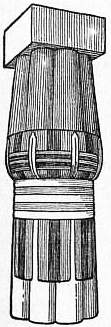
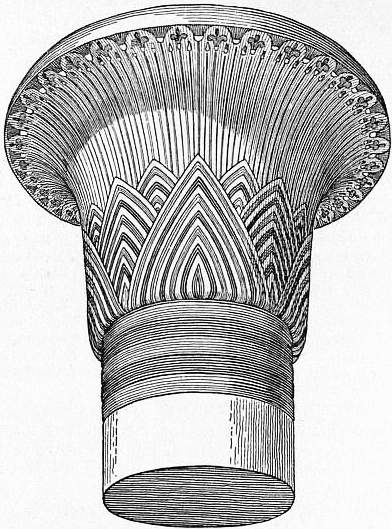
Fig. 1.—Lotus Capital from Karnak. Fig. 2.—Papyrus Capital from Karnak.
The two earliest capitals of importance are those which are based on the lotus (fig. 1) and papyrus (fig. 2) plants respectively, and these, with the palm tree capital, were the chief types employed by the Egyptians down to the 3rd century b.c., when, under the Ptolemaic dynasties, various river plants were employed decoratively and the lotus capital goes through various modifications (fig 3) Some kind of volute capital is shown in the Assyrian bas-reliefs, but no Assyrian capital has ever been found, those exhibited as such in the British Museum are bases.
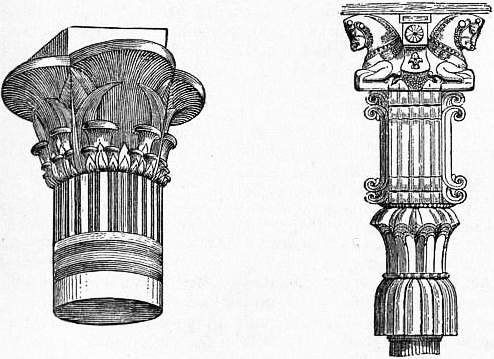
Fig. 3.—Modified Lotus Capital from Philae. Fig. 4.—Persian Capital from Persepolis.
The Persian capital belongs to the third class above mentioned, the brackets are carved with the lion (fig. 4) or the griffin projecting right and left to support and lessen the bearing of the architrave, and on their backs carry other brackets at right angles to support the cross timbers. The profuse decoration underneath the bracket capital in the palace of Xerxes and elsewhere, serves no structural function, but gives some variety to the extenuated shaft.
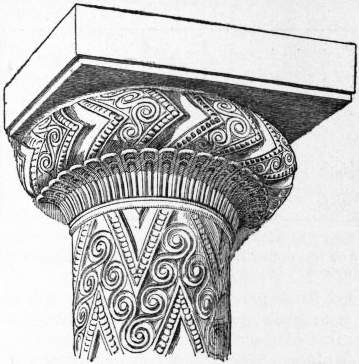
Fig. 5.—Early Greek Capital from the Tomb of Agamemnon, Mycenae.
The earliest Greek capital is that shown in the Temple-fresco at Cnossus in Crete (1600 b.c.); it was of the first type—convex, and was probably moulded in stucco: the second is represented by the richly carved example of the columns (fig 5) flanking the tomb of Agamemnon in Mycenae (c. 1100 b.c.), also convex, carved with the chevron device, and with an apophyge on which the buds of some flowers are sculptured. The Doric capital of the temple of Apollo at Syracuse (c. 700 b.c.) follows, in which the echinus moulding has become a more definite form: this in the Parthenon reaches its culmination, where the convexity is at the top and bottom with a delicate uniting curve The sloping side of the echinus becomes flatter in the later examples, and in the Colosseum at Rome forms a quarter round.
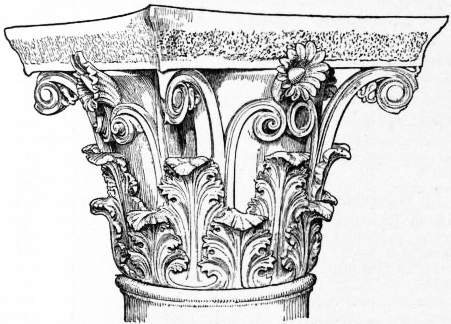
Fig. 6.—Corinthian Capital from the Tholos of Epidaurus.
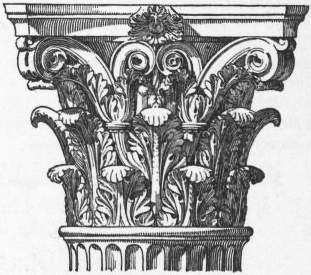
Fig. 7.—Roman Capital from the Temple of Mars Ultor, Rome.
In the Ionic capital of the Archaic temple of Diana at Ephesus (560 b.c.) the width of the abacus is twice that of its depth, consequently the earliest Ionic capital known was virtually a bracket capital. A century later, in the temple on the Ilissus, published in Stuart and Revett, the abacus has become square. One of the most beautiful Corinthian capitals is that from the Tholos of Epidaurus (400 b.c.) (fig. 6); it illustrates the transition between the earlier Greek capital of Bassae and the Roman version of the temple of Mars Ultor (fig. 7).
The foliage of the Greek Corinthian capital was based on the Acanthus spinosus, that of the Roman on the Acanthus mollis; the capital of the temple of Vesta and other examples at Pompeii are carved with foliage of a different type.
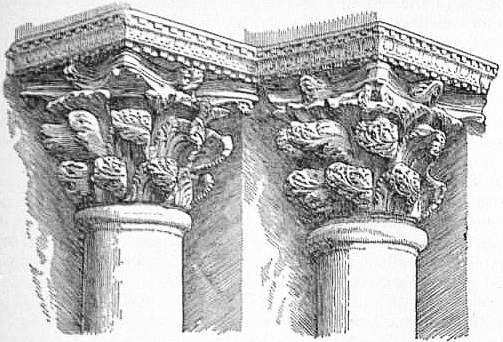
Fig. 8.—Byzantine Capitals from the central portal of St Mark’s, Venice.
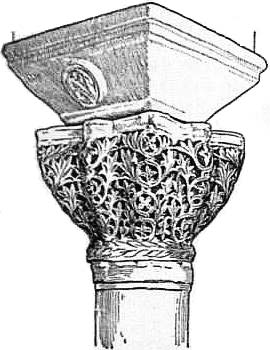
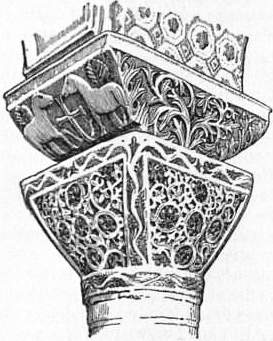
Fig. 9.—Byzantine Capital from the Church of S. Vitale, Ravenna. Fig. 10.—Byzantine Capital from the Church of S. Vitale, Ravenna.
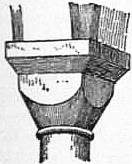
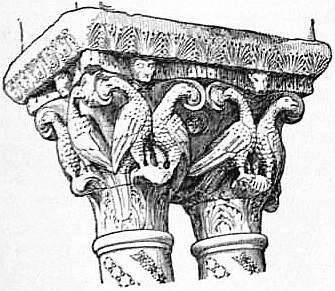
Fig. 11.—Cushion Capital. Fig. 12.—Romanesque Capitals from the Cloister of Monreale, near Palermo, Sicily.
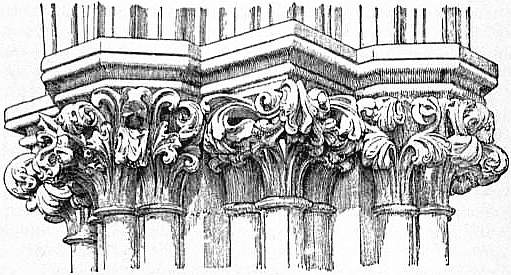
Fig. 13.—Gothic Capitals from Wells Cathedral.
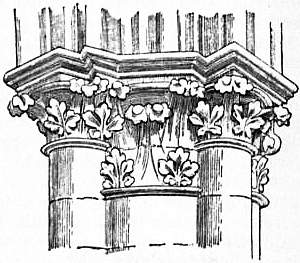
Fig. 14.—Gothic Capitals from Amiens Cathedral.
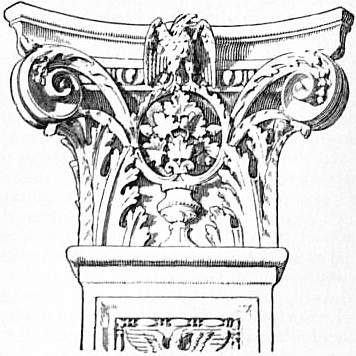
Fig. 15.—Italian Renaissance Capital from S. Maria dei Miracoli, Venice.
Byzantine capitals are of endless variety; the Roman composite capital would seem to have been the favourite type they followed at first: subsequently, the block of stone was left rough as it came from the quarry, and the sculptor, set to carve it, evolved new types of design to his own fancy, so that one rarely meets with many repetitions of the same design. One of the most remarkable is the capital in which the leaves are carved as if blown by the wind; the finest example being in Sta Sophia, Thessalonica; those in St Mark’s, Venice (fig. 8) specially attracted Ruskin’s fancy. Others are found in St Apollinare-in-classe, Ravenna. The Thistle and Pine capital is found in St Mark’s, Venice; St Luke’s, Delphi; the mosques of Kairawan and of Ibn Tūlūn, Cairo, in the two latter cases being taken from Byzantine churches. The illustration of the capital in S. Vitale, Ravenna (figs. 9 and 10) shows above it the dosseret required to carry the arch, the springing of which was much wider than the abacus of the capital.
The Romanesque and Gothic capitals throughout Europe present the same variety as in the Byzantine and for the same reason, that the artist evolved his conception of the design from the block he was carving, but in these styles it goes further on account of the clustering of columns and piers.
The earliest type of capital in Lombardy and Germany is that which is known as the cushion-cap, in which the lower portion of the cube block has been cut away to meet the circular shaft (fig. 11). These early types were generally painted at first with various geometrical designs, afterwards carved.
In Byzantine capitals, the eagle, the lion and the lamb are occasionally carved, but treated conventionally.
In the Romanesque and Gothic styles, in addition to birds and beasts, figures are frequently introduced into capitals, those in the Lombard work being rudely carved and verging on the grotesque; later, the sculpture reaches a higher standard; in the cloisters of Monreale (fig. 12) the birds being wonderfully true to nature. In England and France (figs. 13 and 14), the figures introduced into the capitals are sometimes full of character. These capitals, however, are not equal to those of the Early English school, in which the foliage is conventionally treated as if it had been copied from metal work, and is of infinite variety, being found in small village churches as well as in cathedrals.
Reference has only been made to the leading examples of the Roman capitals; in the Renaissance period (fig. 15) the feature became of the greatest importance and its variety almost as great as in the Byzantine and Gothic styles. The pilaster, which was employed so extensively in the Revival, called for new combinations in the designs for its capitals. Most of the ornament can be traced to Roman sources, and although less vigorous, shows much more delicacy and refinement in its carving.
(R. P. S.)
CAPITAL (i.e. capital stock or fund), in economics, generally, the accumulated wealth either of a man or a community, that is available for earning interest and producing fresh wealth. In social discussion it is sometimes treated as antithetical to labour, but it is in reality the accumulated savings of labour and of the profits accruing from the savings of labour. It is that portion of the annual produce reserved from consumption to supply future wants, to extend the sphere of production, to improve industrial instruments and processes, to carry out works of public utility, and, in short, to secure and enlarge the various means of progress necessary to an increasing community. It is the increment of wealth or means of subsistence analogous to the increment of population and of the wants of civilized man. Hence J.S. Mill and other economists, when seeking a graphic expression of the service of capital, have called it “abstinence.” The labourer serves by giving physical and mental effort in order to supply his means of consumption. The capitalist, or labourer-capitalist, serves by abstaining from consumption, by denying himself the present enjoyment of more or less of his means of consumption, in the prospect of a future profit. This quality, apparent enough in the beginnings of capital, applies equally to all its forms and stages; because whether a capitalist stocks his warehouse with goods and produce, improves land, lends on mortgage or other security, builds a factory, opens a mine, or orders the construction of machines or ships, there is the element of self-deprival for the present, with the risk of ultimate loss of what is his own, and what, instead of saving and embodying income productive form, he might choose to consume. On this ground rests the justification of the claims of capital to its industrial rewards, whether in the form of rent, interest or profits of trade and investment.
To any advance in the arts of industry or the comforts of life, a rate of production exceeding the rate of consumption, with consequent accumulation of resources, or in other words, the formation of capital, is indispensable. The primitive cultivators of the soil, whether those of ancient times or the pioneers who formed settlements in the forests of the New World, soon discovered that their labour would be rendered more effective by implements and auxiliary powers of various kinds, and that until the produce from existing means of cultivation exceeded what was necessary for their subsistence, there could be neither labour on their part to produce such implements and auxiliaries, nor means to purchase them. Every branch of industry has thus had a demand for capital within its own circles from the earliest times. The flint arrow-heads, the stone and bronze utensils of fossiliferous origin, and the rude implements of agriculture, war and navigation, of which we read in Homer, were the forerunners of that rich and wonderful display of tools, machines, engines, furnaces and countless ingenious and costly appliances, which represent so large a portion of the capital of civilized countries, and without the pre-existing capital could not have been developed. Nor in the cultivation of land, or the production simply of food, is the need of implements, and of other auxiliary power, whether animal or mechanical, the only need immediately experienced. The demands on the surplus of produce over consumption are various and incessant. Near the space of reclaimed ground, from which the cultivator derives but a bare livelihood, are some marshy acres that, if drained and enclosed, would add considerably in two or three years to the produce; the forest and other natural obstructions might also be driven farther back with the result, in a few more years, of profit; fences are necessary to allow of pasture and field crops, roads have to be made and farm buildings to be erected; as the work proceeds more artificial investments follow, and by these successive outlays of past savings in improvements, renewed and enhanced from generation to generation, the land, of little value in its natural state either to the owner and cultivator or the community, is at length brought into a highly productive condition. The history of capital in the soil is substantially the history of capital in all other spheres. No progress can be made in any sphere, small or large, without reserved funds possessed by few or more persons, in small or large amounts, and the progress in all cases is adventured under self-deprival in the meanwhile of acquired value, and more or less risk as to the final result.
Capital is necessarily to be distinguished from money, with which in ordinary nomenclature it is almost identical. Wealth may be in other things than money; oxen, wives, tools, have at different stages of civilization represented the recognized form of capital; and modern usage only treats capital as meaning the command of money because money is the ordinary form of it nowadays. The capital of a country can scarce be said to be less than the whole sum of its investments in a productive form, and possessing a recognized productive value.
Adam Smith’s distinction of “fixed” and “circulating” capital in the Wealth of Nations (book ii. c. i.) cannot fail to be always useful in exhibiting the various forms and conditions under which capital is employed. Yet the principal phenomena of capital are found to be the same, whether the form of investment be more or less permanent or circulable. The machinery in which capital is “fixed,” and which yields a profit without apparently changing hands, is in reality passing away day by day, until it is worn out, and has to be replaced. So also of drainage and other land improvements. When the natural forests have been consumed and the landowners begin to plant trees on the bare places, the plantations while growing are a source of health, shelter and embellishment—they are not without a material profit throughout their various stages to maturity—and when, at the lapse of twenty or more years, they are ready to be cut down, and the timber is sold for useful purposes, there is a harvest of the original capital expended as essentially as in the case of the more rapid yearly crops of wheat or oats. The chief distinction would appear to rest in the element of time elapsing between the outlay of capital and its return. Capital may be employed in short loans or bills of exchange at two or three months, in paying wages of labour for which there may be return in a day or not in less than a year or more, or in operations involving within themselves every form of capital expenditure, and requiring a few years or ninety-nine years for the promised fructification on which they proceed. But the common characteristic of capital is that of a fund yielding a return and reproducing itself whether the time to this end be long or short. The division of expenditure or labour (all expenditure having a destination to labour of one kind or another) into “productive” and “unproductive” by the same authority (book ii. c. 3) is also apposite both for purposes of political economy and practical guidance, though economists have found it difficult to define where “productive expenditure” ends and “unproductive expenditure” begins. Adam Smith includes in his enumeration of the “fixed capital” of a country “the acquired and useful abilities of all the inhabitants”; and in this sense expenditure on education, arts and sciences might be deemed expenditure of the most productive value, and yet be wanting in strict commercial account of the profit and loss. It must be admitted that there is a personal expenditure among all ranks of society, which, though not in any sense a capital expenditure, may become capital and receive a productive application, always to be preferred to the grossly unproductive form, in the interest both of the possessors and of the community.
The subject in its details is full of controversies, and a discussion of it at any length would embrace the whole field of economics. The subject will be found fully dealt with in every important economic work, but the following may be specially consulted:—J.S. Mill, Principles of Political Economy; J.E. Cairns, Some Leading Principles of Political Economy; F.A. Walker, Political Economy; A. Marshall, Principles of Economics; E. Bohm v. Bawerk, Capital and Interest; K. Marx, Capital; J.B. Clark, Capital and its Earnings; see also the economic works of W.H. Mallock (Critical Examination of Socialism, 1908, &c.) for an insistence on the importance of “ability,” or brain-work, as against much of modern socialist theorizing against “capitalism.”
CAPITAL PUNISHMENT. By this term is now meant the infliction of the penalty of death for crime under the sentence of some properly constituted authority, as distinguished from killing the offender as a matter of self-defence or private vengeance, or under the order of some self-constituted or irregular tribunal unknown to the law, such as that of the Vigilantes of California, or of lynch law (q.v.). In the early stages of society a man-slayer was killed by the “avenger of blood” on behalf of the family of the man killed, and not as representing the authority of the state (Pollock and Maitland, Hist. Eng. Law, ii. 447.) This mode of dealing with homicide survives in the vendetta of Corsica and of the Mainotes in Greece, and in certain of the southern states of North America. The obligation or inclination to take vengeance depends on the fact of homicide, and not on the circumstances in which it was committed, i.e. it is a part of the lex talionis. The mischief of this system was alleviated under the Levitical law by the creation of cities of refuge, and in Greece and Italy, both in Pagan and Christian times, by the recognition of the right of sanctuary in temples and churches. A second mode of dealing with homicide was that known to early Teutonic and early Celtic law, where the relatives of the deceased, instead of the life of the slayer, received the wer of the deceased, i.e. a payment in proportion to the rank of the slain, and the king received the blood-wite for the loss of his man. But even under this system certain crimes were in Anglo-Saxon law bot-less, i.e. no compensation could be paid, and the offender must suffer the penalty of death. In the laws of Khammurabi, king of Babylon (2285-2242 b.c.), the death penalty is imposed for many offences. The modes for executing it specially named are burning, drowning and impalement (Oldest Code of Laws, by C.H.W. Johns, 1903). Under the Roman law, “capital” punishment also included punishments which deprived the offender of the status of Roman citizen (capitis deminutio, capitis amissio), e.g. condemnation to servitude in the mines or to deportation to an island (Dig. 48. 19).
United Kingdom.—The modes of capital punishment in England under the Saxon and Danish kings were various: hanging, beheading, burning, drowning, stoning, and precipitation from rocks. The principle on which this British and foreign laws and methods. variety depended was that where an offence was such as to entitle the king to outlaw the offender, he forfeited all, life and limb, lands and goods, and that the king might take his life and choose the mode of death. William the Conqueror would not allow judgment of death to be executed by hanging and substituted mutilation; but his successors varied somewhat in their policy as to capital punishment, and by the 13th century the penalty of death became by usage (without legislation) the usual punishment for high and petty treason and for all felonies (except mayhem and petty larceny, i.e. theft of property worth less than 1s.); see Stephen, Hist. Cr. Law, vol. i. 458; Pollock and Maitland, Hist. Eng. Law, vol. ii. 459. It therefore included all the more serious forms of crime against person or property, such as murder, manslaughter, arson, highway robbery, burglary (or hamesucken) and larceny; and when statutory felonies were created they were also punishable by death unless the statute otherwise provided. The death penalty was also extended to heretics under the writ de heretico comburendo, which was lawfully issuable under statute from 1382 (5 Ric. II. stat. 5) until 1677 (29 Chas. II. c. 9). For this purpose the legislature had adopted the civil law of the Roman Empire, which was not a part of the English common law (Stephen, Hist. Cr. Law, vol. ii. 438-469).
The methods of execution by crucifixion (as under the Roman law), or breaking on the wheel (as under the Roman Dutch law and the Holy Roman Empire), were never recognized by the common law, and would fall within the term “cruel and unusual punishments” in the English Bill of Rights, and in the United States would seem to be unconstitutional (see Wilkinson v. Utah, 1889, 136 U.S. 436, 446).
The severity of barbarian and feudal laws was mitigated, so far as common-law offences were concerned, by the influence of the Church as the inheritor of Christian traditions and Roman jurisprudence. The Roman law under the empire did not allow the execution of citizens except under the Lex Porcia. But the right of the emperors to legislate per rescriptum principis enabled them to disregard the ordinary law when so disposed. The 83rd novel of Justinian provided that criminal causes against clerics should be tried by the judges, and that the convicted cleric should be degraded by his bishop before his condemnation by the secular power, and other novels gave the bishops considerable influence, if not authority, over the lay judiciary. In western Europe the right given by imperial legislation in the Eastern Empire was utilized by the Papacy to claim privilege of clergy, i.e. that clerks must be remitted to the bishop for canonical punishment, and not subjected to civil condemnation at all. The history of benefit of clergy is given in Pollock and Maitland, Hist. English Law, vol. i. pp. 424-440, and Stephen, Hist. Cr. Law, vol. iii. 459, 463. By degrees the privilege was extended not only to persons who could prove ordination or show a genuine tonsure, but all persons who had sufficient learning to be able to read the neck-verse (Ps. li. v. 1). Before the Reformation the ecclesiastical courts had ceased to take any effective action with respect to clerks accused of offences against the king’s laws; and by the time of Henry VII. burning on the hand under the order of the king’s judges was substituted for the old process of compurgation in use in the spiritual courts.
The effect of the claim of benefit of clergy is said to have been to increase the number of convictions, though it mitigated the punishment; and it became, in fact, a means of showing mercy to certain classes of individuals convicted of crime as a kind of privilege to the educated, i.e. to all clerks whether secular or religious (25 Edw. III. stat. 3); and it was allowed only in case of a first conviction, except in the case of clerks who could produce their letters of orders or a certificate of ordination. To prevent a second claim it was the practice to brand murderers with the letter M, and other felons with the Tyburn T, and Ben Jonson was in 1598 so marked for manslaughter.
The reign of Henry VIII. was marked by extreme severity in the execution of criminals—as during this time 72,000 persons are said to have been hanged. After the formation of English settlements in America the severity of the law was mitigated by the practice of reprieving persons sentenced to death on condition of their consenting to be transported to the American colonies, and to enter into bond service there. The practice seems to have been borrowed from Spain, and to have been begun in 1597 (39 Eliz. c. 4). It was applied by Cromwell after his campaign in Ireland, and was in full force immediately after the Restoration, and is recognized in the Habeas Corpus Act 1677, and was used for the Cameronians during Claverhouse’s campaign in south-west Scotland. In the 18th century the courts were empowered to sentence felons to transportation (see Deportation) instead of to execution, and this state of the law continued until 1857 (6 Law Quarterly Review, p. 388). This power to sentence to transportation at first applied only to felonies with benefit of clergy; but in 1705, on the abolition of the necessity of proving capacity to read, all criminals alike became entitled to the benefit previously reserved to clerks. Benefit of clergy was finally abolished in 1827 as to all persons not having privilege of peerage, and in 1841 as to peers and peeresses. Its beneficial effect had now been exhausted, since no clergyable offences remained capital crimes.
At the end of the 18th century the criminal law of all Europe was ferocious and indiscriminate in its administration of capital punishment for almost all forms of grave crime; and yet owing to poverty, social conditions, and the inefficiency of the police, such forms of crime were far more numerous than they now are. The policy and righteousness of the English law were questioned as early as 1766 by Goldsmith through the mouth of the vicar of Wakefield: “Nor can I avoid even questioning the validity of that right which social combinations have assumed of capitally punishing offences of a slight nature. In cases of murder their right is obvious, as it is the duty of us all from the law of self-defence to cut off that man who has shown a disregard for the life of another. Against such all nature rises in arms; but it is not so against him who steals my property.” He adds later: “When by indiscriminate penal laws the nation beholds the same punishment affixed to dissimilar degrees of guilt, the people are led to lose all sense of distinction in the crime, and this distinction is the bulwark of all morality.”
The opinion expressed by Goldsmith was strongly supported by Bentham, Romilly, Basil Montaguand Mackintosh in England, and resulted in considerable mitigation of the severity of the law. In 1800 over 200 and in 1819 about 180 crimes were capital. As the result of the labour of these eminent men and their disciples, and of Sir Robert Peel, there are now only four crimes (other than offences against military law or naval discipline) capitally punishable in England—high treason, murder, piracy with violence, and destruction of public arsenals and dockyards (The Dockyards, &c., Protection Act 1772). An attempt to abolish the death penalty for this last offence was made in 1837, but failed, and has not since been renewed. In the case of the last two offences sentence of death need not be pronounced, but may be recorded (4 Geo. IV. c. 48). Since 1838 it has in practice been executed only for murder; the method being by hanging.
The change in the severity of the law is best illustrated by the following statistics:—
Years. Death Sentences. Sentences Executed.
For all Crimes. For Murder. For all Crimes. For Murder.
1831 1601 14 52 12
1833 * 931 9 33 6
1838 * 116 25 6 5
1862 * 29 28 15 15
* Each of these years followed upon legislation mitigating severity of punishment.
During the twelve years from 1893 to 1904, 788 persons were committed for trial for murder, being an average of 65. The highest number was in 1893 (82) and the lowest in 1900 (51). Of those tried in 1904, 28 (26 males and 2 females) were convicted of murder, 16 (all males) were executed; 9 males and 2 females had their sentences commuted to penal servitude for life.
In Scotland capital punishment can be imposed only for treason, murder and offences against 10 Geo. IV. c. 38, i.e., wilful shooting, stabbing, strangling or throwing corrosives with intent to murder, maim, disfigure, disable, or do grievous bodily harm, in all cases where if death had ensued the offence would have been murder. Prior to 1887 rape, robbery, wilful fire-raising and incest, and many other crimes, were also capital offences; but in practice the pains of law were restricted at the instance of the prosecution. The method is by hanging.
In Ireland capital punishment may be inflicted for the same offences as in England, except offences under the Dockyards Protection Act 1772, and it is carried out in the same manner.
Offences under Military Law.—Thus far only crimes against the ordinary law of the land have been dealt with. But both the Naval Discipline Act of 1866 and the Army Act empower courts-martial to pass sentence for a number of offences against military and naval laws. Such sentences are rarely if ever passed where an ordinary court is within reach, or except in time of war. The offences extend from traitorous communication with the enemy and cowardice on the field to falling asleep while acting as a sentinel on active service. It is for the authority confirming a sentence of death by court-martial to direct the mode of execution, which both in the British and United States armies is usually by shooting or hanging. During the Indian Mutiny some mutineers were executed by being blown from the mouth of cannon. As to the history of military punishments see Clode, Military and Martial Law.
British Colonies and Possessions.—Under the Indian Penal Code sentence of death may be passed for waging war against the king (s. 121) and for murder (s. 302). If the murder is committed by a man under sentence of transportation for life the death penalty must be imposed (s. 303). In other cases it is alternative. This code has been in substance adopted in Ceylon, in Straits Settlements and Hong-Kong, and in the Sudan. In most of the British colonies and possessions the death penalty may be imposed only in the case of high treason, wilful murder and piracy with violence. But in New South Wales and Victoria sentence of death may be passed for rape and criminal abuse of girls under ten. In Queensland the law was the same until the passing of the Criminal Code of 1899.
Under the Canadian Criminal Code of 1892 the death sentence may be imposed for treason (s. 657), murder (s. 231), rape (s. 267), piracy with violence (s. 127), and upon subjects of a friendly power who levy war on the king in Canada (s. 68). But the judge is bound by statute to report on all death sentences, and the date of execution is fixed so as to give time for considering the report. The sentence is executed by hanging. In South Africa the criminal law is based on the Roman-Dutch law, under which capital punishment is liable for treason (crimen perduellionis or laesae majestatis), murder and rape (van Lecuwen, c. 36). In the Cape Colony rape is still capital (R. v. Nonosi, 1885; 1 Buchanan, 1898). In Natal rape may be punished by hanging (act no. 22, 1898). Though the Roman-Dutch modes of executing the sentence by decapitation or breaking on the wheel have not been formally abolished, in practice the sentence in the Cape Colony is executed by hanging. In the Transvaal hanging is now the sole mode of executing capital punishment (Criminal Procedure Code, 1903, s. 244). The Roman-Dutch law as to crime and punishments has been superseded in Ceylon and British Guiana by ordinance.
Austria-Hungary.—In Austria capital punishment was in 1787 for a time abolished, but was reintroduced in 1795 for high treason, and in 1803 for certain other crimes. Under the penal code still in force in 1906 it might be inflicted for the offences in the table given below, but not on offenders who were under twenty when they committed the offence. The annexed table indicates that the full sentence was sparingly executed. Under a Penal Code drafted in 1906, however, only two offences were made capital, viz. high treason against the person of the emperor and the graver cases of murder. The sentence is executed by hanging.
Crimes Punishable by Death. 1853 to 1873. 1875 to 1900. 1901 to 1903.
Condemned. Executed. Condemned. Executed. Condemned. Executed.
High treason 4 0 1 0 0 0
Murder s. 136 880 102 2085 81 180 9
Killing by robbers, s. 141 12 3 35 1 3 0
Public violence, ss. 85, 87 · · · · 1 0 0 0
Incendiarism, s. 167 5 0 0 0 0 0
Criminal use of explosives · · · · · · · · · · · ·
(explosives law, s. 4)
Belgium.—Under the Belgian Penal Code of 1867 the death penalty is retained for certain forms of high treason, and for assassination and parricide by poisoning. It may not be pronounced on a person under eighteen. The sentence is executed publicly by the guillotine. No execution seems to have taken place since 1863.
Denmark.—Sentence of death may be imposed for most forms of high treason, aggravated cases of murder, rape and piracy. It is executed publicly by the axe. Offenders under eighteen are not liable.
Finland.—In Finland the death penalty is alleged not to have been inflicted since 1824. It may be imposed for the assassination of the grand duke or grand duchess or the head of a friendly state, and wilful murder of other persons.
France.—Under the ancien régime in France, 115 crimes had become capital in 1789. The mode of execution varied, but in some cases it was effected by breaking on the wheel or burning, and was coupled with mutilation. Under the Penal Code of 1810, as amended in or after 1832, even so late as 1871, thirty offences were capital, one being perjury against a prisoner resulting in his condemnation to death (art. 361). At present it may be imposed for wounding a public official with intent to murder (art. 233), assassination, parricide, poisoning, killing to commit a crime or escape from justice (arts. 302, 304). But juries freely exercise the power of acquitting in capital cases, or of defeating the capital sentence by finding extenuating circumstances in more than seven-eighths of the cases, which compels the court to reduce the punishment by one or more degrees, i.e. below the penalty of death. And in recent times the prerogative of mercy has been continually exercised by the president, even in gross cases where public opinion demanded the extreme penalty. The sentence is executed in public by the guillotine.
Germany.—In many of the states of Germany capital punishment had been abolished (Brunswick, Coburg, Nassau, Oldenburg in 1849; Saxe-Meiningen, Saxe-Weimar, 1862; Baden, 1863; Saxony, 1868). But it has been restored by the Imperial Criminal Code of 1872, in the case of attempts on the life of the emperor, or of the sovereign of any federal state in which the offender happens to be (s. 80), and for deliberate homicide (s. 211)—as opposed to intentional homicide without deliberation—and for certain treasonable acts committed when a state of siege has been proclaimed. The sentence is executed by beheading (s. 13).
Holland.—In Holland there have been no executions since 1860. Capital punishment (by hanging) was abolished in 1870, and was not reintroduced in the Penal Code of 1886.
Italy.—Capital punishment was abolished in Tuscany as far back as 1786, and from Italy has come the chief opposition to the death penalty, originated by Beccaria, and supported by many eminent jurists. Under the Penal Code of 1888 the death penalty was abrogated for all crimes, even for regicide. The cases of homicide in Italy are very numerous compared with those in England, amounting in 1905 to 105 per million as compared with 27 per million in the United Kingdom.
Japan.—The penalty of death is executed by hanging within a prison. It may be imposed for executing or contriving acts of violence against the mikado or certain of his family, and for seditious violence with the object of seizing the territory or subverting the government or laws of Japan, or conspiring with foreign powers to commence hostilities against Japan. It is inflicted for certain forms of homicide, substantially wilful murder in the first degree.
Norway.—Under Norwegian law, up to 1905, sentence of death might be passed for murder with premeditation, but the court might as an alternative decree penal servitude for life. Sentence of death had also to be passed in cases where a person under sentence of penal servitude for life committed murder or culpable homicide, or caused bodily injuries in circumstances warranting a sentence of penal servitude for life, or committed robbery or the graver forms of wilful fire-raising. The sentence was carried out by decapitation (see Beheading); but there had been no execution since 1876. The new Norwegian Code, which came into force on the 6th of January 1905, abolished capital punishment.
Portugal.—There has been considerable objection in Portugal to capital punishment, and it was abolished in 1867.
Rumania.—Capital punishment was abolished in 1864.
Russia.—In 1750, under the empress Elizabeth, capital punishment was abolished; but it was restored later and was freely inflicted, the sentence being executed by shooting, beheading or hanging. According to a Home Office Return in England in 1907 the death penalty is abolished, except in cases where the lives of the emperor, empress or heir to the throne are concerned.
Spain.—Under the Spanish Penal Code of 1870 the following crimes are capital:—inducing a foreign power to declare war against Spain, killing the sovereign, parricide and assassination. The method employed is execution in public by the garrote. But the death sentence is rarely imposed, the customary penalty for murder being penal servitude in chains for life, while a parricide is imprisoned in chains “in perpetuity until death.”
Sweden.—The severity of the law in Sweden was greatly mitigated so far back as 1777. Under the Penal Code of 1864 the penalty of death may be imposed for certain forms of treason, including attempts on the life of the sovereign or on the independence of Sweden, and for premeditated homicide (assassinat), and in certain cases for offences committed by persons under sentence of imprisonment for life. In 1901 a bill to abolish capital punishment was rejected by both houses of the Swedish parliament.
Switzerland.—Capital punishment was abolished in Switzerland in 1874 by Federal legislation; but in 1879, in consequence of a plebiscite, each canton was empowered to restore the death penalty for offences in its territory. The Federal government was unwilling to take this course, but was impelled to it by the fact that, between 1874 and 1879, cases of premeditated murder had considerably increased. Seven of the cantons out of twenty-two have exercised the power given to restore capital punishment. But there do not seem to have been any cases in which the death penalty has been inflicted; and on the assassination of the empress of Austria at Geneva in 1898 it was found that the laws of the canton did not permit the execution of the assassin. The canton of Zug imposes the lowest minimum penalty known, i.e. three years’ imprisonment for wilful homicide, the maximum being imprisonment for life.
United States of America.—Under the Federal laws sentence of death may be passed for treason against the United States and for piracy and for murder within the Federal jurisdiction. But for the most part the punishment of crime is regulated by the laws of the constituent states of the Union.
The death penalty was abolished in Michigan in 1846 except for treason, and wholly in Wisconsin in 1853. In Maine it was abolished in 1876, re-enacted in 1883, and again abolished in 1887. In Rhode Island it was abolished in 1852, but restored in 1882, only in case of murder committed by a person under sentence of imprisonment for life (Laws, 1896, c. 277, s. 2). In all the other states the death penalty may still be inflicted: in Alabama, Delaware, Georgia, Maryland, and West Virginia, for treason, murder, arson and rape; in Alaska, Arizona, Kansas, New Jersey, Mississippi, Montana, New York, North Dakota, Oregon, and South Dakota, for treason and murder; in Colorado, Idaho, Illinois, Iowa, Massachusetts, Minnesota, Nebraska, New Hampshire, New Mexico, Nevada, Ohio, Oklahoma, Pennsylvania, Utah and Wyoming, for murder only; in Kentucky and Virginia, for treason, murder and rape; in Vermont, for treason, murder and arson; in Indiana, for treason, murder, and for arson if death result; in California, for treason, murder and train-wrecking; in North Carolina, for murder, rape, arson and burglary; in Florida, Missouri, South Carolina, Tennessee and Texas, for murder and rape; in Arkansas and Louisiana, for treason, murder, rape, and administering poison or use of dangerous weapons with intent to murder. Louisiana is cited by Girardin (le droit de punir) as a state in which the death penalty was abolished in 1830. Under the influence of the eminent jurist, E. Livingston, who framed the state codes, the legislature certainly passed a resolution against capital punishment. But since as early as 1846 it has been there lawful, subject to a power given to the jury, to bring in a verdict of guilty, “but no capital punishment,” which had the effect of imposing a sentence of hard labour for life. In certain states the jury has, under local legislation, the right to award the sentence. The constitutionality of such legislation has been doubted, but has been recognized by the courts of Illinois and Iowa. Sentence of death is executed by hanging, except in seven of the states, where it is carried out by “electrocution” (q.v.).
With the mitigation of the law as to punishment, agitation against the theory of capital punishment has lost much of its force. But many European and American writers, and some English writers and associations, advocate the The question of abolition. total abolition of the death punishment. The ultimate argument of the opponents of capital punishment is that society has no right to take the life of any one of its members on any ground. But they also object to capital punishment: (1) on religious grounds, because it may deprive the sinner of his full time for repentance; (2) on medical grounds, because homicide is usually if not always evidence of mental disease or irresponsibility; (3) on utilitarian grounds, because capital punishment is not really deterrent, and is actually inflicted in so few instances that criminals discount the risks of undergoing it; (4) on legal grounds, i.e. that the sentence being irrevocable and the evidence often circumstantial only, there is great risk of gross injustice in executing a person convicted of murder; (5) on moral grounds, that the punishment does not fit the case nor effect the reformation of the offender. It is to be noted that the English Children Act 1908 expressly forbids the pronouncing or recording the sentence of death against any person under the age of sixteen (s. 103).
The punishment is probably retained, partly from ingrained habit, partly from a sense of its appropriateness for certain crimes, but also that the ultima ratio may be available in cases of sufficient gravity to the commonweal. The apparent discrepancy between the number of trials and convictions for murder is not in England any evidence of hostility on the part of juries to capital punishment, which has on the whole lessened rather than increased since the middle of the 19th century. It is rarely if ever necessary in England, though common in America, to question the jurors as to their views on capital punishment. The reasons for the comparatively small number of convictions for murder seem to be: (1) that court and jury in a capital case lean in favorem vitae, and if the offence falls short of the full gravity of murder, conviction for manslaughter only results; (2) that in the absence of a statutory classification of the degrees of murder, the prerogative of mercy is exercised in cases falling short of the highest degree of gravity recognized by lawyers and by public opinion; (3) that where the conviction rests on circumstantial evidence the sentence is not executed unless the circumstantial evidence is conclusive; (4) that charges of infanticide against the mothers of illegitimate children are treated mercifully by judge and jury, and usually terminate in acquittal, or in a conviction of concealment of birth; (5) that many persons tried as murderers are obviously insane; (6) that coroners’ juries are somewhat recklessly free in returning inquisitions of murder without any evidence which would warrant the conviction of the person accused.
The medical doctrine, and that of Lombroso with respect to criminal atavism and irresponsibility, have probably tended to incline the public mind in favour of capital punishment, and Sir James Stephen and other eminent jurists have even been thereby tempted to advocate the execution of habitual criminals. It certainly seems strange that the community should feel bound carefully to preserve and tend a class of dangerous lunatics, and to give them, as Charles Kingsley says, “the finest air in England and the right to kill two gaolers a week.”
The whole question of capital punishment in the United Kingdom was considered by a royal commission appointed in 1864, which reported in 1866 (Parl. Pap., 1866, 10,438). The commission took the opinions of all the judges of the supreme courts in the United Kingdom and of many other eminent persons, and collected the laws of other countries so far as this was ascertainable. The commissioners differed on the question of the expediency of abolishing or retaining capital punishment, and did not report thereon. But they recommended: (1) that it should be restricted throughout the United Kingdom to high treason and murder; (2) alteration of the law of homicide so as to classify homicides according to their gravity, and to confine capital punishment to murder in the first degree; (3) modification of the law as to child murder so as to punish certain cases of infanticide as misdemeanours; (4) authorizing judges to direct sentence of death to be recorded; (5) the abolition—since carried out—of public executions.
Authorities.—Beccaria, Dei Delitte e delle Pene (1790); Bentham, Rationale of Punishment; Lammasch, Grundris des Strafrechts (Leipzig, 1902); Olivecrona, De la peine de mort; Mittermaier, Capital Punishment; Report of the Royal Commission on Capital Punishment (Parl. Pap., 1866, No. 10,438); Oldfield, The Penalty of Death (1901); Pollock and Maitland, History of English Law; Pike, History of Crime; Sir J.F. Stephen, History of Crime in England; S. Walpole, History of England, vol. i. p. 191; vol. iv. p. 74; Andrews’ Old Time Punishments; A Century of Law Reform (London, 1901); Lecture ii. by Sir H.B. Poland; Howard Association Publications.
(W. F. C.)
CAPITO (or Köpfel), WOLFGANG [Fabricius] (1478-1541), German reformer, was born of humble parentage at Hagenau in Alsace. He was educated for the medical profession, but also studied law, and applied himself so earnestly to theology that he received the doctorate in that faculty also, and, having joined the Benedictines, taught for some time at Freiburg. He acted for three years as pastor in Bruchsal, and was then called to the cathedral church of Basel (1515). Here he made the acquaintance of Zwingli and began to correspond with Luther. In 1519 he removed to Mainz at the request of Albrecht, archbishop of that city, who soon made him his chancellor. In 1523 he settled at Strassburg, where he remained till his death in November 1541. He had found it increasingly difficult to reconcile the new religion with the old, and from 1524 was one of the leaders of the reformed faith in Strassburg. He took a prominent part in the earlier ecclesiastical transactions of the 16th century, was present at the second conference of Zurich and at the conference of Marburg, and along with Martin Bucer drew up the Confessio Tetrapolitana. Capito was always more concerned for the “unity of the spirit” than for dogmatic formularies, and from his endeavours to conciliate the Lutheran and Zwinglian parties in regard to the sacraments, he seems to have incurred the suspicions of his own friends; while from his intimacy with Martin Cellarius and other divines of the Socinian school he drew on himself the charge of Arianism. His principal works were:—Institutionum Hebraicarum libri duo; Enarrationes in Habacuc et Hoseam Prophetas; a life of Oecolampadius and an account of the synod of Berne (1532).
CAPITULARY (Med. Lat. capitularium), a series of legislative or administrative acts emanating from the Merovingian and Carolingian kings, so called as being divided into sections or chapters (capitula). With regard to these capitularies two questions arise: (1) as to the means by which they have been handed down to us; (2) as to their true character and scope.
(1) As soon as the capitulary was composed, it was sent to the various functionaries of the Frankish empire, archbishops, bishops, missi and counts, a copy being kept by the chancellor in the archives of the palace. At the present day we do not possess a single capitulary in its original form: but very frequently copies of these isolated capitularies were included in various scattered manuscripts, among pieces of a very different nature, ecclesiastical or secular. We find, therefore, a fair number of them in books which go back as far as the 9th or 10th centuries. In recent editions in the case of each capitulary it is carefully indicated from what manuscripts it has been collated.
These capitularies make provisions of a most varied nature; it was therefore found necessary at quite an early date to classify them into chapters according to the subject. In 827 Ansegisus, abbot of St Wandrille at Fontenelle, made such a collection. He embodied them in four books: one of the ecclesiastical capitularies of Charlemagne, one of the ecclesiastical capitularies of Louis the Pious, one of the secular capitularies of Charlemagne, and one of the secular capitularies of Louis, bringing together similar provisions and suppressing duplicates. This collection soon gained an official authority, and after 829 Louis the Pious refers to it, citing book and section.
After 827 new capitularies were naturally promulgated, and before 858 there appeared a second collection in three books, by an author calling himself Benedictus Levita. His aim was, he said, to complete the work of Ansegisus, and bring it up to date by continuing it from 827 to his own day; but the author has not only borrowed prescriptions from the capitularies; he has introduced other documents into his collection, fragments of Roman laws, canons of the councils and especially spurious provisions very similar in character to those of the same date found in the False Decretals. His contemporaries did not notice these spurious documents, but accepted the whole collection as authentic, and incorporated the four books of Ansegisus and the three of Benedictus Levita into a single collection in seven books. The serious historian of to-day, however, is careful not to use books v., vi. and vii. for purposes of reference.