VOLUME V SLICE II Camorra to Cape Colony (continued 5)
Reading edition
Biography has been devoted mainly to political subjects. The best of these are Joseph Pope’s Memoirs of Sir John Macdonald (1894), W.D. le Sueur’s Frontenac (1906), Sir John Bourinot’s Lord Elgin (1905), Jean McIlwraith’s Sir Frederick Haldimand (1904), D.C. Scott’s John Graves Simcoe (1905), A.D. de Celles’ Papineau and Cartier(1904), Charles Lindsey’s William Lyon Mackenzie (1862), J.W. Longley’s Joseph Howe (1905) and J.S. Willison’s Sir Wilfrid Laurier (1903).
In belles lettres very little has been accomplished, unless we may count Goldwin Smith (q.v.) as a Canadian. As a scholar, a thinker, and a master of pure English he has exerted a marked influence upon Canadian literature and Canadian life.
While mediocrity is the prevailing characteristic of most of what passes for poetry in Canada, a few writers have risen to a higher level. The conditions of Canadian life have not been favourable to the birth of great poets, but within the limits of their song such men as Archibald Lampman (1861-1891), William Wilfred Campbell (b. 1861), Charles Roberts, Bliss Carman (b. 1861) and George Frederick Cameron have written lines that are well worth remembering. Lampman’s poetry is the most finished and musical. He fell short of being a truly great poet, inasmuch as great poetry must, which his does not, touch life at many points, but his verses are marked by the qualities that belonged to the man—sincerity, purity, seriousness. Campbell’s poetry, in spite of a certain lack of compression, is full of dramatic vigour: Roberts has put some of his best work into sonnets and short lyrics, while Carman has been very successful with the ballad, the untrammelled swing and sweep of which he has finely caught; the simplicity and severity of Cameron’s style won the commendation of even so exacting a critic as Matthew Arnold. One remarkable drama—Charles Heavysege’s (1816-1876) Saul (1857)—belongs to Canadian literature. Though unequal in execution, it contains passages of exceptional beauty and power. The sweetness and maturity of Isabella Valency Crawford’s (1851-1887) verse are also very worthy of remembrance. The habitant poems of Dr W.H. Drummond (1854-1907) stand in a class by themselves, between English and French Canadian literature, presenting the simple life of the habitant with unique humour and picturesqueness.
The first distinctively Canadian novel was John Richardson’s (1796-1852) Wacousta (1832), a stirring tale of the war of 1812. Richardson afterwards wrote half a dozen other romances, dealing chiefly with incidents in Canadian history. Susanna Moodie (1803-1885) and Katharine Parr Traill (1802-1899), sisters of Agnes Strickland, contributed novels and tales to one of the earliest and best of Canadian magazines, the Literary Garland (1838-1847). The Golden Dog, William Kirby’s (1817-1906) fascinating romance of old Quebec, appeared in 1877, in a pirated edition. Twenty years later the first authorized edition was published. James de Mille (1833-1880) was the author of some thirty novels, the best of which is Helena’s Household (1868), a story of Rome in the 1st century. The Dodge Club (1869), a humorous book of travel, appeared, curiously enough, a few months before Innocents Abroad. De Mille’s posthumous novel, A Strange Manuscript found in a Copper Cylinder (1888), describes a singular race whose cardinal doctrine is that poverty is honourable and wealth the reverse. Sir Gilbert Parker (b. 1862) stands first among contemporary Canadian novelists. He has made admirable use in many of his novels of the inexhaustible stores of romantic and dramatic material that lie buried in forgotten pages of Canadian history. Of later Canadian novelists mention may be made of Sara Jeannette Duncan (Mrs Everard Cotes, b. 1862), Ralph Connor (Charles W. Gordon, b. 1866), Agnes C. Laut (b. 1872), W.A. Fraser (b. 1859) and Ernest Thompson Seton (b. 1860). Thomas Chandler Haliburton (q.v.) stands in a class by himself. In many respects his is the most striking figure in Canadian literature. He is best known as a humorist, and as a humorist he ranks with the creators of “My Uncle Toby” and “Pickwick.” But there is more than humour in Haliburton’s books. He lacked, in fact, but one thing to make him a great novelist: he had no conception of how to construct a plot. But he knew human nature, and knew it intimately in all its phases; he could construct a character and endow it with life; his people talk naturally and to the point; and many of his descriptive passages are admirable. Those who read Haliburton’s books only for the sake of the humour will miss much of their value. His inimitable Clockmaker (1837), as well as the later books, The Old Judge (1849), The Attaché (1843), Wise Saws and Modern Instances (1853) and Nature and Human Nature (1855), are mirrors of colonial life and character.
For general treatment of English-Canadian literature, reference may be made to Sir John Bourinot’s Intellectual Development of the Canadian People (1881); G. Mercer Adam’s Outline History of Canadian Literature (1887); “Native Thought and Literature,” in J.E. Collins’s Life of Sir John A. Macdonald (1883); “Canadian Literature,” by J.M. Oxley, in the Encyclopaedia Americana, vol. ix. (1904); A. MacMurchy’s Handbook of Canadian Literature (1906); and articles by J. Castell Hopkins, John Reade, A.B. de Mille and Thomas O’Hagan, in vol. v. of Canada: an Encyclopaedia of the Country (1898-1900); also to Henry J. Morgan’s Bibliotheca Canadensis (1867) and Canadian Men and Women of the Time (1898); W.D. Lighthall, Songs of the Great Dominion; Theodore Rand’s Treasury of Canadian Verse (1900); C.C. James’s Bibliography of Canadian Verse (1898); L.E. Horning’s and L.J. Burpee’s Bibliography of Canadian Fiction (1904); S.E. Dawson’s Prose Writers of Canada (1901); “Canadian Poetry,” by J.A. Cooper, in The National, 29, p. 364; “Recent Canadian Fiction,” by L.J. Burpee, in The Forum, August 1899. For individual authors, see Haliburton’s A Centenary Chaplet (1897), with a bibliography; “Haliburton,” by F. Blake Crofton, in Canada: an Encyclopaedia of the Country; C.H. Farnham’s Life of Francis Parkman and H.D. Sedgwick’s Francis Parkman (1901); and articles on “Parkman,” by E.L. Godkin, in The Nation, 71, p. 441; by Justin Winsor in The Atlantic, 73, p. 660; by W.D. Howells, The Atlantic, 34, p. 602; by John Fiske, The Atlantic, 73, p. 664; by J.B. Gilder in The Critic, 23, p. 322; “Goldwin Smith as a Critic,” by H. Spencer, Contemp. Review, 41, p. 519; “Goldwin Smith’s Historical Works,” by C.E. Norton, North American Review, 99, p. 523; “Poetry of Charles Heavysege,” by Bayard Taylor, Atlantic, 16, p. 412; “Charles Heavysege,” by L.J. Burpee, in Trans. Royal Society of Canada, 1901; “Archibald Lampman,” by W.D. Howells, Literature (N.Y.), 4, p. 217; “Archibald Lampman,” by L.J. Burpee, in North American Notes and Queries (Quebec), August and September 1900; “Poetry of Bliss Carman,” by J.P. Mowbray, Critic, 41, p. 308; “Isabella Valency Crawford,” in Poet-Lore (Boston), xiii. No. 4; Roberts and the Influences of his Time (1906), by James Cappon; “William Wilfred Campbell,” Sewanee Review, October 1900; “Kingsford’s History of Canada,” by G.M. Wrong, N.A. Review, I p. 550; “Books of Gilbert Parker,” by C.A. Pratt, Critic, 33, p. 271.
(L. J. B.)
2. French-Canadian Literature at the opening of the 20th century might be described as entirely the work of two generations, and it was separated from the old régime by three more generations whose racial sentiment only found expression in the traditional songs and tales which their forefathers of the 17th century had brought over from the mère patrie. Folk-lore has always been the most essentially French of all imaginative influences in Canadian life; and the songs are the quintessence of the lore. Not that the folk-songs have no local variants. Indian words, like moccasin and toboggan, are often introduced. French forms are freely turned into pure Canadianisms, like cageux, raftsman, boucane, brushwood smoke, portage, &c. New characters, which appeal more directly to the local audience, sometimes supplant old ones, like the quatre vieux sauvages who have ousted the time-honoured quatre-z-officiers from the Canadian version of Malbrouk. There are even a few entire songs of transatlantic origin. But all these variants together are mere stray curios among the crowding souvenirs of the old home over sea. No other bridge can rival le Pont d’Avignon. “Ici” in C’est le ban vin qui danse ici can be nowhere else but in old France—le ban vin alone proves this. And the Canadian folk-singer, though in a land of myriad springs, still goes à la claire fontaine of his ancestral fancy; while the lullabies his mother sang him, like the love-songs with which he serenades his blonde, were nearly all sung throughout the Normandy of le Grand Monarque. The habitant was separated from old-world changes two centuries ago by difference of place and circumstances, while he has hitherto been safeguarded from many new-world changes by the segregative influences of race, religion, language and custom; and so his folk-lore still remains the intimate alter et idem of what it was in the days of the great pioneers. It is no longer a living spirit among the people at large; but in secluded villages and “back concessions” one can still hear some charming melodies as old and pure as the verses to which they are sung, and even a few quaint survivals of Gregorian tunes. The best collection, more particularly from the musical point of view, is Les Chansons populaires du Canada, started by Ernest Gagnon (1st ed. 1865).
Race-patriotism is the distinguishing characteristic of French-Canadian literature, which is so deeply rooted in national politics that L.J. Papineau, the most insistent demagogue of 1837, must certainly be named among the founders, for the sake of speeches which came before written works both in point of time and popular esteem. Only 360 volumes had been published during 80 years, when, in 1845, the first famous book appeared—François Xavier Garneau’s (1809-1866) Histoire du Canada. It had immense success in Canada, was favourably noticed in France, and has influenced all succeeding men of letters. Unfortunately, the imperfect data on which it is based, and the too exclusively patriotic spirit in which it is written, prevent it from being an authoritative history: the author himself declares “Vous verrez si la défaite de nos ancêtres ne vaut pas toutes las victoires.” But it is of far-reaching importance as the first great literary stimulus to racial self-respect. “Le Canada français avait perdu ses Ictlres de noblesse; Garneau les lui a rendues.” F.X. Garneau is also remembered for his poems, and he was followed by his son Alfred Garneau (1836-1904).
A. Gérin-Lajoie was a mere lad when the exile of some compatriots inspired Le Canadien errant, which immediately became a universal folk-song. Many years later he wrote discriminatingly about those Dix ans au Canada (1888) that saw the establishment of responsible government. But his fame rests on Jean Rivard (1874), the prose bucolic of the habitant. The hero, left at the head of a fatherless family of twelve when nearly through college, turns from the glut of graduates swarming round the prospects of professional city-bred careers, steadfastly wrests a home from the wilderness, helps his brothers and sisters, marries a habitante fit for the wife of a pioneer, brings up a large family, and founds a settlement which grows into several parishes and finally becomes the centre of the electoral district of “Rivardville,” which returns him to parliament. These simple and earnest Scènes de la vie réelle are an appealing revelation of that eternal secret of the soil which every people wishing to have a country of its own must early lay to heart; and Jean Rivard, le défricheur, will always remain the eponym of the new colons of the 19th century.
Philippe de Gaspé’s historical novel, Les Anciens Canadiens (1863), is the complement of Garneau and Gérin-Lajoie. Everything about the author’s life helped him to write this book. Born in 1784, and brought up among reminiscent eye-witnesses of the old régime, he was an eager listener, with a wonderful memory and whole-hearted pride in the glories of his race and family, a kindly seigneur, who loved and was loved by all his censitaires, a keen observer of many changing systems, down to the final Confederation of 1867, and a man who had felt both extremes of fortune (Mémoires, 1866). The story rambles rather far from its well-worn plot. But these very digressions give the book its intimate and abiding charm; for they keep the reader in close personal touch with every side of Canadian life, with songs and tales and homely forms of speech, with the best features of seigniorial times and the strong guidance of an ardent church, with voyageurs, coureurs de bois, Indians, soldiers, sailors and all the strenuous adventurers of a wild, new, giant world. The poet of this little band of authors was Octave Crémazie, a Quebec bookseller, who failed in business and spent his last years as a penniless exile in France. He is usually rather too derivative, he lacks the saving grace of style, and even his best Canadian poems hardly rise above fervent occasional verse. Yet he became a national poet, because he was the first to celebrate occasions of deeply felt popular emotion in acceptable rhyme, and he will always remain one because each occasion touched some lasting aspiration of his race. He sings what Garneau recounts—the love of mother country, mother church and Canada. The Guerre de Crimée, Guerre d’ltalie, even Castel-fidardo, are duly chronicled. An ode on Mgr. de Montmorency-Laval, first bishop of Quebec, brings him nearer to his proper themes, which are found in full perfection in the Chant du vieux soldat canadien, composed in 1856 to honour the first French man-of-war that visited British Quebec, and Le Drapeau de Carillon (1858), a centennial paean for Montcalm’s Canadians at Ticonderoga. Much of the mature work of this first generation, and of the juvenilia of the second, appeared in Les Soirées canadiennes and Le Foyer canadien, founded in 1862 and 1863 respectively. The abbé Ferland was an enthusiastic editor and historian, and Etienne Parent should be remembered as the first Canadian philosopher.
At Confederation many eager followers began to take up the work which the founders were laying down. The abbé Casgrain devoted a life-time to making the French-Canadians appear as the chosen people of new-world history; but, though an able advocate, he spoilt a really good case by trying to prove too much. His Pèlerinage au pays d’Evangéline (1888) is a splendid defence of the unfortunate Acadians; and all his books attract the reader by their charm of style and personality. But his Montcalm et Lévis (1891) and other works on the conquest, are all warped by a strong bias against both Wolfe and Montcalm, and in favour of Vandreuil, the Canadian-born governor; while they show an inadequate grasp of military problems, and practically ignore the vast determining factor of sea-power altogether. Benjamin Sulte’s comprehensive Histoire des Canadiens-français (1882) is a well-written, many-sided work. Thomas Chapais’ monographs are as firmly grounded as they are finely expressed; his Jean Talon (1904) is of prime importance; and his Montcalm (1901) is the generous amende honorable paid by French-Canadian literature to a much misrepresented, but admirably wrought, career. A. Gérin-Lajoie’s cry of “back to the land” was successfully adapted to modern developments in Le Saguenay (1896) and L’Outaouais supérieur (1889) by Arthur Buies, who showed what immense inland breadths of country lay open to suitable “Jean Rivards” from the older settlements along the St Lawrence. In oratory, which most French-Canadians admire beyond all other forms of verbal art, Sir Wilfrid Laurier has greatly surpassed L.J. Papineau, by dealing with more complex questions, taking a higher point of view, and expressing himself with a much apter flexibility of style.
Among later poets may be mentioned Pierre Chauveau (1820-1890), Louis Fiset, (b. 1827), and Adolphe Poisson (b. 1849). Louis Fréchette (1830-1908) has, however, long been the only poet with a reputation outside of Canada. In 1879 Les Fleurs boréales won the Prix Monthyon from the French Academy. In 1887 La Légende d’un peuple became the acknowledged epic of a race. He occasionally nods; is rather strident in the patriotic vein; and too often answers the untoward call of rhetoric when his subject is about to soar into the heights of poetry. But a rich vocabulary, a mastery of verse-forms quite beyond the range of Crémazie, real originality of conception, individual distinction of style, deep insight into the soul of his people, and, still more, the glow of warm-blooded life pulsing through the whole poem, all combine to give him the greatest place at home and an important one in the world at large. Les Vengeances (1875), by Leon Pamphile Le May, and Les Aspirations (1904), by W. Chapman, worthily represent the older and younger contemporaries. Dr Nérée Beauchemin keeps within somewhat narrow limits in Les Floraisons matutinales (1897); but within them he shows true poetic genius, a fine sense of rhythm, rhyme and verbal melody, a curiosa felicitas of epithet and phrase, and so sure an eye for local colour that a stranger could choose no better guide to the imaginative life of Canada.
A Canadian drama hardly exists; among its best works are the pleasantly epigrammatic plays of F.G. Marchand. Novels are not yet much in vogue; though Madame Conan’s L’Oublié (1902) has been crowned by the Academy; while Dr Choquette’s Les Ribaud (1898) is a good dramatic story, and his Claude Paysan (1899) is an admirably simple idyllic tale of the hopeless love of a soil-bound habitant, told with intense natural feeling and fine artistic reserve. Chief-Justice Routhier, a most accomplished occasional writer, is very French-Canadian when arraigning Les Grands Drames of the classics (1889) before his ecclesiastical court and finding them guilty of Paganism.
The best bibliographies are Philéas Gagnon’s Essai de bibliographie canadienne (1895), and Dr N.E. Dionne’s list of publications from the earliest times in the Transactions of the Royal Society of Canada for 1905.
(W. Wo.)
1 The census is taken every ten years, save in these three provinces, where it is taken every five. Their population in 1906 was:— Manitoba, 360,000; Saskatchewan, 257,000; Alberta, 184,000.
2 The areas assigned to Prince Edward Island, Nova Scotia, New Brunswick and British Columbia are exclusive of the territorial seas, that to Quebec is exclusive of the Gulf of St Lawrence (though including the islands lying within it), and that to Ontario is exclusive of the Canadian portion of the Great Lakes. About 500,000 sq. m. belong to the Arctic region and 125,755 sq. m. are water.
3 In Canada a city must have over 10,000 inhabitants, a town over 2000.
4 The date of foundation is given in brackets.
CANAL (from Lat. canalis, “channel” and “kennel” being doublets of the word), an artificial water course used for the drainage of low lands, for irrigation (q.v.), or more especially for the purpose of navigation by boats, barges or ships. Probably the first canals were made for irrigation, but in very early times they came also to be used for navigation, as in Assyria and Egypt. The Romans constructed various works of the kind, and Charlemagne projected a system of waterways connecting the Main and the Rhine with the Danube, while in China the Grand Canal, joining the Pei-ho and Yang-tse-Kiang and constructed in the 13th century, formed an important artery of commerce, serving also for irrigation. But although it appears from Marco Polo that inclines were used on the Grand Canal, these early waterways suffered in general from the defect that no method being known of conveniently transferring boats from one level to another they were only practicable between points that lay on nearly the same level; and inland navigation could not become generally useful and applicable until this defect had been remedied by the employment of locks. Great doubts exist as to the person, and even the nation, that first introduced locks. Some writers attribute their invention to the Dutch, holding that nearly a century earlier than in Italy locks were used in Holland where canals are very numerous, owing to the favourable physical conditions. On the other hand, the contrivance has been claimed for engineers of the Italian school, and it is said that two brothers Domenico of Viterbo constructed a lock-chamber enclosed by a pair of gates in 1481, and that in 1487 Leonardo da Vinci completed six locks uniting the canals of Milan. Be that as it may, however, the introduction of locks in the 14th or 15th century gave a new character to inland navigation and laid the basis of its successful extension.
The Languedoc Canal (Canal du Midi) may be regarded as the pioneer of the canals of modern Europe. Joining the Bay of Biscay and the Mediterranean it is 148 m. long and rises 620 ft. above sea-level with 119 locks, its depth being about 6½ ft. It was designed by Baron Paul Riquet de Bonrepos (1604-1680) and was finished in 1681. With it and the still earlier Briare canal (1605-1642) France began that policy of canal construction which has provided her with over 3000 m. of canals, in addition to over 4600 m. of navigable rivers. In Russia Peter the Great undertook the construction of a system of canals about the beginning of the 18th century, and in Sweden a canal with locks, connecting Eskilstuna with Lake Malar, was finished in 1606. In England the oldest artificial canal is the Foss Dyke, a relic of the Roman occupation. It extends from Lincoln to the river Trent near Torksey (11 m.), and formed a continuation of the Caer Dyke, also of Roman origin but now filled up, which ran from Lincoln to Peterborough (40 m.). Camden in his Britannia says that the Foss Dyke was deepened and to some extent rendered navigable in 1121. Little, however, was done in making canals in Great Britain until the middle of the 18th century, though before that date some progress had been made in rendering some of the larger rivers navigable. In 1759 the duke of Bridgewater obtained powers to construct a canal between Manchester and his collieries at Worsley, and this work, of which James Brindley was the engineer, and which was opened for traffic in 1761, was followed by a period of great activity in canal construction, which, however, came to an end with the introduction of railways. According to evidence given before the royal commission on canals in 1906 the total mileage of existing canals in the United Kingdom was 3901. In the United States the first canal was made in 1792-1796 at South Hadley, Massachusetts, and the canal-system, though its expansion was checked by the growth of railways, has attained a length of 4200 m., most of the mileage being in New York, Ohio, and Pennsylvania. The splendid inland navigation system of Canada mainly consists of natural lakes and rivers, and the artificial waterways are largely “lateral” canals, cut in order to enable vessels to avoid rapids in the rivers. (See the articles on the various countries for accounts of the canal-systems they possess.)
The canals that were made in the early days of canal-construction were mostly of the class known as barge or boat canals, and owing to their limited depth and breadth were only available for vessels of small size. But with the growth of commerce the advantage was seen of cutting canals of such dimensions as to enable them to accommodate sea-going ships. Such ship-canals, which from an engineering point of view chiefly differ from barge-canals in the magnitude of the works they involve, have mostly been constructed either to shorten the voyage between two seas by cutting through an intervening isthmus, or to convert important inland places into seaports. An early example of the first class is afforded by the Caledonian Canal (q.v.), while among later ones may be mentioned the Suez Canal (q.v.), the Kaiser Wilhelm, Nord-Ostsee or Kiel Canal, connecting Brunsbüttel at the mouth of the Elbe with Kiel (q.v.) on the Baltic, and the various canals that have been proposed across the isthmus that joins North and South America (see Panama Canal). Examples of the second class are the Manchester Ship Canal and the canal that runs from Zeebrugge on the North Sea to Bruges (q.v.).
Construction.—In laying out a line of canal the engineer is more restricted than in forming the route of a road or a railway. Since water runs downhill, gradients are inadmissible, and the canal must either be made on one uniform level or must be adapted to the general rise or fall of the country through which it passes by being constructed in a series of level reaches at varying heights above a chosen datum line, each closed by a lock or some equivalent device to enable vessels to be transferred from one to another. To avoid unduly heavy earthwork, the reaches must closely follow the bases of hills and the windings of valleys, but from time to time it will become necessary to cross a sudden depression by the aid of an embankment or aqueduct, while a piece of rising ground or a hill may involve a cutting or a tunnel. Brindley took the Bridgewater canal over the Irwell at Barton by means of an aqueduct of three stone arches, the centre one having a span of 63 ft., and T. Telford arranged that the Ellesmere canal should cross the Dee valley at Pont-y-Cysyllte partly by embankment and partly by aqueduct. The embankment was continued till it was 75 ft. above the ground, when it was succeeded by an aqueduct, 1000 ft. long and 127 ft. above the river, consisting of a cast iron trough supported on iron arches with stone piers. Occasionally when a navigable stream has to be crossed, a swing viaduct is necessary to allow shipping to pass. The first was that built by Sir E. Leader Williams to replace Brindley’s aqueduct at Barton, which was only high enough to give room for barges (see Manchester Ship Canal). One of the earliest canal tunnels was made in 1766-1777 by Brindley at Harecastle on the Trent and Mersey canal; it is 2880 yds. long, 12 ft. high and 9 ft. wide, and has no tow-path, the boats being propelled by men lying on their backs and pushing with their feet against the tunnel walls (“leggers”). A second tunnel, parallel to this but 16 ft. high and 14 ft. wide, with a tow-path, was finished by Telford in 1827. Standedge tunnel, on the Huddersfield canal, is over 3 m. long, and is also worked by leggers.
The dimensions of a canal, apart from considerations of water-supply, are regulated by the size of the vessels which are to be used on it. According to J.M. Rankine, the depth of Dimensions. water and sectional area of waterway should be such as not to cause any material increase of the resistance to the motion of the boats beyond what would be encountered in open water, and he gives the following rules as fulfilling these conditions:—
Least breadth of bottom = 2 × greatest breadth of boat.
Least depth of water = 1½ ft. + greatest draught of boat.
Least area of waterway = 6 × greatest midship section of boat.
The ordinary inland canal is commonly from 25 to 30 ft. wide at the bottom, which is flat, and from 40 to 50 ft. at the water level, with a depth of 4 or 5 ft., the angle of slope of the sides varying with the nature of the soil. To retain the water in porous ground, and especially on embankments, a strong watertight lining of puddle or tempered clay must be provided on the bed and sides of the channel. Puddle is made of clay which has been finely chopped up with narrow spades, water being supplied until it is in a semi-plastic state. It is used in thin layers, each of which is worked so as to be firmly united with the lower stratum. The full thickness varies from 2 to 3 ft. To prevent the erosion of the sides at the water-line by the wash from the boats, it may be necessary to pitch them with stones or face them with brushwood. In some of the old canals the slopes have been cut away and vertical walls built to retain the towing-paths, with the result of adding materially to the sectional area of the waterway.
A canal cannot be properly worked without a supply of water calculated to last over the driest season of the year. If there be no natural lake available in the district for storage and supply, or if the engineer cannot draw upon Water supply. some stream of sufficient size, he must form artificial reservoirs in suitable situations, and the conditions which must be attended to in selecting the positions of these and in constructing them are the same as those for drinking-water supply, except that the purity of the water is not a matter of moment. They must be situated at such an elevation that the water from them may flow to the summit-level of the canal, and if the expense of pumping is to be avoided, they must command a sufficient catchment area to supply the loss of water from the canal by evaporation from the surface, percolation through the bed, and lockage. If the supply be inadequate, the draught of the boats plying on the canal may have to be reduced in a dry season, and the consequent decrease in the size of their cargoes will both lessen the carrying capacity of the canal and increase the working expenses in relation to the tonnage handled. Again, since the consumption of water in lockage increases both with the size of the locks and the frequency with which they are used, the difficulty of finding a sufficient water supply may put a limit to the density of traffic possible on a canal or may prohibit its locks from being enlarged so as to accommodate boats of the size necessary for the economical handling of the traffic under modern conditions. It may be pointed out that the up consumes more water than the down traffic. An ascending boat on entering a lock displaces a volume of water equal to its submerged capacity. The water so displaced flows into the lower reach of the canal, and as the boat passes through the lock is replaced by water flowing from the upper reach. A descending boat in the same way displaces a volume of water equal to its submerged capacity, but in this case the water flows back into the higher reach where it is retained when the gates are closed.
An essential adjunct to a canal is a sufficient number of waste-weirs to discharge surplus water accumulating during floods, which, if not provided with an exit, may overflow the tow-path, and cause a breach in the banks, Waste-weirs and stop-gates. stoppage of the traffic, and damage to adjoining lands. The number and positions of these waste-weirs must depend on the nature of the country through which the canal passes. Wherever the canal crosses a stream a waste-weir should be formed in the aqueduct; but independently of this the engineer must consider at what points large influxes of water may be apprehended, and must at such places form not only waste-weirs of sufficient size to carry off the surplus, but also artificial courses for its discharge into the nearest streams. These waste-weirs are placed at the top water-level of the canal, so that when a flood occurs the water flows over them and thus relieves the banks.
Stop-gates are necessary at short intervals of a few miles for the purpose of dividing the canal into isolated reaches, so that in the event of a breach the gates may be shut, and the discharge of water confined to the small reach intercepted between two of them, instead of extending throughout the whole line of canal. In broad canals these stop-gates may be formed like the gates of locks, two pairs of gates being made to shut in opposite directions. In small works they may be made of thick planks slipped into grooves formed at the narrow points of the canal under road bridges, or at contractions made at intermediate points to receive them. Self-acting stop-gates have been tried, but have not proved trustworthy. When repairs have to be made stop-gates allow of the water being run off by “off-lets” from a short reach, and afterwards restored with but little interruption of the traffic. These off-lets are pipes placed at the level of the bottom of the canal and provided with valves which can be opened when required. They are generally formed at aqueducts or bridges crossing rivers, where the contents of the canal between the stop-gates can be run off into the stream.
Locks are chambers, constructed of wood, brickwork, masonry or concrete, and provided with gates at each end, by the aid of which vessels are transferred from one reach of the canal to another. To enable a boat to ascend, Locks. the upper gates and the sluices which command the flow of water from the upper reach are closed. The sluices at the lower end of the lock are then opened, and when the level of the water in the lock has fallen to that of the lower reach, the boat passes in to the lock. The lower gates and sluices being then closed, the upper sluices are opened, and when the water rising in the lock has floated the boat up the level of the upper reach the upper gates are opened and it passes out. For a descending boat the procedure is reversed. The sluices by which the lock is filled or emptied are carried through the walls in large locks, or consist of openings in the gates in small ones. The gates are generally of oak, fitting into recesses of the walls when open, and closing against sills in the lock bottom when shut. In small narrow locks single gates only are necessary; in large locks pairs of gates are required, fitting together at the head or “mitre-post” when closed. The vertical timber at the end of the gate is known as the “heel-post,” and at its foot is a casting that admits an iron pivot which is fixed in the lock bottom, and on which the gate turns. Iron straps round the head of the heel-post are let into the lock-coping to support the gate. The gates are opened and closed by balance beams projecting over the lock side, by gearing or in cases where they are very large and heavy by the direct action of a hydraulic ram. In order to economize water canal locks are made only a few inches wider than the vessels they have to accommodate. The English canal boat is about 70 or 75 ft. long and 7 or 8 ft. in beam; canal barges are the same length but 14 or 15 ft. in width, so that locks which will hold one of them will admit two of the narrower canal boats side by side. In general canal locks are just long enough to accommodate the longest vessels using the navigation. In some cases, however, provision is made for admitting a train of barges; such long locks have sometimes intermediate gates by which the effective length is reduced when a single vessel is passing. The lift of canal locks, that is, the difference between the level of adjoining reaches, is in general about 8 or 10 ft., but sometimes is as little as 1½ ft. On the Canal du Centre (Belgium) there are locks with a lift of 17 ft., and on the St Denis canal near La Villette basins in Paris there is one with a lift of 32½ ft. In cases where a considerable difference of level has to be surmounted the locks are placed close together in a series or “flight,” so that the lower gates of one serve also as the upper gates of the next below. To save water, expecially where the lift is considerable, side ponds are sometimes employed; they are reservoirs into which a portion of the water in a lock-chamber is run, instead of being discharged into the lower reach, and is afterwards used for partially filling the chamber again. Double locks, that is, two locks placed side by side and communicating by a passage which can be opened or closed at will, also tend to save water, since each serves as a side pond to the other. The same advantage is gained with double flights of locks, and time also is saved since vessels can pass up and down simultaneously.
A still greater economy of water can be effected by the use of inclined planes or vertical lifts in place of locks. In China rude inclines appear to have been used at an early date, vessels being carried down a sloping plane of Inclines. stonework by the aid of a flush of water or hauled up it by capstans. On the Bude canal (England) this plan was adopted in an improved form, the small flat-bottomed boats employed being fitted with wheels to facilitate their course over the inclines. Another variant, often adopted as an adjunct to locks where many small pleasure boats have to be dealt with, is to fit the incline itself with rollers, upon which the boats travel. In some cases the boats are conveyed on a wheeled trolley or cradle running on rails; this plan was adopted on the Morris canal, built in 1825-1831, in the case of 23 inclines having gradients of about 1 in 10, the rise of each varying from 44 to 100 ft. Between the Ourcq canal and the Marne, near Meaux, the difference of level is about 40 ft., and barges weighing about 70 tons are taken from the one to the other on a wheeled cradle weighing 35 tons by a wire rope over an incline nearly 500 yards long. But heavy barges are apt to be strained by being supported on cradles in this way, and to avoid this objection they are sometimes drawn up the inclines floating in a tank or caisson filled with water and running on wheels. This arrangement was utilized about 1840 on the Chard canal (England), and 10 years later it was adapted at Blackhill on the Monkland canal (Scotland) to replace a double flight of locks, in consequence of the traffic having been interrupted by insufficiency of water. There the height to be overcome was 96 ft. Two pairs of rails, of 7 ft. gauge, were laid down on a gradient of 1 in 10, and on these ran two carriages having wrought iron, water-tight caissons with lifting gates at each end, in which the barges floated partially but not wholly supported by water. The carriages, with the barge and water, weighed about 80 tons each, and were arranged to counterbalance each other, one going up as the other was going down. The power required was provided by two high pressure steam engines of 25 h.p., driving two large drums round which was coiled, in opposite directions, the 2-inch wire rope that hauled the caissons. An incline constructed on the Union canal at Foxton (England) to replace 10 locks giving a total rise of 75 ft., accommodates barges of 70 tons, or two canal boats of 33 tons. It is in some respects like the Monkland canal incline, but the movable caissons work on four pairs of rails on an incline of 1 in 14, broadside on, and the boats are entirely waterborne. Steam power is employed, with an hydraulic accumulator which enables hydraulic power to be used in keeping the caisson in position at the top of the incline while the boats are being moved in or out, a water-tight joint being maintained with the final portion of the canal during the operation. The gates in the caisson and canal are also worked by hydraulic power. The incline is capable of passing 200 canal boats in 12 hours, and the whole plant is worked by three men.
Vertical lifts can only be used instead of locks with advantage at places where the difference in level occurs in a short length of canal, since otherwise long embankments or aqueducts would be necessary to obtain sites for Lifts. their construction. An early example was built in 1809 at Tardebigge on the Worcester and Birmingham canal. It consisted of a timber caisson, weighing 64 tons when full of water, counterpoised by heavy weights carried on timber platforms. The lift of 12 ft. was effected in about three minutes by two men working winches. Seven lifts, erected on the Grand Western canal between Wellington and Tiverton about 1835, consisted of two chambers with a masonry pier between them. In each chamber there worked a timber caisson, suspended at either end of a chain hung over large pulleys above. As one caisson descended the other rose, and the apparatus was worked by putting about a ton more water in the descending caisson than in the ascending one. At Anderton a lift was erected in 1875 to connect the Weaver navigation with the Trent and Mersey canal, which at that point is 50 ft. higher than the river. The lift is a double one, and can deal with barges up to 100 tons. The change is made while the vessels are floating in 5 ft. of water contained in a wrought iron caisson, 75 ft. long and 15½ ft. wide. An hydraulic ram 3 ft. in diameter supports each caisson, the bottom of which is strengthened so as to transfer the weight to the side girders. The descending caisson falls owing to being filled with 6 in. greater depth of water than the ascending one, the weight on the rams (240 tons) being otherwise constant, since the barge displaces its own weight of water; an hydraulic accumulator is used to overcome the loss of weight in the descending caisson when it begins to be immersed in the lower level of the river. The two presses in which the rams work are connected by a 5-in. pipe, so that the descent of one caisson effects the raising of the other. A similar lift, completed in 1888 at Fontinettes on the Neuffossé canal in France, can accommodate vessels of 250 tons, a total weight of 785 tons being lifted 43 ft.; and a still larger example on the Canal du Centre at La Louvière in Belgium has a rise of 50 ft., with caissons that will admit vessels up to 400 tons, the total weight lifted amounting to over 1000 tons. This lift, with three others of the same character, overcomes the rise of 217 ft., which occurs in this canal in the course of 41⁄3 m.
Haulage.—The horse or mule walking along a tow-path and drawing or “tracking” a boat or barge by means of a towing rope, still remains the typical method of conducting traffic on the smaller canals; on ship-canals Animal power. vessels proceed under their own steam or are aided by tugs. Horse traction is very slow. The maximum speed on a narrow canal is about 3½ m. an hour, and the average speed, which, of course, depends largely on the number of locks to be passed through, very much less. It has been calculated that in England on the average one horse hauls one narrow canal boat about 2 m. an hour loaded or 3 m. empty, or two narrow canal boats 1½ m. loaded and 2½ m. empty. Efforts have accordingly been made not only to quicken the rate of transit, but also to move heavier loads, thus increasing the carrying capacity of the waterways. But at speeds exceeding about 3½ m. an hour the “wash” of the boat begins to cause erosion of the banks, and thus necessitates the employment of special protective measures, such as building side walls of masonry or concrete. For a canal of given depth there is a particular speed at which a boat can be hauled with a smaller expenditure of energy than at a higher or a lower speed, this maximum being the speed of free propagation of the primary wave raised by the motion of the boat (see Wave). About 1830 when, in the absence of railways, canals could still aspire to act as carriers of passengers, advantage was taken of this fact on the Glasgow and Ardrossan canal, and subsequently on some others, to run fast passenger boats, made lightly of wrought iron and measuring 60 ft. in length by about 6 ft. in breadth. Provided with two horses they started at a low speed behind the wave, and then on a given signal were jerked on the top of the wave, when their speed was maintained at 7 or 8 m. an hour, the depth of the canal being 3 or 4 ft. This method, however, is obviously inapplicable to heavy barges, and in their case improved conditions of transport had to be sought in other directions.
Steam towage was first employed on the Forth and Clyde canal in 1802, when a tug-boat fitted with steam engines by W. Symington drew two barges for a distance of 19½ m. in 6 hours in the teeth of a strong headwind. Mechanical power. As a result of this successful experiment it was proposed to employ steam tugs on the Bridgewater canal; but the project fell through owing to the death of the duke of Bridgewater, and the directors of the Forth and Clyde canal also decided against this method because they feared damage to the banks. Steam tugs are only practicable on navigations on which there are either no locks or they are large enough to admit the tug and its train of barges simultaneously; otherwise the advantages are more than counterbalanced by the delays at locks. On the Bridgewater canal, which has an average width of 50 ft. with a depth of 5½ ft., is provided with vertical stone walls in place of sloping banks, and has no locks for its entire length of 40 m. except at Runcorn, where it joins the Mersey, tugs of 50 i.h.p., with a draught of 4 ft., tow four barges, each weighing 60 tons, at a rate of nearly 3 m. an hour. On the Aire and Calder navigation, where the locks have a minimum length of 215 ft., a large coal traffic is carried in trains of boat-compartments on a system designed by W.H. Bartholomew. The boats are nearly square in shape, except the leading one which has an ordinary bow; they are coupled together by knuckle-joints fitted into hollow stern-posts, so that they can move both laterally and vertically, and a wire rope in tension on each side enables the train to be steered. No boat crews are required, the crew of the steamer regulating the train. If the number of boats does not exceed 11 they can be pushed, but beyond that number they are towed. Each compartment carries 35 tons, and the total weight in a train varies from 700 to 900 tons. On the arrival of a train at Goole the boats are detached and are taken over submerged cradles under hydraulic hoists which lift the boat with the cradle sufficiently high to enable it to be turned over and discharge the whole cargo at once into a shoot and thence into sea-going steamers. Another method of utilizing steam-power, which was also first tried on the Forth and Clyde canal by Symington in 1789, is to provide each vessel with a separate steam engine, and many barges are now running fitted in this way. Experiments have also been made with internal combustion engines in place of steam engines. In some cases, chiefly on rivers having a strong current, recourse has been had to a submerged chain passed round a drum on a tug: this drum is rotated by steam power and thus the tug is hauled up against the current. To obviate the inconvenience of passing several turns of the chain round the drum in order to get sufficient grip, the plan was introduced on the Seine and Oise in 1893 of passing the chain round a pulley which could be magnetized at will, the necessary adhesion being thus obtained by the magnetic attraction exercised on the iron chain; and it was also adopted about the same time in combination with electrical haulage on a small portion of the Bourgogne canal, electricity being employed to drive the motor that worked the pulley. Small locomotives running on rails along the towpath were tried on the Shropshire Union canal, where they were abandoned on account of practical difficulties in working, and also on certain canals in France and Germany, where, however, the financial results were not satisfactory. On portions of the Teltow canal, joining the Havel and the Spree, electrical tractors run on rails along both banks, taking their power from an overhead wire; they attain a speed of 2½ m. an hour when hauling two 600-ton barges. The electrical supply is also utilized for working the lock gates and for various other purposes along the route of the canal. In the Mont-de-Rilly tunnel, at the summit level of the Aisne-Marne canal, a system of cable-traction was established in 1894, the boats being taken through by being attached to an endless travelling wire rope supported by pulleys on the towpath.
When railways were being carried out in England some canal companies were alarmed for their future, and sold their canals to the railway companies, who in 1906 owned 1138 m. of canals out of a total length in the United Kingdom of 3901 m. As some of these canals are links in the chain of internal water communication complaints have frequently arisen on the question of through traffic and tolls. The great improvements carried out in America and on the continent of Europe by state aid enable manufacturers to get the raw material they use and goods they export to and from their ports at much cheaper rates than those charged on British canals. The association of chambers of commerce and other bodies having taken up the matter, a royal commission was appointed in 1906 to report on the canals and water-ways of the kingdom, with a view to considering how they could be more profitably used for national purposes. Its Report was published in December 1909.
Authorities.—L.F. Vernon-Harcourt, Rivers and Canals (2nd ed., 1896); Chapman, Canal Navigation; Firisi, On Canals; R. Fulton, Canal Navigation; Tatham, Economy of Inland Navigation; Valancy, Treatise on Inland Navigation; D. Stevenson, Canal and River Engineering; John Phillips, History of Inland Navigation; J. Priestley, History of Navigable Rivers, Canals, &c. in Great Britain (1831); T. Telford, Life (1838); John Smeaton, Reports (1837); Reports of the International Congresses on Interior Navigation; Report and Evidence of the Royal Commission on Canals (Great Britain), 1906-9.
(E. L. W.)
CANAL DOVER, a city of Tuscarawas county, Ohio, U.S.A., on the Tuscarawas river, about 70 m. S. by E. of Cleveland. Pop. (1890) 3470; (1900) 5422 (930 foreign-born); (1910) 6621. It is served by the Baltimore & Ohio and the Pennsylvania railways, and by the Ohio canal, and is connected with Cleveland by an inter-urban electric line. It lies on a plateau about 880 ft. above sea-level and commands pleasant views of diversified scenery. Coal and iron ore abound in the vicinity, and the city manufactures iron, steel, tin plate, electrical and telephone supplies, shovels, boilers, leather, flour, brick and tile, salt, furniture and several kinds of vehicles. The municipality owns and operates its water-works. Canal Dover was laid out as a town in 1807, and was incorporated as a village in 1842, but its charter was soon allowed to lapse and was not revived until 1867. Canal Dover became a city under the Ohio municipal code of 1903.
CANALE (or Canaletto), ANTONIO (1697-1768), Venetian painter, born on the 18th of October 1697, was educated under his father Bernard, a scene-painter of Venice, and for some time followed his father’s line of art. In 1719 he went to Rome, where he employed himself chiefly in delineating ancient ruins, and particularly studied effects of light and shade, in which he became an adept. He was the first painter who made practical use of the camera lucida. On returning home he devoted his powers to views in his native city, which he painted with a clear and firm touch and the most facile mastery of colour in a deep tone, introducing groups of figures with much effect. In his latter days he resided some time in England. His pictures, in their particular range, still remain unrivalled for their magnificent perspective. The National Gallery, London, has five pictures by him, notably the “View on the Grand Canal, Venice,” and the “Regatta on the Grand Canal.” He died on the 20th of August 1768. Bellotto (commonly named Bernardo), who is also sometimes called Canaletto (1724-1780), was his nephew and pupil, and painted with deceptive resemblance to the style of the more celebrated master.
CANALIS (also “canal” and “channel”; from the Latin), in architecture, the sinking between the fillets of the volute of the Ionic capital: in the earliest examples, though sunk below the fillets, it is slightly convex in section.
CANANDAIGUA, a village and the county-seat of Ontario county, New York, U.S.A., 30 m. S.E. of Rochester. Pop. (1890) 5868; (1900) 6151; (1910) 7217. It is served by the New York Central and Hudson River, and the Northern Central (Pennsylvania system) railways, and is connected with Rochester by an inter-urban electric line. Among the manufactures are pressed bricks, tile, beer, ploughs, flour, agate and tin-ware. The village, picturesquely situated at the north end of Canandaigua Lake, a beautiful sheet of water about 15 m. long with a breadth varying from a mile to a mile and a half, is a summer resort. It has a county court house; the Canandaigua hospital of physicians and surgeons; the Frederick Ferris Thompson memorial hospital, with a bacteriological laboratory supported by the county; the Clark Manor House (a county home for the aged), given by Mrs Frederick Ferris Thompson in memory of her mother and of her father, Myron Holley Clark (1806-1892), president of the village of Canandaigua in 1850-1851 and governor of New York in 1855-1857; the Ontario Orphan Asylum; Canandaigua Academy; Granger Place school for girls; Brigham Hall (a private sanatorium for nervous and mental diseases); Young Men’s Christian Association building (1905); and two libraries, the Wood (public) library and the Union School library, founded in 1795. There is a public playground in the village with free instruction by a physical director; and a swimming school, endowed by Mrs F.F. Thompson, gives free lessons in swimming. The village owns its water-supply system. A village of the Seneca Indians, near the present Canandaigua, bearing the same name, which means “a settlement was formerly there” (not, as Lewis Morgan thought, “chosen spot”), was destroyed by Gen. John Sullivan in 1779. There are boulder memorials of Sullivan’s expedition and of the treaty signed here on the 11th of November 1794 by Timothy Pickering, on behalf of the United States with the Six Nations—a treaty never ratified by the Senate. Canandaigua was settled in 1789 and was first incorporated in 1812.
CANARD (the Fr. for “duck”), a sensational or extravagant story, a hoax or false report, especially one circulated by newspapers. This use of the word in France dates from the 17th century, and is supposed by Littré to have originated in the old expression, “vendre un canard à moitié” (to half-sell a duck); as it is impossible to “half-sell a duck,” the phrase came to signify to take in, or to cheat.
CANARY (Serinus canarius), a well-known species of passerine bird, belonging to the family Fringillidae or finches (see Finch). It is a native of the Canary Islands and Madeira, where it occurs abundantly in the wild state, and is of a greyish-brown colour, slightly varied with brighter hues, although never attaining the beautiful plumage of the domestic bird. It was first domesticated in Italy during the 16th century, and soon spread over Europe, where it is now the most common of cage-birds. During the years of its domestication, the canary has been the subject of careful artificial selection, the result being the production of a bird differing widely in the colour of its plumage, and in a few of its varieties even in size and form, from the original wild species. The prevailing colour of the most admired varieties of the canary is yellow, approaching in some cases to orange, and in others to white; while the most robust birds are those which, in the dusky green of the upper surface of their plumage, show a distinct approach to the wild forms. The least prized are those in which the plumage is irregularly spotted and speckled. In one of the most esteemed varieties, the wing and tail feathers are at first black—a peculiarity, however, which disappears after the first moulting. Size and form have also been modified by domestication, the wild canary being not more than 5½ in. in length, while a well-known Belgian variety usually measures 8 in. There are also hooped or bowed canaries, feather-footed forms and top-knots, the latter having a distinct crest on the head; but the offspring of two such top-knotted canaries, instead of showing an increased development of crest, as might be expected, are apt to be bald on the crown. Most of the varieties, however, of which no fewer than twenty-seven were recognized by French breeders so early as the beginning of the 18th century, differ merely in the colour and the markings of the plumage. Hybrids are also common, the canary breeding freely with the siskin, goldfinch, citril, greenfinch and linnet. The hybrids thus produced are almost invariably sterile. It is the female canary which is almost invariably employed in crossing, as it is difficult to get the females of the allied species to sit on the artificial nest used by breeders. In a state of nature canaries pair, but under domestication the male bird has been rendered polygamous, being often put with four or five females; still he is said to show a distinct preference for the female with which he was first mated. It is from the others, however, that the best birds are usually obtained. The canary is very prolific, producing eggs, not exceeding six in number, three or four times a year; and in a state of nature it is said to breed still oftener. The work of building the nest, and of incubation, falls chiefly on the female, while the duty of feeding the young rests mainly with the cock bird. The natural song of the canary is loud and clear; and in their native groves the males, especially during the pairing season, pour forth their song with such ardour as sometimes to burst the delicate vessels of the throat. The males appear to compete with each other in the brilliancy of their melody, in order to attract the females, which, according to the German naturalist Johann Matthaus Bechstein (1757-1822) always select the best singers for their mates. The canary readily imitates the notes of other birds, and in Germany and especially Tirol, where the breeding of canaries gives employment to a large number of people, they are usually placed for this purpose beside the nightingale.
(A. N.)
CANARY ISLANDS (Canarias), a Spanish archipelago in the Atlantic Ocean; about 60 m. W. of the African coast, between 27° 40′ and 29° 30′ N., and between 13° 20′ and 18° 10′ W. Pop. (1900) 358,564; area 2807 sq. m. The Canary Islands resemble a roughly-drawn semicircle, with its convex side facing south-wards, and with the island of Hierro detached on the south-west. More precisely, they may be considered as two groups, one of which, including Teneriffe, Grand Canary, Palma, Hierro and Gomera, consists of mountain peaks, isolated and rising directly from an ocean of great depth; while the other, comprising Lanzarote, Fuerteventura and six uninhabited islets, is based on a single submarine plateau, of far less depth. Teneriffe and Gomera, the only members of the principal group which have a common base, may be regarded as the twin peaks of one great volcanic mass. Ever since the researches of Leopold von Buch the Canary Islands have been classical ground to the student of volcanic action. Buch considered them to be representative of his “craters of elevation.” In common with the other West African islands they are of volcanic origin. The lavas consist chiefly of trachytes and basalts.
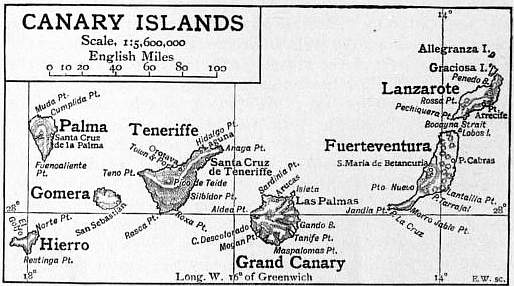
Climate.—From April to October a north or north-east wind blows upon the islands, beginning about 10 A.M. and continuing until 5 or 6 P.M. In summer this wind produces a dense stratum of sea-cloud (cumuloni), 500 ft. thick, whose lower surface is about 2500 ft. above the sea at Teneriffe. This does not reach up to the mountains, which have on every side a stratum of their own, about 1000 ft. thick, the lower surface being about 3500 ft. above the level of the sea. Between these two distinct strata there is a gap, through which persons on a vessel near the island may obtain a glimpse of the peak. The sea-cloud conceals from view the other islands, except those whose mountains pierce through it. On the south-west coasts there is no regular sea or land breeze. In winter they are occasionally visited by a hot south-east wind from Africa, which is called the Levante, and produces various disagreeable consequences on the exposed parts of the person, besides injuring the vegetation, especially on the higher grounds. Locusts have sometimes been brought by this wind. In 1812 it is said that locusts covered some fields in Fuerteventura to the depth of 4 ft. Hurricanes, accompanied by waterspouts, sometimes cause much devastation; but, on the whole, the islands are singularly free from such visitations. The climate generally is mild, dry and healthy. On the lower grounds the temperature is equable, the daily range seldom exceeding 6° Fahr. At Santa Cruz the mean for the year is about 71°. The rainy season occurs at the same period as in southern Europe. The dry season is at the time of the trade-winds, which extend a few degrees farther north than this latitude.
Fauna.—The indigenous mammals of the Canary Islands are very few in number. The dog, swine, goat and sheep were alone found upon the island by the Spanish conquerors: The race of large dogs which is supposed to have given a name to the islands has been long extinct. A single skeleton has been found, which is deposited in one of the museums at Paris. The ferret, rabbit, cat, rat, mouse and two kinds of bat have become naturalized. The ornithology is more interesting, on account at once of the birds native to the islands, and the stragglers from the African coast, which are chiefly brought over in winter, when the wind has blown for some time from the east. Among the indigenous birds are some birds of prey, as the African vulture, the falcon, the buzzard, the sparrow-hawk and the kite. There are also two species of owl, three species of sea-mew, the stockdove, quail, raven, magpie, chaffinch, goldfinch, blackcap, canary, titmouse, blackbird, house-swallow, &c. As to the insects, mention may be made of a species of gnat or mosquito which is sometimes troublesome, especially to strangers. The list of reptiles is limited to three varieties of lizard and one species of frog. The only fresh-water fish is the eel. Marine fishes are not numerous, the reason perhaps being that the steepness of the coast does not allow seaweed to grow in sufficient quantity to support the lower forms of marine animal life. Whales and seals are occasionally seen. The cuttle-fish is abundant, and is sought for as an article of food.
Flora.—The position of mountainous islands like the Canaries, in the subtropical division of the temperate zone, is highly favourable to the development, within a small space, of plants characteristic of both warm and cold climates. Von Buch refers to five regions of vegetation in Teneriffe:—(1) From the sea to the height of 1300 ft. This he styles the African region. The climate in the hottest parts is similar to that of Egypt. Here grow, among the introduced plants, the coffee tree, the date-palm, the sugar-cane, the banana, the orange tree, the American agave and two species of cactus; and among indigenous plants, the dragon tree on the north-west of Teneriffe. A leafless and fantastic euphorbia, E. canariensis, and a shrubby composite plant, Cacalia kleinia, give a character to the landscape about Santa Cruz. (2) Between 1300 ft. and 2800 ft. This is the region of south European vegetation, the climate answering to that of southern France and central Italy. Here nourish vines and cereals. (3) The region of indigenous trees, including various species of laurel, an Ardisia, Ilex, Rhamnus, Olea, Myrica, and other trees found wild also at Madeira. The clouds rest on this region during the day, and by their humidity support a vegetation amongst the trees, partly of shrubs, and partly of ferns. It extends to the height of 4000 ft. (4) The region of the beautiful Pinus canariensis, extending to the height of 6400 ft.; here the broad-leaved trees have ceased to grow, but arborescent heaths are found throughout its whole extent, and specimens of Juniperus oxycedrus may be met with. (5) The region of Retama (Cytisus nubigenus), a species of white-flowering and sweet-scented broom, which is found as high as 11,000 ft. At the upper edge of this region a lilac-coloured violet clings to the soil, and above there is nothing but a little lichen. The number of wild flowering plants may be estimated at 900, upwards of 270 of which are peculiar to the Canaries. The forms of vegetation must in the main be considered North African. The character of the vegetation in Lanzarote and Fuerteventura, islands composed of extensive plains and low hills, with few springs, is different from that of the other islands, which are more elevated and have many springs. The wood is less abundant, and the vegetation less luxuriant.
Inhabitants.—The Guanches (q.v.), who occupied the Canaries at the time of the Spanish invasion, no longer exist as a separate race, for the majority were exterminated, and the remainder intermarried with their conquerors. The present inhabitants are slightly darker than the people of Spain, but in other respects are scarcely distinguishable from them. The men are of middle height, well-made and strong; the women are not striking in respect of beauty, but they have good eyes and hair. Spanish is the only language in use. The birth-rate is uniformly high and the death-rate low; and, despite the emigration of many families to South America and the United States, the census of 1900 showed that the population had increased by over 75,000 since 1877. The excess of females over males, which in 1900 amounted to upwards of 22,000, is partly explained by the fact that few women emigrate. Fully 80% of the inhabitants could neither read nor write in 1900; but education progresses more rapidly than in many other Spanish provinces. Good schools are numerous, and the return of emigrants and their children who have been educated in the United States, tends to raise the standard of civilization. The sustenance of the poorer classes is chiefly composed of fish, potatoes and gofio, which is merely Indian corn or wheat roasted, ground and kneaded with water or milk. The land is, in great part, strictly entailed.
Government.—The archipelago forms one Spanish province, of which the capital is Santa Cruz de Tenerife, the residence of the civil governor, who has under his command one of the two districts into which the archipelago is divided, this first district comprising Teneriffe, Palma, Gomera and Hierro. The other district includes Grand Canary, Lanzarote, Fuerteventura, and has at its head a sub-governor, residing in Las Palmas, on Grand Canary, who is independent of the governor except in regard to elections and municipal administration. The chief finance office is at Santa Cruz de Tenerife. The court of appeal, created in 1526, is in Las Palmas. The captain-general and second commandant of the archipelago reside in Santa Cruz de Tenerife, and there is a brigadier-governor of Grand Canary, residing in Las Palmas, besides eight inferior military commandants. The province furnishes no men for the Spanish peninsular army, but its annual conscription provides men for the local territorial militia, composed of regiments of infantry, squadrons of mounted rifles and companies of garrison artillery—about 5000 men all told. The archipelago is divided into two naval districts, commanded by royal navy captains. Roman Catholicism is the official religion, and ecclesiastical law is the same as in other Spanish provinces. The convents have been suppressed, and in many cases converted to secular uses. Laguna and Las Palmas are episcopal sees, in the archbishopric of Seville.
Industry and Commerce.—Owing to the richness of the volcanic soil, agriculture in the Canaries is usually very profitable. Land varies in value according to the amount of water available, but as a rule commands an extraordinarily high price. In the Terrenos de secano, or non-irrigable districts, the average price of an acre ranges from £7 to £17; in the Terrenes de riego, or irrigable land, it ranges from £100 to £250. Until 1853 wine was the staple product, and although even the finest brand (known as Vidonia) never equalled the best Madeira vintages, it was largely consumed abroad, especially in England. The annual value of the wine exported often exceeded £500,000. In 1853, however, the grape disease attacked the vineyards; and thenceforward the production of cochineal, which had been introduced in 1825, took the place of viticulture so completely that, twenty years later, the exports of cochineal were worth £556,000. France and England were the chief purchasers. This industry declined in the later years of the 19th century, and was supplanted by the cultivation of sugar-cane, and afterwards of bananas, tomatoes, potatoes and onions. Bananas are the most important crop. Other fruits grown in smaller quantities include oranges, figs, dates, pineapples, guavas, custard-apples and prickly pears. Tobacco-planting is encouraged by the Spanish government, and the sugar trade is maintained, despite severe competition. The grain harvest does not supply the needs of the islanders. Pigs and sheep of a small, coarse-woolled breed, are numerous; and large herds of goats wander in an almost wild state over the higher hills. Fishing is a very important industry, employing over 10,000 hands. The fleet of about 2200 boats operates along some 600 m. of the African coast, between Cape Cantin and the Arguin Bank. Shipbuilding is carried on at Las Palmas; and the minor industries include the manufacture of cloth, drawn-linen (calado) work, silk, baskets, hats, &c. A group of Indian merchants, who employ coolie labour, produce silken, jute and cotton goods, Oriental embroideries, wrought silver, brass-ware, porcelain, carved sandal-wood, &c. The United Kingdom heads the import trade in coal, textiles, hardware, iron, soap, candles and colonial products. Timber comes chiefly from North America and Scandinavia, alcohol from Cuba and the United States, wheat and flour from various British possessions, maize from Morocco and Argentina. Large quantities of miscellaneous imports are sent by Germany, Spain, France and Italy. Bananas, tomatoes, potatoes, sugar and wine are exported. The total value of the foreign trade fluctuates very greatly, and the difficulty of forming an estimate is enhanced in many years by the absence of official statistics; but imports and exports together probably amount in a normal year to about £1,000,000. The chief ports are Las Palmas and Santa Cruz, which annually accommodate about 7000 vessels of over 8,000,000 tons. In 1854 all the ports of the Canaries were practically declared free; but on the 1st of November 1904 a royal order prohibited foreign vessels from trading between one island and another. This decree deprived the outlying islands of their usual means of communication, and, in answer to a protest by the inhabitants, its operation was postponed.
History.—There is ground for supposing that the Phoenicians were not ignorant of the Canaries. The Romans learned of their existence through Juba, king of Mauretania, whose account of an expedition to the islands, made about 40 b.c., was preserved by the elder Pliny. He mentions “Canaria, so called from the multitude of dogs of great size,” and “Nivaria, taking its name from perpetual snow, and covered with clouds,” doubtless Teneriffe. Canaria was said to abound in palms and pine trees. Both Plutarch and Ptolemy speak of the Fortunate Islands, but from their description it is not clear whether the Canaries or one of the other island groups in the western Atlantic are meant; see Isles Of The Blest. In the 12th century the Canaries were visited by Arab navigators, and in 1334 they were rediscovered by a French vessel driven among them by a gale. A Portuguese expedition, undertaken about the same time, failed to find the archipelago, and want of means frustrated the project of conquest entertained by a grandson of Alphonso X. of Castile, named Juan de la Cerda, who had obtained a grant of the islands and had been crowned king of them at Avignon, by Pope Clement VI. Two or possibly more Spanish expeditions followed, and a monastic mission was established, but at the close of the 14th century the Guanches remained unconquered and unconverted. In 1402, however, Gadifer de la Salle and Jean de Béthencourt (q.v.) sailed with two vessels from Rochelle, and landed early in July on Lanzarote. The relations between these two leaders, and their respective shares in the work of conquest and exploration, have been the subject of much controversy. Between 1402 and 1404 La Salle conquered Lanzarote and part of Fuerteventura, besides exploring other islands; Béthencourt meanwhile sailed to Cadiz for reinforcements. He returned in 1404 with the title of king, which he had secured from Henry III. of Castile. La Salle, thus placed in a position of inferiority, left the islands and appealed unsuccessfully for redress at the court of Castile. In 1405 Béthencourt visited Normandy, and returned with fresh colonists who conquered Hierro. In December 1406 he left the Canaries, entrusting their government to his nephew Maciot de Béthencourt, and reserving for himself a share in any profits obtained, and the royal title. Eight years of misrule followed before Queen Catherine of Castile intervened. Maciot thereupon sold his office to her envoy, Pedro Barba de Campos; sailed to Lisbon and resold it to Prince Henry the Navigator; and a few years afterwards resold it once more to Enrique de Guzman, count of Niebla. Jean de Béthencourt, who died in 1422, bequeathed the islands to his brother Reynaud; Guzman sold them to another Spaniard named Paraza, who was forced to re-sell to Ferdinand and Isabella of Castile in 1476; and Prince Henry twice endeavoured to enforce his own claims. Meanwhile the Guanches remained unconquered throughout the greater part of the archipelago. In 1479 the sovereignty of Ferdinand and Isabella over the Canaries was established by the treaty of Alcaçova, between Portugal and Castile. After much bloodshed, and with reinforcements from the mother country, the Spaniards, under Pedro de Vera, became masters of Grand Canary in 1483. Palma was conquered in 1491, and Teneriffe in 1495, by Alonzo de Lugo. The archipelago was included for administrative purposes in the captaincy-general of Andalusia until 1833, when it was made a separate province. In 1902 a movement in favour of local autonomy was repressed by Spanish troops.
Bibliography.—For a general description of the islands, see Les Îles Canaries, by J. Pitard and L. Proust (Paris, 1909); Madeira and the Canary Islands, by A. Samler Brown, a guide for travellers and invalids, with coloured maps and plates (London, 1901); A Guide to the Canary Islands, by J.H.T. Ellerbeck (London, 1892); The Canary Islands as a Winter Resort, by J. Whitford (London, 1890, with maps and illustrations); De la Tierra Canaria, by L. and A. Millares Cubas (Madrid, 1894); and Physikalische Beschreibung der kanarischen Inseln, by L. von Buch (Berlin, 1825). Besides the interesting folio atlas of von Buch (Paris, 1836), good modern maps have been published by E. Stanford (London, 1891, 12½ English m. to 1 in.), and M. Perez y Rodriquez (Madrid, 1896-1898, 4 sheets). See also Histoire naturelle des îles Canaries, by P. Barker-Webb and S. Berthelot (Paris, 1835-1849); and “Les Îles Canaries et les parages de pêche canariens,” by Dr. A. Taquin, in the B.S.R. Beige G. 26 (1902), and 27 (1903); and, for history and antiquities, the Historia general de las islas Canarias, by A. Millares Cubas, in 10 vols. (Las Palmas, 1893-1895), and Historia de la Inquisicion en las islas Canarias, by the same author (Las Palmas, 1874); Antiquités canariennes, by S. Berthelot (Paris, 1879).
CANCALE, a fishing port of north-western France in the department of Ille-et-Vilaine on the Bay of Cancale, 9 m. E.N.E. of St Malo by road. Pop. (1906) town 3827, commune 7061. It exports oysters, which are found in its bay in large numbers and of excellent quality, and equips a fleet for the Newfoundland cod-fisheries. The harbour is protected by the rocks known as the Rochers de Cancale. In 1758 an English army under the duke of Marlborough landed here for the purpose of attacking St Malo and pillaged the town. It was again bombarded by the English in 1779.
CANCEL (from the Lat. cancelli, a plural diminutive of cancer, a grating or lattice, from which are also derived “chancel” and “chancellor”), a word meaning to cross out, from the crossed latticed lines drawn across a legal document to annul it, hence to delete or destroy.
CANCELLI (plural of Lat. cancellus, dim. of cancer, a crossing bar), in architecture, the term given to barriers which correspond to the modern balustrade or railing, especially the screen dividing the body of a church from the part occupied by the ministers; hence “chancel” (q.v.). By the Romans cancelli were similarly employed to divide off portions of the courts of law (cf. the English “bar”).
CANCER, LUIS (d. 1549), Spanish missionary to Central America, was born at Barbastro near Saragossa. After working for some time in Dominica and Haiti, he crossed to the mainland, where he had great success in pacifying the Indians whom more violent methods had failed to subdue. He upheld the cause of the natives at an ecclesiastical assembly held in Mexico in 1546, and three years later, on the 26th of June, met his death at their hands on the west coast of Florida.
CANCER (“The Crab”), in astronomy, the fourth sign of the zodiac, denoted by the symbol . Its name may be possibly derived from the fact that when the sun arrives at this part of the ecliptic it apparently retraces its path, resembling in some manner the sidelong motion of a crab. It is also a constellation, mentioned by Eudoxus (4th century b.c.) and Aratus (3rd century b.c.); Ptolemy catalogued 13 stars in it, Tycho Brahe 15 and Hevelius 29. Its most interesting objects are: a large loose cluster of stars, known as Praesepe or the Beehive, visible as a nebulous patch to the naked eye, and ζ Cancri, a remarkable multiple star, composed of two stars, of magnitudes 5 and 5.7, revolving about each other in 60 years, and a third star of magnitude 5.5 which revolves about these two in an opposite direction in a period of 17½ years; from irregularities in the motion of this star, it is supposed to be a satellite of an invisible body which itself revolves about the two stars previously mentioned, in a period of 600 to 700 years.

CANCER, or Carcinoma (from Lat. cancer, Gr. καρκίνωμα, an eating ulcer), the name given to a class of morbid growths or tumours which occur in man, and also in most or all vertebrate animals. The term “malignant disease” is commonly used as synonymous with “cancer.” For the general pathology, &c., of tumours see Tumour.
Cancer exists in various forms, which, although differing from each other in many points, have yet certain common characters to which they owe their special significance.
1. In structure such growths are composed of nucleated cells and free nuclei together with a milky fluid called cancer juice, all contained within a more or less dense fibrous stroma or framework.
2. They have no well-defined limits, and they involve all textures in their vicinity, while they also tend to spread by the lymphatics and veins, and to cause similar growths in distant parts or organs called “secondary cancerous growths.”
3. They are undergoing constant increase, and their progress is usually rapid.
4. Pain is a frequent symptom. When present it is generally of a severe and agonizing character, and together with the local effects of the disease and the resulting condition of ill health or “cachexia,” hastens the fatal termination to which all cancerous growths tend.
5. When such growths are removed by the surgeon they are apt to return either at the same or at some other part.
The chief varieties of cancer are Scirrhus or hard cancer, Encephaloid or soft cancer and Epithelial cancer.
Scirrhus is remarkable for its hardness, which is due to the large amount of its fibrous, and relatively small proportion of its cell elements. It is of comparatively slow growth, but it tends to spread and to ulcerate. Its most common seat by far is the female breast, though it sometimes affects internal organs.
Encephaloid is in structure the reverse of the last, its softness depending on the preponderance of its cell over its fibrous elements. Its appearance and consistence resemble brain substance (hence its name), and it is of such rapid growth as to have given rise to its being occasionally termed acute cancer. Its most frequent seats are internal organs or the limbs. Ulceration and haemorrhage are common accompaniments of this form of cancer.
Epithelial cancer is largely composed of cells resembling the natural epithelium of the body. It occurs most frequently in those parts provided with epithelium, such as the skin and mucous membranes, or where those adjoin, as in the lips. This form of cancer does not spread so rapidly nor produce secondary growths in other organs to the same extent as the two other varieties, but it tends equally with them to involve the neighbouring lymphatic glands, and to recur after removal.
Cancer affects all parts of the body, but is much more frequent in some tissues than in others. According to recent statistics prepared by the registrar-general for England and Wales (sixty-seventh annual report) the most frequent seats are, in numerical order, as follows:—males—stomach, liver, rectum, intestines, aesophagus, tongue; females—uterus, breast, stomach, liver, intestines, rectum. Other statistics give similar, though not identical results. It may be said, broadly, that the most frequent seats are the female sexual organs and after them the digestive tract in both sexes. In children, in whom cancer is rare, the most frequent seats appear to be—under five, the kidneys and supra-renal bodies; five to ten, the brain; ten to twenty, the arm and leg bones.
Cancer tends to advance steadily to a fatal termination, but its duration varies in different cases according to the part affected and according to the variety of the disease. Soft cancer affecting important organs of the body often proves fatal in a few months, while, on the other hand, cases of hard or epithelial cancer may sometimes last for several years; but no precise limit can be assigned for any form of the disease. In some rare instances growths exhibiting all the signs of cancer may exist for a great length of time without making any progress, and may even dwindle and disappear altogether. This is called “spontaneous cure.”
Cancer has been the subject of observation from time immemorial, and of the most elaborate investigation by innumerable workers in recent years; but the problems of its origin and character have hitherto baffled inquiry. Cancer research. Modern scientific study of them may be said to have begun with J. Müller’s microscopic work in the structure of cancerous tissue early in the 19th century. A great impetus to this line of investigation was given by the cellular theory of R. Virchow and the pathological researches of Sir J. Paget, and general attention was directed to the microscopic examination of the cells of which cancer is composed. This led to a classification, on which much reliance was once placed, of different kinds of cancer, based on the character of the cells, and particularly to a distinction between carcinoma, in which the cells are of the epithelial type, and sarcoma, in which they are of the connective tissue type. The distinction, though still maintained, has proved barren; it never had any real significance, either clinical or pathological, and the tendency in recent research is to ignore it. The increased knowledge gained in numerous other branches of biological science has also been brought to bear on the problem of cancer and has led to a number of theories; and at the same time the apparently increasing prevalence of the disease recorded by the vital statistics of many countries has drawn more and more public attention to it. Two results have followed. One is the establishment of special endowed institutions devoted to cancer research; the other is the publication and discussion of innumerable theories and proposed methods of treatment. Popular interest has been constantly fanned by the announcement of some pretended discovery or cure, in which the public is invited to place its trust. Such announcements have no scientific value whatever. In the rare cases in which they are not pure quackery, they are always premature and based on inadequate data.
Organized cancer research stands on a different footing. It may be regarded as the revival at the end of the 19th century of what was unsuccessfully attempted at the beginning. As early as 1792, at the suggestion of Mr. John Howard, surgeon, a ward was opened at the Middlesex hospital in London for the special benefit of persons suffering from cancer. It was fitted up and endowed anonymously by Mr. Samuel Whitbread, M.P. for Bedford, and according to the terms of the benefaction at least six patients were to be continually maintained in it until relieved by art or released by death. The purpose was both philanthropic and scientific, as Mr. Howard explained in bringing forward the suggestion. Two principal objects, he said, presented themselves to his mind, “namely, the relief of persons suffering under this disease and the investigation of a complaint which, although extremely common, is both with regard to its natural history and cure but imperfectly known.” This benefaction was the origin of one of the most complete institutions for the scientific study of cancer that exists to-day.
In 1804 a Society for Investigating the Nature of Cancer was formed by a number of medical men in London, Edinburgh and other towns at the instigation of John Hunter. The aim was collective investigation, and an attempt was made to carry it out by issuing forms of inquiry; but the imperfect means of communication then existing caused the scheme to be abandoned in a short time. Subsequent attempts at collective investigation also failed until recently. About 1900 a movement, which had been for some time gathering force, began to take visible shape simultaneously in different countries. The cancer ward at the Middlesex hospital had then developed into a cancer wing, and to it were added special laboratories for the investigation of cancer, which were opened on the 1st of March 1900. In this establishment the fully equipped means of clinical and laboratory research were united under one roof and manned by a staff of investigators under the direction of Dr W.S. Lazarus Barlow. In the same year the Deutsche Comité fur Krebsforschung was organized in Berlin, receiving an annual subsidy of 5000 marks (£250) from the imperial exchequer. This body devoted its energies to making a census of cancer patients in Germany on a definite date. A special ward for cancer was also set apart at the Charité hospital in Berlin, with a state endowment of 53,000 marks (£2560) per annum, and a laboratory for cancer research was attached to the first medical clinique under Professor Ernst von Leyden at the same hospital. A third institution in Germany is a special cancer department at the Royal Prussian Institute for Experimental Therapeutics at Frankfort-on-Main, which has been supported, like the Imperial Cancer Research Fund in England, by private contributions on a generous scale. The fund just mentioned was initiated in October 1901, and its operations took definite shape a year later, when Dr. E.F. Bashford was appointed general superintendent of research. The patron of the foundation was King Edward VII., and the president was the prince of Wales. It had in 1908 a capital endowment of about £120,000, subscribed by private munificence and producing an income of about £7000 a year. The central laboratory is situated in the examination building of the Royal Colleges of Physicians and Surgeons in London, and the work is conducted under the superintendence of an executive committee formed by representatives of those bodies. In the United States a cancer laboratory, which had been established in Buffalo in 1899 under Dr Roswell Park, was formally placed under the control of New York state in June 1901, and is supported by an annual grant of $15,000 (£3000). There are other provisions in the United States connected with Harvard and Cornell universities. At the former the “Caroline Brewer Croft Fund for Cancer Research” started special investigations in the surgical department of the Harvard Medical School in 1900 or the previous year, and in connexion with the Cornell University Medical School there is a small endowment called the “Huntingdon Cancer Research Fund.” There appear to be institutions of a similar character in other countries, in addition to innumerable investigators at universities and other ordinary seats of scientific research.
Some attempt has been made to co-ordinate the work thus carried on in different countries. An international cancer congress was held at Heidelberg and Frankfort in 1906, and a proposal was put forward by German representatives that a permanent international conference on cancer should be established, with headquarters in Berlin. The committee of the Imperial Cancer Research Fund did not fall in with the proposal, being of opinion that more was to be gained in the existing stage of knowledge by individual intercourse and exchange of material between actual laboratory workers.
In spite of the immense concentration of effort indicated by the simultaneous establishment of so many centres of endowed research, and in spite of the light thrown upon the problem from many sides by modern biological Theories of cancer. science, our knowledge of the origin of cancer is still in such a tentative state that a detailed account of the theories put forward is not called for; it will suffice to indicate their general drift. The actual pathological process of cancer is extremely simple. Certain cells, which are apparently of a normal character and have previously performed normal functions, begin to grow and multiply in an abnormal way in some part of the body. They continue this process so persistently that they first invade and then destroy the surrounding tissues; nothing can withstand their march. They are moreover carried to other parts of the body, where they establish themselves and grow in the same way. Their activity is carried on with relentless determination, though at a varying pace, until the patient dies, unless they are bodily removed. Hence the word “malignant.” The problem is—what are these cells, or why do they behave in this way? The principal answers put forward may be summarized:—(1) they are epithelial cells which grow without ceasing because the connective tissue has lost the capacity to hold their proliferative powers in check (H. Freund, following K. Thiersch and W. Waldeyer); (2) they are embryonic cells accidentally shut off (J.F. Cohnheim); (3) they are epithelial cells with a latent power of unlimited proliferation which becomes active on their being dislocated from the normal association (M.W.H. Ribbert and Borrmann); (4) they are stimulated to unlimited growth by the presence of a parasite (Plimmer, Sanfelice, Roncali and others); (5) they are fragments of reproductive tissue (G.T. Beatson); (6) they are cells which have lost their differentiated character and assumed elementary properties (von Hausemann, O. Hertwig). The very number and variety of hypotheses show that none is established. Most of them attempt to explain the growth but not the origin of the disease. The hypothesis of a parasitic origin, suggested by recent discoveries in relation to other diseases, has attracted much attention; but the observed phenomena of cancerous growths are not in keeping with those of all known parasitic diseases, and the theory is now somewhat discredited. A more recent theory that cancer is due to failure of the normal secretions of the pancreas has not met with much acceptance.
Some generalizations bearing on the problem have been drawn from the work done in the laboratories of the Imperial Cancer Research Fund. They may be summarily stated thus. Cancer has been shown to be an identical process in all vertebrates (including fishes), and to develop at a time which conforms in a striking manner to the limits imposed by the long or short compass of life in different animals. Cancerous tissue can be artificially propagated in the short-lived mouse by actual transference to another individual, but only to one of the same species. Cancerous tissue thus propagated presents all the characteristic features of the malignant growth of sporadic tumours; it infiltrates and produces extensive secondary growths. Under suitable experimental conditions the aggregate growth of a cancer is undefined, of enormous and, so far as we can judge, of limitless amount. This extraordinary growth is due to the continued proliferation of cancerous cells when transplanted. The processes by which growing cancer cells are transferred to a new individual are easily distinguishable and fundamentally different from all known processes of infection. The artificial propagation of cancer causes no specific symptoms of illness in the animal in which it proceeds. Under artificial propagation cancer maintains all the characters of the original tumours of the primary hosts. Carcinoma and sarcoma agree in possessing all the pathological and cellular features of malignant new growths.
Simultaneously with the active pursuit of laboratory research much statistical work has been devoted to establishing the broad Statistics of cancer. facts of the prevalence and incidence of cancer on a firm basis. The point of most general interest is the apparently steady increase of the disease in all countries possessing fairly trustworthy records. It will be sufficient to give the figures for England and Wales as an example.
Annual Death-rates from Cancer to a Million Living. England and Wales.
1871-1875. 1876-1880. 1881-1885. 1886-1890. 1891-1895. 1896-1900. 1901-1904.
445 493 547 631 711 800 861
In forty years the recorded rate had risen from 403 to 861. The question how far these and similar statistics represent a real increase cannot be satisfactorily resolved, because it is impossible to ascertain how much of the apparent increase is due to more accurate diagnosis and improved registration. Some of it is certainly due to those causes, so that the recorded figures cannot be taken to represent the facts as they stand. At the same time it is certain that some increase has taken place in consequence of the increased average length of life; a larger proportion of persons now reach the ages at which cancer is most frequent. Increase due to this fact, though it is a real increase, does not indicate that the cause of cancer is more rife or more potent; it only means that the condition of the population in regard to age is more favourable to its activity. On the whole it seems probable that, when allowance has been made for this factor and for errors due to improved registration, a real increase due to other causes has taken place, though it is not so great as the recorded statistics would indicate.