Chapter VIII · ANALYSIS OF RAW MATERIALS AND FINISHED PRODUCTS
Reading edition
General Methods of Analysis of Fats and Oils—Special Tests for Individual Oils—Analysis of Butter, Margarine, Lard, Cheese, Chocolate.
The adulteration of fats and oils becomes year by year more scientific, the latest developments of chemical research being prostituted to the purpose of enabling sophisticated articles to elude the vigilance of the public analyst, whose duty it is to detect such adulteration. A striking instance of this is furnished by the methods of adulterating butter described in Chapter IV.
As was there mentioned, a method for the examination of pure butter, formulated by Reichert in 1879 and subsequently slightly modified by Meissl and Wollny, was based on the presence of volatile fatty acids, such as butyric acid, in butter. Butter substitutes, as usually made, do not contain these volatile fatty acids, at any rate in appreciable quantity, except when cocoanut oil has been added, and this, therefore, afforded a means of detecting the presence of artificial in genuine butter. It has been found, however, that some manufacturers of butter substitutes, especially on the Continent, have actually added these volatile fatty acids, ostensibly to improve their flavour, but there can be little doubt with the real object of enabling the artificial product to be sold as genuine butter.
It is unfortunately the case that the unscrupulous manufacturer is generally slightly in advance of the examining authority, and as fast as the latter detects one form of adulteration, and devises means for its ready determination, some new form of fraud is invented to take its place.
As a result of this competition between expert adulterator and public analyst, the methods for the examination of edible fats are constantly being improved and increased, and some extremely fantastic and far-fetched tests have been suggested. In the following pages, however, only those most usually adopted in a works’ or commercial laboratory are described.
General Methods of Examination of Fats and Oils
Raw Materials.—The appearance, colour, and odour of the sample should be observed, and any characteristic feature recorded. The taste is also frequently of value in judging the purity of a fat or oil, but deductions from this can only be made after considerable experience.
The following physical and chemical data may be determined:—
Specific Gravity.—In the case of oils liquid at ordinary temperatures, this is usually taken at 15° C., the weight of a given volume of the oil being compared with that of the same volume of water, at 15° C., the symbol used to denote this being
15°
“d —— ”.
15°
If a sufficient quantity of the oil is available a Westphal balance or a hydrometer may be employed for the purpose; if only a small quantity can be obtained, a specific gravity bottle or Sprengel or Nicol pycnometer should be used. This latter method is to be preferred where great accuracy is desirable. The specific gravity bottle or pycnometer must be first calibrated by filling it up to the mark with distilled water at 15° C., and weighing it.
The specific gravity of solid fats is taken at some higher temperature at which they are fluid, preferably at the temperature of a boiling water-bath, which will generally be found to be about 99° C. This is compared with the weight of a similar volume of water at 15° C., and is represented by
99°
“d —— ”.
15°
The specific gravity of oils and fats is liable to increase with age, and also varies with the method of treatment during refining.
The specific gravity of butter fat is best taken at a temperature of 35° C., for reasons which are dealt with under the heading of “Butter,” in Chapter IV.
Free Fatty Acids.—These are determined by warming on the water-bath for a few minutes a weighed quantity (2 to 10 grms. according to the degree of acidity of the fat) of the fat or oil, with 25 c.c. of purified methylated alcohol, which has been neutralised immediately prior to use, with N/10 potassium hydroxide solution, and after adding phenol-phthalein solution, slowly running in from a burette N/2 or N/10 alcoholic potassium hydroxide solution until a faint permanent pink colour is produced. Each c.c. of N/2 or N/10 alkali corresponds to 0·141 or 0·0282 grm. respectively of free fatty acids, expressed as oleic acid, and from this the percentage of acidity is calculated.
The free acidity is frequently expressed as the acid value, which represents the number of milligrams of potassium hydroxide, KOH, required to neutralise the acidity in 1 grm. of oil or fat.
Example.—If 6·656 grms. fat required 1·5 c.c. N/10 alcoholic potassium hydroxide solution to neutralise it, then
1·5 × 0·0282 × 100
———————— = 0·63 per cent.
6·656
free fatty acids, expressed as oleic acid.
The acid value in this case would be
1·5 × 0·00561 x 1000
———————— = 1·26.
6·656
The maximum permissible limit for free acidity depends on the nature of the fat or oil. For edible tallows it should not exceed 3 per cent., for lard 0·5 per cent., and for cocoanut oil 2 per cent.
Saponification Value.—It has been shown in Chapter I, how the various glycerides contained in fats and oils are split up or saponified by the action of caustic alkalies, one molecule of a triglyceride such as stearin requiring three molecules of potassium hydroxide for its saponification (cf. p. 4).
The composition of the various fats and oils being fairly constant, the amount of alkali required for the saponification of any given weight is also nearly constant. Koettstorfer first utilised this fact in 1879 for the analysis of butter fat, and it has now become the basis of one of the most important factors in the analysis of nearly all fats and oils, the amount of any fat which is saponified by 1 grm.-molecule or 56·1 grms. of caustic potash being termed its saponification equivalent.
The more usual method of expressing the same thing is the number of milligrams of potassium hydroxide required to saponify 1 grm. of fat, which is called the saponification value. The difference between the saponification and acid values is spoken of as the ester value.
To convert saponification equivalent into saponification value, it is merely necessary to divide 56·1 by the saponification equivalent, and multiply the quotient by 100.
To determine the saponification value, about 2 grms. of the fat or oil are weighed out into a conical flask of about 200 c.c. capacity, 25 c.c. of neutral methylated spirit added, and 25 c.c. of an approximately N/2 alcoholic solution of potassium hydroxide run in from a burette, similar quantities of methylated spirit and alcoholic potassium hydroxide solution being also placed in another flask to serve as a blank test. The two flasks are now fitted with reflux condensers (which may be simply glass tubes, about four feet long and half an inch in diameter, inserted through a cork), and are placed on a steam or water-bath. The contents are then boiled until saponification of the fat is complete, which may take from thirty to sixty minutes, and is known to be accomplished when all globules of oil disappear. A few drops of phenol-phthalein solution are now added to each flask, and N/2 hydrochloric or sulphuric acid carefully run in from a burette until the pink colour is discharged. The difference in the amount of acid required by the two flasks indicates the quantity of potassium hydroxide required to saponify the weight of fat or oil taken.
Example.—2·1314 grms. fat required 10·7 c.c. N/2 hydrochloric acid to neutralise unabsorbed alkali.
In the blank test 25 c.c. of approximately N/2 alcoholic potassium hydroxide solution required 25·6 c.c. of N/2 hydrochloric acid to neutralise it.
N
25·6 - 10·7 = 14·9 c.c. ——
2
alcoholic potassium hydroxide solution required to saponify the fat, and
2·1314 × 1000 × 2
———————— = 286·1
14·9
saponification equivalent, and
56·1 × 100
———— = 196·1,
286·1
the saponification value.
If the quantity of fat or oil employed for the estimation of acidity is only about 2 grms., the saponification value may also be determined on the same quantity. After proceeding as described above for the acidity estimation, 25 c.c. of approximately N/2 alcoholic potassium hydroxide solution are added to this, and the process continued as described above.
Iodine Absorption.—This test, devised by Hübl in 1884, and subsequently modified by Wijs, by Hanus, and by Waller, is based upon the capacity of unsaturated fatty compounds to absorb iodine, with formation of addition compounds. The amount of iodine absorbed is therefore a measure of the unsaturated compounds present in a fat, and is very fairly constant for any given fat in the fresh condition. The action of Hübl’s solution is attributed by Ephraim to the presence of iodine monochloride, but by Wijs to that of hypoiodous acid. The percentage of iodine absorbed is usually recorded as the iodine number or iodine value.
In Hübl’s method, two solutions are required—(1) containing 25 grms. iodine in 500 c.c. of absolute alcohol, and (2) containing 30 grms. mercuric chloride in 500 c.c. of absolute alcohol. These solutions should be kept separate, and only mixed about twelve to twenty-four hours before use.
The process is carried out as follows:—Into a tightly fitting stoppered bottle is introduced 0·2 to 0·6 grm. of the fat, 10 c.c. chloroform added, and 25 c.c. of the mixed Hübl solution run in from a burette. The bottle is then firmly stoppered, and allowed to stand in a dark place for four hours, a similar bottle containing the same quantities of chloroform and Hübl solution being placed by its side as a blank experiment.
At the end of four hours, 20 c.c. of a freshly prepared 10 per cent. potassium iodide solution and 150 c.c. of water are added to each bottle, and the excess of iodine titrated with recently standardised N/10 sodium thiosulphate solution, the bottles being vigorously shaken during the titration, and fresh starch solution used for determining the final point. The difference in the number of c.c. of N/10 sodium thiosulphate solution required by the contents of the two bottles is a measure of the iodine absorbed by the fat. This figure, multiplied by the iodine equivalent of the sodium thiosulphate solution (found by titrating it with a known weight of pure resublimed iodine), and by 100, and divided by the weight of fat taken, gives the iodine value of the fat.
Example.—0·539 grm. oil taken. Blank bottle, with iodine solution and chloroform only, required 61·4 c.c. N/10 thiosulphate; bottle containing oil required 25 c.c. N/10 thiosulphate. The iodine equivalent of the thiosulphate solution was found to be 1 c.c. = 0·0126 grm. I.
61·4 - 25·0 × ·0126 × 100
Then ——————————— = 85.1 iodine value.
539
Wijs’ Method.—The Hübl method has now to a very large extent been displaced by the Wijs process, in which the iodine is absorbed by the fat much more quickly, only about thirty minutes’ contact being required. The Wijs iodine reagent consists of a solution of iodine monochloride in glacial acetic acid, and may be prepared by either weighing out 7·9 grms. of iodine trichloride (which must be done in a weighing bottle), and 8·7 grms. of iodine, dissolving these separately in glacial acetic acid, mixing and making up to a litre with glacial acetic acid, or by dissolving 13 grms. of iodine in a litre of glacial acetic acid, and passing chlorine into the solution until the iodine is all converted into the iodine monochloride—a point which may be determined by the gain in weight, or, with a little practice, by the change in colour of the solution. The details of the process are exactly similar to those in the Hübl method, except that it is preferable to dissolve the fat in carbon tetrachloride instead of in chloroform.
Bromine Absorption.—This is similar in principle to the iodine absorption, and though numerous processes, both gravimetric and volumetric, have been proposed for its determination, it has now been almost entirely superseded by determination of the iodine absorption. A process devised by McIlhiney (J. Amer. Chem. Soc., 1894, 295, and 1899, 1084), however, deserves attention, for it estimates both the added and the substituted bromine.
The weighed quantity, say 0.5 grms. of the oil or fat, is weighed out, and dissolved in 10 c.c. of chloroform, and 20 c.c. N/3 solution of bromine in chloroform added. After two or three minutes 20 to 30 c.c. of a 10 per cent. potassium iodide solution are added, and the liberated iodine titrated with standard N/10 thiosulphate, the result giving the bromine forming addition compounds. After this, 5 c.c. of neutral 2 per cent. potassium iodate solution are introduced, and the liberated iodine titrated, the result in this case corresponding to the hydrobromic acid formed by the bromine in producing substituted bodies, or, in other words, giving the bromine substitution value.
Titre, or Solidifying Point of the Fatty Acids.—Many methods for determining the melting and solidifying points of fatty matters have been proposed, but the titre test, due to Dalican, is that which is now most generally adopted. This consists in determining the solidifying point of the fatty acids separated from a fat or oil, a figure which is an important characteristic of most fats, and in the case of tallows is largely employed as the basis for their commercial valuation. It is, of course, essential that in the preparation of artificial butters from a standard formula the firmness of the fats used should be as nearly as possible constant, and this is best determined by the titre test.
The test is carried out by first saponifying the fat with alcoholic sodium hydroxide solution, decomposing the resulting soap with dilute sulphuric acid, and after washing and drying the liberated fatty acids, determining their solidifying point. One ounce of the sample is melted in a shallow porcelain basin on a water-bath, and 30 c.c. of a 25 per cent. solution of sodium hydroxide added, together with 50 c.c. of redistilled methylated spirit. The contents of the basin are now evaporated on the water-bath, with constant stirring, until a pasty mass of soap is formed, and this is redissolved in a further 50 c.c. of redistilled methylated spirit, and again evaporated to dryness on the water-bath. The solid soap thus obtained is dissolved in water, sufficient dilute sulphuric acid added to decompose it, and the whole warmed until the fatty acids melt to a clear oily liquid on the surface. The water underneath is now siphoned off, more distilled water added to wash out any remaining trace of mineral acid, and again siphoned off, this treatment being repeated until the washings are no longer acid to litmus paper. The melted fatty acids are next poured on to a dry filter paper, which is inserted in a funnel resting on a beaker, and the latter is placed either in the water-bath or in an air-oven at about 100° C. until the clear fatty acids have filtered through it.
From 10 to 15 grms. of these dry fatty acids are transferred to a wide test tube, about six inches long and one inch in diameter, which is inserted through a cork into a flask or wide-mouthed bottle, to protect the tube from draught. The tube is closed with a loosely fitting perforated cork, through which passes a short range thermometer (0° to 60°), accurately graduated in fifths of a degree centigrade, and having its bulb just immersed in the fatty acids as near the centre as possible.
The temperature is now raised to a few degrees above the melting-point of the fatty acids, and allowed to cool down without stirring. As soon as the fatty acids just begin slowly to solidify, they are stirred round gently with the thermometer, the temperature on which will gradually fall till a minimum point is reached. Stirring is now discontinued, and the rise in temperature, which is usually produced by the heat given out by the acids in crystallising, is observed. The maximum temperature attained by the fatty acids during this rise is the “titre” of the sample.
Refractive Index.—The determination of the refractive power of a fat or oil, or of its fatty acids, is frequently very useful in judging the purity of a sample, or in drawing conclusions as to the composition of a mixture of fats.
The refractive index itself may be either directly determined by means of an Abbé total reflection refractometer, or an Amagat and Jean oleo-refractometer (Analyst, 1890, 87), or, as is more usual in the case of butter, the refractive power may be read off on an arbitrary scale by means of a Zeiss butyro-refractometer.
One of the great advantages of this test is the ease and rapidity with which a number of samples may be examined, while a further advantage of the Abbé and Zeiss instruments is that only a very small quantity of the sample—5 or 6 drops—is necessary.
The different forms of apparatus are fully illustrated and described in the catalogues of most firms supplying chemical apparatus, and it is therefore unnecessary to give a description here.
Different observers employ various temperatures for determining refractive indices, but that most usual for oils and fats, with the exception of butter, is 60° C. The best temperature of observation for butter is 40° C.
Unsaponifiable Matter.—The unsaponifiable matter present in the ordinary animal and vegetable fats is very small in amount, and the addition of any paraffin or other hydrocarbon is therefore readily detected by estimating the unsaponifiable matter. The usual method is to saponify about 5 grms. of the fat, dissolve the soap in water, and extract the unsaponified fatty matter with ether. The saponification is effected by boiling the fat with 50 c.c. of approximately N/2 alcoholic potassium hydroxide solution under a reflux condenser, with frequent agitation, for about an hour. The soapy solution is then evaporated to dryness in a porcelain basin on a steam or water-bath, and the soap obtained is dissolved in about 200 c.c. of hot water and transferred, as soon as sufficiently cool, to a 10 oz. separating funnel. To this is now added 50 c.c. ether, and the whole well shaken, and allowed to separate. The aqueous soap solution at the bottom is now run into another similar separator, and the ethereal extract washed with water to remove any soap dissolved therein. The washings are added to the aqueous soap solution, which is again extracted with a second 50 c.c. of ether, separated, the ethereal extract washed with water, and the extraction repeated a third time. The three washed ethereal extracts are then transferred to a tared flask, the ether distilled off in a water-bath, and the residue dried in the oven at 100° C. till constant in weight. This residue is the unsaponifiable matter in the weight of fat taken, whence the percentage may be calculated.
Difficulty often occurs during this process through the formation of an emulsion between the ethereal and the aqueous solutions, which prevents a sharp separation of the two layers. To overcome this, various expedients are recommended, such as the addition of a few c.c. of alcohol or glycerin or of more ether or water, careful warming, or gentle rotation.
The unsaponifiable matter may consist of cholesterol, a constituent of many animal fats, of phytosterol, a substance similar to cholesterol found in vegetable fats, of solid alcohols, such as cetyl and ceryl alcohols, present in spermaceti and Chinese wax, or of hydrocarbons, which do not occur naturally in either animal or vegetable fats, but are occasionally added as adulterants.
To examine the unsaponifiable matter for cholesterol and phytosterol a small quantity is dissolved in acetic anhydride, and one drop of the solution added to one drop of 50 per cent. sulphuric acid on a white porcelain tile, when, if either is present, a blood red to violet coloration is produced. They may be distinguished from each other by their crystalline form, cholesterol crystallising in laminæ, phytosterol in needle-shaped tufts; or by the melting-points of their acetates, cholesteryl acetate melting at 114°·3-114°·8, and phytosteryl acetate at 125°·6-137° C.
The fact that the unsaponifiable matter of animal fats contains cholesterol, while that of vegetable oils and fats contains phytosterol, has been made the basis of a test for detecting the presence of vegetable oils and fats in butter or lard. This test, which was first proposed by Bömer (Zeit. Untersuch. Nahr. Genussm., 1898, 81), consists in saponifying the fat with alcoholic potash, and extracting the unsaponifiable matter with ether, which is then distilled off, and the residue recrystallised from alcohol. The process has been subsequently improved by converting the cholesterol or phytosterol into the acetic esters by heating it with acetic anhydride, and determining the melting-point of the resulting ester. As mentioned above, that of cholesterol melts at about 114° C., that of phytosterol at 125°·6-137° C., and, according to Bömer, an acetate melting at 117°-118° C. corresponds to an addition of 1 to 2 per cent. of vegetable oil; at 120°-121° C., to an addition of 2 to 3 per cent. of vegetable oil; and at 123°-125° C., to an addition of 3 to 4 per cent. of vegetable oil.
The following method for carrying out this test, which is known as the phytosteryl acetate test, is described by Revis and Bolton (Allen’s Commercial Organic Analysis, ii. p. 301).
Fifty grms. of the clear fat are boiled with 75 c.c. of 95 per cent, alcohol, cooled, and the alcohol poured off, a second extraction being made with a further 75 c.c. of alcohol. These combined extracts, which will contain the greater part of the cholesterol and phytosterol and some fat, are transferred to a porcelain basin, and an excess of solid sodium hydroxide added, the mixture being then evaporated, with gentle stirring. After most of the alcohol has evaporated, more than sufficient sodium bicarbonate is added to convert the excess of sodium hydroxide into sodium carbonate, then some sand, and the whole evaporated to dryness, ground up in the dish, and extracted with light petroleum spirit. The residue from the ether is heated with 5 c.c. of (approximately) N/2 alcoholic sodium hydroxide solution, and again evaporated to dryness, with sand. A fresh extraction with petroleum spirit is made, followed by evaporation, and the residue is taken up with the smallest possible quantity of absolute alcohol. If necessary, the solution is boiled with animal charcoal and some 95 per cent. alcohol, filtered and evaporated to dryness. The crystals obtained are examined microscopically, then converted into their acetate by boiling with acetic anhydride in a covered watch-glass, evaporating off the excess of acetic anhydride on the water-bath, and recrystallising them from absolute alcohol.
Further tests for cholesterol have also been published by Lifschutz (Ber. Deut. Chem. Ges., 1908, 252-5) and Golodetz (Chem. Zeit., 1908, 160).
The method of the former depends on the oxidation of cholesterol to oxycholesterol ester and oxycholesterol. A few mgrms. of the unsaponifiable matter are dissolved in 2 to 3 c.c. of glacial acetic acid, a little benzoyl peroxide added, and the solution boiled, after which four drops of strong sulphuric acid are added. If cholesterol is present, a violet-blue or green colour is produced, the violet colour being due to oxycholesterol ester, the green to oxycholesterol.
Golodetz has devised two tests:—(1) the addition to a small quantity of the unsaponifiable matter of one or two drops of a mixture of 5 parts of concentrated sulphuric acid with 3 parts of formaldehyde solution, this reagent turning cholesterol a blackish-brown colour; and (2) the addition of one drop of 30 per cent. formaldehyde solution to a solution of the unsaponifiable matter in trichloracetic acid, when, if cholesterol is present, an intense blue coloration is produced.
Of the less frequently used methods of examination the following may be mentioned:—
Valenta’s Acetic Acid Test, which depends on the solubility of most oils and fats in hot glacial acetic acid of 1·0562 sp. gr., the temperature at which a warmed mixture of 3 c.c. melted fat and 3 c.c. acetic acid becomes turbid on cooling being noted.
The test has been slightly modified by Pearmain and Moor, who use a short stoppered tube, into which is weighed 2·75 grms. of the fat or oil, followed by 3 c.c. of acetic acid. The tube is then stoppered and heated in a water-bath, the temperature being raised until the contents of the tube become clear on shaking, after which the source of heat is removed, and the tube allowed to cool down gradually in the centre of the water-bath until the contents again become slightly turbid. The temperature at which this takes place is recorded, and is a fairly definite figure for any given oil. This test is of some value in the examination of butter for margarine, as is pointed out in Chapter IV. p. 48; the temperature at which the solution of the latter in acetic acid becomes turbid being very much higher than that of the former.
The following are the figures obtained by Pearmain and Moor by the above method:—
° C.
Butter fat 23-38
Margarine 94-97
Lard 97-99
Tallow 96-99
Cotton-seed oil 71-89
Sesame oil 90-97
Olive oil 83-91
The drawback of this test is that slight variations in the strength of the acetic acid, such as inevitably result from opening the bottle, cause considerable variations in the temperatures of turbidity. To obviate this it is advisable to compare the results with those given by specimens of butter fat of known purity.
Maumené’s Test, first proposed in 1852, consists in observing the rise of temperature which takes place when the fat or oil is mixed with concentrated sulphuric acid. Various methods of applying the test have been proposed by different authorities, that suggested by Archbutt (Allen’s Commercial Organic Analysis) being as follows:—Fifty grms. of oil are weighed into a 200 c.c. beaker, and the latter immersed in a capacious vessel of water, together with the bottle of strong sulphuric acid, until they are both at the same temperature, which should not be far from 20° C. The beaker containing the oil is then wiped, and placed in a cotton-wool nest previously made for it in a cardboard drum, or a wider beaker. The immersed thermometer is then observed, and the temperature recorded. Ten c.c. of the concentrated sulphuric acid should then be withdrawn from the bottle with a pipette, and allowed to run into the oil. During the addition of the acid, which should occupy about one minute, the mixture must be constantly stirred with the thermometer, and the agitation continued till no further rise of temperature ensues. This point is readily observed, as the mercury remains constant for a minute or two, and then begins to fall. Very different results are obtained according to the strength of acid employed, the best strength being 97 per cent.
Thomson and Ballantyne (Journ. Soc. Chem. Ind., 1891, x. 233) proposed to determine the “specific temperature reaction” of the oil, this being obtained by noting (1) the rise of temperature produced when 50 grms. of water are mixed with 10 c.c. of strong sulphuric acid in the same vessel and under the same conditions as those to be used for mixing the acid and oil; (2) mixing the oil and acid as described above, and then multiplying the rise in temperature produced by the oil-acid mixture by 100, and dividing by the rise in temperature given by the water-acid mixture. The following figures are given by Thomson and Ballantyne:—
Temperature.
Oil. Water = 100° C.
Olive 89-95°
Arachis 105-137°
Cotton-seed 163-170°
It has been shown by one of the authors (M.) (Analyst, 1901, xxvi. 169), that if the oil be dissolved in an inert solvent, such as carbon tetrachloride, the rise in temperature on adding sulphuric acid is usually proportional to the iodine value, i.e. the degree of unsaturation of the oil.
Bromine Thermal Value.—The heat reaction with bromine has been recommended as a rapid means of ascertaining the degree of unsaturation of oils and fats by Hehner and Mitchell (Analyst, 1895, xx. 146), a weighed quantity of the sample being dissolved in chloroform or acetic acid, and the rise in temperature on addition of bromine noted. The oil, chloroform, and bromine having first been brought to the same temperature, 1 grm. of oil is dissolved in 10 c.c. chloroform in a Dewar’s vacuum-jacketed test tube, and 1 c.c. of bromine added from a special pipette. This consists of a 1 c.c. pipette with a narrow tube, bent twice at right angles, connected to its top, the horizontal portion of the tube containing caustic lime kept in position by asbestos plugs. The mixture is immediately stirred, and the rise in temperature measured with a thermometer graduated in fifths of a degree. In the case of most ordinary oils and fats a relationship is shown to exist between the rise in temperature and the iodine value, so that this ratio having once been ascertained for the apparatus employed, the iodine value may be readily calculated from the rise in temperature observed on adding the bromine.
The preceding methods of examination are more or less generally applicable to all edible fats and oils, but there are numerous special tests applicable only to individual oils, of which the following are the most important. The application of these is also discussed more generally in the sections dealing with the special oils.
Sesame Oil
Baudouin’s Test.—This is carried out by dissolving 0·1 grm. of cane sugar in 10 c.c. hydrochloric acid of sp. gr. 1·2, and adding this to 20 c.c. of the oil under examination, shaking the mixture thoroughly and allowing it to stand. The presence of as little as 2 per cent. of sesame oil imparts a crimson red colour to the aqueous liquid. This reaction is given by even the most rancid oils, though the colour produced is less intense.
A modification of this, consisting in adding 0·1 c.c. of a 2 per cent. alcoholic solution of furfural to the hydrochloric acid instead of the 0·1 grm. sugar, was devised by Villavecchia and Fabris, who found the reaction to depend upon the formation of furfural; while Wauters suggested that instead of mixing the reagent with the oil, the latter should be poured upon the reagent, under which conditions less than 1 per cent. will impart a crimson colour to the surface of contact.
Sprinkmeyer and Wagner (Zeit. Nahr. Genussm. 1905, x. 347-353) have still further increased the delicacy of the test, so that as little as 0·1 per cent. of sesame oil may be detected. In their process about 100 grms. of the filtered fat are twice extracted with 20 to 30 c.c. of glacial acetic acid at 60° C. The acid extracts are separated and evaporated, and the residue tested as described above. In the case of butter containing colouring matter, which may interfere with the reaction, the latter may be removed by evaporating the acetic acid residue with 10 c.c. of alcohol and 5 c.c. of saturated barium hydroxide solution, and extracting the residue several times with light petroleum spirit, which is then evaporated, and the final residue treated with the furfural solution.
Tocher’s Test.—A freshly made solution of 1 grm. of pyrogallol in 15 c.c. of concentrated hydrochloric acid is shaken up in a separating funnel with 15 c.c. of the oil, and allowed to separate. The aqueous liquid is then drawn off, filtered, and boiled for about five minutes, when, if sesame oil is present, it appears red by transmitted and blue by reflected light.
Olive Oil
An important test for the purity of this oil is based on the elaidin reaction (p. 11), the degree of hardness of the product obtained by treatment of the oil with nitrous acid and the time required for its solidification being observed.
The best method of applying the test is to make use of the action of nitric acid on mercury, a reagent being prepared by dissolving 1 c.c. of mercury in 12 c.c. of cold nitric acid of 142 sp. gr. When this is shaken with the oil in a wide-mouthed stoppered bottle in the proportion of 2 c.c. of reagent to 50 c.c. of oil, the shaking being repeated at intervals of ten minutes for two hours, and the temperature being kept constant at not less than 25° C., a bright lemon-yellow coloured solid mass is obtained with olive oil. The products of the reaction with almond, lard, sperm, and arachis oils are also solid, but those yielded by rape, sesame, cotton-seed, sunflower, cod-liver, and porpoise oils have a consistency resembling that of butter, while those from linseed and other drying oils are liquid.
Cotton-Seed Oil
There are two well-known tests for this oil, those of Bechi and Halphen, both of which have undergone various modifications.
Bechi’s, or the silver nitrate test, requires the preparation of two solutions: (1) containing 1 grm. of silver nitrate dissolved in 200 c.c. or alcohol (98 per cent. by volume), to which is added 40 c.c. of ether and 0.1 grm. of nitric acid; and (2) a mixture of 15 c.c. of rape oil with 100 c.c. of amyl alcohol. Ten c.c. of the oil to be tested are mixed in a test tube with 1 c.c. of solution (1), and then shaken with 10 c.c. of solution (2). The mixture is now divided into two equal parts, and one-half immersed in boiling water for fifteen minutes, after which it is withdrawn and compared with the unheated portion. In the presence of cotton-seed oil a reddish-brown coloration is developed.
Halphen’s Test.—Equal parts of the oil or fat (or its fatty acids), amyl alcohol, and a 1 per cent. solution of sulphur in carbon bisulphide, are heated together in a test tube placed in a boiling water bath until effervescence ceases, and then transferred to a boiling brine-bath for about an hour, when, if cotton-seed oil is present, a pink coloration is produced. The reaction may be rendered much more rapid, according to Rupp (Zeit. Untersuch. Nahr. Genussm., 1907, xiii., 74), by heating the mixture in a stoppered flask.
The production of a coloration with Bechi’s or Halphen’s reagent does not invariably prove the presence of cotton-seed oil, as the pure fat of animals fed with cotton-seed cake, even some long time previously, has been found to give the reaction. On the other hand, failure to obtain a reaction does not prove the absence of cotton-seed oil, since heating the oil to 250° C. causes it to give negative results in these tests.
Arachis Oil
The great similarity in the properties of this oil and olive oil renders some means of distinguishing one from the other necessary, and a process for the purpose has been based on the different chemical composition of the fatty acids, the arachis oil containing a considerable proportion of arachidic and lignoceric acid.
This arachidic acid (the term also being used to include the lignoceric acid) may be determined by the following process due to Renard and modified by Lewkowitsch:—About 10 grms. of the oil are saponified with alkali, as described under the “titre test,” the soap dissolved in water, excess of alkali neutralised with acetic acid, and the lead salts of the fatty acids precipitated by addition of a solution of lead acetate, filtered off, and extracted with ether, all but the palmitate and arachidate being dissolved. These latter are decomposed with hydrochloric acid, the fatty acids separated from lead chloride, and dissolved in 50 c.c. of hot 90 per cent. alcohol.
On cooling this solution, arachidic acid will crystallise out if arachis oil is present, and the amount of arachidic acid may be estimated, if desired, by filtering it off, and washing it twice with 10 c.c. of 90 per cent. alcohol, and once with alcohol of 0.890 sp. gr. The residue on the filter is now extracted with boiling absolute alcohol in which arachidic acid is soluble, the solution evaporated to dryness, and the arachidic acid weighed.
This amount has to be corrected by the addition of 0·0025 grm. for each 10 c.c. of 90 per cent. alcohol used in the crystallisation and washing if the treatment has been carried out at 15° C., or 0·0045 for 10 c.c. if it was done at 20° C. Arachis oil contains about 5 per cent. of arachidic acid, so that twenty times the total amount of arachidic acid represents the quantity of arachis oil in the sample under examination. The melting-point of arachidic acid is 71°-72° C.
Butter
An analysis of butter for the purpose of the Food and Drugs Act should comprise determination of the water and examination of the fatty matter, together with tests for colouring matter and preservatives. In addition, estimations of the casein, ash, and salt are also sometimes made.
The effect of heating a little of the sample in a spoon is a useful rough indication of its purity. Pure butter produces considerable foam, and turns brown, but butter substitutes do not foam appreciably, and unless specially prepared to do so (see Chapter IV. pp. 45 and 71), do not become brown.
Water.—The determination of water may be made by weighing out about 5 grms. of the butter in a platinum dish and placing it in a hot-air oven at a temperature of 100°-105° C., the drying being continued until the weight is constant.
Examination of the Fat.—A quantity of the butter fat is prepared by heating about 50 grms. of the sample on the top of a water-bath until it has completely melted, and the water and casein have separated to the bottom, when the clear fat is decanted off and filtered through a dry, warm filter paper. The filtered fat should be clear and bright, and is then ready for examination.
Many of the general methods already described for the examination of oils and fats are applicable, and furnish useful information as to the purity of butter. Such, for example, are the specific gravity, the saponification value, the refractive power, and Valenta’s acetic acid test, the variations in which are discussed on p. 102.
Refractive Power.—The instrument most usually employed is the Zeiss butyro-refractometer, which consists of an Abbé double prism, which opens for the reception of a few drops of the melted and, preferably, filtered fat. A telescope is attached for reading the refraction on an arbitrary scale graduated from 5°-105°. The prism should be maintained at 40° C. while the observation is being made. At this temperature the reading for pure butter is usually about 35°-38°. If the temperature is above 40° subtract 0·55° for each degree above, and if below 40° C. add 0·55° for each degree below.
Valenta’s Acetic Acid Test.—Reference has already been made to the value of this in the examination of butter fat (p. 48). The mixture of 2·75 grms. butter fat and 3 c.c. glacial acetic acid is warmed to 40° C., when, if the butter fat is pure, the mixture should become clear. If this is the case, the liquid is now allowed to slowly cool down with constant stirring with a thermometer until it just becomes turbid, which should take place at about 30°-40° C.
With the exception of the determination of the refractive power these methods of examination have now very largely given place to processes based on the presence of volatile fatty acids in butter, and on their differentiation from the volatile fatty acids found in cocoanut oil (see pp. 50 et seq.).
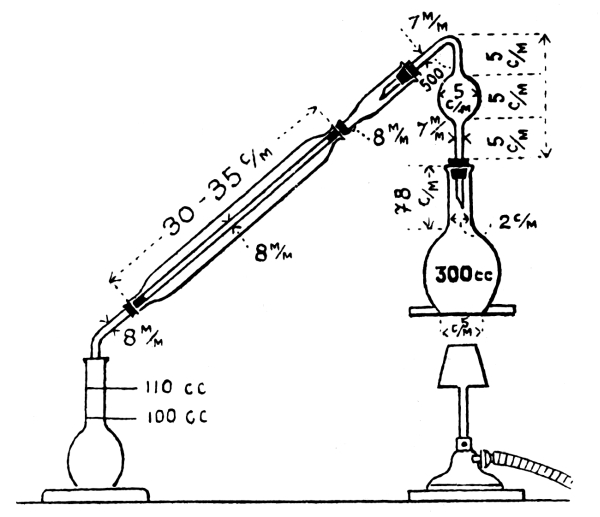
Fig. 1.
The modification of the Reichert process suggested by Wollny was, in its essential details, that adopted for the determination of butter in margarine by a Committee of the Society of Public Analysts appointed in 1900 to confer with the Principal of the Government Laboratory. The details of this process, which was formerly, until the large increase in adulteration of butter with cocoanut oil, or margarine containing cocoanut oil, the chief method for the examination of butter, are as follows (Analyst, 1900, 311):—
Five grms. of the melted and filtered fat are weighed into a 300 c.c. flask, of the form and size shown in the figure, and 2 c.c. of a solution prepared by dissolving 98 per cent. sodium hydroxide in an equal weight of water, taking care to prevent absorption of atmospheric carbon dioxide, and 10 c.c. alcohol (92 per cent.) are added. The mixture is heated under a reflux condenser connected with the flask by a T-piece for fifteen minutes in a bath containing boiling water. The alcohol is distilled off by heating the flask on the water-bath for about thirty minutes, or until the soap is dry. One hundred c.c. of hot water, which has been kept boiling for at least ten minutes, are added, and the flask heated until the soap is dissolved. Forty c.c. of N/1 sulphuric acid, and three or four fragments of pumice or broken pipe-stem, are added, and the flask is at once connected with a condenser by means of a glass tube 7 mm. wide and 15 cm. from the top of the cork to the bend. At a distance of 5 cm. above the cork is a bulb 5 cm. in diameter. The flask is supported on a circular piece of asbestos 12 cm. in diameter, having a hole in the centre 5 cm. in diameter, and is first heated by a very small flame to melt the insoluble fatty acids, though the heat must not be sufficient to cause the liquid to boil. The heat is increased, and, when fusion is complete, 110 c.c. of the liquid are distilled off into a graduated flask, the distillation lasting about thirty minutes (twenty-eight to thirty-two minutes). The distillate is shaken, 110 c.c. filtered, transferred to a beaker, 0·5 c.c. of an alcoholic phenol-phthalein solution (1 per cent.) added, and the filtrate titrated with N/10 sodium hydroxide or barium hydroxide until pink. A blank experiment is carried out in precisely the same way, using the same reagents, and omitting the fat, and the amount of N/10 alkali required to neutralise this distillate should not exceed 0·3 c.c. The difference between the volumes of alkali required with the butter fat and in the blank determination, multiplied by 1·1, gives the Reichert-Meissl-Wollny value.
The improvements in the methods of refining cocoanut oil during recent years have led to the addition of considerable quantities of cocoanut oil to edible fats, and thus has somewhat reduced the value of this process for distinguishing pure from adulterated butter, owing to the fact already mentioned, that cocoanut oil contains a distinct quantity of volatile fatty acids. A very large number of methods have been proposed for detecting cocoanut oil in butter, and such terms as “silver value,” “caprylic acid value,” “oxygen equivalent,” have appeared in the literature of the subject.
Probably the most valuable of all these tests is one devised by Polenské (Zeit. Untersuch. Nahr. Genussm., 1904, vii. 273-280), which is based upon the determination of the volatile insoluble fatty acids that distil over in the Reichert-Wollny process. This method, which is known as the Reichert-Wollny-Polenské process, is now very generally employed for the analysis of butter, but to obtain concordant results it must be carried out strictly under the specified conditions and in an apparatus of the form and dimensions shown in the figure (Fig. 2). The details of the process are as follows:—
Five grms. of the clear butter fat are weighed out into a 300 c.c. flask, and saponified as described on p. 111, with 20 grms. glycerin and 2 c.c. of a 50 per cent. aqueous solution of sodium hydroxide, the heating being effected with a Bunsen burner. When saponification is complete and the mixture perfectly clear, it is allowed to cool down below 100° C., and the soap dissolved in 90 c.c. of water. To this solution, which should be clear and almost colourless, are now added 50 c.c. of dilute sulphuric acid containing 2·5 per cent. sulphuric acid and some fragments of pumice, and the flask attached to the condenser. The distillation is now proceeded with as usual, the heat being so regulated that 100 c.c. of distillate passes over in nineteen to twenty minutes, and the temperature of the condensing water is between 18° and 20° C. As soon as 110 c.c. of distillate have been collected the receiver is changed, and a 25 c.c. cylinder put in its place. The receiver is now transferred (care being taken to mix its contents as little as possible) to a water-bath at a temperature of 10° C., where it is kept for ten minutes, the surface of the water being just above the 110 c.c. mark. The insoluble fatty acids rise into the neck of the flask, and, in the case of butter, are in the form of solid, opaque granules, and with pure cocoanut oil in the form of clear, oily drops. The latter are also obtained in the case of mixtures containing more than 10 per cent. of cocoanut oil. The liquid is mixed and filtered, the Reichert-Wollny value being determined on the filtrate by titration with N/10 alkali.
The condenser, cylinder, and receiver are now washed with 18 c.c. of water, the washings being passed through the filter paper, and the insoluble fatty acids remaining on the filter dissolved in alcohol. The solution obtained is titrated with N/10 barium hydroxide solution, using phenol-phthalein as indicator, the number of c.c. required being termed the “new butter value” of the fat.
This value was stated by Polenské to range, for pure butters having Reichert-Meissl values of 23·3-30·1, from 1·5-3·0, and for cocoanut oils having Reichert-Meissl values of 0·8-7·7, from 16·8-17·8. Mixtures with Reichert-Meissl values between 23 and 27 gave “new butter values” of from 1·6-1·9, a rise of 1·0 in the Reichert-Meissl figure corresponding with an increase of 0·1 in the “new butter value,” and each per cent. of cocoanut oil increasing the new butter value by 0·1 above that given by a genuine butter possessing the same Reichert-Meissl value. By this method it is possible to detect the presence in butter of 10 per cent. and upwards of cocoanut oil.
A process similar in principle, but differing in method has been proposed by Muentz and Coudon (Ann. d. l’Inst. Agron., 1904, iii., Part I.; Analyst, 1905, 155). In this, 10 grms. of the fat, melted and weighed at 60° C., are placed in a cylindrical vessel, and saponified by first stirring for ten minutes with 5 c.c. of potassium hydroxide solution, containing 120 grms. potassium hydroxide in 100 c.c., and then heating to 70°-80° for twenty minutes. The saponified fat is washed into a distilling flask with 200 c.c. of water, gently warmed until solution is complete, and the fatty acids liberated by adding 30 c.c. of phosphoric acid (sp. gr. 1·15), any carbon dioxide being removed by connecting the vessel with a pump for ten minutes.
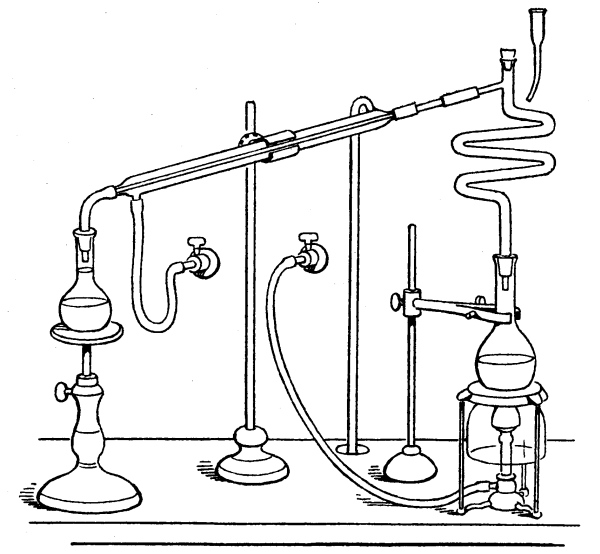
Fig. 3.
The volatile fatty acids are then distilled off in the apparatus shown in Fig. 3, and to obtain comparative results, strict adherence to the form and dimensions given must be made. Two hundred c.c. are distilled over, the heat being regulated so that this takes about one and a half hours, and the distillate is allowed to stand until the following day, when it is filtered through a wet paper, the flask washed with 5 c.c. of water, which is also passed through the paper, and the soluble fatty acids titrated with standardised lime-water, with phenol-phthalein as indicator.
The filter is now washed with four successive quantities of 5 c.c. of alcohol, poured on drop by drop, and the washings collected in the receiver originally used. The condenser is next rinsed, first with 20 c.c. of alcohol, which should fill the tube when closed at its lower end, and a second time with 5 c.c. of alcohol, these washings being added to the remainder, and the whole titrated with the standard lime-water.
The results of both titrations are expressed as butyric acid, and the ratio
insoluble acids
—————— × 100
soluble acids
for pure butter should lie between 10 and 15, whilst for cocoanut oil it is 250-280. For butter containing 10 per cent. of cocoanut oil the figure is 19·8, and 15 per cent. cocoanut oil 24·1, for 20 per cent. cocoanut oil 27, and for 50 per cent. cocoanut oil 73·1. It is claimed that by this process the presence in butter of as little as 5 per cent. of cocoanut oil can be detected with certainty.
Two methods have been proposed, based on the precipitation of insoluble silver caprylate: (1) by Kirschner (Zeit. Untersuch. Nahr. Genussm., 1905, ix. 65-70), and (2) by Wijsman and Reijst (Zeit. Untersuch. Nahr. Genussm., 1906, xi. 267-271).
In the former process, 5 grms. of the fat are treated by the before-mentioned Reichert-Meissl-Wollny process so far as neutralising 100 c.c. of the filtered distillate with N/10 barium hydroxide solution. Half a grm. of silver sulphate is then added to the neutral solution, which is frequently shaken for one hour, and filtered, and 100 c.c. of the filtrate are transferred to a distilling flask. To this liquid are now added 35 c.c. of dilute sulphuric acid (2½ per cent.) and a few fragments of pumice, and the whole distilled until 110 c.c. of distillate have been obtained. This is filtered, and 100 c.c. titrated with N/10 barium hydrate solution, the number of c.c. required; calculated back to the 5 grms., giving what is termed the “second titration value.”
According to Kirschner, the percentage of butter fat in a mixture of butter and cocoanut oil may be calculated from the formula:—Percentage of butter fat = 4·319 S - 0·456 R - 2·15, where S = the second titration value, and R = the Reichert-Meissl figure. A similar formula is given for the percentage of cocoanut oil, which = 7·42 R - 8·116 S - 3·57. Wijsman and Reijst’s method, or the “silver value method,” is performed by treating with silver nitrate (1) the Reichert-Wollny distillate; and (2) 250 c.c. filtered from 300 c.c. of distillate obtained from a further 5 grms. of fat, this being saponified, treated with acid, and 100 c.c. distilled off in the usual way, after which 100 c.c. more water are added from a tap funnel, and another 100 c.c. distillate collected, this being once more repeated.
In both cases the filtered solutions are neutralised with N/10 alkali, and 40 c.c. of N/10 silver nitrate solution added, the precipitated silver salt collected on a filter and washed until about 200 to 300 c.c. of filtrate have been collected, after which 50 c.c. of N/10 sodium chloride solution is added and the excess of chloride titrated back with N/10 silver nitrate solution, potassium chromate being used as indicator.
Eleven-tenths of the number of c.c. required in the first case, and six-fifths of that used in the second, give what are termed the first and second “silver values.”
In the case of pure butter all the caprylic acid should distil over in the first 110 c.c. so that the “second silver value” should not exceed the first, but with cocoanut oil the distillation of caprylic acid continues with the second and third 100 c.c. of distillate, so that the second silver value is greater than the first. The process has been adversely criticised by Jean (Ann. de Chim. Anal., 1906, ii. 121-124).
A useful qualitative test for the detection of even small quantities of cocoanut oil in butter is that due to Hinks (Analyst, 1907, 160). In this, 5 c.c. of the melted and filtered fat are dissolved in 10 c.c. of ether, and cooled to 0° C. for thirty minutes. The solidified glycerides are then rapidly filtered off, the filtrate evaporated, and the residue redissolved in 3 to 4 times its volume of boiling 96 to 97 per cent. alcohol. This is allowed to cool to the ordinary temperature, and then placed in a water-bath at 5° C., at which temperature it is kept for fifteen minutes. The alcoholic layer is filtered off into a tube cooled to 0° C., and the flocculent precipitate, which soon separates, is examined microscopically with a magnification of 250-300. Butter treated in this manner deposits round, granular masses, whereas cocoanut oil gives fine needle-shaped crystals. As little as 5 per cent. cocoanut oil may be detected by this process.
Ross (Analyst, 1908, 457) has attempted to make this process quantitative by determining the refraction of the residues obtained, but without success.
Palm oil in butter may be detected by the Liebermann-Storch reaction for rosin. Ten c.c. of the filtered fat are dissolved in 10 c.c. of acetic anhydride, and 1 drop of sulphuric acid (sp. gr. 1·53) added. The mixture is shaken, and, on standing, a blue liquid, having a greenish tint, separates, if palm oil is present.
Soluble and Insoluble Fatty Acids—the Hehner value.—A weighed quantity of about 5 grms. of the filtered butter fat is introduced into a strong 6 oz. bottle, and 50 c.c. of approximately N/2 alcoholic potassium hydroxide solution added, another 50 c.c. being also placed in an empty flask. The bottle is fitted with an india-rubber stopper, which is secured by wire, and is placed in a water-bath, being occasionally removed, and well agitated without bringing the liquid in contact with the stopper. After about thirty minutes, saponification is complete (this being shown by the contents of the bottle being free from oily globules), and the bottle is withdrawn and allowed to cool. The stopper is then removed, and the contents of the bottle transferred, by rinsing with boiling water, into a 10 oz. flask, which is placed, together with the flask containing only alcoholic potassium hydroxide solution, on a steam-bath.
As soon as all the alcohol has evaporated the contents of each flask are neutralised with N/2 hydrochloric acid, an excess of about 1 c.c. of acid being added, and a note made of the quantity used. The flask containing the butter fat is nearly filled with boiling water, and placed on the water-bath, a cork with a long upright tube being inserted. When the fatty acids have melted to a clear liquid on the surface of the water, the flask is removed and its contents allowed to become perfectly cold, when the fatty acids should solidify. By gently tapping the sides of the flask this cake is detached, and the liquid is poured through a filter into a large flask. This liquid should have a distinct odour of butyric acid, especially on warming.
The flask containing the insoluble fatty acids is again filled with boiling water, the cork and reflux tube inserted, and the liquid gently heated to the boiling-point, after which the flask is removed and thoroughly shaken until the melted fatty acids are emulsified with the water. The fatty acids are now allowed to separate again on the surface, solidified by cooling, detached by gently tapping, and the liquid filtered off as before. The process is repeated three times, or until the washings collected separately do not require more than 0·2 c.c. of N/10 sodium hydroxide solution for neutralisation.
The mixed washings are next diluted to one litre or other convenient volume, and an aliquot part titrated with N/10 sodium hydroxide solution, the number of c.c. required being calculated upon the whole liquid. This amount of alkali is that required to neutralise the excess of acid added after saponification, together with the soluble fatty acids, and the former may be known by titrating the excess in the blank experiment, so that the difference between these two titrations gives the alkali absorbed by the volatile fatty acids. These are usually expressed as butyric acid, C₃H₇COOH, the percentage of which may be found by multiplying the number of c.c. of alkali solution required to neutralise the soluble fatty acids by 0·0088 and by 100, and dividing by the weight of fat taken.
The Insoluble Fatty Acids are determined by allowing the flask containing the solid cake to drain as completely as possible, melting the fatty acids, and pouring them on to the wet filter through which the solution of soluble fatty acids was passed. They are then washed on the filter with boiling water, and the funnel filter transferred to a small beaker and placed in the water-bath until all the fatty acids have filtered through. Flask, funnel, and filter paper are well washed with ether, the washings added to the filtered fatty acids, and the ether evaporated. The fatty acids are then dried in the oven at 100° C. until constant in weight, and from the weight obtained the percentage of insoluble fatty acids is calculated on the weight of butter fat taken. This is known as the Hehner value.
Butter should contain at least 5 per cent. of soluble fatty acids calculated as butyric acid, and the insoluble fatty acids should not exceed 89½, rarely 88½ per cent.
The following table contains results obtained by Thorpe (Journ. Chem. Soc., 1904, 254) on 357 samples of British butters:—
LEGEND:
(A) = Reichert-Meissl-Wollny Number.
(B) = Saponification Equivalent.
(C) = Refactometer Number at 45° C.
(D) = Soluble Acids per cent. on Fat.
(E) = Insoluble Acids per cent. on Fat.
(F) = Mean Molecular Weight of Insoluble Acids.
Number of Samples. (A) Specific Gravity at 37·8° C. (B) (C) (D) (E) (F)
7 22·5 0·9101 255·4 42·0 4·3 90·1 266·9
17 23·5 0·9104 253·4 41·5 4·5 89·7 265·5
15 24·5 0·9108 251·3 41·5 4·7 89·4 265·0
27 25·5 0·9110 251·1 41·3 4·8 89·3 264·2
37 26·5 0·9113 248·9 41.0 4·9 88·9 261·9
51 27·5 0·9114 247·4 40·6 5·2 88·7 261·7
78 28·8 0·9118 245·7 40·1 5·4 88·4 260·9
56 29·5 0·9120 244·0 40·1 5·6 88·3 259·6
41 30·5 0·9123 242·4 39·9 5·8 87·9 260·1
18 31·3 0·9125 241·5 39·7 5·7 87·9 258·0
10 32·6 0·9130 241·2 39·4 6·0 87·7 257·8
357
Casein (Curd).—This may be estimated by transferring the dry butter used in determining the water to a dry filter of known weight, washing it thoroughly with ether or petroleum spirit until free from fat, and weighing the filter after drying at 100° C. The residue includes casein and salt, and the latter may be determined as described below, and subtracted from the total residue.
The amount of casein does not usually exceed 1 to 2 per cent., but cases are recorded when adulteration with casein has been practised, and as much as 5 to 6 per cent. found.
Salt.—For most practical purposes, the ash remaining after burning either the dried butter, or the residue insoluble in ether, may be taken as salt (sodium chloride). If desired, the sodium chloride may be estimated by extracting the butter with 10 to 20 c.c. of hot water in a separating funnel, separating the aqueous layer, repeating this about ten to fifteen times, and titrating the aqueous washings with standard silver nitrate solution, using potassium chromate as indicator.
The proportion of salt may vary from 0·5 for a fresh butter up to 11 per cent. for a salt butter, but should not go beyond the latter limit (see also p. 41).
Colouring Matters.—The natural colouring matter of butter, which is termed “lactochrome,” is insoluble in alcohol or glacial acetic acid, so that if on shaking the sample with either of these reagents a coloured extract is obtained, artificial colouring matter has undoubtedly been added.
Two general schemes have been devised for the detection of artificial colouring matters in butter or margarine: (1) devised by Leeds (Analyst, 1887, 150), in which the fat and colouring matter are first extracted with petroleum ether, and the colouring matter dissolved out of the ethereal extract with N/10 potassium hydroxide, and reprecipitated with dilute hydrochloric acid; and (2) that devised by Cornelison (Journ. Amer. Chem. Soc., 1908, 1478), who extracts the colouring matter directly by means of glacial acetic acid.
Colouring Matter. Concentrated Sulphuric Acid. Concentrated Nitric Acid. Sulphuric Acid and Nitric Acid. Concentrated Hydrochloric Acid.
Annatto Indigo blue changing to violet. Blue becoming colourless on standing. Same. No change, or only slight dirty yellow and brown.
Annatto and decolorised butter. Blue becoming green and slowly changing to violet. Blue through green and bleached. Decolorised. No change, or only slight dirty yellow
Turmeric Pure violet. Violet. Violet. Violet changing to original colour on evaporation of HCl.
Turmeric and decolorised butter. Violet to purple. Violet to reddish violet. Same. Very fine violet.
Saffron Violet to cobalt-blue changing to reddish brown. Light blue changing to light reddish brown. Same. Yellow changing to dirty yellow.
Saffron and decolorised butter. Dark blue changing quickly to reddish brown. Blue through green to brown. Blue quickly changing to purple. Yellow becoming dirty yellow
Carrot Umber brown. Decolorised. Do. with NO₂ fumes and odour of burnt sugar. No change.
Carrot and decolorised butter. Reddish brown to purple similar to turmeric. Yellow and decolorised. Same. Slightly brown.
Marigold Dark olive green Permanent. Blue changing instantly to dirty yellow Green. Green to yellowish green.
Safflower Light brown. Partially decolorised. Decolorised. No change.
Aniline yellow Yellow. Yellow. Yellow. Yellow.
Martius yellow Pale yellow. Yellow reddish precipitate, magenta at margin. Yellow. Yellow precipitate treated with NH₃ deflagrates.
Victoria yellow Partially decolorised. Same. Same. Same colour returns on neutralising with NH₃.
Leeds’ process is carried out by mixing 100 grms. of the sample with 300 c.c. light petroleum spirit (sp. gr. 0·638), separating the ethereal layer by means of a separating funnel, and washing it with 100 c.c. of water in successive small quantities. The ethereal extract is allowed to stand for fifteen to twenty hours surrounded by ice, and is then decanted from any separated “stearin” and shaken with 50 c.c. of N/10 potassium hydroxide solution. The alkaline extract is separated, made faintly acid with dilute hydrochloric acid, and the precipitated colouring matter filtered off, together with a trace of fatty acid, which is always dissolved out by the alkali. The colouring matter may then be identified by the tests given on the preceding page.
In Cornelison’s method 10 grms. of the melted fat are thoroughly shaken with 10 to 20 grms. of glacial acetic acid, at about 35° C., the mixture allowed to separate, and the acid liquid drawn off. The colour of the latter is noted, and portions treated with various reagents to identify the colouring matter. The table on p. 125 gives the results obtained with the colouring matters mentioned, incorporated with pure butter in the proportion of 1 part in 100,000.
Preservatives
(see p. 46).
Boron Compounds.—The presence of these may be detected by thoroughly mixing some of the butter with excess of water in a mortar, pouring off the water, acidifying with a drop of dilute hydrochloric acid, and moistening a piece of turmeric paper with the solution. The paper is then dried in the oven, when, if boron compounds are present, the paper develops a reddish pink tint, changing to dark blue when moistened with weak alkali.
Dye. Colour of Acid Extract. Concentrated Nitric Acid. Concentrated Sulphuric Acid Sulphuric Acid and Ether to Clear Solution.
(Pure natural butter) Colourless. Colourless. Faint pink on standing. Colourless.
Soudan I. (pure) Decided pink. Strong pink. Strong clear pink. Pink.
Butter yellow (impure). Very faint pink. Faint pink. Faint pink. Faint colour.
Cerasine orange G. (Casella). Strong greenish yellow. Acid yellow; oil-globule, salmon-pink. As with HNO₃. Brownish yellow.
Yellow O.B. (Heller and Merz). Decided bright yellow. Acid faint pink; oil-globule, salmon-pink. As with HNO₃. Pink.
Yellow A.B. (Heller and Merz). Slight warm ochre-yellow. Pink; fat colourless. Brownish pink; oil faint pink. Pink.
Annatto Dull yellow. Little change. Faint pink on standing. Very faint yellow.
Curcumine Intense greenish yellow. Dull ochre-yellow. Strong pink Yellow.
Carrot Very faint greenish yellow. Faint yellow. Faint pink on standing. Very faint yellowish.
“Alderney butter colour” (Heller and Merz). Brownish yellow. Strong pink. Strong pink.
Ranson’s butter colour (“vegetable”). Yellow. Almost decolorised. As with HNO₃.
“Dandelion brand” butter colour (“vegetable”). Yellow. Almost decolorised. As with HNO₃.
The amount of boron compound may be readily estimated by Richmond and Harrison’s modification of Thomson’s process. Twenty-five grms. of the sample are weighed into a 100 c.c. stoppered cylinder, and, after determination of the moisture present, sufficient water is added to bring the total volume of water up to such a quantity that 1 c.c. corresponds to 1 grm. of butter. From 10 to 15 c.c. of chloroform are now introduced, and the contents of the flask heated, shaken, and allowed to separate. An aliquot portion of the aqueous liquid is then removed by means of a pipette, evaporated to dryness, ignited, and the residue extracted with hot water. The extract is made neutral to methyl orange, boiled to expel carbon dioxide, half its volume of neutral glycerin added, and the mixture titrated with N/10 sodium hydroxide solution until pink to phenol-phthalein. Each c.c. of N/10 sodium hydroxide solution is equivalent to 0·0062 grms. of boric acid.
Another method, devised by Richmond and Harrison (Analyst, 1902, 181), is to weigh out 25 grms. of the sample in a beaker, add 25 c.c. of a solution containing 6 grms. of milk sugar and 4 c.c. of N/1 sulphuric acid, in 100 c.c. of water. The beaker is placed in a water-oven until the fat has just melted, and the contents are then stirred well, allowed to separate, and 20 c.c. of the aqueous liquor withdrawn. A few drops of phenol-phthalein are then added, and the liquid heated to the boiling-point, and titrated with N/2 sodium hydroxide solution until faintly pink, after which 12 c.c. of glycerin are added, and more N/2 sodium hydroxide solution run in until a faint pink colour is again obtained. The amount of alkali required in the second titration, less the alkali required to neutralise 12 c.c. of the glycerin, multiplied by 0·0368, gives the amount of boric acid in 20 c.c. of the aqueous extract, and the percentage may be calculated by multiplying by (100 + percentage of water in the butter), and dividing by 20. In an average butter the number of c.c. of N/2 sodium hydroxide solution used, multiplied by 0·2, approximates closely to the percentage of boric acid.
The best method of testing for benzoic acid, salicylic acid, fluorides, and [Greek: b]-naphthol is to extract the melted butter with a dilute solution of sodium bicarbonate, and to examine this extract for the various preservatives.
Thus, in testing for benzoic and salicylic acids, the alkaline extract is exactly neutralised with dilute hydrochloric acid, and a solution of ferric chloride added. If benzoic acid or a benzoate has been added, a buff-coloured precipitate will be immediately thrown down, and if salicylic acid has been employed, an intense violet coloration will be produced.
Numerous methods have been suggested for detecting even very minute admixtures of benzoic acid or benzoates, among which may be mentioned those of Halphen (Journ. Pharm. Chim., 1908, 201) and Robin (Ann. de Chim. Anal. Appl., 1908, 431).
Halphen’s test depends on the conversion of the benzoic acid into ammonium diamido-benzoate, which, in alkaline solution, has a brown-red colour. A quantity of the butter is melted with sufficient lime-water to render the aqueous liquor which separates distinctly alkaline. After cooling, the latter is separated, acidified with phosphoric acid, and extracted with ether. The ether is allowed to evaporate spontaneously, and the residue dried at the ordinary temperature, after which it is gently heated with 2 c.c. of concentrated sulphuric acid until completely dissolved. An addition of 0·2 c.c. of fuming nitric acid is now made, and the solution transferred to a dry test tube and heated carefully over a small flame until sulphuric acid fumes appear. After cooling, the mixture is diluted with 5 or 6 c.c. of water, which causes nitrous fumes to be evolved. When again cold, a saturated solution of sodium sulphite is added drop by drop until all yellow vapours have disappeared. Ammonia is then allowed to flow over the surface of the solution, and if benzoic acid is present, an orange-red coloration is produced, the intensity of which is proportional to the quantity of benzoic acid. In case no coloration is produced, the absence of benzoic acid may be confirmed by adding a drop of ammonium sulphide to the ammoniacal solution, when, if benzoic acid is present, a red coloration develops at the point of contact of the two liquids.
By Robin’s process it is claimed that as little as 12 parts per 100,000 of sodium benzoate may be detected with certainty. The test is carried out by shaking 25 grms. of the melted butter with a solution of 0·4 to 0·5 grm. of sodium bicarbonate in 50 c.c. of water, and 15 c.c. of 95 per cent. alcohol, and allowing the mixture to stand for ten minutes, after which the alcoholic layer is drawn off, acidified with 7 or 8 drops of hydrochloric acid, and heated to the boiling-point. It is then shaken with a little talc, and filtered, the cold filtrate extracted in a separating funnel with 40 c.c. of ether, and the ethereal extract washed once with a mixture of 20 c.c. of water, 5 c.c. of 95 per cent. alcohol, and 0·2 to 0·3 grm. of sodium bicarbonate. The alkaline alcoholic extract is evaporated on the water-bath, and the residue carefully warmed with a mixture of 5 c.c. of concentrated sulphuric acid and 10 drops of fuming nitric acid, until white fumes appear, after which the liquid is poured into 50 c.c. of water containing a small piece of turmeric paper. A yellow coloration indicates the presence of benzoic acid, which may be confirmed by adding ammonia solution until alkaline, then a few drops of ammonium sulphide solution, and shaking the vessel. In the presence of benzoic acid the colour changes from yellow to reddish orange.
Fluorides.—The presence of these may be detected in the absence of boric acid by evaporating a small quantity of the alkaline extract to dryness in a platinum crucible, igniting the residue, moistening it with a few drops of concentrated sulphuric acid, and covering the mouth of the crucible with a piece of glass, coated with paraffin wax, through which some marks have been scratched.
Fluorides may also be detected by applying the above process to the aqueous liquor, which separates when a sample of the butter is melted.
If boric acid is present, the fluoride is liable to be lost by volatilisation as boron fluoride. It is necessary, therefore, to separate the borate as calcium borate, by rendering the liquid alkaline with lime-water, evaporating it to dryness, and extracting the residue with dilute acetic acid, which dissolves calcium borate. The insoluble matter is then dried, and treated with concentrated sulphuric acid as described above.
Margarine, Vegetable Butter, or other Butter Substitutes
The analysis of these is a matter requiring a considerable amount of skill, and even when the analysis is made, very long experience is necessary before a right interpretation can be put upon the chemical and physical data obtained.
The only requirements for margarine under the Sale of Food and Drugs Act, 1899, are that the sample shall not contain more than 16 per cent. water or more than 10 per cent. of butter. The same restrictions as to preservatives apply to this as to genuine butter.
The amount of water is readily determined by the method given under “Butter” (p. 109). The method officially adopted by the Committee of the Society of Public Analysts for the estimation of butter is the Reichert-Meissl-Wollny process (p. 111), the maximum permissible limit for the Reichert-Wollny value being 4, and a Reichert-Wollny value of 7·1 being regarded as indicative of the presence of 20 per cent. butter fat.
In addition to the analysis of margarine to ensure compliance with these standards, it is often desirable to endeavour to determine the precise composition of a sample of artificial butter, such as the relative proportions of animal and vegetable fats, and the particular fats or oils of which they consist. It is here where only prolonged experience can decide what tests to apply and determine the correct interpretation to put upon the results obtained.
In an exhaustive analysis, the specific gravity, saponification value, iodine value, titre, and Reichert-Wollny-Polenské figures should always be determined, and such qualitative tests as Halphen’s for cotton-seed, Baudouin’s for sesame, the arachidic acid test for arachis oil, and the Liebermann-Storch test for palm oil applied.
The tests for colouring matters and preservatives are the same as for natural butter.
Lard
In addition to the tests mentioned in Chapter V. pp. 60 et seq., Halphen’s test for cotton-seed oil and Baudouin’s test for sesame oil should be applied, and, if thought desirable, arachis oil may be tested for by the arachidic acid method. The presence of as little as 2 to 3 per cent. cotton-seed oil may be detected by the phytosteryl acetate test (see p. 101), and the addition of maize oil, which is sometimes used for adulterating lard, will also be shown by the same method.
Preservatives may be detected, and, if present, estimated as described under “Butter.”
Cheese
The composition of cheese is so variable that it is to be regretted there are no standards to which it should conform.
The proportion of fat may vary from 20 per cent. or less to 35 or 40 per cent., or, in a cream cheese, up to 75 per cent., while the water may be anything between 20 and 40 per cent.
The analysis of cheese should include determinations of the proportions of water, ash, fat, and nitrogen, and an examination of the fatty matter.
Water.—This may be determined by drying a weighed quantity of about 5 grms. of the sample, cut in thin slices, in the oven at 105° C., until constant in weight.
Ash.—The dried cheese, as obtained in the above determination, is ignited at as low a temperature as possible, and the residue weighed when the whole of the carbon has been burned away.
Fat.—This may be determined approximately by grinding up 25 to 50 grms. of the dried cheese with ignited sand, and extracting the mixture in a Soxhlet apparatus with ether or petroleum spirit, the extract being collected in a weighed carbonic acid flask, from which the solvent is afterwards distilled off, and the residue dried in the oven at 105° C., and weighed.
A better method is that of Palmquist, which is a modification of the Rose-Gottlieb process. In this, about 1 grm. of the cheese is weighed into a Gottlieb tube, 10 c.c. of 2·5 per cent. ammonia solution added, and the mixture warmed on the water-bath, and shaken until a milky homogeneous solution is obtained. After cooling, 10 c.c. alcohol and 25 c.c. of ether are added, the tube being thoroughly shaken after each addition. An addition of 25 c.c. of petroleum spirit is then made, and the tube, after being again well shaken and inverted, is allowed to stand for a few hours for its contents to separate, after which the ethereal layer is siphoned into a weighed flask. A second extraction of the mass remaining in the tube is then carried out in an exactly similar manner, the ethereal extract being again siphoned into the weighed flask, the solvent distilled off, and the residue dried in the oven at 105° C., and weighed.
A larger quantity of the fat for its examination may be readily prepared by cutting up a quantity of the cheese, wrapping it in a piece of muslin, and suspending over a basin in an oven at 105° C. The clear fat collected should then be examined, and its Reichert-Wollny value, which should be similar to that of butter, determined. If the Reichert-Meissl-Wollny figure is abnormal, the fat requires further systematic examination by the processes mentioned under “Margarine” (p. 130), to detect foreign fats.
Nitrogen.—This is estimated by heating 1 to 2 grms. of the cheese with concentrated sulphuric acid and a globule of mercury, as in the well-known Kjeldahl process. The proteins may be calculated by multiplying the percentage of nitrogen by 6·3.
Chocolate
No standards have yet been legally fixed in this country for any of the various forms of chocolate, though such standards are in existence on the Continent, and are urgently needed in view of the large amount of adulteration practised in this industry. Not only is the natural fat of the chocolate replaced by other fats, such as cocoanut oil, and cocoanut stearin, or palm-nut stearin, and the chocolate adulterated with excessive husk or starch, but products are sold as milk or cream chocolate which have no right to such designations. Hence N. P. Booth presented to the International Congress of Applied Chemistry, held in London last year, the following proposed standards, which are not more stringent than those adopted by some Continental countries and by some of the Colonies:—
1. Unsweetened Chocolate must be prepared exclusively from roasted, shelled, finely ground cocoa-beans, with or without the addition of a small quantity of flavouring matter. It should contain not less than 45 per cent. of cacao butter.
2. Sweetened Chocolate.—A preparation consisting exclusively of the products of roasted, shelled, finely ground cocoa-beans, and not more than 65 per cent. of sugar, with or without a small quantity of harmless flavouring matter.
3. Granulated or Ground Chocolate for Drinking Purposes.—The same definition as for sweetened chocolate should apply here, except that the proportion of sugar may be raised to not more than 75 per cent.
4. Chocolate-covered Goods.—Various forms of confectionery covered with chocolate, the composition of the latter agreeing with the definition of a sweetened chocolate.
5. Milk Chocolate.—A preparation composed exclusively of roasted, shelled cocoa-beans, sugar, and not less than 15 per cent. of the dry solids of full-cream milk, with or without a small quantity of harmless flavouring matter.
The analysis of chocolate should comprise determinations of the moisture, ash, fat, fibre, total nitrogen, and sugar, and an examination of the nature of the fatty matter and sugar.
In the case of milk chocolate or cream chocolate, the fatty matter should contain both cacao butter and butter fat, and the sugar should contain lactose.
The analysis is carried out as follows:—
Water.—A weighed quantity of about 5 grms. is finely divided, and dried in the oven at 105° C., until constant in weight.
Ash.—The dried product obtained in the determination of the moisture is cautiously burnt until all carbonaceous matter is volatilised. The proportion of ash should not exceed 1 to 1·5 per cent., unless the sample has been coloured with mineral colouring matter, such as ochre.
Fat.—This may be estimated by extracting 5 grms. of the finely ground sample in an extraction thimble with ether or light petroleum spirit, by means of a Soxhlet apparatus. The extracting liquid is collected in a small weighed flask, which, when extraction is complete, is detached from the Soxhlet apparatus, the solvent distilled off, and the residual fat weighed, after being dried in the oven at 105° C.
Kreutz (Zeit. Untersuch. Nahr. Genussm., 1908, 584-586) recommends melting the sample with chloral alcoholate prior to extraction with ether. From 2 to 3 grms. of the chocolate are placed in a small flask with 3 to 4 grms. chloral alcoholate, and the mixture melted by heating on a water-bath. The hot mass is well stirred with 10 to 15 c.c. of ether, a further 35 c.c. of ether added, and, after thorough shaking, the mixture is filtered through a dry filter. The filtrate is passed through the filter again and again until perfectly bright, and the residue on the filter washed with ether three times. The ether is then distilled off, and any chloral alcoholate removed by heating the residue to about 75° C., under reduced pressure. The residue obtained is extracted with carbon tetrachloride and filtered to eliminate a little theobromine and colouring matter, the filtrate evaporated in a weighed flask, and the residue of fat dried in the oven at 105° C., and weighed.
For the examination of the fat a larger quantity may be prepared by simply shaking up about 15 to 20 grms. of the finely ground sample in a stoppered bottle with three or four successive quantities of petroleum spirit, allowing the mass to settle, pouring off the solvent, and evaporating it. The residual fat should then be examined for its refractive power, its Reichert-Meissl-Polenské values, its saponification value, its iodine value, and its titre.
Genuine cacao butter gives a refractometer reading at 35° C. of about 49°, has a Reichert-Meissl value of 1 or rather less, a saponification value of about 286-290, an iodine value of about 34, and a titre of about 48° C. Cocoanut oil has a refractive power of only about 37°, and is thus readily detected by this, as also by the much increased saponification value and reduced iodine value, and the increased Reichert-Meissl figure.
Cocoanut stearin also increases the saponification value, reduces the iodine value, and raises the Reichert-Meissl figure. Palm-nut stearin increases the saponification value, reduces the iodine number, and slightly raises the Reichert-Meissl figure, its own Reichert-Meissl value being about 2·2.
Of the other fats said to be used as substitutes for cacao butter, and mentioned in Chapter VII.
Dika, or Gaboon Fat, raises the saponification value, lowers the iodine value, but does not affect the Reichert-Meissl figure.
Borneo Tallow, or Tankawang Fat, has analytical values very similar to those of cacao butter.
Illipé Fat has a much higher iodine value (54-60). (See also p. 87.)
Fibre.—This is best estimated by Allen’s method (Commercial Organic Analysis, iii., Part II., p. 567), in which 2 grms. are freed from fat, and boiled for thirty minutes under a reflux condenser with 200 c.c. of water and 2½ c.c. of sulphuric acid. The liquid is filtered through linen, and the residue thoroughly washed with hot water and boiled with 200 c.c. of 1¼ per cent. solution of sodium hydroxide. The residue is filtered off, washed with hot water, alcohol, and ether, and dried at 110° C., and weighed. It is then ignited, and the loss regarded as crude fibre.
Total Nitrogen.—This is estimated on about 2 grms. of chocolate by the Kjeldahl method. In an ordinary chocolate it is normally about 1 per cent., and in a milk chocolate slightly higher. In a plain chocolate the proportion of nitrogen, multiplied by 20, will give the percentage of fat-free cocoa.
Sugar.—This may be determined in plain chocolate by means of a polarimeter, a 20 per cent. aqueous solution, which is clarified with lead acetate in the ordinary way, being used. In the case of milk chocolate the introduction of lactose complicates the determination slightly, but estimation of the copper-reducing power enables the lactose to be calculated, and an allowance made for its effect on the optical rotation.
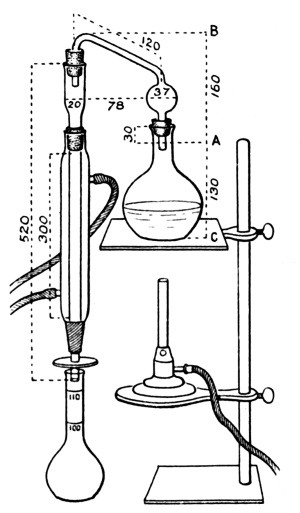
Fig. 2.