DISADVANTAGES OF THE POLYGONAL BARN.
Reading edition
A polygonal barn has the disadvantages of both the rectangular and the round barn, and is less stable than either. It must necessarily have a heavy frame, which is expensive, and as the siding cannot run around the corners, it is very difficult to tie the different sides together sufficiently to prevent the barn being racked by the wind.
Barn No. 6
Fig. 41. Barn No. 6; 85 feet in diameter; Same scale as drawing on opposite page.
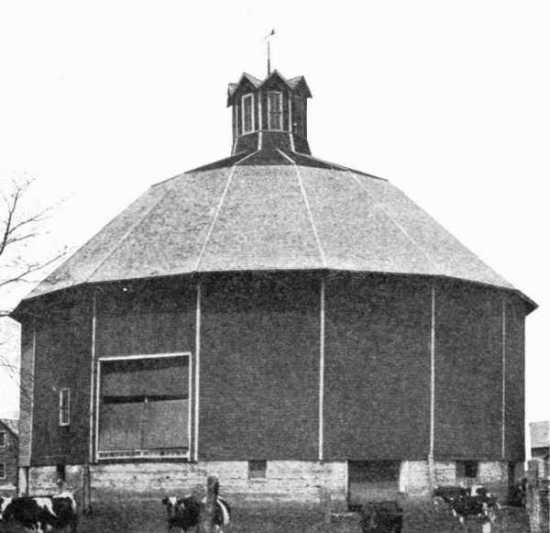
16-sided.
Built, 1888.
Diameter, 85 feet.
Height, 26-foot posts on 9-foot wall.
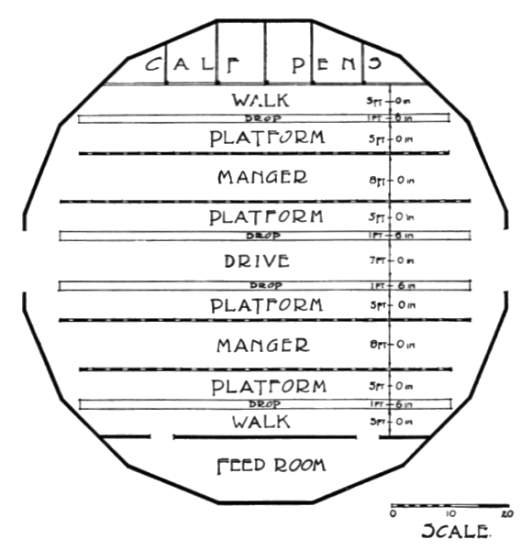
Capacity, 88 cows; 350 tons of hay.
Foundation and first story, cement wall 9 feet above cement floor.
Supports, 4 × 8s, placed just back of stanchions, 3 feet on center.
Studs, 2 × 10s, 26 feet long, placed 21⁄2 feet on center.
Fig. 42. Arrangement of cow stable in Barn No. 6.
Joists 3 × 12s, 20 feet long, 14 inches on center for main span.
Rafters, self-supporting. Sheathed with 1 × 6s with no space between. This roof has a purline plate thrown in the gambrel. The plate is supported only by the braces which tie the joints.
The barn has been racked three times by the wind, replumbed and heavy iron rods put in to brace it, yet it is out of plumb at the present time.