EASY LESSONS IN EINSTEIN
Reading edition
“A warp in nature has been found, No line is straight, no circle round; For Isaac Newton had unsound Ideas of gravitation.”
Why is it that our newspapers are sending out their reporters to interview astronomers as well as actresses and devoting pages to speculations on the nature of space and time as well as on the state of the market? It is—to get at the bottom of it—merely because a few photographs taken during the eclipse of the sun on May 29, 1919, by two telescopes, one at Sobral in northern Brazil and the other on the island of Principe off the west coast of Africa, showed an abnormal shift of less than one-324,000th of a right angle in the position of the stars. When these photograph films were laid over films taken before the eclipse it was found that the star-images about the darkened disk of the sun did not exactly coincide with the images when the sun was not in their midst. Measured with a micrometer the displacement of the stars from their ordinary positions was found to be 1.60 seconds of arc on the African plates and 1.98 seconds on the Brazilian plates. Average these two observations and you get 1.79. This is extremely close to the 1.73 predicted by Professor Einstein of Berlin and twice as large as the deflection calculated according to Newton’s law of gravitation which would be .87 of a second.
When the announcement of this result was made at the meeting of the Royal Society of London on November 6 all eyes were turned toward Sir Oliver Lodge, for last February he had been rash enough to express the hope, if not the prediction, that the results of the eclipse expedition would support Newton rather than Einstein. But instead of taking part in the discussion Sir Oliver got up and walked out. It was suspected that he had “gone off mad,” as we Americans would put it, because the starlight would not follow his preferred path. But he put a stop to any such rumors by a letter to The Times in which he explains that his departure was not due to any dissatisfaction with the universe but to the necessity of catching the 6 o’clock train. He frankly acknowledges that “the eclipse result is a great victory for Einstein; the quantitative agreement is too close to allow much room for doubt” but he adds “a caution against a strengthening of great and complicated generalizations concerning space and time on the strength of this splendid result: I trust that it may be accounted for, with reasonable simplicity in terms of the ether of space.”
This caution is wise, but we cannot hold our breath till 1922, when the next eclipse comes, to see if these observations are verified and we may in the meantime consider some of the implications of Einstein’s theory of relativity.
Sir Joseph Thomson, President of the Royal Society, in making the momentous announcement in the session of the Society, said:
If his theory is right, it makes us take an entirely new view of gravitation. If it is sustained that Einstein’s reasoning holds good—and it has sustained two very severe tests in connection with the perihelion of Mercury and the present eclipse—then it is the result of one of the highest achievements of human thought. The weak point in the theory is the great difficulty in expressing it. It would seem that no one can understand the new law of gravitation without a thorough knowledge of the theory of invariants and of the calculus of variations.
What is this theory of relativity and why is it so important? The mathematics of it are too much for most of us, but we can get some notion of it by a familiar illustration.
Suppose you wake up some morning in a Pullman berth and look out of the window to see where you are. You find your view blocked by a passing train on the next track. Now if you do not feel any jar of your car and cannot catch sight of the landscape beyond the other train you cannot tell whether (1) your train is moving forward and the other train is standing still, or (2) your train is standing still and the other train is moving backward, or (3) whether both trains are moving in opposite directions, or (4) whether both trains are moving in the same direction, but your train faster. It is obvious that the trains are getting past one another. You can measure their speed of parting as accurately as you please. But all you can perceive is the relative motion of the two trains. You begin to wonder whether there is any such thing as absolute motion; whether there is any real difference between rest and motion. Is there any possible way of telling whether your train is in motion or not if all you can see out of the window is some object that itself be moving? Suppose the windows were all curtained, how could you find out whether you were moving forward or backward or standing still?
You discuss this curious question with your fellow passengers at the breakfast table and one of them makes the brilliant suggestion that it might be possible to determine the absolute motion of the car by reference to the air. If the car is moving forward the air would stream from front to rear and the reverse if it were moving backward. “Suppose,” says the ingenious experimentalist, “that you stand at one end of the car and I at the other. We will shout at each other alternately and time the passage of the sound with our stop watches. Since sound is carried by air waves it will take longer for the shout to go against the air current than with it, and from that measurement it might be possible for us not only to determine which way the car is moving but how to calculate how fast it travels, assuming, of course, that there is no wind blowing.” That strikes you as a crucial experiment, but you point out one possible difficulty, that the doors at the ends of the car may be closed and the air inside is being carried along with the car, so no difference would be observable in the speed of the sound even though the car were moving. “All right,” replies your scientific friend, “we will make a preliminary test to see if the enclosed air is carried along with the car, and if we find that it is not then we will try the second experiment with the sound signals to see which way the air current is moving. These two experiments must settle it, for either the air is moving with the car or it is moving through the car. Can you conceive of any other possibility than these two?” No, you cannot, so you proceed to try the two experiments. First you visit both ends of the car and find both doors open; the air then is not being carried along with the car. You turn then with confidence to the second experiment and you find, of course, that there is a difference in the speed of sound whether it moves with the air drift or against it.
There might, I admit, be practical difficulties in the way of carrying out such a delicate experiment on a moving train, but we need not bother with them, for probably the current of air through the car would be so strong as to blow your hat out of the back door and that would settle the question to your satisfaction—or at least it would settle the question in the affirmative.
But imagine your amazement if this second experiment should give negative results like the first one; if you could detect no difference in time whether the sound was sent forward or back or across the car. You would then have proved by experiment (1) that the air did not move with the car and (2) that the air did not move through the car. You might suppose from this that your car is at rest, but suppose the people on the other train passing yours tried the same experiments and got the same result, namely, that they, too, were at rest as regards the air. You would then be in a quandary, for your two indisputable experiments had apparently given contradictory results. You might get out of it by saying that there was no air, but if not what carried the sound waves—and the hat?
CONTRADICTORY EXPERIMENTS
Now this is the quandary in which physicists have been in for the last thirty-three years. Is there any way of discovering absolute motion among the heavenly bodies? We can observe and measure with great accuracy their relative motion. The sun is seen to pass across the sky from east to west and man at first assumed that the earth was still and the sun went around it. This is the natural and instinctive assumption, for when you first glance out of your Pullman window you get the impression that the other train is the moving one. But for the last three hundred years it has been the fashion to assume the earth was moving and not the sun. That assumption has the advantage of simplifying the calculations of the astronomers, though I never could see why we should have to give up our simple notions of sunrise and sunset to save them a little trouble figuring.
The earth moves—if it does move—so quietly and silently that we feel no jar or engine-beat to tell us of its motion. If the earth were perpetually shrouded by clouds could we find out its motion through space or even its rotation? And do we actually get any proof on this point from observation of the heavenly bodies? We see them moving about relatively to each other and we can represent their movements most easily by supposing that the moon goes around the earth and that the earth and the rest of the planets go around the sun. But is this whole solar system in motion? So it seems when we compare it with the stars. But who knows if the solar system and all the visible stars are not altogether moving off through space at the rate of a mile or a thousand miles a second? How can we tell unless we have something that is still and fixed to measure the motion by?
It seemed until recently that we had such a fixture, the ether. We know of the sun and stars only from the light that comes from them to us. Light, as we can prove by simple experiments, consists of wave motion. Now, can you have wave motion without something to wave? Sound waves are conveyed by air but there is no air between the earth and the sun. So as nothing could be found to fill this empty space scientists had to invent something to satisfy their sense of the fitness of things. The ether was the product of their excogitations. It was a British invention, devised in the Royal Institution, whence have come so many useful theories and discoveries.
The ether, as Salisbury said, is simply the nominative of the verb “to undulate.” It was conceived of as a sort of transparent jelly filling all space, more rigid than any solid, more frictionless than any fluid, more easily penetrated than any gas. It must be more elastic than steel and yet so rarefied that ordinary matter passes through it without the slightest effort. The ether is supposed to slip between the particles of the rushing earth as the wind blows through the branches of a tree.
For many years after its invention the ether had nothing to do except to carry light about from one place to another. But when the electro-magnetic waves of the wireless telegraph were produced something was needed also to carry them and this new task was laid upon the shoulders of the uncomplaining ether. When Röntgen discovered the X-rays, whose waves are 10,000 times shorter than the shortest light waves, these were turned over to the ether to run. In fact, it got so that whenever a physicist found any action that he could not explain by ordinary matter he said: “Let the ether do it,” and that hypothetical substance apparently answered every purpose until it came to this question of relative motion.
Now whatever we may think about the ether it would seem that if there is any such thing filling all “empty” space we might use it for measuring the motion of the earth through it as we did the air current in the car. If the earth is really revolving around the sun the ether must be whizzing through its pores at the rate of about nineteen miles a second.
But wait—there is the possibility that the earth carries along with it in its flight through space a sort of atmosphere of ether as it does of air. We must first get rid of this possibility by a preliminary experiment to see if a swiftly moving mass of matter does catch up and carry along with it a little of the ether. This would cause a sort of an eddy or disturbance in the ether in the neighborhood of the moving mass as a boat disturbs the water. For instance, a ray of light passing close to a rapidly revolving wheel would be a little deflected and show a distorted image. Sir Oliver Lodge tried this experiment and got negative results. That is, moving matter does not disturb or carry with it the ether. Consequently, it would seem, we are left to the only other logical alternative, that the ether drifts through matter and we should expect to detect this drift by measuring the speed of light in the direction of the earth’s motion. It ought to take longer for light to travel from one point to another if the earth meantime is moving away from the first point and it ought to take less time if the earth is moving toward it. Well, Michelson and Morley tried this experiment—and also got negative results! It did not make any difference whether the ray of light was sent in the direction of the earth’s movement or the reverse or across the line, it traveled invariably at the same speed, 186,000 miles a second. Here then were two unquestionable experiments apparently contradicting each other. One proved that the ether did not travel with the earth. The other proved that the ether did not stand still while the earth traveled through it.
Now when we get contradictory answers to the questions we put to Nature we must assume—unless Nature is nonsensical—that we are asking nonsensical questions. If in the trial of a pickpocket one witness swears that the thief did not run up the street and another witness that he did not run down the street the lawyer does not necessarily say that one of them must be a liar. He meditates a moment and then it occurs to him that possibly the pickpocket did not move or that perhaps he disappeared into the third dimension by climbing up a fire-escape or dropping into a coalhole.
So with our ether quandary. If the ether does not move and does not stand still perhaps there isn’t any ether or perhaps there is a fourth dimension. These are two conceivable ways out of the dilemma though they are not easy to accept, either of them. If there is no ether what carries the light waves? If there is a fourth dimension in what direction does it lie? But it is no harder to believe in or conceive of a fourth dimension than it is the ether, and if the physicist finds that he needs it in his business he will have to have it. Einstein says that he needs a fourth dimension for his formulas.
THE CONUNDRUM OF THE AGES
For twenty-four hundred years philosophic thought has been concerned with the problem of the relation of space and time. Drop into any of the scientific societies of today and you will find them discussing whether space is finite or infinite, whether there is any difference between rest and motion, whether length is absolute or relative, whether time and space have real existence, which are the very questions discussed by Pythagoras and Zeno in the Greek cities of Asia Minor. Now the time spent in these speculations has not been wasted, although it has led to no definite conclusion, for out of it have grown our mathematics and physics. The Wandering Jew, who is the only mortal having the privilege of attending the schools of the Eleatics and those of the present day, would observe one difference, that modern scientists try to put their theories to the test of experiment wherever possible, while the ancients were content with thinking them out.
Of all the guesses that have been given to this riddle of the universe none has been more bold and revolutionary than that contained in a paper of four or five pages contributed in 1905 to the Annalen der Physik by Albert Einstein. The controversy it precipitated has not altogether been confined to the realm of pure reason, for scientists are but human and as such are not entirely uninfluenced by patriotic prejudice.
In this brief paper he proposed a new theory of the universe based upon two postulates. The first was the principle of relativity; that all motion is relative. This means, for instance, that we would never know the motion of a smoothly moving train if the windows were darkened and that we could never discover the forward movement of the earth if we could not see the heavenly bodies.
Einstein’s second postulate was that the velocity of light is independent of the motion of the source. This is a hard one for our reason to swallow, for it means that nothing can travel faster than light, 186,000 miles a second, and that you cannot make light travel faster than that by giving it a swift send-off. It is the same as saying that if a man standing on the cowcatcher of an engine threw a ball forward, it would not make any difference with the velocity of the ball whether the train was running at full speed forward or backward or standing still. But the experiments of the American physicists, Michelson and Morley, who measured the speed of light and found it the same whether the earth was moving toward the source of the ray or away from it, or at right angles to its direction, confirm Einstein’s second assumption.
If we accept Einstein’s two primary postulates and his later “Principle of Equivalence” his theory clears up this ether-drift difficulty as well as various other riddles of the universe. It explains the shifting of the orbit of Mercury that Newton’s theory could never account for. It foretold the deflection of light by the sun’s gravitation that the observations on the eclipse of last May confirmed. A third test, the shifting of the lines of the solar spectrum toward the red end in a gravitational field, has not been met. Such technical points concern only physicists and astronomers, but Einstein’s relativity theory, which two out of the three experiments support, carries with it certain speculations as to time and space that are upsetting to current conceptions.
PARADOXES OF RELATIVITY
All three of Newton’s laws of motion are now questioned and the world is called upon to unlearn the lesson which Euclid taught it that parallel lines never meet. According to Einstein they may meet. According to Newton the action of gravitation is instantaneous throughout all space. According to Einstein no action can exceed the velocity of light. If the theory of relativity is right there can be no such thing as absolute time or way of finding whether clocks in different places are synchronous. Our yardsticks may vary according to how we hold them and the weight of a body may depend upon its velocity. The shortest distance between two points may not be a straight line. These are a few of the startling implications of Einstein’s theory of relativity. If he had put it forward as a mere metaphysical fancy, as a possible but unverifiable hypothesis, it would have aroused mere idle curiosity. But he deduced from it mathematical laws governing physical phenomena which could be put to the test of experiment. They have been tested in these two crucial cases and prove to be true.
In the preceding pages we have discussed the question of the relativity of motion and seen how impossible it is to tell, for instance, whether a train or a ship you are on is moving or not unless you can compare it with something that you are “sure” is stationary. But what are you sure is stationary? Nothing on earth surely, for the earth compared with the “fixed” stars is spinning around at the rate of about a thousand miles an hour and rushing around the sun at the rate of nearly 70,000 miles an hour. But are we sure the stars are fixed since we have nothing else to compare them with? You may remember Herbert Spencer’s illustration of the sea captain who was walking west on the deck of a ship sailing east at the same rate. Is he moving or not? If you are in the same boat, you say he is. If you are on shore when the ship is passing you say he is standing still and “marking time.” It all depends on the point of view.
Now you may readily admit that all motion is relative, not absolute, and yet you may balk at the idea that space and time are also relative, not absolute. But motion is merely simultaneous change of position in space and time, and why should we feel so certain about space and time when we have never seen either?
You may say, for instance, that you are sure your desk is so long. But if I ask you how long you have to say as long as something else. You may say it is a yard long. But how long is a yard? It is as long as some tape or stick marked “one yard,” and this in turn has been taken from some other yardstick, until you get back to the brass rod in London that is just as long as the distance from the tip of the nose of King Henry I to the end of his royal thumb. But such a standard of absolute measurement is unsatisfactory to everyone except an absolute monarchist. But apart from the difficulty of the present inaccessibility of King Henry’s nose and thumb, can we be confident that our yardstick keeps the same length while we are measuring with it? We must admit indeed that it is longer on a summer day than on a winter day, but can we be sure that it does not alter in length when we hold it upright or lay it horizontally? Or, rather, could we tell if it did change in length as it is changed in direction?
ARE YOU SURE OF YOUR SHAPE?
If you have ever been in any of those funny places at the amusement parks you will have noticed the convex mirrors there and how ridiculous they make other people look. If you cannot afford the nickel necessary for the study of optics in such an establishment you can contemplate your reflection in the side of a shiny tin cup or can. In a plane mirror you see a man who looks as you suppose yourself to be except that somehow you seem to have become left-handed. But when you look into a convex cylindrical mirror set upright you see a man thinner than you “really are.” Look into the same mirror set horizontal and you see a man shorter than you “really are.” You grin at the sight of such queer-looking creatures, but you notice that they are equally amused at your shape. Now how are you going to prove to the men in the curved glasses that they are mere caricatures and that you are not really built on the plan of either of these images? You naturally resort to measurement, as a scientist should. You cannot get into the mirror world to measure the tall man who pretends to represent you, but you can explain to him in the sign language what you want him to do and he instantly complies. You stand up a measuring rod at your side and show him that you are exactly 72 inches tall. He also sets up a rod and that also reads 72 inches. Never mind, let him use any kind of measure he likes, you will catch him when it comes to measurement of width with the same stick. You hold your rule across your shoulders and it reads 18 inches, that is, one-fourth your height. But he also measures his width with his rule and makes it just the same, 18 inches, although as you see him he looks at least six times as high as he is broad.
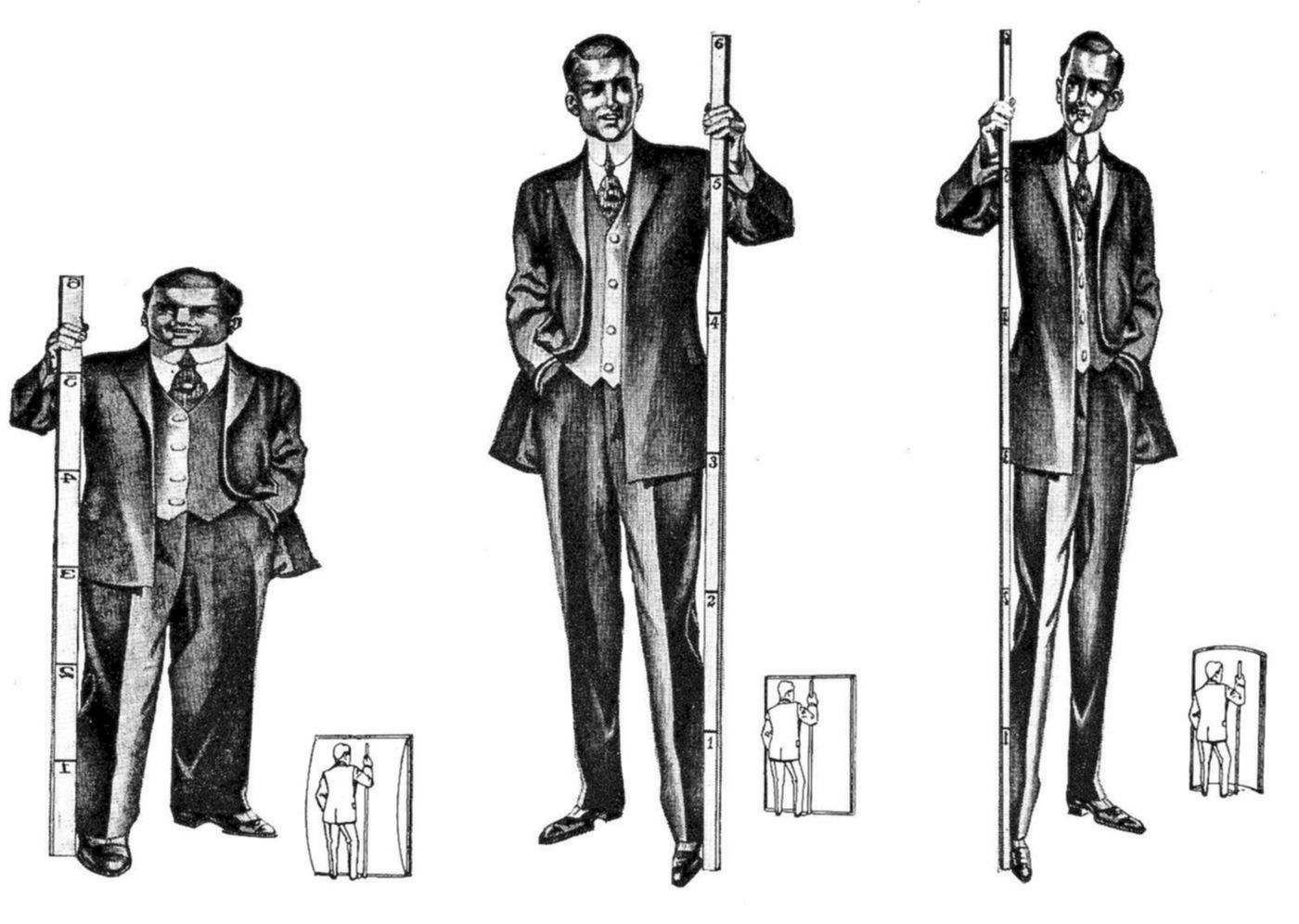
THE MEASURE OF A MAN
When the man in the middle looks at himself in a curved mirror he sees what he regards as a distorted image. The image on the right is thinner and seems taller because it is reflected from a cylindrical surface set upright. The image on the left is shorter and seems broader because it is reflected from a cylindrical surface set horizontally. But if the man and his image are measured by scales in the real world and the mirror world they come out the same. So, too, it would be impossible for us to find out if everything in the world were expanded or contracted in all directions. In other words, all measurements are relative. According to Einstein any body in movement is shortened in the direction of the line of motion while the transverse dimension remains the same. If, then, a man is being carried headlong through space with a velocity approaching the speed of light he would be shortened like the man on the left. If he were moving sideways he would be like the man on the right.
The man’s image in a plane mirror seems to him symmetrical but reversed. His right hand has somehow got over on his left side and vice versa. Such a transformation as the mirror seems to effect cannot be actually accomplished in ordinary space, but would conceivably be possible in a space of four dimensions.
Now you are sure he is cheating—must have some sort of telescoping rod that contracts and expands according to the way he holds it. You point out to him that his measure is unreliable, but to your surprise his gestures seem intended to convince you that you instead are using the elastic rule. You shake your fist in his face—to which he responds with equal indignation—and then you turn to the squatty chap in the other mirror, hoping he will be amenable to reason. But he also measures himself as 72 inches high and 18 inches wide by his own rule. If you try the still queerer-looking fellow in the concavo-convex mirror who is distorted in all sorts of ways you will find that his rule lengthens and shortens and bends just enough to make him as symmetrical a man as yourself. And how can he be otherwise since he is the image of yourself?
You are therefore driven to doubt the invariableness of your own yardsticks. Suppose when you wake up tomorrow everything, including all means of measuring, is twice as big as it is today. Could you tell the difference? Would it make any difference? Would there be any difference? Is there any such thing as absolute distance? Are not all measurements relative?
Such questions had from the earliest times occupied the attention of speculative philosophers, but they passed from the realm of metaphysics to the realm of physics in 1886 when Michelson and Morley made their famous experiment on the speed of light in various directions. Their object was to find out if the ether, the hypothetical medium carrying the light waves, was stationary and drifted back through the earth as the earth moved onward. They devised an instrument of such delicacy that the stamp of a foot a hundred yards off would be noticeable. A ray of light was divided into two parts; one half was sent forward and back in the direction toward which that part of the earth where the experiment was made was moving at the time; the other half was sent back and forth across the line of this motion. But the two rays of light following different routes came back at the same instant and matched up exactly. In order to correct for any inequality in the instrument, Michelson and Morley turned it around so the arm that formerly pointed across the line of motion now pointed in the direction of that motion and the other arm pointed across, but that made no difference. The light traveled with the same velocity regardless of the motion of the earth.
This negative result was just as astonishing as if you should stand at a certain spot on the bank of a river half a mile wide and should send out two boats, one to go up the river half a mile against the current and then back with the current and the other boat to go across the river and back. If both boats should return at the same moment you would be puzzled to account for it. One way of accounting for it would be that your measurement of the half-mile course upstream had been a little short. This was the explanation of the Michelson-Morley experiment given by the Dutch physicist, Lorentz. He suggested that the arm of the instrument shortened a trifle as it was turned from across the line of the earth’s motion to the direction of that motion. The amount of shrinkage necessary to compensate for the ether drift would be exceedingly small. Besides how could you measure the change in the length of the arm if the rule you laid alongside of it altered in the same proportion? Lorentz’s explanation could not be disproved, yet it was so upsetting to our ordinary ideas of the stability of matter that it was hard to accept.
Einstein took Lorentz’s idea and made it one of the fundamental principles of his new theory of the universe and then deduced from this theory sundry very startling conclusions, some of which could be—and have been—confirmed by experiment. According to Einstein the size and shape of any body depends upon the rate and direction of its movement. For ordinary speeds the alteration is very slight, but it becomes considerable at rates approaching the speed of light, 186,000 miles a second. If, for instance, you could shoot an arrow from a bow with a velocity of 160,000 miles a second, it would shrink to about half its length, as measured by a man remaining still on earth. A man traveling along with the arrow could discover no change. No force could bring the arrow or even the smallest particle of matter to a motion greater than the speed of light, and the nearer it comes to this limit the greater the force required to move it faster. This means that the mass of a body, instead of being absolute and unalterable as we have supposed, increases with the speed of its movement. Newton’s laws of dynamics are therefore valid only for matter in motion at such moderate speeds as we have to deal with in our experiments on earth and in our observations of the heavenly bodies. When we come to consider velocities approximating that of light the ordinary laws of physics are subject to an increasing correction.
If a person calculates that he is attaining a speed faster than light he will seem to another observer to be moving the other way. That is, any motion above the speed of light is negative motion. Just as a tourist traveling more than 12,000 miles away from home in any direction will really be getting nearer home the farther he goes.
Such speculations would not have bothered anybody twenty years ago, for then the physicist did not have to handle any cases of such high speeds. But when radium was discovered it was found that this metal was continuously throwing off particles of negative electricity with approximately the speed of light. Now if these electrons are not matter they are at any rate the material of which matter is made. They can be detected and counted and tracked and deflected and speeded and weighed. They are very real things, perhaps the ultimate reality of all things, yet their extreme velocity carries them out of Newton’s world and into Einstein’s.
INTRODUCING THE FOURTH DIMENSION
Now Einstein’s world, as I said before, differs from the world in which we are accustomed to live in many particulars. It has four dimensions instead of three. One of these dimensions may be time. Time, too, must be relative, not absolute. This is even harder to imagine than the relativity of space.
As some schoolboy said: “If there were no matter in the universe the law of gravitation would fall to the ground.” Quite so.
WHAT IS MEANT BY DIMENSIONS
No dimensions: A mathematical point. Has position but no size. Represented by a dot. Like this .
One dimension: Has length but no breadth. Made by moving a point along straight in any direction. Represented by a line. Like this ——
Two dimensions: A plane surface like this page. Has length and breadth but no thickness. Made by moving a line in a direction perpendicular to its length (that is, into the second dimension). Represented by two straight lines of indefinite length perpendicular to each other. The lines are called axes and are labeled x and y. The point where they meet, the origin, is marked O. Like this
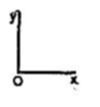
Three dimensions: A solid like a cube. Has length, breadth and thickness. Made by moving a plane in a direction perpendicular to the other two (that is, into the third dimension). Cannot be pictured on paper, but is indicated by three axes, x, y, and z, of which x and y are on the plane of the page and z is supposed to be stuck up at right-angles to the other two. Stick a pin into the paper at the point O and you will have the third or z axis. Like this
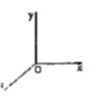
Four dimensions: Has length, breadth, thickness and extension into a fourth dimension, say time. Made by moving a cube in a direction perpendicular to the other three (that is, into the fourth dimension). Cannot be pictured on paper, but may be indicated by four axes, x, y, z and t (or u), each at right-angles to the other three. Like this
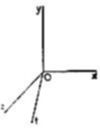
More dimensions: Any desired number of dimensions can be worked out mathematically but with increasing difficulty because of the impracticability of diagrammatical representation. We can generalize the idea by speaking of a “geometry of n dimensions” where n may stand for any number whatever from zero to infinity.
A line of a given length contains an infinite number of points. A square of a given size contains an infinite number of lines. A cube of a given size contains an infinite number of plane squares. A tesseract (four-dimensional cuboid) of a given size contains an infinite number of solid cubes.
And what would there be left of space if you took everything out of it, and what would become of time if nothing ever happened? In other words are not space and time merely forms of thought, the framework of ideas, and if so cannot we fix them over to suit our need of new conceptions? As a matter of fact we do. We have constructed by the aid of Euclid and his successors a geometry of three dimensions that works perfectly for all ordinary requirements and if we need a fourth dimension to accommodate these new astronomical and physical phenomena we will build on the necessary addition to our conception of space. There was no use having a fourth dimension so long as we had nothing to put in it. For ordinary earth measurements (geometry) such as laying out a town lot we only use two dimensions, length and breadth. We speak of “flat ground” and “water-level” regardless of the fact that all our “straight” lines on the earth’s surface are really curves that come back to us after going 25,000 miles or less. It is only when measuring mile lengths that we have to correct for the curvature of the earth in the third dimension. So if, as seems probable, we shall have to make allowance in astronomical measurements for the curvature of the universe in a fourth dimension it will merely mean a little labor to the astronomers and it will relieve their minds of some of their perplexities. There is nothing more mystical or mysterious or “psychical” about a fourth dimension than about the other three. A dimension is simply a measurable direction and we can use five dimensions or n dimensions if we need to.
It does not matter that we cannot “see” a figure in four dimensions even with our mind’s eye. Actually we cannot see any figure of more or less than two dimensions: we have to take the others on faith. Nobody can see the mathematician’s point because it has no dimensions, no size at all. The schoolboy says: “Let that be the point A,” and we let it be although what he is pointing at with his stick is not a point but a vast irregular splotch of white chalk on the blackboard. So, too, we cannot see a mathematical line because it has only one dimension, length and no breadth. But set four lines at right angles to one another and we get a square. This we can really see if the enclosed surface is of a different color such as a shadow or black print. Set six squares together at right angles and we get a cube. This we cannot see in its entirety at one time. All that we see when we look squarely at a cube is a square. If we look at it from an angle we see what looks like a square with a couple of lozenges on the sides. The retina of the eye is practically a plane surface, so all we can get is a two-dimensional projection of a solid.
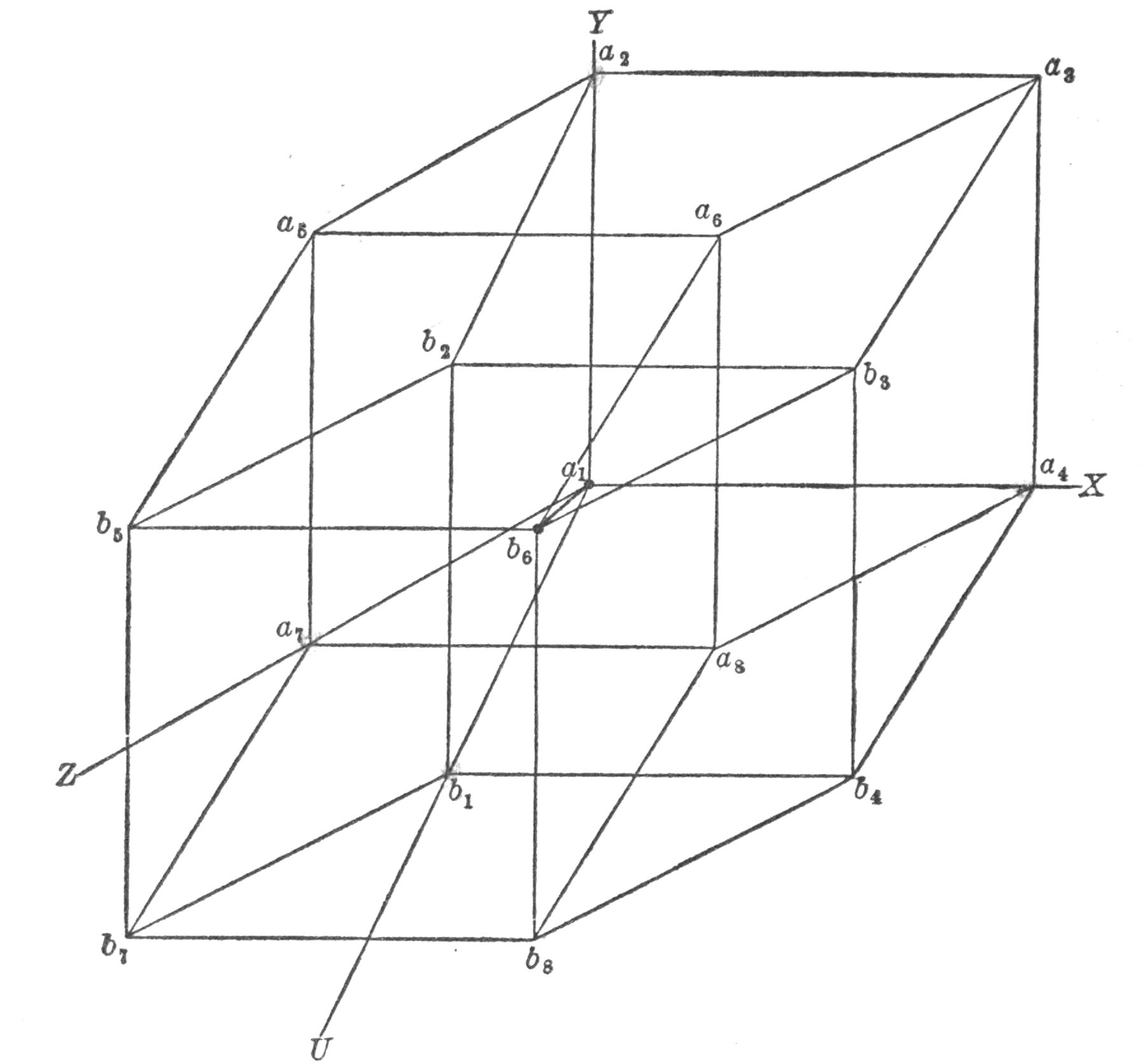
HOW TO DRAW A FOUR-DIMENSIONAL FIGURE
The best way to get an idea of the construction of a cubical solid in four dimensions is to draw a diagram yourself and trace out in turn each of the eight cubes that inclose it. I am indebted to K. W. Lamson of Barnard College for the following sketch and directions:
Draw the four coördinate axes OX, OY, OZ, OU.
Lay off the unit a1a4 on the X axis, a1a2 on the Y axis, a1a7 on the Z axis and a1b1 on the U axis.
Draw the cube a1a2a3a4a5a6a7a8 on the three axes XYZ.
Draw parallel to this the cube b1b2b3b4b5b6b7b8 on the U axis.
Draw the cube a1a2a3a4b1b2b3b4 on the three axes XYU. This is partly drawn already.
Draw parallel to this the cube a7a8a5a6b7b8b5b6 on the three axes XYU.
This completes the figure.
There are four other cubes in the figure besides those described above:
The cube on the XZU axes a1a4b1b4a7a8b7b8 and its opposite a2a3b2b3a5a6b5b6.
The cube on the YZU axes a5a2a7a1b5b2b7b1 and its opposite a6a3a8a4b6b3b8b4.
The figure has: 16 corners, 32 edges, 24 bounding squares, 8 bounding cubes.
The heavy line a1b6 might be called the principal diagonal and makes an angle of 60 degrees with each of the four axes. It is foreshortened in the sketch, but its real length is twice that of one edge of the cube. Every line except this is on the outside of the four-dimensional figure.
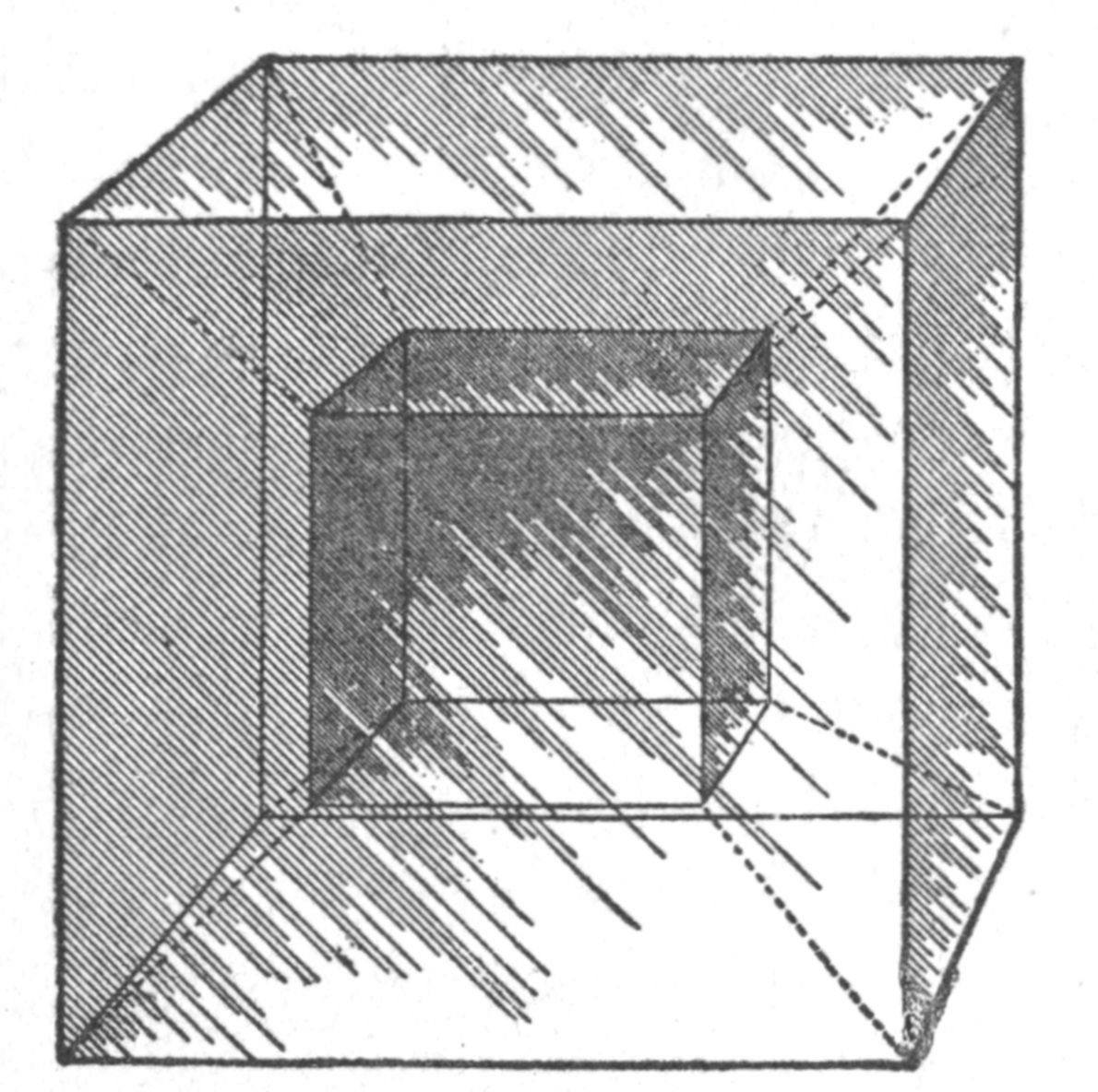
THE TESSERACT
A four-dimensional cube-like solid if transparent and looked at with one eye would appear something like this. But it is obviously impossible to depict a four-dimensional figure on a two-dimensional surface like this page.—From “The Fourth Dimension Simply Explained,” Munn and Company, N. Y.
Since our two eyes present us slightly different pictures of an object we infer from these its size, shape and distance, but this is guesswork.
Still we have a pretty clear idea of a cube although we have never seen it in its solidity. But the attempt to visualize the hypercube, the four-dimensional figure corresponding to the cube, strains our imagination to the breaking point. Some mathematicians endowed with constructive imaginations of high power claim to have got by long hard thinking some sort of a shadowy and fleeting perception of it, but their visions—if they are not imaginary—do not help out us ordinary folks. But if we cannot imagine—that is, image—the hypercube we know all about it, even its name. It is called the “tesseract,” and it is bounded by eight cubes just as the cube is bounded by six squares and the square by four lines. The tesseract has 24 square faces, 32 edges and 16 rightangular corners.
TIME AS THE FOURTH DIMENSION
Although we find it hard to conceive of a fourth dimension in space we have no such difficulty in case the fourth dimension is time. In fact, we use this idea all the while and could not get along without it. To fix the position of any event requires four dimensions. For instance, a man is shot. Where? At the corner of 7th Avenue and 42d Street, New York. This fixes the place by two coördinates crossing at right angles in a plane. But was it above or below this, on the twentieth floor of the Times Building or in the Subway? Knowing this fixes the third dimension, but we have still to fix its position in a fourth dimension, time. Was it today or last week and what hour? If then we find out all four we can distinguish this shooting from any that may have occurred in other places at the same time or at other times in the same place.
Or consider this simple illustration: Cut a strip of motion picture film into its separate scenes and pile them up in order till it is as high as it is broad. You have then a cubical event. Two dimensions of the cube are spatial; the third dimension is essentially temporal, although in a spatial form. If one of the films from the middle of the pack represents the present then the films below represent the past and those above the future. The people on the picture you picked out know only of the scene there depicted though they may have a fading memory of the past and a dim anticipation of the future. But to you who are outside of the film pack all the scenes are equally visible. They are all present to you. This is the way most Christians have conceived of God, as one to whom past and future form one eternal present, so he sees simultaneously all things that have been, are or will be.
If our pile of film were made up of snapshots taken one a day throughout a man’s life we should see at one glance his growth from babyhood to boyhood, to maturity and old age. We could turn the leaves of his life backward or forward as we will. Some day perhaps we shall have stereo-movies, scenes in three dimensions with time as the fourth.
This idea of time as a fourth dimension is not a new one. In 1754 d’Alembert, defining “dimension” in the Encyclopedia, wrote: “A brilliant man of my acquaintance believes that one may regard duration as a fourth dimension.” In 1903 Minkowski worked out the idea in mathematical form. H. G. Wells, always quick to catch up a new scientific theory to use as a plot for a story, wrote in 1895 of “The Time Machine,” a vehicle by which a man could travel back and forth in time as he can travel east and west in a motor car. In this he visits the future and finds mankind split into two species, a subterranean working class living on—literally—a pleasure-loving leisure class.
In “The Plattner Case” Wells tells of a chemical professor who was by an explosion knocked into—not the middle of next week as we commonly say—but into the fourth dimension of space. Ten days later he was knocked back again into our world but the only evidence of the truth of his story was that his heart beat on the right side and he was left handed and otherwise reversed in a way that would be impossible in a space of three dimensions.
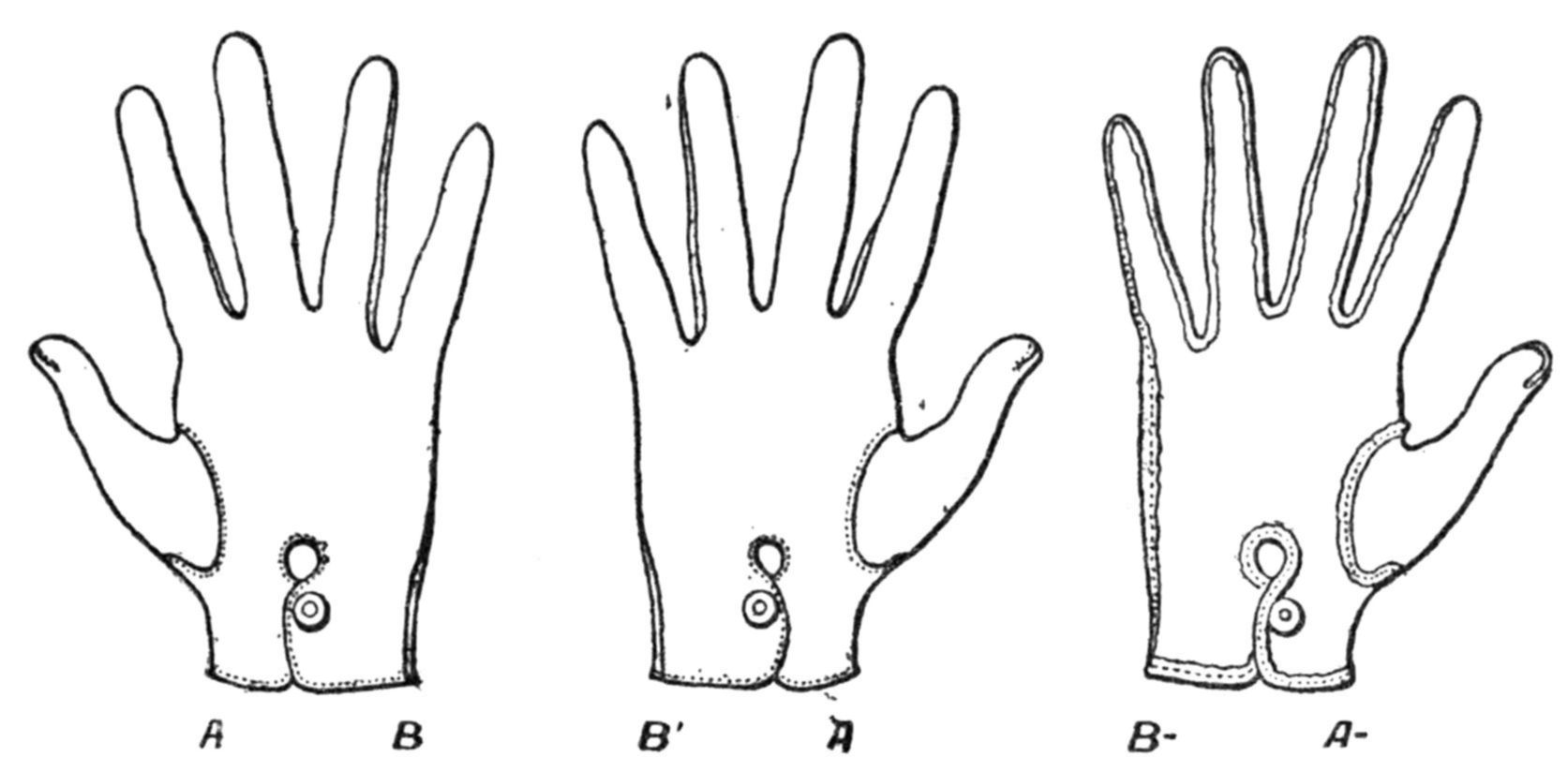
In space of three dimensions we cannot make a right hand glove and a left hand glove look the same no matter how we turn them around. But if we turn one glove inside out it will match the other except that the lining now appears on the outside.
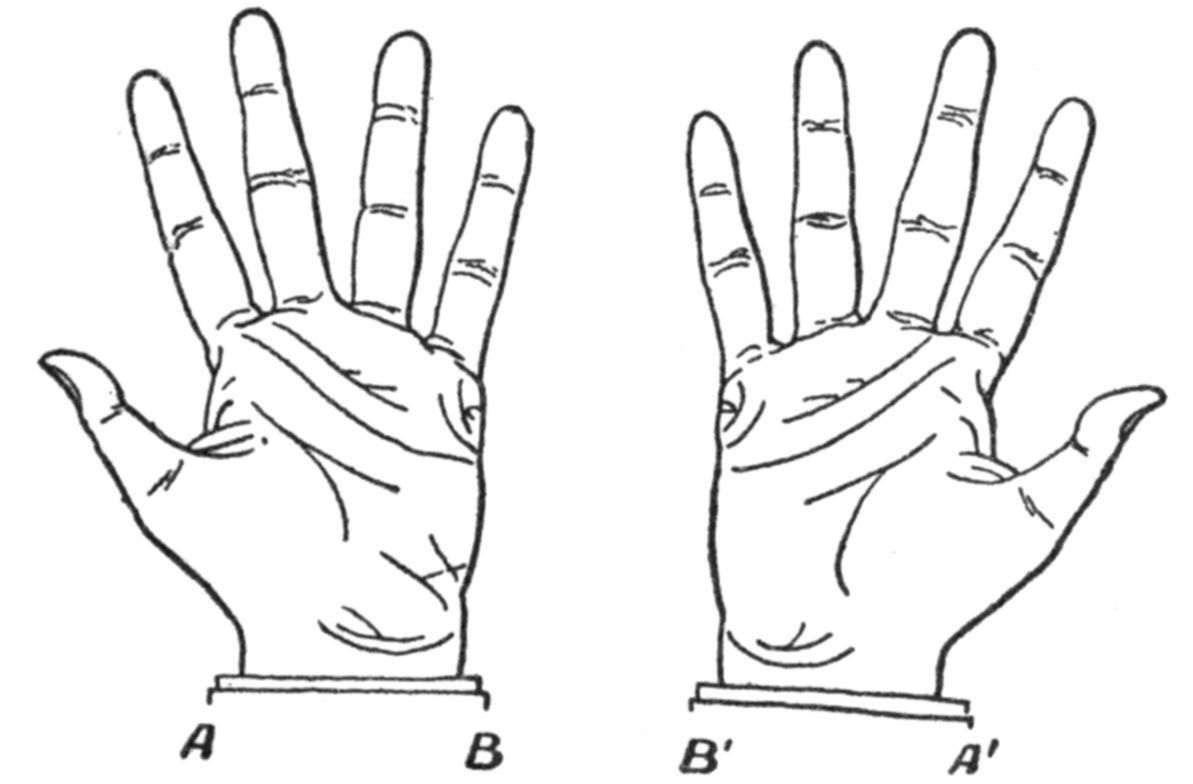
Our two hands cannot be turned inside out so as to look the same in three dimensions, though they might in four dimensions.
We can turn a glove inside out in three dimensions and so make it just like its mate of the other hand, but we cannot turn a solid inside out except in four-dimensional space.
In another of his “Thirty Strange Stories” Wells tells “The Story of Davidson’s Eyes.” While Davidson was working in his London laboratory a lightning shock so affected his eyesight that he could not see the familiar objects about him which he could feel but looked instead at a South Sea island on the opposite side of the globe. This might be possible in a curved space of four dimensions although Wells professes to pooh-pooh such an absurd suggestion while he ingeniously insinuates it. George Macdonald in his fantastic romance “Lilith” also introduces the fourth dimension.
Points that are far apart if measured in three dimensions may be close together in the fourth. We can readily understand this if time is the fourth dimension, for events can happen at the same instant though thousands of miles apart. But it is not impossible to conceive of the fourth dimension as spatial instead of temporal if we approach the problem from a simpler standpoint. Let us think of ourselves as living in a “Flatland” of two dimensions with no thought of a third. There yet survive in enlightened America individuals who believe that “the sun do move” and who deny that the earth is “round like a ball.” That is, they do not recognize the curvature of the earth in the third dimension. But if such an individual were to travel in a “straight” line westward over the “level” land and water he would, much to his surprise, come back to his starting point which he had left 25,000 miles behind him.
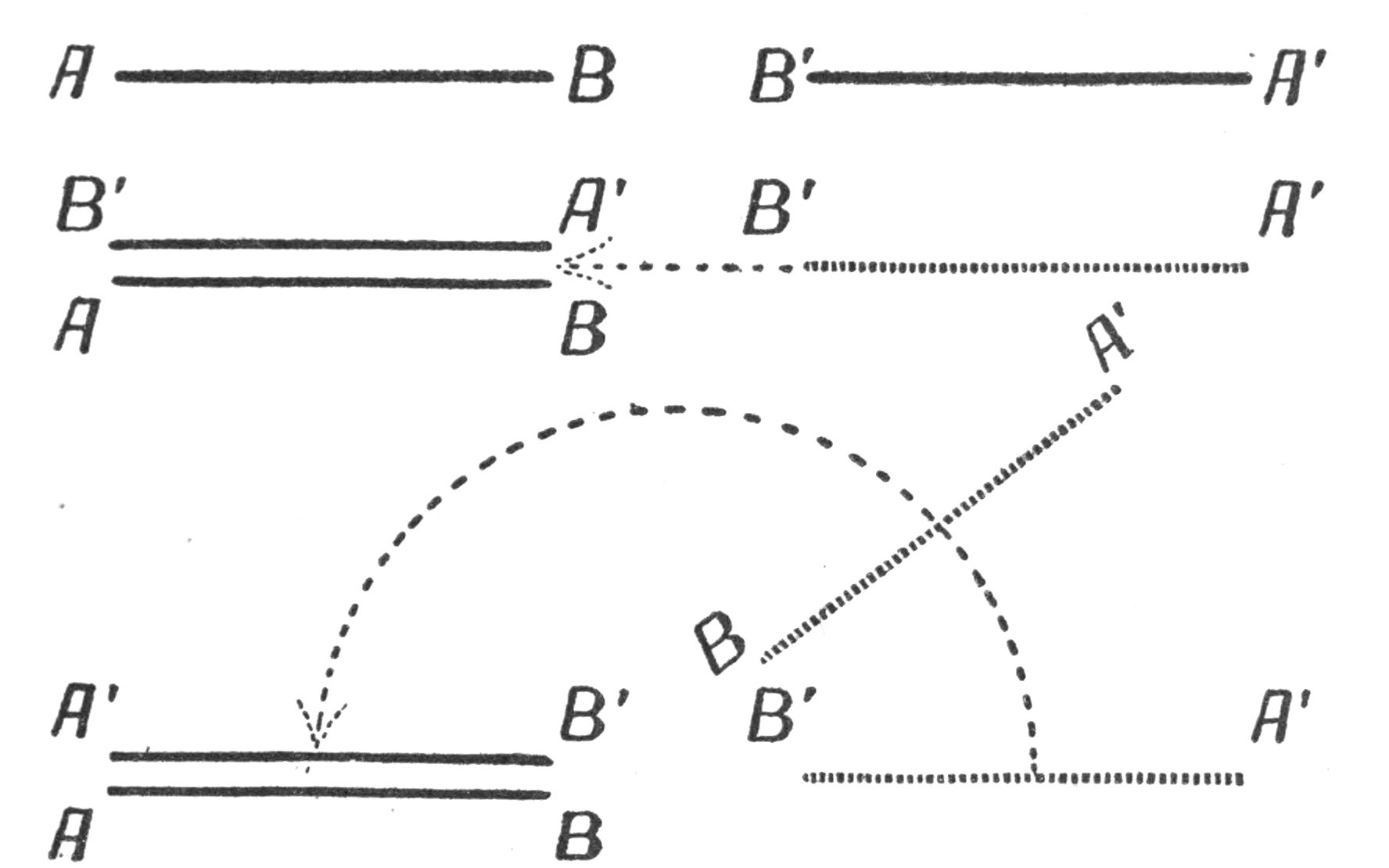
By movement in one dimension we cannot make the lines AB and B′A′ coincide for if we drag B′A′ straight on to AB the ends will not match. But if we swing B′A′ around through the second dimension we bring it on AB so the letters correspond.
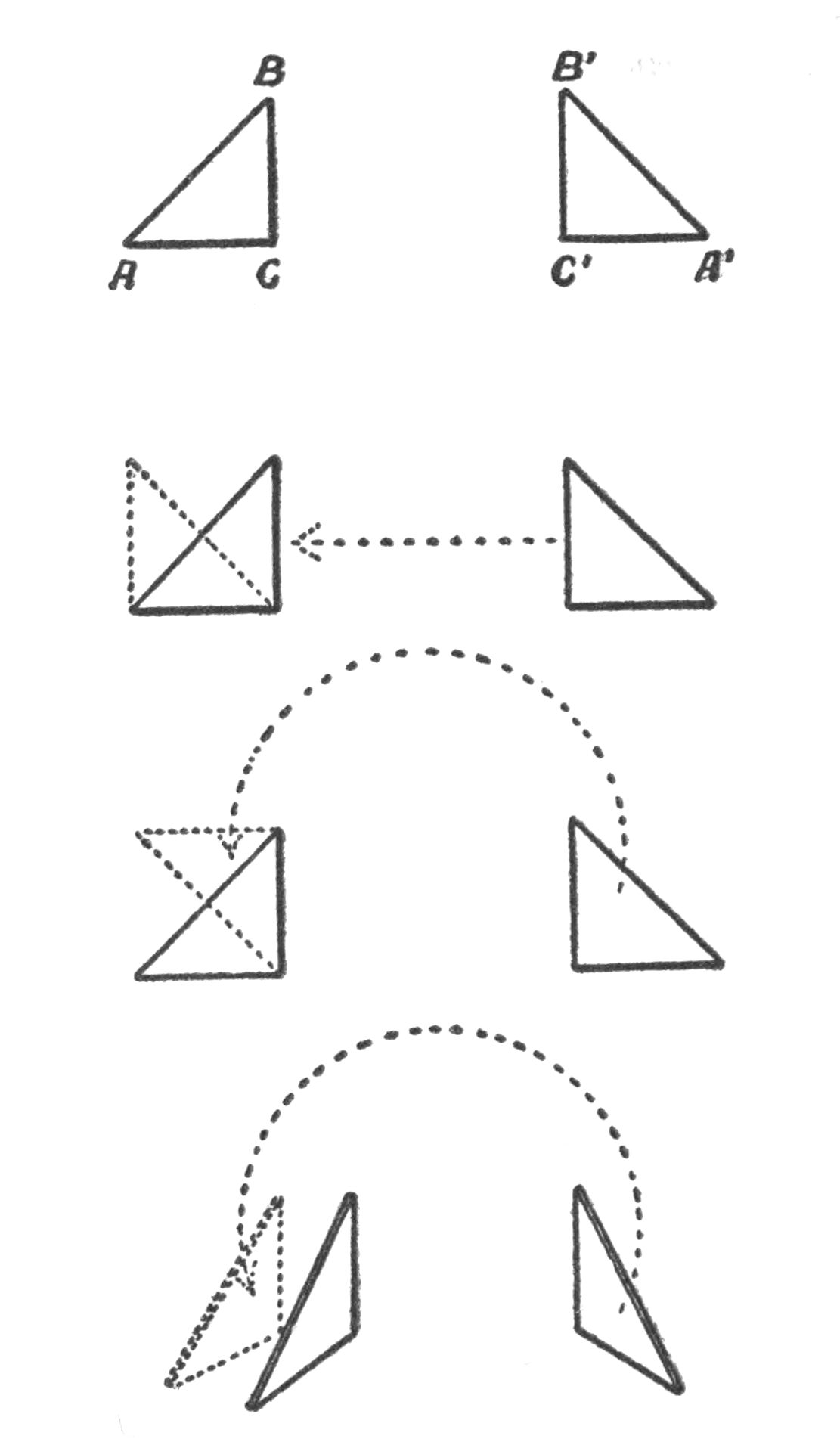
In space of two dimensions, such as a table top, we cannot bring these two triangles into the same position. If we drag one straight over on to the other (movement in one dimension) they will not fit together. If we swing one triangle around (movement in two dimensions) they still do not fit. But if we take one triangle off the table and turn it over (movement in the third dimension) we can then lay it by the side of the other and they will match perfectly.
A WORM’S-EYE VIEW OF THE WORLD
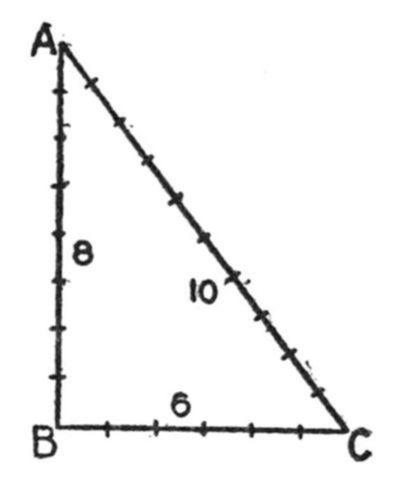
Suppose yourself a worm—the Bible says you are anyway—and crawling around on a sheet of paper. With your vermicular mind you doubtless would take a superficial view of the universe and find it as impossible to imagine a third dimension as man does a fourth. If in the course of your crawling you came across a triangle you might—if you were a measuring worm—pace it off and find that the distance from A to B was 8 inches, from B to C was 6 inches and from this data, if you knew the law of the hypothenuse, you might calculate that the distance from A to C was 10 inches. On measuring it you would find your prediction verified and so gain perfect confidence in your plane geometry. But unbeknownst to you, poor worm with your eyes fixed on the paper, some man may have picked up the sheet and crumpled it up or rolled it over so that A and C are only one inch apart—in the third dimension. The worm is right when he thinks the distance between these points is 10 inches: so is the man right when he says it is one inch. It depends on the point of view.
Now in Einstein’s view something of this sort happens to our three-dimensional space when matter gets into it. We know for instance that if you divide the circumference of any circle by the diameter the ratio figures out as 3.1415+. It has been calculated to 707 decimal places but we can dispense with the rest of them and call the whole thing Pi for short. Write it in Greek as π and it looks more learned. Now if you place a heavy particle, say a lead bullet, in the center of a circle the ratio of the diameter to the circumference, according to Einstein, becomes a little less than Pi, for the circle has been warped, so to speak, into the fourth dimension by the strain of gravitation. The difference in such a case is too small to be measurable by any known means, but it is supposed to be an actual, not an imaginary, deviation from the geometrical law.
Now the sun being a big heavy body must extend its gravitational strain for a considerable distance around and a ray of light passing through this crumpled up space would not be able to pursue a straight course. And, according to the eclipse observations, it does not. Light like everything else follows “the easiest way” and this is not always the straight and narrow path. A river takes the easiest, not the shortest, way to the sea and this leads it through many meanderings. Most of us, I suppose, have a mental image of Newton’s gravitation as a sort of rope by which the sun pulls the earth into its orbit when it is disposed to fly off on a tangent. But from Einstein’s viewpoint we should rather think of the earth as picking its way as best it can through a space-and-time combination that has been strained and distorted by the power of the sun. I visualize Einstein’s solar system as a spider web with the sun in the middle like the spider and the planets like flies trying to get around through the tangled strands. But it is more complicated than that for each planet has its own lesser web of radiating influence to drag about with it wherever it goes.
Newton’s idea is simpler, but unfortunately light at least seems to follow Einstein’s law, not Newton’s. That is why Einstein is such a troublesome fellow. If he would confine himself to metaphysical speculation nobody need bother about these strange notions of his. But when he points how they can be proved and then British astronomers and American physicists find things according to his deductions he cannot be ignored. The man does not seem to have that decent respect for the opinions of mankind that leads most of us to limit our logic to the sphere of common sense. When he gets an idea in his head he follows it wherever it leads him even though he bumps up against Euclid and Newton and the rest of us. For instance, if you admit the second of his two fundamental postulates, that the speed of light is constant, regardless of the velocity of its source, you are irresistibly led—unless you let go of his hand somewhere on the way—to the conclusion that time is a local affair; that there is no way of telling by light signals whether two clocks at a distance are keeping the same time, or whether two events at different places occur simultaneously. You could not tell this even if you could shoot a watch from one place to the other with the speed of light, for no matter how many seconds—or years—the watch might be on its way it would register the same time. If instead of a watch a man could travel at that speed he would not grow old on the way. According to Einstein no man, watch or any other material thing can travel with the speed of light, for it would require an infinite force to give the smallest particle such a velocity. But let us suppose that a hollow projectile holding a man, such as Jules Verne and Wells used on their voyages to the moon, should be sent off into space with a velocity one twenty-thousandth less than light. If at the end of a year the projectile should be caught like a comet by the gravitation of some star and be swung around and sent back to the earth, the man on stepping out of his shell would be two years older but he would find the world two hundred years older. This would be, as Professor Langevin suggests in Scientia, 1911, an interesting way to study history, but it would be risky, not to say impossible. Still French scientists, like Napoleon, have no place in their dictionaries for so stupid a word as “impossible” and M. Esnault-Pelterie has figured out that a thousand pounds of radium would be sufficient to carry a man to Venus in 35 hours if a hollow projectile could be fitted up like a rocket with the radium in the rear sending out a rapid fire of electrons.
TURNING TIME BACKWARD
To loosen up our conventional ideas of the fixity of time and space we may accept the aid of the scientific romancers. Camille Flammarion, the famous French astronomer, wrote a fantastic little book called “Lumen” which tells of a man who died in 1864. His soul flew straight to its heaven which was one of the planets of Capella, the largest star in the constellation Auriga. Here he found the benevolent inhabitants of that sphere, who were endowed with superhuman powers of sight, watching with great distress the bloody scenes of the French revolution of 1793, and wondering how it would come out. To the visitor from the earth this was an old story, to the people of Alpha Aurigae it was a present spectacle, for the distance of the star was such that it took light 72 years to travel from the earth, so they were 72 years belated in their observation of current events on our planet.
The spirit of the defunct Parisian, having the power of flying through empty space at any speed he chose, found that he had thereby also acquired control of time and could hasten, retard, stop or reverse the course of events at will by simply varying his speed. If he remained stationary, scenes on the earth would unfold at their normal rate and in regular order. If he traveled away from the earth with the speed of light everything seemed to stand still. If he traveled faster than light he overtook the rays that had left the earth farther and farther back in the past so he saw through them events in the reverse order. For instance when he looked down on Waterloo he saw the battlefield strewn with corpses and Napoleon walking toward Waterloo backward pushing his horse by the bridle. This is how the battle looked to the interspatial observer:
When my sight was sufficiently habituated to the scene, I perceived some soldiers coming to life out of the eternal night, and by a single effort standing up. The dead horses revived like the dead cavaliers, and the latter remounted them. As soon as two or three thousand men had returned to life, I saw them form unconsciously in line of battle. The two armies took their places fronting one another, and began to fight desperately with a fury that one might have taken for despair. As the combat deepened on both sides, the soldiers came to life more rapidly....
At each gap made by the cannon in the serried ranks a group of resuscitated dead filled up the gaps immediately. When the belligerents had spent the whole day in tearing one another to pieces with grape-shot, with cannons and bullets, with bayonets, sabers and swords—when the great battle was over, there was not a single person killed, no one was even wounded; even uniforms that before it were torn and in disorder were in good condition, the men were safe and sound, and the ranks in correct form. The two armies slowly withdrew from one another, as if the heat of the battle and all its fury had no other object than the restoration to life, amid the smoke of the combat, of the two hundred thousand corpses which had lain on the field a few hours before. What an exemplary and desirable battle it was!
Another literary curiosity on the same theme is “Ignis” by Comte Didier de Chousy. This tells of certain engineers who attempted to utilize the internal heat of the earth by running the waters of a lake into a deep boring. The result was an explosion that blew off a piece of the planet. But the passengers on this artificial asteroid on looking down through their well at the earth they had left could see the lake and city undisturbed and watch themselves at work as they were before the place blew up. The explanation was that this fragment of the earth was projected into space more rapidly than the speed of light and so was catching up with the rays that had gone out before the explosion; these rays, of course, carried the picture of earlier scenes. But Einstein would say that this story—as we might ourselves have suspected—must be fiction for according to his theory the speed of light is the absolute limit of motion, the infinity of velocity, which no material body may excel or attain. He does not, however, say anything about the possible speed of a disembodied spirit such as Flammarion employed in his imaginary exploration of space.
THE METAPHYSICS OF THE MOVIES
But from such fantasies we can see that the order in which we view events depends upon how fast and in what direction we are moving and that past and future may be reversed to our vision. This is easily made apparent by means of motion pictures. If the film is reeled off in the wrong direction the action is reversed. So we see divers rising gracefully out of the water and landing on the spring board. Newly hatched chickens, dismayed at the sight of this unfriendly world, calmly tuck themselves back into their broken shells which close in upon them. When we have come to the close of a perfect Thanksgiving Day the obliging operator may give us an encore of the dinner reversed by running his machine backward. Then we see pieces of turkey politely picked out of the mouths of the diners with their forks and replaced upon the plates. When these are passed back to the carver he puts the slices neatly in their places and the fowl is then sent back to the oven to be unroasted. The cook then sticks on the feathers. The hired man carries the turkey out to the chopping block where with one swift stroke he restores the head and the fowl runs off backwards. This is just as correct as the ordinary order. The sequence of events is the same. Cause and effect are linked together as firmly as before, only they have exchanged places. A scientist knowing nothing of our world except from watching such reversed motion pictures might deduce from them the same consistent and logical system of natural laws that we now have although some of them, for instance, the second law of thermo-dynamics, would be reversed in form.
The motion-picture man has also the power to alter the speed of the passage of time as he will by turning the crank faster or slower. Sometimes he is quite too careless in the way he employs this prerogative. If he is behind time on his schedule he will rush through a lazy siesta scene in a Mexican plaza with all the fury of a Mack Sennett farce. But this telescoping of time can be used to advantage as when he shows us the growth of a plant, the unfolding of its flower and the ripening of its fruit, all in fifteen minutes. On the other hand motion may be slowed up by taking twice as many pictures a minute as usual and projecting them at the ordinary rate. For instance, if it is a dog jumping up to grab a piece of meat from his master’s hand, we see the dog rise slowly from the ground and, while poised in mid-air, eye the meat carefully to select the best point of attack, then deliberately take it between his jaws and gradually descend. Now notice that this is just as true a picture of the dog’s jump as any other. The movie man has simply expanded time measurements as he expands space measurements when he shows us a close-up. A close-up with a face covering a sixteen-foot screen is just as true as a smaller picture. It is what we should always see if the lens of our eyes were a bit more convex. We look through the small end of an opera-glass and objects seem magnified. We look through the large end and objects seem minified. This is not an illusion. The opera-glass does actually enlarge or reduce what we see.
So, too, time intervals can be lengthened or shortened. Take a dose of hashish—no, don’t—I should say, if you did take a dose you would find that your perception of duration was prolonged. If while under the influence of the drug you drop a book it will seem an hour getting to the ground. De Quincey describes such experiences in his “Confessions of an Opium Eater.” But without entering into such abnormal states we all know by everyday experience how time flies or lags according to the number of our sensations. Bergson’s philosophy is built upon the distinction between the idea of duration as experienced by all of us and the idea of time as established by the physicists for comparative measurements.
We live in deeds not years; in thoughts not breaths; In feelings not in figures on a dial. —Festus.
For all we know an ephemeral insect that dies in a day may live a longer life than a Galapagos turtle that exists for two centuries.
What Mark Twain said about classical music applies also to science; “It is not so bad as it sounds.” The thing that the chemist calls “sodium chloride” other folks call “salt”—and so does he when he is off duty. Don’t let the scientist bluff you by his polysyllabic propensity. Just try to see what he means by such language. Now what these new-fashioned non-Euclidean geometricians call “the four-dimensional space-time continuum” is essentially the same system of reference as you have used ever since you could toddle. Minkowski did not invent it. Everybody thinks that way unless he is an idiot. Each one of us has had to build up his own philosophy of the universe long before we went to school, mostly before we could talk. We had to study geometry while we were in our cradles—worse than that we had to work out a practical system of geometry for ourselves without the help of Euclid or anyone else. We had to excogitate a system of relationship between the sights and sounds and touches that came to us before we could get along in the world. Probably we all solve this riddle of the universe in about the same way although since there is no way of directly comparing notes we cannot be sure about that.
THE EGOCENTRIC THEORY OF THE UNIVERSE
But the framework that we construct to hold everything outside of ourselves is essentially of the following form:
You are the center of your universe. Everything and every event that you are considering is related to you here and now. Starting from this, your point of place and time, you imagine eight straight lines stretching out toward infinity in eight directions as divergent as possible. These lines—call them destinations or directions or dimensions or coördinates as you please—consist of four opposing pairs, right and left, up and down, forward and back, future and past. Somewhere along or between these four dimensional lines that cross in your brain you can find a place for anything that you need; your pencil, the discovery of America, the sun and next Friday. You can connect up all these things by lines which may represent changes, that is the tracks of movements in space and time. To connect the pencil in your hand with the discovery of America you would have to count back 428 years on the time line and measure off on the east-west and north-south lines whatever distance you may be from San Salvador—not to consider the motion of the earth.
Anything that exists, that is to say, persists, is moving along the time dimension at what appears to be a uniform rate. Of course you can, if you like, conceive of time itself as a stream flowing through things. Since all motion is relative, that way of looking at it is just as “true” as the other. But it is simpler and more sensible to think of things moving through a stationary time just as we think of them moving through a stationary space. A material point that is at rest, such as the dot of an i on this page, (we continue to disregard the motion of the earth) is not moving about in space but is moving forward in time. Its track then is a straight line along the time dimension. That is, a material point is a line in the fourth dimension. If you move the page to the right the forward movement of the dot of the i in the time dimension is combined with the sideways motion in a single slanting line. If you move the page simultaneously upward, rightward and backward the track of the point is a line combining the movement in all four dimensions. Such a track of a point moving through space and time is called its “world-line.” It is a continuity of one dimension. Any event is the point of intersection of one or more such world lines and we can never observe anything except such intersections. That is to say, everything happens somewhere and sometime.
A picture flashed on a cinema screen has three dimensions. It is, say, 10 feet long and 6 feet high and lasts ¹⁄₁₆ of a second, but it has no thickness. A man necessarily has four dimensions. He may measure from 24 to 72 inches in one dimension, from 8 to 18 inches in the second, from 4 to 9 inches in the third and 70 years in the fourth.
After all, the idea of the relativity of time ought to be easier to accept than that of space for it is in accord with experience instead of contrary to it. We drop off to sleep and wake the next instant if we credit our personal perceptions. Why should we believe the sun and the clock in preference to ourselves?
Bergson bases his whole philosophy upon the distinction between duration as it is felt by the individual while he is living through it and time as it is employed by the physicist in his calculations. The latter conception, physical time, is, as Bergson says, a mere invention of man and virtually a fourth dimension of space, so he concludes:
To sum up; every demand for explanation in regard to freedom comes back, without our suspecting it, to the following question: “Can time be adequately represented by space?” To which we answer: Yes, if you are dealing with time flown; No, if you speak of time flowing.[1]
Past and future are alike to the physicist, differing only in direction, like east and west. But to the living person they are altogether different things. For man rolls up his past, as a tourist his rug, and carries it with him wherever he goes. That is why Wells’s “Time Machine” and the reversed reels of the movies are so funny. There is nothing absurd about running a wheel backward but there is about running a man backward.[2] The physicist feels no reluctance about turning the stream of time backward for all physical phenomena are reversible under the proper conditions. If we interpret the universe as merely matter in motion and imagine at a certain instant that every individual particle reverses its motion and goes in just the opposite direction at the same speed, then the whole history of the world would be reënacted in the opposite order and the earth would return to its primeval nebulæ.
In Wells’s story, “The New Accelerator,” a professor invents an elixir that speeds up the rate of living a thousandfold. A person taking a dose of it sees people as wax figures apparently motionless in the midst of violent action. Falling objects seem to stand still in the air. The music of a band is reduced to “a low-pitched, wheezy rattle” or “the slow muffled ticking of some monstrous clock.” But in compensation for this the accelerated drug-fiend could watch at leisure the slow flapping of a bee’s wings.
But even Wells with his seven-league-boots imagination finds it difficult to keep ahead of the march of science. What he then saw only with his mind’s eye we can actually observe. By moving the accelerating lever on your phonograph toward the S end of the scale you can slow up the tune and lower its pitch until it becomes inaudible as music. The new Pathé ultra-rapid camera can take pictures at the rate of 160 to the second. When these are projected on the screen at the usual rate of 16 to the second all movement takes place ten times slower than in actual life. This gives opportunity for the study in detail of the action of a ballplayer pitching a curve or of the wing motion of a humming bird or of the splash of a marble falling into water or of the flight of a bullet. We can magnify motion or minify it as much as we will. The cinematograph owes its origin the desire of Senator Leland Stanford to study the movement of a horse’s legs so as to find out why one racer went faster than another.
Such playful flights of the scientific imagination as Wells and Flammarion indulge in and such freaks of projection as the camera man amuses us with are of use to those of us who find difficulty in translating a mathematical formula into terms of everyday life. There is no better place to study metaphysics than in the world of the flickering screen, for there man has complete control of time and space. He can enlarge and reduce any object. He can hasten, retard or reverse any action. He can throw upon the screen at the same time events happening months and miles apart. Therefore to those of us who have had the advantage of an education in the movies, Einstein’s ideas of the relativity of time and space do not seem startling or inconceivable.
Kant not only conceived the possibility of more than three dimensions but believed in the probability of it. His argument is based on greater insight into the intentions of the Almighty than we of this day would claim:
“If it is possible that there be developments of other dimensions in space, it is also very probable that God has somewhere produced them. For His works have all the grandeur and variety that can possibly be conceived.”
In this temporal, spatial and material world of ours reality requires that the four dimensions should hang together. But at an infinite distance from all matter this fourfold combination would be dissolved into a three-dimensional space and a one-dimensional time. In that extra-mundane realm time ceases to flow, gravitation no longer drags downward, matter is non-existent, light is immovable and change is impossible.[3] Thus the new mathematics leads to a state curiously like the conventional conception of heaven.
We talk as our forefathers did about “the ends of the earth” but we know that one might start from his home and walk forever in any direction without coming to an end of it. But though the earth’s surface is infinite in the sense of endless, yet one never can get more than 8,000 miles away from home where’er he may roam. If a man stood on the top of the highest mountain on earth and aimed a level gun in any direction, the bullet, if it could be given sufficient velocity to counteract the influence of gravity, would go around the world and hit him in the back of the head. Or if light were sufficiently deflected by gravitation to follow a level line around the earth—another absurd assumption—the man looking through a level telescope in any direction could see how his hair was combed in the back. Such happenings, though impossible, are not inconceivable but are logical consequences of our knowledge that the world is round and that what we call straight or level lines as measured on plain or sea are really great circles around a center four thousand miles below.
Now is it not also conceivable that the lines we call straight in astronomical space may also have an imperceptible curvature in some unknown fourth dimension? If this curve is closed like the circumferences of the earth a ray of light pursuing a straight course in a certain direction might eventually return upon its track, even though not refracted or reflected by the matter it passes through or by. A telescope of unlimited power pointed into space at a tangent might then show the observer his own back, if light were transmitted instantaneously, but, since it is not and since the curvature of space, if there be any, is exceedingly minute, what the observer would see, assuming that the earth had come back to its former position, might be the scenes of some geological age millions of years ago.
NON-EUCLIDEAN GEOMETRY
The idea that space itself may be curved and that the axioms and assumptions on which our geometry since the time of Euclid have been based, may not be absolutely and exactly and eternally and universally true has been diligently studied during the last fifty years. The Russian Lobatchewsky, the Hungarian Bolyai and the German Riemann have developed systems of geometry by starting from premises the opposite of those of Euclid and these systems are just as logical and consistent with themselves as the ordinary or Euclidean geometry. These non-Euclidean geometries were at first commonly regarded as mere freaks of the mathematical imagination, but they have already proved valuable in leading to a reconsideration of the fundamental principles of our thinking and, if Einstein is right, they may be necessary to explain physical phenomena. It is hard for the mathematician to discover anything useless. A distinguished American mathematician in announcing a new theorem exclaimed: “And thank Heaven, no possible use can ever be found for it.” But, whatever it was, he made a rash boast for nowadays the mechanic treads on the heels of the mathematician and uses imaginary quantities, actual only in the fourth dimension, like √-1, in figuring out the winding of his dynamo.
Readers whose mathematical faculty is weak or undeveloped and who like something concrete with “human interest” in it will find what they want in “Flatland by A Square,” a book published in Boston in 1891. The author, who turned out to be the Reverend Edwin Abbott, tells of a land in only two dimensions. The ruling class consisted of polygons, the bourgeoisie of squares and equilateral triangles, the lower class of isosceles triangles of narrow base, while the criminals had more irregular forms and the women were mere needles. Since all were confined to a surface, four lines set in a square made a tight prison. The inhabitants of Flatland, even the aristocratic and intellectual individuals who had so many sides as to be almost circular, could not conceive of a third dimension from which a person like ourselves could look down and see at a glance the insides of their houses, their safes and their bodies just as a being in the fourth dimension could see the insides of ours. The narrator, that is, A Square of Flatland, visits as a missionary the land of two dimensions where all the people lie in a line and refuse to believe in anything outside it and finally he encounters and endeavors to convert a solitary point of no dimensions but finds him, as we should expect, an incorrigible solipsist.
We should all of us have been familiar with the fourth dimension for years if Slade had not turned out a trickster. Slade was an American medium—the original of Browning’s “Mr. Sludge”—who fooled Professor Zöllner by giving him what purported to be experimental evidence of the fourth dimension. Zöllner was a distinguished German physicist, Professor of Astronomy in the University of Leipzig, old, near-sighted, pre-disposed to spiritualism, and unskilled in legerdemain. Any proofs that Zöllner asked for, Slade was usually able at the next séance to produce. All the things that one might do in four dimensions but could not do in three were forthcoming by the obliging spirits whom Slade had at call.
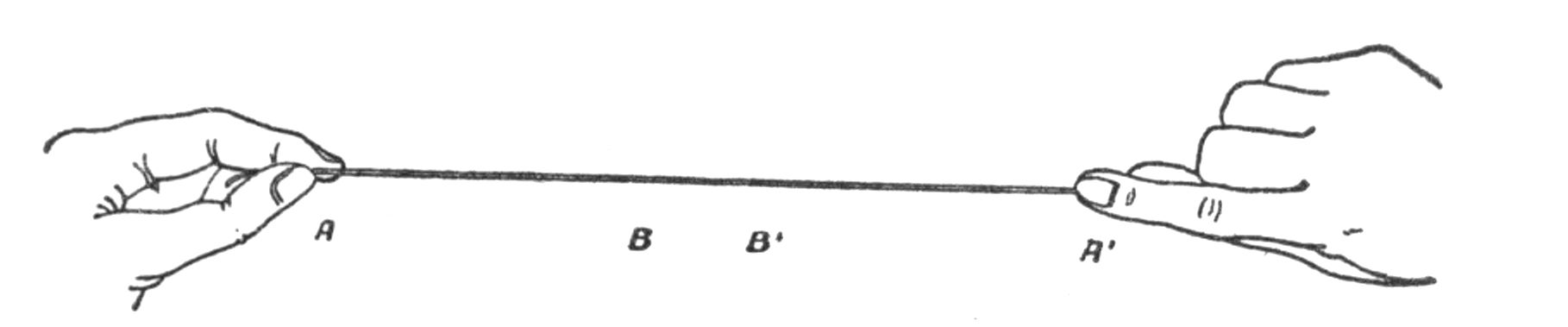
In space of one dimension (a straight line) there could be neither bend, loop nor knot in a string.
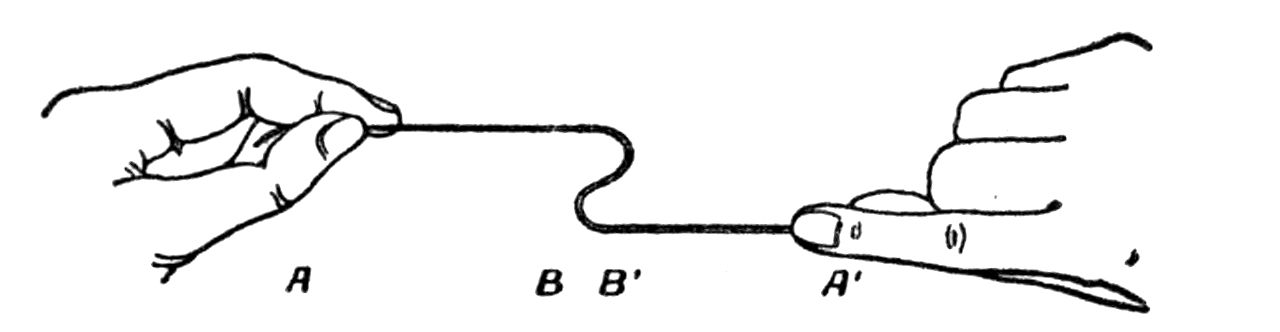
In space of two dimensions (a flat surface) a double bend could be made in the string but no loop or knot could be made.
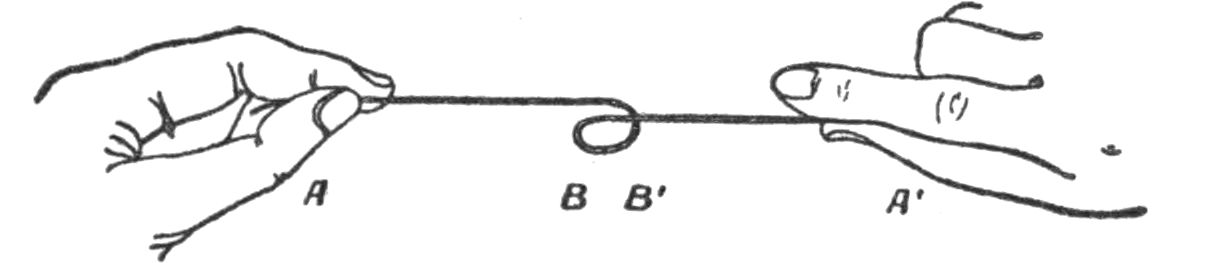
But if we raise one string (into the third dimension) and lay it over the other like this:
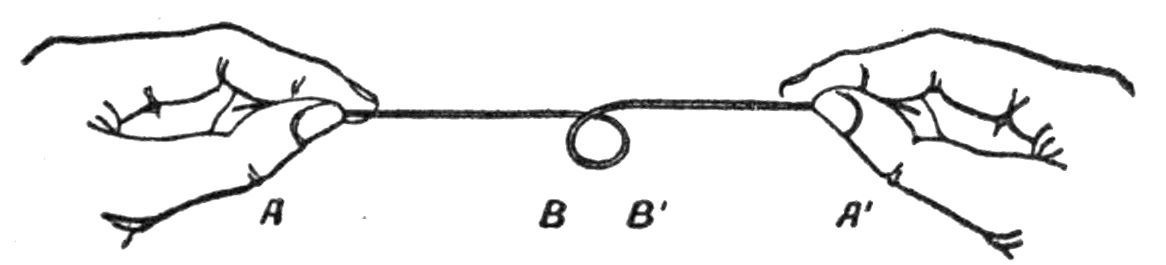
We get a loop but cannot form a knot without using the ends.
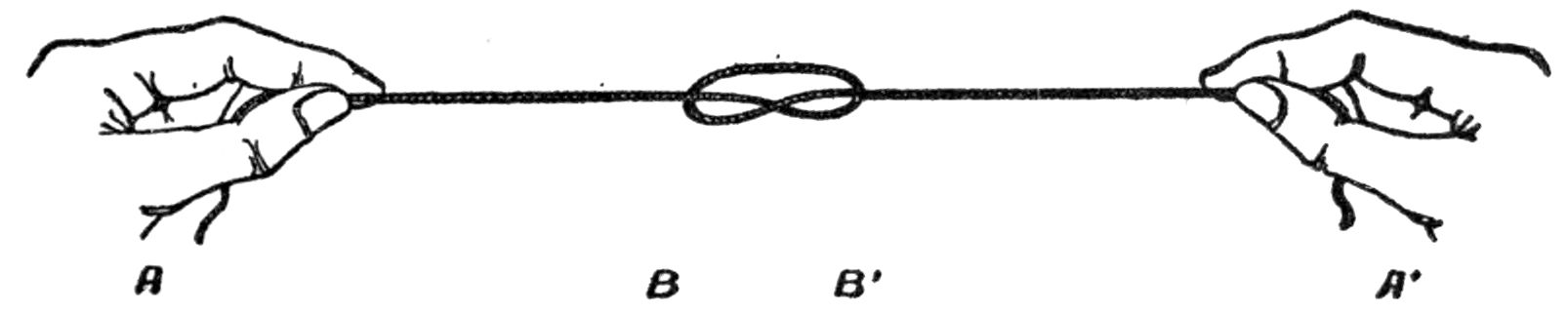
A knot like this cannot be made in a string so long as the ends are held by the hands. But if we could use a fourth dimension we could tie such a knot as easily as we made a bend by the use of the second dimension and a loop by the use of the third. If such a knot could be tied in a string so held it would be experimental evidence of the existence of four-dimensional space.
Zöllner tied the ends of a string together and sealed them on the table top, letting the loop hang down under the table out of sight. He then asked to have a single knot tied in the string and the spirits tied four. Zöllner also reports that the coins he put into a sealed box were taken out and writing produced inside sealed slates.
On the basis of these experiments Zöllner wrote a volume on “Transcendental Physics” to prove the existence of another world in the fourth dimension. But when Slade tried his tricks in London he was caught at them by Professor E. Ray Lankester. He was convicted of deception with intent to defraud in the Bow Street Police Court and sentenced to three months’ imprisonment with hard labor. Nowadays the apparatus for Slade’s famous slate-writing trick can be purchased at any conjurer’s shop.
It is vain to expect anything scientific to come out of the séance room where the alleged phenomena are not reproducible under specified conditions but appear only occasionally and under circumstances prescribed by the medium who always may be and often is proved to be a sleight-of-hand—or sleight-of-foot—performer. The fourth dimension which Einstein and other scientists are now considering is not conceived of as the abode of departed spirits, a spare room for ghostly visitants, but merely as a new factor in a mathematical formula. It offers us no hope of ever being able to take coin out of a closed safe or put coin into an unopened coconut but it does promise to explain certain optical phenomena which, though rare and minute, are yet open to the observation of anybody, be he skeptical or credulous.
SOME SIMPLE EXAMPLES
Lisbon lies nearly straight east of New York but when a ship captain wants to go to Lisbon he does not sail straight east but sets his course a little northward in the beginning and a little southward toward the end and so gets there quicker than if he had followed a line of latitude. Draw his course on a flat map and you would think he was taking a roundabout route, but trace it on a globe and you will see that he is following a great circle, the geodetic line, which is the shortest distance between any two points on the earth’s surface.
An airman looking down on a rocky, hilly, woody country sees it as a flat plain and if he watched a hunter returning home with his bag of game would wonder that he did not go straight instead of wandering around in such an irregular way. Yet the hunter, being tired, is taking what is for him the shortest way home as he dodges rocks and circumambulates the hills. The easiest way is the shortest way.
A river in its desire to reach the sea always takes the shortest possible way. Its meanderings are not meaningless but determined by a law as rigid as a law of geometry, that is, the law of gravitation which prevents the river from taking a short cut over the hill.
If you look at a landscape over a heated plain or bonfire or through uneven glass you will see that the image is distorted and confused because the rays of light are refracted and entangled as they pass through this unequal medium. Yet each ray is going just as straight as it can toward your eye.
Now to such familiar cases where a ray of light is bent out of its straight course by the uneven density of the air or glass through which it passes Einstein has added another and unsuspected effect, namely, that light is likewise deflected in passing through a strong gravitational field such as the vicinity of a large body like the sun.
It has long been known that the displacement of the earth in space and time (that is to say, its motion) causes an apparent displacement of the stars in space.
The astronomer does not point his telescope straight at a star. If he did, he would not see it, for, owing to the forward motion of the earth, the telescope moves out of range of the rays that otherwise would have reached it.
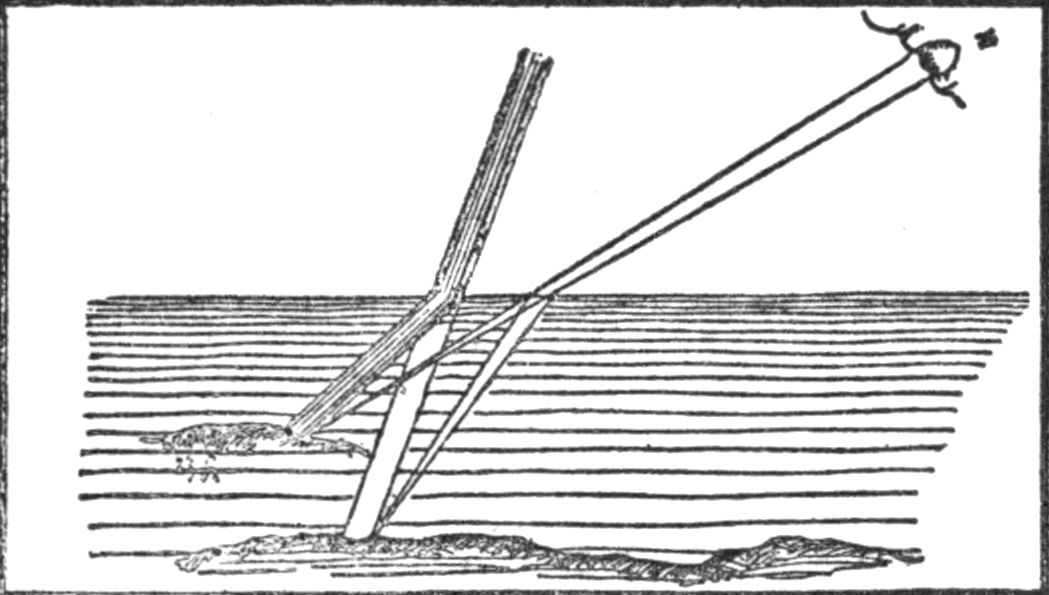
Everyone knows that a ray of light is bent out of its straight course as it passes from the air into a denser medium like water or glass, and that this deflection apparently shifts the position of the object from which the light comes. Einstein’s theory and the British eclipse observations prove, what was not known before, that a ray of light as it passes through the gravitational field of a large body like the sun, is also perceptibly bent out of its straight course and likewise makes an apparent shift in the position of its source, the star.—From Black & Davis’ “Practical Physics.” Published by The Macmillan Company.
If you have ever tried to shoot a bird on the wing, or, better, a prairie-dog from a train you will get the idea. Or, if you have not had this experience, you have doubtless watched the raindrops running down a car window and have noticed that when the rain is falling straight down the drops strike the pane on a slant when the car is moving forward. The faster the car moves the greater the deviation from the perpendicular. If the train runs backward the rain-streaks slant in the opposite direction. If then you should be asked to point out the direction of the cloud from which the rain is coming you would—unless you knew and made allowance for the movement of the train—point in a line with the streaks on the pane, sometimes backward, sometimes forward, but not straight upward where the raincloud really is.
Now the astronomer is on a moving train, the earth, which is rushing around a ring about 186,000,000 miles across. Consequently every star appears to wabble around in a little ellipse and the astronomer has to aim his telescope, now on one side, then on the other, of the real position of the star in order to bring it on the cross-hairs of his object glass. This apparent displacement of the stars is known as “the aberration of light” was explained by Fresnel in 1818—to everybody’s satisfaction until recently—on the assumption that all space is filled with an immovable medium, the ether, which transmits the rays of light in straight lines in the form of wave motion, and that the earth moves through the ether without displacing it, somewhat as an airplane moves through still air. But the aviator knows how fast he is moving by the current of air streaming back in his face. Why then, since the ether is in perfect repose, could we not determine the absolute motion of the earth through space by measuring the drift of the ether as it streams through the pores of the earth? Light appears to afford us a means of measuring such a drift of the ether through matter, if there be such. Since light is conveyed by the ether we should naturally expect it to take less time to travel a certain distance if the receiving instrument is carried toward the source of the light by the earth motion than if it is being carried away from it. This question was put to the crucial test by two American physicists, Michelson and Morley, who devised an instrument so delicate that it could detect differences of one-25,000,000th of an inch in the path of a light ray. But although this delicacy was ten times greater than was necessary to detect the ether drift, if there were any, no evidence of such drift could be discovered.
THE ECLIPSE OBSERVATIONS
In the history of science the year 1919 is likely to be known, not as the year of the overthrow of the German Empire, but as the year of the overthrow of Newton’s law of gravitation. The British astronomers who went to Africa to observe the eclipse of the sun May 29, 1919, came back with the proof that a ray of light passing close by the sun is bent out of its straight course. The photographs taken during the six minutes when the sun was shadowed show the surrounding stars in different positions from where they are seen when the sun’s disk is not in their midst. This is the second time that Einstein has scored over Newton. The first was in regard to the orbit of Mercury. If the sun and Mercury were alone in the universe the planet, according to Newton’s law, would revolve forever around the sun in the same elliptical track. But the presence of the other planets makes Mercury deviate from this regular route so the ellipse it describes is never quite the same but slowly shifts around so that in the course of centuries its longer diameter would be pointing in a different direction. Calculating by Newton’s law, the influence exerted by the other planets astronomers found that it would shift the orbit of Mercury 532 seconds of arc in a century. But when they took observations on Mercury they found that its orbit was shifting at the rate of 574 seconds. The discrepancy between observation and theory, 42 seconds, is thirty times greater than could be accounted for by errors of instruments or observation. But according to Einstein’s theory, if the sun and Mercury were alone in space with no other planets interfering, the orbit of Mercury would not remain the same, but would advance at the rate of 43 seconds a century. This, as the reader will observe, is in substantial agreement with the discrepancy which has for two centuries puzzled astronomers, since it was inexplicable on the Newtonian theory.
The electro-magnetic theory of light, thought out by Clerk Maxwell forty-five years ago, has proved to be an excellent guide to research and led to many practical applications, such as wireless telegraphy. According to this theory the miles-long Marconi waves, the infinitesimal waves that we feel as heat or see as light and the still more minute waves of the X-rays are movements of the same sort, though differing in length, and all travel at the same speed in space of 186,000 miles a second. It was one of the implications of Maxwell’s theory, though it was not perceived until later, that light and all such waves must exercise a certain pressure upon a body against which they strike, just as a jet of water from a fireman’s hose pushes against the side of a house. The pressure of light is so exceedingly slight that it had never been noticed, but it has been actually detected and measured by Professors E. F. Nichols of Yale and G. F. Hull of Dartmouth. The sunshine falls upon the earth with a force of 160 tons. Both theory and experiment have shown that a beam of light has inertia or mass, that is to say, a beam of light pushes like a water jet, and it has now been proved, by the eclipse expedition, that the pull of gravity deflects a beam of light as it does a water jet. That is to say, a beam of light has weight, is attracted by gravity. This deflection of a beam of light by gravity is extremely small, but photographs taken during the recent total eclipse of the sun show that star beams that passed near the sun are bent out of a straight path.
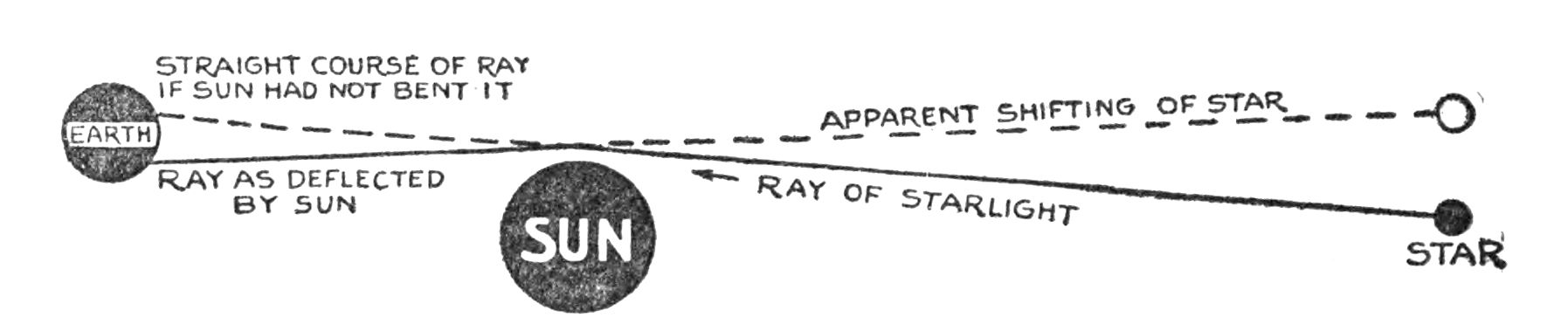
The eclipse expedition found that the stars seen about the sun appear slightly shifted from the positions they occupy on a map of the same region of the sky when the sun is not in their midst. This shows that a ray from a star is refracted or bent as it passes close to the sun and confirms Einstein’s theory that light is affected by gravitation. The observed angle of deflection agrees closely with that predicted by Einstein but is twice as great as that required by Newton’s theory of gravitation. In this diagram of course the angle of the deflected ray and the size of the sun and earth relative to distance are greatly exaggerated.
A better illustration of the eclipse observation than I could word is given by Sir Oliver Lodge in his interesting article on “The New Theory of Gravitation” in The Nineteenth Century of December, 1915, from which I therefore quote:
Take a fine silk thread of indefinite length, and stretch it straight over the surface of a smooth table or floor. Imagine a star at one end of the thread, and an eye at the other; and let the thread typify one of the rays of light emitted in all directions by the star, viz. the ray emitted in the direction of the observing eye.
Now take a halfpenny [or an American quarter,] place it on the table close to the thread, so that the eye end of the thread is ten feet away; and then push the halfpenny gently forward, till it has displaced the thread the barely perceptible amount of one thousandth of an inch. The eye looking along the thread will now see that the ray is no longer absolutely straight; in other words, the star whose apparent position is determined by that ray will appear slightly shifted. The scale is fixed by the size of the halfpenny, whose diameter, one inch, is used to represent the Sun’s diameter of 800,000 miles. The ten-foot distance between eye and Sun practically supposes that the eye is on the Earth, which would be a spot one hundredth of an inch in diameter, or about the size of this full stop.
As for the distance of the star, at the other far end of the thread, that does not matter in the least: but, on this scale, it may be interesting to note that one of the nearest stars, about eight light-years away, would require the thread to be a thousand miles long.
The ray is now bent or deflected as it passes the neighborhood of the Sun on its long journey, so that it is out of place one thousandth of an inch at a distance of ten feet; and the effect of this tilt of the ray, upon the observer, is to make him just able to see a star upon the Sun’s ‘limb’ when it is really behind it, or to make him see a star slightly further off the ‘limb’ or rim of the Sun than it really is. The shift of one thousandth of an inch at a distance of ten feet corresponds to an angle of one and three-quarter seconds of arc, which is just the optical shift that actually ought to occur, according to Einstein, when a ray from a star nearly grazes the Sun’s limb on its way to a telescope; and this is the optical shift which we now know does occur. That may be taken as the definite result of the recent eclipse observations. The effect, both in magnitude and direction, had been predicted four years before, on the strength of a mathematical investigation, by Professor Einstein.