Non-Alcoholic Drinks. (continued 2)
Reading edition
J. A.
Different Sorts of Coffee—Its Enemies—Its Composition and Treatment—Methods of Making—Adulterations—Liberian Coffee—Date Coffee and other Substitutes.
There are about twenty-two species of coffee, seven of them belonging to Asia, and fifteen to Africa, where it grows in districts widely apart, as in Angola and on the shores of the Victoria Nyanza; yet, although it is so widely disseminated, and comes from so many different places, it is getting commercially dearer without any present prospect of any reduction. Its value in the market is as follows—the first being the highest, and the last the lowest in price. Mocha, Jamaica, Ceylon, Honduras, Mysore, Costa Rica, Guatemala, Brazil, New Grenada, and divers East Indian growths; and its consumption per head in Europe, ranks thus: Holland, Denmark, Germany, Belgium, Norway, Switzerland, Sweden, France, Austria, Greece, Great Britain, Italy and Russia.
Unfortunately the coffee plant has its enemies, in the shape of two fungi which have devastated the plantations of Ceylon and Mysore, one the Hemileia Vastata, and the other the Pellicularia Kolerota, whilst an insect called the coffee bug (Lecanium Coffeæ) causes great destruction, as does also the coffee, or Golunda rat. Indeed, these enemies so prevailed in Ceylon as to render coffee growing not only unprofitable, but almost impossible, so the planters took to growing tea, with the good results which we have seen.
Raw coffee has very little scent, and a bitter taste, and no one would credit it with the delicious aroma which is developed—like the tea leaf—by roasting, an operation which increases the bulk of the berry, whilst diminishing its weight. Its commercial value is in proportion to its aroma; and it is found that, by keeping the raw berry, a chemical change takes place, which very much improves inferior qualities. But this aroma is extremely volatile, and ground coffee should be kept in scrupulously air-tight cases. Indeed, so fugitive is it, that coffee to be drank in perfection should be made from berries roasted freshly every day, as is frequently done in France.
Raw coffee contains an astringent acid, which does not stain iron black, like that of tea, but green; and it also embodies Theine, or, as it is called when applied to coffee, Caffeine. This alkaloid does not exist in large quantities as in tea, i.e., the drinker of an equal number of cups of both beverages would have less of the alkaloid if coffee was drunk.
The berries, when roasted, and their flavour developed, are ground—coarse or fine according to taste, and are then ready to be made into a drink. It is here, in conjunction with the use of stale, and consequently, tasteless coffee, that we, in England, go to grief. Of coffee-making machines there are numbers; but if pure coffee is used, they might as well be dispensed with, whilst they are almost necessary if the coffee is adulterated. Another thing that our English housekeepers do not understand is, that coffee, in order to be productive of a good result, should be used large-handedly and generously, and not according to the time-honoured, grandmotherly, but parsimonious method applied to tea, of a teaspoonful for each person and one for the pot. The allowance of freshly ground coffee should be from 1½ to 2 oz. per pint of water, and any less does not make coffee, but only “water bewitched.”
With this quantity excellent coffee can be made without the aid of any machine. Warm the coffee pot, or jug, put in the coffee, and then add the water, which, as with tea, should just have come to the boil, and after standing a little time, the coffee is fit to drink. If the coffee is boiled, the extremely volatile aroma is dissipated, and its exquisite flavour lost.
But a good way of making coffee is to make it over night. Put the coffee in a jug, and pour cold water on it. The lighter particles soon get soaked and fall to the bottom. In the morning it has only to be warmed until it just boils, when it should be strained and served at once. This only applies to pure coffee.
There are too many adulterants used, and what “French Coffee” and “Coffee as in France” is made of, the Lord and their manufacturers only know. The chief of these offenders in England is the root of the succory, chicory, or wild endive (Cichorium Intybus), which, originally wild, is now extensively cultivated in England; whilst on the Continent it is very largely grown in France, Germany, Belgium, and Holland, and both home-grown and foreign chicory are largely in our market, the latter fetching the higher price. It does not taste like coffee, nor has it any aroma; but, when roasted, it gives a dark colour to water, and a bitter taste, as if a great deal of coffee had been used; and for this purpose it must have been first used in the old coffee-houses. But it is a question whether you buy pure roasted and ground chicory. In Germany it is adulterated largely with turnips and carrots, whilst Venetian red is used to give it a colour.
Notice has already been made of the different kinds of coffee, but not the West African species—the Liberian coffee (Coffea Liberica)—which has not, as yet, come into common use in England. There are many substitutes for coffee, one of which developed a few years since into a large commercial undertaking, but eventually collapsed. It was Date Coffee, made out of date stones roasted and ground. Among other substances used in lieu of coffee, are the roasted seeds of the yellow water-lily (Iris pseudocorus); the seeds of a Goumelia, called in Turkey Keuguel; roasted acorns and beans, chick peas, rye and other grains, nuts, almonds, and dandelion roots (Leontodon taraxacum), whilst in Africa many berries are used in its stead.
J. A.
COCOA.
Where Cocoa is Grown—Its Manufacture—Its Use Abroad and in England—Cocoa as a Drink—Chocolate, Edible and Otherwise—Substitutes for Cocoa.
Linnæus was so fond of the drink made from the seeds of this plant that he gave it the name of Cacao Theobroma, or “Food of the Gods.”
As a drink it cannot be classed among the infusions, like tea, nor is it roasted and ground to powder like coffee; but the seeds are crushed and mealed in a mill, and from this oily meal is made the thin gruel which we drink as cocoa.
It seems to have been originally a native of Mexico, and is now cultivated there, in Honduras, Guatemala, Nicaragua, Brazil, Peru, Ecuador, New Granada, Venezuela, Guiana, and most of the West India Islands. Commercially the different sorts rank in value as follow: Trinidad, Caraccas, Grenada, Guayaquil, Surinam, Bahia, Ceylon, and British West Indies.
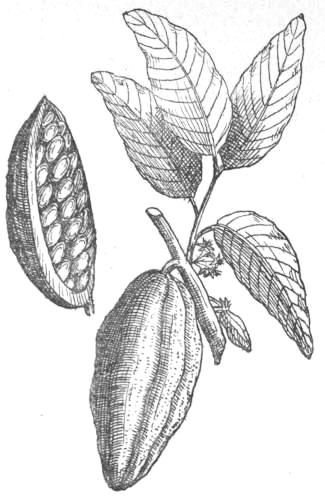
It grows, as we see in the illustration, somewhat like a melon, which contains some fifty or more seeds, in rows embedded in a spongy substance, from which the seeds are cleansed and then dried in the sun, when it becomes brittle and of a dark colour internally, eating like an oily nut, but with a decidedly bitter and somewhat astringent taste. To render it fit for food, it is gently roasted to develop the aroma, allowed to cool, deprived of its husk, and then crushed into small fragments called cocoa nibs, which is the purest form in which it is used, but also the one which entails the greatest trouble in making a drink therefrom. The granulated, rock, flake, and soluble cocoas are made by the beans being ground into a paste in a rolling mill; starch, flour, sugar, and other ingredients being used, according to the taste of different manufacturers.
It was used by the Mexicans and Peruvians before their conquest by the Spaniards, and formed an article of barter among them. Columbus brought a knowledge of it to Europe; but those were not the days of non-alcoholic drinks, and it was some time before it came into vogue. Naturally, first of all in Spain, and to this day Spain is the greatest European consumer of cocoa in some shape or other. It was introduced into England about the same time as tea and coffee, but the chocolate houses, pure and simple, as such, were very few compared to the coffee houses. It was taxed as a drink by the same Acts as tea, and paid the same duty. In the eighteenth century it became a fashionable morning drink, especially for ladies, and is perpetually alluded to by the essayists; but it was so expensive as to be only a drink for the upper classes.
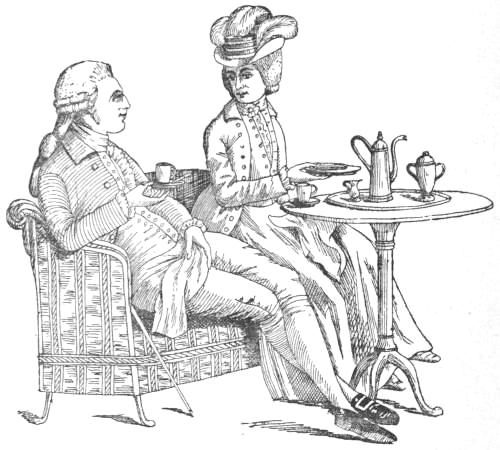
CHOCOLATE DRINKING.
Cocoa as a drink is far more nutritious than either tea or coffee, and like those two substances it has a volatile oil which gives the delicious aroma, and an active principle resembling Theine or Caffeine—but not identical with them—called Theobromine. It has no tannic acid, but it has what the other two do not possess, it has a peculiar fatty matter, known as cocoa butter, which sometimes amounts to half the contents of the seed. It is this excess of fat which renders it liable to disagree with some susceptible stomachs, but the mixture of farinaceous matter and sugar tend in a great measure to obviate this inconvenience.
In another method of manufacture it is known as Chocolate, which is simply the cocoa bean ground and flavoured with sugar, vanilla, almonds, cinnamon, or what not, according to taste. It is in a dry form the most popular of sweetmeats, although the adulterations practised by low class firms, in order to sell a cheap article, are many, owing to its high price; yet the goods of first-rate firms like Menier, Fry, Cadbury, and others, may be taken without suspicion, and are—good!!!
There are pseudo cocoas, as there are pseudo coffees and teas. The Guarana, or Brazilian Cocoa (Paullina sorbilis); a ground nut, the Arachis hypogeia, used in South Carolina, Angola, and elsewhere; the Cyperus esculentus, or earth chestnut, in Spain, are the chief substitutes; but it is needless to say that none compare with the Theobroma. Alas! that it should be adulterated.
J. A.
AËRATED DRINKS.
Ginger Beer—Old and New Methods of Manufacture—Lemonade—Chemicals in Non-Alcoholic Drinks—Fruit Syrups—Non-Alcoholic Cordials and Liquors—Natural Mineral Waters—Their Constituents—Artificial Aërated Waters—Their Introduction into England—Manufacture.
Popular among non-intoxicant drinks is the homely Ginger Beer, so dearly beloved of thirsty holiday makers and small children; dear also to the boating man in connection with good ale, as “Shandy-gaff.” And the stone bottle, in which it used generally to be encased, is familiar to every reader. We say, advisedly, used, because now-a-days it is also put up in glass bottles; nay, it is sold in casks, like beer, to the publicans and others. The probability is that, in the old days, its somewhat murky colour would not bear inspection through bright glass. The old ginger beer, whose flavour cannot be approached by the modern decoctions, was made of Jamaica ginger macerated in water, with the addition of lemon juice and sugar. It was allowed to ferment, and possessed decided traces of alcohol. It was made after this fashion:—
Take 1 ounce of best Jamaica ginger, and crush thoroughly with a hammer or suitable crushing machine; boil gently for about an hour in about a quart of water, then add 1 lb. of best loaf sugar, and make up to a gallon with hot water; stir until all is dissolved. Add a small quantity of the soluble essence of lemon, and gum extract, the quantity to be regulated to taste of the maker. Then stir in ¼ ounce of tartaric acid, and, if required for quick fermentation, a very small quantity of yeast. The beer should fine down perfectly clear, and should then be bottled. In from one to three weeks time it is ready for drinking, and should keep good about six months.
This was the old fashion—now for the new.[146]
Plain Syrup, from 56° to 60° T.[147] 3 quarts
Boiling Water 1 quart
Oil of Lemon 24 minims
Acetic Acid 4 fluid ounces
Ginger Tincture (21, 22, or 23), Q.S.[148]
Use 1 to 1½ ounce of the flavoured spirit to each bottle.
First incorporate the lemon oil with 1 quart of the thick syrup. (If the oil contains a large proportion of insoluble matter, it may be well to use rather less than 1 quart of syrup in the first place.) Then add the boiling water, and, after that, the remaining syrup; taking care to keep the mixture constantly agitated during the process.
Lastly, add the acid, and ginger tincture according to taste, or the requirements of the public analyst.
By adding boiling syrup instead of boiling water to the mixture of plain syrup and oil of lemon, and subsequently adding the required quantity of cold water, the whole operation will be brought more thoroughly under control, and a larger proportion of oil may be employed without waste. With some samples of the oil, it may be necessary to heat a larger portion of the syrup; but the oil should always be mixed with cold, thick syrup in the first place, unless a perfectly close, air-tight vessel is provided for mixing; in this case, hot, thick syrup may be poured on the oil, cold water being subsequently added to give the requisite density.
When it is required to incorporate a maximum quantity of lemon oil with the syrup, it should first be whisked into the whole of the thick syrup cold; the flavoured syrup should then be carefully heated by means of a steam jacket, or other convenient arrangement, until the suspended oil is reduced to a state of solution. The syrup will then be transparent. Let it be cooled again as quickly as possible.
Gingerade.
Plain Syrup, 42° T.[149] 1 gallon
Ginger Tincture (No. 21 or 22) 4 fluid ounces
Acetic Acid 4 ”
Bitter Orange Tincture, Q.S.
Use 1 to 1½ ounce of flavoured syrup to each bottle.
Ginger Ale is a beverage supposed to beguile the artless teetotaller into an idea that he is doing something naughty, or at all events, placing himself on the very verge of tampering with the accursed thing “Beer.” Hence its name, but what a difference in the two drinks! Here are two receipts for making
Ginger Ale.
Plain Syrup, 42° T. 1 gallon
Comp. Ginger Tincture (No. 23) 4 fluid ounces
Acetic Acid 4 ”
Sugar Colouring ½ ”
Or
Plain Syrup, 42° T. 1 gallon
Ginger Tincture (No. 21 or 22) 4 fluid ounces
Capsicum Tincture (No. 24) 1 ”
Sugar Colouring ½ ”
Use 1 to 1½ ounce of flavoured syrup to each bottle.
If desired, the bouquet may be enriched by the use of one or more of the following ingredients:—
Essence of Vanilla 3 drams (180 minims) per gallon
Butyric Ether 4 minims ”
Otto of Roses ⅓ ” ”
Half an ounce of Spanish liquorice to the gallon will considerably improve the flavour.
Lemonade.
Plain Syrup, 42° T. 1 gallon
Lemon Tincture (No. 19) 4 fluid ounces
Acetic Acid 4 to 5 ”
Use 1½ ounce of flavoured syrup to each bottle.
When lemonade is required specially for medicinal purposes, and is sold expressly as a genuine fruit preparation, citric acid should be employed instead of acetic. In that case dissolve 1 lb. of citric acid in a pint of boiling water, and use 4 fluid ounces of the clear solution to each gallon of syrup.
Some manufacturers have attained a high reputation for their lemonade by adding a small quantity of Neroli[150] to the ordinary syrup. This, if judiciously used, will doubtless be deemed an improvement by connoisseurs generally, provided they are kept in ignorance of the substance employed; but a still greater improvement is produced by adding about 1 fluid ounce of good orange flower water to each gallon of syrup.
In the next beverage we are perilously tempting the fiend Alcohol, although it ranks as a Temperance drink.
Champagne Cyder.
Plain Syrup, 42° T. 1 gallon
Butyrate of Ethyl[151] 4 minims
Acetate of Amyl[152] 4 ”
Nitrate of Amyl 2 ”
Acetic Acid 4 or 5 fluid ounces
Sugar Colouring 1 ”
Use 1 to 1½ fluid ounces of this syrup to each bottle.
But here is a direction which plainly shows the cloven hoof.
“The Ethyl and Amyl compounds are conveniently used by mixing them separately in the first place with nine times their bulk of Alcohol, or strong rectified spirit, adding these mixtures to the Acetic Acid, and this in turn to the syrup.”
At every turn, in all these drinks, are chemicals used. Do you want the flavour of the luscious Jargonelle pear? hey, presto! There it is for you in a spirituous solution of Acetate of Amyl, made by distilling potato spirit with Oil of Vitrol and Acetate of Potash, at least this gives a fine fruity flavour, but to bring out the true Jargonelle taste it must be mixed with six times its bulk of spirits of wine (Mem. for Teetotallers). The taste of apples can be counterfeited by mixing Amylic Ether (potato ether) and Valerianic Acid, which latter is made by substituting Bichromate of Potash for Acetate of Potash, and largely added Alcohol. The delicious aroma of the Pine-apple is made from Butyric Acid, mixed with ordinary ether, and dissolved in Alcohol. Indeed with compounds of the Ethyls, Methyls, and Amyls, all the bouquets contained in wines or spirits can be obtained.[153]
Does your chemical compound look flat and dull when poured out? lo! you can produce a “head,” or froth, made out of isinglass, gum arabic, gelatine, white of egg, Irish moss, or soapwort. The latter gives an excellent head; but as these frothing mixtures detract from the keeping of the chemical drink, yet another chemical has to be used as an antiseptic, and Salicylic Acid, made from Carbolic Acid, is recommended. Do you want to colour your decoctions? There is a wide range of tints for you to choose from, from the harmless burnt sugar to the Acetate of Rosaniline, or Aniline Magenta, of which 1/30th of a grain will colour a bottleful, a beautiful red.
For the fruit syrups, fruits are very often used, but of course not necessarily. Even milk is not sacred from the chemist. Here are two recipes for making Cream Syrup:—
No. 1.
Fresh Cream ½ pint
Fresh Milk ½ ”
Powdered Sugar 1 pound
Another formula:—
No. 2.
Oil of Sweet Almonds 2 ounces
Powdered Gum Arabic 2 ”
Water 4 ”
Make an emulsion, and add simple syrup to make up 2 pints, and there you are, thoroughly independent of the cow!
In these syrupy mixtures the Americans run riot, and a few years since many shops, notably druggists, sold strange and curious frothing mixtures; but there was no call for them in the winter, and they died out as suddenly as they were introduced. The following is a fair list of syrups, some of which, however, are decidedly exciseable. Ambrosia, Apple, Apricot, Banana, Blackberry, Brandy, Capillaire, Cherry, Chocolate, Citron, Clove, Coffee, Cream, Curaçoa, Currant (black or red), Ginger, Grape, Groseille, Gum, Lemon, Limes, Mulberry, Nectar, Nectarine, Noyeau, Orange (bitter), Orange (sweet), Orange (Tangerine), Orgeat, Peach, Pear, Peppermint, Pine-apple, Plum, Quince, Raspberry, Roses, Sarsaparilla, Sherbet, Strawberry, Vanilla, Violets.
And here is a list of Non-Alcoholic Cordials and Liqueurs (non-exciseable), it is said; but if so, they must be fearfully and wonderfully made. Anisette, Bitters, Caraway, Cherry Brandy, Clove, Curaçoa, Elderette, Fettle, Ginger Brandy, Ginger Cordial, Ginger Gin, Ginger Punch, Gingerette, Lemon Punch, Lime Fruit, Nectar Punch, Noyeau, Orange Bitters, Orange Gin, Peppermint, Pepper Punch, Pick-me-up, Raspberry, Raspberry Punch, Rum Punch, Rum Shrub, Sarsaparilla, Shrub, Spiced Ale, Strawberry, Tangerine, Tonic, Winter Punch.
But enough of these chemical concoctions of man; let us go to Nature, and see what she turns out of her laboratory. Most marvellous combinations of Minerals, Acids, Gases, and Water. Among the Minerals may be named Alumina, Arsenic, Barium, Boron, Bromine, Cæsium, Calcium, Copper, Fluorine, Iodine, Iron, Lithium, Magnesium, Manganese, Phosphorus, Potassium, Rubidium, Silicon, Sodium, Strontium, Sulphur, Zinc, etc. And of Gases we have Ammonia, Carbonic Acid, Hydrogen, Hydro-Sulphuric, Nitrogen, and Oxygen. These materials are mixed in very varying amounts, and from very valuable medical agencies, from the purgative Friedrichshall, to the nauseous Harrogate. But all are not nasty: some are just sufficiently alkaline to be tasty, and, having a briskness imparted to them either naturally, or otherwise, by carbonic acid, make pleasant drinks for table.
These simple waters are abundant on the Continent. In Germany we have the well-known Apollinaris, Selters, Landskro, Brückenau, Roisdorf, Gieshübel, and Heppingen, whilst in France there are those of St. Galmier, Chateldon, and Pougues, besides some in Italy and many in America.
These, especially the medical waters, are imported into England; but mineral waters are largely manufactured. By mineral waters I do not mean the aërated waters we drink under the names of Soda, and Seltzer, but the medicinal waters.
The effervescing, or aërated waters, which are now so much used all over the civilized world, were first made on a large commercial scale by the firm of J. Schweppe, of Geneva (a name very well known in England, in connection with the manufacture), in 1789; and ten years afterwards, his partner, Mr. N. Paul (whose name yet survives in the firm Paul & Burrows, St. George’s Road, S.E.), established an Aërated Water Factory in England. It is somewhat curious how the names last in this trade, for in 1799 a Mr. Thwaites established a factory in Dublin, and the firm still remains as A. & R. Thwaites & Co.
Since its introduction, aërated water has much improved, especially the universal soda water, which is simply ordinary water charged with carbonic acid gas. Vastly improved machinery has been introduced, cleanliness and purity of materials are specially looked after, and the bottles and vessels for holding it wonderfully improved. We have not, in England, taken so kindly to the syphon as they have abroad; but the cork in the bottle has been nearly entirely done away with, and we are no longer compelled to pay for, if we could not drink, the large bottle, which at one time bid fair to be perennial; but which has almost succumbed to its younger brother the “Small” Soda. Year by year, through competition and vastly increased consumption, aërated waters are getting cheaper, and consequently more used.
The ordinary soda water of commerce contains no soda,—it is made by the absorption, under pressure, of carbonic acid gas, which is generally obtained from chalk or whitening, and sulphuric acid, which makes as good a gas for commercial purposes as if it were produced from the purest Carrara marble.
The number of chemical teetotal drinks is legion. They are all calculated according to their concocter’s reports, to make the drinker healthier and wiser; nay, even to provide him with extra brain power, as did the vaunted Zoedone, which contained phosphates and iron. They have their little day, and another nostrum takes their place. It has, hitherto, always been so, and probably will continue, only intensified, to the end of time.
J. A.
MILK.
First Food of all Mammals—Skim and Butter Milk—Chemicals used in its Preservation—Condensed Milk—Syllabubs—Koumiss—Its Early Use—When first utilized in Medical Treatment—Koumiss from Cows’ Milk—Methods of Manufacture—Intoxicating Drinks made from Milk.
Milk is the first liquid food taken by man, in common with all mammals, after his birth; and this liquid is so happily ordered, as to contain all the elements of food necessary for him, at this period of his existence. The new-born mammal naturally, and directly after its birth, seeks the fountain of its nourishment, and even that most helpless of all created beings, a baby, is soon taught where to seek its food.
But we have to consider milk as a beverage, more than as a food, and, as a drink, it is comparatively a failure, as to most people it is indigestible, if taken in any quantity. It may, however, be taken with comparative impunity as skim milk, i.e. when deprived to a very large extent of its fat, and of a hot day, for a perfect thirst quencher, let us commend slightly acidulated butter milk. Milk has very great disadvantages as a beverage: first, that it will not keep good any time, unless chemicalized by salicylic acid, borax, liquor potassæ, or some other bedevilment, except as condensed milk, which is milk with much of its water evaporated, and sugar added. This, however good it may be as a substitute for fresh cow’s milk, where such is not attainable, can hardly be called a drink. Secondly, milk, in common with all fatty animal substances, has a tendency to absorb any odour which may come in contact with it, and is a ready vehicle for the seeds of disease, especially the microbes of fever or cholera.
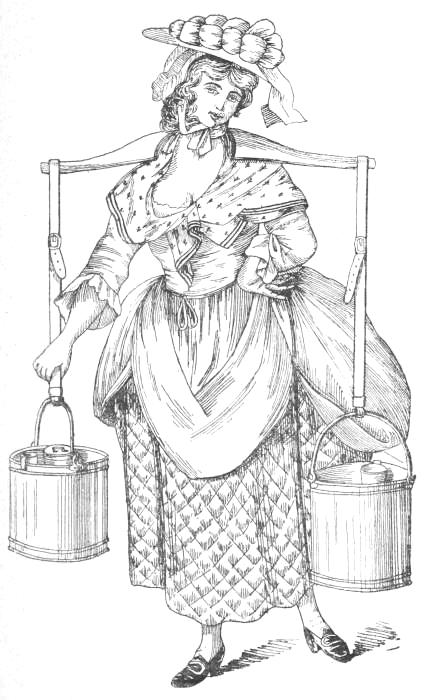
It is singular that milk has not been made into more drinks. Of modern times we have soda and milk, or aërated milk and water, and in the pastoral times of the last century, the times of Corydon and Phyllis, Chloe and Strephon, it was de rigueur to indulge in “syllabubs” whenever the nearest approach to rurality, in the shape of a grass field, and a cow, presented itself. Whoever tastes a syllabub now? Ask fifty people—forty-nine at least, will answer that they have never partaken of the delicacy, and the vast majority will be totally ignorant even of its composition. It was made of milk, milked from the cow into a bowl containing mashed fruit, such as gooseberries, and sugar, or else, wine or beer. The great thing was to make it froth, as we may see in the following recipe for an Ale Syllabub, which our forefathers considered as the ne plus ultra of a syllabub.
“No Syllabubs made at the milking pail, But what are composed of a pot of good ale.”
“Place in a large bowl, a quart of strong ale or beer, grate into this a little nutmeg, and sweeten with sugar: milk the cow rapidly into the bowl, forcing the milk as strongly as possible into the ale, and against the sides of the vessel, to raise a good froth. Let it stand an hour, and it will be fit for use. The proportion of milk, or of sugar, will depend upon the taste of the drinker, who will, after a trial or two, be able to make a delightful beverage. Cider may be used instead of malt liquor for those who object to the alcoholic strength of the ale, or a bottle of wine.”
The Dutch, who are naturally a pastoral people, make a syllabub of milk, sugar, etc., which they call Slemp; but this rustic delicacy has died out owing to the universal use of tea and coffee. Curds and whey used to be much drank, and white wine whey is not to be despised when one has a very heavy cold—but, of course, it can only be drank by the wicked and intemperate; good people confining themselves to hot milk, or treacle posset, either of which served the purpose nearly as well. So, also, the unregenerate have the solace of rum and milk in the early morning.
We have now exhausted all the milk drinks we know of, except “Koumiss,” which, although as old as the hills, is of very modern introduction into civilization, and comes to us heralded by a fanfare of medical trumpets as a panacea for many evils which the human body has to bear, especially consumption; but Koumiss is decidedly alcoholic.
As a drink made from mare’s milk, it has been known for centuries to the Tartars, Khurgese, and Calmucks of the Russian Steppes, and Central and South Western Asia. Perhaps the first mention of it may be found in the Ipatof Annals, published at St. Petersburg, 1871. “In 1182, Prince Igor Seversky was taken prisoner by the Polovtsky, and the captors got so drunk upon Koumiss that they allowed their prisoner to escape.” The old monk and traveller Gulielmus de Rubruquis, who travelled in Tartary in the middle of the thirteenth century, says: “The same evening, the guide who had conducted us, gave us some Cosmos. After I had drunk thereof, I sweat most extremely from the dread and novelty, because I never drank of it before. Notwithstanding I thought it very savoury as indeed it was.” And in another place, he thus refers to it: “Then they taste it, and being pretty sharp, they drink it; for it biteth a man’s tongue like wine of raspes,[154] when it is drunk. After a man has taken a draught thereof, it leaveth behind it a taste like that of almond milk, and maketh one’s inside feel very comfortable; and it also intoxicateth weak heads.” Ser Marco Polo speaks of it. “Their drink is mare’s milk, prepared in such a way, you would take it for a white wine; and a right good drink it is, called by them Kemiz.”
It remained as a traveller’s curiosity until 1784, when Dr. John Grieve, a surgeon, one of the many Scotchmen who have from time to time entered the Russian service, wrote to the Royal Society of Edinburgh (who published his communication in their “Transactions,” Vol. I., 1788). “An account of the Method of making a Wine, called by the Tartars Koumiss, with observations on its use in Medicine,” and, especially, he thought that, “with the superaddition of a fermented spirit, it might be of essential service in all those disorders where the body is defective either in nourishment or strength.” And he further proved the benefit of the milk-wine on three patients, two consumptive, and one syphilitic, sending them to the Steppes among the Tartars, whence they returned stout, and in perfect health. From time to time, until the middle of this century, phthisical patients were sent to Tartary to undergo this milk cure; but life among these nomad tribes, with its filth and privations, was hardly congenial to a sick man, so that although some returned cured, others came back only to die.
But, in 1858, Dr. Postnikof started an establishment for the cure of diseases by fermented mare’s milk, at Samàra, in Eastern Russia, and a similar establishment, about forty-five miles distant, was started by the late Dr. Tchembulatof, both of which have been extremely well patronised, as their places were well ordered, and the Koumiss was prepared in a cleanly manner. So successful were they, that the Russian Government, in 1870, started a place of their own for the cure of sick soldiers belonging to the Kazan district. Here are beds for 100 soldiers and 20 officers.
The curative effect of fermented mare’s milk set people thinking whether the milk of cows, which is much more easy to procure, would not answer the same purpose. It was tried, and a new drink was given to the civilized world, as also a new name, which was coined expressly for it—Galazyene, from γάλα, milk, and ζῦμη, a ferment. It can be obtained in London from the large dairies.
Dr. Polubensky gives the following formula for fermenting cow’s milk.
“An oak churn, such as is used for churning butter, has a bottle of fermented cow’s or mare’s milk, five days old, poured into it in the morning. A tumbler and a half of warm milk (of a temperature of about 90° Fahr.), in which half an ounce of cane, still better milk, sugar has been dissolved, and a bottle of skimmed cow’s milk, are then added.
“The addition of the sugar is made for the purpose of remedying the small amount of lactine in cow’s milk; the water is added to make the milk, which is rich in casein, thinner, and thus to facilitate its agitation and emulsion. Skim milk is used because it contains less fat, an excess of which interferes with fermentation. The mixture is then beaten up during half an hour, to prevent the curdling of the casein, and is then laid aside for three hours. (This is effected at an ordinary room temperature of 60° Fahr.)
“After the lapse of three hours, when the surface of the mixture is covered with a film (of casein and fat in a non-emulsioned condition), it is again agitated for half an hour, and another bottle of skim milk—with or without warm water, according to the thickness of the milk—is added; the whole mass is again churned for an hour and a half, or longer, until the casein is well divided, and small bubbles appear on the surface of the fluid. Then the mixture, having stood for half an hour, has a fresh bottle of milk added to it, and the stirring is again renewed, with short intervals, until the Koumiss is ready, which usually happens by 10 o’clock p.m., if its preparation was commenced at 8 a.m.
“The approaching completion of the Koumiss is known by a thick froth, which sometimes rises very high, forming on its surface; while the full completion of fermentation is recognised by a falling of the froth, and by certain signs detectable by the ear and hand; the process of churning becomes easier, and the splash of the drops during agitation presents a clearer and more metallic sound. The Koumiss is then poured into Champagne bottles, well corked, and left for the night at a room temperature of from 60° to 70° Fahr. Towards morning, the Koumiss is quite fit for use. Left in bottle till the next day, it becomes stronger, but is still drinkable; while, if placed in a cold room, it may be used even on the fifth day.
“In order that the preparation of Koumiss may be carried on successfully, it will be necessary to put aside two bottles of the Koumiss first prepared, and to keep them for three or four days, so as always to have a bottle of four days old Koumiss in store for fermenting new portions of milk, and of replacing the used bottles by new ones.”
This seems to be rather a long method of making Koumiss, compared to that given by Dr. Wolff of Philadelphia, which is excessively simple.
“Take of grape sugar ½ oz.; dissolve in 4 ozs. of water. In about 2 ozs. of milk dissolve 20 grains of compressed yeast, or else well washed and pressed out brewer’s yeast. Mix the two in a quart Champagne bottle, which is to be filled with good cow’s milk to within two inches of the top; cork well, and secure the cork with string or wire, and place in an ice chest or cellar at a temperature of 50° Fahr. or less, and agitate three times a day. At the expiration of three or four days, at the latest, the Koumiss is ready for use, and ought not then to be kept longer than four or five days. It should be drawn with a Champagne syphon tap, so that the carbonic acid may be retained, and the contents will not entirely escape on opening the bottle.”
Be wary in opening a bottle of Koumiss, or you may be thoroughly drenched, and have nothing left to drink, for it generates a large quantity of carbonic acid gas, so much so, indeed, that extra thick bottles should be used.
There is an interesting speculation abroad, that the milk which Jael gave Sisera was fermented, and highly intoxicating, which rendered him in a condition favourable for her purpose.
The Usbecks, Mongols, Kalmucks, and other Tartars not only make milk into Koumiss, but distil a very strong spirit from it, which they call araka, conjectured by some, from its high antiquity, to be the true source whence the Indian Arrack derives its name. The distillation is generally effected by means of two earthen pots closely stopped, from which the liquor slowly runs through a small wooden pipe into a receiver, which is usually covered with a coating of wet clay. The spirit, at first, is weak, but after two or three times distilling, it becomes exceedingly intoxicating. Dr. Edward Clarke, in his Travels in Russia, Turkey, and Asia, saw this process performed by means of a still constructed of mud, or very coarse clay, having for the neck of the retort a piece of cane.
J. A.