Front matter (continued 9)
Reading edition
Soliloquy when a character is left alone on the stage is a perfect illustration of the difference between permanent and ephemeral technique. As a device for easy exposition, it has been popular from the beginning of drama till recently. Now, though one may use it in a rough draft, a technique which is likely to become permanent in this respect forces us to go over this draft, cutting soliloquy to mere action and the few exclamations which the character might utter under the circumstances. Soliloquy has no such permanent place in technique as have preliminary exposition, suspense, and climax. Soliloquy, when other people are on the stage and known by the speaker to be listening is also absurd. It is because of this fact that the dramatic or psychologic monologue, the form taken by a very large portion of Browning’s voluminous poetry, breaks down if we attempt to stage it. “Some speaker is made to reveal his character, and, sometimes, by reflection, or directly, the character of some one else—to set forth some subtle and complex soul-mood, some supreme, all-determining movement or experience of a life, or, it may be, to ratiocinate subtly on some curious question of theology, morals, philosophy, or art. Now it is in strictly preserving the monologue character that obscurity often results. A monologue often begins with a startling abruptness, and the reader must read along some distance before he gathers what the beginning means. Take the monologue of Fra Lippo Lippi for example. The situation is necessarily left more or less unexplained. The poet says nothing in propria persona, and no reply is made to the speaker by the person or persons addressed. Sometimes a look, a gesture or a remark must be supposed on the part of the one addressed, which occasions a responsive remark. Sometimes a speaker imputes a question, and the reader is sometimes obliged to stop and consider whether a question is imputed by the speaker to the one he is addressing, or is a direct question of his own. This is often the case throughout The Ring and the Book.”53
Giuseppe Caponsacchi. Answer you, Sirs? Do I understand aright?
Have patience! In this sudden smoke from hell,—
So things disguise themselves,—I cannot see
My own hand held thus broad before my face
And know it again. Answer you? Then that means
Tell over twice what I, the first time, told
Six months ago: ’twas here, I do believe,
Fronting you same three in this very room,
I stood and told you: yet now no one laughs,
Who then ... nay, dear my lords, but laugh you did,
As good as laugh, what in a judge we style
Laughter—no levity, nothing indecorous, lords!
Only,—I think I apprehend the mood:
There was the blameless shrug, permissible smirk,
The pen’s pretence at play with the pursed mouth,
The titter stifled in the hollow palm
Which rubbed the eyebrow and caressed the nose,
When first I told my tale: they meant, you know,
“The sly one, all this we are bound believe!
Well, he can say no other than what he says.
We have been young, too,—come, there’s greater guilt!
Let him but decently disembroil himself,
Scramble from out the scrape nor move the mud,—
We solid ones may risk a finger-stretch!”
And now you sit as grave, stare as aghast
As if I were a phantom: now ’tis—“Friend,
Collect yourself!”—no laughing matter more—
“Counsel the Court in this extremity,
Tell us again!”—tell that, for telling which,
I got the jocular piece of punishment,
Was sent to lounge a little in the place
Whence now of a sudden here you summon me
To take the intelligence from just—your lips,
You, Judge Tommati, who then tittered most,—
That she I helped eight months since to escape
Her husband, is retaken by the same
Three days ago, if I have seized your sense.54
It may be true that when one reads a dramatic monologue, the changes in thought caused by some movement or look of an imagined hearer may seem sufficiently motivated. When, on the other hand, this monologue is staged, it becomes exceedingly unreal because we feel that the second person would not be silent but would interrupt with question or comment. More than this, unless the listening actor changes from pose to pose with rapid plasticity, he will become stiff in attitude, thus making us conscious of him when we should be listening to the speaker. Increasing the number of hearers does not relieve the situation, but merely increases the number of possible interrupters or of people who stand about the stage more and more stiffly. Soliloquy is, therefore, to be avoided except when it seems or can be made to seem perfectly natural. Monologue, acceptable perhaps to a reader, becomes well-nigh impossible on the stage.
The aside must be subjected to very nearly the same tests. In Two Loves and a Life of Tom Taylor and Charles Reade, Musgrave and his daughter, Anne, are opening letters surreptitiously. They come to the letter of William Hyde, which the girl opens with reluctance, crying,—
Ah, see, father, it is a blank!
Musgrave. A blank! Then it is as I thought!
Anne. How?
Musgrave. Here, girl!
(He takes the letter and holds it to the fire in the brazier.)
Anne. See! Letters become visible!
Musgrave. A stale trick. ’Tis done with lemon juice or milk, when folks would keep what they write from those who are in their secret. Politicians correspond so, Anne, and rebels.
Anne. But William Hyde is neither, father.
Musgrave. Of course not. Now then!
Anne. (Aside.) Thank Heaven! ’tis all about his calling!
Musgrave. Read! (Aside.) I have learned the key to their cypher, which I have copied from the priest’s letter.
Anne. (Reads.) “Dear Will, we have thine advices, and shall be at Lancaster Fair. All the smart fellows—”
Musgrave. (To himself.) Ah! Bardsea Hole—all the Jacobite gentlemen—good.
Anne. (Reads.) “By the time the grilse come ashore—”
Musgrave. (To himself.) Grilse? ammunition. Go on.
Anne. (Reads.) “Which shall be as you fix, on Tuesday the 16th, at ten of the clock, P.M. There is a bill against you and the old clothier, payable at Ulverstone today, drawn by the butcher. Look out and see that he does not nab either of you—”
Musgrave. (Aside.) The proclamation!
Anne. (Reads.) “For your friends assembled. John Trusty.”
Musgrave. From Townley. It is as I suspected.
(He starts up.)
Anne. Father!
Musgrave. I’m a made man, Anne. Give me joy—joy!55
In this once popular drama we have five asides close together, for of course “to himself” is the equivalent of an aside. All are bad, for in each case the other person on the stage must be supposed not to hear, and the aside is merely a device for telling us what the speaker is thinking. They vary in badness, however, for while Musgrave might well explain “grilse” to Anne as “ammunition,” he says, “I have learned the key to their cipher, which I have copied from the priest’s letter,” not as something which he is necessarily thinking at the time, but as something which the audience needs to know at this point. An aside is objectionable when a man speaks what he would be careful only to think, either because of the very nature of his thought or because somebody is near at hand who should not overhear. Asides should be kept for confidential remarks which may be made to some person standing near the speaker, but could not be heard by persons standing at a greater distance; and to what naturally breaks from us in a moment of irritation, terror, or other strong emotion. Asides of the first group, confidential remarks, gain much in naturalness if spoken in half tones. Nothing could be more preposterous than the old stage custom of coming down to the footlights to tell an audience in clear-cut tones confidences which must not be overheard by people close at hand on the stage. Asides which are only brief soliloquies are little better. Asides in which the speaker merely says to the audience what he might perfectly well say to the people on the stage are foolish unless the author wishes to make the point that the character has the habit of talking to himself. The following from Vanbrugh’s The Provoked Wife shows two entirely natural uses of the aside by Lady Brute, and one debatable use by Sir John.
ACT III. Scene opens. Sir John, Lady Brute, and Belinda rising from the Table
Sir John. Will it so, Mrs. Pert? Now I believe it will so increase it, (sitting and smoaking) I shall take my own House for a Papermill.
Lady Brute. (To Belinda aside.) Don’t let’s mind him; let him say what he will.
Sir John. (Aside.) A Woman’s Tongue a Cure for the Spleen—Oons—If a Man had got the Head-ach, they’d be for applying the same Remedy.
Lady Brute. You have done a great deal, Belinda, since yesterday.
Belinda. Yes, I have work’d very hard; how do you like it?
Lady Brute. O, ’tis the prettiest Fringe in the World. Well, Cousin, you have the happiest fancy. Prithee advise me about altering my Crimson Petticoat.
Sir John. A Pox o’ your Petticoat; here’s such a Prating, a Man can’t digest his own Thoughts for you.
Lady Brute. (Aside.) Don’t answer him.—Well, what do you advise me?
Belinda. Why really I would not alter it at all. Methinks ’tis very pretty as it is.56
Sir John’s aside, if addressed to the audience, is bad; if meant to illustrate his habit of grumbling to himself, it is permissible.
Mr. Henry Arthur Jones protests against complete disuse of the aside. “In discarding the ‘aside’ in modern drama we have thrown away a most valuable and, at times, a most necessary convention. Let any one glance at the ‘asides’ of Sir John Brute in The Provoked Wife, and he will see what a splendid instrument of rich comedy the ‘aside’ may become. How are we as spectators to know what one character on the stage thinks of the situation and of the other characters, unless he tells us; or unless he conveys it by facial play and gestures which are the equivalent of an ‘aside’? The ‘aside’ is therefore as legitimate a convention of drama as the removal of the fourth wall. More and more the English modern drama seems to be sacrificing everything to the mean ambition of presenting an exact photograph of real life.”57
Of course Mr. Jones is quite right in wishing to keep the aside for cases in which it is perfectly natural. His illustration of Sir John Brute is, however, not wholly fortunate, for his asides are not conventional but are characterizing touches. Surely we must all admit that a certain type of drunkard likes to mumble to himself insulting speeches which he hasn’t quite the courage to speak directly to other people, but rather hopes they may overhear. Study the asides of Sir John Brute—they are not very many after all—and note that practically every one might be said directly to the people on the stage. All of them help to present Sir John as the heavy drinker who talks to himself and selects for his speeches to himself his particularly insulting remarks.
Why, too, are “facial play and gestures” more objectionable than the conventional aside? The fundamental trouble with the aside which should not be overheard by people on the stage is that, if spoken naturally, it would be too low for the audience to hear, and if spoken loud enough to be heard, would so affect the other characters as to change materially the development of the scene. The aside should, therefore, be used with great care.
Congreve, writing of ordinary human speech said, “I believe if a poet should steal a dialogue of any length, from the extempore discourse of the two wittiest men upon earth, he would find the scene but coldly received by the town.”58 In everyday speech, that is, we do not say our say in the most compact, characteristic, and entertaining fashion. To gain all that, we must use more concentration and selection than we give to ordinary human intercourse. Just that concentration of attention, which produces needed selection, a dramatist must give his dialogue. To this concentration and selection he is forced by the time difficulty already explained. Into the period sometimes consumed by a single bit of gossiping, perhaps shot through with occasional flashes of wit, but more probably dull,—into the space of two hours and a quarter,—the dramatist must crowd all the happenings, the growth of his characters, and the close reasoning of his play. Dramatic dialogue is human speech so wisely edited for use under the conditions of the stage that far more quickly than under ordinary circumstances the events are presented, in character, and perhaps in a phrasing delightful of itself.
Picking just the right words to convey with gesture, voice and the other stage aids of dialogue the emotions of the characters is so exacting a task that many a writer tries to dodge it. He thinks that by prefacing nearly every speech with “Tenderly,” “Sarcastically,” “With much humor,” in other words a statement as to how his lines should be read, commonplace phrasings may be made to pass for the right emotional currency. This is a lazy trick of putting off on the actor what would be the delight of the writer if he really cared for his work and knew what he wished to say. Of course, from time to time one needs such stage directions, but the safest way is to insist, in early drafts, on making the text convey the desired emotion without such statements. Otherwise a writer easily falls into writing unemotionalized speeches, the stage directions of which call upon the actor to provide the emotion.
A similar trick is to write incomplete sentences, usually ending with dashes. Though it is true, as Carlyle long ago pointed out, that a thought or a climax which a reader or hearer completes for himself is likely to give him special satisfaction, the device is easily overdone, and too often the uncompleted line means either that the author does not know exactly what he wishes to say, or that, though he knows, the hearer or reader may not complete the thought as he does. The worst of this last trick is that it may confuse the reader and, as was explained earlier in this chapter, clearness in gaining the desired effect is the chief essential in dialogue.
An allied difficulty comes from writing dialogue in blocks, the author forgetting, in the first place, that the other people on the stage are likely to interrupt and break up such speech, and secondly, that when several ideas are presented to an audience in the same speech, they are likely to confuse hearers. In these parallel passages from the two quartos of Hamlet, is not the right-hand column, with its mingling of rapidly exchanged speech and description, much more vivid and moving?
Enter Ofelia; Enter Ophelia.
Corambis. Farewel, how now Ofelia, what’s the news with you? Ofelia. O my deare father, such a change in nature, So great an alteration in a Prince, So pitifull to him, fearefull to mee, A maiden’s eye ne’re looked on. Corambis. Why, what’s the matter my Ofelia? Ofelia. O yong Prince Hamlet, the only floure of Denmark, Hee is bereft of all the wealth he had, The Jewell that adorn’d his feature most Is filcht and stolne away, his wit’s bereft him. Polonius. Farewell. How now Ophelia, what’s the matter? Ophelia. O my Lord, my Lord, I have been so affrighted. Polonius. With what i’th name of God? Ophelia. My Lord, as I was sowing in my closset, Lord Hamlet with his doublet all unbrac’d, No hat upon his head, his stockins fouled, Ungartred, and downe gyved to his ancle, Pale as his shirt, his knees knocking each other, And with a look so pittious in purport As if he had been loosed out of hell To speake of horrors, he comes before me. Polonius. Mad for thy love? Ophelia. My lord I doe not know, But truly I doe feare it. Polonius. What said he? Ophelia. He took me by the wrist, and held me hard, Then goes he to the length of all his arme, And with his other hand thus ore his brow, He falls to such perusall of my face As a would draw it.59
Is it probable that in the following extract from A Soul’s Tragedy of Browning the deeply interested and excited audience would permit the first bystander to complete uninterrupted his third and very long speech? Are the phrasing and thought really his, or Robert Browning’s?
ACT II. Scene. The market place. Luitolfo in disguise mingling with the Populace assembled opposite the Provost’s Palace.
1st Bystander. (To Luitolfo.) You, a friend of Luitolfo’s? Then, your friend is vanished,—in all probability killed on the night that his patron the tyrannical Provost was loyally suppressed here, exactly a month ago, by our illustrious fellow-citizen, thrice-noble saviour, and new Provost that is like to be, this very morning,—Chiappino!
·········
Luitolfo. (Aside.) (If I had not lent that man the money he wanted last spring, I should fear this bitterness was attributable to me.) Luitolfo is dead then, one may conclude?
3rd Bystander. Why, he had a house here, and a woman to whom he was affianced; and as they both pass naturally to the new Provost, his friend and heir...
Luitolfo. Ah, I suspected you of imposing upon me with your pleasantry! I know Chiappino better.
1st Bystander. (Our friend has the bile. After all, I do not dislike finding somebody vary a little this general gape of admiration at Chiappino’s glorious qualities.) Pray, how much may you know of what has taken place in Faenza since that memorable night?
Luitolfo. It is most to the purpose, that I know Chiappino to have been by profession a hater of that very office of Provost, you now charge him with proposing to accept.
1st Bystander. Sir, I’ll tell you. That night was indeed memorable. Up we rose, a mass of us, men, women, children; out fled the guards with the body of the tyrant; we were to defy the world; but, next gray morning, “What will Rome say?” began everybody. You know we are governed by Ravenna, which is governed by Rome. And quietly into the town, by the Ravenna road, comes on muleback a portly personage, Ogniben by name, with the quality of Pontifical Legate; trots briskly through the streets humming a “Cur fremuere gentes,” and makes directly for the Provost’s Palace—there it faces you. “One Messer Chiappino is your leader? I have known three-and-twenty leaders of revolts!” (laughing gently to himself)—”Give me the help of your arm from my mule to yonder steps under the pillar—So! And now, my revolters and good friend what do you want? The guards burst into Ravenna last night bearing your wounded Provost; and, having had a little talk with him, I take on myself to come and try appease the disorderliness, before Rome, hearing of it, resort to another method: ’tis I come, and not another, from a certain love I confess to, of composing differences. So, do you understand, you are about to experience this unheard-of tyranny from me, that there shall be no heading nor hanging, no confiscation nor exile: I insist on your simply pleasing yourselves. And, now, pray, what does please you? To live without any government at all? Or having decided for one, to see its minister murdered by the first of your body that chooses to find himself wronged, or disposed for reverting to first principles and a justice anterior to all institutions,—and so will you carry matters, that the rest of the world must at length unite and put down such a den of wild beasts? As for vengeance on what had just taken place,—once for all, the wounded man assures me that he cannot conjecture who struck him; and this so earnestly, that one may be sure he knows perfectly well what intimate acquaintance could find admission to speak with him late last evening. I come not for vengeance therefore, but from pure curiosity to hear what you will do next.” And thus he ran on, easily and volubly, till he seemed to arrive quite naturally at the praise of law, order, and paternal government by somebody from rather a distance. All our citizens were in the snare and about to be friends with so congenial an adviser; but that Chiappino suddenly stood forth, spoke out indignantly and set things right again.
Luitolfo. Do you see? I recognize him there!60
People who think ramblingly and not clearly must undoubtedly on the stage speak in similar fashion, but it is wise when possible to avoid stating two or three ideas in the same sentence, or developing two or three ideas in one long speech. An idea to a sentence, with the development of one thought in a speech, is a fairly safe principle, though not unalterable. For instance, the daughter of a widowed mother is facing the fact that if they are to stay in their meagre quarters she may have to ask this as a favor from her employer, Mr. Hollings. The mother, not knowing that he has pressed his attentions objectionably, does not understand the unwillingness of the girl to ask his help. In answer to her pleadings the girl cries, “Oh, I would do anything for you! Poor dear father! Mother, go to Mr. Hollings.” Here are three different trains of thought in one speech. The first exclamation is a direct answer to the mother’s preceding speech. For the audience there is no clearness of transition to the second exclamation, nor from it to the third. Cut the girl’s answer to the first sentence. Then the mother, seizing on the idea that her daughter is willing to do anything, urges her for this and that reason to see her employer, emphasizing the idea that, had the father lived, all their present sorrow would not exist. In this case the second exclamation falls into its proper place, as a natural reply of the girl to her mother. If, too, as the mother urges reason after reason for going to the employer for aid, the girl at last pleads, “Mother, you go to Mr. Hollings,” this sentence also falls into its proper place. It becomes the first sign of her yielding, for she is at last willing that some one should intercede with the man. When a writer finds himself skipping from idea to idea within a speech or a sentence, with transitions likely to be unclear for the audience, he should break what he has written into its component parts and let the other people on the stage, by their interruptions, queries, and comments, provide the connectives of speech and thought which will bind these ideas together properly. The following rearrangement by Miss Anglin of the original text of Lady Windermere’s Fan shows her correct feeling that ideas originally treated together should be separated. Lord Windermere’s reply is to the first sentence of Mrs. Erlynne’s speech. It is therefore much clearer to shift her two succeeding exclamations to her next speech.
ORIGINAL REVISION
Mrs. Erlynne. (C.) How do you do, again, Lord Windermere? How charming your sweet wife looks! Quite a picture! Lord Windermere. (In a low voice.) It was terribly rash of you to come! Mrs. Erlynne. (Smiling.) The wisest thing I ever did in my life. And, by the way, you must pay me a good deal of attention this evening.61 Mrs. Erlynne. (C.) How do you do, again, Lord Windermere? Lord Windermere. (In a low voice.) It was terribly rash of you to come! Mrs. Erlynne. (Smiling.) The wisest thing I ever did in How charming your sweet wife looks! Quite a picture! And, by the way, you must pay me a good deal of attention this evening.
Often dialogue which is clear sentence by sentence is, as a whole, somewhat confusing to an audience. Frequently a careful re-ordering of the parts of the speech, or of a group of speeches, will dispose of the trouble. Occasionally a playwright allows his ordering of his ideas to obscure the cue, or important idea. Undoubtedly the important word in what follows is “christenings,” but Chasuble runs on into various other matters before Jack speaks. Consequently a hearer is a little startled when Jack takes up the idea of christenings instead of anything following it.
Chasuble. In Paris! (Shakes his head.) I fear that hardly points to any very serious state of mind at the last. You would no doubt wish me to make some slight allusion to this tragic domestic affliction next Sunday. (Jack presses his hand convulsively.) My sermon on the meaning of the manna in the wilderness can be adapted to almost any occasion, joyful, or, as in the present case, distressing. (All sigh.) I have preached it at harvest celebrations, christenings, confirmations, on days of humiliation and festal days. The last time I delivered it was in the Cathedral, as a charity sermon on behalf of the Society for the Prevention of Discontent among the Upper Orders. The Bishop, who was present, was much struck by some of the analogies I drew.
Jack. Ah! That reminds me, you mentioned christenings I think, Dr. Chasuble? I suppose you know how to christen all right? (Dr. Chasuble looks astounded.) I mean, of course, you are continually christening, aren’t you?62
It is true that the last part of Chasuble’s speech illustrates his volubility, and that the way in which Jack picks up the idea, “christening,” shows that he is so absorbed in his purpose as to pay no attention to anything Chasuble says after “christenings.” Here, therefore, the method is probably justified, but ordinarily the end of one speech leads into the next, and when something which breaks the sequence stands between, it must prove its right to be there, or be postponed for later treatment, or be cut out altogether. What re-ordering will do for a dialogue which is uninteresting and somewhat confused was shown in the revising of the extract from the John Brown play (pp. 309-313). There is a brilliant instance, in Miss Anglin’s version of Lady Windermere’s Fan, of re-ordering such that a climax of interest develops from groups of somewhat independent sentences.
ORIGINAL REVISION
Lady Plymdale. My dear woman your husband has been dancing with! I should be quite jealous if I were you! Is she a great friend of yours? Lady Windermere. No. Lady Plymdale. Really? Good night, dear. (Looks at Mr. Dumby, and exit.) Dumby. Awful manners young Cecil Graham. Ah! Hopper is one of Nature’s gentlemen, the worst type of gentleman I know. Dumby. Sensible woman, Lady Windermere. Lots of wives would have objected to Mrs. Erlynne coming. But Lady Windermere has that uncommon thing called common sense. Cecil Graham. And Windermere knows that nothing looks so like innocence as an indiscretion. Dumby. Yes; dear Windermere is becoming almost modern. Never thought he would. (Bows to Lady Windermere and exit.) Lady Jedburgh. Good night, Lady Windermere. What a fascinating woman Mrs. Erlynne is! She is coming to lunch on Thursday. Won't you come too? I expect the Bishop and dear Lady Merton. Lady Windermere. I am afraid I am engaged, Lady Jedburgh. Lady Jedburgh. So sorry. Come, dear. (Exeunt Lady Jedburgh and Miss Graham.) Enter Mrs. Erlynne and Lord Windermere. Mrs. Erlynne. Charming ball it has been! Quite reminds me of old days. (Sits on the sofa.)63 Dumby. Awful manners young Hopper has! Cecil Graham. Ah! Hopper is one of Nature’s gentlemen, the worst type of gentleman I know. Lady Jedburgh. What a fascinating woman Mrs. Erlynne is! She is coming to lunch on Thursday, won’t you come too? I expect the Bishop and dear Lady Merton. Lady Windermere. I am afraid I am engaged, Lady Jedburgh. Lady Jedburgh. So sorry. Good night. Come, dear. (Exeunt Lady Jedburgh and Miss Graham.) Dumby. Sensible woman, Lady Windermere. Lots of wives would have objected to Mrs. Erlynne coming. But Lady Windermere has that uncommon thing called common sense. Cecil Graham. And Windermere knows that nothing looks so like innocence as an indiscretion. Dumby. Yes; dear Windermere is becoming almost modern. Never thought he would. Lady Plymdale. Dumby! (Dumby bows to Lady Windermere and exit.) Lady Plymdale. My dear Margaret, what a fascinating woman your husband has been dancing with! I should be quite jealous if I were you! Is she a great friend of yours? Lady Windermere. No! Lady Plymdale. Really? Good night, dear. (Lady Plymdale exits.) Enter Mrs. Erlynne and Lord Windermere. Mrs. Erlynne. Charming ball it has been! Quite reminds me of old days. (Sits on the sofa.)
Dialogue may be both clear and characterizing yet fail because it is difficult to speak. Too many writers, as has been said, do not hear their words but see them. Could any one who heard his words have penned the lines, “She says she’s sure she’ll have a shock if she sees him.” That time “apt alliteration” was so artful that, setting her trap, she caught a dramatist. Here is the amusing comment of a critic on an author’s protest that her lines have been misquoted and made to sound difficult to deliver:
In the review of the——Theatre’s opening bill there occurred a line purporting to come from Miss Blank’s psychic play, The Turtle. Miss Blank writes, “The line, which was either incorrectly spoken or heard, was not, ‘How does one know one is one’s self?’ but ‘How is one to know which is one’s real self when one feels so different with different people?’” Naturally the reviewer of a play is as open to mistakes in noting down lines as the actor is in speaking them, particularly if the author is much given to the “one-one-one” style of construction. If, however, Miss Blank prefers her own version of the sentence, she is welcome to it.
Of course each writer is perfectly sure that his own ear will keep him from errors of this kind, but even the greatest err. Did Shakespeare write the opening lines of Measure For Measure, he the master of exquisitely musical and perfectly chosen dramatic speech? Some scholars believe he did. If so, in that second speech of the Duke which wearies the jaws and tempts to every kind of slurring, Jove certainly nodded.
Enter Duke, Escalus, Lords and Attendants
Duke. Escalus!
Escalus. My lord.
Duke. Of government the properties to unfold,
Would seem in me to affect speech and discourse,
Since I am put to know that your own science
Exceeds, in that, the lists of all advice
My strength can give you: then no more remains,
But that, to your sufficiency ...
... as your worth is able,
And let them work.
Are the following straight translations from the old French farce, Pierre Patelin,64 as easy to speak as the revisions?
TRANSLATION REVISION
Guillemette. And don’t forget your dram, if you can come by it for nothing. Guillemette. And if any one offers to stand treat, don’t refuse.
····· ·····
(Patelin is trying to cheat the Draper out of a piece of cloth.) Patelin. I don’t care: give me my money’s worth. (Whispering in the Draper's ear.) I know of another coin or two nobody ever got a smell of. Draper. Now you're talking! That would be capital. Patelin. In a word, I am hot for this piece, and have some I must. (Patelin is trying to cheat the Draper out of a piece of cloth.) Patelin. I don’t care: give me my money’s worth. (Whispering in the Draper's ear.) I know of some chink— Draper. Now you're talking! Patelin. (Letting his hand fall on the goods.) This!
The first revision certainly gives lines easier to speak. The writer of the second revision hears it and knows the gesture, facial expression, and intonation which must go with “This!” Dialogue which is perfectly clear and characterizing should not be allowed to pass in the final revision if at any point it is unnecessarily difficult to deliver.
From the preceding discussion it must be clear that the three essentials of dialogue are clearness, helping the onward movement of the story, and doing all this in character. Dialogue is, naturally, still better if it possesses charm, grace, wit, irony, or beauty of its own. Dialogue which merely states the facts is, as we have seen, likely to be dull or commonplace. Well characterized dialogue still falls short of all dialogue may be if it has none of the attributes just mentioned. Feeling this strongly, the dramatists throughout the ages have striven to give their dialogue attractiveness because of its style, forgetting that above all for the dramatist it is true that “style is the man,” and that “style is a thinking out into language.” Lyly, Shakespeare, in some of the scenes of his early plays, Kyd in The Spanish Tragedy, John Dryden in his Heroic Drama, Cibber and Lillo in their rhythmic prose which often might be perfectly well printed as blank verse, strove to decorate their dialogue from without—something sure to fail, either with the immediate audience or with posterity. If the charm, the grace, the wit, the irony of the dialogue does not come from the characters speaking, that dialogue fails in what has been shown to be one of its chief essentials, right characterization. Congreve emphasized this in that classic of dramatic criticism, his letter Concerning Humour in Comedy.65 “A character of a splenetic and peevish humour should have a satirical wit. A jolly and sanguine humour should have a facetious wit. The former should speak positively; the latter, carelessly: for the former observes and shows things as they are; the latter rather overlooks nature, and speaks things as he would have them; and his wit and humour have both of them a less alloy of judgment than the others.” Undoubtedly, however, the dramatist may do much in helping a character to reveal these qualities, particularly beauty of thought or phrasing. It is a conventional use supposed to make for beauty which The Rehearsal ridicules in the following scene, for at nearly all crises the Heroic Drama rested on a simile for its strongest effect.
Prettyman. How strange a captive am I grown of late! Shall I accuse my love or blame my fate? My love I cannot; that is too divine: And against fate what mortal dares repine?
Enter Chloris
But here she comes. Sure ’tis some blazing comet! is it not? (Lies down.)
Bayes. Blazing comet! Mark that; egad, very fine.
Prettyman. But I am so surpris’d with sleep, I cannot speak the rest. (Sleeps.)
Bayes. Does not that, now, surprise you, to fall asleep in the nick? His spirits exhale with the heat of his passion, and all that, and, swop, he falls asleep, as you see. Now, here she must make a simile.
Smith. Where’s the necessity of that, Mr. Bayes?
Bayes. Because she’s surprised. That’s a general rule; you must ever make a simile when you’re surprised; ’tis the new way of writing.
Chloris. As some tall pine which we on Ætna find T’ have stood the rage of many a boist’rous wind, Feeling without that flames within do play, Which would consume his root and sap away; He spreads his worsted arms unto the skies: Silently grieves, all pale, repines, and dies: So, shrouded up, your bright eye disappears. Break forth, bright scorching sun, and dry my tears.
(Exit.)
John. Mr. Bayes, methinks this simile wants a little application, too.
Bayes. No faith; for it alludes to passion, to consuming, to dying, and all that, which, you know, are the natural effects of an amour.
(Act II, sc. 3.)66
Why is it that the citation from Shakespeare in the left-hand column is less satisfactory than that in the right-hand?
York. To do that office of thine own good will Which tired majesty did make thee offer, The resignation of thy state and crown To Henry Bolingbroke. King Richard. Give me the crown.—Here cousin, seize the crown; Here, cousin, On this side my hand, and on that side thine. Now is this golden crown like a deep well That owes two buckets, filling one another, The emptier ever dancing in the air, The other down, unseen, and full of water. That bucket down and full of tears am I, Drinking my griefs, whilst you mount up on high, Bolingbroke. I thought you had been willing to resign. King Richard. My crown I am; but still my griefs are mine. You may my glories and my state depose, But not my griefs; still I am king of those.67 Viola. If I did love you in my master’s flame, With such a suffering, such a deadly life, In your denial I would find no sense, I would not understand it. Olivia. Why, what would you? Viola. Make me a willow cabin at your gate, And call upon my soul within the house; Write loyal cantons of contemned love And sing them loud even in the dead of night; Halloo your name to the reverberate hills And make the babbling gossip of the air Cry out “Olivia!” O, you should not rest Between the elements of air and earth, But should pity me! Olivia. You might do much68
The second extract is the more effective because the onward sweep of the emotion of the scene reveals beauty as it moves, but the first shows King Richard checking the course of his natural emotion in order suavely and perfectly to develop his comparison. Of course there is beauty in the first extract, but it is not genuine dramatic beauty. Why does one find the following passage from The Importance of Being Earnest (Act I), delightful as it is, less fine than the passage from The Way of the World (Act II, Scene 5)?
THE IMPORTANCE OF BEING EARNEST
Lady Bracknell. (Sitting down.) You can take a seat, Mr. Worthing.
(Looks in her pocket for notebook and pencil.)
Jack. Thank you, Lady Bracknell, I prefer standing.
Lady Bracknell. (Pencil and notebook in hand.) I feel bound to tell you that you are not down on my list of eligible young men, although I have the same list as the dear Duchess of Bolton has. We work together, in fact. However, I am quite ready to enter your name, should your answers be what a really affectionate mother requires. Do you smoke?
Jack. Well, yes, I must admit I smoke.
Lady Bracknell. I am glad to hear it. A man should always have an occupation of some kind. There are far too many idle men in London as it is. How old are you?
Jack. Twenty-nine.
Lady Bracknell. A very good age to be married at. I have always been of opinion that a man who desires to get married should know either everything or nothing. Which do you know?
Jack. (After some hesitation.) I know nothing, Lady Bracknell.
Lady Bracknell. I am pleased to hear it. I do not approve of anything that tempers with natural ignorance. Ignorance is like a delicate exotic fruit; touch it and the bloom is gone. The whole theory of modern education is radically unsound. Fortunately in England, at any rate, education produces no effect whatsoever. If it did, it would prove a serious danger to the upper classes, and probably lead to acts of violence in Grosvenor Square. What is your income?
Jack. Between seven and eight thousand a year.
Lady Bracknell. (Makes a note in her book.) In land or investments?
Jack. In investments, chiefly.
Lady Bracknell. That is satisfactory. What between the duties expected of one during one’s lifetime, and the duties exacted from one after one’s death, land has ceased to be either a profit or a pleasure. It gives one position and prevents one from keeping it up. That’s all that can be said about land.
Jack. I have a country house with some land, of course, attached to it, about fifteen hundred acres, I believe; but I don’t depend on that for my income. In fact, as far as I can make out, the poachers are the only people who are making anything out of it.
Lady Bracknell. A country house! How many bedrooms? Well, that point can be cleared up afterwards. You have a town house, I hope? A girl with a simple unspoiled nature, like Gwendolen, could hardly be expected to reside in the country.
Jack. Well, I own a house in Belgrave Square, but it is let by the year to Lady Bloxham. Of course, I can get it back whenever I like, at six months’ notice.
Lady Bracknell. Lady Bloxham? I don’t know her.
Jack. Oh, she goes about very little. She is a lady considerably advanced in years.
Lady Bracknell. Ah, nowadays that is no guarantee of respectability of character. What number in Belgrave Square?
Jack. 149.
Lady Bracknell. (Shaking her head.) The unfashionable side. I thought there was something. However, that could easily be altered.
Jack. Do you mean the fashion or the side?
Lady Bracknell. (Sternly.) Both, if necessary, I presume. What are your politics?
Jack. Well, I’m afraid I really have none. I am a Liberal Unionist.
Lady Bracknell. Oh, they count as Tories. They dine with us. Or come in the evening, at any rate. Now to minor matters. Are your parents living?
Jack. I have lost both my parents.
Lady Bracknell. Both?—That seems like carelessness. Who was your father? He was evidently a man of some wealth. Was he born in what the Radical papers call the purple of commerce, or did he rise from the ranks of the aristocracy?
Jack. I’m afraid I really don’t know. The fact is, Lady Bracknell, I said I had lost my parents. It would be nearer the truth to say that my parents seem to have lost me—I don’t actually know who I am by birth. I was—well, I was found.
Lady Bracknell. Found!
Jack. The late Mr. Thomas Cardew, an old gentleman of a very charitable and kindly disposition, found me and gave me the name of Worthing, because he happened to have a first-class ticket for Worthing at the time. Worthing is a place in Sussex. It is a seaside resort.
Lady Bracknell. Where did the gentleman who had a first-class ticket for this seaside resort find you?
Jack. (Gravely.) In a hand-bag.
Lady Bracknell. A hand-bag!
Jack. (Very seriously.) Yes, Lady Bracknell. I was in a hand-bag—a somewhat large, black leather hand-bag, with handles to it—an ordinary hand-bag in fact.
Lady Bracknell. In what locality did this Mr. James, or Thomas, Cardew come across this ordinary hand-bag?
Jack. In the cloak-room at the Victoria Station. It was given to him in mistake for his own.
Lady Bracknell. The cloak-room at Victoria Station?
Jack. Yes, the Brighton line.
Lady Bracknell. The line is immaterial. Mr. Worthing, I confess I feel somewhat bewildered by what you have just told me. To be born, or at any rate, bred in a hand-bag, whether it had handles or not, seems to me to display a contempt for the ordinary decencies of family life that remind one of the worst excesses of the French Revolution. And I presume you know what that unfortunate movement led to? As for the particular locality in which the hand-bag was found, a cloak-room at a railway station might serve to conceal a social indiscretion—has probably, indeed, been used for that purpose before now—but it could hardly be regarded as an assured basis for a recognized position in good society.
Jack. May I ask you then what you would advise me to do? I need hardly say I would do anything in the world to ensure Gwendolen’s happiness.
Lady Bracknell. I would strongly advise you, Mr. Worthing, to try and acquire some relations as soon as possible, and to make a definite effort to produce at any rate one parent, of either sex, before the season is quite over.
Jack. Well, I don’t see how I could possibly manage to do that. I can produce the hand-bag at any moment. It is in my dressing-room at home. I really think that should satisfy you, Lady Bracknell.
Lady Bracknell. Me, sir! What has it to do with me? You can hardly imagine that I and Lord Bracknell would dream of allowing our only daughter—a girl brought up with the utmost care—to marry into a cloak-room, and form an alliance with a parcel? Good morning, Mr. Worthing!
(Lady Bracknell sweeps out in majestic indignation.)69
THE WAY OF THE WORLD
Enter Mrs. Millamant, Witwoud, Mincing
Mirabell. Here she comes, i’faith, full sail, with her fan spread and streamers out, and a shoal of fools for tenders; ha, no, I cry her mercy.
Mrs. Fainall. I see but one poor empty sculler; and he tows her woman after him.
Mirabell. (To Mrs. Millamant.) You seem to be unattended, Madam—you us’d to have the beau monde throng after you; and a flock of gay fine perukes hovering round you.
Witwoud. Like moths about a candle,—I had like to have lost my comparison for want of breath.
Mrs. Millamant. Oh, I have denied myself airs today, I have walk’d as fast through the crowd—
Witwoud. As a favourite just disgraced; and with as few followers.
Mrs. Millamant. Dear Mr. Witwoud, truce with your similitudes; for I am as sick of ’em—
Witwoud. As a physician of good air—I cannot help it, Madam, though ’tis against myself.
Mrs. Millamant. Yet again! Mincing, stand between me and his wit.
Witwoud. Do, Mrs. Mincing, like a screen before a great fire. I confess I do blaze today, I am too bright.
Mrs. Fainall. But, dear Millamant, why were you so long?
Mrs. Millamant. Long! Lord, have I not made violent haste? I have ask’d every living thing I met for you; I have enquir’d after you, as after a new fashion.
Witwoud. Madam, truce with your similitudes—no, you met her husband, and did not ask him for her.
Mrs. Millamant. By your leave, Witwoud, that were like enquiring after an old fashion, to ask a husband for his wife.
Witwoud. Hum, a hit, a hit, a palpable hit, I confess it.
Mrs. Fainall. You were dress’d before I came abroad.
Mrs. Millamant. Ay, that’s true—O but then I had—Mincing, what had I? why was I so long?
Mincing. O mem, your La’ship staid to peruse a pacquet of letters.
Mrs. Millamant. O, ay, letters—I had letters—I am persecuted with letters—I hate letters—nobody knows how to write letters, and yet one has ’em one does not know why—they serve one to pin up one’s hair.
Witwoud. Is that the way? Pray, Madam, do you pin up your hair with all your letters? I find I must keep copies.
Mrs. Millamant. Only with those in verse, Mr. Witwoud, I never pin up my hair with prose. I think I try’d once, Mincing.
Mincing. O mem, I shall never forget it.
Mrs. Millamant. Ay, poor Mincing tift and tift all the morning.
Mincing. ’Till I had the cramp in my fingers, I’ll vow, mem. And all to no purpose. But when your Laship pins it up with poetry, it fits so pleasant the next day as anything, and is so pure and so crips.
Witwoud. Indeed, so crips.
Mincing. You’re such a critic, Mr. Witwoud.
Mrs. Millamant. Mirabell, did you take exceptions last night? O ay, and went away—now I think on’t, I’m angry—no, now I think on’t I’m pleas’d—for I believe I gave you some pain.
Mirabell. Does that please you?
Mrs. Millamant. Infinitely; I love to give pain.
Mirabell. You wou’d affect a cruelty which is not in your nature; your true vanity is in the power of pleasing.
Mrs. Millamant. O I ask your pardon for that—one’s cruelty is in one’s power; and when one parts with one’s cruelty, one parts with one’s power; and when one has parted with that, I fancy one’s old and ugly.
Mirabell. Ay, ay, suffer your cruelty to ruin the object of your power, to destroy your lover—and then how vain, how lost a thing you’ll be! nay, ’tis true: you are no longer handsome when you’ve lost your lover; your beauty dies upon the instant; for beauty is the lover’s gift; ’tis he bestows your charms—your glass is all a cheat. The ugly and the old, whom the looking-glass mortifies, yet after commendation can be flatter’d by it, and discover beauties in it; for that reflects our praises rather than our face.
Mrs. Millamant. O the vanity of these men! Fainall, d’ye hear him? If they did not commend us, we were not handsome! now you must know they cou’d not commend one, if one was not handsome. Beauty the lover’s gift—Lord, what is a lover, that it can give? Why, one makes lovers as fast as one pleases, and they live as long as one pleases, and they die as soon as one pleases; and then if one pleases, one makes more.
Witwoud. Very pretty. Why, you make no more of making of lovers, Madam, than of making so many card-matches.
Mrs. Millamant. One no more owes one’s beauty to a lover than one’s wit to an echo; they can but reflect what we look and say; vain empty things if we are silent or unseen, and want a being.
Mirabell. Yet to those two vain empty things you owe the two greatest pleasures of your life.
Mrs. Millamant. How so?
Mirabell. To your lover you owe the pleasure of hearing yourselves prais’d; and to an echo the pleasure of hearing yourselves talk.
Witwoud. But I know a lady that loves talking so incessantly, she won’t give an echo fair play; she has that everlasting rotation of the tongue, that an echo must wait ’till she dies before it can catch her last words.
Mrs. Millamant. O fiction! Fainall, let us leave these men.70
Is not the dialogue of Congreve the finer because one feels in Wilde the ringmaster showing off his figures, and with Congreve is not conscious of the author at all? That is, the wit of the first passage is an assisted wit, edged, underscored, selectively phrased by a skilful author. In the second, everything springs seemingly unassisted from the characters. The range of accomplishment from obvious search for beauty in consciously made similes, through such relatively fine accomplishment as Wilde shows, to such perfect work as that of Congreve, should be carefully studied by the would-be dramatist. John Ford’s wonderful lines
Parthenophil is like to something I remember, A great while since, a long, long time ago
hold the memory not merely because of the loveliness of their haunting melody, but because they are in character and help to portray the wistful bewilderment of the moment. Why go far afield searching for the phrase that shall give charm, grace, beauty? Look into the souls of your characters and find them there. Either you haven’t seen them or, not being there, they cannot properly appear in your text. Mr. W. B. Yeats tells of rehearsing a young actress who stumbled constantly over the line
And then I looked up and saw you coming toward me, I know not whether from the north, the south, the east or the west.
She gave it with no sense of its contained rhythm, and always came to a full stop after “toward me,” adding the last words almost unwillingly. When asked why she did this, she said that all which followed seemed to her unnecessary: the important fact was contained in what preceded. It took much rehearsing to make the young woman see that the music of the line is characteristic of the dales people, and so has characterizing value, and that she had totally forgotten the situation of the woman speaking. A peddler has come to the only hut in a lonely valley. The woman welcomes him heartily, not that she may buy, but because after days in which she has seen no one except her “man,” she is greedy for talk. Having bargained as long as she can, very regretfully she sees the man departing, and, other topics being exhausted, she tells him of her pleasure in his coming, spinning out her phrase as long as she possibly can in order to hold him. Out of that set of conditions springs a highly characterizing phrase that also has beauty. If Synge had done no more by his plays than to make us recognize in the speech of the peasant the characterizing power and the beauty for him who has “the eye to see and the ear to hear,” his work would deserve permanent fame. He states his ideas in the preface to The Playboy of the Western World.
In writing The Playboy of the Western World, as in my other plays, I have used one or two words only that I have not heard among the country people of Ireland, or spoken in my own nursery before I could read the newspapers. A certain number of the phrases I employ I have heard also from herds and fishermen along the coast from Kerry to Mayo, or from beggar-women and ballad-singers near Dublin; and I am glad to acknowledge how much I owe to the folk-imagination of these fine people. Any one who has lived in real intimacy with the Irish peasantry will know that the wildest sayings and ideas in this play are tame indeed, compared with the fancies one may hear in any little hillside cabin in Geesala, or Carraroe, or Dingle Bay. All art is a collaboration; and there is little doubt that in the happy ages of literature, striking and beautiful phrases were as ready to the story-teller’s or the playwright’s hand as the rich cloaks and dresses of his time. It is probable that when the Elizabethan dramatist took his ink-horn and sat down to his work he used many phrases that he had just heard as he sat at dinner, from his mother or his children. In Ireland, those of us who know the people have the same privilege. When I was writing The Shadow of the Glen, some years ago, I got more aid than any learning could have given me from a chink in the floor of the old Wicklow house where I was staying, that let me hear what was being said by the servant girls in the kitchen. This matter, I think, is of importance for in countries where the imagination of the people, and the language they use, is rich and living, it is possible for a writer to be rich and copious in his words, and at the same time to give the reality, which is the root of all poetry, in a comprehensive and natural form. In the modern literature of towns, however, richness is found only in sonnets, or prose poems, or in one or two elaborate books that are far away from the profound and common interests of life. One has, on one side, Mallarmé and Huysmans producing this literature; and on the other Ibsen and Zola dealing with the reality of life in joyless and pallid words. On the stage one must have reality, and one must have joy; and that is why the intellectual modern drama has failed, and people have grown sick of the false joy of the musical comedy, that has been given them in place of the rich joy found only in what is superb and wild in reality. In a good play every speech should be as fully flavoured as a nut or apple, and such speeches cannot be written by any one who works among people who have shut their lips on poetry. In Ireland, for a few years more, we have a popular imagination that is fiery and magnificent, and tender; so that those of us who wish to write start with a chance that is not given to writers in places where the springtime of the local life has been forgotten, and the harvest is a memory only, and the straw has been turned into bricks.71
As Ibsen says, “Style must conform to the degree of ideality which pervades the representation.”
You are of opinion that the drama ought to have been written in verse, and that it would have gained by this. Here I must differ from you. The play is, as you must have observed, conceived in the most realistic style; the illusion I wished to produce was that of reality. I wished to produce the impression on the reader that what he was reading was something that had really happened. If I had employed verse I should have counteracted my own intention and prevented the accomplishment of the task I had set myself. The many ordinary, insignificant characters whom I have intentionally introduced into the play would have become indistinct, and indistinguishable from one another, if I had allowed all of them to speak in one and the same rhythmical measure. We are no longer living in the days of Shakespeare. Speaking generally, the style must conform to the degree of ideality which pervades the representation. My new drama is no tragedy in the ancient acceptation; what I desired to depict were human beings, and therefore I would not let them talk “the language of the Gods.”72
The dramatist who would write dialogue of the highest order should have not only an inborn and highly trained feeling for the emotional significance of the material in hand; a fine feeling for characterization; ability to write dialogue which states facts in character; and the power to bring out whatever charm, grace, irony, wit, or other specially attractive qualities his characters permit; also he should have, or develop, a strong feeling for the nicest use of language. Dumas fils said, “There should be something of the poet, the artist in words, in every dramatist.”
1 The Far East, June 6, 1914, p. 295.
2 The Devonshire Hamlets, pp. 1-2.
3 The Devonshire Hamlets, pp. 26-27.
4 Act I. Scene 1. Belles-Lettres Series. Austin Dobson, ed. D. C. Heath & Co.
5 Hindle Wakes, Stanley Houghton. J.W. Luce & Co., Boston; Sidgwick & Jackson, Ltd., London.
6 York Plays, p. 363. L. T. Smith, ed. Clarendon Press, Oxford.
7 Ludus Coventriæ, p. 322. J. O. Halliwell, ed. Shakespeare Society.
8 Plays, pp. 71-72 Copyright, 1915, by Chas. Scribner’s Sons, New York.
9 B. W. Huebsch. New York.
10 Julius Cæsar, Act III, Scene 3.
11 The London Merchant, or The History of George Barnwell, Act I, Scene 1. George Lillo. Sir A.W. Ward, ed. Belles-Lettres Series. D. C. Heath & Co., Boston and New York.
12 Works, R.W. Bond, ed. Clarendon Press, Oxford.
13 Selected Dramas of John Dryden. Conquest of Granada. G. R. Noyes, ed.
14 Belles-Lettres Series. Sir A. W. Ward, ed. D. C. Heath & Co., Boston and New York.
15 L’Année Psychologique, 1894, p. 120.
16 The Nigger, Act I. Edward Sheldon. The Macmillan Co., New York.
17 The Devonshire Hamlets, p. 99.
18 Letters of Bulwer-Lytton to Macready, p. 130. B. Matthews, ed.
19 Fortune by Land and Sea. T. Heywood and W. Rowley. W. B. Clarke Co, Boston.
20 From Ibsen’s Workshop, p. 162. Chas. Scribner’s Sons, New York.
21 Prose Dramas, vol. 1, p. 377. Idem.
22 From Ibsen’s Workshop, p. 171. Chas. Scribner’s Sons, New York.
23 Prose Dramas, vol. i, p. 386. Idem.
24 The Ambassador. T. Fisher Unwin, London.
25 Samuel French, New York.
26 Mistress Beatrice Cope. M. E. Le Clerc. D. Appleton & Co., New York.
27 The Devonshire Hamlets, pp. 4, 6.
28 Becket. Tennyson. The Macmillan Co.
29 Becket. Arranged by Sir Henry Irving. Idem.
30 George Riddle’s Readings. Walter H. Baker & Co., Boston.
31 The Origin of the English Drama, vol. II, p. 48. T. Hawkins, ed. Clarendon Press, Oxford, 1773.
32 Antony and Cleopatra, Act I, Scene 1.
33 Belles-Lettres Series. K. L. Bates, ed. D. C. Heath & Co., Boston and New York.
34 Pre-Shakesperean Drama, vol. 1, p. 300. J. M. Manly. Ginn & Co., Boston.
35 Early Plays, p. 72. C. G. Child. Riverside Literature Series, No. 191. Houghton Mifflin Co., Boston.
36 Samuel French, New York.
37 Note that this is a literary detail effective for readers only. At best the first row of spectators alone could identify the title of the book.
38 Justice. Copyright, 1910, by John Galsworthy. Chas. Scribner’s Sons, New York.
39 Die Frau im Fenster. Theater in Versen. H. von Hofmannsthal. S. Fischer, Berlin.
40 The final scene of Act IV of Nathan Hale shows effective use of pantomime.
41 Walter H. Baker & Co., Boston; W. Heinemann, London.
42 The Great Divide, Act I. The Macmillan Co., New York.
43 Translated by Arthur Symons. Brentano, New York.
44 For such skilful substitution of pantomime for words, see pp. 388-89, Lady Windermere’s Fan.
45 Robert Louis Stevenson, the Dramatist, p. 15. Sir A.W. Pinero. Chiswick Press, London. For the play see Three Plays, Henley and Stevenson. Chas. Scribner’s Sons, New York.
46 Samuel French, New York.
47 The Duchesse of Malfi, Act V, Scene 4. Belles-Lettres Series. M. W. Sampson, ed. D. C. Heath & Co., Boston and New York.
48 Othello, Act II, Scene 1.
49 Othello, Act III, Scene 3.
50 Drama League Series. Hannah Lynch, tr. Doubleday, Page & Co.
51 Plays, vol. 1. J. W. Luce & Co., Boston.
52 Plays, vol. 1. J. W. Luce & Co., Boston.
53 Introduction to Browning, pp. 85-86. H. Corson. D. C. Heath & Co.
54 The Ring and the Book. Robert Browning. Tauchnitz ed., vol. IV. Leipzig.
55 Act II, Scene 2. Samuel French, New York.
56 Plays, vol. II, pp. 150-51. J. Tonson. London, 1730.
57 The Foundations of a National Drama, p. 23. H. A. Jones. George H. Doran Company, New York.
58 Concerning Humour in Comedy. A Letter. European Theories of the Drama, pp. 213-214. Ed. B. H. Clark. Stewart and Kidd Co., Cincinnati.
59 The Devonshire Hamlets, p. 28.
60 Belles-Lettres Series, pp. 271-273. A. Bates, ed. D.C. Heath & Co., Boston.
61 Plays of Oscar Wilde, vol. 1, Lady Windermere’s Fan. J. W. Luce & Co., Boston.
62 Idem, vol. II. The Importance of Being Earnest.
63 Plays of Oscar Wilde, vol. 1. J. W. Luce & Co., Boston.
64 Walter H. Baker Co., Boston.
65 Dramatic Works, vol. II, pp. 222-223. London, 1773.
66 Geo. Villiers, Duke of Buckingham. Selected Dramas of John Dryden, with The Rehearsal, p. 399. G.R. Noyes, ed. Scott, Freeman & Co.
67 Richard the Second, Act IV. Scene 1.
68 Twelfth Night, Act I, Scene 5.
69 Plays of Oscar Wilde, vol. II. J. W. Luce & Co., Boston.
70 Dramatic Works of William Congreve, vol. II. pp. 111-117. S. Crowder, London, 1773.
71 J. W. Luce & Co., Boston.
72 The Letters of Henrik Ibsen, p. 269. Letter to Edmund Gosse, January 15, 1874. Fox, Duffield & Co., New York.

CHAPTER IX
MAKING A SCENARIO
There is frequent and decided divergence of opinion among dramatists as to the value of a scenario,—the outline of a play which the dramatist purposes to write or has already written. Some dramatists very carefully prepare a detailed outline before they settle down to writing a play. Others, equally well-known on the stage assert: “I never think of mapping out in detail what I intend to write. When I begin, I may know only my central situation or little more than my main characters in broadest outline. I simply write and rewrite until the perfected manuscript lies before me.” Another declares that although he has no scenario, he does use some notes. Showing these notes,—an accumulation of ideas as they have come to him from time to time, written anywhere on a single sheet without apparent order or form,—he asks triumphantly whether this can be called a scenario. Whatever the opinion of a dramatist as to the usual value to him of a scenario, he can hardly deny that there are times when it is very convenient to have a scenario of a play not yet completed. Plays sometimes have a curious, unexpected way of forcing themselves on the attention of a writer when his mind should be engrossed with another play. Ideas wholly irrelevant to the play in question keep surging into the dramatist’s mind and drawing his attention from the subject in which he wishes to be interested. Often he can relieve his mind of this Banquo-like play, not by stopping to write it out in full, but by putting a careful outline of it on paper and storing this away until such time as he has opportunity to work out the play from this scenario. Or it may be that a dramatist sees that plays he has submitted to some manager or actor are not attractive, but that some subject which as yet lies only half-formed in his mind finds, when mentioned, a ready response. Here is the best opportunity for use of a good scenario. Submit such to the actor or manager in question and even if a contract does not follow, the promise, “I will produce your play if it is as good as your scenario” is very likely to be made. Admitting then, for the moment, that some dramatists believe they can get on equally well without a scenario as a prerequisite for one of their plays, what are the main characteristics of a good scenario—this form of outline which some dramatists have found very useful in their work?
In the first place, the word “scenario” has been very carelessly used. It is often applied to as brief a set of notes as the following, intended by Ibsen merely to suggest to his correspondent in the broadest possible way the play which he thinks might be made from the poem which he has been discussing:
Have you not noticed that you have in the division of your poem entitled, A Norwegian Sculptor, the subject for a five-act popular play (Folkeskuespil)? Act 1. In the Mountains. The wood-carver. The art-enthusiast from the capital discovers him and takes him away with him. Act 2. In Christiania. The boy the hero of the day; great hopes; sent to Rome. Act. 3. In Rome. Life there among the artists and the Italian lower class. Act 4. Many years later. Return to Christiania; forgotten; everything changed. Act 5. At home again in the mountain parish; ruin. Write this with songs and dances and popular costumes and irony and devilry.1 ...
In the following from Little Stories of New Plays we have a far better summary than in the instance just cited, but surely even this is an outline and not a dramatic scenario, for intentionally it does not convey to a reader just that for which he would go to the theatre, the emotional treatment of the scenes—here given only in the merest outline.
GENERAL JOHN REGAN
By George A. Birmingham
Characters
Dr. Lucius O’Grady. Constable Moriarity, R.I.C.
Timothy Doyle. Tom Kerrigan, bandmaster.
Major Ken. Rev. Father McCormack.
Thaddeus Golligher. Lord Alfred Blakeney.
Horace P. Billing. Mrs. de Courvy.
C. Gregg, district inspector. Mrs. Gregg.
Sergeant Colgan, R.I.C. Mary Ellen.
Into Ballymoy, a sleepy little town in the west of Ireland, comes Horace P. Billing, one gentle summer day, and spins in the market place a tale of a certain General John Regan, who, he said, these many years agone had been born and had sailed from Ballymoy to free the oppressed people of Bolivia, and who was the great national hero of that Republic from that time to the present day.
Comes there to listen to his tale one Doctor Lucius O’Grady, whose nose can no more keep out of other people’s business than can his busy brain refrain from all manner of schemings or his tongue from uttering the grandest, gloriousest, whooping lies that the mouth of man e’er uttered.
To the American tourist he unreels anecdote and episode dealing with the romantic life of the great General while he had been yet a boy in Ballymoy. He sends Golligher, the editor of the Connaught Eagle, to show the American gentleman the birthplace of the General, a broken down cow-shed, in a nearby field.
The American leaves Ballymoy wildly excited and fermenting under the constant nagging of the doctor’s busy self and never resting tongue, and promises that he will be back in a few days, and that in the meantime, should the citizens of Ballymoy have enough patriotism in them to erect a statue of their great townie in the market place, he would contribute a hundred pounds towards it.
This sets the Doctor at work with even more (if possible) vim. He gets Doyle to promise to contribute ten pounds, the parish priest (though it nearly breaks the good father’s heart) ten also, Major Kent, the local landlord, another ten, and keeps the list himself—explaining that it is not necessary for him to put himself down for anything for that reason.
It develops that Doyle has a nephew in Dublin who is a mortuary sculptor, and has a statue of some deceased citizen on hand which was never paid for. This statue Doyle’s nephew agrees to sell to Ballymoy for some eighty-odd pounds. The Doctor arranges to buy it, thus figuring that there will be a balance of twenty pounds out of the American’s contribution to divide among themselves. This pleases Doyle, Father McCormack, and Golligher (who form the statue committee) very much; but unfortunately, it develops also that Doyle has neglected to get the money from the American for the statue before he left.
This does not stump the Doctor in the least, however. Among his plans for the unveiling of the statue is the appearance of Mary Ellen, the servant in Doyle’s hotel, as a green fairy, and the appearance of the Lord Lieutenant of Ireland to make a speech. He suggests that when the Lord Lieutenant appears, they ask him for five hundred pounds for a pier—as the town already has but five or six piers—and that the money for the statue be taken out of that. The Major objects to this, but the Doctor’s ability to explain does not desert him, and the Major is satisfied.
The great day of the unveiling finally arrives. The statue from the mortuary sculptor in Dublin is standing in the market place, with a veil over it. A letter comes from the Lord Lieutenant to the effect that he has never heard of General John Regan, can find no record of him in any history of any country on the globe, and, in the person of his aide de camp, Lord Al Blakeney, protests and accuses Ballymoy of having put a hoax over on him and all that sort of bally rot, by Jove.
The Doctor rises to the occasion beautifully. The aide de camp is made to make a speech as a representative of the Lord Lieutenant, and Mary Ellen unveils the statue, disclosing a hideous caricature of a grinning dead man in an ill-fitting business suit.
At that moment the American appears, explains grandly that there is no such man as General John Regan, and says that if the Doctor can prove to him that the General is not a fiction he himself will give the five hundred pounds for the pier—as, he says, “the show is worth it!”
The Doctor merely asks the American to prove to the satisfaction of the assembled townsfolk that the General does not exist.
Billing gives it up and writes out a check to the Doctor’s order for five hundred pounds, while the Doctor poses grandly before the cheers of the assembled and admiring populace of Ballymoy.2
Here, too, is an outline which led to a very dramatic sermon. Obviously it is a satisfactory summary of the story underlying the sermon, but just what it would give a reader, if it were a perfect scenario, is lacking—namely, suggestion of the emotional treatment of the scenes which is to make them worth the manager’s or actor’s producing:
AT THE TOP OF THE TENEMENT
The arrangement of the platform will suggest the bare condition of the home in the first part of the sermon, and in the second part will show the improved condition a year later.
PART I
Dan Howard comes home discouraged. He cannot get work. Christmas is approaching. His wife keeps his courage up and that of the family. The Minister calls and is not received kindly by Dan Howard, who does not believe in the church. He promises to get Dan work and thus proves himself a true friend in need. Misfortune has come to the home. The oldest boy is drinking and the next son has been arrested for theft. Things looks very black. It is Christmas eve and the father compels the children to go to bed. He tells them Santa Claus will not come to-night. But they hang up their stockings by the fireplace.
PART II
A year later. Things have changed. The home is better. All are happy tonight. The father has had steady work and so they are to have a good Christmas this year. The boys are doing well. The family all go to church now and it has made a difference in them all. The children have gone to bed with joy tonight. Dan Howard tells his wife what a help she has been to him through thick and thin. While they stand talking they hear the carol singers from the church, singing outside their home. The Minister comes in and is made very welcome. While they exchange greetings the Christmas Carol is sung and the beautiful illuminated star shines out in the night.
The following may be full of dramatic suggestion for its writer, but if we mean by scenario a document which, when handed to a manager or actor, is to arouse his enthusiasm because it tells him interestingly just what a proposed play will do, this is not a scenario at all.
THE ETERNAL TRIANGLE: A NIGHTMARE
[Diagram of stage]
Dramatis Personæ
Sylvia Macshane, the actress. Norman Pritchard, the manager. Laddie Benton, the poet. The Imp, sentinel at Ventilator X-10, Hell.
SCENE: Room in a well-furnished apartment, New York City. Large round-topped window back right, matched by large semicircular mirror over fireplace back left. Mirror space later serves as Ventilator X-10.
SCENARIO
I. Curtain rises on crimson sunset in room of apartment.
Actress and Manager in jealous love scene.
Enter the bone of contention—the Poet.
Quarrel scene—Poet crushed.
By accident Actress drinks Poet’s suicide potion.
Poet strangles Manager, Actress smashes chair on Poet.
The lamp is knocked over.
Black darkness accompanied by shrieks.
II. In red glow of semi-circular opening appear Imp and two mutes.
Humorous talk of their job, guarding this ventilator of Hell.
The Poet’s face appears, followed by Manager’s and Actress’.
Both Heaven and Hell have refused them admission.
Explanations by Imp—they are not truly dead.
Renewed quarrels—Actress shows she loves neither one.
She returns to earth.
They pursue her.
Imp is ordered to close ventilator.
Black darkness again.
III. Moonlight in the apartment.
Actress, Poet, and Manager where they fell on the floor.
They arouse—each believes the others ghosts.
Explanations—light;—the men’s quarrel renewed and dropped forever.
Poet and Manager plan to make a play of the nightmare.
Actress is wildly jealous of their new-found friendship.
She cajoles each—then quarrels ferociously with each.
They are proof against her and prepare to go.
She demands a part in the play, gets it, and stamps off to her room.
Poet and Manager depart cheerily planning.
Obviously General John Regan is offered not as a scenario, but a summary. All the other so-called “scenarios” are planned only to suggest to the writer or somebody fully acquainted with the content of his mind on the subject what, in broadest terms, may be done with the material. They are all too broadly referential, too vague, to be of real use to a manager or actor looking for a play to produce.
What, then, is the work a real scenario should do? It must show clearly just what is the story, slight or complicated, which the play is to present. It must make the reader understand who the people of the play are, their relations to one another, and anything in their past or present history which he must know if the play at the outset or in its course is to produce upon him the effect desired by the writer. It must tell him where the play takes place—that is, what the settings are, and in such a way as to create atmosphere if anything more than a mere suggestion of background is desirable. It must let the reader see into how many acts the play will break up, and into what scenes if there be more than one setting to an act. Above all, it must make perfectly clear what is the nature of the play—comedy, tragedy, tragi-comedy, farce, or melodrama, and whether it merely tells a story, is a character study, a play of ideas, a problem play, or a fantasy. Proportioning and emphasis as already explained in chapters V and VI will, if rightly understood, bring out correctly in a scenario all these matters of form and purpose.
A good scenario begins with a list of the dramatis personæ, that is, a statement of the names and, broadly, the relations of the characters to one another. If the ages are important, they may be given. Without a list of dramatis personæ a reader must go far into the scenario before he can decide who the people are and what are their relations to one another. As the following scenario shows, he may easily guess wrong and is sure to be uncertain:
SCENARIO. As the curtain rises Nat is seated at the right of centre table, planning an attack upon a fort of blocks with an army of wooden soldiers. A drum lies on the floor beside him. Enter Benny, a bag over his shoulder. They salute each other and throughout use frequent military terms in their talk. Benny has just returned from the village and he gives an account of his trip and his purchases. Mention is made of the probable war with Spain. Benny then surprises Nat with a letter from Harold, which proves to contain an announcement that war has been declared and that Harold has enlisted. The two are proud and delighted at the thought of their hero. They recall his former discontent on the farm, the day of his departure to seek his fortune in the city, his statement that he was “no soldier”—now so gloriously disproved. Harold enters in the midst of their preparations for dinner. He is gaunt and shabby and has a nervous hunted air. He receives their plaudits sullenly. He explains that he is away on a week’s furlough and answers their questions concerning the regiment and his plans with nervous impatience....
In this next so-called scenario who is Professor Ward? What is his relation to Phronie? What is her age? What is the age of Keith Sanford and what are the relations of each of these to Professor Ward himself? A good list of dramatis personæ would clear all this at once.
THE EYES OF THE BLIND
ACT I
Professor Ward, roused at daybreak after a night at his desk, shows intense disappointment and nervous fatigue.
In brief scene with Phronie, he shows the essential part she plays in his life as one on whom he can absolutely depend; but when he expresses his disapproval of her admirer, Keith Sanford, she shows clear signs of rebellious spirit.
In rapid scene with Phronie and Keith, their spirit of youthful romance is made clear; and Keith indicates his college ambition, his predicament regarding his “cribbed” thesis, and his new attitude therein, ending with his evident resolve to make a clean breast of the matter....
There follows a scenario which is somewhat clearer than the others because it identifies the figures, but it certainly leaves their relations rather confused.
An old white-haired man, the Sire de Maletroit, is seated in the chair to right of fireplace, in a listening attitude. The sound of a heavy door banging is heard and a minute later a young man, sword in hand, parts the curtains on left and stands blinking in the opening. He enters and explains that he has accidentally gained entrance to the house and is unable to re-open the door. His name is Denis de Beaulieu. He seems amazed to have the old man say that he has been waiting for him. Denis suggests that he must be going, at which the old man bursts into a fit of laughter. Denis is insulted and offers to hew the Maletroit’s door to pieces. He is convinced that this is folly; the place is full of armed men. The old man rises, goes to door on right and calls upon his niece to leave her prayers and receive her lover. She comes in attended by a priest and protests that this is not the man. The uncle is incredulous and withdraws with a leer.
Again a good list of dramatis personæ would be helpful.
Prefix to this the following:
THE SIRE DE MALETROIT’S DOOR
Place: Château Landon. Time: Fourteenth century.
Dramatis Personæ
Blanche, orphan niece of Sire de Maletroit. A Priest, chaplain to Sire de Maletroit. The Sire de Maletroit. Denis de Beaulieu, a stranger.
With this prefixed we can read the scenario just quoted far more comprehendingly.
Note how clearly the following two lists of dramatis personæ take us to the scenario proper:
THE LEGACY
The Persons
David Brice, a young attorney. Reene Brice, his uncle. Benjamin Doyle, his fiancée’s father. Dr. Wangren, family physician. Mrs. Brice, the mother. ”Ditto” Brice, the sister. Katherine Doyle, fiancée.
THE CAPTAIN: A MELODRAMA
Dramatis Personæ
Captain La Rue, a little sea captain.
Bromley Barnes, former special investigator for the U.S. customs service.
Patrick Clancy, his friend.
A burly Butler.
John Felspar, junior partner of the firm of Felspar & Felspar, wine merchants.
Two Dinner Guests, members of the firm.
Carl Cozzens, the firm’s Canadian representative.
It is easy, however, to let this list of characters go too far descriptively. For instance, this next list tells much which might better appear first in the body of the scenario. The danger here is one already mentioned in this book, namely, that such careful characterizing in the dramatis personæ or program is likely to make the characterization of the scenario or play inadequate.3
AN ENCORE
Adapted from the story by Margaret Deland
In Two Acts
Time: About 1830 in June. Place: Little town of Old Chester. Between the first and second acts three weeks elapse.
Dramatis Personæ
Captain Price: Retired sea-captain, big, bluff, and hearty, with white hair and big white mustachios, rather untidy as to dress. Age, about 68.
Cyrus Price: His son, weak and neat-looking, very thin and of sandy complexion. Age, about 35.
Mrs. North: Sprightly, pretty, white-haired little lady of about 65. Always in black silk.
Miss North: Her daughter, nervous and shy, but truthful with a mania for taking care of her mother and no knowledge of how to wear her clothes; about 40.
Mrs. Gussie Price: A stout, colorless blond, a weeping, vividly gowned lady, who rules her husband, Cyrus, through her tears. Age, about 30.
Flora: A colored maid.
The danger is shown to the utmost in the following. The characterization in the scenario to which this was prefixed was practically nil.
Forsythe Savile: A young lawyer of about thirty, clever, and rather versatile. While of great promise in his profession, he is not at all pedantic, but has many interests. He is well-read, widely travelled, fond of outdoor sports, and is very popular. Perhaps his most prominent characteristic is his ready wit. He is rarely non-plussed, and while quick and pointed in his remarks, is yet not ill-natured with them. He has been Dennings’ most intimate friend ever since they were in college together, although their lives lie along very divergent lines.
Richard Dennings: A globe trotter, as a hunter, explorer, and war-correspondent. He is clever and able, with a tendency to act on impulse rather than after deliberation. He is the closest kind of friend to Forsythe. He has been engaged to Frances Langdon, but the engagement has been broken off. This last fact is not known to any save the two themselves.
Judge Savile: A widower, and Forsythe’s father. He has been a very successful man, and holds a high place in his profession. He is devoted to books, and cannot understand his son’s taste for out-of-door life, and athletics in general. He philosophically accepts the inevitable, however, and is very proud of Forsythe. The Judge does not approve of the engagement of Frances Langdon to Dennings; he cannot understand Dennings’ uncertain methods of life. The Judge while saying very little of his opinion foresees that matters are very far from being finally settled, and is quietly awaiting developments.
Margaret Savile: Forsythe’s younger sister, and a feminine edition of him. She is very pretty, bright, and attractive. She and Forsythe are most intimate, more so than brother and sister usually are.
Frances Langdon: An intimate friend of Margaret, and familiarly known as “Frank.” She is essentially feminine, attractive, witty and talented. She is very nervous and high-strung—a strong character, but susceptible to her feelings. She has known the Saviles since she was a child and is considered exactly as a relative. She has broken her engagement to Richard Dennings.
A butler: The usual English type.
That list tells so much about the characters that the scenario proper could do little but repeat. The writer, troubled by his sense of repetition, rested for his characterization on the slight chance that a reader would remember every detail of the dramatis personæ. All that a reader needs to know at the outset of a scenario is who the characters are, and, in the broadest way, their relations to one another.
A list of dramatis personæ should be followed with a statement of the time and place if they are important, and of the settings for all the acts. A detailed description of each new setting should precede its scene or act.4 In the scenarios already quoted notice how difficult it is to place the characters as far as setting is concerned and how much would be gained if a good description of the setting were added. Keep the description of a setting to essentials, that is, furniture and decorations necessary to give requisite atmosphere or required in the action of the piece. As always in scenarios and acting editions use “left” and “right” as “left” and “right” of the actor, not of the audience.
THE SIRE DE MALETROIT’S DOOR (See p. 428)
SCENE: A large room in the house of the Sire de Maletroit; large fireplace at centre back; curtained door on left leads to stairway; curtained door right leads to chapel. The room is well illuminated by candles, reflecting the polish of stone walls. It is scantily furnished.
THE LEGACY (See p. 464)
THE SCENE: The Brice living-room comfortably furnished in walnut. A piano centre L., a round table, rear R. Four entrances: upper L., rear centre, upper right, right centre. Curtained windows rear R. & L.
As has already been pointed out earlier in this book, it is wholly unwise to call, in a description of a setting, for details not really necessary. Here is the setting for the dramatis personæ quoted on p. 431. It is over-elaborate because the action of the proposed play involves use of hardly any of the properties called for.
SCENE: Forsythe Savile’s “den.” It is an odd room, a curious mixture of library, smoking-room, and museum. On the right is a large fireplace, over which are hung an elk’s head, a couple of rifles, queer-looking Eastern weapons, and other sporting trophies and evidences of travel. The room is panelled in dark oak; low bookcases line the walls, and on top of the cases are small bronzes, photographs, strange bits of bric-à-brac, and a medley of things,—such truck as a man with cultivated tastes would insist on accumulating. There are numerous pictures, a rather heterogeneous lot; valuable engravings,—portraits of famous lights of the bench and the bar, to judge by their wigs,—a few oils of the Meissonier type; and others which are obviously relics of college, with medals slung across them by brightly coloured ribbons. The furniture of the room is of heavy oak, upholstered in dull crimson leather. Capacious club armchairs are in convenient places, near lamps and books. Around the hearth is a high English fender, and before it is a great Davenport sofa. On the left, is a broad-topped table-desk, covered with papers and books, and bearing a squat bronze lamp with a crimson shade. At one end of the Davenport is a low cabinet, on which are glasses and decanters. There is a wide doorway at the back of the stage which gives the only entrance and is hung with heavy crimson portières. The centre of the floor is filled by a huge polar bear-skin rug, with massive head and the odd spaces are covered by smaller fur rugs. The stage is dark, save for the uncertain, wavering light cast by the wood fire.
Time: The present, and about half-past eight on a winter evening.
A sketch of the desired arrangement of the stage should be prefixed to the description of the setting. This may be as simple as comports with clear picturing of the exact conditions required. Such drawings not only help to clearness, they sometimes bring out difficulties in a proposed setting not at once evident in a description. Perhaps the staging called for in what immediately follows may not seem over-elaborate in the reading. A diagram at once shows its awkwardness, expensiveness, and undesirability.
THE SIRE DE MALETROIT’S DOOR
The scene represents a mediæval outer hall of a powerful nobleman of Paris with the approach thereto, the streets adjacent and several other buildings thereon, at 11.30 P.M., the streets in semi-darkness. This hall runs clear down the stage to within the width of a narrow street of the footlights. This street is supposed to run clear across the stage. The approach to the hall from without is through two doors left which open into a gloomy passageway large enough to contain a dozen soldiers. The door to the left of these two entrances opens inward from the street running up left at right angles to the street by the footlights, leaving room enough at the extreme left for several doorways which should be set into the houses so as to form a place sufficient to hide a man who was being searched for on the sidewalk. At the extreme rear of the street going up the stage is stone pavement. The walls of the palace are of thick stones and the furnishings of the hall are plain and gloomy consisting of chairs and a table, a tall clock with a loud tick, curtains at the doors; and over the fireplace, which is huge, hang a shield and helmet, the former emblazoned with the device of the family, the latter beplumed, while under them are two long swords, crossed, with their points hidden behind the shield, these blades both in their scabbards. The floors are all of stone.
At the right of the fireplace are two wide doors which when opened give a full view of the chapel beyond, with the attar to the rear in the centre. The chapel need show no more than a private altar, the accompanying candles, drapery, and steps, lighted with a single hanging lamp of the period that swings before the first step of the altar.
The chairs and table in the hall are of mission style. The doors opening on the street from all of the establishments are very wide, embossed in iron bands and supplied with knockers, heavy bolts and bars on the inside wherever the inside is exposed. There is a large fire in the fireplace. A lamp of the period is swung with heavy chains over the table.
The diagram on the next page shows how this would look.
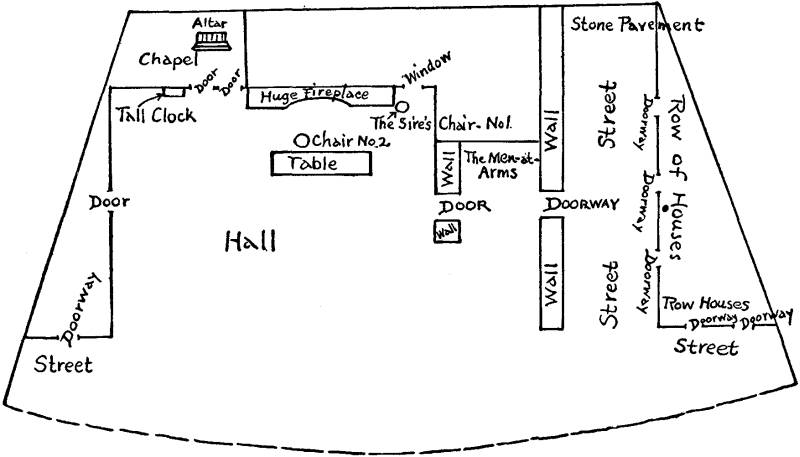
It is in many ways a bad setting. Waiving all question whether any attempt to suggest the fourth wall of a room, as in The Passing of the Third Floor Back by the fireplace at centre front of stage is wise, surely there can be no doubt that to ask an audience to imagine a street between them and the room into which they are looking, particularly when no necessary action takes place in that street, is undesirable. Therefore the suggested “street” across the front of the stage may go. Where is the value of the street at the side? Little, if any, action in it will be seen except by the very small part of the audience directly in line with it. For these the settings below the doors at stage left must be decidedly pushed back or they will lose important action by the fireplace. It is questionable, too, whether the fireplace should not be moved down stage to one side or the other, so important is the facial expression of the Sire de Maletroit as he sits by it. For effective action, it is better, also, to separate fireplace and chapel entrance. It is both easy and for acting purposes better, to stage this proposed play with a setting as simple as this:
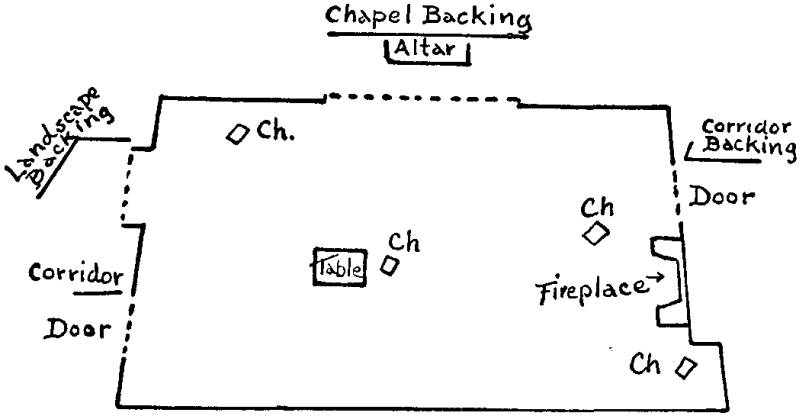
Gothic stone interior: Doors, centre leading to Chapel or Oratory; lower right and up left. All doors with old tapestry curtains. Deep mullioned window up right with landscape backing. Large Gothic fireplace, with hooded chimney, left. Corridor backings for all doors. Large armchair left centre in front of fireplace; large oak table right centre, with chairs on either side; other furniture of period to dress stage. Altar and furnishings for Chapel.
Nowadays descriptions of settings are noticeably free from the mystic R.U.E., L. 2 E., D.L.C., etc., which characterized stage directions of the early Victorian period. When wings and flats, as in some wood-scenes today, were used for indoor as well as outdoor scenes—that is, before the coming of the box-set—the stage was divided in this way:
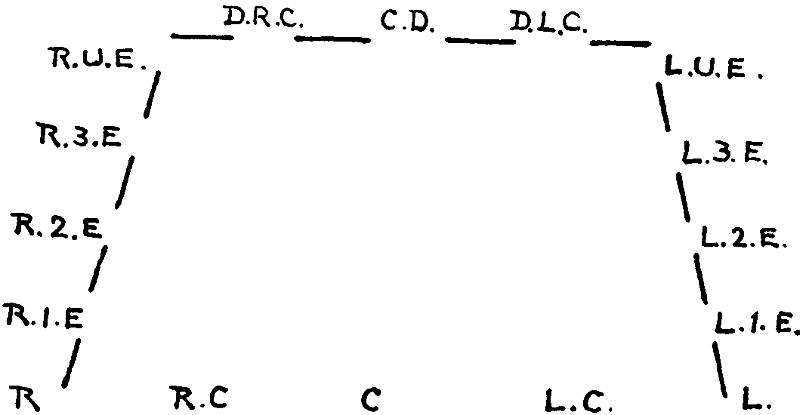
Now that the box-set has replaced the older fashion and new devices are steadily improving on the old wood-wings, it is enough to indicate clearly in the diagram and in the description what doors, windows, fireplaces, and properties are necessary, and exactly where, if their positions are essential in the action. If not, they may be placed to suit the sense of proportion of the designer of the scenery and the sense of fitness of the producer. In any case, rarely today does an author need to use all or many of these stage divisions of an older day. The first of the following diagrams shows how simply an interior set which makes no special demands may be indicated.
THE DANCING GIRL. ACT I5
Diana Valrose’s boudoir at Richmond. A very elegantly furnished room, with light, pretty furniture. Discover Drusilla in handsome morning dress arranging flowers in large china bowl. Enter footman, announcing Mr. Christison. Enter John. Exit Footman.
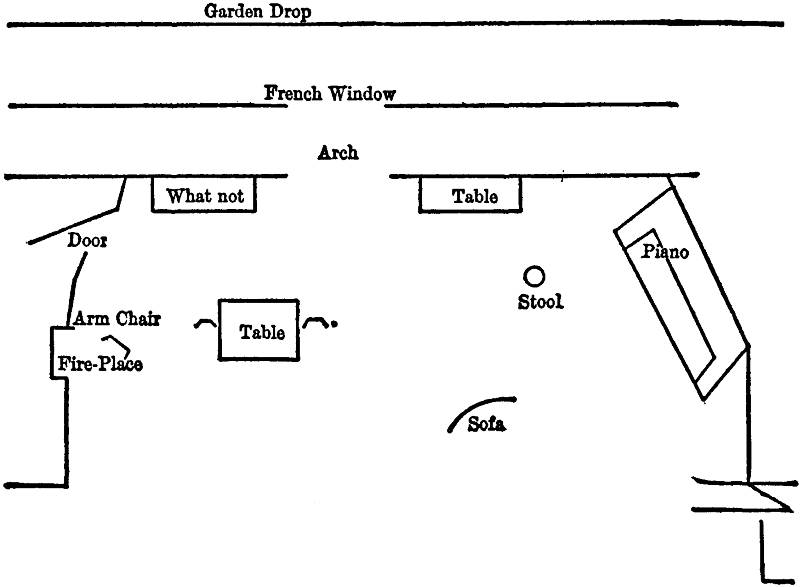
It is often desirable to vary the usual shape given a room on the stage—exactly rectangular or nearly square. The next diagram shows a more complicated setting, of unusual shape.