Front matter (continued 10)
Reading edition
THE WALLS OF JERICHO. ACT I6
An ante-room in Marquis of Steventon’s house during a ball. Miss Wyatt, a vivacious young American, has cake-walked with Twelvetrees all the way from the ball-room.
Music under stage.
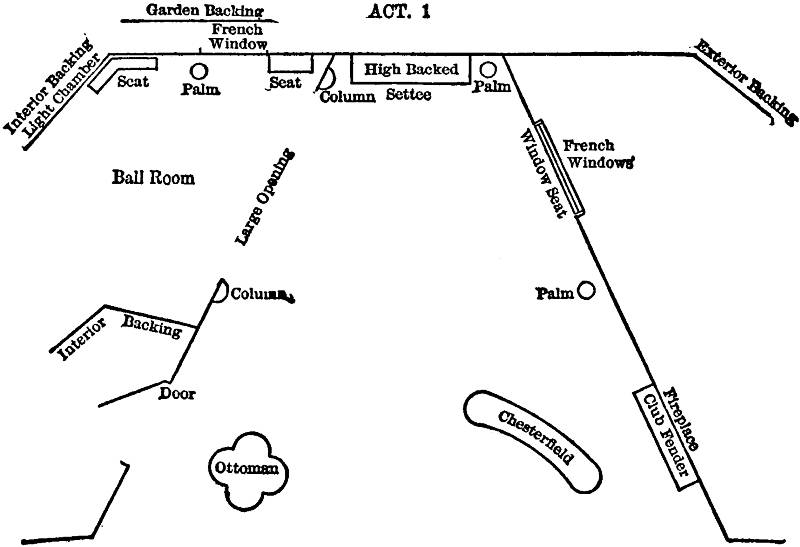
Act II of Young America calls for a setting in which the placing of heavy properties is important.
YOUNG AMERICA. ACT II7
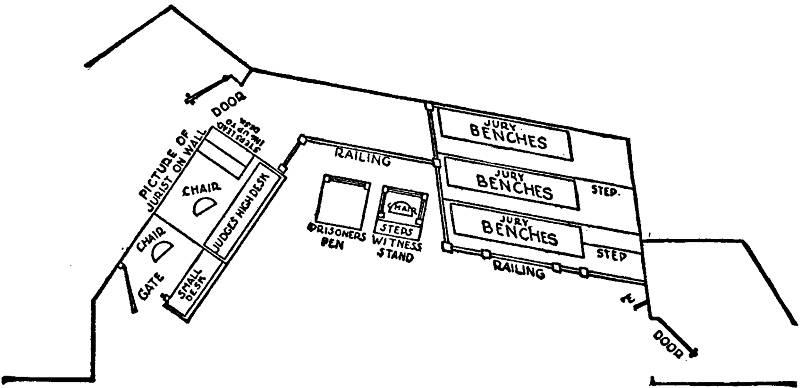
SCENE. The Juvenile Court, 10 A.M.—Two days later.
Two entrances, R. U. door leading to Judge’s chamber. L.2 door leading to corridor.
Right—Judge’s bench. It extends up and down stage. Below it Clerk’s bench upon which are two card catalogue filing cases for court records for children. At L. of Judge’s bench small docket for prisoner. At L. of docket, witness stand. It is an 18-inch platform with chair on it. The docket and witness stand face front.
Left—three benches for spectators and witnesses. They face front and are enclosed within a picket railing. Gate with spring lock, near left end of front railing.
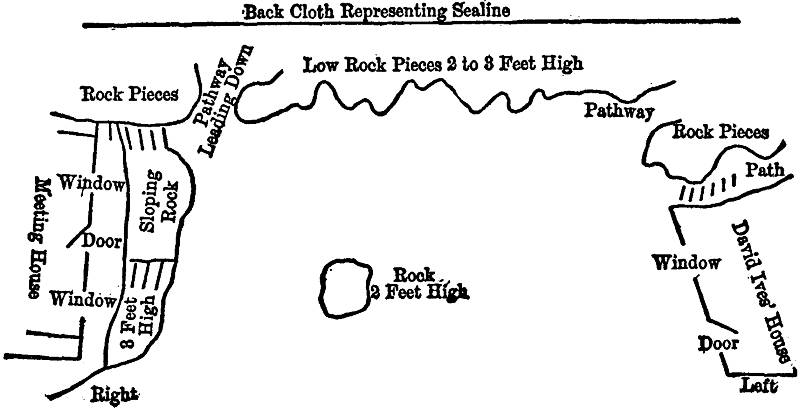
How the setting for an outdoor scene may be indicated the diagram for Act I of The Dancing Girl shows.
THE DANCING GIRL. ACT I8
SCENE. The Island of Saint Endellion, off the Cornish Coast. At the back is a line of low rocks, and beyond, the sea. A pathway leads through the rocks down to the sea. On the right side of the stage is the Quakers’ meeting-house, a plain square granite building, showing a door and two windows. The meeting-house is built on a low insular rock that rises some three or four feet above the stage; it is approached by pathways, leading up from the stage. On the left side of the stage, down towards the audience, is David Ives’s house; another plain granite building, with a door down stage, and above the door, a window. The house is built into a cliff that rises above it. Beyond the house is a pathway that leads up the cliff and disappears amongst the rocks on the left side towards the centre of the stage; a little to the right is a piece of rock rising about two feet from the stage. Time, An Autumn evening. I. Call. John Christison. Faith Ives. David Ives. Drusilla Ives.
As the chief purpose of the writer of a scenario is immediately to grip the interest of the reader, this dramatic outline must obviously provide any historical background necessary to sympathetic understanding of the story. In other words, a scenario must very briefly summarize the preliminary exposition about which so much has already been said in the body of this book.9 The opening of the scenario, already quoted in part on p. 428, may be interesting, but it is also puzzling, for a reader is not told enough in regard to the past of the figures involved to know how to receive what information is given. Much depends on whether Denis de Beaulieu is lying or not. Make the reader somehow understand that Denis and Blanche have never met before and that although the uncle believes Denis is her lover, he is completely in the wrong. Then comedy immediately emerges, interest increases.
Here is a scenario which remained vague and confusing, till just before the final curtain, because the writer thought surprise more valuable than suspense. Consequently he held back the one bit of information which gives significance and comic value to the conduct of Mr. and Mrs. Brede.
[Diagram of setting]
SCENE. The piazza of a mountain boarding-house. R, practicable door. L, practicable window. C, practicable step. On the piazza are a number of chairs. The bit of lawn in front is not too well kept.
Characters
Mr. Jones ordinary, well-educated people. Mrs. Jones
Major Halkit, retired business man, interested in stock companies.
Mrs. Halkit, his wife, an old gossip, prim and censorious.
Mr. Brede young, handsome, “nice.” Mrs. Brede
Jacobus, Yankee boarding-house keeper.
Brede and Jones come from the house and discuss the view from the piazza. Brede is enthusiastic and compares it with that from the Matterhorn. Mrs. Brede and Mrs. Jones come from the house in time to hear “Matterhorn” and Mrs. Brede expresses surprise that her husband has climbed it. Mr. Brede, confused, says it was five years ago, and Mrs. Brede gently chides him for doing such a thing during the first year of their marriage. Mr. Jones and Mrs. Brede talk aside while Mr. Brede explains to Mrs. Jones that he had left his wife in New York some months after their marriage for a hasty trip to Europe and had climbed the Matterhorn then.
Mr. and Mrs. Brede go down the side steps and off at R.C. for a stroll. Mr. and Mrs. Jones discuss them, and decide that they are very “nice” people. During their talk it develops that while Mr. Brede had been telling Mr. Jones that Mrs. Brede had been in this country when he climbed the Matterhorn, Mrs. Brede had informed Mrs. Jones that her husband had left her at Geneva and afterwards taken her to Basle, where their first child was born.
At this point Mrs. Halkit comes from the house. She censures Mrs. Brede for not knowing how to care for her husband and children and it comes out that Mrs. Brede has told Mrs. Halkit that they have two children who have been left with her aunt, whereas Mr. Brede has told Mr. Jones that they have three children at present under the care of his mother-in-law.
Enter Major Halkit from the house. He criticises Mr. Brede, who purports to be looking for a business opening, for his failure to take a fine chance the Major has pointed out to him.
The party come to the conclusion that there is something queer about the couple and are about to call Jacobus when he appears, coming from the left. Before any of the boarders have a chance to speak, Jacobus asks some question about the numbering of streets in New York and the fact is brought out that Mr. Brede told Mrs. Jacobus, when he was engaging the room, that he lived at number thirty-four of his street, and that the day before Mrs. Brede had informed Mrs. Jacobus that their number was thirty-five....
A reader struggling through the paragraphs of this scenario finds very little that is dramatic because the dramatic values the writer feels in his sentences cannot be the reader’s till he learns that Mr. and Mrs. Brede are a newly married couple who wish to conceal the fact. Re-read the quotation with that in mind and all confusion disappears.
On the other hand, it is not always easy to convey needed preliminary exposition interestingly. When much is needed, there is always danger that the opening of the scenario will be talky and referential rather than definite and full of dramatic action. The following is by no means as bad an example as might be found of a slow opening caused by need for much historical exposition, but it certainly lacks gripping action:
SCENARIO OF CONISTON
When the curtain is raised, Millicent Skinner is working about; a second later Chester Perkins comes slinking in, looking back as though pursued by the Evil One, and close on his heels, another local politician, Mr. Dodd, of the Brampton prudential school committee, enters with the same stealthy and harassed air. Millicent twits them with having run away from Bijah Bixby who is at Jonah Winch’s store. They deny that they are afraid of Bije or any one. It is brought out in a sentence or two that Jethro Bass, Cynthia and Ephraim Prescott are away on their Washington trip, and that Bijah, knowing of Jethro’s absence, is not likely to come here, which is why the two men have chosen the yard for a refuge; as they have been planning petty treason against the political control of the town by Jethro Bass. Millicent laughs at them and goes in the house. Mr. Dodd and Chester recover their swagger and begin to discuss Bijah and his sneaking ways. Bob Worthington enters, goes to the porch and calls Millicent. She responds from a nearby window. He enquires when she expects Cynthia to return. She tells him they will be here today. Bob announces that he will return, a little later, and goes out. Chester and Dodd discuss Bob’s attention to Cynthia and how furious the elder Worthington will be if his son marries the ward of Jethro Bass. Then they drift back to their first topic and are soon absorbed in their wordy revolt against Jethro Bass and Bijah.
Chester. This town’s tired of puttin’ up with a king!
(Behind them Bijah enters silently and stands at their elbows unperceived.)
Bijah. Leetle early for campaignin’, Chester, leetle early.
(The other two stand aghast.)
The scene which follows between the three men gives their characters, the Coniston political atmosphere, Jethro’s position as boss of the State and his character, the cumulating antagonism between Jethro Bass and Isaac Worthington, the relation between Jethro and Cynthia, his ward. Bijah confides to the two that a new era is dawning; that “the railroads, represented by Worthington, Sr., are tired of paying tribute” to Jethro and are about to turn and exterminate him. Bixby says that Jethro’s power is gone, that a greater than he has risen, that Isaac Worthington’s campaign, brought forth under cover of a great reform movement, will sweep the State in the next few months and leave Jethro politically dead. Bijah brings out a copy of the last issue of the Newcastle Guardian (leading newspaper of the State), and reads them “The scathing arraignment of Jethro Bass ... showing how he had debauched his own town of Coniston; how, enlarging on the same methods, he had gradually extended his grip over the county and finally over the State; how he had bought and sold men for his own power and profit, deceived those who had trusted him, corrupted governors and legislators ... how he had trafficked ruthlessly in the enterprises of the people.” Bijah tells them that the whole State is in a stir over this article, that it is the open declaration of war against Jethro.
Here Alva Hopkins and his daughter Cassandra enter. Hopkins has read the article and come post-haste to see Jethro. He and Bijah discuss the situation and Bijah tells them that the postmastership which Jethro has promised to Ephraim Prescott (and which it is surmised they have gone to Washington to secure) is to go to Dave Wheelock; that that will be the first tangible sign to the public of the fall of Jethro Bass....
The cardinal principle in scenario writing, as in the play itself, is that not talk but action is basal. In a scenario, however, action is described rather than represented. As we have just seen, the lengthy historical account of what lies behind the opening scene is hard to convey without talkiness. Many would-be dramatists dodge this difficulty, indeed the whole task of making clear the emotional significance of the action which the play involves, by writing scenarios which are little more than schedules of the entrances and exits of their characters. There was something of this in the “Coniston” scenario. The difficulty is still more marked in the following:
THE SIRE DE MALETROIT’S DOOR
SCENE: The Maletroit Entrance-Hall
[Diagram of Setting]
Characters
A Priest. The Sire de Maletroit. Blanche de Maletroit, his niece. Denis de Beaulieu. Retainer.
Discovered, Retainer finishing work on the door, C. Enter Priest, L.U.E. Slight exposition suggesting that a trap is being set for a girl’s gallant. Exit Priest. Enter R.U.E. the Sire. Commends the workman’s results, increasing the suspense regarding purpose. Rope outside window R, examined without explanation. Retainer, questioned as to news in the town, remarks the presence of a dare-devil young French soldier under safe-conduct who is likely to get into trouble with the troops quartered in town, unless he keeps a civil tongue in his head. Retainer dismissed R, with suggestion that he understands what is expected of him.
The Sire calls Priest, questions him regarding Blanche, furthering the exposition.
Blanche enters, dressed as bride, and bursts forth in troubled questions as to the meaning of her uncle’s orders regarding her appearance at this hour in such costume. The cause is hinted at as an intrigue, and Blanche is ordered to retire and wait in the chapel.
The Sire indicates that the hour is approaching for the “arrival” and the lights are extinguished.
As has been pointed out already,10 entrances and exits are of the slightest possible consequence except when they count in characterization or dramatic action. It is what takes place for the characters between an entrance and exit which a scenario must bring out as briefly yet clearly as possible.
This fault of over-emphasizing entrances and exits is closely related to the “referential” treatment of possible dramatic material. The method for this is: “Mr. and Mrs. Brown enter and talk passionately about their future.” “Anne and Sarah now have a tempestuous scene in which Anne discloses to the full her agony.” Such scenario writing is all too easy, for the value of the scenario, like the value of the play, will depend upon the ability of the author to make the first scene passionate and the second tempestuous and agonizing. A scenario which constantly states that at a given point something of interest will be done or a very powerful scene dealing with the emotions of one or more of the characters will be written is both useless and exasperating. Nobody wants to buy such a dramatic “pig in a poke.” Compare a referential scenario, the first of the three which follow, with the other two. They may, as parts of scenarios, have faults, but at least they move, not by references to “sarcasm, a horror that transfixes, violent threats,” etc., but by definitely roused emotional interest.
THE SIRE DE MALETROIT’S DOOR
[Diagram of Setting]
SCENE. A baronial apartment in heavy polished stone. At the back a large doorway hung with rich tapestry leads to a small chapel. At the right are two doors also with tapestry. In the left back corner is a huge fireplace carved with the arms of the Maletroits. At the left is a large open window looking over the parapets of the castle. A heavy table and a chair or two are all the furnishings.
Place: Château Landon. Time: Fourteenth Century.
Dramatis Personæ
Blanche, orphan niece of Sire de Maletroit. A Priest, chaplain to Sire de Maletroit. Sire de Maletroit. Denis de Beaulieu, a stranger.
As the curtain rises Blanche is seen in the chapel kneeling as the priest is finishing the chanting of the vesper service. At the close she rises and walks toward the window, glancing hastily about to see that no one is in the room. As soon as the priest has left she draws from her breast a letter which she starts to read. She is soon interrupted by the entrance of her uncle the Sire de Maletroit, whose keen glance detects her hasty crumpling of the note which she has not had time to conceal. He greets her jovially and starts to walk hand in hand with her. Forcing open her hand, he finds the note, which he reads in a bitterly sarcastic tone, while Blanche stands transfixed with horror. It is a note asking her to leave the house door open at midnight so that the writer may enter and exchange words with her on the stairs. With cold sarcasm, ill concealing his rage, the Sire forces from her the story that a young captain has met her in church and given her the note. She denies that she knows his name, and the most violent threats will not induce her to tell it. She is then sent to her room to dress in sackcloth of repentance and told to prepare to spend the night in the chapel.
THE SIRE DE MALETROIT’S DOOR
Persons represented
The Sire de Maletroit. Blanche de Maletroit, his niece. Denis de Beaulieu, a young soldier. A Priest.
SCENE. Large apartment of stone. On each of the three sides of the room, three doors curtained with tapestry. On left, beside the door a window. Stone chimney-piece, carved with arms of the Maletroits. Furniture, mainly consisting of table, and heavy chair beside chimney.
Place: Château Landon, France. Time: September, 1429.
Curtain rises showing an old gentleman in a fur tipped coat seated in the heavy chair. The old man is mumbling to himself a sort of strange murmur, smiling and nodding, as he sips a cup of wine. The room is silent save for the muttering of the old man.
Suddenly, from the direction of the arras covering the door to left, a muffled sound begins to obtrude itself. This sound, at first vague, then waxing more and more distinct, resolves itself into steps cautiously mounting a flight of stairs. The steps, gradually less vague, finally firm and assertive, reach the tapestried doorway. The click of metal, probably that of a sword, accompanying the steps, echoes in the hush of the room.
The arras parts, and a young man blinking from dark into sudden light, stumbles into the room. (As the tapestry closes behind the youth, a dark passageway and shadowy flight of stairs beyond are visible.)
Another pause ensues, during which the young man and the old man continue to gaze at one another.
”Pray step in,” begins the old man; “I have been expecting you all the evening.”
The youth shivers slightly, hesitating for speech. Finally he manages to answer....
MISTRESS BEATRICE COPE
ACT III. SCENE 1
Next day, White Oaks. Late twilight. Night falls during early part of scene. Later, moonlight. The great dining hall. It opens at the back on a terrace with a large door at centre. Dame Pettigrew, Joyce and Eliza discovered in a flutter over the news of the war. Scotch raids are threatened from over the border. There are terrible tales of the lootings by the King’s soldiers of places suspected of Jacobitry. Dame Pettigrew, as she hears now this story, now that, is first Whig and then Jacobite, until she bewilders herself and the maids. They play on one another’s nerves until they are in sore fright. Pettigrew begins to collect her goods against leaving on the morrow, regretting that she has sent for Beatrice to stay with her, who is momentarily expected. At height of nervous strain, when all windows have been closed, all lights but the fire are out, and the women sit cowering and silent, the mournful shrilling of bagpipes and the heavy tread of feet coming nearer and nearer are heard. Joyce gasps about ghosts. Chilled with terror, no one dares go to the window. The procession reaches the end of the lane and passes. Sudden sharp rapping at door. Frightened parley with spirits, as maids think. Beatrice forces them to open, and appears. The pipes are the funeral train of a Jacobite killed on the neighboring border and now on the way to Goodrest for a final mass. Beatrice is excited and anxious but brings order out of chaos in the room. Turns up lights, gets rid of Dame Pettigrew, and one maid, and sends other maid for supper. Bids Joyce, should Bill Lampeter appear, send him to her at once. She has a message for Crowe Hall. When Joyce has departed wonderingly, it appears that all day Beatrice has been trying to warn Cope at Goodrest that they were watched the day before, but has been unable till as she rode over with Jessie she met Bill Lampeter on the road. Dropping behind, she wrote hastily on her tablets a warning, and dropping them into Bill’s hands made him fly to Goodrest, he to report his success at once. A knock at the big door softly. Raymond’s voice. When she opens to him, a passionate scene follows. She is at first full of affection, mingled with dread of what he may know. He is fighting suspicion, passion for her, and inability to believe her guilty. Seeking her at Crowe Hall, he has followed her thither. At first she is too sincere to play with him. He is too anxious to be able to diplomatize. He shows his fears—that she is intriguing with another, with the Pretender. She is maddeningly incomprehensible—swears she knows no Pretender, but will not say yes or no as to meeting any one in the wood. In his anger and his desire to force the truth from her, by making her feel the uselessness of protecting the Pretender, he lets drop more than he realizes of plans to catch him and for the campaign. Seeing that, had her message not gone, her brother would have been trapped, Beatrice works to delay Raymond. She is first coldly repellent, then alluring, then silent, then apparently almost on the point of revelation. At last in despair he breaks away into the night, vowing vengeance on the destroyer of his happiness and cursing her for a fickle, ambitious thing, unworthy a good man’s love. She stands motionless by the table, then hurries to the wide open door through which the moonlight streams in from the garden, calls again and again softly, staggers back, and falls sobbing on the great settle. Van Brugh appears at the open doors, closes them softly and speaks. He is leaving the Hunters for good, for the final Jacobite blows are to be struck. Seeing Raymond ahead of him, he hid in the garden till Raymond went. He calls on “The Daughter of Charles Cope” to tell him for the good of the cause what she knows of Raymond’s plans. She denies that she knows them fully, but cannot deny that she knows something of them. He shows that everything depends for the Jacobites on knowing the movements of the local forces for the next few days. He uses every appeal he can, her brother among others. To this she only answers that she has warned and saved him. All his appeals are in vain. “Raymond is my husband in the sight of God. His secrets should be my secrets, but my brother I cannot help to kill. To save him I must deceive the man I love best in all the world; so be it. So much I must do, more I will not.” Sandiland, the fanatic breaking out in him, curses her as a renegade and unworthy her name and race. He goes. As she stands murmuring: “Unworthy love, unworthy my father’s name!” suddenly her face softens. She drops to the settle and prays for a moment. Quietly she rises, saying, “Why count the cost if Charles’ life be saved.” The door opens and Joyce enters in great excitement to say, “Bill has come, but in bad plight.” She fetches the boy, his clothes torn, his hands bleeding where ropes have cut the wrists. He has been taken shortly after leaving Beatrice and searched. He snatched the tablets from a captor’s hand and licked off the message before it was read. He was then trussed up behind a soldier on horseback, and started for the “Maid in the Valley” Tavern, the rendezvous from which the journey to Goodrest was to begin. By daring and ingenuity he slipped away at the inn. “Then my brother knows nothing.” “No, and they’ll be starting by now from the Maid in the Valley. They were waiting for the moon to be covered.” “Where’s Philly, my mare?” “In the paddock, miss.” “What do you mean?” cries Joyce. “I am going to Goodrest.” “Alone? To-night, with these rake-hell soldiers abroad?” Beatrice’s only answer is to find her whip and pass quickly out into the night. Joyce sinks down sobbing in window seat. Bill is in the doorway, wild with excitement. “Now, ride, ride, Miss Beatrice. Ride, like Hell!”
Quick Curtain
If it is clear that illustrative action is as essential in a scenario as in a play, it is as true for one form as the other that right proportioning and emphasis must make clear the purpose of the author in writing the scenario and must take a reader clearly to its conclusion. Read any one of the following three scenarios and decide whether you are clear as to the purpose of the author. What did he think was attractively dramatic in his material? What is the central interest of his proposed play? Just what is the suspense created near the beginning of the play and developed throughout from sub-climaxes to a final climax? As has been carefully explained, plays must do all this. Therefore their scenarios must also.
THE FISHING OF SUZANNE
SCENARIO. Curtain rises discovering Madame knitting in chair, upper right, Hélène embroidering in window-seat, Suzanne on sofa, trying to sew. Suzanne gets into trouble and Hélène helps her. Then grandmother offers to tell her a story. Suzanne says that her stories are so sad, always about her dead parents. Hélène represses her. Enter grandfather, the Colonel, rear. Suzanne starts to show him her sewing and is repulsed. Colonel denounces the Dreyfus situation; Madame trying to interfere when he begins on the American attitude, finally gets Hélène and Suzanne from room. Then Colonel learns that George Williams, an American, loves Hélène. He is overcome. Enter George rear. Embarrassing situation; finally George gets up courage and asks for Hélène’s hand, is refused, but goes away undaunted. Enter Hélène, side. Colonel says, “I will have no friend of traitors place his foot in my house.” Scene. Exit Hélène sobbing angrily. Colonel disturbed, but when wife starts after her, forbids her going. Exit the Colonel. Madame again starts toward door. Suzanne and Marie enter. Madame has Suzanne play with fishing rod; dismisses Marie from room. Suzanne hears Hélène’s sobs. Asks if she is sick. Says she will comfort her. Madame feels guilty and leaves. Suzanne persuades Hélène to come out and watch her fish. Catches some imaginary ones. Discovers George. He sends up notes like fish. Later Hélène furnishes bait. Then she fishes him up. Suzanne is dismissed with candy, and he persuades Hélène to elope. Suzanne comes and says the cab is there. Steps heard. George goes down rope. Marie tells of the cab. Hélène rushes into packing. Leaves note for mother with Suzanne, who wins a promise for a speedy return from her. Exit Hélène rear. Marie and Suzanne wave from window. Talk. Soon Colonel and Madame enter. See disorderly room. Suzanne gives them the note. Madame reads it and breaks news to her husband. Defends Hélène; reminds Colonel of their parents’ political differences. Suzanne tells how Hélène thought they did not care for her in her sorrow. Both in tears. Colonel in desperation starts to send for them by Marie. Enter George and Hélène; Hélène unable to leave without seeing them. Colonel says he may have been too hasty. Then Suzanne discovers George’s Legion of Honor badge. He and Colonel shake on the old friendship of the Republics.
Curtain
AN ENCORE
Adapted from a Story by Margaret Deland
Time: About 1830, in June. Place: Little town of Old Chester. Between the first and second act three weeks elapse.
Dramatis Personæ
Captain Price: Retired sea-captain, big, bluff, and hearty, with white hair and big white mustachios, rather untidy as to dress. Age, about 68.
Cyrus Price: His son, weak and neat-looking, very thin and of sandy complexion. Age, about 35.
Mrs. North: Sprightly, pretty, white-haired little lady of about 65. Always in black silk.
Miss North: Her daughter, nervous and shy, but truthful with a mania for taking care of her mother and no knowledge of how to wear her clothes; about 40.
Mrs. Gussie Price: A stout, colorless blond, a weeping, vividly gowned lady, who rules her husband, Cyrus, through her tears. Age, about 30.
Flora: A colored maid.
Stage setting: A drawing-room with a door on either side of the back, leading into the long front hall. A window at the right, looking into the street. Between the window and the door, a stuffed armchair, a hair-cloth sofa. Between the doors, under a mantel-shelf, a Franklin stove, on either side of which, but a little down stage, are two rockers just alike. To the left and back, grand piano. To the left, front, another big chair. Hassocks; and a knit shawl on almost every chair. The only ornament on the shelf is a stuffed bird in a glass case.
ACT I
Miss North is discovered in a very much starched gown, big apron, dusting-cap, and gloves; arranging the chairs more evenly and dusting. Expression of heavy responsibility in her face and manner.
Flora announces Mrs. Price, who enters—right door—at once. Though Mary explains she is busy, Mrs. Price stays. Sits on the sofa. Mary in rocking-chair to left of stove. Dialogue in which Mary explains she is determined to let her mother end life happily in her native town and she expects her to arrive any moment. Mrs. Price offers assistance in fixing up the house and begins to gossip about the fact that her father-in-law, the Captain, who lives in the Price house just across the street, tried to elope with Mrs. North when she was eighteen. Mary becomes very indignant, but sees her mother through the window and dismisses Mrs. Price politely but not sweetly. Exit Mrs. Price by the right door, Mary by the left. Enter Mrs. North by the right and Mary is seen hurrying by the right door with a small wooden chair in her hand.
Mrs. North begins to look about the room while she takes off her calash and leaves it on the piano, her shawl and puts it on the shelf, her gloves and leaves them on a chair. Mary enters, right, with the chair, during this business and remonstrates with her mother for getting out of the chaise without the aid of the chair. As Mrs. North drops her things Mary picks them up. Mrs. North sees the Price house through the window and mentions, cheerily, that the Captain used to be her beau. Mary is shocked. Tries to have her mother put on one of the little shawls and goes to make her some beef-tea. Hangs her things on the hat-tree in hall beyond left door as she goes out.
Mrs. North discovers the Captain going down street and calls him in. Enters right door with his pipe. Both sit in the rockers before the stove and are deep in reminiscences when Mary enters left door. The Captain is requested to put up his pipe, not to talk quite so loud, and not to stay long because of Mrs. North’s delicacy. When Mary offers to make him some beef-tea, too, so her mother can take hers, he leaves precipitately, very much cowed.
While Mary is trying to soothe Mrs. North after the undue excitement, Flora announces Cyrus Price who has come in search of his father—at Gussie’s tearful instigation. Mary and Cyrus hold an anxious aside, while Mrs. North expresses her pleasure at seeing the Captain again. Curtain falls on Mrs. North trying to pick out some of the old tunes on the piano, and Cyrus and Mary bidding each other a stiff “Good-morning.”
ACT II
The Captain and Mrs. North discovered, the Captain with his harmonica trying to teach Mrs. North the old airs. Enter Mary at right door, from outdoors. Consternation ensues and in a few moments the Captain leaves guiltily. Then Mary explains that she has been over to the Prices and requested Cyrus to tell the Captain he must keep away, for they are both too old to be married. Mrs. North exits left, in despair. Flora announces Mr. and Mrs. Price: a conference of war is held during which it is decided that Cyrus must consult the minister, Dr. Lavender, and Gussie must speak to the Captain himself. Exeunt Mr. and Mrs. Price.
Enter Mrs. North for her knitting. Mary wraps her up in a shawl, puts a hassock at her feet, suggests lighting a fire in the stove, and tries to comfort her mother by telling her she will take her away from Old Chester if the Captain keeps on bothering her. Mrs. North remonstrates feebly, and Mary decides she needs some beef-tea after the excitement. Exit Mary to make the tea.
Enter the Captain without ringing or knocking, in great wrath. Gussie has spoken to him. At first they laugh at the children’s stupidity and by degrees decide to carry out and confirm the children’s suspicions by eloping. Enter Mary. Confusion, but the Captain pretends he has come to say good-bye to her because he is going away for a few weeks and under that cover, makes the appointment for the eloping.
Curtain with his exit
THE CAPTAIN, A MELODRAMA
[Diagram]
Dramatis Personæ
Captain La Rue, a little sea captain.
Bromley Barnes, former special investigator for the U.S. Customs Service.
Patrick Clancy, his friend.
A burly Butler.
John Felspar, junior partner of the firm of Felspar & Felspar, wine merchants.
Two Dinner Guests, members of the firm.
Carl Cozzens, the firm’s Canadian representative.
SCENE. The dining-room of Felspar’s Summer Cottage
Time: Early evening
The Captain is discovered sitting on the end of the table next the window with his legs dangling dejectedly. Suddenly he sees something and, rushing to the window, goes through a violent pantomime imploring help and caution from some one without and indicating the way to enter the house. He then wrings his hands and paces the floor excitedly ending at D. R. C. where he listens. The key turns in the lock and Barnes and Clancy enter cautiously. The Captain throws himself at their feet and tells them of being kidnapped and confined and his Ship’s papers taken from him and asks frantically for the time. Barnes tells him, and the Captain becomes at once dejected and silent. The other two, however, draw from him the story of how he has been racing over the Atlantic to get a cargo of champagne to an American port in time to get the benefit of the old tariff rate, just increased by the governments concerned. He got in in time but was drugged and confined in this house till too late and his papers taken from him. They advise him to stay where he is and, promising to help him at once, slip out as they came. The Butler comes in D. R. C. and begins setting table, joking the Captain about the supper to be held in his honor, but growling about the suddenness of his master’s decision to have it. The Captain is excited and helps him in mock politeness. As they are working, Felspar comes in. Butler tells him that he has hired a waiter for the evening, subject to his approval—a man who happened to be walking by, with a friend. Felspar congratulates him and the new waiter is called. It is Clancy. La Rue controls himself as he recognizes him. Felspar orders the Butler to lock La Rue in the up-stairs bedroom, which has been prepared, till he shall be wanted, telling him at the same time that all the guests have arrived but Mr. Cozzens, who is to be brought directly to the dining-room when he arrives. The others will not wait for him. The Butler hurries La Rue off. Felspar gives a few parting instructions to the new waiter and goes to bring the guests. Clancy finishes the preparations and signals out the window to Barnes to come. Felspar comes back with the guests D. L. C. The Butler reappears, is called to the door-bell and ushers in Barnes as “Mr. Cozzens.” Felspar introduces him as the Canadian representative of the firm whom he has never seen before. Barnes takes the cue and excuses his costume, saying that he arrived late and has not had time to change. All sit again and Felspar, telling the Butler to bring La Rue, tells the company that the ship’s papers of the rival business house have come into his hands. These he produces and passes along the table. Barnes, at the opposite end, pockets them as they come to him and refuses to give them up. All are astonished and half-angry. The Butler, having brought in the Captain at Felspar’s order (who stands unnoticed at the back) again answers the bell and ushers in Mr. Cozzens, announcing him in a doubtful voice. Felspar stutters, “You—you Mr. Cozzens?” “So me mother and father says,” the new-comer replies. “And you?” says the wine-merchant wheeling on Barnes. Barnes presents his card which is read aloud by Felspar, who goes into a white heat and demands the papers back. Barnes blandly refuses. Felspar threatens, saying he has four to one. At this point Clancy and La Rue step forward and signify their readiness to side with Barnes. Felspar laughs and tells them to take the papers then as the new law went into effect at four-thirty that afternoon. But Barnes informs him that the provisions of the French-American commercial treaty demand that the customs houses remain open till midnight when such a law goes through, and that they still have several hours. Felspar is again furious and orders them out and the three go together leaving the company in an angry stupor.
Curtain
Let it be clearly understood that there is no definitely established length for a scenario. It may run from one to two pages for a play of one act to twenty or more pages for a longer play. Obviously, a scenario should be as brief as clear presentation of what it must give permits, for it primarily exists as a short cut for the person who reads it to necessary information about a proposed play. Clearness is the first essential; brevity the second. The exact length must in each case be decided by the particular needs of the subject treated and the best judgment of the writer.
Above all, it should be remembered that a scenario unless it is simply an abbreviated presentation of a play already in manuscript should be considered something flexible. What is meant by this is that many a writer working with a scenario which has been approved by a manager or actor feels hampered because as he writes he has almost irresistible impulses to break away from the scenario as planned into situations or details of characterization and even of general treatment which, though they occur to him at the moment, seem to him undoubted improvements. Yet he hesitates to change his plan because it has been approved. This is folly. A scenario is at its best when it concerns not a completed but a proposed play and is held to be not fixed but thoroughly flexible. If changes suggesting themselves are felt by the writer to be improvements, he should by all means incorporate them. A good scenario bears much the same relation to a completed play that an architect’s plans bear to a completed house. Where would the carpenter be without such plans, yet where is the set of plans which has not been modified or even greatly changed while the building is in construction? “Ibsen had no respect for any dramatist who proceeded otherwise [than from a carefully prepared scenario]. Once besought by a young dramatist to read the manuscript of his new play, Ibsen curtly asked for the scenario. When the young man proudly replied that he needed no scenario, having followed his inspiration whithersoever it led him from scene to scene, Ibsen grew furious and showed the pseudo-dramatist the door, declaring that any one who dispensed with a scenario didn’t know what a drama was and couldn’t possibly write one. And yet, after all, the scenario as first outlined by Ibsen may best be regarded as an experimental foreshadowing subject to radical modification as the writing of the play itself proceeds. It serves as the skeleton framework for Ibsen’s later ideation. ... While it is true, then, that the material took shape in his mind long before he wrote a word of actual dialogue, yet Ibsen expressly acknowledged that it never took such unalterable shape in his mind as to permit him to write the last act first or the first act last. During the course of the work the details emerged by degrees.”11
The fact is, a scenario is almost always a photograph of the mind of the person who writes it. If he is not ready to write his play, the scenario will show it, making clear whether this unreadiness comes from insufficiently understood characterization; thin or incomplete story; a lack of right proportioning of the material so that what is unimportant seems important; or a general vagueness as to what the author wants to do with his material. Just here lies the strong reason why every would-be dramatist will do well to become expert in scenario writing. He may for a long time fool himself into thinking that he can work better without a scenario; he may be able to write without putting on paper all that in this chapter has been required from the writer of a scenario, but sooner or later he goes through all the processes in his mind and either on paper or in his brain fulfils these requirements. The very people who shrink from forcing themselves to work out all the details required by a good scenario are merely dodging the inevitable. They avoid something irksome as a preliminary merely to do all this work before the completed play is ready. He who wants to write his play rapidly will find that he makes time in his final composition by taking all the time he needs in the preliminary task of drawing a good scenario. Undeniably, a scenario is the most effective way of forcing oneself to know the characters and the story of a play before one begins to write the play in detail. Work out a scenario carefully and all the difficult problems the play involves will have been solved except those of dialogue and perhaps some subtleties of characterization. Regard the resulting scenario as something entirely flexible and the composition of the play should be safe and even sure. He who steers by the compass knows how with safety to change his course. He who steers by dead reckoning is liable to error and delay.
Often questions as to scenarios are asked which imply that there must be some set form fulfilling all the requirements stated which can be adhered to strictly. Not at all. These various requirements may be met in almost as many ways as there are writers. One man may use more description. Another writer may use more narration. Some will use dialogue very freely. Some will characterize more than others. Yet all these different workers may produce scenarios equally good in that they are clear, brief, move by suggested dramatic action, are definite in genre, and make thoroughly evident their elements of suspense and climax.
Here are some scenarios which use dialogue rather freely. They are given not because such use is especially commendable but merely to illustrate it.
THE LEGACY
The persons
David Brice, a young attorney. Reene Brice, his uncle. Benjamin Doyle, his fiancée’s father. Dr. Wangren, family physician. Mrs. Brice, the mother. ”Ditto” Brice, the sister. Katherine Doyle, fiancée. The Time: The present. The Place: Any city.
SCENE. The Brice living-room comfortably furnished in walnut. A piano centre L., a round table rear R. Four entrances: upper L., rear centre, upper right, right centre. Curtained windows rear R. & L.
Joy seems to radiate through the household. Ditto and Katherine are discovered; Katherine, a pretty enthusiast of 22 playing diminuendo a joy-melody at piano; Ditto, pretty, 20 and nervous, crossing R. with an armload of tagged packages of various sizes and prettily tied—birthday presents for her brother David. Arrived at table, rear R., she deposits them.
Ditto. (Stacking packages.) Don’t you wish you were getting these birthday presents, Katherine?
Katherine. (Playing.) I am, Ditto, dear. David is mine; therefore, what is David’s belongs to me.
Ditto. (Petulantly.) And what is yours....
Katherine. (In fun.) ... Belongs to father.
(Begins to sing merrily.) (Exit Ditto, R.)
Enter Mrs. Brice, L., a thoughtful woman of 50, quite grey and though careworn, attractive. She carries a linen spread and goes to the table. Katherine sings softly, playing diminuendo.
Mrs. Brice. (Covering presents.) You are very happy tonight, aren’t you?
Katherine. (Cheerily.) Why shouldn’t I be, Mrs. Brice? It is David’s birthday. (Going to her.) But you aren’t.
Mrs. Brice. (Bravely.) Yes, I am. But you see this is probably David’s last birthday at home and....
Katherine. (Lovingly.) By no means! I shall bring him home every birthday. (Kissing her.) ... And once in a while between.
Mrs. Brice. (As they go down, arm in arm.) I know you will, Katherine, but we mothers ...
David. (Entering centre rear, overcoat, hat and traveling grip.) Hello everybody!... (Tosses grip on table and makes for them.) ... Merry Christmas, Happy New Year (kisses mother) and a quiet Fourth of July. (Kisses Katherine.)
(David is a well-built handsome man of 28 neatly dressed in business suit, light-weight overcoat and hat.)
David. (Removing coat, Katherine assisting.) Well, how are all the little details?
(Coat off, he begins kissing Katherine again. Enter Ditto, R.)
Ditto. (Petulantly.) Do you realize this is your birthday?
David. (Kissing mother.) I am doing my best to show it! (Tossing Ditto his coat.) Hang that up and I will show you.
(Exit Ditto, R., with his coat and hat.)
David. (Coming down from table with blue-print in hand.) Now, mother and child, look ye!
(He shows them the architectural plans of the new cottage he is going to build as a wedding present to Katherine. They like them very much. More joy. Ditto, reëntering, is also enthusiastic over plans.
David next announces that he has been invited to become a member of his employer’s law firm, one of the most successful in the State. More joy, manifested by another round of kisses.
But he has not only been asked to join the firm; the firm has promised him a straight loan, without interest, with which to build his house. Otherwise he would have had to borrow from a building and loan association. Therefore, bids are now being advertised for and work will begin very soon. Great joy. Ditto seizes mother’s hand and Katherine’s and dances a ring around David.
As the jollification subsides, David inquires for his uncle, Reene. He must approve the plans, for he was a great architect in his day. His mother informs him that the uncle went for a ride with Doctor Wangren.)
David. How is he feeling today?
Mrs. Brice. Not quite so well. In fact, I never saw him so despondent.
David. He must not look at it that way. We all have our little troubles. (To Katherine.) Don’t we?
(They go toward piano. Exit Mrs. Brice, L., taking Ditto with her.
In a short scene at the piano, during which Katherine plays diminuendo, the fact is revealed that her father opposes the match between her and David; not because he does not like David but for reasons which he has not divulged to his daughter. This cloud passes by quickly, however.)
THE CONSULTATION
The persons of the play
Marian. Katherine. Dr. Thomas Wells. Dr. Benjamin Crawford.
The scene represents a sitting room in Marian’s home. It is very cheaply furnished. There is a door at back centre, and also one at R. At upper left is a curtained window, not practicable. In the centre is a table, on which is a lighted lamp. Near the window is a couch. There are chairs about the room, and a few cheap pictures on the walls. It is evening, and the room is dimly lighted.
[Diagram]
When the curtain rises, there is no one in the room, but in a moment the door at rear opens, and Katherine enters noiselessly. She is a pleasant looking woman of 30. She is followed by Dr. Wells, who closes the door behind him very softly. He is a young man, with a Van Dyke beard. The two go to right of table, and Katherine looks at the doctor inquiringly. He speaks with some hesitation.
Dr. Wells. You want the truth?
Katherine. Of course.
Dr. Wells. I think he’s dying. This is the crisis, and the chances are a thousand to one against him.
Katherine. I’m afraid my sister can’t bear the shock. She loves her husband more than I can tell you, Doctor.
(They are discussing the case when Marian enters from the rear. She lingers a moment and looks back into the other room. Then she slowly closes the door, and advances towards the others. She is a pretty woman, about 25, but she looks pale and anxious.
Dr. Wells and Katherine stop talking when she comes near and watch her. She turns to the Doctor and asks for his verdict. He doesn’t reply, but looks inquiringly at Katherine. After a moment, she says he’d better tell her. Very gently he breaks the news, and informs her that her husband will probably die. The disease is vicious and can’t be checked.)
Marian. (Anxiously.) You mean my husband will die?
Dr. Wells. I fear so.
Marian. Don’t say that, Doctor. It will kill me. You don’t know what John means to me.
(The Doctor assures her that he has done his best, and the patient is now in the hands of God. He’s sorry but in all honesty he believes the man will die.
Marian refuses to believe, and maintains that her husband will not die. No doubt he’s a very sick man, but he will live. She declares she has sent for a man who can save him.)
Marian. You’ve been good, Doctor, and God will bless you. But you won’t blame me for saying that perhaps some one else might look at the case differently. You don’t feel hurt? Don’t blame me, but I’ve sent for Dr. Crawford, so you can have—what do you call it?—a consultation. I know he can save my husband’s life.
Dr. Wells. (Surprised.) You mean Dr. William Crawford, the famous specialist?
Marian. Yes. Oh, Doctor, he’s so wonderful!
Dr. Wells. (Enthusiastically.) Wonderful? I should say so. He’s one of the most remarkable men in the profession. If there’s any one in the world who can save your husband’s life, he is the man. (Doubtfully.) But can you pay his fee?
SCENARIO
THE WINNING OF GENERAL JANE
(A farce of three persons, a dog, and a gun “that wasn’t loaded”)
Cast
Jane, about twenty. Aunt Sophy, her maiden aunt, about 45. Bobby Holloway, a lodger, about 23.
Place, Jane’s bedroom. Time about 11 at night
SETTING. Lower left a closet, door opening inward. Upper left a door leading to Aunt Sophy’s room, opening inward. Rear centre, double-windows set in a shallow alcove. The curtains are draped to right and left. Right, up stage, a fireplace without a fire. Left, down stage, a dressing-table with mirror. A low stool stands before it. Against rear wall to left a washstand half-hidden by a Japanese screen, shoulder height. Against right wall and about halfway down stage a bed. It is low and preferably wooden.
[Diagram of Setting]
At rise Jane is discovered at dressing-table occupied in braiding her hair. Enter Aunt Sophy. She asks Jane if Mr. Holloway, their single lodger, is in for the night. Jane replies with some petulance that she does not know. A dissection of that gentleman’s character ensues in which Jane anathematizes him, while Aunt Sophy, despite her avowed dislike for all things masculine, champions his cause. At last Jane intimates that in all probability Mr. Holloway will propose to Aunt Sophy at a very early date. The latter cannot conceal her delight. She is not content with Jane’s assurance on this point but must know how she discovered the state of Bobby’s affections. Jane finally admits that she bases her deduction upon the fact that he “proposes to everybody, in season and out!”—that he has proposed to her, Jane, no less than 237 times.
Aunt Sophy is hurt and shocked at this revelation of perfidy and immediately sides with Jane, declaring that she will oust Mr. Holloway on the following morning. Jane however does not want to be sided with. With true feminine variability she shifts her attitude as completely as Aunt Sophy has hers, and pleads with the outraged old maid to reverse her decision. She shows that she really cares for Bobby more than at first appeared. Aunt Sophy however is obdurate, and departs, leaving Jane almost dissolved in tears.
At this juncture a racket arises outside Jane’s window. It is a mixture of blasphemous English, growls and hurried footsteps. Jane starts to investigate, but seeing an arm and a leg thrust hastily over the sill, retreats to the door in alarm. Immediately Bobby climbs in, and a smothered exclamation from Jane identifies him. He glances about hurriedly, and not perceiving her, turns his attention to the dog who still growls below. He epitomizes him with surprising fluency, until Jane, unable to stand more, interrupts. This precipitates a profuse apology for the intrusion and other things, an explanation, and later a proposal.
Jane is angered beyond measure not only at this invasion of her privacy but also at Bobby’s attitude towards the whole affair. She orders him to leave. He attempts to do so by way of the door.
Jane. (Frightened.) W-w-where are you going?
Bobby. (Shrugging.) Hump!—to heaven—eventually!
Jane. (Barring way.) N-n-not through Aunt Sophy’s room!
(She informs him that he must depart the way he came. He consents but only in a very half-hearted manner. Between Aunt Sophy and Towser he is in a quandary. After several unsuccessful starts he flatly refuses to descend, and upbraids Jane for her cruelty. He dwells at length on the horrors of dog-bites, hydrophobia, madness, and death.)
Bobby. (Injured.) As if I had not already been chewed up so that I can scarcely sit—(hastily)—I mean walk.
Jane. (Relenting.) Gracious! Bobby, did he bite you?
Bobby. Did he?
Jane. (Seizing bottle from table.) Heavens! You must put something on it! Some antiseptic! Bobby come here!
Bobby. Oh, no, no! No, it’s not serious!
Jane. Come here this instant!
Bobby. (Flatly.) I won’t do it!
(He succeeds so well in working upon her sympathies that even a knock at Aunt Sophy’s door is not enough to make her change her attitude. She now as obstinately refuses to let him descend to certain death as previously he had refused to do it. The knocks are continued. Jane is rapidly losing her head when it suddenly occurs to her that if she stores Bobby away under the bed until Towser has departed or Aunt Sophy has gone to sleep, all may yet be well. While Bobby is ensconcing himself in this new position a three cornered conversation takes place, in which Jane becomes more and more involved.)
Aunt Sophy. (Outside.) Jane, Jane, are you ill?
Jane. Ill? Oh, oh! I don’t know!
Aunt Sophy. Open the door this minute or I’ll break it down!
Jane. Break it down?
Aunt Sophy. Yes, this instant!
Jane. Oh, oh! Don’t do that! It’s not locked! ...
It may be interesting to compare the scenario of A Doll’s House from which Ibsen wrote his first draft with his original notes. Here is perfect illustration of the difference between sketchy notes which mean much to the writer and a scenario which at least broadly will convey to a reader the artistic and ethical purposes in the play the dramatist means to write.
NOTES FOR THE MODERN TRAGEDY
Rome, 19. 10, 78.
There are two kinds of spiritual law, two kinds of conscience, one in man and another, altogether different, in woman. They do not understand each other; but in practical life the woman is judged by man’s law, as though she were not a woman but a man.
The wife in the play ends by having no idea of what is right or wrong; natural feeling on the one hand and belief in authority on the other have altogether bewildered her.
A woman cannot be herself in the society of the present day, which is an exclusively masculine society, with laws framed by men and with a judicial system that judges feminine conduct from a masculine point of view.
She has committed forgery, and she is proud of it; for she did it out of love for her husband, to save his life. But this husband, with his commonplace principles of honour is on the side of the law and regards the question with masculine eyes.
Spiritual conflicts. Oppressed and bewildered by the belief in authority, she loses faith in her moral right and ability to bring up her children. Bitterness. A mother in modern society, like certain insects who go away and die when she has done her duty in the propagation of the race.12 Love of life, of home, of husband and children and family. Here and there a womanly shaking-off of her thoughts. Sudden return of anxiety and terror. She must bear it all alone. The catastrophe approaches, inexorably, inevitably. Despair, conflict, and destruction.
(Krogstad has acted dishonourably and thereby become well-to-do; now his prosperity does not help him, he cannot recover his honour.)13
Persons
Stenborg, a Government clerk. Nora, his wife. Miss (Mrs.) Linde (a widow). Attorney Krogstad. Karen, nurse at the Stenborgs’. A Parlour-Maid at the Stenborgs’. A Porter. The Stenborgs’ three little children. Doctor Hank.
SCENARIO. FIRST ACT
A room comfortably, but not showily, furnished. In the back, on the right, a door leads to the hall; on the left another door leads to the room or office of the master of the house, which can be seen when the door is opened. A fire in the stove. Winter day.
She enters from the back, humming gaily; she is in outdoor dress and carries several parcels, has been shopping. As she opens the door, a Porter is seen in the hall, carrying a Christmas-tree. She: Put it down there for the present. (Taking out her purse.) How much? Porter: Fifty öre. She: Here is a crown. No, keep the change. The Porter thanks her and goes. She continues humming and smiling with quiet glee as she opens several of the parcels she has brought. Calls off, is he at home? Yes! At first, conversation through the closed door; then he opens it and goes on talking to her while continuing to work most of the time, standing at his desk. There is a ring at the hall-door; he does not want to be disturbed; shuts himself in. The maid opens the door to her mistress’s friend, just arrived in town. Happy surprise. Mutual explanation of the position of affairs. He has received the post of manager in the new joint-stock bank and is to enter on his duties at the New Year; all financial worries are at an end. The friend has come to town to look for some small employment in an office or whatever may present itself. Mrs. Stenborg gives her good hopes, is certain that all will turn out well. The maid opens the front door to the debt-collector. Mrs. Stenborg, terrified; they exchange a few words; he is shown into the office. Mrs. Stenborg and her friend; the circumstances of the debt-collector are touched upon. Stenborg enters in his overcoat; has sent the collector out the other way. Conversation about the friend’s affairs; hesitation on his part. He and the friend go out; his wife follows them into the hall; the Nurse enters with the children. Mother and children play. The collector enters. Mrs. Stenborg sends the children out to the left. Great scene between her and him. He goes. Stenborg enters; has met him on the stairs; displeased; wants to know what he came back for? Her support? No intrigues. His wife cautiously tries to pump him. Strict legal answers. Exit to his room. She (repeating her words when the collector went out): But that’s impossible. Why, I did it from love!
SCENARIO. SECOND ACT
The last day of the year. Midday. Nora and the old Nurse. Nora, impelled by uneasiness, is putting on her things to go out. Anxious random questions of one kind and another give a hint that thoughts of death are in her mind. Tries to banish these thoughts, to turn it off, hopes that something or other may intervene. But what? The Nurse goes off to the left.—Stenborg enters from his room. Short dialogue between him and Nora.—The Nurse re-enters, looking for Nora; the youngest child is crying. Annoyance and questioning on Stenborg’s part; exit the Nurse; Stenborg is going in to the children.—Doctor Hank enters. Scene between him and Stenborg.—Nora soon re-enters; she has turned back; anxiety has driven her home again. Scene between her, the Doctor and Stenborg. Stenborg goes into his room.—Scene between Nora and the Doctor. The Doctor goes out.—Nora alone.—Mrs. Linde enters. Short scene between her and Nora.—Krogstad enters. Short scene between him and Mrs. Linde and Nora. Mrs. Linde goes in to the children.—Scene between Krogstad and Nora.—She entreats and implores him for the sake of her little children; in vain. Krogstad goes out. The letter is seen to fall from outside into the letter-box.—Mrs. Linde re-enters after a short pause. Scene between her and Nora. Half confession. Mrs. Linde goes out.—Nora alone.—Stenborg enters. Scene between him and Nora. He wants to empty the letter-box. Entreaties, jests, half playful persuasion. He promises to let business wait till after New Year’s Day; but at 12 o’clock midnight—! Exit. Nora alone. Nora (looking at the clock): It is five o’clock. Five;—seven hours till midnight. Twenty-four hours till the next midnight. Twenty-four and seven—thirty-one. Thirty-one hours to live.—
THIRD ACT
A muffled sound of dance music is heard from the floor above. A lighted lamp on the table. Mrs. Linde sits in an armchair and absently turns the pages of a book, tries to read, but seems unable to fix her attention; once or twice she looks at her watch. Nora comes down from the dance; uneasiness has driven her; surprise at finding Mrs. Linde, who pretends that she wanted to see Nora in her costume. Helmer, displeased at her going away, comes to fetch her back. The Doctor also enters, but to say good-bye. Meanwhile Mrs. Linde has gone into the side room on the right. Scene between the Doctor, Helmer, and Nora. He is going to bed, he says, never to get up again; they are not to come and see him; there is ugliness about a death-bed. He goes out. Helmer goes upstairs again with Nora, after the latter has exchanged a few words of farewell with Mrs. Linde. Mrs. Linde alone. Then Krogstad. Scene and explanation between them. Both go out. Nora and the children. Then she alone. Then Helmer. He takes the letters out of the letter-box. Short scene; goodnight; he goes into his room. Nora in despair prepares for the final step; is already at the door when Helmer enters with the open letter in his hand. Great scene. A ring. Letter to Nora from Krogstad. Final scene. Divorce. Nora leaves the house.14
Finally, here is the full scenario of a play which made a great success both in England and the United States and was seen by practically all the Continental countries, namely, Kismet. Notice how well it fulfils the requirements for a good scenario stated in this chapter, not because Mr. Knobloch had these rules in mind as he composed it, but because, as a trained dramatist, he instinctively gave these qualities to his scenario. Carefully studied in relation to the essentials of scenario writing just stated, it should remove all doubt in the mind of a student as to what a good scenario is and why it is an essential preliminary to a good play.
KISMET or HAJJI’S DAY
Scenario for a play in three acts, by EDWARD KNOBLOCH15
CHARACTERS (in order of their appearance)
Original Names Later Names
Hajji. Hajj (as Hajji is Persian, Hajj Arabian).
A Priest. Imam Mahmud.
Guide. Nasir.
Sheikh of the Desert. Jawan.
Young Beggar. Kasim.
Sultan. The Caliph Abdallah.
His Vizier. Abu Bakr.
Shopkeeper I. Amru.
Shopkeeper II. Fayd.
Zira. Marsinah.
Old Woman I. Narjis.
Officer of Guard. Captain of the Watch.
Executioner. Mansur, Chief of Police.
His Scribe. Turned into two characters:
Kafur, the Sworder.
Afife, the Hunchback.
Old Woman II.
Executioner’s Wife. Kut-Al-Kulub.
Gaoler. Kutayt.
Peasant. Trial scene at Cut out in final draft.
Two Wives. Sultan’s.
Dancers, Soldiers, Courtiers, Women, the People.
ACT I
[Scene later introduced before the curtain.]
Scene 1. A Street before a Mosque.
Scene 2. The Bazaar.
Scene 3. Courtyard of a Poor House.
Scene 4. Courtyard of Executioner’s House.
ACT II
Scene 1. Interior Room of Executioner’s House.
Scene 2. Courtyard of a Poor House. (Act I, Scene 3.)
Scene 3. The Sultan’s Audience Hall.
Scene 4. A Dungeon.
ACT III
Scene 1. Courtyard of a Poor House (Act I, Scene 3) [cut in final version].
Scene 2. The Bath of the Executioner’s House.
Scene 3. A street before a Mosque. (Act I, Scene 1.)
The Scene is laid in Bagdad. The action takes place from morning to night.
ACT I
SCENE 1
A narrow street with stone steps leading up to a Mosque left. (Small set.)
The sun is just beginning to rise.
Asleep on a large stone which juts out from the angle of the wall C. sits Hajji wrapped in his beggar’s cloak. On the minaret of the Mosque appears the priest, a venerable white bearded man. He calls to prayer. [See alterations in actual play.]
The crowd begins to pass into the Mosque as the sun rises. Hajji wakes up, rubs his eyes, and has a drink of water from a gourd which he draws out from behind his seat. He begins to beg from the passers-by.
An Old Man (Jawan) preceded by a guide (Nasir) is carried across the scene in a litter. He fixes his gaze on Hajji and is carried off into the Mosque. The guide remains in the portico. Hajji follows the Old Man on his knees to the steps of the Mosque, begging.
As he does so a lean Beggar of a younger cast of countenance takes Hajji’s place.
Hajji returns to his seat.
Hajji. Hajji curses young Beggar. Explains young Beggar must be stranger. Who is he that he does not know of Hajji? He has sat on this seat for thirty years. His father has sat there before him. His grandfather before him. Great pride in his ancestry of beggardom.
Young Beggar. (Kasim.) The young Beggar tries to retaliate. Hajji tells him to go and sit on a seat round the corner—“where other swine have sat before you.” He kicks the young Beggar.
The Guide (Nasir) of the Old Man comes down to interfere. The Young Beggar (Kasim) sulks into a corner nursing his kick.
Hajji. Hajji and Guide get into conversation.
The Guide. (Kasim.) Guide explains Rich Man here on a pilgrimage. Is really a famous old Robber Chief, a Cûrd, One of the Sheikhs of the desert: all of whom were notorious and banished by late Sultan (Caliph). Sheikh old and dying. Come to pray to Allah to restore his son to him before he dies (if son still alive).
[Sultan is used throughout this scenario—for which, in play, Caliph is substituted. Caliph is correct, as being Arabian. The title Sultan is of later origin and of Turkish influence.] Sheikh was attacked by Sultan’s troops twenty-five years ago, and his son, then four years old, carried off. Hajji says he knows what that means. Had his wife carried off many years ago. The only woman he ever loved—really loved. The Guide: “I know, Hajji, and I pity you. I have a proposition to make: I know the Sheikh will give money to charity to save his soul just before dying. Now if you could predict something to him,— Say that he will find his son again,— The Sheikh will give you money.” And for this advice Guide and Hajji are to divide money. Hajji agrees to this. Prayers are over.
The crowd disperses coming from the Mosque. Sheikh is carried out of the Mosque in his litter.
Hajji. Hajji throws himself in front of litter. Crying out: “Listen to me. I can see why you have come. You are looking for some one,—your son. You shall find him. Give me money.” Sheikh amazed at Hajji’s knowledge. Hajji says his wits have been sharpened through grief and suffering. “I had a wife and a son. They were stolen by my enemy. My son was murdered, My wife carried off . The swine of a beggar who sat round the corner did it. He is my enemy. The curse of my life.” Sheikh holds out purse, chinking it. Hajji blesses Sheikh. Sheikh bursts out laughing. Reveals himself to Hajji. He (Sheikh) is his enemy. He ran away with Hajji’s wife.
[Some of this is incorporated in the scene with Nasir.] And became a robber under her inspiring influence. One of a band of robbers that attacked the caravans. It is their son (by Hajji’s wife) that the Sultan captured when he attacked the robbers. Laughs at Hajji for blessing him. Thanks him ironically. Throws the purse and is carried off by his men. Hajji shouts curses after him. And kicks away the money.
Hajji. (Alone.) He is torn in two by the hatred for his enemy.
Young Beggar, in corner. And the love of the money. What he could do with the money.
[This was cut at rehearsals, as halting the action,] He could do so much for Zira (the daughter), The pride of his heart, the consolation of his old age, The one balm to his fatherly heart. But his enemy’s money? Never. But Zira? Trinkets for her. Her laughter. Her smile. But the Sheikh’s money—The beast who robbed him of his wife. Who was Zira’s mother? No one. A dancing girl, a passing whim. The fancy of a late spring. But his wife—the one that the Sheikh took—she was everything. His joy, his pride, the first finding of his manhood. To the purse: “I’ll not touch thee.” (He spits at it.)
He sees some one coming. He quickly pockets the purse.
The Guide reënters
Hajji. Guide. Young Beggar. Guide comes to claim half of his money. Hajji does not know anything of the bargain; “I saw no purse.” Guide furious. Hajji laughs at him. He appeals to young Beggar. Was there a purse there? The young Beggar sides with Hajji. Guide off, furious, vowing vengeance. Hajji says, “Go thy way in peace.”
Hajji. Young Beggar. Young Beggar: “What do I get for siding with you?” “What?” “I saw you pick up the purse. I heard the agreement: you promised him half.” Hajji says the money was given him, not by the Sheikh, but by fate. We all have a day in life. This is Hajji’s day. There is a future before him. The Sheikh rose from the mud to power and riches. Why not Hajji? Fortune is smiling on him at last. He will forsake the seat he has sat on these thirty years. Go forth into the world. What shall he give the Young Beggar? His throne and his beggar’s cloak. (He instates him in his seat and goes off.)
[Here the Priest is introduced in the play to heighten the effect at the end. Also to make him a friend of Hajji’s, as Hajji sends his daughter to him at the end of the Hareem scene. Act III, Scene 1.] Curtain
SCENE 2
The Bazaar. (Large set)
Shopkeeper I and Shopkeeper II lying outside of adjoining shops. They are very friendly.
Crowd.
Young Sultan (Caliph) rides through the bazaar on a white donkey. His Vizier (Abu Bakr) follows him. Also guards.
Hajji appears. Shopkeeper I. Shopkeeper II. Political discussion. Young Sultan just come through bazaar. Hajji regrets he missed seeing him. Sultan only been Sultan ten days.
[Read Caliph for Sultan.] Nephew of old Sultan now dead. Young Sultan brought up in a monastery,
[In the play, the shopkeepers have a scene of explanation before Hajj enters,—altered when writing play.] Said to be a dreamer and a poet. The real ruler said to be the Executioner, A favourite of late Sultan, Young man, too, but very strong, Very cruel and selfish. Young Sultan does not see much of Executioner (Mansur). Supposed to disappear on nightly expeditions, To get to know his people, To have some love adventures. Has been brought up strictly in monastery, Has never yet, they say, tested the “charm of his beard.”
[This altered. See note above. In the play Hajj enters here.] Hajji listens to all this humbly, Sitting almost under the counter, Then begins to finger stuffs. The shopkeeper is going to drive him off. But Hajji is in earnest. Shows his purse. He means to buy. Clothes are forthcoming. He selects some. Once he has gone to the bath and the barber he will be resplendent—as noble as the noblest. Hajji asks the price. It is very high. He begins to bargain. Shopkeeper No. II chimes in. Hajji pits Shopkeeper No. I against No. II. They quarrel. Hajji fans the quarrel into flame. They almost come to blows. Hajji escapes with his clothes.
Shopkeeper No. I. and Shopkeeper No. II The shopkeepers notice his escape. They combine at once against the common enemy. Shopkeeper I will go for the guard, And have Hajji followed and caught. Shopkeeper II to meet him at the Executioner’s to witness against Hajji.
[Here Nasir the Guide is introduced to give away Hajj. This was done when the play was revised for production.] Curtain
SCENE 3
(For “Zira” read “Marsinah.”)
Zira’s home. Small courtyard of a poor house. On right side a large gate backing to street. Fountain in courtyard.
Old Woman. Zira, the daughter Hajji. [Marsinah works. This was altered when writing play, because of Arabian embroidery frame seen in the Museum of Tunis.] Old woman is spinning. Zira is lazily hanging her hand into fountain. (She works instead.) Old Woman reprimands her for not working. She has changed in last three days. Zira, who hides her wools, says her thread has given out. Old Woman will go to bazaar for thread. Locks door carefully, going out.
Zira springs up and goes to the casement in Courtyard and then, plucking a rose, throws it out. She then unlocks casement and goes back to the fountain.
Young Sultan appears in simple clothes, climbing in.
Zira. Young Sultan. Love scene. His madness to come at daytime. Since he saw her first three nights ago from neighboring roof-tops cannot rest. She asks who he is. He is so different from her father. His hands so beautiful. He has love scene, In which they exchange rhymed couplets In Arabian Nights fashion. He puts a question (line one and two rhyming) She caps it (line three not rhyming, but line four rhyming with one and two). The girl is witty but natural. This charms the Sultan beyond measure. All the women he has had presented to him are so stupid. She says: ‘”All the women’!” Who is he? He says a simple scribe—brought up in a monastery. His uncle wishes him to marry. He has never loved before, Till meeting Zira. They embrace.
Noise of key in gate. They hear noise. They separate—He will come back after sundown to see her. She gives him a rose. Then he will tell her something which will surprise her. He escapes through the window. Zira back to fountain, (to her work).
Old Woman reënters breathless.
Old Woman. Zira. Old Woman says Zira’s father is coming. Thing he has never done during daytime. Luckily she saw him as she returned from bazaar. He was coming out of Public Bath, Beautifully dressed. They pretend to be busy working. Noise of key.
Hajji arrives, dressed in good clothes, curls trimmed and beard combed.
Hajji. Zira. Old Woman. Greetings. Zira admires her father. Old Woman sent off to get meal ready.
Hajji. Zira. Hajji has great plans for his daughter. His affection for her profound. He plans for her future. She is very charming to him, As she naturally wishes to hide her love affair, and get into his good graces. She takes out her guitar. Begins to sing to him. He sways before her admiringly on his knees. Says she is beautiful.
[This altered in the writing of play.] Her mother was not beautiful, Not like his wife that he loved Not like his son now dead. But she is more beautiful than all, The light of his eyes. She laughs and sings. He claps his hands in ecstasy He has great ambitions for her. A knock on the door. Zira is sent by her father into the inner house. The Old Woman comes out of house and says it will be some pedlar at door. She opens.
The Officer of the Guard and Guard enter with the Shopkeeper I
Hajji. Shopkeeper. Officer. Shopkeeper accuses Hajji of stealing garments he has on. Hajji denies it. Shopkeeper will have him taken before the Executioner (Mansur). Hajji protests. He is taken off in spite of his assurances that the Shopkeeper is a madman.
[Re-introduction of Nasir, saying, “I saw no purse!” Change made during rehearsals] Curtain
SCENE 4
Hall in Executioner’s House (large set). A colonnade at back, showing courtyard.
Executioner (Mansur). His Scribe (Afife), an old man [Kafur his Sworder,—added when play was written. This first scene is enlarged in play by a letter from the Caliph. See play.] Executioner very discontented. Young Sultan means to curtail Executioner’s prerogatives. Executioner was old Sultan’s favorite. Scribe and Executioner plan to assassinate Sultan. They need a clever man. Whom shall they get?
Hajji is brought by the Guard, followed by Shopkeeper and a Crowd, in which is the Guide of Scene 1.
Hajji. Executioner. Scribe. Guide. Shopkeeper I. Shopkeeper II. Crowd. Hajji accused by Shopkeeper I. Shopkeeper II bearing No. I witness. Hajji protests. Meant to pay—Excitement of new clothes made him forget. Produces money. Where did he get his money? Sheikh of desert. They all laugh. Sheikh of desert does not give money. Sheikhs are outlaws, robbers. Not allowed in town. Hajji says he is in town. Notices Guide (Nasir) in crowd. Appeals to Guide— Guide says it is true that Sheikh is in town. Then, says Executioner, Sheikh must be taken before Sultan. All Cûrds banished by old Sultan. Sultan has an audience this afternoon. Sheikh an exile (by old Sultan). Executioner cannot allow the word of the deceased monarch to be disregarded. Sends Guide off to show the Guard the caravansary at which Sheikh is stopping. Hajji interrupts. One word. He asks Guide did he, the Sheikh, not throw Hajji a purse. Guide repeating Hajji’s words (Scene 1) “I saw no purse.” All laugh. Guide off with the Guard.
[Afterwards, “his hand cut off,” as this is the law of the Koran. Change made when writing play.] Executioner orders Hajji to have his ears cut off. Hajji discourses on Fate, Kismet. Is very witty. Executioner becomes interested in Hajji’s brilliancy. Hajji is pardoned suddenly by Executioner. Executioner does more. He takes Hajji into his household Into his personal guard. A sword is sent for. Hajji kneels in gratitude at the Executioner’s feet. “His servant always.” The sword is brought in. Executioner takes it and hands it to Hajji. “Rise, Hajji, and learn to use this sword in my service.” Hajji rises. He begs he may begin his career by an act of clemency. Executioner grants permission. Hajji makes the Shopkeepers kneel, forgives them for daring to accuse a servant of the Executioner’s of stealing—tickles their beards with his sword and orders them to pay a fine to the Executioner. They leave more dead than alive. Hajji turns to Executioner. H. “Have I begun well?” E. “The beginning is nothing. Go now and the Captain will instruct you in your duties.” H. (with enormous swagger) “Captain?” He goes out, the rest following him.
The Scribe. Executioner. Is amazed at Executioner’s clemency. E. “Don’t you see why I have pardoned him?” S. “No, Master.” E. “This man shall do the deed.” S. “The deed?” E. “Murder the Sultan for me.” S. “I see.”
(They both turn and look after Hajji who is seen traversing the courtyard at the back and twirling his moustaches, the servants all bowing low to him.)
Curtain
ACT II
An inner chamber in Executioner’s House. Door leading to Hareem.
[This is the same hall as at the end of Act I, only that curtains are drawn to hide the courtyard.]
Hajji. Executioner. Scribe. [Coffee and smoking suppressed, as both were found to be anachronisms.] [This altered. Eastern men do not speak of their wives to strangers.] Executioner and Scribe seated on a platform drinking coffee and smoking. Hajji seated below them entertaining them with amorous stories. They are all laughing. Hajji finishes a story. Executioner says it reminds him of his principal wife. A slight pause. The Executioner gives Scribe a look as if to say “To business.” He says to Hajji— How would Hajji like to become a great power in the state? He broaches plan of assassinating the Sultan. Hajji hesitates. Executioner unfolds scheme. There is an audience in half an hour. Hajji can come as a Fakir.
[See play. All of this scene was split in half, and Mansur does not now suggest the assassination till at the end of the second half. The reason is clear: Hajj could not have a love scene (as he does now) if he were brooding about the assassination. This was altered in rehearsal at the suggestion of Mr. Grimwood, who played Mansur in England.] Has told Executioner he could juggle—used to play tricks at his corner when begging. Hajji could get close to Sultan and kill him. No danger to Hajji. As the Guards are under command of Executioner. Executioner will be there. But, of course, Hajji must under no condition recognize the Executioner. Hajji feels doubts. Executioner fills him full of promises. Executioner will be made Sultan. Hajji shall become Executioner. Executioner off to put on his armour for audience. Scribe goes with him. Executioner: “Think it over. If you don’t like it—there is always room for a strangled body in the river.”
[Hajji (Alone).] “So this is why I was pardoned this morning? Oh, Hajji! What a fool you are! And you thought your personal charm did it all.”
Hajji. Old Woman No II. [Changed to young slave Miskah. The note becomes a message, with dialogue between Hajji and Miskah] Door of Hareem opens. Old Woman No. II appears with a note, gives it to Hajji. Hajji reads it, smiles and nods. Old Woman disappears.
Hajji (Alone). “After all I cannot be so utterly without charm, if this can happen to me.” He twirls his moustaches up and looks at himself in the blade of his sword.
Old Woman No. II reenters with veiled woman (Executioner’s Wife). Old Woman stands guard.
Hajji. Wife. The Wife has seen him from her window. As he crossed the courtyard at noon, she lost her heart to him. Her husband neglects her. She comes to Hajji for sympathy. Hajji makes love to her. She refuses to unveil,—at least, at once. She makes appointment with him. To meet him in the Executioner’s Bath at moonrise. All the women bathe then. She will leave a little screen unlatched that leads to the furnaces under the baths. These furnaces reached also from men’s quarters through the door in the Court. (She points it out to him.) He can come and see her there in Bath, when the other women are back in the Hareem. The Executioner never returns from the Sultan till after supper. They hear a noise. She withdraws. Hajji struts about in great glee. He hears Executioner coming. He throws himself on his knees and prays.
Executioner. Hajji. Scribe. Executioner returns armed. What has Hajji decided? Hajji says he has been wrestling in prayer. He cannot make up his mind to kill Sultan, a descendant of the Prophet. Executioner says he also is a descendant of Prophet. Hajji is accused of cowardice. He denies it. He says he has ties that bind him. The risk is too great because of his daughter, his daughter, Zira. He tells about her. Finally he consents to kill Sultan on one condition. No matter what happens to him the Executioner must marry the daughter. The Executioner consents. Hajji is overjoyed. He quite forgets his own danger when he thinks his daughter will be the Sultana. He will hurry off to his daughter’s house, And have her conveyed to Executioner’s house after sun-down. Too beautiful to pass through the streets at day time. Begs for a guard to convey her. Once he has arranged with her he will come on to young Sultan’s palace,— “The Sultan who will be dead. Who is dead!” He hurries off in great exultation.
[When the play was written, the mid-afternoon call to prayer was introduced here as a Curtain.] Curtain
SCENE 2
Zira’s home. Same scene as Scene 3, Act I. Small courtyard.
Zira sits with her guitar singing a love song.
Zira. Old Woman. [Cut when play was written.] Zira tries to get the Old Woman to go out that night. Old woman suspicious. Zira calms her fears. Coaxes her, pets her.
Hajji arrives.
Hajji. Zira. Old Woman. Hajji has come to break news to Zira. Great news! He is going to give her to Executioner as wife. Zira dumb with horror. Violent scene of cursing and cajoling. Finally she rebels. The Old Woman agrees with Hajji whenever he appeals to her. He finally calls in the Guard, and makes them guard door.
[Altered during rehearsal. The guard,—eunuchs of Mansur—take the daughter away at once. Hajji remains on the scene, smiling in a self-satisfied fashion.] At sundown they are to take the girl to Executioner’s house. Ungrateful child! Zira in tears. Hajji off.
Curtain
SCENE 3
The Sultan’s Audience Hall (The Caliph’s Diwan). (Large set.)
Sultan seated on a Divan.
His Vizier by his side.
Dances of Women.
Sultan melancholy. He says to Vizier that all these dances are nothing to the faded rose in his hand.
Hour for audience strikes.
The women dismissed.
The gates are opened to the crowd.
The various dignitaries enter.
The Executioner and the Guard come and kneel to the Sultan.
Different cases for trial called.
First of all the old Sheikh is called.
His whereabouts have been ascertained through the Guide.
The Sheikh is carried in on his litter and with greatest difficulty descends to do obeisance to the Sultan.
Sultan. Sheikh. Executioner. Crowd, etc. Sultan asks him how he, an exile, dare enter the city, defying the decree of his late uncle. Sheikh says he came on peaceful mission, not to rob. He is old; one of many robbers. No longer of consequence. Came to pray at shrine and give alms, the shrine where he had prayed in his youth. Invokes protection of High Priest. Sultan says Sheikh must be imprisoned. If High Priest proves that Sheikh came to give alms and to repent, he shall be released forthwith. Meanwhile, for his many sins, a short repentance in prison will not be harmful to his soul.
The Goaler comes forward and with two guards drags the lame man off. The Sheikh goes, blessing the Sultan for his wisdom and justice. The Sultan says: “Send to the High Priest at once to see if this old man spoke true.”
Sultan. A Peasant with Two Wives. [This scene was cut at rehearsal, as having nothing to do with the story. Instead of which, Hajj was introduced by a speech of Mansur’s. See play.] This should be some comic trial with a difficult question to solve, Such as: “Should a man honour his first wife more—who is old and ugly, but devoted—or his second wife whom he mistrusts but adores for her beauty?” Or something of the kind drawn from Arabian Nights.
The Sultan is puzzled He has no answer. Who can solve the riddle?
Hajji, pushing through the crowd,—“Let me, oh Sire!”—throws himself before Sultan.
Hajji. Sultan. Others Hajji decides in a witty, whimsical way. The Sultan amused by him. Who is he? Hajji says he is a Fakir. He plays some tricks.
[Cut:] While doing one, addresses the Executioner as a slave, asking him to bring a table. Pretends not to know who Executioner is, and begs his pardon when he is told of his rank.
He then gets near the Sultan. Does a trick with a sword. Tries suddenly to stab the Sultan. The Sultan wears a coat of mail. The assassination has failed. Hajji is surrounded at once. He is to be cut to pieces. The Sultan says “Stay! This man shall be made an example of. I have heard there are rumours of sedition, and conspiracies against my person. Therefore I wear this coat of mail. I shall have this man burnt in my pleasure gardens tomorrow and the public shall be admitted to the spectacle. This shall show conspirators I am in earnest; mean to uphold my uncle’s policy. Take this man away.” Hajji appeals, he turns to the Executioner. The Executioner says he does not know him. Hajji says he does. He can prove it. He was in the house of the Executioner. In his pay. Executioner: “The man is mad.” The Sultan fixes Executioner with his eye. Sultan says he will sift matter to bottom. Hajji shall be tortured. The truth shall be wrung from him.
[Hajj is gagged here:] “At once?” asks the Gaoler. Sultan: “No—let him starve the night first.” Tonight (smelling the rose) Sultan has other affairs of import to tend to. Tomorrow (with a meaning look) he expects the Executioner to carry out the tortures himself. The Executioner bows. (To Goaler) “Take the man away!” Hajji is dragged off, screaming. The Sultan to his Vizier: “Oh Mesrur! Mesrur! (Abu Bakr) When does the sun set?” “Another half an hour, sire.” “Half an hour! Oh, would it were that now? Why can I not make the sun set—I—the Sultan? Bring forward the next case.” Curtain.
SCENE 4
A Dungeon. A massive door at the back leads to an endless flight of shallow steps. It is dark: Hardly any light except from one barred window high up: through this come the rays of the setting sun.
The Sheikh is alone in one corner saying his prayers. He then lies down and goes to sleep.
The Gaoler opens the door. Hajji is thrown in and chained.
Hajji alone. Repentance. Curses every one. Raves. If only he hadn’t received money that morning, he would not have been tempted to steal. If he had not stolen, he would not have been taken to the Executioner. If he hadn’t been taken to the Executioner, he would not have been driven to kill the Sultan. The Sheikh is the cause of all his misfortunes. He stole his wife. He killed his son. Now he is killing him. Cursed be the Sheikh!
The Sheikh from the corner: “Who uses my name in vain?”
Hajji. Sheikh. Hajji recognizes him. What is he doing there? Sheikh says he is condemned to prison by Sultan. Hajji delighted. Says this is his only consolation in his trouble. Never a sorrow without a grain of joy. Joy to see his enemy suffer. He could almost feel friendly towards Sheikh, when he thinks how they will be executed together.
[Sheikh’s story of the broken coin and his lost son introduced here. See play. Allusions to wife were cut as unnecessary to the story.] How strangely their lives have been interwoven. They talk of the dead woman they have shared. She is dead now. Better so. She would have been old and ugly now. Sheikh says: “She developed a bad temper.” Hajji furiously: “That was your fault. She was the sweetest tempered creature when she was mine. You ruined her, body and soul. You fiend you—but no matter. You will be tortured tomorrow.” He shrieks with delight.
Gaoler reënters with a decree and a soldier carrying some instruments of torture.
Gaoler. Sheikh. Hajji. Soldier. Gaoler says that it has been found that Sheikh did come on a pilgrimage. The High Priest has testified in his favor. Therefore the Sultan forgives him. He is free, but must leave the city at once and never return. Sheikh asks Gaoler to thank Sultan. Would go—but his limbs are too weak. Could Gaoler send for his litter? Gaoler says he fears Sheikh’s litter gone, but could procure him a chair out of Sultan’s palace used to convey the lesser women of the Hareem when Sultan travels.
[Changed to a stretcher to “carry away the dead.” Alteration made when play was written.] [The torture was cut as too long and too ugly. Altered during rehearsal.] Sheikh gives Gaoler money. Gaoler now turns to Hajji. Says he is to come to him. Makes him kneel down. Hajji: “I am free too, am I?” Gaoler: “Free? Here! (turns to Soldier and takes a casket from him and is about to put it on Hajji’s head). Sometimes these head screws and thumb screws don’t fit. There must be no hitch in the performance tomorrow.” “Head screw?” says Hajji, trembling. Gaoler tears off Hajji’s turban and tries on the torture helmet. Gaoler: “Does it feel comfortable?”
[All this cut. Instead of which, the Gaoler strikes Hajji with his key which makes Hajji faint.] Hajji: “Comfortable!” Gaoler: “It ought to. It’s just as if it had been made for your Highness.” (Takes it off, laughing loudly; the soldier joins politely.) Gaoler (to Sheikh): “I’ll see to your Excellency’s chair.” Gaoler and Soldier off with instruments. Hajji is on the floor, more dead than alive.
Hajji. Sheikh. Hajji bemoans his fate. Why should he have to suffer, and Sheikh be pardoned, when Sheikh is the cause of all of Hajji’s woe? Here is Sheikh, an old robber chief, forgiven. Here is Hajji, a simple, honest beggar, to be tortured and burnt. Who is dependent on the Sheikh? He has lost his son—has never found him again—he may be dead. No one dependent on Sheikh. But Hajji has a daughter dependent on him. A daughter! And the sun is setting. And at this hour she is being taken to the Executioner! The Executioner who has so cruelly forsaken Hajji. His daughter going to him, with Hajji powerless—and the Sheikh to live. It is unjust, cruel, not to be borne. “It shan’t be borne—it—”
[When the play was written, the breaking of the chains was introduced here.] He gives the Sheikh an awful look. The Sheikh realizes his thoughts and draws his knife. Hajji springs at him, overpowers him, and cuts his throat. The Sheikh’s last words: “My son! My son!” A moment’s thought—then Hajji wipes the knife on his own turban (torn off by Gaoler). Quickly he exchanges clothes with the dead man. Puts on his turban. Then rifles pockets. Finds round the dead man’s throat a chain with the broken half of a coin. Slips it over his own neck. He puts the dead body into the corner where he (Hajji) lay when the Gaoler left the dungeon. He hears the tread on the steps. He assumes the old man’s attitude. The sunlight has died out: the scene grows quite dark.