Front matter (continued 4)
Reading edition
"Good-bye. You will send for me should you, by any chance, need me. I trust you will be very well."
"I don't know that I have ever had to interrupt your fishing-trip with any of my needs," Rebecca had answered, briefly. She spoke only the truth; she never had interfered with any pleasure of his; and yet Robert Gray had winced, as if he had not liked her words. Now, alone, in the parlor, darning his stockings, she wondered why. She never said anything but the simple truth; but he looked at her sometimes as a dog looks who expects a blow. He was truthful himself, but he never seemed to care much to hear the truth, she thought, heavily. Once he told her that truth was something more than a statement of fact. The statement of a fact may be a lie, he had said, smiling whimsically; and Rebecca used to wonder how a fact could be a lie? She recalled the time when, with brief accuracy, she had mentioned to him in what condition of ragged neglect she had found his wardrobe after the "creature of light" had left him; and how he had seemed to shrink not from the shiftless dead, but from her. And she remembered painfully that one unkindness: She had told him that, to her mind, not even the weakness of death was quite an excuse for saying you didn't like your own baby; and he had said, with a terrible look, "We will not discuss it, if you please, Mrs. Gray." She had never spoken of it again; but his look had burned into her poor, narrow, sore mind; she thought of it now, moodily, as she sat alone, her heart following him on his journey. If his first wife had only not been so perfect, she said to herself, she could have borne it better; if she had had a bad temper, even, it would have been something. But she had often heard Robert tell Alice that her mother had an "angelic temper." Rebecca wished humbly she herself could be pleasanter. "I don't feel unpleasant inside; but I seem to talk so," she thought, helplessly. She was thinking of this when the two young people came in; and looking up over her spectacles, she said, coldly:
"Did you remember to wipe your feet, Luther? You are careless about that. Alice, I found a flower on my daphne; you can carry the pot up to the cemetery when you go."
"Yes, ma'am," Alice said. She took up her sewing (for Rebecca would not have idle hands about); sometimes she glanced at Luther, sitting primly in the corner of the sofa, and once caught his eye and smiled; but there were no sheep's-eyes or sweet speeches. They were Old Chester young people, and such things would have been considered improper; just as sitting by themselves would have been thought not only indecorous, but selfish.
"Oh, Alice," Luther said, suddenly, "I meant to ask you; wasn't your mother's name spelled 'Alys'?"
"Yes. Why?"
"Well, it's such an unusual name that it struck my attention when I saw it in the paper."
"What about it?" Alice asked. "Oh, dear, why didn't father spell me 'Alys' instead of 'Alice'? It's so much prettier!"
"Prettiness isn't everything; and 'Alice' is a sensible name," Rebecca said. "Don't criticise your father."
"It was an advertisement in one of the Globe's exchanges," Luther explained. "I was scissoring things, and the name caught my eye. It was information wanted. Of course it's just a coincidence, but it's queer, because—here it is," said the editor of the Globe, fumbling in his pocket. "I cut it out and meant to show it to you, but I forgot." Then he read, slowly, "Information wanted of one Alys Winton—"
"Why, but Winton was my mother's name!" cried Alice.
"—one Alys Winton, who married sometime in 1845; husband thought to be an American, name unknown. She (or a child of hers, born in 1846) is requested to communicate with Amos Hughes, Attorney at Law," etc.
Alice stared, open-mouthed. "Why, Lute!" she said—"why, but that must be my mother!"
Lute shook his head. "I don't think there's anything in it. Do you, Mrs. Gray?"
"Might be," she said, briefly.
Alice took the crumpled cutting, and holding it under the lamp, read it through to herself. "But, Lute, really and truly," she said, "it is queer. Perhaps some of my mother's rich relations have left her a fortune! Then we could pay off the mortgage. Only I'm afraid my mother hadn't any rich relations—or poor ones, either. I never heard of any. Did you, Mrs. Gray?"
"No," Rebecca said.
"She was a governess, you know, Lute, in some horrid English family; the wife didn't like her, and she discharged my poor little mother; then the family went off and left her all alone in Germany. Perfectly abominable!"
"Don't be unjust, Alice; you don't know anything about it," Mrs. Gray said. "She was very young. Perhaps she couldn't teach the children to suit their parents. Though it was unkind to leave her unprovided for," she added, with painful fairness.
"I guess it was!" cried Alice. "Oh, how angry father gets when he talks about it! He says she was in such terror, poor little thing, when he met her. And yet she was very forgiving, father says. He says she wrote and told the gentleman that she was married. I wouldn't have. I'd have let him think I'd starved, so he would have suffered remorse—the wretch!"
"I hope you would not have been so foolish or so selfish," her step-mother said.
"You see, she had no relations to turn to," Alice explained to Luther; "if father hadn't come, dear knows what would have become of her."
"I suppose she could have earned an honest living, like anybody else," Mrs. Gray said.
"Well, anyway," Alice said, thoughtfully, "this advertisement is queer. She had no relations that father ever heard of; but there might be some one. What do you think, Mrs. Gray?"
"There might be," Rebecca said. She thought to herself that it was very probable; that first wife had brought Robert Gray beauty and love; it only needed that she should bring him money to make it all perfect. In her bleak mind a window of imagination suddenly opened, and she had a vision of what wealth would mean to her husband, coming as a gift from those dead hands. She set her lips, and said: "Better find out about it, Luther. Write to the man and say that a person of that name before her marriage, died here in Old Chester, leaving a child—and don't keep your hands in your pockets; it's bad manners."
"Do you really think it is worth while, ma'am?" Luther said, incredulously.
"Of course it is," said Alice. "Suppose it should be some inheritance? Such things do happen."
"In story-books," Lute said.
"Well, then I'd like to be in a story-book," Alice said, sighing. "Just think, Lute, we might pay for the press and pay off the mortgage!"
"Golly!" said Lute.
Then they fell to making all sorts of plans, gayly, each tripping the other up with the prosaic reminder of improbability.
"Or, if it should be anything," Luther said, "it won't be more than $100."
"Well, that's something; it will meet two monthly payments on the press."
"It will pay for a diamond-ring for you," Lute said.
"Nonsense! We'll buy father a horse."
"And who will buy the oats?" Rebecca said.
"I could give you a big oleander, Mrs. Gray," Alice told her, smiling.
"You could put the money in the bank, like a sensible girl," Rebecca said, severely. "Don't speak of this outside, either of you. Mr. Gray wouldn't wish his wife's name talked about."
"And don't let's write anything about it to him," Alice said; "let's have it a surprise!—if there is anything in it; only, of course, there isn't anything," she ended, sighing. "But you might write to the man, Lute."
"Of course there isn't anything," Lute agreed, sensibly. "I'll write if you want me to; but I wouldn't build on it, Ally," he said, as he got up to go. And when he paused a minute in the darkness on the porch, he added, softly, "If you get rich, maybe you won't want a poor printer?"
And she laughed, and said, "Maybe I won't!"
Then he kissed her just under her left ear, and said, "Money isn't everything, Ally."
III
Money isn't everything, but it has so much to do with most things that even a dim, story-book vision of it stirred Alice's imagination. Luther, having no imagination, dismissed the vision from his mind after writing a letter to "Amos Hughes, Attorney at Law." Indeed, Luther had more practical things to think of than possible legacies, poor fellow. His balance-sheet for that month of June was very dark. More than once, after the office was closed for the day, he sat at his desk in his shirt-sleeves, hot and tired and grimy, poring over his ledger by the light of a swinging lamp. Alice grew worried about his pallor and the hollows in his cheeks; but there was nothing she could do, though she chafed against her helplessness to help, and revolved all sorts of schemes in her impractical girl-mind. Indeed, she went so far as to pour out her heart to Dr. Lavendar, in the hope that he could make some suggestion. She found the old man sitting in the wistaria arbor near his beehives, smoking peacefully, and throwing sticks to Danny, who needed exercise and scrambled after them into the tall grass, bringing them back with fatiguing alacrity.
"Look here, sir," said Dr. Lavendar, "don't find 'em so quick. I'm worn out pitching them."
Then Alice Gray came down between the box borders and said she wanted his advice; and Dr. Lavendar, glancing up at her, saw an uncertain lip and heard a catch in her voice; whereupon he told her to give Danny a run. "The scoundrel has kept me working for the last half-hour," he complained.
When she came back, flushed and laughing, and sat down on the arbor step, her voice was quite steady; so he listened placidly to her story.
"You want to get some work to help Lute, do you, good-for-nothing?"
"Yes," Alice said, eagerly. "Oh, Dr. Lavendar, can you think of anything? I wanted to go into the office and learn to set type, but Mrs. Gray—"
"Well?"
"Mrs. Gray said I had better learn to keep house economically. She said father wouldn't like it."
"Mrs. Gray would always think first of what your father would like."
Alice scratched lines in the gravel with one of Danny's sticks. "I suppose she would," she admitted.
"And what did Lute say?"
"Oh, he wouldn't listen to it. But I thought maybe you could make him, Dr. Lavendar?"
"I?" said Dr. Lavendar. "No, thank you. Do you think I'd rob the boy?"
"Rob him?"
"Of his self-respect; a boy wants to stand on his own legs; he doesn't want a girl propping him up. You let Lute alone. He'll manage. And you're young yet, anyhow. It won't hurt ye to wait. Mrs. Gray is right. You learn to be as good a housekeeper as she is; and though you mayn't put money into Lute's pocket before you're married, you'll not be taking it out after you're married."
Alice sighed. "Oh, I wish I could help Lute; I wish I had a lot of money."
"A lot of sense is better," Dr. Lavendar said, chuckling. "Oh, you women! You steal a man's unselfishness and self-respect, and you put it down to love. Love? You're a pack of thieves, the lot of you. You ought to be prosecuted. I'd do it, if I had time. Hey, Danny! bite her; she's like all the rest of 'em."
Alice hugged him, and defended herself. "You're just an old bachelor; you don't appreciate us."
"Appreciate ye? I appreciate you. Maybe that's why I'm an old bachelor."
But though he discouraged Alice's projects for assisting Luther, Dr. Lavendar went plodding up the printing-office stairs the next morning. Luther, emerging from behind a press, brightened at the sight of his caller, and ushered him into a small closet which he called his private office; and when Dr. Lavendar asked him to print some more missionary-meeting notices, he said he would put them in at cost price.
"Don't you do it!" said Dr. Lavendar, thumping the floor with his umbrella. "Look here; I'll have to teach you the first principles of business: make your profit—and don't go to 'pauperizing the Church,' sir. There's too much of that sort of thing," he added, with reminiscent crossness. "Some scalawag of a bookseller wrote and offered to sell me books at thirty-three per cent. discount because I was a parson. There's no more reason why a parson should get a discount than a policeman. I told him so. I tell you so. Print those slips, and print 'em better than you did the last lot! Do you hear that? You forgot a comma on the second line. How's business, Lute?"
Lute's face fell. Then they talked things over, to the boy's great comfort; and at the end of the talk Lute straightened his shoulders and drew a good breath.
"By George! sir, if hanging on does it, I'll hang on—" he stopped, and looked round, in answer to a knock. "Well?" he said, impatiently. But the gentleman who stood in the doorway was not rebuffed.
"Are you Mr. Metcalf, the editor of the Globe?"
"Yes, sir," said Luther.
"I called in relation to an advertisement"—Luther was instantly alert, and Dr. Lavendar, scenting a customer, was about to withdraw—"an advertisement in a New York paper, requesting information of a certain person—"
"What!" cried Luther. "I had forgotten all about it."
"My name is Carter. I am from the office of Mr. Amos Hughes. Messrs. Pritchett, Carver, and Pritchett, Solicitors at Law, of London, are our principals. The advertisement was in relation to a person called Alys Winton."
Luther, stumbling in his astonishment over his words, began to explain. "Mrs. Gray is dead," he ended. "And Alice is her daughter; isn't she, Dr. Lavendar? She asked me to write to you."
"Well, well; this is very interesting," said Dr. Lavendar. "I hope your object in seeking to obtain information is to benefit this young lady? She's one of my children."
Mr. Carter, still standing in the doorway, smiled, and said, "Do I understand that this Miss Alice is the daughter of the person named Alys Winton?"
"Yes," said Dr. Lavendar. "You can easily satisfy yourself on that point by consulting my parish records."
"And her mother is the lady you advertised for!" cried Luther. The boy was red with excitement. It was just as Alice said—a story-book. And they could get married right away! For it would be a lot of money—perhaps $5000; people in England didn't advertise for information of a person dead for twenty-two years for any small amount; well, even if it were $4000, they could get married; even if it were $3000. "How m—" he began, and stopped; of course that was not a proper question. "Alice's mother is the lady you advertised about," he said, lamely.
"Well, that does not follow, young gentleman; but the coincidence of the name was of sufficient interest for our firm to feel that I might, perhaps, just look into it. There may be dozens of Alys Wintons, you know."
"Oh," said Luther, so blankly that Dr. Lavendar laughed.
"Perhaps before beginning at the beginning you might save time by looking at the end," he said to the lawyer. "If you will step over to my church, you will see that our little Alice here is the daughter of Mr. Robert Gray and a lady named Alys Winton."
"A very good idea, sir. You, I infer, are a clergyman in this place? Ah, yes; just so. Lavendar? Ah, yes. I shall be pleased to look at the records, as you suggest, sir."
Luther, rather abashed, longing to accompany them, stood waiting for an invitation. But none came. Dr. Lavendar went pounding down the stairs, followed by Mr. Carter, and Lute heard them talking about the roughness of the road from Mercer over which Mr. Carter had come on the morning stage.
"Confound the road!" said Lute to himself. "Hi! Davidson! I'm going out. The first page is all made up; you can close up the fourth." Then he dashed down the creaking stairs and out into the hot sunshine. He had a glimpse up the street of the church, and Dr. Lavendar bending down fumbling with the key of the vestry door; it was evident that Luther's presence was not considered necessary. "I don't care," the boy said to himself, joyously, and started at a swinging pace out over the hill. "I'll be the one to tell her, anyhow!" His face was all aglow. As he hurried along he made calculations as to the rent of the little house. To be sure, he was reckoning on Alice's money; but the boy was so honest, and so in love, that he had no mean self-consciousness of that kind. "We can get married!" He had no room for any other thought.
Mrs. Gray was sitting on the back porch shelling pease; there was a grape trellis running out from the porch roof, and under it the shadows lay cool and pleasant on the damp flagstones. Rebecca, absorbed in the lulling snap of pods, looked up, frowning, at the noisy interruption, for the young man burst in, breathless, swinging his cap, his eyes shining.
"Oh, Mrs. Gray, where's Alice? Oh, my, such news! I never was so excited in my life!"
"That is not saying much," Rebecca told him; "you've not had a very exciting life. Alice is in the dining-room. Alice! come out here. Here's Luther. He says he never was so excited in his life; and I hope he won't be again, for he has upset my bucket of pods."
Luther, full of apologies, began to pick them up. "I'm so sorry, but I was so dreadfully excited—"
"Dreadful is a large word," Rebecca said. "I doubt whether either you or I have ever seen anything 'dreadful' in our lives. Don't exaggerate, Luther."
"Yes, ma'am," Lute said. "Oh, there's Alice! Alice!" He stood up, his hands full of pods, his face red. "Oh, Alice, what do you suppose has happened? You'll never guess!"
"The advertisement man!" cried Alice. Luther's face fell a little, and he laughed.
"Well, you're pretty smart. Yes, it is—"
"What?" said Rebecca Gray. As for Alice, she whirled out on the cool flags and jumped up and down.
"Oh, Lute, tell us—tell us! What does he say? Has he sent some money? Oh, how much is it? Oh, Lute, we'll pay for the press. Lute, is it—is it $1000? Tell us; hurry, hurry!"
Upon which Lute began to subside. "Well, it isn't quite—I mean, he didn't—he hasn't said just exactly how much. I mean, of course, I suppose, it isn't certain; but I'm sure there isn't a particle of doubt; only—"
"Now, Lute, begin at the beginning and tell us." Alice sat down breathlessly beside her step-mother, and began mechanically to shell the pease.
"Don't," Rebecca said; "I will do my own work. You'd better get your table-cloth and finish that darning." Her face had grown quite pale; she saw the fabric of her life crumbling at the base; if, through that first wife, money should come into the family, what use for her patient economies? What use for her existence? That first wife, yet more perfect, would crowd her further from her husband's life. In her heart, used to the long, dull ache of unloved years, rose up a murderous hatred of the dead woman. At first she hardly heard Luther's story, but as it went on she began to listen and the pain in her tightened throat of unshed tears lessened. It might not be. As this Mr. Carter said, there might be dozens of Alys Wintons. Her hands, motionless after the first shock, went at their work again.
"You're the daughter of a lady of that name," she said, coldly; "but she may not be the lady they want. Better not count on it." Alice looked rather blank for a moment; and then she burst into even more than Luther's confidence.
"Do you suppose it will be $2000? Oh, Lute, just think, we'll pay for the new press right down!"
"No, we won't, either," Lute said, stoutly. "I'm not going to let you spend your money on printing-presses."
"Nonsense!" Alice cried, laughing and stamping her foot.
Rebecca frowned and looked at her over her glasses. "Don't be unlady-like, Alice."
"No, 'm," Alice said; and then she laughed at her own excitement; "it may be only $100."
"It may be nothing at all," Rebecca Gray said, and got up and took her pan and bucket and went into the house. It seemed to her that if she had to hear any more of Alys Winton she would speak out and say some dreadful thing about her. But what could she say with any kind of truth? What could she say ill of that poor creature, so beloved and so harmless? For, after all, though a woman ought to see that a man's buttons are sewed on, you can't say that mere shiftlessness is a sin. Besides, she was sick for those few months. "Perhaps if my health hadn't been good, I would have been careless myself," Rebecca thought, with painful justice. But she went up-stairs to her own room and locked the door. She felt sure that it was as Alice and Luther said: there would be money, and she would be of still less consequence to her husband; for what did Robert Gray, nervously polite, really care for her economies and her good housekeeping?
"Not that!" she said to herself, bitterly.
IV
"You will stay and have dinner with me," Dr. Lavendar had told the lawyer, hospitably, "and then Goliath and I will take you up the hill to Mr. Gray's house."
And so, in the early afternoon, Goliath brought Mr. Carter to the Grays' door. Alice, who was on the porch, insisted that Dr. Lavendar should come in, too; she leaned into the buggy to whisper, joyously, "If it is anything nice, I want you to hear it."
But for once Dr. Lavendar did not laugh and give her a kiss and call her his good-for-nothing; he got out silently, and followed Mr. Carter into the parlor, where Luther and Mrs. Gray were awaiting them. There was a tense feeling of expectation in the air. The two young people were together on the sofa, smiling and laughing, with small, whispered jokes of presses and diamond-rings and mortgages. Rebecca sat by the table, her worn hands in a trembling grip in her lap; she sat very upright, and was briefer and curter than ever, and she looked most of the time at the floor.
"You have been informed of my errand, madam?" said Mr. Carter. "It is unfortunate that Mr. Gray is not at home, but perhaps you may be able to give us some information on certain points, which will at least instruct me as to whether the facts in the case warrant further reference to him for confirmation. I will ask a few questions, if you please?"
"Go on," Rebecca said.
"The late Mrs. Gray, the mother of this young lady," said Mr. Carter—"do you happen to know her nationality?"
"English."
"Ah, yes. Just so. And do you know the date of her marriage to Mr. Gray?"
Rebecca gave it.
"If any facts in regard to her occur to you—" the lawyer began.
"I've heard Mr. Gray say that she was a governess in the family of a Mr. Urquhart," Rebecca said; and added, "They discharged her in Berlin."
Mr. Carter, glancing at a memorandum, his face keen with interest, said, eagerly, "Pray proceed, madam."
"I don't know much more; Mr. Gray met her in Interlaken. They were married three weeks afterwards."
"Ah, Switzerland? That explains; there was no record of a marriage at the Embassy. Can you tell me anything of the parentage of the lady?"
"Her father's name was George Winton," Alice broke in, "and they lived in a place called Medfield. He was a clergyman. Her mother's name was Alys, too. Father has a prayer-book belonging to my grandmother; it has her name in it, and my mother's. Would you like to see it, sir?",
"Exceedingly," Mr. Carter said; and while Alice ran to get the book, he studied his memorandum so closely that no one dared to ask him a question, if, indeed, any one wanted to. Rebecca had answered him dully, looking out of the window part of the time, part of the time at the floor. Dr. Lavendar, on the other side of the room, his hands on the head of his cane, sat silently staring down at the carpet, his face heavy and rather stern. Lute, radiant, twirled his cap in his hands, and resolutely held his tongue.
Alice, as she handed the prayer-book to Mr. Carter, stopped on her way back to Luther and squeezed Dr. Lavendar's hand. "Isn't it wonderful?" she whispered; and he shook his head a little impatiently.
"Go and sit down, my dear," he said.
Mr. Carter, glancing at the name on the flyleaf, looked at his notes again and then at Alice, "And this young lady—can she give me the date of her birth?"
There was a little laugh, and Luther and Alice gave it together, eagerly.
There were two or three more questions, and then Mr. Carter folded his memorandum and slipped it within its rubber band with a snap; then he smiled. Rebecca looked at him drearily. "Of course," he said, addressing himself to her, "a question of identity cannot be decided offhand; it is necessary to have certain affidavits which the surviving husband of the deceased (who is asserted to be the person in question) would be obliged, legally, to furnish. I think, however, that I am not going beyond the line of discretion and propriety if I say that if Mr. Robert Gray can produce such proofs (which I think I am not unwarranted in saying I believe he can)—if he can, then this young lady is the heir to a very considerable fortune. I think, in point of fact, I have the right to say that, if (as I have said before) these proofs are forthcoming, the amount to be paid to the daughter of Alys Winton is £5000."
Rebecca Gray put her hand to her mouth and stared blindly at the floor. Dr. Lavendar thrust out his lower lip and frowned. As for Alice, she laughed aloud, then burst out crying.
"Oh, Lute!" she said, tremulously; and, somehow, the two children found themselves holding hands. "It's—it's so much!" she faltered.
"Five thousand pounds is—is $25,000!" the boy said, turning pale. There was a pause; no one seemed to know just what to say. Then Lute, suddenly: "Is it your mother's father that left it to you, Alice?"
She turned to Mr. Carter, drawing in her breath like a child. "Is it?"
"Ah—no," he answered, briefly.
"But I didn't know my mother had any relations?" Alice said, in a dazed way; "I thought father said—I'm sure he said—she hadn't any relations? Perhaps—perhaps it is a mistake, after all?"
"The testator was not a relative of the Alys Winton in question," Mr. Carter said. He glanced uneasily at Dr. Lavendar, who lifted his head and looked at him searchingly. "It will be best to make further explanations to Mr. Gray," Mr. Carter said, hurriedly.
"But who has left the money to me—if it is to me?" Alice said, bewildered. "Can't I ask that? What is the name of the kind person? I think I might ask that."
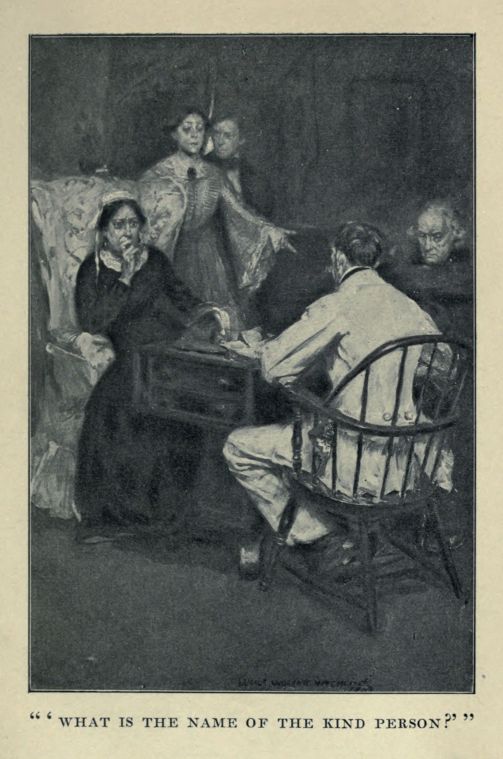
"'WHAT IS THE NAME OF THE KIND PERSON?'"
"The name of the testator was Urquhart," Mr. Carter said, "but—but, you know, my dear young lady, the identity is not yet legally authenticated; so—therefore—perhaps—I think, Dr. Lavendar, I had best go now? I think you mentioned that the stage leaves at four?"
"Urquhart?" Alice said; "the man who was so unkind? Oh, Lute, I suppose he repented. Oh, how astonished father will be! He'll have to forgive him now."
"It's a pretty late repentance," Luther said, with a chuckle; "and how did he know about you, Alice? I don't see why he should leave you money, even if he was a brute to your mother. Still," said the boy, gayly, "I guess we won't complain?"
"Gracious!" cried Alice, "that is queer. Well, he was a kind person!"
Rebecca Gray stared, frowning, at the lawyer. "He knew—this Urquhart—that she had a child?" she said, slowly.
Mr. Carter was gathering up his papers. "Yes," he said—"yes; he—knew it."
"What?" said Rebecca, in a very low voice—"what?"
"In view of the fact that, legally, the matter is still undecided," Mr. Carter said, hurriedly, "perhaps we need not take this point up? At all events, not here."
"Sir," said Rebecca, "why does Mr. Urquhart leave £5000 to Robert Gray's daughter?"
"He was sorry he was unkind to my mother," Alice said, her voice quivering. ("Oh, Lute, $25,000!")
"Alice," her step-mother said, in a loud, harsh voice, "you had better leave the room. Luther, go with Alice, please."
The two young people, bewildered, got up with blank faces, and with obvious reluctance obeyed. "But why should I be sent out, Lute?" Alice said, hotly, when they were in the hall. "It's my money—if I'm the person."
Luther stopped, and stood, frowning. On the boy's open, honest face came a perplexed look. But Alice said again, in injured tones, that she didn't know what Mrs. Gray meant. In the parlor the three elders looked at each other in silence. Mrs. Gray had risen, and stood leaning forward, her trembling hands flat on the table.
"I don't—understand," she said.
"Mr. Carter," said Dr. Lavendar, "certain remarks of yours on our way up here made me apprehensive. I see that my friend, Mrs. Gray, is also—apprehensive. I would suggest that you have a few words with her alone. I will leave you."
"No," Rebecca said; "hear the end of it." Her hard face was red and hot. "Why does Mr. Urquhart leave the child of Robert Gray £5000? Why?"
"It is as I think you surmise, madam," John Carter said, gravely.
Rebecca recoiled, with a broken exclamation of horror.
Dr. Lavendar drew in his breath. "Oh, my poor Robert!" he said.
"It is so stated in the will," the lawyer went on; "there is no disguising it; nor, as far as I can see, can it be hidden from the legatee. The directions for finding this heir make the thing explicit. The testator states that he received information of the expected birth of his child after the marriage of the person in question, who did not mention her married name—hence our difficulty in tracing her."
Rebecca, her eyes narrowing into a cruel smile, sat down and rocked backward and forward in her chair.
"Dreadful—dreadful—dreadful!" she said, aloud, exultantly.
V.
The last quarter of an hour, packed with tragic revelation, lost Mr. Carter the stage.
"I hope you will put up at the Rectory, sir," Dr. Lavendar said, as they drove away from Robert Gray's door.
"I thank you, sir," said Mr. Carter.
Then they fell into silence—Mr. Carter from politeness, Dr. Lavendar from horror. He was going back in his memory with painful effort; but it was all very vague.... He had hardly known her; she had been ill for those months that she had been in Old Chester, and she had made it very clear that she did not care to see people. He thought of her beautiful, sullen face; of Robert Gray's passionate devotion; of Old Chester's silent disapproval.... He groaned to himself, and John Carter looked at him sidewise.
After supper at the Rectory, they sat down to smoke in heavy silence; Mr. Carter respected the old man's distress, but wondered if he should not have been more comfortable with Van Horn at the Tavern. The glowing July day had darkened into rainy night, with a grumble of thunder back among the hills; but in the midst of a sudden downpour they heard footsteps on the path, and then some one pushed open the hall door, and flapped a wet umbrella on the steps before entering. A minute later Luther Metcalf stood, hesitating, on the study threshold.
"Dr. Lavendar—"
The old man got up hurriedly. "Yes, Lute. Come into the dining-room. You will excuse me, sir?" he said to Mr. Carter. He put his hand on Lute's arm, in a friendly grip, for there was a break in the boy's voice.
"I know about it," Lute said. They sat down at the dining-room table; Lute swallowed hard, and pulled with trembling fingers at his hatband; he did not lift his eyes. "And—and I want you to tell her not to take it."
"How is she, Lute?"
"I haven't seen her. She wouldn't come down-stairs. She sent me a little note," Luther said, taking it out of his breast-pocket, and then putting it back again tenderly. "'Course I won't pay any attention to it."
"Saying she'd release you, I suppose?"
"Yes; but that's nothing. I'll make her understand the minute I see her. But, Dr. Lavendar, I don't want that—that money!" the boy ended, almost with a sob. "I want you to tell her not to take it."
Dr. Lavendar was silent.
"At first I thought—I couldn't help thinking—we could get married right off. We could get married and have a home of our own; you know, we'd be rich people with all that money. And I suppose, honestly, that as things are now, there's no chance of our getting married for a good while. But I—I tell you what, sir. I'd rather never get married than—than touch that money!"
Dr. Lavendar nodded.
"You won't let her, sir? You'll make her give it back?"
"My dear boy, I can't 'make' Alice do anything. The money is hers."
"Oh, but Dr. Lavendar, won't you go and talk to her? It may be a temptation to her, just as it was to me, for a minute. We could just make the office hum, sir. We could put it right on its feet; we could have a real Daily. I know she'll think of that. I just thought we could get married. But Alice will think about helping the office, and me."
"Of course the money would bring ease to her father—" Dr. Lavendar stopped abruptly.
"Oh, my God!" Lute said, and dropped his head on his arms.
"Bring ease to—to the family," Dr. Lavendar ended lamely.
"You know Mr. Gray won't touch it," Lute burst out; "and I can't let Alice, either. Dr. Lavendar, I thought maybe you'd let me hitch Goliath up and drive you out to the house?"
"Not to-night, Lute. Alice has got to be alone. Poor child, poor child! Yes; we've all of us got to meet the devil alone. Temptation is a lonely business, Lute. To-morrow I'll go, of course. Did you answer her note?"
"Oh yes; right off. I just said, 'Don't be foolish,' and—and some other things. I didn't tell her we mustn't take the money, because I hadn't thought of it then. Mrs. Gray said she wouldn't come out of her room. Oh, just think of her, all by herself!" Luther bent over and fumbled with his shoelace; when he looked up, Dr. Lavendar pretended not to see his eyes.
When the boy went away, Dr. Lavendar went back to the study and asked John Carter some legal questions: Suppose he had not found this child, what would have become of the money? Suppose the child should now decline to take it, what then?
"Well," said Mr. Carter, smiling, "as a remote contingency, I suppose I might reply that it would revert to the residuary estate. But did you ever know anybody decline £5000, Dr. Lavendar?"
"Never knew anybody who had the chance," Dr. Lavendar said; "but there's no telling what human critters will do."
"They won't do that," said John Carter.
What a long night it was, of rain and wind and dreadful thought! ... Rebecca had told Alice, with kindness, but with such a grip upon herself lest exultation should tremble in her voice, that she seemed harsher than ever. Then she told Lute. He pleaded that Alice would speak to him, and Mrs. Gray had gone to the girl's room and bidden her come down-stairs.
"Come, Alice. You must control yourself. Come down and talk to Luther."
Alice shook her head. "I'll—write him a note."
Mrs. Gray carried the note back to Lute, and brought up the answer, which Alice read silently. Rebecca watched her; and then, with an effort, she said:
"Alice, remember we are not to judge. We don't understand. We must not judge. Good-night." She opened the door, and then looked at the child, seated, speechless, with blank eyes, on the edge of the bed. "Good-night, Alice. I—I'm sorry for you, poor girl!" and she came back hastily and kissed her.
At that, even in her daze of horror, a glimmer of astonishment came into Alice's face. But she did not look up or speak. When it grew dark, she began mechanically to get ready for bed; she knelt down, as usual, at the big chintz-covered winged chair and began to say her prayers, her mind blind as to her own words: "Bless dear father—" Then she cried out, suddenly and dreadfully, and covered her poor, shamed head with her arms, and prayed no more. Then came a long fit of crying, and then a dreary calm. Afterwards, as the night shut in with rain and rumble of thunder, the shame lightened a little, for, though she could not read it in the darkness, she held Lute's little note against her lips and kissed it, and cried over it, and said his words over to herself, and felt that at any rate there was one bright spot in it all: Lute would never have any more anxieties. Of Robert Gray she thought pitifully, but with not much understanding. Oh, dreadful, dreadful! But he had loved his wife so much (so the child thought) he would surely forgive her. Not knowing how little forgiveness counts for when a star goes out. Sometimes, sitting there on the floor, listening to the rain, she slept; then woke, with a numb wonder, which darkened into cruel understanding. Shame; shame—but Lute wouldn't be worried any more; Lute would be rich.
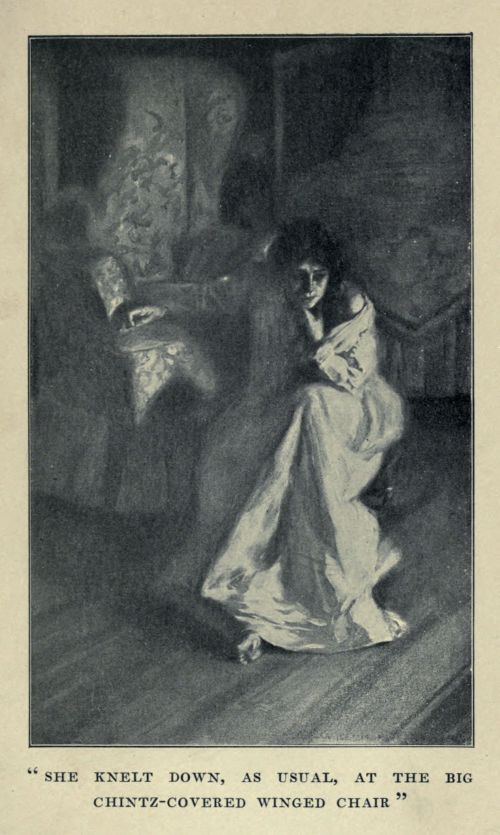
"SHE KNELT DOWN, AS USUAL, AT THE BIG CHINTZ-COVERED WINGED CHAIR"
So the night passed....
Rebecca Gray did not sleep. When the house was still she went up-stairs, eager to be alone. She shut her bedroom door softly; then she put her brass candlestick on the high bureau and looked about her.... Everything seemed strange. Here was her old-fashioned bed with its four mahogany posts like four slender obelisks; there was the fine darn in the valance of the tester; the worn strip of carpet on which she had knelt every night for all these twenty years; it was all the same, but it was all different, all unfamiliar. The room was suddenly the room where that woman had died; the old four-poster was the bed of that heartbreaking night, with sheets rumpling under a wandering hand and pillows piled beneath a beautiful, dying head; not her own bed, smooth and decorous and neat, with her own fine darn in the tester valance. She did not know the room as it was now; she did not know herself; nor Robert; nor that—that—that woman. She sat down, suddenly a little faint with the effort of readjusting a belief of twenty-two years. "She was a wicked woman," she said, out loud; and her astounded face stared back at her from the dim mirror over the mantel-piece. After a while she got up and began to walk back and forth; sometimes she drew a deep breath; once she laughed. "A wicked woman!" ... Now he would know. Now he would see. And he would loathe her. He would hate her. He would—her lip drooped suddenly from its fierce, unconscious smile; he would—suffer. Yes; suffer, of course. But that couldn't be helped. Just at first he would suffer. Then he would hate her so much that he would not suffer. Not suffer? It came over her with a pang that there is no suffering so dreadful as that which comes with hating. However, she could not help that. Truth was truth! All the years of her hungry wifehood rose up, eager for revenge; her mind went hurriedly, with ecstasy, over the contrast; her painful, patient, conscientious endeavor to do her best for him. Her self-sacrifice, her actual deprivations—"I haven't had a new bonnet for—for four years!" she thought; and her lip quivered at the pitifulness of so slight a thing. But it was the whole tenor of her life. She had no vacations in the mountains; she would have liked new valances, but she spent hours in darning her old ones to save his money; she had turned her black silk twice; she had only had two black silks in twenty years. All the great things she had done, all the petty things she had suffered, rose up in a great wave of merit before her; and against it—what? Hideous deceit! Oh, how he would despise the creature! Then she winced; he would—suffer? Well, she couldn't help that. It was the truth, and he had got to face it. She was walking up and down, whispering to herself, a sobbing laugh on her lips, when suddenly, as she passed the mirror, she had a dim, crazy vision of herself that struck her motionless. A moment later she took the candle, and with one hand clutching for support at the high mantel-shelf—for her knees were shaking under her—held it close to the glass and peered into the black depths. Her pale, quivering face, ravaged with tears, stared back at her, like some poor ghost more ugly even than in life. "A wicked woman." Yes—yes—yes; and he would have to know it. But when he knew it, what then? If his eyes opened to sin, would they open to—
"I have tried to make him comfortable," she said, faintly.
Suddenly she put the candle down and sank into a chair, covering her face with her poor, gaunt hands....
And so the night passed.... The dawn was dim and rainy. It was about four o'clock that Alice, sitting on the floor, sleeping heavily, her head on the cushion of the chair, started, bewildered, at the noise of the opening door. Rebecca, in her gray dressing-gown, one hand shielding the flare of her candle, came abruptly into the room.
"Alice," she said, harshly, and stopped by the empty bed; then her eyes found the figure on the floor ("you ought to be in bed"), she said, in a brief aside; then: "Alice, I've been thinking it over. You can't take that money."
"I don't understand," Alice said, confused with sleep and tears.
"You can't take that money. If you do, your father would have to know. And he never must—he never must."
Alice pulled herself up from the floor and sat down in her big chair. "Not take the money?" she said, in a dazed way; "but it's mine."
"That's why you needn't take it. Thank God it was left to you, not just to 'her heirs.' Alice, I've gone all over it. I—I wanted you to take it"—Rebecca's voice broke; "yes, I—did."
"Well, it's mine," Alice repeated, bewildered.
Rebecca struck her hands together. "Yours not to take! Don't you see? You can save your father."
Alice, cringing, dropped her head on her breast with a broken word.
"Don't be a fool," the older woman said, trembling. "He's been your father ever since you were born. And it would be a pretty return for his love to tell him—"
Alice burst out crying; her step-mother softened.
"I am sorry for you, you poor girl. But, oh, Alice, think, think of your father!" She clasped her hands and stood, trembling; she took a step forward, almost as if she would kneel.
"If he would feel so dreadfully," Alice said, at last, "why—we needn't tell him where the money comes from."
"Now, Alice, that is absurd. Of course he would know. He would have to know. A girl doesn't inherit £5000 without her father's knowing where it comes from. And, anyway, Mr. Carter said that Mr. Gray would have to make a statement and swear to it. Of course he would—know."
"Do you mean you don't want me to have it at all?" Alice said, blankly.
"I've just explained it to you," Rebecca said, her voice harsh with anxiety. "You can't have it."
"But it's my money; I have a right to it. And it would make all the difference in the world to Lute. If he is going to take a girl—like me, he ought to have the money, anyhow."
"And kill your father?" Rebecca said. "Alice! Don't you see, he must go on believing that she is"—her voice grew suddenly tender—"that she is 'a creature of light?'"
"I want Lute to have the money," Alice said.
"Alice!" the other exclaimed, with dismay, "don't you think of your father at all? And—for your mother's sake."
Alice was silent; then, in a hard voice, "I don't like her."
"Oh!" Rebecca cried, and shivered. There was a pause; then she said, faintly, "For your own sake?"
Alice looked up sullenly. "Nobody need know; we would only say it had been left to—her. Nobody would know."
Suddenly, as she spoke, despite the plain face and the red hair, Alice looked like her mother. Rebecca stepped back with a sort of shock. Alice, crying a little, got up and began to pull down her hair and braid it, with unsteady fingers. Her step-mother watched her silently; then she turned to go away; then came back swiftly, the tears running down her face.
"Oh, Alice, it is my fault! I've had you twenty-two years, and yet you are like— See, Alice, child; give her a chance to be kind to him, in you. Oh, I—I don't know how to say it; I mean, let her have a chance! Oh—don't you see what I mean? She said she was sorry!" All the harshness had melted out of Rebecca's face; she was nothing but gentleness, the tears falling down her cheeks, her voice broken with love. "Alice, be good, dear. Be good. Be good. And I—I will be pleasanter, Alice; I'll try, indeed; I'll try—"
VI
"Well," said Mr. Amos Hughes, a week later, in the cool dusk of Dr. Lavendar's study, just before tea, "this is a most extraordinary situation, sir!"
"Will ye have a pipe?" said Dr. Lavendar, hospitably.
John Carter, his feet well apart, his back to the fireless grate, his hands thrust down into his pockets, said, looking over at his partner:
"Amos, Dr. Lavendar once remarked to me that there was no telling what human critters would do."
Dr. Lavendar chuckled.
"Very true," Amos Hughes admitted, putting one fat knee over the other; "but I must say that I never before knew a human critter throw away £5000."
"I'm sorry you haven't had better acquaintances," said Dr. Lavendar. "I have. I'm not in the least surprised at this child's behavior. Mr. Carter, are you looking for anything? You'll find a decanter on the sideboard in the next room, sir. This is a pretty good world, Mr. Amos Hughes; I've lived in it longer than you have, so you'll take my word for it. It's a pretty good old world, and Miss Alice Gray has simply decided to do the natural and proper thing. Why, what else could she do?"
"I could mention at least one other thing," said Mr. Carter.
"Extraordinary situation! but I suppose the residuary legatees won't make any objection," murmured Amos Hughes.
Dr. Lavendar rapped on the table with the bowl of his pipe. "My dear sir, would you have a girl, for a paltry £5000, break her father's heart?"
"Her father?"
"Mr. Gray would not, in my judgment, survive such a revelation," said Dr. Lavendar, stiffly.
"May I ask one question?" John Carter said.
"G'on," said Dr. Lavendar.
"What I would like to know is: How did you bring Miss Gray to look at the thing in this way?"
"I didn't bring her," said Dr. Lavendar, indignantly; "her Heavenly Father brought her. Look here, sir; this business of the law is all very well, and necessary, I suppose, in its way, but let me tell you, it's a dangerous business. You see so much of the sin of human nature that you get to thinking human nature has got to sin. You are mistaken, sir; it has got to be decent. We are the children of God, sir. I beg that you'll remember that—and then you won't be surprised when a child like our Alice does the right thing. Surprise is confession, Mr. Carter."
Mr. Carter laughed, and apologized as best he could for his view of human nature; and Dr. Lavendar was instantly amicable and forgiving. He took Mr. Amos Hughes's warning, that he should, as a matter of duty, lay very clearly before the young lady the seriousness of what she proposed to do, and not until he had exhausted every argument would he permit her to sign the papers of release which (as a matter of precaution) he had prepared. "She's of age," said Amos Hughes, "and nobody can say that she has not a right to refuse to proceed further in the matter. But I shall warn her."
"'Course, man," said Dr. Lavendar; "that's your trade."
And so the evening came, and the three men went up to Robert Gray's house.
It was a long evening. More than once Dr. Lavendar trembled as he saw the kingdoms of the world and the glory of them spread before his child's eyes. But he said no word, and once, sternly, he laid his hand on Rebecca's arm to check some word of hers.
"Let her alone," he said.
It was eleven o'clock before there came a moment of solemn silence. Alice bent over a paper, which John Carter had read aloud to her, and signed her name. Luther and Rebecca and Dr. Lavendar witnessed the signature. Then Rebecca Gray took the girl in her arms.
"That young man has got something to him," Mr. Amos Hughes said, as they went back to the Rectory.
"If you could put some printing in his way, it would be a favor to me," said Dr. Lavendar.
"I shouldn't wonder if I could," the lawyer said.
"The girl is a fine creature, poor child," said Mr. Carter.
"Gentlemen," said Dr. Lavendar, "they are both good children, and they have behaved well; but there's somebody else, let me tell you!"
However, he did not tell them. Perhaps he kept his opinion for Robert Gray's ears, for once he said, smiling, in Rebecca's presence:
"Robert, this wife of yours is a noble woman."
Mr. Gray, a little surprised, said, politely, looking with kind eyes at Rebecca, "Mrs. Gray is a very good wife, sir."
And Rebecca went up and hid herself in the garret and cried with joy.
AT THE STUFFED-ANIMAL HOUSE
I
Willy King's buggy, splashed to the top of the hood with mud and sagging sidewise on its worn old springs, came pulling up the hill past the burial-ground. The doctor himself, curled in one corner, rested a leg on the dash-board and hung his reins on the hook over his head. He was very sleepy, for he had been up until three with an old woman who thought she was sick, and he had been routed out of bed again at five because she told her family that she was going to die. William King was not given to sarcasm, but he longed to say to the waiting relatives, "There is no hope!—she'll live." Instead, he looked seriously sympathetic and kept his thoughts to himself. When he got home to breakfast, his wife told him how foolish he was to take so much trouble. "There's nothing the matter with Mrs. Drayton," said Mrs. King; "and I should tell her so, flatly and frankly. It would do her good."
William said that he would like another cup of coffee.
"It wouldn't be good for you," said his Martha; "you are drinking too much coffee. You can have shells if you want to. Shall I have some shells warmed up?"
William said "No," and went trudging off to his office; and then, at ten, started on his round of calls, his old buggy still unwashed from the morning jaunt to the hypochondriac's death-bed. The day was still and sunny, the road quite deserted and full of pleasant shadows under the May foliage. But the sleepy doctor saw it all through half-closed eyes, and yawned, and rested one plump leg on the dash-board, and let the reins hang swaying from the hook in the roof of the bug-pry. Then, suddenly, his mare stopped and William opened his eyes.
"Caught you napping, Willy!" said a loud, hearty voice. And the doctor sat up and drew his leg in and laughed.
"Well, Miss Harriet, how do you know but what I was worrying over a case?"
"Much worrying you do, young man!" She sat down on a log on the road-bank and smiled at him. She was a big, vigorous woman with a fresh, brown face and a keen, kind eye. She had a gun in her hand, and a rabbit's white tail stuck out of the hunting-wallet slung over her shoulder. She had broken through the underbrush on the hill-side just as Willy's buggy jogged into the shadow of a sycamore that stretched its mottled arms over the deserted road.
"Willy," she went on, in her loud, cheerful voice, "do you doctor-men smile at one another when you meet, like the Augurs, because you fool us so easily with your big words? You call a scratched finger an 'abrasion of the epidermis'—and then you send a bill. And, bless me! what a serious air you put on at a minute's notice!—I saw you pull your leg in, Willy. Come, now; you were in my Sunday-school class—why don't you just admit to me that that piercing look over your eye-glasses is one of the tricks of the trade? I won't tell."
William King chuckled. "You just get a touch of lumbago, Miss Harriet, and you'll believe in my tricks."
"Lumbago!" said his reviler. "Not I; a day's shooting would cure it quicker than a barrel of your pills."
"Been shooting this morning?"
"No; I set a trap in Dawson's hollow." She pulled out the rabbit and held it up. "Not a bone broken. Handsome, isn't he? Poor little thing!"
William looked at the soft, furry creature, limp in the big brown hand, with critical appreciation. "Yes, beautiful. Miss Annie didn't find him, to let him out?"
The hunter's face changed to amused impatience. "Willy, she opened three traps last week. And she was so shrewd about it; you would never believe how clever she is. Of course it's no use to scold."
"Of course not. What excuse does she make?"
"Oh, just the same thing: 'Sister, it hurts me to think they can't get out.'"
"Poor thing!" said the doctor.
"I have tried to make her promise not to interfere with the traps. You know, if I could once get a promise out of her I would be all right; Annie never broke a promise in her life. But she is too shrewd to be led into it. She always says, 'I'm the oldest, and you mustn't order me round.' It would be funny if it weren't so provoking."
"Poor thing!" said the doctor again.
"She follows me and takes the bait out of the traps once in a while; but she prefers to let things go. And she is certainly wonderfully bright about it," Miss Harriet said. "Now, why can't she be sensible in other things?"
"Well, you know she has always been about twelve; it's the young head on old shoulders."
"I must tell you her last performance," Miss Harriet said. "You know that picture of Aunt Gordon that hung in the dining-room? Dreadful thing! I never saw the poor woman, but I believe she wasn't quite as ugly as that portrait, though Alex looks just like her, Dr. Lavendar says; and Alex is dreadfully ugly, with those pale eyes of his. Well, I happened to say—it was last Tuesday, at tea, and Matty Barkley was there: 'That picture of Aunt Gordon is awful! I can't bear it.' Of course I never thought of it again, until I came home the next day—and what do you suppose?"
Willy began to grin.
"Yes! she had got up on a chair, if you please, and cut it out of the frame and slashed it all to pieces."
"Well done!" said Willy King, slapping his thigh.
"No such thing. It was ugly, but it was a family portrait."
"What did she say?"
"Oh, she had her excuse.... Willy, I can't understand her mind; it is so unreasonably reasonable: 'Sister, you said you couldn't bear it, so what was the use of having it?' After all, that was sense, William."
"So it was," said the doctor, and unhooked his reins and nodded. "Well," he said—
But Miss Harriet laughed awkwardly. "Wait a minute, can't you? It won't kill anybody to do without a pill for five minutes."
"Well, no, I suppose it won't," William admitted; "but with a view to getting home in time for dinner—"
"Oh, let Martha wait. Willy, you are the meekest being—let her wait. Tell her you'll have your dinner when you're good and ready."
"Martha is only concerned on my own account," the loyal William protested.
"Well, I'm not going to keep you long," his old friend said, roughly; "I—I just want to ask you a question." Her face grew suddenly a dull red. "Not that I believe in your pills and potions—just please remember that. But I suppose you do know a little something."
"I could diagnose a scratched finger," said the doctor, meekly.
"Well—" she said, and looked at the lock of her rifle; "there's nothing in the world the matter with me, but—"
"You don't look like a confirmed invalid," the doctor assured her.
"No!—do I?" she said, eagerly. "I really am very well, William—very well. Dear me, when I get home after a round of my traps (when Annie hasn't teased me by letting things out) and eat a good dinner, and sit down with a taxidermy magazine, I—I wouldn't thank King George to be my uncle. Yes, I am very well."
Her emphasis had in it a certain agitation that caught the doctor's eye. "Your out-of-door life is calculated to keep you well," he said.
Miss Harriet got up and thrust the rabbit back into the pouch at her side. "Of course; and, anyhow, I'm not the sick kind. Imagine me shut up between four walls! I should be like Sterne's starling. Do you remember?—'I want to get out, I want to get out.' No, there's nothing the matter with me. Absolutely nothing."
She did look very well, the big, brown woman, towering up at the road-side, with her rifle in her hand and the good color in her cheeks and lips. Yet her eyes had a worn look, William thought. "Pain somewhere," said the doctor to himself.
"You know, I don't believe in your pills and truck," she insisted, frowning.
"Of course not," he assured her easily. "Come, now, Miss Harriet, what's wrong?"
"Nothing, I tell you," she said, sharply; and then, with impatient brevity, she spoke of some special discomfort which had annoyed her. "It began about six months ago."
"Probably you've taken cold," William King said, and then he asked a question or two. She answered with irritable flippancy:
"Now don't put on airs, Willy. There's no use trying to impress me; I know you. Remember, you were in my Sunday-school class."
"Why didn't you make a better boy of me, then? You had your chance. Miss Harriet, would you mind coming into my office and just letting me look you over? Come, now, why shouldn't I get a job out of you for once? Here you tackle me on the road-side and get an opinion for nothing."
She chuckled, but retorted that she hated doctors and their offices. "I'm not that Drayton cat," she said, "always wanting a doctor to fuss over me. No, you can give me a pill right here—though I haven't a bit of faith in it."
"I wouldn't waste a good pill on you," the doctor defended himself. "You've got to come and see me."
But when she had promised to come, and William, slapping a rein down on the mare's flank, was jogging along under the sycamore branches, he did not fall into his pleasant drowse again. "She looks so well," he said to himself, "she must be all right—"
II
Miss Harriet's house, called by Old Chester children "The Stuffed-Animal House," was on the hill-road a stone's-throw beyond the burial-ground. It was of weather-worn brick, and its white lintels, carved in thin festoons of fruit and flowers, were nearly hidden by ivy that stretched dark figures over the marble, and, thickening with the years across the tops of the windows, made the rooms within dim with wavering leaf shadows. A brick path, damp and faintly green with moss, ran down to a green gate set in a ragged privet hedge that was always dusty and choked with dead twigs. The house itself was so shaded by horse-chestnuts that grass refused to grow in the door-yard. A porch shadowed the front door, which opened into a dark, square hall, full of dim figures that hung from the ceiling and stood in cases against the walls. A dusty crocodile stretched overhead, almost the width of the hall; a shark, with varnished belly splitting a little under one fin and showing a burst of cotton, lurked in a dim corner; over the parlor door a great snake, coiled about a branch, looked down with glittering, yellow eyes; and along the walls were cases of very beautiful birds, their plumage dulled now, for it was forty years since Miss Harriet's father had made his collection. But all around the hall were glistening eyes that stared and stared, until sometimes an Old Chester child, clinging to a mother's protecting hand, felt sure they moved, and that in another moment the crocodile's jaws would snap together, or the eagle's wings would flap horribly in the darkness.
Yet there was an awful joy to Old Chester youth in being allowed to accompany a mother when she made a polite call on Miss Harriet. This hall, that was dark and still and full of the smell of dead fur and feathers and some acrid preservative, had all the fascination of horror. If we were very good we were allowed to walk from case to case with old Miss Annie, while our mothers sat in the parlor and talked to Miss Harriet. Miss Annie could not tell us much of the creatures in the cases, and for all she used to laugh and giggle just as we did, she never really knew how to play that the hall was a desert island and the wild beasts were lurking in the forest to fall upon us.
"It isn't a forest, it's our front hall," Miss Annie would say; "and you must do what I tell you, because I'm the oldest, and I don't want to play desert island. But I'll show you my chickens," she would add, with eager politeness.
Sometimes, if Miss Annie were not in the room, we would hear Miss Harriet tell some story about her mischievousness, and our mothers would sigh and smile and say, "Poor dear!" Our mothers never said "poor dear!" about us when we did such things. If one of us Old Chester children had spoken out in church as Miss Harriet said Miss Annie did once, and told Dr. Lavendar that he was telling a story when he read in the morning lesson that the serpent talked to Eve—"because," said Miss Annie, "snakes can't talk"—if we had done such a dreadful thing, we should have been taken home and whipped and sent to bed without any supper, and probably the whole of the third chapter of Genesis to learn by heart. We should not have been "poor things!" This was very confusing to Old Chester youth until we grew older and understood. Then, instead of being puzzled, we shrunk a little and stayed close to our mothers, listening to Miss Harriet's stories of Miss Annie with strange interest and repulsion, or staring furtively at the little old woman, who laughed often and had a way of running about like a girl, and of smoothing back her gray hair from her temples with a fluttering gesture, and of putting up her lip and crying when she was angry or frightened or when she saw anything being hurt. Miss Annie could never bear to see anything hurt; she would not let us kill spiders, and she made us walk in the grass instead of on the brick path, because the ants came up between the bricks, and she was afraid we would step on them.
"Annie is very kind-hearted," Miss Harriet used to tell our mothers. "She can't bear my traps."
Miss Harriet's traps were her passion; her interest in taxidermy had come to her from her father, and though she had not been able to add anything of real value to Mr. Hutchinson's collection, her work was thoroughly well done; and she even made a fair sum of money each year by sending her squirrels and doves to town for the Christmas trade.
But more important than the money was the wholesome out-of-door life her little business entailed, which had given her her vigorous body and sane mind. She needed both to live with this gray-haired woman, whose mind was eleven or twelve years old. It was not a bad mind for eleven or twelve, Willy King used to say. Old Miss Annie had a sort of crude common-sense; she could reason and determine as well as any other twelve-year-old child—indeed, with an added shrewdness of experience that sixty years of bodily age made inevitable. She knew, innocently, much of life that other children were guarded from knowing; she knew death, too, but with no horror—perhaps as we were meant to know it—something as natural as life itself, and most of all as a release from pain. For old Annie knew pain and feared it as only the body in which the soul is not awake can fear it. She wept at the sight of blood and moaned when she heard a squirrel squeak in the trap; she shivered with passionate expectation of relief when Miss Harriet's kindly chloroform brought peace to fluttering wings or beating claws. When some soft, furry creature, hurt in the trap, relaxed into happy sleep in the thick, sweet smell that came out of Miss Harriet's big bottle, Miss Annie would laugh for joy, the tears of misery still wet upon her wrinkled cheeks.
"Don't come into my shop," Miss Harriet used to say, laughing and impatient, when Miss Annie would follow her into the room in the barn where she did her work—"don't come in here, and then you won't see things that hurt your feelings."
But Annie, smoothing her hair back from her temples with a curious, girlish gesture, would only shake her head and sidle closer to her sister, the young, guileless eyes in the withered face full of protest and appeal. Her horror of pain lost Miss Harriet many a fine specimen; for, in her pity for the trapped creatures, Annie, noiselessly, like some Indian hunter, used to follow on her sister's footsteps through the woods, lifting the baits out of the traps, or if she found a snared creature unhurt, letting it go, and then creeping home, frightened at Miss Harriet's anger, which, if she discovered the old child's naughtiness, fell like a thunderbolt, and then cleared into patient amusement, as a black shower brightens into sunshine. The big, kind woman with a man's mind could not be angry at this poor creature; so she did her duty by her and tried not to think about her. She went her way, and set her traps, and prepared her few specimens, brushing Annie or any other annoyance aside with careless good-nature.
"Don't think about unpleasant things," she used to say, in her loud, cheerful voice. "The trouble with you doctors and ministers," she told Dr. Lavendar, "is that you make people think about their insides. It's stomachs with Willy and souls with you. Nobody ought to know that they have a stomach or a soul. I don't. A tree don't. And there isn't an oak in Old Chester that isn't pleasanter than Mrs. Drayton. Yet she's always fussing about her insides—spiritual and material."
"It's when you don't have 'em that you fuss," Dr. Lavendar said; "the trouble isn't too much soul, it's too little. And I guess it's the same with stomachs."
"Then you say Mrs. Drayton has no soul?" Miss Harriet said, pleasantly.
"I never said anything of the sort," said Dr. Lavendar.
As for Miss Harriet, she went on to Willy King's office, prepared, as usual, to make him as uncomfortable as she could. But she never put Willy out. Her flings at his profession tickled him immensely, and if now and then the good, honest William practised, as Miss Harriet said, a few of the tricks of his trade, he was not averse to sharing their humor with some one who could appreciate it.
"So you have that Drayton cat on your hands again?" Miss Harriet said, plumping herself down in William's own chair in front of his office table so that she could pick up and examine what she called his "riffraff." ("Do open your windows, William. I don't see how you can be so shut up. Po-o-o! how can people live so much in-doors?")
"Well," said William, doing as he was bid, "she enjoys my visits and I enjoy her checks. I don't complain."
"That's like the profession," said Miss Harriet; "you put your hands in our pockets whenever you get a chance. Well, you'll get nothing out of my pocket, William, for there's nothing in it."
"Miss Harriet," said William, chuckling—"you won't tell anybody, will you? But Mrs.—well, I won't name names; that's not professional—"
"Call her a 'Female,'" said Miss Harriet.
"Well, a Female sent for me on Tuesday, in a dreadful hurry; I must come, 'right off! quick!' I was just sitting down to breakfast, but of course I ran—"
"Martha must have been pleased?"
"I ran; and arrived, winded. There was—the Female, at her breakfast. 'Oh,' she said, 'doctor, the baby has slept right through from six last night, and he hasn't wakened up yet. I am afraid there is something the matter with his little brain.'"
"William, if you didn't say that there was something the matter with her little brain—"
"I didn't," William said, grimly, "because she hasn't any. Now, Miss Harriet, let's talk about yourself; it's pleasanter."
"Oh, there was not the slightest occasion to come to see you. But I said I would, and here I am. I suppose you'll send me a bill as long as my arm. Do you have a system of charges, Willy? So much for a look over your glasses? So much for that solemn cough? I suppose you grade all your tricks. Now work off the most expensive ones on me; I propose to get the worth of my money, young man."
"Thought you said you weren't going to pay any bills?" William reminded her; and then refused to be side-tracked any longer, but asked question after question, bringing her up once or twice with a sharp turn. "Don't joke now, please, Miss Harriet. Be as exact as you can. Is this condition thus, or so—?" And when he got through with his questions, he took up the joking rather heavily.
"You're so faithless about pills," he said, "that I'm not going to give you any."
"What! no pills?" said Miss Harriet.
William King laughed awkwardly. "Not a pill! I don't see any condition which warrants them: but—"
"What did I tell you? There's nothing the matter, and you just dragged me here to give your office a busy look."
"I didn't suppose you'd see through it," said Willy King. "But, Miss Harriet, I—I don't feel quite satisfied. I—do you know I've a great mind to get a man in Mercer to look you over? I want you to go up with me to-morrow and see him."
"Nonsense!"
"No, truly," he said; "I am not satisfied, Miss Harriet."
"But what do you mean?" she insisted, sharply. "There's nothing the matter with me. You said yourself I didn't need any medicine. Give me some opiate to stop this—this discomfort when it comes on, and I'll be all right."
"You can't bear opiates," he said, bluntly; "your heart won't stand them. Don't you remember the time you broke your ankle and I tried morphine—a baby dose—to give you some relief? You gave me a scare, I can tell you."
Miss Harriet was silent. Then: "I've known my heart wasn't right for two years. But—"
"Oh, your heart doesn't give me any concern—if you don't take liberties with it. Perhaps it isn't quite as good as it was thirty years ago, but—"
"Ah, I lost it to you then, Willy. You were a sweet little fellow when you came into my class. Do you remember once when—"
"Miss Harriet, you've got to go to Mercer with me to-morrow," William King interrupted, quietly. "I hope there's nothing much out of the way. I hope not. I—I believe not. But I'm not sure. We'll go up and see Greylord and find out. He'll give you some pills, maybe," he ended, and laughed and got up. "Now I'm off to the cat, Miss Harriet."
And Miss Harriet, to her astonishment, found herself dismissed before she had made the boy tell her what he was afraid of. "He is a boy," she said to herself. "Of course he wouldn't be apt to know what was the matter. I ought to have gone to see some Mercer man to begin with. I remember when Willy was born."
III
When they came out of the Mercer doctor's door William King's fresh face had gone white, but Miss Harriet walked smiling. At the foot of the steps the doctor paused and stood an instant leaning on the hand-rail, as though for support and to get his breath. Miss Harriet looked at him with concern. "Why, Willy!" she said.
"Miss Harriet," William said, hoarsely, "he may be mistaken. It's perfectly possible that he is mistaken."
"I guess not, Willy," she said, simply. "Come, now, don't be such a wet string." She struck him a friendly blow on the shoulder that made the doctor take a quick step forward to keep his balance; but it gave him the grip upon himself that for a single instant he had lost.
"And, anyhow," he said, "even if he is right, it may not develop. I've known a case where it was checked for two years; and then the patient died of small-pox."
"Pleasant alternative," said Miss Harriet; she was smiling, her face full of color, her shoulders back, her head up. "Come, Willy, let's have a spree. Here we are for a day, and Martha's at home. We'll have a good dinner, and we'll do something interesting. Hurrah!" said Harriet Hutchinson.
And the doctor could do no less than fall into step at that martial note and march at her side proudly. And by some spiritual contagion his courage met hers like the clash of swords. They went to get their good dinner, and Miss Harriet ate it with appetite. Afterwards she declared they would go to the circus. "It's in town; I saw the tents. I haven't been to a circus for forty years," she said; "but I know just how the pink lemonade tastes. You've got to treat, Willy."
"I'll throw in pea-nuts," said William King; and with that they left the restaurant and went sauntering along the hot, grimy street in the direction of the open lots beyond the blast-furnaces, where, under a deep June sky, dazzling even though it was smudged by coils of smoke, were stretched the circus tents, brave with flags and slapping and billowing in a joyous wind. William King held on to his hat and looked at the great, white clouds, domed and shining, piled all along the west. "We'll get a shower, I'm afraid, Miss Harriet."
"Well, take a pill, Willy, and then it won't hurt you," she told him, with a laugh that belonged to the sun and wind, to the flags whipping out on their halyards and the signs of the side-shows bellying from their guy-ropes, to the blare of music and the eager circus crowd—that crowd that never changes with changing generations. Still there is the old man gaping with excited eyes; still the lanky female in spectacles; the cross elder sister afraid of crushing her fresh skirts; the little boy absorbed in thought; the little girl who would like to ride on the Shetland pony when the clown offers any miss in the audience an opportunity. We know them all, and doubtless they know us, the patronizing, amused on-lookers, who suddenly become as eager and absorbed as any graybeard or child in the crowd. We know the red boxes, too, where men with hard faces and wearied eyes shout mechanically the same words of vociferous invitation to the side-shows. Children, pulled along by their elders, would stop, open-mouthed, before these men; but somehow they never see the wild man or the fat lady. Ah, the regret for the unseen side-shows!—the lady with the snakes; the skeleton man; the duel between the educated hyena and his trainer—that hyena of whom the man in the red box speaks with such convincing enthusiasm. "I have been," cries the strident voice—"I have been connected with circuses all my life—all my life, ladies and gentlemen!—and I give you my sacred word of honor that this is the most magnificent specimen of the terrible grave-robbing hyena that I have ever seen!" Why did we never see that hyena? Why, why did we always hurry on to the main tent? It is the pang that even paradise must know, of the lost experience of earth—or perhaps of hell.
"We ought to see the fat lady," said Dr. King.
"I'm afraid we'll be late," Miss Harriet objected, eagerly.
So they pushed on with the impatient, good-natured crowd. The smell of tan-bark and matted pelts and stale pea-nut shells came in a gust as they jostled under the flap of the outer tent and found themselves inside the circle of gilded cages. "Shall we go right in and get our seats?" William said.
"What! and not look at the animals? Willy, you're crazy. I want to feed the elephants. Why, there are a lot of them, six or seven."
So they trudged around the ring, their feet sinking deep into the loose, trampled earth. Miss Harriet poked the monkeys clinging to the grating of their car, with her big umbrella, and examined the elephant's hide with professional interest. "Imagine curing that proboscis," she said. And then they stopped in front of a miserable, magnificent lion, turning, turning, turning in a cage hardly more than his own length. Miss Harriet drew in her breath. "It's being trapped that is so awful, Willy. The consciousness that you can't get out. It isn't the—the pain of it; it's being trapped."
William King, looking at the poor tawny creature of the desert and free winds and life that dealt death with passion, blinked suddenly behind his glasses. "But you trap things yourself," he protested, a moment afterwards.
"Oh, but I don't keep 'em trapped; I kill 'em," she defended herself. "I couldn't keep things shut up. I'd be as bad as Annie if I saw any living creature that wasn't free to get out-of-doors." And then she pushed on to the next cage, and the next; then suddenly feared that they would not get good seats if they wasted any more time among the animals. "For we won't have any reserved doings," she said. "I want to sit on those boards that I sat on forty years ago."
She was as excited as she might have been forty years ago; and pushed ahead into the big tent, dragging William by the hand, and climbing up tier after tier, to get a good view of the ring. When they sat down, she made haste to spread open the flimsy pink sheet of the programme with its pale type, and read to William, in a loud, ecstatic voice, just what was going to happen:
"Display No. 1. Gigantic Pageantric Prelude—presenting Equitational Exercises, Hippo-dramatical Revivals, Pachydermical Aggregations—the only terpsichorean Pachyderms ever taught to tread the mazes of the Quadrille.
"Display No. 2. Claire St. Jeal and her company—the loveliest daughters of Italy, and world-famous bareback equestriennes—"
"You are sure you are not getting tired?" William King interrupted.
"Tired?" she repeated, scornfully. "William, as Matty Barkley would say, you are a perfect fool. Why should I be tired? I feel first rate—never better. I wouldn't thank King George to be my uncle! I've wanted to come to the circus for years. Willy, what will your wife say?"
"Nothing," said William, significantly.
At which Miss Harriet laughed until the tears stood in her eyes. "William, you have more sense than I gave you credit for. But I am not sure that, as your Sunday-school teacher, I ought not to tell you to confess. Hullo! look what's coming."
Flare of banners! Prancing horses! Roman soldiers in rumbling gold-and-crimson chariots! Elephants bearing, throned upon their backs, goddesses of liberty and queens of beauty! Miss Harriet was leaning forward, her lips parted with excitement. William King looked at her and drew in his breath.
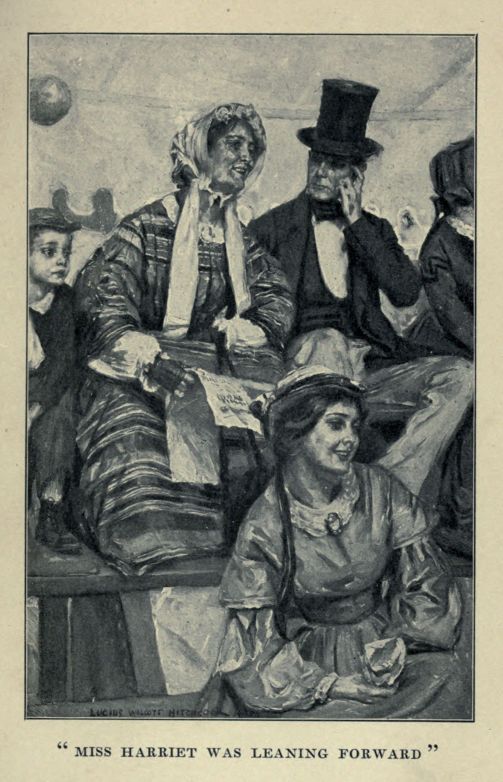
"MISS HARRIET WAS LEANING FORWARD"
"'Not more than six months;' God grant not!—I wish it might not be more than two."
"Willy, read what comes next," she said, shoving the programme at him; "I can't stop looking."
The canvas was darkening a little overhead, so that William had to put on his glasses and hold the printed sheet at arm's-length to decipher the blurred, smudged text sufficiently to say that "Mademoiselle Orinda, Queen of the Flying Trapeze, would give her marv—"
"William—what shall I do about Annie?" Miss Harriet said.
"You know we will all take care of Miss Annie," he said, tenderly; "and—"
"Oh, Willy, there's the red lemonade," she interrupted, standing up and beckoning with her crumpled programme. "Did you ever see so deadly a drink? You forgot the pea-nuts," she reminded him, reproachfully. And when William secured his hot, brown-paper bag, she ate the pea-nuts and watched the changing wonders of the ring with intent eyes. She laughed aloud at the clown's endeavors to ride a kicking donkey, and when the educated dogs carried one another about in a wheelbarrow she applauded generously. "They are wonderful!" she said.
William King looked at her keenly; it was all real. Miss Harriet was incapable of pretence.
The brilliant day, that had showed between lacings of the tent like strings of sapphires, had dimmed and dimmed; and by-and-by, unnoticed at first, there was the drip of rain. Here and there an umbrella was raised, and once or twice a bedraggled man or woman led out a reluctant child—"For I ain't a-goin' to have you catch your death of cold for no trained elephants," a mother said, decidedly, pulling a whining boy from beside Miss Harriet.
"Perhaps," ventured the doctor, "we really ought to go. I can't have you 'catch your death of cold,' Miss Harriet."
"I won't die of a cold, William," she said, her eyes narrowing.
And William swore at himself under his breath, but said, with clumsy jocularity: "Well, not if I can help it. But I don't know why you should be so sure; it might give you bronchitis for a year."
"I won't have bronchitis for a year," Miss Harriet said, gazing at the clowns.
And William King swore at himself again.
The rain increased to a downpour; little streams at first dripped, then poured, upon the thinning benches. The great centre pole was streaming wet; the clown stood in a puddle, and the red triangle on his chalk-white forehead melted into a pink smear.
"Really, Miss Harriet," William said, anxiously, "I'm afraid—"
"If you're afraid for yourself, I'll go," she said; "but we ought to wait for the grand concert. (Ah! there's the man with the red balloons. If you had a half-dozen children, Willy, as you ought to have, I'd buy him out.) Well, are you sugar or salt, to be so scared of a drop of rain?"
She did not look afraid of rain herself when she got up and pushed past the scattered spectators, her hair glistening with drops, her cheeks red, her eyes clear. "William," she said, when they got outside and were hurrying along to catch the stage for Old Chester—"William, that has done me good. I feel superbly. Do you know, I haven't had an instant's pain since I first spoke of the thing to you? That's three days entirely free. Why, such a thing hasn't happened in—in three months. Just think of that—entirely free. William, I'll cheat you doctor-men yet." She looked at him with glowing courage. "I feel so well," she said.
She held out her hand, there in the rain on the black cinder-path, and William King struck his into it with a sort of shout.
"Hurrah!" he said, as she had said when they had come out from hearing the sentence in the Mercer doctor's office.
The long ride home in the stage, in which they were the only passengers, was perhaps a descending scale.... At first they talked of the circus. "I liked the man and the bear best," William said.
"Oh, he wasn't as fine as that beautiful lady in pink petticoats who rode the fat, white horse. Did you ever see a horse with so broad a back, Willy? Why, I could have ridden him myself."
"He would need a broad back," William said; and Miss Harriet told him to hold his tongue and not be impudent. The rain was pattering on the roof and streaming down the windows, and in the dark, damp cavern of the stage they could not see each other's face very well; but the stretches of tense silence in the circus talk made William King's heart beat heavily, although he burst out gayly that the afternoon had brought back his youth. "Miss Harriet, when you were a child, didn't you always want to poke around under the seats when it was over and find things? William Rives once found five cents. But William would find five cents in the Desert of Sahara. I never had his luck, but I was confident that watches were dropped freely by the spectators."
"Of course," cried Miss Harriet. "Or diamond-rings. My fancy led me towards diamond-rings. But I suppose you never knew the envy of the ladies' clothes? Dear me—those petticoats!"
"The ring-master's boots were very bitter to me; but my greatest desire was—"
"Willy," Miss Harriet said, hoarsely, "I don't want anybody to know."
"Of course not," William King said. "Why should they? We may hold this thing at bay for—"
"We will hold it at bay," she said, with passion. "I will! I will! Do you hear me?"
Willy King murmured something inarticulately; his eyes suddenly smarted.
The ride to Old Chester seemed to him interminable; and when, after wandering snatches of talk about the circus, the stage at last drew up at the green gate in Miss Harriet's privet hedge, his nerves were tense and his face haggard with fatigue.
At home, at his belated supper-table, his good Martha was very severe with him. "You oughtn't to allow yourself to get so tired; it's wrong. You could just as well as not have ordered your things by mail. I must say, William, flatly and frankly, that a doctor ought to have more sense. I hope there was nobody in the stage you knew to talk you to death?"
"Miss Harriet came down," William said, "but she hadn't much to say."
"I suppose she went to buy some of her horrid supplies?" Martha said. "I can't understand that woman—catching things in traps. How would she like to be caught in a trap? I asked her once—because I am always perfectly frank with people. 'How would you like to be caught in a trap, Miss Harriet?' I said. And she said, 'Oh, Annie would let me out.' You never can get a straight answer out of Harriet Hutchinson."
"My dear, I'll take another cup of tea. Stronger, please."
"My dear, strong tea isn't good for you," Martha said.
IV
When Miss Harriet woke the next morning the blue June day was flooding her room. At first she could not remember.... What was the something behind her consciousness? It came in an instant. "Trapped," she said, aloud, and turned her head to see Miss Annie at her bedside.
"What is trapped, sister?" said Miss Annie, her little old face crumpling with distress.
"I am," Harriet said; and laughed at the absurdity of telling Annie in such a fashion. But of course there was no use in telling Annie. She couldn't understand, and all that there was for her to know, the ultimate fact, she would find out soon enough. The younger sister felt a sick distaste of dealing with this poor mind; she wanted to be kind to Annie; she had always wanted to be kind to her—but she didn't want her round, that was all. And so she sent her off, patiently and not ungently: "Don't bother me, Annie, that's a good girl. No—I don't want any roses; take them away. No—I don't want to look at pictures. You go away now, that's a good girl."
And the wrinkled child obeyed meekly. But she told the deaf Augustine that Harriet was cross. "I'm the oldest, and she oughtn't to order me round," she whimpered.
Poor Miss Annie was constantly being told to be a good girl and go away, in the days that followed—days, to Miss Harriet, of that amazement and self-concentration which belong to such an experience as hers. There had been no leading up to this knowledge that had come to her—no gradual preparation of apprehension or suspicion. The full speed of living had come, crash! against the fact of dying. The recoil, the pause, the terrible astonishment of that moment when Life, surging ahead with all his banners flying, flings himself in an instant against the immovable face of Death—leaves the soul dazed by the shock—dazed, and unbelieving. "It cannot be." That is the first clear thought. It is impossible; there is a mistake somewhere. A day ago, an hour ago, Death was lying hidden far, far off in the years. Sometime, of course, he would arrive—solemn, inevitable, but beneficent, or at least serene. He would send soft warnings before him—faint tollings of fatigue, vague mists of sunset shadows. The soul will be ready for him when he comes then; will even welcome him, for after a while Life grows a little tired and is ready to grasp that cool hand and rest. We all know how to meet Death then, with dignity and patience. But to meet him to-morrow—to-day, even, when we are full of our own business, of our own urgent affairs—the mere interruption of it is maddening. Across the solemnity of the thought comes with grotesque incongruity an irritated consciousness of the inconvenience of dying.
As for Harriet Hutchinson—"I don't believe it," she said to herself, that first morning. And then, breathlessly, "Why, I can't—die!"
She was not afraid, as one counts fear, but she was absorbed; for there is a dreadful and curiously impersonal interest in the situation that takes possession of the mind in moments like this. No wonder she could not think about Annie. She could not think about anything except that that man in Mercer had said that in a very short time—
"Why, but it's perfectly ridiculous!" she told herself; "it can't be. I'm not sick—"
As she lay there in her bed that morning, after she had sent Miss Annie away, she lifted her hand—a large hand, with strong, square fingers, brown with weather and rough with her work, and looked at it curiously. It was a little thin—she had not noticed that before; but there it was, eager, vital, quick to grip and hold, life in every line. And it would be—still? No; she did not believe it. And, besides, it couldn't be, it mustn't be. She had a hundred things to do. She must do them; she couldn't suddenly—stop. Life surged up in a great wave of passionate determination. She got up, eager to go on living, and to deny, deny, deny! It was the old human experience which is repeated and repeated until Life can learn the fulfilment of Death. Poor Life, beaten by the whips of pain, it takes so long sometimes to learn its lesson!
In those weeks that followed—weeks of refusal, and then struggle, and then acceptance, and last of all adjustment—Miss Harriet found old Annie's companionship almost intolerable. She was very unreasonable with her, very harsh even; but all she asked was solitude, and solitude Annie would not give. She ran at her sister's heels like a dog; sat looking at her with frightened eyes in the bad hours that came with relentlessly increasing frequency; came whimpering to her bedside on those exhausted mornings when Harriet would scourge her poor body onto its feet and announce that she was going out. "These four walls smother me," she used to say; "I must get out-of-doors."
Sometimes it seemed as if the big, kind nature that had borne the pin-pricks so patiently all these years had reached the breaking-point, and another day or another hour of poor old Annie's foolish love would cause it to burst out in frantic anger:
"It hurts, sister?"
"Yes, Annie; but never mind. If I could only get out-of-doors I wouldn't mind."
"Oh, sister, don't let it hurt."
"Can't help it, Annie. Now, don't think about it, that's a good girl. Maybe I can get out to-morrow a little while."
"But I can't bear it."
"Got to, my dear. Come, now, run away. Go and see your chickens."
"Sister, I can't bear it."
"Annie, you drive me wild. Augustine—oh, she can't hear. Augustine! you must take Miss Annie away. Annie, if you say another word—"