Front matter (continued 3)
Reading edition
"But, Lydia, my dear," Dr. Lavendar said, gently, "I am afraid it is extravagant, isn't it, to try to give us all so much pleasure? And is a blue silk frock very—well, serviceable, I believe, you ladies call it?"
"No, indeed it isn't," she said, with sudden, pathetic passion. "That's why I got it. I never, since I was a girl, have had anything that wasn't serviceable."
"But," Dr. Lavendar said, "I rather hoped you would see your way clear to making your house a little more comfortable?"
"Why, but I'm perfectly comfortable," she assured him; "and even if I was not, I'd rather, just for once in my life, have my party and give my presents. Oh, just once in a lifetime! I'd rather," she said, and her eyes snapped with joy—"I'd rather have next Thursday night, and my house as it is, than just comfort all the rest of my days. Comfort! What's comfort?"
"Well, Lydia, it's a good deal to some of us," Dr. Lavendar said. And then his eyes narrowed. "Lydia, my dear—does Mr. Rives know about this?"
Miss Lydia, counting her packages over, said, absently, "No; it is to be a surprise to William."
"If I am not mistaken," said Dr. Lavendar, "it will be a very great surprise to William."
And then he fell into troubled thought; but as he thought his face brightened. It brightened so much that by the time they reached Old Chester he was as joyously excited about the party as was Miss Lydia herself, who made him a thousand confidences about her dress and her presents and the food which would be offered to her guests. His joyousness had not abated when, the next morning, Mrs. Barkley presented herself, breathless, at the Rectory.
"I think," said she, in an awful bass, sitting up very straight and glaring at Dr. Lavendar, "that this is the most terrible thing that ever happened."
"There are worse things," said Dr. Lavendar.
"I know of nothing worse," Mrs. Barkley said, with dreadful composure. "You may. You know what the unregenerate human heart may do. I do not. This is the worst. What will people say? What will Mrs. Dale say? It must be stopped! She ran in this morning and told me in confidence. She came, she said, to know if she could borrow my teaspoons next Thursday week. I said she could, of course; but I suppose I looked puzzled; I couldn't imagine—then she confessed. She said you knew, but no one else. Then, before I came to my senses, she ran out. I came here at once to say that you must stop it."
"In the first place," said Dr. Lavendar, thrusting his hands down into his dressing-gown pockets, "I couldn't stop it. In the second place, I haven't the right to stop it. And in the third place, I wouldn't stop it if I could."
"Dr. Lavendar!"
"I am delighted with the plan. We need gayety in Old Chester; I think we'll get it. I hope she'll have Uncle Davy in, with his fiddle, and we'll have a reel. Mrs. Barkley, will you do me the honor?"
It came over Mrs. Barkley, with a sudden chill, that there was something the matter with Dr. Lavendar.
"I have calculated," said the old minister, chuckling, "that Miss Lydia has in hand, at present, about $1.75 of our $100. This sum I trust she will give to Foreign Missions. The need is great. I shall bring it to her attention."
"Dr. Lavendar," said Mrs. Barkley; and paused.
"Ma'am?"
"I don't understand you, sir."
Dr. Lavendar looked at her and smiled.
IV
And so the night of Old Chester's festivity approached. Miss Lydia's invitations were delivered the morning of the day, but a rumor of the party was already in the air. There had been some shakings of the head and one or two frowns. "It will cost her at least $3," said Martha King, "and she could get a new bonnet with that."
"It's her way of thanking us for her present," said the doctor, "and a mighty nice way, too. I'm going. I'll wear my white waistcoat."
Mrs. Drayton said, calmly, that it was dishonest. "The money was given to her for one purpose. To ask people to tea, and have even only cake and lemonade, is spending it for another purpose. It will cost her at least $4.50. Not a large sum, compared with the whole amount donated in charity. But the principle is the same. I always look for the principle—it is a Christian's duty. And I could not face my Maker if I ever failed in duty."
Then Mrs. Dale's comment ran from lip to lip: "Miss Lydia has a right to do as she pleases with her own; if she invites me to tea, I shall go with pleasure."
When the rumor reached William Rives's ears he turned pale, but he made no comment. "But I came to ask you about it, Lydy," he said. This was Wednesday evening, and William stood at the front door; Miss Lydia was on the step above him. "I won't ask you to come in, William," she said, "I'm so busy—if you'll excuse me."
"I am always gratified," said William, "when a female busies herself in household affairs, so I will not interrupt you. I came for two purposes: first, to inquire when you intend to begin the improvements upon your house; and, secondly, to say that I hope I am in error in regard to this project of a supper that I hear you are to give."
"Why?" said Lydia.
"Because," William said, with his sharp, neat smile, "a supper is not given without expense. Though I approve of hospitality, and make a point of accepting it, yet I am always conscious that it costs money. I cannot but calculate, as I see persons eating and drinking, the amount of money thus consumed, and I often wonder at my hosts. I say to myself, as I observe a guest drink a cup of tea, 'Two cents.' Such thoughts (which must present themselves to every practical man) are painful. And such a supper as I hear you mean to give would involve many cups of tea."
"Twenty-seven," said Miss Lydia.
"And is there to be cake also?" said William, breathlessly.
"There is," said Miss Lydia; "a big one, with a castle in pink-and-white icing on it—beautiful!"
William was stricken into silence; then he said, shaking his head, "Do you really mean it, Lydy?"
"I do, William."
Mr. Rives sighed.
"Well," he said—"well, I regret it. But, Lydy, we might utilize the occasion? Refreshment is always considered genteel at a marriage. Why not combine your supper with our wedding? We can be married to-morrow night. Dr. Lavendar is coming, I presume? I can get the license in the morning."
Miss Lydia was silent; the color came into her face, and she put her hand up to her lips in a frightened way. "Oh, I—don't know," she faltered. "I—I am not—not ready—"
"Oh," William urged, "never mind about being ready; I should be the last to wish you to go to any of the foolish expense of dress customary on such occasions. Yes, Lydy, it is an opportunity. Do agree, my dear; we will save money by it."
Miss Lydia drew in her breath; she was very pale; then suddenly she nodded. "Well, yes," she said. "I will, if you want to, William. Yes, I will."
"I will communicate with Dr. Lavendar," said Mr. Rives, joyfully, "and ask him to hold himself in readiness, but not to speak of it outside." Miss Lydia nodded, and, closing the door, went back to her engrossing affairs. Presents and a party and a wedding—no wonder the poor little soul was white and dizzy with excitement!
Long will Old Chester remember that occasion: The little house, lighted from garret to cellar; candles in every possible spot; flowers all about; the mantel-piece heaped with bundles; William King's bird-cage hanging in the window; Uncle Davy's fiddle twanging in the kitchen; and Miss Lydia in front of the smoky fireplace, banked now with larkspurs and peonies—Miss Lydia in a light, bright blue silk dress trimmed with lace; Miss Lydia in white kid gloves, buttoned with one button at the wrist, and so tight that the right glove split across the back when she began to shake hands. Oh, it was a great moment.... No wonder she was pale with excitement! ... She was very pale when William Rives arrived—arrived, and stood dumfounded!—staring at Miss Lydia; staring at the packages which were now finding their way into astonished hands; staring at the refreshment-table between the windows, at the great, frosted cake, at the bottles of Catawba, at Mrs. Barkley's spoons stuck into tall glasses of wine jelly. Mr. Rives stood staring at these things, his small eyes starting out upon his purpling cheeks, and as he stared, Miss Lydia, watching him, grew paler and paler.
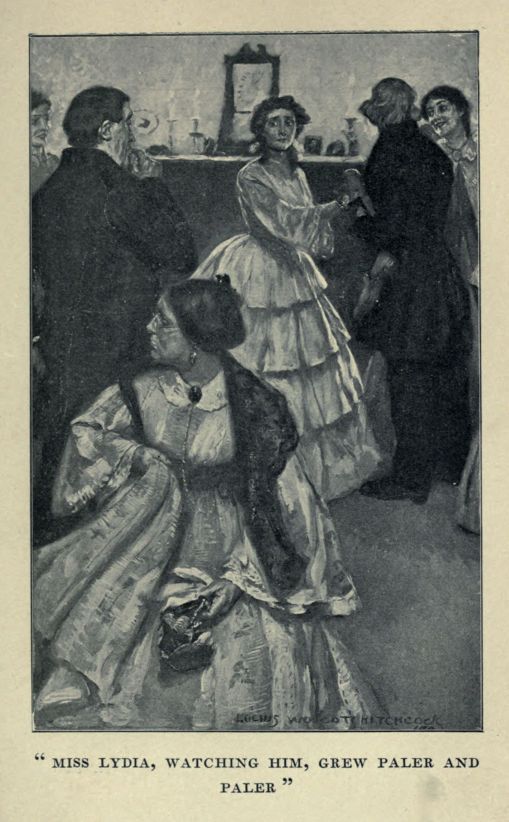
"MISS LYDIA, WATCHING HIM, GREW PALER AND PALER"
Then, suddenly, William, stealthily, step by step, began to back out of the room. In the doorway he shouldered Mrs. Barkley, and, wheeling, turned upon her a ferocious face:
"And I contributed $1.50—"
But as he retreated and retreated, the color returned to Miss Lydia's cheek. She had almost stopped breathing as he stood there; but when he finally disappeared, she broke out into the full joyousness of the occasion. The opening of each present was like a draught of wine to her, the astounded or angry thanks went to her head; she rubbed her hands until the left glove split also; and then Uncle Davy's fiddle began in good earnest, and she bustled about, running and laughing, and arranging partners for the reel.
Yes, it was a great occasion. Old Chester talked of it for months; not even William Rives's most unexpected and unexplainable departure the next day on the morning stage could divert the appalled, excited, disapproving interest that lasted the year out. Not even Miss Lydia's continued faithfulness to the portrait, which had condoned so many offences in the past, could soften Old Chester's very righteous indignation. There were, it must be admitted, one or two who professed that they did not share the disapproval of all right-thinking persons; one was, if you please, Mr. Smith! (He was one of the new Smiths, so one might expect anything from him.) He had not been invited to the party, but when he heard of it he roared with most improper mirth.
"Well done!" he said. "By Jove! what a game old party. Well done! The money was champagne on an empty stomach; of course, she got drunk. It would have been cheaper to have bought a bottle of the genuine article and shut herself up for twenty-four hours. Well, it's worth the cost of a new chimney. I'll put her repairs through, Dr. Lavendar—unless you want to get up another present?" And then he roared again. Very ill-bred man he was.
Dr. Lavendar said that there would not be another present. He said Miss Lydia had a right, in his opinion, to spend her money as she chose; but there would not be another present.
And then he walked home, blinking and smiling. "Smith's a good fellow," he said to himself, "if he is one of the new folks. But what I'd like to know is: did Lydia think $100 a low price?"
AMELIA
I
The exception that proved Old Chester's rule as to the subjection of Youth was found in the household of Mr. Thomas Dilworth.
When the Dilworth children (at least the two girls) hung about their father when he came home at night or teased and scolded and laughed at him at their friendly breakfast-table, an observer might have thought himself miles away from Old Chester and its well-brought-up Youth. The way those girls talk to Thomas Dilworth! "Where will it end?" said Old Chester, solemnly. For instance, the annual joke in the Dilworth family was that father had been in love with mother for as many years as she was old, less so many minutes.
Now, imagine Old Chester children indulging in such familiarities!
Yet on Mrs. Dilworth's birthday this family witticism was always in order:
"Father, how long have you been mother's beau?"
And Thomas, rosy, handsome, looking at least ten years younger than his Amelia, would say: "Well, let's see: forty-one years" (or two or three, as the case might be), "eleven months, twenty-nine days, twenty-three hours, and forty minutes; she was twenty minutes old when I first laid eyes on her, and during those twenty minutes I was heart-whole."
But Mrs. Dilworth, smiling vaguely behind her coffee-cups, would protest: "I never heard anything about it, Tom, until you were sixteen."
And then the girls would declare that they must be told just what father said when he was sixteen and mother was twelve. But Thomas drew the line at that. "Come! come! you mustn't talk about love-making. As for marrying, I don't mean to let you girls get married at all. And Ned here had better not let me catch him thinking of such nonsense until he's twenty-five. He can get married (if I like the girl) when he is twenty-eight."
"You got married at twenty-two, sir," Edwin demurred.
"If you can find a woman like your mother, you can get married at twenty-two. But you can't. They don't make 'em any more. So you've got to wait. And remember, I've decided not to let Mary and Nancy get married, ever. I don't propose to bring up a brace of long-legged girls, and clothe 'em and feed 'em and pay their doctors' bills, and then, just as they get old enough to amount to anything and quit being nuisances, hand 'em over to another fellow. No, sir! You've got to stay at home with me. Do you understand?"
The girls screamed at this, and flung themselves upon him to kiss him and pull his hair.
No wonder Old Chester was shocked.
Yet, in spite of such happenings, Thomas and Amelia Dilworth were of the real Old Chester. They were not tainted with newness—that sad dispensation of Providence which had to be borne by such people as the Macks or the Hayeses, or those very rich (but really worthy) Smiths. The Dilworths were not new; yet their three children had the training—or the lack of training—that made the Hayes children and their kind a subject for Old Chester's prayers.
"Who can say what the result of Milly Dilworth's negligence will be?" Mrs. Drayton said, sighing, to Dr. Lavendar; who only reminded her that folks didn't gather thistles of figs—generally speaking.
But in spite of Dr. Lavendar's optimism, it was a queer household, according to Old Chester lights.... In the first place, the father and mother were more unlike than is generally considered to be matrimonially safe. Amelia was a dear, good soul, but, as Miss Helen Hayes said once, "with absolutely no mind"; while Thomas Dilworth was eminently level-headed, although very fond (so Mrs. Drayton said) of female society. And it must be admitted that Thomas had more than once caused his Milly a slight pang by such fondness. But at least he was never conscious that he had done so—and Milly never told him. (But Mrs. Drayton said that that was something she could not forgive in a married gentleman. "My dear husband," said Mrs. Drayton, "has never wandered from me, even in imagination.") Added to conjugal incongruity was this indifference on the part of Thomas and his wife to the training of the children. The three young Dilworths were allowed to grow up exactly as they pleased. It had worked well enough with Mary and Nancy, who were good girls, affectionate and sensible—so sensible that Nancy, when she was eighteen, had practically taken the housekeeping out of her mother's hands; and Mary, at sixteen, looked out for herself and her affairs most successfully. With Edwin the Dilworth system had not been so satisfactory. He was conceited (though that is only to be expected of the male creature at nineteen) and rather selfish; and he had an unlovely reserve, in which he was strikingly unlike his father, who overflowed with confidences. This, and other unlikeness, was, no doubt, the reason that there were constant small differences between them. And Mrs. Dilworth—vague, gentle soul!—was somehow unable to smooth the differences over as successfully as most mothers do.
Now, smoothing things over is practically a profession to mothers of families. But Milly Dilworth had never succeeded in it. In the first place, she had no gift of words; the more she felt, the more inexpressive she became; but, worst of all, she had, poor woman, not the slightest sense of humor. Now, in dealing with husbands and children (especially with husbands), though you have the tongues of men—which are thought to be more restrained than those of women—and though you have the gift of prophecy (a common gift of wives) and understand all mysteries—say, of housekeeping—and though you give your body to be used up and worn out for their sakes, yet all these things profit you nothing if you have no sense of humor. And Milly Dilworth had none.
That was why she could not understand.
She loved, in her tender, undemonstrative way, her shy, unpractical, secretive Edwin and her two capable girls; she loved, with the single, silent passion of her soul, her generous, selfish, light-hearted Tom, who took her wordless worship as unconsciously and simply as he took the air he breathed; she loved them all. But she did not pretend to understand them. Thus she stood always a little aside, watching and loving, and wondering sometimes in her simple way; but often suffering, as people with no sense of humor are apt to suffer. Dear, dull, gentle Milly! No one could remember a harsh word of hers, or mean deed, or a little judgment. No wonder Dr. Lavendar felt confident that there would be no thistles in her household.
Thomas Dilworth had the same comfortable conviction, especially in regard to his girls. "Now, Milly, honestly," he used to say, "apart from the fact that they are ours, don't you really think they are the nicest girls in Old Chester?"
Milly would admit, in her brief way, that they were good children.
"And Edwin means all right," the father would assure himself; and then add that he couldn't understand their boy—"at least, I suppose he's ours? Willy King says so. I have thought perhaps he was a changeling, put into the cradle the first day."
"But, Tom," Milly would protest, anxiously, "Neddy couldn't be a changeling. He was never out of my sight for the first week—not even to be taken out of the room to be shown to people. Besides, he has your chin and my eyes."
"Well, if you really think so?" Thomas would demur. And Mrs. Dilworth always said, earnestly, that she was sure of it.
Still, in spite of eyes and chin, Ned's unpracticalness was an anxiety to his father, and his uncommunicativeness a constant irritation. Thomas himself was ready to share anything he possessed, money or opinions or hopes, with any friend, almost with any acquaintance. "I don't want to know anybody's business," he used to say; "I'm not inquisitive, Milly; you know I'm not. But I hate hiding things! Why shouldn't he say where he's going when he goes out in the evening? Sneaking off, as if he were ashamed."
"He just doesn't think of it," the mother would say, trying to smooth it over.
"Well, he ought to think of it," the father would grumble, eager to be smoothed.
But Milly found it harder to reconcile her husband to their boy's indifference to business than to his reserves.
"He sees fit to look down on the hardware trade," Tom told his wife, angrily. "'Well, sir,' I said to him the other day, 'it's given you your bread-and-butter for nineteen years; yes—and your fiddle, too, and your everlasting music lessons.' And I'll tell you what, Milly, a man who looks down on his business will find his business looking down on him. And it's a good business—it's a darned good business. If Ned doesn't have the sense to see it, he had better go and play his fiddle and hold out his hat for pennies."
Milly looked anxiously sympathetic.
"I don't know what is going to become of him," Thomas went on. "When you come to provide for three out of the hardware business, nobody gets very much."
Mrs. Dilworth was silent.
"I was talking about him to Dr. Lavendar yesterday, and he said: 'Oh, he'll fall in love one of these days, and he'll see that fiddling won't buy his wife her shoe-strings; then he'll take to the hardware business,' Dr. Lavendar said. It's all very well to talk about his falling in love and taking to business; but if he falls in love, I'll have another mouth to fill. And maybe more," he added, grimly.
"Not for a year, anyway," his wife said, hopefully. "And, besides, I don't think Neddy's thinking of such a thing."
"I hope not, at his age."
"You were engaged when you were nineteen."
"My dear, I wasn't Ned."
Mrs. Dilworth was silent.
"The Packards telegraphed to-day that they wouldn't take that reaper," Tom Dilworth said.
Milly seemed to search for words of sympathy, but before she found them Tom began to talk of something else; he never waited for his wife's replies, or, indeed, expected them. He was so constituted that he had to have a listener; and during all their married life she had listened. When she replied, she was a sounding-board, echoing back his own opinions; when she was silent, he took her silence to mean agreement. Tom used to say that his Milly wasn't one of the smart kind; he didn't like smartness in a woman, anyway; but she had darned good sense;—for, like the rest of us, Thomas Dilworth had a deep belief in the intelligence of the people who agreed with him....
"I have a great mind," he rambled on, "to go up to the Hayeses'. You know that note is due on the 15th, and I believe I'll have to ask him to extend it. I hate to do it, but Packard has upset my calculations, and I'll have to get an extension, or else sell something out; and just now I don't like to do that."
"Very well," she said. It was her birthday—the one day in the year that her Thomas remembered that he had been in love with her for so many years, months, days, hours, minutes—a fact she never for one day in the year forgot. But she could no more have reminded him of the day than she could have flown. She was constitutionally inexpressive.
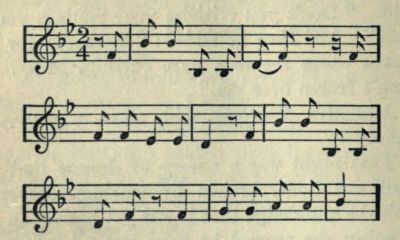
Tom began to whistle:
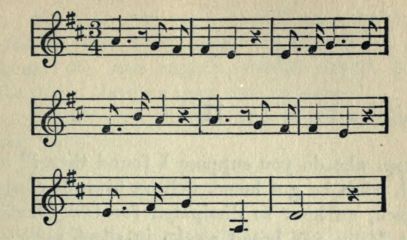
but broke off to say, "Well, since you advise it, I'll see Hayes"; then he gave her a kiss, and immediately forgot her—as completely as he had forgotten his supper or any other comfortable and absolutely necessary thing. Then he lighted his cigar and started for the Hayeses'.
II
"And who do you suppose I found there?" he said, when he got home, well on towards eleven o'clock, an hour so dissipated for Old Chester that Milly was broad awake in silent anxiety. "Why, Ned, if you please! He was talking to Hayes's daughter Helen. She seems a mighty nice girl, Milly. I packed young Edwin off at nine; he was boring Miss Helen to death. Boys have no sense about such things. Can't you give him a hint that women of twenty-five don't care for little boys' talk? By-the-way, she talks mighty well herself. After I settled my business with Hayes, we got to discussing the President's letter; she had just read it."
"Do you mean to say that the President has written to Helen Hayes?" cried Mrs. Dilworth, sitting up in bed in her astonishment.
Thomas roared, and began to pull his boots. "Why, they are regular correspondents! Didn't you know it?"
"No! I hadn't the slightest idea—Tom, you're joking?"
"My dear, you can't think I am capable of joking? But, Milly, look here, I'll tell you one thing: she was mighty sensible about Ned. She thinks there's a good deal to him—"
"I don't need Helen Hayes to tell me that," said Ned's mother.
Tom, who never paused for his wife's reply, was whistling joyfully:
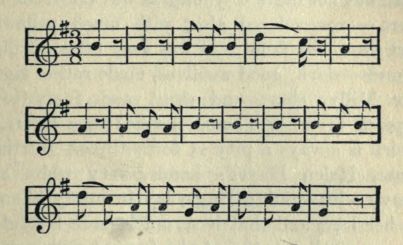
Helen Hayes had been very comforting to him; he had protested, when Ned reluctantly departed, that a boy never knew when to clear out; and Miss Helen had pouted, and said Ned shouldn't be scolded; "I wouldn't let him 'clear out'—so there!" Few women of thirty-two can be cunning successfully, but Tom thought Miss Helen very cunning. "I just perfectly love to hear him talk about his music," she said.
"He can't talk about anything else," Ned's father said. "That's the trouble with him."
"The trouble with him? Why, that's the beauty of him," said Miss Hayes, with enthusiasm; and Thomas said to himself that she was a mighty good-looking girl. The rose-colored lamp-shade cast a soft light on a face that was not quite so young as was the frock she wore—rose-colored also, with much yellowish lace down the front. It was very unlike Milly's dresses—dark, good woollens, made rather tight, for Milly, short and stout and forty-three, aspired (for her Thomas's sake) to a figure,—which is always a pity at forty-three. Furthermore, Helen Hayes's hands, very white and heavy with shining rings, lay in lovely idleness in her lap; and that is so much more restful in a woman's hands than to be fussing with sewing "or everlasting darning," Thomas thought. In fact, what with her lovely idleness and her praise of his boy, Tom Dilworth thought he had rarely seen so pleasing a young woman. "Though she's not so very young, after all; she must be twenty-five," he told his wife.
"She'll never see thirty again."
"Well, she's a mighty nice girl," Thomas said.
Except to look pretty, Miss Helen Hayes had done nothing to produce this impression, for she had contradicted Mr. Dilworth up and down about Ned.
"He has genius, you know."
"You mean his fiddle?" Tom said, incredulously.
"I mean his music. We'll hear of him one of these days."
"I don't care much whether we ever hear from his music," he said, "but I wish I could hear that he was applying himself to business."
"Business!" cried Helen Hayes. "What is business compared to Art?"
Thomas looked over at Mr. Hayes in astonishment, for in those days, in Old Chester, this particular sort of talk had not been heard; the older man sneered and changed his cigar from one corner of his mouth to the other. Miss Hayes did not get much sympathy from her family. But she went on with pretty dogmatism:
"You see, in a man like your son—"
"A man! He's only twenty, my dear young lady."
"In a man, sir! like your son—genius is the thing to consider; and you owe it to the world to let genius have its fullest play. Don't bring Pegasus down to plough Old Chester cornfields. Why, it seems to me," said Helen Hayes, "that he ought to be allowed to just soar. We common folk ought to do the ploughing."
"Thunder an' guns!" said Tom Dilworth.
"I don't care if he can't be sure that two and two make four," cried Miss Helen (Thomas, bubbling into aggrieved confidence on this sore subject, had alleged this against his son); "he can put four notes together that open the gates of heaven. And he'll distinguish himself in music, because his father's son is bound to have tremendous perseverance and energy."
Old Mr. Hayes snorted and spat into the fire; but Miss Helen's look when she said "his father's son" made Mr. Thomas Dilworth simper.
"That girl has sense," he said to himself as he walked home at a quarter to eleven. But he only told Mrs. Dilworth that she had better hint to Ned to be a little more backward in coming forward. "That Hayes girl is nice to him on our account," said Tom, "but he needn't bore her to death. Milly, why don't you have one of those pink wrappers? She had one on to-night. Loose, you know, and trimmed down the front."
"A wrapper isn't very suitable for company," Mrs. Dilworth said, briefly. "It didn't matter with you, because you're an old married man; but she oughtn't to go round in wrappers when Neddy's there."
"Why, it was a sort of party dress—all lace and stuff. I wish you had one like it. As for Ned, he's a babe; and her wrapper thing was perfectly proper, of course. Can't you ask her for the pattern?"
And then Thomas went to sleep and dreamed of a large order for galvanized buckets; but his Milly lay awake a long time, wondering how she could get a pink dress; pleased, in her silent way, that Tom should be thinking about her clothes; but with a slow resentment gathering in her heart that Helen Hayes's clothes should have suggested his thought.
"And pink isn't my color," she thought, a vision of her own mild, red face rising in her mind. Still, a fresh pink lawn—"that's always pretty," Milly Dilworth said to herself, earnestly.
III
Tom Dilworth's boy was a curious sport from the family stock. He did, indeed, look down on the hardware business, but not much more than on any business, although galvanized utensils were perhaps a little more hideous than most things. Business in itself did not interest him. Money-making was sordid folly, he said; because, "What do you want money for? Isn't it to buy food and clothes and shelter? Well, you can't eat more food than enough; you can only wear one suit of clothes at a time; and an eight-foot cell is all the shelter that is necessary."
"Eight-foot—grandmother!" his father would retort; "you'll inventory that lot of spades, young man, and dry up."
And Ned, with shrinking hands and ears that shuddered at the hideous screech of scraping shovels, would make out his inventory with loathing. His mother was not impatient or contemptuous with him—she could not have been that to any one; she simply could not understand what he meant when he spouted upon the folly of wealth (for, like most shy people, he occasionally burst into orations upon his theories), or when he set off some fireworks of scepticism borrowed from Mr. Ezra Barkley, or undertook (when Thomas was not present) to prove his father's politics entirely wrong. On such occasions Nancy would say, "Oh, Ned, do be quiet!" and Mary would yawn openly. As for his music, nobody cared about it, except, perhaps, his mother. "But I must say, Neddy, I like a tune," she would say, mildly, after Edwin had tucked his violin under his chin and poured out all his young soul in what was a true and simple passion.
"A tune!" poor Ned said, and groaned. "Mother, I wish you wouldn't call me that ridiculous name."
"I'll try not to, Neddy, dear," she would promise, anxiously; and Ned would groan again.
With such a family circle, one can fancy what it was to the lad when quite by accident he found a friend. It was the summer that he was twenty, that once, coming back in the stage with him from Mercer, Miss Helen Hayes showed a keen interest in something he said; then she asked a question or two; and when, hesitating, waiting for the laugh which did not come, he began to talk, she listened. Oh, the joy of finding a listener! She looked at him, as they sat on the slippery leather seat of the old stage, with soft, intelligent eyes, her slightly faded prettiness giving a touch of charm to the high and flattering gravity of her manner. When she asked him to bring his violin sometime and play to her, the boy could almost have wept with joy. He made haste to work off several of his dearest and most shocking phrases, which she took with deep seriousness: A whale's throat is not large enough to swallow a man—therefore the Biblical account is false, etc., etc. "In fact," said Ned, "if I could have a half-hour's straight conversation with Dr. Lavendar, I could prove to him the falsity of most of the Old Testament."
Helen Hayes was shocked; she regretted Mr. Dilworth's scepticism with almost tearful warmth; yet she realized that a powerful mind must search for truth, above all. She wished, however, that he would read such and such a book. "I can't argue with you myself," she said—"you are far too clever for my poor little reasoning powers."
It was in April that Edwin entered into this experience of feminine sympathy; and by mid-summer, at the time when Mr. Thomas Dilworth also found Miss Helen Hayes so remarkably intelligent, the boy was absorbed in his new emotion of friendship. He never spoke of it at home, hence his father's astonishment at finding him at the Hayeses'. And when, a week later, he found him a second time, Tom Dilworth was much perplexed.
"I dropped in on my way back from the store," he told his wife, "and there was that boy. I said to Miss Helen that she really must not let him bother her. I told her he was a blatherskite, and she must just tell him to dry up if he talked too much."
"Tom, I don't think you ought to talk that way about Neddy," Mrs. Dilworth said. "He's a dear boy."
"He may be a dear boy, but he is a great donkey," Ned's father said, dryly; "and I think it is very good in Helen Hayes to put up with him. I can see she does it on my account. Milly, why don't you ask her to come to supper, sometime? I like to talk to her; she's got brains, that girl. And she's good-looking, too. Ask her to tea, and have waffles and fried chicken, and some of that fluffy pink stuff the children are so fond of, for dessert."
"She's not much of a child," said Mrs. Dilworth, her face growing slowly red. "She's thirty-two if she's a day."
"My dear, she has aged rapidly; you said thirty a month ago. I like the pink stuff myself, and I'm nearly fifty. I bet the Hayeses don't have anything better at their house."
Milly softened at that. Where is the middle-aged housekeeper who does not soften at being told that her pink stuff is better than anything the Hayeses can produce? Yet Tom's talk of Miss Helen's brains pierced through her vagueness and bit into her heart and mind; and she could not forget that he had called the girl good-looking. "Girl!" said Mrs. Dilworth. She was standing before the small swinging glass on her high bureau, looking at herself critically; then she slipped back and locked her door; then took a hand-glass and stood sidewise to look again. Her hair was drawn tightly from her temples and twisted into a hard knot at the back of her head; she remembered that the Hayes girl wore high rats, which were very fashionable, and had a large curl at one side of her waterfall. "But it's pinned on," Milly said to herself; "anyway, mine's my own." Then she pulled her cap farther forward (in those days mothers of families began to wear caps when they were thirty) and looked in the glass again: Helen Hayes did not have a double chin. "She's a skinny thing," Milly said to herself. Yet she knew, bitterly, that she would rather be skinny than see those cruel lines, like gathers on a drawing-string, puckering the once round neck below the chin. And her forehead: she wondered whether if, every day, she stroked it forty-two times, she could smooth out the wrinkles?—those wrinkles that stood for the tender and anxious thought of all her married life! She had heard of getting rid of wrinkles in that way. "It would take a good deal of time," she thought, doubtfully. Still, she might try it—with the door locked. These reflections did not, however, interfere with the invitation which Thomas had suggested.
Milly had her opinion of a middle-aged woman who wore wrappers in public; but if Tom wanted her and her wrappers, he should have them. He should have anything in the world he desired, if she could procure it. Had he desired Miss Hayes hashed on toast, Milly would have done her best to set the dainty dish before her king. And no doubt poor Miss Helen in this form would have given Mrs. Dilworth more personal satisfaction than did her presence at Tom's side (for the invitation was promptly accepted) in some trailing white thing, her eyes fixed on her host's face, intent, apparently, upon any word he might utter. Watching that absorbed and flattering gaze, Milly grew more and more silent. She heard their eager talk, and her mild eyes grew round and full of pain with the sense of being left out; for Miss Hayes, though patient with her hostess, and even kind in a condescending way, hardly spoke to her. Once when, her heart up in her throat, Mrs. Dilworth ventured a comment, it seemed only to amuse Thomas and his guest—and she did not know why.
"This morning," Tom said, "I was h'isting up a big bunch of galvanized buckets to our loft with a fall and tackle, and all of a sudden the strap slipped, and the whole caboodle just whanged down on the pavement—"
"O-o-o-o!" said Helen Hayes, putting her hands over her ears with dramatic girlishness.
"It was terrific, and just at that moment up came Dr. Lavendar. Well, of course I couldn't express my feelings—"
"Poor Mr. Dilworth!"
"—he came up, and gave me a rap with his stick. 'Thomas,' he said (you know how his eyes twinkle!)—'Thomas, this is the most profane silence I ever heard.'"
Everybody laughed, except Milly and Edwin, the latter remarking that he didn't see anything funny in that. At which Miss Hayes said to him, under her breath, "Oh, you superior people are so contemptuous of our frivolity!" And Ned blushed with satisfaction, and murmured, "Why, no; I'm not superior, I'm sure."
As for Milly, with obvious effort and getting very red, she said that she didn't see how silence could be profane. "As long as you didn't say anything, you conquered your spirit," she added, faintly.
And then they all (except Edwin) laughed again. After that she made no attempt to be taken into the gayety about her, but her heart burned within her. The next morning at breakfast some words struggled out: "You'd think she was a young thing, she laughs so. And she's nearly thirty-five."
"How time flies!" said Tom, chuckling. And then, to everybody's astonishment, the mute Edwin spoke up, and said that as for age it was a matter of the soul and not of the body. "Some people are always young," said Edwin. "Dr. Lavendar is, and you are, father—"
"Thank you, grave and reverend seignior."
"—and mother," continued the candid youth, "has always been old. Haven't you, mother?"
"True, for you, my boy," said the father; "your mother has the wisdom of the family."
Milly Dilworth's face grew dully red to the roots of her hair; a wave of anger rose up in her inarticulate heart. They called her old, these two. She could hardly see her plate for tears.
Edwin, however, was so thrilled by the elegance of his sentiment that he was eager to repeat it to Miss Hayes; but, somehow, he always had difficulty in introducing the subject of age. When he did succeed in getting in his little speech, she said that he impressed her very much when he said things like that. "Your insight is wonderful," she murmured, looking at him with something like awe in her eyes. (Miss Helen was never cunning with Ned.)
"I guess you're the only person that thinks so," Ned said; "at home they're always making fun of me."
"My friend," she said, gravely, "what else can you expect? You are an eagle in a pigeon's nest. I don't mean to criticise your family, but you know as well as I that you are—different. You are an inspiration to me," she ended. And Ned blushed with joy.
It certainly is inspiring to be told you are an inspiration.... Mr. Thomas Dilworth did not blush when he learned that mentally he was the most stimulating person that Miss Hayes had ever met; but he had an agreeable consciousness of his superiority, which he made no effort to conceal from his wife. He never made any effort to conceal anything from Milly, not even that fondness for female society which Mrs. Drayton had deplored.
And by-and-by Milly's tears began to lie very near the surface. They never gathered and fell, but perhaps they dropped one by one on her heart, leaving their imprint of patiently accepted pain. At this time she thought of her own mental deficiencies very constantly. Her mind had no flexibility, and she reached conclusions only by toilsome processes; but once reached, they were apt to be permanent. Her slow reasoning at this time led her to conclude that her Thomas was not to blame because he admired some one who was cleverer than she. "Why, he'd be foolish not to," she thought, sadly.
But this eminently reasonable conclusion did not save Mrs. Dilworth from turning white and red with misery, when, for instance, her husband observed that he had had to take down two bars of the Gordon fence, so that Miss Hayes could go home across lots. Then Thomas chuckled, and added that Helen Hayes was the brightest woman he knew.
He did not go on to tell of his walk in the October dusk, and Miss Helen's arch appeal to him for instruction on a certain political point on which she was ignorant. Thomas had instructed her so fully and volubly, while she looked at him with her reverent gaze, that it had grown dark; and that was why he had to take her home across lots. Thomas had not mentioned these details; he merely said he thought Miss Helen Hayes a bright woman—the brightest, to be exact, that he knew. And yet his Milly went into the kitchen pantry and hid her face in the roller behind the door and sobbed.
Well, of course! It's very absurd. A fat, wordless woman, who ought to be darning her children's stockings, it's very absurd for her to be weeping into a roller because her man, who has loved her for forty-three years, eleven months, twenty-nine days, twenty-three hours, and forty minutes—her man, to whom she is as absolutely necessary as his old slippers or his shabby old easy-chair—because this man does not think her the brightest woman he knows. But absurd as it is, it is suffering.
The woman of faithful heart who has been left behind mentally by her husband is a tragic figure, even if she is at the same time a little ridiculous—poor soul! Her futile, panting efforts to catch up; her brave, pitiful blunders; her antics of imitation; her foolish pink lawn frocks—of course they are funny; but the midnight tears are not funny, nor the prinking (behind locked doors), nor the tightened dresses, nor the stealthy reading to "improve the mind"—that poor, anxious, limited mind which knows only its duty to its dearest and best. These things mean the pain—a hopeless pain—of the recognition of limitations. What did it matter that once a year Tom announced that he had loved his Amelia for so many years, months, days, hours, and minutes?—He did not talk to her about the President's letter! But he talked to Helen Hayes about it. And yet she was a pale thing. "She never had my color," poor Milly thought; "and they say she doesn't get along well at home. And she's no housekeeper. Mrs. Hayes herself told me she was just real useless about the house. I can't understand it."
Of course she could not understand it. What feminine mind ever understood why uselessness attracts a sensible man? It is so foolish that even the most foolish woman cannot explain it.
As the autumn closed in on Old Chester, nobody in the family noticed Milly Dilworth's heavier look and deeper silence. Tom himself was more talkative than usual; business had been good, and he was going to get something handsome out of a deal he had gone into with Hayes. This took him often to the Hayeses' house; and after the two men had had their talk, Miss Helen was to be found at the parlor fireside, very arch and eager with questions, but most of all so respectful of Tom's opinions. His Amelia was respectful of his opinions, too, but in such a different way. Perhaps just at this time Thomas Dilworth pitied himself a little—the middle-aged husband does pity himself once in a while. Perhaps he sighed—certainly he whistled. There is no doubt that Mrs. Drayton would have felt he was wandering from his Amelia—at least in imagination. And yet Tom was as settled and grounded in love for his middle-aged wife as he ever had been.
This, however, cannot be understood by those who do not know that the male creature, good and honest and faithful as he may be, is at heart a Mormon.
"I declare," Tom said, coming home at twelve o'clock at night—"I declare I feel younger."
Milly was silent.
Then Tom began to whistle:
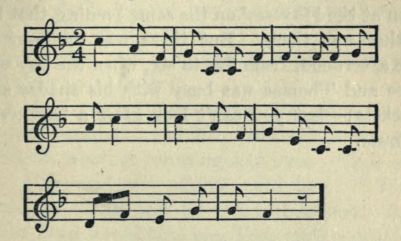
Then he broke off to say that he didn't think that Helen Hayes was over-happy at home. "The Hayeses are commonplace people, and she is very superior. I guess they don't get along well."
Milly thought to herself that when a girl didn't get along with her own mother it didn't speak well for the girl; but she did not say so.
But Thomas went on to declare that he didn't know what to make of Ned. "Hanging round the Hayeses till I'm ashamed of him! Why doesn't he know better? I never bored a woman to death when I was his age." And his wife thought, in heavy silence, that there were other people who hung round the Hayeses.
However, Thomas made his feeling so clear to his son that during the winter Ned was never seen at the Hayeses' on the same evening that his father was there. But there was an hour in the afternoon, from five to six, when the boy was free and Thomas was busy with his spades and buckets;—but you can't look after a boy every minute.
IV
Poor Amelia, in her bedroom, in the chilly December dusk, sopped her eyes with cold water and looked in the glass. "I mustn't cry any more," she said to herself, despairingly—"they're so red now!"
A door opened down-stairs, and there was a burst of laughter; and Mrs. Dilworth, in the cold twilight, went on sopping her eyes. Tom and the girls evidently didn't need her. "They could get along just as well without me. And if the Lord would take me, Tom could—could—so he could—"
Her soul was dumb, even to itself; but she knew what it was that Tom "could" do.
And she knew it without bitterness. Like every other woman whose love for her husband has in it the maternal element (and most good women's love has this element), she had always felt that if she died Thomas ought to marry again; but this simple creature went one ahead of that rather elementary feeling, and specified: she was willing to have him marry her.
"If the Lord would only remove me," said poor Milly, looking miserably in the glass at her plump figure, which showed no indications of removal. Her eyes were hopelessly red; she didn't see how she could possibly go down to supper. But of course she had to go down. The mother of a family and the mistress of one servant must go down to supper, no matter what the condition of her eyes may be. She slunk into her seat behind her teacups, and scarcely dared to look about her noisy, hungry circle, still less at her Thomas, who was smiling to himself, but who did not share his amusement with his family. Still, when he suddenly said something about the refreshment of talking to intelligent people, it was not hard to guess the direction of his thoughts. "It sharpens your brains up," said Thomas. "I was going to suggest, Milly, that you should ask Helen Hayes to tea again; but she's got company; and when they leave she's going off to make a visit to some of her relations, she tells me."
Amelia's mild lips tightened silently. So they had been together again. Her hand shook as she poured out another cup of tea for her Thomas, who took that moment to say, with all a husband's candor, that she was getting fatter than ever. "I thought you were starving yourself to get thin, Milly?" he said, smiling. Milly smiled, too, faintly; but she was saying to herself: "What did they talk about? How long were they together? Oh, if I could only be taken away!"
It would be interesting to follow the processes of a mind like Mrs. Dilworth's: how did a wife and mother of children reach the point of feeling that her family would be better off without her? Anybody in Old Chester could have told her such a belief was folly, and wicked folly at that. But it seemed just plain reason to Milly Dilworth: "I'm not necessary to anybody. Thomas likes somebody younger. He can't marry her because I'm alive; he could marry her (and she would be good to the children) if I were not here. But I am!" she would end, hopelessly.
Morning after morning, as she went about her household duties, or when before tea she sat in her little, old rocking-chair, mending the family stockings, she used to break herself against the hopelessness of the situation: She was there; and unless the Lord would remove her (any other sort of removal was impossible to her devout imagination) Tom could not have what he wanted—yes, and needed, too. For it was at this period that Mrs. Dilworth recognized, what most wives of men do recognize at one time or another, that although being a wife and mother is the only vocation of a married woman, being a husband and father is only one of many vocations of a married man. Hence the companionship of an eminently worthy wife is almost never enough for the male creature. When this harsh truth burst upon Milly, she wiped her eyes on the stocking she was mending and groaned aloud. But she did not rail against the fact, nor did she attempt to deny it; wherein she showed a superfeminine intelligence. She only said to herself that Thomas could not have what he wanted while she was alive; yet she couldn't, it seemed, die, although she was so miserable that she didn't know how she lived! It was at this point that she began to make wild schemes to relieve the situation: Suppose she asked that Hayes girl to come and make them a visit? But no—a man wants more than to just look at a pretty girl across the table. Suppose she went away herself and made a visit, and asked Miss Helen Hayes to come and keep house for her? (Like all good wives, Milly had no hesitation in offering up another woman to the pleasure of her lord.) No; people would talk about Tom if she did that.... The amount of it was, poor Milly, although she did not know it, was really planning that Thomas should have two wives at the same time—and, dear me! how that would simplify things! There would be the old, sensible, matter-of-fact wife to mend his stockings and order his good dinner and nurse him through the indigestion consequent upon the dinner—the old, anxious wife, who has had the children and reared them, who has planned and economized and toiled with him, who has borne the burden and heat of the day at his side—the prosaic wife, who gives, unasked, such good advice. Every one will admit that this elderly person has been, and (to a limited degree) still is, a necessity to every Thomas. But sometimes Thomas thinks, in his simple way, that it would be pleasant to have the luxuries as well as the necessities of life; to have, for instance, a young wife—a pretty wife, clever and light-hearted and gayly tyrannical; a wife who never knew enough to advise anybody, who should be a relaxation and a refreshment, and just a little bit of a fool; for, as every intelligent (unmarried) woman knows, men like fools; feminine fools. Of course the trouble is that if you supply a wife for two sides of a man's character—for utility, so to speak, and for diversion—he may, not unreasonably, demand that every side and angle and facet of his jewel-like nature have its own feminine setting. That was probably Solomon's idea. Well, well! the time is not yet for this reasonable arrangement; and it is possible that trade in galvanized buckets will never warrant its extensive existence.
But all this is very frivolous compared to the reality of this poor woman's pain, a pain that finally evolved a plan which, although less picturesque than the harem, was of the same grade in the eye of the law, though, curiously enough, not in her own eye. She could not, as she expressed it to herself, be dead, so that her Thomas might have his wish; but he could think she was dead.
When this extraordinary idea came into Milly Dilworth's head, she felt as one imprisoned in darkness who sees, far off, the glimmer of daylight. He "could think she was dead!" And if he thought so, of course there could be nothing wrong in his marrying "her." (Miss Hayes's moral status did not enter into Milly's calculations.)
The light in her darkness dazzled poor Milly at first, and the way was not clear. It took two weeks of further thought to decide upon the step, and then to evolve its details; but one need not go into them as Milly did.... As she sat at her work, day after day, she thought her plan out slowly and toilsomely. At first she kept balking at the enormity of it. Then some chance word would betray Tom's admiration for brains, and she would beat and spur her mind up to her project again.... And at last she accepted it.... Once accepted, the thing was settled. Her mind had about as much flexibility as a bar of lead, and there was no changing it. It only remained to decide upon the details. This she did slowly and painfully. Each step was planned, each contingency arranged for.
And by-and-by the day came to act.
The night before, at supper, Mrs. Dilworth, her hands stumbling among her teacups, said, faintly, "I'm going over to the other side of the river to-morrow to order some chickens from Mrs. Kensy."
"That Kensy house is right by the railroad station," Ned said, scowling; "I don't believe she has any hens."
"Yes, she has, Neddy," said Mrs. Dilworth.
Edwin frowned blackly. "I do wish you wouldn't call me by that absurd name, mother."
"I keep forgetting, Neddy dear."
Edwin held up his hands despairingly.
"What are you two people talking about?" demanded Thomas.
"I'm going to walk over, across the ice, to the Bend, to-morrow," said Milly.
"Walk!" her husband protested. "What do you walk for? It's cold as Greenland on the ice, and, besides, they were cutting at the pool by the Bend; you don't want to go that way, Milly. Take the stage round."
Mrs. Dilworth crumbled a piece of bread with shaking fingers, and said nothing.
"What time are you going, mother?" inquired Edwin.
"In the afternoon, about four."
"Why, you went there only two days ago," Edwin said, irritably. "I saw you on the back road carting a big bundle."
"It would have been more to the point if you'd done the carting for your mother," Tom Dilworth said, sharply.
His wife paled suddenly at that word about a bundle, but the subject was not pursued. Edwin said, grumbling, that he didn't see what possessed his mother to choose such an hour. "It's too dark for a lady to be out," Edwin protested.
"Too dark for a—grandmother!" his father said. "Don't you criticise your mother, young man." And then he added: "Look out for the places where the men were cutting, Milly. It hasn't frozen over yet."
And Mrs. Dilworth said, after a pause, "I know."
That night was a misery of dreams that the deed was done, broken by wakings desperate with the knowledge that it was yet to do. In the morning she seemed to have lost all power of words; she bore her husband's reproaches that Ned was late for breakfast; she went about her household duties; she watched the girls start for school (she did not kiss them; demonstrations of affection had never been possible to this dumb breast; but she stared after them with haggard eyes); and through it all she hardly uttered a word; when she did speak, it seemed as though she had to break, by agonizing effort, some actual lock upon her lips. When the girls had gone she looked about for her eldest; but Ned was not to be found. "I never knew him to go to the store before breakfast," she thought, miserably. His father, pulling on his coat in the hall, said that Ned was getting industrious to go to his work so early! His wife was silent.
When he started, whistling cheerfully,
she watched him from the window, straining her eyes until he was out of sight. Then she went up-stairs to her bedroom, and, opening his closet door, leaned her head against one of his coats, trembling very much.
Afterwards she wandered about the house in aimless, restless waiting for Ned.
In the course of the morning Tom sent over to inquire why the boy had not come to the store. Milly told the messenger to tell Mr. Dilworth that Mr. Edwin was not at home. "Say I thought he was at the store," she said. "I'll give him his father's message when he comes in to dinner." But he did not come in to dinner; and minute by minute the afternoon ticked itself away. She had said to herself that she must start about four, before Nancy and Mary got home from school. "It must be so that it would be dark when I was coming back," she reminded herself. "If I leave here at four, and get my bundle from Mrs. Kensy at five, it would be pretty dark by the time I would be going home. Mrs. Kensy will tell them that it was dark."
At four Edwin had not appeared; Milly, having no imagination, had no anxiety; she merely gave up, patiently, the hope of a wordless good-bye. But she kept looking for him; and when she finally put on her things, she paused and turned back to the window, to look once more towards Old Chester; but there was no sign of Ned. It did not occur to her to postpone her plan; her mind, run into the mould of sacrifice, had hardened into rigidity. So at last, miserably, the tears running down her face, she stepped out into the cold and went down through the garden to the river. There she turned and looked back, with dumb passion in her eyes; the firelight was winking from the parlor windows and all the warm commonplace of life seemed to beckon her. She put her muff up to wipe her eyes, but she made no prayer or farewell; her silence had reached her soul by that time.
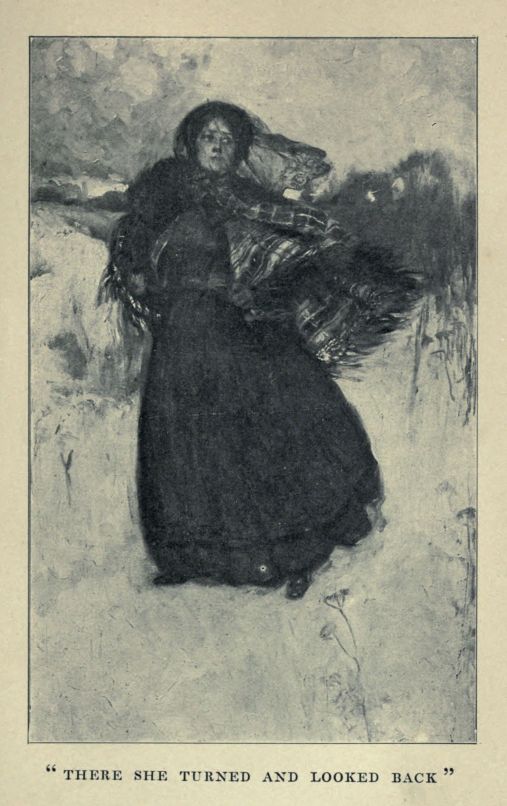
"THERE SHE TURNED AND LOOKED BACK"
It was very cold; the ice was rough, and the wind had blown the dry snow about in light drifts and ripples, so that walking was not difficult. She trudged out, up towards the Bend, skirting the place where the men had been cutting. They had gone home now, and the ice about the black, open space of water was quite deserted. The wind came keenly down the river, blowing an eddy of snow before it; the bleak sky lay like lead over the woods along the shore. There was not a house in sight. Amelia Dilworth looked furtively about her; then she bent down and scraped at the snow on the edge of the ice, as one might do who, in the water, was struggling for a hold upon it. After that, for a long time, she stood there, looking dumbly at the current running, black and silent, between the edges of the ice. At last, her hand over her mouth to check some inarticulate lament, she stooped again, and put her little black muff on the broken snow close to the water.
When she reached Mrs. Kensy's she was quite calm. She said briefly that she had come to order some chickens; "—and I'll take that bundle I asked you to keep for me."
The woman brought it, and Milly tucked her fingers through the stout strings she had tied so carefully a few days before. When she would open it in the woods, and put on the new dress and shawl and the heavy veil that it held, and then, in the dark, take the half-past-five train, no one would know that Thomas Dilworth's wife had fled away into another State. They would find the muff, and they would think—there would be only one thing to think.
"I want the chickens for Sunday," she said; "please send them over on Saturday." Then it came into her mind with a little gush of happiness that she would pay for them on the spot, instead of having the bill sent to Tom, as was her custom; she had drawn a sum of money from the bank a fortnight ago—a small sum, but her own; now it was all in her purse; she would buy Tom's Sunday dinner out of her little fund. Except to leave him, it was the last thing she would ever do for him.
She put her hand into her pocket—and chilled all over. Then stood blankly looking at the woman; then plunged her hand down again into her pocket; then exclaimed under her breath; then tore her bag open and fumbled distractedly among brushes and night-gown and slippers; then pulled her pocket wrong side out with trembling fingers.
"My purse!" she said, breathlessly. Then she searched everything again.
"It ain't any difference," Mrs. Kensy protested.
"I must have left it at home. I can't go back for it. It is too late."
"What for?" said Mrs. Kensy.
"The—the train."
"Oh, you was going on, was you?" Mrs. Kensy said. "Well, I can let you have the price of a ticket a little ways."
But Mrs. Dilworth, with shaking hands, pulled everything out of her bag, shook her skirts, fumbled in the bosom of her dress, ran out and searched the garden-path, strained her eyes across the snow on the river—all in vain. "Oh, my!" she said, faintly.
"But I can lend you the price of a ticket, ma'am," Mrs. Kensy said again.
"No matter," Mrs. Dilworth said, dully. "I'll go home."
Even as she spoke she heard the train tooting faintly far up the valley. She sat down, feeling suddenly sick.
V
There was nothing to do but to go home. She remembered now how in her agitated watching for her son she had put her purse down on the corner of her bureau—and left it there. Yes; there was nothing to do but go back. "I can start to-morrow," she said to herself. But in the sick reaction of the moment she knew that she could never start again; her purpose had been shattered by the blow. She took her bundle—the bundle that meant flight and disguise and self-sacrifice, and that stood for the shrewdness which is so characteristic of the kind of stupidity which forgets the purse—and went stumbling down in the darkness to the river. She said to herself that she must get her muff; and she thought heavily that it would be pretty hard to carry so many things across the ice. She was numb with the shock of interrupted ecstasy. She could not feel even mortification—only fatigue. She was so tired that, seeing in the darkness a hurrying figure approaching her, she did not recognize her husband until he was almost upon her.
"Milly? My God! Milly!"
He had her muff in his hand, and as he reached her he caught at her shoulder and shook her roughly. "Milly—I thought—I thought—" He stammered with agitation. "I found this muff, and I thought it was yours; and Neddy's gone, too, and I thought—both of you—"
"Neddy gone?" she repeated, dully.
She stood still on the ice, trying to get her wits together.
"He's disappeared. He isn't in town. He went out early this morning. To skate, I suppose. Nora saw him from her window; at about six, she says. And this open water"—she felt him quiver at her side—"and then this muff—"
"No!" she said. "I—I made a mistake." She did not take in the words about Ned.
"But where is he? Nobody's seen him. I suppose I'm a fool, but I'm uneasy. I came to meet you because I thought you might know. But when I saw this muff—it is yours, Milly, isn't it?—I got into a panic about you, too."
"Why," she said—"it's mine; yes. I—I left it—I suppose. Neddy wasn't with me. Did you think he was with me? I don't understand," she ended, bewildered.
"He hasn't been at home all day," her husband said, "nor in town, either." And then he repeated the story, while she looked at him, slow understanding dawning in her eyes.
"Neddy—gone! Where?"
"But that's what I don't know," the father said.
And his wife, dazed still, but awake to the trouble in his voice, began to comfort him, alarm rising slowly in her own heart like an icy wave.
"Maybe he went to see somebody in Upper Chester?"
"But he doesn't know anybody at Upper Chester. Of course it's possible. Only—you gave me such a fright, Milly!" Mrs. Dilworth put her hand over her mouth and trembled. "However, I guess he's all right, as you say. I guess we'll find him at home when we get back. It's lucky I came to meet you, because I can lug your things for you. How did you drop your muff, dear? Here, take it; your hands must be cold. Oh, Milly, you gave me an awful fright—it was right on the very edge of the ice; those confounded cutters hadn't put up any ropes. You do really think there's no reason to be uneasy about Ned?"
"No," she said. Her knees shook; she had to pause to swallow before she spoke. Oh, what if he should find her out? As she trudged along at his side in the cold darkness she said to herself, with a sickening sense of apprehension, that if he found her out she should die. Then as her mind cleared she tried in her brief way to encourage him about their boy; yet, as they drew nearer home and she saw again the firelit windows, she began to awaken to the situation: Neddy had gone out to skate; at six, did Nora say? Of course he might have stopped to see somebody in Upper Chester; only Neddy never went to see anybody anywhere—except (Amelia Dilworth had forgotten her!)—except that Hayes girl—and she wasn't at home. Yes, it was strange; and worrying, perhaps. But she only repeated, as they went hurrying up to the back door, that she was sure Neddy was all right. But she held her breath to listen for his voice haranguing his sisters in the sitting-room. Instead, the two girls came running out to meet them.
"Oh, father, did you find Ned? Oh, here's mother; she'll know where he is."
"Mother, I'm sort of scared about him," Mary whispered.
"He's gone to see some friend," the mother said, and her brevity, so agonizing to her, seemed to reassure the others.
"He hasn't any friend except Miss Helen Hayes," Nancy said, "and she went away last week."
"Maybe he's gone to hunt her up," Mary said, giggling, and her father told her to be quiet.
"It's thoughtless in him to be so late. But your mother isn't worried, so I guess we needn't be. Your mother says there is not the slightest cause for anxiety, and she knows."
"Come to supper," Amelia said, her heart sinking; and the commonplace suggestion cheered them all, although Tom Dilworth did not like to lose the assurance of his wife's presence, even to have her go up-stairs to take off her bonnet, and went with her, saying again, decidedly, that there was, as she said, no possible reason for uneasiness, and that he himself hadn't a particle of anxiety. "But I'll give that boy a piece of my mind for worrying you so. Why, Milly, what a fat pocket-book! Where did you get so much money, my dear? I didn't know the hardware trade was so prosperous. Look here, Milly—it is pretty late, honestly?"
She took her purse out of his hands, her own trembling. For a moment she could not speak, and leaned forward to look into the swinging glass and make pretence of untying a knot in her bonnet-strings. "Oh, he'll come home soon," she said.
In spite of assurances, the tea-table was not very cheerful—the girls stopped short in the middle of a sentence to listen for a step on the porch. Tom got up twice to look out of the window. Mrs. Dilworth thought she heard the gate slam, and held her breath; but no Ned appeared. The evening was endlessly long. Tom pretended to read his newspaper, and kept his eye on one spot for five minutes at a time. At ten he packed the girls off to bed; at eleven he was walking up and down the room; at twelve he told his wife to go to bed; but somehow or other he went himself, while she sat up, "to let the boy in."
You can make excuses for this sort of lateness up to a certain point; but it is curious that at about 2.30 in the morning the excuses all give out. Tom Dilworth got up and dressed. "Something has happened, Milly," he said, brokenly. His wife put her arms around him, trying to comfort him.
"If Miss Hayes was only at home," she said, "maybe she would have some idea of his plans. He might have told her. And she could tell us what to do."
"Who?" said Tom—"that Hayes girl? Maybe so. I hadn't thought of her. No, I don't believe she'd be any help. She hasn't got much sense in that kind of way."
Such ages and ages was Milly away from her great experience of jealousy that she felt no relief at this bald betrayal. Together they went out onto the porch, listening, and straining their eyes. The moon was just going down; it was very cold; far off a dog barked. But there was no human sound. The two haggard people went shivering back into the hall, where a candle burned dimly in the glass bell hanging at the foot of the stairs.
"Something has certainly happened," Tom said again. "Oh, Milly, you are always so calm and I go all to pieces." He leaned his elbow against the wall and hid his face in his arm. His wife heard him groan.
"And—I've been hard on him sometimes," he said.
She took his hand and kissed it silently.
Poor Tom went to pieces more than once in the days that followed—dreadful days of panic and despair. Old Chester, aroused at daybreak by the terrified father, decided at once that the boy was drowned; but everybody stood ready to help the stricken parents with hopeful words to the contrary, words which rang as hollow to Thomas and his wife as to the well-meaning liars.
It was on Wednesday that he had disappeared. On Friday they dragged the river through the open holes; on Saturday, blew up the ice and dragged all the way down to the second bend. That night Nancy and Mary crept away to cry in their own room; Tom sat with his head buried in his arms; his wife knelt beside him, touching him sometimes with a quiet hand, but never speaking. Dr. Lavendar came in and put his hand on Tom's shoulder for a minute, and then went away. The firelight slipped flickering about the room; sometimes the coal in the grate snapped and chuckled, and a spurt of flame shone on the two suddenly aged faces. And then into the silent room came, with hurried, shamefaced triumph—Edwin.
"I—I'm afraid you've been anxious—"
"He ought to have written," said another voice, breathless and uncertain, and breaking into nervous laughter. "It is naughty in him to have forgotten. I—I told him so."
Thomas Dilworth lifted his head and stared, silently; but his wife broke out into wild laughter and streaming tears; she ran and threw herself on Edwin's breast, her throat strangling with sobs.
"Oh—she's found Neddy! She has brought him back to us!—she has found him! Oh, Miss Hayes, God bless you—God bless you! Oh, where did you find him?"
Miss Hayes opened her lips—then bit the lower one, and stood, scarlet.
"I meant to write," Edwin began to explain—"of course I meant to write, but—"
"Oh, dear Mrs. Dilworth," Helen's fluttering voice took up the excuse, "you must forgive him"—she came as though to put her arms about Ned's mother. "After all, a bridegroom, you know—"
Milly lifted her head from Edwin's shoulder and gaped at her.
"Bridegroom?"
Thomas Dilworth got on his feet and swore. Miss Helen Hayes—or, no; Mrs. Edwin Dilworth—came and hung upon his arm.
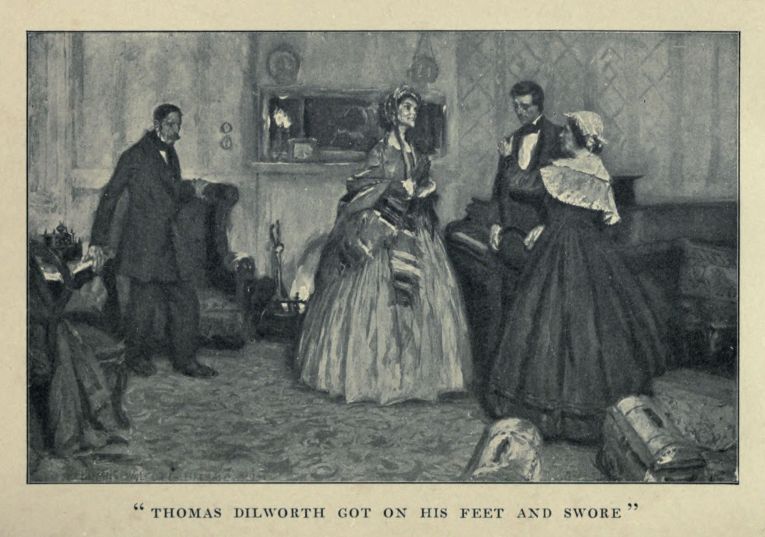
"THOMAS DILWORTH GOT ON HIS FEET AND SWORE"
"You won't mind very much? You'll forgive him? We couldn't tell, because—because papa would have interfered; but I knew your dear, kind heart. Mrs. Dilworth, I have so revered Mr. Dilworth!—that was one reason I said yes. You'll let me be your little girl, Mr. Dilworth?"
"Little—grandmother!" said Tom Dilworth; and burst into a roar of laughter; then stopped, and said through his set teeth to his son, "You scoundrel!"
"Thomas—don't!" the mother entreated. "He has come back."
"He'd better have stayed away!" Thomas said, furiously, in all the anger of suddenly relieved pain.
"Oh, dear Mrs. Dilworth," Helen murmured, "forgive us! He ought to have written—I ought to have reminded him. But—you understand? I know you do. Just these first beautiful days, one forgets everything."
"Well, I tell you I meant to write," Ned persisted, doggedly. "But mother put me all out by going over to the Bend in the afternoon. I was going to take that train, and of course I couldn't; Kensy's house is right there by the station. And I had to take the morning train instead; and it put me all out. I had to get up so early I forgot to take any clothes," he added, resentfully. "It wasn't my fault."
"Not your fault?" his father said, and then turned to his wife, almost with a sob. "Milly, can he be our boy, this sneak?"
"Yes; yes, he is, Tom; indeed he is, dear. And he just forgot; he didn't mean anything wrong." Milly was almost voluble, and she was crying hard. And then she looked at the woman who had brought him back—the faded, anxious, simpering woman, who for once had no words ready. Milly looked at her, and suddenly opened her arms and took her son's elderly wife to her heart. "Oh, you poor woman," she said, "how unhappy you must have been at home!"
Helen looked at her blankly, then dropped her head down on the kind shoulder, and Milly felt her quiver.
"She's fifty!" Tom said, trembling with anger. "How the devil a son of mine can be such a jack—"
"Tom, dear! there now, don't," the mother said; "he's at home. Just think; he's at home! and we thought—we thought—" Her voice broke. "We'll all love you, Miss Hayes—I mean Helen," she whispered to the sobbing woman.
Then, with a sort of gasp, she put her daughter-in-law's arms aside gently, and went over and kissed her husband.
As for Thomas Dilworth, after the first shock of anger and mortification had passed, and the young couple had finally settled themselves upon the disgusted bounty of the respective fathers, he used to whistle incessantly a certain song much in vogue at the time:
"I hanker To spank her, Now I'm her papa!"
"AN EXCEEDING HIGH MOUNTAIN"
I
Robert Gray's first wife, Alys (Old Chester had hard work to swallow her name; "but it's better than any of your silly 'ie's,'" said Old Chester)—this first Mrs. Gray was a good deal of a trial to everybody. She was not only "new," but foreign; not only foreign, but indifferent to Old Chester. Indeed, it took all Old Chester's politeness and Christian forbearance to invite Mrs. Robert Gray to tea—with the certainty that the invitation would be declined. She was an English girl whom Robert met somewhere in Switzerland—a heavy-eyed, silent creature, certainly a very beautiful woman, but most inefficient and sickly; and there were so many nice, sensible girls in Old Chester! (However, there is no use saying things like that: as if a man ever married a girl because she was sensible!)
Yet young Gray certainly needed a sensible wife; his wealth was limited to character and good manners, plus a slender income as tutor in the Female Academy in Upper Chester. Excellent things, all; but a wife with sense (and money) would have been an agreeable addition to his circumstances. Whereas, this very beautiful English girl was a penniless governess, left stranded in Germany by an employer, who had, apparently, got tired of her. Robert Gray had met the poor, frightened creature, who was taking her wandering way back to England, and married her, frantic with rage at the way she had been treated. When he brought her home, he was so madly in love that he probably did not half appreciate Old Chester's patience with her queer ways. But the fact was, that for the few months she lived, she was so miserable that Old Chester could not help being patient, and forgiving her her half-sullen indifference, and her silence, and her distaste for life—even in Old Chester!
For in spite of Robert's adoration, in spite of all the ready friendliness about her, in spite of the birth of a baby girl, she seemed, as it were, to turn her face to the wall. She died when the child was about a week old. Died, the doctor said, only because, so far as he could see, she did not care to live.
"You ought to try to get better for the baby's sake," said Miss Rebecca Jones, who had come in to help nurse her. And the poor girl frowned and shook her head, the heavy, white lids falling over her dark eyes.
"I don't like it."
And Rebecca (who had too much good sense to be shocked by the vagaries of a sick woman) said, decidedly: "Oh, you'll learn to like her. Come, now, just try!"
But she did not seem to try; even though Robert, kneeling with his arm under her pillow, holding her languid hand to his lips, said, sobbing, "Oh, Alys, Alys—for God's sake—don't leave me—"
Then she opened her beautiful eyes and looked at him solemnly. "Robert," she said, "I am sorry. I am—sorry. I—am—"
"What for, precious?" he entreated; "sorry for what? to leave me? Oh, Alys, then live, live, dear!"
"I—am—" she began; and then her voice trailed into eternity.
Miss Rebecca Jones hung about the house for a few days, to make the poor gentleman comfortable; then he was left alone with the child (purchased at so dreadful a cost) and one servant, and his daily work of teaching the polite languages at the Female Academy. Miss Rebecca's hard face softened whenever she thought of him; but all she could do for him was to go often to see the poor seven-months baby—which seemed for a time inclined to follow its mother.
Now it must be understood at once that Rebecca Jones was not a schemer, or a mean or vulgar woman. She was merely a hard-headed, honest-hearted product of years of public-school teaching, with a passion for truth and no grace in telling it. She was sorry for Mr. Gray, and sorry for the poor baby, who was being allowed, she said to herself, to grow up every which way; and sorry for the comfortless house left to the care of what she called "an uneducated servant-girl." So, after school, and on Saturday mornings, she used to go over to Mr. Gray's house and bustle about to the bettering of several things. Indeed, old Mr. Jones told her more than once that he didn't know what that there widower would do without her. And Rebecca said, truthfully enough, that she didn't know, either. And when she said it her heart warmed with something more than pity.
As for Robert Gray, dazed and absent, trying to do his duty at the Academy during the day, and coming home at night to look blankly at his child, he, too, did not know what he would have done that first year without Miss Rebecca's efficient kindness. He was so centred in his grief, and also of so gentle a nature, that he took the kindness as simply as a child might have done. Like many another sweet-minded man, he had not the dimmest idea of the possible effect of his rather courtly manner and his very delicate courtesy upon a woman of slightly different class, whose life had been starved of everything romantic or beautiful. He became to sharp-tongued Miss Rebecca Jones a vision of romance; and, somehow, quite suddenly, about eighteen months after his wife's death, he discovered that he was going to marry her. In his startled astonishment, he realized that he had himself led up to her avowal of willingness by some talk about her kindness. Perhaps she had misunderstood his words; if she had, Robert Gray was not the man to offer an explanation.... However, after the first shock of being accepted, he was gently explicit:
"I realize that the child ought to have the care of a good woman, and therefore I—"
"I'll do my duty by her," Rebecca said.
"I want her brought up to love and reverence her mother. I want her brought up to be like her. It is for the child's sake that I—I marry again. I speak thus frankly, Miss Rebecca, because I so entirely respect you that I could not be anything but frank."
Rebecca's square face flushed over the high cheek-bones to the gaunt forehead and the sparse hair; then her eyes looked passionately into his. "I understand. Yes; I understand. And I will be good to your child, Mr. Gray."
And so he married her; and, when you come to think of it, it was a very sensible thing to do. Even Old Chester said he was very sensible. A man of thirty, with a baby—of course he ought to marry again! "But why on earth," said Old Chester, "when there are so many girls of his own class!—not but what Rebecca Jones is a very worthy person."
Meanwhile, Rebecca, with hard conscientiousness, set herself to bring the child up. She trained her, and disciplined her, and made a painful point of talking to her about the first Mrs. Gray, according to her promise to teach her to "love and reverence her mother." The discipline sometimes made Robert Gray wince; but it was wise, and never unkind; so he never interfered;—but he left the room when it was going on. Once he said, nervously:
"I scarcely think, Mrs. Gray, that it is necessary to be quite so severe?"
"She must be made a good child," Rebecca answered.
"I am not afraid that she will not be a good child," Robert Gray said; "she is her mother's daughter."
"Well, she is her father's daughter, too," Rebecca declared, briefly. And her husband, shrinking, said:
"Light is stronger than darkness; Alice's mother was a creature of light. I am not afraid of her inheritance of darkness."
As for Rebecca, she went away and shut herself up in the garret. "'Creature of light!'" she said, sitting on the floor under the rafters, and leaning her head on an old horsehair-covered trunk wherein were packed away Mr. Gray's winter flannels—"well, I am a good wife to him, if I ain't a 'creature of light.'"
Yes, she was a good wife.... How carefully she put his flannels away in May; how prudently she planned his food; how she managed to make the two ends of his little income meet—yes, and lap over, so that every summer he could go away from her for a two months' vacation in the woods! Not once did he find a button lacking; not once had he put on a clean pair of stockings and then pulled them off because of a hole in the heel. Can our lords say as much, my mistresses? I trow not! Yes, a good wife: that lovely being who left the world with a faint, unfinished regret upon her pitiful lips could never have made him so comfortable.
Indeed, the whole household revolved upon Robert's comfort. Every domestic arrangement had reference to his well-being. That he did not become intolerably selfish was not Rebecca's fault, for, like many good wives, she was absolutely without conscience in the matter of self-sacrifice; but Robert escaped spiritual corruption, thanks to his own very gentle nature and his absolute unconsciousness of the situation. Perhaps, too, Rebecca's tongue mitigated the spoiling process. She never spared him what she considered to be the truth about himself or Alice. But her truthfulness stopped here; she spared the dead, perforce. For what could she say ill of that beautiful creature whose only wrong-doing lay in dying? But she knew, with shame, that she would have liked to speak ill of her—in which reprehensible impulse to remove a fellow-being from a pedestal, Rebecca showed herself singularly like the rest of us.
In this bleak air of unselfishness and truth-telling, Robert Gray became more and more aloof. Gradually he retreated quite into his past, doing his daily work at the Academy—where successive classes of young ladies adored him for his gentle manners and his mild, brown eyes—and living very harmlessly with his memories, which he kept fresh and fragrant by sharing them with Alys's daughter, who, it must be admitted, being young and human, was not always intensely interested; but Rebecca had trained her too well for Alice ever to show any weariness. Robert kept his little collection of pictures and photographs of his first wife shut behind the curtained doors of an old secretary. If his second wife found him standing, his hands clasped behind him, his eyes wandering from one lovely presentment to another, he never displayed an embarrassed consciousness, but he shut the doors. He accepted Rebecca's devotion respectfully; he was never impolite, still less unkind; in fact, in all their married life he had never, she used to tell herself, spoken unkindly save once; and then his words were nothing more dreadful than, "We will not discuss it, if you please, Mrs. Gray." At first he had, very gently, made some grammatical suggestions; and she had profited by them, though, being a true Pennsylvanian, she never mastered "shall" and "will," nor did she lose the Pennsylvania love for the word 'just'; to the end of her days, Rebecca was 'just tired out'; or 'just real glad'; or 'just as busy as could be.' Grammar, however, was as far as Robert Gray went in any personal relation. He addressed her, in his courteous voice (always a little timidly), as "Mrs. Gray"; and he kept as much as possible out of her way. Meantime, Rebecca (remembering why he had married her) did her duty by the child, and never failed to mention, in her hard voice, that Alice must try to grow up like her mother.
"Make me a good girl," Alice used to say in her sleepy prayers every night—"make me a good girl, like my dear mother." Once, of her own accord, the child added, "And make me pretty like her, too." Rebecca, listening to the little figure at her knee, said, sternly, when Alice got up and began to climb into the big four-poster:
"Don't be vain. Don't ask God for foolish things. Beauty is foolish and favor is deceitful. Just ask Him to make you as good as your mother was."
And, indeed, it must be admitted that the child did not inherit her mother's wonderful beauty. At first her father had expected it; he used to take liberties with his Horace, and say:
"O filia pulchra matre pulchriore."
But as Alice grew older, Robert Gray had to admit that the dead woman had taken her beauty away with her. The child had just a pleasant face; eyes that were gray or blue, as it happened; a commonplace nose, and uncompromisingly red hair. In those days red hair was thought to be a mortifying affliction, and poor, plain Alice shed many tears over the rough, handsome shock of hair that broke into curls about her forehead and all around the nape of her pretty, white neck.
II
But in spite of red hair, and what Old Chester religiously believed to be its accompanying temper, Alice Gray was a lovable girl, and at twenty, behold, she had a lover; indeed, she had more than one (not counting Dr. Lavendar); but Alice never gave a thought to anybody but Luther Metcalf. Luther was a good boy, Old Chester said; but added that he would never set the river on fire.
Certainly he did not use his incendiary opportunity; he had a small printing-office, and he owned and edited Old Chester's weekly newspaper, the Globe; but neither the news nor the editorial page ever startled or displeased the oldest or the youngest inhabitant. The Globe confined itself to carefully accredited cuttings from exchanges; it had a Poet's Corner, and it gave, politely, any Old Chester news that could be found; besides this, it devoted the inner sheet to discreet advertisements, widely spaced to take up room. All Old Chester subscribed for it, and spoke of it respectfully, because it was a newspaper; and snubbed its editor, because he was one of its own boys—and without snubbing boys are so apt to put on airs! Poor Luther was never tempted to put on airs; he was too hard-worked and too anxious about his prospects. He and Alice were to get married when he and the Globe were out of debt; for his father had left him a mortgage on the office building, as well as an unpaid-for press. When Luther was particularly low-spirited, he used to tell Alice it would take him five years to pay his debts; and, to tell the truth, that was an optimistic estimate, for the Globe and the printing-office together did very little more than pay the interest on the notes and Luther's board.
So, when they became engaged, waiting was what they looked forward to, for, of course, Robert Gray could not help them; it was all Rebecca could do to stretch his salary to cover the expenses of their own household. But the two young people were happy enough, except when Luther talked about five years of waiting.
"We've been engaged two years already," he said, moodily; "I don't want to be another case of Andrew Steele."
"I'm not afraid," Alice said. "Why, if you get the new job press, and get that Mercer work, think how much that will help!"
"Well," Luther said, "yes; but if I get the press, there's another debt. And if I don't get it, I can't get the work; so there it is. A vicious circle."
This question of the purchase of a new press, before the old press had been paid for, was a very serious and anxious one. "I wish father could help," Alice said—they were walking home from Wednesday-evening lecture, loitering in the moonlight, and wishing the way were twice as long.
"Oh, I wouldn't think of such a thing," the young man declared; "we'll pull out somehow. He's gone off to the woods, hasn't he?"
"Yes, he went this morning; he's so pleased to get away! He won't be back till the Academy opens."
"I suppose he hates to leave you, though," Lute said.
"Yes, but I can see that the getting away is a great relief. I keep his pictures dusted, and take the flowers up to the cemetery for him; so he knows things are not neglected."
"But," Luther said, thoughtfully, "I think she's sorry to have him go?"
"Oh yes; sorry, I suppose," Alice admitted. "She's fond of him—in her way."
"Then why—" Luther began.
"My dear, she's jealous of my mother."
"Oh, Alice!"
"Well, you know," Alice explained, "my mother was so beautiful—and poor Mrs. Gray! But I must say, Lute, she's the justest person I know. She's always told me that my mother was perfect. And of course she was; but when you're jealous, it isn't so easy to acknowledge things like that."
"But I don't see how you can be jealous of the dead," Luther ruminated.
"Oh, I do! I could be jealous of some girl who was dead, if you'd loved her, Lute." And then the boy put his arm round her, and they kissed each other there in the shadows of the locust-trees overhanging a garden wall. "I'm so glad there isn't anybody, dead or alive," Alice said, happily; "though I'd rather have her alive than dead. If she were alive, you'd have quarrelled with her, and stopped loving her. But if she were dead, she would keep on being perfect. Yes; I'd rather marry a man who had been—been divorced," said Alice, lowering her voice, because the word was hardly considered proper in Old Chester, "than a man whose wife was dead, because he would always be thinking what an angel she was and what a sinner I was."
"He would think you were an angel," the boy told her, blushing at his own fervency.
But the fervency died on his ardent young lips when they got into the house and sat decorously in the parlor with Mrs. Gray. Rebecca was sewing, her hard, square face a little harder than usual. Mr. Gray had gone away on that annual fishing-trip—gone, with a look of relief growing in his eyes even as he stepped into the stage and pulled the door to behind him; pulled it hurriedly, as though he feared she would follow. Then, baring his head politely, he had looked out of the window and said: