Part 1 — The Anatomy of Victory (continued 2)
Reading edition
Morgan rode down to the picked riflemen who were going to open the fight and told them he had heard a lot of tall tales about who were the better shots, the men of Georgia or Carolina. Here was the chance to settle the matter and save their country in the bargain. “Let me see which are most entitled to the credit of brave men, the boys of Carolina or those of Georgia,” he roared. By positioning Georgians on the left of the road and Carolinians on the right, Morgan shrewdly arranged to make his competition highly visible.
To Pickens’ men Morgan made a full-fledged speech, reminding them of what the British had already done to their friends and many of their families. He pounded his fist in his hand and told them that this was their moment of revenge. He also praised the courage with which they had fought the British in earlier skirmishes, without the help of regulars or cavalry. Here they had the support of veterans in both departments. He had not the slightest doubt of victory if they obeyed their orders and fought like men. He told them his experiences with his rifle regiment at Saratoga and other battles, where they had beaten the flower of the British army, generals far more distinguished than Benny Tarleton and regiments far more famous than the units Tarleton was leading.
To his Continentals, Morgan made an even more emotional speech. He called them “my friends in arms, my dear boys,” and asked them to remember Saratoga, Monmouth, Paoli, Brandywine. “This day,” he said, “you must play your parts for honor and liberty’s cause.” He restated his battle plan, reminding them that after two or three rounds the militia would retreat under orders. They would not be running away. They would be falling back to regroup and harry the enemy’s flanks.
A Delaware soldier watching Morgan’s performance said that by the time he was through, there was 63 not a man in the army who was not “in good spirits and very willing to fight.”
The blood-red rising sun crept above the hills along the slopes of Thicketty Mountain to the east. The men stamped their feet and blew on their hands to keep warm. It was cold, but the air was crisp and clear. The mighty ramparts of the Blue Ridge were visible, 30 miles away. Much too distant for a refuge now, even if the swollen Broad River did not lie between them and Morgan’s men.
Suddenly the British army was emerging from the woods along the Green River Road. The green-coated dragoons at their head slowed and then stopped. So did the red-coated light infantry behind them. An officer in a green coat rode to the head of the column and studied the American position. Everyone in the rebel army recognized him. It was Banastre Tarleton.
8
Tarleton soon found his position at the head of the column was hazardous. The Georgia and Carolina riflemen drifted toward him through the trees on either side of the road. Pop pop went their rifles. Bullets whistled close to Tarleton’s head. He turned to the 50 British Legion dragoons commanded by Captain Ogilvie and ordered them to “drive in” the skirmishers. With a shout the dragoons charged. The riflemen rested their weapons against convenient trees and took steady aim. Again the long barrels blazed. Dragoons cried out and pitched from their saddles, horses screamed in pain. The riflemen flitted back through the open woods, reloading as they ran, a trick that continually amazed the British. Some whirled and fired again, and more dragoons crashed to earth. In a minute or two the riflemen were safely within the ranks of Pickens’ militia. The dragoons recoiled from this array of fire power and cantered back toward the British commander. They had lost 15 out of their 50 men.
Tarleton meanwhile continued studying the rebel army. At a distance of about 400 yards he was able to identify Pickens’ line of militia, whose numbers he guessed to be about a thousand. He estimated the Continentals and Virginia six-month militia in the second line at about 800. Washington’s cavalry on the crest behind the Continentals he put at 120, his only accurate figure.
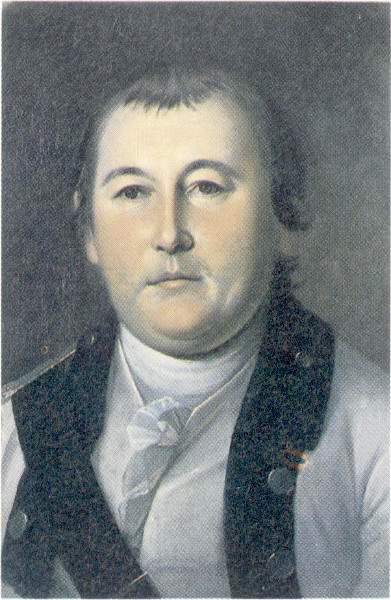
Few officers saw more combat than William Washington. a distant cousin of George. He was a veteran of many battles—among them Long Island and Trenton in 1776, Charleston in 1780, and Cowpens, Guilford, Hobkirks Hill, and Eutaw Springs in 1781—and numerous skirmishes. Thrice he was wounded, the last time at Eutaw Springs, where he was captured. His fellow cavalryman, ‘Light-Horse Harry’ Lee described him as of “a stout frame, being six feet in height, broad, strong, and corpulent ... in temper he was good-humored.... Bold, collected, and persevering, he preferred the heat of action to the collection and sifting of intelligence, to the calculations and combinations of means and measures....”
64
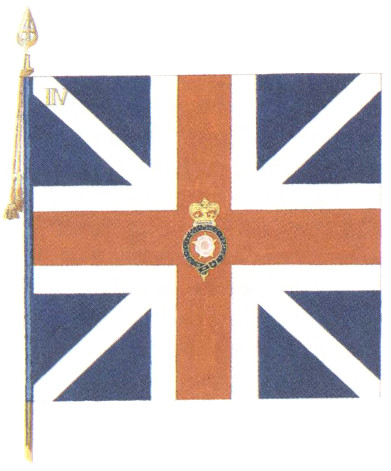
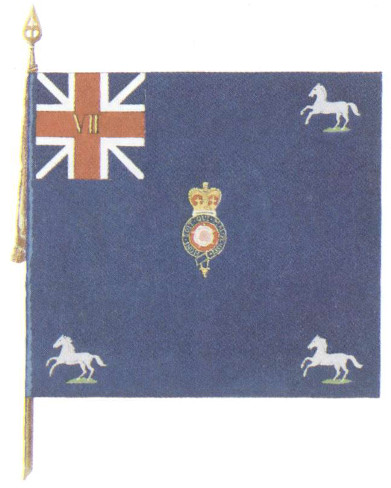
The British carried at least two flags into battle: the King’s standard and the colors of the 7th Fusiliers (below). Both were captured by Morgan’s troops.
Tarleton was not in the least intimidated by these odds, even though his estimates doubled Morgan’s actual strength. He was supremely confident that his regular infantry could sweep the riflemen and militia off the field, leaving only the outnumbered Continentals and cavalry. The ground looked level enough to repeat the Waxhaws rout. In his self-confidence and growing battle fever, he did not even bother to confer on a tactical plan with Newmarsh of the Fusiliers or McArthur of the Highlanders. He simply issued them orders to form a line of battle. The infantry was told to drop their heavy packs and blanket rolls. The light infantry companies were ordered to file to the right, until they extended as far as the flank of the militia facing them. The Legion infantry was ordered into line beside them. Next came a squad of blue-coated artillerymen with their brass grasshopper. They unpacked their gun and ammunition boxes and mounted them on the wheeled carriage with professional speed. In the Royal Artillery school at Woolrich the men who designed the gun estimated this task should take no more than two minutes.
The light infantry and Legion infantry were now told to advance a hundred yards, while the Fusiliers moved into line on their left. The other grasshopper was placed on the right of this regiment, no doubt to bolster the courage of the raw recruits. The two guns began hurling shot into the woods, firing at the riflemen who were filtering back to potshot the tempting red and green targets.
On each flank, Tarleton posted a captain and 50 dragoons, more than enough, he thought, to protect his infantry from a cavalry charge.
Tarleton ordered the Highlanders to form a line about 150 yards in the rear of the Fusiliers, slightly to their left. These veteran Scots and 200 Legion cavalry were his reserve, to be committed to the fight when they were most needed.
Everywhere Tarleton looked, he later recalled, he saw “the most promising assurance of success.” The officers and men were full of fire and vigor. Every order had been obeyed with alacrity. There was not a sign of weariness, though his men had marched half the night. They had been chasing these Americans for two weary weeks. They knew that if they beat them here, the war in South Carolina would be 65 over. To make this a certainty, Banastre Tarleton issued a cruel order. They were to give no quarter, take no prisoners.
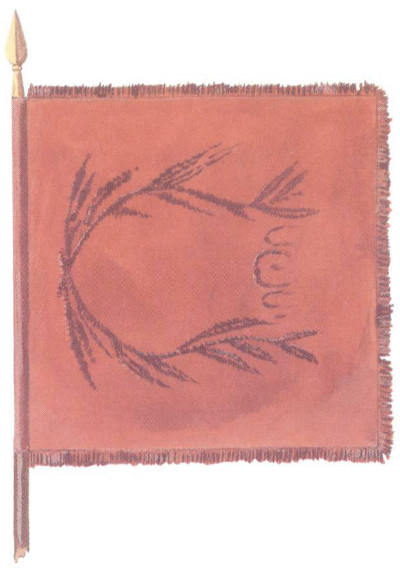
The only reasonably sure patriot flag on the field was a damask color, cut from the back of a chair, that Washington’s dragoons carried. The original, which measures only 18 inches by 18, is in the collection of the Washington Light Infantry Corps of Charleston.
The order might have made some gruesome sense as far as the militia was concerned. Almost every one of them was considered a criminal, fighting in direct violation of the law as laid down by His Majesty’s officers in numerous proclamations. Killing them would save the trouble of hanging them. But to order his men to give no quarter to Morgan’s Continentals was a blatant violation of the rules of war under which both sides had fought for the past five years. It was graphic glimpse of the rage which continued American resistance was igniting in Englishmen like Banastre Tarleton.
One British officer in the battle later said that Major Newmarsh was still posting the officers of the Fusiliers, the last regiment into line, when Tarleton ordered the advance to begin. With a tremendous shout, the green- and red-coated line surged forward.
From the top of the slope, Morgan called on his men to reply. “They give us the British haloo, boys,” he cried. “Give them the Indian haloo.” A howl of defiance leaped from 800 American throats. Simultaneously, the Georgians and North Carolinians opened fire behind the big trees. Some of the new recruits of the Fusiliers regiment revealed their nervousness by firing back. Their officers quickly halted this tactical violation. British infantry fired by the volley, and the riflemen were out of musket range anyway. Rifles outshot muskets by 150 yards.
Morgan watched the riflemen give the British infantry “a heavy and galling fire” as they advanced. But the sharpshooters made no pretense of holding their ground. Morgan had ordered them to fall back to Pickens’ militia and join them for serious fighting. On the British came, their battle drums booming, their fifes shrilling, the two brass cannon barking. The artillerymen apparently did not consider the militiamen an important target. They blasted at the Continentals on the crest. Most of their rounds whizzed over the heads of the infantry and came dangerously close to Colonel Washington and his horsemen. He led his men to a safer position on the slope of the geographical crest, behind the left wing of the main American line.
Andrew Pickens and his fellow colonels, all on 66 horseback, urged the militia to hold their fire, to aim low and pick out “the epaulette men”—the British officers with gold braid on their shoulders.
Tarleton’s Order of Battle
Legion dragoons (two troops)
Light infantry companies of the 16th, 71st, and Prince of Wales regiments
Legion infantry
7th Fusiliers
Royal artillery
71st Highlander regulars
17th Light Dragoons
Legion dragoons
This is the order in which Tarleton deployed his units on the battlefield.
It was no easy task to persuade these men not to fire while those 16-inch British bayonets bore down on them, glistening wickedly in the rising sun. The closer they got, the more difficult it would be to reload their clumsy muskets and get off another shot before the British were on top of them. But the musket was a grossly inaccurate weapon at anything more than 50 yards. This was the “killing distance” for which Pickens and Morgan wanted the men to wait. The steady fire of the grasshoppers, expertly served by the British artillerymen, made the wait even more harrowing.
Then came the moment of death. “Fire,” snarled Andrew Pickens. “Fire,” echoed his colonels up and down the line. The militia muskets and rifles belched flame and smoke. The British line recoiled as bullets from over 300 guns hurtled among them. Everywhere officers, easily visible at the heads of their companies, went down. It was probably here that Newmarsh of the Fusiliers, who had been so pessimistic about fighting under Tarleton, fell with a painful wound. But confidence in their favorite weapon, the bayonet, and the knowledge that they were confronting militia quickly overcame the shock of this first blow. The red and green line surged forward again.
Thomas Young, sitting on his horse among Washington’s cavalry, later recalled the noise of the battle. “At first it was pop pop pop (the sound of the rifles) and then a whole volley,” he said. Then the regulars fired a volley. “It seemed like one sheet of flame from right to left,” Young said.
The British were not trained to aim and fire. Their volley firing was designed to intimidate more than to kill. It made a tremendous noise and threw a cloud of white smoke over the battlefield. Most of the musket balls flew high over the heads of the Americans. Decades later, visitors to Cowpens found bullets embedded in tree trunks as high as 30 feet from the ground.
Out of the smoke the regulars came, bayonets leveled. James Collins was among the militiamen who decided that the two shots requested by Morgan was more than they could manage. “We gave the 67 enemy one fire,” he recalled. “When they charged us with their bayonets we gave way and retreated for our horses.”
Most of the militia hurried around Morgan’s left flank, following Pickens and his men. A lesser number may have found the right flank more convenient. The important thing, as far as they were concerned, was to escape those bayonets and reach the position where Morgan promised them they would be protected by Howard’s Continentals and Washington’s cavalry. Watching from the military crest, Sgt. William Seymour of the Delaware Continentals thought the militia retreated “in very good order, not seeming to be in the least confused.” Thus far, Morgan’s plan was working smoothly.
Tarleton ordered the 50 dragoons on his right flank to pursue Pickens and the bulk of the militia. If, as he later claimed, the British commander had seen William Washington and his 120 cavalry at the beginning of the battle, this order was a blunder. With 200 cavalrymen in reserve, waiting a summons to attack, Tarleton sent 50 horsemen to face twice their number of mounted Americans. He may have assumed that Morgan was using standard battle tactics and regarded Washington’s cavalry as his reserve, which he would not commit until necessity required it. The British commander never dreamt that the Old Wagoner had made a solemn promise to the militiamen that he would protect them from the fearsome green dragoons at all costs.
As the militia retreated. Tarleton’s cavalry thundered down on them. their deadly sabers raised. “Now,” thought James Collins, “my hide is in the loft.” A wild melee ensued, with the militiamen dodging behind trees, parrying the slashing sabers with their gun barrels. “They began to make a few hacks at some,” Collins said, “thinking they would have another Fishing Creek frolic.” As the militiamen dodged the swinging sabers, the British dragoons lost all semblance of a military formation and became “pretty much scattered,” Collins said.
At that moment, “Col. Washington’s cavalry was among them like a whirlwind,” Collins exultantly recalled. American sabers sent dragoons keeling from their horses. “The shock was so sudden and violent, they could not stand it, and immediately betook themselves to flight.” Collins said. “They 68 appeared to be as hard to stop as a drove of wild Choctaw steers, going to Pennsylvania market.” Washington’s cavalry hotly pursued them and “in a few minutes the clashing of swords was out of hearing and quickly out of sight.”
Thomas Young was one of the South Carolina volunteers in this ferocious charge. He was riding a “little tackey”—a very inferior horse—which put him at a disadvantage. When he saw one of the British dragoons topple from his saddle, he executed “the quickest swap I ever made in my life” and leaped onto “the finest horse I ever rode.” Young said the American charge carried them through the 50 dragoons, whereupon they wheeled and attacked them in the rear. On his new steed he joined Washington’s pursuit of the fleeing British.
In spite of William Washington’s victorious strike, many militiamen decided that Cowpens was unsafe and leaped on their horses and departed. Among the officers who took prompt action to prevent further panic was young Joseph Hughes. Although blood streamed from a saber cut on his right hand, he drew his sword and raced after his fleeing company. Outrunning them, he whirled and flailed at them with the flat of his blade, roaring. “You damned cowards, halt and fight—there is more danger in running than in fighting.”
Andrew Pickens rode among other sprinters, shouting. “Are you going to leave your mothers, sisters, sweethearts and wives to such unmerciful scoundrels, such a horde of thieves?”
On the battlefield, volley after volley of musketry thundered, cannon boomed. The Continentals and the British regulars were slugging it out. Daniel Morgan rode up to the milling militiamen, waving his sword and roaring in a voice that outdid the musketry: “Form, form, my brave fellows. Give them one more fire and the day is ours. Old Morgan was never beaten.”
Would they fight or run? For a few agonizing moments, the outcome of the battle teetered on the response of these young backwoodsmen.
9
On the other side of the crest behind which Morgan and Pickens struggled to rally the militia, Banastre Tarleton was absorbed in pressing home the attack with his infantry. He seems to have paid 69 no attention to the rout of his cavalry on the right. Nor did any of his junior officers in the Legion attempt to support the fleeing dragoons with reinforcements from the 200-man cavalry reserve. At this point in the battle, Tarleton badly needed a second in command who had the confidence to make on-the-spot decisions. One man cannot be everywhere on a battlefield. Unfortunately for Tarleton, Maj. George Hanger, his second in command, was in a hospital in Camden, slowly recovering from yellow fever.
With the militia out of the way, the British infantry had advanced on the Continentals and begun blasting volleys of musketry at them. The Continentals volleyed back. Smoke enveloped the battlefield. Tarleton later claimed the fire produced “much slaughter,” but it is doubtful that either side could see what they were shooting at after the first few rounds. The British continued to fire high, hitting few Continentals.
To Tarleton, the contest seemed “equally balanced,” and he judged it the moment to throw in his reserve. He ordered Major McArthur and his 71st Highlanders into the battle line to the left of the Fusiliers. This gave Tarleton over 700 infantrymen in action to the rebels’ 420. Simultaneously, Tarleton ordered the cavalry troop on the left to form a line and swing around the American right flank.
These orders, shouted above the thunder of musketry and the boom of the cannon, were promptly obeyed. On the crest of the hill, Howard saw the British threat developing. Once men are outflanked and begin to be hit with bullets from two sides, they are in danger of being routed. Howard ordered the Virginia militia on his right to “change their front” to meet this challenge. This standard battlefield tactic requires a company to wheel and face a flanking enemy.
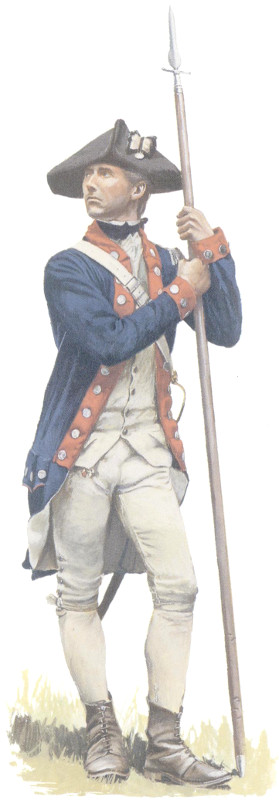
An officer of the Maryland Regiment. He carries a spontoon, which is both a badge of office and in close combat a useful weapon.
A battlefield is a confusing place, and the Virginians, though mostly trained soldiers, were not regulars who had lived and drilled together over the previous months. Their captain shouted the order given him by Howard, and the men wheeled and began marching toward the rear. The Maryland and Delaware Continentals, seeing this strange departure, noting that it was done in perfect order and with deliberation, assumed that they had missed an 70 order to fall back. They wheeled and followed the Virginians. On the opposite flank, the other company of Virginians repeated this performance. In 60 seconds the whole patriot line was retreating.
Behind the geographical crest of the hill, Morgan and Pickens had managed to steady and reorganize the militia. Morgan galloped back toward the military crest on which he assumed the Continentals were still fighting. He was thunderstruck to find them retreating. In a fury, he rode up to Howard and cried: “Are you beaten?”
Howard pointed to his unbroken ranks and told Morgan that soldiers who retreated in that kind of order were not beaten. Morgan agreed and told him to stay with the men and he would ride back and choose the place where the Continentals should turn and rally. The Old Wagoner spurred his horse ahead toward the geographical crest of the hill, about 50 paces behind their first line.
On the British side of the battlefield, the sight of the retreating Continentals revived hopes of an easy victory. Major McArthur of the 71st sought out Tarleton and urged him to order the cavalry reserve to charge and turn the retreat into a rout. Tarleton claimed that he sent this order to the cavalry, who were now at least 400 yards away from the vortex of the battle. Perhaps he did. It would very probably have been obeyed if it had arrived in time. The dragoons of the British Legion liked nothing so much as chopping up a retreating enemy.
But events now occurred with a rapidity that made it impossible for the cavalry to respond. The center of Tarleton’s line of infantry surged up the slope after the Continentals, bayonets lowered, howling for American blood. With almost half their officers dead or wounded by now, they lost all semblance of military formation.
Far down the battlefield, where he had halted his pursuit of the British cavalry, William Washington saw what was happening. He sent a horseman racing to Morgan with a terse message. “They are coming on like a mob. Give them another fire and I will charge them.” Thomas Young, riding with Washington, never forgot the moment. “The bugle sounded,” he said. “We made a half circuit at full speed and came upon the rear of the British line shouting and charging like madmen.”
71
Simultaneously, Morgan reached the geographical crest of the slope, with the Continentals only a few steps behind him. He roared out an order to turn and fire. The Continentals wheeled and threw a blast of concentrated musketry into the faces of the charging British. Officers and men toppled. The line recoiled.
“Give them the bayonet,” bellowed John Eager Howard.
With a wild yell, the Continentals charged. The astonished British panicked. Some of them, probably the Fusiliers, flung themselves faced down on the ground begging for mercy. Others, Thomas Young recalled, “took to the wagon road and did the prettiest sort of running away.”
At almost the same moment, the Highlanders, whose weight, if they had joined the charge, would probably have been decisive, received an unexpected blast of musketry from their flank. Andrew Pickens and the militia had returned to the battle. The backwoodsmen blazed at the Scotsmen, the riflemen among them concentrating on the screen of the cavalrymen. The cavalry fled and McArthur’s men found themselves fighting a private war with the militia.
Astonished and appalled, Tarleton sent an officer racing to the British Legion cavalry with orders for them to form a line of battle about 400 yards away, on the left of the road. He rode frantically among his fleeing infantry, trying to rally them. His first purpose was “to protect the guns.” To lose a cannon was a major disgrace in 18th-century warfare. The artillerymen were the only part of the British center that had not succumbed to the general panic. They continued to fire their grasshoppers, while the infantry threw down their muskets or ran past them helter skelter. Part of the artillery’s tradition was an absolute refusal to surrender. They lived by the code of victory or death.
Once past the surrendering infantry, the Continentals headed for the cannon. Like robots—or very brave men—the artillerymen continued to fire until every man except one was shot down or bayonetted.
The last survivor of the other gun crew was the man who touched the match to the powder vent. A Continental called on him to surrender this tool. The artilleryman refused. As the Continental raised his bayonet to kill him, Howard came up and blocked 72 the blow with his sword. A man that brave, the colonel said, deserved to live. The artilleryman surrendered the match to Howard.
Up and down the American line on the crest rang an ominous cry. “Give them Tarleton’s quarter.” Remembering Waxhaws, the regulars and their Virginia militia cousins were ready to massacre the surrendered British. But Daniel Morgan, the epitome of battle fury while the guns were firing, was a humane and generous man. He rode into the shouting infantrymen, ordering them to let the enemy live. Junior officers joined him in enforcing the order.
Discipline as well as mercy made the order advisable. The battle was not over. The Highlanders were still fighting fiercely against Pickens’ men. Tarleton was riding frantically toward his Legion cavalry to bring them back into the battle. But the militia riflemen were back on the field and Tarleton was their prime target. Bullets whistled around him as he rode. Several hit his horse. The animal crashed to the ground. Tarleton sprang up, his saber ready. Dr. Robert Jackson, assistant surgeon of the 71st, galloped to the distraught lieutenant colonel and offered him his horse. Tarleton refused. For a moment he seemed ready to die on the chaotic battlefield with his men. Dr. Jackson urged him again. Springing off his horse, he told Tarleton, “Your safety is of the highest importance to the army.”
Tarleton mounted Jackson’s horse and rode to rally his troops. Fastening a white handkerchief to his cane, Jackson strolled toward the all-but-victorious Americans. No matter how the battle ended, he wanted to stay alive to tend the wounded.
Looking over his shoulder at the battlefield, Tarleton clung to a shred of hope. An all-out charge by the cavalry could still “retrieve the day,” he said later. The Americans were “much broken by their rapid advance.”
But the British Legion had no appetite for another encounter with the muskets of Andrew Pickens’ militia. “All attempts to restore order, recollection [of past glory] or courage, proved fruitless,” Tarleton said. No less than 200 Legion dragoons wheeled their horses and galloped for safety in the very teeth of Tarleton’s harangue. Fourteen officers and 40 dragoons of the 17th Regiment obeyed his summons and charged with him toward the all-but-disintegrated British battle line. Their chief hope was to save the cannon and rescue some small consolation from the defeat.
73
Stages of the Battle
Because the battle was a continuous flow of action from the opening skirmish to the pell-mell flight of the Legion dragoons at the end, the important maneuvers cannot all be shown on a single map. This sequence of maps diagrams the main stages of the battle.
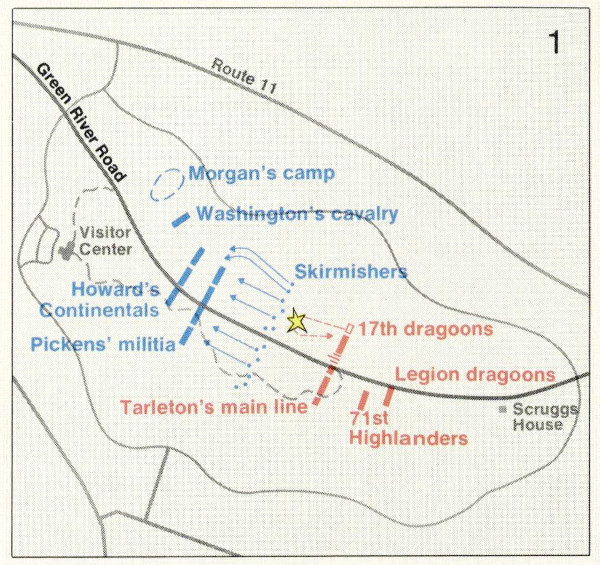
1.
Skirmishers drive back Tarleton’s cavalry, sent forward to examine the enemy’s lines, and then withdraw into Pickens’ line of militia. Without pausing, Tarleton forms his line of battle.
Green River Road
Route 11
Morgan’s camp
Washington’s cavalry
Visitor Center
Howard’s Continentals
Pickens’ militia
Skirmishers
17th dragoons
Legion dragoons
Tarleton’s main line
71st Highlanders
Scruggs House
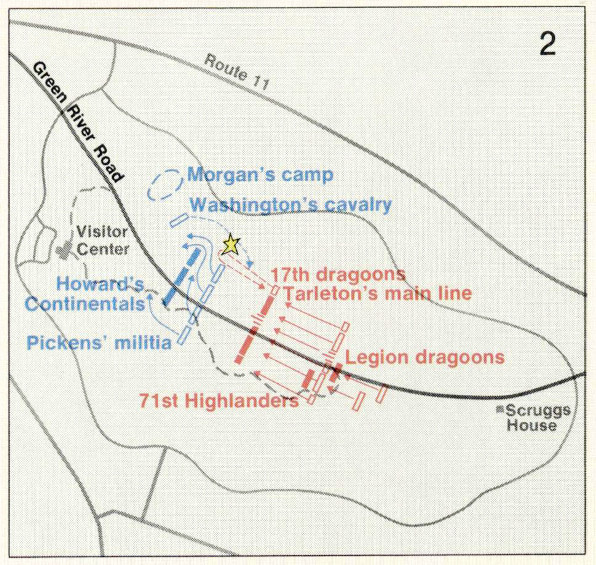
2.
The British advance on Pickens’ militia, who deliver the promised two shots each and fall back on the flanks. When they are pursued by British dragoons, Washington’s cavalry charges into action and drives them off.
Green River Road
Route 11
Morgan’s camp
Washington’s cavalry
Visitor Center
Howard’s Continentals
Pickens’ militia
17th dragoons
Tarleton’s main line
Legion dragoons
71st Highlanders
Scruggs House
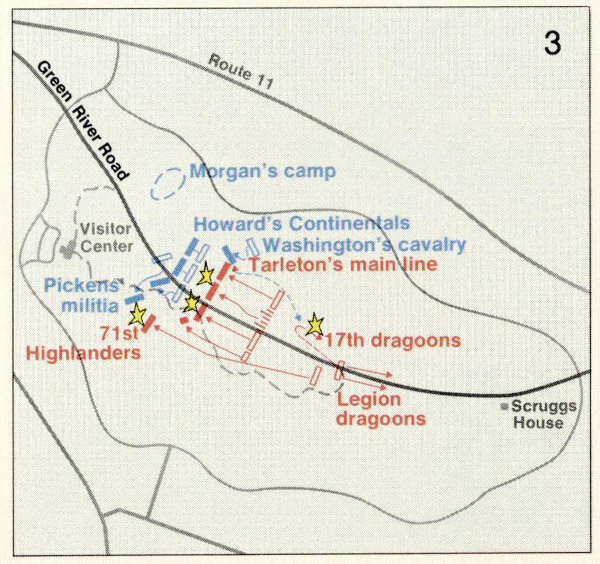
3.
Howard’s Continentals rout the British in the center, supported by cavalry on the left and militia on the right.
Green River Road
Route 11
Morgan’s camp
Howard’s Continentals
Washington’s cavalry
Visitor Center
Tarleton’s main line
Pickens’ militia
71st Highlanders
17th dragoons
Legion dragoons
Scruggs House
How to read these battle diagrams
British positions are shown in RED, American in BLUE. Open boxes show former positions, arrows movement. Clashes are shown by stars. Modern features, included for orientation, appear in gray.
74
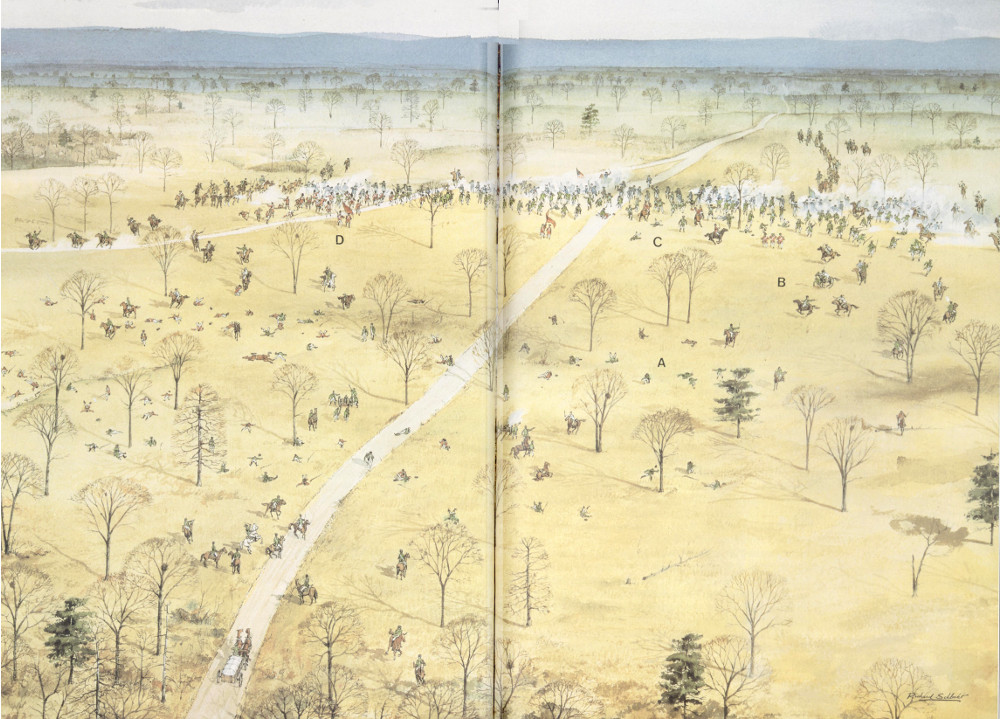
This perspective by the artist Richard Schlecht compresses the whole battle into one view. The open woods in the foreground (A) is littered with British shot down by Pickens’ skirmishers. At the far right (B) Washington’s cavalry drive back the British dragoons pursuing Pickens’ militia. Along the third line (C) Howard’s Continentals repulse the attacking British regulars with volleys and bayonets. On Tarleton’s left (D) the 71st is engaged in a hot contest with militia, some of whom had returned to the battle after firing their two shots and withdrawing. They hit Tarleton’s left flank hard while Howard’s troops rout the British in the center, giving Morgan the victory. A gem of tactical planning and maneuver, it was by far the patriot’s best fought battle of the war.
The painting conveys a close sense of the original terrain with its scattered hardwoods and undulating ground that Morgan turned to good use. The axis of the battlefield, then as now, is the old Green River Road, which runs diagonally across the scene. The diverging road at left was not there at the time of the battle.
76
They never got there. Instead, they collided with William Washington’s cavalry that had wheeled after their assault on the rear of the infantry and begun a pursuit of the scampering redcoats, calling on them to surrender, sabering those who refused. Washington shouted an order to meet the British charge. Most of his horsemen, absorbed in their pursuit of the infantry, did not hear him. Washington, leading the charge, did not realize he was almost unsupported. The burly Virginian, remembering his humiliating defeat at Lenuds Ferry in May 1780, had a personal score to settle with Banastre Tarleton. He headed straight for him.
Tarleton and two officers accepted Washington’s challenge. The Virginian slashed at the first man, but his saber snapped at the hilt. As the officer stood up in his stirrups, his saber raised for a fatal stroke, Washington’s bugler boy rode up and fired at the Englishman. The second officer was about to make a similar stroke when the sergeant-major of the 3d Continental Dragoons arrived to parry the blow and slash this assailant’s sword arm. Tarleton made a final assault. Washington parried his blow with his broken sword. From his saddle holsters, Tarleton drew two pistols in swift succession and fired at Washington. One bullet wounded Washington’s horse.
By this time Tarleton saw that the battle was totally lost. The riflemen were running toward his horsemen, and their bullets were again whistling close. The Highlanders were being methodically surrounded by Pickens’ militia and Morgan’s Continentals. Summoning his gallant 54 supporters, Tarleton galloped down the Green River Road, a defeated man.
On the battlefield, the Highlanders were trying to retreat. But Howard’s Continentals and Washington’s cavalry were now between them and safety. Through the center of their line charged Lt. Col. James Jackson and some of his Georgians to try to seize their standard. Bayonet-wielding Scotsmen were about to kill Jackson when Howard and his Continentals broke through the 71st’s flank and saved him. Howard called on the Highlanders to surrender. Major McArthur handed his sword to Pickens and so did most of the other officers. Pickens passed the 77 major’s sword to Jackson and ordered him to escort McArthur to the rear.
Captain Duncasson of the 71st surrendered his sword to Howard. When Howard remounted, the captain clung to his saddle and almost unhorsed him. “I expressed my displeasure,” Howard recalled, “and asked him what he was about.” Duncasson told Howard that Tarleton had issued orders to give no quarter and they did not expect any. The Continentals were approaching with their bayonets still fixed. He was afraid of what they might do to him. Howard ordered a sergeant to protect the captain.
Around the patriots main position, a happy chaos raged. In his exultation, Morgan picked up his 9-year-old drummer boy and kissed him on both cheeks.
Others were off on new adventures. Cavalryman Thomas Young joined half a dozen riders in pursuit of prisoners and loot down the Green River Road. They must have embarked on this foray shortly after most of Tarleton’s cavalry had deserted him and before Tarleton himself quit the battlefield after the encounter with Washington.
“We went about twelve miles,” Young said in his recollections of the battle, “and captured two British soldiers, two negroes and two horses laden with portmanteaus. One of the portmanteaus belonged to a paymaster ... and contained gold.” The other riders decided this haul was too good to risk on the road and told Young to escort the prisoners and the money back to Cowpens. Young had ridden several miles when he collided with Tarleton and his 54 troopers. Abandoning his captures, Young tried to escape. He darted down a side road, but his horse was so stiff from the hard exercise on the battlefield, the British overtook him.
“My pistol was empty so I drew my sword and made battle,” the young militiaman said. “I never fought so hard in my life.” He was hopelessly outnumbered. In a few clanging seconds, a saber split a finger on his left hand, another slashed his sword arm, a third blade raked his forehead and the skin fell over his eyes, blinding him. A saber tip speared his left shoulder, a blade sank deep into his right shoulder, and a final blow caught him on the back of the head. Young clung to his horse’s neck, half conscious.
78
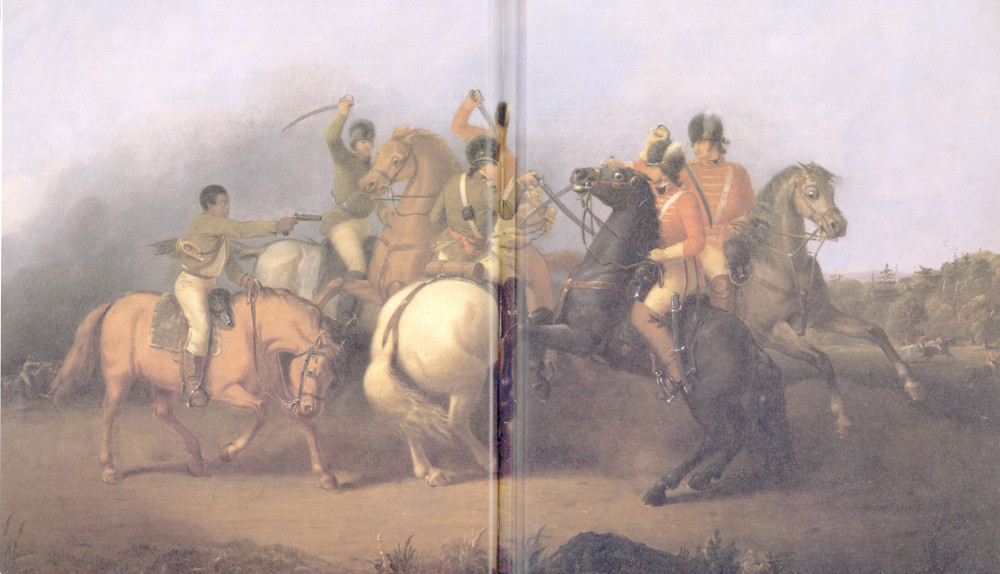
Washington and Tarleton Duel
One of the battle’s most colorful incidents occurred at the very end. As defeat enveloped his army, Tarleton tried to rally his cavalry to the support of the infantry. His Legion dragoons, ignoring his orders and threats, stampeded off the field. Only the disciplined veterans of the 17th Dragoons followed him into battle. They ran head-on into the Continental dragoons of Lt. Col. William Washington. As sabers flashed, Washington found himself far in advance of his unit. What happened next is described in a passage from John Marshall’s famous Life of George Washington, written when the event still lingered in the memory of contemporaries: “Observing [Washington about 30 yards in front of his regiment], three British officers wheeled about and attacked him; the officer on his left was aiming to cut him down, when a sergeant came up and intercepted the blow by disabling the sword-arm, 79 at the same instant the officer on his right was about to make a stroke at him, when a waiter, too small to wield a sword, saved him by wounding the officer with a pistol. At this moment, Tarleton made a thrust at him, which he parried, upon which the officer [Tarleton] retreated a few paces and discharged his pistol at him....”
It is this account that probably inspired the artist William Ranney in 1845 to paint the vigorous battle scene spread across these pages. Washington and Tarleton (on the black horse) raise their swords in the center while Washington’s servant boy levels his pistol at the far dragoon. While the painting errs in details of costume—Washington and his sergeant should be dressed in white coats, not green, and the British should be in green, not red—it catches the spirit of the duel.
80
He was battered and bleeding, but his courage saved his life. With the peculiar sportsmanship that the British bring to war, they took him off his horse, bandaged his wounds, and led him back to the main road, where they rejoined Tarleton and the rest of his party. One of the Tory guides that had led the British through the back country to Cowpens recognized Young and announced he was going to kill him. He cocked his weapon. “In a moment,” Young said, “about twenty British soldiers drew their swords, cursed him for a coward wishing to kill a boy without arms and a prisoner, and ran him off.”
Tarleton ordered Young to ride beside him. He asked him many questions about Morgan’s army. He was particularly interested in how many dragoons Washington had. “He had seventy,” Young said, “and two volunteer companies of mounted militia. But you know, they [the militia] won’t fight.”
“They did today,” Tarleton replied.
10
On the battlefield at Cowpens, Surgeons Robert Jackson of the 71st Highlanders and Richard Pindell of the 1st Maryland were doing their limited best to help the wounded of both sides. There were 62 patriots and 200 British in need of medical attention, which consisted largely of extracting musket balls, if possible, bandaging wounds, and giving sufferers some opium or whiskey, if any was available. The battle had also cost the British 110 dead, including 10 officers. Only 12 patriots were killed in the battle, though many more died later of wounds. But it was the number of prisoners—some 530—that underscored the totality of the American victory.
Even as prisoners, the British, particularly the Scots, somewhat awed the Americans. Joseph McJunkin said they “looked like nabobs in their flaming regimentals as they sat down with us, the militia, in our tattered hunting shirts, black-smoked and greasy.”
Other patriots were not content to inspect their exotic captives. William Washington was having a terse conference with Andrew Pickens. They agreed that there was still a good chance to catch Tarleton. But they needed enough men to overwhelm his 54-man squadron. Washington changed his wounded horse for a healthy mount and rounded up his scattered dragoons. Pickens summoned some of his own 81 men and ordered James Jackson to follow him “with as many of the mounted militia as he could get.”
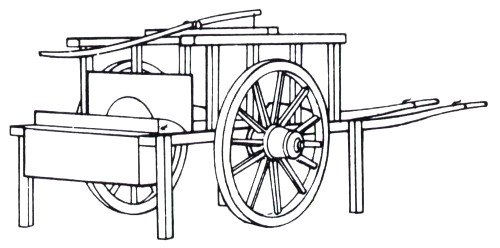
Among the equipment captured from the British was a “Travelling Forge,” used by artificers to keep horses shod and wagons in repair.
Down the Green River Road they galloped, sabers in hand. But Tarleton the cavalryman was not an easy man to catch. He rode at his usual horse-killing pace. A few miles above William Thompson’s plantation on Thicketty Creek, they found the expedition’s baggage wagons abandoned, 35 in all, most of them belonging to the 7th Regiment. The fleeing cavalry of the Legion had told the 100-man guard of the defeat. The officer in command had set fire to all the baggage that would burn, cut loose the wagon horses, mounted his infantry two to a horse, and ridden for the safety of Cornwallis’s army. Abandoned with the baggage were some 70 black slaves. A short time later, a party of loyalists, fugitives from the battlefield, reached the baggage train and began to loot it. They were not long at this work before Tarleton and his heartsick officers and troopers came pounding down the road. They did not ask questions about loyalty. They cut down the looters without mercy.
Tarleton too was riding for Cornwallis’s camp, but he had more than safety on his mind. He assumed the British commander was just across the Broad River at Kings Mountain in a position to rescue the 500 or so men Morgan had taken prisoner. Perhaps Tarleton met a loyalist scout or messenger somewhere along the road. At any rate, he heard “with infinite grief and astonishment” that the main army was at least 35 miles away, at Turkey Creek.
This news meant a change of route. The British decided they needed a guide. Near Thicketty Creek they stopped at the house of a man named Goudelock. He was known as a rebel. But Tarleton probably put a saber to his throat and told him he would be a dead man if he did not lead them to Hamiltons Ford across the Broad River, near the mouth of Bullocks Creek. Goudelock’s terrified wife watched this virtual kidnapping of her husband.
About half an hour after Tarleton and his troopers departed to the southeast, Washington, Pickens, and their dragoons and militia troopers rode into Goudelock’s yard. They had stopped to extinguish the fires the British started in the baggage wagons and collect some of the slaves the enemy had abandoned. The Americans asked Mrs. Goudelock 82 if she had seen the British fugitives. Yes, she said. What road did they take? She pointed down the Green River Road, which led to Grindal Shoals on the Pacolet. Like a great many people in every war, she was more interested in personal survival than national victory. If the Americans caught up to Tarleton, there was certain to be a bloody struggle, in which her husband might be killed. Mrs. Goudelock preferred a live husband to a dead or captured British commander.
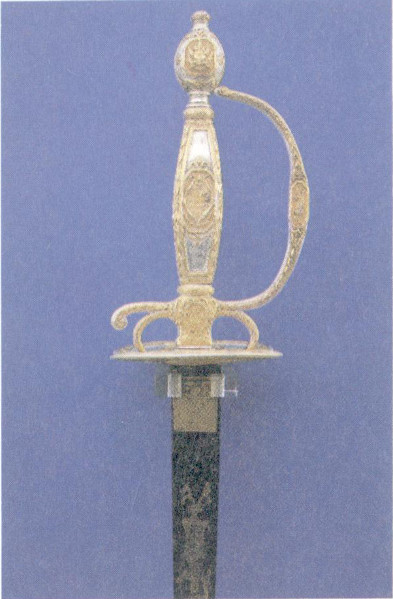
Congress awarded this silver sword to Colonel Pickens for his part in the battle.
The Americans galloped for the Pacolet. Not until they had traveled 24 miles on this cold trail did they turn back. By then, it was much too late. Tarleton was safely across the Broad River at Hamiltons Ford. But the American pursuit helped save Thomas Young, the captured militiaman. When Tarleton and his men, guided by the reluctant Goudelock, reached the ford, it was almost dark. Someone told them the river was “swimming.” Someone else, perhaps a loyalist scout, rode up with word that Washington and his cavalry were after them. Considerable confusion ensued, as Tarleton and his officers conferred on whether to flee down the river to some other ford, attempt to swim the river in the dark, or stand and fight. Everyone stopped thinking about Thomas Young and another prisoner, a Virginian whom the British had scooped up along the road. The two Americans spurred their horses into the darkness, and no one noticed they were gone.
Tarleton crossed the Broad River that night and spent the next morning collecting his runaway dragoons and other stragglers before riding down to Cornwallis’s camp at Turkey Creek. The British commander already knew the bad news. Some of the Legion cavalry had drifted into camp the previous night. But Tarleton, as the field commander, was required to make a detailed report.
According to Joseph McJunkin, whose father had been taken prisoner by the British and was an eyewitness, Cornwallis grew so agitated he plunged his sword into the ground in front of his tent and leaned on it while listening to the details of the disaster. By the end of Tarleton’s account, the earl was leaning so hard on the hilt that the sword snapped in half. He threw the broken blade on the ground and swore he would recapture the lost light infantry, Fusiliers, and Highlanders.
83
The general exonerated Tarleton of all culpability for the defeat at Cowpens. “You have forfeited no part of my esteem, as an officer,” he assured Tarleton. Cornwallis blamed the loss on the “total misbehavior of the troops.” But he confided to Lord Rawdon, the commander at Camden, that “the late affair has almost broke my heart.”
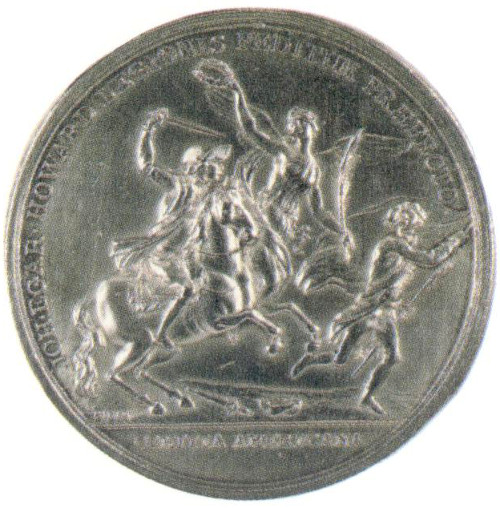
Of the three medals awarded by Congress—a gold medal to Morgan and silver medals to Washington and Howard—only the Howard medal has survived. The Latin inscription reads: “The American Congress to John Eager Howard, commander of a regiment of infantry.” The medal is in the collection of the Maryland Historical Society.
On the same morning that Tarleton was making his doleful report, Washington and Pickens returned to Cowpens. On their ride back, they collected several dozen—some versions make it as many as 100—additional British soldiers straggling through the woods. At the battlefield they found only the two surgeons caring for the wounded and a handful of Pickens’ men guarding them. Daniel Morgan, knowing Cornwallis would make a determined effort to regain the prisoners, had crossed the Broad River on the afternoon of the battle and headed northwest toward Gilbert Town. Pickens and Washington caught up to him there, and Morgan gave Pickens charge of the prisoners, with orders to head for an upper ford of the Catawba River. Decoying Cornwallis, Morgan led his Continentals toward a lower ford of the same river. In an exhausting five-day march, often in an icy rain, both units got across this deep, swift-running stream ahead of the pursuing British. The prisoners were now beyond Cornwallis’s reach. They were soon marched to camps in Virginia, where the men Morgan helped capture at Saratoga were held.
This final retreat, a vital maneuver that consolidated the field victory at Cowpens, worsened Morgan’s sciatica. From the east bank of the Catawba, he warned Greene that he would have to leave the army. “I grow worse every hour,” he wrote. “I can’t ride or walk.” As the rain continued to pour down, Morgan had to abandon his tent and seek the warmth of a private house. Greene immediately rode from Cheraw Hills and took personal command of the army. By the time Morgan departed for Virginia on February 10, he was in such pain that he had to be carried in a litter.
A grateful Congress showered the Cowpens victors with praise and rewards. Morgan was voted a gold medal, and Howard and Washington were voted silver medals. Pickens received a silver sword. Perhaps the most immediate result of the battle was in the minds of the people of the South. The victory 84 sent a wave of hope through the Carolinas and Georgia. It also changed attitudes in Congress toward the southern States. John Mathews of South Carolina told Greene that “the intelligence ... seems to have had a very sensible effect on some folks, for as this is a convincing proof that something is to be done in that department ... they seem at present to be well disposed to give it every possible aid.”
The news had an exhilarating effect on Greene’s half of the southern army. He ordered a celebration and praised Morgan extravagantly in the general orders announcing the victory. A friend on Greene’s staff sent a copy to Morgan, adding, “It was written immediately after we heard the news, and during the operation of some cherry bounce.” To Francis Marion, Greene wrote, “After this, nothing will appear difficult.”
This optimism soon faded. To the men in the field, Cowpens did not seem particularly decisive. Banastre Tarleton was soon back in action at the head of the British cavalry. On February 1, from his sick bed, Morgan wrote a despairing letter to Gov. Thomas Jefferson of Virginia, describing the retreat of the Southern army before Cornwallis. “Our men [are] almost naked,” still too weak to fight him. “Great God what is the reason we can’t have more men in the field? How distressing it must be to an anxious mind to see the country over run and destroyed for want of assistance.”
The civil war between the rebels and the loyalists continued in South Carolina, marked by the same savage fratricidal strife. “The scenes were awful,” Andrew Pickens recalled. Young James Collins, in his simple, honest way, told the militiaman’s side of this story. Summing up his role at Cowpens, Collins said he fired his “little rifle five times, whether with any effect or not, I do not know.” The following day, he and many other militiamen received “some small share of the plunder” from the captured British wagons. Then, “taking care to get as much powder as we could, we [the militia] disbanded and returned to our old haunts, where we obtained a few days rest.” Within a week, Collins was again on his horse, risking his life as a scout and messenger.
Only years later, with a full perspective of the war, did the importance of Cowpens become clear. By destroying Tarleton’s Legion, Daniel Morgan crippled 85 the enemy’s power to intimidate and suppress the militia. Cornwallis was never able to replace the regulars he lost at Cowpens. He had to abandon all thought of dividing his field army—which meant that British power did not extend much beyond the perimeter of his camp. When he pursued Greene’s army deep into North Carolina, the partisans in South Carolina rose in revolt. Eventually, Cornwallis was forced to unite his decimated, half-starved regiments with the British troops in Virginia, where they were trapped by Gen. George Washington’s army at Yorktown in October 1781.
In South Carolina, meanwhile, Nathanael Greene combined militia with his small regular army in the style Morgan had originated at Cowpens. Though Greene was forced to retreat without victory at Guilford Courthouse (March 15, 1781), Hobkirks Hill (April 25, 1781), and Eutaw Springs (September 8, 1781), the British army suffered such heavy losses in these and other encounters that they soon abandoned all their posts in the back country, including the fort at Ninety Six, and retreated to a small enclave around Charleston. There they remained, impotent and besieged, until the war was almost over.
It took nine years for the U.S. Treasury to scrape together the cash to buy Daniel Morgan the gold medal voted him by Congress for Cowpens. In the spring of 1790, this letter came to the Old Wagoner at his home near Winchester, Virginia:
New York, March 25, 1790
Sir: You will receive with this a medal, struck by the order of the late Congress, in commemoration of your much approved conduct in the battle of the Cowpens and presented to you as a mark of the high sense which your country entertains of your services on that occasion.
This medal was put into my hands by Mr. Jefferson, and it is with singular pleasure that I now transmit it to you.
I am, Sir &c., George Washington
86