XXVI AUNT POLLY’S ADVICE
Reading edition
IF Aunt Polly had entertained any real desire to forbid the expedition planned for Dorothy, the prompt interference of Madison Peyton in that behalf would have dissipated it.
No sooner had Peyton learned of the contemplated journey than he bustled over to Wyanoke to see Aunt Polly regarding it.
It is not a comfortable thing to visit a man with whom one has recently quarrelled and to whom one has had to send a letter of apology. Even Peyton, thick-skinned and self-assured as he was, would probably have hesitated to make himself a guest at Wyanoke at this time but for the happy chance that Arthur was absent in Richmond for a few days.
Seizing upon the opportunity thus afforded, Peyton promptly visited Aunt Polly to enter a very earnest and insistent protest. He was genuinely alarmed. He realized Dorothy’s moral and intellectual superiority to his son. He was shrewd enough to foresee that travel and a year’s association with men and women of attractive culture and refined intellectual lives would, of necessity, increase this disparity and perhaps—nay, almost certainly—make Jefferson Peyton seem a distinctly unworthy and inferior person in Dorothy’s eyes. He realized that the arrangement made some years before between himself and Dr. South, was not binding upon Dorothy, except in so far as it might appeal to her conscience and to her loyalty to her father’s memory when the time should be ripe to reveal it to her. For as yet she knew nothing of the matter.
She had liked young Peyton when he and she were children together. His abounding good nature had made him an agreeable playmate. But as they had grown up, the sympathy between them had steadily decreased. The good nature which had made him agreeable as a playmate, had become a distinct weakness of character as he had matured. He lacked fixity of purpose, industry and even conscience—while Dorothy, born with these attributes, had strengthened them by every act and thought of her life.
The young man had courage enough to speak the truth fearlessly on all occasions that strongly called for truth and courage, but Dorothy had discovered that in minor matters he was untruthful. To her integrity of mind it was shocking that a young man should make false pretences, as he had done when they had talked of literature and the like. She could not understand a false pretence, and she had no toleration for the weakness that indulges in it.
Moreover in intellectual matters, Dorothy had completely outgrown her former playmate. The bright boy, whom Dorothy’s father had chosen as one destined to be a fit life companion for her, had remained a bright boy. And that which astonishes us as brilliancy in a child ceases to impress us as the child grows into manhood, if the promise of it is not fulfilled by growth. A bright boy, ten or twelve years old, is a very pleasant person to contemplate; but a youth who remains nothing more than a bright boy as he grows into manhood, is distinctly disappointing and depressing.
It is to be said to the credit of Madison Peyton that he had done all that he could—or rather all that he knew how—to promote the intellectual development of this his first born son. He had lavished money upon tutors for him, when he ought instead to have sent him to some school whose all dominating democracy would have compelled the boy to work for his standing and to realize the value of personal endeavor. In brief Madison Peyton had made that mistake which the much richer men of our day so often make. He had tried to provide for his son a royal road to learning, only to find that the pleasures of the roadside had won the wayfarer away from the objects of his journey.
Madison Peyton now realized all this. He understood how little profit his son had got out of the very expensive education provided for him, how completely he had failed to acquire intellectual tastes, and in a dimly subconscious way, he understood how ill equipped the young man was to win the love of such a girl as Dorothy, or to make her happy as his wife. And he realized also that if travel and culture and a larger thinking should weaken in Dorothy’s mind—as it easily might—that sense of obligation to fulfil her father’s desires, on which mainly he had relied for the carrying out of the program of marriage between these two, with Pocahontas plantation as an incidental advantage, the youth must win Dorothy by a worthiness of her love, or lose her for lack of it.
The worthiness in his son was obviously wanting. There remained only Dorothy’s overweening loyalty to her father’s memory and will as a reliance for the accomplishment of Madison Peyton’s desires. It was to prevent the weakening of that loyalty that he appealed to Aunt Polly to forbid the travel plan.
Aunt Polly from the first refused. “Dorothy is a wonderful girl,” she said, “and she has wonderful gifts. I shall certainly not stand in the way of their development.”
“But let me remind you, Cousin Polly,” answered Peyton, “that Dorothy’s life is marked out for her. Don’t you think it would be a distinct injustice to her to unfit her as this trip cannot fail to do, for the life that she must lead? Will not that tend to render her unhappy?”
“Happiness is not a matter of circumstance, Madison. It is a matter of character. But that isn’t what I meant to say. You want me to keep Dorothy here in order that she may not grow, or develop, or whatever else you choose to call it. You want to keep her as ignorant as you can, simply because you know she is already the superior of the young man whom you and Dr. South, in your ignorant assumption of the attributes of Divine Providence, have selected to be her husband. You are afraid that she will outgrow him. Isn’t that what you mean, Madison?”
“Well, yes, in a way. You put it very baldly, but——”
“But that’s the truth, isn’t it? That’s what you’re afraid of?”
“Well, the fact is I don’t believe in educating girls above their station in life.”
“How can anything be above Dorothy’s station, Madison? She is the daughter and sole heir of one of the oldest and best families in Virginia. I have never heard of anything higher than that.”
“Oh, certainly. But that isn’t what I mean. You see Dorothy has been permitted to read a lot of books that young women don’t usually read, and study a lot of subjects that young women don’t usually study. She has got her head full of notions, and this trip will make the matter worse. I think women should look up to their husbands and not down upon them, and how can Dorothy——”
“How would it do, Madison, for the young men to make an effort on their own account, to improve their minds and build up their characters so that their wives might look up to them without an effort? There are some men to whom the most highly cultivated women can look up in real respect, and it is quite natural that the best of the young women should choose these for their husbands. Many young men refuse to make themselves worthy in that way, or fail in such efforts as they may make to accomplish it. If I understand you properly, you would forbid the girls to cultivate what is best in them lest they grow superior to their coming husbands.”
“That’s it, Cousin Polly. The happy women are those who feel the superiority of their husbands and find pleasure in bowing to it.”
“I thought that was your idea. It is simply abominable. It makes no more of a woman than of a heifer or a filly. It regards her as nothing more or better than a convenience. I’ll have nothing to do with such a doctrine. Dorothy South is a girl of unusual character, and unusual mind, so far as I can judge. She has naturally done all she could to cultivate what is best in herself, and, so far as I can control the matter she shall go on doing so, as every woman and every man ought to do. When she has made the best she can of herself, she may perhaps meet some man worthy of her, some man fit to be her companion in life. If she does, she’ll probably marry him. If she meets none such she can remain single. That isn’t at all the worst thing that can happen to a woman. It is a hideous thing to marry a girl to her inferior. You have yourself suggested that such a marriage can only mean wretchedness to both. And your plan of avoiding such marriages is to keep the girls inferior by denying them the privilege of self-cultivation. I tell you it is an abominable plan. It’s Turkish, and the only right way to carry it out is to shut women up in harems and forbid them to learn how to read. For if a woman or a man of brains learns that much, the rest cannot be prevented. So you may make up your mind that Dorothy is going to make this trip. I’ve already consented to it, and the more I think about it, the more I am in favor of it. My only fear is that she may fall off the earth when she gets to the other side, and I reckon that will not happen, for both Arthur and Edmonia assure me they didn’t fall off when they were over there.”
Peyton saw the necessity of making some stronger appeal to Aunt Polly, than any he had yet put forward. So he addressed himself to her conscience and her exalted sense of honor.
“Doubtless you are right, Cousin Polly,” he said placatively, “at least as to the general principle. But, as you clearly understand, this is a peculiar case. You see Dorothy must marry Jefferson in any event. Don’t you think it would be very unfair and even cruel to her, to let her unfit herself for happiness in the only marriage she is permitted to make? Will it not be cruel to let her get her head full of notions, and perhaps even accept some man’s attentions, and then find yourself in honor bound to show her the letter you hold from Dr. South, instructing her to carry out his will? You know she will obey her dead father and marry Jefferson. Isn’t it clearly your duty to shield and guard her against influences that cannot fail to unfit her for happiness in the marriage she must make?”
“I am sole judge of that matter, Madison. I am the guardian of Dorothy’s person during her nonage—four years longer. By the terms of Dr. South’s will she must not marry until she is twenty-one, except with my consent. With my consent she may marry at any time. As to the letter you speak of, you have never had the privilege of reading it, and I do not intend to show it to you. It is less peremptory, perhaps than you think. It does not command Dorothy to marry your son. It only recommends such a marriage to her as a safe and prudent one, securing to her the advantages of marriage into as good a family as her own. But there are other families than yours as good as her own, and I may see fit not to show Dorothy her father’s letter at all. I am not bound to let her read it, by any clause in his will, or by any promise to him, or even by any injunction from him. I am left sole judge as to that. If I had not been so left free to use my own discretion I should never have accepted the responsibility of the girl’s guardianship.”
“You astonish me!” exclaimed Peyton. “I had supposed this matter settled beyond recall. I had trusted Dr. South’s honor——”
“Stop, Madison!” interposed Aunt Polly. “If you say one word in question of Dr. South’s honor and integrity, I will burn that letter now, and never, so long as I live mention its existence.”
“Oh, I didn’t mean—”
“It seems to me you say a good many things you do not mean today, Madison. As for me, I am saying only what I mean, and perhaps not quite all of that. Let me end the whole matter by telling you this: I am going to let Dorothy make this trip. I am going to give her every chance I can to cultivate herself into a perfect womanhood—many chances that I longed for
DOROTHY SOUTH.
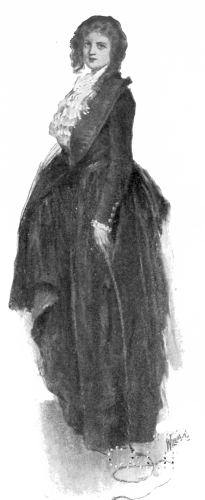
in my own girlhood, but could not command. I may or may not some day show her Dr. South’s letter. That shall be as my judgment dictates. I shall not consent now or hereafter, while my authority or influence lasts, to Dorothy’s marriage to anybody except some man of her own choosing, who shall seem to me fit to make her happy. If you want Jefferson to marry her, I notify you now that he must fairly win her. And my advice to you is very earnest that he set to work at once to render himself worthy of her; to repair his character; to cultivate himself, if he can, up to her moral and intellectual level; to make of himself a man to whom she can look up, as you say, and not down. There, that is all I have to say.”
Madison Peyton saw this to be good advice, and he decided to act upon it. But, as so often happens with good advice, he “took it wrong end first,” in the phrase of that time and country. He decided that his son should also go north and to Europe, following the party to which Dorothy belonged as closely as possible, seeing as much as he could of her, and paying court to her upon every opportunity.