XIV DOROTHY’S AFFAIRS
Reading edition
A GOOD many things happened “endurin’ of the feveh”—if Dick’s expressive and by no means inapt phrase may again be employed.
First of all the outbreak gave Madison Peyton what he deemed his opportunity. It seemed to him to furnish occasion for that reconciliation with Aunt Polly which he saw to be necessary to his plans, and, still more important, it seemed to afford an opportunity for him to withdraw Dorothy from the influence of Dr. Arthur Brent.
Accordingly, as soon as news came to him of the epidemic, and of Arthur Brent’s heroic measures in meeting it, he hurried over to Wyanoke, full of confident plans.
“This is dreadful news, Cousin Polly,” he said, as soon as he had bustled into the house.
“What news, Madison?” answered the old lady. “What have you come to tell me?”
“Oh I mean this dreadful fever outbreak—it is terrible—”
“I don’t know,” answered Aunt Polly, reflectively. “We have had only ten or a dozen cases so far, and you had three or four times that many at your quarters last year.”
“Oh, yes, but of course this is very much worse. You see Arthur has had to burn down all the quarters, and destroy all the clothing. He’s a scientific physician, you know, and—”
“But all science is atheistic, Madison. You told me so yourself over at Osmore, and so of course you don’t pay any attention to Arthur’s scientific freaks.”
“Now you know I didn’t mean that, Cousin Polly,” answered Peyton, apologetically. “Of course Arthur knows all about fevers. You know how he distinguished himself at Norfolk.”
“Yes, I know, but what has that to do with this case?”
“Why, if this fever is so bad that a scientific physician like Arthur finds it necessary to burn all his negro quarters and build new ones, it must be very much worse than anything ever known in this county before. Nobody here ever thought of such extreme measures.”
“No, I suppose not,” answered Aunt Polly. “At any rate you didn’t do anything of the kind when an epidemic broke out in your quarters last year. But you had fourteen deaths and thus far we have had only one, and Arthur tells me he hopes to have no more. Perhaps if you had been a scientific physician, you too would have burned your quarters and moved your hands to healthier ones.”
This was a home shot, as Aunt Polly very well knew. For the physicians who had attended Peyton’s people, had earnestly recommended the destruction of his negro quarters and the removal of his people to a more healthful locality, and he had stoutly refused to incur the expense. He had ever since excused himself by jeering at the doctors and pointing, in justification of his neglect of their advice to the fact that in due time the epidemic on his plantation had subsided. He therefore felt the sting of Aunt Polly’s reference to his experience, and she emphasized it by adding:
“If you had done as Arthur has, perhaps you wouldn’t have so many deaths to answer for when Judgment Day comes!”
“Oh, that’s all nonsense, Cousin Polly,” he quickly responded. “And besides we’re wasting time. Of course you and Dorothy can’t remain here, exposed to this dreadful danger. So I’ve ordered my driver to bring the carriage over here for you this afternoon. You two must be our guests at least as long as the fever lasts at Wyanoke.”
Aunt Polly looked long and intently at Peyton. Then she slowly said:
“The Bible forbids it, Madison, though I never could see why.”
“Forbids what, Cousin Polly?”
“Why, it says we mustn’t call anybody a fool even when he is so, and I never could understand why.”
“But I don’t understand you, Cousin Polly—”
“Of course you don’t. I didn’t imagine that you would. But that’s because you don’t want to.”
“But I protest, Cousin Polly, that I’ve come over only because I’m deeply anxious about your health and Dorothy’s. You simply mustn’t remain here.”
“Madison Peyton,” answered the old lady, rising in her stately majesty of indignation, “I won’t call you a fool because the Bible says I mustn’t. But it is plain that you think me one. You know very well that you’re not in the least concerned about my health. You know there hasn’t been a single case of fever in this house
“I WON’T CALL YOU A FOOL BECAUSE THE BIBLE SAYS I MUSTN’T.”
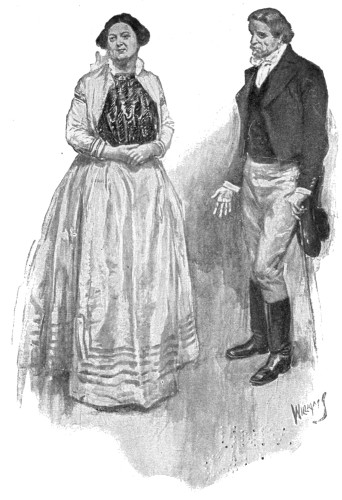
or within a mile of it. You know you never thought of removing your own family from your house when the fever was raging in your negro quarters. You know that I know what you want. You want to get Dorothy under your own control, by taking her to your house. Very well, I tell you you cannot do that. It would endanger the health of your own family, for Dorothy has been in our fever camp for two days and nights now, as head nurse and Arthur’s executive officer. Why do you come here trying to deceive me as if I were that kind of person that the Bible doesn’t allow me to call you? Isn’t it hard enough for me to do my duty in Dorothy’s case without that? Do you imagine I find it a pleasant thing to carry out my orders and train that splendid girl to be the obedient wife of such a booby as your son is? You are making a mistake. You tried once to intimidate me. You know precisely how far you succeeded. You are trying now to deceive me. You may guess for yourself what measure of success you are achieving. There are spirits in the sideboard, if you want something to drink after —— well, after your ride. I must ask you to excuse me now, as I have to go to the prize barn to superintend the work of the sewing women.”
With that the irate old lady courtesied low, in mock respect, and took her departure, escorted by her maid.
Madison Peyton was angry, of course. That, indeed is a feeble and utterly inadequate term with which to describe his state of mind. He felt himself insulted beyond endurance—and that, probably, was what Aunt Polly intended that he should feel. But he was baffled in his purpose also, and he knew not how to endure that. He was not a coward. Had Aunt Polly been a man he would instantly have called her to account for her words. Had she been a young woman, he would have challenged her brother or other nearest male relative. As it was he had only the poor privilege of meditating such vengeance as he might wreak in sly and indirect ways. He was moved to many things, as he madly galloped away, but one after another each suggested scheme of vengeance was abandoned as manifestly foolish, and with the abandonment of each his chagrin grew greater and his anger increased. When he met his carriage on its way to Wyanoke in obedience to the orders he had given in the morning, he became positively frantic with rage, so that the driver and the black boy who rode behind the vehicle grew ashen with terror as the carriage was turned about in its course, and took up its homeward way.
A few weeks later the court met, and a message was sent to Aunt Polly directing her to bring Dorothy before the judge for the purpose of having her choose a guardian. When Dorothy was notified of this she sent Dick with a note to Col. Majors, the lawyer. It was not such a note as a young woman more accustomed than she to the forms of life and law would have written. It ran as follows:
“Dear Col. Majors:—Please tell the judge I can’t come. Poor Sally is very, very ill and I mustn’t leave her for a moment. The others need me too, and I’ve got a lot of work to do putting up prescriptions—for I’m the druggist, you know. So tell the judge he must wait till he comes to this county next time. Give my love to Mrs. Majors and dear Patty.
“Sincerely yours, “Dorothy South.”
On receipt of this rather astonishing missive, Colonel Majors smiled and in his deliberate way ordered his horse to be brought to him after dinner. Riding over to Wyanoke he “interviewed” Dorothy at the fever camp.
He explained to the wilful young lady the mandatory character of a court order, particularly in the case of a ward in chancery.
“But why can’t you do the business for me?” she asked. “I tell you Sally is too ill for me to leave her.”
“But you must, my dear. In any ordinary matter I, as your counsel, could act for you, but in this case the court must have you present in person, because you are to make choice of a guardian and the court must be satisfied that you have made the choice for yourself and that nobody else has made it for you. So you simply must go. If you don’t the court will send the sheriff for you, and then it will punish Miss Polly dreadfully for not bringing you.”
This last appeal conquered Dorothy’s resistance. If only herself had been concerned she would still have insisted upon having her own way. But the suggestion that such a course might bring dire and dreadful “law things,” as she phrased it, upon Aunt Polly appalled her, and she consented.
“How long shall I have to leave poor Sally?” she asked.
“Only an hour or two. You and Miss Polly can leave here in your carriage about ten o’clock and as soon as you get to the Court House I’ll ask the judge to suspend other business and bring your matter on. He will ask you whom you choose for your guardian, and you will answer ‘Madison Peyton.’ Then the judge will ask you if you have made your choice without compulsion or influence on the part of anybody else, and you will answer ‘yes.’ Then he will politely bid you good morning, and you can drive back to Wyanoke at once.”
“Is that exactly how the thing is done?” she asked, with a peculiar look upon her face.
“Exactly. You see it will give you no trouble.”
“Oh, no! I don’t mind anything except leaving Sally. Tell the judge I’ll come.”
Col. Majors smiled at this message, but made no answer, except to say:
“I’ll be there of course, and you can sit by me and speak to me if you wish to ask any question.”
The lawyer made his adieux and rode away. Dorothy, with a peculiar smile upon her lips returned to her patients.