REIGN OF JAMES VI.: 1603-1625. (continued 2)
Reading edition
Aug. 29.
The plague broke out in Perth, and continued till the ensuing May, ‘wherein deit young and auld five hundred persons.’—Chron. Perth.
Sep. 1.
1608.
It was reported to the Privy Council that a quarrel had arisen between John Napier of Merchiston, and the sons and daughters of the late Sir Archibald Napier of Edinbellie, regarding the right to the teind sheaves of the lands of Merchiston for the crop of the present year. ‘Baith the said parties,’ says the record, ‘intends to convocate their kin, and sic as will do for them in arms, for leading [home-bringing], and withstanding of leading, of the said teinds; whereupon further inconvenients are like to fall out.’ To prevent breach of the peace, William Napier of Wrightshouses, a neutral person, was ordered to collect the teind sheaves of Merchiston, and account to the Council.—P. C. R. ‘Whilk order,’ says John Napier, ‘is guid eneuch for me, and little to their contentment;’ that is, to the contentment of his Edinbellie relatives.330
This, it must be owned, is a new light in which to view the inventor of the logarithms. It is, however, worthy of observation, that a dispute between other parties on the same grounds is described in precisely similar terms, and the same arrangement made to preserve the peace.
Sep.
‘In the beginning of September, the Duke of Wirtemberg, a prince in Germany, a young man of comely behaviour, accompanied with twenty-four in train, came to see the country. He was convoyed from place to place by noblemen, by the king’s direction, and weel enterteened. His train were all clothed in black.’—Cal.
The duke was a great friend and ally of the king, who, soon after his accession, sent Lord Spencer with a splendid ambassage to Stuttgart, to invest his serene highness with the Order of the Garter.
The records of Privy Council are still full of instances of assaults made by men of rank and others with deadly weapons upon persons against whom they bore hatred. It would be wearisome to enumerate even those which occur throughout a single year. It is to be remembered there were famous acts of parliament against going armed defensively or offensively; yet in every case we find the guilty parties set about their vengeful proceedings in steel bonnets, gauntlets, and plait-sleeves, and with swords and pistolets.
1608.
As an example—one Gavin Thomson, burgess of Peebles, was held at hatred by Charles Pringle, another burgess; we do not learn for what cause. One day in September 1608, as Gavin was walking in sober and quiet manner along the High Street of the burgh, Charles Pringle, accompanied by nine or ten persons, all armed with lances and whingers, set upon and ‘cruelly hurt and wounded the said Gavin upon the left hand, drave him perforce back, and housit him within the dwelling-place and lock-fast yetts of Isobel Anderson; and were it not by the providence of God, that the Person and Minister of Peebles, accompanied with some others weel-affected persons to the peace of the said town, and knawing the said Gavin his innocency, come forth to the redding,331 they had not failit, as they had begun, with great jeists, trees, and fore-hammers, to have surprised and strucken up the yetts and doors of the said dwelling-house, and within the same to have unmercifully slain and murdered the said Gavin.’
For several subsequent months, Pringle and his associates had lain in wait at divers times to kill Gavin, so that he had been prevented from attending kirk or market, or going about the business of his farm. At length, on the 2d of December, as he was walking peaceably on the street, they attacked him again, armed as before. ‘Being informit that he had come furth of his house, they first bostit and menaced him aff the hie street, and he retiring himself hame again in quietness, they all followit and pursewit him with drawn swords,’ when one of the party, Alexander Dalmahoy, ‘by his sword, with ane great stane of aucht pund wecht in his hand, hurt the said Gavin his thie-bone.’ The assailants ‘hurt and woundit William Murray of Romanno and divers other gentlemen redders, and in end fiercely pursewit Gavin and housit him within the dwelling-house of the close yetts of William Elliot, and cryit for jeists and fore-hammers, and had not failit to have strucken up the doors and yetts thereof, and to have slain the said Gavin within the same, were not timous relief come at hand.’ The active parties in this wickedness were denounced rebels by the Council.—P. C. R.
Oct.
William Turnbull of Airdrie lived in Edinburgh, having in his family a daughter, Elizabeth, eleven years of age. He admitted to his house, and often civilly entertained Robert Napier son of William of Wrightshouses—a gentleman who has just been under our notice. On the 4th of October, Turnbull complained to the Privy Council that, on the 29th of September, Robert Napier had by craft and violence taken away his daughter, under cloud of night, and now keeps her in some obscure place, refusing to render and deliver her up to her father. The Council caused Robert Napier to be denounced as a rebel for this fact.
1608.
The abduction of women, of which some examples were formerly given, was still an offence of frequent occurrence. On the subsequent 8th of December, there is a complaint before the Council from Margaret Stewart, widow, that as she was walking home from her booth to her dwelling-house in Edinburgh, between seven and eight o’clock in the evening of the 5th of the same month, accompanied by her orphan grandchild, Katherine Weir, fourteen years of age, a young citizen, named William Geddes, had beset her with six men armed like himself with swords, gauntlets, steel bonnets, and plait-sleeves, and violently took the child from her, ‘without pity of her manifold exclamations and crying.’ Geddes was likewise denounced rebel.
Nov. 8.
‘There was an earthquake at nine hours at night, sensible enough at St Andrews, Cupar, Edinburgh, Glasgow, Dundee, but more sensible at Dumbarton; for there the people were so affrayed, that they ran to the kirk, together with their minister, to cry to God, for they looked presently for destruction. It was thought the extraordinar drouth in the summer and winter before was the cause of it.’—Cal.
At Perth, this earthquake shook the east end of the Tolbooth, insomuch that ‘many stones fell aff it.’—Chron. Perth.
At Aberdeen, where the shock excited great alarm, the kirk-session met, and accepting the earthquake as ‘a document that God is angry against the land, and against this city in particular, for the manifold sins of the people,’ appointed a solemn fast to be held on the ensuing day, and ‘the covenant to be renewed by the haill people with God, by halding up of their hands publicly before God in his sanctuary, and promising by his grace to forbear in time coming from their sins.’ There was one particular sin which was thought to have had a great concern in bringing about the earthquake—namely, the salmon-fishing practised on the Dee on Sunday. Accordingly, the proprietors of the salmon-fishings were called before the session, and rebuked. ‘Some,’ says the session record, ‘promist absolutely to forbear, both by himselfs and their servands in time coming; other promised to forbear, upon the condition subscryvant; and some plainly refusit anyway to forbear.’332
Dec. 1.
1608.
‘The Earl of Mar declared to the [Privy] Council that some women were ta’en in Broughton, as witches, and being put to ane assize, and convict, albeit they persevered constant in their denial to the end, yet they were burnt quick [alive], after sic ane cruel manner, that some of them deit in despair, renuncand and blasphemand, and others, half burnt, brak out of the fire, and was cast in quick in it again, while [till] they were burnt to the deid.’333
1609. Jan. 5.
‘... the wind did blow so boisterously, that the like was not heard in the memory of man. Houses in burgh and land were thrown down with the violence of it; trees rooted up, corn-stacks and hay-stacks blown away. Some men passing over bridges were driven over violently and killed. The wind continued vehement many days and weeks, even till mid-March, howbeit not in the same measure that it blowed this day.’—Cal.
The book entitled Regiam Majestatem, containing the ancient laws of Scotland, seems to have been printed by a contribution from the burghs. In April this year, we find the magistrates of Glasgow charged to make payment of £100 on this account. In September, the learned author, Sir John Skene, had some difficulty with his printer, Thomas Finlayson, of importance enough to come under the attention of the Privy Council. It was alleged that Thomas, after perfyting the Scottish volume, ‘upon some frivole consait and apprehension of his own, without ony warrant of law or pretence of reason,’ maliciously refused to deliver the volume to Sir John, ‘but shifts and delays him fra time to time with foolish and impertinent excuses, to Sir John’s heavy hurt and prejudice.’ The Lords of Council ordered Thomas to deliver the book to its author within eight days, on pain of being denounced rebel; and ‘whereas there is some little difference and question betwixt the said parties anent their comptis,’ a committee was appointed ‘to sort the same, and put them to ane rest.’—P. C. R.
May.
1609.
The severities called for by the General Assembly against the papist nobles and others, had been, to appearance, backed up by the royal power. The Marquis of Huntly was actually in prison at Stirling as an excommunicated rebel. The king probably felt this a high price for the soothing of Presbyterian scruples regarding episcopacy; but it had so far been paid. He contemplated having the observance of Christmas brought in at the end of the year; and it was therefore advisable to shew a little further earnestness in the right direction.
By the activity of Spottiswoode, archbishop of Glasgow, John Hamilton, a zealous trafficking priest, was apprehended—an act the more important that this culprit was uncle to the king’s advocate. Another priest, named Paterson, was taken with all his vestments, while celebrating mass in a house in the Canongate in Edinburgh before an audience of thirty persons. These must, of course, have been gratifying proofs of the royal zeal, albeit Calderwood cannot repress a bitter remark as to the ‘tolerable entertainment’ allowed to the prisoners (the allowance made in another case for an incarcerated priest, and probably in these also, was a merk—1s. 1-1/3d. sterling—per diem), while ministers incarcerated for opposition to the king’s episcopal innovations ‘were left to their shifts.’
About the same time, the archbishop went with a party to the town of New Abbey, in the stewartry of Kirkcudbright, and there broke into the house of Mr Gilbert Brown, former abbot of New Abbey, ‘and having found a great number of popish books, copes, chalices, pictures, images, and such other popish trash, he most worthily and dutifully as became both a prelate and a councillor, on a mercat-day, at a great confluence of people in the hie street of the burgh of Dumfries, did burn all those copes, vestments, and chalices,’ delivering up the books to Maxwell of Kirkconnel, to be afterwards dealt with. The Privy Council (June 13, 1609) allowed this to be good service on the part of the archbishop, and granted him a gift of the books left unburnt.—P. C. R.
In the parliament held a few days after the last date, several acts were passed against popery—one ordaining that pedagogues sent abroad with the sons of noblemen and others, should be duly licensed by a bishop; another that the young persons so sent abroad should remain at places where ‘the religion’ is professed, and ‘where there is no cruel inquisition;’ a third for confiscating the property of papists to the king’s use; a fourth was meant to deprive Catholics of all benefit from the legal system of the country. The more severe class of Presbyterians looked on, with no inclination to object to these measures, but only with a disbelief in the sincerity of the government which had brought them forward. They had begun to see that it was ‘to grace the bishops, and procure them greater credit and authority in the country,’ that popery was thus dealt with.—Cal.
July.
1609.
We have seen that, so lately as September 1606, the Borders were reduced to obedience by a moral medicine of considerable sharpness, administered by the Earl of Dunbar; that is to say, one hundred and forty thieves had been hanged. We now find that the effect was only temporary, for it had become necessary for the earl to go once more to Dumfries to hold a justice-court. On this occasion, he was equally severe with such offenders as were in custody, causing many to be hanged.—Cal. The Chancellor Dunfermline wrote to the king that Lord Dunbar ‘has had special care to repress, baith in the in-country and on the Borders, the insolence of all the proud bangsters, oppressors, and nembroths [Nimrods], but [without] regard or respect to ony of them; has purgit the Borders of all the chiefest malefactors, robbers, and brigands as were wont to reign and triumph there, as clean, and by as great wisdom and policy, as Hercules sometime is written to have purged Augeas, the king of Elide, his escuries; and by the cutting aff ... the Laird of Tynwald, Maxwell, sundry Douglases, Johnstons, Jardines, Armstrangs, Beatisons, and sic others, magni nominis luces, in that broken parts, has rendered all those ways and passages betwixt your majesty’s kingdoms of Scotland and England, as free and peaceable, as Phœbus in auld times made free and open the ways to his awn oracle in Delphos, and to his Pythic plays and ceremonies, by the destruction of Phorbas and his Phlegians, all thieves, voleurs, bandsters, and throat-cutters. These parts are now, I can assure your majesty, as lawful, as peaceable, and as quiet, as any part in any civil kingdom of Christianity.’334
1609.
This was too happy a consummation to be quite realised. We find, not long after, a representation going up to the king from the well-disposed people of the Borders, shewing that matters were become as bad as ever. It is a curious document, full of Latin quotations. The thieves, it says, are like the beasts of the field, according to the words of Cicero in his oration for Cluentius; quæ, fame dominante, ad eum locum ubi aliquando pastæ sunt, revertuntur. Lord Dunbar being now gone with his justice-courts, they are returned to their old evil courses, and there is nothing which they will not attempt. ‘Wild incests, adulteries, convocations of lieges, shooting and wearing of hagbuts, pistolets, and lances, daily bloodsheds, oppression, and disobedience in civil matters, neither are nor has been punished ... there is no more account made of going to the horn, than to the ale-house.’ Lord Scone and his guard are of no use, for they favour their friends. ‘If diligent search were made ... there would be found ane grit number of idle people, without any calling, industry, or lawful means to live by, except it be upon the blood of the poorest and most obedient sort.’
The final attempt to plant the Lewis took place this year, under the care of only two adventurers, Sir George Hay (subsequently chancellor of Scotland) and Sir James Spens of Wormiston. The Lord of Kintail had in the interval made an unsuccessful attempt to obtain a grant of the island.
The two undertakers went to the island with a force which they considered sufficient to meet the opposition of the pertinacious Niel Macleod. ‘The Lord of Kintail did privately and underhand assist Niel Macleod, and sent his brother, Rorie Mackenzie, openly with some men to aid the undertakers by virtue of the king’s commission. He promised great friendship to the adventurers, and sent unto them a supply of victuals in a ship from Ross. In the meantime he sendeth quietly to Niel Macleod, desiring him to take the ship by the way, that the adventurers, trusting to these victuals, and being disappointed, might thereby be constrained to abandon the island, which fell out accordingly; for Sir George Hay and Sir James Spens failing to apprehend Niel, and lacking victuals for their army, they wearied of the bargain, and dismissed all the neighbouring forces. Sir George Hay and Wormiston retired into Fife, leaving some of their men in the island to keep the fort, until they should send unto them supply of men and victuals. Whereupon Niel Macleod, assisted by his nephew ... and some other of the Lewis men, invaded the undertakers’ camp, burnt the fort, apprehended the men which were left behind them in the island, and sent them home safely into Fife, since which time they never returned again into the island.’—G. H. S.
1609.
The Lord of Kintail afterwards obtained possession of the isle of Lewis, and Niel, thoroughly circumvented by the Clan Kenzie, was driven for refuge with a small company to a fortified rock called Berissay. ‘The Clan Kenzie then gathered together the wives and children of those that were in Berissay, and such as, by way of affinity or consanguinity, within the island, did appertein to Niel and his followers, and placed them all upon a rock within the sea, where they might be heard and seen from Berissay. They vowed and protested that they would suffer the sea to overwhelm them the next flood, if Niel did not presently surrender the fort; which pitiful spectacle did so move Niel Macleod and his company to compassion, that immediately they yielded the rock and left the Lewis; whereupon the women and children were rescued and rendered.’—G. H. S.
This unfortunate insular chief, falling into the hands of his enemies, was taken to Edinburgh, and there executed in April 1613.
Aug.
There was a Presbyterian prejudice against burying in churches, and the blame of kirk-burial had not only been a subject for the pamphleteer, but the legislature. Nevertheless, John Schaw of Sornbeg in Ayrshire, on the death of his wife, resolved to inhume her corpse in his parish kirk of Galston, in spite of all the minister and session could say or do to the contrary. Accompanied by his brother and his ‘bailie,’ and attended by a numerous party, ‘all bodin in feir of weir,’ he came to the church, broke up the door with fore-hammers, and dug a grave, in which he deposited his spouse. He was afterwards glad to make public repentance for this fact, and pay twenty pounds to the box-master of the kirk, besides which the Privy Council ordained him to appear again as a penitent, and solemnly promise never again to attempt to bury any corpse within the church.’—P. C. R.
Aug. 10.
Notwithstanding Lord Ochiltree’s protestations of innocence regarding the assassination of Lord Torthorald, the relatives of the latter continued to bear a deadly grudge at him, and seemed likely to wreak it out in some wild manner. This came to the knowledge of the king, who felt himself called upon to interfere. The Privy Council, in obedience to the royal letters, had the parties summoned before them. William Lord Douglas and James Lord Torthorald appeared before them that day, and undertook, before the 20th of September, that ‘they sall owther pursue the said Lord Ochiltree criminally before his majesty’s justice in the Tolbooth of Edinburgh, for airt, part, rede, and counsel, of the slaughter of umwhile Lord Torthorald, or then that they sould reconceil themselves with the said Lord Ochiltree, and be agreit with him.’—P. C. R.
1609.
Oct. 26.
Under favour of the king, a number of strangers had been introduced into the country to practise the making of cloths of various kinds. A colony of them was settled in the Canongate, Edinburgh, headed by one John Sutherland and a Fleming named Joan Van Headen, and ‘are daily exercised in their art of making, dressing, and litting of stuffis, and gives great licht and knowledge of their calling to the country people.’ These industrious and inoffensive men, notwithstanding the letters of the king, investing them with various privileges, were now much molested by the magistrates of the Canongate, with a view to forcing them to become burgesses and freemen there in the regular way. On an appeal to the Privy Council, their exemption was affirmed.
Nov. 7.
From London, where the pest had long been, a ship had lately come to Leith, and was now lying at the west side of the bulwark there, prepared to discharge her cargo. The case looked the more alarming, as several of the mariners had died of plague during the voyage. The Lords of Council immediately issued orders that the vessel should be taken to Inchkeith, where her cargo should be taken out and handled, cleansed, and dressed, the inhabitants affording all facilities for that purpose, ‘with such houses and other necessaries as are in the said inch.’—P. C. R.
Nov. 9.
The time was approaching when, in accordance with a recent act, the Egyptians were to depart from Scotland, under pain of being liable thereafter to be killed by any one without challenge of law. In anticipation of this dread time, one of the nation, named Moses Faw, appeared before the authorities of the kingdom, and pleaded for permission to remain under protection of the laws, on the ground that he had wholly withdrawn himself and his family from that infamous society, and was willing to give surety for his future good behaviour. The desired permission was extended to him on that condition.—P. C. R.
Dec. 25.
Having of late shewn some zeal against popery, King James thought he might now effect one little change essential to episcopacy, without more than enough of outcry from the earnest Presbyterians. By his order, sent by Chancellor Seton, it was arranged that Christmas-day should henceforth be solemnly held in Scotland. The Court of Session accordingly rose for that day, and till the 8th of January ensuing. ‘This,’ says Calderwood, ‘was the first Christmass vacance of the session keepit since the Reformation. The ministers threatened that the men who devised that novelty for their own advancement, might receive at God’s hand their reward to their overthrow, for troubling the people of God with beggarly ceremonies long since abolished with popery. Christmass was not so weel keepit by feasting and abstinence from work in Edinburgh these thretty years before, an evil example to the rest of the country.’
1610. Jan.
‘About the end of Januar, the Scotch Secretar, Sir Alexander Hay, came from court with sundry directions, and among the rest, for the habit of the senators of the College of Justice [which the Chancellor had told the king was now, since the departure of the court to England, ‘the special spunk of light and fondament of your majesty’s estate, and only ornament of this land‘],335 advocates, clerks, and scribes; which was proclaimed in the beginning of Februar—viz., that the senators should wear a purple robe or gown in judgment and in the streets, when they were to meet or were dissolved; that advocates, clerks, and scribes should wear black gowns in the judgment-hall and in the streets ... the provost and bailies of burghs and their councillors should wear black when they sat in council and judgment; that ministers should wear black clothes, and in the pulpit black gowns; that bishops and doctors of divinity should wear black cassikins syde to [long enough to reach] their knee, black gowns above, and a black crape about their neck.... On the 15th of Februar, the Lords of the Session and the bishops put on their gowns and came down from the chancellor’s lodging, with their robes, to the Tolbooth [the court-house—a section of St Giles’s Church]. All the robes, except the chancellor’s, were of London cloth, purple coloured, with the fashion of an heckled cloak from the shoulders to the middle, with a long syde hood on the back, the gown and hood lined with red sattin. The people flocked together to behold them. The bishops were ordeened to have their gowns with lumbard sleeves, according to the form of England, with tippets and crapes about their craigs [necks]; which was performed.’—Cal.
On the 20th of June, the lord provost of Edinburgh exhibited in his council ‘twa gowns, the ane red, the other black claith linit in the breists with sable furring, sent to his lordship by the king’s majesty for to be worn by him, and to be patterns of the gowns to be worn by the provost and bailies, and sic of the council and town as are appointed thereto by his majesty.’336
Feb. 27.
1610.
Alexander Kirkpatrick, younger of Closeburn, being in the Tolbooth of Edinburgh for the slaughter of James Carmichael, son to John Carmichael of Spothe, the Lady Amisfield, wife of a neighbour, came to the prison, and entered into conference with the keeper in his private apartments. At her persuasion, the man allowed ‘Young Closeburn’ to come to speak with her; and she then executed her design of exchanging clothes with him, and so allowing him to escape. The lady was warded in the Castle; but what ultimately became of her does not appear.—Pit.
June.
A General Assembly was held at Glasgow, so constituted and managed by royal authority that the king at length accomplished one grand portion of his ecclesiastical scheme for Scotland, in being acknowledged as the head of the kirk. Three English divines, chaplains to the king, Dr Christopher Hampton, Dr Phineas Hodson, and Dr George Meriton, were present to use their influence in reconciling the country to ‘a more comely and peaceable government in our kirk than was presently.’ But for the absence of the six banished ministers, and the confinement of zealous, fiery, fearless Andrew Melville in the Tower, it might not have been possible to carry this measure. The Presbyterian historians also insinuate that bribes were used with the members, whence they take leave to call it the Golden Assembly.
‘Immediately after this, the Bishops of Glasgow and Brechin took journey to court, to report what was done, and got great thanks frae the king. Galloway followed, who all three abode there till the month of November, at what time ... by a special commission from the king to the Bishop of London to that effect, the Archbishop of Glasgow and the other two were solemnly ordained, inaugurat, and consecrated, with anointing of oil and other ceremonies, according to the English fashion.’ [The ceremony, which took place in the chapel at London House, was celebrated by a banquet, at which ‘gifts were bestowed, and gloves were distributed, in token of the solemnisation of the marriage between the bishops and their kirks.’—Cal.] The three new prelates, ‘thereafter [January 23, 1611] returning to Scotland, did to the Archbishop of St Andrews, in St Andrews, as they were done withal at Lambeth, as near as they could possibly imitate; and thereafter the two archbishops consecrated the rest, and the new entrant bishops as they were nominat by the king ... first quietly, as being ashamed of the foolish guises in it, but afterward more and more solemnly, as their estate grew.’—Row. ‘All of them [the whole thirteen] deserted their flocks, and usurped thereafter jurisdiction over the ministers and people of their dioceses.’—Cal.
1610.
At the same time the king established in Scotland a court of High Commission, by which the new hierarchy acquired great power over the people.
‘The king was so earnest upon the creating of bishops, that he cared not what it cost him.... In buying in their benefices out of the hands of the noblemen that had them, in buying votes at Assemblies, in defraying of all their other charges, and promoving of all their adoes and business, as coming to, and going from, and living at court prelate-like; that is, sumptuously and gorgeously in apparel, house, diet, attendants, etc., [he] did employ (by the confession of such as were best acquainted with, and were actors in, these businesses) above the sum of £300,000 sterling money, one huge thing indeed; but sin lying heavy on the throne, crying aloud for wrath on him and his posterity, is infinitely sadder nor £300,000 sterling!‘—Row.
The Marquis of Huntly, and other papists of rank, had meanwhile been suffering considerably in order to dispose the Presbyterian opposition to yield to the king’s wishes. But now there was no longer any immediate occasion for severity. The marquis, professing to be once more thoroughly Protestant, was relieved from excommunication, and allowed to return to his palace in the north. With Errol there was greater difficulty. The king, through the Earl of Dunbar, had promised that he should lose his lands. He had, what Huntly happily wanted, a painfully tender conscience. One day, he was brought to promise that he would subscribe; but that very night he fell into such a trouble of mind as to have been on the point of killing himself. ‘Early next morning, the Archbishop of Glasgow being called, he confessed his dissimulation with many tears, and, beseeching them that were present to bear witness of his remorse, was hardly brought to any settling all that day.’ By some treacherous excuse, lenity was extended to Errol also. Such was the way in which the king performed his engagements on this solemn subject. ‘The turn being done,’ says Calderwood, ‘promises were not keepit.’
July 3.
An act was passed by the Privy Council in favour of Anthony Aurego, Anthony Soubouga, and Fabiano Fantone, allowing them to live in the country, and practise their ‘trade and industry of making hecks and other machines for taking of rottons and mice.’—P. C. R.
July 27.
1610.
Piracy was at this time a flourishing trade, and the Scottish and Irish seas were a favourite walk of its practitioners. Vessels of various countries besides Scotland, were pursued by these marauders and mercilessly plundered, their crews seized, tortured, and sometimes slaughtered, or else set ashore on desolate coasts, that they might not be readily able to take measures of redress. The Long Island, on the west coast of Ireland, appears to have served as a regular station for pirate ships; they also haunted much the Western Isles of Scotland. In 1609, a piratical crew, headed by two captains named Perkins and Randell, started from the Long Island in a vessel of 200 tons, named the Iron Prize, attended by a nimble pinnace of about half that burden; and for some months they roamed about the northern seas, picking up whatever small-craft came in their way. They even had the audacity to shew themselves at the mouth of the Firth of Forth. The attention of the Privy Council being called to their proceedings, three vessels were fitted out in a warlike manner at Leith, and sent in quest of the pirates. Perkins and Randell had meanwhile come to Orkney to refit. They ‘landed at the castle, and came to the town thereof,’ where they ‘behaved themselves maist barbarously, being ever drunk, and fechting amang themselves, and giving over themselves to all manner of vice and villany.’ Three of them attacked a small vessel belonging to the Earl of Orkney, lying on the shore, and were taken prisoners in the attempt by the earl’s brother, James Stewart. A day or two after this event, the three government ships made their appearance, and immediately a great part of the piratical company made off in the pinnace. A pursuit proving vain, the government ships returned and attacked the Iron Prize; and after a desperate conflict, in which they had two men killed and sundry wounded, they succeeded in capturing the whole remaining crew, amounting to nearly thirty men, who, with those previously taken, were brought to Leith and tried (July 26). Being found guilty, twenty-seven of these wretched men, including the two captains, were hung upon a gibbet next day at the pier of Leith. Three were reserved in the hope of their giving useful information.
1610. Aug. 12.
The Chancellor Dunfermline, who took the lead in this severe administration of the law, tells the king in a letter written on the day of the execution: ‘This company of pirates did enterteen one whom they did call their Person [parson] for saying of prayers to them twice a day, who belike either wearied of his cure, or foreseeing the destruction of his flock, had forsaken them in Orkney, and, privily convoying himself over land, was at length deprehendit in the burgh of Dundee.’ As he confessed and gave evidence against the rest, besides bringing some of them to confession, he was reserved for the king’s pleasure, and probably let off.—Pit. C. K. Sc.
There was at this time ‘a great visitation of the young children [of Aberdeen] with the plague of the pocks.’ There were also ‘continual weets,’ which threatened to destroy the crops and cause a famine. The cause being ‘the sins of the land,’ a public fast and humiliation was ordered in Aberdeen, ‘that God may be met with tears and repentance.’—A. K. S. R.
Oct. 21.
‘The Archbishop of St Andrews [Gladstanes], reposing in his bed in time of the afternoon sermon, the Sabbath after his diocesan synod in St Andrews, was wakened, and all the kirk and town with him, with a cry of blood and murder. For his sister son [Walter Anderson], master of his household, with a throw of his dagger, killed his cook [Robert Green], while as he was busy in dressing the lord-bishop’s supper. The dagger light[ed] just under the left pap of the cook, who fell down dead immediately.’—Cal.
The young man was committed to prison; but, ‘the poor man’s friends being satisfied with a piece of money, none being to pursue the murder, he was by moyen [influence] cleansed by a white assize (as they call it) and let go free.’—Row. This trial took place before the regality court of St Andrews. On the ensuing 17th January, letters were raised by the king’s advocate against the assize, but with what result does not appear.—P. C. R.
Nov. 1.
‘... before the going to of the sun, there were seen by twelve or thretteen husbandmen, great companies of men in three battles, joining together and fighting the space of an hour, on certain lands perteening to my Lord Livingston and the Laird of Carse. The honest men were examined in the presence of divers noblemen, barons, and gentlemen, and affirmed constantly that they saw such appearance.’—Cal.
Dec. 23. 1610. Dec. 24.
We have now the first hint at public conveyances in Scotland in a letter of the king, encouraging Henry Anderson of Trailsund to bring a number of coaches and wagons with horses into Scotland, and licensing him and his heirs for fifteen years ‘to have and use coaches and wagons, ane or mae, as he shall think expedient, for transporting of his hieness lieges betwixt the burgh of Edinburgh and town of Leith ... providing that he be ready at all times for serving of his majesty’s lieges, and that he tak not aboon the sum of twa shillings Scots money for transporting of every person betwixt the said twa towns at ony time.’
A patent was granted for the establishment of a glass-manufacture in Scotland. The business was commenced at Wemyss, in Fife, and, about ten years after, we find it, to all appearance, going on prosperously. ‘Braid glass’—that is, glass for windows—was made, measuring three quarters of a Scots ell and a nail in length, while the breadth at the head was an ell wanting half a nail, and at the bottom half an ell wanting half a nail. It was declared to be equal in quality to Danskine glass. The glasses for drinking and other uses not being of such excellence, it was arranged that some specimens of English glass should be bought in London and established in Edinburgh Castle, to serve as patterns for the Scotch glass in point of quality. For the encouragement of the native manufacture, and to keep money within the country, the importation of foreign glass was (March 6, 1621) prohibited.—P. C. R.
1611. Mar.
The Veitches and Tweedies of the upper part of Peeblesshire had long been at issue,337 and peace was only kept between them by means of mutual assurances given to the Privy Council. The king heard of the case, and was the more concerned about it, because he believed he had, by his personal exertions, so entirely suppressed what he called the auld and detestable monster of deidly feid in Scotland, that ‘we do hardly think there be any one feid except this in all that kingdom unreconciled.’ As to these belligerent men of the Tweed, ‘the wrongs and mischiefs done by either of, as we understand, to others’ [each other], is ‘in such a proportion of compensation, as neither party can either boast of advantage, or otherwise think himself too much behind.’ He now ordered his Scottish Council, ‘that you call before you the principals of either surname, and then take such course for removing of the feid, and reconceiling, as you have been accustomed to do in the like cases’—that is, force them into bonds of amity, if they would not go of their own accord.—P. C. R.
May 10.
1611.
It was found necessary to put some restraint upon the number of poor Scotch people who repaired to the English court in hope of bettering their circumstances. The evil is spoken of as a ‘frequent and daily resort of great numbers of idle persons, men and women, of base sort and condition, and without ony certain trade, calling, or dependence, going from hence to court, by sea and land.’ It was said to be ‘very unpleasant and offensive to the king’s majesty, in so far as he is daily importuned with their suits and begging, and his royal court almost filled with them, they being, in the opinion and conceit of all behalders, bot idle rascals and poor miserable bodies;’ the country, moreover, ‘is heavily disgracit, and mony slanderous imputations given out against the same, as gif there were no persons of guid rank, comeliness, nor credit within the same.’ The Council, therefore, deemed it necessary to cause an order to be proclaimed in all the burghs and seaports, forbidding masters of vessels to carry any people to England without first giving up their names, and declaring their errands and business to the Lords, under heavy penalties.—P. C. R.
A number of the king’s Scottish courtiers had, as is well known, accompanied or followed him into England, and obtained shares of his good-fortune. Sir George Home, now Earl of Dunbar; Sir John Ramsay, created Earl of Haddington; Sir James Hay, ultimately made Earl of Carlisle; and recently, Mr Robert Ker, who became the king’s especial favourite, and was made Earl of Somerset, are notable examples. The English, regarding the Scottish courtiers with natural jealousy, called them ‘beggarly Scots,’ of which they complained to the king, who is said to have jocosely replied: ‘Content yourselves; I will shortly make the English as beggarly as you, and so end that controversy.’ On one occasion, this jealousy broke out with some violence at a race at Croydon, in consequence of a Scotsman named Ramsay striking the Earl of Montgomery with his riding-switch. ‘The English,’ says the scandal-mongering Osborne, ‘did, upon this accident, draw together, to make it a national quarrel; so far as Mr John Pinchbeck, a maimed man, having but the perfect use of two fingers, rode about with his dagger in his hand, crying: “Let us break our fast with them here, and dine with the rest in London!” But Herbert, not offering to strike again, there was nothing lost but the reputation of a gentleman.’338 A ballad of the day described the metamorphosis which Scotchmen were understood to have undergone after their migration into England:
1611.
‘Bonny Scot, we all witness can, That England hath made thee a gentleman. Thy blue bonnet, when thou came hither, Could scarce keep out the wind and weather But now it is turned to a hat and a feather; Thy bonnet is blown, the devil knows whither.
Thy shoes on thy feet, when thou camest from plough, Were made of the hide of an old Scots cow; But now they are turned to a rare Spanish leather, And decked with roses altogether. Thy sword at thy back was a great black blade, With a great basket-hilt of iron made; But now a long rapier doth hang at thy side, And huffingly doth this bonny Scot ride.’339 &c.
Even Osborne acknowledges that the ordinary conceptions as to the enrichment of the Scots courtiers were exaggerated. He says: ‘If many Scots got much, it was not more with one hand than they spent with the other;’ and he explains how Cecil, Earl of Salisbury, the king’s English treasurer, ‘had a trick to get the kernel, and leave the Scots but the shell, and yet cast all the envy on them. He would make them buy books of fee-farms, some £100 per annum, some 100 marks; and he would compound with them for £1000 ... then would he fill up this book with such prime land as should be worth £10,000 or £20,000, which was easy for him, being treasurer, so to do.... Salisbury by this means enriched himself infinitely.’ The case is a significant one. The experience by the Scots, a simple rustic people, of the superior mercantile sharpness of the English, on coming into business relations with them, is probably the main cause of that dry cautious manner which the English censure in them as a national characteristic.
July 11.
From an act of the Privy Council of this date, we get a curious idea of the customs of the age regarding legal suits. It was declared that one of the chief causes of ‘the frequent and unlawful convocations, and the uncomely backing of noblemen and pairties upon the streets of Edinburgh,’ was the fact that ‘noblemen, prelates, and councillors repairing to this burgh, do ordinarily walk on the streets upon foot, whereby all persons of their friendship and dependence, and who otherwise has occasion to solicit them in their actions and causes, do attend and await upon them, and without modesty or discretion, importunes and fashes them with untimely solicitations and impertinent discourses, and sometimes by their foolish insolence and misbehaviour gives occasion of great misrule and unquietness within this burgh.’
1611.
The remedy ordered was as curious as the evil itself. It was, that noblemen, prelates, and councillors, when they come to the council, or are abroad in the town on their private affairs, should, as became their rank, ‘ride on horseback with footmantles or in coaches’—thus freeing themselves of that flocking of suitors which so much beset them when they appeared on foot.—P. C. R.
July 17.
This day, John Mure of Auchindrain, James Mure, his son, and James Bannatyne of Chapeldonald, were brought to trial in Edinburgh for sundry crimes of a singularly atrocious character. The first of these personages has been before us on two former occasions—namely, under January 1, 1596-7, and May 11, 1602; to which reference may be made for an introduction to what is now to be related.
Auchindrain, it appears, felt that the boy William Dalrymple, who had carried the letter making the appointment for a meeting with Colzean, was a living evidence of his having been the deviser of the slaughter of that gentleman. He got the lad into his hands, and kept him for a time in his house; then, on his wearying of confinement, sent him to a friend in the Isle of Arran; thence, on his wearying of being ‘in a barbarous country among rude people,’ he had him brought back to his own house, and, as soon as possible, despatched him with a friend to become a soldier in Lord Buccleuch’s regiment, serving under Maurice Prince of Orange. Dalrymple had not been long in the Low Countries, when he tired of being a soldier, and came back to Scotland. Once more he was at large in Ayrshire, and a source of uneasiness to Mure of Auchindrain. It was now necessary to take more decisive measures. Mure and his son (September 1607) sent a servant to the young man to take him to the house of James Bannatyne of Chapeldonald, and arranging to join them on the way, ‘held divers purposes, speeches, and conferences with him, tried of him the estate of the Low Countries and sundry other matters,’ and finally placed him as a guest in Chapeldonald House, under the name of William Montgomery.
1611.
According to appointment, at ten o’clock of the evening of next day, James Bannatyne came with Dalrymple to meet the two Mures on the sands near Girvan. There, the elder Mure explained to Bannatyne the cause of his fears regarding the young man, telling him ‘he saw no remeed but to redd Dalrymple furth of this life, since he could not otherwise be kept out of his way. Whereunto Bannatyne making answer, that it was ane cruel purpose to murder the poor innocent youth, specially seeing they might send him to Ireland, to be safely kept there.... Auchindrain seemed to incline somewhat to that expedient; and, in the uncertainty of his resolution, turning toward the part where his son stood, of purpose, as appeared, to consult with him, young Auchindrain perceived them no sooner near, but, thereby assuring himself of their assistance, in the execution of that whilk his father and he had concluded, he did violently invade Dalrymple, rushed him to the ground, and never left him till, helped by his father, with his hands and knees he had strangled him.’
1611.
The horrid deed being accomplished, the Mures, with spades they had brought, tried to bury Dalrymple in the sand; but, finding the hole always fill up with water, they were at length obliged to carry the body into the sea, going in as far as they could wade, and hoping that an outgoing wind would carry it to the coast of Ireland. Five nights after, it was thrown back upon the beach at the very scene of the murder, and was soon found by the country people. The Earl of Cassillis heard of it, and caused an account of the discovery to be published throughout the district. By the mother and sister of Dalrymple, it was at once pronounced to be his corpse, and suspicion instantly alighted upon the Mures. A relative, advised with about the rumour, said it could not be safe for them to brave the law in the teeth of so much prejudice; neither, supposing they absconded under such a suspicion, could their friends stand up for them. The only expedient was to make an excuse for going out of the way—assault, for instance, Hugh Kennedy of Garriehorn, a servant of the Earl of Cassillis, a man against whom they had many ‘probable quarrels.’ The Mures actually adopted this expedient, setting upon Garriehorn in the town of Ayr, and only failing to slay him by reason of the vigour of his defence. The earl then saw that it was necessary to take strong measures against enemies capable of such doings, and he accordingly had them summoned both for Dalrymple’s murder and for the assault of Garriehorn. They allowed themselves to be put to the horn—that is, denounced as rebels for not appearing—but loudly professed that, if freed on the score of the assault, they would stand their trial for the murder, alleging their entire innocence of that transaction. The king was now made acquainted with the case, and, by his orders, Auchindrain the elder was seized, and thrown into the Tolbooth in Edinburgh. The two culprits nevertheless continued to feel confidence in the want of proof against them, believing that, if Bannatyne were out of the way, it would be impossible to bring the fact home to them. The younger Mure, still at large, accordingly dealt with Bannatyne to induce him to go to Ireland. It is a wonder he did not at once send his friend to a more distant bourn. When Bannatyne was gone, young Mure came boldly forward to take his trial, somewhat to the embarrassment of the officers of justice. However, by the suggestion of his majesty, he was not allowed to depart till he should have suffered the torture, with a view to making him confess. To the admiration of all, he bore this treatment with unflinching fortitude, and confessed nothing.
Public sentiment now rose in favour of the Mures as persecuted men, and the Privy Council was inclined to let them off; and would have done so, had not the king continued firm in his belief of their guilt, and ordered them to be detained. Some years passed on, and proof seemed still past hope, when the Earl of Abercorn contrived to find out Bannatyne in Ireland, and caused him to be brought over to his own house in Paisley. There, Bannatyne gave a full account of the murder, but claimed, as fulfilment of a condition, that he should be allowed his freedom. The earl told him he had had no such understanding of the matter; but, to take away all ground of complaint, he would liberate him for the meantime, but at the end of ten days make every possible effort to take him unconditionally, whether dead or alive. At this Bannatyne hesitated; he knew that already the Mures had been laying plots to get him cut off in Ireland—now, between their vengeance and the extreme persecution threatened by Lord Abercorn, he could see no chance for safety. He therefore avowed his inclination to make a full confession before a court of law, and trust to his majesty’s clemency.
On being confronted with Bannatyne, the Mures appeared as obstinate in their protestations of innocence as ever, contradicting everything he said, and denouncing him as a tool of their enemies. They were, nevertheless, brought to trial, along with Bannatyne, on the day noted in the margin—found guilty, and condemned to be beheaded at the Cross of Edinburgh, with forfeiture of all they possessed to his majesty’s use. So ended this extraordinary tissue of crimes, old Auchindrain being at the time about eighty years of age.340
Aug.
1611.
Macleod of Raasay had been proprietor of the lands of Gairloch on the mainland of Ross-shire. He had the misfortune to live in the same time with Kenneth Mackenzie of Kintail, who has already been described as a man much too clever for his neighbours. Lord Kintail—for he had recently been made a peer—had a wadset or bond over a third of Gairloch, and by proper use of this legal footing in the estate, joined to neglect of legal defences by the insular chieftain, was in the way of becoming proprietor of the whole. While Raasay, however, neglected law, he had no reluctance to use the sword: so a hot feud subsisted between him and the crafty Mackenzie. The latter had already pursued the Macleods out of Gairloch with fire and sword.
Under the date noted in the margin, Lord Kintail hired a ship, that his son Murdo Mackenzie might go to Skye with a proper following, in order to apprehend one John Holmogh MacRorie, a duniwassal of Raasay,341 who had given him some trouble in the Gairloch. The vessel, with whatever design it set out, soon changed its course, and arrived opposite Macleod’s castle in the isle of Raasay—the same place where Johnson and Boswell afterwards found such an elegant scene of Highland hospitality. MacGilliecallum—such is the Highland appellative of the Laird of Raasay—seeing the vessel, went out to it with twelve of his followers, to buy some wine. ‘When Murdo Mackenzie did see them coming, he, with all his train, lest they should be seen, went to the lower rooms of the ship, leaving the mariners only above the decks. The Laird of Raasay entered; and, having spoken the mariners, he departed, with a resolution to return quickly. Murdo Mackenzie, understanding that they were gone, came out of the lower rooms; and perceiving them coming again, he resolved to conceal himself no longer. The Laird of Raasay desired his brother Murdo to follow him into the ship with more company in another galley, that they might carry to the shore some wine which he had bought from the mariners; so returning to the ship, and finding Murdo Mackenzie there beyond his expectation, he consulteth with his men, and thereupon resolveth to take him prisoner, in pledge of his cousin John MacAllan MacRorie, whom the Laird of Gairloch detained in captivity.’—G. H. S.
1611.
The History of the Mackenzie family (MS.) says that Raasay, on coming the second time into the vessel, fell to drinking with Murdo Mackenzie in loving terms. ‘Four of Murdo’s men, fearing the worst, kept themselves fresh [sober].... Raasay, sitting on the right hand of Murdo, said to him: “Murdo, thou art my prisoner!” Murdo, hearing this, starts, and, taking Raasay by the middle, threw him upon the deck, and said he scorned to be his prisoner. With that a fellow of Raasay’s strake him with a dirk. He, finding himself wounded, drew back to draw his sword, [so] that he went overboard. He, thinking to swim to the coast of Sconsarie, was drowned by the small boats that were coming from Raasay. His men, seeing him killed, resolved to sell their lives at the best rate they could. The four men that kept themselves fresh, fought so manfully in their own defence, and in revenge of their master, that they killed the Laird of Raasay and Gilliecallum More, the author of this mischief, his two sons, with all the rest that came to the vessel with Raasay. Tulloch’s son, with six of Murdo’s company, were killed as they were coming above deck from the place where they lay drunk. The four [sober] men ... were all pitifully hurt. When they were drawing the anchor, the fourth man, called Hector Oig M‘Echin Vich Kinnich, ane active young gentleman, was shot with a chance bullet from the boats. The other three, cutting the tow of the anchor, did sail away with the dead corpses of both parties.’
‘Thus,’ says Sir Robert Gordon in conclusion to this murderous story, ‘hath the Laird of Gairloch obtained peaceable possession of that land.’
Sep. 24.
‘Sir James Lawson of Humbie, riding in Balhelvie Sands, where many other gentlemen were passing their time, sank down in a part of the sands and perished. He was found again on the morn, but his horse was never seen.’—Cal.
Oct. 25. 1611. Nov. 4.
It had been customary for the Scottish universities to receive students who had, through misbehaviour, become fugitives from other seats of learning; and now, as a natural consequence, it was found that the native youth at the university of Edinburgh, presuming on impunity for any improprieties they might commit, or a resource in case of punishment being attempted, ‘has ta’en and takes the bauldness to misknow the principal and regents, and to debord in all kind of uncomely behaviour and insolencies, no wise seemly in the persons of students and scholars.’ The Privy Council therefore issued a strict order forbidding the reception of fugitive students into the universities.—P. C. R.
The Privy Council was at this time obliged to renew former acts against Night-walkers of the city of Edinburgh—namely, idle and debauched persons who went about the streets during the night, in the indulgence of wild humours, and sometimes committing heinous crimes. If it be borne in mind that there was at that time no system of lighting for the streets of the city, but that after twilight all was sunk in Cimmerian darkness, saving for the occasional light of the moon and stars, the reader will be the better able to appreciate the state of things revealed by this public act.
Reference is made to ‘sundry idle and deboshit persons, partly strangers, who, debording in all kind of excess, riot, and drunkenness ... commit sundry enormities upon his majesty’s peaceable and guid subjects, not sparing the ordinar officers of the burgh, who are appointit to watch the streets of the same—of whom lately some has been cruelly and unmercifully slain, and others left for deid.’ The Council ordered that no persons of any estate whatsoever presume hereafter to remain on the streets ‘after the ringing of the ten-hour bell at night.’ The magistrates were also ordained to appoint some persons to guard the streets, and apprehend all whom they might find there after the hour stated.—P. C. R.
1612.
In this year there happened a strife between the Earl of Caithness on the one side, and Sir Robert Gordon of Gordonston and Donald Mackay on the other, highly illustrative of a state of things when law had only asserted a partial predominancy over barbarism.
1612.
One Arthur Smith, a native of Banff, had been in trouble for coining so long ago as 1599, when his man actually suffered death for that crime. He himself contrived to escape justice, by making a lock of peculiarly fine device, by which he gained favour with the king. Entering into the service of the Earl of Caithness, he lived for seven or eight years, working diligently, in a recess called the Gote, under Castle Sinclair, on the rocky coast of that northern district. If we are to believe Sir Robert Gordon, the enemy of the Earl of Caithness, there was a secret passage from his lordship’s bedroom into the Gote, where Smith was often heard working by night, and at last Caithness, Sutherland, and Orkney were found full of false coin, both silver and gold. On Sir Robert’s representation of the case, a commission was given to him by the Privy Council to apprehend Smith and bring him to Edinburgh.
While the execution of this was pending, one William MacAngus MacRorie, a noted freebooter, was committed to Castle Sinclair, and there bound in fetters. Contriving to shift off his irons, William got to the walls of the castle, and jumping from them down into the sea which dashes on the rocks at a great depth below, swam safely ashore, and escaped into Strathnaver. There an attempt was made by the Sinclairs to seize him; but he eluded them, and they only could lay hold of one Angus Herriach, whom they believed to have assisted the culprit in making his escape. This man being taken to Castle Sinclair without warrant, and there confined, Mackay was brought into the field to rescue his man—for so Angus was—and Caithness was forced to give him up.
May.
The coiner Smith was living quietly in the town of Thurso, under the protection of the Earl of Caithness, when a party of Gordons and Mackays came to execute the commission for apprehending him. They had seized the fellow, with a quantity of false money he had about him, and were making off, when a set of Sinclairs, headed by the earl’s nephew, John Sinclair of Stirkoke, came to the rescue with a backing of town’s-people, and a deadly conflict took place in the streets. Stirkoke was slain, his brother severely wounded, and the rescuing party beat back. During the tumult, Smith was coolly put to death, lest he should by any chance escape. The invading party were then allowed to retire without further molestation. ‘The Earl of Caithness was exceedingly grieved for the slaughter of his nephew, and was much more vexed that such a disgraceful contempt, as he thought, should have been offered to him in the heart of his own country, and in his chief town; the like whereof had not been enterprised against him or his predecessors.’
1612.
The strife is now transferred in partially legal form to Edinburgh, where the parties had counter-actions against each other before the Privy Council. Why the word partially is here used, will appear from Sir Robert Gordon’s account of the procedure. ‘Both parties did come to Edinburgh at the appointed day, where they did assemble all their friends. There were with the Earl of Caithness and his son Berriedale, the Lord Gray, the Laird of Roslin, the Laird of Cowdenknowes (the earl’s sister’s son), the Lairds of Murkle and Greenland (the earl’s two brethren); these were the chief men of their company. There were with Sir Robert Gordon and Donald Mackay, the Earl of Winton and his brother the Earl of Eglintoun, with all their followers; the Earl of Linlithgow, with the Livingstones; the Lord Elphinstone, with his friends; the Lord Forbes, with his friends; Sir John Stewart, captain of Dumbarton (the Duke of Lennox’s bastard son); the Lord Balfour; the Laird of Lairg Mackay in Galloway; the Laird of Foulis, with the Monroes; the Laird of Duffus; divers of the surname of Gordon ... with sundry other gentlemen of name too long to set down. The Earl of Caithness was much grieved that neither the Earl of Sutherland in person, nor Hutcheon Mackay, were present. It galled him to the heart to be thus overmatched, as he said, by seconds and children; for so it pleased him to call his adversaries. Thus, both parties went weel accompanied to the council-house from their lodgings; but few were suffered to go in when the parties were called before the Council.’
June.
1612.
All of these friends had, of course, come to see justice done to their respective principals—that is, to outbrave each other in forcing a favourable decision as far as possible. What followed is equally characteristic. While the Council was endeavouring to exact security from the several parties for their keeping the peace, both sent off private friends to the king to give him a favourable impression of their cases. ‘The king, in his wisdom, considering how much this controversy might hinder and endamage the peace and quietness of his realm in the parts where they did live, happening between persons powerful in their own countries, and strong in parties and alliances, did write thrice very effectually to the Privy Council, to take up this matter from the rigour of law and justice unto the decision and mediation of friends.’ The Council acted accordingly, but not without great difficulty. While the matter was pending, Lord Gordon, son of the Marquis of Huntly, happened to come to Edinburgh from court; and his friends, having access to him, were believed by the Earl of Caithness to have given him a favourable view of their case against himself. ‘So, late in the evening, the Lord Gordon coming from his own lodging, accompanied with Sir Alexander Gordon and sundry others of the Sutherland men, met the Earl of Caithness and his company upon the High Street, between the Cross and the Tron. At the first sight, they fell to jostling and talking; then to drawing of swords. Friends assembled speedily on all hands. Sir Robert Gordon and Mackay, with the rest of the company, came presently to them; but the Earl of Caithness, after some blows, given and received, perceiving that he could not make his part good, left the street, and retired to his lodging; and if the darkness of the night had not favoured him, he had not escaped so. The Lord Gordon, taking this broil very highly, was not satisfied that the Earl of Caithness had given him place, and departed; but, moreover, he, with all his company, crossed thrice the Earl of Caithness his lodging, thereby to provoke him to come forth; but perceiving no appearance thereof, he retired himself to his own lodging. The next day, the Earl of Caithness and the Lord Gordon were called before the Lords of the Privy Council, and reconciled in their presence.’
It was not till several years later that these troubles came to an end.
Mar. 28.
Proceeding upon the principle that the smallest trait of industrial enterprise forms an interesting variety on the too ample details of barbarism here calling to be recorded, I remark with pleasure a letter of the king of this date, agreeing to the proposal lately brought before him by a Fleming—namely, to set up a work for the making of ‘brinston, vitreall, and allome,’ in Scotland, on condition that he received a privilege excluding rivalry for the space of thirteen years. About the same time, one Archibald Campbell obtained a privilege to induce him ‘to bring in strangers to make red herrings.’ In June 1613, he petitioned that the king would grant him, by way of pension for his further encouragement, the fourteen lasts of herrings yearly paid to his majesty by the Earl of Argyle, ‘as the duty of the tack of the assize of herrings of those parts set to him,’ being of the value of £38 yearly.—M. S. P.
Mar. 29.
1612.
Some of the principal Border gentlemen—Scott of Harden, Scott of Tushielaw, Scott of Stirkfield, Gladstones of Cocklaw, Elliot of Falnash, and others—had a meeting at Jedburgh, with a view to making a final and decisive effort for stopping that system of blood and robbery by which the land had been so long harassed, even to the causing of several valuable lands to be left altogether desolate. They entered into a sort of bond, declaring their abhorrence of all the ordinary violences, and agreeing thenceforth to shew no countenance to any lawless persons, but to stand firm with the government in putting them down. Even where the culprits were their own dependents or tenants, they were to take part in bringing them to justice, and, if they fled, were to deprive them of their ‘tacks and steedings,’ and ‘put in other persons to occupy the same.’ Should any fail to act in this way, or to pursue culprits to justice, they agreed that a share of guilt should lie with that person. This bond seems to have been executed with the concurrence of the state-officers, and more especially under encouragement from the king, who, they say, had shewn his anxiety every way ‘for the suppressing of that infamous byke342 of lawless limmers.’343
Mar. Apr.
The Presbyterian historian of this period notes, that ‘in the months of March and April fell forth prodigious works and rare accidents. A cow brought forth fourteen great dog-whelps, instead of calves. Another, after the calving, became stark mad, so that the owner was forced to slay her. A dead bairn was found in her belly. A third brought forth a calf with two heads. One of the Earl of Argyle’s servants being sick, vomited two toads and a serpent, and so convalesced; but after[wards] vomited a number of little toads. A man beside Glasgow murdered both his father and mother. A young man going at the plough near Kirkliston, killeth his own son accidentally with the throwing of a stone, goeth home and hangeth himself. His wife, lately delivered of a child, running out of the house to seek her husband, a sow had eaten her child.’—Cal. It is curious thus to see what a former age was capable of believing. The circumstances here related regarding the first two cows are now known to be impossibilities; and no such relation, accordingly, could move one step beyond the mouths of the vulgar with whom it originated. Yet it found a place in the work of a learned church historian of the seventeenth century.
June.
There was at this time an ‘extraordinary drowth, whilk is likely to burn up and destroy the corns and fruits of the ground.’ On this account, a fast was ordered at Aberdeen.—A. K. S. R. In September, and for some months after, there are notices of ‘great dearth of victual,’ doubtless the consequence of this drouth. ‘The victual at ten pound the boll.’—Chron. Perth.
July 28.
1612.
Gregor Beg Macgregor, and nine others of his unhappy clan, were tried for sundry acts of robbery, oppression, and murder; and being all found guilty, were sentenced to be hanged on the Burgh-moor of Edinburgh.—Pit. The relics of the broken Clan Gregor lived at this time a wild predaceous life on the borders of the lowlands of Perthshire—a fearful problem to the authorities of the country, from the king downward. One called Robin Abroch, from the nativity of his father (Lochaber), stood prominently out as a clever chief of banditti, being reported, says Sir Thomas Hamilton, king’s advocate, as ‘the most bluidy murderer and oppressor of all that damned race, and most terrible to all the honest men of the country.’344 In a memoir of the contemporary Earl of Perth occurs an anecdote of Robin, which, though somewhat obscure, speaks precisely of the style of events which modern times have seen in the Abruzzi and the fastnesses of the Apennines. The incident seems to have occurred in 1611.
‘In the meantime, some dozen of the Clan Gregor came within the laigh of the country—Robin Abroch, Patrick M‘Inchater, and Gregor Gair, being chiefs. This Abroch sent to my chamberlain, David Drummond, desiring to speak to him. After conference, Robin Abroch, for reasons known to himself, alleging his comrades and followers were to betray him, was contented to take the advantage, and let them fall into the hands of justice. The plot was cunningly contrived, and six of that number were killed on the ground where I, with certain friends, was present; three were taken, and one escaped, by Robin and his man. This execution raised great speeches in the country, and made many acknowledge that these troubles were put to ane end, wherewith King James himself was well pleased for the time.’345 We nevertheless find the king’s advocate soon after desiring of the king that, for the sake of public peace, he would withdraw a certain measure of protection he had extended to Robin, and replace him under the same restrictions as had been prescribed to the rest of his clan.
In this year, a large body of troops was levied in Scotland in a clandestine manner for the service of the king of Sweden, in his unsuccessful war with Christian IV. of Denmark. As the king of Great Britain was brother-in-law of the latter monarch, this illegal levying of troops was an act of the greater presumption. The Privy Council fulminated edicts against the proceedings as most obnoxious to the king,346 but without effect. One George Sinclair—a natural brother of the Earl of Caithness, and who, if we are to believe Sir Robert Gordon (an enemy), had stained himself by a participation in the treacherous rendition of Lord Maxwell—sailed with nine hundred men, whom he had raised in the extreme north.
1612.
The successful course of the king of Denmark’s arms had at this time closed up the ordinary and most ready access to Sweden at Gottenburg, and along the adjacent coast. A Colonel Munckhaven, in bringing a large levy of mercenaries from the Netherlands in the spring of 1612, had consequently been obliged to take the riskful step of passing through Norway, then a portion of the dominions of the Danish monarch. The greater part of his soldiery entered the Trondiem Fiord, landed at Stordalen, and proceeded through the mountainous regions of Jempteland towards Stockholm, where they arrived in time to save it from the threats of the Danish fleet.347
Colonel Sinclair resolved to take a similar course; but he was less fortunate. Landing in Romsdalen, he was proceeding across Gulbrandsdalen, and had entered a narrow pass at Kringelen, utterly unsuspicious of the presence of an enemy, when he fell into a dire ambuscade formed by the peasantry. Even when aware that a hostile party had assembled, he was craftily beguiled on by the appearance of a handful of rustic marksmen on the opposite side of the river, whose irregular firing he despised, till his column had arrived at the most difficult part of the pass. The boors then appeared amongst the rocks above him, in front and in rear, closing up every channel of egress. Sinclair fell early in the conflict. The most of his party were either cut off by the marksmen, or dashed to pieces by huge rocks tumbled down from above. Of the nine hundred, but sixty were spared. These were taken as prisoners to the houses of various boors, who, however, soon tired of keeping them. It is stated that the wretched Scots were brought together one day in a large meadow, and there murdered in cold blood. Only one escaped.
The Norwegians celebrated this affair in a vaunting ballad, and, strange to say, still look back upon the destruction of Sinclair’s party as a glorious achievement. In the pass of Kringelen, there is a tablet bearing an inscription to the following purport: ‘Here lies Colonel Sinclair, who, with nine hundred Scotsmen, was dashed to pieces like clay-pots by three hundred boors of Lessöe, Vaage, and Froen. Berdon Segelstadt of Ringeböe was the leader of the boors.’ In a peasant’s house near by were shewn to me, in 1849, a few relics of the poor Caithness-men—a matchlock or two, a broadsword, a couple of powder-flasks, and the wooden part of a drum.
1613.
After the treacherous slaughter of the Laird of Johnston in 1608, Lord Maxwell was so hotly prosecuted by the state-officers, as to be compelled to leave his country. His Good-night, a pathetic ballad, in which he takes leave of his lady and friends, is printed in the Border Minstrelsy: afterwards, he returned to Scotland, but could not shew himself in public. A succession of skulking adventures ended in his being treacherously given up to justice by his relative, the Earl of Caithness; and he was, without loss of time, beheaded at the Cross of Edinburgh—the sole noble victim to justice out of many of his order who, during the preceding thirty years, had deserved such a fate.
May 21.
When informed by the magistrates of the city that they had got orders for his execution, he professed submission to the will of God and the king, but declined the attendance of any ministers, as he adhered to the ancient religion. ‘It being foreseen by the bailies and others that gif he sould at his death enter in any discourse of that subject before the people, it might breed offence and sclander, he was desirit, and yielded to bind himself by promise, to forbear at his death all mention of his particular opinion of religion, except the profession of Christianity; which he sinsyne repented, as he declared to the bailies, when they were bringing him to the scaffold.’ On the scaffold, the unfortunate noble expressed his hope that the king would restore the family inheritance to his brother. He likewise ‘asked forgiveness of the Laird of Johnston, his mother, grandmother, and friends, acknowledging the wrong and harm done to them, with protestation that it was without dishonour for the worldly part of it.... Then he retired himself near the block, and made his prayers to God; which being ended, he took leave of his friends and of the bailies of the town, and, suffering his eyes to be covered with ane handkerchief, offered his head to the axe.’348
Thus at length ended the feud between the Johnstons and Maxwells, after, as has been remarked, causing the deaths of two chiefs of each house.
Aug.
1613.
Edward Lord Bruce of Kinloss lost his life in a duel fought near Bergen-op-zoom with Sir Edward Sackville, afterwards Earl of Dorset. They were gay young men, living a life of pleasure in London, and in good friendship with each other, when some occurrence, arising out of their pleasures, divided them in an irremediable quarrel. Clarendon states that on Sackville’s part the cause was ‘unwarrantable.’ Lord Kinloss, in his challenge, reveals to us that they had shaken hands after the first offence, but with this remarkable expression on his own part, that he reserved the heart for a truer reconciliation. Afterwards, in France, Kinloss learned that Sackville spoke injuriously of him, and immediately wrote to propose a hostile meeting. ‘Be master,’ he said, ‘of your own weapons and time; the place wheresoever I will wait on you. By doing this, you will shorten revenge, and clear the idle opinion the world hath of both our worths.’
Sackville received this letter at his father-in-law’s house, in Derbyshire, and he lost no time in establishing himself, with his friend, Sir John Heidon, at Tergoso, in Zealand, where he wrote to Lord Kinloss, that he would wait for his arrival. The other immediately proceeded thither, accompanied by an English gentleman named Crawford, who was to act as his second; also by a surgeon and a servant. They met, accompanied by their respective friends, at a spot near Bergen-op-Zoom, ‘where but a village divides the States’ territories from the archduke’s ... to the end that, having ended, he that could, might presently exempt himself from the justice of the country by retiring into the dominion not offended.’
In the preliminary arrangements, some humane articles were agreed upon, probably by the influence of the seconds; but, if we are to believe Sir Edward Sackville, Lord Kinloss, in choosing his adversary’s weapon, expressed some blood-thirsty sentiments, that gave him reason to hope for little mercy if he should be the vanquished party. Being on his part incensed by these unworthy expressions, he, though heavy with a recent dinner, hurried on the combat. To follow his remarkable narrative:349
1613.
‘I being verily mad with anger [that] the Lord Bruce should thirst after my life with a kind of assuredness, seeing I had come so far and heedlessly to give him leave to regain his lost reputation, bade him alight, which with all willingness he quickly granted; and there, in a meadow ankle-deep in water at the least, bidding farewell to our doublets, in our shirts began to charge each other; having afore commanded our surgeons to withdraw themselves a pretty distance from us, conjuring them besides, as they respected our favours or their own safeties, not to stir, but suffer us to execute our pleasures; we being fully resolved (God forgive us!) to despatch each other by what means we could. I made a thrust at my enemy, but was short, and in drawing back my arm, I received a great wound thereon, which I interpreted as a reward for my short-shooting; but, in revenge, I pressed in to him, though I then missed him also, and then received a wound in my right pap, which passed level through my body, and almost to my back. And there we wrestled for the two greatest and dearest prizes we could ever expect trial for—honour and life; in which struggling, my hand, having but an ordinary glove on it, lost one of her servants, though the meanest, which hung by a skin.... At last, breathless, yet keeping our holds, there passed on both sides propositions of quitting each other’s swords; but when amity was dead, confidence could not live, and who should quit first, was the question; which on neither part either would perform, and restriving again afresh, with a kick and a wrench together, I freed my long captivated weapon; which incontinently levying at his throat, being master still of his, I demanded if he would ask his life, or yield his sword; both which, though in that imminent danger, he bravely denied to do. Myself being wounded, and feeling loss of blood, having three conduits running on me, which began to make me faint, and he courageously persisting not to accord to either of my propositions, through remembrance of his former bloody desire, and feeling of my present state, I struck at his heart, but with his avoiding missed my aim, yet passed through the body, and drawing out my sword, repassed it again through another place, when he cried: “O, I am slain!” seconding his speech with all the force he had to cast me; but being too weak, after I had defended his assault, I easily became master of him, laying him on his back, when, being upon him, I redemanded if he would request his life; but it seemed he prized it not at so dear a rate to be beholden for it, bravely replying, “he scorned it.” Which answer of his was so noble and worthy, as I protest I could not find in my heart to offer him any more violence; only keeping him down, until at length his surgeon, afar off, cried out, “he would immediately die if his wounds were not stopped.” Whereupon, I asked if he desired his surgeon should come, which he accepted of; and so being drawn away, I never offered to take his sword, accounting it inhuman to rob a dead man, for so I held him to be. This thus ended, I retired to my surgeon, in whose arms, after I had remained a while for want of blood, I lost my sight, and withal, as I then thought, my life also. But strong water and his diligence quickly recovered me, when I escaped a great danger. For my lord’s surgeon, when nobody dreamt of it, came full at me with his lord’s sword; and had not mine, with my sword, interposed himself, I had been slain by those base hands; although my Lord Bruce, weltering in his blood, and past all expectation of life, comformable to all his former carriage, which was undoubtedly noble, cried out: “Rascal, hold thy hand!”’
Thus miserably, a victim of passion, died a young nobleman who might otherwise have lived a long and useful life. Being childless, his title and estates went to his next brother, Thomas. Through what means it came about, we cannot tell, but possibly it might be in consequence of some recollection of a well-known circumstance in the history of a former great man of his family, King Robert Bruce, the heart of Edward Lord Kinloss was enclosed in a silver case, brought to Scotland, and deposited in the abbey-church of Culross, near the family seat. The tale of the Silver Heart had faded into a family tradition of a very obscure character, when, in 1808, this sad relic was discovered, bearing on the exterior the name of the unfortunate duellist, and containing what was believed to be the remains of a human heart. It was again deposited in its original place, with an inscription calculated to make the matter clear to posterity. The Bruce motto, Fuimus, is also seen on the wall, conveying to the visitor an indescribable feeling of melancholy, as he reflects on the stormy passion which once swelled the organ now resting within, and the wild details of that deadly quarrel of days long gone by.
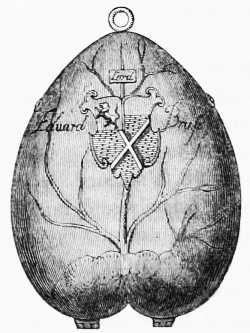
Silver Heart in Culross Abbey-church.
1613.
‘The unfortunate Lord Bruce saw distinctly the figure or impression of a mort-head, on the looking-glass in his chamber, that very morning he set out for the fatal place of rendezvous, where he lost his life in a duel; and asked of some that stood by him if they observed that strange appearance: which they answered in the negative. His remains were interred at Bergen-op-Zoom, over which a monument was erected, with the emblem of a looking-glass impressed with a mort-head, to perpetuate the surprising representation which seemed to indicate his approaching untimely end. I had this narration from a field-officer, whose honour and candour is beyond suspicion, as he had it from General Stuart in the Dutch service. The monument stood entire for a long time, until it was partly defaced when that strong place was reduced by the weakness or treachery of Cronstrom, the governor.’—Theophilus Insulanus’s Treatise on the Second-Sight. 1763.
Sep. 11.
Robert Philip, a priest, returned from Rome in the summer of this year, and performed mass in sundry places in a clandestine manner, but with the proper dresses, utensils, and observances. One James Stewart, living at the Nether Bow Port in Edinburgh, commonly called James of Jerusalem—a noted papist and resetter of seminary priests—was accustomed to have this condemned ceremonial performed in his house, in presence of a small company. Both men were now tried for these offences; and two days after, a third, John Logan, portioner of Restalrig, was also put to an assize, for being one of the audience at Stewart’s house. One cannot, in these days of tolerance, read without a strange sense of uncouthness, the solemn expressions of horror employed in the dittays of the king’s advocate against the offenders, being precisely the same expressions which were used against heinous offences of a more tangible nature. Philip and Stewart were condemned to banishment,350 and Logan, in as far as he expressed penitence and shewed that he had since conformed to the kirk, and even borne office in the session, was let off with a fine of one thousand pounds!
Dec. 1.
1613.
Robert Erskine, brother of the lately deceased Laird of Dun, in Forfarshire, was put upon trial for an offence that recalls the tale of the Babes in the Wood. To open the succession to himself, he formed the resolution to put away his two nephews, John and Alexander Erskine, minors, and for this purpose consulted with his three sisters, Isobel, Annas, and Helen. These women, readily entering into his views, attempted to bribe a servant to engage a witch for the purpose of destroying the two boys; but the man’s virtue was proof to the temptation. Annas and Helen then made a journey across the Cairn-a-mount to a place called the Muir-alehouse, where dwelt a noted witch called Janet Irving. From her they came back, bearing certain deadly herbs fitted for their purpose, and gave these to their brother. He, doubtful of the efficacy of the herbs, went himself to the witch, to get full assurance on that point; and, finding reason to believe that they could destroy the two boys, lost no time in making an infusion of them in ale, which he administered to his victims in the house of their mother at Montrose. The effect was not immediate; but it inflicted the most horrible torments upon the poor youths, one of whom, after dwining for three years, died, uttering, just before death, these affecting words: ‘Wo is me! that ever I had right of succession to ony lands or living, for, gif I had been born some poor cotter’s son, I had not been sae demeaned [treated], nor sic wicked practices had been plotted against me for my lands!’ The other remained without hope of recovery at the time of the trial.
Robert Erskine was found guilty and condemned to be beheaded. His sisters were tried June 22, 1614, for their share of the guilt, and also condemned to death, which two of them suffered. Helen alone, as being less guilty and more penitent than the rest, had her sentence commuted to banishment. The case must have been felt as deeply afflicting by the friends of the Presbyterian cause, as these wretched victims of the mean passion of avarice were the great-grandchildren of the venerated reformer, John Erskine of Dun.—Pit.
1613(?)
One John Stercovius, a Pole, had come into Scotland in the dress of his country, which exciting much vulgar attention, he was hooted at on the streets, and treated altogether so ill, that he was forced to make an abrupt retreat. The poor man, returning full of wounded feelings to his own country, published a Legend of Reproaches against the Scottish nation—‘ane infamous book against all estates of persons in this kingdom.’—P. C. R. It will now be scarcely believed, in Scotland or elsewhere, that King James, hearing of this libel, employed Patrick Gordon, a foreign agent—himself a man of letters—to raise a prosecution against Stercovius in his own country, and had the power to cause the unhappy libeller to be beheaded for his offence! The affair cost six thousand merles, and a convention of burghs was called (December 3, 1613), to consider means of raising this sum by taxation. This mode of raising the money having failed, the king made an effort to obtain aid for the payment of the money from the English resident in the town of Danzig—with what result does not appear. It is a notable circumstance, that while James was on the whole a mild administrator of justice, he was unrelenting towards satirists, and the grossest judicial cruelties of his reign are against men who had been in one way or another contumelious towards himself.
1613. Dec. 10.
One of the king’s large ships-of-war, which had lain in the Roads of Leith for six weeks, and was about to set sail on her return to England, met her destruction ‘about the twelfth hour of the day,’ through the mad humour of an Englishman, who, while the captain and some of his officers were on shore, laid trains of powder throughout the vessel, notwithstanding that his own son was on board, along with about sixty other men. ‘The ship and her whole provision were burnt; only the bottom and some of the munition were safe. Twenty-four of the men were burnt or perished in the sea; the rest were mutilated and lamed, notwithstanding of all the help that could be made. The fire made the ordnance to shoot, so that none durst come near to help.’—Cal.
‘The sixty-three men that escaped were shipped and transported to London.’—Bal.
Dec. 16.
1613.
The Privy Council of Scotland had this day under their consideration a subject which must have sent their minds back to the associations of an earlier and more romantic age. That custom among the people of the Scottish Border, of going into Cheviot to hunt, which had led to the dismal tragedy narrated in the well-known ballad of Chevy Chase, was, it seems, still kept up. What was once the border of either country being now the middle of both in their so far united condition, the king felt the propriety of putting down a custom so apt to lead to bad blood between his English and Scottish subjects; and accordingly, his council now ordered that the inhabitants of Roxburgh and Selkirk shires, of Liddesdale and Annandale, should cease their ancient practice of going into Tynedale, Redesdale, the fells of Cheviot and Kidland, for hunting and the cutting of wood, under pain of confiscation of their worldly goods.—P. C. R.
1614. Jan. 18.
Hugh Weir of Cloburn, a boy of fourteen years, had been taken out of the town of Edinburgh from his mother’s friends, and carried over to Ireland, and there married to the daughter of the Laird of Corehouse. He ‘was, by Sir James Hamilton’s means, apprehended in Ireland, and sent back to Scotland, and presented to the Council. He was imprisoned in the Tolbooth, in a room next the Laird of Blackwood, by whose means the boy was taken away and sent into Ireland.’—Bal.
Mar. 3.
(Tuesday) at ‘half an hour to sax in the morning, ane earthquake had in divers places.’ ‘On Thursday thereafter, ane other earthquake at 12 hours in the night, had baith in land and burgh.’-Chron. Perth.
Aug. 12.
1614.
Theophilus Howard, Lord Walden (afterwards Earl of Suffolk), made a short journey of pleasure in Scotland; and as the details give some idea of the means there were in the country of entertaining a stranger of distinction, they may be worth noting. His lordship was received by the Earl of Home into Dunglass House, in Berwickshire, and ‘used very honourably.’ He dined next day with his brother-in-law, Sir James Home of Cowdenknowes, at Broxmouth House, near Dunbar. Advancing thence towards Edinburgh, he was met by the secretary of state, Sir Thomas Hamilton of Binning, accompanied by a number of gentlemen of the country, all of whom had waited for him the preceding night at Musselburgh Links, but were disappointed of his coming forward. He was by them convoyed to the Canongate, and lodged in John Killoch’s house. Next morning, he proceeded to the Castle, and ‘viewed the site, fortification, and natural strength thereof.’ Having dined, he rode from Edinburgh with the Lord Chancellor to Dunfermline, where he was entertained with all kindness and respect till Monday, the 16th. He then went to Culross, to see Sir George Bruce’s coal-works, which were one of the wonders of the age; ‘where, having received the best entertainment they could make him, my Lord Chancellor took leave of him, and left him to be convoyed by my Lord Erskine to Stirling, where he could not be persuaded to stay above one night. The next day, he saw the park of Stirling, dined in the Castle, and raid that night towards Falkland.’ On the way, Lord Erskine transferred him to the care of Lord Scone, who, assisted by many gentlemen of Fife, took him to his house in Falkland.’ There, doubtless to the great distress of Lord Scone, no entreaties could prevail upon Lord Walden to stay longer than a night, ‘to receive that entertainment which he wald gladly have made langer to him.’ So, ‘after the sight of the park and palace, having dined, his lordship and my Lord of Scone came to Burntisland, where he had ready and speedy passage; but the wind being very loud, he was exceeding sick at sea.’ Landing at Leith, the distinguished company was received for refreshment into the house of a rich and prominent person of that day, Bernard Lindsay, whom we shall see erelong entertaining Ben Jonson in the same place. Here the secretary again took up the stranger, and convoyed him once more to John Killoch’s in the Canongate, ‘whither the bailies of Edinburgh came to him, and invited him to supper the next day, but could not induce him by any entreaty to stay.’ Having dismissed them, he went to see the palace of Holyrood. Next day, the 19th of August, he left Edinburgh, and rode with the secretary to Seton, ‘where he was received by the Countess of Winton and her children, and used with all due respect.’ After taking a sight of the house, which was of princely elegance, with beautiful gardens, Lord Walden proceeded to Broxmouth, and there spent the night.
‘In all his journey through this country,’ says the contemporary writer, ‘great and loving respect has been borne to him by all honest men, whereof he has proven most worthy; for he has esteemed all things to the uttermost of their worth, and in his courteous discretion has favourably excused all oversights and defects.... Every honest man here wishes him happiness in all his other journeys and enterprises, for the honourable, wise, and humane behaviour he has used amang them.’351
1614.
In this year, a small volume was printed and published by Andro Hart of Edinburgh, under the title of Mirifici Logarithmorum Canonis Descriptio, &c., Auctore et Inventore Joanne Napero, Barone Merchistonii, Scoto. This was a remarkable event in the midst of so many traits of barbarism, bigotry, and ignorance; for in Napier’s volume was presented a mode of calculation forming an essential pre-requisite to the solution of all the great problems involving numbers which have since been brought before mankind.
John Napier is believed to have been engaged in the elaboration of his Logarithms for fully twenty years, while at the same time giving some of his time to such inventions as burning-glasses for the destruction of fleets, to theological discussions, and the occult sciences. The tall, antique tower of Merchiston, in which he lived and pursued his studies, still exists at the head of the Burgh-moor of Edinburgh.