REIGN OF JAMES VI.: 1591-1603. (continued 2)
Reading edition
In July of this year, Logan entered into a contract with John Napier of Merchiston, proceeding upon the fact of ‘diverse auld reports, motives, and appearances, that there should be within the said Robert’s dwelling-place of Fast Castle a sowm of money and pose, hid and huirdit up secretly.’ John Napier undertook that he ‘sall do his utter and exact diligence to search and seek out, and be all craft and ingyne that he dow [can], to tempt, try, and find out the same, and, be the grace of God, either sall find out the same, or than mak sure that nae sic thing has been there.’ For this he was to have a third of any money found. He was also to be convoyed back in safety to Edinburgh, unspoiled of his gains.
As Logan was competent to make simple mechanical search for the supposed treasure without the aid of a philosopher, there is much reason to believe that Napier designed to use some pseudo-scientific mode or modes of investigation, such as the divining-rod, or the so-called magic numbers. The affair, therefore, throws a curious light on the state of philosophy even in the minds of the ablest philosophers of that age, the time when Tycho kept an idiot on account of his gift of prophecy, and Kepler perplexed himself with the Harmonices Mundi.
It is not known whether Napier did actually journey to the spray-beaten tower of Fast Castle, and there practise his craft and ingyne. Probably he did, and was disappointed in more ways than one, as, two years after, he is found letting a portion of his property to a gentleman on the strict condition that no part of it shall be sub-let to any one of the name of Logan.200
1594.
‘This year, in the Merse, there was a great business about sorcery and the trial of witches, and many was there burnt, as, namely, one Roughhead, and Cuthbert Hume’s mother of Dunse, the parson of Dunse’s wife, and sundry of Eyemouth and Coldingham; near a dozen moe, and many fugitives, as the old Lady A. Sundry others were delated, and the Ladies of Butt: and Lady B.: the Laird of B.: his sister; one in Liddesdale by virtue of [a] superstitious well, whereat was professed great skill; one Dick’s sister, who had her mother hanged before in Waughton. They confessed the death of the whole goods [live-stock] of the country.’—Pa. And.
Nov.
The disposition to violent and lawless acts at this time is strikingly shewn in the proceedings against Claud and Alexander, two sons of James Hamilton of Livingstone, in Linlithgowshire. Having some ground of offence against David Dundas of Priestinch, they had gone at mid-day with an armed party to his fold, and, there barbarously mutilated and slaughtered a number of his cattle. They and their elder brother, Patrick, also destroyed a mill leased by the same person, and further set fire to his barn-yard at Duddington. Two months afterwards, when John Yellowlees, a messenger, went with two assistants to the Peel of Livingstone, to deliver letters of citation against these young men, the laird, with his wife and four sons, came forth to the gate, and taking him first by the throat, proceeded to beat him unmercifully, and then, with a bended pistol at his breast, and many violent threats, forced him to eat and swallow his four letters, and to promise never to attempt to bring any such documents against them in future; besides which, they struck the two witnesses with swords and pistols, and left them for dead. The family were denounced as rebels.—Pit.
1594-5. Jan. 19.
A great tulyie or street-combat this day took place in Edinburgh.
1594-5.
The Earl of Montrose, head of the house of Graham, was of grave years—towards fifty: he was of such a character as to be chosen, a few years afterwards, as chancellor of the kingdom: still later, he became for a time viceroy of Scotland, the king being then in England. Yet this astute noble was so entirely under the sway of the feelings of the age, as to deem it necessary and proper that he should revenge the death of John Graham (see under February 13, 1592-3) upon its author, under circumstances similar to those which attended that slaughter. On its being known that the earl was coming with his son and retinue to Edinburgh, Sandilands was strongly recommended by some of his friends to withdraw from the town, ‘because the earl was then over great a party against him. His mind was, notwithstanding, sae undantonit, and unmindful of his former misdeed, finding himself not sae weel accompanied as he wald, he sent for friends, and convokit them to Edinburgh, upon plain purpose rather first to invade the said earl than to be invadit by him, and took the opportunity baith of time and place within Edinburgh, and made a furious onset on the earl [at the Salt Tron in the High Street], with guns and swords in great number.201 The earl, with his eldest son, defendit manfully, till at last Sir James was dung [driven down] on his back, shot and hurt in divers parts of his body and head, [and] straitly invadit to have been slain out of hand, gif he had not been fortunately succoured by the prowess of a gentleman callit Captain Lockhart. The lord chancellor and Montrose were together at that time; but neither reverence [n]or respect was had unto him at this conflict, the fury was sae great on either side; sae that the chancellor retirit himself with gladness to the College of Justice. The magistrates of the town, with fencible weapons, separatit the parties for that time; and the greatest skaith Sir James gat on his party, for he himself was left for dead, and a cousin-german of his, callit Crawford of Kerse, was slain, and mony hurt: but Sir James convalescit again, and this recompense he obteinit for his arrogancy. On the earl’s side was but ane slain, and mony hurt.’—H. K. J.
Feb. 18.
Hercules Stewart was hanged at the Cross in Edinburgh, for his concern in the crimes of his brother the Earl of Bothwell. The people lamented his fate, for ‘he was ane simple gentleman, and not ane enterpriser.’—Moy. He ‘was suddenly cut down and carried up to the Tolbooth to be dressed; but within a little space he began to recover and move somewhat, and might by appearance have lived. The ministers, being advertised hereof, went to the king to procure for his life; but they had already given a new command to strangle him with all speed, so that no man durst speak in the contrary.’—Pa. And.
Mar. 10. 1595. May 26.
Commenced ‘ane horrible tempest of snaw, whilk lay upon the ground till the 14[th] of April thereafter.’—Bir.
‘John Gilchrist, Henderson, and Hutton, all three [were] hangit for making of false writs and pressing to verify the same. Jun. 11. Ane callit Cuming the Monk [was] hangit for making of false writs.’—Bir.
July.
July 12.
Two gentlemen of Stirlingshire, one named Bruce, the other Forester, happened to love one woman, about whom they and their respective friends consequently quarrelled. At a meeting held by the parties with a view to composing differences, Bruce was hurt. Then the ‘clannit men’ of the names of Livingstone and Bruce in the Carse of Falkirk banded themselves together for revenge. A bailie of Stirling, named Forester, who had had no concern in the dispute, was soon after about to journey from Edinburgh to Stirling, when the friends of the deceased ‘belaid all the hieways for his return.’ Before he had gone many miles, they set upon him, and with sword and gun slew him. The most remarkable part of the affair was what followed. Forester being a special servant of the Earl of Mar, it was resolved that he should be buried with solemnity in Stirling. The corpse was met at Linlithgow by the earl and a large party of friends, with displayed banner, and in ‘effeir of weir.’ On their journey to Stirling, they passed through the lands of Livingstone and Bruce, exhibiting ‘a picture of the defunct on a fair canvas, painted with the number of the shots and wounds, to appear the more horrible to the behalders, and this way they completed his burial.’202—H. K. J.
Another curious circumstance followed. The parties involved in the homicide had a day of law appointed for them in Edinburgh, December 20th, and they, in customary style, summoned their respective friends to be present. A great attendance was expected; but the Privy Council, knowing there was deadly feid between a great number of them, ‘feirit that, upon the first occasion of their meeting, some great inconvenients sall fall out, to the break of his hieness’ peace, and troubling of the guid and quiet estate of the country[!], beside the hindering of justice,’ forbade the coming of such persons to Edinburgh under pain of ‘deid without favour.’—P. C. R.
Aug. 1.
1595.
Complaint was made to the Town Council of Edinburgh by the corporation of surgeons, against M. Awin, a French surgeon, for practising his art within the liberties of the city. He was ordered to desist, under a penalty, except for certain branches of surgery—namely, cutting for the stone, curing of ruptures, couching of cataracts, curing the pestilence, and diseases of women consequent on childbirth.203
Sep.
Sep. 13.
The violences of the age extended even to school-boys. The ‘scholars and gentlemen’s sons’ of the High School of Edinburgh had at this time occasion to complain of some abridgment of their wonted period of vacation, and when they applied to the Town Council for an extension of what they called their ‘privilege,’ only three days in addition to the restricted number of fourteen were granted. It appears that the master was favourable to their suit, but he was ‘borne down and abused by the Council, who never understood well what privilege belonged to that charge. Some of the chief gentlemen’s sons resolved to make a mutiny, and one day, the master being on necessary business a mile or two off the town, they came in the evening with all necessary provision, and entered the school, manned the same, took in with them some fencible weapons, with powder and bullet, and renforcit the doors, refusing to let [any] man come there, either master or magistrate, untill their privilege were fairly granted.’—Pa. And.
A night passed over. Next morning, ‘some men of the town came to these scholars, desiring them to give over, and to come forth upon composition; affirming that they should intercede to obtein them the license of other eight days’ playing. But the scholars replied that they were mocked of the first eight days’ privilege ... they wald either have the residue of the days granted for their pastime, or else they wald not give over. This answer was consulted upon by the magistrates, and notified to the ministers; and the ministers gave their counsel that they should be letten alone, and some men should be depute to attend about the house to keep them from vivres, sae that they should be compelled to render by extremity of hunger.’—H. K. J.
1595.
A day having passed in this manner, the Council lost patience, and determined to use strong measures. Headed by Bailie John Macmoran, and attended by a posse of officers, they came to the school, which was a long, low building standing on the site of the ancient Blackfriars’ monastery. The bailie at first called on the boys in a peaceable manner to open the doors. They refused, and asked for their master, protesting they would acknowledge him at his return, but no other person. ‘The bailies began to be angry, and called for a great jeist to prize up the back-door. The scholars bade them beware, and wished them to desist and leave off that violence, or else they vowed to God they should put a pair of bullets through the best of their cheeks. The bailies, believing they durst not shoot, continued still to prize the door, boasting with many threatening words. The scholars perceiving nothing but extremity, one Sinclair the chancellor of Caithness’ son, presented a gun from a window, direct opposite to the bailies’ faces, boasting them and calling them buttery carles. Off goeth the charged gun. [The bullet] pierced John Macmoran through his head, and presently killed him, so that he fell backward straight to the ground, without speech at all.’204
‘When the scholars heard of this mischance, they were all moved to clamour, and gave over. Certain of them escaped, and the rest were carried to prison by the magistrates in great fury, and escaped weel unslain at that instant. Upon the morn, the said Sinclair was brought to the bar, and was there accused of that slaughter; but he denied the same constantly. Divers honest friends convenit, and assisted him.’205 The relatives of Macmoran being rich, money-offers were of no avail in the case: life for life was what they sought for. ‘Friends threatened death to all the people of Edinburgh(!) if they did the child any harm, saying they were not wise that meddled with the scholars, especially the gentlemen’s sons. They should have committed that charge to the master, who knew best the truest remedy without any harm at all.’
1595.
Lord Sinclair, as head of the family to which the young culprit belonged, now came forward in his behalf, and, by his intercession, the king wrote to the magistrates, desiring them to delay proceedings. Afterwards, the process was transferred to the Privy Council. Meanwhile, the other youths, seven in number, the chief of whom were a son of Murray of Spainyiedale and a son of Pringle of Whitebank, were kept in confinement upwards of two months, while a debate took place between the magistrates and the friends of the culprits as to a fair assize; it being alleged that one composed of citizens would be partial against the boys. The king commanded that an assize of gentlemen should be chosen, and, in the end, they, as well as Sinclair, got clear off.
The culprit became Sir William Sinclair of Mey. He married Catherine Ross of Balnagowan, whom we have seen unpleasantly mixed up in the charges against Lady Foulis, under July 22, 1590.
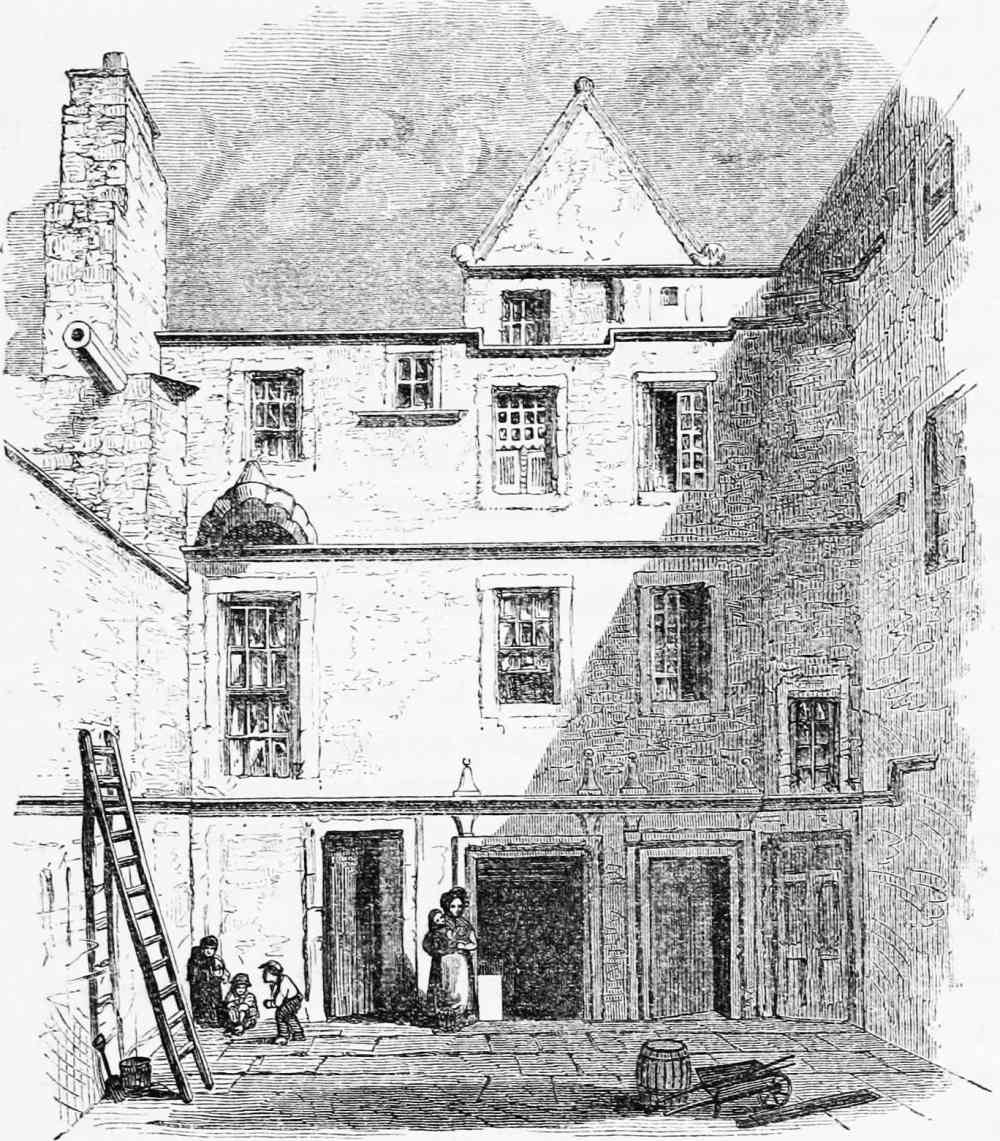
Bailie Macmoran’s House.
1595.
‘Macmoran,’ says Calderwood, ‘was the richest merchant in his time, but not gracious to the common people, because he carried victual to Spain, notwithstanding he was often admonished by the ministers to refrain.’ It would appear that he had been a servant of the Regent Morton, and afterwards was what is called a messenger, or sheriff’s officer.206 We have also seen that, after the fall of Morton, he was reported to have been concerned in secreting the treasures which had been accumulated by his former master.207 His house, still standing in Riddell’s Close in the Lawnmarket, Edinburgh, gives the idea that the style of living of a rich Scottish merchant of that day was far from being mean or despicable.
Sep. 22.
‘Among the constancies of the court this year, one was remarkable, that at Glasgow, in September, the king received the Countess of Bothwell into his favour, the 22d day, at night; and on the 3d of December, again proscribed and exiled her, under the pain of death; yet gave her a letter of protection, under his awn hand, within six days thereafter.’—Bal.
This inconstancy is partly explained away in the Privy Council Record, where it is stated that the countess abused the privilege of the letter granted to her by going about where she pleased and vaunting of her credit with the king, while in reality it was designed only to serve ‘for remaining of herself and her bairns within the place of Mostour, that her friends might sometime have resorted to her without danger to his hieness’s laws.’
Oct.
James Lord Hay of Yester, brother and successor of the turbulent Master of Yester already introduced to the reader, kept state in Neidpath Castle, with his wife, but as yet unblessed with progeny.208 His presumptive heir was his second-cousin, Hay of Smithfield, ancestor of the present Sir Adam Hay of Haystoun. In these circumstances, occasion was given for a curious series of proceedings, involving the fighting of a regular passage of arms on a neighbouring plain beside the Tweed—a simple pastoral scene, where few could now dream that any such incident had ever taken place.
1595.
Lord Yester had for his page one George Hepburn, brother of the parson of Oldhamstocks in East Lothian. His master-of-the-horse—for such officers were then retained in houses of this rank—was John Brown of Hartree. One day, Brown, in conversation with Hepburn, remarked: ‘Your father had good knowledge of physic: I think you should have some also.’ ‘What mean ye by that?’ said Hepburn. ‘You might have great advantage by something,’ answered Brown. On being further questioned, the latter stated that, seeing Lord Yester had no children, and Hay of Smithfield came next in the entail, it was only necessary to give the former a suitable dose in order to make the latter Lord Yester. ‘If you,’ continued Brown, ‘could give him some poison, you should be nobly rewarded, you and yours.’ ‘Methinks that were no good physic,’ quoth Hepburn drily, and soon after revealed the project to his lord. Brown, on being taxed with it, stood stoutly on his denial. Hepburn as strongly insisted that the proposal had been made to him. For such a case, there was no solution but the duellium.
Due authority being obtained, a regular and public combat was arranged to take place on Edston-haugh, near Neidpath. The two combatants were to fight in their doublets, mounted, with spears and swords. Some of the greatest men of the country took part in the affair, and honoured it with their presence. The Laird of Buccleuch appeared as judge for Brown; Hepburn had, on his part, the Laird of Cessford. The Lords Yester and Newbottle were amongst those officiating. When all was ready, the two combatants rode full tilt against each other with their spears, when Brown missed Hepburn, and was thrown from his horse with his adversary’s weapon through his body. Having grazed his thigh in the charge, Hepburn did not immediately follow up his advantage, but suffered Brown to lie unharmed on the ground. ‘Fy!’ cried one of the judges, ‘alight and take amends of thy enemy!’ He then advanced on foot with his sword in his hand to Brown, and commanded him to confess the truth. ‘Stay,’ cried Brown, ‘till I draw the broken spear out of my body.’ This being done, Brown suddenly drew his sword, and struck at Hepburn, who for some time was content to ward off his strokes, but at last dealt him a backward wipe across the face, when the wretched man, blinded with blood, fell to the ground. The judges then interfered to prevent him from being further punished by Hepburn; but he resolutely refused to make any confession.209
1595.
About this time and for some time onward, Scotland underwent the pangs of a dearth of extraordinary severity, in consequence of the destruction of the crops by heavy rains in autumn. Birrel speaks of it as a famine, ‘the like whereof was never heard tell of in any age before, nor ever read of since the world was made.’ ‘In this month of October and November,’ he adds, ‘the wheat and malt at £10 the boll; in March thereafter [1596], the ait meal £10 the boll, the humble corn £7 the boll. In the month of May, the ait meal £20 the boll in Galloway. At this time there came victual out of other parts in sic abundance, that, betwixt the 1st of July and the 10th of August, there came into Leith three score and six ships laden with victual; nevertheless, the rye gave £10, 10s. and £11 the boll. The 2 of September, the rye came down and was sold for £7 the boll, and new ait meal for 7s. and 7s. 6d. the peck The 29 of October, the ait meal came up again at 10s. the peck. The 15 of July, the ait meal at 13s. 4d. the peck; the pease meal at 11s. the peck.
‘In this year, Clement Orr and Robert Lumsden, his grandson, bought before hand from the Earl Marischal, the bear meal overhead for 33s. 4d. the boll.’ ‘The ministers pronounced the curse of God against them, as grinders of the faces of the poor; which curse too manifestly lighted on them before their deaths.’—Bal.
As usual, the buying up and withholding of grain with the prospect of increased prices, was viewed with indignation by all classes of people. The king issued a proclamation in December 1595, attributing much of the misery of his people to ‘the avaritious greediness of a great number of persons that has bought and buys victual afore it come off the grund, and that forestalls and keeps the same to a dearth,’ and to ‘the shameless and indiscreet behaviour of the owners of the same victual, wha refuses to thresh out and bring the same to open markets.’ He threatened to put the laws in force against these guilty persons, and have the grain escheat to his majesty’s use.
Dec. 23.
1595.
The king professed to be at this time scandalised at the state of the commonweal, ‘altogether disorderit and shaken louss by reason of the deidly feids and controversies standing amangs his subjects of all degrees.’ Seeing how murder had consequently become a daily occurrence, he resolved upon a new and vigorous effort to bring the hostile parties to a reconciliation ‘by his awn pains and travel to that effect,’ so that the country might be the better fitted to resist the common enemy, now threatening invasion. The Privy Council, therefore, ordained letters to be sent charging the various parties to make their appearance before the king on certain days, wherever he might be for the time, each accompanied by a certain number of friends who might assist with their advice, but the whole party in each case ‘to keep their lodgings after their coming, while [till] they be specially sent for by his majesty.’
The groups of persons summoned were, Robert Master of Eglintoun, and Patrick Houston of that Ilk; James Earl of Glencairn, and Cunningham of Glengarnock; John Earl of Montrose, and French of Thorniedykes; Hugh Campbell of Loudon, sheriff of Ayr, Sandielands of Calder, Sir James Sandielands of Slamannan, Crawford of Kerse, and Spottiswoode of that Ilk; David Earl of Crawford and Guthrie of that Ilk; Sir Thomas Lyon of Auldbar, knight, and Garden of that Ilk; Alexander Lord Livingston, Sir Alexander Bruce, elder, of Airth, and Archibald Colquhoun of Luss; John Earl of Mar, Alexander Forester of Garden, and Andro M‘Farlane of Arrochar; James Lord Borthwick, Preston of Craigmiller, Mr George Lauder of Bass, and Charles Lauder son of umwhile Andro Lauder in Wyndpark; Sir John Edmonston of that Ilk, Maister William Cranston, younger, of that Ilk; George Earl Marischal and Seyton of Meldrum; James Cheyne of Straloch and William King of Barrach; James Tweedie of Drumelzier and Charles Geddes of Rachan. The nobles in every instance were allowed to have sixty, and the commoners twenty-four persons to accompany them to the place of agreement, and all, while attending, to have protection from any process of horning or excommunication which might have been previously passed upon them. Fire and sword was threatened against all neglecting to comply with the summons.
Earnest as the king seems now to have been, and influential as a royal tongue proverbially is, we know for certain that several of the parties now summoned continued afterwards at enmity.
1595-6. Mar. 15. 1595-6.
‘The king made ane orison before the General Assembly, with many guid promises and conditions. I pray God he may keep them, be content to receive admonitions [from the clergy], and be collected himself and his haill household, and to lay aside his authority royal and be as ane brother to them, and to see all the kirks in this country weel planted with ministers. There are in Scotland 900 kirks, of the whilk there are 400 without ministers or readers.’—Bir.
The admonitions which it was so desirable that the king should receive, were embodied in a paper called Offences in the King’s House, under the following heads: ‘1. The reading of the Word, and thanksgiving before and after meat, oft omitted. 2. Week-sermons oft neglected, and he would be admonished not to talk with any in time of divine service. 3. To recommend to him private meditation with God in spirit and in his awn conscience. 4. Banning and swearing is too common in the king’s house and court, occasioned by his example. 5. He would have good company about him: Robertland, papists, murderers, profane persons, would be removed from him. 6. The queen’s ministry would be reformed. She herself neglects Word and sacrament, is to be admonished for night-waking, balling, &c., also touching her company—and so of her gentlewomen.’—Row.
On the other hand, the king demanded of this assembly sundry concessions as to his power over the kirk, and that ministers should not be allowed to meddle with civil affairs or ‘to name any man in the pulpit, or so vively to describe him as it shall be equivalent to the very naming of him, except upon the notoriety of a public crime.’
1595-6.
On this occasion the clergy denounced the common corruption of all estates within this realm; namely, ‘an universal coldness, want of zeal, ignorance, contempt of the Word, ministry, and sacraments, and where knowledge is, yet no sense nor feeling, evidenced by the want of family exercises, prayer, and the Word, and singing of psalms; and if they be, they are profaned and abused, by calling on the cook, steward, or jackman to perform that religious duty ... superstition and idolatry entertained, evidenced in keeping of festival-days, fires, pilgrimages, singing of carols at Yule, &c. ... swearing, banning, and cursing: profanation of the Sabbath, especially by working in seed-time and harvest, journeying, trysting, gaming, dancing, drinking, fishing, killing, and milling: inferiors not doing duty to superiors, children having pleas of law against their parents, marrying without their consent; superiors not doing duty to inferiors, as not training up their children at schools in virtue and godliness; great and frequent breaches of duty between married persons: great bloodshed, deadly feuds arising thence, and assisting of bloodshedders for eluding of the laws: fornications, adulteries, incests, unlawful marriages and divorcements, allowed by laws and judges ... excessive drinking and waughting, gluttony (no doubt the cause of this dearth and famine), gorgeous and vain apparel, filthy speeches and songs: cruel oppressions of poor tenants ... idle persons having no lawful callings—as pipers, fiddlers, songsters, sorners, pleasants, strong and sturdy beggars living in harlotry.... Lying, finally, is a rife and common sin.’
1596. Apr. 12.
Sir Walter Scott of Branxholm, Laird of Buccleuch, performed an exploit which has been celebrated both in prose and rhyme.
About the end of January, a ‘day of truce’ was held at a spot called Dayholm of Kershope in Liddesdale, by the deputies of the English warden, Lord Scrope, and the Laird of Buccleuch, keeper of Liddesdale. The Scotch deputy, Scott of Goldielands, had but a small party—not above twenty—among whom, however, was a noted border reiver, William Armstrong of Kinmont, commonly known as Kinmont Willie. The English deputy was attended by several hundred followers. It happened that, before the end of the meeting, a report came to the English deputy of some outrages at that moment in the course of being committed by Scottish borderers within the English line. He entered a complaint on the subject, and received assurance that the guilty parties should be as soon as possible rendered up to the vengeance of Lord Scrope.
The day of truce ended peaceably; but, as the English party was retiring along their side of the Liddel, they caught sight of the Scottish reivers, and gave chase. Kinmont Willie was now riding quietly along the Scottish side of the Liddel. Mistaking him for one of the guilty troop, the English pursued him for three or four miles, and taking him prisoner, bore him off to Carlisle Castle.
Probably the Liddesdale thief had incurred more guilt in England than ten lives would have expiated. Yet what was this to Buccleuch? To him the case was simply that of a retainer betrayed while on his master’s business and assurance. If the affair had a public or national aspect, it was that of a Scottishman mistreated, to the dishonour of his sovereign and country. Having in vain used remonstrances with Lord Scrope, both by himself and through the king’s representations to the English ambassador, he resolved at last, as himself has expressed it, ‘to attempt the simple recovery of the prisoner in sae moderate ane fashion as was possible to him.’
1596.
Buccleuch’s moderate proceeding consisted in the assembling of two hundred armed and mounted retainers at the tower of Morton, an hour before sunset of the 12th of April. He had arranged that no head of any house should be of the number, but all younger brothers, that the consequences might be the less likely to damage his following; but, nevertheless, three lairds had insisted on taking part in the enterprise. Passing silently across the border, they came to Carlisle about the middle of the night. A select party of eighty then made an attempt to scale the walls of the castle; but their ladders proving too short, it was found necessary to break in by force through a postern on the west side. Two dozen men having got in, six were left to guard the passage, while the remaining eighteen passed on to Willie’s chamber, broke it up, and released the prisoner. All this was done without encountering any resistance except from a few watchmen, who were easily ‘dung on their backs.’210 As a signal of their success, the party within the castle sounded their trumpet ‘mightily.’ Hearing this, Buccleuch raised a loud clamour amongst his horsemen on the green. At the same time, the bell of the castle began to sound, a beacon-fire was kindled on the top of the house, the great bell of the cathedral was rung in correspondence, the watch-bell of the Moot-hall joined the throng of sounds, and, to crown all, the drum began to rattle through the streets of the city. ‘The people were perturbit from their nocturnal sleep, then undigestit at that untimeous hour, with some cloudy weather and saft rain, whilk are noisome to the delicate persons of England, whaise bodies are given to quietness, rest, and delicate feeding, and consequently desirous of more sleep and repose in bed.’ Amidst the uproar, ‘the assaulters brought forth their countryman, and convoyit him to the court, where the Lord Scrope’s chalmer has a prospect unto, to whom he cried with a loud voice a familiar guid-nicht! and another guid-nicht to his constable Mr Saughell.’ The twenty-four men returned with Kinmont Willie to the main body, and the whole party retired without molestation, and re-entered Scotland with the morning light. ‘The like of sic ane vassalage,’ says the diarist Birrel, with unwonted enthusiasm, ‘was never done since the memory of man, no, not in Wallace’ days!’ Buccleuch himself, with true heroism, treated the matter calmly and even reasoningly. The simple recovery of the prisoner, he said, ‘maun necessarily be esteimit lawful, gif the taking and deteining of him be unlawful, as without all question it was.’
1596.
The matter was brought before the king in council (May 25) by the English ambassador, who pleaded that Sir Walter Scott should be given up to the queen for punishment. It was on this occasion that the border knight defended himself in the terms above quoted. Of course his own countrymen sympathised with him in a deed so gallant, and performed from such a motive, and the king could not readily act in a contrary strain. Elizabeth never obtained any satisfaction for the taking of Kinmont Willie.—Spot. Moy. H. K. J. C. K. S. P. C. R. Bir.211
1596 (?) Apr.
‘... there came an Englishman to Edinburgh, with a chestain-coloured naig, which he called Marroco ... he made him to do many rare and uncouth tricks, such as never horse was observed to do the like before in this land. This man would borrow from twenty or thirty of the spectators a piece of gold or silver, put all in a purse, and shuffle them together; thereafter he would bid the horse give every gentleman his own piece of money again. He would cause him tell by so many pats with his foot how many shillings the piece of money was worth. He would cause him lie down as dead. He would say to him: “I will sell you to a carter:” then he would seem to die. Then he would say: “Marroco, a gentleman hath borrowed you, and you must ride with a lady of court.” Then would he most daintily hackney, amble, and ride a pace, and trot, and play the jade at his command when his master pleased. He would make him take a great draught of water as oft as he liked to command him. By a sign given him, he would beck for the King of Scots and for Queen Elizabeth, and when ye spoke of the King of Spain, would both bite and strike at you—and many other wonderful things. I was a spectator myself in those days. But the report went afterwards that he devoured his master, because he was thought to be a spirit and nought else.’—Pa. And.
This was ‘the dancing horse’ to which Moth alludes in Shakspeare (Love’s Labour Lost, act I., sc. 2). The actual fate of Banks, the keeper of the animal, was not better than that which vulgar rumour assigned to him. It is almost an incredible, yet apparently well-authenticated fact, that horse and man, after wandering through various countries, were burnt together as magicians at Rome.
1596. May.
At this time, while the country was suffering from famine, there was a renewing of the Covenant with fasting and humiliation in St Andrews presbytery. ‘After this exercise,’ says James Melville, one of those chiefly concerned in ordering it, ‘we wanted not a remarkable effect.’ ‘God extraordinarily provided victuals out of all other countries, in sic store and abundance as was never seen in this land before;’ without which ‘thousands had died for hunger,’ ‘for,’ he goes on to say, ‘notwithstanding of the infinite number of bolls of victual that cam hame from other parts, all the harvest quarter of that year, the meal gave aucht, nine, and ten pounds the boll, and the malt eleven and twal, and in the south and west parts many died.’
June 7. 1596.
Napier, still brooding over the dangers from popery, devised at this time certain inventions which he thought would be useful for defending the country in case of invasion. One was a mirror like that of Archimedes, which should collect the beams of the sun, and reflect them concentratedly in one ‘mathematical point,’ for the purpose of burning the enemy’s ships. Another was a similar mirror to reflect artificial fire. A third was a kind of shot for artillery, not to pass lineally through an enemy’s host, destroying only those that stand in its way, but which should ‘range abroad within the whole appointed place, and not departing furth of the place till it had executed his [its] whole strength, by destroying those that be within the bounds of the said place.’ A fourth, the last, was a closed and fortified carriage to bring harquebussiers into the midst of an enemy—a superfluity, one would think, if there was any hopefulness in the third of the series. ‘These inventions, besides devices of sailing under the water, with divers other stratagems for harming of the enemies, by the grace of God and work of expert craftsmen, I hope to perform.’212 So wrote Napier at the date noted in the margin. Sir Thomas Urquhart describes the third of the devices as calculated to clear a field of four miles’ circumference of all living things above a foot in height: by it, he said, the inventor could destroy 30,000 Turks, without the hazard of a single Christian. He adds that proof of its powers was given on a large plain in Scotland, to the destruction of a great many cattle and sheep—a particular that may be doubted. ‘When he was desired by a friend in his last illness to reveal the contrivance, his answer was that, for the ruin and overthrow of man, there were too many devices already framed, which if he could make to be fewer, he would, with his might, endeavour to do; and that therefore, seeing the malice and rancour rooted in the heart of mankind will not suffer them to diminish, the number of them, by any concert of his, should never be increased.’213
June 24.
John, Master of Orkney, was tried for the alleged crime of attempting to destroy the life of his brother the Earl of Orkney, first by witchcraft, and secondly by more direct means. The case broke down, and would not be worthy of attention in this place, but for the nature of the means taken to inculpate the accused. It appeared that the alleged witchcraft stood upon the evidence of a confession wrung from a woman called Alison Balfour, residing at Ireland, a village in Orkney, who had been executed for that imaginary crime in December 1594. The counsel for the Master shewed that, when this poor woman made her ‘pretended confession,’ as it might well be called, she had been kept forty-eight hours in the cashielaws—an instrument of torture supposed to have consisted of an iron case for the leg, to which fire was gradually applied, till it became insupportably painful. At the same time, her husband, a man of ninety-one years of age, her eldest son and daughter, were kept likewise under torture, ‘the father being in the lang irons of fifty stane wecht,’ the son fixed in the boots with fifty-seven strokes, and the daughter in the pilniewinks, that they, ‘being sae tormented beside her, might move her to make any confession for their relief.’ A like confession had been extorted from Thomas Palpla, to the effect that he had conspired with the Master to poison his brother, ‘he being kept in the cashielaws eleven days and eleven nights, twice in the day by the space of fourteen days callit [driven] in the boots, he being naked in the meantime, and scourgit with tows [ropes] in sic sort that they left neither flesh nor hide upon him; in the extremity of whilk torture the said pretended confession had been drawn out of him.’ Both of these witnesses had revoked their confessions, Alison Balfour doing so solemnly on the Heading Hill of Kirkwall, when about to submit to death for her own alleged crime, of which she at the same time protested herself to be innocent. These are among the most painful examples we anywhere find of the barbarous legal procedure of our ancestors.—Pit.
Aug. 3. 1596.
One John Dickson, an Englishman, was tried for uttering slanderous speeches against the king, calling him ‘ane bastard king,’ and saying ‘he was not worthy to be obeyed.’ This it appeared he had done in a drunken anger, when asked to veer his boat out of the way of the king’s ordnance. He was adjudged to be hanged.—Pit. It is curious on this and some other occasions to find that, while the king got so little practical obedience, and the laws in general were so feebly enforced, such a severe penalty was inflicted on acts of mere disrespect towards majesty.
Aug. 17.
The court was at this time unable to keep silence under the pelt of pasquils which it had brought upon itself. We have now a furious edict of Privy Council against the writers and promulgators of ‘infamous libels, buiks, ballats, pasquils, and cantels in prose and rhyme,’ which have lately been set out, and especially against ‘ane maist treasonable letter in form of a cockalane,214 craftily divulgat by certain malicious, seditious, and unquiet spirits, uttering mony shameful and contumelious speeches, full of hatrent and dispite, not only against God, his servants and ministers, but maist unnaturally to the prejudice of the honour, guid fame, and reputation of the king and queen’s majesties, not sparing the prince their dearest son, besides their nobility, council, and guid subjects.’ The only active redress, however, was to proclaim a reward for the discovery of the offenders.—P. C. R.
Nov. 3.
Since November 1585, when he was driven from the king’s councils, James Stewart of Newton (sometime Earl of Arran) had lived in obscurity in the north.215 Now that the Chancellor Maitland was dead, he formed a hope that possibly some use might be found for him at court; he therefore came to Edinburgh privately, and had an interview with the king at Holyroodhouse. He received some encouragement; but as nothing could be done for him immediately, and there were many enemies to reconcile, he bethought him of going to live for a while amongst his friends in Ayrshire, trusting erelong to be sent for.
1596.
The ex-favourite was travelling by Symington, in the upper ward of Lanarkshire, when some one who knew him gave him warning that he was come into a dangerous neighbourhood, for not far from the way he was about to pass dwelt a leading man of that house of Douglas which he had mortally offended by his prosecution of the Regent Morton. This was Sir James Douglas of Parkhead, whose father was a natural brother of the regent: he was now the husband of the heiress of the house of Carlyle of Torthorald, and a man of consideration. Stewart replied disdainfully that he was travelling where he had a right to be, and he would not go out of his way for Parkhead nor any other of the house of Douglas. A mean person who overheard this speech made off and reported it to Douglas, who, on hearing it, rose from table, where he had been dining, and vowed he would have the life of Stewart at all hazards. He immediately mounted, and with three servants rode after his enemy through a valley called the Catslack. When Stewart saw himself pursued, he asked the name of the place, and being told, desired his people to come on with all possible speed, for he had got a response from some soothsayer to beware of that spot. Parkhead speedily overtook him, struck him from his horse, and then mercilessly killed him. Cutting off the head, he caused it to be carried by a servant on the point of a spear, thus verifying another weird saying regarding Stewart, that he should have the highest head in Scotland. His body was left on the spot, to become the prey of dogs and swine.216
Thus perished an ex-chancellor of Scotland, one who had been permitted for a time to treat the world as if it had only been made for his own aggrandisement, who had governed a king, struck down a regent, and made the greatest of the old nobility of the country tremble. Violence, insolence, and cruelty had been the ruling principles of his life, and, as Spottiswoode says, ‘he was paid home in the end.’ No decided effort was made to execute justice upon his slayer;217 but it will be afterwards found that the Ochiltree Stewarts did not forget his death. (See under July 1608.)
Dec. 17. 1596.
An edict of the king against what he called unlawful convocations of the clergy, had raised a general uneasiness and excitement, many believing that all independent action of the clergy was struck at. The prosecution of a minister named David Black, who had slandered the king and queen in the pulpit, and refused to submit to a secular tribunal, added to the turmoil. James had further raised a great distrust regarding his fidelity to the Protestant religion by his allowing the exiled papist lords to return to their own country. It was at this crisis that the tumult long known in French fashion as the Seventeenth of December took place.
‘... being Friday, his majesty being in the Tolbooth sitting in session, and ane convention of ministers being in the New Kirk [a contiguous section of St Giles’s Church], and some noblemen being convenit with them, as in special Blantyre and Lindsay, there came in some devilish officious person, and said that the ministers were coming to take his life. Upon the whilk, the Tolbooth doors were steekit, and there arase sic ane crying, “God and the king!” other some crying, “God and the kirk!” that the haill commons of Edinburgh raise in arms, and knew not wherefore always. There was ane honest man, wha was deacon of deacons; his name was John Watt, smith. This John Watt raisit the haill crafts in arms, and came to the Tolbooth, where the entry is to the Chequer-house, and there cried for a sight of his majesty, or else he sould ding up the yett with fore-hammers, sae that never ane within the Tolbooth sould come out with their life. At length his majesty lookit ower the window, and spake to the commons, wha offerit to die and live with him. Sae his majesty came down after the townsmen were commandit off the gait, and was convoyit by the craftsmen to the abbey of Holyroodhouse.’—Bir.
1596.
The king either was really exasperated or pretended to be so. Retiring to Linlithgow next day, he sent orders to Edinburgh, discharging the courts of justice from sitting there, commanding one minister to be imprisoned and others to be put to the horn, and citing the magistrates to come and answer for the seditious conduct of their people. Great was the consternation thus produced, insomuch that one Sunday passed without public worship—‘the like of which had not been seen before.’ On the last day of the year, James returned, to all appearance charged with the most alarming intentions against the city. A proclamation was issued, commanding certain lords and Border chiefs of noted loyalty to occupy certain ports and streets. There consequently arose a rumour ‘that the king’s majesty should send in Will Kinmont, the common thief, as should spulyie the town of Edinburgh. Upon the whilk, the haill merchants took their haill geir out of their booths and shops, and transportit the same to the strongest house that was in the town, and remainit in the said house with themselves, their servants, and looking for nothing but that they should have all been spulyit. Siclike, the haill craftsmen and commons convenit themselves, their best goods, as it were ten or twelve households in ane, whilk was the strongest house, and might be best keepit from spulying and burning, with hagbut, pistolet, and other sic armour, as might best defend themselves. Judge, gentle reader, gif this be playing! Thir noblemen and gentlemen, keepers of the ports and Hie Gait, being set at the places foresaid, with pike and spear, and other armour, stood keeping the foresaid places appointit, till his majesty came to St Giles’s Kirk, Mr David Lindsay making the sermon. His majesty made ane oration or harangue, concerning the sedition of the seditious ministers, as it pleased him to term them.’—Bir.
The affair ended three months after, in a way that supports the opinion of the Laird of Dumbiedykes, that ‘it’s sad work, but siller will help it.’ March 22d, ‘the town of Edinburgh was relaxed frae the horn, and received into the king’s favour again, and the session ordained to sit down in Edinburgh the 25th of May thereafter.’ Next day, ‘the king drank in the council-house with the bailies, council, and deacons. The said bailies and council convoyit his majesty to the West Port thereafter. In the meantime of this drinking in the council-house, the bells rang for joy of their agreement; the trumpets sounded, the drums and whistles played, with [as] many other instruments of music as might be played on; and the town of Edinburgh, for the tumult-raising the 17 of December before, was ordained to pay to his majesty thretty thousand merks Scottish.’—Bir.
1596-7.
John Mure, of Auchindrain, in Ayrshire, was a gentleman of good means and connections, who acted at one time in a judicial capacity as bailie of Carrick, and gave general satisfaction by his judgments. He was son-in-law to the Laird of Bargeny, one of the three chief men of the all-powerful Ayrshire family of Kennedy. Sir Thomas Kennedy of Colzean, another of these great men, was on bad terms with Bargeny. Mure, who might naturally be expected to take his father-in-law’s side, was for a time restrained by some practical benefits, in the shape of lands, offered to him by Sir Thomas; but the titles to the lands not being ultimately made good, the Laird of Auchindrain conceived only the more furious hatred against the knight of Colzean. This happened about 1595, and it appears at the same time that Sir Thomas had excited a deadly rage in the bosom of the Earl of Cassillis’s next brother, usually called the Master of Cassillis. The Master and Auchindrain, with another called the Laird of Dunduff, easily came to an understanding with each other, and agreed to slay Sir Thomas Kennedy the first opportunity. Such was the manner of conducting a quarrel about land-rights and despiteful words amongst gentlemen in Ayrshire in those days.
Jan. 1.
On the evening of the 1st of January, Sir Thomas Kennedy supped with Sir Thomas Nisbet in the house of the latter at Maybole. The Lairds of Auchindrain and Dunduff, with a few servants, lay in wait for him in the yard, and when he came forth to go to his own house to bed, they fired their pistols at him. ‘He being safe of any hurt therewith, and perceiving them with their swords most cruelly to pursue his life, ... was forced for his safety to fly; in which chase they did approach him so near, as he had undoubtedly been overta’en and killed, if he had not adventured to run aside and cover himself with the ruins of ane decayed house; whilk, in respect of the darkness of the night, they did not perceive; but still followed to his lodging, and searched all the corners thereof, till the confluence of the people ... forced them to retire.’218
For this assault, Sir Thomas Kennedy pursued at law the Lairds of Auchindrain and Dunduff, and was so far successful that Dunduff had to retire into England, while ‘Colzean gat the house of Auchindrain, and destroyit the ... plenishing, and wrackit all the garden. And also they made mony sets [snares] to have gotten [Auchindrain] himself; but God preservit him from their tyranny.’219 Auchindrain, however, was forced ‘to cover malice by show of repentance, and for satisfaction of his bypast offence, and gage of his future duty, to offer his eldest son in marriage to Sir Thomas Kennedy’s dochter; whilk, by intercession of friends, [was] accepted.’220
We shall hear more of this feud hereafter (see under December 11, 1601).
Feb. 17. 1596-7.
Under a commission from the king, the provost and bailies of Aberdeen commenced a series of witch-trials of a remarkable kind. The first delinquent, Janet Wishart, spouse of John Lees, stabler—a woman considerably advanced in life—was accused of a great number of maléfices perpetrated, during upwards of thirty years, against neighbours, chiefly under a spirit of petty revenge. In the greater number of cases, the victim was described as being seized with an ailment under which he passed through the extremes of heat and cold, and was afflicted with an insatiable drouth. In several cases the illness had a fatal conclusion. For instance, James Low, stabler, having refused Janet the loan of his kiln and barn, took a dwining illness in consequence, ‘melting away like ane burning candle,’ till he died. John, in his last moments, declared his belief that, if he had lent Janet his kiln and barn, he would still have been a living man. ‘By the whilk witchcraft casten upon him, and upon his house, his wife died, his only son [fell] in the same kind of sickness, and his haill geir, surmounting three thousand pounds, are altogether wrackit and away.’ It was considered sufficient proof on this point, that sundry persons testified to having heard James lay on Janet the blame of his misfortunes. Another person had been ruined in his means, in consequence of his wife obeying a direction of Janet for the insurance of constant prosperity—namely, taking nine pickles of wheat and a piece of rowan-tree, and putting them in the four nooks of the house. Janet had also caused a dozen fowls belonging to a neighbour to fall from a roost dead at her feet. She raised wind for winnowing some malt in her own house, at a moment of perfect calm, by putting a piece of live coal at each of two doors. She caused a neighbour’s cow to give something like venom instead of milk. A Mart ox which she wished to buy, became furious; wherefore she got it at her own price, and on her laying her hands on it, the animal became quiet. There is also a terrible recital of her causing a neighbour to accompany her to the gallows in the Links, where she cut pieces from the various members of a dead culprit, to be used for effecting some of her devilish purposes. This story was only reported by one who had received it from the woman herself, now deceased; but it passed as equally good evidence with the rest. It was alleged that, twenty-two years ago, she had been found sitting in a field of green corn before sun-ris, when, being asked what she was doing, she said: ‘I have been peeling the blades of the corn: I find it will be ane dear year; the blade of the corn grows withershins [contrary to the course of the sun]: when it grows sungates about [in the direction of the sun’s course], it will be ane cheap year.’ One of the last points in the dittay was that, for eight days before her apprehension, ‘continually there was sic ane fearful rumbling in thy house, that William Murray, cordiner, believit the house he was into, next to thy house, should have fallen and smoorit him and his haill bairns.’ This poor woman appears to have been taken to the stake immediately after her trial.
Her son, Thomas Lees, was accused of having aided her in her evil deeds, and being ‘ane common witch and sorcerer,’ and his trial (February 23) brings out some curious points. He was accused of having been one of a large company of witches and sorcerers who had gone to the Market and Fish Crosses of Aberdeen at midnight of the previous Halloween (All Saints’ Eve), ‘under the guiding and conduct of the devil ... playing before you on his kind of instruments.’ The company were all transformed, some as hares, some as cats, some in other likenesses, and all danced about the two crosses and the meal-market a long space of time, Thomas being the leader of the ring. One Catherine Mitchell being somewhat laggard, he beat her to make her go faster; a fact to which Catherine herself now bore witness. A woman with whom Thomas had been too intimate also testified to his having offered to take her to Murrayland and marry her, telling her that by the way, at the foot of a particular mountain, he could raise a spirit able to provide them with all necessaries. This poor fellow was also condemned to the flames. The husband and daughters of Janet Wishart—the latter of whom are taxed as well known to be ‘quick gangand devils’—narrowly escaped with banishment from the city.
1597.
Helen Fraser, who was tried in April, was accused of many witchcrafts of common kinds, and of some less common. For instance, she had translated a sickness from a man’s horse to his cow, and, worse than that, the affection of Andrew Tullideff from his wife to a woman called Margaret Neilson, ‘and sae michtily bewitchit him, that he could never be reconceillit with his wife, or remove his affection frae the said harlot.’ Another man, Robert Merchant by name, who had been married happily to Christian White for two years, being taken to sow corn for a widow named Isobel Bruce, at the Murihill of Foveran, where Helen Fraser was then living, ‘fand his affection violently and extraordinarily drawn away from the said Christian to the said Isobel, ane great luve being betwixt him and the said Christian always theretofore, and nae break of luve or discord falling out or intervening upon either of their parts: whilk thing the country supposit to be brought about by the unlawful travelling of the said Helen’—and was further testified by Robert himself. Helen was likewise convicted, and of course burnt.
1597.
Isobel Cockie took from cows the power of giving healthful milk, making them give a poisonous stuff instead. She also prevented good milk from ‘yirning.’ Horses had fallen dead under her touch.
Men against whom she had pronounced evil words took deadly sicknesses in consequence, or suffered a decay in their worldly means. Her house being ruinous, the proprietor, Alexander Anderson, had come in her absence, and was proceeding to mend the roof, when she came home, and finding he had uncovered her pantry, where her valuables lay, she said: ‘I shall gar thee forthink it, that thou hast tirrit my house, I being frae hame,’ and glowrit up at him. Immediately Alexander’s speech went from him, and he retired to bed sick, and could get no rest or sleep. Under the threats of his son, she was induced to come and charm this sickness away from him, and ‘gave him droggis, that his speech came to him again.’221 By the confession of the recently burnt Thomas Lees, Isobel Cockie had been second to himself in the infernal dance at the Fish Cross, ‘and because the devil playit not so melodiously and weel as thou cravit, thou took his instrument out of his mouth, then took him on the chafts therewith, and playit thyself thereon to the haill company.’ Isobel was likewise condemned.
1597.
It would be tedious to enter into the long series of trials which extended over this year in and near Aberdeen; but a few particulars are worth giving. The case of Andrew Man, an aged person, formerly of Tarbrugh, in the parish of Rathven, involves a more imaginative style of warlockry than is common. According to his own confessions—that is to say, the hallucinations which he described—the devil came sixty years ago to his mother’s house, in the form of a woman, called the Queen of Elfen, and was delivered of a bairn; at which time, he being a boy, bringing in water, was promised by this distinguished stranger ‘that thou should know all things; and should help and cure all sorts of sickness, except stand-deid, and that thou should be weel enterteinit, but wald seek thy meat ere thou de’ed, as Thomas Rhymer did.’ Thirty-two years before, he had begun a guilty intercourse with this Queen of Elfen, at whose first coming, ‘she caused ane of thy cattle die upon ane hillock called the Elf-hillock, but promised to do him good thereafter.’ Andrew, according to his own account, could ‘cure the falling-sickness, the bairn-bed, and all other sorts of sickness that ever fell to man or beast, except the stand-deid, by baptising them, reabling them in the auld corunschbald, and striking of the gudis on the face, with ane fowl in thy hand, and by saying thir words: “Gif thou will live, live; and gif thou will die, die!” with sundry other orisons, sic as of Sanct John and the three silly brethren, whilk thou can say when thou please, and by giving of black wool and salt as a remeid for all diseases and for causing a man prosper and that his blude should never be drawn.’ He had cured several persons by his enchantments, one mode being to put the patient nine times through a hasp of unwatered yarn, and then a cat as many times backward through the same hasp, the effect of which was to translate the sickness from the patient to the cat.
The devil, whom Andrew called Christsonday, and believed to be an angel, was raised by the word Benedicite, and laid again by taking a dog under his armpit, casting the same in the devil’s mouth, and speaking the word Maikpeblis. ‘The Queen of Elfen has a grip of all the craft, but Christsonday is the guidman, and has all power under God, and thou kens sundry deid men in their company, and the king that died at Flodden and Thomas Rhymer is there.’
‘Upon Rood-day in harvest, in this present year, whilk fell on a Wednesday, thou saw Christsonday come out of the snaw in likeness of a staig [young male horse], and the Queen of Elfen was there, and others with her, riding upon white hackneys.’ ‘The elves have shapes and claithes like men, and will have fair covered tables, and they are but shadows, but are starker [stronger] nor men, and they have playing and dancing when they please; the queen is very pleasand, and will be auld and young when she pleases; she makes any king whom she pleases.... The elves will make thee appear to be in a fair chalmer, and yet thou will find thyself in a moss on the morn. They will appear to have candles, and licht, and swords, whilk will be nothing else but dead grass and straes.’ Andrew denied his guilt, but was nevertheless convicted, and doubtless burnt.
In the dittay against Marjory Mutch, it was alleged that, having an ill-will against William Smith in Tarserhill, she came to his plough and bewitched the oxen, so that ‘they instantly ran all wood [mad], brak the pleuch, twa thereof ran over the hills to Deer, and other twa thereof up Ithan side, whilk could never be tane nor apprehendit again.’ This woman was said to have destroyed much cattle, laid sickness on many persons, and attended all the witch conventions of the district. In token of her being a witch, there was a spot under her left ear, into which a gentleman had thrust a pin without producing any pain.
1597.
Margaret Clark, being sent for by the wife of Nicol Ross, when she was in childbed, ‘cast the haill dolours, sickness, and pains whilk she should have susteinit, upon Andrew Harper, wha, during all the time of her travelling, was exceedingly and marvellously troubled, in ane fury and madness as it were, and could not be halden; and how soon the said gentlewoman was delivered, the pains departed frae the said Andrew.’
It is alleged of Violet Leys, that, her husband, a mariner, being discharged from William Finlay’s ship, she and her late mother bewitched the said ship, ‘that, since thy husband was put forth of the same, she never made one good voyage, but either the master or merchants at some times through tempest of weather, were forced to cast overboard the greatest part of their lading, or then to perish, men, ship, and geir.’ Several of the other culprits are accused of raising and calming the wind at pleasure.222
It appears that at this time twenty-two unfortunate men and women, chiefly the latter, suffered in Aberdeen and its neighbourhood. Such a tremendous sacrifice to superstition would in itself be worthy of special notice here; but it becomes the more so from a probability which appears that Shakspeare must have been acquainted with the details of these trials. It will be found that the chief of his company, Lawrence Fletcher, was in Aberdeen with a party of comedians in October 1601. That Shakspeare was of the party is not certain; but there is no fact to militate against the probability that he was. Mr Charles Knight223 has shewn that in these trials there occur many things which strongly recall passages in the witch-scenes of Macbeth—as if those scenes had been written by one who had thoroughly studied the dittays against Janet Wishart and her associates. Nearly all of those women—and it is very much a special feature of this group of cases—had laid heavy disease on those whom they held at ill-will, causing them to suffer fearful pains, and their strength to decay.
‘He shall live a man forbid: Weary seven nights nine times nine, He shall dwindle, peak, and pine.’
1597.
Such are the dread words of the Macbeth hags. We see that the Aberdeen witches had power over the winds; so had those of Macbeth. Banquo says to the weird sisters:
‘If you can look into the seeds of time, And say which grain will grow, and which will not, Speak then to me.’
This, it must be acknowledged, is wonderfully like a suggestion to the imagination from such a fact as that of Janet Wishart’s vaticinations among the growing corn. The witch-dance at the Fish Cross is much like those under the guidance of Hecate; and Wishart’s dealing with the malefactor’s corpse at the gallows on the Links, might well furnish a hint for the incantations over the caldron.
‘Grease that’s sweaten From the murderer’s gibbet, throw Into the flame.’
And perhaps even the humble cantrip of Marjory Mutch with William Smith’s oxen, might suggest the fine passage descriptive of the conduct of Duncan’s horses at his death; when they
‘Turned wild in nature, broke their stalls, flung out, Contending ’gainst obedience, as they would Make war with mankind.’
‘If it be not,’ says Mr Knight, in concluding this curious speculation, ‘to inquire too curiously, may we not trace one of the most striking passages in Othello to the humble source of an Aberdeen superstition?’
“That handkerchief Did an Egyptian to my mother give; She was a charmer, and could almost read The thoughts of people: she told her, while she kept it, ’Twould make her amiable, and subdue my father Entirely to her love.”
1597.
In the information against Isobell Straquhan, it is alleged that “the said Isobell came to Elspet Mutrey in Wodheid, she being a widow, and asked of her if she had a penny to lend her, and the said Elspet gave her the penny; and the said Isobell took the penny, and bowit [bent] it, and took a clout and a piece red wax, and sewed the clout with a thread, the wax and the penny being within the clout, and gave it to the said Elspet Mutrey, commanding her to use the said clout to hang about her craig [neck], and when she saw the man she loved best, take the clout, with the penny and wax, and stroke her face with it, and she so doing, should attain in to the marriage of that man whom she loved.”
The “clout” sewed “with a thread” wants, indeed, the poetical colouring of the “handkerchief” of Othello; but still
“There’s magic in the web of it.”
More curious in the effects produced is another example of the “prophetic fury” of the “sibyl” Isobell Straquhan. She could not only produce love, but remove hatred: Walter Ronaldson had used to strike his wife, who took consultation with Scudder (alias Straquhan), and ‘she did take pieces of paper, and sew them thick with thread of divers colours, and did put them in the barn amongst the corn, and from henceforth the said Walter did never strike his wife, neither yet once found fault with her, whatsoever she did. He was subdued “entirely to her love.”’
1596-7. Mar. 11.
The duellium seems to have been particularly in vogue at this time. ‘There chanced a single combat betwixt James Hepburn of Moreham and one Birnie, a skinner in Edinburgh [at St Leonard’s Craigs]. They were both slain [and buried the morning after]. The occasion and quarrel was not thought to be great nor yet necessary. Hepburn alleged and maintained that there was seven sacraments; Birnie would have but two, or else he would fight. The other was content with great protestations that he would defend his belief with the sword; and so, with great earnestness, they yoked, and thus the question was decided.’—P. And.
1596-7.
There was a traditionary tale in Edinburgh, which Sir Walter Scott had heard in his youth, and which he narrated to the author of this work in 1824, to the effect that, a gentleman having been foully murdered by a man of formidable repute as a swordsman, his widow brought forward two sons in succession to challenge the murderer to mortal combat, and when these had fallen, did not scruple even to send a third, her youngest and favourite, to avenge the slaughter of the rest; thus imitating, as Sir Walter remarked, the conduct of Don Arias Gonzalo, in sending his three sons in succession to meet Don Diego Ordoñez, when the latter challenged the people of Zamora for sheltering the traitor Vellido—as related in the Chronicle of the Cid.224 The two first youths, like the sons of Don Diego, ‘died like good men in their duty;’ but the third slew the murderer. The last fight, said Sir Walter, took place on Cramond Island in the Firth of Forth, and since then there has been no such combat permitted. Apparently the basis of this story is as follows:
Mar. 15.
James Carmichael, second son of the Laird of Carmichael, had killed Stephen Bruntfield, captain of Tantallon, in a duel at St Leonard’s Craigs, 22d December 1596. Adam Bruntfield, brother of the deceased, ‘allegit that James Carmichael had slain his brother by treason, having promisit to meet him hand to hand, and had brought others with him to his slaughter, and therefore was a traitor. The other stood to his denial, and they baith seyit [tried] their moyen [influence] at his majesty’s hands for ane license to fecht, whilk with great difficulty was granted by his grace.’ They met on Barnbougle Sands or Links,225 in the presence of a great multitude, and with the Duke of Lennox, the Laird of Buccleuch, Sir James Sandilands, and Lord Sinclair, to act as judges. ‘The one was clothed in blue taffeta, the other in red sattin.’ Carmichael, who was ‘as able a like man as was living,’ seemed at first to have great advantage over Adam Bruntfield, who was ‘but ane young man, and of mean stature;’ and at the first encounter he struck Adam on the loin. To the surprise of all, however, Bruntfield ‘strikes him in the craig [neck], and syne loups aboon him, and gives him sundry straiks with his dagger, and sae slays him. Adam Bruntfield is convoyit to Edinburgh with great triumph as ane victorious captain; and the other borne in deid.’—Bir. Pa. And. C. K. Sc.
1597. Mar. (?)
This spring, there was ‘sic increase of sawing, that the like has not been heard of before. Ane man of Libberton, callit Douglas, had, of ten pecks of beir sawn thirty-one thrave, and every threif had ane boll of beir and ane peck.’—Bir.
Apr. 20. 1597.
‘At this time, one Sir James Mac Oniel [Mac Connel], alias Sorley Buie, a great man in Ireland, being here for the time to complain of our chief islesmen, was knighted, and went with his train and dependers to visit the Castle and provision therein, and gave great and noble rewards to the keepers.’—Pa. And. ‘The 7th of May, he went homeward, and for honour of his bonalley226 the cannons shot out of the Castle of Edinburgh.’—Bir. ‘This Sir James was ane man of Scottis bluid, albeit his lands lies in Ireland. He was ane braw man of person and behaviour, but had not the Scots tongue, nor nae language but Erse [Irish].’—C. K. Sc.
June 6.
There was a proclamation ‘that no man take upon hand to give out money any dearer nor ten for the hundred [ten per cent. interest], or victual according thereto, under the pain of confiscation of their goods, and punishing of their bodies as usurers.’—Bir.
June 10.
Died Hugh Rose of Kilravock, at an advanced age. A descendant describes him as ‘ane excellent person.’ ‘He found the fortune [of the family] low, and under great burden, which he not only defrayed, leaving it free to his son, but also acquired the whole lands now holden of the Bishop of Moray. He had seventeen sisters and daughters, all whose portions, mediately or immediately, he paid, though their very portions were a considerable debt. He lived in a very divided factious time, there falling out then great revolutions in church and state; religion changed from popery to protestant, and the queen laid aside, living in exile; yet such was his even, ingenious, prudential carriage, that he wanted not respect from the most eminent of all parties. He had troubles from neighbours, which he prudently carried, and yet knew how discreetly to resent them, as appears, that a debate being betwixt him and two neighbours, he subscribed: “Hucheon Rose of Kilravock, ane honest man, ill guided betwixt them both.” This was ridentem dicere verum.
‘He was a man that could make good use of his troubles, as appears by his answer to King James, who, being in Kilravock in his progress to the north (in the year 1589, as I suppose), inquired how he could live amongst such ill turbulent neighbours; [he] made this reply: “That they were the best neighbours he could have, for they made him thrice a day go to God upon his knees, when perhaps otherwise he would not have gone once.” And at the same time, as I have learned many years ago from old persons, the king was pleased to honour him with the name of Father, and desiring he might be covered.
1597.
‘As to his person, I have had it from such as knew him, that he was of a tall, and of a square well-compact body, but not corpulent. He was of a venerable grave aspect; his beard white and long in his old age. He died full of days, not so much of sickness as nature being worn out. The night before his death, he went forth to his orchard, and there supped upon a little broth, and then going to his bed, died the next morning, without trouble, muttering these words in Latin at his expiring: “In manus tuas, Domine, commendo spiritum meum.”‘227
June 26.
This was a day of great joy to the friends of the reformed faith, for the Earls of Huntly and Errol had at length been wrought upon to make profession of the true religion, and so be relaxed from the pains of excommunication. Though the pressing nature of the motive was obvious, no dread of insincerity seems ever to have entered the minds of the honest zealots who left these lords no other course for their preservation. The affair took place in the kirk of Aberdeen, and was in several respects noticeable. The evening before, the Earl of Huntly shook hands in token of reconciliation with Lord Forbes and young Irvine of Drum, and signed the articles of the established religion, swearing not to decline therefrom. On the Sunday, which was observed as a fast, on account of the importance of this conversion, the two nobles appeared in the marriage desk or pew in the Old Kirk, where was ‘sic a confluence of noblemen, barons, gentlemen, and common people, as that the like was never seen in that kirk.’
1597.
To pursue the narrative of an eye-witness: ‘The bishop preached, and made a godly and excellent sermon. The sermon being concluded, the earls rises furth of their desk, comes in before the pulpit, make ane open confession of their defection and apostasy, affirms the religion presently confessed to be the only true religion, renounces all papistry, &c., and of new swears never to decline again, but to defend the samen to their life’s end. The Earl of Huntly confessed his offence, first to God, next to his majesty, to the kirk and country, for the slaughter of the Earl of Moray. And sae the bishop pronounces openly their sentence of absolution frae the sentence of excommunication. The earls are then received by the haill ministry, being in number twelve or thirteen persons, wha, during all the time of the sermon, sat at the table in the mids’ of the kirk, and with them the provost, bailies, and maist part of the council. And after the earls were received by the ministry, then Patrick Murray, commissioner for his majesty, received them in his hieness’ name; next the provost, bailies, and council. And sae they were received to the bosom of the kirk. At the samen time, the Laird of Gight, before the pulpit, sat down on his knees, and askit God, his majesty, and the kirk pardon and forgiveness for the receipt of the Earl of Bothwell, for the whilk he was excommunicate; and he was absolved frae the excommunication. This being done, the twa earls, with mony mae gentlemen and barons, all the ministry, communicate together at the table of the Lord.’...
Next day, the Market Cross was solemnly hung with tapestry, and in a small house close by a band of musicians was placed. Four score of the young men of the town, in their best habiliments, with hagbuts, took their station around. There also were placed the magistrates and council, with six maskers. On a table set out in the street were wine, glasses, and sweetmeats. The earls’ pacification was then formally proclaimed by Marchmont herald. ‘The twa earls sat at the Cross in chairs, with his majesty’s commissioner and the ministry. The wand of peace delivered to them by Patrick Murray, he receives them in his majesty’s name; next the ministry embraces them, and then the provost, bailies, and magistrates. Hagbuts sounded, that day nor dur could not be heard; wine drunk in abundance; glasses broken; sirfootfeats casten abroad on the causey, gather whaso please! After this the earls and their kin passes to the Tolbooth, with the haill ministry; all are made burgesses of this town, the ministry with the rest. At even, naething but waughting.’228
Of course, all was a forced hypocrisy on the part of the two lords, merely to avoid the legal consequences of their excommunication. Most curious it would be to know if there were no misgivings on the subject among the clergy: certainly none appear. Huntly, as might have been expected, quickly relapsed to his popish professions, and was again excommunicated in 1606. Nevertheless, he was some years later accepted once more as a Protestant, and restored to his civil rights.
1597.
A deputation of ministers went this summer through the provinces of Aberdeen, Moray, and Ross, to complete as far as possible the planting of them with ministers. The chief of the Clan Mackintosh surprised the deputation by the zeal and cordiality he shewed towards the object. He met them at Inverness, exhibited a plan for settling ministers in his country, and subscribed it in their presence. ‘Now,’ said he, ‘it may be thought I am liberal because nae minister will venture to come amang us. Get me men and sey [try] me. I will find sufficient caution in St Johnston, Dundee, or Aberdeen, for safety of their persons, obedience to their doctrine and discipline, and guid payment of their stipend.’—Ja. Mel. We have seen enough of the leading men of this age in Scotland not to be too much surprised on learning that this was the same Highland chief who had sent out his clan on a wild ravaging expedition in 1592, when the hospitable old baron of Brackla was one of their victims, and who is summed up in the Historie of King James the Sext, as ‘a man unconstant, false, and double-minded, by the report of all men.’
June 14.
Oct. 11.
The Lanarkshire lead-mines, under the care of Thomas Foulis, goldsmith in Edinburgh, and Bewis Bulmer, an Englishman, whom Thomas had assumed as partner, were now beginning to be a source of profit. The lead was transported on the backs of horses to sundry parts of the realm, but the greater part of it to Leith, where it was disposed of for exportation. Just, however, as all the mining difficulties had been overcome, the enterprisers found troubles of a different kind. The broken men of the Borders had heard of this valuable metal passing along the uplands of Clydesdale, and it seemed to them not too hazardous an adventure to cross the hills, and make a dash at such a booty. We therefore now hear of the carriers of the lead, servants of Thomas Foulis, being occasionally beset on their way, and robbed by the borderers of ‘horses, armour, clothing, and their haill carriage.’ Nearer neighbours, too, respectable men, burgesses of Lanark and Glasgow, were accused of lawlessly helping themselves to the lead and lead ore, won from the mines in Crawford Muir, not scrupling for this purpose to seize it in its passage to Leith, and dispose of it for their own benefit. Nay, these persons, it was said, had appropriated two horse-load of rye and white bread on its way to the mines, and within six miles of them, thus seriously hindering the progress of the work itself.
The Council issued a threatening proclamation against the first class of spoliators. As the latter set represented themselves as having lawfully purchased the lead in question, an order was issued that they should return or pay for it to Thomas Foulis.—P. C. R.
1597. June.
Owing to the fame of Andrew Melville, the university of St Andrews was this year attended by a considerable number of foreign youth, Poles, Danes, Belgians, and Frenchmen: ‘whilk crabbit the king mickle,’ Andrew being no favourite of his.—Ja. Mel.
‘Much about this time, there was a great number of witches tried to be in Scotland, as the like was never heard tell of in this realm, specially in Athole, both of men and women. There was in May at ane convention upon a hill in Athole, to the number of twenty-three hundred, and the devil amongst them. A great witch of Balwery told all this, and said she knew them all well enough, and what mark the devil had given severally to every one of them. There was many of them tried by swimming in the water, by binding of their two thumbs and their great toes together, for, being thus casten in the water, they floated ay aboon.’—Pa. And.
This ‘great witch of Balwery’ was one Margaret Aiken, who, being tortured on suspicion, not only confessed her guilt, but, for the saving of her own life, informed upon others, stating that they had a secret mark in their eyes, by which she could at once tell that they were witches. For three or four months, she was carried about the country detecting witches. At Glasgow, owing to the credulity of the minister John Cowper, several old women suffered in consequence of her accusations. In time it was found that she was a deceiver; for the same persons whom one day she declared to be guilty, she would next day, when they appeared before her in different clothes, affirm to be innocent. ‘At her trial, she affirmed all to be false that she had confessed, either of herself or others, and persisted in this till her death; which made many forthink their too great forwardness that way, and moved the king to recall the commissions given out against such persons.’—Spot.
In November we find the presbytery of Glasgow taking notice of ‘divers persons wha traduces and slanders the ministry of the city, as the authors of putting to death the persons lately execute for witchcraft;’ and it ordains that any person hereafter uttering this slander ‘shall be put in the branks at the judges’ will.’229
1597.
As a natural consequence of the deceptions of Margaret Aiken, there was now in some quarters an apprehension that, in the late proceedings against witches throughout the provinces, some injustice had been done. Some had complained ‘that grit danger may ensue to honest and famous persons, gif commissions grantit to particular men beiring particulars [that is, having anger] again’ them, sall stand and be authorised.’ The king professed to see the reality of this danger, and although it was his purpose to persevere in his efforts to extirpate that ‘maist odious and abominable crime,’ the Council (August 12) revoked all the lately granted commissions, certifying to such as hereafter ‘proceeds to the execution of persons to the deid, or melling with their guids or geir, that the same sall be repute slauchter upon forethocht, felony, and spulyie.’
At this time, the enthusiastic section of the church was in a state of discouragement; otherwise the king might not have been able to concede to the representations made to him against witch-commissions. It is too remarkable to be overlooked, that the heat of persecution against these unfortunates was generally in some proportion to the influence of the more zealous clergy, either through their direct agency or through the fear for their reproaches in others.
July 23.
‘Between eight and nine in the morning, there was an earthquake which made all the north parts of Scotland to tremble; Kintail, Ross, Cromarty, Mar, Breadalbane, &c. A man in St Johnston [Perth] laying compts with his compters, the compts lap off the buird; the man’s thighs trembled; one leg went up, and another down.’—Cal.
This earthquake happening at the time when King James ‘interrupted Mr Robert Wallace and undid the ministry of St Andrews,’ James Melville likens it to that which God sent to punish Uzziah, king of Judah, for usurping the priestly office—which rent the Temple of Jerusalem, and caused a beam to hurt the king in the face, the beginning of a leprosy with which he was afflicted. He adds what he calls a Dix-huitaine on the subject, concluding in the following strain:
‘King James the Saxt, this year thou fast aspires O’er Christ his kirk to compass thy desires. Oh, weigh this weel, and here exemple tak; Lest Christ, wha this year shook thy north-wast parts, And with eclipsed sun amazed the hearts For kings to come thee just exemple mak.’
Aug. 6. 1597.
‘The pest began in Leith’ (Bir.), and soon ‘infected sundry parts about Edinburgh, so that many fled out of the town.’—Cal. It raged during this year in England, 17,890 persons being carried off in London alone. A fast was held in Edinburgh on account of this visit of the pestilence, from the 7th of August till the end of harvest, when it ceased. Notwithstanding the scarcity of food from October 1595 down almost to this time, the mortality in Scotland does not appear to have been great—a result probably owing in the main part to the abundant harvest of the present year.
Aug. 27.
‘Ane trouble betwixt certain servants of the Drummonds and Oliver Young, then one of the bailies of Perth, within the Hie Gait [High Street] of the said burgh; when the greatest number of the pursuers leapt the town’s walls, and so few number of them as escapit came to the Tolbooth. The agreement was made in the South Inch, the 1st of September thereafter.’—Chron. Perth.
Nov. 3.
‘The Earl of Cassillis marries Dame Jean Fleming, wha was wife to the last chancellor [Lord Thirlstane], ane very unmeet match, for she was past bairns-bearing, and he was ane young man not past twenty-three years or thereby, and his lands unheired. The king and court mockit the same marriage, and made sonnets in their contempt; and specially his majesty took his pastime of that sport.’—C. K. Sc.
Nov. 7.
‘... it pleased God to tak the Laird of Bargeny in his mercy; wha was the nobillest man that ever was in that country [Carrick] in his time. He was endued with mony guid virtues. First he fearit God, and was fra the beginning on the right side of religion. He was wise and courteous, and therewith stout and passing kind; and sic ane noble spender in outings with the best-halden house at hame that ever was in the land. He was never behind with na party, and keepit himself ever to the fore with his living. He had ever in his household twenty-four gallant gentlemen, double-horsit, and gallantly clad; with sic ane repair to his house, that it was ane wonder where the same was gotten that he spendit.’—Ken.
Nov. 1597.
While so much lawless violence prevailed throughout the country at large, it was not to be expected that the Borders should be quiet. In truth, the greatest disorders prevailed in that district, particularly in the west, where certain broken clans—Armstrongs, Johnstons, Bells, Batisons, Carlyles, and Irvings—lived in a great measure by robbing and oppressing their neighbours. Occasionally, too, they would make predatory incursions into England, and thereby endanger the peace existing between the two realms. The king was at length roused to make a vigorous effort for the repression of this system of violence. He came at the beginning of this month to Dumfries, ‘of resolution not to return therefra till that turn was effectuate, as indeed his majesty did meikle to it.’—Moy. In the course of four weeks, which he spent in the town, ‘he hangit fourteen or fifteen limmers and notorious thieves.’ From every branch of the guilty clans, he took one or two of the principal men, ‘as pledges that the haill stouths and reifs committed by them, or any of their particular branch, should be redressed, and that they and all theirs should abstene from sic insolency in time coming, under pain of hanging.’230
For the reception of such persons in general, there was a pledge-chalmer—a sort of honourable jail, we presume—in Dumfries. On this occasion, however, the pledges, thirty-six in number, were distributed over his majesty’s houses, where it was ordained they should each pay 13s. 4d. weekly for their maintenance.
The arrangement for the Court of Redress at Dumfries was in characteristic terms. It was to be composed of ‘aucht special honest gentlemen of the country, least suspect, maist neutral and indifferent, and the best inclined to justice,’ with ‘twa or three of his majesty’s council appointit to be present with them.’—P. C. R.
Lord Ochiltree, whom the king appointed as warden of the west Border, ‘remainit five or six months at Dumfries, halding courts of redress, and pacifying the country. He hangit and slew three score, with the more notable thieves ... and kept the country in great quietness and guid order all this time.’—Moy.
There is a small silver toy at Dumfries, in the form of a fusee or musket, which King James is represented as having gifted to the Seven Incorporated Trades in 1598, that it might be the prize of an annual shooting-match. ‘The siller gun,’ as it is called, has till recent times accordingly been carried by the trades in procession to a shooting-field near the town, whence the victor used to bring it home stuck in his hat. Most probably, it was while spending this month in Dumfries, and not during 1598 (when he certainly did not visit the town), that he conferred this mark of his favour.
Dec. 7. 1597.
A homicide committed at this time brings out a remarkable illustration of the exclusive rule of master over man which then prevailed. On the first day of the sitting of parliament, Archibald Jardine, servitor and master-stabler to the Earl of Angus, was slain negligently by Andrew Stalker, goldsmith, at Niddry’s Wynd head. The said Andrew was apprehendit and put in prison. The young men of the town being all in arms, as they use to be in the time of the parliament, they came to his majesty, and desirit grace for the young man wha had done ane reckless deed. The king’s majesty desirit them to go to my Lord of Angus, the man’s master, and satisfy and pacify his wrath, and he should be contentit to grant his life. James Williamson, being captain to the young men, came to my Lord of Angus, offered him their manreid to be ready to serve him gif he had to do: upon the whilk, he grantit them his life, and sae the said Andrew was releasit out of prison upon the said day at even.’—Bir.
1597-8. Jan. 16.
‘Thomas Foulis conceivit sickness.’—Bir. One who knew nothing more of Thomas Foulis than what Birrel tells, might be surprised to find the simple fact of his becoming sick entered in this pointed way by the old diarist. As we have already had Thomas several times under our attention, and know him for a great goldsmith, banker, and speculator in mines, we can imagine his indisposition as a public fact of that degree of consequence that a diarist might well think worth chronicling. The truth is, King James had gone deeply into debt towards Thomas for goldsmith work and ready money advanced; his creditors were now pressing him, and he had nothing wherewith to satisfy them. The unhappy man consequently fell into a ‘phrensie.’ It would appear from one chronicler as if the king had not acted humanely towards his creditor under these circumstances. It is alleged that Thomas’s offices were taken from him, and he was obliged to surrender a certain jewel of note, called the H, which he had in pledge from the king231 for the sum of twelve thousand pounds. But all this is scarcely in harmony with the fact that, in June next, one of the doings of a convention parliament was to arrange ‘that the debt awaud by his majesty to Thomas Foulis be payit in six years, namely, thirty thousand merks every year.’—Bir. Thomas was at the same time made master of the cunyie-house (mint).
1597-8.
It appears on the 28th May 1601, that the king owed ‘nine score thousand punds money’ to Thomas Foulis, goldsmith, Robert Jowsie, merchant-burgess of Edinburgh, and Thomas Acheson, master-cunyier, who were in consequence subject to infinite complaints from their creditors. His majesty professed ‘guid affection and desire to the payment thereof,’ and arranged that it should be discharged in the course of eleven years by a preferable power over the receipts of the royal rents. ‘His majesty als promittis to give to Thomas, his wife and bairns, during their lifetime successive after others, ane yearly pension of ane thousand punds money.’—P. C. R.
In December 1602, a piteous complaint was made before the Privy Council by Andrew Lockhart, regarding the hardship he underwent as a creditor of Thomas Foulis and Robert Jowsie, through the effect of a supersedere they had obtained for their debts. He speaks of having been, ‘with his wife and aucht bairns,’ reduced to misery, through the non-payment of what these men owed him, ‘he being ane aigit gentleman, and a brother of ane honourable house,’ The Council could not interfere, but engaged that when the present supersedere run out, which it would do erelong, no other should be granted.—P. C. R.