The Physical Description
Reading edition
Let us first examine the book as it appears before us. The title-page reads:
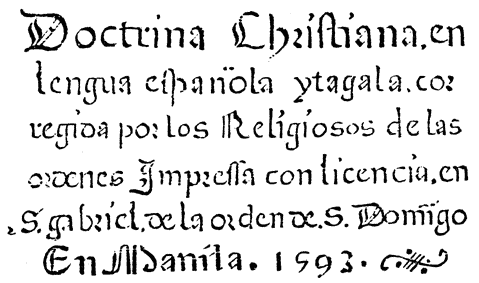
The volume is printed throughout by the xylographic method, that is to say, each page of text is printed from one wood-block which was carved by hand. Along the inner margins of some pages are vertical lines which were made by the inked edge of the block, and the grain of the wood has caused striations to appear in the printed portions throughout. The unevenness of the impression indicates that the pages were printed in some primitive manner without the help of a conventional press.
The paper, which is one of the distinctive features of most old Oriental books, has been discussed at length by Pardo de Tavera in his study of early Philippine printing, and we can do no better than translate the relevant passage in full:
“I have said before that the material composition of our books is inferior. The imprints before 1830 were made on a paper called by some rice paper, by others silk paper, and by still others China paper, according to their taste. It is detestable, brittle, without consistency or resistance, and was called rice paper because it was supposed to be made from that grain. It was the only kind then used in the Philippines, not only for printing, but for all manner of writing, letters, etc., and it is even recorded that in 1874 when tobacco was a state monopoly, cigarettes were made with this paper, and that the Indians and Chinese preferred it (and perhaps they still do) to rag paper or other kinds, because of the horrible taste it gives the tobacco.
Because the Doctrina Christiana, which may well be translated “The Teachings of Christianity,” contains the basic elements of the religion which the missionaries were trying to spread among the unbaptized in the remote regions of the world, it was the most useful handbook they had. A summary of the contents of the present edition shows the fundamental character of the work. After a syllabary comes the Pater Noster, the primary and most popular prayer of Christianity. Then follow the Ave Maria, Credo, Salve Regina, Articles of Faith, Ten Commandments, Commandments of the Holy Church, Sacraments of the Holy Church, Seven Mortal Sins, Fourteen Works of Charity, Confession and Catechism. Here in a small compass is presented the simplest, most easily learned and most essential tenets of the Catholic Church.
We have then a book, the Doctrina Christiana, in Spanish and Tagalog, corrected by priests of more than one order—and this is important in tracing the authorship of the work—and printed by the xylographic method with license at Manila at the Dominican Church of San Gabriel in 1593. So much we get from the title, and in itself it is a fairly complete story, but from the date of its issue until the present time that very fundamental information has not been completely recorded.