Front matter (continued 2)
Reading edition
Weakness of Type. The L-I (Luftschiff, or airship), the first of the German airships designed for purely military purposes, was a Zeppelin 525 feet long by 50 feet in diameter, of 777,000 cubic feet capacity, and 22 tons displacement. Its three sets of motors developed 500 horsepower and it had a speed of 52 miles per hour. It was launched at Friedrichshafen in 1912, and after a number of successful cross-country trips, it was tried in connection with naval maneuvers off Heligoland. Before the trial had proceeded very far, a sudden squall broke the backbone of the huge gas bag and hurled it into the sea, drowning fifteen out of the crew of twenty-two. It is a striking commentary on the frailness of these aerial monsters that every one of the big airships built up to that time had met disaster in an equally sudden manner but from a totally different cause in each instance. The L-II was slightly shorter but had 5 feet longer beam and displaced 27 tons. She was designed particularly for naval use, had four sets of motors developing 900 horsepower, and was fitted with a navigating bridge like that of a ship. It was confidently thought that all possible shortcomings had been remedied and success finally achieved in the L-II, but before there was any opportunity to demonstrate its efficiency, the airship exploded in mid-air, killing its entire crew.
Effectiveness Grossly Overrated. Despite this unbroken chain of disasters, the German official press bureau spread broadcast the prowess of the Zeppelin, its magnificent ability, and its remarkable achievements as an engine of war—in theory, since this was a year or two prior to the outbreak of hostilities. Had it not been for the forced descent of the Zeppelin IV at Luneville, where it was taken possession of by the French, these tales might have been accepted at their face value. But the log of the commander of this airship showed that its maximum speed was but 45 miles per hour, the load 10,560 pounds, and the ascensional effort 45,100 pounds. The fuel consumption averaged 297 pounds per hour while the fuel capacity was only sufficient for a flight of seven hours. During its flight, it had reached an altitude of only 6,250 feet, to accomplish which over 3 tons of ballast had to be dropped. It was also shown that the critical flying height of these huge airships is between 3,500 and 4,000 feet, Zeppelin himself declaring that his machines were useless above 5,000 feet. This probably accounts for the fact that the early raids on English towns were carried out at a height but slightly in excess of 2,000 feet. Later types, however, are said to have reached high altitudes.
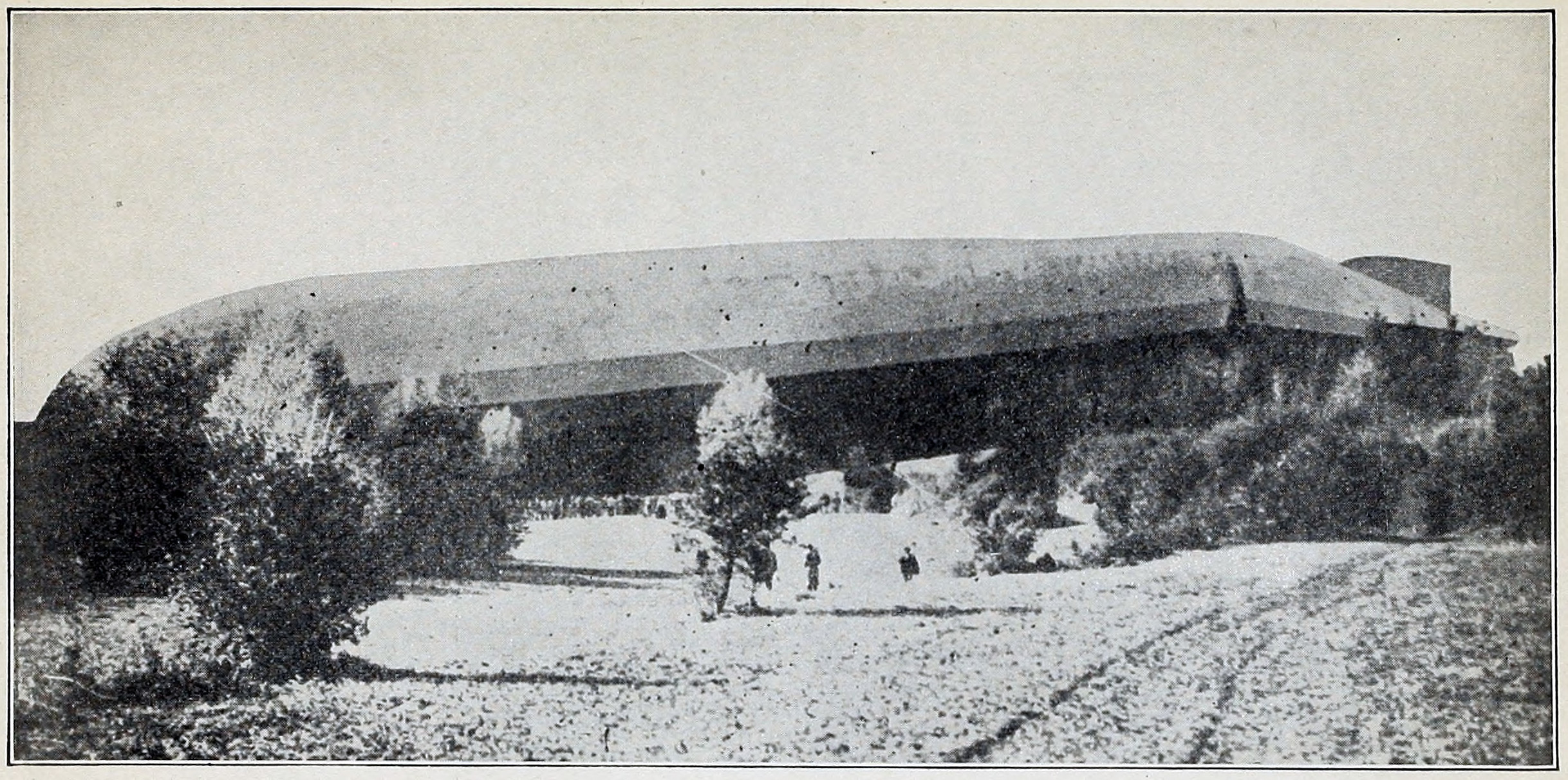
Fig. 22. Zeppelin L-49 Brought Down Intact by a French Airman, Resting on Hillside near Bourbon-Les-Baines Copyright by Underwood and Underwood, New York
Shortly before the outbreak of the war the L-5 was completed. This had a capacity of about 1,000,000 cubic feet, motors aggregating 1,000 horsepower or over, and a reputed speed of 65 miles per hour. Just what was the fate of this particular ship did not become known, since information of a military character has not been permitted to leak out of Germany from that time on. But capture or destruction has accounted for many of the intermediate numbers of the series; big German airships have been brought down in England, in the North Sea, in France, and at Saloniki, their loss culminating in the disaster to four out of the fleet of five that attempted a raid over London but were caught by adverse winds which exhausted their fuel supply so that they were blown out of control, toward the south of France. French anti-aircraft batteries or aeroplanes accounted for three of these, while the fourth, the L-49, was captured intact.
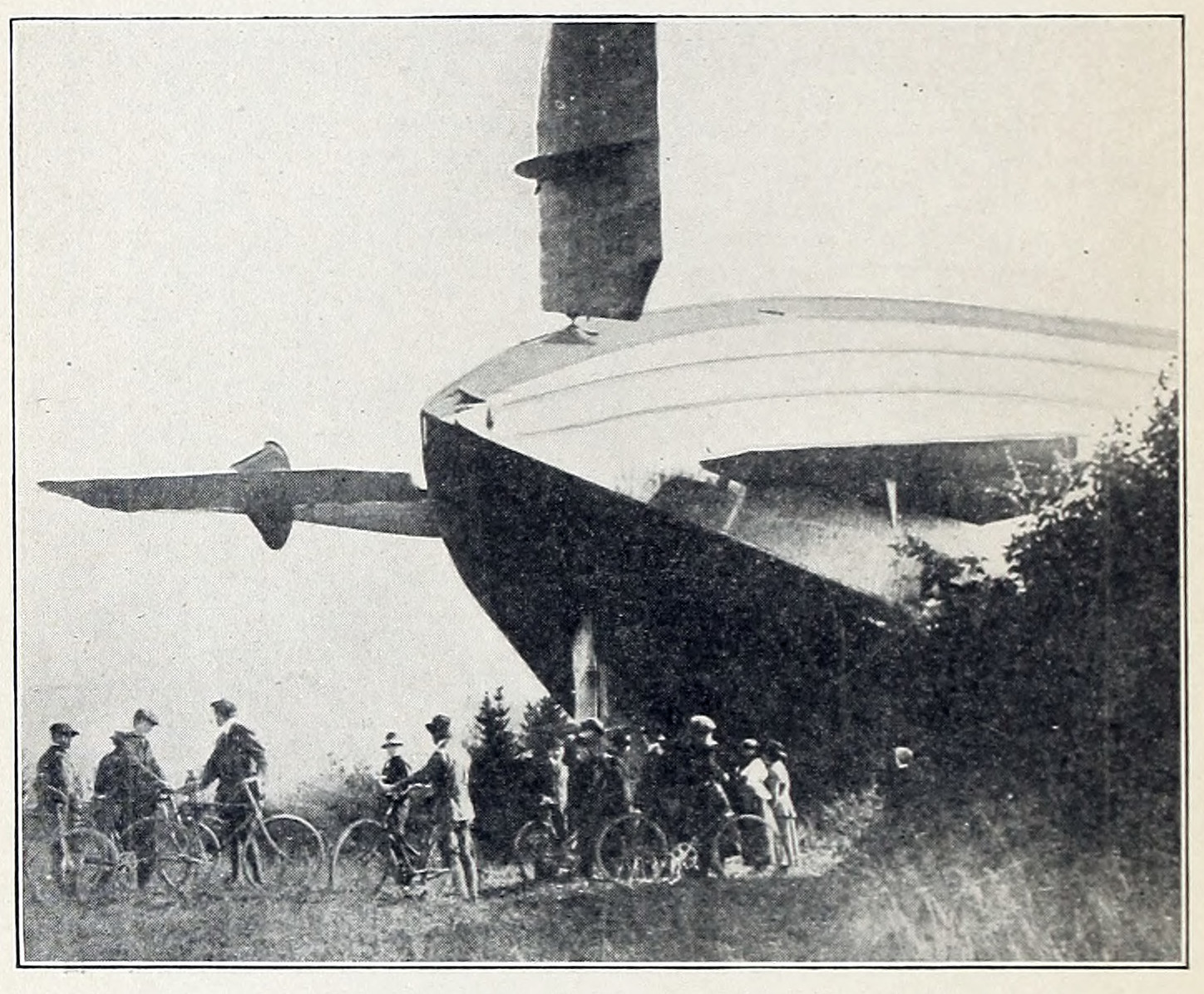
Fig. 23. Nose of Giant L-49 and Group of Sightseers Copyright by Underwood and Underwood, New York
L-49. An essential part of the equipment of every form of German military apparatus is a means of destroying it in case of capture. In the case of the big airships, the officers are provided with revolvers loaded with incendiary bullets, which are fired into the gas bag, so that until the L-49 was forced to descend in the south of France by the activities of a battle plane, plus a lack of fuel, no airship of a recent type had ever been captured intact. In this case, the commander fired his pistol at the balloon but missed and was prevented from firing again by a French peasant who "covered" him with a shotgun. The wireless operator succeeded in using a sledge hammer on some of the apparatus of the very completely equipped wireless cabin before he was captured but did not do sufficient damage to prevent reassembly of the parts with little trouble. With the exception of the earlier type of Zeppelin that was forced to descend at Luneville prior to the war, the L-49 was the first that was ever known to have landed undamaged in hostile territory, as practically all the others were destroyed in the air, most of them having been wrecked either by aeroplane or anti-aircraft fire. Fig. 22 shows the L-49 as it rested on a hillside at Bourbon-les-Baines, France, and Fig. 23 shows a close view of the nose of the monster.
Standardized Parts. Comparing the L-49 with many of its predecessors led to the conclusion that it was one of the latest types, but an inspection of its construction revealed the use of many parts produced in quantities from standard patterns as well as a lack of the finish that has always characterized airship construction. Appearance and comfort had both been sacrificed with a view to saving the last ounce of superfluous weight in order to carry more fuel and ammunition. Evidently the production of these large airships has been reduced to a manufacturing basis and they are constructed in series in much the same manner as motor cars, though on a reduced scale.
General Design. In its general construction the L-49 was along the same lines that have characterized the Zeppelin since its inception, the outer envelope being stretched over a rigid frame of aluminum girders, inclosing a large number of independent balloons inflated with the usual hydrogen gas, no trace being discovered of the non-inflammable gas, the discovery of which had been hailed by the German press. The commander’s cabin was suspended well forward with the wireless room directly behind it, while a V-shaped gangway, recessed in the envelope proper so as to present no additional head resistance, ran back from the latter the whole length of the ship. This and the gun platform on top, mounting two machine guns and reached by a ladder suspended in a well amidships, have been familiar features of all the recent Zeppelins. The main envelope contained nineteen independent gas bags, each of which was made integral with an air balloonet to take care of the expansion and contraction of the hydrogen with varying altitudes and temperatures. Distributed along the lower part of the frame inside the envelope were a series of 50-gallon water-ballast tanks.
Power Plant. No less than nine large motors were employed to drive the huge gas bag, the maximum horsepower probably aggregating 1,600 to 2,000. The motors were distributed in five different locations, the largest being suspended just abaft the wireless room. The remainder were placed in self-contained units in the form of gondolas suspended from the sides of the frame, as shown in Fig. 24, the outline being that of a blunt-nosed fish. Each of these gondolas carried two motors placed side by side and coupled up so that either one or both could be employed to drive the single propeller. For cruising speeds one motor in each gondola supplied sufficient power or in some gondolas both motors could remain idle. No accommodation was provided for attendants in the gondolas, any of which could easily be reached by light ladders from the inclosed gangway.
To insure greater safety, the fuel supply was divided among sixteen tanks, all of which were interconnected with each other and the engines so that gasoline from any tank or tanks could be diverted to any particular engine. The supply of lubricating oil for each engine was carried in a tank in the gondola itself.
Control. Vertical and horizontal stabilizing surfaces of conventional form were built on the sharply tapering rear end of the frame, the elevator and rudder being similar to those used in aeroplane construction, except that the rudder was in two sections, the larger of which was placed on top of the envelope. The control of these surfaces, the operation of all the engines, the control of the water ballast, the air supply to the balloonets, and the fuel supply to the motors were all concentrated at a panel board in the commander’s cabin, the forward end of which bore a close resemblance to the bridge of a man-of-war. By means of thirty-eight push buttons, half red and half white, air could be released from or pumped into the balloonets, while in a similar manner the contents of any one of the water-ballast tanks could be emptied. Elaborate controls were provided for the power plant, it being possible to vary the speed or stop any one or more of the motors from the bridge. The rudder and elevators were operated by means of small hand wheels, similar to a marine steering wheel. One of the most prominent features of the operating cabin was a huge chart frame, capable of carrying a large scale map covering a considerable area, as well as an ample supply of maps. Few instruments were found in the captured ship and it is thought highly probable that everything not fastened in place had been dumped overboard at the last to increase its lifting power.
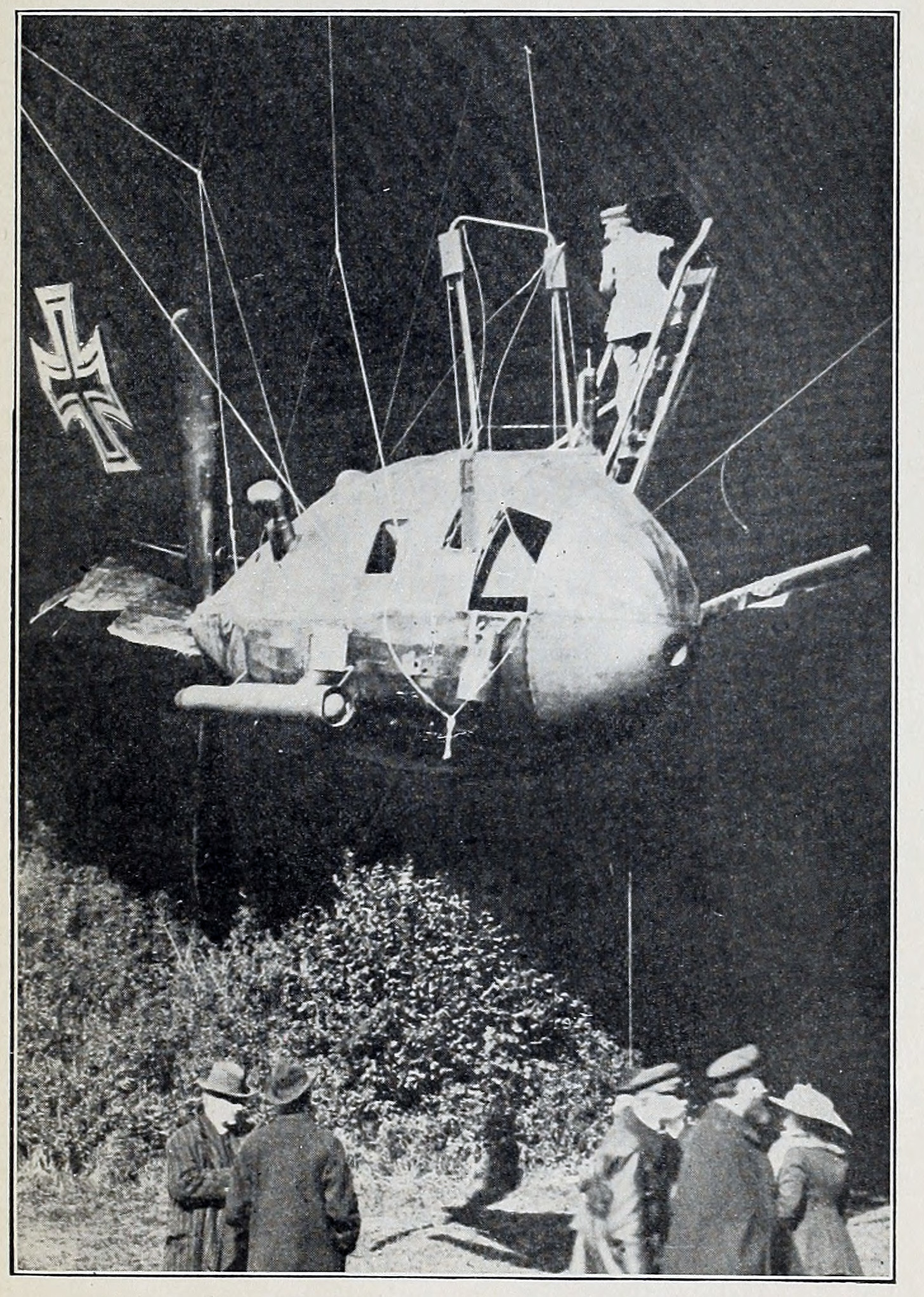
Fig. 24. One of Six Gondolas, or Power Units of the Zeppelin L-49 Copyright by Underwood and Underwood, New York
Apart from the use of standardized fittings and parts and the employment of a great deal more power in a slightly different manner than had characterized the earlier types of Zeppelins, the L-49 revealed nothing of unusual importance in airship design and certainly none of the world-beating features that German propaganda had been heralding for some time previous.
Destruction of Zeppelins. Mention has already been made of the fact that practically the only use made by Germany of her huge airships has been the bombardment of open cities, and that always at night. From the first of September, 1914, up to the end of 1917, between thirty and forty had met disaster, but only two were captured intact. The first of these was discovered by a Russian cavalry patrol while at anchor and its crew of thirty men were made prisoners. This was at an early period in the war, while the second one to be captured was the L-49, already referred to, which formed one of a squadron of five evidently sent out on a bombing expedition against London. Owing to adverse winds, they never reached their destination and four of them were known to have been put out of action, all except the L-49 being destroyed in the air. Not a few of these big airships have fallen victims to their own weakness and succumbed to the elements, in one instance a high wind tearing the airship loose from its moorings while the crew was not aboard. This was at Kiel, and after traveling a number of miles unguided, the big bag fell into the North Sea. In quite a number of other cases head winds have prevented the return of the raiders to their base and they have either been destroyed by their crews or wrecked at sea in attempting to return. In still other instances the unwieldy monsters have been wrecked by high winds when attempting to land, as was so frequently the case prior to the war.
Aeroplane and Anti-Aircraft Fire Effective. Before the war broke out the ability of either the aeroplane or the anti-aircraft gun to overcome the Zeppelin was purely theoretical, but actual experience has demonstrated that much of the theory was well founded. At least three Zeppelins have been destroyed by British aviators in mid-air, all or most of the crews being killed, while probably an equal number have been accounted for by French aviators in open battle. The war had not been under way a month before French anti-aircraft gunners showed their skill by bringing down-a "Zep," while only a week later a Russian battery accomplished the same feat, in this instance killing the entire crew. In 1916, British and French gunners succeeded in either "winging" or setting on fire three or four, while two dropped into the North Sea and one was blown up by its crew, having run out of fuel while raiding Scotch towns.
Bombing Raids against Zeppelin Sheds. Not the least of the disadvantages from which such huge and unwieldy craft suffer is the fact that the correspondingly large structures required to house them make exceedingly easy marks for the raiding aviator. Bombing, however, is such an uncertain art that even such large buildings as these cannot be struck from any altitude with a fair degree of accuracy. Consequently, in the number of raids that have been carried out against Zeppelin sheds, success has been due very largely to the temerity of the aviators, who have descended within a few hundred feet of their mark despite the fire directed at them from all quarters. At least three and probably more of the big airships have been destroyed in this manner by British aviators, who have made flights of several hundred miles to reach their destination, while the destruction of as many more has been ascribed by the Germans to the "accidental" explosion of a bomb in the shed. In view of the great precautions taken against accident from the explosion of the bombs carried by the airship itself, it is not considered at all likely that there was anything accidental about the wrecking of these craft.
One of the earliest attempts against Zeppelin headquarters at Friedrichshafen on Lake Constance, which resulted in the destruction of the L-31, is typical of the plan followed in attacks of this kind. Two British aviators flew from their base in France, about 250 miles distant, at a high altitude. They became separated before reaching their destination owing to a mist. This, however, prevented their discovery until they had dropped within a few hundred feet of the surface of the lake, which it was necessary to do to obtain a view of the airship sheds. The first pilot dropped his cargo of bombs from a height of only 100 feet or so over the shed and was rewarded by seeing it catch fire. He had hardly straightened out on his return course before he heard the attack of his companion. The latter was not so fortunate in escaping unscathed, as a bullet pierced his fuel tank and compelled him to descend. In the majority of instances, however, the raiders have succeeded not only in carrying out their task but in escaping undamaged as well.
CAPTIVE BALLOONS
Military Value. As an aid to military operations, the use of the captive balloon dates back many years. It was extensively employed in the Civil war and more recently in the Boer war, but with the advent of both the dirigible and the aeroplane, it was generally considered outside of Germany that its reason for existence had passed away. The German military plans included a large number of balloons for artillery observation purposes and they were used right from the start. It was only when the fighting settled down to trench warfare, however, that they came into prominence and the aid that they rendered the German batteries put their opponents at a serious disadvantage. Like the bayonet, which was also generally considered to have been relegated to military operations of the past, the captive balloon is now playing a very important role, particularly on the western front. In favorable weather, anywhere from ten to forty of these aerial observation posts will be visible from a single point on the line.
Spherical Type Defective. The captive balloon of the present day, however, bears no resemblance to its predecessors. From a sphere, it has been developed into a form that more nearly resembles the dirigible and at the same time, it embodies some of the features of the aeroplane. The old spherical balloon was always at the mercy of the wind, which not only governed the altitude to which the balloon would rise but also made things extremely uncomfortable as well as dangerous for the observers. With 1,000 feet of cable out, such a balloon rises to an equivalent height on a perfectly, calm day. But even a light wind cuts this height down by 100 or 200 feet, while if a strong wind is blowing, the balloon is held down to within a few hundred feet of the ground regardless of the length of cable paid out. Every strong gust beats it over at a perilous angle and the resulting shocks to the basket are so severe that its occupants can have little thought for anything but their own safety. Strong cross gusts set both the bag and basket to spinning and jumping in a manner that would make the results of the severest storm at sea seem mild by comparison, since the movements of the basket are executed with such rapidity that they seem to be in almost every plane simultaneously. As a result, the old type of captive balloon was available for service only in the calmest weather.
Modern Kite Balloon. It should not be supposed that the improved type of observation balloon now in use in such large numbers provides any unusual amount of ease or comfort, since it is also prey to the wind and does a great deal of swinging about as well as jerking when the wind is more than 15 or 20 miles an hour. But it has been improved to a point where the wind not only serves to elevate, instead of depressing it, but also to steady it. The new type. Fig. 25, is technically known as a kite balloon, because, in addition to the appendages attached to the bag itself for steadying purposes, it is equipped with a tail to assist in keeping it heading into the wind. This consists of a number of bucket-shaped pieces of heavy canvas attached to the tail cable by bridles so as to catch the wind and hold it, thus placing a heavy strain on the cable and preventing the balloon from swinging violently. As is the case with practically everything used at the front, the technical name of the new type of balloon is prominent by its absence. It is a Drache (kite) to the Germans and a "blimp" to Tommy Atkins. Both its shape and attitude when aloft bear a close resemblance to a huge sausage, so that the term "sausage" is used by all the belligerents in common to a large extent. A side view of an American type is shown in Fig. 26.
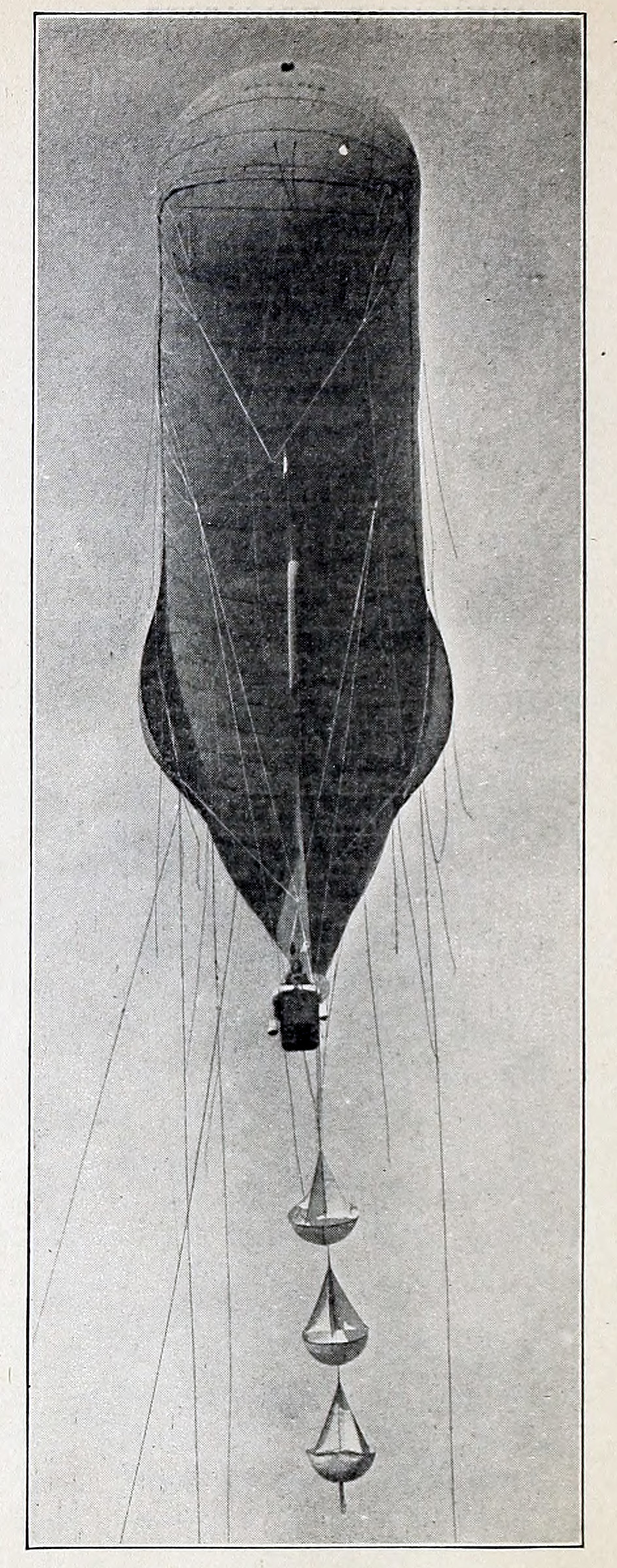
Fig. 25. Head-On View of Modern Kite Balloon, Showing Details of Tail Buckets Copyright by Central News Service, New York City
It will be noted from Figs. 25 and 26 that the suspension of the basket and the appendages attached to the balloon at the rear hold it in a position which is roughly the equivalent on a large scale of the curve of an aeroplane wing. It has both camber and an angle of incidence, so that the wind serves to elevate it instead of beating it down. This lifting effect is further increased by tubes of large diameter, open at the forward end only and curving around the end of the gas bag at the rear. (It is also equipped with an air balloonet, the same as a dirigible.) The wind enters the lower end of this tubular member, which is in a line with the longitudinal axis of the balloon, but it must pass around the curve at the end of the gas bag before it can fully inflate it, so that it performs the double function of increasing the lift and steadying the balloon, though the latter is its chief purpose. The basket is suspended quite a distance below the gas bag and has accommodation for two observers. Like scores of other inventions that the Germans were the first to utilize on a large scale in the present war, the kite balloon was not a German creation but was originally developed in France.
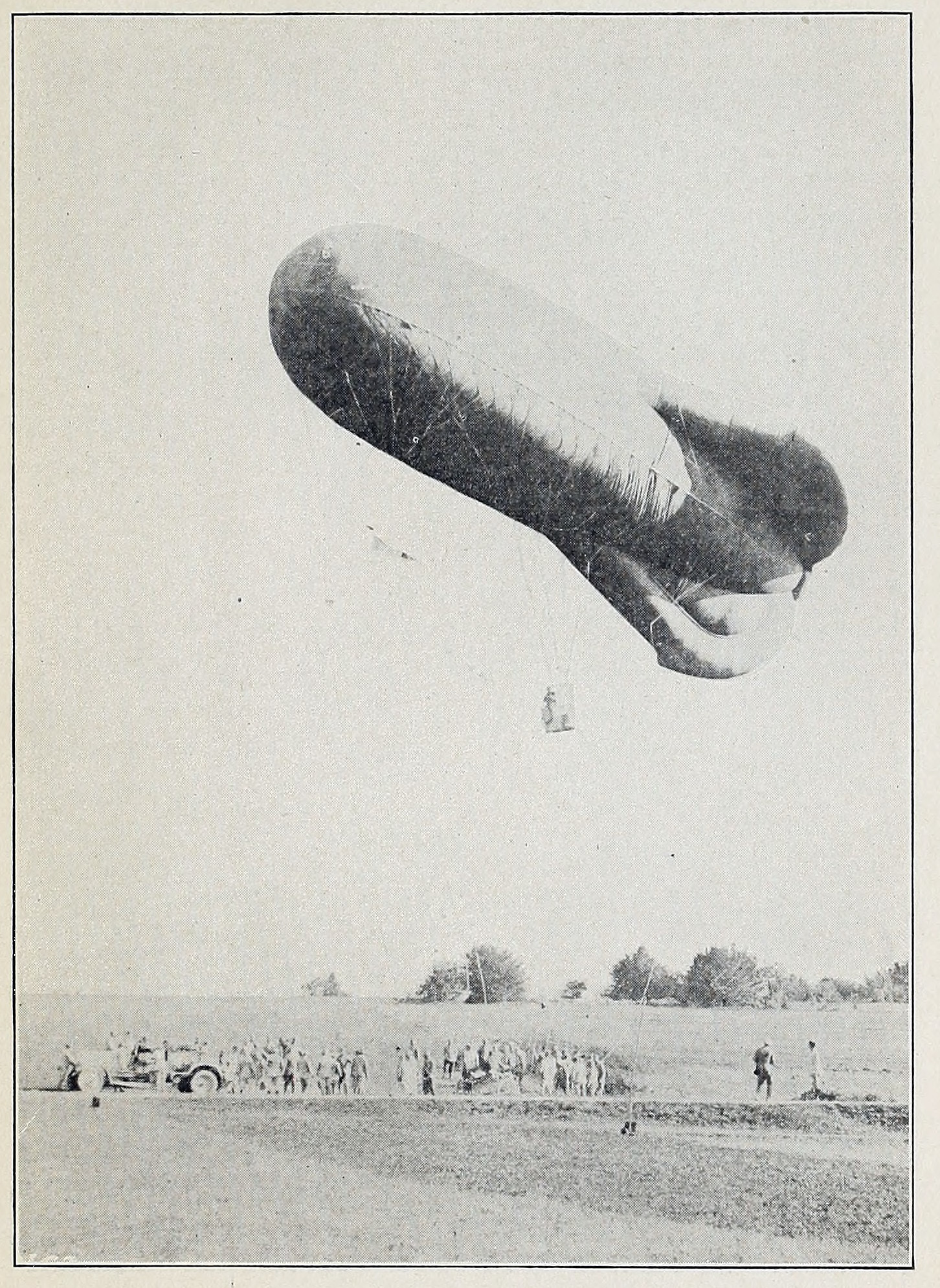
Fig. 26. American Kite Balloon of Latest Type Ascending Copyright by Committee on Public Information, Washington, D C.
Methods of Inflation. The average capacity of the kite balloons used for observation purposes is 28,000 cubic feet. They are inflated with hydrogen either from a portable generating plant forming part of the equipment of the balloon company or from a supply carried under high pressure in heavy steel "bottles" similar to those used for transporting oxygen or carbonic acid gas intended for industrial use. Since the balloon companies are stationed about 4 miles back of the firing line, the use of the portable plant is practical, but it has been found more economical and more convenient to generate the gas on a large scale at special establishments in France and England and send it to the front in containers. With a portable plant, several hours are necessary to inflate the gas bag, whereas with a large supply of the gas at hand under high pressure, the operation may be carried out in less than an hour.
The balloon naturally works under the same difficulties as all lighter-than-air craft, that is, there is a constant leakage of the hydrogen through the fabric in addition to that lost by the expansion of the gas on warm days when the summer sun beats down directly on the gas bag. Where a field generating plant is employed, quick inflation of a new balloon or replacement of loss is accomplished by the used of several "nurses", Fig. 27. These are simply large gas bags which are kept replenished by the gas plant working constantly, in other words, they are storage tanks, and when it is necessary to inflate the balloon quickly, their contents are simply transferred to it.
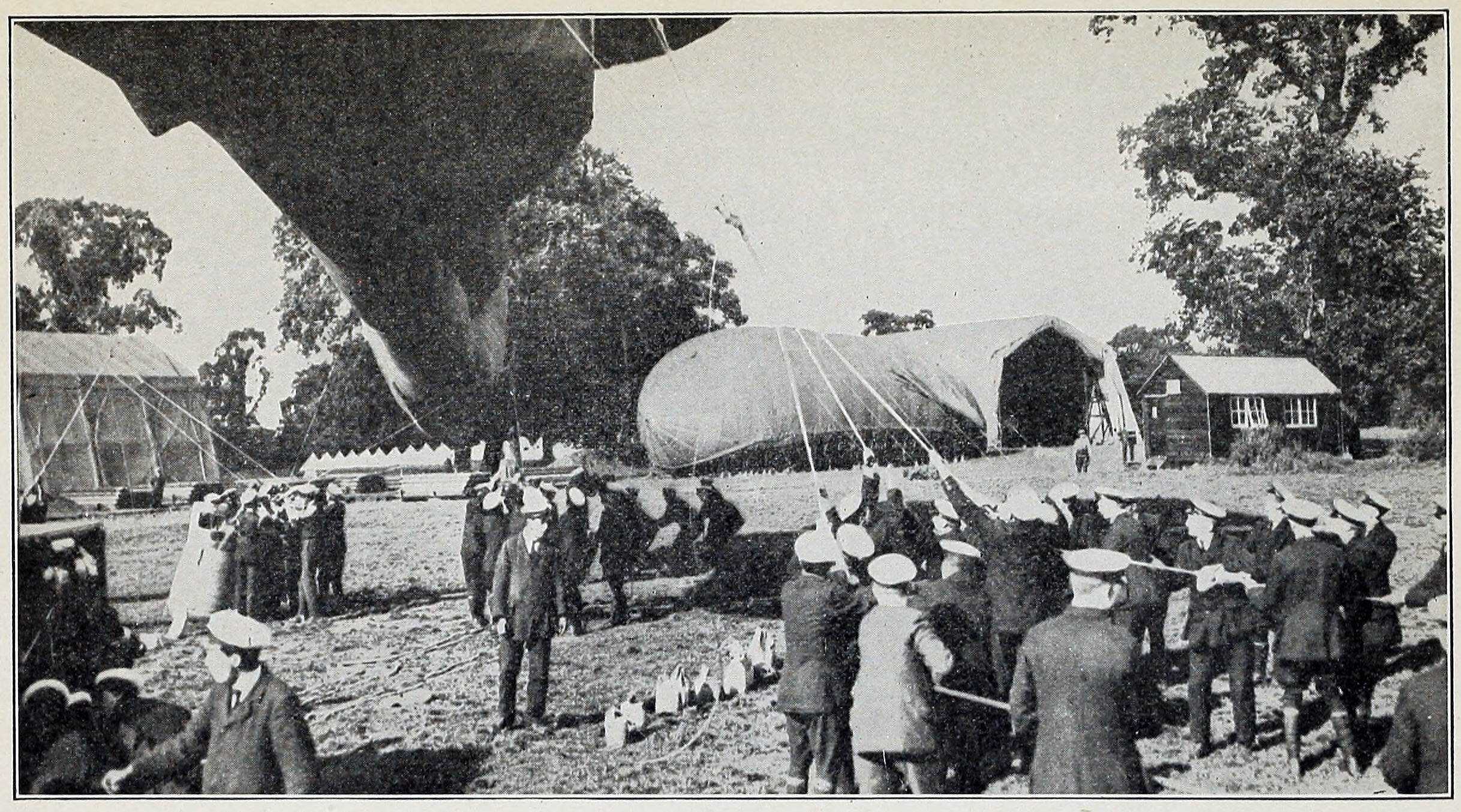
Fig. 27. Landing Big Kite Balloon at Training Station "Somewhere in England." "Nurse" in Background Copyright by Underwood and Underwood, New York
Balloon Company. Though aeronautical in character, the kite balloon service is actually a branch of the artillery, to which it is directly attached. A balloon company accordingly consists of twelve to twenty artillery officers of varying ranks and about 120 to 130 men. Of the officers, six to eight are artillery lieutenants or captains and go aloft as observers, this number being necessary because the strain of watching constantly is very great and the observers must be relieved at frequent intervals, the balloon otherwise being kept up continuously, both day and night. There are also a number of sergeants, each of whom is in charge of a different branch of the work, such as the inflation, transport, telephone service, and winding machine. No less than fifteen 3-ton to 5-ton motor trucks are necessary for each balloon company besides two or more motorcycle messengers, the care of the machines usually being entrusted to the corporals of the company. The remainder of the company are practically laborers, whose chief duties are to attach the ballast bags to the ropes when it is intended to hold the balloon on the ground for any length of time and to utilize their own weight for the same purpose when the balloon is about to go aloft or is only on the ground temporarily. In addition, every company has its surgeon and assistants, quartermaster, cooks, company clerk, and other attaches necessary to complete its organization, since a balloon company serves as an independent unit.
Equipment. The paraphernalia required is quite as elaborate as that necessary to keep several aeroplanes aloft, though naturally of a different nature. It must all be readily portable, for a balloon company has to change camp more or less frequently, or as often as the enemy artillery happens to discover its range. To secure mobility is the purpose of the great number of motor trucks employed. One of these is equipped with a hoisting winch and a large drum capable of holding 3,000 or 4,000 feet of about 3/8-inch steel cable. The winch is driven by the same engine that propels the truck, and in case of emergency the engine may be applied to the two purposes alternately within a short space of time. For instance, in case of attack either by shrapnel from an enemy battery or by a hostile aviator, it may be used to quickly haul in or let out cable to change the altitude of the balloon, or it may be employed to drive the truck to another and more favorable location with the balloon in tow.
Another truck houses a complete telephone exchange, since the observers in the balloon may wish to communicate with any one of a number of batteries which they are serving. Telephone communication is established by means of an insulated wire which forms the core of the cable, while the steel cable itself acts as the return wire to complete the circuit. In some cases, a separate copper cable is employed, using the steel cable as the return half of the circuit. In addition there is a truck for transporting the balloons, for the company must always have duplicate equipment at hand in case of the destruction of the balloon it is using or, as more frequently happens, damage of a nature that requires hours or days to repair. In addition to the balloon itself, there are covers and the ground cloth, as in inflating a balloon no part of its fabric must be allowed to touch the ground because of the danger of stones or sticks tearing rents in it. The balloon proper and its immediate accessories utilize at least one and sometimes two motor trucks.
To hold the balloon on the ground when out of service, there are eighty sacks of sand weighing 25 pounds each, or an aggregate of 1 ton of ballast, in addition to which there are necessary a large number of steel screw stakes, spare ropes and parts, ladders and the like, besides the basket and its equipment. The stakes are employed to hold the balloon down in a heavy wind by "pegging" it in the same manner as a tent. Three or four trucks are required to carry the large supply of hydrogen necessary, which entails the transportation of 130 to 150 containers. Each container holds several thousand cubic feet of gas under high pressure, which is released through a reducing valve. Some of the other transportation units required are the "cook wagon," quartermaster’s stores truck, truck for carrying tents, blankets, and other impediments for the men, and the "doctor’s wagon" (ambulance).
Advantages of Kite Balloon. It became a necessity to resurrect the captive balloon and bring it up to date, not simply because the Germans were employing it in numbers, but because experience demonstrated that it possessed numerous advantages over the aeroplane for artillery observation. The observer in an aeroplane is carried back and forth over and around the location he wishes to watch, at high speed and at a constantly varying altitude. He must communicate by means of either signals or wireless, and it is not always possible for him in either case to know whether his signals have been received and understood, since it is possible to transmit messages by wireless from an aeroplane but a very difficult matter to receive. The observers in a kite balloon, on the other hand, have the advantage of being able to scrutinize a certain sector constantly with the aid of powerful glasses. With a few weeks of experience in observing a given terrain they become so familiar with it that any changes or the movements of troops or supplies are quickly distinguished. The greatest advantage, however, is that the information thus acquired may be instantly transmitted not merely to one but to any one or all of a group of batteries extending over a mile or two of front in either direction, the balloons being stationed 4 to 6 miles apart. The observers are fitted with portable head sets so that they speak directly into their telephones without the necessity of removing the glasses from their eyes, which enables them to watch the fall of the shells and tell the battery attendant in the dugout alongside the gun whether a shell fell "short", "over," "left," or "right," and the amount of correction needed before the smoke from the explosion has cleared away. With the aid of close corrections of this nature the battery commander is in a position to get the range exactly without the great expenditure of ammunition that firing entirely by map or with the assistance of aeroplane observers entails. Instances are recorded in which a 9.5-inch shell has been landed right in a concrete "pill-box" not over 15 feet square from a distance of 3 miles after six trial shots had been fired to obtain the range. Such a shot is reported back to the battery by the balloon observer as a "direct hit," and it is only necessary to fire the gun at the same range and direction to score as often as necessary.
Duties of Balloon Crew. Each kite balloon carries aloft two observers, Fig. 28, both of whom can concentrate their entire attention on the work of "spotting," since they have nothing to do with the control of the balloon itself, except to give orders. Their chief duties consist of "counter-battery" observation, that is, spotting the location of enemy batteries, and being constantly alert to detect any suspicious movements back of the enemy’s lines, such as movements of troops, ammunition, or supplies. The batteries controlled from observation balloons are the "heavies," which are located 1 mile or more back of the front line trenches and to the gunners of which the objects they are firing at are never visible. Some of the heaviest guns mounted on specially constructed railway trucks are often fired from points 5 miles or more back of the lines. In fact, when balked in their attempt to take Calais, the Germans bombarded the town with the aid of long-range naval guns from a distance of over 15 miles and every shot dropped into either some part of the city or its outskirts. Buildings, hills, or specially constructed and concealed observation towers are frequently utilized in conjunction with captive balloons to serve as auxiliary observation posts, so that the base line connecting the two may be used to triangulate distances and thus calculate them more accurately than is possible by direct observation from a single point.
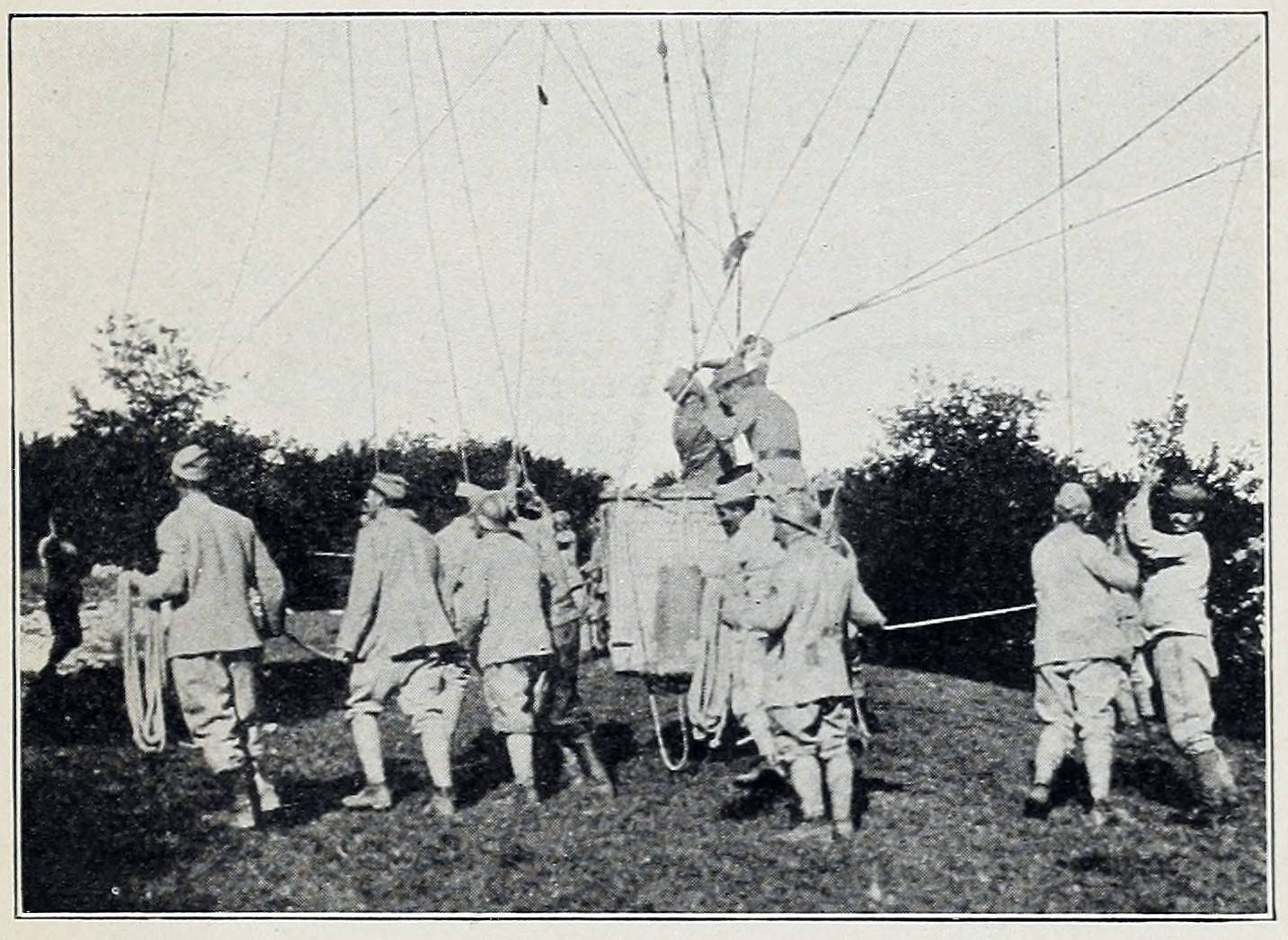
Fig. 28. French Kite Balloon Observers about to Ascend Copyright by Committee on Public Information, Washington, D.C.
Risks Incurred. Enemy Fire. While the observers in a kite balloon are not subjected to all the risks that the aviator must encounter when he goes aloft or, at least, not to the same extent, their lot is far from being free from danger. One of the duties of the reconnoitering aviator is to destroy observation balloons by means of incendiary bombs equipped with fishhooks which catch in the fabric or by the use of his machine gun. Enemy batteries may also succeed in getting the range of the balloon and fire at it with large caliber shrapnel, which spreads its fragments over an area 100 yards or more in diameter when it bursts. So many of the German balloons were downed by French and British aviators in the early part of the war—and the Germans retaliated in kind—that a battle plane is now always detailed to keep watch above the balloon to ward off attacks by aeroplanes.
Escape of Balloon. In addition to the risk of being shot down, there is the ever-present danger of the balloon being wrecked by a sudden squall or of its breaking away from its windlass through the parting of the cable and floating over the enemy lines. Balloons have been lost through both causes in a number of instances. Each of the two observers wears a heavy harness to which is attached a parachute suspended by a light cord from the rigging of the balloon, so that in case of emergency they may save themselves by jumping without having to make any preparations for their sudden drop.
In case of the breakage of the cable, which usually results from a strong wind coming up suddenly and putting a terrific strain on the steel line by jerking it, the observers are guided in their actions by the direction in which the balloon moves. When it is carrying them back over their own territory, they navigate in the same manner as a free balloon, coming to the ground as soon as a favorable landing place can be reached. Instruction in free ballooning is accordingly an important part of the curriculum that the kite balloon observers must go through. Should the wind be in the opposite direction, however, as only too often proves to be the case, all instruments, papers, and maps are immediately thrown over the side and the observers promptly follow suit in their parachutes, abandoning the balloon to its fate. As the balloon travels with the speed of the wind, once it is released, and the parachute of the descending observer is carried in the same direction, prompt action is vital to prevent coming to the ground in the enemy’s territory. In a 30-mile wind, for example, only eight minutes would elapse from the moment that the balloon broke away until it traversed the 4 miles intervening between its station and the enemy’s lines. On some occasions, kite balloons which were not fit for further service have been loaded with explosives and released from a height that would cause them to land well within the enemy’s territory with disastrous results to the men detailed to capture them.
Marine Service. The kite balloon was first used by the British naval forces in their operations against the Dardanelles and proved so valuable that they have since been employed in fleet expeditions in the North Sea as well as for anti-submarine work. In the latter form of service, they have the same superiority over the aeroplane for observation that they possess in land operations. The ship naturally cannot run the risk of remaining stationary, but as the speed of the balloon is the same as that of the ship towing it, the observers do not pass over a given area with anything like the velocity of an aeroplane, while their elevated position affords the same advantages for detecting the presence of the submerged submarine or the approach of enemy vessels.
EXAMINATION PAPER
DIRIGIBLE BALLOONS
Read Carefully: Place your name and full address at the head of the paper. Any cheap, light paper like the sample previously sent you may be used. Do not crowd your work, but arrange it neatly and legibly. Do not copy the answers from the Instruction Paper; use your own words, so that we may be sure you understand the subject.
What essential features of design did Meusnier’s first dirigible incorporate?
Describe the difference between rigid, semi-rigid, and flexible types of dirigibles.
State the laws governing the increase of resistance with speed, the increase of power necessary for a given increase of speed, and the ratio in which the volume and area of the gas bag increase with increased dimensions.
What provides the lifting power of the dirigible and how is this lifting power utilized? Why should this lifting power be so much less at night than in the daytime? What is net lifting power?
What are air balloonets? How and for what purpose are they used?
What is the most efficient form of envelope for the dirigible, and why?
Why cannot the ordinary spherical balloon be propelled as a dirigible?
Is the form of the stern as important as the bow?
What is longitudinal stability and how is it obtained?
How is stability of direction obtained? What are stabilizing planes?
Why must a form of suspension for the car that cannot be accidentally displaced with relation to the balloon be provided?
12. Theoretically, where should the propulsive effort be applied to a dirigible? What factors affect the placing of the propeller and what has been proved to be the most practical solution of the problem?
Discuss the advantages of the kite balloon over the aeroplane for observation.
What is the effect of the wind on a modern kite balloon?
What is the difference between "pounds per horsepower" and "pounds per horsepower hour" as applied to the motor of a dirigible? Which is more important?
Sketch and explain the Astra-Torres suspension.
What differences exist between a Zeppelin and a Schutte-Lanz dirigible?
Describe the "L-49", discussing power plant and control.
Define static and dynamic equilibrium as applied to the dirigible.
Is the Zeppelin effective? Discuss fully.
After completing the work, add and sign the following statement:
I hereby certify that the above work is entirely my own.
(Signed)
Please read this before you distribute or use this work.
You provide, in accordance with paragraph 1.F.3, a full refund of any money paid for a work or a replacement copy, if a defect in the electronic work is discovered and reported to you within 90 days of receipt of the work.
1.F.
1.F.3. LIMITED RIGHT OF REPLACEMENT OR REFUND – If you discover a defect in this electronic work within 90 days of receiving it, you can receive a refund of the money (if any) you paid for it by sending a written explanation to the person you received the work from. If you received the work on a physical medium, you must return the medium with your written explanation. The person or entity that provided you with the defective work may elect to provide a replacement copy in lieu of a refund. If you received the work electronically, the person or entity providing it to you may choose to give you a second opportunity to receive the work electronically in lieu of a refund. If the second copy is also defective, you may demand a refund in writing without further opportunities to fix the problem.
1.F.4. Except for the limited right of replacement or refund set forth in paragraph 1.F.3, this work is provided to you ‘AS-IS,’ WITH NO OTHER WARRANTIES OF ANY KIND, EXPRESS OR IMPLIED, INCLUDING BUT NOT LIMITED TO WARRANTIES OF MERCHANTABILITY OR FITNESS FOR ANY PURPOSE.
1.F.5. Some states do not allow disclaimers of certain implied warranties or the exclusion or limitation of certain types of damages. If any disclaimer or limitation set forth in this agreement violates the law of the state applicable to this agreement, the agreement shall be interpreted to make the maximum disclaimer or limitation permitted by the applicable state law. The invalidity or unenforceability of any provision of this agreement shall not void the remaining provisions.
The Foundation's principal office is in Fairbanks, Alaska, with the mailing address: PO Box 750175, Fairbanks, AK 99775, but its volunteers and employees are scattered throughout numerous locations. Its business office is located at 809 North 1500 West, Salt Lake City, UT 84116, (801) 596-1887, email business@pglaf.org. Email contact links and up to date contact information can be found at the Foundation's web site and official page at http://www.pglaf.org
For additional contact information:
Dr. Gregory B. Newby
Chief Executive and Director
gbnewby@pglaf.org
While we cannot and do not solicit contributions from states where we have not met the solicitation requirements, we know of no prohibition against accepting unsolicited donations from donors in such states who approach us with offers to donate.
International donations are gratefully accepted, but we cannot make any statements concerning tax treatment of donations received from outside the United States. U.S. laws alone swamp our small staff.
Each eBook is in a subdirectory of the same number as the eBook's eBook number, often in several formats including plain vanilla ASCII, compressed (zipped), HTML and others.
Corrected editions of our eBooks replace the old file and take over the old filename and etext number. The replaced older file is renamed. Versions based on separate sources are treated as new eBooks receiving new filenames and etext numbers.
Most people start at our Web site which has the main PG search facility: