"Dick o' the Fens" (continued 6)
Reading edition
“Hah, there’s something in that!” said the squire, drawing his breath in angrily through his teeth. “If I only knew who was at the bottom of it! Marston, it must be the work of a gang among your men.”
“Think so?” said the engineer quietly.
“I do.”
“But why should my men do such a dastardly act?”
“To make the job last longer.”
“Nonsense, my dear sir! We have work before us that will last us for years, for this drain is only the first of many.”
“Then who is it—who can it be?”
“I think I’ve got an insight to-night,” said Marston. “Tom Tallington saw a couple of men coming along the road and creep to the edge of the mere.”
“True! I had forgotten that,” said the squire sharply.
“And that shows us that our enemies belong to a party somewhere at a distance, and that we should be wasting time in searching here. Hallo! who’s this?”
The exclamation was caused by the appearance of a dark figure coming towards them from the direction of the Toft.
“Why, it’s Thorpeley, the constable!” said Dick in a whisper to his companion.
“Oh, it’s you!” said the squire gruffly. “Pity you weren’t down here sooner.”
“Has it been an explosion, sir?” said the constable in a smooth unctuous voice.
“Yes,” said the squire abruptly, and he walked on with the engineer.
“Ah, I was going on to see!” said the constable; “but as you’re all going back, I’ll go back too.”
No one spoke, but all walked on in silence, for the man’s coming seemed to have damped the conversation; but the opportunity for making himself heard and showing his importance was not to be ignored.
“They’re very clever,” he said in a high voice, so that the squire and Mr Marston, who were in front, could hear; “but I’ve got my hye upon them.”
“Why didn’t you ketch ’em, then, ’fore they did this here?” said Dave with a little laugh.
“Ay, why didst thou not stop this?” growled Hickathrift.
“Because the thing was not quite ripe. I shall tak’ ’em yet red-handed, and then—”
He paused and rubbed his hands.
“What then?” asked Dave.
“Transportation or hanging—one of them,” said the constable with a chuckle.
“Ay, but you heven’t found ’em yet,” said Dave, shaking his head.
“Nay, bud I can put my hand on ’em pretty well when I like.”
“Wheer are they, then?” said Hickathrift excitedly.
“Ay, wheer are they?” said the constable. “Going about stealthily of a night, creeping behind hedges, and carrying messages one to the other. I know! They think no one suspects them, and that they’re going to be passed over, but I’m set here to find them out, and I’ve nearly got things ready.”
“Look here, my man,” said the engineer, stopping short; “can you say for certain who’s at the bottom of this mischief?”
“Mebbe I can, sir.”
“Then who was it?”
“Nay,” said the constable with a little laugh; “if theer’s going to be any credit for takkin of ’em, I mean to hev it, and not give it over to someone else.”
“Pish!” ejaculated the squire angrily; “come along! The man knows nothing.”
“Mebbe not,” said the constable with a sneer. “Mebbe if people treated people proper, and asked them to their house, and gave ’em a lodging and a bit of food, things might hev been found out sooner; but some people thinks they know best.”
The squire understood the hint, but he scorned to notice it, and went on talking sternly to the engineer; but Thorpeley was not to be put down like that, for he continued:
“Mebbe theer’s people in it—old people and young people—as wouldn’t like to be exposed, but who hev got to be exposed, and—”
“Look here,” said Dick boldly, “if my father won’t speak, I will. Do you mean to say you believe Tom Tallington and I know anything about these cowardly tricks?”
“Nay, I’m not going to show my hand,” said the man. “Wait a bit, and you’ll see.”
“No; you speak out now,” cried Dick. “I won’t be suspected by any man. Do you mean to say Tom Tallington and I know?”
“Nay, I shall na speak till proper time comes. I know what I know, and I know what I’ve seen, and when time comes mebbe I shall speak, and not before.”
“He don’t know anything,” cried Tom, laughing. “He’s a regular sham.”
“Nay, I don’t know as boys steals out o’ windows at nights, and goes creeping along in the dark, and playing their games as other people gets the credit on. I don’t know nothing. Oh, no!”
“Why, you cowardly—”
Dick did not finish his speech, for at that moment Hickathrift stretched out one of his great arms, and his big hand closed with a mighty grip on the constable’s shoulder, making the man utter a sharp ejaculation.
“That’ll do,” he growled. “Yow shoot thee neb. Man as says owt again Mester Dick here’s saying things agen me.”
“What do you mean?” cried the constable. “Are you going to resist the law?”
“Nay, not I,” said Hickathrift. “I am a good subject o’ the king’s. God bless him! But if yow says owt more again Mester Dick, I’ll take thee by the scruff and pitch thee right out yonder into the bog.”
“Ay,” snarled Dave, spitting in his hands and giving his staff a twist; “and I’ll howd him down till he says he’s sorry.”
How the constable was to beg Dick’s pardon when held down under the black ooze and water of the mere was not very evident; but the threat had a good effect, for the man stared from one of the speakers to the other, and held his peace till they reached the Toft.
The explosion proved to have done more mischief than was at first supposed, and necessitated the taking down of all one side of the gowt and the making of a new sluice door. It was all plain enough, as the engineer had surmised upon the first inspection: a heavy charge of powder had been lowered down by the miscreants who were fighting against the project, and they had probably used a long fuse sufficient to enable them to get far enough away before the explosion.
What followed was, however, quite enough to daunt the most determined foe, for in place of disheartening the engineer, the mishap seemed to spur him on to renewed exertions. He was on the spot by daybreak, and before long a strong dam was made across, to prevent the entrance of the sea-water; the drain was emptied, and while one gang was engaged in taking down the ruined side of the gowt, the rest of the men went on with the delving, as if nothing had happened, and the dike increased.
Dick and Tom were down at the works directly after breakfast, but Mr Marston took very little notice of them, and it seemed to Dick that the engineer shared the squire’s doubts.
The consequence was, that, being a very natural boy, who, save when at school, had led rather a solitary life, finding companionship in Tom Tallington and the grown-up denizens of the fen, Dick, who was by no means a model, turned sulky, and shrank within his metaphorical shell.
“I sha’n’t go begging him to talk to me if he doesn’t like,” he said to Tom; “and if my father likes to believe I would do such things I shall go.”
“Go where?” said Tom, looking at him wonderingly.
“I don’t know—anywhere. I say, let’s find an island and build a hut, and go there whenever we like.”
“But where?—out in the sea somewhere?”
“No, no, I mean such a place as Dave’s and John Warren’s. You and I could retreat there whenever we liked.”
Tom stared, and did not seem to grasp the idea for a few minutes; then his eyes brightened.
“Why, Dick,” he cried, “that would be glorious! We could catch and shoot birds, and have our own fire, and no one could get to us.”
“Without a boat,” said Dick slowly.
“I’d forgotten that,” said Tom thoughtfully. “How could we get there, then?”
“We’d borrow Hicky’s punt till we had built one for ourselves.”
“But could we build one?”
“Of course we could, or make one of skins, or a raft of reeds. There are lots of ways.”
“But what will your father say?”
“I don’t know,” said Dick dolefully; “he thinks I’m fighting against him, so I suppose he’ll be glad I’ve gone.”
“But how about your mother?”
Dick paused a few moments before answering.
“I should tell her as a secret, and she’d help me, and lend me things we should want. I don’t care to be at home now, with everybody looking at one as if there was something wrong.”
“I don’t think my father would let me go,” said Tom thoughtfully, “and I’m sure my mother wouldn’t; and I say, Dick, isn’t it all nonsense?”
“I don’t think it’s nonsense,” said Dick, who was taking a very morbid view of matters, consequent upon a mistaken notion of his father’s ideas and thoughts at that time, and matters were not improved by a conversation which ensued in the course of the next day.
Dick was in the garden with Tom, paying court to the gooseberry trees, for though fruit by no means abounded there, the garden always supplied a fair amount of the commoner kinds, consequent upon the shelter afforded from the north and bitter easterly sea-winds by the old buildings which intervened.
“Here, I want to talk to you two,” said the squire; and he led the way into the house, where Mrs Winthorpe was seated at work, and, probably by a preconcerted arrangement, to Dick’s great disgust she rose and left the room.
“Now,” said the squire, “I don’t like for there to be anything between us, Dick; and as for you, Tom Tallington, I should be sorry to think anything about you but that you were a frank, straightforward companion for my son.”
“I’m sure, sir—” blundered out Tom.
“Wait a minute, my lad. I have not done. Now, I’m going to ask you a plain question, both of you, and I want a frank, manly answer. But before I ask it, I’m going to say a few words.”
He drew his tobacco-jar towards him, and took down his pipe, carefully filled it, and laid it down again.
“Now, look here,” he said. “I’m a great believer in keeping faith and being true to one another, and looking down with contempt upon a tale-bearer, or one who betrays a secret. Do you understand?”
“Yes, sir,” said Tom, for Dick felt that he could not speak. “You mean, sir, that you don’t like a sneak.”
“That’s it,” said the squire; “but I should have liked to hear you say that, Dick. However, that is what I mean. There are times, though, when lads have been led into connections where things are done of which they are heartily ashamed. They have joined in them from the idea that it was a good bit of fun, or that there was some injustice being perpetrated, and they have, as they think, joined the weaker side. But I want you both to see that in such cases as we have had lately it would be weak and criminal to keep silence from the mistaken notion that it would be cowardly to speak, and betraying friends.”
Dick’s face was scarlet, and his bosom swelled with emotion as he felt choked with indignation at his father suspecting him, while he changed countenance the more as he saw his father watching him keenly. In fact the more innocent Dick strove to look the worse he succeeded, and the squire seemed troubled as he went on.
“Now, my lads, as you are well aware, there are some cowardly outrages being perpetrated from time to time; and I want you to answer me at once—do you either of you know anything whatever about the persons who have done these things?”
“No,” said Tom at once; and the squire turned to Dick.
“Now, my boy,” he said, “why don’t you speak?”
Dick felt as if he would choke, and with his morbid feeling increasing, he said in a husky voice:
“No, father, I do not know anything either.”
“On your honour, Dick?” said his father, gazing at him searchingly.
“On my honour, father.”
“That will do,” said the squire in a short decisive tone. “I must own that I thought you two knew something of the matter. I suspected you before that meddling, chattering idiot shared my ideas. But now there’s an end to it, and I shall go to work to find out who is fighting against us, since I am sure that you two boys are quite innocent. That will do.”
“Father doesn’t believe me,” said Dick bitterly as soon as they were alone.
“Nonsense!” cried Tom. “Why, he said he did.”
“Yes, but I could see it in his eyes that he did not I know his looks so well, and it does seem so hard.”
As if to endorse Dick’s fancy, the squire passed them an hour afterwards in the garden and there was a heavy frown upon his countenance as he glanced for a moment at his son, who was, of course, perfectly ignorant of the fact that his father was so intent upon the troubles connected with the drain, and the heavy loss which would ensue if the scheme failed, that he did not even realise the presence of his boy.
It was enough, though, for Dick; and he turned to his companion.
“There,” he said, “what did I tell you? Father doesn’t believe me. But I know what I’ll do.”
“What will you do—run away from home?” said Tom.
“Like a coward, and make him feel sure that I knew all this and told a lie. No, I won’t. I’ll just show him.”
“Show him what?”
“That I’m innocent.”
“Yes, that’s all very well; but how are you going to do it?”
“Find out the people and let him see.”
“Yes, but how?” cried Tom eagerly, as he knocked an apple off one of the trees and tried to take a bite, but it was so hard and green that he jerked it away.
“I don’t know yet; but someone does all these cowardly things, and I mean to find it out before I’ve done.”
“Oh, I am disappointed!” said Tom dolefully.
“Disappointed! Why? Won’t you help me?”
“Yes, I will. But I thought we were going to find an island of our own somewhere out in the mere, where no one ever goes, and have no end of fun.”
“And so we will,” said Dick eagerly. “We could keep it secret, and there would be the sort of place to be and watch.”
“What, out there?”
“To be sure! Whoever does all this mischief comes in a boat, I’m sure of that, and he wouldn’t suspect us of watching, and so we could catch him.”
Tom screwed up his face in doubt, but the idea of starting a sort of home out there in the middle of the wild fen-land had its fascinations, and the plan was discussed for long enough before they parted that day.
Chapter Sixteen.
Another Trip.
The two lads had left the grammar-school in the county town about a year before in consequence of a terrible outbreak of fever; and, Mrs Winthorpe declaring against their going back, they had been kept at home. But though several plans had been proposed of sending them for another year’s education somewhere, the time had glided by, the business of the draining had cropped up, and as the lads proved useful at times, the school business kept on being deferred, to the delight of both, the elongated holiday growing greatly to their taste. Even though they were backward from a more modern point of view, they were not losing much, for they were acquiring knowledge which would be useful to them in their future careers, and in addition growing bone and muscle such as would make them strong men.
Hence it was that the time glided pleasantly on, with the two lads finding plenty of opportunities for the various amusements which gratified them when not occupied in some way about the farms.
It was a few days after the conversation with the squire that Tom proposed a turn after the fish in Hickathrift’s boat.
“We could pole ourselves without Dave; and let’s ask Mr Marston to come. It’s a long time since he has had a holiday.”
Dick’s brow was overcast, and he wore generally the aspect of a boy who had partaken of baking pears for a week, but his face cleared at this, and he eagerly joined in the plan.
“We’ll get Hicky to lend us his boat, and pole down as far as we can, and then run across to Mr Marston.”
Their preparations did not take long, and though they were made before they knew whether they could have the punt, they did not anticipate any objections, and they were right.
Hickathrift was busy sawing, but he looked up with a broad grin, and leaving his work went down with them to the water side.
“Course I’ll lend it to you, lads,” he said. “Wish I could come wi’ you.”
“Do, then, Hicky. It’s a long time since we’ve had a fish.”
“Nay; don’t ask me,” was the reply. “I wean’t leave the work. Ay, bud it’s nice to be a boy,” he added, with a smile.
“Couldn’t you do your work afterward?” cried Tom.
“Nay, nay, don’t tempt a poor weak fellow,” he cried. “I’m going to do that bit o’ sawing ’fore I leave it. Now, theer, in wi’ you!”
The boys made another appeal to the great fellow to come; but he was staunch. Still he uttered a sigh of relief as he gave the punt a tremendous thrust from the bank into deep water, where it went rustling by the willow boughs and over the wild growth where the pink-blossomed persicaria sent up its pretty heads.
“If we had pressed Hicky a little more, I believe he would have come,” said Dick.
“No, he wouldn’t. He never will when he says he won’t.”
Just at that moment Hickathrift was muttering to himself on the bank, as he watched the boat.
“Straänge thing,” he said, “that a girt big man like I am should allus feel like a boy. I wanted to go wi’ they two straänge and badly. I will go next time.”
Taking it in turns, the boys sent the punt quickly over the amber water, the exercise in the bright sunshine chasing the clouds from Dick’s countenance, so that before they reached their intended landing-place on the edge of the mere, as near as they could go to the spot where Mr Marston’s men were at work, he was once more his old self, laughing, reckoning on the fish they would catch with the trimmers that lay ready, and forgetting for the time all about the plots to injure the drain and its projectors.
There was a low patch of alders at the spot where they intended to land, and Dick was just about to run the punt close in, when he suddenly ceased poling and stood motionless staring before him.
“What’s the matter?” cried Tom.
There was no answer, in fact none was needed, for at that moment Tom’s eyes fell upon the object which had arrested his companion’s action, to wit, the flabby, unpleasant-looking face of Thorpeley, the constable, that individual being seated by the low bushes smoking his pipe in a position where he must have been watching the lads ever since they started.
Dick’s teeth gave forth a peculiar gritting sound, and then, thrusting down the pole, he ran in the punt, leaped on to the quivering shore with the rope, fastened it to a bush, and signed to Tom to follow.
The man said nothing, but there was a curiously aggravating leering grin upon his countenance as he sat taking in every movement on the part of the boys, who walked away rapidly with the full knowledge that they were followed.
“Don’t look back, Tom,” said Dick between his teeth. “Oh, how I should have liked to give him a topper with the pole!”
“I wish old Dave was here to pitch him in the water,” growled Tom.
“Did you ever see anything so aggravating? He’s following us. I can hear his boots. Don’t take any notice. Let’s go on fast as if he wasn’t there.”
“I don’t know that I can,” grumbled Tom. “I feel alloverish like.”
“Feel how?”
“As if I couldn’t do as I liked. My head wants to turn round and look at him, my tongue wants to call him names, and my toes itch, and my fists want to feel as if it would be like punching a sack of corn to hit him in the nose.”
“Come along!” cried Dick, who was too angry to laugh at his companion’s remarks. “Let’s make haste to Mr Marston.”
As they reached the works the first man they encountered was big Bargle, who stuck his spade into the soft peat and came slowly up the embankment, to stand wiping his fist on his side, before opening it and holding it out, smiling broadly the while.
He shook hands with both lads, and then went back to his work smiling; and as they walked on they could hear him say confidentially to all around him:
“We’re mates, we are, lads; we’re mates.”
The engineer was coming towards them; and as they met, Dick unfolded his plan, but before he had half-finished his words trailed off, and he stopped short. For the severe countenance before him checked his utterance.
“No,” said Mr Marston, shortly. “I am too busy. Good day!”
He went on to speak to his men, and Dick looked at Tom with a dismal expression of countenance which spoke volumes.
“Come along back!” he said.
Tom obeyed without a word, and glancing neither to the right nor left, the two boys walked heavily back over the dry surface of the quaking bog, so as to reach their boat.
Before they had travelled half-way they met Thorpeley, who leered at them in a sinister way, and, as they passed on, turned and followed at a distance.
“Look here, Dick,” whispered Tom, “let’s give him something to think about. Come along!”
Tom started running as if in a great state of excitement, and Dick followed involuntarily, while after a momentary hesitation the constable also began to run.
“I say, don’t go that way,” said Dick, as his companion struck off to the left. “Bog’s soft there.”
“I know: come along! Keep on the tufts.”
Dick understood Tom’s low chuckling laugh, which was just like that of a cuckoo in a bush, and divining that the object was to reach the boat by a détour, he did not slacken his speed.
Long familiarity with the worst parts of the fen enabled the lads to pick their way exactly, and they went on bounding from tuft to tuft, finding fairly firm ground for their feet as if by instinct, though very often they were going gingerly over patches of bog which undulated and sprang beneath their tread, while now and then they only saved themselves from going through the dry coat of moss by making a tremendous leap.
They had pretty well half a mile to run to reach the boat by the alder bush, and the constable soon began to go heavily; but he was so satisfied that the boys had some sinister design in view, and were trying to throw him off their scent, that he put forth all his energies, and as Dick glanced back once, it was to see him, hat in hand, toiling along in the hot sun right in their wake.
“You’d better not go round there, Tom,” said Dick as they approached a patch of rushes. “It’s very soft.”
“I don’t care if I go in; do you?” was the reply.
“No, I don’t mind,” said Dick sadly. “I don’t seem to mind anything now.”
“Come along then,” cried Tom; “and as we get round let’s both look back and then try to keep out of sight—pretend, you know.”
They reached the patch of tall rushes and reeds, which was high enough to hide them, and giving a frightened look back at their pursuer, plunged out of sight.
“Oh, I say, isn’t it soft?” cried Dick.
“Never mind: some people like it soft,” said Tom. “Follow me.”
He had arranged his plan so deftly that while keeping the patch of reeds between them and their pursuer, Tom managed, with no little risk of going through, to reach a second patch of the marsh growth, behind which he dodged, and threw himself down, Dick following closely; and they were well hidden and lay panting as the constable came round the first patch, glanced round, and then made for a third patch still more to the left, and beyond which was quite a copse of scrubby firs.
“Ho—ho—ho!” laughed Tom in a low voice, as he nearly choked with mirth, for all at once there was a splash, a shout, a strange wallowing noise, and as the lads parted and peered through the rushes they could see that the constable was down and floundering in the bog.
“Oh, Tom,” cried Dick, struggling up, “he’ll be smothered!”
“Sit down; he won’t. It’ll be a lesson to him.”
“But suppose—”
“No, don’t suppose anything. He’ll get out right enough.”
The constable had a hard struggle for a few minutes, and doubtless would have got out sooner if he had worked a little more with his brains; but finally he crawled to firmer ground, just as a scuffle began between Dick and Tom, the former being determined to go to his enemy’s help, the latter clinging to him with all his might to keep him back.
“Now, come along down to the boat. We can get nearly there before he sees us,” whispered Tom.
“But do you think he will get back safe?”
“Of course he will. He won’t try to run any more.”
Dick took a long look at the constable to see that he was really out of danger, and feeling satisfied at last that there was nothing to mind, he followed Tom once more, the two managing so well that after losing sight of them altogether for some time, their inquisitive pursuer had the mortification of seeing them enter the punt and push off, leaving him to make a long and tedious circuit, crawling part of the way, and when he stood erect, wanting as he was in the boys’ experience, making very slow progress to the regular track.
As soon as the excitement was over, and the boat reached once more, Dick’s gloomy feelings came back, and but for his companion’s efforts he would have relapsed into a mournfully depressed condition, which would have done little towards making their trip agreeable.
Tom, however, worked hard, and using the pole with vigour he drove the punt along, till Dick roused up from a fit of musing on his father’s severe looks and Mr Marston’s distant manner, to find that they were close to Dave’s home.
“Why have you come here?” he cried.
“To see how he is,” replied Tom; and, thrusting down his pole, he soon had the punt ashore.
“Why, he isn’t at home!” said Dick.
His words proved correct, for the punt was missing, and unless it lay on the other side of an alder patch or was drawn out to be repaired, the master must have it far away somewhere on the mere.
It need not be supposed that the two lads were troubled with more curiosity than is the property of most boys of their age, because they landed and looked round, ending by going up to the fen-man’s hut and entering.
It was not a particularly cleanly place, but everything there, dealing as it did with Dave’s pursuits, had its attraction, from the gun hanging upon a couple of wooden pegs to the nets and lines above the rough bed-place, with its sheep-skins and dingy-looking blanket.
“I should like to take the gun and have a turn by ourselves,” said Dick, gazing at the long rusty piece longingly.
But it remained untouched, and, returning to the boat, the boys pushed off and made for the more remote portion of the fen, passing from one open lake to another as they followed the long meandering lanes of water, in and out among reed-beds and alder patches, islands of bog-plants, islets of sedge, and others where the gravel and sand enabled the purple heather and lavender ling to blow profusely, in company with here and there a little gorgeous orange-yellow furze.
The hours went by, and the sun was declining fast as they neared at length a spot which had attracted them for some time past. It was either a little promontory or an isthmus, where the ground was strong enough for fir-trees to flourish, and this promised dry ground, wood, and a good site for a little hut if they set one up.
Dick brightened at the sight, for there was a cheering notion in his mind that he was going to find rest, peace, and happiness here in a little home of his own making, to which he could retire from the world to fish, shoot, and eat the fruits he would be able to gather in the season.
In short, Dick Winthorpe, being in a marsh, was suffering from a sharp fit of goose, such as attacks many boys who, because matters do not go exactly as they like at home, consider that they are ill-used, and long for what they call their freedom—a freedom which is really slavery, inasmuch as they make themselves the bond-servants of their silly fancies, and it takes some time to win them back.
The clump of firs here, which they had before seen at a distance, surpassed their expectations, for it was a good-sized island, far from the shore, and promised fishing, fowling, and security from interruption, for it was not likely that any one would venture there.
But the evening was rapidly coming on, and the punt’s head was turned homewards, the distance they had come proving startling, as they began now to feel that they were very hungry, and that they had hours of work before them before they could reach the Toft.
“Not many fish to land,” said Dick rather dismally.
“Why, you wouldn’t fish!” replied Tom. “Never mind, we’ve found the island. Shall we build a place?”
Dick’s reply was in the affirmative, and for the next two hours they debated on the subject of what they should take over, and how soon, and so passed the time away till after dark, when, being still quite a mile from home, there came the sharp report of a gun, and then they fancied that they heard a cry.
“Why, who can be shooting now?” said Dick in an awe-stricken whisper. “Is anything wrong?”
“I don’t know. Look! look!”
Tom whispered these words, and pointed in the opposite direction, to a lambent light which seemed to be moving slowly over the marshy edge of the mere.
The light was in a portion of the shore where the mere narrowed; and the two lads let the boat drift as they sat and watched, each thinking of the place in the light of experience.
“Why, Tom, that can’t be a boat,” whispered Dick.
“Boat! No, it’s land there.”
“Land! It’s soft bog that nobody could walk on!”
“Then it couldn’t be a boat. Why, it’s a will-o’-the-wisp.”
“Yes,” said Dick, after a sceptical pause, during which he watched the lambent light as it played about in a slow fantastic way, just as if it were a softly-glowing lantern carried by a short-winged moth, which used it to inspect the flowering plants as it sought for a meal. “Let’s go over and look at it.”
“No, no! no, no!” whispered Tom excitedly.
“Why not? Are you afraid?”
“No, not a bit; but I don’t want to go. I’m tired and hungry. I don’t believe you want to go either.”
“Yes, I do,” said Dick eagerly. “I feel as if I wanted to go, but my body didn’t.”
“Ha, ha, ha!” laughed Tom, but very softly, as he kept his eyes fixed on the distant light. “That’s a nice way of backing out of it. Why, you’re as much afraid as I am, only I’m honest and you’re not.”
“Yes, I am,” whispered Dick. “I’m as honest as you are, and I’ll show you that I am. There, I should feel afraid to go by myself.”
“Will you go if I go with you?”
Before Dick could answer there was a long, low, piteous cry from the other direction, that from whence they had heard the shot.
“I say, what’s that?” whispered Tom in an awe-stricken tone.
“I don’t know. It sounds very queer. There it is again.”
“Is it a bird?” whispered Tom.
“No. I never heard a bird cry like that.”
“What is it then—a fox trapped?”
“Nobody would trap the foxes, and it can’t be a rabbit, because that would be a squeal.”
The cry came again over the dark water of the mere, and sounded so strange and weird that Dick shivered.
“It’s something queer,” said Tom huskily. “Take the pole and let’s get away. Don’t make a noise.”
“But—”
“No, no; don’t stop. We don’t know what it is. Perhaps it’s one of those things Hicky talks about that he has heard sometimes.”
“Father says it’s all nonsense, and there are no such things in the fens.”
“He’d better say there are no will-o’-the-wisps to lead people astray,” whispered Tom.
“He doesn’t say that. He says there are jack-o’-lanterns, but they don’t lead people astray—people go astray to try and catch them.”
“Hist! there it is again!” said Tom, gripping his companion’s arm, as the long piteous cry came faintly over the water. “It is something horrible!”
“It isn’t,” said Dick. “It’s someone in distress.”
“People in distress never cry out like that.”
“Why, Tom, it’s that Thorpeley stuck in the mud somewhere; and it’s our doing.”
“It’s his own if he is stuck there. But I don’t believe it is. Why, it’s two miles nearer home than where we left him.”
“Then it’s somebody else in trouble,” said Dick excitedly.
“It isn’t. Let’s go home.”
Tom was, as a rule, no coward; but he was faint and tired, and the very fact of being seated out on the dark waters with the gloom so thick that they could see but a short distance, and with an unnatural-looking light on one side and a strange marrow-thrilling cry coming on the other, was enough to startle stouter-hearted lads than he, and he held more tightly to his companion as Dick seized the pole.
“Let’s get back home,” he said again.
“You said I was afraid to go to the will o’ the wisp,” said Dick stoutly. “You’re afraid to go now and see what it is makes that noise.”
“Well, I can’t help it,” said Tom appealingly; “but if you go I shall go with you. There, listen! Isn’t it horrible!”
He spoke as the cry came again faintly but piteous in the extreme.
Dick drove the pole down into the soft bottom of the mere and sent the punt surging through the water, determined now to go straight to the spot whence the cry seemed to come; and, guided by the sound, he toiled away for about ten minutes before giving way to Tom, who worked hard to reach the place.
For, once the two lads had taken action, they seemed to forget their nervous dread, while what was more encouraging to them to proceed was the fact that as they reduced the distance the cries gradually seemed to be more human, and were evidently those of some person in peril or great distress.
It was a weird strange journey over the water now, the excitement lent by their mission seeming to change the aspect of all around. The reeds whispered, the patches of growth looked black, and every now and then they disturbed some water-fowl, whose hurried flight seemed suddenly to have become mysterious and awe-inspiring, as if it were a creature of the darkness which had been watching their coming and had risen to hover round.
But there was the cry again and again, sometimes faint and distant, sometimes sounding as if close at hand, and, as is often the case, apparently varying in position to right or left as it was borne by the soft night wind.
“We cannot go any farther,” cried Dick at last as he drove the boat in amongst the broad belt of reeds which fringed the edge of the mere.
“Yes, we can. There’s a way here,” cried Tom excitedly, pointing through the gloom to his left where there was an opening. “Coming!” he yelled as the cry rose once more.
Dick backed the boat out, with the reeds whistling and rustling strangely, and the next minute he had it right in the gloomy opening, which proved to be quite a little bay, where, at the end of a few good thrusts of the pole, the prow of the punt bumped up against the quivering moss.
The two boys got out cautiously; the pole was driven down into the peat, and the boat made fast; and then they paused and listened for the next cry.
Everything now was perfectly silent, not so much as the whisper of a reed or the whir of the wing of a nightbird fell upon their ears; and at last, in an awe-stricken whisper, Tom said:
“Hicky is right. It was something strange from out of the marsh. Let’s get away.”
Dick was stouter-hearted than his companion, and lifting his voice he shouted, and then stood silent.
“Help! help!” came faintly in reply.
“There!” cried Dick turning sharply. “It’s a man.”
“Think so?”
“Why, of course! Come along! Here, I can see where we are now.”
“Yes, I think I know where we are,” whispered Tom. “But is it safe to go after it?”
“You mean after him,” said Dick. “Yes, it’s pretty firm here—yes, it’s all right. We’re amongst heath and bilberry as soon as we get by this bit of bog. Hoy! shout again,” he cried as he plodded on cautiously, with his feet sometimes sinking in the bog, sometimes finding it pretty firm.
But there was no answer; and though as far as was possible Dick walked in the direction of the sound, the guidance was of the most unsatisfactory nature, and at the end of a minute or two they listened again.
“It must be that Thorpeley regularly bogged,” said Dick at last, and a curious shiver ran through him. “I hope he hasn’t sunk in.”
“He couldn’t,” said Tom. “I know this part. It’s all firm ground between the water and the track to the sea.”
“I can’t quite make out where we are,” said Dick, staring about him.
“I can. There’s the big alder clump, and beyond it there’s the river wall.” (Mud embankment.)
“So it is. Yes, I know now. Why, it is all firm about here, and nobody could be bogged unless he got into a hole. Ahoy!”
He shouted once more, but there was no answer; and when he raised his voice again it was only for the sound to seem to come back, just as if they were shut up in some large room.
“He must be hereabout,” said Dick.
“Shall we find our way back to the boat?” said Tom in a doubting tone.
“I don’t know, but if we don’t we could walk home in half an hour. Come along. Ahoy!”
Still no answer; and in spite of his companion’s suggestions and strange doubts Dick kept on hunting about in the darkness among the patches of alders and the heath that here grew freely. For, save in places, the ground was sandy and firm, and, dark as it was, they had no difficulty in making out the watery spots by their faint gleam or the different character of the growth.
They shouted in turns and together, listening, going in different directions, and all to no purpose. Not a sound could they get in reply; and at last, with a curious feeling of horror stealing over him, compounded of equal parts of superstition and dread lest the person whose cry they had heard had sunk in the mire of some hole, Dick reluctantly gave way to Tom’s suggestion that they should go back to the boat.
“I knew it was something queer,” whispered Tom. “If we had gone on, we should have been led into some dangerous hole and lost.”
“Don’t believe it,” said Dick, as they trudged slowly back, utterly worn-out and hoarse with shouting.
“You’re such a doubting fellow!” grumbled Tom. “If it had been anybody in distress we should have found him.”
“Perhaps,” said Dick sadly. “It’s so dark, though, that we might have passed him over.”
“Nonsense!” cried Tom; “we were sure to find him. There wasn’t anybody. It was a marsh cry, and—oh!”
Tom uttered a yell and went headlong down, with the effect of so startling his companion that he ran a few steps before he could recover his nerve, when he returned to extend his hand to Tom, who rose trembling, while Dick stood staring aghast at the dark figure lying extended among the heath, and over which his friend had stumbled.
“Why, Tom, it’s Thorpeley!” cried Dick, as he went down on one knee and peered into the upturned face. “Mr Thorpeley, Mr Thorpeley!” he cried; “what’s the matter?”
There was no reply.
“It must have been him,” whispered Dick. “He had lost his way.”
“Then let him find it again,” grumbled Tom, “instead of watching us.”
“But perhaps there is something the matter. Mr Thorpeley, Mr Thorpeley!”
Dick laid his hand upon the man’s shoulder and shook him, but there was no response.
“Is he dead?” said Tom in an awe-stricken whisper.
“Dead!” cried Dick, leaping up and shrinking away at the suggestion. “No, he can’t be. He’s quite warm,” he added, going down on his knee again to shake the recumbent man, who now uttered a low groan.
“What shall we do, Dick?” said Tom huskily. “I hate him, but we can’t leave him here.”
“Well,” said Dick, “I’m not very fond of him, but it would be like leaving anybody to die to go away now. We must carry him down to the boat.”
“Come on then, quick!”
Dick placed his hands beneath the constable’s arms and locked his fingers across his breast, while Tom turned his back as he got between the man’s legs, stooped in turn, and proceeded to lift them as if they were the handles of a wheel-barrow.
“Ready?”
“Yes.”
“Then both together.”
The two lads lifted the constable, staggered along a few yards, and set him down again.
“Oh, I say!” groaned Tom. “Isn’t he heavy?”
“Come and try this end,” retorted Dick. “He’s an awful weight. We must go a few yards at a time, and we shall do it yet. Now then.”
“Stop a minute,” said Tom, who had picked up a handful of moss, and was rubbing one hand. “I—it’s warm and sticky, and—oh, Dick, he’s bleeding.”
Dick lowered the insensible man down again, and, shuddering with horror, stepped to his companion’s side.
Then kneeling down he tried to examine the spot pointed out by Tom, to find out as well as was possible in the dim light that the constable was bleeding freely from one leg.
“Dick, what shall we do?” cried Tom piteously.
“Why, what would anybody do if he had cut his finger?” cried Dick manfully, as he undid his neckcloth and doubled it afresh.
“I don’t know,” cried Tom, who was sadly scared.
“You don’t know! Suppose you had cut your finger, wouldn’t you tie it up?”
“Yes, I suppose so,” faltered Tom, whom the situation had completely unnerved.
“Take off his neckerchief while I tie this on,” said Dick, whom the emergency had rendered more helpful. “How can he have hurt himself like this?”
As he spoke he busied himself in tightly bandaging the man’s leg, and added to the bandage the cotton cloth that Tom handed to him.
“I think that has stopped it,” said Dick. “Now then, we must carry him down.”
“But we shall sink into the bog with him,” faltered Tom.
“No, we sha’n’t if we are careful. Now, then, are you ready?”
“I don’t like to try and lift him now,” said Tom. “It’s so horrible. The man’s bleeding to death.”
“More shame for you to stand still and not try to help him,” said Dick hotly. “Here, you come and carry this end.”
Tom hastened to obey, heedless of the fact that the task would be the harder; and setting to with a will, the lads carried their load a few yards before setting it down again to rest.
This time, in spite of Tom’s appeal not to be left alone, Dick went on for a bit so as to explore and make sure of the best way to get back to the boat, and not without avail, for he was able, in spite of the darkness, to pick out the firmest ground, his knowledge of the growth of the fen and its choice of soil helping him.
But it was a long and painful task. The lads were faint and terribly hungry. They had been working hard for several hours propelling the punt, and the load they were carrying would not have been an easy one for a couple of stout men. Still, by means of that wonderful aid to success, perseverance, they at last got past bog and water-pool, patch of sphagnum, bed of reed, and slimy hollow, where the cotton rushes nourished, and reached the belt of waving reeds which separated them from the water.
It was not done without tremendous effort and a constant succession of rests; but they stood there at last bathed in perspiration, and waiting for a few minutes before lifting the sufferer into the boat.
Up to this time they had been so busy and excited that they had not paused to ask the question: How was it that the man had been wounded? but as they lifted him carefully into the boat, Tom being in and Dick ashore, they both burst out with the query, as if moved by the same spring.
“I know,” said Dick, as the truth seemed to flash upon him. “Some one must have shot him.”
Tom had taken up the pole and was just about to force the boat along when this announcement seemed to paralyse him, and he stood there thinking of what had taken place before.
“Why, Dick,” he whispered, “isn’t it very horrible?”
“Don’t talk,” cried his companion, entering the boat; “let’s get home.”
The pole plashed in the water, which rippled against the bows, and once more they glided over the surface, just as the injured man uttered a low groan.
“We sha’n’t be very long,” said Dick, kneeling down and carefully feeling whether the kerchiefs he had bound round the leg were fulfilling their purpose. “Are you in much pain?”
“Pain!” groaned the man. “Hah! Give me some water.”
There was no vessel of any kind in the punt, and Dick had to scoop up some water in the hollow of his hand, and pour it between the injured man’s lips, with the result that he became sufficiently refreshed to sit up a little and begin muttering.
Dick now took the pole, and it was Tom’s turn to try and administer a little comfort in the shape of words as to the time that would elapse before they could reach the Toft; but the only result was to produce an angry snarl from their patient.
“How does he seem?” Dick asked, as Tom went to his relief.
“Better not ask him.”
“Why not?”
“Perhaps he’ll bite you. He nearly did me. I say, how much farther is it?”
“Take another quarter of an hour. Oh, I shall be glad, Tom! Work hard.”
Tom looked in his companion’s face, and uttered a low laugh, as he toiled away at the poling, and that laugh seemed to say more than a dozen long speeches. Then there was nothing heard for some time but the regular plash and ripple of the water, as it was disturbed by pole and punt, while the darkness seemed to increase. At the same time, though, the hopes of the two lads rose high, for, standing as it were alone in the midst of the black darkness, there was a soft yellow light. At first it was so dull and lambent that it suggested thoughts of the will-o’-the-wisp. But this was no dancing flame, being a steady glow in one fixed spot, and Tom expressed his companion’s thoughts exactly as he exclaimed:
“There’s Hicky’s old horn lanthorn!”
A few minutes more and the big bluff voice of the wheelwright was heard in a loud hail.
This was answered, and the sounds roused the wounded man.
“Nearly there?” he said hoarsely.
“Very close now,” replied Dick; and snatching the pole from Tom he drove it down vigorously, making a tremendous spurt to reach the patch of old pollard willows by the landing-place, on one of whose old posts the lanthorn had been hung, and beyond which could now be seen the light in the Hickathrifts’ cot.
“Why, I was a-coming swimming after you, lads,” shouted Hickathrift. “You scarred me. Squire’s been down twiced to see if you’d got back, and the missus is in a fine way.”
“Don’t talk, Hicky,” shouted back Dick. “Is Jacob there?”
“Ay, lad. Why?”
“You’ll want help. Look here, send for the doctor.”
“Doctor, lad?”
“Yes; I know. Let Jacob go and tell my father, and he’ll send down the old cob. Thorpeley’s hurt badly.”
They heard a low whistle, then the wheelwright’s orders given sharply to his apprentice, followed by the dull thud, thud of his boots as he ran off; and directly after the punt glided in and its bow was seized by the big strong hand upon which the soft glowing light of the horn lanthorn shone.
“Hey, but what’s the matter with the man?” cried Hickathrift. “We’ve been wondering why he didn’t come back.”
“I don’t know, only we heard a shot,” said Dick excitedly; “and then we heard someone calling for help, and found him lying ashore.”
“Let me get a good howd on him,” said the wheelwright; and with one foot in the boat he passed his great arm under the constable and lifted him out as tenderly as if he had been a child.
But, gentle as was the wheelwright’s act, it roused the injured man, who seemed to be driven into a fit of fury by the pain he suffered, and he burst into a torrent of bad language against Hickathrift and the two boys, which he kept up till he had been carried into his lodging and laid upon his bed.
“Hey, lads,” said the wheelwright with a low chuckle, as he walked down with the boys to where the lanthorn still hung upon the willow-stump, the care of the constable having been left to the women; “he don’t seem to hev lost his tongue.”
“But he’s very bad, isn’t he?” said Dick anxiously.
“I should say no,” replied Hickathrift. “Man who’s very badly don’t call people.”
“But his leg?”
“Ay, that’s badly. I give the hankycher a good tighten up, and that hot him, so that he had to howd his tongue.”
“That made him hold his tongue, Hicky?”
“Ay, lad. I med him feel that if he didn’t shoot his neb, I’d pull tighter, and so he quieted down. Now, tell us all about it.”
“Give us some bread and butter first, Hicky; we’re nearly starved.”
“Hey, lads,” cried the wheelwright. “Here, coom in to missus and—”
Hickathrift’s speech was cut short by the coming of the squire, who hurried up.
“Here, boys,” he cried; “what’s all this?”
Dick told all he knew, and the squire drew a long breath and turned by the light of the lanthorn to gaze first in the lads’ faces, and then to speak to the wheelwright.
“This is bad, Hickathrift,” he said hoarsely.
As he spoke he gazed searchingly at the great workman.
“Ay, squire; it is a straänge awkard thing.”
Mr Winthorpe gazed in his great frank face again; and then, with his lips compressed, he went to the bed-side of the injured man.
“Bad business,” said Hickathrift; “but lads mustn’t starve because a constable’s shot. Coom along. Here, missus, let’s hev bit o’— Nay, she’s gone to see the neighbours, and hev a bit o’ ruckatongue.” (A gossip.)
That did not much matter, for Hickathrift knew the ways of his own house; and in a very short time had placed a loaf and a piece of cold bacon before the hungry boys.
This they attacked furiously, for now that they were relieved of the responsibility of the injured man, their hunger had asserted itself. But they had not partaken of many mouthfuls before they heard the squire’s voice outside, in hurried conversation with Hickathrift.
“Yes, I sent him off directly on the cob,” the squire said; “but it must be some hours before the doctor can get here.”
“Think he’s very badly, squire?” came next, in Hickathrift’s deep bass.
“No, not very bad as to his wound, my lad; but this is a terrible business.”
“Ay, mester, it is trubble. Straänge thing to hev first one man shot and then another. Say, squire, hope it wean’t be our turn next.”
“Go on eating, Tom,” whispered Dick, setting the example, and cutting a slice for his companion, while Tom hacked the bread.
“I’m hard at work,” said Tom thickly. “I shall eat as much as ever I can, and make mother give Hicky a piece o’ chine.”
“So will I,” said Dick; “and a couple o’ chickens.”
The hungry lad had taken a piece of pink-fleshed bacon upon his fork, and was about to transfer it to his mouth, when he stopped short with his lips apart and eyes staring, while Tom let fall his knife and thrust his chair back over the stone floor.
They had been eating and listening to the conversation outside, till it reached its climax in the following words:
“What, man? You don’t know what he says.”
“What he says!” chuckled the wheelwright. “Ay, I heerd what he said; a whole heap o’ bad words till I checked him, and let him feel he’d best howd his tongue.”
“But you know what he says about who shot at him?”
“Nay, but if he says as it were me, I’ll go and pitch him into the watter.”
“You did not hear, then?” cried the squire, huskily. “Hickathrift, he says it was done by those boys!”
“What!” roared the wheelwright.
“It’s a lie, father!” shouted Dick, recovering himself and running out. “Here, ask Tom.”
“Why, of course it’s a lie,” cried Tom.
“But that man says—” cried the squire.
“Yah!” shouted Hickathrift angrily, “they never shot him; they heven’t got no goon.”
Chapter Seventeen.
Under Clouds.
Thorpeley was not badly hurt, so the doctor said when he came; but, as usual, he added, “If it had been an inch or two more to the right an important vessel would have been divided, and he would have bled to death.”
But if the constable was not badly wounded, though the injury caused by a bullet passing through his leg was an ugly one, the reputations of Dick Winthorpe and Tom Tallington had received such ugly wounds that their fathers found it difficult to get them cured.
For Thorpeley stuck to his first story, that he suspected the two boys to be engaged in some nefarious trick, and he had watched them from the time they borrowed the wheelwright’s punt. He went on to describe how he had offended them by keeping his eye upon their movements, and told how they had tried to smother him by leading him into a dangerous morass, while just at dusk, as he was watching their boat, he saw them start towards him, and evidently believing that they were unseen from where they had tied their punt, they had deliberately taken aim at him and shot him.
The squire questioned him very sharply, but he adhered to everything. He swore that he saw them thrust the punt away, and go into the misty darkness; and then when they had heard his cries, they came back and landed, evidently repentant and frightened, and then helped him down to the boat.
“But,” said the squire, “it might have been two other people in a punt who shot at you.”
“Two others!” shouted the man; “it weer they, and I heered ’em laughing and bragging about it as I lay theer in the bottom o’ the boat nearly in a swownd, bud I could hear what they said.”
This charge was so serious that, as a matter of course, there was a magisterial inquiry, which was repeated as soon as the constable was sufficiently well to limp into the justice-room in the little town where he had been removed as soon as the doctor gave permission, the neighbourhood of the Toft and Hickathrift having grown uncomfortably warm.
At that last examination the magistrates shook their heads, and, after hearing a great deal of speaking, decided that Thorpeley must have been deceived in the darkness, and the charge was dismissed.
In those days the law had two qualities in an out-of-the-way place that have pretty well died out now. These qualities were laxity and severity—the disposition to go to extremes; and in this case some idea of the way in which the work of petty sessions was carried on will be grasped when it is told that after the examination the chairman of the bench of magistrates, an old landholder of the neighbourhood, shook hands with the squire, and then less freely with Farmer Tallington.
“Look here, you two,” he said; “we’ve let off these two young scamps; but you had better send them to sea, or at all events away from here.”
“I don’t understand you, sir,” said the squire hotly.
“I can’t help that,” was the gruff reply. “You take my advice. Send ’em away before there’s more mischief done. I sha’n’t let ’em off next time.”
Hickathrift, who had watched all the proceedings, heard these words; and as the two lads trudged home beside him, with the squire and Farmer Tallington in front, he told them all that had been said.
Dick said nothing, but Tom fired up and exclaimed angrily, while the wheelwright kept on talking quietly to the former.
“Niver yow mind, lad; we don’t think you shot at him. It’s some o’ they lads t’other side o’ the fen. They comes acrost and waits their chance, and then goes back, and nobody’s none the wiser. Niver you mind what owd magistrit said. Magistrit indeed! Why, I’d mak’ a better magistrit out of owd Solomon any day o’ the week.”
It was kindly spoken; but if there is a difficult thing to do it is to “never mind” when the heart is sore through some accusation that rankles from its injustice.
“Yes, Tom,” said Dick, when they were about half-way home; “they’d better send us away.”
He looked longingly across the fen with its gleaming waters, waving reeds, and many-tinted flowers; and as he gazed in the bright afternoon sunshine it seemed as if it had never looked so beautiful before. To an agricultural-minded man it was a watery waste; but to a boy who had passed his life there, and found it the home of bird, insect, fish, and flower, and an ever-changing scene of pleasure, it was all that could be called attractive and bright.
“I’m ready to go,” said Tom sturdily; “only I don’t know which to do.”
“Which to do!” cried Dick, with his face growing red, and his eyes flashing. “Why, what do you mean?”
“Whether to go for a soldier or a sailor.”
“Haw! haw!”
Hickathrift’s was a curious laugh. At a distance it might have been taken for a hail; but a fine heron standing heel-deep in the shallow water took it to be a cry to scare him, so spreading his great flap wings, and stooping so as to get a spring, he flew slowly off with outstretched legs, while the squire and Farmer Tallington looked back to see if they had been called.
“What are you laughing at?” said Tom angrily.
“Yow, lad, yow. Why, you arn’t big enew to carry a goon; and as for sailing, do you think a ship’s like a punt, and shoved along wi’ a pole!”
“Never mind,” grumbled Tom. “I’m not going to stop here and be suspected for nothing.”
“Nay, nay, don’t you lads talk nonsense.”
“It’s no nonsense, Hicky,” said Dick bitterly. “I’ve made up my mind to go.”
“Nay, nay, I tell thee. Thou wean’t goo, lads.”
“Indeed but we will,” cried Dick energetically.
“What, goo?”
“Yes.”
“Height awayer?”
“Yes, right away.”
“Then what’s to become of me?” cried the wheelwright excitedly.
“Become of you! Why, what’s it got to do with you?” cried Tom surlily.
“Do wi’ me! Why, iverything. What’s the good o’ my punt? what’s the good o’ me laying up a couple o’ good ash-poles for you, and putting a bit o’ wood up chimney to season, so as to hev it ready for new soles for your pattens (skates) next winter. Good, indeed! What call hev you to talk that clat?”
“You’re a good old chap, Hicky,” said Dick, smiling up at the big fellow; “but you can’t understand what I feel over this.”
“Hey, bud I can,” cried the wheelwright quickly; “you feel just the same as I did when Farmer Tallington—Tom’s father here—said I’d sent him in his bill after he’d sattled it; and as I did when my missus said I’d took half a guinea outer money-box to spend i’ town. I know, lads. Yes, I know.”
“Well, I suppose it is something like that, Hicky,” said Dick sadly.
“Ay, joost the same; bud I didn’t tell Farmer Tallington as I should go for a soldier, and I didn’t turn on my wife and tell her I should go to sea.”
Dick was silent the rest of the way home, but he shook hands very solemnly with Tom, and Tom pressed his hand hard as they parted at the farm. Then Dick went on beside the wheelwright, while the squire walked swiftly ahead, evidently thinking deeply.
There was a meaning in that grip of the hand which Hickathrift did not understand; but he kept on talking cheerily to the lad till they were close up to the Toft, when, just as the squire turned in and stopped for Dick to join him, the wheelwright shook hands with the lad.
“Good day, Mester Dick!” he said aloud; and then in a whisper:
“Don’t you go away, lad, for if you do they’ll be sure to say it was yow as fired the shot.”
Chapter Eighteen.
Preparations for Flight.
The squire was very quiet over the evening meal, but he looked across at Dick very sternly two or three times, and the lad did not meet his eye.
For certain plans which he had been concerting with Tom wore so strange an aspect in his eyes that he felt quite guilty, and the old frank light in his face seemed to have died out as he bent down over his supper, and listened to his father’s answers to his mother about the proceedings of the past day.
Bed-time at last, and for the first time since he had returned Dick was alone with his mother, the squire having gone to take his customary look round the house.
“Good-night, mother!” said Dick in a low sombre manner, very different to his usual way.
Mrs Winthorpe did not answer for a moment or two, but gazed full at her son.
“And so the magistrate thought you guilty, Dick?” she said.
“Yes, mother,” he flashed out, “and—”
“Ah!” exclaimed Mrs Winthorpe, flinging her arms about his neck. “That’s my boy who spoke out then. Dick, if you had spoken out like that to your father and everyone they would not have suspected you for a moment. There, good-night! It will all come right at last.”
Dick said “good-night” to his father, who gave him a short nod, and then the lad went slowly up to his room, to sit on the edge of the bed and think of the possibility of building a hut out there in the island they had found in the fen, and then of how it would be if he and Tom did so, and went there to live; and when he had debated it well, he asked himself what would be the use, and confessed that it would be all nonsense, and that he had been thinking like a child.
“No,” he said; “I’m no baby now. All this has made a man of me, and Tom Tallington is right; we must go and begin life somewhere else—where the world will not be so hard.”
“He will not be here for an hour yet,” he thought; so he employed himself very busily in putting together the few things he meant to take on his journey into that little-known place beyond the fen, where there were big towns, and people different to themselves; and as Dick packed his bundle he tried to keep back a weak tear or two which would gather as if to drop on the lavender-scented linen, that reminded him of her who had that night called him her boy.
But there was a stubborn feeling upon him which made him viciously knot together the handkerchief ends of his bundle, and then go and stand at the window and watch and listen for the coming of Tom.
For he had made up his mind to go with Tom if he came, without him if he failed, for he told himself the world elsewhere would not be so hard.
One hour—two hours passed. He heard them strike on the old eight-day clock below. But no Tom.
Could he have repented and made up his mind not to keep faith, or was there some reason?
Never mind, he would go alone and fight the world, and some day people would be sorry for having suspected him as they did now.
He laughed bitterly, and stepped to the open window bundle in hand. He had but to swing himself out and drop to the ground, and trudge away into that romantic land—the unknown. Yes, he would go. “Good-bye, dear mother; father, good-bye!” he whispered softly; and the next moment one foot was over the window-sill, and he was about to drop, when a miserably absurd sound rose on the midnight air, a sound which made him dart back into his room like some guilty creature, as there rang out the strange cry:
“He—haw, he—haw!” as dismal a bray as Solomon had ever uttered in his life; and for no reason whatever, as it seemed, Dick Winthorpe went back and sat upon his bed thinking of the wheelwright’s words:
That if he went away people would declare he fired the shot.
“I can’t help it,” cried Dick at last, after an hour’s bitter struggle there in the darkness of the night; and once more he ran to the window, meaning to drop out, when, as if he saw what was about to take place, Solomon roused the echoes about the old buildings with another dismal bray.
“Who can run away with a donkey crying out at him like that!” said Dick to himself; and in spite of his misery, he once more seated himself upon the bed-side and laughed.
It was more a hysterical than a natural laugh; but it relieved Dick Winthorpe’s feelings, and just then the clock struck two.
Dick sat on the bed-side and thought. He was not afraid to go—far from it. A reckless spirit of determination had come over him, and he was ready to do anything, dare anything; but all the same the wheelwright’s words troubled him, and he could not master the feeling that it would be painful for the constant repetition to come to his mother’s knowledge, till even she began to think that there must be some truth in the matter, and he would not be there to defend himself.
That was a painful thought, one which made Dick Winthorpe rise and go and seat himself on the window-sill and gaze out over the fen.
From where he was seated his eyes ranged over the portion where the drain was being cut; and as he looked, it seemed to him that all his troubles had dated from the commencement of the venture by his father, and those who had joined in the experiment.
Then he thought of the evening when Mr Marston had been brought in wounded, and the other cases which had evidently been the work of those opposed to the draining—the fire at Tallington’s, the houghing of the horses, the shots fired, the blowing up of the sluice-gate.
“And they think I did it all,” he said to himself with a bitter laugh; “a boy like me!”
Then he began considering as to who possibly could be the culprit, and thought and thought till his head ached, and he rose sadly and replaced the articles in his bundle in the drawer.
“I can’t go,” he said softly. “I’ll face it out like a man, and they may say what they like.”
He stood looking at his bed, with its white pillow just showing in the faint light which came through the open window, but it did not tempt him to undress.
“I can’t sleep,” he said; “and perhaps, if I lie down, I may not hear Tom coming, if he comes. Why is one so miserable? What have I done?”
There was no mental answer to his question, and he once more went softly across the room, and sat in the window-sill to gaze out across the fen.
How long he had been watching he could not tell, for his brain felt dazed, and he was in a half-dreamy state, when all of a sudden he grew wakeful and alert, for right away out over the mere he saw a faint gleam of light which flashed upon the water and then expired.
For a moment he thought that it might have been the reflection of a star, but it flashed out again, and then was gone.
The marsh lights always had a strange fascination for him, and this appearance completely changed the current of his thoughts. A few moments before and they were dull and sluggish, now they were all excitement; and he sat there longing for the next appearance when, as of old, he expected to see the faint light go dancing along, as a moth dances over the moist herbage, disappearing from time to time.
He strained his eyes, but there was no light, and he was beginning to think that it was fancy, when he heard a faint rustling apparently outside his door; and as he listened, he felt that someone must be going down stairs.
Then there was complete silence for a few minutes, and he was ready to think that both the light and the sound were fancy, when all doubts were set at rest, for the door below opened and someone passed out.
It was still very dark, in spite of a faint sign of dawn in the north-east; but the watcher had no difficulty in making out the figure which passed silently along in the shadow of the house, and close beneath him, to be that of his father.
What did it mean? Dick asked himself as he sat there holding his breath, while he watched intently, and saw his father steal from place to place in the most secretive manner, taking advantage of bush, wall, and outbuilding, and every now and then pausing as if gazing out across the fen.
“I know,” thought Dick, as a flash of comprehension came across his brain. “He saw that light, and he is watching too.”
The thought was quite exciting.
The reaction as depressing, for directly after he very naturally said to himself: “My father would not get out of bed to watch a will-o’-the-wisp.”
But suppose it was not a will-o’-the-wisp, but a light!
He sat thinking and trying to trace which way his father had gone; and as far as he could make out, he had gone right down to the nearest spot to the water, where, about a hundred yards away, there was fair landing, by one of the many clumps of alder.
Dick had just come to the conclusion that he ought not to watch his father, who was angry enough with him as it was, and who would be more suspicious still if he again caught him at the window dressed, and he was about to close it, after wondering whether anyone would be on the water with a light—Dave, for instance—and if so, what form of fowling or netting it would be, when there was a low hiss—such a sound as is made by a snake—just beneath his window.
“Dick!”
“Hallo!”
“Couldn’t come before. Ready?”
“No,” said Dick shortly, for the plan to run away seemed now to belong to some project of the past.
“I couldn’t come before,” whispered Tom. “I was all ready, but father did not go to bed for ever so long; and when at last I thought it was all right, and was ready to start, I heard him go down and open the back-door.”
“And go out?” whispered Dick.
“Yes. How did you know?”
“I didn’t know, but my father has done just the same.”
“Oh!”
“Did yours come back?”
“No,” said Tom; “and I daren’t start for ever so long. But I’ve come now, so let’s start off quick.”
“Which way did your father go?”
“I don’t know, but we’re wasting time.”
“Did he take the boat?”
“How should I know? I didn’t see him go. I only heard. Come, are you ready?”
“No,” said Dick hoarsely, and not prepared to tell his companion that he had repented. “How can we go now with them both somewhere about? They would be sure to catch us and bring us back.”
It was a subterfuge, and Dick’s face turned scarlet, as he knew by the burning sensation. The next instant he had felt so ashamed of his paltry excuse that he blurted out:
“I sha’n’t go. I’m sorry I said I would. It’s cowardly, but I don’t mean to go—there!”
The hot tears of vexation and misery stood in his eyes as he made this confession, and rose up prepared to resent his companion’s reproaches with angry words; but he was disarmed, for Tom whispered hastily:
“Oh, Dick, I am so glad! I wouldn’t show the white feather and play sneak, but I didn’t want to go. It seemed too bad to mother and father. But you mean it?”
“Yes, I mean it!” said Dick, with a load off his breast. “I felt that it would be like running away because we were afraid to face a charge.”
“Hooray!” cried Tom in a whisper. “I say, Dick, don’t think me a coward, but I am so glad! I say, shall I go back now?”
“No; stop a bit,” whispered Dick, with his heart beating, and a strange suspicion making its way into his breast. For in an incoherent vague manner he found himself thinking of Farmer Tallington stealing out of his house in the middle of the night. He had a boat, as most of the fen farmers had, for gunning, fishing, and cutting reeds. What was he doing on the water at night? For it must have been he with a light.
Then a terrible suspicion flashed across him, and the vague ideas began to shape themselves and grow solid. Suppose it was Farmer Tallington who had been guilty of—
Dick made a strong effort at this point to master his wandering imagination, and forced himself to think only of what he really knew to be the fact, namely, that Farmer Tallington was out somewhere, and that the squire was out too.
“My father must have come to meet yours, Dick,” whispered Tom at that point. “I know they suspect there’s something wrong, and they have gone down to watch the drain, or to meet Mr Marston.”
“Yes,” said Dick, in a tone which did not carry conviction with it. “That must be it.”
“What shall we do? Go back to bed?”
“Ye–es, we had better,” said Dick thoughtfully. “I say, Tom, we have done quite right. We couldn’t have gone away.”
“Hist! did you hear that?”
For answer Dick strained out of the window. He had heard that—a sudden splashing in the water, a shout—and the next moment there was a flash which cut the darkness apparently a couple of hundred yards away, and then came a dull report, and silence.
The boys remained listening for some moments, but they could not hear a sound. The signs of the coming morning were growing plainer; there was a faint twittering in some bushes at a distance, followed by the sharp metallic chink chink of a blackbird; and then all at once, loud and clear from the farm-yard, rang out the morning challenge of a cock.
Then once more all was still. There was no footstep, no splash of pole in the water.
For a few minutes neither spoke, but listened intently with every nerve upon the strain; and then with a catching of the breath as he realised what had gone before, and that he had seen his father steal carefully down in the direction of the mere, Dick sprang from the window and gripped his companion by the arm.
“Tom,” he gasped, “quick! come on! Some one else has been—”
He would have said shot, but his voice failed, and with a cold chill of horror stealing over him he remained for a few moments as if paralysed.
Then, with Tom Tallington close behind, he ran swiftly down towards the mere.
Chapter Nineteen.
The New Horror.
They did not know exactly where to go, for the guidance afforded by a sound is very deceptive, but there had been the splash of water, so that the shot must have been from somewhere at the foot of the Toft, down where the meadow land gave place to rough marsh, bog, and reedy water.
Dick listened as he ran; but there was no splash now—no sound of footstep.
As the lads advanced the dawning light increased, and a startled bird flew out from the bushes, another from a tuft of dry grass; and once more there was the chink—chink of a blackbird. The day was awakening, and Dick Winthorpe asked himself what the dawn was to show.
It was still dark enough to necessitate care, and over the mere as they neared it a low mist hung, completely screening its waters as they vainly attempted to pierce the gloom.
Plash, plash through the boggy parts of the mere fringe, for Dick had not paused to follow any track, stumbling among tufts of grass and marsh growth, they hurried on with eager eyes, longing to shout, but afraid, for there was a growing horror upon both the lads of having to be shortly in presence of some terrible scene.
They neither of them spoke, but mutually clung together for support, though all the time there was a strange repugnance in Dick’s breast as he now began to realise the strength of the suspicion he entertained.
But if they dared not shout, there was some one near at hand ready to utter a lusty cry, which startled them as it rang out of the gloom from away down by the labourers’ cottages and the wheelwright’s.
“Ahoy! Hillo!” rang out.
“Hillo, Hicky!” yelled Tom. “Here!”
“Where away, lads?” came back; and then there was the dull low beat of feet, and they heard the wheelwright shout to his apprentice to follow him.
The two little parties joined directly, to stand in the mist all panting and excited, the wheelwright half-dressed, and his bare head rough from contact with the pillow.
“Hey, lads,” he cried, “was that you two shouting?”
Dick tried to speak, but he could not frame a word.
“No; we heard it from somewhere down here,” panted Tom.
“I heered it too,” cried Jacob, “and wackened the mester.”
“Ay, that’s a true word,” cried Hickathrift. “What does it mean?”
“Hicky,” panted Dick in piteous tones, “I don’t know—I’m afraid I—my father’s out here somewhere.”
“Hey! The squire?” cried Hickathrift with a curious stare at first one and then the other. “Yow don’t think—”
He paused, and Dick replied in a whisper:
“Yes, Hicky, I do.”
“Here, let’s search about; it’s getting light fast. Now, then,” cried the wheelwright, “yow go that way, Jacob; I’ll go this; and you two lads—”
“No, no,” said Dick. “It must be somewhere close by here, near the water. Let’s keep together, please.”
“Aw reight!” muttered the wheelwright; and following Dick they went as close to the water’s edge as they could go, and crept along, with the bushes and trees growing more plain to view, and the sky showing one dull orange fleck as the advance guard of the coming glory of the morn.
They went along for a couple of hundred yards in one direction, but there was nothing to be seen; then a couple of hundred yards in the other direction, but there was nothing visible there. And as the light grew stronger they sought about them, seeing clearly now that the ghastly figure Dick dreaded to find was nowhere as far as they could make out inshore.
“Hillo!” shouted Hickathrift again and again; “squire!”
There was no reply, and the chill of horror increased as the feeling that they were searching in vain out and in pressed itself upon all, and they knew that the man they sought must be in the water.
“Here, howd hard,” cried Hickathrift. “What a moodle head I am! You, Jacob, run back and let loose owd Grip.”
The apprentice ran back as hard as he could, and the group remained in silence till they saw him disappear behind the shed. Then there was a loud burst of barking.
Hickathrift whistled, and the great long-legged lurcher came bounding over the rough boggy land, to leap at his master and then stand panting, open-mouthed, eager, and ready to dart anywhere his owner bade.
“Here, Grip, lad, find him, then—find him, boy!”
The dog uttered one low, growling bark, and then bounded off, hurrying here and there in the wildest way, while the boys watched intently.
“Will he find him, Hicky?” said Dick huskily.
“Ay, or anyone else,” said the wheelwright, who alternately watched the dog, and swept the surface of the mere wherever the mist allowed.
“There! Look at that!” he cried, as, after a minute, the dog settled down to a steady hunt, with his nose close to the ground, and rapidly followed the track lately taken by someone who had passed.
“But perhaps he is following our steps!” said Dick excitedly.
“Nay, not he. Theer, what did I tell you?” cried Hickathrift as the dog suddenly stopped by the water, opposite to a thick bed of reeds a dozen yards or so from the bank.
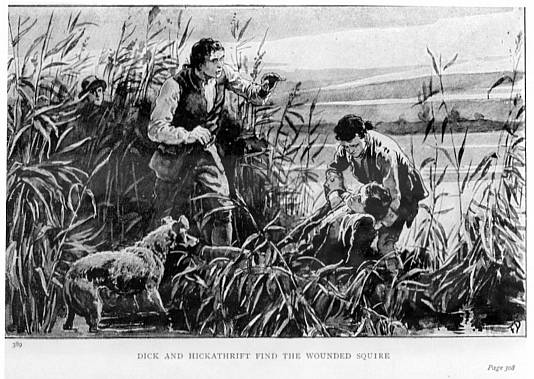
Dick turned pale; the wheelwright ran down to the edge of the mere; and as the dog stood by the water barking loudly, Hickathrift waded in without hesitation, the boys following, with Grip swimming and snorting at their side, and taking up the chase again as soon as he reached the reeds.
It was only a matter of minutes now before the dog had rushed on before them, disappeared in the long growth, and then they heard him barking furiously.
“Let me go first, Mester Dick,” said Hickathrift hoarsely. “Nay, don’t, lad.”
There was a kindly tone of sympathy in the great fellow’s voice, but Dick did not give way. He splashed on through the reeds, his position having placed him in advance of his companions, and parting the tall growth he uttered a cry of pain.
The others joined him directly, and stood for a moment gazing down at where, standing on the very edge of the mere, Dick was holding up his father’s head from where he lay insensible among the reeds, his face white and drawn, his eyes nearly closed, and his hands clenched and stretched out before him.
Hickathrift said not a word, but, as in similar cases before, he raised the inanimate form, hung it over his shoulder, and waded back to firm ground.
“Hey, Mester Dick,” he said huskily, as he hurried towards his cottage, “I nivver thowt to hev seen a sight like this.”
“No, no,” cried Dick; “not there.”
“Yes, I’ll tak’ him home to my place,” whispered Hickathrift. “You’d scare your mother to dead. Here, Jacob, lad, don’t stop to knock or ask questions, but go and tak’ squire’s cob, and ride him hard to town for doctor.”
“Tell my father as you go by, Jacob,” cried Tom excitedly; and as the apprentice dashed off, Tom’s eyes met those of Dick.
“Don’t look so wild and strange, Dick, old chap,” whispered the lad kindly; and he laid a hand upon Dick’s shoulder, but the boy shrank from him with a shudder which the other could not comprehend.
Hickathrift shouted to his wife, who had risen and dressed in his absence, and in a short time the squire was lying upon a mattress with Hickathrift eagerly searching for the injury which had laid him low; but when he found it, the wound seemed so small and trifling that he looked wondering up at Dick.
“That couldn’t have done it,” he said in a whisper.
The wheelwright was wrong. That tiny blue wound in the strong man’s chest had been sufficient to lay him there helpless, and so near death that a feeling of awe fell upon those who watched and waited, and tried to revive the victim of this last outrage.
It was a terrible feeling of helplessness that which pervaded the place. There was nothing to do save bathe the wounded man’s brow and moisten his lips with a little of the smuggled spirit with which most of the coast cottages were provided in those distant days. There was no blood to staunch, nothing to excite, nothing to do but wait, wait for the doctor’s coming.
Before very long Farmer Tallington arrived, and as he encountered Dick’s eyes fixed upon him he turned very pale, and directly after, when he bent over the squire’s couch and took his hand, the lad saw that he trembled violently.
“It’s straänge and horrible—it’s straänge and horrible,” he said: “only yesterday he was like I am: as strong and well as a man can be; while now—Hickathrift, my lad, do you think he’ll die?”
The wheelwright shook his head—he could not trust himself to speak; and Dick stood with a sensation of rage gathering in his breast, which made him feel ready to spring at Farmer Tallington’s throat, and accuse him of being his father’s murderer.
“The hypocrite—the cowardly hypocrite!” he said to himself; “but we know now, and he shall be punished.”
The boy’s anger was fast growing so ungovernable that he was about to fly out and denounce his school-fellow’s father, but just then a hasty step was heard outside, and a familiar voice exclaimed:
“Where is my husband?”
The next minute Mrs Winthorpe was in the room, wild-eyed and pale, but perfectly collected in her manner and acts.
“How long will it be before the doctor can get here?” she said hoarsely, as she passed her arm under the injured man’s neck, and pressed her lips to his white brow.
“Hickathrift’s lad went off at a hard gallop,” said Farmer Tallington in a voice full of sympathy. “Please God, Mrs Winthorpe, we’ll save him yet.”
Dick uttered a hoarse cry and staggered out of the room, for the man’s hypocrisy maddened him, and he knew that if he stayed he should speak out and say all he knew.
As he reached the little garden there was a step behind him, a hand was laid upon his shoulder, another grasped his arm.
“I can’t talk and say things, Dicky,” said Tom in a low half-choking voice; “but I want to comfort you. Don’t break down, old fellow. The doctor will save his life.”
This from the son of the man whom he believed to have shot his father! and the rage Dick felt against the one seemed to be ready to fall upon the other. But as his eyes met those of his old school-fellow and companion full of sorrowful sympathy, Dick could only grasp Tom’s hands, feeling that he was a true friend, and in no wise answerable for his father’s sins.
“Ay, that’s right,” said a low, rough voice. “Nowt like sticking together and helping each other in trouble. Bud don’t you fret, Mester Dick. Squire’s a fine stark man, and the missus has happed him up waärm, and you see the doctor will set him right.”
“Thank you, Hicky,” said Dick, calming down; and then he stood thinking and asking himself how he could denounce the father of his old friend and companion as the man who, for some hidden reason of his own, was the plotter and executor of all these outrages.
At one moment he felt that he could not do this. At another there was the blank suffering face of his father before his eyes, seeming to ask him to revenge his injuries and to bring a scoundrel to justice.
For a time Dick was quite determined; but directly after there came before him the face of poor, kind-hearted Mrs Tallington, who had always treated him with the greatest hospitality, while, as he seemed to look at her eyes pleading upon her husband’s behalf, Tom took his hand and wrung it.
“I’m going to stick by you, Dick,” he said; “and you and I are going to find out who did this, and when we do we’ll show him what it is to shoot at people, and burn people’s homesteads, and hough their beasts.”
Dick gazed at him wildly. Tom going to help him run his own father down and condemn him by giving evidence when it was all found out! Impossible! Those words of his old companion completely disarmed him for the moment, and to finish his discomfiture, just then Farmer Tallington came out of the cottage looking whiter and more haggard than before.
He came to where the wheelwright was standing, and spoke huskily.
“I can’t bear it,” he said. “It is too horrible. Might hev been me, and what would my poor lass do? Hickathrift, mun, the villain who does all this must be found out.”
“Ay, farmer, but how?”
“I don’t know how,” said the farmer, gazing from one to the other. “I on’y know it must be done. If I’d gone on this morning I might have found out something, but I went back.”
Dick gazed at him searchingly, but the farmer did not meet his eyes.
“I’ve been straänge and fidgety ever since my fire,” continued the farmer; “and it’s med me get out o’ bed o’ nights and look round for fear of another. I was out o’ bed towards morning last night, and as I looked I could see yonder on the mere what seemed to be a lanthorn.”
“You saw that?” said Dick involuntarily.
“Ay, lad, I saw that,” said the farmer, rubbing his hands together softly; “and first of all I thowt it was a will-o’-the-wisp, but it didn’t go about like one o’ they, and as it went out directly and came again, I thought it was some one wi’ a light.”
“What, out on the watter?” said Hickathrift.
“Yes, my lad; out on the watter,” said the farmer; “and that med me say to mysen: What’s any one doing wi’ a light out on the watter at this time? and I could on’y think as they wanted it to set fire to some one’s plaäce, and I couldn’t stop abed and think that. So I got up, and went down to the shore, got into my owd punt, and loosed her, and went out torst wheer I’d seen the light.”
“And did you see it, mester?” said Hickathrift.
“Nay, my lad. I went on and on as quietly as I could go, and round the reed-bed, but all was as quiet as could be.”
“Didn’t you see the poont?” said the wheelwright.
“What punt?” said Tom sharply.
Hickathrift looked confused.
“Poont o’ him as hed the light, I meant,” he said hurriedly.
“Nay, not a sign of it,” said Farmer Tallington; “and at last I turned back and poled gently home, keeping a sharp look-out and listening all the way, but I niver see nowt nor heered nowt. But if I’d kept out on the waiter I should p’raps have seen and saved my poor owd neighbour.”
“You might, mebbe,” said the wheelwright thoughtfully; while, after gazing in the faces of the two men and trying to read the truth, Dick turned away with his suspicions somewhat blunted, to go to his mother’s side, and watch with her till the sound of hoofs on the rough track told that the messenger had returned.
Chapter Twenty.
The Doctor’s Dictum.
Dick leaped up and came to the window as soon as he heard the beating of the horse’s hoofs; and to his great joy, as the mounted man turned the corner he saw that it was the doctor, whom he ran down to meet.
“Hah, my lad! here is a bad business!” exclaimed the doctor as he dismounted. “Well, come, they cannot say this was your doing. You wouldn’t shoot your own father, eh?”
“Oh, pray, come up, sir, and don’t talk,” cried Dick excitedly. “Poor father is dying!”
“Oh, no,” said the doctor; “we must not let him die.”
“But be quick, sir! You are so long!” cried Dick.
“Don’t be impatient, my lad,” said the doctor smiling. “We folks have to be calm and quiet in all we do. Now show me the way.”
Dick led him to the room, the doctor beckoning Hickathrift to follow; and as soon as he reached the injured man’s side he quietly sent Mrs Winthorpe and Dick to wait in the next room, retaining the great wheelwright to help him move his patient.
The time seemed interminable, and as mother and son sat waiting, every word spoken in the next room sounded like a moan from the injured man. Mrs Winthorpe’s face appeared to be that of a woman ten years older, and her agony was supreme; but like a true wife and tender mother—ah, how little we think of what a mother’s patience and self-denial are when we are young!—she devoted her whole energies to administering comfort to her sorely-tried son.