"Dick o' the Fens" (continued 5)
Reading edition
“Might have showed us something about the Warren,” said Dick in an ill-used tone; “but never mind, there isn’t much to see.”
He turned to go back to the boat.
“I say, Hicky,” he said; “let’s go and see Dave. You won’t mind poling?”
“He says I won’t mind poling, Mester Marston,” said Hickathrift with a chuckle. “Here, come along.”
John Warren had disappeared into the cottage, but as they walked away some of the rabbits came to the mouths of their holes and watched their departure, while Snig, who could not leave his master’s property, uttered a valedictory bark from time to time.
“I say, Mr Marston,” cried Dick, pausing, “isn’t he a little beauty, to have such a master! Look at him watching that food, and not touching it. Wait a minute!”
Dick ran back to the dog and stooped down to open a cloth, when the faithful guard began to snarl at him and show his teeth.
“Why, you ungrateful beggar!” cried Dick; “I was going to give you a bit of the chicken. Lie down, sir!”
But Snig would not lie down. He only barked the more furiously.
“Do you want me to kick you?” cried Dick.
Snig evidently did, for not only did he bark, but he began to make charges at the visitor’s legs so fiercely that Dick deemed it prudent to stand still for a few moments.
“Now, then,” he said, as the dog seemed to grow more calm; “just see if you can’t understand plain English!”
The dog looked up at him and uttered a low whine, accompanying it by a wag of the tail.
“That’s better!” cried Dick. “I’m going to pull you off a leg of that chicken for yourself. Do you understand?”
Snig gave a short, friendly bark.
“Ah, now you’re a sensible dog,” said Dick, stooping down to pick up the cloth in which the chicken was wrapped; but Snig made such a furious onslaught upon him that the boy started back, half in alarm, half in anger, and turned away.
“Won’t he let you touch it, Mester Dick?” chuckled Hickathrift.
“No; and he may go without,” said Dick. “Come along!”
They returned to the boat, Snig giving them a friendly bark or two as they got on board; and directly after, with lusty thrusts, the wheelwright sent the punt along in the direction of Dave’s home.
The evening was still beautiful, but here and there little patches of mist hung over the water, and the rich glow in the west was fast fading out.
“I say, Mr Marston,” said Dick, “you’ll stay at our place to-night?”
“No; I must go home, thank you,” was the reply.
“But it will be so late!”
“Can’t help that, Dick. I want to be out early with the men. They came upon a great tree trunk this afternoon, and I want to examine it when it is dug out. Is that Decoy Dave’s place?”
“That’s it, and there’s Chip!” cried Dick, as the boat neared the shore. “You see how different he’ll be!”
Dick was right in calling attention to the dog’s welcome, for Chip’s bark was one of delight from the very first, and dashing down to the water, he rushed in and began swimming rapidly to meet them.
“Why, Chip, old doggie!” cried Dick, as, snorting and panting with the water he splashed into his nostrils, the dog came aside, and after being lifted into the boat gave himself a shake, and then thrust his nose into every hand in turn. “This is something like a dog, Mr Marston!” continued Dick.
“Yes; but he would behave just the same as the other,” said the engineer.
“Here’s Dave,” said Dick. “Hoy, Dave!”
The decoy-man came slowly down toward the shore to meet them, and waved his hand in answer to Dick’s call.
“Oh, I am sorry!” cried the latter. “I wish I’d brought him something too. I daresay he’s as bad as John Warren.”
Dave’s appearance proved the truth of Dick’s assertion. The decoy-man never looked healthy, but now he seemed ghastly of aspect and exceedingly weak, as he leaned upon the tall staff he held in his hand.
“We’ve come to see how you are, Dave,” cried Dick as the boat bumped up against the boggy edge of the landing-place.
“That’s kindly, Mester Dick. Servant, mester. How do, neighbour?”
Dave’s head went up and down as if he had a hinge at the back; and as the party landed, he too shivered and looked exceedingly feverish and ill.
“Why, Dave, my man, you ought to see a doctor!” said Mr Marston, kindly.
“Nay, sir, no good to do ought but bear it. Soon be gone. Only a shivering fit.”
“Well, I’m trying to doctor you,” said the engineer, laughing. “Once we get the fen drained, ague will begin to die out.”
“Think so, mester?”
“I am sure so.”
“Hear that, neighbour?” said Dave, looking at Hickathrift. “Think o’ the fen wi’out the shakes.”
“We can’t stop, Dave,” cried Dick; “because we’ve got to get home, for Mr Marston to walk over to the sea-bank to-night; but I’ll come over and see you to-morrow and bring you something. What would you like?”
“What you heven’t got, Mester Dick,” said the fen-man, showing his yellow teeth. “Bit of opium or a drop o’ lodolum. Nay, I don’t want you to send me owt. Neighbour Hick’thrift here’ll get me some when he goes over to market.”
Hickathrift nodded, and after a little more conversation the party returned toward the boat.
“Straänge and thick to-night, Mester Dick,” said Dave. “Be thicker soon. Yow couldn’t pole the boat across wi’out losing your way.”
“Couldn’t I?” cried Dick. “Oh, yes, I could! Good-night! I want you to show Mr Marston some sport with the ducks some day.”
“Ay; you bring him over, Mester Dick, and we’ll hev’ a good turn at the ’coy. Good-night!”
They pushed off, and before they were fifty yards from the shore the boat seemed to enter a bank of mist, so thick that the wheelwright, as he poled, was almost invisible from where Mr Marston and Dick were seated.
“I say, Hicky, turn back and let’s go along the edge of the fog,” cried Dick.
“Nay, it’s driftin’ ower us,” replied the wheelwright. “Best keep on and go reight through.”
“Go on, then,” cried Dick. “Feel how cold and damp it is.”
“Feel it, Dick? Yes; and right in my wounded arm.”
“Does it hurt much?”
“No; only aches. Why, how dense it is!”
“Can you find your way?”
“Dunno, mester. Best keep straight on, I think. Dessay it’ll soon pass over.”
But it did not soon pass over; and as the wheelwright pushed on it seemed to be into a denser mist than ever.
For a long time they were going over perfectly clear water; but soon the rustling of reeds against the prow of the boat told that they must be going wrong, and Hickathrift bore off to the right till the reeds warned him to bear to the left. And so it went on, with the night falling, and the thick mist seeming to shut them in, and so confusing him that at last the wheelwright said:
“Best wait a bit, Mester Dick. I dunno which way I’m going, and it’s like being blind.”
“Here, let me have the pole!” cried Dick. And going to the front of the boat, the wheelwright good-humouredly gave way for him, with the result that the lad vigorously propelled the craft for the space of about ten minutes, ending by driving it right into a reed-bed and stopping short.
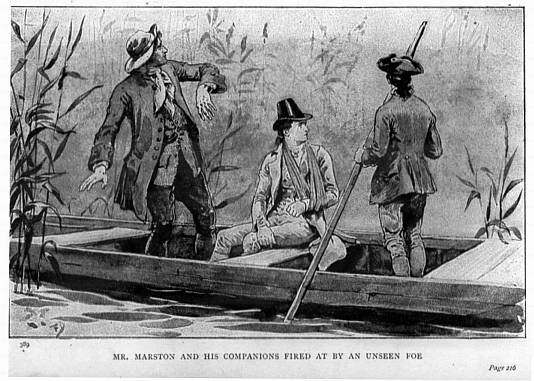
“Oh, I say, here’s a muddle!” he cried. “You can’t see where you are going in the least.”
“Shall I try?” said Mr Marston.
“Yes, do, please,” cried Dick, eager to get out of his difficulty. “Take the pole.”
“No, thank you,” was the laughing reply. “I cannot handle a pole, and as to finding my way through this fog I could as soon fly.”
Bang!
A heavy dull report of a gun from close by, and Hickathrift started aside and nearly went overboard, but recovered himself, and sat down panting.
“Here! hi! Mind where you’re shooting!” cried Dick. “Who’s that?”
He stared in the direction from which the sound had come, but nothing but mist was visible, and no answer came.
“Do you hear? Who’s that?” shouted Dick with both his hands to his mouth.
No answer came, and Hickathrift now shouted.
Still no reply. His great sonorous voice seemed to return upon him, as if he were enveloped in a tremendous tent of wet flannel; and though he shouted again and again it was without result.
“Why, what’s the matter with your hand, man?” cried Mr Marston, as the wheelwright took his cotton kerchief from his neck, and began to bind it round his bleeding palm.
“Nowt much, sir,” said the man smiling.
“Why, Hickathrift, were you hit?”
“S’pose I weer, sir. Something came with a whuzz and knocked my hand aside.”
“Oh!” ejaculated Dick; while Mr Marston sat with his heart beating, since in spite of his efforts to be cool he could not help recalling the evening when he was shot, and he glanced round, expecting to see a flash and hear another report.
Dick seized the pole which he had laid down, and, thrusting it down, forced the punt back from the reeds, and then, as soon as they were in open water, began to toil as hard as he could for a few minutes till the wheelwright relieved him. Declaring his injury to be a trifle, he in turn worked hard with the pole till, after running into the reeds several times, and more than once striking against patches of bog and rush, they must have got at least a mile from where the shot was fired, by accident or purposely, when the great fellow sat down very suddenly in the bottom of the boat.
As he seated himself he laid the pole across, and then without warning fell back fainting dead away.
A few minutes, however, only elapsed before he sat up again and looked round.
“Bit sick,” he said. “That’s all. Heven’t felt like that since one o’ squire’s horses kicked me and broke my ribs. Better now.”
“My poor fellow, your hand must be badly hurt!” said Mr Marston; while Dick looked wildly on, scared by what was taking place.
“Nay, it’s nowt much, mester,” said the great fellow rather huskily, “and we’d best wait till the mist goes. It’s no use to pole. We may be going farther away, like as not.”
Dick said nothing, but stood listening, fancying he heard the splash of a pole in water; but there was no sound save the throbbing of his own heart to break the silence, and he quite started as Mr Marston spoke.
“How long is this mist likely to last?”
“Mebbe an hour, mebbe a week,” was the unsatisfactory reply. “Bud when the moon rises theer may come a breeze, and then it’ll go directly.”
Hickathrift rested his chin upon his uninjured hand, and Dick sat down in silence, for by one consent, and influenced by the feeling that some stealthy foe might be near at hand keen-eyed enough to see them through the fog, or at all events cunning enough to trace them by sound, they sat and waited for the rising of the moon.
The time seemed to be drawn out to a terrible extent before there was a perceptible lightening on their left; and as soon as he saw that, though the mist was as thick as ever, Hickathrift rose and began to work with the pole, for he knew his bearings now by the position of the rising moon, and working away, in half an hour the little party emerged from the mist as suddenly as they had dived in, but they were far wide of their destination, and quite another hour elapsed before they reached the old willow-stump, where the wheelwright made fast his boat, and assuring his companions that there was nothing much wrong he went to his cottage, while Mr Marston gladly accompanied Dick to the Toft, feeling after the shock they had had that even if it had not been so late, a walk down to the sea-beach that night would neither be pleasant nor one to undertake.
Dick was boiling over with impatience, and told his father the news the moment they entered the room where supper was waiting.
“A shot from close by!” cried the squire, excitedly.
“Yes, Mr Winthorpe,” said the engineer; “and I’m afraid, greatly afraid, it was meant for me.”
Chapter Fourteen.
Hicky’s Opinions.
“Nay, lads, I don’t say as it weer the will-o’-the-wisps, only as it might have been.”
“Now, Hicky,” cried Dick, “who ever heard of a will-o’-the-wisp with a gun?”
“Can’t say as ever I did,” said the wheelwright; “but I don’t see why not.”
“What stuff! Do you hear what he says, Tom? He says it may have been one of the will-o’-the-wisps that shot and broke his finger.”
“A will-o’-the-wisp with a gun!” cried Tom. “Ha! ha! ha!”
“Why shouldn’t a will hev a goon as well as a lanthorn?” said Hickathrift, stolidly.
“Why, where would he get his powder and shot?” said Dick.
“Same place as he gets his candle for his lanthorn.”
“Oh, but what nonsense! The will-o’-the-wisp is a light that moves about,” cried Dick. “It is not anybody.”
“I don’t know so much about that,” said the wheelwright, lifting up his bandaged hand. “All I know is that something shot at me, and broke my finger just the same as something shot at Mester Marston. They don’t like it, lads. Mark my words, they don’t like it.”
“Who don’t like what?” said Tom.
“Will-o’-the-wisps don’t like people cootting big drains acrost the fen, my lads. They don’t mind you fishing or going after the eels with the stong-gad; but they don’t like the draining, and you see if it don’t come to harm!”
“Nonsense!” cried Dick. “But I say, Hicky, you are so quiet about it all, did you see who it was shot at you?”
The big wheelwright looked cautiously round, as if in fear of being overheard, and then said in a husky whisper:
“Ay, lads, I seen him.”
“What was he like, Hicky?” said Tom, who suffered a peculiar kind of thrill as the wheelwright spoke.
“Somethin’ between a big cloud, shape of a man, and a flash of lightning with a bit o’ thunder.”
“Get out!” roared Dick. “Why, he’s laughing at us, Tom.”
“Nay, lads, I’m not laughing. It’s just what I seemed to see, and it ’most knocked me over.”
“It’s very queer,” said Dick thoughtfully. “But I say, Hicky, what did the doctor say to your hand? Will it soon get well?”
“Didn’t go to the doctor, lad.”
“Why, what did you do then?”
“Went to old Mikey Dodbrooke, the bone-setter.”
“What did you go to him for?”
“Because it’s his trade. He knows how to mend bones better than any doctor.”
“Father says he’s an old sham, and doesn’t understand anything about it,” said Dick. “You ought to have gone to the doctor, or had him, same as Mr Marston did.”
“Tchah!” ejaculated Hickathrift. “Why, he had no bones broken. Doctors don’t understand bone-setting.”
“Who says so?”
“The bone-setter.”
“Well, is it getting better, Hicky?”
“Oh yes! It ar’n’t very bad. Going down to the drain?”
“Yes. Mr Marston’s found a curious great piece of wood, and the men are digging it out.”
“Don’t stop late, my lads,” said the wheelwright, anxiously. “I wouldn’t be coming back after dark when the will-o’-the-wisps is out.”
“I don’t believe all that stuff, Hicky,” said Dick. “Father says—”
“Eh! What does he say?” cried the wheelwright, excitedly.
“That he thinks it’s one of Mr Marston’s men who has a spite against him, and that when there was that shot the other night, it was meant for the engineer.”
“Hah! Yes! Maybe,” said the wheelwright, drawing a long breath and looking relieved. “But I wouldn’t stop late, my lads.”
“We shall stop just as long as we like, sha’n’t we, Tom?”
“Yes.”
“Then I shall come and meet you, my lads. I sha’n’t be happy till I see you back safe.”
“I say, Hicky, you’ve got a gun, haven’t you?” said Tom.
“Eh! A goon!” cried the wheelwright, starting.
“Yes; you’ve got one?”
“An old one. She’s roosty, and put awaya. I heven’t hed her out for years.”
“Clean it up, and bring it, Hicky,” said Dick. “We may get a shot at something. I say, you’d lend me that gun if I wanted it, wouldn’t you?”
“Nay, nay; thou’rt not big enew to handle a goon, lad. Wait a bit for that.”
“Come along, Tom!” cried Dick. “And I say, Hicky, bring the forge-bellows with you, so as we can blow out the will’s light if he comes after us.”
“Haw—haw—haw—haw!” rang out like the bray of a donkey with a bad cold; and Jacob, Hickathrift’s lad, threw back his head, and roared till his master gave him a sounding slap on the back, and made him close his mouth with a snap, look serious, and go on with his work.
“Jacob laughs just like our old Solemn-un, sometimes,” said Dick merrily. “Come along!”
The morning was hot, but there was a fine brisk breeze from off the sea, and the lads trudged on, talking of the progress of the drain, and the way in which people grumbled.
“Father says that if he had known he wouldn’t have joined the adventure,” said Tom.
“And my father says, the more opposition there is, the more he shall go on, for if people don’t know what’s good for them they’ve got to be taught. There’s a beauty!”
Dick went off in chase of a swallow-tail butterfly—one of the beautiful insects whose home was in the fens; but after letting him come very close two or three times, the brightly-marked creature fluttered off over the treacherous bog, a place of danger for followers, of safety for the insect.
“That’s the way they always serve you,” said Dick.
“Well, you don’t want it.”
“No, I don’t want it. Yes I do. Mr Marston said he should like a few more to put in his case. I say, they are getting on with the drain,” Dick continued, as he shaded his eyes and gazed at where, a mile away, the engineer’s men were wheeling peat up planks, and forming a long embankment on either side of the cutting through the fen.
“Can you see Mr Marston from here?”
“Why, of course not! Come along! I say, Tom, you didn’t think what old Hicky said was true, did you?”
“N–n–no. Of course not.”
“Why, you did. Ha—ha—ha! That’s what father and Mr Marston call superstition. I shall tell Mr Marston that you believe in will-o’-the-wisps.”
“Well, so do you. Who can help believing in them, when you see them going along over the fen on the soft dark nights!”
“Oh, I believe in the lights,” said Dick, “but that’s all I don’t believe they shot Mr Marston and old Hicky; that’s all stuff!”
“Well, somebody shot them, and my father says it ought to be found out and stopped.”
“So does mine; but how are you going to find it out? He thinks sometimes it’s one and sometimes another; and if we wait long enough, my gentleman is sure to be caught.”
“Ah, but is it a man?”
“Why, you don’t think it’s a woman, do you?”
“No, of course not; but mightn’t it be something—I mean one of the—well, you know what I mean.”
“Yes, I know what you mean,” cried Dick—“a ghost—a big tall white ghost, who goes out every night shooting, and has a will-o’-the-wisp on each side with a lantern to show him a light.”
“Ah, it’s all very well for you to laugh now out in the sunshine; but if it was quite dark you wouldn’t talk like that.”
“Oh yes, I should!”
“I don’t believe it,” said Tom; “and I’ll be bound you were awfully frightened when Hicky was shot. Come, tell the truth now—weren’t you?”
“There goes a big hawk, Tom. Look!” cried Dick, suddenly becoming interested in a broad-winged bird skimming along just over the surface of the fen; and this bird sufficed to change the conversation, which was getting unpleasant for Dick, till they came to the place where the men were hard at work on the huge ditch, the boggy earth from which, piled up as it was, serving to consolidate the sides and keep them from flooding the fen when the drain was full, and the high-tide prevented the water from coming out by the flood-gates at the end.
Mr Marston welcomed the lads warmly.
“I’ve got a surprise for you,” he said.
“What is it—anything good?” cried Dick.
“That depends on taste, my boy. Come and see.”
He led the way along the black ridge of juicy peat, to where, in an oblique cutting running out from the main drain, a dozen men were at work, with their sharp spades cutting out great square bricks of peat, and clearing away the accumulations of hundreds of years from the sides of what at first appeared to be an enormous trunk of a tree, but which, upon closer inspection, drew forth from Dick a loud ejaculation.
“Why, it’s an old boat!” cried Tom.
“That it is, my lad.”
“But how did it come there?” cried Dick, gazing wonderingly at the black timber of the ancient craft.
“Who can tell, Dick? Perhaps it floated out of the river at some time when there was a flood, and it was too big to move back again, and the people in the days when it was used did not care to dig a canal from here to the river.”
“Half a mile,” said Dick.
“No, no. Not more than a quarter.”
“But it doesn’t look like a fishing-boat,” said Dick.
“No, my lad. As far as I can make out, it is the remains of an old war galley.”
“Then it must have belonged to the Danes.”
“Danes or Saxons, Dick.”
“But the wood’s sound,” cried Tom. “It can’t be so old as that.”
“Why not, Tom? Your people dig out pine-roots, don’t they, perfectly sound, and full of turpentine? This is pine wood, and full of turpentine too.”
“But it’s such a while since the Danes and Saxons were here, Mr Marston,” said Tom.
“A mere yesterday, my lad, compared to the time when the country about here was a great pine and birch forest, before this peat began to form.”
“Before the peat began to form!”
“To be sure! Pine and birch don’t grow in peaty swamps, but in sandy ground with plenty of gravel. Look all about you at the scores of great pine-roots my men have dug out. They are all pine, and there must have been quite a large forest here once.”
“And was that farther back?”
“Perhaps thousands of years before the Danes first landed. The peat preserves the wood, Tom. Bog is not rotten mud, but the decayed masses that have grown in the watery expanse. Well, Dick, what do you think of it?”
“I wish we could get it home to our place to keep as a curiosity?”
“But it would want a shed over it, my lad, for the rain, wind, and sun would soon make an end of it.”
“Then, what are you going to do?”
“Get it out and up that slope they are cutting, along some planks if we can, and then fill up the trench.”
The lads inspected the curious-looking old hull, whose aspect seemed to bring up recollections of the history of early England, when fierce-looking men, half sailors, half warriors, came over from the Norland in boats like this, propelled by great oars, and carrying a short thick mast and one sail. All the upper portions had rotted away, but enough of the hull remained to show pretty well what its shape must have been, and that it had had a curiously-projecting place that must have curved out like the neck of a bird, the whole vessel having borne a rough resemblance to an elongated duck or swan.
The boys were, however, by no means so enthusiastic as the engineer; and as a great figure came looming up behind them, Dick was ready enough to welcome the incident of the man’s reminder about the disturbance at the Toft.
“We’re mates, we are,” cried the great fellow, holding out his broad hairy hand to take Dick’s in his grasp, and shake it steadily up and down. “I heven’t forgot, I heven’t forgot.”
“Are you all right again, Bargle?” said Dick, trying in vain to extricate his hand.
“Yeees. Knock o’ the yead don’t hot me. See here.”
He slowly drew out of his pocket a great piece of dark-yellow ivory, evidently the point, and about a foot in length, of the tusk of some animal, probably an elephant.
“Theer’s what I promised you, lad. That’s a tush, that is. What yer think o’ that?”
Dick did not seem to know what to think of it, but he expressed his gratitude as well as he could, and had to shake hands again and again with the great fellow, who seemed to take intense delight in smiling at Dick and shaking his head at him.
How long this scene would have lasted it is impossible to say; but at last, as it was growing irksome, there came a shout from the end of the drain.
“They’ve found something else,” said Mr Marston; and the lads needed no telling to hasten their steps, for the finding of something buried in the peat could not fail to prove interesting; but in this case the discovery was startling to the strongest nerves.
As they neared the end of the drain where the men were slowly delving out the peat, and a section of the bog was before them showing about twelve feet of, the wet black soil, Mr Marston stepped eagerly forward, and the group of men who were standing together opened out to let him and his companions pass through.
Dick shuddered at the object before him: the figure of a man clothed apparently in some kind of leather garb, and partly uncovered from the position it had occupied in the peat.
“Some un been murdered and berrid,” growled Bargle, who was close behind.
“No, my man,” said Mr Marston, taking a spade and cutting down some more of the turf, so as to lay bare the figure from the middle of the thigh to the feet.
“Lemme come,” growled Bargle, striding forward and almost snatching the sharp spade from his leader’s hand.
“Don’t hurt it,” cried Mr Marston, giving way.
“Nay, no fear o’ hotting him,” growled Bargle, grinning, and, bending to his work, he deftly cut away the black peat till the figure stood before them upright in the bog as if fitted exactly in the face of the section like some brownish-black fossil of a human being.
It was the figure of a man in a leather garb, and wearing a kind of gaiters bound to the legs by strips of hide which went across and across from the instep to far above the knee. There was a leathern girdle about the waist, and one hand was slightly raised, as if it had held a staff or spear, but no remains of these were to be seen. Probably the head had once been covered, but it was bare now, and a quantity of long shaggy hair still clung to the dark-brown skin, the face being half covered by a beard; and, in spite of the brown-black leathery aspect of the face, and the contracted skin, it did not seem half so horrible as might have been supposed.
“Why, boys,” said Mr Marston after a long examination, “this might be the body of someone who lived as long back as the date when that old galley was in use.”
“So long back as that!” cried Dick, looking curiously at the strange figure, whose head was fully six feet below the surface of the bog.
“Got a-walking across in the dark, and sinked in,” said Bargle gruffly.
That might or might not have been the case. At any rate there was the body of a man in a wonderful state of preservation, kept from decay by the action of the peat; and, judging from the clothing, the body must have been in its position there for many hundred years.
“What’s got to be done now?” said Bargle. “We want to get on.”
Mr Marston gave prompt orders, which resulted in a shallow grave being dug in the peat about fifty yards from where the drain was being cut, and in this the strange figure was carefully laid, ready for exhumation by any naturalist who should wish to investigate farther; and after this was done, and a careful search made for remains of weapons or coins, the cutting of the drain progressed; till, after an enjoyable day with the engineer, the boys said good-bye, and tried to escape without having to shake hands with Bargle.
But this was not to be. The big fellow waylaid them, smiling and holding out his hand to Dick for a farewell grip, and a declaration that they were mates.
About half-way back, and just as it was growing toward sundown, they were met by Hickathrift, who came up smiling, and looking like a Bargle carefully smoothed down.
“Thought I’d see you safe back,” said Hickathrift so seriously that a feeling of nervousness which had not before existed made the boys glance round and look suspiciously at a reed-bed on one side and a patch of alders on the other.
“What are you talking like that for?” cried Dick angrily; “just as if we couldn’t walk along here and be quite safe! What is there to mind?”
The wheelwright shook his head and looked round uneasily, as if he too felt the influence of coming danger; but no puff of smoke came from clump of bushes or patch of reeds; no sharp report rose from the alders that fringed part of the walk, and they reached the wheelwright’s cottage without adventure.
Here Hickathrift began to smile in a peculiar way, and, having only one hand at liberty, he made use of it to grip Dick by the arm, and use him as if he were an instrument or tool for entrapping Tom, with the result that he packed them both into his cottage, and into the presence of his wife, who was also smiling, as she stood behind a cleanly-scrubbed table, upon which was spread a tempting-looking supper.
“Here, Hicky, don’t! What do you mean?” cried Dick, whom the great fellow’s grip punished.
“Wittles,” said the wheelwright, indulging in a broad grin.
“Oh, nonsense! We’re off home. Tom Tallington’s going to have supper with me.”
“Nay, he’s going to hev his supper here along o’ uz,” said Hickathrift. “Didn’t I say, missus, I’d bring ’em home?”
“Yes, Mester Dick,” cried Mrs Hickathrift; “and thank ye kindly, do stop.”
“Oh, but we must get back!” cried Dick, who shrank from partaking of the wheelwright’s kindly hospitality.
“Theer, I towd you so,” cried Mrs Hickathrift to her husband, and speaking in an ill-used tone. “They’re used to table-cloths, and squire’s wife’s got silver spoons.”
“Nay, nay, never mind the cloths and spoons, Mester Dick; stop and have a bite.”
“But, Hicky—”
“Nay, now,” cried the wheelwright interrupting; “don’t thee say thou’rt not hungry.”
“I wasn’t going to,” said Dick, laughing, “because I am horribly hungry. Aren’t you, Tom?”
Tom showed his teeth. It was meant for a smile, but bore a wonderful resemblance to a declaration of war against the food upon the table.
“Don’t be proud, then, lad. Stop. Why, you nivver knew me say I wouldn’t when I’ve been at your place.”
That appeal removed the last objection, and the boys took off their caps, sat down with the wheelwright, and Mrs Hickathrift, according to the custom, waited upon them.
It is unnecessary to state what there was for supper, and how many times Dick and Tom had their plates replenished with—never mind what—and—it does not signify. Suffice it to say that for the space of half an hour the wheelwright’s wife was exceedingly busy; and when at the end of an hour the trio rose from the table, and Hickathrift filled his pipe, both of his visitors seemed as if they had gone through a process of taming. For though a boy—a hearty boy in his teens—living say anywhere, can, as a rule, eat, in the exception of boys of the old fen-land, where the eastern breezes blow right off the German Ocean, they were troubled with an appetite which was startling, and might have been condemned but for the fact that it resulted in their growing into magnificent specimens of humanity, six feet high not being considered particularly tall.
It was quite late when the boys reached the Toft, to find the squire standing outside smoking his pipe and waiting for them.
“Where have you been, lads?” he said; and on being told, he uttered a good-humoured grunt, and laying his hand upon Tom’s shoulder, “Here,” he said, “you’d better stop with Dick to-night. They won’t be uneasy at home?”
“No, sir,” said Tom naïvely; “I told father perhaps I should stay.”
“Oh, you did, eh!” said the squire. “Well, you’re welcome. If you don’t want any supper, you’d better be off to bed.”
Both lads declared that they did not want any supper, but Mrs Winthorpe had made certain preparations for them which they could not resist, and something very like a second meal was eaten before they retired for the night.
As a rule, when one boy has a visitor for bed-fellow, it is some time before there is peace in that room. Set aside unruly demonstrations whose effects are broken pillowcase strings, ruptured bolsters, and loose feathers about the carpet, if nothing worse has happened in the way of broken jugs and basins, there is always something else to say at the end of the long conversation upon the past day’s occurrences or the morrow’s plans.
But in this instance it was doubtful whether Dick fell asleep in the act of getting into bed, or whether Tom was nodding as he undressed; suffice it that the moment their heads touched pillows they were fast asleep, and the big beetle which flew in at the open window and circled about the room had it all to himself. Now he ground his head against the ceiling, then he rasped his wings against the wall, then he buzzed in one corner, burred in another, and banged himself up against the white dimity curtains, till, seeing what appeared to be a gleam of light in the looking-glass, he swept by the open window, out of which he could easily have passed, and struck himself so heavily against the mirror that he fell on the floor with a pat, and probably a dint in his steely blue armour.
Then came a huge moth, and almost simultaneously a bat, to whirr round and round over the bed and along the ceiling, while from off the dark waters of the fen came from time to time strange splashings and uncouth cries, which would have startled a wakeful stranger to these parts. Now and then a peculiar moan would be heard, then what sounded like a dismal, distant roaring, followed by the cackling of ducks, and plaintive whistlings of ox-birds, oyster-catchers, and sandpipers, all of which seemed to be very busy hunting food in the soft stillness of the dewy night.
But neither splash nor cry awakened the sleepers, who were, like Barney O’Reardon, after keeping awake for a week; when they went to sleep they paid “attintion to it,” and the night wore on till it must have been one o’clock.
The bat and the moth had managed to find their way out of the open window at last, and perhaps out of malice had told another bat and another moth that it was a delightful place in there. At all events another couple were careering about, the moth noisily brushing its wings against wall and ceiling, the bat silently on its fine soft leather wings, but uttering a fine squeak now and then, so thin, and sharp, and shrill that, compared to other squeaks, it was as the point of a fine needle is to that of a tenpenny nail.
The beetle had got over the stunning blow it had received, to some extent, and had carefully folded up and put away its gauzy wings beneath their hard horny cases, deeming that he would be better off and safer if he walked for the rest of the night, and after a good deal of awkward progression he came to the side of the bed.
It was a hot night, and some of the clothes had been kicked off, so that the counterpane on Tom’s side touched the floor. In contact with this piece of drapery the beetle came, and began to crawl up, taking his time pretty well, and finally reaching the bed.
Here he turned to the left and progressed slowly till he reached the pillow, which he climbed, and in a few more moments found himself in front of a cavern in a forest—a curiously designed cavern, with a cosy hole in connection with certain labyrinths.
This hole seemed just of a size to suit the beetle’s purpose, and he proceeded to enter for the purpose of snuggling up and taking a good long nap to ease the dull aching he probably felt in his bruised head.
But, soundly as Tom Tallington slept, the scriggly legs of a beetle were rather too much when they began to work in his ear, and he started up and brushed the creature away, the investigating insect falling on the floor with a sharp rap.
Tom sat listening to the sounds which came through the window and heard the splashing of water in the distance, and the pipings and quackings of the wild-fowl; but as he leaned forward intently and looked through the open window at the starry sky, there were other noises he heard which made him think of sundry occasions at home when he had been awakened by similar sounds.
After a few moments he lay down again, but started up directly, got out of bed, and went to the window to listen.
The next minute he was back at the bed-side.
“Dick,” he whispered, shaking him; “Dick!”
“What is it?”
“There’s something wrong with the horses.”
“Nonsense!”
“There is, I tell you. Sit up and listen.”
“Oh, I say, what a nuisance you are! I was having such a dream!”
Dick sat up and listened, and certainly a sound came from the yard.
He jumped out of bed and went with Tom to the open window, but all was perfectly still round the house, and he was about to return to bed when a dim shadowy-looking creature flew silently across the yard.
Dick uttered a peculiar squeak which was so exactly like that of a mouse that the bird curved round in its flight, came rapidly up toward the window, and hovered there with extended claws, and its great eyes staring from its full round face.
The next moment it was flying silently away, but another shrill squeak brought it back to hover before them, staring in wonder, till, apparently divining that it was being imposed upon, it swooped away.
“What a big owl!” said Tom in a whisper. “There! Hear that?”
Dick did hear that! A low whinnying noise, and the blow given by a horse’s hoof, as if it had stamped impatiently while in pain.
Directly after there was a mournful lowing from the direction of the cow-house, followed by an angry bellow.
“That’s old Billy,” said Dick. “What’s the matter with the things! It’s a hot night, and some kind of flies are worrying them. Here, let’s get to bed.”
He was moving in the direction of the bed; but just then there was another louder whinnying from the lodge where the cart-horses were kept, and a series of angry stamps, followed by a bellow from the bull.
“There is something wrong with the beasts,” said Dick. “I’ll call father. No, I won’t. Perhaps it’s nothing. Let’s go down and see.”
“But we should have to dress.”
“No; only slip on our trousers and boots. You’ll go with me, won’t you?”
“Yes, I’ll go,” said Tom; “but I don’t want to.”
“What! after waking me up to listen!”
“Oh, I’ll go!” said Tom, following his companion’s lead and beginning to dress.
“Tell you what,” said Dick; “we’ll get out of the window and drop down.”
“And how are we to get back?”
“Short ladder,” said Dick laconically. “Come along. Ready?”
“Yes, I’m ready.”
The boys moved to the window, and, setting the example, Dick placed one leg out, and was seated astride the sill, when the bed-room door was suddenly thrown open, and the squire appeared.
“Now, then! What does this mean?” he cried angrily.
“We heard something wrong with the beasts, father, and we were going to see,” cried Dick.
“Heard something wrong with the beasts, indeed! Yes, and I heard something wrong with them. Now, then, both of you jump into bed, and if I hear another sound, I’ll—”
The squire stopped short, for there was a piteous whinny from the stable again.
“There, father! and old Billy’s got something the matter with him too,” cried Dick eagerly, the bull endorsing his statement with a melancholy bellow.
“Why, there is something wrong, then, my boys!” said the squire, angry now with himself for suspecting them of playing some prank. “Here, let’s go down.”
He led the way directly, and lit a lantern in the kitchen before throwing back the bolts and going out, armed with a big stick, the boys following close behind, and feeling somewhat awe-stricken at the strangeness of the proceedings.
“Hullo, my lads, what is it then?” cried the squire, entering the rough stable, where three horses were fastened up, and all half lying in the straw.
One of them turned to him with a piteous whinny, and then the great soft eyes of all three of the patient beasts were turned toward them, the light gleaming upon their eyes strangely.
“Why, what’s this?” cried the squire, holding down the lantern, whose light fell upon the hocks of the poor beasts. “Oh, it’s too cruel! what savage has done this!”
As he held down the light the boys hardly realised what had happened. All they could make out was that the light gleamed horribly on the horses’ hind-legs, and Dick exclaimed:
“Why, they must have been kicking, father, terribly!”
“Kicking, my boy!” groaned the squire. “I wish they had kicked the monster to death who has done this.”
“Done this! Has anybody done this?” faltered Dick, while Tom turned quite white.
“Yes; don’t you understand?”
“No, father,” cried Dick, looking at him vacantly.
“The poor beasts have been houghed—hamstrung by some cruel wretch. Here, quick!”
He hurried across to the lodge where a favourite cow and the bull were tethered, and as he saw that these poor beasts had been treated in the same barbarous way—
“Did you hear or see anyone, Dick?” he cried, turning sharply on his son.
“No, father. I was asleep till Tom woke me, and told me that the beasts were uneasy.”
“It is too cruel, too cruel,” groaned the squire huskily. “What is to happen next? Here, go and call up the men. You, Tom Tallington, go and rouse up Hickathrift. We may be in time to catch the wretches who have done this. Quick, boys! quick! And if I do—”
He did not finish his sentence; but as the boys ran off he walked into the house, to return with his gun, and thus armed he made a hasty survey of the place.
By the time he had done, Dick was back with the men, and soon after, Hickathrift came panting up, with Tom; but though a hot search was carried on for hours, nothing more was found, and by breakfast-time five reports had rung out on the bright morning air, as Squire Winthorpe loaded his old flint-lock gun with a leaden bullet five times, and put the poor helpless suffering brutes out of their misery.
“Three good useful horses, and the best-bred bull and cow in the marsh, squire,” said Farmer Tallington, who had come over as soon as he heard the news. “Any idea who it could be?”
“No,” said the squire; “thank goodness, no. I don’t want to find out the wretch’s name, Tallington, for I’m a hot-tempered, passionate man.”
“It’s the drain, neighbour, the drain,” said the farmer, shaking his head. “Let’s be content with the money we’ve lost, and try to put a stop to proceedings before we suffer more and worse. There’s them about as hev sworn the drain sha’n’t be made, and it’s the same hands that fired my stacks and those shots, neighbour.”
“I daresay it is, farmer,” said the squire sternly; “but do you know what it says in the Book about the man who puts his hand to the plough?”
“Ay, I think I know what you mean.”
“And so do you, Dick?” said the squire.
“Yes, father.”
“Well, my boy, I’ve put my hand to the plough to do a good, honest, sensible work, and, knowing as I do, that it’s a man’s duty to go on with it, I shall stand fast, come what may.”
“And not leave me in the lurch, Mr Winthorpe?” said a voice.
“No, Marston, not if they hamstring me in turn,” cried the squire, holding out his hand to the young engineer, who had hurried over. “I suppose I shall get a bullet in me one of these days; but never mind, we’ve begun the drain. And do you hear, all of you?” he shouted; “spread it about that the fen will be drained, and that if they killed me, and a hundred more who took my place, it would still be done.”
Chapter Fifteen.
The Man of Suspicion.
There was a good deal of inquiry made about the houghing of Squire Winthorpe’s horses, and there was a great deal of excitement before the poor beasts were skinned, for their hides to go to town to the tanyard and their carcasses were carted away.
People came from miles in all directions, including all the men who were at work for Mr Marston—every one to stand and stare at the poor dead beasts and say nothing.
Small farmers, fen-men, people from the town, folk from the shore where the cockle-beds lay, and the fisher-people who were supposed to live upon very little fish and a great deal of smuggling.
Even Dave and John Warren punted themselves over, both looking yellow and thin, and so weak that they could hardly manage their poles; and they too stared, the former frowning at the bull and shaking his head at the horses, but wiping away a weak tear as he stood by the cow.
“Many’s the drop of good fresh milk the missus has given me from her, Mester Dick,” he said with a sigh; “and now theer’s no cow, no milk, no nothing for a poor sick man. Hey, bud the ager’s a sad thing when you hev it bad as this.”
There was a visit from a couple of magistrates, who asked a great many questions, and left behind them a squinting constable, who took very bad snuff, and annoyed Dick by looking at him suspiciously, as if he believed him to be the cause of all the mischief. This man stopped in the village at a cottage next to Hickathrift’s, from which place he made little journeys in all directions, evidently full of the belief that he was going to discover the people who did all this mischief in the neighbourhood.
This constable’s name was Thorpeley, and he did a great deal of business with a brass box and a short black clay-pipe, in which he smoked short black tobacco.
“I don’t know,” said Dick one day as he stood with his arms folded, leaning upon Solomon, talking to Tom Tallington and staring at Thorpeley the constable, who was leaning against a post smoking and staring with one eye at the fen, while with the other he watched the group of three in the Toft farm-yard.
“Well, I’m sure I don’t,” said Tom. “He never goes over to the town to buy any.”
“And Hicky says nobody fetches any for him, but he always seems to have plenty though he hasn’t any luggage or box or anything.”
“No; I saw him come,” said Tom. “He only had a small bundle in a red handkerchief!”
“And he keeps on smoking from morning till night.”
“And watching you!”
“Yes. He’s always watching me,” cried Dick in an aggrieved tone. “Stand still, will you? Yes, you’d better! You kick, and I’ll kick you!”
This was to Solomon, who had hitched up his back in an arch, laid down his ears, thrust his head between his fore-legs and his tail between his hind, giving himself the aspect of being about to reach under and bite the tip of the said tail. But that was not the case, and Dick knew by experience that all this was preparatory to a display of kicking.
Solomon may have understood plain English or he may not. This is a matter which cannot be decided. At all events he slowly raised his head and twisted his tail in a peculiar manner, stretched out his neck, and cocking his ears he sighed loudly a sigh like the fag-end of a long bray, all of which seemed to point to the fact that he felt himself to be a slave in leathern chains, gagged with a rusty bit, and at the mercy of his master.
“Flies tease him,” said Tom apologetically. “Poor old Sol!”
“Don’t touch him!” cried Dick, “or he’ll kick you.”
“Poor old Sol!” said Tom again, and this time he approached the donkey’s head.
“Don’t touch him, I tell you! He’ll bite if you do! He’s in a nasty temper because I would put on his bridle, and I was obliged to persuade him to be quiet with a pitchfork handle.”
“What a shame!” said Tom.
“Shame, eh! Just you look here,” cried Dick, and down one of his coarse worsted stockings, he displayed a great bruise on his white leg. “He did that three days ago, and he tried to do it again this morning, only I was too quick for him.”
“Haugh! haugh–h–haugh!” sighed Solomon in a most dismal tone.
“Says he’s sorry for it!” cried Tom, grinning.
“Oh, very well then, I’m sorry I hit him with the pitchfork handle. I say, Tom, I gave him such a whop!”
“Where did you hit him?”
“Where I could. You can’t pick your place when you try to hit Solomon. You must look sharp or you’ll get it first.”
“But he wouldn’t be so disagreeable if you were kind to him,” said Tom. “Poor old Sol, then!”
There was a sharp twist of the donkey’s neck, and, quick as lightning, the fierce little animal made a grab at Tom. Fortunately he missed his shoulder, but he got tightly hold of the sleeve of his coat, and held on till Dick gave him a furious kick, when he let go.
“Kick him again, Dick!” cried Tom, who looked very pale. “Ugh! the treacherous beast!”
“It’s his nature,” said Dick coolly, as he resumed his position and leaned over the donkey’s back. “He always was so from a foal! Father’s always kind to dumb beasts, and feeds them well, and nurses them when they’re ill; but he often gives Solomon a crack. I say, look at old Thorpeley; he’s watching you now.”
“He isn’t; he’s looking all round. I say, Dick, you can’t tell where he is looking. I wonder what makes any one squint like that!”
“Had one of his eyes knocked out and put in again upside down,” said Dick.
“Get out!” cried Tom.
“Haugh, haugh, haugh, haugh, haugh, haugh!” cried Solomon.
“There, he’s laughing at you. I say, Dick, do you think he really does watch us?”
“Sure of it. He thinks I houghed the poor horses. I know he does, and he expects to find out that I did it by following me about.”
“How do you know he suspects you?”
“Because he is always asking questions about our window being open that night, and about how I found out there was something the matter with the poor beasts. I say, Tom, I hate that fellow.”
“So do I,” said Tom in tones which indicated his loyalty to his friend. “Let’s serve him out!”
“Oh, but you mustn’t! A constable is sworn in.”
“What difference does that make?”
“I don’t know, but he is; and he has a little staff in his pocket with a brass crown upon it, and he says, ‘In the king’s name!’”
“Well, let him if he likes. The king in London can’t know what we do down here in the fen. I say, let’s serve him out!”
“No,” said Dick, “it might get father into trouble. I say, I know what I’ll do if you like.”
“What, take him out in a boat and upset it?”
“No, lend him Solomon to ride!”
As he spoke Dick looked at Tom and Tom looked at Dick before they both burst into a hearty fit of laughter.
“Here, let’s get away. He’s coming!”
Dick turned to go, but Solomon objected. Possibly he understood what had been said. At all events he stood fast, and refused to move till, in obedience to a call from his friend, Tom took hold of the bridle and dragged, while Dick made a sudden rush behind, as if to deliver a tremendous kick.
Solomon sighed and consented to move, and, evidently considering himself mastered, he became amiable, made a playful attempt to bite, and then started off at a canter.
“Jump on, Tom!” cried Dick.
The lad wanted no second invitation, but scuffled on to the donkey’s back as it went on, and the trio trotted along for about a hundred yards.
“Where shall we go?” cried Tom.
“Straight on. Let’s see how Mr Marston’s getting along. Here, you ride on to the alders’ corner and tie up Sol, and then go on.”
“I say: here’s the constable coming.” Dick looked back and frowned.
“There, I told you so!” he cried. “It doesn’t matter what I do, that man watches me.”
“He’s only going for a walk.”
“Going for a walk!” cried Dick fiercely; “he’s following me. You’ll see he’ll keep to me all the time. I should like to serve him out.”
Tom was going to say something else, but his words were jerked out at random, and the next died away, for, as if he approved of the smell of the salt-sea air, Solomon suddenly whisked his tail, uttered a squeak, and after a bound went off at a tremendous gallop, stretching out like a greyhound, and showing what speed he possessed whenever he liked to put it forth.
The sudden spring he made produced such comical effects that Dick Winthorpe stopped short in the rough track along the edge of the fen, to laugh. For Tom Tallington had been seated carelessly on the donkey’s back right behind, and turned half round to talk to his companion. The consequence was that he was jerked up in the air, and came down again as if bound to slip off. But Tom and Dick had practised the art of riding almost ever since they could run alone, and in their early lessons one had ridden astride the top bar of a gate hundreds of times, while the other swung it open and then threw it back, the great feat being to give the gate a tremendous bang against the post, so as to nearly shake the rider from his seat.
The jerk was unpleasant, at times even painful; but it taught the lads to hold on with their legs, and made them better able to display their prowess in other mounts which were tested from time to time.
They were not particular as to what they turned into a steed. Sometimes it was Farmer Tallington’s Hips, the brindled cow, when she was fetched from the end of the home close to be milked. This would have been one of the calmest of rides, and afforded plenty of room for both boys to ride Knight-Templar fashion, after old Sam had helped them on, but it was not a ride much sought for, because Hips was not a mollusc. Quite the contrary: she was a vertebrate animal, very vertebrate indeed, and a ride on her back represented a journey upon the edge of a Brobdingnagian blunt saw, set up along a kind of broad lattice covered with a skin.
There was a favourite old sow at the Toft which was often put in requisition, but she only carried one. Still it was a comfortable seat, only in the early days of the boys’ life that pig’s back was wont to tickle; and then too she had a very bad habit.
Of course these rides were not had in the sty, nor yet in the farm-yard, but out along by the edge of the fen, and the enjoyment was nearly perfect till it was brought to an end, always in the same way, as soon as a nice convenient shallow pool was encountered, for here Lady Winthorpe, as she was called, always lay down for a comfortable wallow, when it was no use to wait for another ride, for the seat became too wet.
Tallington’s ram was splendid when he could be caught, which was not often; but upon the rare occasions when he did fall captive to the boys’ prowess, he had rather a trying time, considering how big he was, and how thin his legs. But his back was beautiful. The wool formed a magnificent cushion, and a couple of locks could be grasped for security by the rider, while the attendant, who waited his turn drove with a branch of furze or heather.
A pole across a stone wall was another splendid aid to horsemanship, see-saw fashion, or turned into a steed for one, by wedging the thick end into a hole and riding the thin end, spring fashion; while, as the years rolled by and the boys were back from school, an occasional mount was had upon Saxon, Tallington’s old grey horse, falsely said to be nearly two hundred. But if he was not, he looked it.
Of course it was pleasant to be seated on high upon his back, but the ride was not exhilarating, for whether he was bound for the ploughed fields, or to harrow, or to fetch home a load, it seemed to make no difference to Saxon, who always seemed to be examining the ground before him with his big dull eyes before he lifted a foot to set it down in advance. He was a cautious beast, and this may have arisen from his having been often bogged. These rides were, then, not much sought after, and when Solomon was placed at Dick’s disposal he was voted by far the best, and the donkey was not long in finding that his young master had learned how to ride; as, with his long head he debated how he might best rid himself of such incubi as Dick and his friend.
All this is explanatory of the reason why Tom Tallington did not slip off at Solomon’s first bout, but kept on when he came down by hooking himself, as it were, with his leg and gripping a piece of the donkey’s skin with his hand.
By these means he regained his perpendicular, but only for a moment, Solomon having at command a perfect battery of ruses for ridding himself of a rider. No sooner was Tom upright than the donkey gave the whole of his skin and muscles a wrench sidewise, which felt as if the seat was being dragged away.
The consequence was that Tom nearly went off to the right. He was too good an assman, though, and by a dexterous gymnastic feat he dragged himself once more upright, when Solemn-un’s back suddenly grew round and began to treat Tom as if he were a ball. Now he was jerked up; now he was jerked forward; now he was jerked back—bob—bob—bob—bob—till he nearly went off over the tail. There was another bout of kicking, and away went Tom again forward till he was a long way on toward the donkey’s neck, but only to shuffle himself back to the normal seat upon the animal, after which, in token of defeat, Solomon went on out of sight at a rapid canter, leaving Dick laughing till he had to wipe his eyes.
“He will be so sore and so cross!” cried Dick, as he walked swiftly on; when, involuntarily turning his head, he saw that the constable was following him.
“The idiot!” cried the lad angrily. “Well, he shall have a run for it.”
Setting his teeth and doubling his fists, he bent his head, and started off running as hard as he could go, with the result that as he was going somewhat after the fashion of a hare making use of his eyes to watch his pursuer, and not looking ahead, he suddenly went round a curve, right into Hickathrift’s chest, and was caught and held by the big wheelwright.
“Why, Mester Dick, what now?”
“Don’t stop me, Hicky. I was running because that stupid constable fellow is after me.”
“Hey, and what should make you run away from constable, lad?” said Hickathrift severely. “You’ve done nowt to be ’shamed on?”
“No, of course not!” cried Dick, shaking himself free. “Did you meet Tom Tallington?”
“Ay, iver so far-off, trying to stop old Solomon, and he wouldn’t stay.”
Dick nodded and glanced at him; and then, as he ran on again, the lad ground his teeth.
“It’s a shame!” he cried. “Why, old Hicky thinks now that there’s something wrong. I’ll serve that old stupid out for all this; see if I don’t!”
He ran on, getting very hot, and beginning now to abuse Tom Tallington for going so far before he tied up; and at last saw the donkey browsing by the side of a tree, while Tom was well on along the track to the drain, walking as fast as he could go.
Solomon pointed one ear at Dick, as he came up, but took no further notice, being engaged in picking nutriment out of some scraps of as unlikely looking vegetation as could be found in the fen. Perhaps it was the thistly food he ate which had an effect upon his temper and made him the awkward creature he had grown.
“My turn now,” cried Dick, unfastening the rein, which was tightly tied with string to the stout stem of an alder.
Solomon had cocked one ear at his master as he came up. The animal now laid both ears down and began to back so rapidly along the road, keeping the reins at their full stretch, that it was impossible to mount him, and it was evident that a long battle was beginning, in which the ass might win.
Dick, however, found an ally in the shape of Grip, Hickathrift’s lurcher, who had been evidently off on some expedition upon his own account, and was now hastening to overtake his master.
Solomon’s attention was taken up by Dick, and he did not perceive Grip coming up at full speed till, with a rush, the dog made a bound at him, and sent him towards Dick, who was dragging at the reins.
Grip seemed to enjoy the donkey’s astonishment as it backed from him and then wheeled sharply round to deliver a goodly kick; but before this could be planted satisfactorily, Dick had mounted and began tugging at the reins and drumming with his heels in a way there was no resisting, so Solomon went off at a gallop and Grip followed his master.
At the end of a mile Tom had been passed, and Dick drew up by the first scrubby willow he reached, to tie up the donkey and leave it for his friend; but a glance back showed him the constable returning toward the Toft, so the boy stood leaning over Solomon’s back, waiting.
“I don’t want to ride,” he said to himself. “Tom can have the donkey, and I’ll walk.”
“Why didn’t you go on?” cried Tom, as he came up with a very red face.
“Don’t want to be alone,” replied Dick lazily, as he gazed away over the wide-stretching fen-land with the moist air quivering in the glorious sunshine. “I say, Tom, what a shame it seems!”
“What seems a shame?”
“Corn-fields and pastures and orchards are all very well, but the old fen does look so lovely now!”
“Yes, it does,” said Tom; “and father’s horribly sorry he joined in the draining scheme. He says it’s going to cost heaps of money, and then be no good. But come along.”
“Where?” said Dick.
“I don’t know. Where we’re going.”
“We’re not going anywhere, are we?”
“Well, you are a fellow! Come galloping off here into the fen, and then say you don’t know where we’re going!”
“I did it to get away from that Thorpeley. What shall we do?”
“Pst! Look there! What’s that?”
“Snake!”
“No; it’s an adder. Look!”
“’Tisn’t,” said Dick; “it’s a snake. Adders aren’t so long as that. No, no; don’t throw at it. Let’s see what it’s going to do.”
The reptile was crossing the track from a tuft of alders, and seemed to be about three feet long and unusually thick, while, as it reached the dense heath and rushes, interspersed with grey coral moss on that side, it disappeared for a few moments, and they thought it had gone; but directly after it reappeared, gliding over a rounded tuft of bog-moss, and continued its way.
“Why, it’s going to that pool!” cried Dick.
“To drink,” said Tom. “No wonder. Oh, I am hot and thirsty! Here, I could knock him over with a stone easily.”
“Let him alone,” said Dick, who had become interested in the snake’s movements. “How would you like to be knocked over with a stone?”
“I’m not a snake,” said Tom, grinning.
“Look!” cried Dick, as the reptile reached the edge of one of the many deep fen pools, whose amber-coloured water was so clear that the vegetation at the bottom could be seen plainly, and, lit up by the sunshine, seemed to be of a deep-golden hue across which every now and then some armoured beetle or tiny fish darted.
To the surprise of both, instead of the snake beginning to drink, it went right into the water, and, swimming easily and well, somewhat after the fashion of an eel, sent the water rippling and gleaming toward the sides.
“Look!” cried Tom. “Oh, what a bait for a pike!” For just then one of these fishes about a foot long rose slowly from where it had lain concealed at the side, and so clear was the water that they could make out its every movement.
“Pooh! a pike could not swallow a snake,” said Dick, as the reptile swam on, and the pike slowly followed as if in doubt.
“Oh, yes, he could!” said Tom, “a bit at a time.”
“Nonsense! Don’t make a noise; let’s watch. The snake’s a yard long, and the pike only a foot. I say, can’t the snake swim!”
It could unmistakably, and as easily as if it were quite at home, gliding along over the surface and sending the water rippling away in rings, while the little pike followed its movements a few inches from the top so quietly that the movements of its fins could hardly be made out.
“Now he’ll have him!” said Tom, as the snake reached the far side of the pool, raised its head, darted out its tongue, and then turned and swam back toward the middle, glistening in the sun and seeming to enjoy its bath.
But Tom was wrong; the pike followed closely, evidently watching its strange visitor, but making no effort to seize it, and at last, quite out of patience, the lads made a dash forward.
The result was a swirl in the water, and the fish had gone to some lurking-place among the water plants, while the snake made a dive, and they traced its course right to the bottom, where it lay perfectly still.
They sat down to wait till it came up, but after a time, during which Tom had lamented sorely that he had not killed the snake, which seemed comfortable enough in its prolonged dive, they both grew tired, and returned to where Solomon stood making good use of his time and browsing upon everything which seemed to him good to eat.
“Here, let’s go and see how they’re getting on with the drain,” said Dick.
“But we’re always going to see how they’re getting on with the drain,” grumbled Tom.
“Never mind! Mr Marston may have had something else dug up.”
“I don’t want to see any more old boats; and as for that other thing—Ugh!”
“Never mind! Come along! Perhaps they’ve found something else.”
“Don’t believe it. Are you going to ride?”
“No; you can ride,” said Dick. “I’ll walk.”
The heat of the day seemed to make the boys silent as they walked and rode in turn, gazing longingly the while over the spreading pools glistening in the sunshine, with the dragon-flies glancing here and there upon their gauzy wings which rustled and thrilled as they darted and turned in their wonderful flight, chasing their unfortunate winged prey. Every now and then a beautiful swallow-tail butterfly, plentiful once in these regions, flitted by, inviting pursuit where pursuit was impossible; while from the waving beds of giant grass which rose from the water and now began to show their empurpled heads, came the chattering of the reed-birds, as if in answer to the chirping of the crickets in the crisp dark heath.
“Look at the bulrushes, Tom!” said Dick lazily. And he nodded in the direction of a patch of the tall, brown, poker-like flowers and leaves of the reed-mace.
“Oh, yes, look at them!” said Tom sourly. “What a shame it is that we weren’t born with wings! Everything grows where you can’t get at it. If there’s a good nest, it’s surrounded by water.”
“Like an island,” assented Dick.
“The best butterflies are where you can’t get them without you go in a boat.”
“You can’t catch butterflies out of a boat,” said Dick contemptuously.
“You could, if you poled it along fast enough. Here, you jump on now. What a hot back old Solomon has got!”
“I daresay he thinks you’ve got horribly hot legs,” said Dick, laughing. “Here, come along quick!”
“What for?”
“Can’t you see!” cried Dick, starting off in the direction of where the men were at work; “there’s something the matter.”
Certainly something did seem to be wrong, for the men were hurrying along the black embankment of the great drain in the direction of the sea; and as the boys reached the spot where the digging had been going on, the explanation was plain.
The last time they were there, the men were at work in the bottom of the oozy dike, where a little water lay, soaked out of the sides; but now, right away to the flood-gates, there was a glistening lane of water, the open ditch resembling a long canal in which a barge could have been sailed.
“There isn’t anything the matter,” said Tom. “They’ve let the water in to try how it goes.”
But when at last they reached the sea end, it was to find Mr Marston very busy with his men closing the great gates to keep out the tide, which had risen high and threatened to flood a good deal of low-lying ground. For probably by carelessness the sluice-gate down by the sea had been left open, and the tide had come up and drowned the works.
The two lads stood looking on for some time, until the gates were closed, and then, as the men sauntered away to their lodgings, Mr Marston joined them.
“What did you fill the dike for, Mr Marston?” said Dick.
“Yes: wasn’t it to try how it would go?”
“No,” said the young engineer. “I did not want it filled. The gates were left open.”
“And what are you going to do now?”
“Wait till the tide’s down, so that we can open them and let the water run off.”
“You can’t do anything till then?”
“We could begin digging farther on,” said Mr Marston; “but as the tide will soon be going down I shall wait. It is a great nuisance, but I suppose I must have some accidents.”
The lads stayed with him all the afternoon, waiting till the tide had turned, and getting a good insight at last into how the drain would act.
It was very simple, for as soon as the tide was low enough the water ran rapidly from the drain; and that evening the gates were closed tightly to keep out the next rise, the great dike being quite empty.
The engineer walked back with the boys, for there was no riding. They had left Solomon tethered where he could get a good feed of grass and tender shoots; but upon reaching the spot when they were ready to return there was the tethering line gnawed completely through, and the donkey was out of sight.
“Not taken away?” said Mr Marston.
“No: he has gone home,” said Dick. “That rope wasn’t thick enough to hold him. I thought he would get away.”
“Then why not have asked me for a thicker rope, Dick?”
“What’s the good! If I had tied him there with a thicker rope, he’d have bitten through the bridle. He wanted to go back home, and when he does, he will go somehow.”
“He seems a wonderful beast,” said Mr Marston, smiling.
“I don’t know about being wonderful. He’s a rum one, and as cunning as a fox. Why, he’ll unfasten any gate to get into a field, and he’ll get out too. He unhooks the doors and lifts the gates off the hinges, and one day he was shut up in the big barn, and what do you think he did?”
“I know,” said Tom; “jumped out of the window.”
“Yes, that he did,” said Dick. “He climbed up the straw till he got to the window, and then squeezed himself through.”
That evening, after tea, the squire was seated in the orchard where the stone table had been built up under the big gnarled apple-tree, and the engineer was talking to him earnestly as Dick came up from going part of the way home with his companion.
“Shall I go away, father?” asked the lad, as he saw how serious his father looked.
“No, my boy, no. You are getting old enough now to think seriously; and this draining business will be more for you than for myself—better for your children than for you. Mr Marston has some more ugly news about the work.”
“Ugly news, father?”
“Yes, Dick,” said Mr Marston; “that was no accident this afternoon, but a wilful attempt made by some miserably prejudiced person to destroy our work.”
“But it did no harm, Mr Marston.”
“No, my boy; but the ignorant person who thrust open that gate hoped it would. If it had been a high-tide and a storm, instead of stopping our work for a few hours he might have stopped it for a few weeks.”
“And who do you think it was?” asked Dick.
“Someone who hates the idea of the drain being made. I have seen the constable, Mr Winthorpe,” continued Marston.
“Well, and what does he say?”
“That he thinks he knows who is at the bottom of all these attacks.”
“And whom does he suspect?” cried Dick excitedly.
“He will not say,” replied the engineer. “He only wants time, and then he is going to lay his hand upon the offender.”
“Or offenders,” said the squire drily.
“Yes, of course,” said the engineer; “but the mischief is doubtless started by one brain; those who carry it out are only the tools.”
Mr Marston had come with the intention of staying for the night at the Toft; and after a ramble round the old orchard and garden, and some talk of a fishing expedition into the wilder parts of the fen “some day when he was not so busy,” supper was eaten, and in due time Dick went to bed, to stand at his window listening to the sounds which floated off the mere, and at last to throw himself upon his bed feeling hot and feverish with his thoughts.
“I wish Tom was here to talk to,” he said to himself. “But if I did talk to him about it he’d only laugh. That constable thinks I’m at the bottom of it all, and that I set the people to do these things, and he’s trying to make Mr Marston believe it, and it’s too bad!”
He turned over upon one side, but it was no more comfortable than the other; so he tried his back, but the bed, stuffed as it was with the softest feathers from the geese grown at the farm, felt hard and thorny; there was a singing and humming noise made by the gnats, and the animals about the place were so uneasy that they suggested the idea of something wrong once more.
Then at last a drowsy sensation full of restfulness began to come over the weary lad, and he was fast dropping off to sleep, when—Cock-a-doodle-doo!
A shrill and sonorous challenge came from one of the lodges, which made Dick start and throw one leg out of bed, sit up, and throw himself down again.
“Ugh! you stupid!” he cried angrily. “I don’t believe I’ve been asleep yet.”
He seized his pillow, gave it a few savage punches, and lay down again, but only to find himself more wakeful than ever, with the unpleasant feeling that he was suspected of fighting against his father’s plans; and after turning the matter over and over, and asking himself whether he should go straight to his father in the morning and tell him, or whether he should make Mr Marston his confidant, he came to the conclusion that he should not like to, for it might make them suspicious, and think that he really was concerned in the case.
Then he resolved to tell Hickathrift and ask his advice, or Dave, or John Warren.
Lastly, he resolved to tell his mother; and as he thought of how she would take his hand and listen to him attentively, and give him the best of counsel, he asked himself why he had not thought of her before.
But he grew more hot and uncomfortable, thinking till his troubled brain seemed to get everything in a knot, and he had just come to the conclusion that he would say nothing to anybody, for the constable’s suspicions were not worth notice, when there was a sharp rap on the floor as if something had fallen, and he lay listening with every sense on the strain.
He had not long to wait, for from beneath his window came a low familiar whistle.
“Why, it’s Tom!” he thought, starting up in bed; and as he was in the act of gliding out, a second thought troubled him—Tom there in the middle of the night! And if the squire heard him he would believe they were engaged in some scheme.
“Tom!” he whispered, as he leaned out of the open window.
“Yes. May I come up?”
“No, don’t. What do you want? Why have you come over?”
“Nobody knows I’ve come. I got out of the bed-room window and ran across.”
“What for?”
“I can’t tell you down here, Dick; I must come up.”
He ran away softly over the grass, and came back in a few minutes with one of the short ladders, of whose whereabouts he knew as well as Dick, and planting it against the window-sill, he ran up and thrust in his head.
“I say, Dick,” he whispered, “I couldn’t sleep to-night, and I went to the window and looked out.”
“So did I. Well, what of that? Here, be quick and go, or father will hear you, and we shall get into trouble.”
“There’s going to be something done to-night.”
“What! the horses again, or a fire?”
“I don’t know, only I’m sure I saw two men creep along on their hands and knees down to the water.”
“Pigs,” said Dick, contemptuously.
“They weren’t. Think I can’t tell a man from a pig!”
“Not in the dark.”
“I tell you they were men.”
“Pigs!”
“Men! and they went down to the water.”
“To drink, stupid! They were pigs! They look just like men crawling in the dark!”
“Pigs don’t get in punts and pole themselves along the mere!”
“You didn’t see two men get in a punt and pole themselves along!”
“No, but I heard them quite plain.”
“Well, and suppose you did, what then?”
“I don’t know. Only I couldn’t sleep, and I was obliged to come over to you.”
“And wake me out of a beautiful sleep! What was that you threw in?”
“Stone!”
“Then now go back, and don’t come here in the night to get me into trouble! What’s the good of going and dreaming such stuff and then coming along the dark road to tell me? What’s that?”
Tom was going to say lightning as a brilliant flash made their faces quite plain for a moment, but before he could give the word utterance there was a heavy dull report as of a cannon, which seemed to run over the surface of the mere, and murmur among the reeds and trees.
“Why, it’s out at sea,” said Tom in a whisper. “It can’t be a wreck!”
“I know!” cried Dick excitedly. “Smugglers and a king’s ship!”
Just then a window was heard being opened, and the squire’s voice speaking to Mrs Winthorpe.
“I don’t know,” he said; “sounded like a gun. That you, Marston?” he cried aloud as another window was thrown open.
“Yes. Did you hear a report?”
“Yes. Like a gun out at sea.”
“I heard a slight noise a little while ago, and I was listening when I saw a flash and heard the report. Mr Winthorpe, I’m afraid there’s something wrong again.”
“No, no, man!”
“I’m afraid I must say, Yes, sir. That sound was not off the sea, but much nearer the house. Who’s that?”
“Hallo! who’s on that ladder?” cried the squire, turning sharply round at the engineer’s query. “Tom Tallington?”
“Yes, sir,” faltered Tom.
“What are you doing here, sir? Is Dick there?”
“Yes, father.”
“What’s the meaning of this, sir?”
“We saw a flash, father, and heard a report!”
“Where?” cried Mr Marston.
“I think it must have been close to the outfall of the big drain, father.”
“There! you hear,” said Mr Marston in a low voice. “There is something wrong!”
“Stop a moment,” said the squire sternly. “You, Tom Tallington, why are you there?”
“Tell him, Tom,” said Dick in a low voice.
“Speak out, sir,” cried the squire. “What are you whispering there, Dick?”
“I was asking him to tell you, father,” faltered Dick; for their being caught like this a second time, and the feeling that he was suspected, troubled the lad sorely at that moment.
“Once more, then, my lad,” said the squire. “Why are you here?”
“I came to tell Dick, sir, that I had seen two men come from the town way past our place, and that I heard them get into a boat and go away across the mere.”
“You saw that?”
“Yes, sir.”
“Well, what of it? Why did you come and tell Dick that?”
“Because I thought there was something wrong, sir.”
“You hear?” said Mr Marston again.
“Yes, I hear,” muttered the squire, “but I don’t like it. These boys know more than they care to say.”
The squire’s window was heard to shut, and his heavy footstep sounded loudly on the floor in the silence of the night, while the two lads stood listening.
“What shall we do, Dick?”
“I’m going to dress,” was the reply; and the speaker began to hurry on his things. “You had better go home.”
“No,” said Tom sturdily; “if I’ve got you into a hobble I’ll stand by you. But I didn’t mean any harm.”
Five minutes later all were standing down in the great stone porch, the squire with a stout staff and Mr Marston similarly armed.
The squire looked very hard at the two lads, but he did not speak. Still there was something in his glance, dimly seen though it was in the star-light, which made Dick wince. It was as if something had risen up between father and son; and, rightly or wrongly the lad felt that his father was looking upon him with doubt.
At the end of a few moments Dick mastered his awkwardness, and spoke to his father as the latter came down from saying a few parting words to Mrs Winthorpe.
“Shall I come with you, father—I mean, shall we?”
“If you like,” said the squire coldly. “Come, Marston.”
Dick made a movement to speak to the latter, but he was staring straight out across the fen in the direction of the draining works, and fretting with impatience at the delay.
The next minute a start was made, and the boys were left behind.
“Mr Marston might have said come,” said Tom in a low sulky voice.
“They both think we’ve been at some mischief,” said Dick sadly.
“Then don’t let’s go with them. I should have liked to go though.”
“And so we will,” cried Dick angrily. “We’ll go and show them that we’re not afraid to face anybody. I wish people wouldn’t be so suspicious.”
“So do I,” cried Tom. “But I say, Dick, it does look suspicious when you’re found getting into anybody’s house in the middle of the night with a ladder.”
“Well, I suppose it does,” replied Dick thoughtfully.
“Why, my father would have shot at anybody he saw climbing in. I say, are we going?”
“Yes, come along,” cried Dick; and the two lads started off at a rapid pace, following in the tracks of the squire and the engineer, whose voices could be heard in a low murmur now some way ahead.
The night was glorious, and the stars were reflected in the face of the mere, whose black smooth waters seemed to form an inverted curve to complete the arch of spangled glory overhead. From far and near came the many sounds peculiar to the wild fen, while every now and then there was a solitary splash, or perhaps a loud flapping and beating of the water following closely upon the whistling and whirring of wings.
The lads had an hour’s walk before them, and if they wished to keep up with those in front, an arduous and sharp walk, for it soon became evident that they were hurrying on at a great rate.
“We shall have to run directly,” said Dick, after they had been going on for about twenty minutes. “Hist! what did Mr Marston say?”
“That he must have been mad to stop away from his lodgings to-night,” whispered Tom, who had been a little in advance on the narrow path. “Here, what’s that?”
“Somebody on the mere,” cried Dick excitedly. “Hi! ho!”
“Hi! ho!” came from out of the darkness where the splashing of water had been heard, accompanied by the peculiar sliding sound made by drawing a pole over the edge of a boat.
“That you, Dave?”
“Yes, Mester Dick. Hear a noise?”
“Yes. Did you?”
“Something like thunder, and it wakkened me. I think it weer a fireball.”
These words were shouted as the man forced the punt along rapidly, till it was abreast of the rough road track which ran along by the edge of the mere.
“Wheer are you going?” cried Dave as soon as he came close up.
“Down to the drain-works,” said Tom.
“Think it fell theer?” asked Dave.
“Yes: there was a flash of light went up.”
“Hey, bud I’ll come wi’ you,” said Dave earnestly. “I’d best land here, for I can’t get much farther.”
For thereabouts the track went wide of the edge of the mere, and Dave was just landing, talking volubly the while, as the squire and Mr Marston pressed on, leaving them behind, when there came another hail off the water.
“Why, it’s John Warren!” cried Tom.
“What’s matter?”
“We dunno, lad,” shouted back Dave. “Fireball come down, I think.”
“That all?” said the rabbit-catcher. “Any mischief? Don’t see no fire.”
“Nay, bud we don’t know,” replied Dave. “Squire and engineer chap’s on ahead, and we’re going to see. Coming?”
“Nay, I’m going back to bed again. Busy day wi’ me to-morrow. I thowt someone was killed.”
There was a faint glimpse of the man and his boat seen for a moment, and the water flashed in the rays of the stars as he turned; then his voice was heard muttering, and the splash of his pole came more faintly, while Dave secured and stepped out of the boat, to burst out suddenly in his grating unmusical laugh.
“He, he, he! His, hec, hac! Seems straänge and disappointed, lads. Talks as if he wanted someone killed. Now, then, come on.”
By this time the squire and Mr Marston were a long way ahead, and Tom proposed a run to overtake them.
“Ay, run, lads. Keep up a trot. Dessay I shall be clost behind.”
“Come along!” cried Dick; and they started off along the track, with Dave increasing his stride and seeming to skim without effort over the ground, his long wiry legs and great strength enabling him to keep up with the boys, who, whenever they looked back, found him close behind.
“You needn’t mind about me, lads,” he said with a chuckle; “I sha’n’t be far.”
They were rapidly gaining upon those in front; knowing this fact from the murmur of their voices as they kept up an animated discussion, when, all at once, it seemed as if the squire had begun to talk much more rapidly, and that Mr Marston was replying to him at a terrible rate, their voices becoming blurred and confused, as it were, when Dick realised what it meant.
“There’s a party of the drain-men coming. Let’s run!”
Dick was right, and five minutes after, he and his companions had joined a group gathered round Mr Marston, while Bargle, the big labourer, was talking.
“Ay, mester, we all tumbled out, and went away down to the gaäts as soon as we’d tumbled out, and they’re all knocked down and the water in.”
“Knocked down!” cried the squire.
“Ay,” cried another of the men, “far as we could see; one’s smashed to bits, and brickwork’s all ploughed up.”
“Come along!” said the engineer. “Two of you run on first and get lanthorns.”
The big labourer and another went off back with a heavy trot, and the party were advancing again when a heavy step was heard behind.
“Who’s that?” said Tom.
“Me, lad, me,” came back in the thick hearty voice of the wheelwright. “What’s amiss?”
They told him.
“I was straänge and fast asleep,” he said, “and didn’t hear nowt; but my missus wakkened me, and I come on.”
“Ay, bud it wakkened me, neighbour,” said Dave, who was busy administering to himself a pill. “I’ve slep’ badly since I had that last touch of ager, and I thowt some un was broosting in the wall, and as soon as I jumped up and looked out, the plaäce seemed alive, for all the birds in the fen were flying round and round, and you could hear their wings whistling as they flew away. I was scarred.”
Half an hour later they were picking their way along the embankment at the side of the great drain, now once more filled with salt water, while when they reached the mouth, where a peculiar dank saline odour was perceptible, the two men who had been flitting before them with lanthorns like a couple of will-o’-the-wisps, went cautiously down the crumbling bank, followed by the engineer, and the mischief done was at once plain to see.
Apparently a powerful blast of powder had been placed in the hollow of the stone-work, where the mechanism for opening and closing the great sluice-gates was fixed, and the result of the explosion was a huge chasm in the stone, and one of the gates blown right off, leaving the way for the water free.
A dead silence fell upon the group as the engineer took one of the lanthorns and carefully examined the damage, the squire holding the other light, and peering forward in the darkness till the engineer climbed back to his side.
“They’ve managed it well,” he said bitterly.
“Well!” cried the squire angrily. “I’m not a harsh man, but I’d give a hundred pounds down to see the wretch who did this lying dead in the ruins.”
“Ay, mester,” said Hickathrift in a low hoarse voice; “it be a shaäme. Will it spoil the dreern, and stop all the work?”
“Ay,” said Dave, as he stood leaning upon his pole, which he had brought over his shoulder; “will it stop dreern?”
The two lads leaned forward to hear the answer, and there was a peculiar solemnity in the scene out there in the wild place in the darkness, merely illumined by the two lanthorns.
“Stop the drain!” exclaimed the squire hoarsely, and in a voice full of rage.
“No, my men,” said the engineer coolly. “It will make a job for the carpenters and the masons; but if the madman, or the man with the brains of a mischievous monkey, thinks he is going to stop our great enterprise by such an act as this, he is greatly mistaken. You, Bargle, be here to meet me at daylight with a double gang. Get the piles up here at once, and if we work hard we can have the piles in and an embankment up before the next tide. A few days’ hindrance, Mr Winthorpe, that’s all.”
The men broke into a cheer, in which Dave and Hickathrift joined; and as nothing more could be done, the little crowd separated, the men going slowly back to their huts, while the squire and Marston made for the track so as to return, talking earnestly the while.
“You talked as if the thing were a trifle,” said the squire angrily. “It will cost us hundreds!”
“Yes, but it might cost us thousands if we let the scoundrels know how big a breach they have made in our works, and they would renew the attack at once.”