Part 5 — Ladak and the Monastery of Hemis.
Reading edition
The first event after being settled in our new quarters was the arrival of a sheep, presented to us by the Kardar, or chief dignitary of the town, as a mark of affection and distinction. This, according to the strict letter of the law, we should have refused to accept; twenty days marching, however, while it had sharpened our appetites, had rather diminished our stores. Sheep were not to be got every day, and an ill-looking animal which we had succeeded in purchasing at Egnemo, had been overcome by the heat of the weather and taken itself off on the road. Other supplies, also, were a good deal weakened by successive attacks; potatoes had been extinct many days, and the stock of ducks, which formed our main stay in case of future difficulties, was rapidly succumbing to the knife of the assassin. Under these circumstances we felt that we would be in no way justified in hurting the Kardar’s feelings at the expense of our own, by refusing his present, and believing ourselves to be in this instance fit subjects for out-door relief, the new arrival was soon swinging about in the breeze, a welcome addition to our unfurnished larder.
Having thus ended the struggle between our duty and our feelings, we turned our attention to the exploration of the surrounding country.
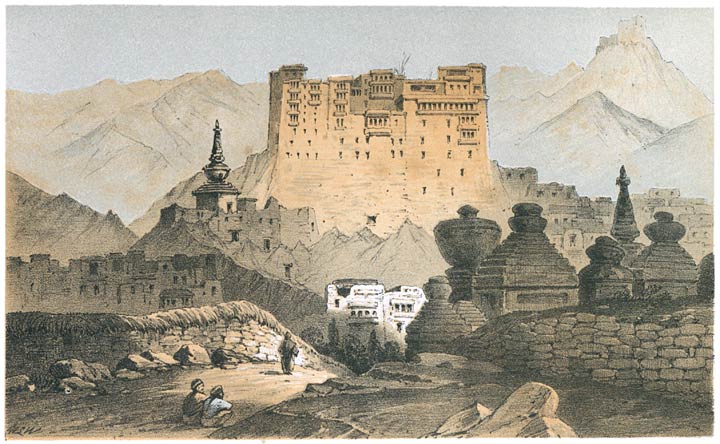
W.H.K. Delt. Hanhart, Lith.
Rajah’s Palace, Ladak.
August 15.—Employed all the morning in endeavouring to procure supplies of tea, and after unearthing a queer-looking package containing seven pounds and a half, we differed about the price, the proprietor demanding twenty-four shillings, or about twice its local value.
August 16.—There being no tidings of the arrival of expected caravans, we marched for the monastery of Hemis, crossing the Indus immediately after leaving Ladak, and following it up towards its source. Outside the town we passed a mound of the inscribed stones, which must have been nearly a quarter of a mile in length, and probably contained as many as 30,000. The left bank of the river, which thus formed our path, was a continuation of detached huts, forming no regular villages, and affording very little shade or apparent prospect of shelter for man or beast. The right bank, however, was studded with picturesque-looking little villages, built generally on rocky summits, and surrounded by tombs and Mani panees, to an extent almost to rival the towns themselves in size and importance. About nine miles on the road we halted for breakfast, on the confines of a desert of smooth stones, from which the heat ascended like vapour, and made our eye-balls ache again. There was no shade in sight, however, and milk was here forthcoming, so we made the best of a bad situation, and, after our repast, lost no time in getting again under weigh. After a hot tramp over a perfect desert, we reached the wooded little village of Chunga, where, as it was getting late, we called a halt and pitched our camp. All hands being tired by their march, we got our dinner at nine o’clock.
August 17.—Started early for Hemis. From the formation of the mountains in which it is situated, the entrance to the village opens upon the traveller suddenly and as if by magic; and as we tramped this morning along the parched and sandy desert, welcome indeed was the unexpected vision of trees and rushing water which the sharp turn presented to our astonished gaze.
The entrance to the gorge in which the monastery is situated was, as usual, quite covered with Mani panees and walls of inscribed stones; one of the former was studded with human skulls, and otherwise ornamented, in a way that proved the vicinity of some stronghold of Lama talent, though not perhaps of the very highest order.
The monastery we found situated in a beautifully-wooded valley, thickly planted, and having a dashing little torrent foaming through the centre.
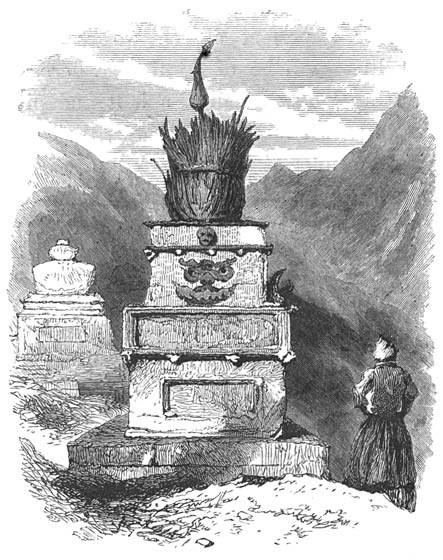
It was built as usual, on the very face of the rock, and towering above it was an airy fort, ensconced among a number of crows’-nest habitations, perched about apparently with more regard to effect than comfort.
While waiting for the kitchen to come up, we inspected the monastery, and were waited upon by half-a-dozen Lamas, who showed us through the various temples of the gods. Originally containing some two hundred Lamas, its numbers had now dwindled down, by their account, to fifteen or sixteen. We, however, saw actually more than that number ourselves while wandering through the building.
They owned to having treasure in the monastery to the amount of three lakhs of rupees (£30,000), but of this we saw small signs during our inspection.
Some of the divinities were, however, provided with vestments of cloth of gold, and were seated upon thrones, studded with would-be precious stones. Others were accommodated with large silver bowls, placed on pedestals, filled to the brim with “ghee,” or rancid butter, and unless blest with inordinate appetites, these, from their enormous size, might fairly last them all till doomsday. We were altogether conducted through four temples, each inhabited by a number of Chinese figures, seated in state, with offerings of corn, flour, rice and ghee, &c. before them, and these were generally served in valuable cups of china, and precious metals. Hanging from the ceiling and the walls around were scrolls, decorated in the Chinese fashion, with figures of tightly-robed, narrow-eyed ladies and gentlemen, scattered about with the usual perspective results.
Some of these scrolls were decorated with scenes which it would take hours to decipher and appreciate. One, in particular, of the last day, was covered with innumerable little figures, and appeared well worthy of a close inspection.
The bad people might here be seen, falling into the hands of some of the most disrespectable looking monsters I have ever beheld; while the good were sitting up in a bunch, looking on at the dreadful scene, in a satisfied and undisturbed way, beautiful to behold.
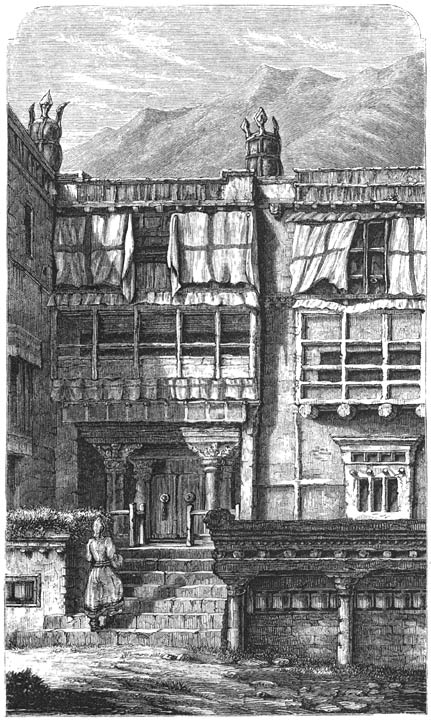
Monastery of Hemis.
In the vicinity of the monasteries were various small temples, probably chapels of ease, rudely decorated with grotesque figures, in red and yellow, and having queer-looking structures fastened on the top of them, generally a trident, with tufts of hair attached, or strips of coloured calico, horns of animals, and other rude devices.
In one place we came upon a praying-wheel, turned by water, but I was unable to ascertain whether the benefit accrued to the water, or to the possessor of the stream, or to the public generally. Sometimes the people carry portable wheels, and one old gentleman we met was provided with a huge brass one, with a wooden handle. It was suspended from his neck, in company with a collection of square leather charms, fastened by a string to his coat.
On my asking him what the structure meant, he immediately begun to set it in motion, and piously ejaculating “Ûm mani panee,” passed on without another word, but in evident pity for my benighted spiritual condition.
Among other curious sights, we saw one of the Lamas sitting at a chapel door, having, before him seven little brass pots. In each of these there was a letter of the words “Ûm mani panee,” and the pots being filled with water, he was employed in strewing each with a few grains of corn from a heap at his side, keeping up at the same time a loud mournful chant, and swaying himself to and fro, in time with the music. To have inquired the meaning of this would only have again resulted in the comprehensive information contained in “Ûm mani panee,” so we rested in our ignorance, and passed on, much to the relief of the chaunter. After going all through this curious monastery, we repaired to our tents, which had arrived in the interim, and which we found pitched pleasantly among the trees, within a few yards of the torrent. After a bathe and breakfast, we came unanimously to the conclusion that the water was so cold, and the air so cool and refreshing, we could not do better than halt for a couple of days, under the protection of the Church, before again taking the road on our homeward route.
August 18.—Out early for a day’s stalk over the mountains, after deer, or anything there might be forthcoming. One of the coolies being a “shikaree,” or what they call in Ireland a “sportsman,” I took him with me, and with another to carry some breakfast, off we started at about five A.M. The ascent at first was so abrupt, that, although in pretty good walking condition by this time, I found myself halting very frequently to admire the prospect. Having attained the greatest height actually attainable, we spied quietly grazing, about half a mile off, some half dozen little animals, which my “sportsman” declared to be Ibex, and down Aye went again, best pace, with a view to making a circumbendibus, to get behind them. With a view to accomplish this, we had to pass across some very difficult ground, and at last came to a smooth face of rock, with nothing whatever about it to hold on by, and, moreover, an overhanging ledge, which fairly seemed to bar all further progress.
The coolie, however, whose every toe was as useful to him as a finger, managed to scramble up; and not to be outdone, I also attained some height, when, holding on fly-fashion, and clinging to the rock with my fingers and grass shoes, suddenly the pole which partly supported me slipped away, and my whole attention had to be directed to again reaching the ground in as soft and comfortable a manner as possible. In this I succeeded beyond my expectations, and, a second attempt being more successful, finally reached the top. On attaining our hardly-earned post of vantage, however, there was no sign of our friends, but, suddenly, on the mountain below us a herd of about five-and-twenty more appeared to our delighted view. They were standing gazing up at us in astonishment, and for some moments we remained fixed and motionless, hoping to be taken for the stones we were habited in imitation of. Then, crouching down and crawling along as if on velvet, down we went again, and after another long and trying stalk, over broken ground formed apparently of small slates placed edgeways, and crumbling rocks, whose slightest fall would have been destruction to our plans, we attained a rock about two hundred yards from the herd, and paused for breath once more. They were lying about sunning themselves, with an outlying sentinel posted here and there on either side of them on the look-out; and seeing an eligible spot some fifty yards nearer, we stole along to reach it. We were not, however, destined to take this unfair advantage of the enemy. Just as we had half crossed the distance, an ill-fated, abominable little fragment of rock suddenly broke off, and at its first bound away went the herd like lightning over the precipitous rocks, and with a little chirrupping noise like sparrows, were in a few seconds well out of range of bullets. As the natives express it, “they became wind,” and we were left behind our rock, looking, after all our toils, to say the least of it, extremely foolish. A shot which I took at some 250 yards was more to relieve ourselves by making a noise than with any hopes of bringing down one of the light-heeled little creatures, for their bounding powers put all correctness of aim at that range out of the question.
The next part of the programme was breakfast, but alas! there were no signs in any direction of the bearer of our supplies, and I now recollected that the rock which had so puzzled us would be quite inaccessible to the coolie and his precious charge, without which he himself was useless. All we could do was to ascend a high peak of mountain, in hopes that the breakfast would ascend another, and that we could then exchange signals of distress and obtain relief. However, after reaching our look-out station, which took us some climbing, we could discern nothing around us bearing the slightest resemblance to a coolie, and our hopes began to descend below zero.
It was now about twelve o’clock, and taking advantage of the produce of the country, I made a light breakfast off two stalks of rhubarb, and tying a handkerchief to the top of my pole as a signal, lay down in the very minute portion of shade procurable under a midday sun, and indulged in the pleasures of imagination, conjured up by absent chicken legs and cold chupatties. After a long wait, I came to the conclusion that the two pieces of rhubarb were entirely insufficient to continue the day’s work upon, so I reluctantly gave the order to retreat upon our camp, and turned from thoughts of breakfast to those of dinner. My grass shoes were by this time completely worn out by the pointed rocks and flinty ground we had traversed, and my spare ones were in the society of the cold chicken and the chupatties, so that I was soon walking in nothing but socks. Before long, this portion of my property was also run through, and I was finally obliged to borrow the sportsman’s pointed slippers, in which I managed to get along over the ruggedest piece of creation I ever traversed, and reached our camp about three P.M. Tired, hungry, and burnt by the sun, a bathe in the rushing torrent and a visit to the kitchen were soon accomplished, and I then learnt that the coolie, being stopped by the rock, had come back at once, and, having been again immediately packed off by F. to search for us, had not been since heard of.
August 19.—Found the Q.M.G. to-day laid up with fever and influenza, and administered some quinine pills to him, besides ordering a steed to carry him on to Ladak to-morrow.
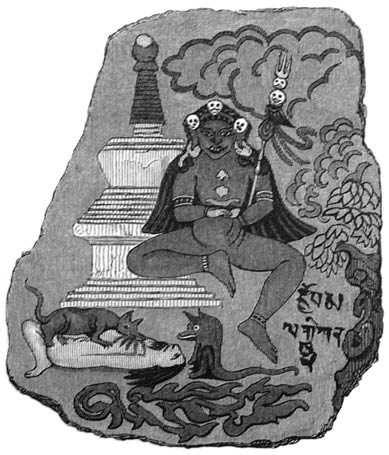
Explored the Lama’s habitations and temples, and saw some very curious carvings and paintings on stones, some of them not altogether in the Church order of design.
Some of the ceilings were beautifully decorated, and must have cost a good deal of money in their day, but they were now rapidly falling into decay.
As I passed out, however, a huge black dog, which was chained up in the yard, seemed, by the rabid manner in which he made feints at my legs, to be quite aware of what I had done, and he snapped and howled, and strained and tore at his chain as I went by, just as if he detected the holy bundle sticking out of my pocket, and thoroughly understood my consequent guilty appearance. The principal designs upon the stones here—some of which, in colour, were in wonderful preservation—appear to be cross-legged effigies of Buddha, seated in that state of entire abstraction from all passions and desires, which seem to be the end and object of Buddhists’ aspirations.
A certain rotundity of form, however, and appearance of comfortableness, rather tend to suggest that the pleasures of the table at least have not quite been renounced among the other pomps and vanities of Buddhist life.
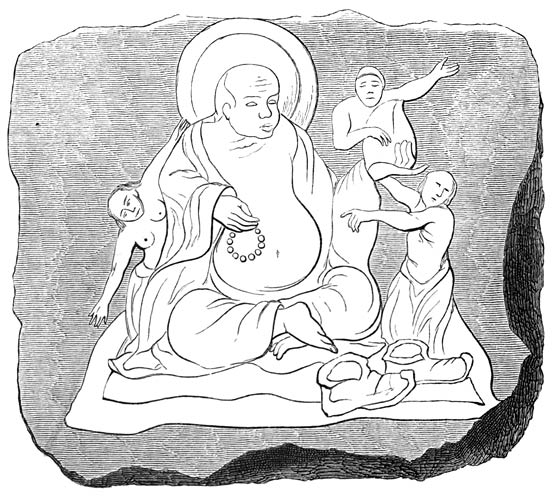
August 20.—Started for Ladak again, nominally at some desperately early hour of the morning, but in reality at about half-past five, the sun not shining upon our position until late, in consequence of our proximity to the mountains. Mr. Rajoo being still indisposed, and, in his own belief, dying, we mounted him upon a hill horse, where he looked like a fly on a dromedary. Halted for breakfast half way, and had a hot wearisome march afterwards into Ladak, the sun being intensely powerful, and the greater part of the journey over a glaring desert of shifting sand and loose stones. So deep was this in some places, that it was with difficulty we could drag our steps along. The latter part seemed perfectly interminable, and not until four o’clock, burnt, tired, and parched with thirst, did we reach our old halting place. Since our departure, the Thanadar had changed his fancy as to brandy, and now requested a bottle of vinegar. This we promised in the event of his procuring us some tea, our stock being low, and none other procurable without government assistance. By this means we obtained a decorated bundle of pale-looking tea for thirteen rupees, or 1l. 6s. The bundle contained 7½ lbs., so that the price was heavy enough, considering our proximity to the land of tea.
My shoe-leather being in a doubtful state, I invested in a pair of the sheepskin Chino-Esquimaux ones of local manufacture, but soon found that the old saw of “nothing like leather” was quite a fallacy, when the leather savoured so strongly of mutton as that composing my new boots did. In the morning they were absent, and it was not until after much search that the mutilated remains of one foot was discovered, gnawed and sucked out of all semblance to Blucher, Wellington, or any other known order of shoe or boot, while the other appeared irretrievably to have gone to the dogs. Our lantern here was also carried off by some of the canine race, and left beautifully cleaned, but unbroken, not far from our tent door.
Finding that there was no news of caravans, or probability of their arriving, we determined upon striking our camp, and retiring again towards Cashmere, having attained the furthermost point which the limits of our leave allowed.