TANOAN EPOCH
Reading edition
The Tanoan epoch in the chronology of Hopi pottery symbolism is markedly different from the Keresan. It began with the influx of Tanoan clans, either directly or by way of Zuñi and the Little Colorado, being represented in modern times by the early creations of Hano women, like Nampeo. It is clearly marked and readily distinguished from the Sikyatki epoch, being well represented in eastern museums by pottery collected from Hano, the Tewan pueblo on the East Mesa.
Migrations of Tanoan clans into the Hopi country began very early in Hopi history, but waves of colonists with Tanoan kinship came to Walpi at the close of the seventeenth century as a result of the great rebellion (1680), when the number of colonists from the Rio Grande pueblos was very large. The Badger, Kachina, Asa, and Hano clans seem to have been the most numerous and important in modifying sociological conditions, especially at the East Mesa of the Hopi. Some of these came directly to Walpi, others entered by way of Zuñi, and still others by way of Awatobi. They brought with them Tanoan and Keresan symbolism and Little Colorado elements, all of which were incorporated. The Tanoan symbols are very difficult to differentiate individually but created a considerable modification in the artistic products, as a whole.
The symbolism that the colonists from the Little Colorado settlements brought to Walpi was mixed in character, containing certain Gila Valley elements. Among the last-mentioned were increments derived directly from Zuñi, as shown in the symbolism of their pottery. Among the most important thus introduced were contributions of the Asa, Kachina, Badger, and Butterfly clans. The most important element from the Little Colorado clans that originally came from the Gila Valley (Palatkwabi) are those connected with the plumed serpent.[50] It is possible to trace successive epochs in the history of ceramic decoration in the Little Colorado ruins and to identify, in a measure, the clans with which these epochs were associated, but to follow out this identification in this paper would take me too far afield and lead into a discussion of areas far distant from the Hopi, for it belongs more especially to the history of ceramic decorations of Zuñi decoration and composition.[51] In the present article all the Little Colorado influences are treated as belonging to the Tanoan epoch, which seems to have been the dominant one in the Little Colorado when emigration, comparatively modern in time, began to Hopi.
Symbols Introduced from the Little Colorado
After the destruction of Sikyatki there was apparently a marked deterioration in the excellence of Hopi ceramics, which continued as late as the overthrow of Awatobi, when the Sikyatki epoch ceased. Shortly before that date and for a few years later there was a notable influx of foreigners into Hopiland; a number of southern clans from the Little Colorado successively joined the Hopi, bringing with them cultural conceptions and symbolic designs somewhat different from those existing previously to their advent. Among these clans are those known in migration legends as the Patki peoples. Although we can not distinguish a special Patki epoch in Hopi ceramics, we have some ideas of the nature of Patki symbolism from large collections from Homolobi, Chevlon, and Chavez Pass. From traditions and ceremonial objects now in use we also know something of the nature of the objective symbols they introduced into Walpi, and we can detect some of these on pottery and other objects used in ceremonies at Walpi. Some of these symbols did not come directly from the Little Colorado ruins, but went first to Awatobi and from there to Walpi[52] after the destruction of the former pueblo in the autumn of the year 1700. The arrival of southern clans at the East Mesa with their characteristic symbols occurred approximately in the seventeenth century, about 200 years after the date of the discovery of Hopi by Tovar. Awatobi received the Rabbit, Tobacco, and other clans from this migration from the south between the years 1632 and 1700, and Walpi received the Patki shortly after or at the same time the Hano clans came from the far east. The similarities in ancient pottery from the Little Colorado and that belonging to the Sikyatki epoch can not be ascribed to anything more profound than superficial contact. It is not probable that the ancient pottery of Awatobi or that of Kawaika and other Keres pueblos on the Awatobi mesa or in the adjacent plain was modified in any considerable degree by incoming clans from the south, but survived the Sikyatki epoch a century after Sikyatki had been destroyed.
The advent of the clans from the Little Colorado into the Hopi country was too late to seriously affect the classic period of Hopi ceramics; it appears also not to have exerted any great influence on later times. Extensive excavations made at Homolobi, Chevlon, and Chavez Pass have revealed much pottery which gives a good idea of the symbolism characteristic of the clans living along this valley, which resembles in some respects the classic Hopi pottery of the time of Sikyatki, but several of these likenesses date back to a time before the union of the Hopi and Little Colorado clans. As a rule the bird figures on pottery from Homolobi, Chevlon, Chavez Pass, and other representative Little Colorado ruins are more realistic and less conventionalized and complex than those from Sikyatki. The peculiar forms of feathers found so constantly in the latter do not occur in the former, nor does the sky-band with its dependent bird figure ever occur on Little Colorado ware. We are here dealing with less-developed conventionalism, a cruder art, and less specialized symbolism. Even if the colors of the pottery did not at once separate them, the expert can readily declare whether he is dealing with a bowl from Sikyatki or Homolobi. There are, to be sure, likenesses, but well-marked differences of local development. The resemblances and differences in the case of bird figures on prehistoric Hopi ware and that from the ruins on the Little Colorado can be readily shown by considering figures 105, 106, and 107, found at Homolobi and Chevlon, and the corresponding preceding bird figures. It may be interesting to instance another example. Figure 104 shows a lateral view of a bird with wings extended, bearing marginal dentations representing feathers on the breast and a tail composed of four triangular feathers and two eyes, each with iris and pupil. The upper and lower jaws in this figure are extended to form a beak, as is customary in bird designs from the Little Colorado ruins, but never found at Sikyatki. In figure 105 we have another lateral view of a characteristic bird design from the Little Colorado region, and figures 106 and 107 show hourglass bodies, a special feature of the same region.
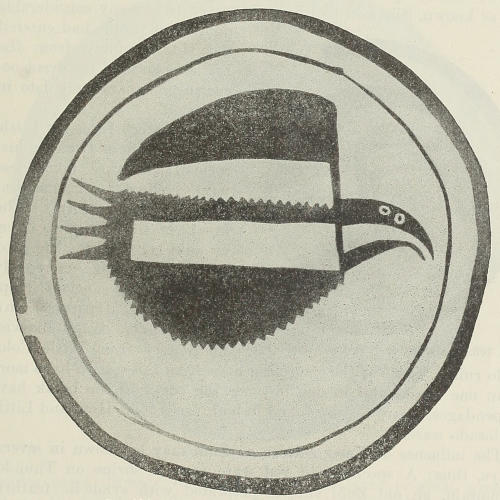
Fig. 104.—Lateral view of bird with double eyes.
In the same way many other distinctive characteristics separating figures of animals from the two regions might be mentioned. Those above given may suffice to show that each is distinctive and in a way specialized in its development, but the main reason to believe that the clans from the Little Colorado never affected the symbolism of Sikyatki is the fact that the latter ruin was destroyed before these clans joined the Hopi villages.
The ruins Homolobi and Chevlon were probably inhabited well into historic times, although there is no archeological evidence that artifacts from them were modified by European influences. The symbolism on pottery shows that their culture was composite and seems to have been the result of acculturation from both south and east. Some of the clans, as the Tobacco, that peopled these settlements joined Awatobi before its overthrow, while others settled at Pakatcomo, the ruins of which near Walpi are still visible, and later united with the people of the largest village of the East Mesa. So far as known, Sikyatki had been destroyed before any considerable number of people had entered the Hopi country from the Little Colorado,[53] the event occurring comparatively late in history.
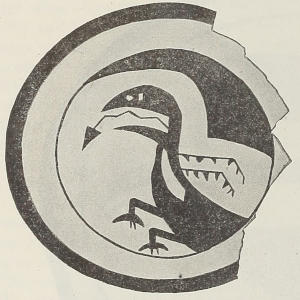
Fig. 105.—Lateral view of bird with double eyes.
The pottery from the Little Colorado differs from prehistoric Hopi ware much less with respect to geometrical designs than life forms. The break in the encircling line, or, as it is called, the life gate, which is almost universally found on the ancient Hopi vases, bowls, dippers, and other objects, occurs likewise on pottery from Little Colorado ruins. Some of the encircling lines from this region have more than one break, and in one instance the edges of the break have appendages, a rare feature found in both prehistoric Hopi and Little Colorado ware.[54]
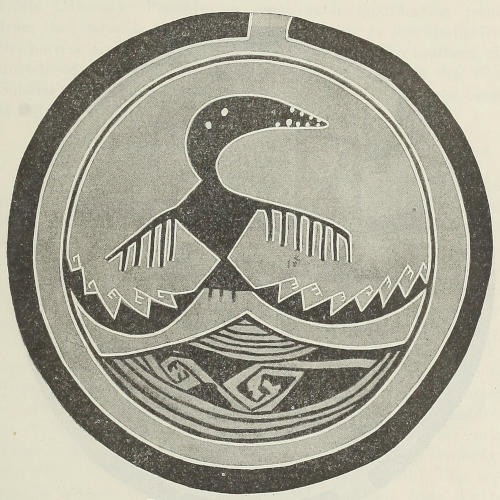
Fig. 106.—Bird with double eyes.
The influence of Keres culture on Zuñi may be shown in several ways, thus: A specimen of red ware from a shrine on Thunder Mountain, an old Zuñi site, is decorated with symbolic feathers recalling those on Sikyatki ware ascribed to eastern influence. The nonappearance of Keres and Tewa symbols on ancient pottery from the Zuñi Valley ruins, Heshotauthla and Hálonawan, and their existence in the mountain shrine above mentioned, implies that the latter settlement is more modern, and that the eastern clans united with preexisting Little Colorado clans comparatively late in its history. The first settlements in Zuñi Valley were made by colonists from the Gila. There are several ceremonies in the Walpi ritual which, like the New Fire, although immediately derived from Awatobi, came originally from Little Colorado pueblos, and other ceremonies came directly to Walpi from the same original source. Among the former are those introduced by the Piba (Tobacco) clan, which brought to Walpi a secret fraternity called the Tataukyamû. This brotherhood came directly from Awatobi, but the Tobacco clan from which it was derived once lived in a pueblo on the Little Colorado, now a ruin at Chevlon, midway between Holbrook and Winslow.[55] The identification of the Chevlon ruin with the historic Chipias has an important bearing on the age of the Little Colorado ruins, for Padre Arvide, a Franciscan missionary, was killed in 1632 by the Chipias, who lived west of Zuñi. In other words, their pueblo was then inhabited.
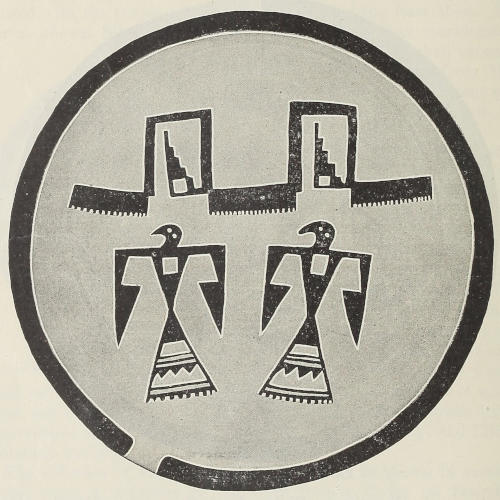
Fig. 107.—Two birds with rain clouds.
We know that the Piba joined Awatobi before 1700, or the year it was destroyed; consequently the desertion of the Chevlon ruin (Chipiaya, or Tcipiaiya) evidently occurred between 1632 and 1700, not so much on account of Apache inroads as from fear of punishment by the Spaniards.[56] As no clans from the other large pueblo on the Little Colorado or Homolobi joined Awatobi, we can not definitely fix the date that this group fled to the north, but it was probably not long after the time the Chevlon clans migrated to Awatobi, from which it follows that the Little Colorado settlements were inhabited up to the middle of the seventeenth century. While the Little Colorado clans did not influence the Sikyatki pottery, they did affect the potters of Awatobi to a limited extent and introduced some symbols into Walpi in the middle of the seventeenth and eighteenth centuries. Among these influences may be mentioned those derived from Awatobi after its destruction in 1700. It is not possible to state definitely what modifications in pottery symbols were introduced into Walpi by the potters of the clans from Awatobi and the Little Colorado. Possibly no considerable modification resulted from their advent, as there was already more or less similarity in the pottery from these geographical localities. The southern clans introduced some novelties in ceremonies, especially in the Winter Solstice and New-fire festivals and in the rites of the Horned Serpent at the Spring Equinox.
Symbols Introduced by the Badger and Kachina Clans
As the clans which came to the Hopi country from Zuñi were comparatively late arrivals of Tewa colonists long after the destruction of Sikyatki, their potters exerted no influence on the Sikyatki potters. The ancient Hopi ceramic art had become extinct when the clans from Awatobi, the pueblos on the Little Colorado, and the late Tewa, united with the Walpi settlement on the East Mesa. The place whence we can now obtain information of the character of the symbolism of the Asa, Butterfly, Badger, and other Tewan clans is in certain ceremonies at Sichomovi, a pueblo near Walpi, settled by clans from Zuñi and often called the Zuñi pueblo by the Hopi. One of the Sichomovi ceremonies celebrated at Oraibi and Sichomovi on the East Mesa, in which we may find survivals of the earliest Tewa and Zuñi symbolism, is called the Owakülti. The Sichomovi variant of the Owakülti shows internal sociologic relation to the Butterfly or Buli (Poli) clan resident in Awatobi before its fall. This statement is attested by certain stone slabs excavated from Awatobi mounds, on which are painted butterfly symbols. The Walpi Lalakoñti, first described by the author and Mr. Owens in 1892, has also survivals of Awatobi designs. It appears that while it is not easy to trace any of the rich symbolism of Awatobi directly into Walpi pottery, it is possible to discover close relations between certain Awatobi symbols and others still employed in Walpi ceremonials. Sikyatki and Awatobi were probably inhabited synchronously and as kindred people had a closely allied or identical symbolism; there is such a close relation between the designs on pottery from the two ruins that Awatobi symbols introduced into Walpi have a close likeness to those of Sikyatki.[57]
The natural conservatism in religious rites of all kinds has brought it about that many of the above-mentioned designs, although abandoned in secular life of the Hopi, still persist in paraphernalia used in ceremonies. It is therefore pertinent to discuss some of these religious symbols with an idea of discovering whether they are associated with certain clans or ruins, and if so what light they shed on prehistoric migrations. In other words, here the ethnologists can afford us much information bearing on the significance of prehistoric symbols.
One great difficulty in interpreting the prehistoric pictures of supernaturals depicted on ancient pottery by a comparison of the religious paraphernalia of the modern Hopi is a complex nomenclature of supernatural beings that has been brought about by the perpetuation or survival of different clan names for the same being even after union of those clans. Thus we find the same Sky god with many others all practically aliases of one common conception. To complicate the matter still more, different attributal names are also sometimes used. The names Alosaka, Muyinwû, and Talatumsi are practically different designations of the same supernatural, while Tunwup, Ho, and Shalako appear to designate the same Sky-god personage. Cultus heroines, as the Marau mana, Shalako mana, Palahiko mana, and others, according as we follow one or another of the dialects, Keres or Tewa, are used interchangeably. This diversity in nomenclature has introduced a complexity in the Hopi mythology which is apparent rather than real in the Hopi Pantheon, as their many names would imply.[58] The great nature gods of sky and earth, male and female, lightning and germination, no doubt arose as simple transfer of a germinative idea applied to cosmic phenomena and organic nature. The earliest creation myths were drawn largely from analogies of human and animal birth. The innumerable lesser or clan gods are naturally regarded as offspring of sky and earth, and man himself is born from Mother Earth. He was not specially created by a Great Spirit, which was foreign to Indians unmodified by white influences.
As the number of bird designs on Sikyatki pottery far outnumber representations of other animals it is natural to interpret them by modern bird symbols or by modern personations of birds, many examples of which are known to the ethnological student of the Hopi.
In one of a series of dances at Powamû, which occurs in February, men and boys personate the eagle, red hawk, humming bird, owl, cock, hen, mocking bird, quail, hawk, and other birds, each appropriately dressed, imitating cries, and wearing an appropriate mask of the birds they represent. In a dance called Pamurti, a ceremony celebrated annually at Sichomovi, and said to have been derived from Zuñi, personations of the same birds appear, the men of Walpi contributing to the performance. Homovi, one of the Hopi Indians who took part, made colored pictures representing all these birds, which may be found reproduced in the author’s article on Hopi katcinas.[59]
In the Hopi cosmogony the Sky god is thought to be father of all gods and human beings, and when personations of the subordinate supernaturals occur they are led to the pueblo by a personator of this great father of all life. The celebrations of the Powamû, at the East Mesa of the Hopi, represent the return of the ancestors or kachinas of Walpi, while the Pamurti is the dramatization of the return of the kachinas of Sichomovi whose ancestors were Zuñi kin.
Life figures or animal forms, as birds, serpents, and insects, depicted on Little Colorado pottery differ considerably from those on Sikyatki ware. Take, for instance, bird designs, the most abundant life forms on ancient pueblo pottery on the Little Colorado, as well as at Sikyatki. It needs but a glance at the figures of the former to show how marked the differences are. The leader of the kachinas in the Powamû, which celebrates the return of these ancestral gods to the pueblo, Walpi, wears an elaborate dress and helmet with appended feathers. He is led into the village by a masked man personating Eototo.[60]
Symbols Introduced from Awatobi
The women saved at Awatobi in the massacre of 1700, according to a legend, brought to Walpi the paraphernalia of a ceremony still observed, called the Mamzrauti. Naturally we should expect to find old Awatobi symbolism on this paraphernalia, which is still in use. The cultus heroine of the Mamzrauti is the Corn-mist maid, known by the name of Shalako mana or Palahiko mana.[61] We have several representations of this maid and their resemblance to the pictures of Shalako mana depicted by Hano potters would imply a common Tanoan origin.
Shalako Mana
The most common figure on the third epoch of Hopi pottery, commonly called modern Tewa and manufactured up to 1895 by Nampeo, a Hano potter, is a representation of the Corn-maid, Shalako mana, who, as shown, is the same personage as Marau mana and Palahiko mana in the festival of the Mamzrauti derived from Awatobi. The symbol of this goddess is instructive and easily recognized in its many variations. Her picture on Hano pottery is shown in figure 108.
The most striking features of her symbolism, brought out in plate 89, are terraced bodies representing rain clouds on the head, an ear of maize symbol on the forehead, curved lines over the mouth, chevrons on the cheeks, conventionalized wings, and feathered garment. It is also not uncommon to find carved representations of squash blossoms occupying the same positions as the whorls of hair on the heads of Hopi maidens.
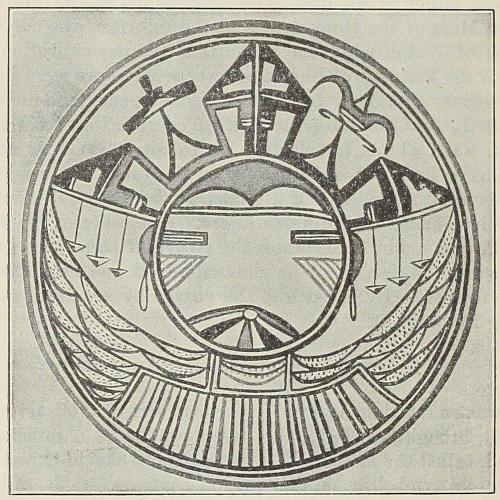
Fig. 108.—Head of Shalako mana, or Corn maid.
The Shalakotaka male is likewise a common design readily recognized on modern pottery. Particularly abundant are figures of the mask of a Kohonino god, allied to Shalako, which is likewise called a kachina, best shown in paraphernalia of the Mamzrauti ceremony.
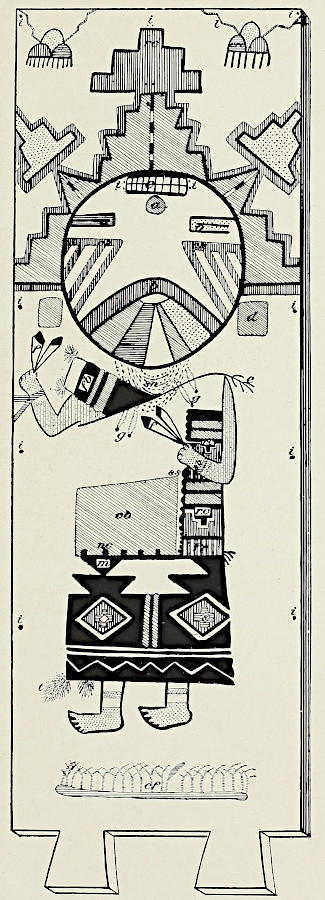
BUREAU OF AMERICAN ETHNOLOGY THIRTY-THIRD ANNUAL REPORT PLATE 89
SHALAKO MANA, CORN MAID (FROM TABLET DANCE)
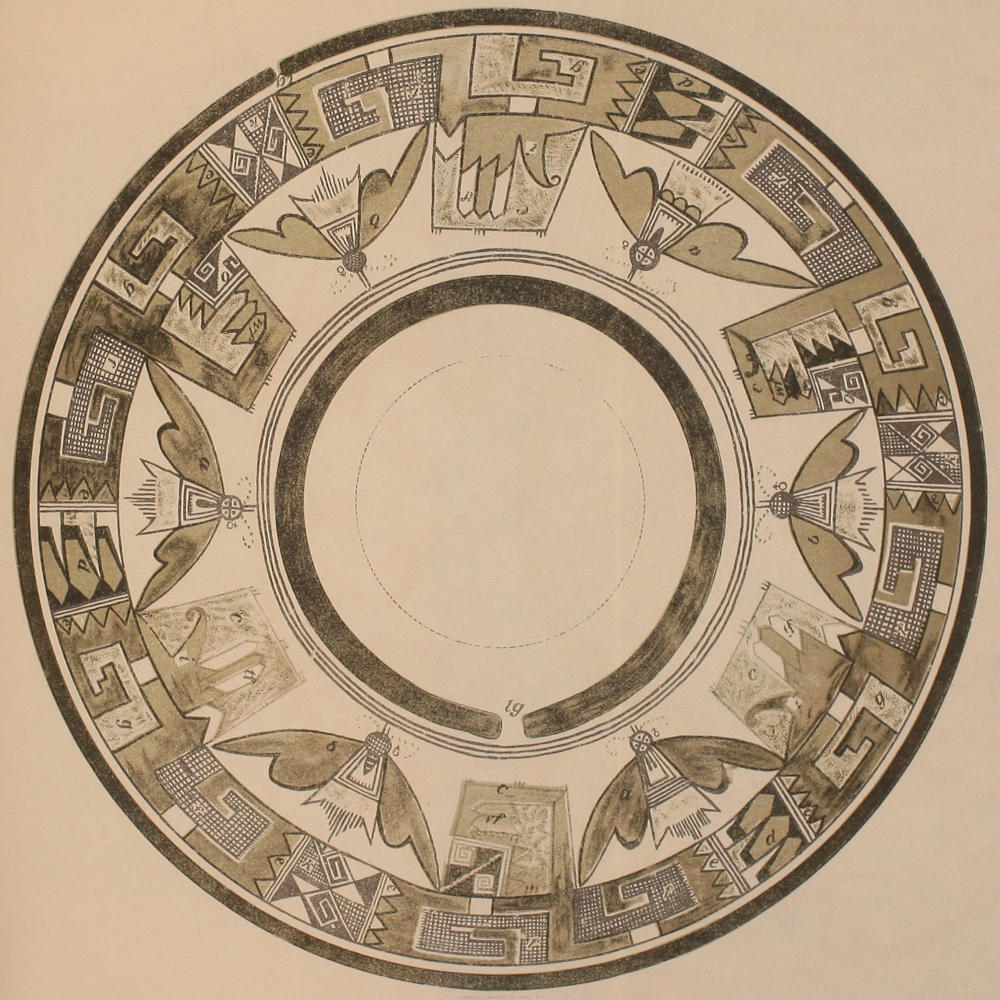
BUREAU OF AMERICAN ETHNOLOGY THIRTY-THIRD ANNUAL REPORT PLATE 90
TOP OF BUTTERFLY VASE.
It sometimes happens in Hopi dramatization that pictures of supernatural beings and idols of the same take the place of personations by priests. For instance, instead of a girl or a woman representing the Corn maid, this supernatural is depicted on a slab of wood or represented by a wooden idol. One of the best-known figures of the Corn maid (Shalako mana) is here introduced (pl. 89) to illustrate the relation of old Awatobi and existing Hopi symbolism; a modern figure (108) of this Corn maid, painted on a wooden slab, is sometimes carried by the Walpi women in their dance. Figures of the Awatobi germ god, Alosaka, otherwise called Muyinwû,[62] are depicted on the slabs used by most of the women at that time.
The different designs on the slab under consideration (pl. 89) are indicated by letters and explained as follows: a represents a circular fragment of the haliotis or abalone shell hanging midway from a figure of an ear of corn, c. The cheeks are tattooed or painted with characteristic figures, cb, the eyes rectangular of different colors. The letter d is a representation of a wooden ear pendant, a square, flat body covered on one side with a mosaic of turquoise sometimes arranged in figures. The letter e is the end of a string by which the ceremonial blanket is tied over the left shoulder, the right arm being free, as shown in the illustration. Over the right shoulder, however, is thrown a ceremonial embroidered kilt, fb.
The objects in the hands represent feathers and recall one type of the conventional feathers figured in the preceding pages. The letters fr represent falling rain embroidered on the rim of the ceremonial blanket and rc the terraced rain clouds which in arc become rounded above; g represents a turquoise at the end of a string of turquoise suspended from shell necklaces sn; m represents the butterfly and is practically identical with the decorations on dados of old Hopi houses; s represents a star; sb represents shell bracelets, many examples of which occur in ruins along the Little Colorado; ss is supposed to have replaced the key patterns which some authorities identify as sprouting beans. There are commonly nine rectangular markings, nc, on the upper border of the embroidered region of ceremonial blankets and kilts, each of which represents either a month or a day, by some said to refer to ceremonial or germ periods.[63]
The Shalako mana figures have not yet been found in the unmodified Little Colorado ware, but homologous figures have been found in the Rio Grande area.
The design (pl. 88, d) with a horn on the left side of the head and a rectangle on the right, the face being occupied by a terrace figure from which hang parallel lines, reminds one of the “coronets” worn on the head by the Lakone maids (manas) in the Walpi Basket dance of the Lalakoñti. The horn in the coronet is without terminal appendages, although a feather is tied to it, and the rectangle of plate 88, d, is replaced by radiating slats spotted and pointed at their ends, said to represent the sunflower. The whole design in plate 88, d, represents a bird,[64] recalling that of the figure Marautiyo on one of the appended slabs of the altar of the Walpi Marau ceremony. In this altar figure we find not only a horn on the left side of the head, but also a rectangular design on the right.
On the corresponding right-hand side of this altar we have a picture of Marau mana (Shalako mana). It will thus appear that when compared with the Lakone coronet the figure on the Shongopovi bowl represents a female being, whereas when compared with the figure on the Marau altar it resembles a male being. There is, therefore, something wrong in my comparison. But the fact remains that there survive in the two woman’s festivals—Lakone maid’s coronet and Marau altar—resemblances to prehistoric Hopi designs from Shongopovi. Moreover, it is known that the Marau fetishes are stated by the chief Saliko to have been introduced from Awatobi into Walpi by her ancestor who was saved at the massacre of that town in 1700.
The life figures of the Tanoan epoch, or that following the overthrow of Sikyatki, can be made out by a study of modern Hano pottery. Perhaps the most complex of these is that of the Corn maid, Shalako mana. Shalako mana plays a great rôle in the Mamzrauti, a ceremony derived from Awatobi, and figures representing her are common designs made on Hano pottery. Designs representing this being are common on the peculiar basket plaques made at the Middle Mesa and dolls of her are abundant. The constant presence of her pictures on basket plaques at the Middle Mesa would also seem to show an ancient presence in the Hopi country, and indicate an identity of pottery designs from ancient Shumopavi with those from the East Mesa and Awatobi.[65]
One of her modern Walpi ceremonies has such pronounced Awatobi symbolism that it may be instanced as showing derivation; viz., the New-fire festival.[66] The women of the Marau and the men of the Tataukyamû regard themselves kindred, and taunt each other, as only friends may without offence, in this festival, and the Tataukyamû often introduce a burlesque Shalako mana into their performances.
The designs painted on the bodies and heads of several modern dolls representing Corn maids are symbols whose history is very ancient in the tribe. For instance, those of feathers date back to prehistoric times, and terraced designs representing rain clouds are equally ancient. The dolls of the Corn maid (Shalako mana) present a variety of forms of feathers and the headdresses of many dolls represent kachinas, and show feathers sometimes represented by sticks on which characteristic markings are painted, but more often they represent symbols.[67]
Symbols of Hano Clans
Hano, as is well known, is a Tewan pueblo, situated on the East Mesa, which was the last great body of Tewa colonists to migrate to Hopiland. While other Tewa colonists lost their language and became Hopi, the inhabitants of Hano still speak Tewa and still preserve some of their old ceremonies, and consequently many of their own symbols. Here were found purest examples of the Tanoan epoch.
The potters of clans introduced symbols on their ware radically different from those of Sikyatki, the type of the epoch of the finest Hopi ceramics, and replaced it by Tewan designs which characterize Hopi pottery from 1710 to 1895, when a return was suddenly made to the ancient type through the influence of Nampeo. At that date she began to cleverly imitate Sikyatki ware and abandoned de toto symbols introduced by Hano and other Tewa clans.
Fortunately there exist good collections of the Tewa epoch of Hopi ceramics, but the ever-increasing demand by tourists for ancient ware induced Nampeo to abandon the Tewa clan symbols she formerly employed and to substitute those of ancient Sikyatki.[68]
The majority of the specimens of Hano pottery, like those of the Tanoan epoch to which it belongs, are decorated with pictures of clan ancients called kachinas. These have very little resemblance to designs characteristic of the Sikyatki epoch. They practically belong to the same type as those introduced by Kachina, Asa, and Badger peoples. One of the most common of these is the design above discussed representing Shalako mana, the Corn maid, shown in figure 109. In this figure we have the face represented by a circle in the center and many lenticular figures arranged in rows attached to the neck and shoulders corresponding to the appendages explained in figure 108. It is said in the legends that when the Corn maid appeared to men she was enveloped in fleecy clouds and wore a feathered garment. These are indicated by the curved figures covered with dots and the parallel lines on the body. Feather symbols recalling those of the Sikyatki epoch hang from appendages to the head representing rain clouds.
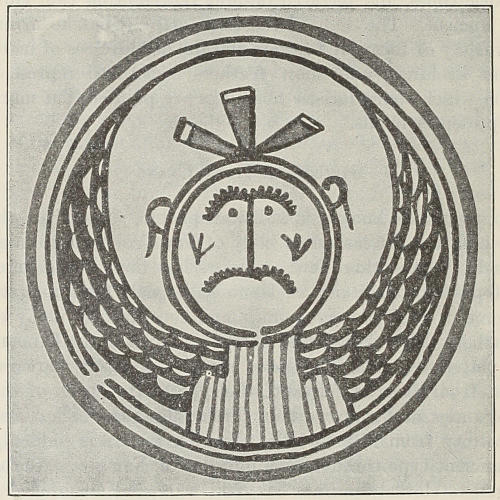
Fig. 109.—Head of Kokle, or Earth woman.
In figure 109 we have a representation of the head with surrounding clouds, and portions of the body of a kachina, called Kokle, who is personated in Winter ceremonies. It is instructive to note that this figure has symbols on the head that recall the Sikyatki epoch. The ancient Tewan earth goddess, Hahaiwugti, is represented in figure 110. She appears also in figure 111, where her picture is painted on a ladle, the handle of which represents an ancient Tewan clown called by the Hano people Paiakyamû.
Fig. 110.—Head of Hahaiwugti, or Earth woman. Fig. 111.—Ladle with clown carved on handle and Earth woman on bowl. Fig. 112.—Püükon hoya, little War god.
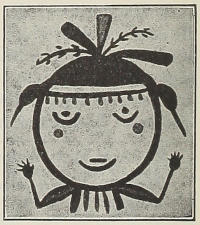
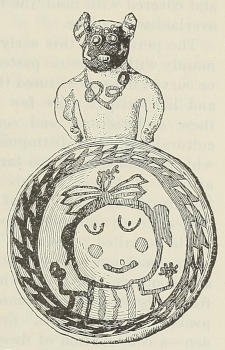
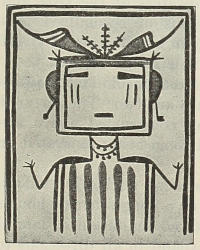
The War god, Püükon hoya, also a Tewan incorporation in the Hopi pantheon, appears frequently on pottery of the Tanoan epoch, as shown in figure 112. This figure, painted on a terra-cotta slab, is identified by the two parallel marks on each cheek.