DESERT (continued 3)
Reading edition
But to the self-torturing nature of Malchus it was hard not to believe that these things had a virtue in themselves, and the thought of relinquishing what he had so hardly achieved filled him with fear.
"Do as I tell you, my son," said Serapion, seeing his hesitation, "and afterward, as other inclinations come to you, follow them so long as they are without offense. And in your prayers do not ask for one thing after another, but let your prayer be about the thing that is troubling you at the time. Then, after you have overcome that trouble, you may turn in prayer to other things. But if, when you are troubled by one passion, you set it aside and pray about another, the first passion will never be wholly cast out. For you it is necessary to conquer the spirit of unrest, and to do this you must stay in your cell and go out only in case of extreme necessity. To-morrow I will accompany you to your cell and bring away the mats you have woven, for I am going soon to Alexandria to sell those that I have made and I will sell yours at the same time. For you it would not yet be safe to go into the world even for a few hours."
When Malchus had returned to his cell and taken up the life which Serapion had prescribed, he began to discover by degrees the wisdom of the old man's instructions. For at first the consolation of food, drink, and sleep and the escape from the monotony of weaving loosened the cord of his unrest and a mellowness came into his heart. It became once more an easy and joyful thing to pray and it seemed to him that his prayers were answered. When evil thoughts came to him he was no longer afraid, but he turned aside his attention from them, saying: "I have nothing to do with this thought and I do not desire it. Let the sin of it be upon Satan." And after a little time he felt a desire to work again at the weaving of mats, and, taking up one of the neglected palm leaves, he began to tear it into strips, and when he had enough strips he put them to soak, and next day he fell to work with the old zeal, weaving a mat of wonderful fineness. And as he wove he reflected that even so the meditations and prayers of the righteous are woven together into a garment for the soul. After another interval of time he felt the impulse to rise in the night and pray, and then also to deny himself food and drink. So by overcoming the spirit of unrest he was drawn back, of his own desire, to the hermit's way; and for some time all seemed to be well with him.
But not for long. For soon the evil spirits, seeing that they could no longer dismay him by evil dreams and terrors of the night, began to tempt him subtly with things which seemed to be innocent and beautiful. And one night, after Malchus had been fasting for three whole days, an evil spirit appeared to him in the form of that vision of a winged man which once he had seen standing on the altar of Serapion's cell. Again Malchus saw that the feathers of his wings were plumed with golden beams and he was filled with delight and wonder and, crouching upon his knees before the altar, he remained for a long time gazing in ecstasy at the angel. Then the angel bent toward him and spoke.
"Malchus," he said, "I have been sent to comfort and exhort you because of your great abstinence. For the abstinence of the shepherd is now as nothing compared with yours."
And next day the evil spirits entered his cell in the form of flies, and when they saw that Malchus refrained from eating and drinking on that day also (though it had been his purpose to fast for three days only), they laughed and clapped their hands; but their laughter was nothing more, for Malchus, than the droning of flies.
Toward evening two young men came and knocked at the door and one of them said to Malchus: "Give us something to eat and some water to drink, my father, for we are broken with hunger, our mouths are parched with thirst, and we have still a long way to go."
Malchus brought them in and set bread and water before them; but he himself stood apart and ate nothing. And the elder of the young men said to him, "Will you not eat with us, my father?"
But Malchus shook his head. "Food and drink," he said, "are not necessary to me."
At that the two young men made a sign of astonishment to each other and Malchus heard the elder whisper to the younger, "This is a great saint." Then, having finished eating and drinking, they rose and went on their way. But as soon as they had gone out it came into Malchus's mind that he ought to have given them food for their journey also; and he took two loaves from the sack and hurried to the door to call them back. But the desert both far and near was empty and there was no new footprint about the door.
Malchus closed the door and, dropping the loaves into the sack, fell to thinking. His mind was troubled by what had happened and his trouble increased when he remembered that by refusing to eat with the young men he had made a boast of his abstinence; for true abstinence, as Serapion had often told him, does not concern that which is without, but only that which is within, and it is better to lay by for a moment the rule of abstinence than to fall into pride and boastfulness. Throughout that night Malchus prayed, confessing his sin and asking for strength to overcome pride; but as he prayed there crept into his mind the memory of the vision of the angel and, believing still that he had acquired merit by his abstinence, he took comfort. But it seemed, that night, as though all the creatures of the desert were holding sinful revel, for far over the sandhills the harsh laughter of fiends echoed through the darkness; and Malchus, hearing it, trembled, not knowing what it might signify. But because he had repented of his second act of pride, the power of the evil spirits over him was diminished: yet since he was not wholly purged of pride, being still blind to that former presumption into which he had been led by the false vision, the hold of Satan was not entirely loosed from him. And Satan, who, like a skillful hunter, is wont to pursue his prey slowly and by artful delays, was content to withdraw to a distance from Malchus till a convenient occasion should come.
But, alone in that waste where all things, down to the meanest herb and the smallest grain of sand, are instruments in the hands of Good and Evil, and where the sounds of winds and the crying of beasts are but the earthly embodiments of the voices of angels and devils, Malchus felt that evil had receded from him, and his life for a time became calm and untroubled, and his prayers and the work of his hands were as an unwavering flame ascending into the presence of God. But after many weeks were past the water skin was again empty and it became necessary for Malchus to go out and refill it. And as soon as the heat of noon began to abate he set out, keeping his eyes on the ground that lay before his feet. But an evil spirit had gone before him.
Having arrived at the edge of the grove, he threw down the water skin and began first to collect the fallen palm leaves; for whenever he came to the grove for water he replenished also his stock for weaving. But as he moved from tree to tree, with his eyes on the ground, he came down toward the little valley through which the water overflowed from the spring. The stream was broad and smooth, and tall canes in crowds waded in its shallows, hanging their long green pennons above the water; and as Malchus raised his eyes he saw through the screen of canes that something was moving on the further bank.
It was a girl with a bunch of long canes in her arms, and just as Malchus caught sight of her she laid the bunch on the ground and, kneeling down, bound it together in a bundle. But Malchus, forgetting in a flash all the strict and careful discipline of his new life, stood suddenly still in the grip of an overwhelming excitement, and, leaning against the bole of a palm tree, he stared at her like a tiger watching a drinking gazelle. When she had made the bundle fast she rose upright with a quick, youthful movement. One of her arms moved. She was undoing her sleeveless cotton garment. Then she wriggled her shoulders free and the gown dropped to her feet. She looked surprisingly small and neat without the clumsy gown; her spare, compact little body with the quick, full curves of first maturity shone softly like honey-colored bronze. She stepped clear of the gown and, like some delicately moving little animal, walked down into the shallow water. At first the pool only covered her ankles, then step by step it rose to her knees, and she went on, balancing herself with outstretched arms, till it was more than halfway up each thigh. She carried some small thing in her right hand. It was a knife, and bending down she began to cut the canes, the left hand grasping the tall stems and the right dipping down to cut below the water-level. When she had cut all she was able to hold, she waded back to the bank and laid them by the bundle, and then she returned into the stream to gather more. Where could she have come from? It seemed that she must be not a mortal girl, but the naiad of the spring, and that if she were disturbed she would surely dive down with one slim movement and a single hollow, musical splash, to her home under the water. When at last she had cut all the canes she wanted, she paused for a moment in the water and looked about her.
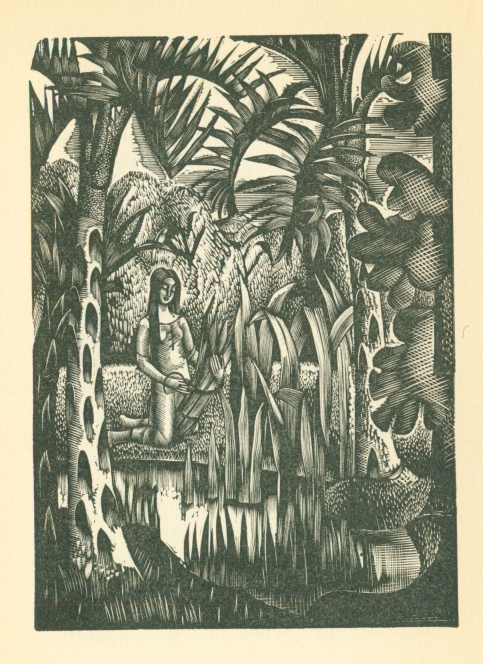
Malchus had all the while stood immovable, leaning against the tree trunk and partly hidden by it. A suppressed trembling shook him like a palsy, and the girl, as her eyes wandered idly over the bank and among the trees, suddenly caught sight of the parched hairy face and the eyes fixed hungrily upon her. She stared back at Malchus for a moment, and then, turning her back with the charming contempt of a young animal, went up on to the bank and slowly slipped on her gown. Malchus, too, stirred himself, and with a deep-drawn sigh began to retrace his steps to where he had left the water skin. When he had found it and carried it to the spring he was once more within sight of where the girl had been. She was gone now, and, having drawn the water, he departed slowly under the burden. He felt no repentance. His heart was hard and exultant. At that moment he revolted with the whole strength of his being against the God who demanded of His chosen the renunciation of earthly love, the beauty of the flesh, and the joys of the senses, and he was glad that, instead of flying at once from the grove as it was his duty as a hermit to do, he had seized the moment and obeyed the clamorous impulse. But as the seething of the senses died down and he found himself once again in the hard, pure desert, he knew that in that brief hour he had brought to naught all the long months of stern living and that the powers of evil had gained a great ascendancy over him. Perhaps that very night evil spirits would break down the door of his cell, and burst in the window bars, and lay hold upon him body and soul, torturing him until the weak body could resist no longer. Bodily death at such a time would bring with it the death of the immortal soul—an everlasting exile from the sight of the God against whom he had revolted. The thought overwhelmed him with horror and, staggering on his way toward the refuge of his cell, he called upon God like a wild creature howling at the sky. "O God," he wailed, "save me from the death I deserve. Remember, O God, my former life, that I loved without discrimination all things beautiful, and consider how great was my temptation. For was she not beautiful, O God, beautiful as a young gazelle? How can it be that what is so beautiful has no part in the divine nature?" Then, feeling that he had spoken blasphemy, he ceased and began to repeat aloud penitential psalms and prayers for the forgiveness of sins. So he hastened, feeble and breathless, on his way, looking neither before him nor behind, where, on the edge of the grove, the slim, straight-robed figure of a girl stood with one hand shading her eyes, watching him.
When he reached his cell he threw down the water skin and the palm leaves, not caring, in his despair, what became of them, and, flinging open the door, he staggered in and fell on his face in the oratory. At first he lay as one stunned, neither praying nor thinking, but after an hour of this prostration he came to his senses and began to pray feverishly, torrentially, like a man in a burning house or a sinking ship, pouring out passionate phrases and ejaculations so rapidly that his mind almost ceased to follow the sense of what his lips uttered. As he prayed, the light began to fail, and it seemed that the shadows that gathered silently into his cell were bodily presences. Soon the darkness would come, and with it the hosts of Satan into whose power he had so recklessly given himself.
But the night fell calm and silent. Not the remotest howl of hyena or jackal disturbed the crystal silence. And as the silence continued unbroken, Malchus, racked by fearful expectancy, became fascinated by it like a bird by the eye of a snake. He waited cold and breathless, more and more certain every minute that it would be shivered suddenly, appallingly, by some diabolical tumult which would be the prelude to his destruction. His mind had grown numb beneath the unendurable suspense, when at last the silence was broken and all his being concentrated into the one act of listening.
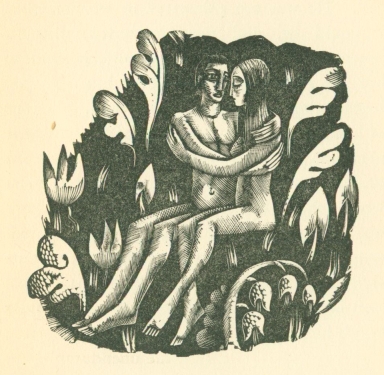
Instead of the horrors he was awaiting, it was a gentle, clear voice which had called softly outside his cell, A broken square of primrose-colored moonlight lay on the wall and floor of the oratory. For a time there was deep silence again. Then near the door the same sweet voice sent a thrill of delight through him, speaking a word that he did not understand. A sense of unreality possessed him; he must be asleep and dreaming, and he remembered with a feeling of infinite relief that Serapion had told him that a man is not responsible in the sight of God for his dreams. His fears were gone now, but his sense was still alert and soon he heard a faint sound in the outer room of his cell. He was too exhausted to wonder what it could be, and next moment something touched him in the dark—a hand, it seemed; but not the fierce hand of evil, but a gentle, ingratiating hand that stroked him. Malchus did not move. As in a dream, his will was nerveless and he lay with eyes closed while the groping hand explored him. Then two arms wound themselves about him and a soft cheek was laid against his. "Helena!" he whispered, ardently, and suddenly he threw off his passivity and, freeing his arms, he clasped to his own body the warm body that lay on the floor beside him.
Chapter Twelve
He awoke next morning to a cold despair. He knew that what he had experienced had been no dream, and he knew, too, that one small spark of consciousness, which he had willfully muffled, had affirmed at the time that it was real. He had sinned consciously and willingly; his delusion had been deliberate. He dared not pray, for to take the name of God into his mouth, vile as he was, would itself be mortal sin; and even if he had dared to pray, the prayers of a wretch like himself, who had implored God's help and protection only to scorn it when the moment of temptation came, would, he knew, be no better than an insolent mockery in the ear of Heaven. Now he was alone indeed, cut off not only from the worldly life which he had abandoned, but also from the holy life of the desert and the eternal life which is its reward. He was exhausted by long fasting and the violence of his emotions; and as with eyes fixed starkly on vacancy he contemplated his state, the horror of it numbed his understanding. "It is impossible," he muttered to himself, "impossible that it was not a dream." Slowly and painfully he rose to his feet. His brain reeled and for a moment he could do no more than stand, steadying himself with both hands pressed against the walls. Then with groping hands and feet he staggered into the outer room and so to the doorway of the cell. On the smooth sand outside, the print of small bare feet was set as a witness against him; and, as if for a sign that all his good works had been brought to naught, all the mats that he had woven were gone. Then his gaze fell on the sack of loaves, and a light came into his eyes, for he saw in food and drink a last consolation for his misery. He plunged both arms into the sack, bringing out all the loaves that were left, and, carrying them outside the cell, he sat down beside the full water skin which he had left there on the previous evening. He untied the neck and dipped each loaf into the water. But to dip them only was not enough; the loaves were still too hard to eat. He gnawed at one, holding it in both hands and chawing at it like a dog at a bone. But he could not break the crust, and at last he flung it away from him in fury and, getting on to his knees, he reached an earthenware dish from the table and set the loaves to soak. And as they soaked he crouched beside them, snatching impatiently at one and another and putting them to his teeth. Crouching solitary there, now immovable, now breaking into convulsive activity as he seized a loaf and raised it to his mouth, he looked like a great ape playing with stones. At last the loaves were soft enough and he fell upon them ravenously, stuffing fragment after fragment into his mouth and then bowing his face to the dish and sucking in draughts of water to soften the mass. So he fed, a fierce and uncouth spectacle, while water and a paste of masticated bread exuded from the corners of his mouth and clung to his ragged beard. He did not remember how on that day a year ago he had lain, exquisitely dressed, at table in his own house, the host of one of the most marvelous of all the marvelous feasts for which he and his friends were famed throughout Alexandria. At that feast the guests had been delighted by the novelty of the little silver ovens in which the slaves handed small newly baked loaves, each cunningly molded into a fantastic shape.
When he had eaten all the bread, he sat for a while, staring before him; then untying the water skin again, he took a long draught from it and, letting it slip from his hands so that it lay gulping out its contents into the thirsty sand, he rose and reached for his staff. Without a glance behind him he stepped out into the empty desert. His mind was empty, barren. He had no plan, no hope, nothing but the instinct to fly from a place accursed, to fly further and further into the desert, as if by unceasing flight he could at last outrun the terrible consequences of his sin. But the moment he left the shelter of the cell an invisible host of evil flung itself upon him, beating up the sand in clouds into his eyes and mouth, wrapping him round in a bewildering whirlwind and hurling broadcast the heap of palm leaves which on the previous evening he had flung down outside the door. He blundered on blindly, with no thought of his direction, beating the air with his hands in an attempt to drive off the unseen adversaries that surrounded him with jeers and whistlings, owlish hoots and derisive laughter. Behind him he heard his door beat and beat again upon its hinges, and he knew that demons had taken possession of his deserted cell and were desecrating it with their foul revelries. He ran on blindly, falling headlong and rising again, till his strength was exhausted and he lay where he fell....
He opened his eyes. He was lying on the level plain of the desert. Long screens of blowing sand, long filmy processions of sand which had taken on human and animal forms, came streaming toward him out of the distance. There was sand everywhere. His eyes and mouth and ears were full of sand; sand coated his skin and filled his clothes, and the ground, the air, and the sky were full of flying sand. It was as if the desert itself had risen against the outcast, had taken on a fierce, vengeful mobility which would soon engulf him, consume him, disintegrate and dry him till he himself was nothing but a cloud among clouds of blowing sand, whirling restlessly from desert to desert, with no more life than a vague and changing form and a thin, crying voice like the voice of despair. Dust to dust; ashes to ashes. The words whirled in the emptiness of his mind as the sand in the empty air, and he nestled his head in his clasped arms and lay on his face, still as a boulder, while the sand hailed against his leather tunic and mounded itself about him till it overflowed in rivulets over his neck and arms and legs.
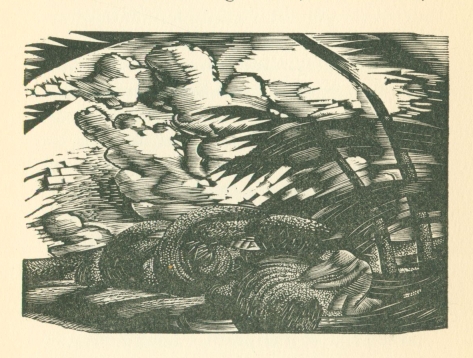
With darkness the storm grew fiercer. The wind shrieked and howled about his prostrate, half-buried body and through the wind came other and wilder howls, now far off, now close and terrible. Then something touched him, and again and again. Something heavy and four-footed stood upon his back. It moved, and then he felt a hot snuffling breath against his cheek. He turned his head in horror and opened his eyes. Green eyes stared down at him. He clenched his fist and struck out. The creature moved away, but slowly, and Malchus felt that it was still lurking close by, with others, waiting its time. Then a more terrible outburst of howls severed the night. He was surrounded by howling, yelling beasts. Raising his head, he could see their eyes glinting, now green, now red, all round him. They beat him, trampled on him; their claws tore at his naked arms and legs. He sprang to his feet and flung himself forward, waving his arms, and there was a scattering of vague shapes in the darkness and the wind was for a moment more densely loaded with sand. No longer daring to lie down, he moved onward, slowly, feebly, painful step by step, and only when it grew light did he dare to submit and, abandoning all effort, sink to the ground in a stupor.
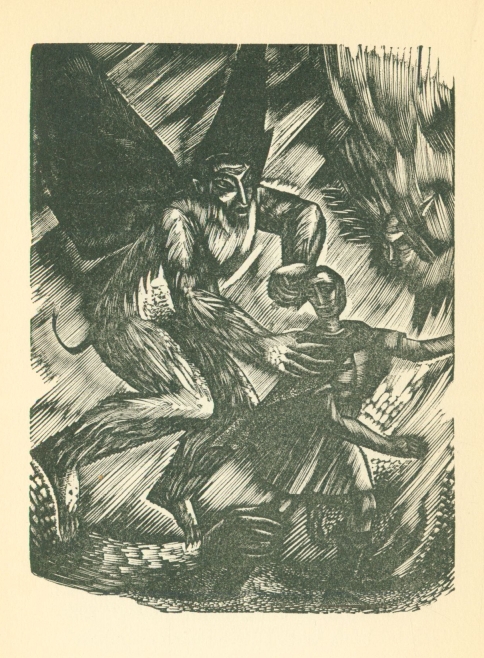
When he awoke he was sitting up, with a strong arm supporting him. A young man knelt beside him, offering him a cup of water. A cake of dried dates lay on a flat stone beside him. He drank the water greedily and then ate the dates; then he turned his eyes to the young man's. They were deep, untroubled blue eyes like the eyes of a child. As they met Malchus's they were full of a gentle solicitude. "How do you come to be here, so far from mankind?" he asked Malchus.
"I was a hermit," Malchus replied, in a voice that was hardly more than a sigh.
"I too am a hermit," answered the young man. "My cell is only a few yards away. When I came out this morning I found you lying here." He helped Malchus to rise. "Come into my cell," he said, "for you are half dead."
Malchus shook his head. "I cannot," he said, "for I am not worthy. I have committed the unforgivable sin and I must go my way."
"Whither are you going?"
Malchus pointed forward into the desert.
"But can I do no more for you, my brother?" the young man asked him.
"Pray for me," Malchus replied as he began to move away. "Pray that I myself may some day dare to pray again."
The young hermit stood watching the meager, plodding figure which soon the desert gathered out of his sight into its arid heart....
Week after week Malchus pushed on. At first he was fed by the hermits upon whose lonely cells he chanced often enough to escape starvation, for in those days the number of hermits in the desert was very great. But after a while the cells grew less frequent and he began to enter a stark country which seemed to have been stripped of all life. Only once in that quarter did he come upon a cell. It stood gaunt upon the naked rock, itself more like a rock than a house built by mortal hands. In it lived an aged and venerable hermit who had spoken with the great Saint Anthony face to face. There were no springs in that waterless waste and the ancient man was compelled to collect in sponges the dew which fell only in the last two months of the year. Every evening he set out the sponges on his roof and before dawn he squeezed the dew out of them into a cistern. In this way he was able to collect enough water for the whole year. He set food and water before Malchus and questioned him about his journey.
"I do not know whither I am going, my father," Malchus replied, "for I who was a hermit have committed the unforgivable sin and I fly onward into the pathless wilderness that I may escape from humanity and from my sin."
"For him that truly repents," the old man answered, "there is no unforgivable sin. But if, being a hermit, you committed sin, it was because you did not perpetually set death, and that which follows death, before your eyes; for he who has his eyes perpetually fastened on death comes to a state of understanding which forever releases the soul from temptation. Each day the hermit must set his soul to contemplate this mortal body of ours and must speak thus with the voice of his soul to each part of it in turn: 'O legs, which have strength to move yourselves and to stand up, stand up before the presence of your Lord.' And to the hands: 'O hands, so soon to decay and crumble into dust and never again be clasped together; before that hour of dissolution comes, stretch yourselves out in supplication to the Lord.' And to the whole body: 'O body, rise and worship God and bear me up that I may offer praise and prayer to the Lord with a good heart, before we are separated one from another and I go down into the place of forgetfulness and am fettered in everlasting darkness, and you consume away and rot and become a thing of loathing and putrefaction. For if you follow after the delights and pleasant things of the world you will surely cast me into never-ending torment.' My son," the old man concluded, "if you meditate thus always until the truth of these things has bitten itself into your heart and mind, it will be impossible for you thereafter to commit sin."
Then Malchus, having eaten and drunk, arose and bade the holy man farewell.
Thenceforward all human habitation ceased, but still he traveled onwards. His food was now the meager herbage springing in rare places among stones or in the frail shadow of thorn-bushes, and his scarce drink was from a desert well or some foul and clotted pool which still lingered stagnating among the sandhills.
One morning, after many desolate days, he saw far ahead of him on the pale floor of the desert as it were a ragged black cloth. It was about four hours after dawn, and as he walked on he saw also that the desert before him was streaked with green. Then, as he drew nearer, he saw that what had seemed to be a black cloth was in truth a great herd of browsing beasts; and when, at noon, he came up with them, he found that they were buffaloes. They were feeding upon the green herb which sprang plentifully in that place. Some of them lifted their great lowering heads as he approached, and he was afraid and was about to turn aside, when two figures, dark as themselves, stood upright in the midst of the herd. When they saw Malchus they began to come toward him, making their way among the beasts. And Malchus saw that they had the forms of men and that they were naked and their bodies covered with hair. He stood, his limbs weak with terror, for he was sure that they were demons, but as they drew near, one of them shouted to him, "Do not be afraid, for we are men like yourself."
Malchus made the sign of the Cross, but still they came on. "If you are men," he asked them, fearfully, "why are you living among wild beasts?"
The one who had spoken before replied: "We were once monks in a great monastery, the monastery of Tabenna; but we both desired the life of solitude, so we left the monastery and wandered into the desert alone, and at length we came here. We have been here for forty years. I am an Egyptian and this brother is a Lybian." Then he began to question Malchus. "Tell me," he said, "how it goes with the children of men. Do they still build houses and ships? Do the ancient cities still stand and are their kings and governors still subject to the powers of evil? And what of the land we knew? Do the river waters still rise in flood once in the year?"
Malchus turned away with a sign of repulsion. "I cannot answer such questions, for I, too, have abandoned the world." Then he turned to the two creatures again, his eyes still fierce with suspicion. "How," he muttered, "can you be men? For if men were to remain here naked and without shelter, their bodies would be burned up by the summer sun and frozen to death by the winter cold."
"We are men indeed," answered the Egyptian, "though we graze the green herb with the beasts, and God has given to our naked bodies the power to endure both heat and cold."
Then those two human creatures turned from him to the nearest patch of herb, and there crouched upon their hands and knees and began to feed. And the great beasts that browsed about them accepted them as one of themselves and, moving forward as they cropped the herb, they inclosed them in their midst and Malchus saw them no more.
With a heavy sigh he resumed his way. "Here," he said to himself, "I have crossed the limit of the human world." But still he fled onward, for his despair drove him, and again he was a creeping thing upon the powdery floors of the desert, goaded daily by remorse, horror-stricken, and tortured nightly by the devils into whose power he had give himself, his body all the while blistered by the noonday fire, shaken by the chills of night, consumed by hunger and thirst and strange fevers. Throughout that time he trusted for his sustenance to what green herb he might find, for he would collect no food to carry with him, being determined to leave in God's hands whether he should live or die. And at last in a remoter desert of rock and sand he saw the dark mouth of a cave in the rock. He climbed up to it and looked inside, and when his eyes grew accustomed to the dimness he saw a man seated within with his back to the entrance. Malchus took up a stone and beat against the rock after the custom of the hermits, but the man did not move, and thinking that he might be at prayer or in a state of meditation, Malchus sat patiently outside, waiting till he should have finished. Yet after many hours the man had not moved, and when Malchus knocked again more loudly he took no notice.
But Malchus could not bring himself to depart. He was desperate, in his long loneliness, for the comfort of a human voice; even a short phrase, a human word or two, would be something to take back with him into the great void where the only voices were the voices of those embodiments of evil which tormented him by night. And so he entered the cave and laid his hands on the bowed shoulders of the seated man. Then, to his horror, the figure swayed, paused, and suddenly crumbled beneath the weight of his arms into a wreckage of bones and dry powder. The powdery dust stuck to his hands and steamed up into his nostrils, and he sprang back, sickened to the heart and, turning round, fled in horror from the cave.
Dust to dust. All about him now was dust and sand, the dried and crumbled residue of extinct life. For now he had reached the limit not only of humanity, but of life itself, and nothing was left for him but to parch and disintegrate with all else, a prey to the relentless heat and cold and the eternal restlessness of the winds. With a shudder of loathing he shook that gray human dust from his hands; but as he stared into the open palms the thought came to him, in the words of the aged holy man, that those hands of his would ere long decay and crumble into the same gray dust. Why, then, should he turn with loathing from what he himself was so soon to become? For whether the soul is destined for eternal bliss or eternal torment, dust is surely the destiny of the body. As he pondered those words, spoken by the soul to the hands, he remembered how they continued, "Before that hour of dissolution comes, stretch yourselves out in supplication to the Lord," and for the first time since his frenzied flight had begun he felt within him the desire and the courage to pray.
He was passing now by a solitary rock shaped like an altar, and it came into his mind that it had been set there as a sign that his prayer would be accepted. He approached it and knelt down before it. "O Saviour of mankind," he prayed, "guide me through this desolation to the place where I may at last find forgiveness." He remained long in prayer and when he rose he felt for the first time that a little core of light had begun to dawn in the blackness of his despair. Each day, after that, he prayed, and night by night the hauntings of the demons were diminished and he knew that the tyranny which the powers of evil had gained over him was abating. He felt now that he was under heavenly guidance as day after day he wandered on, heedless of the changes in the great monotony of sand that seemed boundless as the earth itself, until he began again to come upon the solitary cells of the hermits. Some were empty and ruinous, but in others he found the stern inhabitant who shared with him his scanty store of bread and water. The impulse to fly from himself which had first driven him out on his long pilgrimage, had spent itself, and he began to think that when he came to a suitable place he would stop there and build himself a cell in which, by a life of stern repentance, he might pursue that forgiveness for which he had prayed.
Chapter Thirteen
When that thought had grown to a resolve, night had fallen. A full moon rising heavy and ripe out of the horizon was transforming the night into a pale and spectral day, and Malchus determined to travel on through the night and to choose for his abode the place where he should stop to rest an hour before dawn. And so he tramped on, and when it seemed that the night was flagging and dawn was not far off he halted on a ledge midway up a sandy slope and, nestling down into the deep, loose sand which still kept beneath the surface the warmth of the departed day, he fell asleep.
When he awoke, sunlight brooded heavy upon the world. His memory was confused and it seemed to him that this was no more than many of his awakenings in the unknown desert. Then the voice of his soul spoke as loud and clear as if an unseen speaker stood beside him. "Here is the place," it said, "in which you must seek forgiveness." And hearing those words, Malchus remembered that where he lay was the place in which he had resolved to remain. He rose up to survey it; but as he raised his eyes astonishment seized him, then horror and despair. Was it a hideous delusion, or had he been led during all these days not by Heaven but by demons? For, like a sudden and murderous onslaught, the discovery flashed upon him that he was standing before his own cell. And not only that, but, as he continued to glare dumbly at the familiar scene, he saw that a few yards away, small and slim in her straight gown, the cane-gatherer stood watching him. At that a frenzy came upon him and, snatching up stones in both hands, he rushed forward, hurling them at the girl and snatching up more and hurling again. But as he drew near to her her face became distorted and hideous and she dissolved before his eyes like a wraith; and Malchus stood poising a great stone in his right hand and staring foolishly on vacant air. He dropped the stone, but as he turned, with doubt and fear in his heart, toward his cell, he saw the girl come round the corner of it and—lovely again as when he had first seen her—vanish into the doorway. A shuddering came upon him like an ague, for now he understood that this was God's answer to his prayer that he might be guided to the place where he should find forgiveness. It was not by flying from his sin that he could overcome it, but by facing it. And now, in answer to his prayer, God had brought him face to face with the bodily symbol of his sin. He understood, but his courage sank before the ordeal; he felt that he was not yet strong enough to face the terrible and supreme struggle which involved the fate of his immortal soul. For, despite the long weeks of austerity in the inner-most desert, his mind was still troubled by earthly weaknesses and earthly desires: even after this long mortification of the flesh the desire of the flesh was still alive. How could he be sure, then, that he would have the strength to conquer? Could he stand firm against that girl, mortal or demon, waiting for him there in his cell? He stood trembling, for even this brief sight of her had aroused in him all his old half-conquered desire. If he were to fail again in the contest, how irrevocable this time would be his damnation. He braced himself and, raising his arms to Heaven, cried for mercy. "O Father," he prayed, "try not my weakness too sternly. Drive me not away from Thee." He took a few trembling steps toward the cell. Then he stopped. The odds were too terrible; his courage suddenly broke like a wall that collapses upon itself, and with hands thrust out before him like one groping in utter darkness, he turned his back on the cell and ran down the slope to the desert plain below.
He neither knew nor cared where he was going. He did not even know why he ran. As when Helena had cast him off, he felt that his life was broken in two. But now it was worse; for, to a man who is fleeing from God, no new hope, no saving ideal, can ever come. Henceforward he would be no more than a beast cast out from the herd, wandering lonely and disconsolate till death should bring deliverance. Worse, even worse, than that; for to him death would bring not deliverance, but inescapable and everlasting torment.
He had stopped running. His feeble body had of its own accord stood still, and, swaying like a tree in the wind, his head muffled in his cloak as if to shut out all existence, he tried to collect his thoughts. But his mind was dark and empty. A whirlwind of misery and despair filled its emptiness, and he stood, without a will, without thought, blind, stark as a desert rock, empty as a tomb.
Suddenly he started with fear. A touch had fallen upon his arm and a well-known voice sounded in his ears. "My son, I saw you in a vision as you were returning to yourself and I have brought you the money which I received in Alexandria for your weaving." A hand drew down his hand and put money into it. "It was told me in Alexandria that God has freed your father from the burden of the flesh. Give thanks to God, then, that he has given freedom to your father and has loosed from you another earthly bond."
Malchus stood immovable. He dared not lower the cloak from his face lest his eyes should meet the eyes of Serapion. A hand fell on his shoulder as if to comfort and exhort him, and in a little while Malchus felt that he was alone. Then only did he dare to lower his cloak. A hundred paces behind him a lonely figure retreated across the sand, and Malchus knew that he had cast off his only friend. He turned away with a sob and continued his aimless wandering; and, as he fared on, the storm of passion abated and he understood what Serapion had told him. At first the thought that his father was dead was no more to him than an echo out of the remote distance; it came to him as a surprise that his father should have been alive until so lately. But soon his dissolved life began to crystallize in new thoughts and emotions about this new thing and, as it were, to become coherent again. For, now that his father was dead, his mother would be alone, and he told himself that it was his duty to go to Alexandria to help her to settle her affairs. That thought became the center of his life; he fastened upon it as strayed birds of passage settle in flocks among the rigging of a ship, finding there for a moment foothold and repose in the homeless void of sea and sky. His life took on again a meaning and direction and he did not question whether it was truly love for his mother or the sight of a refuge for his own mind that urged him on. He knew only that his desires were fixed on returning to Alexandria.
And so he wandered on, not knowing where he was in the vast deformity of the desert; and late in the evening he found himself on the bank of the great river. Human shapes moved before him, and, following them, he went on board a boat which stood with loosely hanging sail at a wooden jetty. It seemed that it was about to cross the river and he stationed himself lonely and apart on the deck, as he had done long ago when he had followed Serapion on to the ship on Lake Mareotis.
The passage of the river did not take long, but when they touched the further bank it was already broad moonlight. The other passengers, having disembarked, settled themselves in the sand on the edge of the broad track which skirted the river. Malchus questioned one of them, who replied that they were waiting for a caravan which was traveling northward toward the towns and villages at the mouth of the river, and Malchus resolved at once that he too would join the caravan. He lay down in the sand not far from the other travelers, brushing away the upper layers with his hands till he came down to the warmth that lingered below, and soon, overcome with weariness, he fell into a deep sleep.
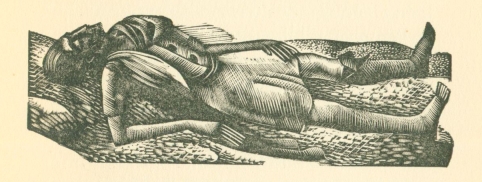
It seemed that he had only slept for a few minutes when some one shook him by the shoulder and he awoke to a hushed, multitudinous noise which seemed to fill the whole desert. It was the sound of hundreds of muffled footsteps churning the sand, the low muttering of a great company, the snuffling and breathing of camels, and the creaking of their harness and loads. The sky was cold and bright as polished steel. Malchus saw with amazement that it was not more than an hour from the dawn. He stood up, feeling stiff, weary, and very old. A great blur of shadowy forms moved against the clear sky and, like the distant rocks and hills of an unstable world, the fantastic shapes of camels swayed above them. The air was sharp and searching: he could see the breath of the camels smoking upward in a thin fume.
With the others who had crossed the river, he took his place in the rear of the shadowy host, and before they had marched an hour the dawn broke like a sudden summer on their right flank and their left was accompanied by a long saw-edged shadow like a mountain range that flowed and undulated in pace with them. Too soon upon the dawn came the torrid sunlight, burning up the morning coolness and adding another torment to each suffering life in the great sinuous retinue. As they went on their way, new companies joined them, and before long Malchus and his companions were no longer in the rear, but in the middle of the line of march. Noon came, burdening them with its relentless pressure, and Malchus, as in his lonely desert wanderings, fell into that monotonous rhythm of movement in which the body labors on wearily of its own accord and the mind is lulled into a stupor.
Suddenly a tremor ran through the company, a spasm of doubt, apprehension, then of sharp fear. Malchus thrilled to it with the rest and, seeing many heads turned eastward, he turned his eyes in that direction and saw a great cloud of dust that moved toward them like a sandstorm. He watched it keenly, anxiously, till it grew to a company of white-cloaked riders. Rapidly they came nearer and nearer still. They were Arabs. Perched on their long-legged camels, they crouched eagerly forward. Their long cloaks streamed behind them. Soon they were so close that if they had been going to cross the course of the caravan they would have swung to the right or left; but still they swept on, straight for the center. Then suddenly the caravan broke into three. The van detached itself from the rest and flew cowering forward; the rear turned and shrank backward on its tracks. A small company in the middle, which included Malchus and his companions and a dozen laden camels, halted, terrified and bewildered by its sudden isolation. The white-cloaked riders swept round them in a circle and closed in upon them.
Malchus awaited the outcome like one in a trance. Was this, he wondered numbly, God's retribution for his cowardly flight from the ordeal appointed by Him? Without hope and without fear he watched some of the Arabs dismount and move among the captured company, carrying drawn swords in their hands. Soon an Arab approached him also, and he was led away to where four camels lay waiting. The small heads with their great eyes and haughty muzzles moved, scornfully inquisitive, on the top of the long bird-like necks. The Arab stopped before the first and signed to Malchus to mount. A figure wrapped in a black cloak was already in the saddle. Malchus climbed up behind it. The figure did not stir, and Malchus, too, neither stirred nor spoke, waiting idly for what should happen.
When all the prisoners were mounted and a party of Arabs had taken charge of the captured camels, one of the Arabs came up and beat up the four grumbling beasts and the company began to move. The van and the rear of the caravan, which had fled forward and backward, were no longer in sight. They had vanished among the rocks and sandhills.
Malchus, looking for the sun, saw that they were now traveling due east. At first they moved slowly, but soon the leaders broke into a canter and Malchus and his unknown companion were flung against each other. The violent swaying began to give him great pain, and, seeing that his companion was also distressed, Malchus put his arms about him that they might steady each other. Thus bound together, they were able to avoid the swaying and buffeting which had tormented them and endangered their safety when apart. The thought of Alexandria, which, when he had joined the caravan, had grown for Malchus into something beautifully and terribly real, had shrunk back now into a dream. Perhaps he would never go there now, and his mind effortlessly began to picture the city—the streets, his parents' house, his own house, and that little door, so piercingly familiar, which opened into Helena's garden. He paused at the door, hesitated; something—he could not remember what—held him forcibly back, but he shook off the restraint and opened the door. He went in quickly and secretly, shutting the door behind him, and stood breathless at the beauty of the place, at the gentle stirring chequer of sunlight and leaf shadows, the flowers drooping in clusters from the trees and swelling in mounds of blended colors from the grass, the fountains—silver ghosts half-seen among the trees—filling the place with the cooling rustle of water. He ventured forward upon a grassy walk, but figures moved among the trees and he hid himself till they had passed. "Where is she?" he asked himself with ecstatic fear, and just as he was going to move again he saw that Helena was watching him through the boughs. She came toward him, her eyes shining with pleasure, and he stood waiting. A voice called him loudly and commandingly from the garden gate. He trembled, for he knew that it was the voice of God; but he lingered like a disobedient child and Helena caught him by the shoulders. Then, submitting wilfully to his desire as he had done when the cane-gatherer came to his cell, he threw his arms around Helena, whispering into her ear little passionate phrases, deliciously aware of the smallness and suppleness of the body in his arms. Then a startling rush of wind in his ears and a gust of sand in his face, and he awoke to the flowerless desert and the weary lurching of the camel. But still he was no more than half awake; still his mind thrilled to the sweetness of his meeting with Helena, his arms still felt that soft weight of her body. Though a man is not responsible before God for his dreams, was it not deadly sin to take delight in the memory of them? But this was more than a memory. He still held the soft body in his arms. He cried out in fear and the cry roused him from his drowsiness. The body that he clasped was the body of his fellow captive. He shuddered and loosed his grasp, as if what he clasped were a thing unclean. But at his cry and the loosing of his arms his companion turned, and at the same moment another gust of wind blew the cloak from the muffled face. Malchus saw with horror and despair that the face looking at him was the face of a woman.
Was she an evil spirit in human form? Or was it that God had rescued him from his cowardly flight and his desperate attempt to return to Alexandria, and brought him again, with an inexorable indulgence, face to face with his sin? Malchus did not know; but he knew that he was in dire jeopardy and he prayed from his heart, making the holy sign at the end of each prayer. And still, despite his prayers, the woman remained on the saddle in front of him, so that he knew she was no demon, but a creature of flesh and blood like himself. The speed of their going had slackened to a walk, but now again the leaders of the company urged on the lurching beasts and again Malchus and his companion clung together for safety. And Malchus cried to the soul within him: "O my soul, such is the outcome of your attempt to escape the judgment of God and return to the life which you had cast off."
Chapter Fourteen
Late in the evening of the second day, when the sky was already curdling into darkness and those sharp points of brightness which are called the stars, they halted. They had reached the Arab encampment. A dark cluster of tents showed square and angular on the gray plain and the air was full of the mournful bleating of the flocks which had been brought in from pasture. Then the same Arab came and made their camel kneel down, and Malchus and the woman stepped stiffly into the sand and lay down apart to rest in the place appointed for them.
Soon after the dawn Malchus awoke. A tall figure stood beside him, who ordered him to rise up and follow him. It was the sheikh of the company who had captured them, and he led Malchus toward the largest of the tents and, lifting the curtain of the doorway, took him inside. A woman crouched on the floor, preparing food. The sheikh told Malchus that this was his mistress whom he must obey, and Malchus, being defenseless, bowed himself down before the Arab woman. Then food of curdled camel's milk was given to him for himself and the woman who had ridden with him, and he returned to the place where he had slept. Of the rest of the captives he saw nothing, and, being alone with the woman among a strange people, Malchus was forced to converse with her daily, to the peril of his soul. But he did not allow his eyes to fall upon her, for he had seen that she was young and beautiful. Her name was Veronica. She was a married woman of his own race. Her husband's house was in Lycopolis, and when she had fallen into the hands of the Arabs she had been traveling to Alexandria; but of her life and circumstances Malchus knew no more, since he forbore to question her or to talk with her more than was needful. She herself spoke no more than he, but when she did so the soft low note of her voice thrilled him, for it was too like the voice of Helena—so like that, whenever she spoke, old memories and old delights woke again in his heart and dreams of Helena troubled his nightly sleep.
After a few days the sheikh led Malchus out and set him in charge of their flock in place of the Arab shepherd who was so old that he could scarcely drag his parched and wearied body as far as the meager pastures where the beasts found a daily sustenance. For two days the old shepherd accompanied Malchus, showing him where the sparse herb sprang among the rocks and thorns, and in the evening when they had returned to the tents he sat with Malchus, teaching him the names of the sheep and goats. Each had its own name and each when called would raise its head and come to the call. The Arabs scorn the shepherd's lot, preferring the monotonous idleness of the camp to the free and open life of the herdsman, and none of them will undertake it except from bare necessity.
But the freedom and peace of the shepherd's life comforted Malchus. He rose with the dawn and led forth the flock, and when they had reached the pasture land the beasts browsed slowly forward till near upon noon, when he called them in to shelter from the torrid heat in the shadows of the rocks or thickets. There he milked a goat or sheep for his midday meal and, having drunk, stretched himself full length in the shade while the sheep stood together with hanging heads and the goats drew apart and lay down to rest. Then, when the breathless urgence of the noon was past, Malchus called them out to pasture again till sunset, when he led them back to the encampment, where the women were waiting to milk the ewes and female goats. Each beast knew the woman that milked it and went of its own accord to the accustomed tent. With the darkness the herd lay down to rest where the horses and camels were gathered about the tents, and the sheep dogs mounted guard through the night, prowling to and fro with frequent snarling and barking. Sometimes a wolf came out of the rocky hills, and at his approach the flock would suddenly shrink together in a panic and the dogs set up a loud baying. Then the shepherd with beating heart leaped up and raised a clamor to drive off the thief; but often, when the night was moonless, a small, agonized bleating was heard in the darkness and, when the light returned, the flock was the less by a lamb. When no green herb remained within a short distance of the camp, Malchus had to lead the flock further afield, and sometimes for many days together they were out in the open desert, since it was too far to return to camp each night. At such times the sheikh used to ride out once in two or three days to see that all was well with the flock.
Malchus was glad of this peaceful occupation. All day he had the solitude that he desired and he was dependent upon no man, for by his labor as shepherd he earned the milk which he drew from the flock for his sustenance. In that high desert country the air was pure and sweet and, except during the burning noon-tide hours, the sun was less fierce than in the lower deserts he had known. His body, under the daily exercise and the healthy diet of milk, grew firm and strong and his sleep was the deep sleep of honest weariness. No visions, good or evil, came to him there. That grim battle ground of the spirit in which he had lived so long, where the difficult pursuit of holiness and the endless struggle against evil were alike an unceasing torment and all earthly things were but the outward manifestation of striving spiritual forces, seemed now a country remote as the moon. He had been carried, it seemed, into a peaceful limbo where all was simple and kindly, and he loved the innocent beasts that answered his call and intrusted themselves to his guidance. Only two things marred his life's serenity—the knowledge that he had failed before the great ordeal of the spirit and had basely withdrawn from God the life he had dedicated to Him, and the unappeasable desire of love which flamed up, still undiminished, in dreams of Helena and the abiding memory of the cane-gatherer which lived on in his mind unexorcised by all his agonies of repentance and prayer. The presence of his fellow captive, Veronica, also disturbed him, and made those unbidden memories more real and vivid than before. But alone in the high desert with his flock he had many days of peace in which it seemed to him that he was not altogether excluded from the mercy of God, and as he led them from patch to patch of the sparse herb or, unsheathing the sword which he carried to guard them against wolves, set himself to cut a bundle of dry thorns for his lonely camp fire, he prayed to God from a full heart for final deliverance.
Yet in other moods, the fear came upon him that the untroubled quiet of his life was not the peace of forgiveness, but the silence of utter exclusion. Perhaps he was no longer tormented by evil spirits or visited by comforting visions because the battle was over and lost and Satan waited, secure of his prey, for the moment of his death. Then horror came upon him and he lay on his face in the dust in the agony of desperation. But those despairing moods were less frequent than the other moods of serenity in which it seemed to him that his life as a shepherd was a blessed respite from the tempestuous life of hermit.
But one evening the sheikh called him to his tent. To reward him for his honest service, he told Malchus, he was resolved to give him the woman Veronica as his wife. "For every man," he said, "has need of a woman to ease his loneliness and to pitch his tent and serve his food." Malchus thrust out protesting hands, declaring that he was a monk and might not marry, and the woman, besides, was married already. But, hearing his generosity scorned, the sheikh's face grew dark with anger and he drew his sword and would have killed Malchus if he had not run for refuge to his mistress, the sheikh's wife, and grasped her hand. Perforce he resigned himself to the sheikh's will and, hearing that he submitted, the sheikh was appeased and a tent was set apart for Malchus and Veronica and they were married after the manner of the Arabs.
But when at the end of the day they had been brought together into the tent and left alone, Malchus turned his face from Veronica and crouched in a corner of the tent. He believed now that the Arabs had been sent to capture him only that his damnation might be the more certain. He was being inescapably drawn to commit once more the sin which had imperiled his immortal soul. But as this thought grew to terrible certainty in his mind it brought with it another—the thought that it was surely Satan, and not God, who had led him back through the wilderness to his cell and shown him the cane-gatherer waiting for him. His sin, indeed, was unforgivable, God had abandoned him from the moment he had committed it. He knew now that all hope was past. The bitterness of death entered into his soul and with a choking sob he bowed his head to the dust. But one thing, at least, he could do, one act to bear witness before God that his soul still desired chastity. Rising from the ground, he drew his sword from its scabbard and turned the point to his heart.
But in the little moonlight that pierced the darkness of the tent the woman saw the gleam of the sword and cried out. The sword slipped from his trembling hands.
"What are you doing?" she cried.
"Do not be afraid," answered Malchus. "I will not harm you."
But Veronica was groping toward him in the dark. She set her foot on the fallen sword. "Tell me," she whispered, "what you were going to do."
No reply came from the motionless figure half seen in the darkness before her. She spoke again:
"Swear to me by Jesus Christ that you will not kill yourself because of me. Rather, if such is your wish, turn your sword against me, for I am as anxious as you to preserve my chastity. I fled even from my lawful husband for the sake of Christ, and when the Arabs captured me I was on my way with the holy woman, Melania, to enter the White Convent which is outside the walls of Alexandria. May we not, then, live together in chastity, loving one another with a spiritual love? I will cover up my face and speak to you only when necessity compels. So we shall escape the sheikh's displeasure, for he will never know that we are not in truth husband and wife."
When Malchus heard these words and perceived the mercy of God, he knelt down in the tent and offered up thanks to Him who is the sinner's salvation. Veronica also prayed in a corner of the tent apart, and when they had made an end they lay down to sleep, for at dawn Malchus would have to go far out into the desert with the flock and Veronica would follow him, leading the ass on which they would load their tent and a few household utensils. In those days the herb was becoming rare and they had to seek it so far afield that the shepherd and his flock were often a whole month away from the Arab camp. But at intervals of three or four days the sheikh, as was his custom, rode out to see that all was well, and, perceiving that Malchus took good care of the flock, he was content.
For many weeks Malchus and Veronica lived together chastely in the sandy solitudes, sharing their single tent and eating together; and although they seldom spoke and Malchus never saw her face, yet he knew that a kindness toward her was growing up in his heart, and, imagining the face that he could not see, he had come to imagine it always as the face of Helena. So day by day, as he sat lonely among the high rocks and tended the grazing beasts, or lay drowsing at noon in the shadow of some great stone or thorn bush, or watched nightly with the prowling sheep dogs under stars which seemed every moment about to shower down in their bright millions on to the dim gray desert, his heart began more and more to turn back with longing toward his cell.
Then his mind grew fruitful with schemes. The sheikh, secure in his confidence in Malchus, never visited them now more often than once in four days, and Malchus began to see that it might be possible for him and Veronica to escape. He knew where the river lay. From the rocky heights above their present grazing-grounds he had seen its thin silvery scroll gleaming far to the west. If they could carry enough food and water for six days they might be able to reach the river and find there a boat or some northward-moving caravan.
One evening, when Veronica had finished milking the ewes, Malchus, returning to their tent, found her in tears. Her trouble was so great that she was unable to disguise it and she sat with her face bowed in her hands, her shoulders shaken by sobs. At first, when Malchus questioned her, she could not speak, but before long she had gained control of herself. "I think," she sobbed, "that we shall be captives until our death, and when I reflect that I shall never enter the holy life for which I have left my husband and my home, despair comes upon me, for it seems that God has not found worthy the life I have offered to him."
Then, for the first time, Malchus spoke to her of his schemes. "But for wanderers in the desert," he said, "there waits hunger and parching thirst and infinite weariness of the body. Would you risk these things, and worse, for the bare chance of escape?"
"I would gladly risk death itself," she said; and seeing her so ready, Malchus began to build up a plan.
"We must wait till the moon is almost at the full, and we must wait, too, for a day when the sheikh comes to visit us so that we may have all the interval between that visit and his next before our flight is discovered. It will be a long journey, four days at the least, and, if we wander a little out of our direction, perhaps six or seven. And I must set about preparing food for the journey and water skins in which to carry water, so that we shall not have to linger on the way, seeking for these things, for water and green herbs may be very scarce in the part of the desert that we must cross."
During the days that followed, Malchus killed two kids and dried their flesh for food, and from their skins he made water skins. It was the shepherd's duty every second day to lead his flock to one of the desert pools, for sheep must drink at least once in two days, and next time he led them to the water Malchus took the skins and brought them back filled. The moon was already waxing toward the full and, everything being ready, Malchus and Veronica waited anxiously for the sheikh's visit.
He came, late one afternoon, cantering on his long-tailed mare, with two companions. He began at once, as they had feared, to count over the flock, and soon noticed that two kids were missing. When Malchus told him that they had died, his face darkened and they waited with stopped breath for what he would do. But next moment it seemed that he accepted Malchus's tale, for his face cleared and he spoke of other matters, and soon he and his two companions mounted and rode away.
Malchus and Veronica stood watching them as they grew smaller and smaller and then vanished over the last visible wave of the desert with bowed heads and cloaks filled out with the wind of their speed.
Chapter Fifteen
Then they began with feverish haste to prepare for flight. First they dug out of the sand the kids' flesh and water skins which they had buried to hide them from the sheikh, and then, leaving their tent standing, they led the flock to the nearest pool, because Malchus could not bring himself to desert the innocent beasts where they would perish of thirst.
When the light had almost gone and the flock had lain down about the pool, they loaded the flesh and the two water skins on their shoulders and struck out into the void. For a while the dead ashes of the sunset guided them; then suddenly the heaven was full of stars, waking depth beneath depth in glittering shoals, and when they had marched a little above an hour the orange disk of the moon rose out of the ghostly sands and the whole desert glimmered white and visionary under the paling and brightening moonlight. They fled on in haste, not daring for more than a few minutes and at rare intervals to throw down their burdens and ease their aching shoulders. Crest beyond crest and trough beyond trough, the desert dropped downward beneath their stumbling feet and the uplands they had left grew up higher and higher behind them, lines of black ramparts against a luminous heaven. Dawn found them faint with weariness on a rock-strewn waste between two crests. For two hours still they labored on, till Veronica stumbled and fell and could not rise. Then they ate a little of the flesh and drank some water and laid themselves down to sleep a little in the shadows of the rocks.
But it was not long before their fears awoke them, and soon they were hastening on again until burning noon, brooding breathless upon the fiery sand, drove them to seek the shadow. And now their failing bodies, grown careless, in their dire exhaustion, of peril and death, claimed the repose without which they could no longer endure the labors demanded of them. They slept till the noonday ardor was long spent; then, waking with renewed energy and renewed fear, they plunged on through the hot and clogging sand, turning their heads sometimes as they hurried onward, to scan the horizon behind them. But the horizon was bare and all the great spaces they had traversed empty of life, and moonrise saw them plodding painfully toward the ever-receding crest of a vast undulation in the sand, beyond which opened the star-hung emptiness of night. In all their journey they spoke hardly at all; all their strength and all their breath were needed to carry them on. But without the help of words, fellowship and sympathy were strong between them, born of the fears and hardships they had shared. Sometimes Malchus, reminding himself that his companion was but a woman, would urge Veronica to take more rest and food, but Veronica bore up with an energy equal to his own and for him the steadfastness of body and soul in this small woman was a thing for wonder and admiration.
It was in the morning of the fourth day that, as Malchus turned to stare backward on their tracks, two shapes rose suddenly upon the sky line. In a moment they had dropped downward from the blue and were descending the pallid gold of the desert. They were camel-drivers. Malchus said nothing of it to Veronica, but his eyes anxiously scanned the country that lay about them. They were rounding the slow curve of a hillside. On their left the desert fell away to a wide, empty hollow; on the right, not far above them, it heaved itself against the sky in a rampart of broken rocks. Malchus led the way upward. Their only hope was to find some cleft or hollow in the rocks. He shot a glance backward. The riders had disappeared, but he could see their tracks, scrawled in a long curve down the slope to where a nearer crest hid them, and Malchus's trembling imagination pictured them scouring the intervening hollow and mounting faster and faster to the new crest on which, at any moment, they would appear, terrifyingly enlarged. The knowledge that in that silence and emptiness a secret death was rushing toward them, the sense of a headlong pursuit about to burst upon them when and where he did not know, but terribly soon and terribly near, gripped his heart in a hand of ice. He threw his arm about the laboring Veronica, urging her up the rising ground toward the rocks. Then, high above them, a great ragged disk of black shadow appeared among the rocks and Malchus knew that God, who is the Help of the helpless and the Hope of the hopeless had opened a cavern for them in the cliff. They climbed desperately toward it, gripping the sheer rocks with their hands, and flung themselves within. Shrunk together into a dark corner, they huddled breathless, listening while it seemed to each of them that the loud beating of their hearts filled the whole cavern with dull vibrations. Then, crouching there they grew aware that they were not alone in the cave. Some other living thing was near them; the air was thick with the rank, tawny smell of a wild beast. But in their dire extremity they had no fear for any beast, for all their fear was fastened upon their pursuers, who at any moment would break in upon them. "If it please God," whispered Malchus, "this cave shall be our salvation; but if He forsake us, at least it will receive our dead bodies."
Suddenly the golden mouth of the cave was blurred with shadow. A man holding a drawn sword in his hand stood in the sunlight, so close that, leaning forward, they might have touched him. They held their breath, immovable as stone. Then the man, who, because his eyes were unaccustomed to the darkness of the cave, could see nothing, shouted into the echoing mouth. "Come out, you runaway slaves," he cried. "Your master is waiting for you below."
But as he shouted, something stirred in the darkness at the other side of the cave and a great beast sprang at the man and hurled him to the ground. His sword leaped from his loosened grasp and clanged upon the rocky floor. Staring into the bright mouth of the cave, they saw that the beast was a lioness. She stood for a moment with her forepaws and her great head planted upon the prostrate body; then slowly she dragged it into the cave where her cubs waited. From the man there came not a sound, but they could hear the hot breathing of the beast like a wind throttled in a cleft of the rocks.
For a long while all was still. Then again a shadow troubled the brightness of the cave's mouth; the shadow of a great arm swept suddenly across the sunlit wall, and the voice of the sheikh, their master, rang through the vault. Waiting below, he had become impatient when his companion did not return with the captives, and now he had come himself in great wrath. "Ho, Zogreb!" he shouted, and the well-known voice struck terror to their hearts. "Bring them out. Why do you delay?"
With his sword raised he took three paces into the cave. But again the lioness sprang like a tree-trunk hurled from a catapult, and the sheikh went down before her as his servant had done. His last agonized cry filled the cavern with the very voice of horror, and then there was silence but for the dragging of the heavy corpse along the floor.
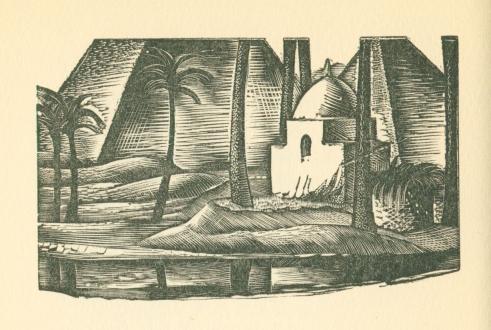
Then Malchus and Veronica rose up and went forth from the cave, and, climbing down the rocks, they saw two camels picketed below. Then both fell upon their faces and offered up thanks to Him who is the Help of the helpless and the Hope of the hopeless, who had sent the lioness to deliver them from their oppressor and had given them the two camels to carry them back into freedom. And when they had eaten and drunk of the store of provisions which they found upon the camels, they loosed the picket ropes and mounted, and an hour before sunset of the same day they came to the banks of the Nile.
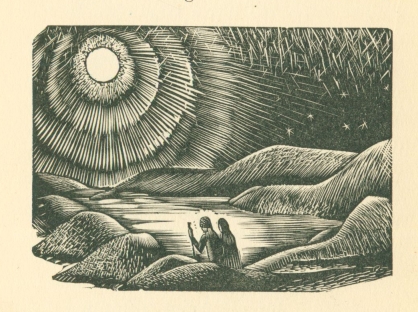
They followed the river, and as darkness fell they reached a town where a north-bound ship was taking cargo for Alexandria. It was even then almost ready to cast off. Malchus and Veronica made haste to unload the camels, and while Veronica sat guarding the loads on the wharf, Malchus led away the camels and sold them to provide money for their passage. And within the hour they lay on the deck and the great sail yawned above them in the feeble breeze, and above the sail, above all their world of sand and rock and water, yawned the profound blue of the night filled to its uttermost recesses with luminous galaxies which showered their images on the black crystal of the river gliding endlessly northward. They lay motionless: a great peace had fallen upon them. It seemed that their lives, having rushed down through a great turmoil of fears, agonies, and despairs, had suddenly swung to rest in a dark, quiet pool. And in Malchus's mind so great was the peace that he had ceased to look forward into the future.
It was Veronica's voice that recalled it to him. "Do for me now one thing more, my brother," she said. "Lead me to the White Convent without the walls of Alexandria. There we will bid each other farewell and you will be free."
The words fell like a dirge upon his ears. How calmly Veronica spoke of their parting. He himself had forgotten that they were to part. The terrible adventures and hardships of their long flight had, for him, drawn them together by a hundred bonds of sympathy. Day by day he had seen the great spirit shining in the small, calm face and carrying the small body through ordeals that even a strong man might fear to face, and his own spirit had bowed in reverence before her nobility. Now, remembering that in a few days he was to bid her farewell, his soul shrank within him at the thought of the separation. It was as if the noblest part of himself was to be cut away from him. And during the long, calm days of the voyage he sat silent and unmoving beside her while the endless golden hills, the long lines of emerald palm grove and the broken temples and monstrous sculptured gods of a race long dead glided past them and were lost in the all-devouring distance. And it seemed to him, as he watched that endless flux and dissolution, that all the human things of his own world—the love, the beauty, the swift adventure—were being slowly but irrevocably withdrawn from him, leaving him cold, stripped, and solitary, a shape of rock exposed to the warring tempests of heaven and hell till it should be weathered down to a handful of pure gold or a heap of restless sand. At night, when he slept, his dreams turned always to Helena. In every dream now she was in danger or captivity, calling to him to save her, to take her back to him. Her voice came to him small and faint from behind closed doors, out of thick darkness, across impenetrable forests. Sometimes for a brief moment she stood before him, close and vivid; but as his heart warmed into final happiness she faded from his sight with an unfinished appeal on her lips. Sometimes he dreamed of one of his earlier loves and sometimes, too, of Veronica, but always at the end of the dream the face, or body, or voice resolved itself into Helena, as though Helena were for him the essence and symbol of all womanhood.
Chapter Sixteen
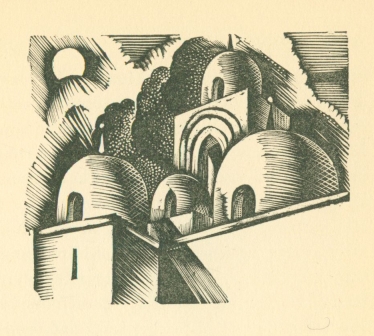
Malchus sat outside the closed gate of the White Convent. He had faithfully led Veronica to her destination; an hour ago she had entered the gate and with the closing of the gate behind her she had left the world forever. She had approached the convent as a lover approaching her beloved, and as she bade farewell to Malchus and his eyes fell upon her for the last time her face shone with the ecstatic gladness of a saint entering Paradise. Yet, though that moment was also the moment of his own freedom, Malchus felt none of her gladness. He felt only homeless and abandoned; it was as though his heart were dying within him. He found comfort only in the thought of Alexandria, whose walls and towers showed a mile to the east above the greenery of a vineyard. There, it seemed to him, Helena waited to give him that peace which he had sought so long. Kneeling beside the convent wall, he prayed desperately for guidance, but still his thoughts and desires drew him to Alexandria so strongly and so insistently that at last he came to believe that, for some hidden reason, it was God's will that he should enter the city. He delayed, perplexed and timid, till he fell asleep, seated there in the gray dust under the convent wall.
When he woke his soul was trembling like a harp string at the touch of a half-forgotten dream. Some heavenly vision had come to him and gone again, leaving a trouble like the echo of incomprehensible words. Then, as he groped for the meaning of the vision, the words took on clearness and sense. "Go into Alexandria," they seemed to say, "and follow your desires, for thus you shall find your peace."
That, it seemed, was the only answer to his prayer. He rose and, with slow and doubtful steps, began to make his way toward the city, and at sunset he entered the court of Diocles the poet and stood by the little fountain which leaped from a fringe of tall blue irises, while the slave went to announce his name. He had not waited for more than a minute when a quick step sounded in the portico and Diocles, with the familiar movement of his wide shoulders, came hurrying forward with outstretched hands.
"My dear Malchus!" he cried in his deep, ringing voice, laying his two hands on Malchus's shoulders. "At last you have returned after all this time. And you left us without a word ... without a hint, how many years ago?"
"A lifetime, for me, Diocles!" Malchus replied, gazing at his friend as at some incredible vision.
"Yes, a lifetime indeed, my friend; for you are changed beyond belief."
Malchus did not reply, for he realized now for the first time the full magnitude of the change which had come over him. For Diocles was not changed; he was the same as when Malchus had last seen him, but it seemed to him that he himself was beholding his friend and the familiar house across a gulf wide as the grave, for the man and the place, so familiar to his sight, were strange, immeasurably strange, to his mind and soul. He felt that he had dropped back suddenly into a life whose language he had forgotten and he could do nothing but gaze at Diocles in speechless bewilderment. Diocles saw his distress and, throwing his arm about Malchus's shoulder, led him into the house.
"Come, my friend," he said, "you are exhausted. The slaves shall take you to the bath and I will seek you out some fresher and more comfortable clothes than those you are wearing at present. When you are bathed and rested you shall tell me your adventures, which, I am sure, must have been of the strangest." Diocles clapped his hands and the slaves came and led Malchus to the bath.
But the slaves, as they bathed the parched body and anointed it with unguents, gazed at Malchus in astonishment, for, overcome by the waking of a hundred memories, his dazed mind had sunk into a stupor and it seemed to them that the nerveless body and limbs that they handled were the body and limbs of a puppet.
When he was bathed and dressed, one of the slaves led him to the portico where Diocles reclined, waiting for him. The poet rose at his approach and led him to a couch beside his own. "Lie here, my dear Malchus," he said, "and rest. You are still, I think, too tired to talk. Try to sleep for a while. I will give orders that no one is to be admitted."
Malchus lay down without a word; then, looking up at his friend, his eyes kindled for a moment to something of their old intensity.
"Tell me," he asked, "before I sleep, of Helena."
"Still of Helena, my poor Malchus? But what can I tell you? Helena has gone. Months ago she left us almost as suddenly as you did. She had been ill for a while and suddenly one day we heard that her villa was closed and she had gone abroad—to Constantinople, it was said. The villa is closed still and nobody can tell us whether or not she will ever return."
Malchus made no reply, but Diocles, looking into the worn face of his friend, saw the lips turn gray and a look of deeper suffering contract the wrinkled flesh about the eyes, and as he laid his head back upon the pillow he turned away his face like a dying man.
For many days Malchus stayed on, a lonely stranger, in the house of Diocles. When friends, some of whom had been his friends, visited Diocles, he avoided them, for he could no longer talk to them. Their fluent, cultured talk had lost all meaning for him, and he sat silent among them, his eyes like the eyes of a wild creature that has been trapped in a cage. Diocles saw that some devastating experience had transformed his friend and was careful to guard him from all annoyance. In time, he hoped, Malchus would recover something of his old self. And sometimes, indeed, it seemed that he was awaking from his stupor, for by degrees, when he and Diocles were alone, he began to break silence. He spoke always of the past, of his old life in Alexandria; but his talk was always vague and hesitating and he questioned Diocles often, as though he were blindly seeking for some clue in events which he himself had half forgotten. It was as though he were recovering from a long and severe illness.
One day he dared at last to walk out into the city. He went alone, walking slowly and shrinkingly, keeping close to the walls like a man who fears an ambush. And indeed he had cause to fear, for on all sides from streets and squares and porches the ambushed memories arose like strong perfumes from flowers, till the present reality about him was confused and darkened by the stronger and more tyrannous reality of the past, searching out and delicately torturing the hidden nerves of spirit and sense. As he gazed about him he knew that he had lost that awareness of place and time, of the here and the now, by which a man is able to relate himself to his temporal surroundings. His spirit had strayed, it seemed, into some interspace between past and present, his old life in Alexandria, his present ghost-like haunting of those old scenes, and the remote, holy, and terrible life of the desert; for all of these diverse lives were present to him and all were equally real or unreal.
Such was the mood in which he wandered through the city. Soon he found himself standing at the door of Helena's garden. His instinct had led him there. But now another instinct—the instinct of the hermit who had fled from the cane-gatherer and shrunk away from the presence of Veronica—tightened his muscles in a spasm of revulsion, and with clenched fists and suddenly indrawn breath he drew back from the door. He was on the point of hastening away, when those words which had come to him in the dream struck again upon his sense so clearly that it seemed that some invisible presence had spoken them in his ear. "Go into the city and follow your desires, for thus shall you find your peace." But to what purpose had his desires led him to the house where Helena was no more? Even if he should try to enter the deserted garden, he would surely find this door barred against him. The very door looked deserted; it was weather-worn and caked with dust, and the weeds encumbered the threshold. He stood irresolutely gazing at it. Then, obeying an idle impulse, he stretched out his hand and laid it on the latch.
To his surprise, the door opened. He went in and closed it quickly behind him.
The garden was beautiful in its abandonment; the paths that had been so faultless in the old days were covered with weeds; the grass of the lawns, formerly short and smooth as the fur of a squirrel, stood a foot high, and the flowers had broken bounds and changed the place into a jungle rich with a hundred odors and colors. Its beauty soothed the heart which ached for its desolation.
Walking slowly and softly like one who enters a holy place, Malchus made his way toward the house. He came upon it round a tall grove of rose-laurels, thick with blossom. Like the little door and the garden, it was desolate. He stood like one in a trance, gazing with incredulous eyes. It faced him blindly. He felt that he was looking into a dead and eyeless face which till now had always shone for him with a thousand welcomes. Still, as if attracted by the misery of it, he walked on and stood by the tall porch. Suddenly his heart leaped. Rapid footsteps were approaching him. He turned. An old man stood before him. Malchus knew him—he was Helena's house steward.
"What are you doing here?" the old man asked. There was both fear and challenge in his voice.
"You do not recognize me, Ammon," Malchus answered him. "I am Malchus, the son of Sempronius. I have been away for a long while and, finding the garden door open just now, I entered. Let me come in and look round the house too, and then I will depart."
"I am sorry, sir, but you cannot enter."
"But why? Surely..."
"My mistress gave strict orders, sir."
"Yes, against inquisitive strangers, Ammon; but an old friend.... Come, let me go in." Malchus was about to enter when the old man seized him by the cloak.
"Stop, sir! Stop! Let me explain." Malchus turned impatiently and saw that the old man was trembling. The sight of his trouble roused a sudden, enthralling doubt in Malchus's mind, and his persistence became the more stubborn.
"You know me, my friend," he said. "Why make all this trouble? I am not a thief."
"I implore you, sir, to go away. The gate should not have been left open. It was all my fault, and the consequences..."
"That is soon remedied, Ammon; and, as it happens, no harm has come of it." Malchus, too, was trembling now. The old man stood wringing his hands.
"Do not speak so loud, sir. Let me explain, since you will not go; but promise me on your honor that you will not reveal what I tell you."
"I promise."
"My mistress is still here."
Malchus gasped and clutched the old man's shoulder. "Here? In the house?"
"Yes, sir."
"I must see her."
"You cannot, sir. She has given strict orders that not even her dearest friends are to know that she is here."