WRITINGS (continued 3)
Reading edition
What I am really trying to destroy is the mine owners’ influence in the Mine Workers’ Union. To that I plead guilty and there I draw the line. The operators know it and hate me accordingly. The mine workers, most of them, do not, as yet, know it and they share the hatred of their masters. But I can wait.
It is true that the district convention of miners, held here, denounced me; it is also true that I said in reference to such action that “labor may generally be relied upon to crucify its friends.” This Mr. Mitchell is pleased to call a “whine.” These words were used to characterize the action of the men who said, “We have got to denounce Debs to set ourselves right with the operators.” They understood me and this is sufficient. And mark me, Mr. Mitchell, and don’t forget it, that body of miners, or their successors, will rescind those resolutions, and when they are finally directed where they properly belong you may have less occasion than you fancy you now have, even with the operators on your side, for self-congratulation.
In the meantime I have no resentment but entire sympathy for those who denounced me. They acted for their masters and simply emphasized their own wage slavery.
Mine Owner Robbins was wise when he said to the miners’ delegates: “The union between the operators and miners has been a partnership for several years that I have been proud of.”
There is a whole volume in that paragraph.
And there is another in the utterance of Vice President T. L. Lewis of the United Mine Workers when the strike seemed certain: “If Senator Hanna had lived there would have been no strike. His influence would have been powerful enough to force the operators to listen to reason.”
What a commentary upon the United Mine Workers and its leaders!
Operator Robbins and labor leader Mitchell and his colleagues, 174Governor Peabody and President Gompers, David Parry and Sherman Bell all belong to the same capitalist political party that supports the same capitalist administration that assassinates eight-hour and anti-injunction bills and treats labor like a galley slave.
To me it seems not only like sarcasm but positively tragic to hear Mr. Mitchell and his colleagues boast of the “great benefits” that have come to the miners and the “substantial” things they are now enjoying in face of the fact that thousands of them are totally idle, that those employed in the coal fields of Indiana today do not average above two days of work a week, that they are in debt, housed in shacks and eke out a miserable existence as the coal digging victims of wage slavery.
These miners get 85 cents for digging a ton of coal for which the people in that immediate vicinity pay $3.50. The operators, of course, get rich; the miners, of course, stay poor. Truly, an ideal arrangement.
Small wonder that the “interstate movement” perfectly suits the operators, that the United Mine Workers under the leadership of Mitchell, Wilson and Lewis is so satisfactory to them that they agree to collect its dues by deducting them from the wages of the miners, without which the union would go to pieces; and this is one of the reasons why Mr. Mitchell did not dare to break with Mr. Robbins, and why Mr. Mitchell helped Mr. Robbins to force the wage reduction upon the miners.
Mr. Mitchell has profound regard for the good will of the capitalist and great consideration for his feelings, interests and general importance, so great that he issues a proclamation to the miners of the country calling upon them to refrain from work while a capitalist is being buried, with not the remotest thought of showing such extreme respect to the memory of the dead when instead of a rich capitalist it is only a hundred and eighty poor coal diggers, stark and mutilated, blown up in a mine through the criminal negligence of the capitalist owners for whom they were digging up profits.
Mr. Mitchell sees “no necessary conflict between labor and capital.” Then why the United Mine Workers? What excuse has it to exist? Its whole record is one of conflict, honorable 175conflict, waged under difficulties and involving hunger, rags and death, and every page of it tells in harrowing phrase of the necessary conflict between the capitalist and the wage worker, the exploiter and his victim, the master and his slave.
If there is no “necessary” conflict, why any at all? Why do not the operators raise wages instead of lowering them? What have the miners been striking for all these years? Is it not because they have had to fight tooth and nail for every particle they have ever received? Has all this been unnecessary? Does Mr. Mitchell draw salary as president of the Mine Workers to continue this “unnecessary” conflict, or to put an end to it by letting the operators control his union and advising the miners to thankfully accept what the operators see fit to allow them?
It is doubtless because he sees no “necessary” conflict between capital and labor that Mr. Mitchell is a Republican in politics. He also claims to be a friend of President Roosevelt—and so is Sherman Bell.
Mr. Mitchell’s friend Roosevelt hasn’t the power as chief executive and commander-in-chief of the nation to prevent the snuffing out of a state constitution, the brutal banishment of Mother Jones, the burial alive of that real labor leader, C. H. Moyer, and the murder and mobbing of miners in Colorado by the military criminals in authority.
Grover Cleveland served the capitalists by invading the state of Illinois and Theodore Roosevelt serves them just as loyally by keeping out of Colorado.
President Roosevelt may be your friend, Mr. Mitchell, but he is not the friend of the exploited class you are supposed to stand for. He is not my friend, nor do he and I belong to the same party, or stand for the same principles.
Mr. Mitchell says “there is no necessary conflict between capital and labor.” I say there is no possible peace between them. Every hour of truce is at the price of slavery. This is Mr. Mitchell’s fundamental error. From this all others spring and he has yet to face their consequences.
Personally, I have not the slightest feeling about the matter. There was a time when I admired and applauded Mitchell’s leadership. I thought I saw the coming of a man. 176But alas! Little by little I have seen him succumb to the blandishments of the plutocrats. He is today their beau ideal as a labor leader.
The man was never born who can honestly serve both capitalist and wage worker, both master and slave.
Time will tell!
There is a mass of evidence and other matter I have had to omit. Space will not allow its use and I have already exceeded proper bounds. I have a proposition:
Messrs. Mitchell, Wilson and Lewis allude to themselves as “men who are the equals of Mr. Debs physically, morally and intellectually.” Good! Now, then, I want the truth and shall assume that these gentlemen want the same. There is not space in a paper for full discussion of this question, nor is such discussion satisfactory or final. I aver that the essential facts set forth in my article in the Herald of April 9 are true and can be maintained by overwhelming proof. Mr. Mitchell says there is scarcely a truthful statement in the entire article. He also says “there is no necessary conflict between capital and labor.” I challenge Mr. Mitchell to meet me upon these issues before the members of his own organization, the miners of Illinois, his own state, and of Spring Valley, the city in which he lives. Mr. Mitchell may have both Mr. Wilson and Mr. Lewis to help him.
Let the case be presented to the miners whose union I am charged with attempting to destroy and let them render the verdict.
Eugene V. Debs.
Supplementary to the above the following and final letter of Mr. Debs appeared in the same paper July 2, 1904:
MR. DEBS.
Terre Haute, Ind., June 24, 1904.
To the S. D. Herald:
Some time ago I said that John Mitchell, president of the United Mine Workers, and Francis L. Robbins, president of the Pittsburg Coal Company, understood each other perfectly in reference to the settlement of the threatened coal strike which reduced the miners’ wages; and that Mr. Robbins and the operators had the assistance of Mr. Mitchell in enforcing 177the reduction and were able to predict it with accuracy long before it was finally agreed to by the rank and file of the miners. Mr. Mitchell denied this over his signature and Mr. Robbins, according to the Pittsburg Labor World, said it was a “contemptible lie.”
The Pittsburg Dispatch of June 7 has an extended account of an incident that may not be corroborative but it is certainly significant, and, like the proverbial straw, shows which way the wind blows.
Mr. Mitchell has gone to Europe and it is not my purpose to attack him in his absence but simply to put this incident on record for future reference.
The article in question is headed with a five-column cut of an elaborate banquet scene, the guests consisting of mine owners, mine workers and capitalist politicians. At the table of honor are Mr. Mitchell and Mr. Robbins, with Patrick Dolan, district president, between them as the central figure and toastmaster of the evening.
Mr. Dolan’s boast is that he has never read a book on economics and he proves it daily in his works. In a recent action for libel brought against a local paper by a couple of organizers for the Socialist Labor Party, Mr. Dolan testified for the defendant. In answer to a question he said that Socialism and anarchy were one and the same thing. Asked how that was he said: “They are both against the flag.” If the rearmost straggler in the rank and file were as far advanced as Mr. Dolan, his leader, the darkness would be complete and the cause of labor all but hopeless.
Such a leader is conclusive evidence that there are vast stretches between his followers and daylight.
What Mr. Dolan does not know about labor makes him hate Socialism and fits him to preside at a banquet where workers are used as dummies to renew allegiance to the reign of their masters.
The Dispatch article has the following double-column headlines:
“MINERS START A BOOM FOR COMBINE LEADER”—“F. L. ROBBINS APPROVED FOR UNITED STATES SENATOR AT DINNER IN HONOR OF LABOR OFFICIALS”—“THEIR GRACEFUL COMPLIMENT.”
178The account in part follows:
“In the presence of the recipient of the honor, coal operators and organized coal miners of western Pennsylvania formally proposed Francis L. Robbins, president of the Pittsburg Coal Company, for the United States senate at a banquet last night at the Henry Hotel. The banquet was in honor of John Mitchell, president of the United Mine Workers, and District Secretary William Dodds to wish the two godspeed on a European tour they are about to make in the interest of their organization. Even Mitchell joined in the tribute to Robbins, which was taken up by others.”
“Although hailed as the next senator from Pennsylvania, Mr. Robbins confined his remarks to an eulogy of Mitchell and Dodds.”
“Mitchell and Dodds were presented with diamond mementoes of the esteem of the operators and miners.”
“Secretary Dodds started the Robbins movement. Dodds is secretary of a district of 37,000 organized miners. He formally proposed Mr. Robbins for United States senator. The coal president was cheered for several minutes. He said he attended the banquet to do honor to two friends.”
“The presence of operators and miners,” said Mr. Robbins, “defines the proper relation between capital and labor, employer and employed. One thing has led up to the present state of affairs: Miners recognize that conservative men must be placed at the head of their organization.” * * *
“If the future shows a change it will be because labor does not continue to put conservative men at the head of their organization.”
“THE ONLY MENACE TO ORGANIZED LABOR NOW IS SOCIALISM, AND SOCIALISM MUST BE RELEGATED TO THE REAR.”
“Mr. Mitchell then spoke and among other things is reported as saying that:
“He believes harmonious relations between organized capital and organized labor can be obtained without labor surrendering any of its rights or capitalism surrendering its rights.”
179The foregoing appeals strongly for comment, especially the statement of Mr. Robbins, coal baron and labor leader, that Socialism is a menace to organized labor, but I will only say that Mr. Robbins knows quite well that Socialism is a menace only to the class suggested by his name and that this prompts him to assail it while he places diamond decorations upon the “conservative” leaders of his coal-digging wage-slaves.
The fact that Mr. John Mitchell, labor leader, sees nothing wrong in accepting a diamond badge from the rich and designing exploiters of his poor and pilfered followers; that he evidently has not the least conception of what such a testimonial really symbolizes, may serve sufficiently in mitigation to shield him from merited contempt and condemnation.
Eugene V. Debs.
The editions of the Herald containing the letters were speedily exhausted, and as there seemed to be an increasing interest in the controversy it was finally concluded to publish the correspondence in pamphlet form to supply the great demand.
180
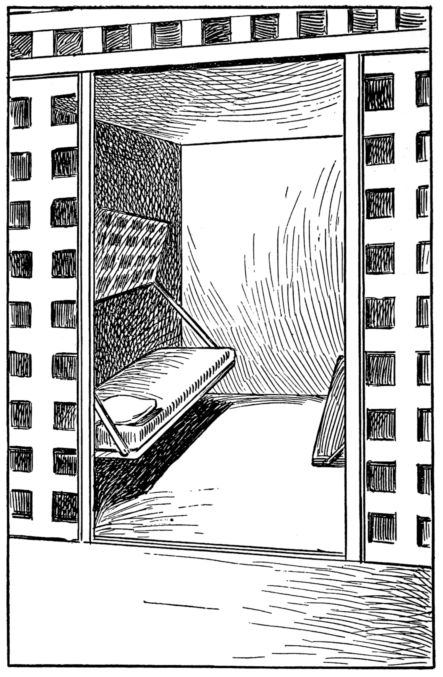
CELL OCCUPIED BY DEBS IN WOODSTOCK JAIL
181
The Federal Government and the Chicago Strike
Reply to the article on “The Government in the Chicago Strike of 1894” in McClure’s Magazine, July, 1904, by Grover Cleveland, ex-President of the U. S.
Written for and rejected by McClure’s Magazine. Published by Appeal to Reason, August 27, 1904.
In the July issue of McClure’s Magazine ex-President Grover Cleveland has an article on “The Government in the Chicago Strike of 1894.” That there may be no mistake about the meaning of “government” in this connection it should be understood that Mr. Cleveland has reference to the Federal government, of which he was the executive head at the time of the strike in question, and not to the State government of Illinois, or the municipal government of Chicago, both of which were overridden and set at defiance by the executive authority, enforced by the military power of the Federal government under the administration of Mr. Cleveland.
CLEVELAND VINDICATES HIMSELF.
The ex-President’s article not only triumphantly vindicates his administration but congratulates its author upon the eminent service he rendered the republic in a critical hour when a labor strike jarred its foundations and threatened its overthrow.
It may be sheer coincidence that Mr. Cleveland’s eulogy upon his patriotic administration and upon himself as its central and commanding figure appears on the eve of a national convention composed largely of his disciples, who are urging his fourth nomination for the presidency for the very reasons set forth in the article on the Chicago strike.
182However this may be, it is certain that of his own knowledge ex-President Cleveland knows nothing of the strike he discusses; that the evidence upon which he acted officially and upon which he now bases his conclusion was ex parte, obtained wholly from the railroad interests and those who represented or were controlled by these interests, and it is not strange, therefore, that he falls into a series of errors beginning with the cause of the disturbance and running all through his account of it, as may be proved beyond doubt by reference to the “Report on the Chicago Strike” by the “United States Strike Commission” of his own appointment.
WHAT WAS THE CHICAGO STRIKE?
Simply one of the many battles that have been fought and are yet to be fought in the economic war between capital and labor. Pittsburg, Homestead, Buffalo, Latimer, Pana, Cœur d’Alene, Cripple Creek and Telluride recall a few of the battles fought in this country in the world-wide struggle for industrial emancipation.
When the strike at Chicago occurred did President Cleveland make a personal examination? No.
Did he grant both sides a hearing? He did not.
In his fourteen-page magazine article what workingman, or what representative of labor, does he cite in support of his statements or his official acts? Not one.
I aver that he received every particle of his information from the capitalist side, that he was prompted to act by the capitalist side, that his official course was determined wholly, absolutely, by and in the interest of the capitalist side, and that no more thought or consideration was given to the other side—the hundreds of thousands of workingmen whose lives and whose wives and babes were at stake—than if they had been so many swine or sheep that had balked on their way to the shambles.
THE OBJECT OF FEDERAL INTERFERENCE.
From the Federal judge who sat on the bench as the protege of the late George M. Pullman, to whose influence he was indebted for his appointment—as he was to the railroad companies for the annual passes he had in his pocket—down 183to the last thug sworn in by the railroads and paid by the railroads (p. 340 report of Strike Commission) to serve the railroads as United States deputy marshal, the one object of the Federal Court and its officers was, not the enforcement of law and preservation of order, but the breaking up of the strike in the interest of the railroad corporations, and it was because of this fact that John P. Altgeld, Governor of Illinois, and John P. Hopkins, Mayor of Chicago, were not in harmony with President Cleveland’s administration and protested against the Federal troops being used in their state and city for such a malign purpose.
This is the fact and I shall prove it beyond doubt before this article is concluded.
CLEVELAND OMITS REFERENCE TO JUDGE WOODS.
The late Judge William A. Woods figured as one of the principal judges in the Chicago affair, issuing the injunctions, citing the strikers to appear before him and sentencing them to jail without trial, but President Cleveland discreetly omits all reference to him; and although he introduces copies of many documents, his article does not include copies of the telegrams that passed between Judge Woods from his home at Indianapolis and the railroad managers at Chicago before he left home to hold court in the latter city.
Judge Woods had the distinction of convicting the writer and his colleagues without a trial and of releasing William W. Dudley of “Blocks of Five” memory in spite of a trial.
Judge Woods is dead and I do not attack the dead. I have to mention his name, and this of itself is sufficient.
PULLMAN’S CONTEMPT OF COURT.
During the strike the late George M. Pullman was summoned to appear before the Federal Court to give testimony. He at once had his private car attached to an eastbound train and left the city, treating the court with sovereign contempt. On his return, accompanied by Robert Todd Lincoln, his attorney, he had a tete-a-tete with the court, “in chambers,” and that ended the matter. He was not required to testify, nor to appear in open court. The striker upon whom there fell even the suspicion of a shadow of contempt was sentenced 184and jailed with alacrity. Not one was spared, not one invited to a “heart-to-heart” with his honor, “in chambers.”
A CHALLENGE TO CLEVELAND.
In reviewing the article of ex-President Cleveland I wish to adduce the proof of my exceptions and denials, as well as the evidence to support my affirmations, but I realize that in the limited space of a single issue it is impossible to do this in complete and satisfactory manner; and as the case is important enough to be revived, after a lapse of ten years, by Mr. Cleveland, and as the side of labor has never yet reached the people, I am prompted to suggest a fair and full hearing of both sides on the public rostrum or in a series of articles, and I shall be happy to meet Mr. Cleveland or any one he may designate in such oral or written discussion, and if I fail to relieve the great body of railroad men who composed the American Railway Union of the criminal stigma which Mr. Cleveland has sought to fasten upon them, or if I cannot produce satisfactory evidence that the crimes charged were instigated by the other side—the side in whose interest President Cleveland brought to bear all the powers of the Federal government—I will agree to publicly beg forgiveness of the railroads, apologize to the ex-President and cease my agitation forever.
THE CAUSE OF THE PULLMAN STRIKE.
It is easy for Mr. Cleveland and others who were on the side of the railroads to introduce copies of documents, reports, etc., for the simple reason that the Federal Court at Chicago compelled the telegraph companies to deliver up copies of all our telegrams and copies of the proceedings of the convention and other meetings of the American Railway Union, including secret sessions, but the Federal Court did not call upon the railroads to produce the telegrams that passed among themselves, nor between their counsel and the Federal authorities, nor the printed proceedings of the General Managers’ Association for public inspection and as a basis for criminal prosecution.
HAD THE STRIKE WON.
Nevertheless, there is available proof sufficient to make it clear to the unprejudiced mind, to the honest man who seeks 185the truth, that the United States government, under the administration of President Grover Cleveland, was at the beck and call of the railroad corporations, acting as one through the “General Managers’ Association,” and that these corporations, with the Federal Courts and troops to back them up, had swarms of mercenaries sworn in as deputy marshals to incite violence as a pretext for taking possession of the headquarters of the American Railway Union by armed force, throwing its leaders into prison without trial and breaking down the union that was victorious, maligning, brow-beating and persecuting its peaceable and law-abiding members and putting the railroad corporations in supreme control of the situation.
That was the part of President Cleveland in the Chicago strike, and for this achievement the railroad combine and the trusts in general remember him with profound gratitude, and are not only willing but anxious that he shall be President of the United States forevermore.
A PRECEDENT FOR FUTURE ACTION.
In the closing paragraph of his article Mr. Cleveland compliments his administration upon having cleared the way “which shall hereafter guide our nation safely and surely in the exercise of its functions which represent the people’s trust.” The word “people’s” is not only superfluous but mischievous and fatal to the truth. Omit that and the ex-President’s statement will not be challenged.
CLEVELAND’S FIRST MOVE.
How did President Cleveland begin operations in the Chicago strike. Among the first things he did, as he himself tells us, was to appoint Edwin Walker as special counsel for the government.
Who was Edwin Walker?
“An able and prominent attorney,” says Mr. Cleveland.
Is that all?
Not quite. At the time President Cleveland and his Attorney-General, Richard Olney, designated Edwin Walker, upon recommendation of the railroads, as special counsel to the government, for which alleged service he was paid a fee that amounted to a fortune, the said Edwin Walker was already the counsel for the Chicago, Milwaukee & St. Paul Railway.
186
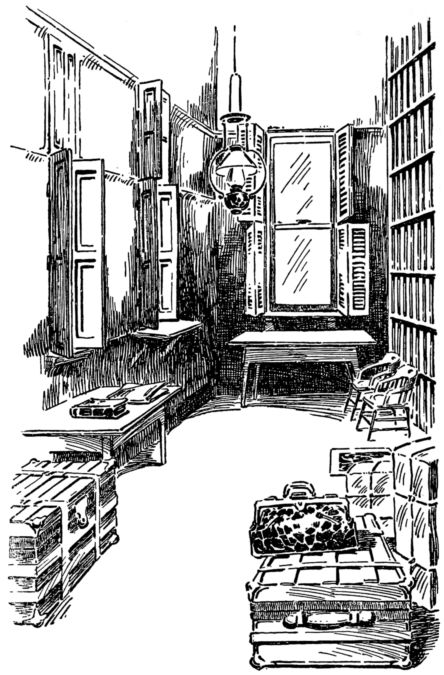
CORRIDOR IN WOODSTOCK JAIL WHERE DEBS EXERCISED
187Turning for a moment to “Who’s Who In America,” we find:
“Walker, Edwin, lawyer, * * * removed to Chicago in 1865; has represented several railroads as general solicitor since 1860. Illinois counsel for C., M. & St. P. R. R. since 1870; also partner in firm of W. P. Rend & Co., coal miners and shippers. Was counsel for the railway companies and special counsel for the United States in the lawsuits growing out of the great railroad strike of 1894.”
THE SIGNIFICANCE OF THE APPOINTMENT.
Here is the situation: There is a conflict between the General Managers’ Association, representing the railroads, and the American Railway Union, representing the employes. Perfect quiet and order prevail, as I shall show, but the railroads are beaten to a standstill, utterly helpless, cannot even move a mail car, simply because their employes have quit their service and left the premises in a body. Note also that the employes were willing to haul the mail trains and all other trains, refusing only to handle Pullman cars until the Pullman Company should consent to arbitrate its disagreement with its striking and starving employes. But the railroad officials determined that if the Pullman cars were not handled the mail cars should not move.
This is how and why the mails were obstructed and this was the pretext for Federal interference. In a word, President Cleveland, obedient to the railroads, took sides with them and supported them in their conflict with their employes with all the powers of the Federal government.
STRIKE COMMISSION REPORT VS. CLEVELAND.
To bear out these facts it is not necessary to go outside of the official report of the Strike Commission, which anyone may verify at his pleasure. The only reason I do not incorporate the voluminous evidence is that the space at my command must be economized for other purposes.
It is thus made clear that President Cleveland and his 188Cabinet placed the government at the service of the railroads.
Edwin Walker, their own attorney, made the agent of the government and put in supreme command of the railroad and government forces! What an unholy alliance! And what a spectacle and object lesson!
Upon Walker’s representations Cleveland acted; upon Walker’s demand, the Federal soldiers marched into Chicago; upon Walker’s command, the great government of the United States obeyed with all the subserviency of a trained lackey.
SUPPOSE CLEVELAND HAD APPOINTED DARROW?
Suppose that President Cleveland had appointed Clarence S. Darrow, attorney for the American Railway Union, instead of Edwin Walker, attorney of the General Managers’ Association, as special counsel for the government!
And suppose that Darrow had ordered the offices of the General Managers’ Association sacked, the books, papers and correspondence, including the unopened private letters of the absent officers, packed up and carted away and the offices put under the guard of Federal ruffians, in flagrant violation of the Constitution of the United States, as was done by order of Walker with the offices of the American Railway Union!
And suppose, moreover, that the American Railway Union, backed up by Darrow, agent of the United States government, had sworn in an army of “thugs, thieves and ex-convicts” (see official report of Michael Brennan, superintendent of Chicago police to the Council of Chicago) to serve the American Railway Union as deputy United States marshals and “conservators of peace and order!”
And suppose, finally, that the expected trouble had followed, would anyone in possession of his senses believe that these things had been done to protect life and property and preserve law and order?
That is substantially the case that President Cleveland is trying to make for himself and his administration out of their participation in the Chicago strike.
THE REAL LAWBREAKER THE RAILROADS.
The implication that runs through Mr. Cleveland’s entire article is that the railway corporations were paragons of peace 189and patriotism, law and order, while the railway employes were a criminal, desperate and bloodthirsty mob which had to be suppressed by the strong arm of the government.
No wonder the ex-President is so dear to the iron heart of the railroad trust and every other trust that uses the government and its officers and soldiers to further its own sordid ends.
Let us consider for a moment these simple questions:
Who are the more law-abiding, the predatory railroad corporations or the hard-worked railroad employes?
What railroad corporation in the United States lives up to the law of the land? Not one.
What body of railroad employes violates it? Not one.
THE BRAZEN DEFIANCE OF LAW BY THE RAILROADS.
The railroad corporations are notorious for their brazen defiance of every law that is designed to curb their powers or restrain their rapacity.
The railroad corporations have their lobby at Washington and at every State capital; they bribe legislators, corrupt courts, debauch politics and commit countless other legal and moral crimes against the commonwealth.
The railway employes are a body of honest, useful, self-sacrificing, peace-loving men, who never have been, and never will be, guilty of the crimes committed by their corporate masters.
And yet President Cleveland serves the corporate masters and exalts and glorifies the act while he attempts to absolve the criminals and fasten the insufferable stigma upon honest men.
Nothing further is required to demonstrate beyond all cavil the capitalist class character of our present government.
THE STRIKE COMMISSION’S REPORT.
Now for a few facts about the strike. It began May 11, 1894, and was perfectly peaceable and orderly until the army of “thugs, thieves and ex-convicts,” as Superintendent of Police Brennan called them in his official report to the Council of Chicago, were sworn in as deputies by the United States marshal at the command of Edwin Walker, attorney of the 190General Managers’ Association and special counsel to the government. Let us quote the report of the Strike Commission, consisting of Carroll D. Wright, Commissioner of Labor, who served ex-officio; John D. Kernan, of New York, and N. E. Worthington, of Illinois, two lawyers, appointed by President Cleveland.
Let it be noted that the railway employes, that is to say, labor, the working class, had no representative on this Commission.
From the report they issued we quote as follows:
A. R. U. LEADERS ADVISE AGAINST STRIKE.
“It is undoubtedly true that the officers and directors of the American Railway Union did not want a strike at Pullman and advised against it. * * * (P. xxvii.) (Yet the people were told over and over and still believe that Debs ordered the strike.)
RAILROADS SET THE EXAMPLE.
“It should be noted that until the railroads set the example a general union of railroad employes was never attempted.” (P. xxxi.)
“The refusal of the General Managers’ Association to recognize and deal with such a combination of labor as the American Railway Union seems arrogant and absurd when we consider its standing before the law, its assumptions, and its past and obviously contemplated future action.” (P. xxxi.)
“* * * the rents (at Pullman) are from 20 to 25 per cent higher than rents in Chicago or surrounding towns for similar accommodations.” (P. xxxv.)
STRIKE COMMISSION CONTRADICTS CLEVELAND.
“The strike occurred on May 11, and from that time until the soldiers went to Pullman, about July 4, 300 strikers were placed about the company’s property, professedly to guard it from destruction or interference. This guarding of property in strikes is, as a rule, a mere pretense. Too often the real object of guards is to prevent newcomers from taking the strikers’ places, by persuasion, often to be followed, if ineffectual, by intimidation and violence. The Pullman Company 191claims this was the real object of these guards. These strikers at Pullman are entitled to be believed to the contrary in this matter, because of their conduct and forbearance after May 11. It is in evidence, and uncontradicted, that no violence or destruction of property by strikers or sympathizers took place at Pullman, and that until July 3 (when the Federal troops came upon the scene) no extraordinary protection was had from the police and military against even anticipated disorder.” (P. xxxviii.)
This paragraph from the report of Mr. Cleveland’s own Commission is sufficient answer to Mr. Cleveland’s article. It is conclusive, crushing, overwhelming.
DEPUTIES STARTED THE TROUBLE.
There was no trouble at Pullman, nor at Chicago, nor elsewhere, until the railroad-United States deputy marshals were sworn in, followed by the Federal troops.
Governor Altgeld, patriot and statesman, knew it and protested against the troops.
Mayor John P. Hopkins knew it and declared that he was fully competent to preserve the peace of the city.
SUPERINTENDENT OF POLICE CALLED THEM “THUGS.”
Michael Brennan, superintendent of the Chicago police, knew it and denounced the deputy marshals Edwin Arnold’s hirelings, the General Managers’ Association’s incendiaries and sluggers, as “thugs, thieves and ex-convicts.”
These were the “gentlemen” President Cleveland’s government pressed into service upon requisition of the railroads to preserve order and protect life and property, and this is what the ex-President calls “the power of the National government to protect itself in the exercise of its functions.”
As to just what these “functions” are when Grover Cleveland is President, the railroad corporations understand to a nicety and agree to by acclamation.
PROFOUND PEACE RESTORED.
The only trouble, when the “deputies” were sworn in, followed by the soldiers, was that there was no trouble. That is the secret of subsequent proceedings. The railroads were paralyzed. 192Profound peace reigned. The people demanded of the railroads that they operate their trains. They could not do it. Not a man would serve them. They were completely defeated and the banners of organized labor floated triumphant in the breeze.
Beaten at every point, their schemes all frustrated, outgeneraled in tactics and strategy, the corporations played their trump card by an appeal to the Federal judiciary and the Federal administration. To this appeal the response came quick as lightning from a storm cloud.
PEACE FATAL TO MANAGERS’ ASSOCIATION.
Peace and order were fatal to the railroad corporations. Violence was as necessary to them as peace was to the employes. They realized that victory could only be snatched from labor by an appeal to violence in the name of peace.
First, deputy marshals. The very day they were appointed the trouble began. The files of every Chicago paper prove it. The report of the Strike Commission does the same.
That was what they were hired for and their character is sufficient evidence of their guilt.
Second, fires (but no Pullman palace cars were lighted) and riots (but no strikers were implicated).
Third, the capitalist-owned newspapers and Associated Press flashed the news over all the wires that the people were at the mercy of a mob and that the strikers were burning and sacking the city.
Fourth, the people (especially those at a distance who knew nothing except what they saw in the papers) united in the frenzied cry: “Down with anarchy! Down with the A. R. U.! Death to the strikers!”
DISTURBANCES STARTED BY DEPUTY MARSHALS.
The first trouble instigated by the deputy marshals was the signal for the Federal Court injunctions, and they came like a succession of lightning flashes.
Next, the general offices of the American Railway Union were sacked and put under guard and communication destroyed. (Later Judge Grosscup rebuked the Federal satraps 193who committed this outrageous crime, but he did not pretend to bring them to justice.)
Next, the leaders of the strike were arrested, not for crime, but for alleged violation of an injunction.
Next, they were brought into court, denied trial by jury, pronounced guilty by the same judge who had issued the injunction, and sent to jail for from three to six months.
THE CONCLUDING WORDS NOT YET WRITTEN.
The Supreme Court of the United States, consisting wholly of trained and successful corporation lawyers, affirmed the proceeding and President Cleveland says that they have “written the concluding words of this history.”
Did the Supreme Court of the United States write the “concluding words” in the history of chattel slavery when it handed down Chief Justice Taney’s decision that black men had “no rights that the white man was bound to respect?”
These “concluding words” will but hasten the overthrow of wage slavery as the “concluding words” of the same Supreme Court in 1857 hastened the overthrow of chattel slavery.
The railroad corporations would rather have destroyed their property and seen Chicago perish than see the American Railway Union triumphant in as noble a cause as ever prompted sympathetic, manly men to action in this world.
PEACE OVERTURES TURNED DOWN.
The late Mayor Pingree of Detroit came to Chicago with telegrams from the mayors of over fifty of the largest cities urging that there should be arbitration. (P. xxxix, Report of Strike Commission.) He was turned down without ceremony, and afterwards declared that the railroads were the only criminals and that they were responsible for all the consequences.
June 22, four days before the strike against the railroads, or, rather, the boycott of Pullman cars, took effect, there was a joint meeting of the railroad and Pullman officials. (P. xlii, Report of Strike Commission.) At this meeting it was resolved to defeat the strikers, wipe out the American Railway Union, and, to use their exact words, “that we act unitedly to that end.”
194
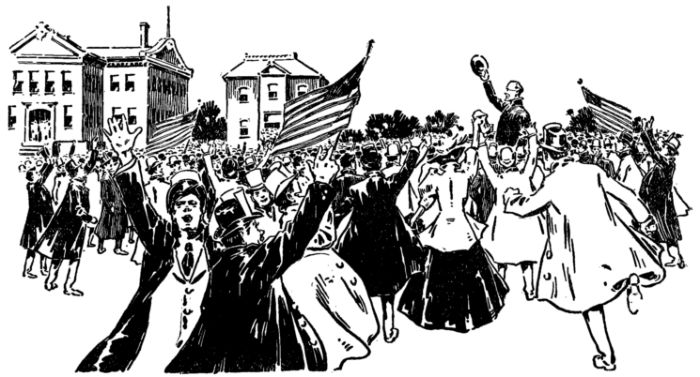
DEBS’ RELEASE FROM WOODSTOCK JAIL
195This was the only joint meeting of the kind that had ever been held between the officials of the railroad companies and the Pullman company. They mutually determined to stand together to defeat the strike and destroy the union.
Now, to show what regard these gentlemen have for courts and law and morals, this incident will suffice:
RAILWAY OFFICIALS PERJURE THEMSELVES.
When the officers of the American Railway Union were indicted by a special and packed grand jury and placed on trial for conspiracy, the general managers of the railroads were put on the witness stand to testify as to what action had been taken at the joint railroad and Pullman meeting described, and each and every one of them perjured himself by swearing that he had no recollection of what had taken place at that meeting. Sitting within a few feet of them I saw their faces turn scarlet under the cross-examination, knowing that they were testifying falsely; that the court knew it, and that every one present knew it; but they stuck to their agreement and uniformly failed to remember that they had resolved to stand together, the railroads agreeing to back the Pullman company in defeating their famishing employes, and the Pullman company pledging itself to stand by the railroads in destroying the American Railway Union.
That is what their own record shows they resolved to do, and a little later they concluded to forget all about it, and to this they swore in a Federal Court of law.
I have copies of the court records, including the testimony, to prove this, and the files of all the Chicago dailies of that time contain the same testimony.
These are the gentlemen who have so much to say about law and order—the vaunted guardians of morals and good citizenship.
When A. B. Stickney, president of the Chicago Great Western, who had been victimized by them, told them to their faces that there was not an honest official among them and that he would not trust one of them out of his sight, they did not attempt any defense, for they knew that their accuser was on the inside and in position to make good his assertions.
196
THE DEPUTIES AS VIEWED BY THE COMMISSION.
I must now introduce a little evidence from the report of the Strike Commission bearing upon the United States deputy marshals who were sworn in by the railroads “to protect life and property and preserve the peace”:
Page 356: Superintendent Brennan, of the Chicago police, testifies before the Commission that he has a number of deputy marshals in the county jail arrested while serving the railroads as United States deputy marshals for highway robbery.
NEWSPAPER REPORTERS’ EVIDENCE.
Page 370: Ray Stannard Baker, then a reporter for the Chicago Record, now on the staff of McClure’s Magazine, testified as follows in answer to the question as to what he knew of the character of the deputy marshals: “From my experience with them it was very bad. I saw more cases of drunkenness, I believe, among the United States deputy marshals than I did among the strikers.”
Pages 366 and 367: Malcomb McDowell, reporter for the Chicago Record, testified: “The United States deputy marshals and the special deputy sheriffs were sworn in by the hundreds about the 3d and 4th of July, and prior to that, too, and everybody who saw them knew they were not the class of men who ought to be made deputy marshals or deputy sheriffs.” * * * “In regard to most of the deputy marshals they seemed to be hunting trouble all the time.” * * * “At one time a serious row nearly resulted because some of the deputy marshals standing on the railroad track jeered at the women that passed and insulted them.” * * * “I saw more deputy marshals drunk than I saw strikers drunk.”
These were Edwin Walker’s justly celebrated guardians of the peace.
Page 370: Harold I. Cleveland, reporter for the Chicago Herald, testified: “I was on the tracks of the Western Indiana fourteen days.” * * * “I saw in that time a couple of hundred deputy marshals. I think they were a very low, contemptible set of men.”
197
HIRED AND PAID BY THE RAILROADS.
Now follows what the Strike Commissioners themselves have to say about the deputy marshals, and their words are specially commended to the thoughtful consideration of their chief, President Cleveland: “United States deputy marshals, to the number of 3,600, were selected by and appointed at request of the General Managers’ Association, and of its railroads. They were armed and paid by the railroads, and acted in the double capacity of railroad employes and United States officers. While operating the railroads they assumed and exercised unrestricted United States authority when so ordered by their employers, or whenever they regarded it as necessary. They were not under the direct control of any government official while exercising authority. This is placing officers of the government under control of a combination of railroads. It is a bad precedent, that might well lead to serious consequences.”
THE GOVERNMENT SERVES THE CORPORATIONS.
Here we have it, upon the authority of President Cleveland’s own Commission, that the United States government under his administration furnished the railroad corporations with government officers in the form of deputy marshals to take the places of striking employes, operate the trains and serve in that dual capacity in any way that might be required to crush out the strike. This is perhaps more credit than the ex-President expected to receive. His own Commission charges him, in effect, with serving the railroads as strike-breaker by furnishing government employes to take the places of striking railroad men and arming them with pistols and clubs and with all the authority of government officials.
Page after page bears testimony of the disreputable character of the deputy marshals sworn in to the number of several thousand and turned loose like armed bullies to “preserve the peace.”
The report of the Strike Commission contains 681 pages. I have a mass of other testimony, but for the purpose of this article have confined myself to the report of Mr. Cleveland’s own Commission.
198
HOW THE STRIKERS WERE DEFEATED.
Hundreds of pages of evidence are given by impartial witnesses to establish the guilt of the railroad corporations, to prove that the leaders of the strike counselled peace and order; that the strikers themselves were law-abiding and used their influence to prevent disorder; that there was no trouble until the murderous deputy marshals were sprung upon the community, and that these instigated trouble to pave the way for injunctions and soldiers and change of public sentiment, thereby defeating the strike.
CONFIRMED BY CLEVELAND.
President Cleveland, unwittingly, confirms this fact. On page 232 of his article he quotes approvingly the letter written to Edwin Walker, special counsel of the government and regular counsel of the railroads, by Attorney-General Richard Olney, as follows: “It has seemed to me that if the rights of the United States (Railroads?) were vigorously asserted in Chicago, the origin and center of the demonstration, the result would be to make it a failure everywhere else, and to prevent its spread over the entire country.”
That is the point, precisely the point, and Mr. Cleveland admits it. It is not the “obstruction of the mails,” nor disorder, nor the violation of law, that arouses Mr. Cleveland’s government and prompts it to “vigorous” assertion of its powers, but the “demonstration,” that is, the strike against the railroads; and to put this down, not to move the mails or restore order—a mere pretext which was fully exposed by Governor Altgeld—was the prime cause of Federal interference, and to “make it a failure everywhere” all constitutional restraints were battered down, and as a strike-breaker President Cleveland won imperishable renown.
STRIKE LEADERS EXONERATED BY THE COMMISSION.
Particular attention is invited to the following, which appears on page xlv:
“There is no evidence before the Commission that the officers of the American Railway Union at any time participated in or advised intimidation, violence or destruction of property. 199They knew and fully appreciated that as soon as mobs ruled the organized forces of society would crush the mobs and all responsible for them in the remotest degree, and that this means defeat.”
And yet they all served prison sentences. Will President Cleveland please explain why? And why they were refused a trial?
IN WHOSE INTERESTS WERE CRIMES COMMITTED?
Read the above paragraph from the report of the Strike Commission and then answer these questions:
To whose interest was it to have riots and fires, lawlessness and crime?
To whose advantage was it to have disreputable “deputies” do these things?
Why were only freight cars, largely hospital wrecks, set on fire?
Why have the railroads not yet recovered damages from Cook county, Illinois, for failing to protect their property? Why are they so modest and patient with their suits?
The riots and incendiarism turned defeat into victory for the railroads. They could have won in no other way. They had everything to gain and the strikers everything to lose.
The violence was instigated in spite of the strikers, and the report of the Commission proves that they made every effort in their power to preserve the peace.
When a crime is committed in the dark the person who is supposed to be benefitted by it is sought out as the probable culprit, but we are not required to rely upon presumption in this case, for the testimony against the railroads is too clear and complete and convincing to admit of doubt.
IMPRISONED WITHOUT TRIAL.
If the crimes committed during the Chicago strike were chargeable to the strikers, why were they not prosecuted? If not, why were they sentenced to prison?
The fact that they were flung into prison without evidence and without trial, and the fact that the Supreme Court affirmed the outrage, seemed to afford Mr. Cleveland special satisfaction, and he accepts what he calls the “concluding words” of the court as his own final vindication.
200
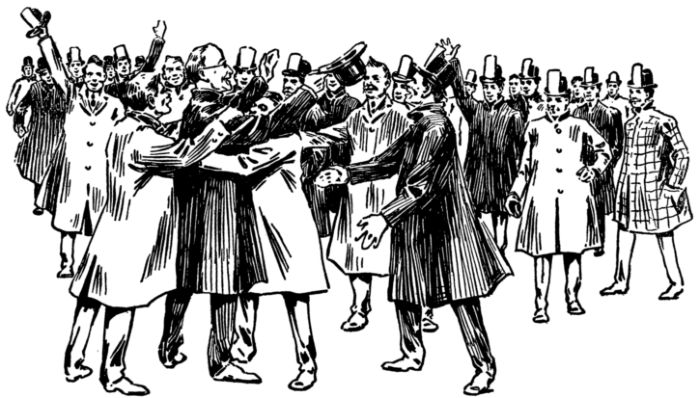
DEBS’ FIRST GREETING BY THE COMMITTEE
201
JUDGE TRUMBULL’S OPINION.
The late Senator and Judge Lyman Trumbull, for many years United States Senator, chairman of the Senate Committee on Judiciary, Supreme Judge of Illinois, author of the thirteenth amendment to the Constitution of the United States, personal friend of Abraham Lincoln, and, above all, an honest man, wrote: “The doctrine announced by the Supreme Court in the Debs case places every citizen at the mercy of any prejudiced or malicious Federal judge who may think proper to imprison him.”
President Cleveland doubtless understands the import of these ominous words. Let the people, the working people, whom the ex-President regards merely as a mob to be suppressed when they peaceably protest against injustice—let them contemplate these words at their leisure.
When the strike was at its height and the railroads were defeated at every turn, the Federal Court hastily impaneled a special grand jury to indict the strikers. The foreman of this jury was chosen specially because he was a violent union hater, and he afterward betrayed his own capitalist colleagues in a matter they had entrusted to his integrity.
The jury was impaneled, not to investigate, but to indict.
A Tribune reporter, who refused to verify a false interview before the jury, and thereby perjure himself to incriminate the writer, was discharged. The Chicago Times published the particulars.
An indictment was speedily returned. “To the penitentiary,” was the cry of the railroads and their henchmen. A trial jury was impaneled. Not a juror was accepted who was of the same political party as the defendants. Every possible effort was made to rush the strike leaders to the State prison.
THE FAILURE OF THE PROSECUTION.
After all the evidence of the prosecution had been presented they realized that they had miserably failed. Not one particle of incriminating testimony could the railroads produce with all the sleuth hounds they had at their command.
202Next came our turn. The General Managers were dumbfounded when they were, one after the other, put on the stand. Eighty-six witnesses were in court to testify as to the riots and fires. Assistant Chief Palmer and other members of the Fire Department were on hand to testify that when they were trying to extinguish the flames in the railroad yards they caught men in the act of cutting the hose and that these men wore the badges of deputy marshals. Other witnesses were policemen who were ready to testify that they had caught these same deputies instigating violence and acts of incendiarism.
THE JURY DUMBFOUNDED.
The jury had been packed to convict. When our evidence began to come in their eyes fairly bulged with astonishment. There was a perfect transformation scene. The jurors realized that they had been steeped in prejudice and grossly deceived.
The General Managers testified that they did not remember what had taken place at the joint General Managers’ and Pullman meeting. Their printed proceedings were called for. They looked appealingly to Edwin Walker. The terror that overspread their features can never be forgotten by those who witnessed it. Their own printed proceedings would expose their mendacity and convict them of conspiracy and crime. Something must be done, and done quickly. Court adjourned for lunch. When it reconvened Judge Grosscup gravely announced that a juror had been suddenly taken ill and that the trial could not proceed.
THE “ILLNESS” OF A JUROR.
The next day and the next the same announcement was repeated. We offered to proceed in any of the several ways provided in such exigencies. The prosecution objected. The cry “To the penitentiary” had subsided. “To let go” was now the order of the railroads. Not another session of court must be held, for their printed proceedings, the private property in the strong box of each member, and full of matter that would convict them, would have to be produced. All the proceedings of the American Railway Union had been produced in evidence by order of the court and the court could not 203refuse to command the railroad officials to produce the proceedings of their association. These proceedings were brought in at the closing session of the trial, but by order of the court the defendants were forbidden to look into them, and Edwin Walker, the government counsel, watched them with the faithful eye of a trusted guardian.
We were not allowed to examine the proceedings of the General Managers’ Association, notwithstanding our proceedings, telegrams, letters and other private communications had been brought into court by order of the judge, inspected by Edwin Walker and others, and printed in the court records for public inspection.
It was at this point that the court adjourned and the juror was taken “ill.”
Ten years have elapsed. He is still “ill,” and we are still waiting for the court to reconvene and the trial to proceed.
GOVERNMENT REFUSED TO GO ON WITH THE CASE.
Every proposition to continue the case was fiercely resisted by Edwin Walker, special counsel of the government and general counsel of the railroads.
Clarence S. Darrow objected to Mr. Walker’s appearing in that dual capacity, representing at the same time the government and the railroads—the supposed justice of the one and the vengeful spirit of the other—but Judge Grosscup overruled the objection.
The trial was postponed again and again, the interest in it gradually subsiding, and many months afterward, when it was almost forgotten, the case was quietly stricken from the docket.
JURORS GREET DEFENDANTS.
When the remaining eleven jurors were discharged by the court, Edwin Walker extended his hand to them, but they rushed by him and surrounded the writer and his co-defendants, grasping their hands and assuring them, each and every one of them, that they were convinced of their innocence and only regretted that they had been prevented from returning their verdict accordingly. The details appear in the Chicago papers of that time.
204At the very time we were being tried for conspiracy we were serving a sentence in prison for contempt, the program being that six months in jail should be followed by as many years in penitentiary.
For a jury to pronounce us innocent in substantially the same case for which we were already serving a sentence would mean not only our complete vindication, but the exposure of the Federal Court that had, at the behest of the railroads, sentenced us to prison without a trial.
And so the trial was abruptly terminated on account of the alleged illness of a juror and they could find no other to take his place.
These are the facts and I have all the documentary evidence in detail, and only lack of space prevents me from making the exhibits in this article.
If President Cleveland or the Railroad Managers doubt it I stand ready to meet them face to face in discussion of the issue upon any platform in America.
THE GREATEST INDUSTRIAL BATTLE IN HISTORY.
The Chicago strike was in many respects the grandest industrial battle in history, and I am prouder of my small share in it than of any other act of my life.
Men, women and children were on the verge of starvation at the “model city” of Pullman. They had produced the fabulous wealth of the Pullman corporation, but they, poor souls, were compelled to suffer the torment of hunger pangs in the very midst of the abundance their labor had created.
A hundred and fifty thousand railroad employes, their fellow members in the American Railway Union, sympathized with them, shared their earnings with them, and after trying in every peaceable way they could conceive of to touch the flint heart of the Pullman company—every overture being rejected, every suggestion denied, every proposition spurned with contempt—they determined not to pollute their hands and dishonor their manhood by handling Pullman cars and contributing to the suffering and sorrow of their brethren and their wives and babes. And rather than do this they laid down their tools in a body, sacrificed their situations and submitted 205to persecution, exile and the blacklist; to idleness, poverty, crusts and rags, and I shall love and honor these moral heroes to my latest breath.
There was more of human sympathy, or the essence of brotherhood, of the spirit of real Christianity in this act than in all the hollow pretenses and heartless prayers of those disciples of mammon who cried out against it, and this act will shine forth in increasing splendor long after the dollar worshipers have mingled with the dust of oblivion.
Had the carpenter of Nazareth been in Chicago at the time He would have been on the side of the poor, the heavy-laden and sore at heart, and He would have denounced their oppressors and been sent to prison for contempt of court under President Cleveland’s administration.
President Cleveland says that we were put down because we had acted in violation of the Sherman Anti-Trust law of 1890. Will he kindly state what other trusts were proceeded against and what capitalists were sentenced to prison during his administration?
A TRIBUTE TO ALTGELD.
He waited ten years to cast his aspersions upon the honor of John P. Altgeld, and if that patriotic statesman had not fallen in the service of the people, if he were still here to defend his official acts, it is not probable that the ex-President would have ventured to assail him.
Reluctantly, indeed, do I close without the space to incorporate his burning messages to President Cleveland and at least some extracts from his masterly speech on “Government by Injunction.”
His memory requires no defense, but if it did I could speak better for him than for myself. He never truckled to corporate wealth; he did not compromise with his conscience; he was steadfast in his devotion to truth and in his fidelity to right, and he sought with all his strength to serve the people and the people will gratefully remember him as one of the true men, one of the great souls of his sordid age.
The Chicago strike is not yet settled, and its “concluding pages” are YET TO BE WRITTEN.
207
You Railroad Men
Written for Appeal to Reason, February 3, 1906
FOREWORD
At the time this remarkable paper was written and published in the Appeal to Reason, two years ago, “fool dinner pail” prosperity flourished like a green bay tree.
One there was who, wanting an audience for his voice of warning, yet sounded with his pen a loud alarm. Debs had in the beginning of his life’s labors allowed the railroad companies to coin his brawn and his brain in their service, but had since devoted himself, with an earnestness sublime, to the study of the condition of wage workers in general and railroad employes in particular. From his hard experience and many years of study he was in position to know, and he did know. Whatever else has been said, no detractor has questioned his honesty and the fine fiber of his magnificent manhood.
Yet, his warning went unheeded. The so-called “labor press,” as well as the capitalist papers, decried him as an alarmist and a mischiefmaker.
How swiftly and how accurately has his forecast been verified! We see the system he has arraigned trembling and crashing, we hear the hunger tread of the unemployed, and the tragedy he foretold is in the “rat-tat-tat” on a million kitchen doors.
Industry is confounded and labor is confused. By the statement of the railroad companies themselves a half million railroad workers alone are out of employment.
Choked into despair, it is to be hoped that Debs’ mighty appeal to them, which is here republished, will now be read and assimilated by railroad men and the way of Socialism learned.
BRUCE ROGERS.
Girard, Kansas, March, 1908.
This appeal is made particularly to railway employes, among whom I began my career as a wage-worker, with whom I spent twenty-seven consecutive years—the complete span of my young manhood—as co-employe, labor organizer and union official, and for whom I shall have an affectionate regard of peculiar tenderness that will end only with my days.
208The very relation I bear them inspires me with the liveliest sense of obligation to that great body of brave and brawny men whose hands, as hard as their hearts are soft, first grasped my own in welcome as a recruit to the army of toil; whose honest faces, beaming with approval, first warmed my heart and stirred my blood, and whose applause, the first I ever knew, fired my boyhood years with high resolves. In every dark and trying hour these comrades of my early years stood staunch and true and pushed me on and raised me up that others might see my face and know my name, while they remained unnoticed, unapplauded, the soldiers of obscurity, the rank and file, the lower class, the common herd, who made and move this world and who should be, and yet will be, its ruling aristocracy.
I believe it can be said with truth, as I am sure it can without vanity, that I personally know, and am personally known to, more railroad employes than any other man in the country; and with equal truth, I believe, that the great majority who know me—better than this, the whole body of them, with but few exceptions—feel kindly toward me, and may be claimed my personal friends.
In all my travels—and I have been moving almost continually these twelve years past, over all the railways of the continent, especially since the railway corporations forcibly divorced me from their employes—in all my travels I have never made a trip, nor ever expect to, without feeling many times the touch of kindness, oft in stealth, of my old comrades of railroad days.
It is not, therefore, because of any lessening of our mutual regard that I am no longer in active touch with them, but because of the stern decree of fate which commanded me to go where they might not yet follow for a while, but where they will be found in good time, united with their class, and battling manfully for freedom.
I could yet be the “grand” officer of a railway brotherhood, have a comfortable office, a large salary, plenty of friends, including railway and public officials, and read my praises as an “ideal labor leader” in capitalist newspapers, but my convictions would not allow it, and so I had to resign, and having 209no choice about it, I am entitled to no credit for quitting a “good” position and plunging recklessly into “a career of folly, failure and disgrace.”
It was not easy to resign, and I had to insist upon it in a way that hurt me as much as it did the loyal brothers from whom I had to tear myself apart; and it has been the first and almost the only case of voluntary resignation from a similar organization.
I had been with the Brotherhood of locomotive firemen almost from its birth; had organized the Brotherhood of Railroad Brakemen, now the Brotherhood of Railway Trainmen; had helped to organize the Switchmen’s Mutual Aid Association, the Brotherhood of Railway Carmen, the Order of Railway Telegraphers, and other labor unions, and was now to organize, with half a dozen others, the American Railway Union, to embrace all railway workers, so that the engine wiper and section man might come in for their share of consideration as well as the engineer and conductor.
There is where I broke with the railway officials. They were perfectly willing that we should have a firemen’s union, but they were not willing for us to have a union that would unite all employes in the service in the equal interest of all.
This much by way of introduction. Now a word as to the purpose of this writing. I have something to say to the railway employes of America. It may not be considered as amounting to much, but I think it of importance enough to ask the railway workers to follow me through with patience, and think over what I have to say at their own leisure.
You railroad men are told that I am too radical, that I am dangerous, that as a “leader” I am a failure, and a good many other things, but the time will come when you will know that from first to last I was true to you, and because of that very fact the corporations you work for warn you against me; and you will furthermore know that, for the opposite reason, most of your present leaders are not true to your best interests. They are “popular” with the public, and your railway officials 210sing their praises on every occasion and tell you over and again how wise and good these “leaders” are and how lucky you are and how proud you should be to command their valuable services.
Time will tell and I can wait. I am not courting your flattery nor evading your blame. I am seeking no office; aspiring to no honors; have no personal ax to grind. But I have something to say to you and shall look straight into your eyes while saying it. I shall speak the truth—as I see it—no more and no less, in kindness and without malice or resentment.
I should tell you what I think you ought to know though all of you turned against me and despised me.
I am not wiser than you, but have had more experience with capitalists and more chance to study their system of fleecing and fooling labor than most of you. I am not better than you—not so good, in fact—for there is no better man on earth than an honest workingman. So I shall not preach to you, nor moralize you, nor even venture to advise you, but I shall put a few facts before you that may temporarily disturb your digestion, but if you will stick to them and assimilate them you will feel yourself growing stronger and you will thank me for having changed your mental bill of fare.
Taken in the aggregate, there is no division of the working class more clannish and provincial, more isolated from other divisions of labor’s countless army, than railway employes, the workers engaged, directly and indirectly, in steam railway transportation. Nor is there a group or department in the entire working class that, outside of its own sphere of industrial activity, is more ignorant of the true essentials of the labor question or more oblivious of the class struggle and the fundamental principles and objects of the labor movement.
To verify this statement it is not necessary to refer to the unorganized, unskilled and poorly-paid employes; on the contrary, let a dozen engineers and the same number of conductors, picked at random, be put upon the stand and catechized from a 211primer on economics and see what percentage of them can give even a definition of the term. They know how to run engines and trains and, as a rule, that is practically the limit of their knowledge. That is all the corporations want them to know, and, from their point of view, all they are fit to know.
It is true that they read journals published by their unions in which a five-column account is given of a reception to some “noble grand chief,” and as many columns more about babies born and brothers buried, but which may be searched in vain for a line of revolutionary economics to nourish their brain, open the eyes, give cheer to the heart or aspiration to the soul of a corporation slave.
The several unions of railway employes, considered in any militant sense, are not labor unions at all. Warren S. Stone, grand chief of the Brotherhood of Locomotive Engineers, worthy successor of the late P. M. Arthur, is on record as having pledged his word to a well known railway manager that the Brotherhood of Locomotive Engineers should never go out on strike while he was its executive head. The same grand chief is on record as threatening John J. Hannahan, grand master of the Brotherhood of Locomotive Firemen, with keeping his engineers at work on the Northern Pacific system, virtually scabbing on the firemen, if the latter went out on strike.
If the Brotherhood of Locomotive Engineers was a bona fide labor union instead of the fossilized tool of railway corporations its grand chief would be peremptorily impeached for treason to the working class.
The Civic Federation Review loves to print the portrait of Mr. Stone and idealize him as a “leader of labor” worthy to sit at the feast with, and at the feet of, August Belmont, Andrew Carnegie, Archbishop Ireland and other millionaire labor exploiters who regard workingmen as sheep to be sheared and skinned and slaughtered, and asses to be harnessed and worked and whipped, and, from that point of view, the engineers and the rest of the railway unions are to be congratulated upon their astute leadership.
212It is not that Mr. Stone is personally dishonest and corrupt; he may be, and I think he is, perfectly conscientious in what he says and does, and the same is doubtless true of the grand officers of the other railway unions, but that is not the question.
If workingmen are betrayed and defeated and made to suffer, it makes little difference if their misfortunes are due to dishonest, or ignorant and incompetent, leadership.
The question is not, Are these leaders honest? Let that be conceded. The question is, Are they true to the working class? If their official attitude does not square with the working class as a whole, then they are not in line with the true interests of their own union and are not in fact the friends, but the enemies of labor; not serving, but betraying those who trust and follow them.
In saying this and making the further statement that the existing railway brotherhoods are of far more actual benefit to the railway corporations than they are to the employes who support them, and that in some essential respects they are a positive detriment to their members in teaching them to venerate a “grand” officer, subjecting themselves, bound and gagged, to his “official sanction,” and in keeping them in economic ignorance—in saying these things, it is possible that Grand Chief Stone of the Engineers, and other “grand” officials will take issue; and here let me say that nothing would please me better than the chance to meet Mr. Stone before his engineers, or any other grand official before his followers, at any time, or in any public place, to prove every assertion herein made, and more, too; and I shall not object if the grand officers invite their friends, the railway officials, to occupy their accustomed seats on the platform, but I will not guarantee that the menu will be as agreeable to their corporation palates as that served at a recent Chicago banquet of the Order of Railway Conductors, or at the average brotherhood convention.
Now to another branch of the question: According to the report of the interstate commerce commission there were, for the year ended June 30, 1904, a total of 1,206,121 employes on 213the railways of the United States, as against 1,017,653 in 1900, an increase in four years of 278,468. How many thousands of unemployed there are, ready to take jobs when they are offered, in event of a strike, or otherwise, the reports do not say. Since 1904 there has been great increase in railroad activities and it is probable that the total has since reached 1,400,000. In 1894 the number was 779,608. That was during the last period of “hard times.” In the ten years since, from 1894 to 1904, from “panic” to “prosperity,” the number of railway employes has been almost doubled, the actual increase being 620,392, an average of over 60,000 a year. Fully five hundred thousand (500,000) new railroad men have been made in that time, and they have swelled the brotherhoods to unprecedented limits.
Now keep your eye “peeled” for the signal for the return trip from “prosperity” to “panic.”
That is not a matter of guess, but of arithmetic.
It may not come next month nor next year, but it will come, and the longer it is coming the longer will be the backward trip.
Railway employes, as a rule, do not know why there are alternating periods of “panic” and “prosperity”; panic that paralyzes, but prosperity that does not prosper, except for the plutocrats. The reason they do not know is that they are ignorant of working class economics, which are not discussed by their leaders, nor in their journals, and this accounts for the further fact that nearly all of them vote these sufferings upon themselves, as non-political labor unionists uniformly do, while their unions, vaccinated by the corporation doctor against politics, become parties to “grand balls,” such as the Brotherhood of Locomotive Firemen has given in Chicago, and the “grand banquet” held by the Order of Railway Conductors in the same city, where the “grand march” is led by the capitalist mayor and a “grand” officer, and “grand” officials of the railroads beam approvingly, while “grand” corporation politicians disport themselves in huge diamonds and swallow-tails and “grand” speeches are spouted about the “brotherhood of capital and labor,” the choicest lobster on the bill; the whole “green goods” affair being concocted by a tool of the corporations who belongs to the union and who, as a smooth politician, is on the pay roll 214at the city hall, or the state house, or capitol. Such nauseating exhibitions—planned by sycophants and patronized by plutocrats—are given to hoodwink the common herd and keep it forever in the capitalist corrals of wage slavery.
Political conspiracy is the term to apply to these doings of the henchmen of capital, masquerading in the garb of labor, who are so fearful that their dupes may wake up and go into politics.
But to return for a moment. Keep your eye open for that signal! When Wall Street says the word you’ll see the signal, but it will not prevent you and your little union from going into the ditch. The signal and the slump will come together.
Several hundred thousand of you will be left high and dry; no jobs, but plenty of time to tramp and think. What next? Sweeping reductions of wages. Next—Strikes? Probably. And then? Defeat and disaster!
That’s the history of all the “panics” of the last thirty years. They have all been ushered in with widespread railroad strikes, and when the crash has come the brotherhoods have burst like bubbles and been crushed like egg-shells, utterly powerless to give their members the least particle of protection. This is what has uniformly come to the unions that waste their time at such child’s play as “exemplification of secret work” and studying signs and passwords, as if every corporation did not have its union reporter to inform it of every move worth knowing.
And so it will be again. Mark it! Make a note of it! Ask your grand officer about it and make a note of his answer. Don’t allow him to dodge by calling me a calamity howler. He will help you after the lightning has struck your job by certifying that you are entitled to another, but you will have to hunt it alone, and in the meantime the “brotherhood of capital and labor” will have suspended and cannot save your wife from eviction, nor your children from starvation.
Think it out; don’t let go till you do! Don’t take my word; rely on yourself! I can’t help you railway slaves. You only 215can help yourselves. No one else can. If you don’t even know that you are slaves in the existing capitalist system, the gods have mercy on you, for your blindness is complete; your condition is pitiable and there is no hope for you but death.
The most pathetic object to me is a corporation slave with a dazzling diamond or a constellation of brass buttons to decorate his deformity and hide the hollows in his gray matter. He swells like a toad as he talks about the good wages “we” are paying; he is a part of the corporation, as a pimple is a part of the plutocrat. He has hinges in his knees. He fawns like a spaniel at the feet of an official, but snarls like a cur at the car inspector or track man. He believes in the “brotherhood of capital and labor”; he is “conservative”; is opposed to politics in the union or the journal; talks about his masters as “our superiors”; is proud of his pusillanimity; does with alacrity what he is ordered to do and asks no questions; is a scab at heart, if not in fact; has no trace of manhood, no self-respect, no honor—craven-hearted and stony-souled—and when he dies Judas Iscariot will have another recruit for his army of the damned.
In his address to the joint committee of the several brotherhoods of railway employes that called at the White House on November 14, 1905, to plead in behalf of the railway corporations, President Roosevelt, among other things, said: “I would be false to your interests if I failed to do justice to the capitalist as much as to the wage-worker.”
The president was much impressed by the delegation and the delegation by him. The president was really addressing his own brethren, for, like themselves, he was a brotherhood man, and had the grip, sign and pass-words, all up to date; and they were all agreed that no injustice must be done the poor capitalists. The latter themselves were not in evidence. Their president and their brotherhoods would see that no harm came to them.
In his message to the banquet of the Order of Railway Conductors, given at Chicago on December 31, 1905, in behalf of 216the railroad corporations, and presided over by Major (?) B. B. Ray, paymaster, U. S. A., in recognition of his faithful services in lining up railway employes in support of the corporation ticket on election day, and as smooth a politician as ever came down the avenue—in his communication to this corporation auxiliary, regretting his inability to mingle with the railway presidents and managers who were in attendance to point around at the conductors as evidence that the working class in general, and the railway slaves in particular, were opposed to rate legislation—in his telegram of regret Vice-President Fairbanks, once himself a railroad attorney and now a magnate, said:
“The Order of Railway Conductors * * * recognizes in full degree the right of both employer and employe and understands full well that in a large sense the interests of one are the interests of the other, and that the interests of neither can be disregarded without harm to both.”
Precisely! “Our interests are one,” exclaimed the fox, after devouring the goose. “Same here,” answered the hawk, with the feathers of the dove still clinging to his beak. “I’m with you,” chipped in the shark; and “I congratulate you upon your wise political economy” was the amen of the lion as the lamb’s tail disappeared down the red lane.
Toastmaster Ray, the mortgaged major of the railroads, read another telegram of regret from President “Jim” Hill, of the Great Northern, and then President Delano, of the Wabash, was introduced and proceeded to orate on “Opposition to Railroad Rate Legislation.” The dummies are reported to have nodded in hearty approval every time he looked at them. President Delano might have stayed at home and used a string to operate his puppets.
Upon this important point of “identity of interests,” between lion and mutton, President Roosevelt, Vice-President Fairbanks and all the railroad presidents, corporations and brotherhoods are a unit.
The railroads furnish the lion and the brotherhoods the mutton.
217It is upon this false basis, this vicious assumption, this fundamental lie, that the railroad brotherhoods are organized, and in that capacity they are of incalculable value to the railroads, the very bulwarks of their defense, and the sure means of keeping the great body of railway employes in economic ignorance, and, therefore, unorganized, divided and helpless.
Such unionism means organized strength for the railroads and organized weakness for the employes. And the latter foot the bill. No wonder their grand officers get annual passes and their delegates free trains. The stupid employes pay for them all an hundredfold.
And to what base purpose the railroad magnates put these brotherhoods to still further entrench their power and perpetuate their reign of robbery!
At this very moment they are using them as political pokers to stir up the fire of public sentiment against rate legislation. And the poor dupes that pay the dues don’t even know that their unions are in politics, corporation politics, the dirtiest of all politics.
On their own account the unions are forbidden to have anything to do with politics—that would fracture their delicate diaphragm—but when the corporations need them as political tools—ah, that’s different; that’s what they are for!
Cannot you hoodwinked railway slaves begin to see something?
In all the history of organized labor, from the earliest times to the present day, no body of union workingmen ever served in a more humiliating and debasing role than that in which the railway unions appear at this very hour before the American people and the world.
It is a spectacle for the gods, and future generations will marvel that such an exhibition of servility was possible in the twentieth century.
Union workingmen, rallying round the robbers of the working class, and defending them against their own people!
It is true that there is nothing in rate legislation for the 218workingman, but the incident loses none of its significance on that account.
The free use of the brotherhoods by and for the corporations, at election time, when the legislature meets, when congress is in session, whenever and wherever required—that is the point.
How smoothly this emergency appliance works!
The corporations sniff danger; they send for their officials—the officials for the “grand chiefs” of the brotherhoods—the “grand chiefs” for their decoy ducks, and presto! a joint committee—and it is a “joint” committee—serves notice on the president and the country that the million and more railway employes want no interference with the divine right of the railroad robbers to hold up the people.
Then another set of political tools of the same robbers take their cue and bound to their feet in the capitalist congress and in a serio-comic burst of paid-for passion, exclaim: “Don’t you see, gentlemen, that organized labor, the horny-handed nobility of the land, the muscle and sinew, the very backbone of the nation, recognizes this measure as a menace to its “full dinner pail” and interposes its righteous indignation! Gentlemen, we dare not make such an assault upon the dignity, the sacred rights, aye, the very life of honest toil!”
That settles it! The trick is done. The Goulds, Vanderbilts and Harrimans are on top, their slaves at the bottom, and their “identity of interests” is once more triumphantly vindicated.
I purpose now to deal briefly with that ghastly lie itself.
In what way, Mr. Railroad Slave, is your interest identical with that of “Jim” Hill, your master?
He owns the railway system that you workingmen built and now operate.
He pulls every dollar of profit out of it for himself he can, and leaves you not one dollar more than he must.
If you don’t suit him, he discharges you, and you then have to pull up stakes and hunt another master. He gets the lion’s 219share, you get what’s left; and in the aggregate that is fixed by what is required to fill your dinner pail, cover you with overalls and maintain a habitation where you can raise more wage-slaves to take your place when you are worn out and go to the scrap heap.
The “Jim” Hills live out of your labor—out of your ignorance—for if you were not densely stupid you would not be their dumb-driven cattle.
Now they and their politicians and preachers and “labor leaders” tell you how bright and smart you are to flatter your ignorance, and keep you from opening your eyes to your slavish condition, and above all, to the wage-system, which lies at the bottom of your poverty and degradation.
Your interests as wage-slaves are not only not identical with, but are directly opposed to, the interests of the “Jim” Hills and the railroad corporations, and I challenge any of your “grand chiefs” to deny it in my presence on any public platform.
You have got to get rid of the capitalist leeches that suck your hearts’ blood through the quill of “identity of interests.”
They are in the capitalist class; you are in the working class. They gouge out profits; what’s left you get for wages. They perform no useful work; you deform your bodies with slavery. They are millionaires; you are paupers. They have everything; you do everything. They live in palaces; you in shanties. They have abundance of leisure and mountains of money; you have neither. Finally, they are few; you are legions!
Poor, dumb giant, you could in a breath extinguish your pigmy exploiter, were you only conscious of your overmastering power!
The workers made and operate all the railroads; the capitalists had and have nothing to do with either. They pocket the proceeds on a basis of watered stock and other “stock,” in the form of employes, and then issue fraudulent reports to show on what a small margin of profit they are actually doing business.
In this connection it should be said that the railroads pad their “operating expenses” outrageously to deceive their employes and the general public, and their reports can be shown to be full of duplicity and fraud. They are not required to itemize 220their “operating expenses” in their reports to the interstate commerce commission; this they only do in the reports of the directors to the stockholders, and an examination of these will disclose the swindle and show how much reliance can be placed in the public reports of private grafters.
Mr. Railway Slave, to resume our interview, you are not in the same class with the “Jim” Hills of the railroads. You don’t visit their homes; nor they at yours. You don’t ride in their private cars and yachts and automobiles. Your wives don’t wear the same kind of clothes and jewelry and move in the same circle with theirs. You don’t join them in their luxuriant travels to Europe when they are received by the crowned heads and other parasites and given a private audience by the pope. You stay at home and sweat and suffer to foot all the bills; they do all the rest.
To sum up: They are in the capitalist class; you in the working class. They are masters; you slaves. They fleece and pluck; you furnish the wool and feathers.
That is the basis of the class struggle.
Upon that basis you have got to organize and fight before you can move an inch toward freedom.
You have got to unite in the same labor union and in the same political party and strike and vote together, and the hour you do that, the world is yours.
The railroads will oppose this; they want to keep you divided and at their mercy. Your grand officers will oppose it; they want to keep you divided and continue to draw their salaries.
When you have a little time figure out the amount annually paid to the grand officers of the railway unions in salaries and expenses, and you will be amazed; you will also understand why railroad employes will never get together as long as their grand officers can prevent it.
By the way, why do you persist in calling your officers “Grand Chiefs” and “Grand Masters”? Are they “grand” because you are petty?
221The working class, the rank and file, are grander than all the labor leaders, good and bad, that ever lived.
A “Master” implies slaves. It is bad enough to be slaves without glorying in it. A “Master” is bad enough; a “Grand Master” is the limit, especially if the title is voluntarily conferred by the slaves.
There was a time when I did not realize this and many other things I now do. The difference is that I have learned to think and can now see these things as they are.
The capitalist class! The working class! The class struggle! These are the supreme economic and political facts of this day and the precise terms that express them.
These are the grim realities in the existing capitalist system, and the sooner you drop your brotherhood toys and deal with the labor question, to which most of you are strangers, the better will it be for you.
What is the labor question?
It is the question of the working class organizing to overthrow the capitalist class, emancipating itself from wage slavery and making itself the ruling class of the world.
Can this be done?
Anything can be done by the working class.
Labor has but to awaken to its own power. Then the earth and all its fullness will be for labor. Now the exploiters of labor have it; and they must be put out of that business and into useful service.
First of all, you railroad workers, you million and almost a half of slaves, must wake up; realize that you are a part of the working class and that the whole working class must unite, close up the ranks and present a solid front, every day in the year, election day especially included.
As individual wage-slaves you are helpless and your condition hopeless. As a class, you are the greatest power between the earth and the stars. As a class, your chains turn to spider-webs and in your presence capitalists shrivel up and blow away.
222The individual wage-slave must recognize the power of class unity and do all he can to bring it about.
That is what is called class-consciousness, in the light of which may be seen the class struggle in startling vividness.
The class-conscious worker recognizes the necessity of organization, economic and political, and of using every weapon at his command—the strike, the boycott, the ballot and every other—to achieve his emancipation.
He, therefore, joins the union of his class and the party of his class and gives his time and energy to the work of educating and lining up his class for the struggle of his class for emancipation.
You railroad men may think you are doing this now, but you are not. You are wasting most of your time and money for that which will bring no returns.
Let me tell you a few things the railroad corporations and your leaders, between whom there is an “identity of interests,” are having you do to occupy your time and keep you chained to the kennels of your masters.
First—They have you divided into petty groups, each trying to be it, and not one having any real power for working class good.
Second—They have you quarreling about jurisdiction and about an “open door,” and the corporations smile serenely while you play with these toys.
Your jurisdiction squabbles never will be settled, but grow worse. At places the B. L. E. and B. L. F. are at swords’ points, and the O. R. C. and B. R. T. are ready to fly at each others’ throats; and so intense is the petty craft jealousy that they are ready to scab on one another.
And if they ever go out on strike, particularly the B. L. E., their own former members, victimized by them, will rise up to smite them.
The other day I met a man who had an official position that paid him $5,000.00 a year. Said he to me: “I will quit this job for but one thing, and that will be to take an engine when the B. L. E. go out on strike.” He used to be a member.
223There are any number of men scattered over the country—most of them its own former members—waiting for the B. L. E. to strike, and the day is not distant when that union will reap the harvest it has sown.
Third—You are kept apart from other workers, for it would be dangerous if you affiliated with them and got an idea above the round-house or caboose or cab you work in. Besides, you might get class-conscious and that would endanger your slavery.
Fourth—You spend hours in the lodge room, “riding the goat,” getting the secret work “down fine,” giving “passwords” and “signs,” and unpacking job-lots of “secret work” that any railroad official in the country can have any day he wants it.
These are but bibs and rattles for mental babies, and the more time you amuse yourselves with them the less danger there is of your thinking about anything that will break your chains and set you free.
These are a few of the things; I have not space for more. The hundreds of columns of stale stuff rehashed for years in your journals that might be called goose gossip would, perhaps, be excusable in the official organ of some feeble-minded asylum, but it is woefully out of place in a working class publication.
Now let me say a few more things—and space will allow only a few of the many that might be put down—that you may think about at your leisure.
The Brotherhood of Locomotive Engineers is forty-two years old and has never won a strike of any consequence in all its career.
It is called a success because the corporations make some concessions to it so as to use it as a battering ram against other employes in the service; and this is substantially true of all the “brotherhoods.”
Then, again, the brotherhoods are used against each other.
The union switchmen on the Denver and Rio Grande, at Pittsburg and other places; the engineers on the C., B. & Q.; the telegraph operators on the A. & P., M., K. & T., Great 224Northern and Northern Pacific; and the machinists on the Santa Fe are but a few of the long list of victims of the “dog-eat-dog” unionism, a quarter of a century behind the times.
But the grand officers of the several unions attend one another’s conventions and join in solemn chorus in telling the delegates of each other’s union what wise grand officers they have, how kind the corporations are to them, and how proud they ought to be of their noble brotherhoods.
In the next few years locomotive engineers will become motormen and firemen will disappear. It is safe to say that in another twenty years locomotive firemen will be practically of the past. They can then cling to their last straw—their insurance policy—and that is the main thing that holds them together today. But for that they would soon cave in, and that is true of them all. They are then, primarily, coffin clubs and not labor unions. They care for the sick and bury the dead—a good thing, incidentally, for the corporations. To get the full benefits, it is necessary to be maimed or killed.
It is well to bury the dead, but the living are infinitely more important.
One effective blow to break the chains of wage slavery is better than a century of attention to dead bodies.
Class-consciousness is better than corpse-consciousness.
A good deal more that should be said must be omitted for the want of time and space.
It is my hope that the facts here presented may lead the railroad workers to study the real labor question. A few of them only know what Socialism is, and they are Socialists. The rest are opposed to it because the little they know about it is not true.
No honest workingman understands Socialism without embracing it.
The railroad workers, if they want their eyes opened, must read class struggle literature.
225The Appeal to Reason, with a circulation of over three hundred thousand copies, can be obtained for a trifle—fifty cents for a whole year—and if they can’t afford that, they can send ten cents for a trial subscription.
They cannot afford to remain in ignorance of the class struggle, or of what Socialism really means.
A mighty social revolution is impending—it is shaking the earth from center to circumference, and only the dead may be deaf to its rumblings.
Revolutionary education and organization is the vital need of the working class.
Let every railroad employe who is alive enough to want to know how the working class can emancipate the working class and walk the earth free, and enjoy all its manifold blessings, subscribe for a revolutionary paper and read it for a year; and he will then find himself with the rest of us, in class-conscious array, in the struggle for freedom.