SPEECHES
Reading edition
327
Liberty
Speech at Battery D, Chicago, on his release from Woodstock Jail, November 22, 1895.
Manifestly the spirit of ’76 still survives. The fires of liberty and noble aspirations are not yet extinguished. I greet you tonight as lovers of liberty and as despisers of despotism. I comprehend the significance of this demonstration and appreciate the honor that makes it possible for me to be your guest on such an occasion. The vindication and glorification of American principles of government, as proclaimed to the world in the Declaration of Independence, is the high purpose of this convocation.
Speaking for myself personally, I am not certain whether this is an occasion for rejoicing or lamentation. I confess to a serious doubt as to whether this day marks my deliverance from bondage to freedom or my doom from freedom to bondage. Certain it is, in the light of recent judicial proceedings, that I stand in your presence stripped of my constitutional rights as a freeman and shorn of the most sacred prerogatives of American citizenship, and what is true of myself is true of every other citizen who has the temerity to protest against corporation rule or question the absolute sway of the money power. It is not law nor the administration of law of which I complain. It is the flagrant violation of the constitution, the total abrogation of law and the usurpation of judicial and despotic power, by virtue of which my colleagues and myself were committed to jail, against which I enter my solemn protest; and any honest analysis of the proceedings must sustain the haggard truth of the indictment.
In a letter recently written by the venerable Judge Trumbull 328that eminent jurist says: “The doctrine announced by the supreme court in the Debs case, carried to its logical conclusion, places every citizen at the mercy of any prejudiced or malicious federal judge who may think proper to imprison him.” This is the deliberate conclusion of one of the purest, ablest and most distinguished judges the Republic has produced. The authority of Judge Trumbull upon this question will not be impeached by anyone whose opinions are not deformed or debauched.
At this juncture I deem it proper to voice my demands for a trial by a jury of my peers. At the instigation of the railroad corporations centering here in Chicago I was indicted for conspiracy and I insist upon being tried as to my innocence or guilt. It will be remembered that the trial last winter terminated very abruptly on account of a sick juror. It was currently reported at the time that this was merely a pretext to abandon the trial and thus defeat the vindication of a favorable verdict, which seemed inevitable, and which would have been in painfully embarrassing contrast with the sentence previously pronounced by Judge Woods in substantially the same case. Whether this be true or not, I do not know. I do know, however, that I have been denied a trial, and here and now I demand a hearing of my case. I am charged with conspiracy to commit a crime, and if guilty I should go to the penitentiary. All I ask is a fair trial and no favor. If the counsel for the government, alias the railroads, have been correctly quoted in the press, the case against me is “not to be pressed,” as they “do not wish to appear in the light of persecuting the defendants.” I repel with scorn their professed mercy. Simple justice is the demand. I am not disposed to shrink from the fullest responsibility for my acts. I have had time for meditation and reflection and I have no hesitancy in declaring that under the same circumstances I would pursue precisely the same policy. So far as my acts are concerned, I have neither apology nor regrets.
Dismissing this branch of the subject, permit me to assure you that I am not here to bemoan my lot. In my vocabulary there are no wails of despondency or despair. However gloomy the future may appear to others, I have an abiding 329faith in the ultimate triumph of the right. My heart responds to the sentiments of the poet who says:
“Swing back today, O prison gate,
O winds, stream out the stripes and stars,
O men, once more in high debate
Denounce injunction rule and czars.
By Freedom’s travail pangs we swear
That slavery’s chains we will not wear.
“Ring joyously, O prison bell,
O iron tongue, the truth proclaim;
O winds and lightnings, speed to tell
That ours is not a czar’s domain.
By all the oracles divine
We pledge defense of Freedom’s shrine.
“O freemen true! O sons of sires!
O sons of men who dared to die!
O fan to life old Freedom’s fires
And light with glory Freedom’s sky.
Then swear by God’s eternal throne,
America shall be Freedom’s home.
“O workingmen! O Labor’s hosts!
O men of courage, heart and will;
O far and wide send Labor’s toasts
Till every heart feels Freedom’s thrill,
And freemen’s shouts like billows roar
O’er all the land from shore to shore.”
Liberty is not a word of modern coinage. Liberty and slavery are primal words, like good and evil, right and wrong; they are opposites and coexistent.
There has been no liberty in the world since the gift, like sunshine and rain, came down from heaven, for the maintenance of which man has not been required to fight, and man’s complete degradation is secured only when subjugation and slavery have sapped him of the last spark of the noble attributes of his nature and reduced him to the unresisting inertness of a clod.
The theme tonight is personal liberty; or giving it its full height, depth and breadth, American liberty, something that Americans have been accustomed to eulogize since the foundation of the Republic, and multiplied thousands of them 330continue in the habit to this day because they do not recognize the truth that in the imprisonment of one man in defiance of all constitutional guarantees, the liberties of all are invaded and placed in peril. In saying this, I conjecture I have struck the keynote of alarm that has convoked this vast audience.
For the first time in the records of all the ages, the inalienable rights of man, “life, liberty and the pursuit of happiness,” were proclaimed July 4, 1776.
It was then that crowns, sceptres, thrones and the divine right of kings to rule sunk together and man expanded to glorious liberty and sovereignty. It was then that the genius of Liberty, speaking to all men in the commanding voice of Eternal Truth, bade them assert their heaven-decreed prerogatives and emancipate themselves from bondage. It was a proclamation countersigned by the Infinite—and man stood forth the coronated sovereign of the world, free as the tides that flow, free as the winds that blow, and on that primal morning when creation was complete, the morning stars and the sons of God, in anthem chorus, sang the song of Liberty.
It may be a fancy, but within the limitless boundaries of the imagination I can conceive of no other theme more appropriate to weave into the harmonies of Freedom. The Creator had surveyed his work and pronounced it good, but nothing can be called good in human affairs with liberty eliminated. As well talk of air without nitrogen, or water without oxygen, as of goodness without liberty.
It does not matter that the Creator has sown with stars the fields of ether and decked the earth with countless beauties for man’s enjoyment. It does not matter that air and ocean teem with the wonders of innumerable forms of life to challenge man’s admiration and investigation. It does not matter that nature spreads forth all her scenes of beauty and gladness and pours forth the melodies of her myriad-tongued voices for man’s delectation. If liberty is ostracized and exiled, man is a slave, and the world rolls in space and whirls around the sun a gilded prison, a doomed dungeon, and though painted in all the enchanting hues that infinite art could command, it must still stand forth a blotch amidst the 331shining spheres of the sidereal heavens, and those who cull from the vocabularies of nations, living or dead, their flashing phrases with which to apostrophize Liberty, are engaged in perpetuating the most stupendous delusion the ages have known. Strike down liberty, no matter by what subtle and infernal art the deed is done, the spinal cord of humanity is sundered and the world is paralyzed by the indescribable crime.
Strike the fetters from the slave, give him liberty and he becomes an inhabitant of a new world. He looks abroad and beholds life and joy in all things around him. His soul expands beyond all boundaries. Emancipated by the genius of Liberty, he aspires to communion with all that is noble and beautiful, feels himself allied to all the higher order of intelligences, and walks abroad, redeemed from animalism, ignorance and superstition, a new being throbbing with glorious life.
What pen or tongue from primeval man to the loftiest intellect of the present generation has been able to fittingly anathematize the more than satanic crime of stealing the jewel of liberty from the crown of manhood and reducing the victim of the burglary to slavery or to prison, to gratify those monsters of iniquity who for some inscrutable reason are given breath to contaminate the atmosphere and poison every fountain and stream designed to bless the world!
It may be questioned if such interrogatories are worth the time required to state them, and I turn from their consideration to the actualities of my theme. As Americans, we have boasted of our liberties and continue to boast of them. They were once the nation’s glory, and, if some have vanished, it may be well to remember that a remnant still remains. Out of prison, beyond the limits of Russian injunctions, out of reach of a deputy marshal’s club, above the throttling clutch of corporations and the enslaving power of plutocracy, out of range of the government’s machine guns and knowing the location of judicial traps and deadfalls, Americans may still indulge in the exaltation of liberty, though pursued through every lane and avenue of life by the baying hounds of usurped and unconstitutional power, glad if when night lets down her sable curtains, they are out of prison, though still the 332wage-slaves of a plutocracy which, were it in the celestial city, would wreck every avenue leading up to the throne of the Infinite by stealing the gold with which they are paved, and debauch Heaven’s supreme court to obtain a decision that the command “thou shalt not steal” is unconstitutional.
Liberty, be it known, is for those only who dare strike the blow to secure and retain the priceless boon. It has been written that the “love of liberty with life is given” and that life itself is an inferior gift; that with liberty exiled life is a continuous curse and that “an hour of liberty is worth an eternity of bondage.” It would be an easy task to link together gilded periods extolling liberty until the mind, weary with delight, becomes oblivious of the fact that while dreaming of security, the blessings we magnified had, one by one, and little by little, disappeared, emphasizing the truth of the maxim that “eternal vigilance is the price of liberty.”
Is it worth while to iterate that all men are created free and that slavery and bondage are in contravention of the Creator’s decree and have their origin in man’s depravity?
If liberty is a birthright which has been wrested from the weak by the strong, or has been placed in peril by those who were commissioned to guard it as Gheber priests watch the sacred fires they worship, what is to be done? Leaving all other nations, kindred and tongues out of the question, what is the duty of Americans? Above all, what is the duty of American workingmen whose liberties have been placed in peril? They are not hereditary bondsmen. Their fathers were free born—their sovereignty none denied and their children yet have the ballot. It has been called “a weapon that executes a free man’s will as lighting does the will of God.” It is a metaphor pregnant with life and truth. There is nothing in our government it can not remove or amend. It can make and unmake presidents and congresses and courts. It can abolish unjust laws and consign to eternal odium and oblivion unjust judges, strip from them their robes and gowns and send them forth unclean as lepers to bear the burden of merited obloquy as Cain with the mark of a murderer. It can sweep away trusts, syndicates, corporations, monopolies, and every other abnormal development of the money 333power designed to abridge the liberties of workingmen and enslave them by the degradation incident to poverty and enforced idleness, as cyclones scatter the leaves of the forest. The ballot can do all this and more. It can give our civilization its crowning glory—the co-operative commonwealth.
To the unified hosts of American workingmen fate has committed the charge of rescuing American liberties from the grasp of the vandal horde that have placed them in peril, by seizing the ballot and wielding it to regain the priceless heritage and to preserve and transmit it without scar or blemish to the generations yet to come.
“Snatch from the ashes of their sires
The embers of their former fires,
And he who in the strife expires
Will add to theirs a name of fear
That Tyranny shall quake to hear.”
Standing before you tonight re-clothed in theory at least with the prerogatives of a free man, in the midst of free men, what more natural, what more in consonance with the proprieties of the occasion, than to refer to the incarceration of myself and associate officials of the American Railway Union in the county jail at Woodstock?
I have no ambition to avail myself of this occasion to be sensational, or to thrust my fellow prisoners and myself into prominence. My theme expands to proportions which obscure the victims of judicial tyranny, and yet, regardless of reluctance, it so happens by the decree of circumstances, that personal references are unavoidable. To wish it otherwise would be to deplore the organization of the American Railway Union and every effort that great organization has made to extend a helping hand to oppressed, robbed, suffering and starving men, women and children, the victims of corporate greed and rapacity. It would be to bewail every lofty attribute of human nature, lament the existence of the golden rule and wish the world were a jungle, inhabited by beasts of prey, that the seas were peopled with sharks and devil-fish and that between the earth and the stars only vultures held winged sway.
The American Railway Union was born with a sympathetic 334soul. Its ears were attuned to the melodies of mercy, to catch the whispered wailings of the oppressed. It had eyes to scan the fields of labor, a tongue to denounce the wrong, hands to grasp the oppressed and a will to lift them out of the sloughs of despondency to highlands of security and prosperity.
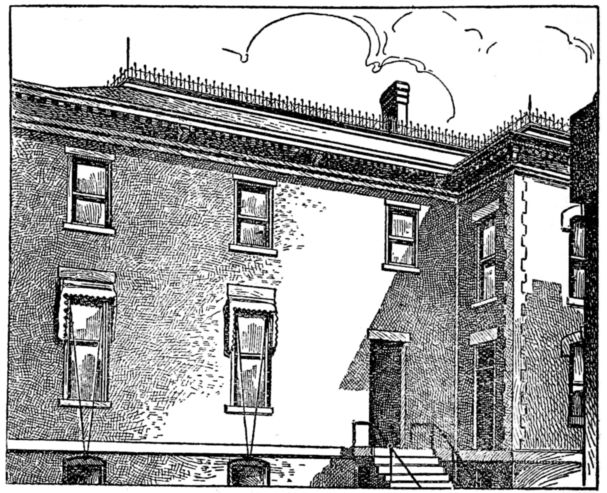
WOODSTOCK JAIL, IN WHICH DEBS WAS CONFINED
Here and now I challenge the records, and if in all the land the American Railway Union has an enemy, one or a million, I challenge them all to stand up before the labor world and give a reason why they have maligned and persecuted the order. I am not here to assert the infallibility of the organization or its officials, or to claim exemption from error. But I am here to declare to every friend of American toilers, regardless of banner, name or craft, that if the American Railway Union has erred, it has been on the side of sympathy, mercy and humanity—zeal in a great cause, devotion to the spirit of brotherhood which knows no artificial boundaries, 335whose zones are mapped by lines of truth as vivid as lightning, and whose horizon is measured only by the eye of faith in man’s redemption from slavery.
I hold it to have been inconceivable that an organization of workingmen, animated by such inspirations and aspirations, should have become the target for the shafts of judicial and governmental malice.
But the fact that such was the case brings into haggard prominence a condition of affairs that appeals to all thoughtful men in the ranks of organized labor and all patriotic citizens, regardless of vocation, who note the subtle invasions of the liberties of the American people by the courts, sustained by an administration that is equally dead to the guarantees of the constitution.
It is in no spirit of laudation that I aver here tonight that it has fallen to the lot of the American Railway Union to arouse workingmen to a sense of the perils that environ their liberties.
In the great Pullman strike the American Railway Union challenged the power of corporations in a way that had not previously been done, and the analyzation of this fact serves to expand it to proportions that the most conservative men of the nation regard with alarm.
It must be borne in mind that the American Railway Union did not challenge the government. It threw down no gauntlet to courts or armies—it simply resisted the invasion of the rights of workingmen by corporations. It challenged and defied the power of corporations. Thrice armed with a just cause, the organization believed that justice would win for labor a notable victory, and the records proclaim that its confidence was not misplaced.
The corporations, left to their own resources of money, mendacity and malice, of thugs and ex-convicts, leeches and lawyers, would have been overwhelmed with defeat and the banners of organized labor would have floated triumphant in the breeze.
This the corporations saw and believed—hence the crowning act of infamy in which the federal courts and the federal armies participated, and which culminated in the defeat of labor.
336Had this been all, the simple defeat of a labor organization, however disrupted and despoiled, this grand convocation of the lovers of liberty would never have been heard of. The robbed, idle and blacklisted victims of defeat would have suffered in silence in their darkened homes amidst the sobbings and wailings of wives and children. It would have been the oft repeated old, old story, heard along the track of progress and poverty for three-quarters of a century in the United States, where brave men, loyal to law and duty, have struck to better their condition or to resist degradation, and have gone down in defeat. But the defeat of the American Railway Union involved questions of law, constitution and government which, all things considered, are without a parallel in court and governmental proceedings under the constitution of the Republic. And it is this judicial and administrative usurpation of power to override the rights of states and strike down the liberties of the people that has conferred upon the incidents connected with the Pullman strike such commanding importance as to attract the attention of men of the highest attainments in constitutional law and of statesmen who, like Jefferson, view with alarm the processes by which the Republic is being wrecked and a despotism reared upon its ruins.
I have said that in the great battle of labor fought in 1894 between the American Railway Union and the Corporations banded together under the name of the “General Managers’ Association,” victory would have perched upon the standards of labor if the battle had been left to these contending forces—and this statement, which has been verified and established beyond truthful contradiction, suggests the inquiry, what other resources had the corporations aside from their money and the strength which their federation conferred?
In replying to the question, I am far within the limits of accepted facts when I say the country stood amazed as the corporations put forth their latent powers to debauch such departments of the government as were required to defeat labor in the greatest struggle for the right that was ever chronicled in the United States.
Defeated at every point, their plans all frustrated, outgeneraled 337in tactics and strategy, while the hopes of labor were brightening and victory was in sight, the corporations, goaded to desperation, played their last card in the game of oppression by an appeal to the federal judiciary and to the federal administration. To this appeal the response came quick as lightning from a storm cloud. It was an exhibition of the debauching power of money which the country had never before beheld.
The people had long been familiar with such expressions as “money talks,” “money rules,” and they had seen the effects of its power in legislatures and in congress. They were conversant with Jay Gould’s methods of gaining his legal victories by “buying a judge” in critical cases. They had tracked this money power, this behemoth beast of prey, into every corporate enterprise evolved by our modern civilization, as hunters track tigers in India jungles, but never before in the history of the country had they seen it grasp with paws and jaws the government of the United States and bend it to its will and make it a mere travesty of its pristine grandeur.
The people had seen this money power enter the church, touch the robed priest at the altar, blotch his soul, freeze his heart and make him a traitor to his consecrated vows and send him forth a Judas with a bag containing the price of his treason; or, if true to his conviction, ideas and ideals, to suffer the penalty of ostracism, to be blacklisted and to seek in vain for a sanctuary in which to expound Christ’s doctrine of the brotherhood of man.
The people had seen this money power enter a university and grasp a professor and hurl him headlong into the street because every faculty of mind, redeemed by education and consecrated to truth, pointed out and illumined new pathways to the goal of human happiness and national glory.
The people had seen this money power practicing every art of duplicity, growing more arrogant and despotic as it robbed one and crushed another, building its fortifications of the bones of its victims, and its palaces out of the profits of its piracies, until purple and fine linen on the one side and rags upon the other side, defined conditions as mountain ranges and rivers define the boundaries of nations—palaces 338on the hills, with music and dancing and the luxuries of all climes, earth, air and sea-huts in the valley, dark and dismal, where the music is the dolorous “song of the shirt” and the luxuries rags and crusts.
These things had been seen by the people, but it was reserved for them in the progress of the Pullman strike to see this money power, by the fiat of corporations, grasp one by one the departments of the government and compel them to do its bidding as in old plantation days the master commanded the obedience of his chattel slaves.
The corporations first attacked the judicial department of the government, a department which, according to Thomas Jefferson, has menaced the integrity of the Republic from the beginning.
They did not attack the supreme bench. A chain is no stronger than its weakest link, and the corporations knew where that was and the amount of strain it would bear. How did they attack this weakling in the judicial chain?
I am aware that innuendoes, dark intimations of venality are not regarded as courageous forms of arraignment, and yet the judicial despotism which marked every step of the proceedings by which my official associates and myself were doomed to imprisonment, was marked by infamies, supported by falsehoods and perjuries as destitute of truth as are the Arctic regions of orange blossoms.
Two men quarrelled because one had killed the other’s dog with an ax. The owner of the dog inquired, “when my dog attacked you, why did you not use some less deadly weapon?” The other replied, “why did not your dog come at me with the end that had no teeth in it?”
There is an adage which says, “fight the devil with fire.” In this connection why may it not be intimated that a judge who pollutes his high office at the behest of the money power has the hinges of his knees lubricated with oil from the tank of the corporation that thrift may follow humiliating obedience to its commands?
If not this, I challenge the world to assign a reason why a judge, under the solemn obligation of an oath to obey the constitution, should in a temple dedicated to justice, stab the 339Magna Charta of American liberty to death in the interest of corporations, that labor might be disrobed of its inalienable rights and those who advocated its claim to justice imprisoned as if they were felons?
You may subject such acts of despotism to the severest analysis, you may probe for the motive, you may dissect the brain and lay bare the quivering heart, and, when you have completed the task, you will find a tongue in every gash of your dissecting knife uttering the one word “pelf.”
Once upon a time a corporation dog of good reputation was charged with killing sheep, though he had never been caught in the act. The corporation had always found him to be an obedient dog, willing to lick the hand of his master, and declared that he was a peaceable and law-abiding dog; but one day upon investigation the dog was found to have wool in his teeth and thenceforward, though the corporation stood manfully by him, he was believed to be a sheep-killing dog. The world has no means of knowing what methods corporations employ to obtain despotic decrees in their interest, but it is generally believed that if an examination could be made, there would be found wool in the teeth of the judge.
I do not profess to be a student of heredity, and yet I am persuaded that men inherit the peculiarities of the primal molecules from which they have been evolved. If the modern man, in spite of our civilizing influences, books, stage and rostrum, has more devil than divinity in his nature, where rests the blame?
Leaving the interrogatory unanswered, as it has been in all the past, it is only required to say that men with the ballot make a fatal mistake when they select mental and moral deformities and clothe them with despotic power. When such creatures are arrayed in the insignia of authority, right, justice and liberty are forever in peril.
What reasons exist today for rhetorical apostrophes to the constitution of the Republic? Those who are familiar by experience, or by reading, with the pathways of the storms on the ocean will recall recollections of ships with their sails rent and torn by the fury of the winds, rolling upon the yeasty billows and flying signals of distress. Clouds had for days 340obscured sun and stars and only the eye of omnipotence could tell whither the hulk was drifting—and today the constitution of our ship of state, the chart by which she had been steered for a century, has encountered a judicial tornado and only the gods of our fathers can tell whither she is drifting. True, Longfellow, inspired by the genius of hope, sang of the good old ship:
“We know what master laid thy keel,
What workmen wrought thy ribs of steel,
Who made each mast and sail and rope,
What anvils rang, what hammers beat,
In what a forge and what a heat
Were shaped the anchors of thy hope.”
But the poet wrote before the chart by which the good old ship sailed had been mutilated and torn and flung aside as a thing of contempt; before Shiras “flopped” and before corporations knew the price of judges, legislators and public officials as certainly as Armour knows the price of pork and mutton.
Longfellow wrote before men with heads as small as chipmunks and pockets as big as balloons were elevated to public office, and before the corporation ruled in courts and legislative halls as the fabled bull ruled in a china shop.
No afflatus, however divine, no genius, though saturated with the inspiring waters of Hippocrene, could now write in a spirit of patriotic fire of the old constitution, nor ever again until the people by the all pervading power of the ballot have repaired the old chart, closed the rents and obscured the judicial dagger holes made for the accommodation of millionaires and corporations, through which they drive their four-in-hands as if they were Cumberland gaps.
Here, this evening, I am inclined to indulge in eulogistic phrase of Liberty because once more I am permitted to mingle with my fellow-citizens outside of prison locks and bars.
Shakespeare said:
“Sweet are the uses of adversity,
Which, like the toad, ugly and venomous,
Wears yet a precious jewel in his head.”
341I know something of adversity, and with such philosophy as I could summon have extracted what little sweetness it contained. I know little of toads, except that of the genus judicial, and if they have a precious jewel in their heads or hearts it has not fallen to my lot to find it, though the corporations seem to have been more successful.
The immortal bard also wrote that
“This our life, exempt from public haunt,
Finds tongues in trees, books in running brooks,
Sermons in stones, and good in everything.”
If to be behind prison bars is to be “exempt from public haunt,” then for the past six months I may claim such exemption, with all the rapture to be found in listening to the tongues of trees, to the charming lessons taught by the books of the running brooks and to the profound sermons of the stones. There is not a tree on the Woodstock prison campus, or near by, to whose tongued melodies or maledictions I have not in fancy listened when liberty, despotism or justice was the theme.
The bard of Avon, the one Shakespeare of all the ages, was up to high-water mark of divine inspiration when he said there were those who could find tongues in trees, and never since trees were planted in the garden of Eden has the tongue of a tree voiced a sentiment hostile to liberty.
Thus, when in prison and exempt from judicial persecution, the tongues of trees as well as the tongues of friends taught me that sweets could be extracted from adversity.
Nor was I less fortunate when I permitted my fancy to see a book in a running brook as it laughed and sang and danced its way to the sea, and find that on every page was written a diviner song to liberty and love and sympathy than was ever sung by human voice.
And as for the stones in Woodstock prison, they were forever preaching sermons and their themes were all things good and evil among men.
In prison my life was a busy one, and the time for meditation and to give the imagination free rein was when the daily task was over and night’s sable curtains enveloped the world in darkness, relieved only by the sentinel stars and the earth’s 342silver satellite “walking in lovely beauty to her midnight throne.”
It was at such times that the “Reverend Stones” preached their sermons, sometimes rising in grandeur to the Sermon on the Mount.
It might be a question in the minds of some if this occasion warrants the indulgence of the fancy. It will be remembered that Aesop taught the world by fables and Christ by parables, but my recollection is that the old “stone preachers” were as epigrammatic as an unabridged dictionary.
I remember one old divine who, one night, selected for his text George M. Pullman, and said: “George is a bad egg—handle him with care. Should you crack his shell the odor would depopulate Chicago in an hour.” All said “Amen” and the services closed. Another old sermonizer who said he had been preaching since man was a molecule, declared he had of late years studied corporations, and that they were warts on the nose of our national industries,—that they were vultures whose beaks and claws were tearing and mangling the vitals of labor and transforming workingmen’s homes into caves. Another old stone said he knew more about strikes than Carroll D. Wright, and that he was present when the slaves built the pyramids; that God Himself had taught His lightning, thunderbolts, winds, waves and earthquakes to strike, and that strikes would proceed, with bullets or ballots, until workingmen, no longer deceived and cajoled by their enemies, would unify, proclaim their sovereignty and walk the earth free men.
O, yes, Shakespeare was right when he said there were sermons in stones. I recall one rugged-visaged old stone preacher who claimed to have been a pavement bowlder in a street of heaven before the gold standard was adopted, and who discussed courts. He said they had been antagonizing the decrees of heaven since the day when Lucifer was cast into the bottomless pit. Referring to our Supreme Court he said it was a nest of rodents forever gnawing at the stately pillars supporting the temple of our liberties. I recall how his eyes, as he lifted their stony lids, flashed indignation like orbs of fire, and how his stony lips quivered as he uttered his maledictions of judicial treason to constitutional liberty.
343But occasionally some old bald-headed ashler, with a heart beating responsive to every human joy or sorrow, would preach a sermon on love or sympathy or some other noble trait that in spite of heredity still lived even in the heart of stones. One old divine, having read some of the plutocratic papers on the Pullman strike and their anathemas of sympathy, when one workingman’s heart, throbbing responsive to the divine law of love, prompted him to aid his brother in distress, discussed sympathy. He said sympathy was one of the perennial flowers of the Celestial City, and that angels had transplanted it in Eden for the happiness of Adam and Eve, and that the winds had scattered the seed throughout the earth. He said there was no humanity, no elevating, refining, ennobling influences in operation where there was no sympathy. Sympathy, he said, warmed in every ray of the sun, freshened in every breeze that scattered over the earth the perfume of flowers and glowed with the divine scintillation of the stars in all the expanse of the heavens.
Referring to the men and women of other labor organizations who had sympathized with the American Railway Union in its efforts to rescue Pullman’s slaves from death by starvation, the old preacher placed a crown of jeweled eulogies upon their heads and said that in all the mutations of life, in adversity or prosperity, in the vigor of youth or the infirmities of age, there would never come a time to them when like the Peri grasping a penitent’s tear as a passport to heaven, they would not cherish as a valued souvenir of all their weary years that one act of sympathy of the victims of the Pullman piracy, and that when presented at the pearly gate of paradise, it would swing wide open and let them in amidst the joyous acclaims of angels.
From such reflections I turn to the practical lessons taught by this “Liberation Day” demonstration. It means that American lovers of liberty are setting in operation forces to rescue their constitutional liberties from the grasp of monopoly and its mercenary hirelings. It means that the people are aroused in view of impending perils and that agitation, organization, and unification are to be the future battle cries of men who will not part with their birthrights and, like Patrick 344Henry, will have the courage to exclaim: “Give me liberty or give me death!”
I have borne with such composure as I could command the imprisonment which deprived me of my liberty. Were I a criminal; were I guilty of crimes meriting a prison cell; had I ever lifted my hand against the life or the liberty of my fellowmen; had I ever sought to filch their good name, I would not be here. I would have fled from the haunts of civilization and taken up my residence in some cave where the voice of my kindred is never heard. But I am standing here without a self-accusation of crime or criminal intent festering in my conscience, in the sunlight once more, among my fellowmen, contributing as best I can to make this “Liberation Day” from Woodstock prison a memorial day, realizing that, as Lowell sang:
“He’s true to God who’s true to man; wherever wrong is done,
To the humblest and the weakest, ’neath the all-beholding sun.
That wrong is also done to us, and they are slaves most base,
Whose love of right is for themselves and not for all their race.”
345
Prison Labor
Its Effect on Industry and Trade
Address before Nineteenth Century Club at Delmonico’s, New York City, March 21st, 1899.
In my early years I stood before the open door of a blazing furnace and piled in the fuel to create steam to speed a locomotive along the iron track of progress and civilization. In the costume of the craft, through the grime of mingled sweat and smoke and dust I was initiated into the great brotherhood of labor. The locomotive was my alma mater. I mastered the curriculum and graduated with the degree of D. D., not, as the lexicons interpret the letters, “Doctor of Divinity,” but that better signification, “Do and Dare”—a higher degree than Aristotle conferred in his Lyceum or Plato thundered from his academy.
I am not in the habit of telling how little I know about Latin to those who have slaked their thirst for learning at the Pierian springs, but there is a proverb that has come down to us from the dim past which reads “Omnia vincit labor” and which has been adopted as the shibboleth of the American labor movement because, when reduced to English, it reads “Labor overcomes all things.” In a certain sense this is true. Labor has built this great metropolis of the new world, built it as coral insects build the foundations of islands—build and die; build from the fathomless depth of the ocean until the mountain billows are dashed into spray as they beat against the fortifications beneath which the builders are forever entombed and forgotten.
Here in this proud city where wealth has built its monuments grander and more imposing than any of the seven wonders of the world named in classic lore, if you will excavate for facts you will find the remains, the bones of the toilers, buried and imbedded in their foundations. They lived, they wrought, they died. In their time they may have laughed and 346sung and danced to the music of their clanking chains. They married, propagated their species, and perpetuated conditions which, growing steadily worse, are today the foulest blots the imagination can conceive upon our much vaunted civilization.
And from these conditions there flow a thousand streams of vice and crime which have broadened and deepened until they constitute a perpetual menace to the peace and security of society. Jails, workhouses, reformatories and penitentiaries have been crowded with victims, and the question how to control these institutions and their unfortunate inmates is challenging the most serious thought of the most advanced nations on the globe.
The particular phase of this grave and melancholy question which we are to consider this evening is embodied in the subject assigned the speakers: “Prison Labor, Its Effects on Industry and Trade.”
I must confess that it would have suited my purpose better had the subject been transposed so as to read: “Industry and Trade, Their Effect on Labor,” for, as a Socialist, I am convinced that the prison problem is rooted in the present system of industry and trade, carried forward, as it is, purely for private profit without the slightest regard to the effect upon those engaged in it, especially the men, women and children who perform the useful, productive labor which has created all wealth and all civilization.
Serious as is the problem presented in the subject of our discussion, it is yet insignificant when compared with the vastly greater question of the effect of our social and economic system upon industry and trade.
The pernicious effect of prison contract labor upon “free labor,” so called, when brought into competition with it in the open market, is universally conceded, but it should not be overlooked that prison labor is itself an effect and not a cause, and that convict labor is recruited almost wholly from the propertyless, wage-working class and that the inhuman system which has reduced a comparative few from enforced idleness to crime, has sunk the whole mass of labor to the dead level of industrial servitude.
347It is therefore with the economic system, which is responsible for, not only prison labor, but for the gradual enslavement and degradation of all labor, that we must deal before there can be any solution of the prison labor problem or any permanent relief from its demoralizing influences.
But we will briefly consider the effect of prison labor upon industry and then pass to the larger question of the cause of prison labor and its appalling increase, to which the discussion logically leads.
From the earliest ages there has been a prison problem. The ancients had their bastiles and their dungeons. Most of the pioneers of progress, the haters of oppression, the lovers of liberty, whose names now glorify the pantheon of the world, made such institutions a necessity in their day. But civilization advances, however slowly, and there has been some progress. It required five hundred years to travel from the inquisition to the injunction.
In the earlier days punishment was the sole purpose of imprisonment. Offenders against the ruling class must pay the penalty in prison cell, which, not infrequently, was equipped with instruments of torture. With the civilizing process came the idea of the reformation of the culprit, and this idea prompts every investigation made of the latter-day problem. The inmates must be set to work for their own good, no less than for the good of the state.
It was at this point that the convict labor problem began and it has steadily expanded from that time to this and while there have been some temporary modifications of the evil, it is still an unmitigated curse from which there can be no escape while an economic system endures in which labor, that is to say the laborer, man, woman and child, is sold to the lowest bidder in the markets of the world.
More than thirty years ago Prof. E. C. Wines and Prof. Theodore W. Dwight, then commissioners of the Prison Association of New York, made a report to the legislature of the state on prison industry in which they said:
“Upon the whole it is our settled conviction that the contract system of convict labor, added to the system of political appointments, which necessarily involves a low grade of official qualification and constant 348changes in the prison staff, renders nugatory, to a great extent, the whole theory of our penitentiary system. Inspection may correct isolated abuses; philanthropy may relieve isolated cases of distress; and religion may effect isolated moral cures; but genuine, radical, comprehensive, systematic improvement is impossible.”
The lapse of thirty years has not affected the wisdom or logic of the conclusion. It is as true now as it was then. Considered in his most favorable light, the convict is a scourge to himself, a menace to society and a burden to industry, and whatever system of convict labor may be tried, it will ultimately fail of its purpose at reformation of the criminal or the relief of industry as long as thousands of “free laborers,” who have committed no crime, are unable to get work and make an honest living. Not long ago I visited a penitentiary in which a convict expressed regret that his sentence was soon to expire. Where was he to go, and what was he to do? And how long before he would be sentenced to a longer term for a greater crime?
The commission which investigated the matter in Ohio in 1877 reported to the legislature as follows:
“The contract system interferes in an undue manner with the honest industry of the state. It has been the cause of crippling the business of many of our manufacturers; it has been the cause of driving many of them out of business; it has been the cause of a large percentage of reductions which have taken place in the wages of our mechanics; it has been the cause of pauperizing a large portion of our laborers and increasing crime in a corresponding degree; it has been no benefit to the state; as a reformatory measure it has been a complete, total and miserable failure; it has hardened more criminals than any other cause; it has made total wrecks morally of thousands and thousands who would have been reclaimed from the paths of vice and crime under a proper system of prison management, but who have resigned their fate to a life of hopeless degradation; it has not a single commendable feature. Its tendency is pernicious in the extreme. In short, it is an insurmountable barrier in the way of the reformation of the unfortunates who are compelled to live and labor under its evil influences; it enables a class of men to get rich out of the crimes committed by others; it leaves upon the fair escutcheon of the state a relic of the very worst form of human slavery; it is a bone of ceaseless contention between the state and its mechanical and industrial interests; it is abhorred by all and respected by none except those, perhaps, who make profit and gain out of it. It should be tolerated no longer but abolished at once.”
349And yet this same system is still in effect in many of the states of the Union. The most revolting outrages have been perpetrated upon prison laborers under this diabolical system. Read the official reports and stand aghast at the atrocities committed against these morally deformed and perverted human creatures, your brothers and my brothers, for the private profit of capitalistic exploiters and the advancement of Christian civilization.
What a commentary on the capitalist competitive system! First, men are forced into idleness. Gradually they are driven to the extremity of begging or stealing. Having still a spark of pride and self-respect they steal and are sent to jail. The first sentence seals their doom. The brand of Cain is upon them. They are identified with the criminal class. Society, whose victims they are, has exiled them forever, and with this curse ringing in their ears they proceed on their downward career, sounding every note in the scale of depravity until at last, having graduated in crime all the way from petit larceny to homicide, their last despairing sigh is wrung from them by the hangman’s halter. From first to last these unfortunates, the victims of social malformation, are made the subjects of speculation and traffic. The barbed iron of the prison contractor is plunged into their quivering hearts that their torture may be coined into private profit for their exploiters.
In the investigation in South Carolina, where the convicts had been leased to railroad companies, the most shocking disclosures were made. Out of 285 prisoners employed by one company, 128, or more than 40 per cent, died as the result, largely, of brutal treatment.
It is popular to say that society must be protected against its criminals. I prefer to believe that criminals should be protected against society, at least while we live under a system that makes the commission of crime necessary to secure employment.
The Tennessee tragedy is still fresh in the public memory. Here, as elsewhere, the convicts, themselves brutally treated, were used as a means of dragging the whole mine-working class down to their crime-cursed condition. The Tennessee Coal and Iron Company leased the convicts for the express 350purpose of forcing the wages of miners down to the point of subsistence. Says the official report: “The miners were compelled to work in competition with low-priced convict labor, the presence of which was used by the company as a scourge to force free laborers to its terms.” Then the miners, locked out, their families suffering, driven to desperation, appealed to force and in a twinkling the laws of the state were trampled down, the authorities overpowered and defied, and almost five hundred convicts set at liberty.
Fortunately the system of leasing and contracting prison labor for private exploitation is being exposed and its frightful iniquities laid bare. Thanks to organized labor and to the spirit of prison reform, this horrifying phase of the evil is doomed to disappear before an enlightened public sentiment.
The public account system, though subject to serious criticism, is far less objectionable than either the lease, the contract or the piece-price system. At least the prisoner’s infirmities cease to be the prey of speculative greed and conscienceless rapacity.
The system of manufacturing for the use of state, county and municipal institutions, adopted by the state of New York, is an improvement upon those hitherto in effect, but it is certain to develop serious objections in course of time. With the use of modern machinery the limited demand will soon be supplied and then what? It may be in order to suggest that the prisoners could be employed in making shoes and clothes for the destitute poor and school books for their children and many other articles which the poor sorely need but are unable to buy.
Developing along this line it would be only a question of time until the state would be manufacturing all things for the use of the people, and then perhaps the inquiry would be pertinent: If the state can give men steady employment after they commit crime, and manufacturing can be carried forward successfully by their labor, why can it not give them employment before they are driven to that extremity, thereby preventing them from becoming criminals?
All useful labor is honest labor, even if performed in a prison. Only the labor of exploiters, such as speculators, 351stock gamblers, beef-embalmers and their mercenary politicians, lawyers and other parasites—only such is dishonest labor. A thief making shoes in a penitentiary is engaged in more useful and therefore more honest labor than a “free” stonemason at work on a palace whose foundations are laid in the skulls and bones, and cemented in the sweat and blood of ten thousand victims of capitalistic exploitation. In both cases the labor is compulsory. The stonemason would not work for the trust-magnate were he not compelled to.
In ancient times only slaves labored. And as a matter of fact only slaves labor now. The millions are made by the magic of manipulation. The coal miners of West Virginia, Pennsylvania, Ohio, Indiana and Illinois receive an average wage of less than seventy-five cents a day. They perform the most useful and necessary labor, without which your homes, if possible at all, would be cheerless as caves and the great heart of industry would cease to throb. Are they free men, or are they slaves? And what is the effect of their labor on trade and industry and upon themselves and their families? Dante would search the realms of inferno in vain for such pictures of horror and despair as are to be found in the mining regions of free America.
To the student of social science the haggard fact stands forth that under the competitive system of production and distribution the prison problem will never be solved—and its effect upon trade and industry will never be greatly modified. The fact will remain that whatever labor is performed by prison labor could and should be performed by free labor, and when in the march of economic progress the capitalist system of industry for private profit succumbs to the socialist system of industry for human happiness, when the factory, which is now a penitentiary crowded with life convicts, among whom children often constitute the majority—when this factory is transformed into a temple of science, and the machine, myriad-armed and tireless, is the only slave, there will be no prison labor and the problem will cease to vex the world, and to this it is coming in obedience to the economic law, as unerring in its operation as the law of gravitation.
That prison labor is demoralizing in its effect on trade and 352industry whenever and wherever brought into competition with it, especially under the various forms of the contract system, is of course conceded, but that it has been, or is at present, a great factor in such demoralization is not admitted. There is a tendency to exaggerate the blighting effects of prison labor for the purpose of obscuring the one overshadowing cause of demoralized trade and impoverished industry.
Prison labor did not reduce the miner to a walking hunger-pang, his wife to a tear-stained rag, and his home to a lair. Prison labor is not responsible for the squares of squalor and miles of misery in New York, Chicago and all other centers of population. Prison labor is not chargeable with the sweating dens in which the victims of capitalistic competition crouch in dread and fear until death comes to their rescue. Prison labor had no hand in Cœur d’Alene, Tennessee, Homestead, Hazleton, Virden, Pana, that suburb of hell called Pullman and other ensanguined industrial battle fields where thousands of workingmen after being oppressed and robbed were imprisoned like felons, and shot down like vagabond dogs; where venal judges issued infamous injunctions and despotic orders at the behest of their masters, enforcing them with deputy marshals armed with pistols and clubs and supported by troops with gleaming bayonets and shotted guns to drain the veins of workingmen of blood, but for whose labor this continent would still be a wilderness. Only the tortures of hunger and nakedness provoked protest, and this was silenced by the bayonet and bullet; by the club and the blood that followed the blow.
Prison labor is not accountable for the appalling increase in insanity, in suicide, in murder, in prostitution and a thousand other forms of vice and crime which pollute every fountain and contaminate every stream designed to bless the world.
Prison labor did not create our army of unemployed, but has been recruited from its ranks, and both owe their existence to the same social and economic system.
Nor are the evil effects confined exclusively to the poor working class. There is an aspect of the case in which the rich are as unfortunate as the poor. The destiny of the capitalist class is irrevocably linked with the working class. Fichte, the great German philosopher said, “Wickedness increases in proportion to the elevation of rank.”
353Prison labor is but one of the manifestations of our economic development and indicates its trend. The same cause that demoralized industry has crowded our prisons. Industry has not been impoverished by prison labor, but prison labor is the result of impoverished industry. The limited time at my command will not permit an analysis of the process.
The real question which confronts us is our industrial system and its effects upon labor. One of these effects is, as I have intimated, prison labor. What is its cause? What makes it necessary? The answer is, the competitive system, which creates wage-slavery, throws thousands out of employment and reduces the wages of thousands more to the point of bare subsistence.
Why is prison labor preferred to “free labor?” Simply because it is cheaper; it yields more profit to the man who buys, exploits and sells it. But this has its limitations. Capitalist competition that throngs the streets with idle workers, capitalist production that reduces human labor to a commodity and ultimately to crime—this system produces another kind of prison labor in the form of child labor which is being utilized more and more to complete the subjugation of the working class. There is this difference: The prison laborers are clothed and housed and fed. The child laborers whose wage is a dollar a week, or even less, must take care of themselves.
Prison labor is preferred because it is cheap. So with child labor. It is not a question of prison labor, or of child labor, but of cheap labor.
Tenement-house labor is another form of prison labor.
The effects of cheap labor on trade and industry must be the same, whether such labor is done by prisoners, tenement house slaves, children or starving “hoboes.”
The prison laborer produces by machinery in abundance but does not consume. The child likewise produces, but owing to its small wages, does not consume. So with the vast army of workers whose wage grows smaller as the productive capacity of labor increases, and then society is afflicted with overproduction, the result of under-consumption. What follows? The panic. Factories close down, wage-workers are idle and 354suffer, middle-class business men are forced into bankruptcy, the army of tramps is increased, vice and crime are rampant and prisons and work-houses are filled to overflowing as are sewers when the streets of cities are deluged with floods.
Prison labor, like all cheap labor, is at first a source of profit to the capitalist, but finally it turns into a two-edged sword that cuts into and destroys the system that produced it.
First, the capitalist pocket is filled by the employment of cheap labor—and then the bottom drops out of it.
In the cheapening process, the pauperized mass have lost their consuming power.
The case may now be summed up as follows:
First. Prison labor is bad; it has a demoralizing effect on capitalist trade and industry.
Second. Child labor, tenement house and every other form of cheap labor is bad; it is destructive of trade and industry.
Third. Capitalist competition is bad; it creates a demand for cheap labor.
Fourth. Capitalist production is bad; it creates millionaires and mendicants, economic masters and slaves, thus intensifying the class struggle.
This indicates that the present capitalist system has outlived its usefulness, and that it is in the throes of dissolution. Capitalism is but a link in the chain of social and economic development. Just as feudalism developed capitalism and then disappeared, so capitalism is now developing socialism, and when the new social system has been completely evolved the last vestige of capitalism will fade into history.
The gigantic trust marks the change in production. It is no longer competitive but co-operative. The same mode of distribution, which must inevitably follow, will complete the process.
Co-operative labor will be the basis of the new social system, and this will be for use and not for profit. Labor will no longer be bought and sold. Industrial slavery will cease. For every man there will be the equal right to work with every other man and each will receive the fruit of his labor. Then we shall have economic equality. Involuntary idleness will be a horror of the past. Poverty will relax its grasp. 355The army of tramps will be disbanded because the prolific womb which now warms these unfortunates into life will become barren. Prisons will be depopulated and the prison labor problem will be solved.
Each labor-saving machine will lighten the burden and decrease the hours of toil. The soul will no longer be subordinated to the stomach. Man will live a complete life, and the march will then begin to an ideal civilization.
There is a proverb which the Latin race sent ringing down the centuries which reads, “Omnia vincit amor,” or “Love conquers all things.” Love and labor in alliance, working together, have transforming, redeeming and emancipating power. Under their benign sway the world can be made better and brighter.
Isaiah saw in prophetic vision a time when nations should war no more—when swords should be transformed into plowshares and spears into pruning hooks. The fulfillment of the prophecy only awaits an era when Love and Labor, in holy alliance, shall solve the economic problem.
Here, on this occasion, in this great metropolis with its thousand spires pointing heavenward, where opulence riots in luxury which challenges hyperbole, and poverty rots in sweat shops which only a Shakespeare or a Victor Hugo could describe, and the transfer to canvas would palsy the hand of a Michael Angelo—here, where wealth and want and woe bear irrefutable testimony of deplorable conditions, I stand as a socialist, protesting against the wrongs perpetrated upon Les Miserables, and pleading as best I can for a higher civilization.
The army of begging Lazaruses, with the dogs licking their sores at the gates of palaces, where the rich are clothed in purple and fine linen with their tables groaning beneath the luxuries of all climes, make the palaces on the highland where fashion holds sway and music lends its charms, a picture in the landscape which, in illustrating disparity, brings into bolder relief the hut and the hovel in the hollow where want, gaunt and haggard, sits at the door and where light and plenty, cheerfulness and hope are forever exiled by the despotic decree of conditions as cruel as when the Czar of Russia 356orders to his penal mines in Siberia the hapless subjects who dare whisper the sacred word liberty—as cruel as when this boasted land of freedom commands that a far-away, innocent people shall be shot down in jungle and lagoon, in their bamboo huts, because they dream of freedom and independence.
These conditions are as fruitful of danger to the opulent as they are of degradation to the poor. It is neither folly nor fanaticism to assert that the country cannot exist under such conditions. The higher law of righteousness, of love and labor will prevail. It is a law which commends itself to reasoning men, a primal law enacted long before Jehovah wrote the decalogue amidst the thunders and lightnings of Sinai. It is a law written upon the tablets of every man’s heart and conscience. It is a law infinitely above the creeds and dogmas and tangled disquisitions of the churches—the one law which in its operations will level humanity upward until men, redeemed from greed and every debasing ambition, shall obey its mandates and glory in its triumph.
Love and labor will give us the Socialist Republic—the Industrial Democracy—the equal rights of all men and women, and the emancipation of all from the vicious and debasing thraldoms of past centuries.
357
The Socialist Party and the Working Class
Opening Speech Delivered as Candidate of the Socialist Party for President, at Indianapolis, Ind., September 1, 1904
Mr. Chairman, Citizens and Comrades:
There has never been a free people, a civilized nation, a real republic on this earth. Human society has always consisted of masters and slaves, and the slaves have always been and are today, the foundation stones of the social fabric.
Wage-labor is but a name; wage-slavery is the fact.
The twenty-five millions of wage-workers in the United States are twenty-five millions of twentieth century slaves.
This is the plain meaning of what is known as
THE LABOR MARKET.
And the labor market follows the capitalist flag.
The most barbarous fact in all christendom is the labor market. The mere term sufficiently expresses the animalism of commercial civilization.
They who buy and they who sell in the labor market are alike dehumanized by the inhuman traffic in the brains and blood and bones of human beings.
The labor market is the foundation of so-called civilized society. Without these shambles, without this commerce in human life, this sacrifice of manhood and womanhood, this barter of babes, this sales of souls, the capitalist civilizations of all lands and all climes would crumble to ruin and perish from the earth.
Twenty-five millions of wage-slaves are bought and sold daily at prevailing prices in the American Labor Market.
358This is the
PARAMOUNT ISSUE
in the present national campaign.
Let me say at the very threshold of this discussion that the workers have but the one issue in this campaign, the overthrow of the capitalist system and the emancipation of the working class from wage-slavery.
The capitalists may have the tariff, finance, imperialism and other dust-covered and moth-eaten issues entirely to themselves.
The rattle of these relics no longer deceives workingmen whose heads are on their own shoulders.
They know by experience and observation that the gold standard, free silver, fiat money, protective tariff, free trade, imperialism and anti-imperialism all mean capitalist rule and wage-slavery.
Their eyes are open and they can see; their brains are in operation and they can think.
The very moment a workingman begins to do his own thinking he understands the paramount issue, parts company with the capitalist politician and falls in line with his own class on the political battlefield.
The political solidarity of the working class means the death of despotism, the birth of freedom, the sunrise of civilization.
Having said this much by way of introduction I will now enter upon the actualities of my theme.
THE CLASS STRUGGLE.
We are entering tonight upon a momentous campaign. The struggle for political supremacy is not between political parties merely, as appears upon the surface, but at bottom it is a life and death struggle between two hostile economic classes, the one the capitalist, and the other the working class.
The capitalist class is represented by the Republican, Democratic, Populist and Prohibition parties, all of which stand for private ownership of the means of production, and the triumph of any one of which will mean continued wage-slavery to the working class.
359As the Populist and Prohibition sections of the capitalist party represent minority elements which propose to reform the capitalist system without disturbing wage-slavery, a vain and impossible task, they will be omitted from this discussion with all the credit due the rank and file for their good intentions.
The Republican and Democratic parties, or, to be more exact, the Republican-Democratic party, represent the capitalist class in the class struggle. They are the political wings of the capitalist system and such differences as arise between them relate to spoils and not to principles.
With either of these parties in power one thing is always certain and that is that the capitalist class is in the saddle and the working class under the saddle.
Under the administration of both these parties the means of production are private property, production is carried forward for capitalist profit purely, markets are glutted and industry paralyzed, workingmen become tramps and criminals while injunctions, soldiers and riot guns are brought into action to preserve “law and order” in the chaotic carnival of capitalistic anarchy.
Deny it as may the cunning capitalists who are clearsighted enough to perceive it, or ignore it as may the torpid workers who are too blind and unthinking to see it, the struggle in which we are engaged today is a class struggle, and as the toiling millions come to see and understand it and rally to the political standard of their class, they will drive all capitalist parties of whatever name into the same party, and the class struggle will then be so clearly revealed that the hosts of labor will find their true place in the conflict and strike the united and decisive blow that will destroy slavery and achieve their full and final emancipation.
In this struggle the workingmen and women and children are represented by the Socialist party and it is my privilege to address you in the name of that revolutionary and uncompromising party of the working class.
ATTITUDE OF THE WORKERS.
What shall be the attitude of the workers of the United States in the present campaign? What part shall they take 360in it? What party and what principles shall they support by their ballots? And why?
These are questions the importance of which are not sufficiently recognized by workingmen or they would not be the prey of parasites and the service tools of scheming politicians who use them only at election time to renew their masters’ lease of power and perpetuate their own ignorance, poverty and shame.
In answering these questions I propose to be as frank and candid as plain-meaning words will allow, for I have but one object in this discussion and that object is not office, but the truth, and I shall state it as I see it, if I have to stand alone.
But I shall not stand alone, for the party that has my allegiance and may have my life, the Socialist party, the party of the working class, the party of emancipation, is made up of men and women who know their rights and scorn to compromise with their oppressors; who want no votes that can be bought and no support under any false pretense whatsoever.
The Socialist party stands squarely upon its proletarian principles and relies wholly upon the forces of industrial progress and the education of the working class.
The Socialist party buys no votes and promises no offices. Not a farthing is spent for whiskey or cigars. Every penny in the campaign fund is the voluntary offerings of workers and their sympathizers and every penny is used for education.
What other parties can say the same?
Ignorance alone stand in the way of socialist success. The capitalist parties understand this and use their resources to prevent the workers from seeing the light.
Intellectual darkness is essential to industrial slavery.
Capitalist parties stand for Slavery and Night.
The Socialist party is the herald of Freedom and Light.
Capitalist parties cunningly contrive to divide the workers upon dead issues.
The Socialist party is uniting them upon the living issue:
Death to Wage Slavery!
When industrial slavery is as dead as the issues of the 361Siamese capitalist parties the Socialist party will have fulfilled its mission and enriched history.
And now to our questions:
First, all workingmen and women owe it to themselves, their class and their country to take an active and intelligent interest in political affairs.
THE BALLOT.
The ballot of united labor expresses the people’s will and the people’s will is the supreme law of a free nation.
The ballot means that labor is no longer dumb, that at last it has a voice, that it may be heard and if united shall be heeded.
Centuries of struggle and sacrifice were required to wrest this symbol of freedom from the mailed clutch of tyranny and place it in the hand of labor as the shield and lance of attack and defense.
The abuse and not the use of it is responsible for its evils.
The divided vote of labor is the abuse of the ballot and the penalty is slavery and death.
The united vote of those who toil and have not will vanquish those who have and toil not, and solve forever the problem of democracy.
THE HISTORIC STRUGGLE OF CLASSES.
Since the race was young there have been class struggles. In every state of society, ancient and modern, labor has been exploited, degraded and in subjection.
Civilization has done little for labor except to modify the forms of its exploitation.
Labor has always been the mudsill of the social fabric—is so now and will be until the class struggle ends in class extinction and free society.
Society has always been and is now built upon exploitation—the exploitation of a class—the working class, whether slaves, serfs or wage-laborers, and the exploited working class in subjection have always been, instinctively or consciously, in revolt against their oppressors.
Through all the centuries the enslaved toilers have moved slowly but surely toward their final freedom.
362The call of the Socialist party is to the exploited class, the workers in all useful trades and professions, all honest occupations, from the most menial service to the highest skill, to rally beneath their own standard and put an end to the last of the barbarous class struggles by conquering the capitalist government, taking possession of the means of production and making them the common property of all, abolishing wage-slavery and establishing the co-operative commonwealth.
The first step in this direction is to sever all relations with
CAPITALIST PARTIES.
They are precisely alike and I challenge their most discriminating partisans to tell them apart in relation to labor.
The Republican and Democratic parties are alike capitalist parties—differing only in being committed to different sets of capitalist interests—they have the same principles under varying colors, are equally corrupt and are one in their subservience to capital and their hostility to labor.
The ignorant workingman who supports either of these parties forges his own fetters and is the unconscious author of his own misery. He can and must be made to see and think and act with his fellows in supporting the party of his class and this work of education is the crowning virtue of the socialist movement.
THE REPUBLICAN PARTY.
Let us briefly consider the Republican party from the worker’s standpoint. It is capitalist to the core. It has not and can not have the slightest interest in labor except to exploit it.
Why should a workingman support the Republican party?
Why should a millionaire support the Socialist party?
For precisely the same reason that all the millionaires are opposed to the Socialist party, all the workers should be opposed to the Republican party. It is a capitalist party, is loyal to capitalist interests and entitled to the support of capitalist voters on election day.
All it has for workingmen is its “glorious past” and a “glad hand” when it wants their votes.
363The Republican party is now and has been for several years, in complete control of government.
What has it done for labor? What has it not done for capital?
Not one of the crying abuses of capital has been curbed under Republican rule.
Not one of the petitions of labor has been granted.
The eight hour and anti-injunction bills, upon which organized labor is a unit, were again ruthlessly slain by the last congress in obedience to the capitalist masters.
David M. Parry has greater influence at Washington than all the millions of organized workers.
Read the national platform of the Republican party and see if there is in all its bombast a crumb of comfort for labor. The convention that adopted it was a capitalist convention and the only thought it had of labor was how to abstract its vote without waking it up.
In the only reference it made to labor it had to speak easy so as to avoid offense to the capitalists who own it and furnish the boodle to keep it in power.
The labor platforms of the Republican and Democratic parties are interchangeable and non-redeemable. They both favor “justice to capital and justice to labor.” This hoary old platitude is worse than meaningless. It is false and misleading and so intended. Justice to labor means that labor shall have what it produces. This leaves nothing for capital.
Justice to labor means the end of capital.
The old parties intend nothing of the kind. It is false pretense and false promise. It has served well in the past. Will it continue to catch the votes of unthinking and deluded workers?
What workingmen had part in the Republican national convention or were honored by it?
The grand coliseum swarmed with trust magnates, corporation barons, money lords, stock gamblers, professional politicians, lawyers, lobbyists and other plutocratic tools and mercenaries, but there was no room for the horny-handed and horny-headed sons of toil. They built it, but were not in it.
364Compare that convention with the convention of the Socialist party, composed almost wholly of working men and women and controlled wholly in the interest of their class.
But a party is still better known by its chosen representatives than by its platform declarations.
Who are the nominees of the Republican party for the highest offices in the gift of the nation and what is their relation to the working class?
First of all, Theodore Roosevelt and Charles W. Fairbanks, candidates for President and Vice-President, respectively, deny the class struggle and this almost infallibly fixes their status as friends of capital and enemies of labor. They insist that they can serve both; but the fact is obvious that only one can be served and that one at the expense of the other. Mr. Roosevelt’s whole political career proves it.
The capitalists made no mistake in nominating Mr. Roosevelt. They know him well and he has served them well. They know that his instincts, associations, tastes and desires are with them, that he is in fact one of them and that he has nothing in common with the working class.
The only evidence to the contrary is his membership in the Brotherhood of Locomotive Firemen which seems to have come to him co-incident with his ambition to succeed himself in the presidential chair. He is a full fledged member of the union, has the grip, signs and passwords; but it is not reported that he is attending meetings, doing picket duty, supporting strikes and boycotts and performing such other duties as his union obligation imposes.
When Ex-President Grover Cleveland violated the constitution and outraged justice by seizing the state of Illinois by the throat and handcuffing her civil administration at the behest of the crime-stained trusts and corporations, Theodore Roosevelt was among his most ardent admirers and enthusiastic supporters. He wrote in hearty commendation of the atrocious act, pronounced it most exalted patriotism and said he would have done the same himself had he been president.
And so he would and so he will!
How impressive to see the Rough Rider embrace the Smooth Statesman! Oyster Bay and Buzzard’s Bay! “Two 365souls with but a single thought, two hearts that beat as one.”
There is also the highest authority for the statement charging Mr. Roosevelt with declaring about the same time he was lauding Cleveland that if he was in command he would have such as Altgeld, Debs and other traitors lined up against a dead wall and shot. The brutal remark was not for publication but found its way into print and Mr. Roosevelt, after he became a candidate, attempted to make denial, but the words themselves sound like Roosevelt and bear the impress of his savage visage.
Following the Pullman strike in 1894 there was an indignant and emphatic popular protest against “government by injunction,” which has not yet by any means subsided.
Organized labor was, and is, a unit against this insidious form of judicial usurpation as a means of abrogating constitutional restraints of despotic power.
Mr. Roosevelt with his usual zeal to serve the ruling class and keep their slaves in subjection, vaulted into the arena and launched his tirade upon the “mob” that dared oppose the divine rule of a corporation judge.
“Men who object to what they style ‘government by injunction,’” said he, “are, as regards the essential principles of government, in hearty sympathy with their remote skin-clad ancestors, who lived in caves, fought one another with stone-headed axes and ate the mammoth and woolly rhinoceros. They are dangerous whenever there is the least danger of their making the principles of this ages-buried past living factors in our present life. They are not in sympathy with men of good minds and good civic morality.”
In direct terms and plain words Mr. Roosevelt denounces all those who oppose “Government by Injunction” as cannibals, barbarians and anarchists, and this violent and sweeping stigma embraces the whole organized movement of labor, every man, woman and child that wears the badge of union labor in the United States.
It is not strange in the light of these facts that the national congress, under President Roosevelt’s administration, suppresses anti-injunction and eight-hour bills and all other measures favored by labor and resisted by capital.
366No stronger or more convincing proof is required of Mr. Roosevelt’s allegiance to capital and opposition to labor, nor of the class struggle and class rule which he so vehemently denies; and the workingman who in the face of these words and acts, can still support Mr. Roosevelt, must feel himself flattered in being publicly proclaimed a barbarian, and sheer gratitude, doubtless, impels him to crown his benefactor with the highest honors.
If the working class are barbarians, according to Mr. Roosevelt, this may account for his esteeming himself as having the very qualities necessary to make himself Chief of the Tribe.
But it must be noted that Mr. Roosevelt denounced organized labor as savages long before he was a candidate for president. After he became a candidate he joined the tribe and is today, himself, according to his own dictum, a barbarian and the enemy of civic morality.
The labor union to which President Roosevelt belongs and which he is solemnly obligated to support, is unanimously opposed to “Government by Injunction.” President Roosevelt knew it when he joined it and he also knew that those who oppose injunction rule have the instincts of cannibals and are a menace to morality, but his proud nature succumbed to political ambition, and his ethical ideas vanished as he struck the trail that led to the tribe and, after a most dramatic scene and impressive ceremony, was decorated with the honorary badge of international barbarism.
How Theodore Roosevelt, the trade-unionist, can support the presidential candidate who denounced him as an immoral and dangerous barbarian, he may decide at his leisure, and so may all other union men in the United States who are branded with the same vulgar stigma, and their ballots will determine if they have the manhood to resent insult and rebuke its author, or if they have been fitly characterized and deserve humiliation and contempt.
The appointment of Judge Taft to a cabinet position is corroborative evidence, if any be required, of President Roosevelt’s fervent faith in Government by Injunction. Judge Taft first came into national notoriety when, some years ago, sitting with Judge Ricks, who was later tried for malfeasance, they 367issued the celebrated injunction during the Toledo, Ann Arbor & North Michigan railroad strike that paralyzed the Brotherhoods of Locomotive Engineers and Firemen and won for them the gratitude and esteem of every corporation in the land. They were hauled to Toledo, the headquarters of the railroad, in a special car, pulled by a special engine, on special time, and after hastily consulting the railroad magnates and receiving instructions, let go the judicial lightning that shivered the unions to splinters and ended the strike in total defeat. Judge Taft is a special favorite with the trust barons and his elevation to the cabinet was ratified with joy at the court of St. Plutus.
Still again did President Roosevelt drive home his arch-enmity to labor and his implacable hostility to the trade-union movement when he made Paul Morton, the notorious union hater and union wrecker, his secretary of the navy. That appointment was an open insult to every trade-unionist in the country and they who lack the self-respect to resent it at the polls may wear the badge, but they are lacking wholly in the spirit and principles of union labor.
Go ask the brotherhood men who were driven from the C. B. & Q. and the striking union machinists on the Santa Fe to give you the pedigree of Mr. Morton and you will learn that his hate for union men is equalled only by his love for the scabs who take their places.
Such a man and such another as Sherman Bell, the military ferret of the Colorado mine owners, are the ideal patriots and personal chums of Mr. Roosevelt, and by honoring these he dishonors himself and should be repudiated by the ballot of every working man in the nation.
Mr. Fairbanks, the Republican candidate for Vice-President, is a corporation attorney of the first class and a plutocrat in good and regular standing. He is in every respect a fit and proper representative of his party and every millionaire in the land may safely support him.
THE DEMOCRATIC PARTY.
In referring to the Democratic party in this discussion we may save time by simply saying that since it was born again 368at the St. Louis convention it is near enough like its Republican ally to pass for a twin brother.
The former party of the “common people” is no longer under the boycott of the plutocracy since it has adopted the Wall street label and renounced its middle class heresies.
The radical and progressive element of the former Democracy have been evicted and must seek other quarters. They were an unmitigated nuisance in the conservative counsels of the old party. They were for the “common people” and the trusts have no use for such a party.
Where but to the Socialist party can these progressive people turn? They are now without a party and the only genuine Democratic party in the field is the Socialist party, and every true Democrat should thank Wall street for driving him out of a party that is democratic in name only and into one that is democratic in fact.
The St. Louis convention was a trust jubilee. The Wall street reorganizers made short work of the free silver element. From first to last it was a capitalistic convocation. Labor was totally ignored. As an incident, two thousand choice chairs were reserved for the Business Men’s League of St. Louis, an organization hostile to organized labor, but not a chair was tendered to those whose labor had built the convention hall, had clothed, transported, fed and wined the delegates and whose votes are counted on as if they were so many dumb driven cattle, to pull the ticket through in November.
As another incident, when Lieutenant Richmond Hobson dramatically declared that President Cleveland had been the only president who had ever been patriotic enough to use the federal troops to crush union labor, the trust agents, lobbyists, tools and clackers screamed with delight and the convention shook with applause.
The platform is precisely the same as the Republican platform in relation to labor. It says nothing and means the same. A plank was proposed condemning the outrages in Colorado under Republican administration, but upon order from the Parryites it was promptly thrown aside.
The editor of American Industries, organ of the Manufacturers’ Association, commented at length in its issue of 369July 15 on the triumph of capital and the defeat of labor at both Republican and Democratic national conventions. Among other things he said: “The two labor lobbies, partly similar in make-up, were, to put it bluntly, thrown out bodily in both places.” And that is the simple fact and is known of all men who read the papers. The capitalist organs exult because labor, to use their own brutal expression, was kicked bodily out of both the Republican and Democratic national conventions.
What more than this is needed to open the eyes of workingmen to the fact that neither of these parties is their party and that they are as strangely out of place in them as Rockefeller and Vanderbilt would be in the Socialist party?
And how many more times are they to be “kicked out bodily” before they stay out and join the party of their class in which labor is not only honored but is supreme, a party that is clean, that has conscience and convictions, a party that will one day sweep the old parties from the field like chaff and issue the Proclamation of Labor’s Emancipation?
Judge Alton B. Parker corresponds precisely to the Democratic platform. It was made to order for him. His famous telegram in the expiring hour removed the last wrinkle and left it a perfect fit.
Thomas W. Lawson, the Boston millionaire, charges that Senator Patrick McCarren, who brought out Judge Parker for the nomination, is on the pay roll of the Standard Oil Company as political master mechanic at twenty thousand dollars a year, and that Parker is the chosen tool of Standard Oil. Mr. Lawson offers Senator McCarren one hundred thousand dollars if he will disprove the charge.
William Jennings Bryan denounced Judge Parker as a tool of Wall street before he was nominated and declared that no self-respecting Democrat could vote for him, and after his nomination he charged that it had been dictated by the trusts and secured by “crooked and indefensible methods.” Mr. Bryan also said that labor had been betrayed in the convention and need look for nothing from the Democratic party. He made many other damaging charges against his party and its candidates, but when the supreme test came he was not equal to it, and instead of denouncing the betrayers of the “common 370people” and repudiating their made-to-order Wall street program, he compromised with the pirates that scuttled his ship and promised with his lips the support his heart refused and his conscience condemned.
The Democratic nominee for President was one of the Supreme Judges of the State of New York who declared the eight-hour law unconstitutional and this is an index of his political character.
In his address accepting the nomination he makes but a single allusion to labor and in this he takes occasion to say that labor is charged with having recently used dynamite in destroying property and that the perpetrators should be subjected to “the most rigorous punishment known to the law.” This cruel intimation amounts to conviction in advance of trial and indicates clearly the trend of his capitalistically trained judicial mind. He made no such reference to capital, nor to those ermined rascals who use judicial dynamite in blowing up the constitution while labor is looted and starved by capitalistic freebooters who trample all law in the mire and leer and mock at their despoiled and helpless victims.
It is hardly necessary to make more than passing reference to Henry G. Davis, Democratic candidate for Vice-President. He is a coal baron, railroad owner and, of course, an enemy to union labor. He has amassed a great fortune exploiting his wage-slaves and has always strenuously resisted every attempt to organize them for the betterment of their condition. Mr. Davis is a staunch believer in the virtue of the injunction as applied to union labor. As a young man he was in charge of a slave plantation and his conviction is that wage-slaves should be kept free from the contaminating influence of the labor agitator and render cheerful obedience to their master.
Mr. Davis is as well qualified to serve his party as is Senator Fairbanks to serve the Republican party and wage-workers should have no trouble in making their choice between this pernicious pair of plutocrats, and certainly no intelligent workingman will hesitate an instant to discard them both and cast his vote for Ben Hanford, their working class competitor, who is as loyally devoted to labor as Fairbanks and Davis are to capital.
371
THE SOCIALIST PARTY.
In what has been said of other parties I have tried to show why they should not be supported by the common people, least of all by workingmen, and I think I have shown clearly enough that such workers as do support them are guilty, consciously or unconsciously, of treason to their class. They are voting into power the enemies of labor and are morally responsible for the crimes thus perpetrated upon their fellow-workers and sooner or later they will have to suffer the consequences of their miserable acts.
The Socialist party is not, and does not pretend to be, a capitalist party. It does not ask, nor does it expect the votes of the capitalist class. Such capitalists as do support it do so seeing the approaching doom of the capitalist system and with a full understanding that the Socialist party is not a capitalist party, nor a middle class party, but a revolutionary working class party, whose historic mission it is to conquer capitalism on the political battle-field, take control of government and through the public powers take possession of the means of wealth production, abolish wage-slavery and emancipate all workers and all humanity.
The people are as capable of achieving their industrial freedom as they were to secure their political liberty, and both are necessary to a free nation.
The capitalist system is no longer adapted to the needs of modern society. It is outgrown and fetters the forces of progress. Industrial and commercial competition are largely of the past. The handwriting blazes on the wall. Centralization and combination are the modern forces in industrial and commercial life. Competition is breaking down and co-operation is supplanting it.
The hand tools of early times are used no more. Mammoth machines have taken their places. A few thousand capitalists own them and many millions of workingmen use them.
All the wealth the vast army of labor produces above its subsistence is taken by the machine owning capitalists, who also own the land and the mills, the factories, railroads and mines, the forests and fields and all other means of production and transportation.
372Hence wealth and poverty, millionaires and beggars, castles and caves, luxury and squalor, painted parasites on the boulevard and painted poverty among the red lights.
Hence strikes, boycotts, riots, murder, suicide, insanity, prostitution on a fearful and increasing scale.
The capitalist parties can do nothing. They are a part, an iniquitous part, of the foul and decaying system.
There is no remedy for the ravages of death.
Capitalism is dying and its extremities are already decomposing. The blotches upon the surface show that the blood no longer circulates. The time is near when the cadaver will have to be removed and the atmosphere purified.
In contrast with the Republican and Democratic conventions, where politicians were the puppets of plutocrats, the convention of the Socialist party consisted of workingmen and women fresh from their labors, strong, clean, wholesome, self-reliant, ready to do and dare for the cause of labor, the cause of humanity.
Proud indeed am I to have, been chosen by such a body of men and women to bear aloft the proletarian standard in this campaign, and heartily do I endorse the clear and cogent platform of the party which appeals with increasing force and eloquence to the whole working class of the country.
To my associate upon the national ticket I give my hand with all my heart. Ben Hanford typifies the working class and fitly represents the historic mission and revolutionary character of the Socialist party.
CLOSING WORDS.
These are stirring days for living men. The day of crisis is drawing near and Socialists are exerting all their power to prepare the people for it.
The old order of society can survive but little longer. Socialism is next in order. The swelling minority sounds warning of the impending change. Soon that minority will be the majority and then will come the co-operative commonwealth.
Every workingman should rally to the standard of his class and hasten the full-orbed day of freedom.
Every progressive Democrat must find his way in our direction 373and if he will but free himself from prejudice and study the principles of Socialism he will soon be a sturdy supporter of our party.
Every sympathizer with labor, every friend of justice, every lover of humanity should support the Socialist party as the only party that is organized to abolish industrial slavery, the prolific source of the giant evils that afflict the people.