PREFACE (continued 4)
Reading edition
Auf Grund der hohen Feier tage Geändert unsere Feindeslage. Wir leben heut' in tiefem Frieden: Zur kürzen Zeit ist's uns beschieden, Dann werden wir die Waffen mässen; Jedoch soll niemals man vergessen Den Stifter deiser Weltenbrand. "Gott Strafe England." The holy days of Easter-tide Have set our enmity aside. We live in perfect peace to-day: 'Tis but a little time we may, Then to our weapons we must get; But ever we'll remember yet Who lit this fire of world-wide wrack; O God, pay England back.
April 9.
I have been visiting my friends at the Staff of the army at Jaslo. Even this place has not been immune, bombs have been thrown from aeroplanes, doing no damage to the army but wounding and killing some children.
I visited the General in command, who is in splendid spirits. He is the simplest of men, and stops in the streets to talk to the children or to any new arrival. He is happy now, because things are going forward.
The Staff lies in rather better quarters here, but with the same simplicity as when I first visited it at Pilsno. One of the regiments I knew came through in fine style with its colonel at its head; it had done forty-eight miles in two days, and was ready for any amount more. The different battalions were singing different soldiers' songs, each taking pride in getting a good swing and putting in the best foot forward. I was struck with one man who marched at the side leading the songs with a mouth like a brass instrument and a voice to match.
Two German airmen have just come down here. They had made a wide circuit, and were brought down by the failure of their motor. As always here, they are being well treated. Even in the case of spies caught red-handed, it is most difficult to get the Russian soldier to shoot, especially if the condemned shows any sign of fear.
Austrian soldiers are to be seen here everywhere. The Germans and Magyars are under close surveillance; but the Austrian Slavs are ordinarily allowed to wander about freely. Many of them have shown in the most thorough way their attachment to the Russian cause; but I am told on the best authority for this area, that there is not a known instance of their abusing their liberty to play the part of spies. At many points on the Austrian front the Slavonic cause is like a kind of contagion. Under German direction disaffected troops are moved from one point to another to escape this infection, and finally, at the first opportunity, come over en masse.
Every day the prisoners are gathered together in groups according to their various nationalities for examination. These interrogations, which are of a very systematic kind, obtain very interesting results. Most of the prisoners testify to a shortness of food, not only in the front but in the rear. Letters from home to them speak of the dearness of all food; some necessities cannot even be obtained for money, and different parts of the empire are applying to each other for them in vain. Nowhere is there any spirit left. The only comfort which the officers can suggest is to await some success from the Germans. Some, moreover, describe the officers as being never on view, except to abuse their men, treating them worse than cattle: "So that one does not know whether one is a man or not." Only one Austrian officer so far has been taken in this part with a bayonet wound. It is known that there have been further protests in Bohemia after the taking of Peremyshl, and that the severest repression has been used, also that two Polish regiments have been literally decimated, that is, that every tenth man in them has been shot. One man's brother writes to him that he is called for the first time to the army at the age of forty-eight, and in his part the last call covers those between forty-two and fifty-two. Other new battalions are formed, ninety per cent. of reservists and ten per cent. of wounded who have returned to the colours; in most of them there is now a hopeless mix up of all nationalities. Some describe their training as having only lasted four weeks. In all cases the preoccupation of the commanding officers is regarding retreat.
April 11.
The centre of interest is now in the Carpathians. If Russia could have advanced with success against the strong German positions in East Prussia, she would have secured her right flank, but only as far as the sea, which would still have remained in German hands. On her left, her victories in Galicia have brought her to a very different barrier, which, if passed by her, will certainly remain impassable for the beaten enemy. It is a good thing that the Austrians, continually spurred forward by the Germans, have exhausted themselves in one desperate counter-attack after another on Galicia. It is a good thing that the Germans, realising what the ultimate defeat of Austria must mean to them, have diverted so many of their forces to this side. It is best of all that they have risked a desperate advance in the Bukovina and even as far as the Russian frontier, in the hope of dragging Rumania in on their side. The fall of Peremyshl has opened the gates of Hungary and has made possible a movement which threatens vital results on this front. Hungary and Prussia are the two keys to our triumph in this war. The one element in Austria that holds firm to the Prussian alliance is the Magyar; the one statesman in Austria is the Hungarian, Count Tisza, whose estate almost on the crest of the Carpathians is now in Russian hands. A Russian advance on this side can crush Hungary or cut her from Prussia. It can bring even the Magyar to wish for peace; it can finally put aside all action of Austria; and along the real barrier thus secured to the south, it can facilitate the concentration of the forces of the allies against the main enemy. It is, indeed, good that this effect comes at the time when we are hammering at the gates of Constantinople and opening up an effective advance from our western front.
But the task in the Carpathians is a stupendous one, and it comes when the Russian army has been tried to the full by the tremendous work which it has already gone through. We had in England no adequate army when the war began; we had not reckoned on the shameless violation of Belgian territory or on the obligations of a joint struggle with allies for the independence of Europe. Every one in Russia understands the miracle that we have done in creating so rapidly a really competent continental army on the basis of volunteer service, and every one sees that we were right to defer our blow till the great new instrument was whole and perfected. But it is Russia who has given us time for preparing our action on land; and the sacrifices which this has cost her are heavy indeed. The tremendous impact at Rava Ruska was followed by another prolonged and exterminating effort on the San, and this takes no account of the work which was done in holding the furious attacks of the main enemy in Russian Poland. These efforts put a terrible drain on the Russian resources. While we stood firm on the west, whole Russian regiments were almost annihilated in the victorious storming of one Austrian position after another. In my earlier visits to regiments I have often asked how many men of the first call still remain; sometimes only six of a company were still left, sometimes it was hardly more out of a whole regiment. It was an army already replaced at almost every point which had to attempt the conquest of the Carpathians.
The Carpathians are not the Alps. It might be easier if they were, for there would be fewer positions capable of being defended. They are a belt of high and higher hills some sixty miles or more in breadth, where whole armies can hold line after line. They are full of trees, water and mud. Only one double line of railway runs through them. As they have the shape of a fan spread northwards, the defence can concentrate backward along the various converging passes and can, in a relatively small space, almost block the narrow entrance to the Hungarian plain. But once that final barrier is passed, Hungary is lost. Any counter advance can be blocked without great expenditure of forces, and the conqueror will be free to advance southwards or westwards.
April 12.
At the Staff of the Army I fell in with a number of casual acquaintances who all saluted me as "Mister." There was a keen young flying-man who was now going back to his cavalry regiment, and a colonel sent to take temporary command of an infantry regiment. The talk was in fragments and all of incidents of camp life or engagements. We knew that another advance had been made and that big things were going forward.
All night we travelled by train, with changes and queer moments in the dark when our luggage ought to have been lost but wasn't. In the early morning the Colonel and I were on an engine climbing the Carpathians along a fine double track. We sat like Dean and Archdeacon in little side stalls with our things stacked where there was least coal and bilge, while the engine-driver, a most intelligent man from the Caucasus, explained the difficulties of his work. The rise is a very steep one, and we had a front view of it, passing up long slopes or through strata of yellow rock. In these mountains one had at once the feeling of being altogether away from Russia; and the new Russian army notices blending with the earlier Polish and Hungarian inscriptions suggested the atmosphere of a big adventure. All along the beautiful slopes there was the look of a huge Russian picnic, soldiers sitting at rest in great boyish crowds very much as in peace time the peasants do on the sloping banks of the Volga. The bright dresses of the Ruthenian women and the almost theatrical picturesqueness of their men-folk touched the whole with novelty.
Alighting at a station near the top, I found the usual war crowd and park of waiting army carts, and a brisk-faced intendant who rapped out business-like answers to a running fire of questions from all sides. My own business was to get to General Dobrotin, and it was made easy by the appearance of a plain-faced officer who said, "He's the man who pours cold water over himself in the morning; give him to me; we know him all over the division." I was soon in a formanka—a sort of boat-like cart which works particularly well in the mountains—and making my way up the gorge, at first with a broad shallow river to my left and later branching into the hills. Here in a little gully lay a scattered village; and the notes of a mountain flute were wafted down the slope.
General Dobrotin and his famous division have had far more than their share of the great fighting in this war; and they have been given one critical task after another, because their action has so often been decisive. In no less than three great movements they made the first cut in, and held the ground won as a kind of pivot until the whole operation was successfully completed. It was so at Rava Russka, on the San, and at Muchowka. They had now been transferred to the other flank of our Army.
It was the second time that this division, now enlarged into an army corps, had had mountain fighting, to which the Russian soldier is much less accustomed than to the plains. This time the task was a stupendous one. The railway pass crosses one of the lowest parts of the Carpathians, but close to it rises the long, steep ridge of the Eastern Beskides, which is the actual crest of the range at this point. It is covered with forest, and forms a line of rounded heights which are often separated from each other by almost precipitous gullies. Along this line ran a chain of carefully prepared positions, which the Austrian officers regarded as inaccessible.
Dobrotin's force, brought up with the greatest secrecy, had in some cases hardly detrained before it was launched to the attack. It soon mastered the outlying ground and then marched from all sides to the attack of the main ridge. The Russian infantry, on which has fallen the brunt of attack in this war, does not ordinarily go forward in close columns like the German. Groups of men, led by the instinctive enterprise of the more daring, gain one point of vantage after another, each of which forms a pivot for an advance of the whole line. In night attacks the movement can, of course, be more general and more rapid. In any case the last hundred yards or so are covered at a rush; but there is an inevitable pause before the wire entanglements, which in front of the Austrian trenches are generally most elaborate and have to be cut through with enormous scissors under a storm of fire, especially of quick-firing guns.
The Russians went up the slope with unconquerable daring, the new recruits showing the same courage as those already seasoned by the war. The whole operation went with a simplicity which made short work of all obstacles. Under a furious fire the men swarmed into the Austrian trenches, at once overcoming all opposition. There is no easy retreat from heights of this kind; everywhere hands were thrown up and the positions were won. The Russians sit firm on the crest of the Carpathians.
The staff from which this crucial attack was directed lived like a little family of brothers in a farmhouse in the valley. The General, white-haired, with one eye left, and with two other wounds, but with a youthful vigour of voice and movement, lived among his officers with a comradely simplicity, now patting one on the back, now sharing with another a bench on which to draw up a report, now gazing with amused interest at the regimental chronicler at work with his typewriter. His was an authority absolute.
April 14.
The F and J Regiments were to storm a height of about 2,500 feet on the further side of the Beskides and thus close the flank of the newly-won positions against any turning movement of the enemy.
I set out in the General's britchka in a swirling storm of sleet. Ground could only be made very slowly; for the whole country was sunk in deep mud. On a slope in the road we came upon an ambulance transport stuck fast, with a couple of soldiers using all their expletives, which would have translated quite simply into English. Soon afterwards we had to leave the road and plough through spongy meadows intersected with ditches. At one ditch there were two sharp cracks, and here both our springs were broken.
It was a desolate halting-place, with no one in sight. My soldier-driver announced: "We shall go nowhere with this to-day." However, he set to work and showed prodigies of strength and resource, using broken boughs as levers, detaching certain parts of the carriage for strange uses in other places, and more than once lifting the cart almost off its wheels by its own strength. I made a fruitless journey for help; and a squadron passing on its way to the front could do nothing for us. My driver did, indeed, succeed in tying up the broken springs; but the most that he could hope for was to get back safely; so I went forward on foot over a bog and a moor, to the nearest village. Here I found a train of transports, whose captain kindly sent help to the britchka, and I myself went on to the staff of the J Regiment. This was in a Ruthenian cottage several miles behind the firing line; only orderlies were left here besides the Ruthenian family, which almost always remains in some corner of its hut during occupation by the Russians. These people had vigorous, handsome faces, and were dressed, men and women, in bright colours; they sat almost silent in an attitude of long waiting. While I was with them, orders came for the staff to move on: a squad of men marched in, and, saluting, took away the regimental flag, tramping off southwards. As the last man left, the Ruthenians began to talk, at first in whispers. Their language was Russian, their religion Uniat, and they had much more in common with the invader than with the neighbouring Magyar.
The delays had spoiled my chance of seeing the action, which was nearly over. Horses sent from the front took me on to the new headquarters of the F Regiment. It was a big cottage with two bare, spacious rooms. On the wall of one were pencil pictures of Hindenburg, surrounded with a laurel wreath, and Austrian ladies of various degrees of comeliness. The officer in charge made me comfortable; and from the outside room were audible the telephone reports from the battlefield. The first words that I heard were "rank and file many: number not yet ascertained."
The staff had left this cottage at six in the morning. At eight the Russians opened a heavy artillery fire which came home on a weak part of the enemy's line. At eleven the infantry left its trenches and advanced, point by point, making shallow holes with head-cover at each line when it halted. At five in the evening, being now within storming distance, the whole Russian line went forward. The Austrian front was pierced at two points; to left and to right their quick-firing guns continued to play with deadly effect, but with a third great sweep forward in the centre, the whole position were surrounded and carried, nothing being possible for the enemy except surrender. The regiment encamped on the conquered hill.
All this came in over the telephone, with first some and then more detail, as to the losses. "G. is killed"; "H. is shot in the ear"; "L. is wounded"; "G. is missing"; "G. is at the station, seriously wounded." The group of soldiers at the telephone were all taken up with the general course of the action. I asked the officer if G. was a great friend: "I am sorry for him," he said. "He's a comrade." Every word of the reports was checked by the receiver and then repeated to the divisional officers. It was clear that the Austrian positions were very strong, and that the chief damage was done by their machine-guns.
I was in bed in my corner, when there was a hubbub of rather exacting voices; it was a group of fifteen captured Austrian officers. One, who retained the habit of command, quieted the rest and then entered our room. He was a young captain, strong and healthy, and showed no sign of confusion or annoyance. He seated himself to the good meal which his captors had prepared for him, ate with appetite and, turning to the Russians, said vigorously, "I see no point in this war; it should be stopped: it is all England's fault." I interposed from my corner and asked for his reasons; he had none; he said, "That's the only way that I can explain it; England is the only real enemy of Germany; she has egged on the others indirectly; and she has kept her own fleet in harbour." We had a friendly discussion as to the facts of the matter, especially about the Austrian policy of aggression at the expense of the Slavs and Russia; and he ended by saying that he knew nothing of politics and did not think that officers ought to. He told me the Austrian trenches were flooded, and though the food was fair, the condition of the men was enough to make his heart bleed. When the hill was taken, he was at the telephone; he saw that the Russians were through on the left, that they were through on the right, and that they were storming the centre. "There was no point in running on them," he said simply, "so I surrendered. But I'm keeping you awake, am I not?"
A young sentry came in, saluted the regimental flag, and mounted guard over it, his face settling at once into a fixed stare. When I woke the next morning, the man, his pose and his stare were still the same.
Along the drenched road and fields came numberless batches of blue Austrian uniforms, prisoners, usually escorted only by one brown Russian. I had a lot of talk with some of these. "Miserabel" was their word for their condition before capture. All were sick of the war, "even the Hungarians now, though at first they liked it." "The main thing," said one, "is that people should not go on killing each other: nothing else counts. As to territory, it's all one to me to what State my home belongs; I only want to earn my living." "When you hear that in Russia," I said, "you will have the kind of peace that you ask for, but I don't think you ever will."
The colonel came back with his staff, drenched through, even to the case of his field-glass, but jubilant. After the rest came a middle-aged officer with his head bound up, and that gentle look which accompanies head wounds. He said in a conversational voice "Hurrah" and sat down. Some one asked him of his wound; and he simply answered, "Oh, that's nothing."
April 16.
I have been to see one of the first regiments which I visited, in its new surroundings. When I was first with the H's, they were maintaining ground under difficulties. They were opposite a notable and commanding height, which could sweep the Russian line with a cross-fire or lodge bombs among the H's at short range. I remember in particular a visit to an exposed part of the trenches in company with two officers, one a fair-haired florid young man who sniped at stray Austrians, the other also young, but dark and sallow, evidently not strong, to whom this part of the front had been entrusted. When I said I should like to visit it, he said, "You'll be killed"; and when I rather pointlessly said, "That is interesting," he replied, "No, it is not interesting." He struck me and others as bearing a hard burden, and bearing it well. I remember the fair young man sniping at the enemy, and also dealing with a soldier who asked to be sent to the rear. "What's his wound? That's not much." "Yes, but he has a wife and three children." "Then I should say he is one of those who ought to stay: he has seen a bit of life."
I found the H's beyond the Beskides. My orderly and I rode over a broad shoulder, then crossed a gully, and climbed the main ridge at one of its lower points. The Beskides are the frontier between Galicia and Hungary, and they are in almost every sense a dividing line. From here the rivers flow respectively north and south—to the Vistula and Baltic or to the Danube and Black Sea. There is a marked difference between the views northward and southward. Though on a very much larger scale and with greater detail, it recalls the difference between the northern and southern views from Newlands Corner in Surrey. To the north, it is true, there are descending lines of hills, but they are uniform and severe, and covered mostly with firs. To the south opens up a whole series of Hascombes and Hind Heads and, best of all, Horseblock Hollows. It is an English forest, of oaks and elms and especially beeches; and the firs and pines, as in Surrey, are in relief and not in sole possession. Many of the hills are covered with brown fern like the hills in east Herefordshire. The earth is rich in soil, in water which seems to bubble to the surface as soon as one makes any hole in it, and also in snakes, of which a great number have been found wintering by the Russian soldiers wherever they have entrenched themselves. The streams are broad and clear with beds of stones and pebbles.
One looks in vain for any sign of the plain below. In every direction it is a sea whose waves are hills. This is all the more so because the broad belt of the Carpathians makes an enfolding curve forward and southward, both to left and to right. One sees in the distance other hills as high as the Beskides and to the east the towering mass of the High Tatra.
Near the ridge of the Beskides was a great park of horses, and along the top were trenches and soldiers. All the way down among the beeches one seemed to be riding straight on to the enemy, whose positions, unless absolutely enveloped in cloud, seem to be at less than half their real distance. Soon the horses had to be left in the wood; and crossing a narrow hollow we came out on a low, bare bluff which was the line of the H regiment. A green hill loomed up close above us, and every man and every line of the trenches could be distinguished. This was the enemy. It seemed only a stone's throw, but when the rifles and machine-guns first set to work here, they found that they did not carry the distance and stopped firing. A desultory cannonade was going on, but it ceased as the evening began to close in; mingled rain and snow were sweeping in gusts about us, and even the near distance was soon so shrouded as to seem for us non-existent. We were as if on a promontory in a dark sea.
By this time I was in the earth shelter of an old acquaintance, the commander of the battalion with whom I had passed a night some months before. How changed he was. Always the soldier, he had before looked the smart man of the world. Now he was grimed and tired and had something of the mild and enduring look of a hermit. The water came through our mud hut everywhere. As we sat eating biscuits and chocolate, another acquaintance came in and with almost such a smile as one might have in speaking of a wedding said, "You remember the fair young man; he is dead." I asked after the sallow young officer. "He is dead, too; both were killed when we tried to take the green hill opposite, they are lying out there now." The fair youth just before his death had telephoned "All in order," and he was first wounded in the open and then shot dead while looking through his field-glass. The H's were among the first to move on the Beskides, which they took at the rush. Here, on the further side, they had three tries at the green hill in front of us, two at night and one in the early morning; each time they had won the top, and each time the German troops, which had been brought up in large numbers to the defence of the Carpathians, proved too many for them, and they had to retire, leaving their dead behind. Each attack was made up the stiff ascent in mud knee-deep. Such is the price to be paid for each hill in the Carpathians.
All night the water poured in on my host and myself. We lay so as to avoid, as far as possible, its trickling on the face. At intervals in this unquiet night one saw the soldier servant rise from where he slept bowed on a box and move over our squelching floor of fir boughs to try some new plan to stop the dripping. My host said, "I'm used to it now." However, next morning he had a great inspection of earth shelters, with the result that we moved into the telephone hole. I asked a private if it was better there, and with a glad smile he said, "It's good there and it's good here; as long as we stand here we have got to suffer; soon there'll be peace."
The colonel, whose staff was some way behind, was of the same way of thinking. He used to like to say, "He that endureth to the end shall be saved." He had himself lived for a week in our night quarters, till he was driven out by a shell which fell a yard off and sent a beam flying past his head. Firing went on most of the time, and while I was there shots lodged on or near the trenches and at different points on our path up the Beskides. When I halted to look back from the crest, a man came up at once and said, "You're under fire." I remember the quiet reply of one of the soldiers when he was asked if there were any wounded that day. He said "Not yet."
I found the regimental staff, with the kindest of colonels, in an armoured blockhouse that had guarded the railway tunnel between Hungary and Galicia. I asked him after the two dead officers. The sallow young man was not dead after all. He had led the storming of the Beskides and was the first man into the trenches. "He saved the whole thing for us," said the Colonel, "and I am presenting him for the Cross of St. George."[1]
April 17.
I started off from the General's on a journey of six miles, and I had an object lesson in the difficulties of movement in this region. My orderly, naturally, did not know the names of villages in this part, and thus we found ourselves at a neighbouring station eight miles from my destination. A train was due; but at any station on this line a long halt may be necessary for the collection of all that must be forwarded, whether troops or material. I spent the interval at a local Feeding Point, where I had some acquaintances. Only a soldier-caretaker was there, attending to a young scout-leader who had got a shrapnel wound.
At last the train moved off. I had made a couch of my wraps in a large goods wagon; but I was the only passenger who travelled in comfort. The others were private soldiers, and in the dark they talked freely, and were entirely themselves. One of them was telling sad things of the losses in his regiment, of how the telephone might have saved them, but had broken down. "You won't manage in war without loss," said one of the elder men. "No losses, no victory." Few as they were, his words summed up the difference between sitting in trenches and making ground by attack. They talked on; and as one often notices in these night talks of the Russian privates, there was a kind of sacred simplicity, which left one thinking. I recalled the Austrian private who did not care what country his home belonged to as long as he earned his own living.
Seven hours had passed since I left my starting-point, and I was still a mile and a half from my destination. I decided to walk, and set out along the railway. The night was dark, and the only light was from the enemy's projectors. There were bridges over deep gullies that called for caution; and every hundred yards or so I was hailed by a sentry; one of them asked naïvely whether I was a Magyar. Anyhow, I reached the station an hour and a half before the train; and in the half-smashed station building I found first an ambulance room, and above it a little band of devoted workers with whom I had lived at another part of the front.
This forward detachment of the Red Cross was always keen and united. It worked under fire during a time of retreat, and all its members had the George medal for courage. When I was with them it was a slack time; and the result was that one member of the band after another felt the effects of the previous stress and had to go off to Russia. Now they had struck another period of arduous work, and the absent ones were returning with a few new additions. Work pulls people together, especially out here, and they were making more effort than ever. When I reached their very modest quarters (two rooms: one for the sisters and one for the men), I could not make out where the ambulance rooms ended, because each member's bed in the detachment was occupied by a wounded man or invalid awaiting the evacuation train. Here was an old colonel (they had nursed several here); there was a private, who had won first the George Cross and then a commission. Judging by my own experience, I fully expected the train to be hours late, and thought the detachment would get no sleep till the morning. However, the train drew up, the officers thanked and kissed the gentlemen of the detachment, and the room was clear. I had a warm welcome from my friends, and a bed was found for me.
The next day I had an interesting talk with some cordial officers at the staff of a brigade which had taken 7000 prisoners, or almost the number of its own men, from the enemy since December. In all the regiments in the Austrian army the various nationalities were now hopelessly mixed up. They told me of a Serbian, an officer in an Austrian regiment, who had been court-martialled and transferred for not joining, at a banquet, in toasting the extermination of Serbia. All the Austrians, they said, are now for peace, and the military oath, to which, in this non-national state, the greatest significance is attached, is the only deterrent from wholesale surrender. As always elsewhere at the front, I found the greatest enthusiasm for the work of England in the allied cause.
I ended this journey in an ambulance train standing at Mezolaborcz, which is already Hungary. The chief of the train, though I did not know him, gave me a clear night's rest, with luxuries of every kind, including English tobacco, of which he insisted on making me up a packet for my journey. But the best of the evening was, as so often, a clever and fascinating conversation on the war and the future of Russia and England. There is matter in this subject for all sorts of interesting suggestion, but one seldom meets any difference of opinion on one point, namely, that after the war the relations of the two countries will assume a far wider importance, political, economic and, above all, social, and that they will be among the chief factors that make for the peace of Europe.
April 19.
The staff of the Xth Division was housed in a white-walled cottage at the end of the little town. After the usual glasses of tea and talk of England, we set out with a small cavalcade for the front. The long street was very definitely Hungarian. It was not only the notices and the shops, with surname written first, among which I saw the historic name of Rakoczy, probably a Jew; but that the line of the houses, the river and the landscape were all new to one coming from Russia.
We rode fast along the double track of railway, and very quickly reached our first halting-place. Diverging to the high road, which was also fairly hard and dry, we soon left our horses and proceeded on foot. The road was so good and straight, the weather was so fine, and the beautiful hills so peaceful, that, though talking all the time about the war, we somehow forgot that we were in it, when suddenly, from a high hill that seemed quite close to us, there crashed a shell about thirty yards from us. The little lurid flame that preceded the explosion burned long enough to let us throw ourselves against the bank, which was bright with pretty blue flowers. We found we had exactly reached the front of our positions and made our way under shelter up a slope. The men were at work on their breastworks, which were very different from those of the Galician plain. On this higher ground, almost at any point the spade soon came on springs of water which filled the hole in a few minutes. In such places the breastworks are ordinarily what is called horizontal; they are constructed of brushwood and spruce fir, and give hardly any shelter. The earth-huts are replaced by little arbours of fir boughs, which are very much more difficult to warm, though from the captured Austrian trenches, unfortunately facing in the other direction, there have been taken quite a number of excellent little stoves. As the new Russian lines were only recently occupied, they were still in a very primitive state; in the wood that stretched in front, trees were still being cut to the stump to serve as posts for the wire-entanglements, and the lines themselves were not as yet at all continuous. Shells continued to fall at short intervals for some time, and a private, killed while at work, was brought up for burial. The colonel pointed the moral of getting the shelters finished as soon as possible.
When the firing died away, we walked along the outside of the lines; the task of sentries and scouts was a difficult one, for the trees stood close together. After a halt, I was taken further by a business-like officer with worn uniform and steely blue eyes, and, with his approval, I passed a word or two of greeting from the English army to the groups of soldiers at work. Several of the men asked me to send a like greeting back.
As we went forward, this little procedure became more detailed. The idea was taken up with enthusiasm by the commanders of companies, especially after I had been conducted, staff in hand, over a deep gully which separated us from the next regiment. Here each company was called outside its trenches and drawn up facing the enemy. I gave the salute, "Health, brothers"; and the usual answer came in a thundering peal. I told them how grateful we were for everything that they had sacrificed and everything that they had done for our common cause, and said that we wanted to be in time to do our full share on land, that our new big army was ready, and that we were going to advance as they had done. There is no difficulty in making simple things clear to Russian soldiers. They answered with their "Glad to do our best," and the "Hurrah!" which was so vigorous as to bring the Austrian machine guns into play; I am glad to say, without results. Several of the men came and talked to me in groups later; they felt the effects of their hard work and the heavy losses that go with attack, but their spirit was a conquering one, and all the more impressively so, because of the hardships in which I saw them. Later, when I saw the Commander of the Army, who had run a risk of being captured close to this very ground, he asked me to continue to give these greetings, "to hearten for the common cause," and arranged for me to get early news of any successes on the western front.
I slept with the usual brotherly group of officers in a little forester's hut, a hundred yards from the comparatively open front; on the outside of the door was chalked the word "Willkommen," which read like an amusing invitation to the enemy. We all slept on the floor, but I was accommodated with a litter, which made an excellent bed. The porch served as first-aid point, and when the firing was resumed in the morning, a wounded man was brought in here.
Before I went further, the Brigadier-General sent me by telephone a warm greeting, to be communicated to England.
April 20.
The reader will remember "The Birds," a very tight place held by the L regiment beyond a river on another front. The L's had done no end of work and had suffered heavily long before I visited them at "The Birds." There, too, they lost many men—about 1500 out of 4000—in an action which followed on their occupation of those positions and in the weeks of cannonade which they endured there.
I was aware that the L's were now in the Carpathians and close to me. The two regiments whose lines I had traversed had lost many in this hill warfare. Where a hill is taken, the enemy's losses, though probably more than double the Russian, are rather in surrenders than in killed and wounded. A hill attack, which is beaten off by superior numbers, means heavy sacrifices.
I clambered over another of the steep intersecting gulleys. A group of S's stood waving their farewells. There was a bit of bare slope facing the Austrian plateau, and then I came on the first shelter of the L's, quite a comfortable mud hut. The young officer, who had come to meet me, was an acquaintance, and he sat down and told me about the men I knew. In a single night attack on the height in front of us, two-thirds of the officers that I had known had gone down, and about half the regiment. Name after name came up with the brief record, "He's killed." We lay on the straw—in nearly all other huts here there were only boughs of fir—and he told me the whole story. The hill was almost inaccessible, the works were long prepared and elaborate, the Germans had hurried up large forces here; yet the attack all but succeeded. "All but," and no results but losses. At Rava Russka and on the San the L's had given of their best, and decisive successes had followed. The hill opposite had cost more and still faced us. It is one of the saddest of thoughts, that the bravest of all, the men who go furthest, must lie where they fell. Yet the L's, who in the course of a few days have again been brought up to full strength by the enormous reinforcements which Russia continues to pour into the army, will have written their name on the Hungarian war in as lasting colours as on the Galician. We are over the crest; we are fighting in the main downwards; we touch a vital spot; and we are going forward.
There is nothing which makes one feel all this better than to pass along the lines of a regiment so battered, still in position at the time when I visited it; nay, more, occupying for the moment far more than the natural extent for its full strength, and occupying it as a conqueror with swiftly thrown-up works that only provide for an elementary shelter. And the battle is not offered; the enemy sits on his heights and makes no counter-stroke to push his temporary advantage home.
I write of a time which has already passed; for the whole position is very different now. But I say the L's were conquerors. There were nothing like enough of them for a continuous line; so they had picked out all those sections which commanded any possible advance of the enemy, and held them as masters. For the intervals, the gullies, they detached large scouting parties which met any forward move halfway. The work which this meant for all will remain with me as giving a picture of a Russian regiment after a check. All the officers and men were alert and looking to the next move in the game. A soldier who guided me, confident and intelligent, stopped only for a moment in his conversation, to say: "But, as a matter of fact, sir, there are very few left of us." Regiments that can take punishments like this, communicate their spirit and tradition to those of the new recruits who are so fortunate as to join them.
From one occupied point to another, our little party of officers and men walked freely over the open, in face of the neighbouring Austrian plateau, till each of our cleverly chosen positions had fallen into its place in our survey. I had a long walk back; in fact, I did not get out of the range of the Austrian plateau till the next day. My two soldier guides and I sat down and smoked by a stream for a while, and they told me that of their fellow villagers who set out at the beginning of the war, the one had lost sixteen out of eighteen, and the other fifty out of sixty. One of them, with three comrades, had fought his way back, when the rest of his company was lost.
The position is changed now, but I feel that the more we know of this fighting, the more we shall understand of the Russian spirit and of the Russian sacrifices, and the clearer will be the picture of the Russian advance.
May 1.
Waiting at a railway station, I met a young officer who was taking home the body of his brother. The young man met his death leading a night attack. He took his company further up than any, and even got through the wire entanglements and into the enemy's trenches. The deadly fire of the machine guns made it necessary to draw off the men, and this company got the order late. Some fought their way through, but their leader was mortally wounded. The brother was serving in the neighbouring artillery and was able to be with the dying man to the last. He said that his brother might easily have surrendered with others, but it would always be a satisfaction that he did not "hold up his hands and go into Austria."
At staff headquarters of the army I passed many funerals. Here the enemy's airmen make a visit almost every day. Two days ago, and again to-day, they appeared in force and dropped their bombs almost without a break. The air battery and picked riflemen kept up an incessant fire on them. Yesterday I watched an aeroplane under fire of Russian shrapnel. The shells burst all round it and evidently forced it to give up its intention of reaching the town: it sped away northwards. These raids have had hardly any success. Even the bombs which lodged where they were meant to, on the railway or on the aerodrome, did no real damage. The net result is a small number of wounded, including civilians and a sister of mercy.
An officer whom I met in the trenches, and of whom I wrote under the name of "George," has very appropriately been appointed one of the judges of recommendations for the George Cross. The soldier's George is given for any signal act of bravery, and the men thus honoured are always found to be the rallying points in further attacks. The officers' George is in four classes. Only some four individuals have ever received the first class, beginning with Kutuzov. The second class, which is for very definite achievements of generalship can only be given to Generals (Ivanov has it for the conquest of Galicia), and the third only to Generals and Colonels. The fourth, which is for any act of courage or initiative, can be won by any officer. The different achievements which can win the George are clearly set out. The two first classes are conferred only by the nomination of the Sovereign; for the other two there is in each army what is called a "Duma," or panel of selectors.
My friend, who is one of the bravest and simplest men that I have met, told me very interesting things about his work. His own standard of bravery is not striking acts of daring, but the maintenance of normal composure in the performance of dangerous tasks. It is, I think, a standard which will appeal to Englishmen. One of the most typical instances of Russian courage that I know is among the records of the battle of Borodino. An aide-de-camp galloped up to a commanding officer and, pointing towards a hill, said: "The Commander-in-Chief asks you to attack there." As he spoke, a cannon ball carried away his extended arm; he simply pointed to the hill with the other, and said, "There: be quick."
At many points of our line there has been a complete lull. One battery which I visited, standing on some thickly wooded hills, was building a wooden villa for the officers, and had already put up a camp theatre for the performances of short plays written by the men. There was little but the ordinary diversion of shooting at aeroplanes.
Prisoners continue to testify to the discontent in the enemy's armies. For instance, an Alsatian says that any Alsatian would come over at the first opportunity. A German says that the conditions in his regiment are such that he would have shot himself but for regard for his family. Czechs report further mutinies in their regiments which have been punished with military executions. The Ruthenian regiments, which cannot now be reinforced from Galicia, are rapidly melting away. Even the Hungarian soldiers are described as desirous of peace.
May 3.
The advance of the Russians over the Carpathians was sure to draw a counter-stroke, and it has come just where many have expected it, but with tremendous force. This is because it is not so much the work of the tired Austrians, but rather the biggest effort that Germany has yet put forth in her attempts to bolster her ally. We have all been preparing for May, and Germany and even Austria have evidently made great preparations. The food supply in the Austrian army has been much improved; the proportion of Germans on the Austrian front has been enormously increased; heavy artillery has been concentrated; and the Emperor and Hindenburg have been reported to be here.
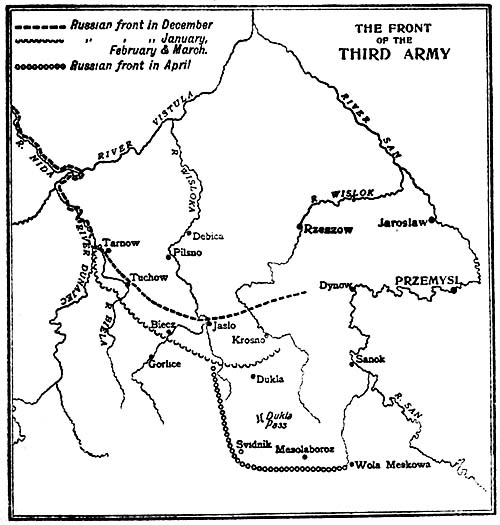
I set out with a nice bright-eyed chauffeur who did a splendid day's work with me. We had the main road for some distance, and none of the varieties later seemed to trouble him. We went along a valley, and in a house standing high by a church we found the staff of the Division. I had friends; and I was soon dispatched with a tall determined Cossack to the point where the road climbed the hill. Here we left our machine, and in a hundred yards or so we had the whole scene before us.
There was a hut on the top of the hill; sitting in front of it one could see for at least ten miles in either direction. The Division was holding a front of eight miles with the Z's on the left, the O's in the middle, the R's on the right and the I's in reserve. The O's, who were just beyond a hollow, occupied a low line of wooded heights a thousand yards in front of me. The Z's held a lower wooded ridge, the R's connected with the O's over a valley and were posted along a less defined line, of which the most marked feature was a village with a little church tower. Against these three regiments were nine, mostly German, and backed by the most formidable artillery. Beyond each of the flanks of the Division one could see at intervals black clouds of smoke; one thick stream of smoke that stretched into the skies came from some distant petroleum works. The whole line of the R's was being pounded with crash after crash, sometimes four black columns rising almost simultaneously at intervals along it; under each would break out little angry teeth of sparkling flame; the only thing that seemed not to be hit was the church tower, which, as each cloud died down, came out simple again in the bright sunshine. The Z's were in patches of smoke that sometimes disappeared for a time.
What was happening to the O's was not so clear; so after watching the shells and shrapnel bursting along the line and on the slope for some hours, we descended by some winding gullies, drawing a shrapnel as we passed over a low shoulder, and soon reached the staff of the O's. Under the nearer wall of a hut, a group of officers was working the telephones, while a number of soldiers lay on logs around. The Colonel came forward to me with a preoccupied smile: "A convoy for the flag," he explained, and turning to his men; "you have the flag there?" Then he took me into the open and pointed at the ridge some six hundred yards away: all his left was at grips with the enemy who had come through at several points, and on the right his men were fighting at the close range of two hundred yards in the wood beyond the crest.
We crouched behind the houses amid a constant roar of shells bursting all round us, and firing some of the neighbouring huts. The telephones worked incessantly. Now each of the battalion commanders reported in turn—one, that his machine guns had been put out of action, another that there were gaps in his line, a third that he was holding good, but hard put to it. The Colonel explained that his last reserves were engaged. A message came that his right flank was open and was being turned. He seized the telephone and called to the reserve regiment: "Two companies forward at the double," reporting his action directly to the staff of the Division. There was a peculiar humanness about all these messages; in form they were just ordinary courteous conversation. The question which brought the most disquieting answers was "Connexions." The Z Colonel reported that his line was penetrated at more than one point, but was holding out. The R telephone gave no answer at all. Life there was unlivable, the trenches were destroyed, and on my way I had heard from soldiers a report that when taking ammunition to the R's they had seen the Austrians in our lines. Shells and shrapnel were crashing all round us, especially on our rear; a great cloud rose where I had sat at the top, and a hut that I had passed on the way down broke out in full flame. Nearer down there fell four black explosives at regular distances of fifty yards, "the four packets" as one officer called it. Our cover would all have gone with a single shot, and the men crouched to avoid the falling splinters from each shell. In this depressing atmosphere there went on the conversation between the Colonel and the divisional staff: "I can get no contact, with the R's. Cavalry is reported on both of my flanks. The R's have had to retreat." The answer was an order to retire at nightfall. Three hours at least had to run. The order was communicated in French over each battalion telephone. The Colonel apologised for his elementary French; anyhow it was the French of a brave man. As disquietudes increased, the permission came to retire at once; but the Colonel answered that this could not be done: he was in hot defensive action, and the enemy would follow on his heels; at present he was holding his own.
Twice on the telephone the fatal word "surrounded" had been used. My hosts urged me to go. "We have each a different duty," they said. It was with little heart that I faced for the slope, turning a few yards off to salute these brave men once more. They were some wounded struggling up the gullies, one with a maimed foot, whom we helped along but who had to sit down at times and smoke. As we began to approach shelter, we suddenly saw on the hills to the west of us men coming down the slope towards us. "Perhaps ours, perhaps the enemy," said my Cossack, who never turned a hair throughout the day. We got our lame man up the big hill, but as soon as we had passed the crest he said that his strength failed him, and sat down with several others round a well. The next thing was to look for the motor. We were now in comparative safety; for we were out of the line of fire, and the valley to the north of us was full of our own people. Officers galloped forward, looking at the line of our retreating field trains. In the valley there was a long train of wounded. I at last found our motor in the midst of it. We packed in the men with the worst wounds that we noticed; they lay without a groan, and one old soldier said: "Thanks to Thee, O Lord; and eternal gratitude to you." A young soldier with an eager face pressed forward with a letter, begging us to take his wounded officer, whom he had brought five miles from the distant lines of the R's. "Harchin"—that was his name, was like a loving son, with his captain, walking by our side or standing on our step for mile after mile and all the while helping to hold the litter in position. He told us that no living man could have driven the R's from their position: but that the whole area was covered with shells till trenches and men were levelled out of existence. The companies left comparatively intact had all joined on to the O's. Of the O's themselves we could only hear vague rumours; it was said that most of them had made their way back.
There was no panic, no hurry in the great throng, as it retired. Each was ready to help his neighbour. Crossing a long hill we had to transfer some of our wounded to an empty cart which we commandeered, the men moving without a word. In the night Harchin kept holding up his officer and giving any comfort that he could. "It's quite close now, your nobility, it's a good road now," he would say. We reached a hut where the kind Polish hostess showed us beds for our wounded; Harchin was constant and tender in his care, and I left the two together to await the arrival of the doctor. A private with a crushed face refused to lie on his bed for fear of spoiling it, and sat holding his bleeding head in his hands.
Through the darkness and past an incessant train of army carts, which without any shouting did all they could to give us passage, I made my way to the corps of the staff and to the next Division; where I slept long into the morning. It was only later that we knew the full scope of our losses. The Division had against it double its number of infantry and an overwhelming mass of heavy and light artillery. It had held its trenches till it was almost annihilated.
May 4.
When I woke up in the morning, the deserted school where the staff had stretched their beds was alive with work and anxiety. The lines lay only a mile and a half outside the town of Biecz, and the Germans and Austrians were making a tremendous attack on them, pounding them with the heaviest artillery and advancing on them in close column again and again. The leader of this Division is a fighting General, robust, active and of great composure. The Staff was very close up to the front, and our own immediate movements depended on to-day's results. As we were being shelled, we went for lunch to a neighbouring Polish monastery, a pleasing white-walled building on a hill. It was deserted but for one or two monks; and its cloisters and wall-paintings and stations of the Cross were like an oasis far from the war. I lay down in one of the empty rooms and had some more hours of sleep. On my return to the school building I found that the situation was critical. From the balcony the General viewed the lines and gave some short directions. In the summer weather one watched groups of soldiers descending from the neighbouring hill and making for the bridge at the foot of our house. They were ours and were being relieved; and they formed up into order and were addressed by an officer before crossing the bridge. The enemy had been beaten off in every infantry attack, but many parts of the lines were now non-existent, having been reduced to a series of shell-pits by the German artillery.
With a young Cossack I started out for the D regiment. The picturesque little town—all the Polish towns are full of pleasing architecture—was crowded with troops, and the atmosphere was one of uncertainty. Men were sheltering from the hot fire all along the banks of the sunken road. On the top of the hill were a few huts through which we threaded our way, dodging an exposed area where shells burst continually. Further on we found to the right of us a deep valley thick with lofty trees. On the edge of this wood were a number of soldiers who had lost touch with their regiments. We stopped them to find our way. The D regiment, we learned, was no longer at the front; and indeed on this side we should not find any lines at all. We were told that the Austrians were already in the wood, which later proved to be true. The fire was heavy here, splinters falling upon us through the trees; and the stragglers hurried away.
Turning to the left I found myself at the head of a wide hollow in the hills. Over it soldiers were moving forward. Making my way to one of the huts, I found the Brigadier-General and got leave to accompany this advance. It was the first regiment of the famous Caucasian Corps just arrived after an all-night march, and going up to the attack. A battalion commander stood just below the hut, putting his men in position. He was a quiet little man, already elderly and with an old voice, that sounded vigorously, however, across the slope. "You shall come with me," he said. The men who had been sitting in groups, made their way by companies up the different clefts in the hollow and soon lined into the ridge beyond. The commander moved about among them at an easy walk, directing some, hurrying on others. The men went forward on their knees, separating off into what the Russians call a "chain," where any one with initiative, by finding cover a little further forward, gives a lead to all the rest. The officers walked upright throughout.
When the crest was lined, the commander went forward in different directions. On his return he gave a few orders to his officers; one of them was a little excited, and called out: "I have an instinct that it will go right; God grant that it is a true one," and turning to his men he shouted, "God is with us." Except for this, nothing broke the atmosphere of the evening stillness. "Well, children," said the commander, "what shall I say to you? With God! Forward!"
One company went off to the wood on the right, and after a few minutes another with the commander and myself moved forward over the bare hill, leaving two others to follow in reserve. Throughout the men advanced in little groups, creeping in line with each other; the officers walked about freely, often in advance of the men, or encouraging any that showed too much caution. We soon saw that the ground was clear in front of us, and we descended the hill a good deal more rapidly. The commander and I branched off into the edge of the wood; all the time he was calling out to keep touch with the company on our right; he turned and smiled to me as the shrapnel tore away some of the boughs.
At the bottom the machine guns were hurried up, and we ascended the further slope. We were now on a bare height, which was like a tongue projecting forward, and a hot musketry fire was opened on us. A man near me called out that he was wounded and rolled himself down to the hollow, where a bearer set about bandaging him; a shell burst beyond us and another called out. I could only see what happened to the men nearest to me. The commander continued to stroll about among the men, in the same way as he would have done out of action; several of the men begged him to lie down. We went round the outside of the height, and he brought his men everywhere to the edge of it and told them to entrench themselves, which they set about doing at once.
We could see where the bullets came from, on the low ground in front. To our left was a ridge with trees, along which we could see men on horseback coming from the direction of the enemy. To our right, beyond the wood, was a high ridge covered with men who appeared to be advancing upon us but did not open fire. Later it seemed that they were stationary, and we could not make out whether they were ours or theirs, so a scouting party was sent to find out. Suddenly a column of blue figures was seen coming up close on our front. In what seemed a minute, two of our machine guns had been moved to this side. Round some brushwood thirty yards away came the first rank of the column; one caught sight of a line of pale faces; I remember a slim fair-haired youth who peered anxiously forward. Our commander shouted orders; our machine-gun men, standing up and with indignation on their faces, ground out a shower of bullets, and the Austrian column disappeared into the wooded valley.
Night was closing in, the enemy's cannonade was slackening, and the time was approaching when the physical superiority of man to man would put the balance firmly on the Russian side. The men were entrenching themselves; and the commander wished to send a message to the brigade about the undefined troops on his right. I was going with this message and had not got more than two hundred yards from the front when I heard shouts of hurrahs, which marked the beating off of another Austrian attack. A few more shells burst on our way back, but my companion muttered to the enemy: "It's getting dark, brother"; for, once technique does not dominate, the Russian feels that he is master.
On the road we found a large batch of Austrians (Poles) taken in the wood. I was invited to examine them; they had had no food that day; there was much disaffection in Austria; they were strongly against the Germans and were glad that for them the war was over. Our report was delivered; the troops on our right were Russians. Later there came other and sadder news. The little commander was brought back into the town wounded in the head in the last Austrian attack.
In the evening I rode with the Divisional Staff several miles to our new quarters. All along the road he stopped any straggling soldiers and asked closely what had happened to their regiments. This was all extremely well done; he was really severe only to one batch who told him an obvious lie. Altogether the retreat, for it was that, was unattended by any panic. Going at a sharp trot, we reached our new quarters at three in the morning.
May 6.
I woke in a farmhouse, in a village that was filled with the divisional field train. The Divisional General had gone off early to the front to rectify the new positions. The news that came in was uncertain and anxious. The first hut which the General and his staff had entered had been made untenable by the enemy's artillery. The second hut that he visited was also set on fire. No further news of him came till late in the evening that he had barely escaped capture.
Word came that the staff would be moved further back. The field trains were set in motion, and we travelled without any kind of confusion across a beautiful range of wooded hills. We stopped more than once to see the fight that was going on below us. It was a blazing line of fire and smoke, the twin yellow and white bursts of the Austrian shrapnel being almost lost in the white or black smoke of the German artillery. We travelled very slowly and for a good part of the day; officers and men were full of vexation at having to retire before troops which they felt themselves capable of beating with any equal conditions: among themselves there prevailed a simple good humour.
I rode at different times with the adjutant, the chief of the field train, and the divisional doctor, all of whom were perfectly cool and collected. We made different wayside halts, and in the afternoon drew up in a large village also full of field trains. Here we took rest and refreshments, while different rumours came in from all quarters: and in the evening I drove in for news to the staff of the army at Jaslo, which was now close to the enemy.
From nearly all the regiments of the corps which I had accompanied, great losses were reported; on the other hand, practically every infantry attack had been driven off with great loss to the enemy. The trenches had been left only when the enemy's artillery had made them untenable. In some parts the systematic ploughing up of whole given areas had gone so far behind our lines that even approach to the trenches had been made impossible.
The game was not lost even on this ground, and immediate measures had been taken for counter-attacks the following day. Meanwhile Jaslo was under an intermittent but violent bombardment of aeroplanes; and all the hospitals were being moved to the rear.
I learned that the enemy were making a similar artillery attack on Tarnow, where I had spent several of my periods of Red Cross work at the hospitals. The Russian workers in the local Civil Spital had stayed on to the last and were now under a hot fire, and it was desired that they should be moved without delay. The Red Cross authorities had been told that this detachment could be guaranteed "against capture for the present, but not against artillery fire." I was commissioned to go and move it.
I found the General of the Transport at the railway station full of work, but cool and business-like. His was one of the most difficult tasks, but there was no better head in the Third Army. At three in the morning he came to tell me that a motor was at my disposal at once.
At my first stop I was asked to take with me an official of the Red Cross who had been deprived by contusion of his voice and hearing. He was in full possession of his senses and wrote down his wishes. He had been under fire with three hundred wounded in the village where I had slept the night before. There were other reports more disquieting. In one advanced bandaging point the German soldiers had burst in, full of drink and rage, and had bayoneted the staff and, as we were told, the doctor.
In the early morning I reached an ambulance point managed almost entirely by the members of one family, the father (who was a retired divisional doctor), the mother, and their son. To them I handed over my unhappy companion. Here I had anxious news of the hospital for which I was making. Tarnow was four miles from the front; on the German advance nine shells had been fired on the hospital in one day, and one of them had struck the operating-room and wounded the lady doctor.
I drove on to the staff of the neighbouring corps to see about transport, and thence to my destination. There was an ominous absence of troops, other than retreating field trains. The inhabitants were all in the streets, alive as it seemed to me with excitement and expectation. As I drove up, I saw the five plucky sisters waiting on their balcony. They had already sent away all their Russian wounded and were ready to start. The wounded civilians, who were Austrian subjects, and some wounded Austrian soldiers had been housed in the cellars and would be left to the care of their own people.
This work had all been done in two hours directly after the last bombardment. The sisters had been given a second George medal for bravery. They spent the evening on a hill watching the artillery attack on our troops. It was a ring of fire that simply demolished the trenches. Attack after attack of the enemy's infantry was beaten off. One detachment, sent to the support of a neighbouring regiment, found some of the defenders asleep under the cannonade: they had beaten off eight attacks. The N Regiment was decimated, but full of spirit.
All this I learned later. Without any kind of haste or commotion, the sisters said good-bye to the Austrian wounded and to the kind Polish sisters who had worked so long with them, and we all started in my motor. We were soon out of the range of fire, and continued our journey until we had reached the new headquarters of the Red Cross, where we were joined a day later by the staff of the army.
May 9.
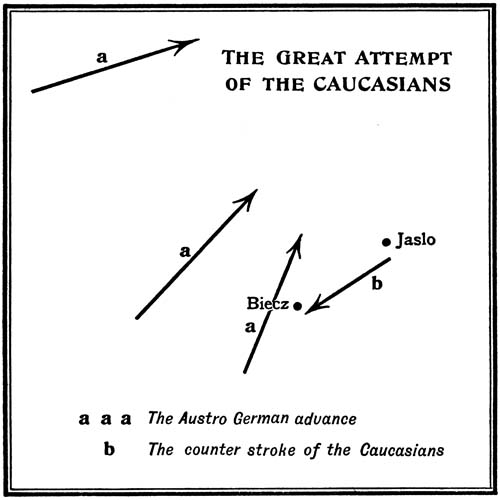
The details of the Austro-German advance on the Third Army are now clearer. The Russian advance over the Carpathians was not met directly, but by a counter-advance on its flank. Here five army corps were concentrated, some of the fresh troops being drawn from reserve divisions on the French front, especially in the neighbourhood of Verdun. The journey across Germany is reckoned at three to five days, according to whether or not one includes the mountain marches at the end of the railway journey. Prisoners of the Prussian Guard tell me that they were given special training in hill climbing before they started.
Meanwhile, the long months of comparative inaction had been employed in bringing up the heaviest German and Austrian artillery, both of which were last summer concentrated on the western front, and getting the range not merely of the Russian lines, but of squares which covered a good part of their rear. This was a long and toilsome operation, as these guns cannot be moved except by railway or, with great efforts and under good weather conditions, on roads which have a certain consistency. The potentialities of these guns are in any case limited; they cannot easily follow up an advance or get away in case of a rout. They can force the evacuation of a given area, but it may be possible to manœuvre in such a way that the general position is but little changed.
It will be remembered that the Austrians during the idle months have been covering the Russian lines in front of them with a ceaseless cannonade. This counted for little at the time. The Austrian artilleryman has only lately developed any accuracy; for a long time they continued in the most stupid errors of detail; they hardly ever placed a Russian battery, and evidently the process of range-finding has been long and very expensive. The Austrians rarely attempted infantry attack, knowing that they always met their masters; thus their ceaseless cannonade was not a preparation for an infantry offensive; and the Russians might even, if necessary, leave their trenches only partially occupied during the day, keeping less in those parts which were under the hottest fire and holding the whole line in force only by night.
It was a very different story when the initiative on this side was undertaken by the Germans, who use artillery as a preparation for desperate attacks in close column. The difference in accuracy between the German and Austrian artillery fire was very soon discovered to the Russian regiments in front of them; and it was known that the Prussian Guard Reserve was here. The trenches were, therefore, occupied in full and held until they became untenable.
The enemy's advance was at first directed against what was thought to be the weakest part of the Third Army, namely its right flank, which had sent a number of reinforcements to the Carpathian wing; but the alertness of the Russian general on this side produced an alteration in the plan, and the attack was diverted to the next army corps eastwards. This corps contained regiments which had had heavy losses in the previous hill-fighting. A gap was forced between the two army corps; and the right flank of the threatened corps (the R Regiment) was crushed by the pounding fire which I have described under May 3. The regiment retreated in good spirit, but with the heaviest losses, the O Regiment, holding its ground to the end, retired with its colonel and some 300 men: the Z Regiment was severely cut up. In all this fighting practically every infantry attack of the enemy was beaten back. The next day the impact fell mainly on the troops which I described on May 4. They held their ground to the evening and then executed an orderly retreat, coming into line with the broken forces to the right of them. But on both days a tremendous cannonade was directed on the division still further eastward, with the result that some regiments suffered terribly. The next day a fresh corps, the Caucasians, one of the most famous in the Russian army, had arrived and went forward boldly to the attack on the flank of the enemy's advance. The prisoners cannot speak too highly of the courage of this corps; and it did succeed in stemming the tide, with such effect that the broken army corps to its right had in two days reformed and come again into position. But it did not get as far as the enemy's heavy artillery, and retired fighting rearguard actions—not much further than the point from which it had started.
I have explained that the whole advance of the enemy was a counter-stroke to the Russian advance over the Carpathians further eastwards. The right wing of that advance was now outflanked and had to retire. Half of this corps succeeded in rectifying its positions without serious loss; but the other division had the greatest difficulty in fighting its way through, and lost heavily.
Meanwhile the enemy's attack was extended also westwards, including the area against which it had been originally directed. Here the cannonade was furious and the trenches were in many parts wiped out, all approach to them of reinforcements from the rear being made almost impossible. But here, too, practically all hostile infantry attacks were repulsed with heavy loss. Ultimately a retreat was ordered by the Russians on this side. Results are indefinite unless they bring one side or the other to a definite line of defence.
The situation resulting from all this fighting was as follows: The present area of conflict is a square lying between two rivers west and east (Dunajec and San), with the Vistula on the north and the Carpathians on the south. The square may now be divided by a diagonal running from north-west to south-east. On the one side are the Russians and on the other are the enemy; but the diagonal is not any natural line of defence, and the operations must be continued till one side or the other occupies the whole of the square.
The enemy has made a special concentration by depleting other parts of his line. The respective forces are now at close grips in a great battle which is likely to last for several days. The enemy's heavy artillery is not likely to have the same effect as before; and a successful Russian advance may even endanger its retreat.
There are two obvious deductions from this fighting. The Germans are risking more and more of their forces in the support of Austria, or, to speak more accurately, in the defence of Hungary, and in order to do this they must surely have weakened their western front. They must secure definite results on the Russian side if their attack here is to be of value to them, as they may again have to throw their forces westwards ere long.
May 10.
What a picture these days will leave on the minds of those who have lived through them. It is only the simple things that count; but they keep coming back on one in new forms again and again, and that is why one must repeat oneself so often.
The staff is in no way downhearted; it is sometimes preoccupied, sometimes cheerful, but always full of vigour. The cause of our losses has been localised; and there is no sign of panic or hurry in the search for the necessary remedies. At the bottom of all is this wonderful confidence of the men and officers who come back wounded from the front. The Commander of the Army is full of spirit and energy, and we all consider that we are only halfway through this battle.
The other hospital institutions have mostly been sent to the rear; but this period of movement is a time of small advance ambulance points which dispatch their wounded to the rear at once and themselves are ready to move at short notice, whether forward or backward; and the Russian sisters who returned with me from the front organised at once such an ambulance at the station, going on duty the same night, and working sometimes fifteen hours or more at a stretch.
Enemy aeroplanes threw bombs at them every day, and we picked up several badly wounded at the station, but none of the workers in the bandaging-room took any notice of the explosions.
The station is a wonderful place—as wonderful as the great station in Lvov, which I described several months ago. It is crowded with wounded, lying close together in the family manner of the Russian peasant. Most are wounded in the hands or the head; this means that they were under a devastating fire in the trenches which hit anything that was at all exposed. But there are also many signs of advance or of infantry attacks beaten off, in wounds of all kinds all over the body. Every night hundreds of wounded are given clean bandages and fed with anything that can be bought in a place where all is movement.
The officers lie here like the rest, separated only by the silent respect shown to them by the men. The number of wounded officers is not surprising, for, as I have explained, they stand and walk while their men are ordered to crawl; but the sacrifice in officers is particularly impressive.
For me the officers are also sources of information as to the fate of each of the regiments I have visited. Four jolly N's, three of them wounded, told me of how their trenches were levelled and how they retired because there were only shell pits to sleep in; seven officers led the last counter-attack of this regiment. Of some regiments the news was that they were practically all gone; in one case the answer was "The regiment does not exist." Some one asked of one of the O's where his regiment was to be found: he answered "In the other world." I learned that three hundred men of this regiment with the colonel had fought their way back; later, I learned that only seventy-one were left. The General of this Division told me that he had reformed and reinforced his men and that they were again at the front, where he was off to join them. The T's had invited me to join them when in action, and it was a pure chance that I was directed to another point. I passed in the street the field trains of this regiment; the officer riding at the head stopped me and grasped my hand: "What I wanted to say," he said, "is that the T's are gone, only the flag is saved." The next day a private with the number of this regiment came up to me in the street: would I come and see the Colonel who had just been brought in wounded? I found him at the quarters of the Commander of the Army. His head was bound up, but he was seated and writing. General Radko Dmitriev came in and shook his hand time after time. "Thank you for your splendid stand; human strength can do no more." The Colonel related that his entrenchments were demolished with the men in them; one company was cut off, and forty hands were held up in surrender; he himself saw how the Germans bayoneted half the number out of hand; his own men, when only five hundred were left of them, went on taking prisoners exceeding themselves in number, and rejoiced in this sign of their moral superiority. Of forty officers and four thousand men, in the end two hundred and fifty were left.
The enemy was in overwhelming numbers; but prisoners continued to come in in great batches. I spoke with some of the Prussian Guard; they were vigorous and contentious, and spoke with small respect of the Austrians. The war is becoming more and more bitter.
I return to my inevitable conclusion. There has been a big success of technique; and it has wiped out a number of good lives. Even this battle is not over, and our own people are advancing at points which offer hope of better results. The Russian army is firmer than ever, and more and more men are being poured in. It can win, but only if it can be given anything like fair conditions; in a word, that the Germans should be met on their own ground, that of heavy and more numerous artillery, by every possible united effort of the Allies.
May 13.
I learned that the FF Corps, which contained regiments that I had twice stayed with, was going to make a determined attempt to turn the tide. On the heels of this came the news that it had already begun a daring advance and had taken some heights on the rear of the enemy's line. I had no means of transport, and was wondering how to get to this corps when I met in the street a group of soldiers who were asking who wanted to buy a bicycle for five roubles (ten shillings). I learned afterwards that a large German cyclist corps had been cut off by our cavalry. The bicycle was there, so I had a turn on it and bought it. The handles of the bar were gone, and there was no bell or lamp; the seat and brake wanted screwing up; otherwise it was a good machine. I had lost my maps in the retreat, so I went to one of the adjutants, who sketched for me a map of the district, and I started off.
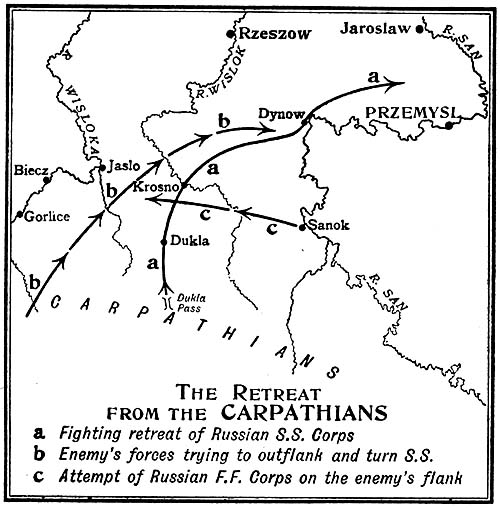
My first destination was Dynow, where I was to find the staff of the SS Corps. The Polish inhabitants whom I asked pointed forward along a good straight road, and with the wind behind me I made good way. I passed plenty of troops going both ways, and the cavalry indulged in friendly banter with me as to who would arrive first.
Meanwhile, at Dynow things were not at all as we imagined. The FF Corps further on found that it was advancing into an empty space, while its neighbour, the SS Corps, was being beset by superior German forces; there was nothing left for it but to give up its attempt. The SS Corps arrived at Dynow only to find it already occupied by the enemy. In instant danger of being cut off, this corps swerved from the road and went straight forward at a point where it had to cross two bends of the river. The water was more than breast high; the two passages were made under a hot fire, and a number of men were killed or drowned; but the corps made good its retreat, and indeed served as rearguard from hence to the San line. It was followed closely and vigorously, the Germans showing the greatest ardour, which in one case brought on them the most serious losses at the hands of the Russian artillery. The SS Corps also suffered severely and was greatly reduced in strength.
I should have ridden straight on to the enemy, but my bicycle collapsed, and I was misdirected as to the road, so that in the evening I found myself at quite a different point, not far from the town of Rzeszow, which I had left in the morning. Making for a railway station, I found a train waiting and learned the new turn of events, also that Rzeszow itself was likely to fall into the enemy's hands.
It was important that this news should reach those with whom I had been working; but it was twelve hours before any train could move in this direction, and then it was only an engine that was sent forward, with one carriage full of high explosives and a colonel in charge. The colonel and I sat on either side of the engine, and the driver kept looking out and slowing down to ask news of the stragglers who were coming from Rzeszow. Of course we got the usual exaggerated reports; some said that every one had left or was leaving Rzeszow and that the enemy were just about to enter. Puffs of shrapnel were to be seen ahead of us, but we made our way safely into the town.
Here little was known of what was happening; but several plain signs indicated retreat, and an officer whom I knew kindly gave us the lead that we required. In the streets there was an unpleasant silence, and the people seemed to be waiting for something from the west. The last trains out started with little delay. We looked back on the smoke of explosions and travelled leisurely and without panic through a peaceful country, where at each halt the road was lined by good-natured soldiers resting, eating or chaffing each other on the embankments, as if there were no war and they were all happy on the banks of some great Russian river. At one point there was a small collision, but all was put right without the slightest hurry or excitement.
May 18.
We had retreated to the San, and the Corps of the Third Army held a not extensive front, partly in front of and partly behind the river. The apparently endless file of trains had all made their way along the single line across the river. Wherever they stopped, the station was infested by the enemy's aeroplanes; at one time ten of these were flying along the line. In one day three were brought down, all the airmen being killed.
The long road picnic on these trains, military or ambulance, shows the Russian soldier at his best. All content themselves with the simplest and roughest conditions, and lie anywhere about the spacious vans or dangle their legs out of the broad doors and talk cheerily with any who pass. Most of these goods vans are festooned with boughs.
Of course there is an endless stock of narratives from the life at the front, always with a complete absence of self, except for a summary mention of the date and occasion of the narrator's own wound. The main features are always the same—regiments reduced by sheer artillery fire to half or a quarter, furious infantry attacks of the enemy vigorously repelled.
Now that we again had a definite line in front of us, I decided to go up again. I started on foot in fine evening weather and took a straight line for a point to the south-west. I was halfway to my destination when in the failing light I saw a motor, which carried one of the adjutants of the commander of the army. He beckoned me up, and explained the day's fighting, at which he had been present. It was a furious artillery duel; and it was chiefly concentrated at a different point from that for which I was making. He advised me to return and to visit this point the next day.
On the following morning I started out, again on foot, with a supply of big biscuits. Nearing the area of firing, I turned across the fields and came upon a battery of Russian heavy artillery, which was so well masked that, though I was looking for it, I did not make it out until I was only a hundred yards off. I had a talk with the commander and went on to a neighbouring village which was under a heavy fire. Here were the staffs of a regiment and of the Division which I was seeking. On the telephone there was brisk conversation. I was invited in to lunch, where all business talk was avoided, and I was given a Cossack to take me to the infantry positions. Heavy shells were rattling like goods vans over our heads, sometimes three being in the air at once and all taking the same direction. The crashes came from some distance behind us. The enemy was clearing a space in our reserves and among our staffs.
The Cossack was a quaint person, with flashing eyes, who walked about leading his horse everywhere. When he was told to take me in the direction of the firing, he murmured something about its being "the very best." His idea was that we should go on foot, he leading his horse, from which he was most unwilling to part, because he would feel lost without it. This was all very well: but the appearance of any horse near the positions is strictly barred, as it at once calls forth a more or less accurate fire on the infantry. This it was hopeless to explain to him; so in the end I left both him and his horse behind.
I went on to one of the regimental staffs, and obtained two guides to the respective regiments which I was visiting. I had hardly left this hut when a bomb fell on it, killing or wounding several of the staff. We had sheltered ground almost up to the river. The famous San is here about a hundred yards broad, with a steep further bank and, on our own side, a long hollow running parallel with the river and thick with willows and alder; the country in general, except for some depressions, is quite flat.