PREFACE (continued 2)
Reading edition
In Radom I found our Russian orderly from Kostroma fraternising with the Polish servants, joining in their work and singing them songs of the Volga. I told him he was another Susanin who had led the foreigners into the marsh. We were soon on our way back to Warsaw.
November 25.
I have dealt with the Russian advance from Warsaw and Ivangorod, by which the Russian front was carried forward some one hundred and seventy miles in all from the original defensive line on the Bug and the communications of the Austrian and German armies were threatened in the neighbourhood of Cracow. This movement was necessarily completed by an advance of the Russian forces on the San.
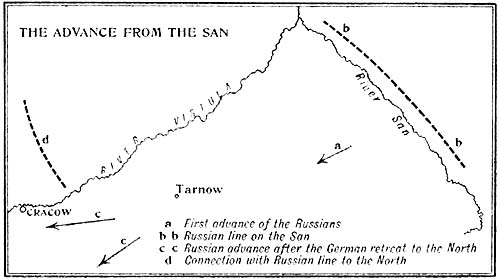
After their first successes in Galicia the Russians had advanced as far as the Wisloka, but the German attempt on Warsaw from the west and south and a strong Austrian and Hungarian counterstroke on Galicia made advisable a temporary strategic withdrawal of the Russian line to the San, while all available forces helped in repulsing Germans further north. For nearly a month the Russian defensive line held good against superior Austrian forces on the San and in the south. Report says that bounteous rewards were offered to the Austrian troops for the reconquest of Lvov; and the Russian occupation of eastern Galicia was seriously endangered. The San varies in breadth from fifty to a hundred and fifty yards and is lined with marshes. Across this narrow obstacle Russians in trenches maintained an unbreakable resistance, repulsing all Austrian attempts at crossing.
I have seen many of the wounded of this long defensive struggle. Their temper is the same conquering spirit that has carried the general advance. I stayed at their hospital some days. A group of slightly wounded, mostly young men with bright, radiant faces and strong, lusty voices, sat up in bed recounting to me, one after the other, individual feats of daring done by their comrades. Throughout there was the feeling of individual superiority to the enemy tested by the heaviest conditions and sometimes by the wiping out of nearly all one's company or squadron. Most were wounded in the left arm or left leg in the trenches. Five or ten of the company would fall every day. The most exposed were the telephonists. Others fell in daring reconnaissances in boats across the river. All testified to the far heavier losses inflicted on the enemy. One simple young fellow crippled in a leg described how one did not in one's first day's fighting like to look out of the trenches. Then he showed how one began to peer about, and later one took no notice of bullets whistling round one, because of the sense that the army would surely go forward. One bright day he said to me, "It must be fine in the trenches to-day." This is the spirit of them all.
At last, when the Russians to the north had advanced and Sandomir had been taken, the word came to go forward. The river was crossed at night and the enemy driven from the trenches and neighbouring villages and further back. The advance was triumphant at all points. The Austrians were driven southward and westward. Some were pressed against the Carpathians, with two difficult passes which would hardly admit the passage of artillery and field trains; others were pressed back on Cracow where the line of the whole Russian advance is now complete.
The Russian impact on Cracow promises, first, a settlement of the destiny of western Galicia, where the population is Polish and very ready to respond to the appeal of Grand Duke. Next, a gap is made between the Austrians and Germans who are already retiring in mutual dissatisfaction in different directions, and whose political interests must more and more differentiate. Further advance through this gap will be on Slavonic territory, as southern Silesia up to the River Neisse is mainly Polish or Bohemian, and the Czechs in general are largely Russophil and quite hostile to Germany.
The Germans are doing all that is possible to make diversions on other sides. Stopped and driven back on the side of Mlawa, they have made a serious effort on both sides of the Vistula, near Plock, but have been decisively repulsed, the inhabitants giving effective aid in bridging the river. They are now attempting to force a strong wedge into the Russian front between the Vistula and the Wartha; but so far the Russian line, which is everywhere continuous and is reinforced wherever necessary with strong reserves, has successfully outflanked every local German advance.
Meanwhile a double Russian advance on East Prussia from east and south is overcoming the numerous obstacles and making rapid progress, avoiding and enveloping the thickset fortified line of the Mazurian lakes. Here, too, the subject population is chiefly Polish.
Retreating German troops in Poland, previously transferred from the western front, expressed to the inhabitants great despondency, even saying, "This is our last judgment" (Das ist unser Weltgericht). Many prisoners have displayed a similar mood.
November 28.
A Russian Field Hospital
A large, low, white building with a grassy court and outhouses; four large tents stand in the court; on the centre of the main building a white canvas band that bears in rough black letters the inscription: First Etape Lazaret of the Imperial Duma.
After a wonderful star-lit journey in a formanka or double-horsed cart with a courteous and humble old grey-haired peasant, I come on this building about half-past two in the morning. The last part of the journey was adventurous; the driver at one point wished to strike work, which resulted in a wait of nearly an hour; the way had to be asked of a group of soldiers with blackened faces seated round a camp fire, and of three sentries of the étape marching through the night with fixed bayonets, who challenged, "Who goes there?" and received with some hesitation the answer, "Our side" (svoi). One of them lowered his bayonet to be ready for any further emergencies. In the end I was guided to the lazaret, where I had a cordial welcome from the two sanitars on duty and was accommodated with a bed in one of the large tents, which was empty and ready for moving.
The Duma Lazaret was equipped chiefly by the energy and liberality of Prince Volkonsky, Vice-President of the Duma and one of its most respected and popular members. All parties are associated in the work; and Prince Volkonsky, who is a Conservative, has had the valuable help of the eminent Radical, Dr. Shingarev, who earlier earned a wide reputation as the organiser of the sanitary system in the province of Voronezh. Meetings of a committee are held in the Duma, and lately two other lazarets have been equipped and dispatched, one to the Prussian front and one to the Caucasian.
The first Duma lazaret was one of the earliest to arrive behind the front during the tremendous fighting in southern Poland and in Galicia. At Brody on the road to Lvov it gave preliminary treatment to thousands of wounded in the course of a few days. Later it was moved to Lvov, Sokal and Belzec, where I now found it. It had picked up on its road stray dogs which it had named after their places of adoption—Brodka, Rava, and Belzec.
The lazaret was equipped for two hundred patients, but at the time of my visit had only forty, as it was about to be moved further to the front. Operations were performed daily, to be ready for the move. I saw one poor fellow, very frail and no longer young, just after his leg was amputated; he was calling in a piteous way to his mother. In one ward the patients were in a late stage of convalescence from typhus, and in another lay one of the sanitars of the lazaret. In a far corner lay a poor fellow with a wound in the head; his case was hopeless, and he was communicated by the priest in an interval of consciousness.
The central wards were full of strong, lusty men, most of them young, some with bad wounds but nearly all getting the better of them. They were in many ways like dormitories of big schoolboys, all of them good comrades—during my stay of some days I only heard one altercation and that was mild and very short. They lived a chance corporate life of their own; and when I went round with cigarettes, there was always some one to see that tired or sleeping comrades got their share. There was very little groaning and no complaint; the men felt their wounds in the long night time, and sometimes one would mention that his wound was smarting. One Armenian, a weak-looking lad of the gentlest disposition, lay striving to bear his pain. "Oh!" he said as he fought it; and then, with closed teeth, "No matter; it doesn't matter; our Emperor ought to be rich; it had to be done—to beat the Germans; it doesn't matter."
Usually, however, the wound would only be mentioned in a side sentence in a narrative—"and then I got this," or it would be the occasion for a story of strong life and effort and the triumph of "ours." There was a peculiar delicate courtesy about the halest and strongest, who would shift their wounded limbs with an inviting gesture of the hand, making room for me to sit on their beds; and then there would rise a general stream of narrative where all joined in without ever seeming to interrupt each other, each telling of some daring feat of a comrade against all odds. One will not forget the figures leaning up in bed and the young, radiant faces; many of these men were cripples who will never fight again, but everything about them was full of health and fresh air and victory.
A young trooper told me of the actions of his regiment against the Hungarians. They have, it appears, a particularly mobile horse artillery, served with great accuracy by horsemen who fire with the left hand. They enticed the regiment up with displays of white flags and suddenly rent them with a murderous fire. For all that, as in practically all these narratives, in the end the Russians triumphed.
Others described the long defensive work on the San, with its narrow stream and muddy banks, and the final irresistible advance. There were two young men, one from Chernigov and one from Tauris, who beckoned to me each day, and with whom I spent several happy hours. When I asked for their addresses they wrote them down in form, beginning in the one case with "Wounded in arm" and in the other with "Wounded in leg." "Wounded in leg" was a sunny youth who, when we were photographed together, made quite a careful toilette. He was the boy who called out "What a splendid day! It's fine to-day in the trenches!" These two discussed with me all sorts of subjects, including the English sailors and the Grimsby fishermen, who appealed to them as "going for boldness." Another more elderly pair, one like a jolly farmer and the other like a brown-bearded stationmaster, worked out with me on the map the progress of the Russian army. Simplicity was the note of all, and it would have been hard to convince them that it was they more than any others who were now under the eyes of Europe.
There was another still more elderly couple that had an out-of-the-way interest. They were two old men, one of sixty-six and one of seventy-two, who had been shot by the Hungarians for sheltering Russian soldiers. One of them, a picturesque-looking person with round head and furry grey hair, told me of how he was locked up in his attic and then called down to be shot, while his womanfolk were reviled and struck. His leg was broken, but was mending. Both these poor old men were full of plaints and, after the Galician manner, insisted on kissing one's hand each time that one talked with them.
One of the most sympathetic figures in the lazaret was the priest, a man of the age and with many of the features of a Russian picture of the Christ. He was a monk from the famous Pochayev monastery in Volyn, sent hither by the Archbishop Eulogius. His was an entirely un-selfconscious nature, gentle, good and whole; and the care that he gave to the dying was like the best of man and of woman combined. I had some talk with him of the Uniats, that oppressed people under the heavy hand of Jewish taskmasters, which had held through centuries to its roots of parish organisation thrown out by the early Brotherhood of Lvov. We glanced in at one of their services in the quaintest little wooden church, where the singing was congregational and like a sad plaint.
Our priest every day read a short Orthodox service in the central ward, and on Saturday and Sunday served the full Mass in one of the largest tents. Some six of the soldiers were trained singers; the priest himself did not chant, and the words of the service came with all the more reality, especially the frequent allusions to the "Christ-loving army." At one point the priest went through the wards to repeat a part of the service; for, as he said, "our soldiers are deeply religious, and the patients will feel that they are left out." At the end all in the tent kissed the cross, and the priest then went to hold it to each of the patients in turn. He told us that at the mobilisation and before battle communions were frequent and that fasting was in such cases excused.
It was while I was here that the order to move forward arrived. The remaining wounded were arranged for in neighbouring hospitals; warm blue vests were served out to all for the journey. "We have much to be thankful for," said one soldierly fellow who looked like a sergeant and took a lead among the rest. "Our Emperor has indeed fed and clothed us." Everything was packed, the large farm buildings were left deserted, and the hospital moved forward in the track of Radko Dmitriev.
Kiev, December 15.
The Country and the War
I have just made a journey across Russia. The average opinion seems to be the same everywhere. The feeling expressed is quiet and sober; no boasting of any kind is heard anywhere; news of the war is treated on its merits, and anything that seems unsatisfactory is faced and is given its reasonable value. As to the ultimate issue, complete confidence is felt, and, in this feeling, satisfaction with what has been done and the determination to go through with the matter seem to have an equal share. Every one is clear that there can be no stopping half-way with the task unfinished; and the task, as it presents itself to the average man or woman, is that the crisis thrust upon us must not occur again. I say "thrust upon us" because, with average people even perhaps more than in official circles, and with the peasant more than all, there is the strongest feeling that peace has been wilfully disturbed by Germany, and that Russia was left no option but to hit back as hard as she could. A peasant cabman, fraternising with me on our alliance and promoting me in the course of our conversation to the second person singular, summed up the common instinct very well by saying: "How disagreeable He is" ("He" is always the enemy); "he makes himself nasty to every one," which is surely the chief reason why "He" is having a bad time of it now. "He might have smashed you or the French," my cabman goes on; "us he can only hit about a bit (pobit)," and his attitude is that of a big, kindly animal that is provoked into defending itself and others. "Pobit" is the ordinary expression of the soldiers for the work they have to do. A peasant servant puts it stronger and is sorry that I am not going to "spike" (kolot) any Germans, especially as she has made up her mind that they are going to kill me. "You had better tell me what to do with your things," she says, "for you're not going on a pleasure trip"; and she reminds me of this as I start by asking, "But when you're killed, though?" I quote this because this good woman has a brother in the Siberian rifles, of whom so many are lying under the great wooden crosses outside the wrecked village of Rakitna, and no doubt she judges of my chances by his; but she talks of him with the same equanimity. Beneath all this, there is the full and silent sense of all the sacrifices that are asked and a silent pride in making them. I have never heard this take words with the peasants, though it is behind everything they say; but it comes out often with those who have any responsibility for others and most of all with any who are in close touch with the common soldier. Those speak the strongest and simplest of him, who are only telling a friend their daily experience of him; and the selflessness of his courage and endurance keeps coming back on them as something that astounds and even confounds them.
All the life of the country that lies behind the line is centred in it. The nearer one comes up to the line, the more does one feel in the moral atmosphere a sense of satisfaction, of ease of mind. In the line itself all sense of self disappears, and the big band of brothers lives for its daily work and divides up everything in common. It is wonderful how far little resources can go when they are put together; one produces some chocolate, another a little store of comfits, a third hands round a flask, another supplies the cigarettes and another the matches, and a little feast is thus improvised by the half-light of a candle; all these stores are renewed at chance and are expended without reserve.
But it is farthest of all from the front that the sense of the war is most painfully felt, and that because it has to seek ways of finding its satisfaction. For this it seeks continually. Every now and then, in the capitals and all the big towns, a week is set aside for some special object: for the collection of warm underwear for the men in the trenches, for Christmas presents for the troops, for the families left behind, for the widows and orphans, for the supply of means for the crippled. At these times, which are constantly recurring, every tram or train is boarded and every restaurant is traversed by the collectors, who for each donation pin on a little special badge to secure the donor from any further importunity; but the badge is quite disregarded both by donors and collectors, and one sees many who have paid their due several times over. Thus the public is taxing itself over and over again for every need that it can think of.
The posters have a nervous force, such as the Petrograd one that begins and ends in large letters with the words "It's cold in the trenches." Several of them bear the signatures of members of the Imperial Family, one of the most simple and telling coming from a sister of the Emperor who is engaged in ordinary hospital work among the wounded. Another striking appeal, for the widows and orphans, is simply a twofold picture. Along the top in pale blue with a sullen sky of winter dawn above, a number of scattered soldiers, big and clumsy and heavily clothed, are running forward over a rough, flat field, with the lumbering run of a Russian porter at a railway station, their bayonets lowered and all with set faces; from a copse in the distance come puffs of smoke; and in front of the men, close behind his chief, who has already fallen, an officer has his hand thrown up in the air as a bullet carries him over. Underneath sits a group of dark-haired figures; a young wife with set and brooding face, and two young boys at once with fear and spirit in their eyes. I have asked that some of these posters should be sent to England, in case any could spare from their nearer needs something for the countless bereaved of Russia.
Every non-military unit of society is looking for a way of its own of helping. Mary Dolina, who might perhaps be called the Mrs. Kemble of Russian opera, has, with her many helpers, now given over thirty concerts of national and patriotic music for widows and orphans. The artists of Russia, banded together with special imperial approval, are giving movable representations in restaurants or in public squares, where, as in all other cases, the full collection goes to the army. The Press of Moscow is meeting to organise a day on which the Press will make a united effort for the same object. And then there are the collections for claims that make a special appeal, such as the devastated homes of Poland, Belgium and Serbia. The superscriptions adopted in these various endeavours are quite simple and usually take the form of offering a present—for instance, Petrograd to Poland, Moscow to Poland and Belgium, Artists to Soldiers, and so on. All this wealth of various charity is co-ordinated, and regularity of service is secured by committees of the most representative kind under the chairmanship of one or other member of the Imperial Family. The Emperor himself is constantly paying visits to the army with abundant supplies of medals for all the heavily wounded.
Among the links between front and rear are the frequent short visits to the capitals of those chief organisers of the Red Cross who must be everywhere. Prince George Lvov, one of the most admirable of Russian public workers, who organised relief during the famines and led the Civil Red Cross in the Japanese War, passes from Lemberg to East Prussia, or from Warsaw to the Caucasus, seeing as much as can come under one pair of eyes, and returning to Petrograd and Moscow to find ways of meeting each new need. Nicholas Lvov, a former Vice-President of the Duma, whose brother has fallen and whose eldest boy has been killed by shrapnel before Cracow, passes constantly between Petrograd and Galicia. Alexander Guchkov, the organiser of Red Cross work on the Warsaw front, who is constantly in the front line and was reported prisoner at Lodz, pays flying visits to Moscow. And all these glimpses of the realities of the war draw closer the ties between the army of defenders at the front and the country that is waiting to meet every sacrifice and to fill every gap. Russia will close the ranks till the work is done; and she can go on doing this after it has become impossible for our enemies.
December 18.
In Kiev, though there is every sign of its being in the minds of all, materially the war is hardly felt. It is in fact wonderful how little effect of this kind it seems to have made on the body of Russia. On the other hand, the atmosphere of nervous tension begins to disappear the moment one begins to get really near to the front. In the Red Cross offices at Kiev I found the same straining toward the front as elsewhere, only much calmer because these were people who had a big war work to do. Hospitals meet the eye in the streets at every turn.
Once in the train for Galicia it was again the war atmosphere and simplicity itself. The talk was all of people engaged directly or indirectly in it. A graceful old lady with a very attentive son was on her way to get a sight of her husband, one of the generals. A young officer, whose wound has kept him out of it for three weeks, is on his way to the front before Cracow. A fresh-looking young man, at first unrecognisable to his friends with his close-cropped bullet head, tells how he went on a reconnaissance, how he came on the Austrians, how their first line held up their muskets and when the Russians had passed on fired on their rear, how nevertheless practically all came back safe and sound. It was told with a kind of schoolboy ingenuousness and without suggestion or comment of any kind on the conduct of those concerned. Then followed an account of a war marriage, at first put off and then carried out as quietly as possible. All the friends of every one seemed to be at the war.
At the old frontier some of the buildings near the station were wrecked by artillery fire, and the railway was lined with a succession of solid hospital barracks, with the local commandant's flag flying over one of them. There was plenty to eat at the station; and though we moved on very quickly, every one from our crowded train managed to find a place in the Austrian carriages, chiefly because every one was ready to help his neighbour. The corridors jammed with passengers and kits, we moved on through the typical "strips" of Russian peasant culture, a pleasant wooded country, passing a draft detachment on the halt which waved greetings to us. My companion, Mr. Stakhovich, a phenomenally strong man and imbued by a fine spirit, was talking of the indifference of the Russian peasant to danger; he regarded it as an indifference to all sensations; anyhow they go forward, whatever the conditions, as a sheer matter of course. With the ordinary educated man the mind must be kept occupied with work if unpleasant possibilities of all kinds are to be kept out of it; but General Radko Dmitriev, to whom we are going, will jump up from a meal, however hungry, when there is a chance of getting under fire.
We draw up in the great station at Lvov. To the right of us stretch endless lines crowded with wagons, especially with sanitary trains. In the lofty passages and waiting-rooms are sleeping troops with piled muskets, some wounded on stretchers tended by the sisters of mercy who are constantly on duty here, and a crowd of men, all soldiers, coming and going. One passed many Austrian prisoners, of whom another enormous batch was just announced to arrive; and elsewhere a Russian private explained to me the excellent quality of the Hungarian knapsack, which he and his comrades had turned into busbies. One man was asleep inside the rail opposite the ticket office. He did not seem to mind how often he was woken up.
In the town everything is quiet, and life goes so naturally that no one could take it for a conquered city. In the country this might have been expected because far the greater part of the population is Little Russian; but in Lvov the Russians are only about 17 per cent. and the predominant element is the Polish (60 per cent.), the rest being Jews (20 per cent.) or Germans (3 per cent.). The university, the Press and the bulk of the professional class are Polish. This result is in character with the place, which has a peculiarly pleasing atmosphere of its own. But it is also a great tribute to two quite different influences: to those Poles who, though in no way tied to Russia, have preferred to all other considerations the corporate interests of their fellow-countrymen, and to the wise and sympathetic administration of the Russian Governor-General, Count George Bobrinsky.
December 22.
Lvov is taking on more of the character of a Russian town. Many of the Jews have left. The Russian signs over new restaurants, stores, etc., meet the eye everywhere. Of the Little Russian party which supported the Austrians, many have now returned and are making their peace with the new authorities. The Russian soldier is quite at home in Lvov, as one sees when the singing "drafts" swing past the Governor-General's palace; the Austrian prisoners in uniform, who are allowed liberty on parole, seem equally at their ease. Numbers of Russian priests are pouring into Galicia, but not fast enough for the Uniat villages which have embraced Orthodoxy; as soon as they arrive, peasants come with their carts and take them off to their parishes, without waiting for any formal distribution. The Uniat creed and ritual are practically identical with the Orthodox, so that the difference between the two was purely political. At the new People's Palace of Nicholas II, I saw a number of children, principally from families that had suffered severely at the hands of Austrian troops, receive Christmas presents on the day of St. Nicholas, who is the Russian Santa Claus. Archbishop Eulogius, in a very effective little address, told them that the biggest Christmas present which they were receiving was the liberty to speak their own language and worship in their own way in union with their Russian brothers.
Starting for the army, I spent a night of strange happening in the great railway station, as our train was delayed till the morning. At one time I went, in the frosty night, to look for it at the goods station, where there were endless rails and wagons, and found it after a long search. In the big restaurant four little boys made great friends with me, one of fourteen in uniform and spurs who had been serving as mounted scout with a regiment at the front, and one of thirteen who had attached himself in the same capacity to a battery. Both were small creatures, and the first was a remarkable little person, with all the smartness and determination of a soldier, relieved by an amusing childlike grace and courtesy. He said to me in a confidential voice, "I see you are very fond of little children," and he ordered with pride lemonade and chocolates for us both. He said the men at the front could last a week to ten days, if necessary, without any food but sukhari (army biscuit), so long as they had cigarettes. His imagination had been caught by the aeroplanes over Peremyshl, and also by the Carpathians, which he described with an up and down movement of the hand. He had a great disgust for anything mean and a warlike pride in the exploits of the soldiers of his regiment. His model was a boy, now a young man, who had been through the Japanese War. "If a general comes past," and he made a salute to show the extreme respect felt for his hero. Many a time in that long night, while the weary heads of doctors and sisters of mercy were bent in sheer tiredness against the tables, he would come and sit by me and ask me to read the war news to him, or to tell him about the English submarines. He left me with the smartest of salutes in the early hours of the morning.
Our train is an enormous one with endless warm carriages (teplushki) for the wounded. The staff of sanitars and sisters, working for the Zemstvo Red Cross, live in a spotlessly clean carriage, and there are special carriages for drugs, stores, kitchen, etc. They are simple and interesting people, and, as I am now in the Red Cross and have many interests in common with them, they kindly made me up a bed in their carriage, where we discussed Russia in all its bearings.
We carry a group of passengers who have all made friends after the Russian way. A colonel and his wife are going to fetch the body of a fallen comrade. Another colonel, a delightfully simple man with close-cropped hair, thin brown face and bright, clever eyes seems to know all the Slavonic languages and has much to say of the Austrians. He has seen twenty of them surrender to a priest and his clerk who came on them in a wood, made the sign of the cross and told them to come with them. In another place twenty-two Austrians were captured by two Russians. The Austrian officers put quick-firing guns behind their own rifle pits for the "encouragement" of their men, on whom he has seen them fire. They make their gunners fire every two hours in the night as a kind of exercise. He has seen them form their men in close column under fire and march them about up and down along the line of the Russian trenches. The Austrian artillery seldom takes cover; the Russian directs its fire on the enemy rather than on his batteries. In one place, heavy Russian artillery at a range of seven miles demolished an Austrian field train and two battalions who were lunching in the square of a small town. He is full of life and confidence, and all that he says breathes of fresh air and of work.
December 24.
Our train made its way through to the furthest point up. We had to stop several times to let through the ambulance trains already charged with wounded, which take precedence. We had to go very slowly over several repaired bridges; and this was no simple matter, as we had twenty-seven long and heavy coaches. Some of these repairs were complicated pieces of work, as the bridges were high above the level of the rivers. At point after point, and especially on the Austrian sides of the rivers, we passed lines of carefully prepared trenches, and in one place there was a masterpiece of artillery cover, with every arrangement for a long stay.
The damage done by the artillery fire was sporadic—here a smashed station building, there a town where several houses had suffered. But there was nothing indiscriminate; and the Polish population, which showed no sign of any hostility to the Russians, seemed to find the war conditions livable.
As in other parts, I was specially struck by the easy relations existing between the inhabitants, the Austrian soldiers and their Russian captors. There were exceptions. I had some talk with a few Austrian Germans from Vienna. They were simple folk and seemed to have no grudge against the Russians; and the circumstance in their position which they felt most—they were only taken the day before yesterday—was that this was Christmas Eve, the "stille Nacht, heilige Nacht" of the beautiful German hymn, and that they were far from home among strange people. They kept apart as far as possible not only from their captors but from their fellow prisoners from Bohemia and Moravia. These last seemed at least quite comfortable, smoking their long pipes and leisurely sweeping the platforms. They were quite a large company. They understood my Russian better than my German. When I asked them how they stood with the German troops, instead of the sturdy "Gut" of their Viennese fellows, they answered with a slang word and a gesture. When asked about the Russians, they replied in a quite matter-of-course way: "We are brothers and speak the same tongue; we are one people." For any difficulties, the Poles often prove good interpreters. It is very different for the Austrian captive officers, who often cannot understand their own men.
These Czechs confidently assured me that any Russian troops that entered Bohemia would be welcomed as friends; and they claimed that not only the neighbouring Moravians and Slovaks but also the Croats further south were to be taken as feeling as they did. The Bohemians and Moravians seem to be surrendering in the largest numbers of all; and though the Viennese claimed that large numbers of Russians had also been taken, I cannot regard as anything but exceptional the enormous batches of blue uniforms that I passed on the road here. I asked these men about their greatcoats and was not at all surprised when they said they felt cold in them. It is nothing like such a practical winter outfit, whether for head, body or legs, as that of the Russian soldier.
We came very well over the last part of our journey. I was sorry to part with the friendly sanitars, who all seemed old acquaintances by the end of the journey and invited me to take up my quarters permanently with them. Theirs was more than ordinary kindness, as they had shared everything they had with me, including their little sleeping apartment. The bearer company under their orders is all composed of Mennonites, a German religious sect from South Russia which objects to war on principle and, being excused military service even in this tremendous struggle, seems to be serving wholesale as ambulance volunteers.
As there were none but soldiers about, these men helped me out with my luggage; and through the window of the First Aid point in Tarnow station, I saw another acquaintance waving me a welcome. This is the last point that the railway can serve; and my friends will go back with a full burden, which will keep the medical staff busy day and night all the way. One of my new companions, who has been out to a village to get milk for the wounded, has seen the shrapnel bursting; and the guns are sounding loud and clear near the town as I write this. It is here that the most seriously wounded must be treated at once, as a railway journey would simply mean death for them. This is brought home to one, if one only looks at the faces of the workers. Yet with this huge line of operations, and the assaults which may be made at any point of it, at any moment the nearest field hospitals may need to send off any wounded who can be moved without delay. Though the work is being done with danger all round, less thought is being given to it than anywhere that I have been yet.
Christmas Eve: peace on earth and good will toward men. And all through "the still night, the holy night," the sound that means killing goes on almost continuously. How can any one say prayers for a world which is at war, or for himself that is a part of it? May God, who knows everything, help each of us to bear our part and not disgrace Him, and make us instruments to the end that He wishes.
December 26.
Christmas day I spent in the hospitals. In one ward, at a local Austrian hospital, and full of wounded, I found that almost every one of the line of patients was of a different nationality. Going round the room, one found first a Pole of western Galicia, then a Russian from the Urals, next a Ruthenian (Little Russian) from eastern Galicia, next a Magyar from Hungary, and against the wall a young German from Westphalia. After him came an Austrian-German from Salzburg, a Serbian from southern Hungary, another Ruthenian, an Austrian-German from Moravia, an Austrian-German from Bohemia, and a Moravian from Moravia.
I spent a couple of hours here, talking sometimes with each of the patients, sometimes with all. The Pole knew only Polish and the bearded Russian, who had a bad body wound, was too tired to talk much. Of the Ruthenians one was a frail, white-faced boy from close to the Russian frontier who seemed, like most of his people, subdued, and confused with the strangeness of his position in fighting against his own people; the other was a lumpish boy without much intelligence. The thin, bearded Hungarian, who knew no German but a little Russian, was mostly groaning or dozing. The Salzburg Austrian was dazed and drowsy, but at intervals talked quietly of his pleasant homeland.
The German stood out from the rest. He was a bright, vigorous boy of twenty, had gone as a volunteer and was tremendously proud of the spirit of the German army. He had fought against the French during four days of pouring rain, mostly in standing water. The Bavarians, who seemed to have quarrelled with the other troops in that part, were making war atrociously, he said, knifing the inhabitants, insulting the women and destroying all that came in their way. He was later moved to the Carpathians, where one German division fought between two Austrian ones. They advanced in snow without field kitchens, and were not allowed to touch the pigs and poultry that they passed. However, they had enough to eat; and they were hoping to surprise their enemy, when the Russians fell upon them and left only the remnants of a regiment, many of the officers also falling. He himself was wounded in both legs, and was brought here in a cart.
Every German soldier has a prayer-book and a song-book. They constantly sing on the march, and find it a great remedy against fatigue. Songs of Arndt and Körner are very popular, and there is a new version of an old song, which is perhaps the greatest favourite; it begins—
"O Deutschland hoch an Ehren, Du heil'ges Land der Treu,"
and it goes on to speak of the new exploits in east and west. There are any number of volunteers in Germany; the women are all joining the Red Cross; and the population is busy with every kind of work for the army; but when I asked whether the people were keen for the war, he answered with astonishment, "The people? The people thought that the war was not to be avoided; but that was at the start; now it is different." He asked if there were many other Englishmen in Russia, and when I answered that there were some, he said, to my surprise, "The English are everywhere, they are a fine people—nobel." He also asked me on the quiet whether, when he was well, he would be sent to Siberia. He had been told that the Russians were terrible, but had written home to say that he had found them nothing of the sort.
Much of our talk turned on the Austrian army. The German said that it didn't stand firm "unless it was properly led, by Germans." In Bohemia and Moravia the regiments were mixed, Slavs and Austrian-Germans, and, according to the Moravian soldiers, were constantly quarrelling; all the officers were Austrian-Germans, and even some of the Hungarian regiments seemed to be commanded by Germans. The young Serbian spoke of frequent quarrels and even brawls between Serbian and Hungarian fellow-soldiers. The great wish of all was that the war should end. When I said that the end was not in sight, the German exclaimed, "More misery, more misery;" a second said, "Oh, Jammer, Jammer" (lamentation), and a third had tears in his eyes.
In another ward I heard more of the Bohemians. There Prussia is the antipathy. There appear to be Czech officers only in the reserve. After the outbreak of war, the Austrians made wholesale arrests among the educated Czechs, quite apart from party politics, and were particularly severe on the gymnastic volunteer organisations (sokols), which are popular among all the Slav nationalities of Austria. The Bohemians had not had time to find their legs under the new possibilities created by the Russian successes, but the Russian troops would be sure of a cordial welcome there. The whole of my informant's regiment had surrendered en masse; and even in the mobilisation of 1909, a Prague regiment had refused to march against Russia and several of the men had been shot. I was told that the Austrian army was much weaker in reserves than the Russian.
I ended the day at the railway station, where the Russian wounded just brought in were being attended to, while the cannon sounded from time to time not far off. Several lay on stretchers in the corridors and others on pallets in the ambulance room, all still in their greatcoats and with their kits lying beneath them. I had no conversations here; there was too much pain, one could only sit by the sufferers or perhaps help them to change their position. First aid had been given elsewhere, but this was the stage when the wounds seem to be felt most. There was wonderfully little complaining. Most were silent, except when a helping hand was needed. One man shot through the chest told me that "By the grace of God, it was nothing to matter." It was always a satisfaction to the men that they had been wounded while attacking. A general walked quickly round, distributing cigarettes, which he put in the men's mouths and himself lighted.
In the night the cannonade sounded close to the town, but seemed farther off again next morning.
To-day I also went round a hospital with the dressers. The work was quickly executed, but much of it was very complicated. One does not describe such scenes, not so much because of the ugly character of many of the wounds, nor because of the end impending over many of the patients. To this last the Russian soldier's attitude is simple—gilt es dir, oder gilt es mir. He will speak of it as "going to America," the undiscovered country. But all these things come to be forgotten in the atmosphere of work. Here all the resources of life are going forward in their own slow way, for they can have no quicker, handicapped and outpaced in their struggle to keep up with the work of death. You work early and late, do what you can, and try to be ready for the fresh work of to-morrow.
December 27.
General Radko Dmitriev is a short and sturdily built man with quick brown eyes and a profile reminiscent of Napoleon. He talks quickly and shortly, sometimes drums on the table with his fingers, and now and then makes a rapid dash for the matches. The daily visit of the Chief of the Staff is short, because, as the General says on his return, simple business is done quickly. Every piece of his incisive conversation holds together as part of a single and clear view of the whole military position, of which the watchword is "Forward."
It is only the heavy rains that have saved the retreating Austrians from further losses. The roads are so broken up and so deep with mud that any quick movement is impossible. This gives the occasion for a useful rest. The cold weather—and it is freezing now—will be welcomed on this side; and the Russian winter kits, which have already been served out, are immeasurably better than the thin blue greatcoats of the draggled and demoralised Austrians.
Numbers of Austrian units are so reduced that they are only shadows of what they were, and some seem to have disappeared altogether. The ordinary drafts came in some time ago and are now exhausted—such is the testimony of Austrian officers. The new Russian recruits, on the contrary, will join the colours shortly.
From the beginning of the war, Bosnians, who are really Serbians, surrendered in large numbers. Then the Poles began to come in, and now the Bohemians. The Hungarians are sure to go on to the end; but the Roumanian and Italian soldiers of Austria have also come over very easily. In front of Cracow a Russian officer under fire came on a whole number of Bohemians, who were singing the "Sokol" songs and shouted a greeting as they came into the Russian lines.
These wholesale surrenders have, I think, an extremely interesting political significance. When governments turned the whole people into an army, it was clear that the army was also being turned into the people; but it was not clear how the people could express itself when under army discipline. These surrenders, in their general character and in their differences of detail, are a picture of the feelings and aspirations of the various nationalities which are bundled together under the name of Austria.
January 1, 1915.
At this Staff, as at the General Staff, life was very simple. We all met twice a day for a plain meal without any alcohol; there was plenty of conversation, but it was that of men engaged in responsible work; any news from outside was welcome, especially from the western allies, and there was full appreciation and sympathy for their hard task.
There was plenty of news from other quarters of the Russian front, and one could have a much juster and fuller perspective of how things were going than anywhere behind the army; the two things which stood out even more here than elsewhere were, on the one hand, the immensity of the sacrifices which have been asked and are being cheerfully made by Russia, and, on the other, the sense of quiet confidence as to the ultimate result.
These things were of course talked of here with greater detail. There is a photograph of a battlefield, not with a few straight lines and some scattered dead, but with zigzag lines all close together and simply heaps of Austrian dead (the Russian dead had already been removed). From the attack of one German division on this side, one thousand corpses were counted. The Germans and also the Austrians advance in close column, which may give moral support to the men, but results in terrible losses, as compared with the more individualistic advance of groups of eight to ten on the Russian side. In bayonet fights practically no quarter can be given, and sometimes the men can only use their rifles as clubs. The Austrian army is already no more than a relic of its former self, though it still makes some vigorous moves and covers every retreat with a tremendous cannonade, often resulting in the capture of the guns and men thus left behind. It must not be forgotten that Russia has had to deal with practically all the forces of two of the three allies (Austria and Turkey), as well as with an ever increasing proportion of the forces of the third (Germany). But she is going steadily through with her work, and already it is possible to see more clearly both what has been achieved and how the remainder of the task can be attempted.
After some days in a cottage with some friends, living largely by candle-light and discussing the great social changes which are to be expected in Europe after the war, we were joined by V. S., who had walked in through the thick mud a distance of some twenty miles. V. S. is a young and clever Conservative, who has sat in several Dumas, always a strong and witty enemy of revolution, but never content to sink his conservatism or patriotism in any commonplace formula. He went to the front at the beginning of the war and was wounded in the trenches simultaneously by shrapnel and by bullet. He is now partially recovered and is working energetically for the Red Cross, superintending the removal of the wounded from the front.
V. S. left the neighbouring town in a motor with some Christmas presents for the General. He had only come halfway when his benzine gave out, and, as none was to be got anywhere near, he left the motor with the chauffeur and made the rest of the journey on foot. He had to plough his way through rivers of mud, and when the early night fell he took shelter in a Polish cottage. When he reached us next day he was dead beat and slept for hours.
As soon as his main business was done, we set out together yesterday morning in a long boat-like cart with three horses and a soldier driver; our plan was to find the motor and return to the town, sending back the General's presents in our cart. For some hours we made a sort of slow progress, rolling about in a way that exceeded the North Sea at its nastiest; however, we had time to talk over many subjects that interested us both. We pulled up at the Polish cottage, where V. S. had a most affectionate welcome from the children, and we lunched on bread and milk. We were not out of sight of the cottage when our axle broke; and after finding that there was no smith, and no other cart to be had, we loaded our benzine and chattels on the horses and left the cart at the cottage with a note explaining what was to be done with it.
For several more hours we tramped on in the mud with our pack horses; it was quite impossible to follow the track of the road closely; it was thick with mud too deep to walk through and often the fields were a sort of swamp. At one point we turned in to a Jewish cottage and ate more bread and milk, while our old host asked ceaselessly when the war would end.
At last we found the motor and the chauffeur, and, after a cottage dinner, started on the short remainder of our journey; but we were by no means at the end of our troubles, and this, I was told, was to be expected, because a hare had run across our track. We were going along, dodging the huge and deep ruts in the chaussée, when, close up to one of the hugest and deepest, a cart coming the other way compelled us to make a sudden turn, and we were landed on a kind of plateau between two deep holes with our wheels almost off the ground in them.
We had tried almost all the ordinary expedients in vain, when a long train of soldiers began to pass us with artillery. Appeals of "Brothers, come and help us," brought about a dozen of them to our aid, and they performed prodigies of strength, pushing forwards or backwards, and at one point even raising the whole motor from the ground. Sometimes they counted "one, two, three," sometimes they sang a bargee's chanty, and each of them put the best of his wits to our service; but at last, just after one of them had said "Let's do something a bit more together," the officer in command felt it his duty to call them back to their work, and our brown-coated brothers left us in the semi-darkness while the guns boomed a few versts away.
The chauffeur meanwhile had set himself like a hero to raise the motor out of the ruts. V. S. and I found a cottage with a pile of bricks outside, which we took with the explanation "Needed." After several journeys to and fro we collected a little brickyard; and V. S., though his back was paining him, came dragging a huge log and a tree stump to use for leverage. He still found a free hand to shake mine with the words: "A Happy New Year; it finds us hard at work but full of spirits in spite of everything." The new year began well: the lever acted, the chauffeur made a sort of macadam of his own, and we sailed over the obstacle and on to our destination, which we reached at 1.30 a.m.
These are the conditions of weather and roads under which Russia has to press back the enemy; but she never lets him alone, for she knows that on persistent pressure depends the issue on the allied front.
January 3.
Yesterday I walked out to the lines, which are about four miles out of Tarnow. The railway runs quite straight to the little river which is the Russian front at this point; so I followed the railway embankment, meeting small bodies of troops on the way and a few sentries guarding the bridge over the Biela. It was a beautiful crisp December day, with a blue sky, distant views and a good foothold. To the left lay a long low plateau abutting on the river and crowned with a wooded village and a little church. In front was flat ground, rather marshy, with scattered villages close up to the broken railway bridge. The smoke from burning houses rose at different points to either side of the foreground, and high rugged hills bounded the view. Making my way to some rising ground, I for a time sat in an arbour beside a dismantled and deserted house, with the panorama of plain and villages stretched in front of me, listening to the swirl of the enemy's shrapnel and to the booming replies of a Russian battery. I made my way round to this battery; the men were engaged in improving their underground shelters, which were lined with straw, well heated, and furnished with shelves for a few belongings, including even books, and, anyhow, provided a refuge against frost and bullets. Water was near, and the soldiers' washing was hanging out to dry outside. We couched in the straw and talked of the western front till the word was given to fire. The officer gave the directions and the guns were discharged smartly. A German shell, which broke near us, was greeted with a cry of "Bravo!"; and when the officer announced that the practice was "excellent" the men all cheered. I had more talk in the telephone pit and in the officers' shelter; there was absolute composure, and the men were anxious to move forward again, having been here for over two weeks; I was asked to share any little delicacies that these hermits possessed.
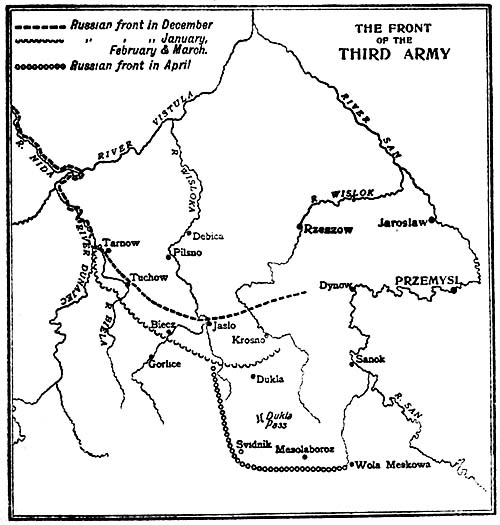
Exchanging good wishes "for health and success" I made my way on through the villages toward the broken bridge. One of a group of soldiers, when I asked the way to the lines, simply pointed, saying "Here, close by." A long line of high earthworks ran close to the stream, on the other side of which were the Germans, their sentry being about 1000 yards away. I entered a hut and drank tea with the battalion commander, an old gentleman in a jersey, who, with charming apologetic gesture, offered me some white bread and chocolate. The telephone gave word of my coming to the staff of the regiment, to which I was piloted over the marsh by a soldier. The Germans shoot at almost any mark, or, even, at hazard, in the darkness; but very few are wounded in this way—this day none, and the day before only one. Scouts go out from time to time and sometimes find a searchlight turned on them. It is a waiting position.
The colonel, a good-looking young man of great simplicity and vigour, entertained me at supper, and we talked late into the night. Everywhere one feels the winning spirit. After the last great halt, on the San, the men went forward with a tremendous rush, and the enemy's rifle pits were filled with dead. Again the talk turned chiefly on the French and English front, and on the necessity of carrying the war to a real settlement. No one can understand why the Germans challenge such enormous losses by their attacks in close columns. Late at night I made my way back to the town; every now and then a few isolated shots rattled in the darkness.
January 5.
I set out late in the evening for a forward ambulance post attached to a famous fighting division. Our party consisted of two soldiers, a niece of Count Bobrinsky, who took such a notable part in the Duma visit to England, and myself. The young Countess, who was enveloped in tarpaulins, is one of the hardest workers in the ambulance. Our cart was stacked with necessaries for the soldiers; on the wall of the courtyard German soldiers had scribbled in large letters expressions of their self-satisfaction, such as "Austria and Germany fear God, and nothing else in the world," and sundry contemptuous allusions to "der Nikolai, der Georg und der Französe."
From the time when we left the lights of the town we had to go mostly on foot, negotiating difficult bits of road and ploughing our way through fluid mud. We passed over high ground and close to the front; all round us was the glare of camp fires and in the distance the flash of projectors. In the darkness we were constantly meeting trains of carts.
At last, on the slope of a hill, we turned into a Polish hut. It had two fairly large apartments, with a big stove and an earthen floor. In the inner room lived the six sisters of mercy: in the outer we were an interesting and strange collection; along one side lay a big bed, on which, crosswise, sat or slept the Polish peasant, his wife, two daughters and little son; in a corner, on a heap of boxes which he had to arrange each night, slept the young priest, the monk, whom I had met before, and one of the most spiritual men whom I have known; the two sanitars and myself made our beds each night beneath the windows (one of which was smashed), removing them each day to make room for the dinner-table. By the stove, or anywhere else, our soldier servants slept on straw.
Not two hundred yards off, but only to be reached by crossing two deep gullies of mud, lay the lazaret of the division, quartered in a white-walled village school. These quarters, I was told, were luxury compared to most of the ordinary stopping places; but we were in a very different atmosphere from the admirably equipped hospitals further back. The wounded arrive all day in large carts or on foot; they come straight from the First Aid stations, which are close up to the actual fighting line; there are no beds, only pallets of straw, on which the men lie down while waiting their turn. They have not yet lost the sense of the battlefield or reached the stage where they are fully conscious of their wounds. They take their places one after another in the cottage chair—in which one of them died yesterday as soon as he had sat down—and the young divisional doctor, with the help of the sisters, removes their first rough-and-ready bandages, and gives them such quick treatment as may enable them to be sent further. It is, of course, the seriously wounded of whom one sees most here, for many of these get no further, dying here, or on the road. From one of them the doctor removed an enormous splinter of shrapnel completely embedded in the body; the largest bombs of all, which the soldiers call "portmanteaux," make terrible wounds.
Here all day and all night the doctors and sisters work at the wounded as they come in. The senior sister, a lady of the most remarkable capacity, takes about one night's sleep in five, but is always as fresh and bright as can be. Her husband, a member of the Duma, travels over Russia for the better organisation of the Duma field hospitals. The transport is in charge of one of the sanitars, the son of a Moscow business man, who has a particularly clear head for work. The whole party, three of whom talk excellent English, are drawn close together by their work; and there is the atmosphere of complete unselfishness which one feels so strongly in anything connected with the Russian soldier. As to our soldier servants, it is clear that their constant preoccupation is to make themselves useful to anyone.
January 6.
We lie at the head of a little valley, some few miles from the Divisional Staff. As the troops move forward new questions are constantly arising; and our transport sanitar, Nikolay Nikolayevich, discusses the possibilities of getting better access for the wounded to the hospitals. We are pressing back the enemy into the Carpathians, and there are halts in front of difficult hill positions. The advance through swamps of mud makes tremendous demands on the men, who have to lie for days in rifle pits full of water; at times a well-chosen and well-entrenched position holds the Russians at bay at a distance of a few hundred yards or less, in one case fifty, and yet they will not go back. "Und auf den Carpathen sind die wege beschneit," often recur to me, these lines of one of the laziest of German student songs, which is a kind of renunciation of all effort.
Nikolay Nikolayevich and I rode over through the snow to the Staff of the Division. He is a charming and simple man, very like one of our own best-known Generals both in face and manner. He lives in a small hut, which is kept very clean. We lunch and discuss transport, and I am asked to carry certain suggestions to the town. On our way back, accompanied by two Cossacks, we pass through Tuchow, a little township half in ruins, and I notice that, as on our way out, some one is still strumming on a piano in a house of which only the walls are standing. The cannon has carried away a large tree and left deep pits near the road.
Driving in the evening to the town, I find groups of wounded, for whom there is no place on the carts, wandering forward in the darkness. The men choose among themselves which I shall take with me: "Let him with the nose go," for one of them has had his face smashed up; the rest move on contentedly, and my passengers give me a word of thanks, which would make any one feel ashamed of himself. This is their Christmas Eve.
It is very wonderful, this self-denying patience of the Russian soldier, and it is too big a thing that one should get tired of speaking of it. A doctor at work here tells me how constantly it is impressed upon him. A man whose chin he has had to remove simply says: "Thank Heaven, now you've tied me up, and I am all right." Another, after his leg has been taken off, as soon as he is able to speak, says: "Ah, but it was a fine fight at Krasny; they gave it us, but we gave it to them too." Another, when he is brought in for operation, is only taken up with the thought that he meets in the operating room an Austrian officer to whom he has attached himself as guide and friend. Anything else that is human comes before any thought of self. I am quite certain that one of the greatest things that this war is doing is its revelation to Europe of the simple goodness of the Russian peasant in the person of the Russian soldier. He is more than the unconscious hero of the moment. The qualities of the real Russian people are going to take their proper place among the best factors in the future of European civilisation.
January 8.
In our halupa (hut) we had those intimate and speculative conversations which seem so natural to Christmas Eve. Monk and Intelligents were on common ground. Only once Father Tikhon put down his foot when one of the party expressed indifference as to the other life. "No," he said, "joking apart, that's not good, least of all in time of war"; and the rebuke was accepted as gently as it was given.
Our Russian Christmas began with the burial of a wounded soldier who had died in the night. In a little waste patch in the snow, near the lazaret, the priest stood in his gorgeous vestments and bowed deep over the new grave, while two soldier choristers sang the beautiful prayers for the dead.
In the evening there was a Christmas Eve service in a room of the lazaret, which Father Tikhon and the soldiers had spent no end of trouble in turning into a chapel. The room was crowded with soldiers, and there was an improvised choir. The simple directions of the priest and the strangeness of the surroundings only added to the deep atmosphere of reverence.
I completed the night service in our hospital in the town. Here the first-floor landing had been turned into a chapel. A matronly sister from Moscow, one of the simplest souls in this work-a-day gathering, served as clerk. The leader of the choir was a young Social Democrat doctor, who had suffered for his convictions at the time of the second Duma; and among the choir were all who had had a training in church singing, which reaches such a high standard in Russia. The singers included sisters, sanitars, soldiers and several of the convalescent wounded, who were wrapped in their long grey dressing-gowns; and one wounded man had been laid on his stretcher among the choir in order that he might take part in the singing. Afterwards we all had cakes and tea; and a conversation as to what England could do, and what would follow in Europe, lasted well into Christmas Day.
We have here with us Bishop Tryphon, of Moscow, who, like the Bishop of London, asked leave to accompany the army, and is now the Superior, or Rural Dean, of one of our Divisions. The Russian army has a staff of army chaplains with an Arch-Presbyter or Chaplain General, as in England; but many priests have enrolled specially for the war. Some have been killed, others wounded, others taken prisoner; some have been specially honoured for serving the Liturgy to regiments under fire. I am told that Father Tikhon's first sermon under fire was wonderfully simple and impressive. One regimental priest told me how a shell burst in his quarters, blowing a medical attendant to bits and leaving himself with a bad contusion.
Bishop Tryphon took a prominent part in the entertainment of our Bishops in Moscow, and sends them by me a message of greeting and good wishes. He arranged a solemn Christmas Day service, with trained singers who were serving in the army. He later visited the hospitals, giving short and plain addresses, and his blessing to each branch of the Red Cross work in turn. There was a great Christmas tree in the station, where presents were distributed to four hundred wounded. Gifts were also distributed under fire by the hospital workers to the soldiers in the trenches some miles from the town.
In the evening I took part in a Christmas gathering in one of the big hospitals. Everyone's health was drunk in turn by Christian name, the whole being woven into a long song. Afterwards we sang songs of the Volga, and some stayed on talking till five in the morning, resuming their work a few hours later.
January 10.
Returning to our halupa in the little village, I rode over in the night to the General to convey the results of my journey. It was almost pitch dark and the road was in most places a simple swamp of mud, sometimes with gaping holes in the causeway or with beams or trunks of trees lying about; and though I had a soldier and a lantern, the ten miles took over four hours. Next morning we left the halupa: the dismantling process made the hut look more desolate, and while our things were being packed, the peasant family sat on their bed, looking on like moony spectators at some rustic entertainment. They showed more than satisfaction with their payment, which they expressed after the local fashion by kissing every one's hands; but they had now to expect the arrival of a fresh batch of strangers.
Our forward move of a few miles was carried out with great expedition; but our carts made quite a long train, and the movement of even a small ambulance section is in itself, under such conditions, almost an exploit. Just in front of me went our Austrian field kitchen with three separate cauldrons, which is found very useful. In a few hours we were installed in our new quarters, a great improvement on the halupa, within a stone's throw of the divisional lazaret and the now reopened railway station. From beyond a near wooded hill came the sound of almost continuous firing.
We were now close behind the line of the front ambulance points. At the station, which we put in order for their reception, there was a constant dribbling stream of soldiers who had come almost straight from the front. Most of them had walked in with their kits, and many seemed almost unconscious of their wounds. Their conversation was of comrades who stood at other points in the line, of the relative distance of the enemy and of the conditions of work in the rifle pits.
Through the thick mud the Russians are driving the Austrians upward over the deeply indented country of the Carpathian region. The enemy entrenches himself strongly, making much use of complicated wire entanglements which can only be carried with a rush. Thus, the heavily clad Russians, whose efforts have pushed the enemy all this way, have sometimes to dig themselves in as best they can at a few paces from the enemy—1000, 500, 100 or even 50. The rifle pits are full of water, straw makes hardly any difference, and as soon as a head is shown it is shot at; many of the wounded have fallen at the moment of rising from the trenches. The Austrians continue a rumbling fire nearly all night. On the other hand, some of our men have seen the shells from the heavy Russian artillery falling plump in the middle of the enemy and have seen how they scatter under the fire of the Russian machine guns. The Russians use less ammunition with much more effect. I have met several Russians who have had at different points fifteen or seventeen days on end of this soaking trench work. One officer, who had had two long doses of it, had contracted rheumatism in one place and bronchitis in another and was resting in a hospital with the hope of getting back as soon as possible. A wounded soldier asked Father Tikhon to write a request that he should be sent back to his regiment as soon as possible. One man at the station, twice wounded in hand and in chest, asked that this time he should be sent to recover in his native town.
The station was very soon in order. One of the sisters went round distributing clean underwear. "Change while you can, children," she said; "we shall give you some tea and soup, and pack you into the train, and send you straight off to Russia"; and in a few hours the first train had arrived and the station was cleared for further work. In the dusk, the military ambulance men set out again to collect more of the wounded under fire.
What is happening is, shortly, this. The Russians, who had first to deal mainly with the Austrians, leaving the Germans to us, have now got within sight of the end of this part of their task. A first-class military power has been so pounded and smashed and has been repulsed in so many vigorous counterstrokes that it is coming to have only a secondary importance. Meanwhile the bulk of the Russian forces is now devoted to meeting the incessant and desperate initiative of the Germans. Russia's new defensive front on this side runs in a straight line to the point where it covers the Russian conquest in Galicia. It is now being extended further south to the natural barrier of the Carpathians. The interval made necessary by the operations in the north is not being wasted by the victorious troops in the south. When we get to the end of the Austrian efforts and have a mountain barrier to safeguard us on that side, these forces will be able to act with much more effect against the Germans. Russia, by accounting for Austria and concentrating her attack on Germany, will have done more than her full share of the work in the common cause. "Honour is not to be divided," said Ney when he stormed the heights of Elchingen; and it is in this spirit of generous rivalry that the Allies move forward.
January 15.
By a little arrangement room was made in our small quarters for a New Year's feast, to which the divisional doctors were all invited. Father Tikhon had turned the local hall of the Sokols into a Russian church, and the evening service was crowded with soldiers. There was great delight in unpacking the gifts and delicacies received from Petrograd, and soon the guests began to arrive. It was all the simple talk of men accustomed to great privations: some of it turned on a comparison of unpleasant bivouacs; for instance, one told of a night spent in driving wind and rain on an open slope by the light of a burning village; he hoped the wind would blow over some of the warmth from the flames, till at last shelter and sleep were found in a ditch. Another officer was drowsing in a hovel when the door was opened, there entered a strong smell of coarse tobacco and a heavy weight fell on him; he woke in the morning to find a soldier asleep across his knees. An artillery officer, a fine-looking man, told of the tremendous work of the mobilisation and of the strain which war life puts upon the hardest nerves. Regimental doctors have, of course, had to work under fire for weeks on end. Every one discounts the heavy German mortars which in the field do very little damage in comparison with their expense. As to the Austrian bullets, one doctor says that it takes a man's weight of bullets to wound a man. When the trenches are near they come pouring in a sort of continuous rain. One man who insisted on standing up had thirty-six bullets through him directly. When the distance is a hundred to two hundred yards, especially where there is no natural cover, continuous sniping goes on. The line not being straight, but varied by all sorts of indentations, due to the lie of the ground and to the Russians' desire to get as close as possible to the enemy, the former at many points crouch in the temporary and flooded holes which they have scratched out for themselves, perhaps all the while under a cross fire. Men are killed going out with long scissors to cut the Austrian wire entanglements. Many a man has fallen in a crawling excursion to dig up a potato. The sniping becomes a kind of game, and it was described as such by two Russian soldiers, of whom one had knocked over nine Austrians and the other sixteen. The Austrians fire a lot of random shots in the night which are in most cases a sheer waste of powder; but it was hard on a man who was relieved after a week's rifle pits to be hit by a bullet in the night on his way back, as far as a mile from the front.
The last hours of the Russian Old Year I spent in a goods carriage. My companions kept reckoning whether we should reach the town by midnight. Twelve o'clock was well past when the train drew up heavily a verst from the station and we were told that it would go no further. We scrambled out into the snow, when suddenly from the lighted station there rose in full orchestra, strong and triumphant, the most beautiful and the most religious of national anthems. It was played three times, and the notes may even have been carried to the neighbouring Germans beyond the river. This was our Russian New Year: and in the station a colonel was dismissing his men with the words, "For this year I wish you health and victory."
Next day the stretch of railroad that we had traversed and the carriage in which we had supped was cannonaded by the biggest German shells. The bombardment went on all day and night, the huge "portmanteaux" making tremendous holes and falling for the most part far wide of their only mark, the railway, and carrying ruin and mutilation to many of the inhabitants, who are thus encouraged by the beaten enemy to remain Austrian subjects. There is hardly any object in this bombardment, which is put down to the Germans and has roused great indignation among the many wounded Austrian officers and men who are lying here in hospital. Not a soldier has been touched; but wounded civilians, men, women and children, have been brought in to the different hospitals.
January 16.
The bombardment, which was continued yesterday, has created a certain excitement here, but nothing approaching to panic. The big "portmanteaux" are very ugly things and make an unpleasant noise, but only two shots can be said to have produced any results worth mention. The prevailing mood is one of vigour and interest.
I have had some informing conversations with wounded officers of the enemy. They indicate a definite mental attitude very different from ours. I see no trace of religious enthusiasm and little of nationality in the wider sense. The Germans have the greatest confidence and pride in their army. They tell me that two million volunteers were inscribed at the beginning of the war—an enormous fact, if correct. The attitude of the German women is such that no man who can serve dares to remain at home. My informants fully realise that for Germany the war is a matter of life and death. They have served on the western front and described the French fortresses as extremely strong ("brillant"). The Bavarians are terrible in warfare and spread alarm among the population. The losses of the first move through Belgium were enormous. The Belgians are described as excellent soldiers, and large German losses are put down to them. In the march on Paris the reserves and the commissariat could not keep up. The retreat is accepted as an unpleasant necessity. There was a certain pedantry among my informants in insisting on the need of turning the allied right wing, whatever should happen at other points. They claimed that the Germans were now in Calais.
Large losses against the Russians were admitted, but it was claimed, without any real evidence, that the Russians had lost more. Again, there was a kind of machine-like insistence on the need of attack in columns with reserves close up—as this was "our tactics." The Germans had so far been saved by the default of any real Russian winter, which would have ruined the German transport and artillery and robbed their operations of all effect. What struck me most was the absence of any real intelligence as to the political issues in debate. My informants were, for reasons of humanity, in favour of a status quo peace.
Some Austrians gave an interesting account of the origin of the war. The Austro-Serbian quarrel was not political but personal. The Serbian dynasty, failing to obtain any satisfactory recognition from Austria, was credited with a personal hostility against the late Archduke, who was described as in general a friend of the Slavs. Proof in support of this view of his end had been widely circulated in Austria in December. The personal quarrel between the reigning houses of Austria and Serbia had been turned by the insistence of the Emperor William into an occasion for a European war, specially directed against Russia, into which Austria had been hurried against her will. Her present position now was described as very precarious.
To a Hungarian officer I put the question whether the war had produced any real poetry in Hungary. He answered that there had been some rough-and-ready effusions among the working classes, whom he described as militant in their habits in time of peace and always ready for any war, especially with Russia. But the educated classes were not well disposed either to war or to this war.
It is rarely that one meets among these wounded of the enemy any other disposition than a strong desire for peace. I should add that several of them have asked me to communicate to their relations that they were being treated with the greatest kindness in Russia; "I am lovingly tended," wrote one of them. An Austrian colonel, a fine soldier and gentleman, told me he should never forget the "Anständigkeit" (decency) of all the Russians with whom he had had to do since his capture. Even Germans who at first are challenging and hostile, are softened by the true humanity with which they are surrounded in the Russian hospitals.
January 22.
The town has been bombarded for several days on end, beginning with the Russian New Year, January 14. The Germans had given a foretaste on our own Christmas Eve. They dropped from an aeroplane a paper bearing the words: "We ask you not to shoot on December 25; we will send you presents": the text of the telegram I had from the Commandant of the town, to whom it was taken. For all that, and though the Russian artillery was instructed only to reply, five heavy bombs were fired into the town and some of the inhabitants were wounded.
There were other Christmas "presents" which I have seen, sent by the Austrians with a parleyer and a white flag. With other objects of no importance were six matchboxes full of matches and containing also short manifestoes printed in Russian and addressed to the troops. They were signed "Your unfortunate Tsar, Nicholas"; and they informed the Russian soldiers that the Emperor knew the war would ruin Russia and had sought to avoid it, but had been forced into it by the Grand Duke Nicholas and the "perfidious" Russian generals, against whom the soldiers were invited to turn their arms. I have not often seen a document so conspicuously lacking in humour.
Punctually at midnight of January 13, one Russian regiment received two large shells bearing on their case the words "Congratulations on the New Year." The next day the town, though it had no troops in it, was shelled severely, and this bombardment was kept up for several days. The chief mark, and a very legitimate one, was the railway; here there fell in all six large bombs, making holes some twenty feet in diameter and ten in depth. But the great majority of the bombs fell in other parts of the town; and two of them rattled close over the roof of two different hospitals while I was in them, and the splinters of a third flew into the lodging of the workers of another lazaret.
In one of these hospitals, a local one now served by the Russian Red Cross, a large proportion of the patients are wounded of the enemy, including officers, most of them too badly hit to be removed without danger to their lives; and these were greatly agitated by the shells passing so near to them. Hurried councils were held by the different Red Cross authorities. One hospital, where the shells continued to fall quite near, left the town. The most serious cases were moved to the local hospital, where the Russian Red Cross courageously decided to remain. Here are also to be found many local inhabitants, wounded by bullets and shrapnel in the town or in neighbouring villages under fire; and one room is mostly filled with little Polish boys, all of them wearing a little silver religious medal round their necks. Here, too, are the inmates of a Polish hut who were injured by the explosion of a hand grenade; in a space of about twelve feet square, some sixteen persons were thus wounded; the father is dead and the mother and one of the children are out of their minds.
These are all cases that have come under my notice; and of course there are many others. Yet it is wonderful how the inhabitants remain in their huts under fire in the hope that the worst is over or in despair of finding any other shelter. From one such hut, after the last and finally crushing shot, there issued an old man of nearly seventy with a pipe in his mouth and entirely unharmed. I remember that on my first visit to Lvov, I heard a barrel organ repeating about fifty times the beautiful Polish national hymn: "From the Smoke of Fires"; in the Lublin province, on a line of some seventy miles, I found almost every other village half demolished. It is everywhere Poland that suffers; and it will be hard if some new life for this unhappy people does not rise out of their present ordeal.
There must be endless espionage in this town. An Austrian was found by one of our priests at the top of a tower working a telephone, and to the priest's question he replied that he was "sending word as to fires," which was no doubt strictly true. If so, it is a pity that the shots were not better directed. There is no question that the guns at work were not Austrian but German. General Radko Dmitriev came without delay to the town, and distributed the George medal for bravery among the workers of the Red Cross.
January 23.
I have been visiting some of the Regimental First Aid stations. In principle each regiment of four battalions should have five doctors and a captain of bearers. The bearers are selected from each company and can be supplemented by soldiers who volunteer for this service. They must be sound and strong; in peace time they march with their companies, carrying the rifle, and meet for a course of instruction twice a week. They are expected to gather under their captain before an action and to go out to the field to pick up the wounded only at night time, or after the action is over. In the present war it is seldom possible to maintain the full complement of regimental doctors. As battles have continued for weeks on end, it has been quite impossible to limit the bearers' work to less dangerous times; and it has been found most convenient to send them to the trenches with their respective companies, as they could then get to work as soon as they were wanted, and could also know the least dangerous track from their companies to the first-aid points. Ordinarily four bearers are assigned to one wounded: but as the track under fire is often long and exposed, it is sometimes necessary to send out eight men together, to carry by turns. They are supposed to have a leader, but in practice any one gives a lead, and if good it will be followed. The mortality in this service is considerably higher than in the ranks, as this is largely a war of cover, and these are the men who are most deprived of it.
Every Russian soldier is supplied with a packet containing lint, two compresses and a fastening pin. The object of the first bandaging is simply to stop the flow of blood and keep out dirt; and the wounded man is bandaged on the spot by himself, some comrade, or a feldsher (a trained medical assistant), one of whom is in the trenches with each company.
During the seventeen days of fighting on the San, the wounded had to be carried by relays over a long exposed slope and in many cases over the river. It was found possible to divide the distance into different sections; but the workers in each section were under fire, and so was the regimental point, which might sometimes be in a hut, but was more often a patch of open ground, with a tent stretched over it, or with no covering at all. There were instances where wounded and bearers alike were crushed by a shell on their road; for the Austrians poured endless artillery volleys on to given points. For all that, when the Russian trenches were examined after the battle, it was found that the bearers' work had been carried out completely, and that all the wounded had been removed.
The tremendous mortality of this war has put a specially hard strain on this service. Yet it is one of those which it would be most difficult to supplement with volunteers. Untrained men would be almost certain to be killed off soon; and indeed the appearance of bearers on the field is at once an indication to the enemy of the positions of the troops.
It has been found quite impossible, with the present range of artillery, to keep the regimental points in security. The work has therefore to be dispatched with the greatest expedition. The regiments, for mobility, dispense with any superfluous material and appliances and send their patients as soon as possible to the divisional lazaret, where the first really serious treatment is received.
Lazarets further back have often, as I have previously mentioned, been under fire. Austrian prisoners tell me that they have often seen their artillery fire on field hospitals; and from Russian observation points it has several times been noticed that the Austrian fire has been opened on what could only be a hospital field train. One of the subjects discussed with me by wounded officers of both sides is the possibility of securing further respect for the Geneva Convention and even a further definition of its regulations; but at present the overpowering stress under which we all live seems to be carrying us to the total disregard of any limitations at all.
January 27.
After a talk with the Divisional General, I set out for a visit to the regiments at the front. My orderly told me with pride that this was the best fighting Division in the army; certainly it has that reputation in other quarters and has three times in this campaign done decisive work against superior odds. It has rushed the Austrians from point to point, and would do so still unless they had taken refuge in the hill country before the Carpathians, where every hill has to be won in turn. Its General, an old man full of fire and energy, has received three wounds, which, as he says, make for him a calendar of the war.
The way lay between pleasant fir-clad hills, and late in the evening I reached the X regiment, with quite a good-sized house for its headquarters. The Colonel, who was very simple and businesslike, lived with his staff in the dining-room by a kind of half-light and with picnic fare, of which, as always in Russia, much more than his share was pressed upon the guest. The talk was that of comrades at serious work. These men will all go to the end, but they don't find it necessary to say so. When one said something about finishing at Berlin, a young officer put in with a smile: "Do you know, if we do, I expect none of us will be alive by then?"
I spent the night in the regimental doctor's hut, and next day went off to the artillery observation point. It was a clear day and we could see not only our own lines and the enemies', but also some of the Austrians walking about near their trenches. A shell from us sent them scattering back into their burrows, and our guns were then turned on one point after another, the shells, as we could see, always exploding on or very close to the object aimed at; this day, there was only a half-hearted reply. The following day, I saw the guns themselves at work; the place of the battery was not likely to be located. It is very seldom during the war that a Russian battery has been silenced by the enemy. The Austrians, on the other hand, often place their guns on the crests of hills and have suffered severely from the accuracy of the Russian artillery, which is one of the striking features of the whole campaign. There is, further, this difference, that the Russians never fire without a target, whereas the Austrians in the most systematic way sweep whole areas in turn, as a rule doing extraordinarily little damage for the powder expended. One colonel suggested that the Emperor Francis Joseph must have more money than he knows what to do with.