Part 3 — CHAPTER I
Reading edition
EXAMINATION OF CRIMINALS
Criminal anthropologists are unanimous in insisting on the importance of the results to be gained from a careful examination of the physical and psychic individuality of the offender, with a view to establishing the extent of his responsibility, the probabilities of recidivation on his part, the cure to be prescribed or the punishment to be meted out to him; but besides furnishing the magistrate with a sound basis for his decisions, the anthropological examination will prove of great assistance to probation officers, superintendents of orphanages and rescue homes and all those who are entrusted with the destinies of actual offenders or candidates for crime. I have therefore decided to devote this part of my summary to a minute demonstration of the methods to be employed in these examinations, which should be conducted on the one hand with the scientific precision that distinguishes clinical diagnoses of diseases and on the other with special rules deduced from the long experience of criminologists in dealing with criminals and the insane, between whom there is so much affinity.
Antecedents and Psychic Individuality
The examination of a criminal or person of criminal tendencies should, if possible, be preceded by a careful investigation of his antecedents. Questions put to relatives and friends often bring to light facts relating to his past life, and give an idea of the surroundings in which he has grown up and the illnesses suffered by him during childhood (meningitis, typhus, convulsions, hemicrania, giddiness, pavor nocturnus, trauma). The prevalence of disease in the family (parents, grandparents, uncles, cousins, etc.) should be elicited and note taken not only of nervous maladies, but of arthritic, tuberculous, pellagrous, and inebriate forms, including a tendency to morphiomania. Even goitre should not escape notice, since it may indicate cretinism or any other form of degeneration. The existence of criminality in the family is of still greater importance, but it is extremely difficult to obtain any information on this head, either from the patient himself or his relatives. A certain amount of strategy must be used in eliciting facts of this kind, by suddenly asking, for instance, whether a certain individual of the same name, already deceased or confined in such-and-such an asylum or prison, is any relation of the patient.
Next should be ascertained whether he is single or married, and in the latter case, whether his wife is still living; also what profession or professions he has exercised. In this connection it should be observed that although criminals are generally successful in everything they undertake, they are incapable of remaining constant to one thing for any length of time.
Many persons, cooks, tavern-keepers, confectioners, etc., exercise callings that have a deleterious effect on the nervous centres and encourage an abuse of alcohol; others like bakers, have night work, which is equally harmful. Professions which bring poor men, servants, secretaries, cashiers, etc., into close contact with wealth, are sometimes the cause of dishonesty in those who in the absence of special temptations, would have remained upright; others provide criminaloids with opportunities or instruments for accomplishing some crime, as in the case of locksmiths, blacksmiths, soldiers, doctors, lawyers, etc.
The time of the year and other circumstances under which the crime takes place should be elicited, and it should be borne in mind that the vintage season in countries of Southern Europe and extremes of heat and cold are favourable to seizures of an epileptic nature.
When the subject under examination is a recidivist, care should be taken to ascertain at what age and under what circumstances the initial offence was committed. Precocity in crime is a characteristic of born criminals, and puberty and senility have their peculiar offences, as have the extremes of poverty and wealth.
Intelligence. As we are not dealing with an ordinary patient, who is generally only too ready to talk about his troubles, but with an individual who has been put on his guard by constant cross-examination, his suspicions should first of all be allayed by a series of general questions on his native place or the town in which he is now living, his trade, etc. "Why did you leave your native town? Why do you not return? Are you married? How many children have you?" etc. Then an attempt should be made to gain an idea of his intellectual powers by asking easy questions: "How many shillings are there in a pound? How many hours are there in a day? In what year were you married?" etc.
Affection. The affections should be tested in an indirect way. "Is your father a bad man?" or "Are your neighbours worthless people? Do they treat you with due respect? Has any one a spite against you? Are you fond of your parents? Are you aware that your brother (or mother) is seriously ill?" Questions concerning relatives and friends are of special interest, because they enable the examiner to ascertain whether they cause the patient emotion of any kind, whether he has any real affection for those beings to whom normal persons are attached, but towards whom born criminals and the insane in general do not manifest love. In the absence of instruments, we must judge of the feelings of patients by their answers and the facial changes caused by emotion, but medico-legal experts naturally prefer a scientific test by means of accurate instruments, by which the exact degree of emotion is registered. These instruments are the plethysmograph and the hydrosphygmograph.
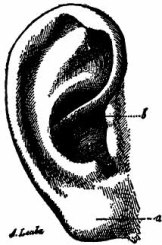
Fig. 28 Criminal's Ear
It is well known that any emotion which causes the heart-beats to quicken or become slower makes us blush or turn pale, and these vaso-motor phenomena are entirely beyond our control. If we plunge one of our hands into the volumetric tank invented by Francis Frank, the level of the liquid registered on the tube above will rise and fall at every pulsation, and besides these regular fluctuations, variations may be observed which correspond to every stimulation of the senses, every thought and above all, every emotion. The volumetric glove invented by Patrizi (see Fig. 25), an improvement on the above-mentioned instrument, is a still more practical and convenient apparatus. It consists of a large gutta-percha glove, which is put on the hand and hermetically sealed at the wrist by a mixture of mastic and vaseline. The glove is filled with air as the tank was with water. The greater or smaller pressure exercised on the air by the pulsations of blood in the veins of the hands reacts on the aerial column of an india-rubber tube, and this in its turn on Marey's tympanum (a small chamber half metal and half gutta-percha). This chamber supports a lever carrying an indicator, which rises and falls with the greater or slighter flow of blood in the hand. This lever registers the oscillations on a moving cylinder covered with smoked paper. If after talking to the patient on indifferent subjects, the examiner suddenly mentions persons, friends, or relatives, who interest him and cause him a certain amount of emotion, the curve registered on the revolving cylinder suddenly drops and rises rapidly, thus proving that he possesses natural affections. If, on the other hand, when alluding to relatives and their illnesses, or vice-versa, no corresponding movement is registered on the cylinder, it may be assumed that the patient does not possess much affection.
Fig. 25 Fig. 26
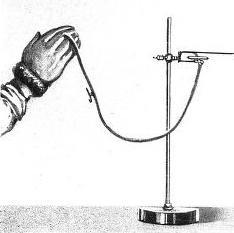
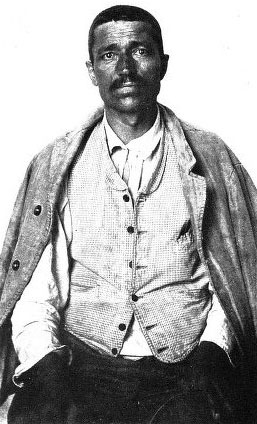
A Volumetric Glove (see page 224) Head of a Criminal Epileptic
Thus when Bianchi and Patrizi spoke to the notorious brigand Musolino about life in his native woods, his mother, and his sweetheart, there was an immediate alteration in the pulse, and the line registered by the plethysmograph suddenly changed, nor did it return to its previous level until some time afterward.
My father sometimes made successful use of the plethysmograph to discover whether an accused person was guilty of the crime imputed to him, by mentioning it suddenly while his hands were in the plethysmograph or placing the photograph of the victim unexpectedly before his eyes.
Morbid Phenomena. When examining a criminal or even a suspected person, who is nearly always more or less abnormal, it is advisable to investigate the more common morbid phenomena he may be subject to, on which he is not likely to give information spontaneously because he is ignorant of their importance. He should be questioned about his sleep, whether he has dreams, etc. Mental sufferers nearly always sleep badly and are frequently tormented by insomnia and hallucinations. The inebriate imagines he is being pursued by disgusting, misshapen creatures, from which he cannot escape. Epileptics, and frequently also hysterical persons have peculiar obsessions. They fancy they cannot perform certain actions unless they are preceded by certain words and gestures.
The susceptibility of the patient to suggestion should also be tested, to determine what value can be attached to his assertions. Sufferers from hysteria and general paralysis are like children, highly susceptible to suggestion, not necessarily of an hypnotic nature. If you tell an hysterical person with conviction that he suffers pain in a certain part of his body, is feverish or pale or something of the sort, he will inform you spontaneously after a few minutes that he feels pain or fever, etc. After a crime of a startling nature has been committed by some unknown person, it not unfrequently happens that some hysterical subject, generally a youth, who imagines he has been accused of the crime by the neighbours or his acquaintances, becomes convinced that he is really guilty and gives himself up to the police.
Speech. Special attention should be directed during the examination to the way in which the patient replies to questions and his mode of pronunciation. There may be peculiarities of pronunciation and stammering, characteristic of certain forms of mental alienation, or at any rate of some nervous anomaly; or articulation may be tremulous and forced, as in precocious dementia and chronic inebriety. In other cases the words are jumbled and confused, especially if long and difficult. In the first stages of progressive paralysis the letter r is not pronounced. To test this anomaly, which is of great importance in the diagnosis, the patient should be requested to pronounce difficult words, such as, corroborate, reread, rewrite, etc.
In order not to lose such valuable indications, in cases where personal examination is impossible, phonograph impressions of conversations between the patient and some third person will serve as a substitute.
The inquiry may reveal still more serious anomalies in the ideas, intelligence, and mental condition of the patient. Sometimes the answers given are sensible but are followed by nonsense. Other patients, especially when afflicted with melancholia, speak unwillingly, as if the words were forced from them, one by one. Idiots, cretins, and demented persons are sometimes incapable of expressing themselves. Some patients who have had apoplectic strokes substitute one word for another, "bread" for "wine," etc., or elide one part of the sentence and only repeat the last word.
Memory. To form an idea of the memory of the subject, questions should be put to him concerning recent and remote personal facts and circumstances, the year in which he or his children were born, what he had for his supper on the previous evening, etc., etc.
Visual memory may be tested by giving the patient a sheet of paper, on which are drawn various common objects, letters, or easy words. He should be allowed to look at these for five or ten seconds and requested to enumerate them after the paper has been withdrawn. In order to test the memory of sounds, the examiner should utter five or six easy words and ask the patient to repeat them immediately afterwards.
To test sense of colour, a picture on which various colours are painted is placed before the patient, as well as a skein of wool of the same shade as one of the colours in the picture, which he is requested to point out.
Handwriting is very important, particularly in distinguishing a born criminal from a lunatic, and between the various kinds of mental alienation.
Monomaniacs and mattoids (cranks) who give the police the most trouble often speak in a perfectly sane manner, but pour out all their insanity on paper, without an examination of which it is not easy to detect mental derangement. They write with rapidity and at great length. Their pockets, bags, etc., are always full of sheets of paper covered with small handwriting, sometimes scribbled in all directions. The matter is generally absurd or simply stupid, consisting of endless repetitions.
Individuals in the first stage of paralysis make orthographical errors, which coincide with their mistakes in pronunciation, like Garigaldi, instead of Garibaldi. Care must be taken to test this defect thoroughly. If the patient is fairly well-educated, his signature, which is the last to alter, is not sufficient; nor are a few lines a satisfactory test, since he can easily concentrate his attention on them, but he should be requested to write a page or two and be exhorted to make haste.
Alcoholism and paralysis generally give rise to tremulous handwriting with unsteady strokes, as in old people. After epileptic seizures and attacks of hysteria the writing is shaky. The slightest trembling of the hand is detected if Edison's electric pen be used.
In progressive general paralysis and some forms of dementia shakiness is so excessive that it becomes dysgraphy, with zigzag letters. The handwriting of persons subject to apoplectic strokes has often the appearance of copper-plate. Monomaniacs intersperse their writings with illustrations and symbols. They write very closely in imitation of print, as do mattoids, hysterical persons, and megalomaniacs, and use many notes of exclamation and capital letters. Their writings are full of badly-spelled words, scrolls, and flourishes.
Criminals guilty of sanguinary offences generally have a clumsy but energetic handwriting and cross their t's with dashing strokes. The handwriting of thieves can scarcely be distinguished from that of ordinary persons, but the handwriting of swindlers is easier to recognise, as it generally lacks clearness although it preserves a certain uniformity. The signature is usually indecipherable and enveloped in an infinite number of arabesques.
Clothing. The manner in which a patient is dressed often gives an exact indication of his individuality. Members of those secret organizations of Naples and Sicily, the Camorra and Mafia, are fond of dressing in a loud manner with an abundance of jewelry. Murderers, epileptics, and the morally insane, who lead isolated lives, attach no importance to dress and are frequently dirty and shabby. (See Fig. 26, A. D., a morally insane epileptic, the perpetrator of three murders.) Swindlers are always dressed in faultless style, the cinædus is fond of giving his costume a feminine air, and monomaniacs trick themselves out with ribbons, decorations, and medals: their clothes are generally of a strange cut. The cretin and the idiot go about with their clothes torn and in disorder and not infrequently emit a strong odour of ammonia.
Physical Examination
Having carefully investigated the past history of the subject and made a minute study of his abnormal psychic phenomena, the expert should proceed to the examination of his physical characters.
Chapter I of Part I contains a detailed description of the principal physiognomical anomalies of the criminal that may be discerned by the naked eye. They will now be briefly recapitulated.
Skin. The skin frequently shows scars and (in the epileptic subject to seizures) lesions on the elbows and temples. Marks of wounds inflicted in quarrels and attempted suicide are frequent in habitual criminals. The forehead and nose must be examined for traces of acne rosacea frequent in drunkards, and for erythema on the back of the hands, characteristic of pellagra. Ichthyosis, psoriasis, or other skin diseases are very common in cases of mental alienation, and scurvy often indicates long seclusion in prison.
Tattooing. Great care must be taken to ascertain whether the subject is tattooed, and if so, on what parts of his body. Tattooing often reveals obscenity, vindictiveness, cupidity, and other characteristics of the patient, besides furnishing his name or initials, that of his native town or village, and the symbol of the trade he refuses to reveal (sometimes such indications have been blurred or effaced). (See Fig. 27.)
One of the chief proofs showing the untruthfulness of the statements made by the Tichborne claimant was the fact that his person was devoid of tattooing, whereas it was well known that Roger Tichborne had been tattooed.
Tattooing often reveals the psychology, habits, and vices of the individual. The tattooing on pederasts usually consists of portraits of those with whom they have unnatural commerce, or phrases of an affectionate nature addressed to them. A pederast and forger examined by Professor Filippi was tattooed on his forearm with a sentimental declaration addressed to the object of his unnatural desires; a criminal convicted of rape was covered with pictorial representations of his obscene adventures. From these few instances, it is apparent that these personal decorations are of the utmost value as evidence of hidden vices and crimes.
Wrinkles. We have already spoken of the abundance and precocity of wrinkles in born criminals. They are also a characteristic of the insane.
The following are of special importance: the vertical and horizontal lines on the forehead, the oblique and triangular lines of the brows, the horizontal or circumflex lines at the root of the nose and the vertical and horizontal lines on the neck. (The ferocious leader of a band of criminals at twenty-five, and a savage murderer under thirty years of age.)
Beard. The beard is scanty in born criminals and often altogether absent in epileptics. On the other hand, it is common in insane females and in normal women after the menopause. Degenerates of both sexes frequently manifest characteristics of the opposite sex in the distribution of hair on the body. A tuft of hair in the sacro-lumbar region, suggestive of the tail of the mythological faun, is frequently found in epileptics and idiots, and in some cases the back and breast are covered with thick down which makes them resemble animals.
The hair covering the head is generally thick and dark, the growth is often abnormal with square or triangular zones growing in a different direction from the rest, or in small tufts like those inserted in a brush. Still more frequently do we find anomalies in the position of the vortex, or that point whence the hair-growth diverges circularly, which in normal persons is nearly always situated on the crown. In degenerates it is frequently on one side of the head and in cretins on the forehead. Precocious greyness and baldness are common in the insane criminals, and cretins, on the contrary, show these initial signs of senility at a much later period than normal persons.
Teeth. The greatest percentage of anomalies is found in the incisors; next come the premolars, the molars, and lastly the canines. In criminals, especially if epileptics, the middle incisors of the upper jaw are sometimes missing and their absence is compensated by the excessive development of the lateral incisors. In other cases the lateral incisors are of the same size as the middle ones, and sometimes the teeth are so nearly uniform that it is difficult to distinguish between incisors, canines, and molars, a circumstance which recalls the homodontism of the lower vertebrates. After the incisors, the premolars show the greatest number of anomalies. While in normal persons they are smaller than the molars, in degenerates they are frequently of the same size or even larger. Supernumerary teeth, amounting sometimes to a double row, are not uncommon. In other cases there is extraordinary development of the canines. Inherited degeneracy from inebriate, syphilitic, or tuberculous parents frequently manifests itself in rickety teeth with longitudinal and transverse striæ or serration of the edges, due to irregularities in the formation of the enamel. In idiots and epileptics, dentition is often backward and stunted; the milk-teeth are not replaced by others, or are almond-shaped and otherwise of abnormal aspect.
Ears. The ears of criminals and epileptics exhibit a number of anomalies. They are sometimes of abnormal size or stand out from the face. Darwin's tubercle, which is like a point turned forward when the helix folds over, and turned backward when the helix is flat, is frequently encountered in the ears of degenerates. The lobe is subject to a great many anomalies, sometimes it is absent altogether, in some cases it adheres to the face or is of huge dimensions and square in shape. Sometimes the helix is prolonged so as to divide the concha in two. Idiots often show excessive development of the anti-helix, while the helix itself is reduced to a flattened strip.
Eyes. The eyebrows are generally bushy in murderers and violators of women. Ptosis, a species of paralysis of the upper lid, which gives the eye a half-closed appearance, is common in all criminals; but more frequently we find strabismus, a want of parallelism in the visual axes, bichromatism of the iris, and rigidity of the pupils.
Nose. In thieves the base of the nose often slants upwards, and this characteristic of rogues is so common in Italy that it has given rise to a number of proverbs. The nose is often twisted in epileptics, flattened and trilobate in cretins.
Jaws. Enormous maxillary development is one of the most frequent anomalies in criminals and is related to the greater size of the zygomæ and teeth. (See Fig. 27.) The lemurian apophysis already alluded to is not uncommon.
Chin. This part of the face, which in Europeans is generally prominent, round and proportioned to the size of the face, in degenerates as in apes is frequently receding, flat, too long or too short.
These anomalies may be studied rapidly with the naked eye, but height, weight, the proportions of the various parts of the body, shape of the skull, etc., should be measured with the aid of special instruments.
Height. Criminals are rarely tall. Like all degenerates, they are under medium height. Imbeciles and idiots are remarkably undersized. The span of the arms, which in normal persons about equals the height, is often disproportionately wide in criminals. The hands are either exaggeratedly large or exaggeratedly small.
Fig. 27
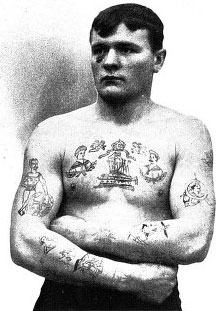
Anton Otto Krauser Apache (see page 236)
Fig. 29 Anthropometer
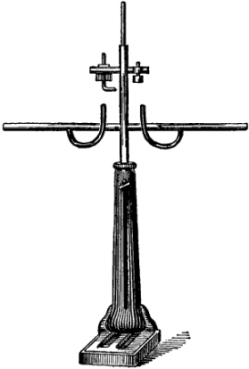
The height of a patient must be compared with the mean height of his fellow-countrymen, or, to be more exact, of those inhabitants of his native province or district who are, needless to say, of the same age and social condition. The average height of a male Italian of twenty is 5 feet 4 inches (1.624 m.), that of a female of the same age, 5 feet (1.525 m.). The distances from the sole of the foot to the navel and from the navel to the top of the head are in ratio of 60 to 40, if the total height be taken as 100.
These measurements may be effected very rapidly by using the tachyanthropometer invented by Anfossi (see Fig. 29). It consists of a vertical column against which the subject under examination places his shoulders, a horizontal bar adjustable vertically until it rests on the shoulders, and can be used at the same time for ascertaining the length of the arms and middle finger: a graduated sliding scale in the vertical column for rapid measurements of the other parts of the body and a couple of scales at the base for measuring the feet.
Weight. In proportion to their height, criminals generally weigh less than normal individuals, whose weight in kilogrammes is given by the decimal figures of his height as expressed in metres and centimetres.
Fig. 30 Craniograph Anfossi
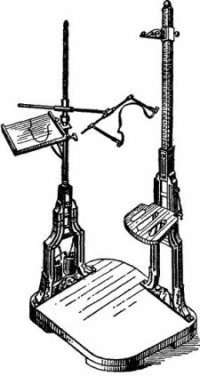
Head. The head, or rather the skull, the shape of which is influenced by the cerebral mass it contains, is rarely free from anomalies, and for this reason the careful examination of this part is of the utmost importance. We have no means of studying subtle cranial alterations in the living subject, but we can ascertain the form and capacity of his skull. This is rendered easy and rapid by means of a very convenient craniograph invented by Anfossi (see Fig. 30), which traces the cranial profile on a piece of specially prepared cardboard.
Fig. 31 Pelvimeter
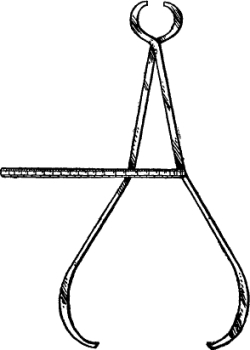
In the absence of a craniometer, measurements may be taken with calipers, the arms of which are curved like the ordinary pelvimeters used in obstetrics (see Fig. 31), and a graduated steel tape.
The following are the principal measurements:
1. Maximum antero-posterior diameter, which is obtained by applying one arm of the instrument above the root of the nose just between the eyebrows and sliding the other arm over the vault of the skull till it reaches the occiput. The distance between the two arms furnishes the maximum longitudinal diameter.
2. The maximum transverse diameter or breadth of the skull is measured by placing the arms of the calipers, one on each side of the head on the most prominent spot.
3. The antero-posterior curve is obtained by fixing the graduated tape at zero on the root of the nose (on the fronto-nasal suture) and passing it over the middle of the forehead, vertex, and occiput to the external occipital protuberance.
4. The transverse, or biauricular curve is obtained by applying the steel tape at zero to a point just above the ear, and carrying it over the head in a vertical direction till it reaches the corresponding point on the other side.
5. The maximum circumference is obtained by encircling the head with the steel tape, touching the forehead immediately above the eyebrows, the occiput at the most prominent point, and the sides of the head more or less at the level, where the external ear joins the head, according to whether the position of the occipital protuberance is more or less elevated. (See Figs. 32, 33.)
6. The cranial capacity is obtained by adding together these five measurements, the antero-posterior diameter, maximum transverse diameter, antero-posterior curve, transverse curve, and maximum circumference. For a normal male the capacity is generally 92 inches (1500 c.c).
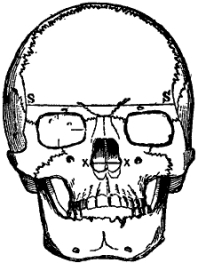
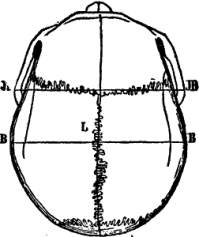
Fig. 32 Fig. 33
Diagram of Skull
7. The cephalic index is obtained by multiplying the maximum width by 100 and dividing the product by the maximum length, according to the following formula:
W × 100
———= X (cephalic index).
L
If the longitudinal diameter is 200 and the transverse diameter 100, the cephalic index is 10,000 divided by 200 = 50.
The cephalic indices of degenerates, like their height, have only a relative importance; that is, when they are compared with the mean cephalic index prevalent in the regions of which the subject is a native. The cephalic index of Italians varies between 77.5 (Sardinians) and 85.9 (Piedmontese).
Skulls are classified according to the cephalic index, in the following manner:
Hyperdolichocephalicunder 66
Dolichocephalic66-75
Subdolichocephalic75-77
Mesaticephalic77-80
Subbrachycephalic80-83
Brachycephalic83-90
Hyperbrachycephalicabove 90
We shall find among criminals frequent instances of microcephaly, macrocephaly, and asymmetry, one side of the head being larger than the other. Sometimes the skull is pointed in the bregmatic region (hypsicephaly), sometimes it is narrow in the frontal region in correlation to the insertion of the temporal muscles and the excessive development of the zygomatic arches (stenocrotaphy, see Fig. 5, Part I., Chapter I.), or depression of the bregmatic region (cymbocephaly).
Face. We have already remarked on the excessive size of the face compared with the brain-case, owing chiefly to the high cheek-bones, which are one of the most salient characteristics of criminals, and to the enormous development of the jaws, which gives them the appearance of ferocious animals (see Fig. 5). To these peculiarities may be added progeneismus, the projection of the lower jaw beyond the upper, a characteristic found only in 10% of normal persons, receding forehead as in apes, and the lemurian apophysis already mentioned.
Arms and Hands. With the exception of the excessive length as compared with the stature, anomalies in the arms are rare, but the hands show some interesting characteristics, which have already been described in the first chapter of Part I, an increase or decrease in the number of fingers and syndactylism or palmate fingers. Also the lines in the palm and those on the palmar surfaces of the finger-tips show deviations from the normal type resembling characteristics of apes.
Feet. Degenerates and more especially epileptics, frequently have flat or prehensile feet and an elongated big-toe with which, like the Japanese, they are able to grasp objects.
All these anomalies vary in number and degree according to whether the subject examined is a born criminal or a criminaloid, and according, also, to the special type of crime to which he is addicted. Thieves commonly show great mobility of the face and hands. Their eyes are small, shifty and obliquely placed, and glance rapidly from one object to another. The eyebrows are bushy and close together, the nose twisted or flattened, beard scanty, hair not particularly abundant, forehead small and receding, and the ears standing out from the head. Projecting ears are common also to sexual offenders, who have glittering eyes, delicate physiognomy excepting the jaws, which are strongly developed, thick lips, swollen eyelids, abundant hair, and hoarse voices. They are often slight in build and hump-backed, sometimes half impotent and half insane, with malformation of the nose and reproductive organs. They frequently suffer from hernia and goitre and commit their first offences at an advanced age.
The cinædus is distinguished by his feminine air. He wears his hair long and plaited, and even in prison his clothing seems to retain its feminine aspect. The genitals are frequently atrophied, the skin glabrous, and gynecomastia not uncommon.
The eyes of murderers are cold, glassy, immovable, and bloodshot, the nose aquiline, and always voluminous, the hair curly, abundant, and black. Strong jaws, long ears, broad cheek-bones, scanty beard, strongly developed canines, thin lips, frequent nystagmus and contractions on one side of the face, which bare the canines in a kind of menacing grin, are other characteristics of the assassin.
Forgers and swindlers wear a singular, stereotyped expression of amiability on their pale faces, which appear incapable of blushing and assume only a more pallid hue under the stress of any emotion. They have small eyes, twisted and large noses, become bald and grey-haired at an early age, and often possess faces of a feminine cast.
Sensibility
This external inspection of the criminal should be followed by a minute examination of his senses and sensibility.
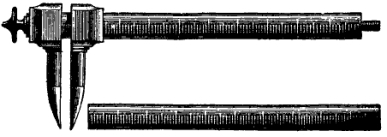
Fig. 34 Esthesiometer
General Sensibility and Sensibility to Touch and Pain. Tactile sensibility should be measured by Weber's esthesiometer, which consists of two pointed legs, one of which is fixed at the end of a scale graduated in millimetres, along which the other slides (see Fig. 34). After separating the two points three or four millimetres, they are placed on the finger-tips of the patient, who closes his eyes and is asked to state whether he feels two points or one. Normal individuals feel the points as two when they are only 2 mm. or 2.5 mm. apart; when, however, tactile sensibility is obtuse (as in most criminals) the points must be separated from 3 to 4.5 mm. or even more, before they are felt as two. Obtuseness varies with the type of crime committed habitually by the subject; in burglars, swindlers, and assaulters, being approximately double, while in violators, murderers, and incendiaries it stands in the ratio of 5 to 1 compared with normal persons.
In the absence of an esthesiometer, a rough calculation may be made by using an ordinary drawing compass or even a hairpin, separating the two points and measuring with the eye the distance at which they are felt to be separate.
General Sensibility and Sensibility to Pain are measured by a common electric apparatus (Du Bois-Reymond), adapted by Lombroso for use as an algometer. (See Fig. 35.) It consists of an induction coil, put into action by a bichromate battery. The poles of the secondary coil are placed in contact with the back of the patient's hand and brought slowly up behind the index finger, when the strength of the induced current is increased until the patient feels a prickling sensation in the skin (general sensibility) and subsequently a sharp pain (sensibility to pain). The general sensibility of normal individuals is 40 and the sensibility to pain, 10-25: the sensibility of the criminal is much less acute and sometimes non-existent.
Sensibility to Pressure. Various metal cubes of equal size but different weight, are placed two by two, one on each side, on different parts of the back of the hand. The patient is then asked to state which of any two weights is the lighter or heavier. This sense is fairly acute in criminals.
Sensibility to Heat. Experiments are made by placing on the skin of the patient various receptacles filled with water at different temperatures. If great exactitude is desirable, Nothnagel's thermo-esthesiometer should be used. This is an instrument very similar to Weber's esthesiometer, but the points are replaced by receptacles filled with water of varying heat and furnished with thermometers. The patient must state which is the colder, and which the hotter spot. Sensibility to heat is less acute in criminals than in normal individuals.
Localisation of Sensibility. After the patient has been requested to close his eyes, various parts of his body are touched with the finger and he is asked to point out the exact spot touched. Should he not be able to reach it with his finger, a statuette should be placed before him on which he should mark with a pencil the part touched. Normal persons are always able to localise the sensation exactly: inability to do so signifies disease of the brain or some kind of anomaly.
Sensibility to Metals is tested by placing discs of different metals, copper, zinc, lead, and gold, or the poles of a magnet, on the frontal and occipital parts of the patient's head. Sometimes he feels pricking or heat, giddiness, somnolence, or a sense of bodily well-being. In general, criminals show great sensibility to metals; in hysterical persons this sensibility reaches an extraordinary degree of acuteness. By applying a magnet to the nape of the neck, the sensations of such individuals become polarised, that is, what appeared white to them before becomes black; bitter, what was formerly sweet, or vice versa. This is an excellent way of distinguishing between bona-fide cases of hysteria and sham ones. My father once detected simulation in a soi-disant hysterical patient by means of a piece of wood shaped and coloured to represent a magnet. On application of either magnet, the real or sham one, the patient's sensations were identical, whereas hysterical persons experience very diverse sensations and are able to distinguish very sharply between the contact, not only of wood and metal, but of the different kinds of metal, and are particularly sensitive to the magnet.
Fig. 35 Fig. 36
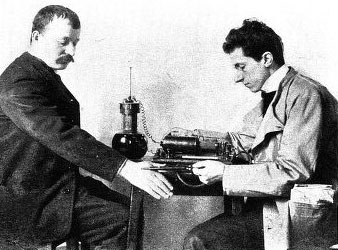
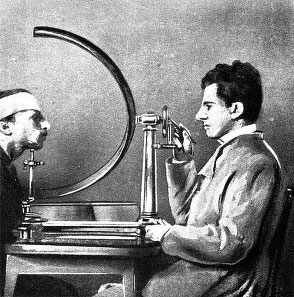
Algometer (see page 246) Campimeter of Landolt (Modified) (see page 249)
Sight—Acuteness of Vision—Chromatic Sensibility—Field of Vision. Visual acuteness is tested by holding letters of a specified size at a certain distance. Sight is generally more acute in criminals than in normal persons; not so, chromatic sensibility, which is tested by giving the patient a number of skeins of different coloured silks, and requesting him to arrange them in series. Persons afflicted with dyschromatopsia confuse the different colours and the different shades of the same colour. Colour-blind people confuse black and red.
Especially important is the examination of the field of vision, as the seat of one of the most serious anomalies discovered by the Modern School, the presence of peripheral scotoma, frequently found in epileptics and born criminals. To test this anomaly, use should be made of Landolt's apparatus (Fig. 36). This consists of a semicircular band, which can revolve around a column. The patient rests his chin on a support placed in front of the semicircle in such a manner that the eye under examination is exactly in the centre, and looks directly at the middle point of the semicircle, corresponding to 0 in the scale: the testing object, a small ball, is passed backwards or forwards along the semicircle. A graduated scale, placed on the semicircle, marks the point limiting the field of vision, and the result is registered on a diagram. The average limit of the normal field of vision is 90 mm. on the temporal side, 55 mm. on the nasal side, 55 mm. above and 60 mm. below (see Fig. 37). If a suitable instrument is not available, a series of concentric circles may be traced on a slate and the patient placed at a certain distance with one eye covered. The examiner then touches the different points of the circles with his hand and asks the patient whether he can see it when his eye is fixed on the central point. In this way the various points limiting the field of vision are noted and furnish, when united, the boundary line.
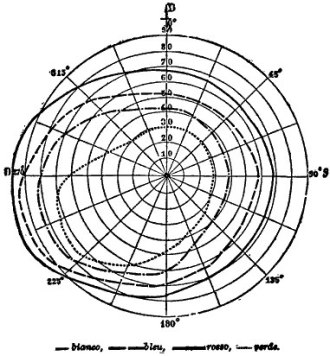
Fig. 37 Diagram Showing Normal Vision
Hearing is generally less acute in the criminal than in the normal individual, but does not show special anomalies. It may be tested by speaking in a low voice at a certain distance from the patient, or by holding an ordinary watch a little way from his ear.
Smell. Olfactory acuteness is tested by solutions of essences of varying strength, which the patient should be requested to place in order, indicating the one in which he first detects an odour. Ottolenghi has invented a graduated osmometer which is easy to use. The criminal generally shows olfactory obtuseness.
Taste is tested in the same way as smell, by varying solutions of saccharine or strychnine dropped on to the patient's tongue by means of a special medicine dropper. The mouth should be rinsed out each time. Normal persons taste the bitterness of sulphate of strychnine in a solution 1:600,000; the sweetness of saccharine in a solution 1:100,000. The sense of taste is less acute in criminaloids than in normal persons, and is specially obtuse in born criminals, 33% of whom show complete obtuseness.
Movements. Normal individuals in a state of repose remain almost motionless, and their gestures are always appropriate. Lunatics and imbeciles have a habit of speaking and gesticulating even when they are not interrogated. Nervous diseases manifest themselves in facial contortions or slight spasmodic contractions. In melancholia and all forms of depression, the patient does not gesticulate but remains immovable like a statue with his eyes cast down. Degenerates manifest a fairly varied series of involuntary motions,—twitchings of the muscles, as in chorea, tonic and clonic convulsions and tremors. In senility, chorea, and Parkinson's disease, the tremors are incessant and continue even when the body is in a state of repose; in sclerosis, goitre, and chronic inebriety they accompany voluntary movements, and in this case they are easily detected by making the patient lift the tip of his finger to his nose or a filled glass to his lips. The nearer the hand approaches its goal, the more intense the oscillations become. Above all, the examiner should not fail to ask the patient to put out his tongue. If it protrudes on one side, it is a sign of a serious nervous alteration and nearly always denotes the beginning or remains of paralysis, or partial apoplectic strokes.
Muscular Strength is measured by a common dynamometer (Fig. 38), which the patient is requested to grasp with all his might. Compressive strength is tested by compressing the oval. In order to test tractive strength, the dynamometer is fastened to a nail at the point C, and the patient pulls with all his strength at D. The effort is registered on a graduated scale and is of importance for detecting left-handedness and measuring the extraordinary force that is displayed in certain states of excitement.
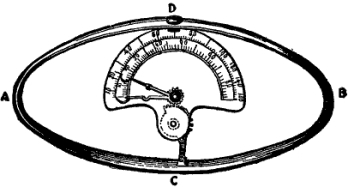
Fig. 38 Dynamometer
Reflex Action consists of movements and contractions produced by an impression exciting the nerves of the cutis (cutaneous reflex) or tendons (tendinous reflex).
Cutaneous Reflex Movements may be tested by placing the patient in a recumbent position and stroking methodically certain parts of the body, the sole of the foot (plantar reflex), the under side of the knee-joint (popliteal reflex), the abdominal wall (abdominal reflex). Certain reflex movements are of special importance: the cremasteric reflex, on the inner side of the thigh (obtuse in old people and individuals addicted to onanism), the reflex action of the mucous membrane covering the cornea (suspended during stupor, coma, and epileptic convulsions), and the pharyngeal reflex along the isthmus of the fauces (absent in hysterical persons).
The dilatation and contraction of the pupil in accommodation to the distance of the object viewed or in response to light stimuli is undoubtedly the most important cutaneous reflex movement. It may be tested by requesting the patient to look at a distant object and immediately afterwards at the examiner's finger, placed close to his eye, or bringing him suddenly from semi-darkness into the light. If the pupil reacts very slightly to the light, it is called torpid: if it does not react at all, it is called rigid. Rigidity of the pupil always denotes some serious nervous disturbance. In certain diseases, especially tabes, the pupils do not respond to light stimuli, but accommodate themselves to objects.
Tendinous Reflex Action may be tested in every part of the body, but the rotular reflex movement is generally sufficient. The patient is asked to sit on the edge of the bed or on a chair with his legs crossed. If he is healthy, the reflex movement is fairly strong, but in some illnesses spastic movements may be provoked and extend to the abdomen (exaggerated reflex action); in others no reflex is forthcoming. This is one of the first symptoms of tabes.
Fig. 39
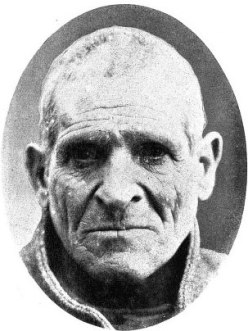
Head of an Italian Criminal
Urine and Feces. As the functions are anomalous, the chemical changes must also be anomalous, owing to the correlation of organs. In born criminals there is a diminished excretion of nitrogen, whereas that of chlorides is normal. The elimination of phosphoric acid is increased, especially when compared with the nitrogen excreted. Pepton is sometimes found in the excretions of paralytic persons in whom there is always an increased elimination of phosphates and calcium carbonate.
The temperature is generally higher than in normal persons, and, more important still, varies less in febrile illnesses.
For the reader's convenience, I have drawn up a list of the different points that should be noted in a careful examination.
Table showing the Anthropological Examination of Insane and Criminal Patients (drawn up by Tamburini, Strassmann, Benelli, and Mario Carrara).
A—Anamnesis. Name—surname—nationality—domicile—profession—age—education.
Economic and hygienic conditions of native place.
Family circumstances—pre-natal conditions—infancy—puberty.
Causes to which decease of parents may be attributed.
Cases of insanity—neurosis—imbecility—perversity—suicide—crime—or eccentricity in the family.
Progressive diseases or trauma in the subject.
Offence and causes thereof.
B—Physique. Skeletal development—height—span of the arms.
C—Physical Examination. Muscular development.
Colour of hair and eyes.
Quantity and distribution of hair.
Tattooing.
Craniometry: Antero-posterior diameter—transverse diameter— antero-posterior curve—transverse curve—cephalic index—type and anomalies of the skull—circumference—probable capacity—semi-circumference (anterior, posterior)—forehead—face, length, diameter (bizygomatic and bigoniac)—facial type—facial index—anomalies of conformation and development in the skull, in the face, in the ears, in the teeth, in other parts.
D—Functions.
E—Animal Life. Sensibility: meteoric—tactile—thermal—dolorific and muscular—visual—auditory—of the other senses.
Motivity: Sensory left-handedness—motory left-handedness—voluntary and involuntary movements—reflex action (tendinous or muscular, abnormal, chorea).
F—Vegetative Life. Muscular strength.
Circulation.
Respiration.
Thermo-genesis.
Digestion: Rumination—bulimy—vomiting—dyspepsia—constipation—diarrhœa.
Secretions: Milk—saliva—perspiration—urine—menstruation.
Dyscrasia: poisoning.
G—Psychic Examination. Language—writing—slang.
Attention—perception.
Memory (textual)—reason.
Dreams—excitability—passions.
Sentiments: Affection—morality—religion.
Instincts and tendencies.
Moral character—industry.
Physiognomical expression.
Education—aptitudes.
H—Morbid Phenomena. Illusions—hallucinations—delusions—susceptibility to suggestion.
I—Offences.
Cause of first offence: Environment—occasion—spontaneous or premeditated—drunkenness.
Conduct after the offence: Repentance—recidivation.