Chapter III · BOWLING: BY A. G. STEEL. (continued 2)
Reading edition
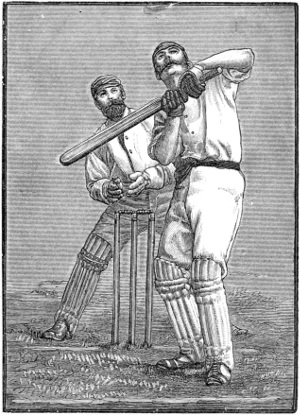
A pokey batsman dealing with a high-dropping full-pitch.
We cannot omit, when enumerating the different balls of which a slow bowler may avail himself, one which is by no means used as often as it should be, viz. the full-pitch. In slow bowling there are three different kinds of full-pitches—the high-dropping full-pitch, which will pitch either on the top of the wicket or a few inches before it; the ordinary slow full-pitch, which reaches the batsman about the height of his knees; and the medium-paced full-pitch, which will hit the stumps nearly at the top. The high-dropping full-pitch is a ball that is seldom used, the reason for its rarity probably being the extreme difficulty of bowling it accurately and the certain punishment it will meet with if it falls at all short either in height or length of what it should be. It should be delivered as high as possible; there is no limit to the height this ball may go in the air, as the higher it ascends the more difficult it is to play. It should be bowled so that it reaches its highest point when it is almost directly over the head of the batsman, and should pitch on the very top of the stumps. It is strange that this ball is not more often practised by slow bowlers, as, especially to the pokey, nervous style of batsmen, it is fraught with considerable uneasiness and requires some skill to play properly. To really first-class punishing batsmen it is a ball which has comparatively no terrors, and on which not much reliance can be placed, though it should always, in our opinion, be tried at least once to every batsman who is getting ‘well set.’ But to the poker, the man who refuses to do anything but stick his bat in front of the wicket, who lets half-volleys, full-pitches, and long-hops pass unscathed and unplayed on both sides of him—to him who considers he is doing his side good service by wasting three hours of valuable time for a dozen runs on his side of the balance, and three hours’ wear and tear of the wicket on the other—to him who helps so greatly to fill up the records of drawn matches, the high-dropping full-pitch is an excellent ball. He does not know what to do with it; he is afraid to step back to play it for fear of hitting his wicket, and he hardly likes to be so bold as to try to cut or hit it on the on side. One of the most amusing sights we have ever seen at cricket was one of these batsmen having ball after ball of this sort bowled to him; it was not till after he had nearly lost his wicket a dozen times, only keeping it by exceptional good luck, and had afforded the greatest merriment to players and spectators alike, that he burst out from sheer desperation into wild and furious hitting—a line of conduct which had the immediate effect of compelling the bowler to desist from his lofty attacks.
The second kind of full-pitch—the one reaching the batsman about the height of his knees—is the most usual of full-pitches, and enjoys the distinction of being considered the easiest of all balls to hit. A good batsman can hit this ball from a slow bowler to almost any part of the field; consequently, though it often happens in the chapter of accidents that a wicket falls to this ball—a catch in the country perhaps, or a hard catch and bowl—it is of all balls the very worst for a slow bowler to deliver, except perhaps a long hop.
The third kind—the medium-paced full-pitch straight to the top of the stumps—is occasionally, for a slow bowler, a very useful ball. In the first place, it is not quite so easy to hit as it appears to the batsman; the change in pace from slow to medium often causes him to hit a trifle slower than he should do, when the ball, coming on faster than expected, hits the top or splice of the bat, and goes straight up in the air. This ball is generally more successful with players who have a partiality for on-side hitting than with others, as it is never a difficult one to play quietly; it is only when the batsman tries to hit that it becomes likely to get a wicket. It is also useful when a hitter, by running out and hitting every ball, is demoralising bowler, fielders, and the whole side. If the bowler sees the intention of the hitter to run out before the ball is delivered—and he is often able to do this—he can do nothing better than bowl a good medium-paced full-pitch straight at the top of the middle stump; if the batsman goes on with his intention of running out, he is not only apt to overrun this faster than usual ball, and let it pass over the top of his bat, but if he does hit it he is likely to send it high in the air, from the above-mentioned cause of catching it with the top or splice of the bat. There is, however, nothing so flurrying to a bowler as a batsman who runs out to every ball, and who evinces his intention of doing so before the ball is delivered. The writer has often talked with old cricketers on this subject, and they have remarked how well the old bowlers of their early days used to keep their heads under these trying circumstances. Doubtless they deserve the very greatest credit for doing so, for there is nothing so trying to a bowler; it spoils his pitch, and is rather apt to do the same to his temper. The regular attendant at matches may have seen almost every bowler of reputation in England so thoroughly flurried and upset by a batsman doing this, that, in spite of all efforts to keep cool, the bowling was simply paralysed and rendered useless to the side for the time being. The best courses for a slow bowler to pursue on these occasions is, 1st, to bowl the sort of full-pitch just discussed; and, 2nd, to increase his pace a little, and bowl a little short of a good length, about a foot or more outside the legs of the batsman. There is nothing a rushing-out batsman finds so hard to hit as a ball well outside his legs.
Widish off balls are also useful, as a batsman going down the wicket is not only apt to miss, but also, if he can reach, to sky them. A high full-pitch into the hands of the wicket-keeper is likewise sometimes successful; but, though we may lay down certain rules and suggestions as to what is best for a bowler to do at this very trying time, we are afraid that, unless he is able to keep exceptionally cool, they will be of no practical assistance.
The variableness of the English climate plays a very important part in the success or otherwise of slow bowlers. A shower of rain in the night often has the effect of making particularly deadly a slow bowler who, the day before, on a hard and fast ground, was comparatively harmless and ineffective. Up to 1884 the disadvantage of a rainfall in the night to a side that had begun but not finished its innings was increased by the rule forbidding the ground to be rolled except before the commencement of each innings. Rain in the night not only softens the ground, but brings up to the surface numbers of worms, which cover the pitch with little heaps of earth mould. These little heaps, in the absence of any rolling, made the ground bumpy and treacherous, and consequently entailed serious discomfiture to the batting side. The only plausible argument ever advanced for this injustice was that it might happen to either side, and was one of the chances of the game. However, the M.C.C. wisely decided, though not till quite recently, that this rule should be abolished, the reason for the decision being that the side which won the toss had a great advantage as it was, from having the first and best of the wicket, and that, as the other side was usually batting at the end of the day, it gave the men an extra and unfair disadvantage in having the wicket spoilt by rain and worms without the chance of having it rolled. No rule, however, can affect the drawback under which a batting side is placed whose wicket is softened by a heavy rainfall in the night. The roller may level the worm moulds, but it cannot alter the slow, sticky state of the ground; in fact, it often brings up more water, and makes the pitch still more sticky and slow. It is on occasions such as these that slow bowlers meet with their greatest success. So frequently during the course of the season do these soft wickets occur, even in what are called our hot summers, that it is part of the science of bowling to know how to turn such grounds to the best advantage. The different states of the ground caused by the weather may be roughly, and for all practical purposes, divided into five: 1st, the hard and dry state; 2nd, the hard state, with the grass wet; 3rd, the very soft and slow state, (a) with the grass dry, (b) with the grass wet; 4th, the drying state, when it has been very slow and soft, but is gradually drying under the influence of a hot sun or wind; 5th, the hard and crumbled state. The hard and dry state calls for no comment, as everything written on the subject of bowling, unless otherwise specified, refers to the ground in this condition. The hard state, with the grass wet, is perhaps the most trying time for a slow bowler. He has to bowl with a wet ball, which he has great difficulty in holding; he cannot get on the slightest degree of twist, as the wet ball slips off the wet grass directly it pitches, allowing no time for the ball to ‘bite’ the ground and take the twist. A good batsman on these wickets knows that all he has to do is to play forward with a straight bat when the ball is anything like a good one, and he is bound to meet it. The slippery ball flies off the bat like lightning, and travels, if the grass is short and not too thick, over the hard ground faster than it does when the grass is dry. Every now and then a ball may be inclined to keep low or shoot; but a shooter does not possess the same terrors on a wet as on a dry ground, because in almost every instance it can be played forward to, and a good batsman in playing forward always keeps his bat low enough to stop shooters (especially on wet wickets) until he actually sees the ball rise.
The only course for a slow bowler to adopt on these wickets is to bowl as good a length as he can, and as straight as possible. He should also bear in mind that the ball leaves the ground far more quickly than usual in its wet, slippery state, and that, consequently, the most likely place in the field to capture a batsman is short-slip. Easy as the ground is for a batsman when once he gets the pace of it, it often happens that at first he is surprised at the great pace from the pitch, plays back instead of forward, and places the ball in the slips. It is a golden rule for every bowler, slow and fast, on these wickets to have short-slip ‘finer’ than on ordinary occasions, and a trifle further back. It is often advisable to have an extra man standing about three yards squarer than the regular short-slip, but no farther from the wicket. Two quick active men, who are capable at times of bringing off smart one-hand catches, should be chosen for these places. They are by far the most likely men in the field to dismiss good batsmen on wet hard wickets; in fact, it is often difficult to see how two such batsmen are to be separated on these occasions except by a catch at one of these places, or at the wicket. A bowler should with this object keep bowling a good length on the off stump and just outside it, recollecting that good-length balls must pitch considerably shorter than usual on these very quick wickets.
The very soft and slow state is the result of heavy rain which has left the surface of the pitch dry, but the ground itself thoroughly sodden. This condition of the ground is popularly supposed to favour a slow bowler. How often, on coming on to the ground to inspect the wicket after a night’s rain, is he accosted something in this style: ‘Well, Jack, this ought to suit you; those twisters of yours will want some watching to-day!’ Jack, after looking at the pitch, which is as soft and sodden as a piece of dough, knows full well that it will be a long time before the ground gets back enough of its half-drowned life to help him in the slightest degree. There is no poorer fun for a slow bowler than having to bowl on these utterly lifeless wickets. On a hard true ground, though it may be favourable to the batsman, he has good sport in trying every dodge he can think of; he fishes and feeds and angles as warily as Izaak Walton himself; the ground and ball are full of life and go, and very often, unfortunately for the bowler, the batsman too. On wet hard wickets, when he can get no twist on, there is still life and pace in the ground; but in the sodden dead state, directly the ball touches the ground it sinks in, loses all life and pace, and comes on to the batsman like what a Yorkshire professional was once heard to call a ‘diseased lawn-tennis ball.’ There is no greater fallacy at cricket than to suppose that a sodden wicket is an advantage to a slow bowler. The time when it begins to assist him is when the surface is ‘caking’ under the influence of the sun or a drying wind; and then it is that, as we said above, the greatest successes of slow bowlers are met with. A slow bowler having to bowl on a sodden wicket perceives at once that it is extremely difficult for him to bowl to a good batsman a ‘good-length’ ball for the following reasons:—
What is called a ‘good-length’ ball on ordinary occasions remains on the ground so long and comes off the pitch so slow that a batsman, if he is so minded, can with ease play it back—i.e. he can see it coming on from the pitch in time for him to get back and play it as a simple ‘long-hop.’ Anything short of this will all the more be capable of being played as a ‘long-hop.’ If the ball is pitched farther than a good length, it becomes at once—certainly to batsmen quick on their legs—a half-volley. Thus, if a batsman really gets the time of the ground, he has only to play these two simplest of balls. No amount of spin will help the bowler; the ball in the soft ground may twist at right angles, but it does it so slowly that the batsman has ample time to defend his wicket. In these circumstances there is only one thing for a slow bowler to do, and that is to bowl faster and endeavour, by giving extra pace to the ball, to make it come off the ground quicker. There are some batsmen whom, on these sodden wickets, it is almost impossible to get rid of. They remain for hours, perfectly contented if a whole day is taken up with their innings and forty runs added to the total, the chances of a draw being thereby greatly augmented. A famous professional stick, on one occasion, remained at the wickets when the ground was sodden for one hour and fifty minutes before troubling the scorer; he was then so flustered by the jeering of the mob that he rushed out, hit a catch, was missed, and, amidst as much cheering as if he had wanted one run to complete his hundred, broke his duck’s-egg. Louis Hall, of Yorkshire, was a desperate man to bowl to on these grounds; every ball that was bowled he either played back or smothered. Nothing in cricket could be more dull or dismal than bowling to this batsman on a sodden wicket at Bramall Lane Ground in a real Sheffield fog. A. Bannerman, the Australian batsman, is another terrible hard nut for a bowler to crack on these sodden wickets.
Although, as has been said, slow bowlers are not assisted by the ground when in this condition, and it is extremely difficult to bowl anything approaching a good ball to a good batsman, there are some batsmen, and real good ones too on a hard true ground, who are utterly unable to adapt their style of play to a slow ground, or rather never can realise that a ball pitched into a lump of dough will leave it much slower than when pitched on to a stone. These batsmen, if they kept their keenness of eye and activity till they were a hundred, would still be seen playing a quick forward stroke on the sodden ground, sending the ball up in the air in every direction. A batsman who persists in playing forward on a dead wicket and finishing his stroke as he would do on a fast wicket is certain not to last long. It is very curious to notice how sometimes nearly a whole batting side will make a mistake about the condition of the wicket. The first batsmen see the ground slow and the ball twisting a good deal, and begin playing as they would do on a faster wicket, viz. playing forward to the pitch instead of waiting and playing a back game. Four or five batsmen will follow, play in the same style, and lose their wickets, generally bowled, or caught and bowled. Some batsman will then come in who at once finds out what the slow bowlers have long since known—that it is a slow easy wicket he has to bat on, and not a ‘caked,’ ‘kicky’ one. What happens? He plays every ball back except those that he hits, and he hits everything except a long-hop, because he can get to the pitch of anything else. The slow bowlers who have been doing the mischief are soon knocked off, and his side, in spite of the failure of its four or five most competent batsmen, makes a good score. On one occasion in a first-class match the first seven wickets fell for fifty runs, the wicket being deadly slow and dull; the eighth man came in, and, by dint of playing back and hitting and a little luck, made over a hundred in about an hour and a half, being fortunate enough to have some one to stick in with him at the other end.
When the ground is very soft and the grass wet, the bowler is in about the same position as when the grass is wet on a hard wicket; he has to bowl with a wet slippery ball, and cannot get any twist at all upon it. This is called the ‘cutting through’ state, which means that, the ball being slippery and the ground and grass wet, it cuts through the surface of the pitch, taking with it a small piece of wet sticky turf. As in the hard state with wet grass, short-slip is an important place and likely to get chances. Although the ground when in this condition is in favour of the batsman, cricket is miserable under such circumstances, and is enjoyed neither by batsman, bowler, nor fielders. The batsman cannot stand on the slippery mud; the bowler, with wet dirty hands, and boots and trousers bespattered with slush, is utterly unable to do anything with the slimy ball; and the fieldsmen can neither hold nor stop it. The ground is covered with sawdust, without the use of which it would be impossible for the bowler to grasp the ball firmly, and altogether the whole scene is so unlike cricket, essentially a fine-weather game, that it always seems a pity under such conditions to go on playing.
The drying state, when the ground has been very soft and sodden, but is gradually drying and caking on the surface under the influence of a hot sun or wind, is the time when slow bowlers have it all their own way. It is on this condition of ground that in former days bowlers like Alfred Shaw, and Peate, of Yorkshire, and in present times Tyler, Briggs, and Wainwright, have so often astonished the cricket community with wonderful analyses. When the ground has got into this state, it will often remain so for several hours. At Lord’s, when the ground after being soft has become caked on the top, it is no unusual occurrence to see thirty good wickets or more fall in the course of the day. When a side, no matter how many really good batsmen it may number, has to go in on ‘caked’ wickets against good bowling, they may think themselves lucky if they get 100 runs. The ball takes almost as much twist as a bowler wants to put on; it comes off the ground at different paces, one part of the pitch being a trifle drier and harder than another. The first ball of the over will perhaps get up almost straight and very quickly from the pitch as a batsman is playing it; the next pitches a trifle shorter, may stop in the ground, and ‘get up and look at you,’ as it is called, making correct play an impossibility. Or perhaps one ball will get up very quickly and high, and hit the batsman on the arm or side, and the next, pitched in almost the same spot, will leave the pitch equally quickly, but never rise more than an inch from the ground. It is no recommendation to a bowler to be able to get wickets on such grounds as these; any bad bowler might bowl a good batting side out for a small score with such assistance. The only way a batsman can reasonably hope to add any notches to the score of his side is to grasp the situation at once, throw careful correct play to the winds, and hit, pull, and slog in every direction where he thinks he can get rid of the teasing ball. The Australian eleven of 1882 were particularly good on this class of wicket; they had four men—Giffen, Bonnor, McDonnell, Massie—who, rarely needing much inducement to hit, used to launch out most vigorously and successfully on these occasions, often cracking up twenty or thirty runs in about half the number of minutes, and securing victory for their side.
Although very badly caked wickets are not uncommon, perhaps the best for bowling and the worst for batting in modern experience was at the Oval during the last innings of the England v. Australia match, in 1882. It is the only disastrous match for England in the whole list of national fixtures that have been played in this country. It may be remembered that England, having only a few runs to get to win, nearly made them for the first two wickets, Grace and Ulyett both making about twenty. The ground at this time was drying and becoming every minute more difficult, and the way in which our English wickets were mowed down by Spofforth is now a matter of cricket history, too well known to repeat. Spofforth was bowling rather more than medium pace, bringing the ball back a foot or more very quickly from the pitch, sometimes kicking to the height of the batsman’s head, and at others shooting. Some of our cricket reporters talked in an airy manner about the ‘funk’ of the English team on that occasion, but the charge was wholly without foundation. A batsman’s consciousness that twenty thousand spectators were watching each ball with breathless interest, and that on his own individual efforts depended the reputation of English cricket, that the bowling was about as good and the ground as bad as any cricketer had ever seen, might, and probably did, cause a feeling of intense anxiety in the minds of each of the English players who failed in his efforts to win victory for his side; but to say that their efforts were paralysed, or that any one of them was unnerved by what is popularly called ‘funk,’ is certainly unjust to the well-tried cricketers who did battle for England on that memorable and disastrous occasion.
The hard and crumbled wicket is perhaps almost more difficult for batsmen than when it is caked. The ball will twist a great deal on this class of wicket, and does it very quickly. It is also inclined both to ‘pop’ and keep low. Spofforth and Turner of the Australian bowlers, and Peel, Briggs, and Attewell of the English ones, are all most deadly bowlers on such a wicket as this.
Some of our most successful slow bowlers have been left-handed. The peculiarity and difficulty about left-hand bowling is that the natural spin imparted to the ball by a left-handed bowler is the off-spin, which, of course, makes the ball after the pitch twist from the leg side of the right-handed batsman to the off. This, as we have mentioned above, is the most difficult twist for a batsman to play, as an off break is more easy to watch after the pitch than a leg-break. The leg-break which a batsman has to meet from a right-handed bowler is not so difficult to play as that from a left-hander; because, first, the latter is usually faster than the former, and, secondly, it is much more disguised. The right-hand leg-break is impossible without getting the ball in the centre of the hand and screwing the hand round just as if it were twisting a corkscrew the reverse way—an action which at once prepares the batsman for the leg twist. Thirdly, because it usually twists very much less than the right-hand leg-break. It is not the ball which twists the most that gets the wickets; it is the ball that just twists enough to beat the bat.
The mode of attack generally adopted by a slow left hander is to place all his men, with the exception of a short-leg and a deep mid-on, on the off side. He then proceeds to bowl on the off stump and outside it, making the ball go away from the batsman to the off as much as possible after the pitch. Great care has to be taken by the batsman, as the slightest mistake in hitting or forward play will give a catch to one of the numerous traps laid all round on the off side. It is the object of the bowler to get the batsman either to hit at a ball which is not quite far enough to be smothered, or to reach out and play forward at one which is a little beyond his reach. A favourite device of the left-handed bowler is to get the batsman to hit at widish ones on the off side, a stroke that must cause an uppish hit somewhere, as it is impossible for a batsman to smother a ball that is a trifle out of his reach. It is often a good thing for a left-handed bowler to send down a ball without any twist on it at all, especially if he is bowling on a wicket where he is able to ‘do’ a good deal. The ball without any spin on it should pitch on the middle and off stumps; and if the bowler is bowling from round the wicket, as left-handers usually do, it will then come on in a line with the pitch and the hand at the moment of delivery, and if not stopped by the bat, take the leg-stump. This slow ball that comes with the arm in the middle of others going the other way is very successful. Slow left-handed bowlers often have their tempers sorely tried by a class of batsmen that were discussed in a previous portion of this chapter, namely, those who are so frightened of getting out that they will never play at an off ball, long-hop, half-volley, or good-length. There are many enticing balls bowled by left-handed bowlers that ought to be left alone by every batsman, notably those that pitch too wide to enable them to be played forward and smothered. There is no greater or more successful trap for wild young players than these widish off balls. But it is indeed a trying time for the bowler when he keeps pitching just outside the off stump, and is not even played at by the batsman. Bowlers should, in these circumstances, bowl ball after ball on the off stump and just outside it. It is by no means an uncommon occurrence to see these punishing batsmen taken in by a ball that comes in a little with the arm, and removes the bail while they are striking an attitude, bat over shoulder.
We have had some excellent left-handed bowlers in England, and there can be no doubt that every team should possess one of this sort if possible. Peate for some years enjoyed the reputation of being the best left-hander in England, and rightly so. He was an exceptional good length, difficult to see, and had a lot of work on. Some of his performances against the Australians are truly wonderful. When Peate first began to play cricket he was a very fast, high-actioned bowler, and the writer remembers finding him on the slow sticky wicket of the Carlisle ground very nasty to play. He subsequently altered his pace to slow, and it is a remarkable fact that after this alteration he completely lost the power of sending down a really fast ball. Another of our great slow left-handed bowlers was David Buchanan, and, strangely enough, he too was in his early days a fast bowler. As one of the slow school he is best known, and we have no doubt that he at the present moment has taken nearly twice as many wickets in the course of his career as any other living cricketer. His bowling was celebrated for the great amount of work he got on to the ball; unless the batsman was on the pitch of it, a mistake was certain. The only team that ever seemed to enjoy Buchanan’s bowling was the Rugby boys, and constant practice had robbed it of all terrors for them.
It is a doubtful point amongst cricketers whether Peel of Yorkshire or Briggs of Lancashire was the best left-handed slow to medium bowler. In the writer’s opinion Peel was the best. He bowled perhaps a slightly better length than Briggs, and as he had a more difficult action to see, was not so easily hit by a resolute batsman as Briggs. They were both, however, excellent bowlers, but both are now a little past their prime. Briggs possesses a marvellous strength of wrist and fingers, which give him great power of twist and pace. His very fast ball is nearly as good as that of Palmer, the Australian. One of his best performances was in England v. Australia at Lord’s in 1886. None of the English bowlers on this occasion could do much with the ball except Briggs. There is one Australian left-handed bowler who we regret has never been seen on English cricket grounds—Tom Kendall. In 1878, when the first colonial team visited this country, great accounts of Kendall’s prowess with the ball had reached us. His name was included in the list of the players whom we were led to expect, but for some reason or other, though he did actually start with the team, he left it at Adelaide or at some other port at which the ship touched. The writer saw him and played against him in 1882 in Tasmania, and, though getting on in years and rather on the big side for bowling, he was about as nasty a left-hander as any batsman could wish to play. He had a high action, changed his pace well, from slow to medium, and then to very fast, had lots of work both ways on his slow and medium balls, and the very fast ones went with the arm. When the writer saw him his length was not as good as it might have been, or, from all accounts, as it once was. His action reminded us rather of that excellent bowler J. C. Shaw, in his day the best left-hander in England.
In the first Australian team that visited this country, in 1878, there was another left-handed slow bowler named Allan, about whom the Australians themselves spread most extraordinary statements. It was said that Allan, ‘the bowler of the century,’ as he was called in Australia, possessed some of the most remarkable qualities. Rumour declared his spin off the ground was so great that the slowest ball came off up to the bat at ten times greater speed than it had travelled to the pitch; that he could twist either way, to almost any degree, at will, and that his bowling had a most remarkable curve in the air, which rendered it most deadly. This left-handed bowler is mentioned because, though his powers of bowling had, of course, been greatly exaggerated, it was certainly most puzzling. He met with some considerable success at the outset of the tour; but subsequently his health gave way before the wearing work of cricket every day, and he was unable to bowl at all. His bowling had a considerable amount of spin, but what was the most extraordinary thing connected with it was the inward curl in the air towards the body of the batsman, and then, after the pitch, the outward twist of the ball. A ball that goes one way in the air, and another after the pitch, is calculated to try the mettle of the best batsman. It is a subject for regret that Allan, through increasing years and his consequent inability to stand hard work, has not accompanied any of the later teams, as his bowling was so very different from anything we have ever seen at home.
Does bowling curl or twist in the air? is a question we have often been asked, and we have frequently heard disputes, by men who possessed some considerable knowledge of the game, as to whether it was possible for balls to travel thus or not. It seems almost incredible that men who have over and over again handled the bat should doubt the tendency of some kinds of bowling to twist or curl in the air. Nearly all leg-break slow bowlers curl inwards towards the batsman before the pitch, and no one who has ever played against W. G. Grace’s bowling can doubt that the real secret of his success as a bowler has been in the peculiar flight his action gives the ball, causing it to curl before it pitches.
However, the question as to balls turning in the air has been definitely settled by the American base-ball players. In this game the pitcher throws one full-pitch after another to the batsman, and even if the latter happen to be one of the best and most experienced in the game he misses a considerable proportion of these full-pitches. And why? because of the twist or curl in the air which the pitcher imparts to the ball. A very interesting account is given by Mr. R. A. Proctor in ‘Longman’s Magazine’ for June 1887 of a well-known English cricketer’s failure to strike the full-pitches of one of the best American pitchers. Time after time the bat struck the air and nothing else; and this was simply owing to the curl the pitcher put on the ball. Mr. Proctor scientifically explains the curl in the air, and it may be of interest to insert a short extract from his article:—
When a ball (or in fact any missile) is advancing rapidly through the air, there is formed in front of it a small aggregation of compressed air. (In passing we may remark that the compressed air in front of an advancing cannon ball has been rendered discernible—we can hardly say visible—by instantaneous photography.) In shape the cushion of air is conical or rather conoidal, if the ball is advancing without spin; and therefore it resists the progress of the ball equally on all sides, and only affects the ball’s velocity. The same is the case if the ball is spinning on an axis lying along its course. But in the case we have to consider, where the ball is spinning on an axis square to its course, the cushion of compressed air formed by the advancing ball has no longer this symmetrical shape. On the advancing side of the spinning surface the air cannot escape so readily as it would if there were no spin; on the other side it escapes more readily than it would but for the spin. Hence the cushion of air is thrown towards that side of the ball where the spin is forwards and removed from the other side. The same thing then must happen as where a ball encounters a cushion aslant. A ball driven squarely against a very soft cushion plunges straight into it, turning neither to the right nor to the left, or if deflected at all (as against a billiard cushion) comes straight back on its course; but if driven aslant against the cushion, it is deflected from the region of resistance. So with the base ball. As the cushion of air against which it is advancing is not opposed squarely to it, but is stronger on one side than on the other, the ball is deflected from the region of greatest resistance.
There is one style of slow bowling that has of late years almost completely vanished from first-class cricket: we refer to under-hand slows. When Ridley left off bowling lobs, about twelve years ago, nobody except Humphreys attempted to bowl lobs, but in 1897 Jephson, of Surrey, has introduced them again with some success, and we hope he will prosper. As under-hand was at one time the only bowling that was allowed by the rules of cricket, and as it met with a great amount of success, even after the raising of the arm was permitted, it will be as well to refer to the cause that has brought about its practical abolition. This is owing to the increasing popularity of the game, and the consequent great increase in the number of good batsmen. The greatest under-hand bowler that ever played was probably William Clarke, whose merits have been so often discussed in cricket writings that it is unnecessary to repeat them here. In order to ascertain the style of batsmen Clarke made his great reputation against, we must refer to some one who has seen and known the great bowler and conversed with those who were in the habit of playing against him. We are told that Clarke had perfect accuracy of pitch, a quick rise from the ground, and a good leg twist on his bowling. These attributes in an under-arm bowler, most excellent as they are, would not nowadays, with the present efficient state of batting, justify the name of the possessor being placed in the first rank, because we consider no amount of accuracy of pitch, twist, or anything else can ever secure this coveted distinction to a bowler of this kind. Mr. Pycroft gives us the information we require on the subject of batting against Clarke’s bowling. He says with regard to Pilch, at that time the best batsman of the day, ‘He played him back all day if he bowled short, and hit him hard all along the ground whenever he over-pitched; and some times he would go in to Clarke’s bowling, not to make a furious swipe, but to “run him down” with a straight bat.’
Now this description of the play of a man who was able to meet Clarke’s bowling is interesting to us, because it shows us that the way in which the great bowler was played by one of the few who could oppose him successfully is exactly the same method in which every good batsmen of the present time does play under-hand bowling. If any man of to-day, chosen to take part in the Gentlemen v. Players match as a batsman, were to endeavour to play under-hand bowling in any other manner, he would be laughed at as being devoid of the most elementary rules of the game. Mr. Pycroft goes on to tell us the way which many did adopt in playing Clarke. He says, ‘This going in to Clarke’s bowling some persons thought necessary for every ball, forgetting that discretion is the better part of cricket; the consequence was that many wickets fell from positive long-hops.’ This description shows that a great number of those who fell victims to Clarke’s bowling were absolutely uninitiated in the first principles of playing slows, viz. never to hit except on the volley, or just as the ball pitches. Nowadays every batsman—at any rate all who play in first-class cricket—knows the danger of playing wildly at under-hand ‘lobs,’ as they are called. Occasional mistakes are made, no doubt, when an unexpected lob bowler appears, but more from wildness and anxiety to score than from any ignorance as to the mode of playing such balls. The way to play lobs is exactly the method Mr. Pycroft tells us was adopted by the great Fuller Pilch.
Slow lobs have therefore in first-class cricket died a natural death, and although we may expect to find a lob bowler occasionally cropping up here and there, we do not think there is much prospect of seeing an exemplar of this style who will ever attain the rank of a first-class bowler such as that acquired by Clarke, Mr. V. E. Walker, and Tinley. Mr. A. W. Ridley was the last well-known amateur under-arm bowler who made a mark in first-class cricket. His performance against Cambridge in the now famous University match is too well known to need record here. Humphreys of Sussex has only retired two or three seasons, and for a long time he got a lot of wickets. His bowling has always been useful to his county, but during the season of 1893 it has met with extraordinary success. He has great command over the ball and can consequently vary its flight, pitch and break at will. Humphreys will always be a terror to those batsmen who prefer to hit the ball in the air rather than along the ground, and to those who recklessly leave their ground and hit wildly at the pitch of the ball. J. B. Wood of Oxford has occasionally got wickets for his University with lobs, and helped materially to win the match v. Cambridge in 1892; but he, though useful as a change, is a long way removed from a good lob bowler, and, indeed, his best ball would seem to be a straight high full pitch. Although we have stated that lob bowling has died a natural death, and cannot ever be expected to cope with the present state of batting, still under-hand slows are occasionally such an excellent change that we are sorry they are not more practised. It is not, however, wonderful that there are so few lob bowlers who can go on at a pinch for a change, when we consider what has been already said about batting having mastered the art of under-hand; men will not practise any art unless they have some fair prospect of being ultimately successful, and knowing that lobs will only be useful very occasionally and cannot attain to great success, they will not practise them. It is a pity they do not, as over and over again we see instances of a good wicket falling to a poorish lob bowler when everything else has failed. The previous remarks about under-hands refer to first-class cricket; against schools and against second-class batsmen lobs have been and always will be particularly deadly. There is something so tempting to an inexperienced player in seeing a ball chucked up in the air slowly and simply, it looks so very easy to hit, so peculiarly guileless, that a wild slog is frequently the result, too often followed by disastrous consequences.
For this reason the captain of every school eleven should insist on one of his team devoting himself to lob bowling; a little practice will enable any one to get a fairly accurate pitch, and twist from the leg side any boy can manage. Lob bowling thus acquired at school will often be useful in after days as a change, even in first-class cricket. There are one or two simple rules connected with lob bowling which everyone who attempts this style should master.
First.—Do not bowl too slow; if the ball is thrown high and slow in the air, a good batsman, quick on his legs, will have time to reach and hit it before it pitches. Old Clarke used to say, ‘It wants a certain amount of pace to make a good-length ball with proper rise and twist.’ The ball should be sent at such speed as will oblige the batsman to play forward to it.
Secondly.—A good long run should be taken, as this gets way and ‘fire’ on to the ball, and is always more likely than a short run to deceive the batsman as to the pitch.
Thirdly.—Generally bowl round the wicket.
Most of the remarks that we have made on slow round-arm leg-break bowling apply to slow lobs.
Having devoted a number of pages to the subject of slow bowling, let us now turn to the consideration of what is almost equally important—fast bowling; indeed, it may be said that the co-operation of a good fast bowler is absolutely essential if a team wants to rank amongst the best, particularly as, if there be one of each sort bowling at either end, the change in pace is more likely to embarrass the batsman than if he had to play two bowlers of the same pace. Between 1872 and 1887 there was a great dearth of good fast bowlers, at the time much regretted and not easily accounted for. Now there is a great improvement, and fast bowling gets much more attention paid to it than formerly was the case.
Although ordinary fast balls are easy to play on good wickets, however, it is but seldom that a wicket which is good at the beginning of a match remains so to the close. The ground wears and cuts up with the continual pitching of the ball and the tramp of feet, and fast bowling on such occasions often becomes most deadly. Then, again, a fast quick delivery to a newcomer, even though the best of batsmen, may deceive him in the pace, and, before the eye gets accustomed to the light and the hand becomes steady, cheat him into playing back at a ball which ought to have been met with forward play. Often have crack batsmen been dismissed summarily by the first or second ball coming quicker than they expected off the pitch. Murdoch, the famous Australian batsman, was particularly apt to mistime fast bowling on first going in, and several times has the author seen his stumps shattered immediately by an ordinary straight fast ball without any ‘work’ at all on it. The tail end of a team are usually victims to a good straight fast bowler, as, unless a fast bowler is met by straight fearless forward play, he is bound to be dangerous, and it very rarely happens that the tail end of an ordinary team, even a county team, is capable of this. A great deal has been said and written about young fast bowlers bowling too fast for their strength, thus overtaxing their powers and over-bowling themselves. It is doubtless a fact that many young promising fast bowlers have been rendered useless by this anxiety to get more pace on the ball than their strength warranted; and there can be no better advice to a young aspirant for the honours of a fast bowler than that so often given, viz. ‘Bowl within your strength, or else you will over-bowl yourself.’ Although the wisdom and truth of this warning are generally ascertained by personal experience pretty early in the career of most fast bowlers, it is seldom, we are sorry to say, remembered in actual practice—which remissness, we are bound to add, does not in the least surprise us. It may possibly sound like heresy to many old cricketers to say that in fast bowling pace is nearly everything; but such is our opinion. Assume that a man can bowl straight and a good length—i.e. has a good command over the ball—and then it may be said that the faster he bowls the more likely he is to get wickets. And this is generally discovered by young bowlers who have an aptitude for fast bowling, with the result that many ‘over-bowl’ themselves, strain muscles, rick shoulders, and render themselves useless.
The object of fast bowling is to beat the batsman by the pace of the ball, and if this object be accomplished the ball will either be missed or a bad stroke will be made by the batsman. The faster the bowling the more likely it is that a batsman will be beaten both before and after the ball leaves the ground. Should the ball ‘shoot’ or ‘get up,’ the chances of its being played accurately are rendered much less when the ball leaves the ground with lightning-like speed and is almost invisible to the eye than when it leaves it with less speed, and gives the batsman an opportunity of seeing what is going to happen for an appreciable moment before it reaches him. Besides, the faster the bowling the more scope there is for the bowler to change his pace should he be one of the few fast bowlers who have the power of so doing with advantage. While saying that pace is everything in a fast bowler, we do not wish for a moment to cry down or disparage the advantages of medium-paced bowling. This style has its own characteristics, which are more closely allied to slow bowling than to fast; but at the same time there are many moderately good medium-paced bowlers now bowling with some success in first-class matches who would be much more deadly and successful could they add about half as much speed again to their bowling. There are, of course, men who, on the other hand, spoil a good style by trying to bowl too fast—men who depend for their success on peculiarity in flight and the work on the ball. Every man must judge for himself; if he possess great powers of twist combined with accuracy, and anything peculiar or difficult to see in his action, then let him devote himself to slow or medium-paced bowling.
When the first edition of this work was published, first-class cricket was almost entirely without any really fast good bowling. Things have changed since then, and the hope that we then expressed that a new race of good fast bowlers would arise has been happily fulfilled. Ten years ago the only really fast professional bowler was Ulyett of Yorkshire. He was fast and bumpy, and occasionally most deadly with his break-backs. Allan Hill of the same county, with his easy and beautiful delivery, had retired owing to increasing years. There were brilliant comets for a season or so who shone brightly and then quickly disappeared. Harrison, likewise of Yorkshire, seemed likely to make his mark, but after a brilliant beginning vanished from the scene of first-class cricket. Crossland of Lancashire, for a brief period, mowed down the County Palatine’s opponents like ninepins, but he too retired—a victim to the just cry against unfair bowling. There was Bowley of Surrey, a very fast and uncertain bowler, who was perhaps the best fast bowler for a season or so, but it was a pitiful best for English cricket to produce. Amongst the amateurs were A. Rotherham, S. Christopherson, Whitby and C. Toppin. H. Rotherham, at the beginning of his career, his last year at Uppingham and the year following, was a very deadly bowler. He had a good slow ball and a splendid yorker; but he only lasted a very short time. S. Christopherson was a fairly good fast bowler at one time, but he took a good deal out of himself with his action, and soon lost the fire and life that a fast bowler must possess. The temporary absence of good fast bowlers during some of the years between 1880 and 1888 was one of the most remarkable facts connected with first-class cricket. It was the more remarkable because it was only a few years before this that nearly all the great bowlers were fast: the list included Tarrant, Jackson, and Freeman, whose bowling used, it was said, to hum in the air; and after these what a harvest of fast amateur bowlers there was—Butler, Francis, Powys, Evans, Morton, and names too numerous to mention.
Now, we are happy to say, English cricket can once more be proud of her array of fast bowlers. Richardson of Surrey, the greatest in our judgment that ever lived, Mold and Cuttell of Lancashire, Hearne and Davidson are all good fast bowlers. Among amateurs, S. M. J. Woods was the best, but for the last few seasons he has been handicapped by a sprain, but when at his best he was a magnificent fast bowler with a most deceptive slow ball; while Jackson, Kortright, Jessop, and Cunliffe are all far above the average.
As mentioned above, with reference to slow bowling, the higher the hand and arm are raised at the moment of delivering the ball, the higher the ball will bound after it leaves the pitch. A fast bowler should always bear this in mind, and keep his hand as high as possible. It is simply a matter of ordinary common sense that a ball which rises up high from the pitch is more difficult for a batsman to get over and smother than one that comes on low and skimming. A fast ball, when it is anything like a good length, must be met with the bat, i.e. it must be played with the forward stroke; consequently a ball that rises quickly from the pitch, and is still rising when it meets the bat, is extremely likely to rise higher still after it leaves it, unless it is played with great care and caution.
The low skimming fast bowler is generally an easy man to play; the batsman, when the ground is true, can play hard forward to almost any length of ball; there is no abrupt rise to render an uppish stroke probable, even if he does slightly misjudge the pace and length of the ball. There is, of course, in fast bowling, a much greater difficulty in getting any appreciable twist on to the ball than in slow. The ball leaves the ground so quickly that it is hardly in contact with it long enough to ‘bite’ the turf, and so avail itself of any spin that may have been imparted to it by the bowler. It is to be remembered, however, that the slightest deviation of a fast ball from its course after it has pitched is, if a good length, most likely to deceive the batsman. The latter is bound to play to the pitch of the ball, as it leaves the ground so quickly as to render it impossible for him to follow it with the eye in its course from the ground. He plays forward with a straight bat to meet it; should it turn an inch or two he will most likely miss it.
The off break is the one most usually attempted by fast bowlers; the ball is grasped firmly, generally by the seam, to give the hand a firmer grip, and is delivered in the same way as described for the slow off break. There have been but few really fast bowlers who have been able consistently to make their balls come ‘back.’ Every now and then, however, for some unaccountable reason, a fast bowler finds that he is making the ball do a lot from the off side. Perhaps his grasp is firmer and his wrist and fingers are more powerful than on ordinary occasions, or the ground may have more turf on it, or, for some other reason, his bowling twists in from the pitch with most fatal results to the batsmen.
If a fast bowler happen to be a man of strong physique, which is usually the case, a fairly long run up to the wickets before delivering the ball is an advantage to his bowling. This gives more impetus to the ball, and what is popularly known as ‘devil.’ Spofforth, the Australian bowler, when bowling fast, took a much longer run than when bowling medium pace. It is also an advantage to keep the batsman waiting for the delivery of the ball, which happens when the bowler runs several yards up to the wicket. For a fast bowler who intends to change his pace from very fast to medium slow, a long run is of great advantage, as the sight of the bowler coming up to the wicket before the delivery of a slow ball as fast as before the delivery of a fast one, is extremely likely to take in the batsman with regard to the pace. There are not so many tricks and dodges in the art of bowling fast as there are in bowling slow; the chief object to be sought is to bowl straight and good length, and to make the ball bound. A fast bowler, when first being put on, should remember that his muscles are probably stiff, and that he may not at first be able to bowl as accurately and as fast as he will be when thoroughly warmed to his work. For this reason it is always well to bowl two or three balls to one side of the wicket before beginning. These should be not quite at full speed, for fear of straining or ricking a muscle not yet in full swing, but a good medium pace. It is always best for a fast bowler to try a ball or two before beginning, excepting in circumstances when he is called upon to bowl to some one he has never bowled to before, and especially so to some one who has never seen him bowl. How often when batting have we silently chuckled with joy at seeing a man quite unknown to us rapidly loosening his arms with two or three balls before beginning to bowl! It is a great thing to have an unknown bowler on one’s side, but he loses half his value if his style and action are revealed to the batsman before he receives the ball. In 1886 the writer was playing in a match against the Australians, when, although things had been going very well for the English side, the team was beginning to get tied up into a knot owing to the steady careful way in which Scott, the colonial captain, was defying all the efforts of our bowlers to dislodge him. A fast bowler, who had never seen Scott in his life before, was deputed to bowl, and was proceeding to get ready for ‘two or three down’ to loosen his arm, when he was told not to mind his arm being stiff, but to bowl the first over as fast as ever he could. The first ball sent Scott’s leg-stump flying; it was quite a simple ball, never turned a hair’s breadth either way, but the action and pace of the bowler took him in, and this would have been very unlikely to happen had he had an opportunity of seeing the bowler’s style.
A fast bowler must be straight to be good. This is not the art of one skilled in the dodges of slows; he has to bowl straight, and a good length too, or else the runs will come at an enormous rate. In the present day it is usual to do without a long-stop even to the fastest bowlers; this makes it imperatively necessary for the bowler not to bowl to leg, or, if missed by the batsman, the balls have a good chance of flying past the wicket-keeper to the boundary for four. Whether it is a good principle to do without long-stops, even when the best wicket-keepers are behind the sticks, is a doubtful point.
A fast bowler should have such command over the ball as to be able to bowl a ‘yorker’ whenever he wishes, for the fact may be repeated that a fast ‘yorker’ is a most deadly ball.
Spofforth and Palmer, the Australians, and Rotherham, the old Uppingham bowler, Woods, and Mold were about the best fast ‘yorker’ bowlers of modern times. The ball came from these bowlers as high as the arm would allow, and seemed to fly like an arrow, with lightning-like rapidity, straight to the block-hole, or a few inches inside it. A high-action ‘yorker’ is more likely to deceive a batsman than a low-action one, as in the former case the starting-point of the ball is above the line of vision, and in the latter on a line with or below it, which naturally makes the course and pace of the ball more easy for the eye to judge. A very common error into which good fast ‘yorker’ bowlers fall is not being content with trying the ball occasionally to a batsman, and when he first comes on or when they first go on, but persistently trying, over after over, to break down his guard with a ball with which he is evidently quite at home, and which presents no terrors to him. The result of this mistake is that the balls get considerably punished, either by being driven on the full-pitch or else on the half-volley, the latter ball being often the result of a tired-out ‘yorker’ bowler’s persistency. The writer remembers, when playing in a match some years ago, asking W. G. Grace, who was on the same side, what sort of a fast bowler a certain man was who was going on to bowl. ‘Oh, I’m never frightened of him; he is always trying to “york” you, and bowls any amount of half-volleys,’ was the reply, and this was soon proved to be, like most of the champion cricketer’s opinions, perfectly accurate.
A good length just outside the off stump and between the off and middle stump is the direction that may be commended to the bowler who bowls over the wicket, and tries to get a little off spin on the ball. The leg-stump, in olden days, was considered the most deadly spot for a fast bowler to aim at; but since every first-class batsman now stands up to his wicket, and does not draw away an inch when the ball comes between it and his legs, leg-stump bowling is rather expensive work. By all means let fast bowlers lay siege to the leg-stump of inferior batsmen; but good batsmen, getting over this ball, will play it with an almost perfectly straight bat on the outside, and tax it most unmercifully for the total of their side.
As a rule, it is better for a fast bowler to bowl over the wicket, as by so doing he has more of the wicket to bowl at, and has, consequently, a slightly better chance of hitting it if the ball is missed by the batsman. He has also a greater chance of an appeal for leg before wicket being answered in his favour than if bowling from the other side of the wicket. There are some fast bowlers, however, who must, from the very nature of their action and delivery, bowl from round the wicket, viz. those who have either a natural bias from the on to the off, or who are able by their strength of wrist and fingers to impart such a bias to the ball. A man who bowls from the very extent of the crease outside the wicket, and whose bowling has naturally or otherwise this leg side bias—it can hardly be called twist in fast bowling—is a particularly awkward customer for the batsman. There is such a constant tendency and inclination for the ball to keep going farther away to the off side, both before and after its pitch, that the greatest care must be exercised by the batsman to prevent himself playing inside the ball and putting it up either to point, third man, or short-slip. A fast ball that comes in from the leg side is the most difficult ball that has to be played, assuming its good length. There have been very few—too few—fast right-handed bowlers who have been able to manage this ball, but there are many instances of left-handed men who have attained to great accuracy with it. The late Fred Morley, of Nottingham, and Emmett, of Yorkshire, are instances.
About thirty years ago there were numerous good fast bowlers, who used to get the leg bias on the ball in the following way: They bowled round the wicket, and delivered the ball from about the height of the hip; the backs of the fingers were presented to the batsman before and at the moment of delivery; the result being that the ball had on it a slight amount of what, in slow bowling, we have described as leg-break. This was a useful style, and it is a pity that it has almost altogether died out at the present day.
It is quite impossible to say with any certainty what essentials are necessary in fast bowling before it can be ranked as first-class; so very much depends on whether the action is easy or difficult for the batsman to see. By the word ‘see’ is meant whether the pace and pitch of the ball at the moment of delivery can be instantly gauged by the batsman or not. Given equal straightness, pace, and command over the ball in every respect, the bowler who has an action which it is easy to see cannot compare with the man who, from some peculiarity in the movements of his body at the moment of delivery, has an action which is not easy to see. Now, it is a very difficult task to lay down any rules or reasons why some bowlers are easier to see than others; but after a good deal of consideration on this subject the writer has come to the conclusion that the bowlers who do not present a square front to the batsman when the ball is delivered, but who stand sideways or half turned, are, as a rule, the most difficult to judge. The hand comes then from behind the body, and is often not plainly seen till the very latest moment before delivery. There may be, and no doubt are, many mannerisms in bowlers which have their effect, but the above suggestion will probably be found to contain a good sound working rule. Take Giffen, the Australian; almost as much of his back as his front was visible to the batsman when he delivered the ball, and his bowling was most difficult to see—at any rate until the batsman was thoroughly well set. Perhaps the best English batsmen have made more bad and utterly mistimed strokes off Giffen than off any other modern bowler. Spofforth may have bowled more men out, but Giffen certainly was the cause of more misjudged and uppish strokes, due, in all probability, to the fact of his bowling being so difficult to see.
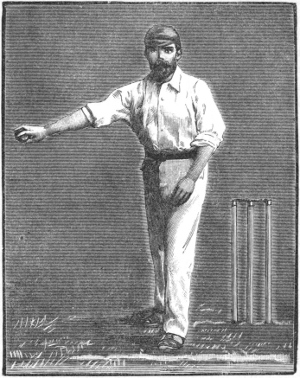
Low delivery.
The best bit of bowling the writer ever recollects playing against was in the second innings of the Gentlemen of England v. Australians, at Lord’s in 1884. It was Giffen’s day, and a batsman had to have luck on his side if he succeeded in staying in long enough to appreciate the beauty of the bowling. Take Peate and Emmett, the two Yorkshire left-handers, both in their day the best bowlers in England—both these men stand sideways to the batsman when they deliver the ball, and both are most difficult to see. Palmer, the Australian, bowled very nearly quite square; his bowling was very easy to see and to judge, and the more credit is therefore due to him for being such a successful bowler. There is no doubt a greater difficulty in attaining to perfect length and command over the ball when the body of the bowler is not square at the moment of delivery; but if these essentials to good bowling are obtained by patience and constant practice, the bowler has this great advantage, that his balls are more difficult for the batsman to judge accurately. It seems strange that not one of the numerous published books on cricket has ever suggested the advantage to the bowler which is obtained in this way. In almost every one of these works great stress is laid upon the necessity of the bowler presenting a full face to the opposite wicket at the moment the ball leaves the hand. It is doubtless easier for a beginner to bowl straight if he adopts this style of bowling; but if he can once gain straightness by the other, viz. the sideways style, he has enlisted a great help to success.
W. G. Grace is, however, an exception to this rule. He delivers the ball perfectly square with the batsman; and yet we suppose that to a batsman who meets him for the first time, his bowling is about as difficult to see and to judge as that of any bowler ever was. It is a fact that his bowling is invariably fatal to men he has not met before. This is owing to the hovering flight that his action imparts to the ball. The first time the writer ever played against W. G. Grace’s bowling was at Cambridge in 1878, and on the way to the wickets he was greeted with the cheering cry, ‘I’ll get you out; I always get youngsters out!’ and surely enough he did, caught and bowled for two or thereabouts. What the champion did next morning showed that he was as generous and kind to young cricketers as he was skilful in the game. He took the writer to the nets prior to the beginning of the second day’s play, and saying that youngsters required to know his bowling before being at home with it, he proceeded to bowl for quite twenty minutes to him; a comprehension of his method was thus gained, and the result was an addition to the Cambridge score of some forty odd in the second innings. Few latter-day cricketers would do this.
Perhaps one of the reasons why W. G. Grace is so deadly to young cricketers is this: the batsman, seeing an enormous man rushing up to the wickets, with both elbows out, great black beard blowing on each side of him, and a huge yellow cap on the top of a dark swarthy face, expects something more than the gentle lobbed-up ball that does come; he cannot believe that this baby-looking bowling is really the great man’s, and gets flustered and loses his wicket. W. G. Grace is certainly enormous, and a year or two ago at Lord’s an amusing remark might have been overheard on this subject. The England v. Australia match was being played. W. G. walked out into the field side by side with Briggs of Lancashire, the latter, as is well known, being very small, perhaps hardly up to W. G.’s elbow. A small child of about five was in the pavilion with his father, and said, ‘Father, who is that big man?’ ‘That’s Dr. Grace, the champion,’ said the papa; and ‘Who is the little one?’ the child continued. ‘That is Briggs.’ Dead silence for a few moments, and then, ‘Papa, is Briggs Dr. Grace’s baby?’
Although power of pace, straightness, and command over the ball are the really essential qualities of good fast bowling—as, indeed, of all sorts—there are many occasions when fortune smiles upon bowling which possesses none of these good attributes. And it is for this reason, we think, that every cricketer should be able to bowl when called upon to do so by his captain. Every man who has played cricket has bowled at a net, and he certainly has an action which is different from everybody else’s. As a rule, men who are not considered regular bowlers can send the ball in somehow or other at a fairly fast pace more or less straight, and these unknown, wild, and erratic bowlers often succeed in getting rid of well-set batsmen who have defied all the efforts of the recognised bowlers of the side. There are numerous instances of a side being deeply indebted to a bowler who never before nor afterwards showed the slightest ability to get wickets. In Australia in 1882, when Ivo Bligh’s English team was playing combined Australia, on a certain occasion two of the best Australian batsmen—Murdoch and Bannerman—seemed immovable. They had been in for about an hour, and every one of the regular English bowlers had been on and off. A suggestion was made to try C. F. H. Leslie. Now this gentleman, with all his great merits, was never, even in the estimation of his best friends, a great bowler. But on he went with pleasure, as every cricketer should when ordered. The first ball was a very fast one, rather wide, the second ditto, but the third one—‘Ah, the third!’—was a head ball, designed after the manner of Spofforth’s best; and it pitched on the middle of Murdoch’s middle stump! The next comer was Horan, at that time the reputed best player of fast bowling in the Colonies. A very fast long-hop, wide on the off side, was prettily cut straight into Barlow’s hands at third man, and Mr. Leslie had secured two wickets for no runs. He continued for another over or two, had Bannerman beautifully stumped by Mr. Tylecote off a fast wide half-volley on the leg side, and then retired in favour of one of the regular bowlers, after having, simply by wild erratic fast delivery, lowered three of the best Australian wickets. We give this as an example of the principle that every cricketer should try to bowl, and if he finds that he cannot attain to any efficiency, even with constant practice, then let him try to ‘sling in’ as hard as ever he possibly can; he will often be of use to his side when in a fix.
Before leaving the subject of fast bowling a word must be said about what—some years ago, and again now—may be called the great cricket bugbear of the last few years—viz. throwing. It is worthy of notice that when over-arm bowling was first allowed a great outcry arose, and there were not wanting those who prophesied that this ‘hand over head’ style would ultimately result in ‘a mere over-hand throw—a kind of pelting, with a little mannerism or flourish to disguise it.’ Now it is an astonishing thing that, in a great variety of cases, this is just what actually has happened. Some of the bowling that has been allowed to pass unnoticed by umpires is well described by the phrase quoted; but, although this is so, there are many minor offenders whom all would like to see pulled up short, not out of any ill-will to them personally, but in the interests of the game. Now throwing is most pernicious to cricket, and is calculated, if allowed to increase (as it surely will unless promptly suppressed by the authorities, backed by public opinion), to exercise a most disastrous effect on the game. The subject of throwing is sometimes pooh-poohed by prominent cricketers, who have remarked, ‘What does it matter whether a man bowls or throws?’ If it makes no difference, by all means let the M.C.C. at once expunge the rule relating to throwing and jerking. But let us pause for a moment to see if there are any reasons to suppose that it does make a difference. There are, in truth, two very good reasons why throwing should be stopped. First, if it were allowed it would seriously interfere with the art of bowling. The reasons for this proposition are as follows: In throwing there is no scope for dissimilarity of style. All men who throw must, from the very nature of the delivery, send the ball on its course with exactly the same description of spin. It is impossible for a thrower to make the ball go across the wicket from the leg to the on side; every ball which leaves a thrower’s hand has the off-side spin on it, and none other is possible. Any style which tends to cramp bowling, as this does, must be bad. Again, a throwing bowler cannot change his pace as other bowlers do; he dare not bowl the slow high-dropping ball so successfully used by Spofforth and others, because he knows that when his arm and wrist move slowly the unfair jerk of the wrist and elbow will be more manifest than when it is partially concealed by the usual quick movement of his arm. If throwing tends to cramp bowling, as it does, and render certain essentials for the development of the science impossible, then it must be injurious to the game. Secondly, if throwing were allowed the batsman would be in a position of considerable danger. Many cricketers say, ‘Let throwers alone, they are always easy to play;’ and this, no doubt, is so, for the reasons given above, especially when every thrower must, for the sake of appearances, adopt some slight measure of disguise in his action; but once let it be recognised that throwing is part of the game, and a race of sturdy chuckers will spring up, whose pace will be so terrific that the best and pluckiest batsman will not be able to defend his body, much less his wicket, against their lightning-like deliveries. Imagine what it would be if Bonnor, or Forbes, or Game were to be allowed to throw, all of them having thrown in their best days as much as 120 yards—is it likely that a batsman at a distance of only twenty-one yards could be quick enough with his bat to stop such bowling? Even with an ordinary fast bowler a batsman has sometimes difficulty in preventing himself from being struck by the ball, and with an undisguised thrower the danger would be tenfold.
The question then arises, what can be done to stop the throwing nuisance? And it is one which every member of the cricket-loving community should ask himself. It is a question of the greatest difficulty, as is evident from the fact that the committee of the M.C.C. have so far found it impossible to legislate with regard to the nuisance. The committee has done everything in its power; it has instructed the umpires to watch closely the delivery of every doubtful bowler, and probably the umpires have acted fully up to their instructions; but they have stopped here, and absolutely refused to report to the world the result of their careful observations. It is a fact that of late years no professional umpire in a first-class match has no-balled a professional bowler for throwing. This is not to be wondered at: professional umpires themselves have been professional bowlers, and they cannot bring themselves to take the bread out of the mouth of one of their own class by no-balling him, and stigmatising him at once and for ever as a ‘thrower.’
We cannot get amateur umpires to stand: these would, no doubt, fearlessly no-ball any unfair bowler; but if we could, we should probably find that the quantity of bad decisions in the course of the year would be greatly increased. An umpire wants practice and experience in keeping his attention and whole mind fixed impartially on the game, and this can only be acquired by those who stand day after day in that capacity.
The only way, then, to our mind, to stop throwing, as the M.C.C. cannot and the umpires will not, is to get public opinion to step in and sweep it off our cricket grounds. Let every amateur cricketer, whether he plays for his county or his village club, set his face resolutely against the evil, and do his utmost to discourage it. If an ‘Anti-Throwing Society’ could be established amongst cricketers, we firmly believe it would effect its object.
In the North of England, where the game is ever increasingly popular, there are many ‘chuckers’ to be met with. The clubs who do not possess, to say the least, a doubtful bowler are, we should say from our experience, in the minority. Young professional bowlers see the general laxity that prevails, and adopt the peculiar flick of the wrist and elbow, hoping thereby to get more twist on the ball, and this sooner or later develops into a throw. Young bowlers of this description get drafted from their village clubs into the county team, and thereby augment the number of ‘doubtful’ bowlers in first-class matches. Now if every amateur stood out against this system, and even went so far as to say, ‘I will not be one of a team that wins its matches by such means,’ unfair bowling would soon die out.
It may be accepted as an absolute truth that the greatest bowlers do not throw, and never have. Spofforth, Turner, Palmer, Lohmann, Richardson, Morley, and a host of others are true bowlers, and to the credit of the Australians it may be said that till 1896, when Jones and McKibbin came over, there had been no suspicion against any Colonial bowler, and it is a matter of great regret that both Jones and McKibbin must be described as very great offenders in the matter of throwing.
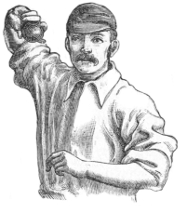
Doubtful delivery.
It will be well for everyone to realise that, if this question is allowed to drift on from year to year without any serious protest from public opinion, it will become absolutely necessary for the committee of the M.C.C. to do something in the matter. What this should be is, as we have said, very doubtful, and many and varied would be the opinions of competent judges as to the form of legislation that would meet the evil. It can almost be taken for granted that it is impossible satisfactorily to define a throw, and even if this were not so the solution of the question would be no nearer, as there would be just the same difficulties in the way of an umpire saying that a bowler came within the definition as there is now in saying that he throws. What is wanted is to get rid of throwers in small club and village matches, and then we should never get them drafted into first-class cricket. If the umpire at either end were allowed to no-ball, we believe the system of throwing would receive a serious blow. It often happens that the thrower can only bowl at his own umpire’s end; if he attempted it at the other end he knows what would await him; and if both umpires had the right to no-ball for throwing, this difficulty would be overcome by his not being able to bowl at either end. It is, however, earnestly to be hoped that no change of any sort in the rules will be necessary, but that all true cricketers will unite in discountenancing that which is always a source of wrangling and dispute.
Before leaving the subject of fast bowling a few remarks on the position of the field will not be out of place. Every bowler who is worth his salt knows much better than anyone else how the field should be placed to his bowling. So much depends upon the style and favourite strokes of the batsman to be dislodged and the mode of attack that is going to be brought into requisition, that the general rules we suggest here are more as a guide to young fast bowlers than to those who have gained their experience. To a fast over the wicket round-arm bowler (on a true wicket) the field should be placed as on page 176.
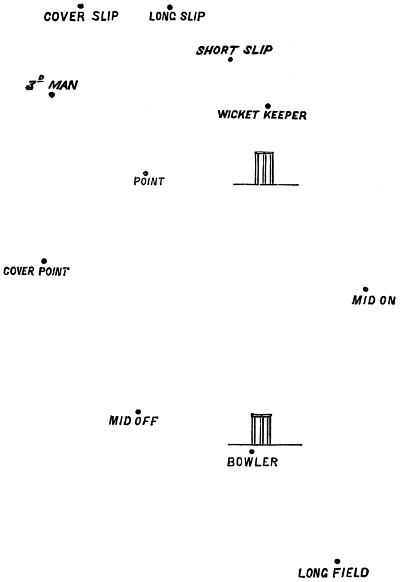
The field for a fast right-arm bowler.
Should the bowler, however, be one who changes his pace to slow and relies occasionally on quite a slow head ball, it will be as well to bring short-leg half-way between the umpire and the bowler, and put mid-on out deep in the field on the on side. On no occasion should short-slip be dispensed with; he should on a fast wicket be fairly fine, and if he is a quick active man with his hands (as he should be for this post), about eight yards from the wicket. The object of short-slip is to pick up snicks which just miss the wicket-keeper, and although he may hold a larger proportion of these quick snap catches when a long way from the wicket, he will get an infinitely greater number when closer in; consequently, if he is a man of quick sight and tenacious hand, he will actually secure more catches close in, although at the same time he may miss more. The positions of long-leg, third man, short-leg, and mid-on depend to a great extent on the batsman’s play. It is a golden rule never to do without a point and cover-point, although in some instances—e.g. when a strong cutting batsman is in on a fast wicket—it is sometimes advisable to place point in front of the wicket and cover-point square. It is, however, but seldom that this is necessary, and many cricketers always view the change with some misgiving as to its correctness, because a good active cover-point in the usual place saves a large number of runs and, probably, gets more catches than any other man in the field, with the exception of the wicket-keeper and short-slip.
A round the wicket fast bowler requires the field in much the same position. But in his case it is sometimes necessary to have an extra man on the leg side, as these bowlers are very apt to bowl between the legs and the wicket, which means with good batsmen that they get played on to the leg side, between mid-on and short-leg. If this change is necessary long-leg may be sent almost to the boundary, very fine, behind the wicket, and long-stop be brought on to the leg side. A very fine long-leg prevents boundary byes, and generally manages to save the fine long-leg boundary hits. Unless there is a first-class man behind the stumps, however, this generally results with first-class bowling in rather too many extras to justify its continuance. Fast left-hand bowlers want more men on the off side, as, from the nature of their bowling, they get more punished in that direction than anywhere else. If fast left-hand bowling is accurate and straight, long-leg is usually dispensed with, and, in fact, mid-on as well is often taken to the other side of the wicket, leaving short-leg, who is brought forward a few yards, the only man on the leg side of the wicket. Then there is an unbroken line of fielders on the off side, which the batsman finds it difficult to break through if it is composed of active and energetic men. The way in which fast left-handed bowlers place their field is usually as on page 177.
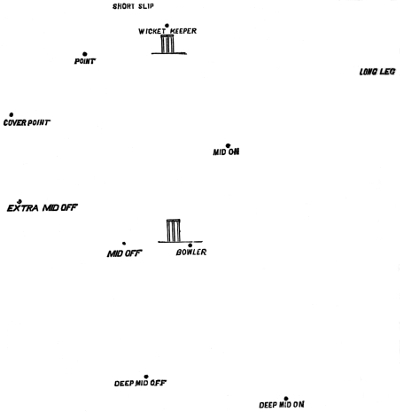
The field for a fast left-arm bowler.
There is a class of fast left-hand bowlers who require more men on the on side—viz. those who give the ball the leg side bias on delivery, which, to a right-handed batsman, causes the ball to come in from the off side, or, as it is usually termed, to come with the arm. It is often necessary with this style of bowling to have a very fine short-leg, to stop the snicks and leg byes which are caused by the batsman playing outside the ball. Then a short-leg by the umpire is necessary, and also a mid-on, making three on the on side. Mr. Appleby, of Lancashire, is an example of this style of bowler, as is Wright of Kent, who at times is most deadly with the ball coming with the arm, especially if he has any assistance from the lie of the ground. We have occasionally seen a left-arm bowler, like Emmett of Yorkshire—who relies exclusively on the off break, which, to a right-handed batsman, brings the ball from leg to off—involuntarily send down a ball that, instead of taking the bias imparted to it, for some strange and unaccountable reason went the other way, an accident which places the batsman in a most awkward fix.
Some bowlers experience great difficulty in bowling to left-handed batsmen. The necessary alteration in their style seems to worry them and interfere with their accuracy of pitch. Usually a slow bowler tries to get a left-handed batsman caught on the off side. He places most of his men on this side, and bowls the off break (or, as it would be to a left-handed batsman, the leg-break) with the object of getting the batsman to play inside the ball, and thus make an upstroke. In short, he places the men as a left-handed bowler places them when bowling to a right-handed batsman. Left-handed batsmen are notoriously strong and powerful in their off hitting, and consequently in this direction must the bait be laid. As a rule, left-handed batsmen are apt to be a trifle wild and unable to restrain their keenness to hit, and consequently they pay the usual penalty of attempting to hit widish off balls going away from them. But occasionally a bowler meets a left-hander who is too wide awake and too good a batsman thus to throw away his chance of scoring, and then different tactics must be employed. There have been, and are, wonderfully few really good left-handed batsmen in England, and the chance of a bowler having to meet one of them is very slight. Between the years 1880 and 1890 there were only, in first class cricket, the late W. Scotton of Notts and Peel of Yorkshire and the late F. M. Lucas. The best of this class was perhaps F. M. Lucas, whose early death in India will always be deeply regretted by his wide circle of friends. He was really an accomplished batsman with good sound defence and great punishing powers. A slow bowler might bowl for hours on the off side to him with the sole result of seeing four after four being despatched all along the ground to the boundary. Moses of Sydney has many times distinguished himself against our English teams in Australia, and was an excellent batsman. At the present time we have Ford, Clement Hill and Darling the Australians, and the two last are probably the two finest left-handed batsmen the world has seen. Ford as a hitter was perhaps the hardest left-hander that ever lived, and Hewett a few years ago was almost as hard. Bruce the Australian is a fine free left-handed batsman, and certainly has a more graceful and finished style than any other left-hander we have yet seen. In our opinion, when a really good left-hander comes in, one who is not likely to get himself out on the off side by careless hitting, an attack should be made on his leg-stump. Most left-handers are good leg-hitters, but we have never yet seen one (not excepting those above named) who was as good on the leg-stump as a first-class right-handed batsman. There is an awkwardness apparent in the left-hander’s play to a ball pitching on the leg-stump, or just inside it, and there is always a great likelihood of a cross bat being used for a leg hit. Many and many a time has the writer, after trying the off-ball trick unsuccessfully against one of these batsmen, succeeded in dismissing him by bowling over the wicket at the leg-stump and between the legs and leg-stump of the batsman. This manœuvre only entails a couple of men being brought across from the off side to stop the run-getting.
There is one species of ball which we have not discussed, deadly as it is, both in fast and slow bowling. This is the ball which, after the pitch, never rises, but shoots along the surface of the ground, and is commonly called a ‘shooter.’ The reason why no notice was taken of this when the different kinds of ball which may be bowled were being dealt with is because no amount of practice or skill can enable a bowler to bowl thus. It depends for existence upon inequalities in the ground. There are some grounds which have acquired great reputation for supplying ‘shooters’ for the benefit of bowlers; but this reputation is unfortunately always accompanied by one for being lumpy and dangerous. Not a great many years ago Lord’s used to be celebrated for shooters, owing to its rough condition; and even now, well looked after as it is, shooters are of more frequent occurrence there than on most other good grounds. Although it is not in the power of any man to bowl shooters at will, still there is no doubt that men with a low delivery have a greater chance of being helped by a shooter than men who bowl with a high overhead action. The writer recollects at Cambridge, about 1879 or 1880, being told by a young professional bowler, engaged at the University ground at that time, that he had found out how to bowl shooters. He was a bowler of considerable promise, and had begun to make his mark in county cricket, but it being known that his cricket abilities far exceeded his intellectual powers, the announcement of this wonderful discovery was received with some amount of doubt. However, out he came to bowl, to prove his prowess with the celebrated shooter; but it simply appeared that, instead of bowling with an overhead delivery, which was his wont, he bent his body quite low, and proceeded to bowl in a manner which was hardly removed from genuine under-hand. It is unnecessary to say that there were no shooters. His balls kept low after the pitch because his action was low.
There is one style of bowling sometimes seen in the present day that has not been mentioned, viz. fast under-arm. This is of two kinds: first, that which pitches a good length as with round-arm bowling; secondly, ‘sneaks,’ or bowling that pitches near the bowler’s hand and travels along the ground till the ball reaches the batsman. The latter can never be of any avail against a good player on a decent wicket, as every ball can be met by the forward stroke and rendered harmless. In country matches it is amusing to see the batsmen holding their bats in the air and trying to pounce down at the very last moment on these balls. This mode of playing such bowling is essentially incorrect, and would even be likely to cause the downfall of a good batsman; it is as certain as anything can be at cricket that a good forward straight bat cannot miss a ‘sneak.’ Mr. C. I. Thornton at one time attempted this style of bowling, and was known to get a wicket or two. The good-length fast under-arm, when bowled round the wicket with a good leg twist on, might be made very dangerous. The old style of low round-arm, mentioned a few pages back, was very similar to this style of bowling, and was bowled with the same object as this has in view, viz. catches in the slips and on the off side. We only know of one fast under-arm, leg twist, good-length bowler, and he does not play in first-class cricket. His name is Bunch, an old sergeant of the Black Watch, well known on many military cricket-grounds all over England and India. Some years ago he was decidedly a good bowler, his balls came very fast, pitched good length on the leg-stump, and, having lots of leg stuff on, wanted very careful play.