Chapter II · BATTING. (By the Hon. R. H. Lyttelton.) (continued 2)
Reading edition
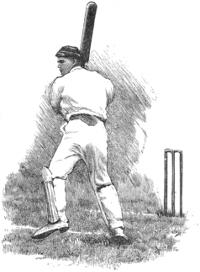
Fig. 13.—Running out to drive. (Shrewsbury.)
If you find, on going out to hit a ball, that it is too short, and you cannot get at the pitch of it, you have several courses open to you. If you are a very big hitter, and the field is not very far out, it is worth while to try the experiment of hitting as hard as you can; the ball must go high, and may go over the ropes or out of harm’s way; indeed, some great hitters seem to prefer a ball that is not quite a half-volley. Mr. C. I. Thornton, the biggest hitter the world has ever beheld, with the exception of G. J. Bonnor and perhaps Lyons, has made his longest hits off such balls as these; while Bonnor, who possesses a prodigious reach, seldom leaves his ground at all, and constantly sends the ball out of the ground by hitting short of the actual pitch. If the ball is smothered it cannot go up in the air, and though it is more correct cricket to get over the ball and drive it forward, as Shrewsbury and A. G. Steel do, it is probable that the great hitters would lose more than they gained by playing the orthodox game. There is a golden rule to be carefully remembered in playing slows, and that is, never to run out to a ball that is well outside the off stump. We do not mean to bar the player from running out to a ball which is absurdly over-pitched, and which he is certain to get full-pitch if he goes out; but he should not leave his ground to the half-volley unless it is nearly straight. There is more than one reason for this. In the first place, if you miss the ball, it is the easiest sort for the wicket-keeper to take, and any moderately decent wicket-keeper will certainly have you out. In the second place, an off ball is one that it is impossible to hit or play with a straight bat, and if you run out to slows you ought always to hit thus; and this rule is sound even when you run out to a ball on your legs, for that is generally hit to long-on with a straight bat, and not to leg. It is generally true that you should never leave your ground to any ball that may be called crooked, whether it is to leg or to the off, for in either case you run a serious risk of being stumped; it is only straight or nearly straight balls that you ought to meet by going out of your ground. The modern slow bowler is so very accurate that he very rarely bowls on the leg side at all, and the old-fashioned lobber who used to bowl on the leg side with a twist from leg and have four or five fields on the leg side is gradually disappearing. The ball that in nineteen cases out of twenty you have to meet by going out of your ground is, therefore, the straight ball.
As far as lobs are concerned, you can play them by stopping in your ground; but the really good player to lobs runs out to a certainty when the ball is overpitched, and the famous Wm. Clarke used to say that Pilch played him best, as he used to wait his opportunity and meet him and run him down with a straight bat. If you come to reason out the theory of batting to slows, and think how you can best defend your wicket and best score off such bowling, you will easily satisfy yourself that by playing back and gently forward you may ensure safety for a considerable period, but you cannot score even moderately fast. The ball does not come up to the bat fast off the ground as in fast bowling, and if you play forward hard you run the enormous risk of being caught and bowled or caught at mid off. In other words, while to fast bowling you play forward to get runs, to slow bowling you play forward to defend your wicket. If, therefore, you play the extra-cautious game and stick in your ground, or from some cause or another are unable ever to ‘give her the rush,’ you will not be able to score except by casual singles, unless you wait and fully avail yourself of a full pitch or an outrageous long hop, relished, and often obtained, when amateurs are bowling, but very seldom delivered in first-class matches, and practically never by professional players.
It is difficult to know what to do with the good length off ball. It is much harder to cut slow bowling than fast: greater strength of wrist is wanted, and there are many players who are unable to do more than merely pat the ball towards third man for a single or two runs. Slow bowlers have a great fancy for bowling without a field at third man, and this is to the advantage of the batsman; but even if there is a third man, at any rate he cannot cover more than a certain amount of ground, and you will find that many a run may be got by the pat. Mind and get over the ball, and you cannot then come to grief by being caught at third man or short-slip, and very rarely by the wicket-keeper. The bumping ball ought to be left alone; this sort of ball is the only one in meeting which prudence is the better part of valour, and no attempt ought to be made to hit at all. The old Adam within them forces a great many players to try and hit, but it is almost a certainty that if the ball is hit it must be from underneath, and up in the air it will consequently go. On a soft slow wicket any run getting to good slow bowling is extremely difficult, but even on such wickets you will lose nothing and gain the casual single by the pat.
The good length ball on the off side is the modern batsman’s bugbear, but it is far easier to play when the bowling is fast than when it is slow. It is easier to cut in the first instance, and there are seldom so many fields on the off side to the fast bowler. But the slow ball can be and ought to be driven along the ground if the batsman gets well over it, times it correctly, and throws the left leg across in the same way as we explained in describing the proper method of making this stroke off fast bowling. It is more difficult to time good slow bowling, when the bowler is continually altering his pace, than fast, and herein lies the difficulty of hitting these off balls. Bear in mind, however, that by keeping well over the ball you practically run no risk of being caught anywhere; sooner or later you will get your eye in, and when that desirable consummation is accomplished, you will be astonished to find how safely you will hit many balls that when you are looking on it seems impossible to hit without incurring considerable danger. But nothing can be gained by leaving balls alone; you run the minimum of risk by hitting at them, if only you observe the two rules which ought to be hung in your bedroom and branded into your brain, ‘Put the left leg over,’ and ‘Get on the top of the ball.’ Above all things do not play for a draw.
From what has been said on the principles which govern the proper playing of fast and slow bowling, the reader may be led to think that slow bowling is far more difficult to play successfully than fast. Chacun à son goût is true, no doubt, but we are inclined to think that, to the majority of players in the prime of their play, slow bowling is on the whole more difficult to play, especially on hard wickets. Take the case of W. G. Grace. It was almost a waste of time on hard wickets to put on fast bowlers when Mr. Grace was at his best. The sole advantage to be derived from so doing arose from the fact that it was advisable to distract his eye, and for this purpose a fast bowler was useful. By this we mean that, when slow bowlers were on at both ends, his eye would become more accustomed to the pace of the ground, and in a shorter time than it would have been if a fast bowler had been on at one end. But the fast bowler was on mainly to enable the slow bowler to get him out, and if the reader looks at Mr. Grace’s enormous scores of twenty years back he will find that Shaw, Southerton, Peate, and Lillywhite got him out a dozen times to the fast bowlers’ once. And the runs that came from bowlers like Martin McIntyre were astonishing; anywhere, cuts, pushes through any number of short-legs, big drives and colossal leg hits—all were alike to the great batsman.
On soft wickets, though many think otherwise, we believe that fast or medium-paced bowling is more difficult. This must be assumed only in the case of those fast bowlers who have power to keep their precision and pace on slow wickets, like Morley and Richardson. The variety of wickets, as is shown in the chapter on Bowling, is very great, and on the real mud farmyard sort of wicket it is generally safe to presume that fast bowlers cannot act. When there is a slight drizzling rain, which keeps the ball and surface of the ground wet, fast bowlers flounder about like porpoises, and the only bowlers who can act at all are the slow, though they are very much handicapped. But on the real bowler’s wicket, soft, yet gradually hardening by the effect of the sun, cæteris paribus, the fast or fast medium bowler will, as a rule, be the most deadly. The year 1879 was, on the whole, the wettest year for cricket that the present generation has seen, and it is instructive to turn to the result of the season’s bowling for the county of Nottingham. This county possessed in Alfred Shaw and Morley the two best bowlers in England—one slow, the other fast. Here is the analysis of each for Nottingham:—
OversMaidensRunsWicketsAverage
Morley725349867899·66
Shaw7944536516211·31
It will be seen from this pair of analyses that Morley’s is slightly better all round than Shaw, with the exception of the number of maiden overs. But maiden overs are not the final goal of the bowler’s ambition. They are only means to an end. The true bowler’s one idea is to get wickets. The reader will note that Morley, the fast bowler, got no fewer than twenty-seven wickets more than Shaw, which more than makes up for the latter’s greater success in bowling maidens. The year 1879 was doubtless a great year for bowlers, but none the less we doubt whether, taking a whole season’s work for a county, this record has ever been surpassed by any pair of bowlers at any time, and it is as good an illustration of the truth of our theory that in wet years slow bowlers are not likely to succeed so well as fast or medium-pace.
It has always appeared to us that the reason why real slow bowling is slightly less deadly than fast or medium on slow wickets is simply that the batsman is more at the mercy of the eccentricities of the ground when playing to the latter class of bowling than when playing to the former. He always has the power, if he would only exercise it, of leaving his ground to balls of a certain length from the slow bowler, and smothering them. And again let the beginner lay this axiom to heart: the ground can commit no devilry if the ball is smothered at the pitch. On slow wickets, therefore, to slow bowling leave your ground with even less hesitation than on fast, and argue in this way, that as life against these bowlers and on this wicket is certain to be a short one, therefore it had better be a merry one for the sake of the score.
There are and have been a few great men with the bat who obey no law, but possess that strange indefinable gift called genius, which rises superior to any difficulty of ground or bowling; these batting luminaries may play their ordinary game on slow difficult wickets, and their genius enables them to do what ordinary mortals cannot. On really difficult wickets Shrewsbury shone, and on the whole he has proved himself the best player the world has ever seen on caking, difficult, soft wickets. But let the ordinary player, who has acquired a certain amount of skill in batting, remember that cricket on hard and fast wickets and cricket on slow are two quite different things, and that he must alter his game to suit the circumstances. The very fast-footed bookish sort of player is the one who is most at sea on soft wickets; and this last bit of advice we respectfully urge upon him—that one hit for four and out next ball will probably be of more value to his side than twenty minutes’ careful defence and no run. It is not on soft wickets that drawn games are played, unless there is rain after the match has begun; it is on dry wickets, with boundaries close in, that the plethora of runs makes the game dull to all except the ignorant spectator and the voracious batsman. Of course, if there is only a short time left before the drawing of stumps and conclusion of the match, say an hour and a half or two hours, it may be of importance to play for a draw; then the twenty-minutes-without-a-run batsman may be the means of salvation for his side, as Louis Hall has proved to be more than once for Yorkshire; but, except under such circumstances, the hitter who runs a certain risk for the sake of a hit is the more valuable man.
A few words now on running. A man is out if run out as decisively as if his middle stump is knocked down; but being run out is more annoying than being bowled, so everybody ought to learn how to run. Some fieldsmen are so renowned for their throwing and rapidity of movement that when such a man is going for the ball the batsman will not venture on a run which, under ordinary circumstances, he might safely make. In any event do not run if you feel any doubt of its safety. The first invariable rule is that the striker calls the run if the ball is hit in front of the wicket. This is simple to remember and there is no exception unless it be when the ball is hit to third man under certain circumstances. These circumstances refer to the fieldsman himself. If the third man knows his business and throws to the bowler, the striker has to run the risk; therefore he ought to call. If the third man is a player of tradition and always throws to the wicket-keeper, the non-striker is in danger, but if he is backing up he never will be run out. All hits behind the wicket—except in the case above mentioned—must be called by the non-striker, and the striker must not look at the ball after he has hit it, but at the non-striker. The man who has not to judge the run must have a simple childlike faith in the judgment of his partner, and if he gets run out he may remonstrate gently with him afterwards with good reason. The man who is receiving the ball can easily get into the habit of watching it after it has passed him on its way to the long-stop or if he has hit it to long-slip; but this is a bad habit, and if indulged in will result in the two batsmen holding different ideas as to whether a run can be got or not, on which subject there must be no difference of opinion. If the batsman to whom rightly belongs the call shouts ‘run,’ and his colleague shouts ‘no,’ unless one gives way promptly there may be a crisis at hand. Never do batsmen look so foolish as when they affectionately meet at the same wicket, and nothing is so maddening to the supporters of a side as to see a good batsman well set deliberately lose his wicket by the folly of either his colleague or himself. If batsmen will only remember that the decision of the run must rest with one man, and that his call must be obeyed at once, there will not be many runs out. When, say, the third run is being made, and the question whether a fourth can be successfully attempted arises, that batsman who has to run to the wicket nearest the ball ought to call. The reason of this is, that as the ball is a considerable way from the nearest wicket it is almost certain to be thrown there, and the batsman who calls ought to be he who runs the risk. We will give the following rules to be remembered by every cricketer with regard to running. (1) The striker must call every time when the ball is hit in front of the wicket. (2) The non-striker must call every run when the ball is hit behind the wicket, except in the case of hits to third man as mentioned above. (3) Whoever has to shout, let him shout loudly; there is no penalty attaching to a yell, and it is comforting to a man to know his colleague’s intention without any doubt. (4) If a bye is being run, the striker must run straight down the wicket, as he may be saved from being run out by the ball hitting his head instead of the wicket, for which mercy he ought to be duly thankful. (5) On all other occasions run wide of the wicket so as not to cut it up. (6) Always run for a catch if sent reasonably high into the air; if it is caught no harm is done to you, and to be missed and to secure a run in one and the same hit is a veritable triumph. (7) Run the first run as hard as you can, and turn quickly after grounding your bat within the popping crease, for the fieldsman may bungle even the easiest ball, and it is never safe to assume that there can be no second run.
We hope that we have now explained the true principles of batting to guide the youthful player in his path. One other word of caution. A young cricketer may go to Lord’s and watch a great match; he may see the giants of the game perform—MacLaren, Ranjitsinhji, Jackson, and Palairet. He will wonder and admire, but let him beware of imitation, which may lead him into innumerable quagmires. In another walk of life, literature, you will find facetious writers who are fond of imitating the style of famous authors, and very amusing the attempts sometimes are; but it is easily seen that the points they successfully imitate are the roughnesses and eccentricities which are frequently characteristic of great authors. An imitator of Carlyle, for instance, revels in the brusque eccentricities of the great man’s style, but he never succeeds in portraying his noble qualities. It is much the same in cricket: genius defies imitation, and is only by poor struggling humanity to be admired. In the prime of his play nothing in cricket was grander than the sight of W. G. Grace scoring two runs off a ball that any other cricketer would have been only too happy to stop. No school coach that understood his business would tell a youth to play certain balls as they are played by Mr. A. G. Steel, who sometimes adopts the most daring methods, and it is not safe to infer that anybody else in the world can play in a like manner. It is so with hitting. Bonnor, Lyons, O’Brien, Ford, and Jessop can hit many balls which the great majority of other cricketers would only venture to play gently forward. Some critics who are great at criticism, but great at nothing else, have been known to shake their heads at some of the methods of great players; but we can assure these gentlemen that real genius admits no more of criticism than it does of imitation. The four never-to-be-violated rules previously mentioned need not trouble the genius at all; no human law need concern him: he is a law to himself, and looks down from a lofty eminence on his weaker brethren. What is the good of telling A. G. Steel not to move out of his ground to fast bowling, seeing that he does so constantly, and gets four runs by a fine hit when he ‘gives her the rush’? He will not heed you; and why should he?
Apart altogether from the natural accuracy and quickness of hand and eye, without a proper allowance of which labour will be in vain, a great deal depends on the temperament of each player. Whether failure is owing to health, to inability to recover elasticity of spirits after a few defeats, or to some other cause, it is impossible to say. But let the good player who goes through a whole month, or perhaps even a season, with very bad luck, and comes out in the end with a bad average, comfort himself with this reflection, that not only have good players had these reverses, but even the very best. Mr. W. G. Grace must be accustomed to hear and see his name referred to, but even he has had spells of bad luck, and he will, we are sure, excuse us if we put in full the following figures of innings which were played when he was in his prime:—
June 15 and 16, 1871.—Gloucestershire v. Surrey.
c. R. Humphrey, b. Street1
June 19 and 20, 1871.—M.C.C. v. Cambridge University.
c. Ward, b. Bray4
c. Thornton, b. Bray4
June 22 and 23, 1871.—M.C.C. v. Oxford University.
c. and b. Butler15
June 29 and 30, 1871.—Gentlemen of South v. Players of South.
c. Lillywhite, b. Southerton4
b. Lillywhite11
These figures show how the mighty do sometimes fall, and this certainly ought to console those in the humbler walks of the cricket world. Some players have shot up like rockets, played for a season or so, and then have been heard of no more; but the county that plays a series of county matches will act unwisely if it shunts a player who has shown that he possesses real batting ability. Of course there are limits to the patience of every club committee, but all committees would be wise if they were to err on the side of leniency in this matter.
It is of very little avail writing any sort of homily on nervousness, which is in the constitution, and cannot be got rid of by much or any reading. It is common to all, in greater or less degree, and if any man tells you that he does not know what nervousness in cricket is, do not believe him. To say that there is no sensation other than a distinctly pleasant one in walking to the wickets is absurd. It is true that nervousness does not appear to affect the play of some batsmen, who on first going in seem to be playing their ordinary game. But the sensation is there, and these are the fortunate men whose play suffers but little in consequence.
Nervous players must try and reason to the effect that they are sometimes in the habit of making runs, and that therefore there is no great presumption on their part if they assume that the chances are they will do so again. They must also remember that, after all, cricket is but a game, and no moral disgrace will attach to them if they fail. These are but poor consolations at the best, but the game is so glorious that, as we have before remarked, it is better to try and to fail than never try at all.
It has always been assumed that the crack English Eleven that failed to make the necessary seventy-nine runs against the Australians in 1882 were nervous because they did not succeed in making them. We are not sure that they all were, or that there was more nervousness than usual; but the wicket was difficult, the Australians’ fielding superb, and their bowling extraordinarily good. Certainly two or three of the Englishmen were nervous, and no eleven could be got together anywhere to play such an important match without this being the case. But the longer anyone plays the less nervous will he become, and the fortunate men in cricket are those, like the famous Tom Emmett of Yorkshire, who can, as he modestly said, ‘bowl a bit sometimes.’ The player who plays only because he is a good bat, and never bowls after he has laid his duck egg, has no opportunity of retrieving his character by getting four or five wickets with the ball. The unhappy batsman makes one bad stroke and his wicket is lost, and he has possibly no further chance in the match. But though the bowler may bowl a wide one ball he may take a wicket the next, and we believe that these all-round players find more enjoyment in cricket than the man who only bats. To their credit be it said that at no previous period have the professionals combined the two more than they do now, and we congratulate Peel, Briggs, Attewell, Rawlin, Davidson, Hirst, and Wainwright accordingly.
The obvious advice to give to players whose success depends mainly on health is to implore them to look after and pay great respect to the laws by which health is regulated. Not to eat and drink too much, great though the temptation may be to do both, is a rule that ought to be observed by cricketers; but there is another, not so obvious, but of great importance, and that is, avoid sitting up late at night. There is such a lot of cricket in these days that some amateurs and a great many professionals play six days in the week. There is the corresponding amount of travelling to be got through, and a lot of fatigue to be undergone; sleep, therefore, must not be neglected, and long hours devoted to convivial evenings not only entail loss of health but loss of runs also. It is a curious and unwholesome feature of the present day that it is judged expedient to have enormous meals in the middle of the day, with salmon, forced meats, creams, jellies, champagne, and everything calculated to disturb digestion and pervert the sight. This meal is not only the cause of much indigestion, but also of a gross waste of time. Instead of half an hour being taken up by the legitimate luncheon, a precious hour is stolen from the middle of the day. It must be said that on the principal public grounds there is no reason to complain of the luncheons: excess is more the custom on private grounds.
As we have in this chapter implored captains of elevens to be merciful to good players who may happen to be out of luck, so now, in justice to the other side of the question, let us beg the batsman not to be superstitious.
Superstitions abound in most games, but we have no objection to examples of the weakness which cause inconvenience to nobody except the possessor. We have heard, for instance, of a really great player who never goes in to bat in a match with anything new about him, not even a shoe-lace; but such superstitions are harmless. There is, however, the man who has got it into his head, or possibly has dreamt, that it is quite impossible for him to score if he goes in first or fifth, or in some particular place; consequently the unhappy captain, after he has written out, with great care, an order of going in, is bothered and worried by men who begin to make excuse. One is certain that he cannot score if he goes in first, another thinks he ought not to be put so low down as eighth, and so on. Our advice to the captain is to care for none of these things; let him use his own judgment and not consider the absurd whims and eccentricities of nervous batsmen. The responsibility of managing a match is quite enough anxiety and trouble for him without being bothered by a mutinous eleven, and we entreat batsmen to obey without murmuring their captain’s orders, and go in without grumbling.
The rules of cricket are imperfectly understood even by some reputedly famous umpires; it may be well, therefore, to remind batsmen how many ways there are of getting out. They know what it is to be bowled out, caught out, stumped, run out, to get out leg before wicket, or to hit wicket; and a great many think that nothing else will get them out. This is a mistake, and it was a comical sight to see, as we saw some years ago, a first-rate professional diddled out in another way. It is against the rules, properly understood, to wilfully hit the ball twice. The rule runs: ‘The batsman is out if the ball be struck ... and he wilfully strike it again, except it be done for the purpose of guarding his wicket.’ But if a batsman plays a ball and a proper interval elapses the ball is dead, and he may return the ball to the bowler. The old rule reads: ‘if the striker touch or take up the ball while in play.’ In the case alluded to, Barlow was batting in a North and South match at Lord’s. He hit the ball twice, and, unfortunately for him, started to run. This starting to run proved the more or less wilful nature of the act. There was a roar of ‘How’s that?’ from the colossal throat of W. G. Grace, standing at point; it was a case of ‘You’ll have to go, Barlow,’ and naturally, in a somewhat moody manner, Barlow went to the pavilion. It is absurd to say that there was anything unfair in this; he violated a distinct rule of cricket. A lot of players think that the ball must not be hit twice under any circumstances, and they would as soon think of touching a red-hot coal as hitting the ball a second time. If there is no wicket-keeper and the ball is played dead against the foot, it may save a few seconds of time if the batsman shove the ball back to the bowler with his bat and stand still, thus saving point the trouble of picking the ball up and returning it. The ball while ‘in play’ must never be picked up by the hand, for handling the ball wilfully loses a wicket as much as having two stumps knocked down. It is an easy rule to remember, and is very rarely broken, but still it is a rule that must be observed. Obstructing the field is another violation of rule for which the extreme penalty is exacted. Of course a witness may tell an untruth in the witness-box, but unless it is spoken wilfully it is not perjury. So it is with obstructing the field. Many hundreds of times has a batsman standing in his ground prevented a wicket-keeper from catching him out; the mere fact that the player’s body, being in a certain position, forces the wicket-keeper to run round him instead of straight at the ball will make an uppish ball as unreachable as the sun. The fieldsman is obstructed, but not wilfully, so no penalty is incurred. But if the batsman were to hit up a ball to point, for instance, and either strike at the ball with his bat or wilfully baulk the fieldsman in any way, he would be out, and deservedly so. In this, as in other like matters, the umpire must be the sole judge, and it ought to be pretty plain and easy for him to give a right decision. About twenty years ago the well-known Cambridge University cricketer, Mr. C. A. Absalom, playing for his University against Surrey, was running a bye, and whilst running to the opposite wicket the ball hit his bat, possibly preventing him from being run out. The umpire gave him out; but the umpire was wrong, for the ball came from behind him, and as it was never alleged that he looked to see the course the ball was taking and then interposed his bat, it was obviously impossible that he could have wilfully obstructed the ball: it merely chanced that while running in towards the wicket the ball by accident hit his bat. We do not mean to imply that the batsman ought to run wide of the wicket to a short run in order to give the fieldsman every chance of running him out; on the contrary, if a short bye is to be run, we advise the batsman to run straight down the wicket, for then, as pointed out elsewhere, the ball will very likely hit him and prevent him being run out. But he must not deliberately get in the way of the ball or in any way contribute to the fact of the ball hitting him. A case of wilful obstruction ought easily to be detected by any decent umpire.
It is amusing to ask experienced cricketers in how many ways it is possible for a man to be got out at cricket, and it is astonishing to find many who give most absurd answers. There are nine distinct ways of getting out—(1) bowled; (2) caught; (3) stumped; (4) leg before wicket; (5) hit wicket; (6) run out; (7) handling the ball; (8) obstructing the field; (9) hitting ball twice. It is well to know these facts, for the batsman who gets out in an untoward and unusual way feels himself to be a fool, and generally looks like one. Mr. Alfred Lyttelton, when playing some years ago for Cambridge University Eleven against M.C.C. at Lord’s, got back to a slow long hop and with his foot just touched the leg stump, the bail of which did not at once fall off. Oblivious of this fact, and only conscious that he had caught the ball in the middle of the bat and sent it far away, off he started for his runs with radiancy on his face and a mocking smile on his lips. No less than five runs were run, and not until then did anyone except the wicket-keeper notice that the leg bail, after hanging on a frail basis for a few seconds, had fallen off. The appeal was made and the facts examined, the deadly verdict was given, and it was a case of a return to the pavilion. The batsman on such occasions as these may look pleasant; but that is only one of the beneficent results of civilisation, for, as a matter of fact, he feels extremely bitter, and there are innumerable swords in his heart. In the case mentioned the unhappy batsman felt hot and out of breath after his exertions in running the five runs, and there was a sad reversal of the pleasant feelings that attend a successful hit—the applause of the crowd was all wasted, the expected increase to the score was not realised, all had vanished, and a melancholy man walked drearily to the dressing-room.
Batting may be called the most enjoyable feature of the great and glorious game of cricket. A man even in full training invariably feels the effect of fatigue after bowling sixty or seventy overs, and fieldsmen go through the same experience during a long outing. But it may with truth be said that the keen pleasure which is realised by every cricketer worthy of the name, while he is actually at the wickets, prevents him from feeling fatigue as an inconvenience until the innings is over. We do not believe, though with bated breath let it be said, that the fine rider on a fine horse in a good position and over a grass country with a burning scent can feel so supremely content with the world and its glorious surroundings while galloping and jumping close to hounds, as does a batsman who feels himself master of the bowling on a good wicket in a first-class match, with a fine day and a large crowd keenly anxious for his well-doing. He is conscious that his side is gaining a glorious victory by his efforts, and life can give him no prouder moments. To the young cricketer let us therefore say, in conclusion, that, as the pleasure is so intense and the excitement so keen, he should strive to attain proficiency by care, practice, and the advice of great masters. Above all, he must cultivate the moral qualities that of necessity must have a place in such a great, glorious, and unsurpassable game as cricket.
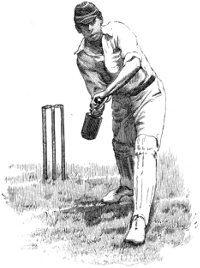
Fig. 14.—Gunn playing forward.