What to See and Do
Reading edition
Rim Drive.
Many spectacular views may be had from numerous observation points along this road which encircles the caldera.
Wizard Island.
This symmetrical cinder cone, towering some 760 feet above the surface of the lake, is reached by boat. A trail leads from the shore to the crater, which is approximately 90 feet deep and 300 feet in diameter.
The Phantom Ship.
Rising about 160 feet above the waters of the lake, this island resembles a ship under sail. The best views of the Phantom Ship are obtained from the launches and from Kerr Notch along the Rim Drive.
Garfield Peak.
A 1.7-mile trail, east of the lodge, leads to Garfield Peak. From its summit, elevation 8,060 feet, there is a magnificent view of the lake and surrounding region.
The Watchman.
This peak, on the west rim, may be reached by a half-mile trail from the rim road. A rare panorama of the park and surrounding country may be viewed from the fire lookout, 8,025 feet above sea level and about 1,850 feet above the lake.
Cloudcap.
On the east rim, and rising to an elevation of more than 8,000 feet, Cloudcap provides an excellent observation point.
Mount Scott.
East of Cloudcap is Mount Scott, the highest point in the park, reaching an altitude of 8,938 feet. Its summit, on which there is a fire-lookout station, is accessible by a 2.5-mile trail from Rim Drive.
The Pinnacles.
In Wheeler Creek, near the east boundary of the park, are slender spires of pumice. Some of the needles are 200 feet high. In Sand Creek Canyon and Godfrey’s Glen, in Annie Creek Canyon, there are other spires and fluted columns carved out of the soft volcanic material by water erosion.
Other Places of Interest in the Park and Vicinity.
Hillman Peak, 13 8,156 feet, is the highest point on the rim, rising nearly 2,000 feet above the lake. Palisade Point, Kerr Notch, and the Wineglass are low points on the rim, being slightly more than 500 feet above the lake.
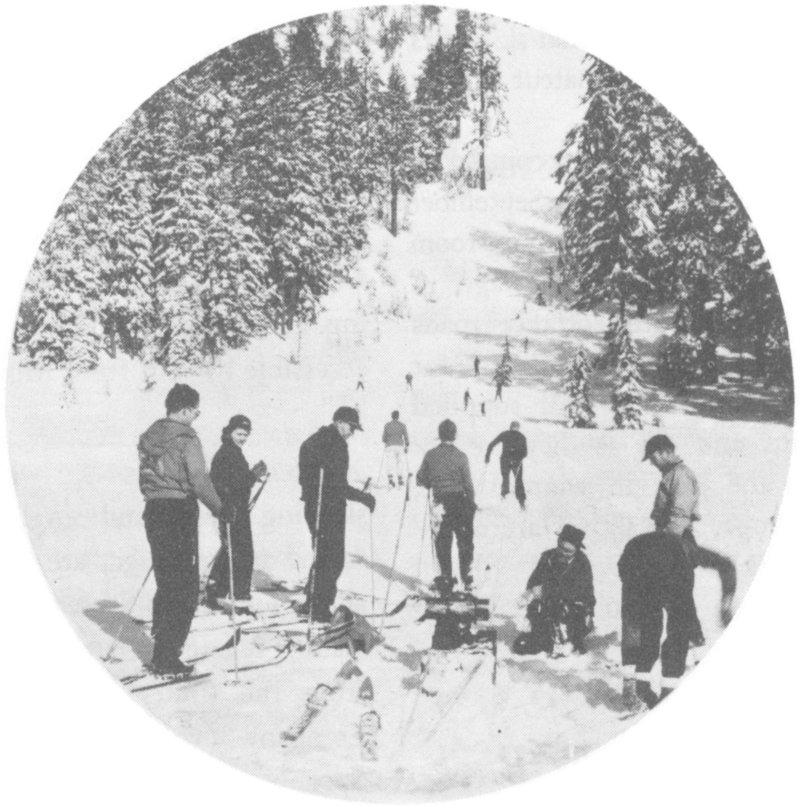
Natural ski run cut by old rock slide.
Hiking.
Besides the longer hikes mentioned in preceding paragraphs, there are delightful short walks, such as along Discovery Point Trail on the rim, and through Castle Crest Wildflower Gardens.
Those who desire information about other interesting places in the park and vicinity are invited to inquire at park headquarters or the Information Building.
Fishing.
Angling amid the scenic beauty of Crater Lake is an experience long to be remembered. No fish were native to Crater Lake; the first planting of rainbow trout was made in 1888 by William G. Steel. In recent years only rainbow trout and sockeye (kokanee) salmon have been planted. Trolling has proved to be the most successful method of fishing. The daily limit is 10 fish per person. From about mid-July to Labor Day, rowboats are available. Shore fishing usually may be enjoyed from the latter part of June until late September, depending on weather conditions. No license is needed to fish in Crater Lake. Possession or use of fish as bait is not allowed.
Winter Visits.
Since the park is open the year round, you may enjoy Crater Lake’s fantasy of snowy splendor and participate in winter sports. 14 Two trails from the Rim Village to park headquarters are maintained for skiers in winter. Professional ski meets are discouraged and amateur sports encouraged.
There are no overnight accommodations in the park from about September 15 to June 15, but warming-room facilities are provided at Rim Village.
The west and south entrance roads to the Rim Village area are open to motor travel. You should be well supplied with gasoline and oil, as they are not available in the park in winter. Tire chains, tow rope, and shovel are necessary accessories.
Rangers are on duty to render service all year.