Front matter
Reading edition · Edition 2
E-text prepared by KD Weeks, Anne Grieve, and the Online Distributed Proofreading Team (http://www.pgdp.net) from page images generously made available by Internet Archive (https://archive.org)
Note: Images of the original pages are available through Internet Archive. See https://archive.org/details/cranford00gaskrich
Transcriber’s Note:
Please see the transcriber’s note at the end of this text for a list of corrections made.
Any corrections are indicated using an underline highlight. Placing the cursor over the correction will produce the original text in a small popup.
Any corrections are indicated as hyperlinks, which will navigate the reader to the corresponding entry in the corrections table in the note at the end of the text.
Any corrections are indicated as hyperlinks, which will navigate the reader to the corresponding entry in the corrections table in the note at the end of the text.
ICRANFORD
II

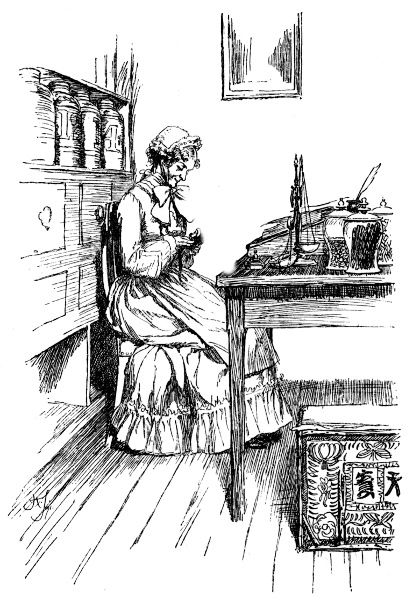
Miss Matty
III
CRANFORD
BY
MRS. GASKELL
WITH A PREFACE BY
ANNE THACKERAY RITCHIE
AND ILLUSTRATIONS
BY
HUGH THOMSON
London
MACMILLAN AND CO.
AND NEW YORK
1891
IVPrinted by R. & R. Clark, Edinburgh
v
I
My father has written of the memories connected with the writing of books, and of the scenes and feelings which are printed on the pages, quite other from those which they recount. And there are also the associations of the readers as well as of the writers. One scene in Cranford always comes back to me, not only for its own most pathetic value, but because I saw my father reading it. I can still remember him coming through the doorway just as I had finished the chapter, when not without some agitation and excitement I put the close printed number of Household Words into his hand. It was in the little dining-room of his house in Young Street, by gas light, just before dinner-time. The story was that of Captain Brown and he sat down and read it then and there, and afterwards told me the writer’s name. But indeed I did not think of it as a story at all, it seemed to me rather vithat I had witnessed some most touching and heroic deed, some sad disaster, and though I was a grown girl at the time I had a foolish childish wish for my father’s sympathy, and a feeling that even yet he might avert the catastrophe. Dear Captain Brown! in his shabby wig and faded coat, loved and remembered far beyond the narrow boundaries of Cranford—the city of the Amazons, the home of Miss Pole, and Miss Matty, and Miss Jenkyns, the place where economy was always ‘elegant,’ where ‘though some might be poor we were all aristocratic.’ Ever since the winter’s evening when I made my first acquaintance with that delightful place it has seemed to me something of a visionary country home, which I have visited at intervals all my life long (in spirit) for refreshment and change of scene. I have been there in good company. ‘Thank you for your letter,’ Charlotte Brontë writes to Mrs. Gaskell in 1853. ‘It was as pleasant as a quiet chat, as welcome as spring showers, as reviving as a friend’s visit; in short, it was very like a page of Cranford.’ ... The quotation breaks off with little dots, but I am sure that each one of them represents a happy moment for Currer Bell, who had not many such in her sad life.
There is a most interesting notice of Mrs. Gaskell in the Biographical Dictionary, in which Lord Houghton is quoted as writing of Cranford, as ‘the finest piece of humoristic description that has been added to British literature since Charles Lamb.’ I had been thinking of Elia after re-reading the book, and I was pleased to find viimyself on the steps of such a critic as Lord Houghton. One could imagine Mrs. Sarah Battle and the poor relation dwelling in Cranford, and if Charles Lamb could have liked anything that was not London, he too might have fancied the place. Perhaps Miss Austen’s ladies may also have visited there, but I feel less certainty about them, they belong to a different condition of things, to a more lively love-making set of people, both younger in age and older in generation than the Cranford ladies. Cranford is farther removed from the world, and yet more attuned to its larger interests than Meryton or Kellynch or Hartfield. Drumble, the great noisy manufacturing town, is its metropolis, not Bath with its succession of card parties and Assembly Rooms. At Cranford love is a memory rather than a present emotion; the sentimental locks of hair have turned to gray, the billet doux to yellow, like autumn leaves falling from the Tree of Life, but there is more of real feeling in these few signs of what was once, than in all the Misses Bennett’s youthful romances put together. Only Miss Austen’s very sweetest heroines (including her own irresistible dark-eyed self, in her big cap and folded kerchief) are worthy of the old place. I should give the Freedom of Cranford, were it mine to bestow, in the usual ‘handsome casket,’ to Anne Elliott, to Fanny Price perhaps . . . but as I write some spirit of compunction disturbs the ‘obiter dicta’ of a hasty moment. Where is one to draw the line! Lady Bertram and the Honourable Mrs. Jamieson would surely have been kindred souls, delightful viiicreatures both with their divergences. Who will ever forget Lady Bertram’s plea for morality, or Mrs. Jamieson’s languid replies to Miss Matty’s inquiries as to the preparations expected in a gentleman’s dressing-room, those answers given in the wearied manner of the Scandinavian prophetess, ‘Leave me, leave me to repose.’
But it is all very well to decide who shall and who shall not in turn be a dweller in this favoured spot! Cranford chooses its own inhabitants, and is everywhere, where people have individuality and kindliness, and where oddities are tolerated, nay, greatly loved for the sake of the individuals.
I am sure Cranford existed in the quarter in Paris where my own early youth was passed. I can remember it in Kensington also, though we did not quite go the length of putting our cows into gray flannel dressing-gowns, as Miss Betsy Barker did. Perhaps Cranford did not even stop at Kensington, but may have reached farther afield, taking Chiswick on its way. Miss Debōrah, as she preferred to be called, is certainly first cousin to Miss Pinkerton; can either of these ladies have been connected with the unrivalled Miss Seward herself? I do not quite know upon what terms Miss Seward and Dr. Johnson happened to be, but I could imagine the great lexicographer driving them all before him and Miss Pinkerton’s turban, or Miss Jenkyns in her little helmet-like bonnet.
Miss Debōrah and Miss Pinkerton belong to an altogether bygone type, but all the rest of the ladies in Cranford ixare as modern and as much alive as if they had been born in the 60’s.
‘I believe the art of telling a story is born with some people,’ writes the author of Cranford; it was certainly born with Mrs. Gaskell. My sister and I were once under the same roof with her in the house of our friends Mr. and Mrs. George Smith, and the remembrance of her voice comes back to me, harmoniously flowing on and on, with spirit and intention, and delightful emphasis, as we all sat indoors one gusty morning listening to her ghost stories. They were Scotch ghosts, historical ghosts, spirited ghosts, with faded uniforms and nice old powdered queues. As I think it over I am suddenly struck by the immense superiority of the ghosts of my youth to the present legion of unclean spirits which surround us, as we are told—wielding teacups, smashing accordions and banjos, breaking furniture in bits. That morning at Hampstead, which I recall, was of a different order of things, spiritual and unseen; mystery was there, romantic feeling, some holy terror and emotion, all combined to keep us gratefully silent and delighted.
II
It is something for us Cockneys to know that Mrs. Gaskell belongs to London after all, if only as a baby. Although so much of her life was spent in the North, and Knutsford was the home of her childhood, and Manchester xthat of her married life, yet she was born in Chelsea. She was born in 1810, in pretty old Lindsay Place, of which the windows—ancient lights even then—still look out upon the river at its turn, as it flows from Cheyne Row, towards the sunset, past Fulham Palace, where the Bishops dwell, and Hampton Court and its histories, out into the country plains beyond.
Mrs. Gaskell was born in that propitious hour of the great men and women who came into the world in the beginning of this century: may the next hundred years bring to our descendants many more such birthdays! She belonged to a good stock on either side; her father came from Berwick upon Tweed, that city built upon the rock; he was Mr. William Stevenson, a Unitarian minister. There is a tradition that the Stevensons came originally from Norway, and there are old family papers in which the name is spelled Stevensen. Mrs. Gaskell liked to think of her Scandinavian forefathers, and when she went away now and again for little jaunts and expeditions, such as she always enjoyed, she used to laugh and say that the blood of the Vikings her ancestors was rising in her veins. She was always tenderly attached to her father’s memory, and proud and fond of him, and he must have been indeed a most interesting and delightful character. A letter lately written to the Athenæum, evidently by some old friend of the family, gives a quotation from Longman’s Annual Obituary for 1830 and of the notice of Mr. Stevenson’s death, beginning thus: ‘The literary and scientific world has sustained a great loss in the death of xiMr. Stevenson, a man remarkable for the stores of knowledge which he possessed, and for the simplicity and modesty by which his rare attainments were concealed.’ Among other facts we read that in early life while preaching at Manchester Mr. Stevenson was also ‘Classical Tutor in the Manchester Academy, so well known through the Aikens and Barbaulds. He was afterwards appointed secretary to Lord Lauderdale, and finally Keeper of the Records to the Treasury, both of which appointments brought him up to London.’ He laboured with unremitting diligence, contributing to the Edinburgh Review, the Westminster, and Dr. Brewster’s Encyclopedia. ‘He had the true spirit of a faithful historian, and, contrary to the practice too prevalent in those days, dived into original sources of information.’ Was not this the father, one might imagine, for such a daughter? Mr. Stevenson married, as his first wife, Miss Eliza Holland of Sandlebridge. It would not be difficult to name some dozen families now existing which have set their mark upon the times, trump cards in the game of life, so to speak, and to one of these families Mrs. Gaskell’s mother belonged. The poor young lady died very soon after her little girl was born, and the child was taken away to the care of an aunt, her mother’s sister, who was living at Knutsford in Cheshire with an only child, a cripple. The whole story was very melancholy, and one can imagine that it may have been a somewhat sad and silent home for a little girl full of life and imagination. There was an uncle also dwelling in the same little country town, Dr. xiiPeter Holland, who was the father of the great physician Sir Henry Holland, and the grandfather of the present Lord Knutsford. Besides their houses in Knutsford the Holland family had a pretty old country house some two or three miles beyond the town, from whence Mrs. Gaskell’s own mother had come. The house where Mrs. Gaskell lived as a little girl with her aunt is on the Heath, a tall red house, with a wide spreading view, and with a pretty carved staircase and many light windows both back and front.
I have heard that Mrs. Gaskell was not always quite happy in those days,—imaginative children go through many phases and trials of their own,—in her hours of childish sorrow and trouble she used to run away from her aunt’s house across the Heath and hide herself in one of its many green hollows, finding comfort in the silence, and in the company of birds and insects and natural things. But at other times she had delightful games of play with her cousins in the sweet old family house at Sandlebridge, where so many Hollands in turn had lived.
The old house stands lonely in a beautiful and tranquil position, with a waving prospect of fields and shady trees and hedges, reaching to the hills which rise in the far distance. As we stood there we could see Alderley Edge clean painted against the stormy sky. Just before reaching the house the road dips into a green hollow, where stands a forge which has been there for over two hundred years, handed down from father to son. Just beyond the forge is an old mill, shaded by beautiful trees; we could hear xiiithe peaceful sounds of labour, the clanking blows of the anvil, the soft monotonous thud of the mill.
Sandlebridge is now given up to a farmer; a pretty flagged stone path leads up to the front door. There used to be two brick pediments with balls at the garden gate. Years ago, so long ago that the great Lord Clive was only a schoolboy in Knutsford at the time (his mother was a Gaskell and had connections in the place), he used to come over to spend his half holidays at Sandlebridge, and his pleasure was to jump across from one stone ball to the other, to the great danger of his legs and arms. Here too in later times, as we have said, Mrs. Gaskell used to come as a little girl, and play with her cousins and gather flowers from the garden. There was a great bed of saxifrage, which may still be there, it was always her favourite flower. The old house is now dismantled, but one or two things still remain out of its past; among others are the fine old wooden chimney-pieces in the front parlour, one within the other,—so it seemed to me,—and the old shuffleboard. A shuffleboard is an immensely long table, standing upon legs of shining oak with many drawers and cupboards underneath. There are hardly any left anywhere now. They were once used for a game which consisted in jerking heavy counters from one end to the other of the shining board, and trying to keep your own and to throw your enemy’s over the side of the table. As we were looking with interest at all these relics of bygone times, we heard a sort of chucking noise from the big inner room or kitchen; it came from a little person xivsome two or three months old lying in a huge carved oak cradle by the fire, which cradle must have rocked any number of generations to sleep.
Knutsford itself is a little town of many oak beams and solid brick walls; there are so many slanting gables left, and lattices and corners, that the High Street has something the look of a mediæval street. ‘’Tis an old ancient place,’ said the shopwoman, standing by her slanting counter, where Shakespeare himself might have purchased hardware. From the main street several narrow courts and passages lead to the other side of the little town, the aristocratic quarter, where are the old houses with their walled gardens. One of these passages runs right through the Royal George Hotel, itself leading from shadow into the sunshine, where a goat disports itself, and one or two ladies seem always passing with quiet yet rapid steps,—the inhabitants of Knutsford do not saunter. My friend the shopwoman told us she had a beautiful garden at the back of her ‘old ancient place’; all the houses in Knutsford have gardens, with parterres beautifully kept, and flowers in abundance. It was autumn, but everything was swept and tidy. Straggling branches, plants overgrown and run to seed do not seem to be known in Knutsford amidst its heathy open spaces. There is something so spirited and fresh and methodical in the place that I can understand how even the flower-beds have a certain self-respect, and grow trim and straight, instead of straggling about in lazy abandon, as mine do at home.
xvAs we entered the Royal George Hotel out of the dark street, we came upon a delightful broadside of shining oak staircase and panelled wainscot; old oak settles and cupboards stood upon the landings. On the walls hung pictures, one was of Lord Beaconsfield, one was a fine print of George IV., and others again of that denuded classic school of art which seems to have taken a last refuge in old English Inns. There were Chippendale cabinets, old bits of china, and above all there were the beautiful oak bannisters to admire. But these handsome staircases, the china, the wood carvings are all about the place, to which the great traffic of the coaches from Liverpool and Manchester brought real prosperity for many years, so that the modest little houses are full of worthy things, of pretty doorways, arched corners, carved landings and mahogany doors, to make the fortune of a dealer in bric-à-brac, only that these are not bric-à-brac, and this is their charm. The staircases and chimney-pieces are their own original selves, the cupboards were made to dwell in their own particular niches, and it is the passing generations who turn and unturn the keys as they go by. Our kind Interpreter at Knutsford patiently led us from one place to another; sometimes we seemed to be in Cranford, greeting our visionary friends; sometimes we were back in Knutsford again, looking at the homes of the people we had known in the fact rather than in the fancy. And just as one sometimes sees traces of another place and time still showing in the streets of some new and busy town, so every here xviand there seemed isolated signs and tokens of the visionary familiar city as it has been raised by the genius of its founder.
III
Mrs. Gaskell was a very beautiful young woman. I heard her described only the other day by a friend who remembered her in her youth. She had a well-shaped head, regular, finely-cut features; her mien was bright and dignified, almost joyous, so my informant said, and among her many other gifts was that of delightful companionship. She was very young when she was married to the Reverend William Gaskell, minister of the Cross Street Unitarian Chapel in Manchester. She was married from her aunt’s house at Cranford at the Parish Church, and not in the beautiful old Unitarian Chapel, with its ivy-clad walls and its latticed windows, dating from Oliver Cromwell’s time. In those days marriages were only solemnised in the Parish Church.
The young couple settled in their new home, Mrs. Gaskell ‘co-operated with her husband in his work,’ we are told, ‘and was always ready for any useful work of charity or helpfulness.’
Mr. Gaskell was one of those ministers whose congregations are outside as well as inside chapel walls, for I have heard his name mentioned again and again by different people, and always with affection and respect.
For some years after her marriage Mrs. Gaskell lived xviia domestic life, busy with her children, and ordering her household and training her maids, for which indeed she had a special gift; then a terrible sorrow fell upon her, and we know how she began to write to divert her mind from brooding upon the loss of her only son.
In 1847 she had finished that noble book, Mary Barton, that book with ‘a sob in it,’ as the French critic says. ‘Ah! quelle musique douloureuse dans un sanglot.’
But there is something far beyond a sob in Mary Barton. The writer is writing of what she has lived, not only of what she has read or even looked at as she passed her way. It is true she read Adam Smith and studied Social Politics, but with that admirable blending of the imaginative and the practical qualities which was her gift, she knows how to stir the dry skeleton to life and reach her readers’ hearts. Many books and novels dealing with the poor are touchingly expressed and finely conceived, but somehow this particular gift of the spirit is wanting; we admire the books without being ourselves absorbed by them. It is the difference in short between the light of genius and the rays of the prism analysed, calculated, divided. This power of living in the lives of others and calling others to share the emotion, does not mean, as people sometimes imagine, that a writer copies textually from the world before her, I have heard my father say that no author worth anything, deliberately, and as a rule, copies the subject before him. And so with Mrs. Gaskell. Her early impressions were vivid and dear to her, but her world, though coloured by remembrance and sympathy, xviiiwas peopled by the fresh creations of her vivid imagination, not by stale copies of the people she had known.
Mary Barton made a great and remarkable sensation. Carlyle, Landor, Miss Edgeworth praised and applauded, and nameless thousands also praised and read the noble outspoken book. ‘Individuals may have complained,’ so says the biographer, from whom I have so often quoted, ‘but the work has unquestionably helped to make the manufacturing world very different from what it was forty years ago.’
The same intuition which guided her along the pleasant country lanes made her at home in the teeming streets and crowded alleys of Manchester.
A very interesting article by Monsieur Emile Montégut, written some thirty years ago, pays a fine tribute to Mrs. Gaskell’s striking exposition of the life amidst which so much of her own was passed, to her depth of feeling, to her moderation of statement.
The article also, to my surprise, gives an answer to the little riddle I was trying to solve in my own mind as to the difference between the world of Cranford and that of Miss Austen. Each century possesses a force of its own, says the critic, one particular means of action, to the exclusion of others; it may be intelligence, it may be passion, it may be determination, each rules in turn.
In the sixteenth century will prevailed, and the character of the men and the martyrs of that time were in value far beyond their convictions. In the eighteenth century, on the contrary, the ideas were worth more than xixthe lives. Books and pamphlets were better than the men who wrote them. What is the force, says Mr. Montégut, of the age in which we ourselves are living? it is certainly not will, nor is it brilliant intelligence, as in the days of Voltaire. It is a quality which, for want of a better word, we will call the ‘force of sentiment.’... ‘People,’ he continues, ‘have little confidence in systems, a man with a hobby is immediately a butt, but a man who is not obliged to be right in order to guard his vanity, has but to describe in a few simple and true sentences some fact, some moral wrong which needs redressing, and see the effect, and the silent help which immediately follows, and for this reason it is that in literature we have seen of late the almost exclusive reign of fiction.’...
It is this quality of statement which we find in Mrs. Gaskell’s books which distinguishes them from so many which preceded them, and which gives them their influence. It was because she had written Mary Barton that some deeper echoes reach us in Cranford than are to be found in any of Jane Austen’s books, delightful as they are. Young people read books to learn about their lives which are to come, old people read them to forget the present; there is yet another class of readers, old and young, who read to find expression to the indefinite unshaped feelings by which they are haunted,—of all these will not each find response in the books of Elizabeth Gaskell, in Ruth, in Cousin Phyllis, in Sylvia’s Lovers, in that last fine work which she never finished?
It must be remembered that Mrs. Gaskell wrote in the xxgreat time of literature, in the earlier part of the century. It remains for readers of this later time to see how nobly she held her own among the masters of her craft. ‘She has done what we none of us could do,’ said George Sand to Lord Houghton; ‘she has written novels which excite the deepest interest in men of the world, and yet which every girl will be the better for reading.’
We all know what a friend Mrs. Gaskell proved herself to Charlotte Brontë, and what happiness this friendship brought to the author of Jane Eyre. Mrs. Gaskell had the gift of giving out in a very remarkable degree. Miss Brontë, as we all know, was tortured and imprisoned by shyness. ‘She does not, and cannot care for me, for she does not know me, how should she,’ Miss Brontë says, writing of a child of Mrs. Gaskell, but that child’s mother did Charlotte Brontë justice, and guessed by happy intuition at the treasure concealed in the unpretending casket.
Mrs. Gaskell quotes a letter from Miss Brontë in her Life which is very characteristic of them both. ‘Do you, who have so many friends, so large a circle of acquaintance, find it easy when you sit down to write to isolate yourself from all those ties and their sweet associations, so as to be your own woman, uninfluenced or swayed by the consciousness of how your work may affect other minds, what blame or what sympathy it may call forth; does no luminous cloud ever come between you and the severe truth in your own secret or clear-seeing soul?’ This question is best answered by Mrs. Gaskell’s own pages. xxiWhether or not she found it easy I cannot say, but that she did not ‘isolate herself,’ but did on the contrary entirely associate her own woman with the work of her life, her readers can best realise. Her great natural gift and genius instinctively led her to the secret of things, to the very soul of her race. She must have felt its life and spirit too keenly indeed for her own happiness at times, but how much has she not added to the sunshine of the world!
Not long ago I found myself in Mrs. Gaskell’s old home in Manchester, and the thought of the beautiful books created in those very rooms seemed to give life to the stones and to light up the grim Manchester streets outside. Cranford was written in the house in Plymouth Grove, as were almost all Mrs. Gaskell’s books. But when tired or overdone she used often to return to Knutsford for rest and for refreshment. Sometimes in later life she stayed with her cousins, the Miss Hollands, whose traditions she wove into shape, together with the quaint conceits and stories which are still told in Knutsford. It has its customs and oddities now, just as when Mrs. Gaskell was a girl. I am told that the streets are sanded on certain days in pretty patterns all along the pavement; there are temperance processions in which the immortal sedan chair still figures, and I myself observed that some of the humbler bonnets formed quite an important feature in the scene, while recollections of Miss Matty’s successive caps seemed to float across one’s mind. It was delightful to hear the people of Knutsford still speak of Mrs. Gaskell, and of xxiithe pleasure her visits always brought, and the pleasure she always took in them; of her long country drives with an old friend, a doctor, going his rounds, twenty and thirty miles at a time; of her talk and interest in all the details along the way. She loved country things and farming things; she always kept her cow, even in Manchester; she understood the practical facts of life as well as its feelings. I have heard of her, tired and ill, starting on a three mile walk on behalf of a poor dependent, so as to make sure that some necessary help was properly administered. There is one thrilling tradition of Knutsford far too melodramatic for our Cranford, where the mere rumour of the housebreaker so alarmed Mr. Mulliner; this story is that of the highwayman Higgins, who lived in Heath House, and who kept his horses underground concealed in the cellar. The highwayman must have enjoyed his lovely garden and his fine old staircase, when he was not escaping by his secret passage.
I heard of one Knutsford lady the other day, greatly excited by some piece of news,—no highway robbery, but a wedding, I believe. To soothe herself she was obliged to have a dish of toasted cheese prepared, and to send for a friend to play bezique, and share the news and the dainty; it might have been Miss Barker herself. Another little story amused us greatly, so well was it told, and so characteristic of all times, old and new. One of the young Hollands born in the South was greatly interested in the family traditions, and he came for a holiday to Knutsford to see the old home of his fathers. He looked xxiiiall about Knutsford, and then went on to Sandlebridge to call on the old farmer there, and asked him many questions, and begged him to show him all over the place. And the old farmer kindly welcomed the young man for his parents’ and grandparents’ sake, and said, ‘O yes, Master Frank, I’ll show you about. I’ll show you wonderful things; I’ll show you things will mak’ your hair stan’ on end. Coom along o’ me.’ So they drove and they drove along the lanes and under the hedgerows, and all the way the young man wondered what was coming, until finally the old farmer, who would not say a word beforehand, stopped his horse and triumphantly pointed to the bran new red and yellow villas which had been built on Alderley Edge, where he found such good custom for his butter and eggs. And these were the wonderful things.
Knutsford likes to associate itself with Cranford in a desultory visionary sort of way. One house claims Miss Matty’s tea-shop. The owner was standing in the doorway, and he kindly brought us into the little wainscoted parlour, with the window on the street through which Aga Jenkyns may have dispensed Miss Matty’s stock of sugar plums; here too was a pretty carved staircase and arches belonging to the early Georges; another most charming old house, Church House, with the lovely garden where the children were gathering the apples and the gay flower beds were skirting the turf walk, might almost have been the home of Molly Gibson, and its present mistress said she liked to imagine her peeping out from xxivthe side window at the old coaches as they clattered through the town. As I sate there drinking my tea I thought I could almost hear Mrs. Gibson herself conversing. ‘Spring! Primavera, as the Italians call it,’ the lady was saying.
xxv
PAGE
Preface v
CHAPTER I.
Our Society 1
CHAPTER II.
The Captain 19
CHAPTER III.
A Love Affair of Long Ago 42
CHAPTER IV.
A Visit to an Old Bachelor 57
CHAPTER V.
Old Letters 75
CHAPTER VI.
Poor Peter 92
xxviCHAPTER VII.
Visiting 110
CHAPTER VIII.
‘Your Ladyship’ 126
CHAPTER IX.
Signor Brunoni 147
CHAPTER X.
The Panic 162
CHAPTER XI.
Samuel Brown 186
CHAPTER XII.
Engaged to be Married 204
CHAPTER XIII.
Stopped Payment 219
CHAPTER XIV.
Friends in Need 239
CHAPTER XV.
A Happy Return 267
CHAPTER XVI.
Peace to Cranford 286
xxvii
PAGE
Miss Matty Frontispiece
Heading to Preface v
Heading to Contents xxv
Heading to List of Illustrations xxvii
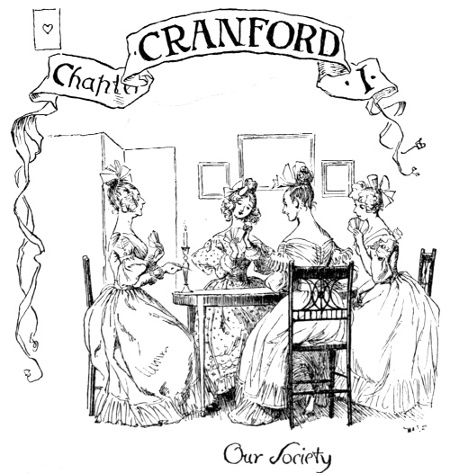
Heading to Chapter I. 1
‘A magnificent family red silk umbrella’ 3
‘Clattered home in their pattens’ 6
‘To see the Alderney’ 9
‘Sang out loud and joyfully’ 11
‘Coming out of church’ 12
‘The account of the “Swarry”’ 16
Tailpiece to Chapter I. 18
Heading to Chapter II. 19
‘Carrying her baked mutton and potatoes’ 20
‘No one could black his boots except himself’ 22
‘Miss Jenkyns’ 24
‘One with whom his lordship held conversation’ 26
‘And he shuddered at the recollection’ 31
‘He shook hands with Miss Jessie’ 38
Tailpiece to Chapter II. 41
Heading to Chapter III. 42
xxviii‘If you please, my love, will you call me Matilda?’ 44
‘So as to throw the shadow on the clock face’ 46
‘She "nudged" the major’ 51
‘How are you? how are you?’ 54
Tailpiece to Chapter III. 56
Heading to Chapter IV. 57
‘Requested her to fill the bowl’ 62
‘Or glimpse of distant upland pastures’ 64
‘He had begun a long poem’ 66
‘Here are the poems for you’ 68
‘God forbid that I should grieve any young hearts’ 73
Tailpiece to Chapter IV. 74
Heading to Chapter V. 75
‘When Martha brought in the lighted candle and tea’ 78
‘Preached before some judge’ 81
A Post Boy 86
‘Turning out of the volunteers’ 88
Tailpiece to Chapter V. 91
Heading to Chapter VI. 92
‘The little curtseys’ 95
‘Have you done enough, sir?’ 98
‘He and my father were such friends!’ 108
Heading to Chapter VII. 110
‘With bland satisfaction’ 111
Mrs. ffarringdon and Mr. ffoulkes 118
‘Hush, ladies! if you please, hush!’ 122
Tailpiece to Chapter VII. 125
Heading to Chapter VIII. 126
‘We sedulously talked together’ 130
Mr. Mulliner 132
Miss Pole and the brooches 135
‘In dignified surprise’ 141
Tailpiece to Chapter VIII. 146
xxixHeading to Chapter IX. 147
‘Making such a graceful bow’ 151
‘Walk mincingly up the room’ 156
‘The Church smiling approval’ 160
Heading to Chapter X. 162
‘A regular expedition’ 163
‘Armed with a footstool’ 167
‘Called out valiantly’ 170
‘Speaking very ominously’ 173
‘To have her teeth examined’ 175
‘Implored the chairman’ 178
‘He was a sharp lad’ 181
‘Leading questions’ 183
Tailpiece to Chapter X. 185
Heading to Chapter XI. 186
‘Perplexed about the exact path’ 187
‘Riding over’ 189
‘Airing the Sedan Chair’ 191
‘In Darkness Lane’ 193
‘The boys who stole the apples’ 195
‘A diary in two columns’ 198
Heading to Chapter XII. 204
‘Miss Jenkyns used to say’ 207
‘It was too big for words’ 209
‘Bread and cheese’ 211
‘Lady Glenmire’ 213
‘Mr. Hoggins looked radiant’ 216
Tailpiece to Chapter XII. 218
Heading to Chapter XIII. 219
‘Each individual coin’ 221
‘Over the counter’ 225
‘The country people came in’ 226
‘Our neighbour’ 227
xxx‘“Dang it!” said he’ 229
‘He hung back’ 232
‘The civil Mr. Johnson’ 234
‘The account-books’ 236
Heading to Chapter XIV. 239
‘Posting the letter’ 240
‘Don’t “but Martha” me’ 242
‘There!’ 247
‘He’s only Jem Hearn’ 250
‘Soothed by her lover’ 253
‘Mrs. Fitz-Adam’ 255
‘Drumming with his fingers upon it’ 263
Tailpiece to Chapter XIV. 266
Heading to Chapter XV. 267
‘All the smiling glory of his face’ 269
‘A complimentary speech’ 275
‘Absorbed in contemplation’ 278
‘Gleefully awaited the shower of comfits and lozenges’ 284
Tailpiece to Chapter XV. 285
Heading to Chapter XVI. 286
‘The Father of the Faithful’ 288
‘The proof sheet of a great placard’ 294
‘He had shot a cherubim!’ 296
‘Mrs. Jamieson on one side, and my lady, Mrs. Hoggins, on the other’ 298
1
In the first place, Cranford is in possession of the Amazons; all the holders of houses, above a certain rent, are women. If a married couple come to settle in the town, somehow the gentleman disappears; he is either fairly frightened to death by being the only man in the Cranford evening parties, or he is accounted for by being with his regiment, his ship, or closely engaged in business all the week in the great neighbouring commercial town of Drumble, distant only twenty miles on a railroad. 2In short, whatever does become of the gentlemen, they are not at Cranford. What could they do if they were there? The surgeon has his round of thirty miles, and sleeps at Cranford; but every man cannot be a surgeon. For keeping the trim gardens full of choice flowers without a weed to speck them; for frightening away little boys who look wistfully at the said flowers through the railings; for rushing out at the geese that occasionally venture into the gardens if the gates are left open; for deciding all questions of literature and politics without troubling themselves with unnecessary reasons or arguments; for obtaining clear and correct knowledge of everybody’s affairs in the parish; for keeping their neat maidservants in admirable order; for kindness (somewhat dictatorial) to the poor, and real tender good offices to each other whenever they are in distress,—the ladies of Cranford are quite sufficient. ‘A man,’ as one of them observed to me once, ‘is so in the way in the house!’ Although the ladies of Cranford know all each other’s proceedings, they are exceedingly indifferent to each other’s opinions. Indeed, as each has her own individuality, not to say eccentricity, pretty strongly developed, nothing is so easy as verbal retaliation; but, somehow, goodwill reigns among them to a considerable degree.
The Cranford ladies have only an occasional little quarrel, spirted out in a few peppery words and angry jerks of the head; just enough to prevent the even tenor of their lives from becoming too flat. Their dress is very independent of fashion; as they observe, ‘What does it signify how we dress here at Cranford, where everybody knows us?’ And if they go from home, their reason is equally cogent, ‘What does it 3signify how we dress here, where nobody knows us?’ The materials of their clothes are, in general, good and plain, and most of them are nearly as scrupulous as Miss Tyler, of cleanly memory; but I will answer for it, the last gigot, the last tight and scanty petticoat in wear in England, was seen in Cranford—and seen without a smile.
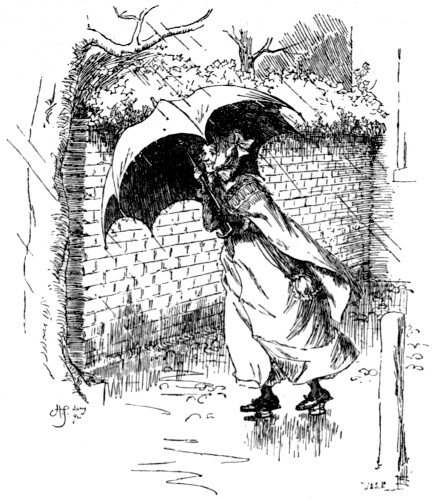
‘A magnificent family red silk umbrella.’
I can testify to a magnificent family red silk umbrella, under which a gentle little spinster, left alone of many brothers and sisters, used to patter to church on rainy days. Have you any red silk umbrellas in 4London? We had a tradition of the first that had ever been seen in Cranford; and the little boys mobbed it, and called it ‘a stick in petticoats.’ It might have been the very red silk one I have described, held by a strong father over a troop of little ones; the poor little lady—the survivor of all—could scarcely carry it.
Then there were rules and regulations for visiting and calls; and they were announced to any young people, who might be staying in the town, with all the solemnity with which the old Manx laws were read once a year on the Tinwald Mount.
‘Our friends have sent to inquire how you are after your journey to-night, my dear’ (fifteen miles in a gentleman’s carriage); ‘they will give you some rest to-morrow, but the next day, I have no doubt, they will call; so be at liberty after twelve—from twelve to three are our calling-hours.’
Then, after they had called—
‘It is the third day; I daresay your mamma has told you, my dear, never to let more than three days elapse between receiving a call and returning it; and also, that you are never to stay longer than a quarter of an hour.’
‘But am I to look at my watch? How am I to find out when a quarter of an hour has passed?’
‘You must keep thinking about the time, my dear, and not allow yourself to forget it in conversation.’
As everybody had this rule in their minds, whether they received or paid a call, of course no absorbing subject was ever spoken about. We kept ourselves to short sentences of small talk, and were punctual to our time.
I imagine that a few of the gentlefolks of Cranford 5were poor, and had some difficulty in making both ends meet; but they were like the Spartans, and concealed their smart under a smiling face. We none of us spoke of money, because that subject savoured of commerce and trade, and though some might be poor, we were all aristocratic. The Cranfordians had that kindly esprit de corps which made them overlook all deficiencies in success when some among them tried to conceal their poverty. When Mrs. Forrester, for instance, gave a party in her baby-house of a dwelling, and the little maiden disturbed the ladies on the sofa by a request that she might get the tea-tray out from underneath, every one took this novel proceeding as the most natural thing in the world, and talked on about household forms and ceremonies as if we all believed that our hostess had a regular servants’ hall, second table, with housekeeper and steward, instead of the one little charity-school maiden, whose short ruddy arms could never have been strong enough to carry the tray upstairs if she had not been assisted in private by her mistress, who now sat in state, pretending not to know what cakes were sent up, though she knew, and we knew, and she knew that we knew, and we knew that she knew that we knew, she had been busy all the morning making tea-bread and sponge-cakes.
There were one or two consequences arising from this general but unacknowledged poverty, and this very much acknowledged gentility, which were not amiss, and which might be introduced into many circles of society to their great improvement. For instance, the inhabitants of Cranford kept early hours, and clattered home in their pattens, under the guidance of a lantern-bearer, about nine o’clock at night; and the whole town was 6abed and asleep by half-past ten. Moreover, it was considered ‘vulgar’ (a tremendous word in Cranford) to give anything expensive, in the way of eatable or drinkable, at the evening entertainments. Wafer bread-and-butter and sponge-biscuits were all that the Honourable Mrs. Jamieson gave; and she was sister-in-law to the late Earl of Glenmire, although she did practise such ‘elegant economy.’
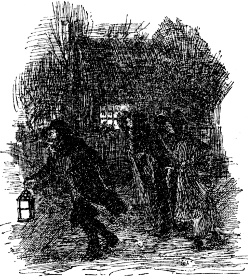
‘Clattered home in their pattens.’
‘Elegant economy!’ How naturally one falls back into the phraseology of Cranford! There, economy was always ‘elegant,’ and money-spending always ‘vulgar and ostentatious’; a sort of sour grapism which made us very peaceful and satisfied. I never shall forget the dismay felt when a certain Captain Brown came to live at Cranford, and openly spoke about his being poor—not in a whisper to an intimate friend, the doors and windows being previously closed, but in the public street! in a loud military voice! alleging his poverty as a reason for not taking a particular house. The ladies of Cranford were already rather moaning over the invasion of their territories by a man and a gentleman. He was a half-pay Captain, and had obtained some situation on a neighbouring railroad, which had been vehemently petitioned against by the little town; and if, in addition to his masculine gender, and his connection 7with the obnoxious railroad, he was so brazen as to talk of being poor—why, then, indeed, he must be sent to Coventry. Death was as true and as common as poverty; yet people never spoke about that, loud out in the streets. It was a word not to be mentioned to ears polite. We had tacitly agreed to ignore that any with whom we associated on terms of visiting equality could ever be prevented by poverty from doing anything that they wished. If we walked to or from a party, it was because the night was so fine, or the air so refreshing, not because sedan chairs were expensive. If we wore prints, instead of summer silks, it was because we preferred a washing material; and so on, till we blinded ourselves to the vulgar fact that we were, all of us, people of very moderate means. Of course, then, we did not know what to make of a man who could speak of poverty as if it was not a disgrace. Yet, somehow, Captain Brown made himself respected in Cranford, and was called upon, in spite of all resolutions to the contrary. I was surprised to hear his opinions quoted as authority at a visit which I paid to Cranford about a year after he had settled in the town. My own friends had been among the bitterest opponents of any proposal to visit the Captain and his daughters only twelve months before; and now he was even admitted in the tabooed hours before twelve. True, it was to discover the cause of a smoking chimney, before the fire was lighted; but still Captain Brown walked upstairs, nothing daunted, spoke in a voice too large for the room, and joked quite in the way of a tame man about the house. He had been blind to all the small slights, and omissions of trivial ceremonies, with which he had been received. He had been friendly, though the Cranford 8ladies had been cool; he had answered small sarcastic compliments in good faith; and with his manly frankness had overpowered all the shrinking which met him as a man who was not ashamed to be poor. And, at last, his excellent masculine common sense, and his facility in devising expedients to overcome domestic dilemmas, had gained him an extraordinary place as authority among the Cranford ladies. He himself went on in his course, as unaware of his popularity as he had been of the reverse; and I am sure he was startled one day when he found his advice so highly esteemed as to make some counsel which he had given in jest to be taken in sober, serious earnest.
It was on this subject: An old lady had an Alderney cow, which she looked upon as a daughter. You could not pay the short quarter-of-an-hour call without being told of the wonderful milk or wonderful intelligence of this animal. The whole town knew and kindly regarded Miss Betsy Barker’s Alderney; therefore great was the sympathy and regret when, in an unguarded moment, the poor cow tumbled into a limepit. She moaned so loudly that she was soon heard and rescued; but meanwhile the poor beast had lost most of her hair, and came out looking naked, cold, and miserable, in a bare skin. Everybody pitied the animal, though a few could not restrain their smiles at her droll appearance. Miss Betsy Barker absolutely cried with sorrow and dismay; and it was said she thought of trying a bath of oil. This remedy, perhaps, was recommended by some one of the number whose advice she asked; but the proposal, if ever it was made, was knocked on the head by Captain Brown’s decided ‘Get her a flannel waistcoat and flannel drawers, ma’am, if 9you wish to keep her alive. But my advice is, kill the poor creature at once.’
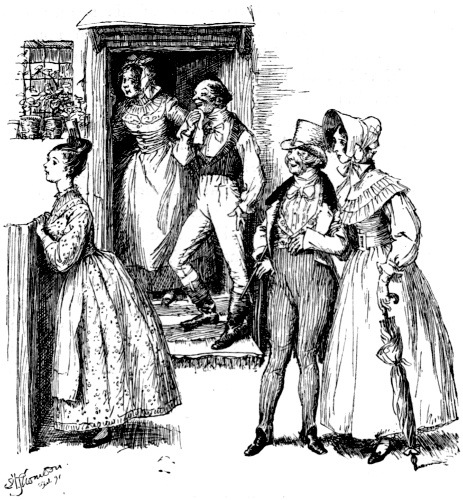
‘To see the Alderney.’
Miss Betsy Barker dried her eyes, and thanked the Captain heartily; she set to work, and by and by all the town turned out to see the Alderney meekly going to her pasture, clad in dark gray flannel. I have watched her myself many a time. Do you ever see cows dressed in gray flannel in London?
10Captain Brown had taken a small house on the outskirts of the town, where he lived with his two daughters. He must have been upwards of sixty at the time of the first visit I paid to Cranford after I had left it as a residence. But he had a wiry, well-trained, elastic figure, a stiff military throw-back of his head, and a springing step, which made him appear much younger than he was. His eldest daughter looked almost as old as himself, and betrayed the fact that his real was more than his apparent age. Miss Brown must have been forty; she had a sickly, pained, careworn expression on her face, and looked as if the gaiety of youth had long faded out of sight. Even when young she must have been plain and hard-featured. Miss Jessie Brown was ten years younger than her sister, and twenty shades prettier. Her face was round and dimpled. Miss Jenkyns once said, in a passion against Captain Brown (the cause of which I will tell you presently), ‘that she thought it was time for Miss Jessie to leave off her dimples, and not always to be trying to look like a child.’ It was true there was something childlike in her face; and there will be, I think, till she dies, though she should live to a hundred. Her eyes were large blue wondering eyes, looking straight at you; her nose was unformed and snub, and her lips were red and dewy; she wore her hair, too, in little rows of curls, which heightened this appearance. I do not know whether she was pretty or not; but I liked her face, and so did everybody, and I do not think she could help her dimples. She had something of her father’s jauntiness of gait and manner; and any female observer might detect a slight difference in the attire of the two sisters—that of Miss Jessie being about two pounds per 11annum more expensive than Miss Brown’s. Two pounds was a large sum in Captain Brown’s annual disbursements.
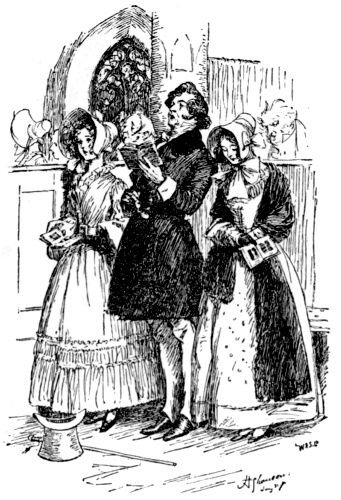
‘Sang out loud and joyfully.’
Such was the impression made upon me by the Brown family when I first saw them all together in Cranford Church. The Captain I had met before—on the occasion of the smoky chimney, which he had cured by some simple alteration in the flue. In church, he held his double eye-glass to his eyes during the Morning Hymn, and then lifted up his head erect and sang out loud and joyfully. He made the responses louder than 12the clerk—an old man with a piping feeble voice, who, I think, felt aggrieved at the Captain’s sonorous bass, and quavered higher and higher in consequence.
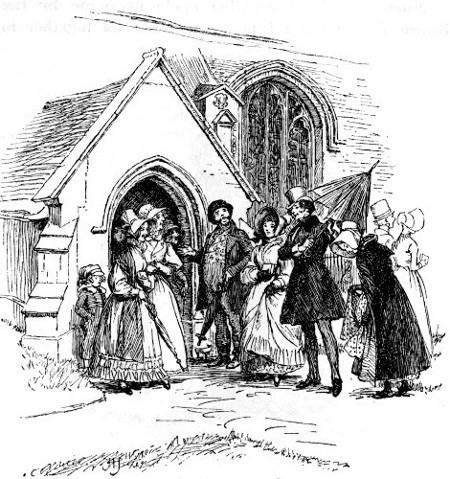
‘Coming out of church.’
On coming out of church, the brisk Captain paid the most gallant attention to his two daughters. He nodded and smiled to his acquaintances; but he shook hands with none until he had helped Miss Brown to unfurl her umbrella, had relieved her of her prayer-book, and had waited patiently till she, with trembling nervous 13hands, had taken up her gown to walk through the wet roads.
I wondered what the Cranford ladies did with Captain Brown at their parties. We had often rejoiced, in former days, that there was no gentleman to be attended to, and to find conversation for, at the card-parties. We had congratulated ourselves upon the snugness of the evenings; and, in our love for gentility and distaste of mankind, we had almost persuaded ourselves that to be a man was to be ‘vulgar’; so that when I found my friend and hostess, Miss Jenkyns, was going to have a party in my honour, and that Captain and the Miss Browns were invited, I wondered much what would be the course of the evening. Card-tables, with green-baize tops, were set out by daylight, just as usual; it was the third week in November, so the evenings closed in about four. Candles and clean packs of cards were arranged on each table. The fire was made up; the neat maidservant had received her last directions; and there we stood, dressed in our best, each with a candle-lighter in our hands, ready to dart at the candles as soon as the first knock came. Parties in Cranford were solemn festivities, making the ladies feel gravely elated as they sat together in their best dresses. As soon as three had arrived, we sat down to ‘Preference,’ I being the unlucky fourth. The next four comers were put down immediately to another table; and presently the tea-trays, which I had seen set out in the storeroom as I passed in the morning, were placed each on the middle of a card-table. The china was delicate egg-shell; the old-fashioned silver glittered with polishing; but the eatables were of the slightest description. While the trays were yet on the 14tables, Captain and the Miss Browns came in; and I could see that, somehow or other, the Captain was a favourite with all the ladies present. Ruffled brows were smoothed, sharp voices lowered at his approach. Miss Brown looked ill, and depressed almost to gloom. Miss Jessie smiled as usual, and seemed nearly as popular as her father. He immediately and quietly assumed the man’s place in the room; attended to every one’s wants, lessened the pretty maidservant’s labour by waiting on empty cups and bread-and-butterless ladies; and yet did it all in so easy and dignified a manner, and so much as if it were a matter of course for the strong to attend to the weak, that he was a true man throughout. He played for threepenny points with as grave an interest as if they had been pounds; and yet, in all his attention to strangers, he had an eye on his suffering daughter—for suffering I was sure she was, though to many eyes she might only appear to be irritable. Miss Jessie could not play cards, but she talked to the sitters-out, who, before her coming, had been rather inclined to be cross. She sang, too, to an old cracked piano, which I think had been a spinnet in its youth. Miss Jessie sang ‘Jock o’ Hazeldean’ a little out of tune; but we were none of us musical, though Miss Jenkyns beat time, out of time, by way of appearing to be so.
It was very good of Miss Jenkyns to do this; for I had seen that, a little before, she had been a good deal annoyed by Miss Jessie Brown’s unguarded admission (à propos of Shetland wool) that she had an uncle, her mother’s brother, who was a shopkeeper in Edinburgh. Miss Jenkyns tried to drown this confession by a terrible cough—for the Honourable Mrs. Jamieson was sitting 15at the card-table nearest Miss Jessie, and what would she say or think if she found out she was in the same room with a shopkeeper’s niece! But Miss Jessie Brown (who had no tact, as we all agreed the next morning) would repeat the information, and assure Miss Pole she could easily get her the identical Shetland wool required, ‘through my uncle, who has the best assortment of Shetland goods of any one in Edinbro’.’ It was to take the taste of this out of our mouths, and the sound of this out of our ears, that Miss Jenkyns proposed music; so I say again, it was very good of her to beat time to the song.
When the trays reappeared with biscuits and wine, punctually at a quarter to nine, there was conversation, comparing of cards, and talking over tricks; but by and by Captain Brown sported a bit of literature.
‘Have you seen any numbers of The Pickwick Papers?’ said he. (They were then publishing in parts.) ‘Capital thing!’
Now Miss Jenkyns was daughter of a deceased rector of Cranford; and, on the strength of a number of manuscript sermons, and a pretty good library of divinity, considered herself literary, and looked upon any conversation about books as a challenge to her. So she answered and said, ‘Yes, she had seen them; indeed, she might say she had read them.’
‘And what do you think of them?’ exclaimed Captain Brown. ‘Aren’t they famously good?’
So urged, Miss Jenkyns could not but speak.
‘I must say, I don’t think they are by any means equal to Dr. Johnson. Still, perhaps, the author is young. Let him persevere, and who knows what he may become if he will take the great Doctor for his model.’ This 16was evidently too much for Captain Brown to take placidly; and I saw the words on the tip of his tongue before Miss Jenkyns had finished her sentence.
‘It is quite a different sort of thing, my dear madam,’ he began.
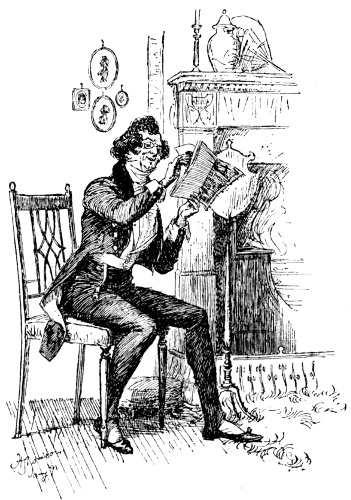
‘The account of the “swarry.”’
‘I am quite aware of that,’ returned she. ‘And I make allowances, Captain Brown.’
‘Just allow me to read you a scene out of this month’s number,’ pleaded he. ‘I had it only this morning, and I don’t think the company can have read it yet.’
17‘As you please,’ said she, settling herself with an air of resignation. He read the account of the ‘swarry’ which Sam Weller gave at Bath. Some of us laughed heartily. I did not dare, because I was staying in the house. Miss Jenkyns sat in patient gravity. When it was ended, she turned to me, and said, with mild dignity—
‘Fetch me Rasselas, my dear, out of the book-room.’
When I brought it to her she turned to Captain Brown—
‘Now allow me to read you a scene, and then the present company can judge between your favourite, Mr. Boz, and Dr. Johnson.’
She read one of the conversations between Rasselas and Imlac, in a high-pitched majestic voice; and when she had ended she said, ‘I imagine I am now justified in my preference of Dr. Johnson as a writer of fiction.’ The Captain screwed his lips up, and drummed on the table, but he did not speak. She thought she would give a finishing blow or two.
‘I consider it vulgar, and below the dignity of literature, to publish in numbers.’
‘How was The Rambler published, ma’am?’ asked Captain Brown, in a low voice, which I think Miss Jenkyns could not have heard.
‘Dr. Johnson’s style is a model for young beginners. My father recommended it to me when I began to write letters—I have formed my own style upon it; I recommend it to your favourite.’
‘I should be very sorry for him to exchange his style for any such pompous writing,’ said Captain Brown.
18Miss Jenkyns felt this as a personal affront, in a way of which the Captain had not dreamed. Epistolary writing she and her friends considered as her forte. Many a copy of many a letter have I seen written and corrected on the slate, before she ‘seized the half-hour just previous to post-time to assure’ her friends of this or of that; and Dr. Johnson was, as she said, her model in these compositions. She drew herself up with dignity, and only replied to Captain Brown’s last remark by saying, with marked emphasis on every syllable, ‘I prefer Dr. Johnson to Mr. Boz.’
It is said—I won’t vouch for the fact—that Captain Brown was heard to say, sotto voce, ‘D——n Dr. Johnson!’ If he did, he was penitent afterwards, as he showed by going to stand near Miss Jenkyns’s armchair, and endeavouring to beguile her into conversation on some more pleasing subject. But she was inexorable. The next day she made the remark I have mentioned about Miss Jessie’s dimples.
19
It was impossible to live a month at Cranford and not know the daily habits of each resident; and long before my visit was ended I knew much concerning the whole Brown trio. There was nothing new to be discovered respecting their poverty; for they had spoken simply and openly about that from the very first. They made no mystery of the necessity for their being economical. All that remained to be discovered was the Captain’s infinite kindness of heart, and the various modes in which, unconsciously to himself, he manifested it. Some little anecdotes were talked about for some time after they occurred. As we did not read much, and as all the ladies were pretty well suited with servants, there was a dearth of subjects for conversation. We 20therefore discussed the circumstance of the Captain taking a poor old woman’s dinner out of her hands one very slippery Sunday. He had met her returning from the bakehouse as he came from church, and noticed her precarious footing; and, with the grave dignity with which he did everything, he relieved her of her burden, and steered along the street by her side, carrying her baked mutton and potatoes safely home. This was thought very eccentric; and it was rather expected that he would pay a round of calls, on the Monday morning, to explain and apologise to the 21Cranford sense of propriety: but he did no such thing; and then it was decided that he was ashamed, and was keeping out of sight. In a kindly pity for him we began to say, ‘After all, the Sunday morning’s occurrence showed great goodness of heart,’ and it was resolved that he should be comforted on his next appearance amongst us; but, lo! he came down upon us, untouched by any sense of shame, speaking loud and bass as ever, his head thrown back, his wig as jaunty and well-curled as usual, and we were obliged to conclude he had forgotten all about Sunday.
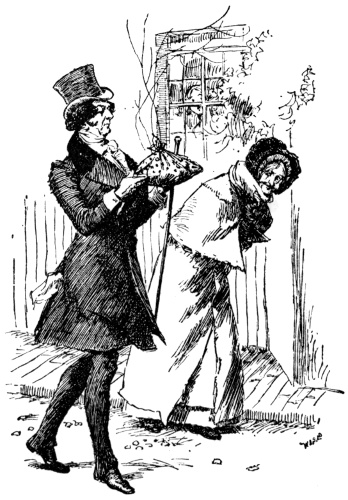
‘Carrying her baked mutton and potatoes.’
Miss Pole and Miss Jessie Brown had set up a kind of intimacy on the strength of the Shetland wool and the new knitting stitches; so it happened that when I went to visit Miss Pole I saw more of the Browns than I had done while staying with Miss Jenkyns, who had never got over what she called Captain Brown’s disparaging remarks upon Dr. Johnson as a writer of light and agreeable fiction. I found that Miss Brown was seriously ill of some lingering incurable complaint, the pain occasioned by which gave the uneasy expression to her face that I had taken for unmitigated crossness. Cross, too, she was at times, when the nervous irritability occasioned by her disease became past endurance. Miss Jessie bore with her at these times, even more patiently than she did with the bitter self-upbraidings by which they were invariably succeeded. Miss Brown used to accuse herself, not merely of hasty and irritable temper, but also of being the cause why her father and sister were obliged to pinch, in order to allow her the small luxuries which were necessaries in her condition. She would so fain have made sacrifices for them, and have lightened their cares, that the original generosity of her 22disposition added acerbity to her temper. All this was borne by Miss Jessie and her father with more than placidity—with absolute tenderness. I forgave Miss Jessie her singing out of tune, and her juvenility of dress, when I saw her at home. I came to perceive that Captain Brown’s dark Brutus wig and padded coat (alas! too often threadbare) were remnants of the military smartness of his youth, which he now wore unconsciously. He was a man of infinite resources, gained in his barrack experience. As he confessed, no one could black his boots to please him except himself: 23but, indeed, he was not above saving the little maidservant’s labours in every way—knowing, most likely, that his daughter’s illness made the place a hard one.
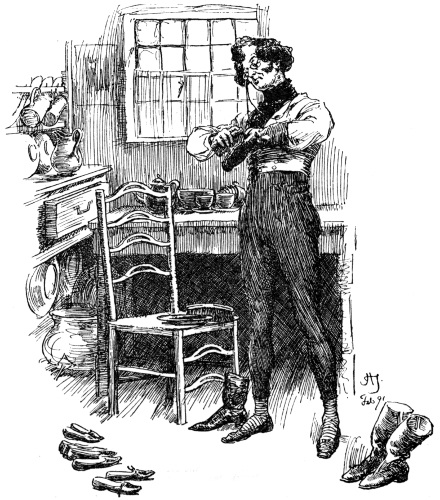
‘No one could black his boots except himself.’
He endeavoured to make peace with Miss Jenkyns, soon after the memorable dispute I have named, by a present of a wooden fire-shovel (his own making), having heard her say how much the grating of an iron one annoyed her. She received the present with cool gratitude, and thanked him formally. When he was gone, she bade me put it away in the lumber-room; feeling, probably, that no present from a man who preferred Mr. Boz to Dr. Johnson could be less jarring than an iron fire-shovel.
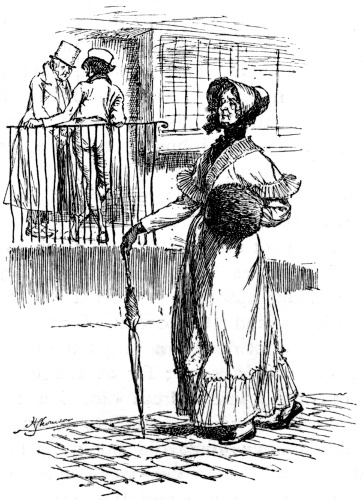
‘Miss Jenkyns.’
Such was the state of things when I left Cranford and went to Drumble. I had, however, several correspondents who kept me au fait as to the proceedings of the dear little town. There was Miss Pole, who was becoming as much absorbed in crochet as she had been once in knitting, and the burden of whose letter was something like, ‘But don’t you forget the white worsted at Flint’s’ of the old song; for at the end of every sentence of news came a fresh direction as to some crochet commission which I was to execute for her. Miss Matilda Jenkyns (who did not mind being called Miss Matty when Miss Jenkyns was not by) wrote nice, kind, rambling letters, now and then venturing into an opinion of her own; but suddenly pulling herself up, and either begging me not to name what she had said, as Deborah thought differently, and she knew, or else putting in a postscript to the effect that, since writing the above, she had been talking over the subject with Deborah, and was quite convinced that, etc.—(here probably followed a recantation of every opinion she 24had given in the letter). Then came Miss Jenkyns—Debōrah, as she liked Miss Matty to call her, her father having once said that the Hebrew name ought to be so pronounced. I secretly think she took the Hebrew prophetess for a model in character; and, indeed, she was not unlike the stern prophetess in some ways, making allowance, of course, for modern customs and difference in dress. Miss Jenkyns wore a cravat, and a little bonnet like a jockey-cap, and altogether had the appearance of a strong-minded woman; although she would have despised the modern idea of women being 25equal to men. Equal, indeed! she knew they were superior. But to return to her letters. Everything in them was stately and grand, like herself. I have been looking them over (dear Miss Jenkyns, how I honoured her!), and I will give an extract, more especially because it relates to our friend Captain Brown——
The Honourable Mrs. Jamieson has only just quitted me; and, in the course of conversation, she communicated to me the intelligence that she had yesterday received a call from her revered husband’s quondam friend, Lord Mauleverer. You will not easily conjecture what brought his lordship within the precincts of our little town. It was to see Captain Brown, with whom, it appears, his lordship was acquainted in the “plumed wars,” and who had the privilege of averting destruction from his lordship’s head, when some great peril was impending over it, off the misnomered Cape of Good Hope. You know our friend the Honourable Mrs. Jamieson’s deficiency in the spirit of innocent curiosity; and you will therefore not be so much surprised when I tell you she was quite unable to disclose to me the exact nature of the peril in question. I was anxious, I confess, to ascertain in what manner Captain Brown, with his limited establishment, could receive so distinguished a guest; and I discovered that his lordship retired to rest, and, let us hope, to refreshing slumbers, at the Angel Hotel; but shared the Brunonian meals during the two days that he honoured Cranford with his august presence. Mrs. Johnson, our civil butcher’s wife, informs me that Miss Jessie purchased a leg of lamb; but, besides this, I can hear of no preparation whatever to give a suitable reception to so distinguished a visitor. Perhaps they entertained him with “the feast 26of reason and the flow of soul”; and to us, who are acquainted with Captain Brown’s sad want of relish for “the pure wells of English undefiled,” it may be matter for congratulation that he has had the opportunity of improving his taste by holding converse with an elegant and refined member of the British aristocracy. But from some mundane failings who is altogether free?’
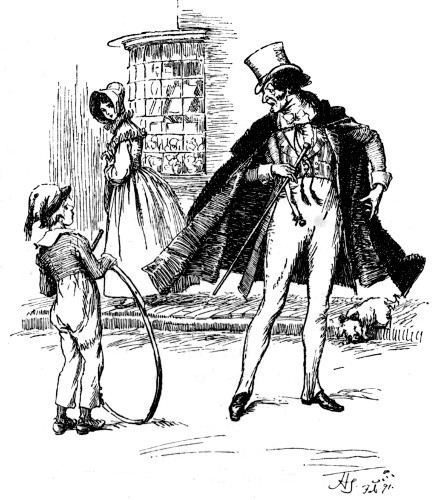
‘One with whom his lordship held conversation.’
Miss Pole and Miss Matty wrote to me by the same post. Such a piece of news as Lord Mauleverer’s visit was not to be lost on the Cranford letter-writers; they made the most of it. Miss Matty humbly apologised for writing at the same time as her sister, 27who was so much more capable than she to describe the honour done to Cranford; but, in spite of a little bad spelling, Miss Matty’s account gave me the best idea of the commotion occasioned by his lordship’s visit, after it had occurred; for, except the people at the Angel, the Browns, Mrs. Jamieson, and a little lad his lordship had sworn at for driving a dirty hoop against the aristocratic legs, I could not hear of any one with whom his lordship had held conversation.
My next visit to Cranford was in the summer. There had been neither births, deaths, nor marriages since I was there last. Everybody lived in the same house, and wore pretty nearly the same well-preserved old-fashioned clothes. The greatest event was, that the Miss Jenkynses had purchased a new carpet for the drawing-room. Oh, the busy work Miss Matty and I had in chasing the sunbeams, as they fell in an afternoon right down on this carpet through the blindless window! We spread newspapers over the places, and sat down to our book or our work; and lo! in a quarter of an hour the sun had moved, and was blazing away on a fresh spot; and down again we went on our knees to alter the position of the newspapers. We were very busy, too, one whole morning, before Miss Jenkyns gave her party, in following her directions, and in cutting out and stitching together pieces of newspaper so as to form little paths to every chair set for the expected visitors, lest their shoes might dirty or defile the purity of the carpet. Do you make paper paths for every guest to walk upon in London?
Captain Brown and Miss Jenkyns were not very cordial to each other. The literary dispute, of which I had seen the beginning, was a ‘raw,’ the slightest touch 28on which made them wince. It was the only difference of opinion they had ever had; but that difference was enough. Miss Jenkyns could not refrain from talking at Captain Brown; and, though he did not reply, he drummed with his fingers, which action she felt and resented as very disparaging to Dr. Johnson. He was rather ostentatious in his preference of the writings of Mr. Boz; would walk through the streets so absorbed in them that he all but ran against Miss Jenkyns; and though his apologies were earnest and sincere, and though he did not, in fact, do more than startle her and himself, she owned to me she had rather he had knocked her down, if he had only been reading a higher style of literature. The poor, brave Captain! he looked older, and more worn, and his clothes were very threadbare. But he seemed as bright and cheerful as ever, unless he was asked about his daughter’s health.
‘She suffers a great deal, and she must suffer more; we do what we can to alleviate her pain;—God’s will be done!’ He took off his hat at these last words. I found, from Miss Matty, that everything had been done, in fact. A medical man, of high repute in that country neighbourhood, had been sent for, and every injunction he had given was attended to, regardless of expense. Miss Matty was sure they denied themselves many things in order to make the invalid comfortable; but they never spoke about it; and as for Miss Jessie!—‘I really think she’s an angel,’ said poor Miss Matty, quite overcome. ‘To see her way of bearing with Miss Brown’s crossness, and the bright face she puts on after she’s been sitting up a whole night and scolded above half of it, is quite beautiful. Yet she looks as neat and as ready to welcome the Captain 29at breakfast-time as if she had been asleep in the Queen’s bed all night. My dear! you could never laugh at her prim little curls or her pink bows again if you saw her as I have done.’ I could only feel very penitent, and greet Miss Jessie with double respect when I met her next. She looked faded and pinched; and her lips began to quiver, as if she was very weak, when she spoke of her sister. But she brightened, and sent back the tears that were glittering in her pretty eyes, as she said—
‘But, to be sure, what a town Cranford is for kindness! I don’t suppose any one has a better dinner than usual cooked, but the best part of all comes in a little covered basin for my sister. The poor people will leave their earliest vegetables at our door for her. They speak short and gruff, as if they were ashamed of it; but I am sure it often goes to my heart to see their thoughtfulness.’ The tears now came back and overflowed; but after a minute or two she began to scold herself, and ended by going away the same cheerful Miss Jessie as ever.
‘But why does not this Lord Mauleverer do something for the man who saved his life?’ said I.
‘Why, you see, unless Captain Brown has some reason for it, he never speaks about being poor; and he walked along by his lordship looking as happy and cheerful as a prince; and as they never called attention to their dinner by apologies, and as Miss Brown was better that day, and all seemed bright, I daresay his lordship never knew how much care there was in the background. He did send game in the winter pretty often, but now he is gone abroad.’
I had often occasion to notice the use that was made of fragments and small opportunities in Cranford: 30the rose-leaves that were gathered ere they fell to make into a pot-pourri for some one who had no garden; the little bundles of lavender-flowers sent to strew the drawers of some town-dweller, or to burn in the chamber of some invalid. Things that many would despise, and actions which it seemed scarcely worth while to perform, were all attended to in Cranford. Miss Jenkyns stuck an apple full of cloves, to be heated and smell pleasantly in Miss Brown’s room; and as she put in each clove she uttered a Johnsonian sentence. Indeed, she never could think of the Browns without talking Johnson; and, as they were seldom absent from her thoughts just then, I heard many a rolling three-piled sentence.
Captain Brown called one day to thank Miss Jenkyns for many little kindnesses, which I did not know until then that she had rendered. He had suddenly become like an old man; his deep bass voice had a quavering in it, his eyes looked dim, and the lines on his face were deep. He did not—could not—speak cheerfully of his daughter’s state, but he talked with manly, pious resignation, and not much. Twice over he said, ‘What Jessie has been to us, God only knows!’ and after the second time, he got up hastily, shook hands all round without speaking, and left the room.
That afternoon we perceived little groups in the street, all listening with faces aghast to some tale or other. Miss Jenkyns wondered what could be the matter for some time before she took the undignified step of sending Jenny out to inquire.
Jenny came back with a white face of terror. ‘Oh, ma’am! oh, Miss Jenkyns, ma’am! Captain Brown is killed by them nasty cruel railroads!’ and she burst 31into tears. She, along with many others, had experienced the poor Captain’s kindness.
‘How?—where—where? Good God! Jenny, don’t waste time in crying, but tell us something.’ Miss Matty rushed out into the street at once, and collared the man who was telling the tale.
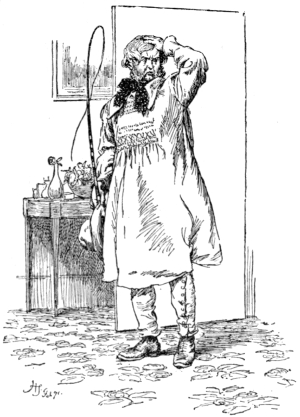
‘And he shuddered at the recollection.’
‘Come in—come to my sister at once,—Miss Jenkyns, the rector’s daughter. Oh, man, man!—say it is not true,’ she cried, as she brought the affrighted carter, sleeking down his hair, into the drawingroom, where he stood with his wet boots on the new carpet, and no one regarded it.
‘Please, mum, it is true. I seed it myself,’ and he shuddered at the recollection. ‘The Captain was a-reading some new book as he was deep in, a-waiting for the down train; and there was a little lass as wanted to come to its mammy, and gave its sister the slip, and came toddling across the line. And he looked up sudden, at the sound of the train coming, and seed the child, and he darted on the line and cotched it up, and his foot slipped, and the train came over him in no time. Oh Lord, Lord! 32Mum, it’s quite true—and they’ve come over to tell his daughters. The child’s safe, though, with only a bang on its shoulder, as he threw it to its mammy. Poor Captain would be glad of that, mum, wouldn’t he? God bless him!’ The great rough carter puckered up his manly face, and turned away to hide his tears. I turned to Miss Jenkyns. She looked very ill, as if she were going to faint, and signed to me to open the window.
‘Matilda, bring me my bonnet. I must go to those girls. God pardon me, if ever I have spoken contemptuously to the Captain!’
Miss Jenkyns arrayed herself to go out, telling Miss Matilda to give the man a glass of wine. While she was away Miss Matty and I huddled over the fire, talking in a low and awestruck voice. I know we cried quietly all the time.
Miss Jenkyns came home in a silent mood, and we durst not ask her many questions. She told us that Miss Jessie had fainted, and that she and Miss Pole had had some difficulty in bringing her round; but that, as soon as she recovered, she begged one of them to go and sit with her sister.
‘Mr. Hoggins says she cannot live many days, and she shall be spared this shock,’ said Miss Jessie, shivering with feelings to which she dared not give way.
‘But how can you manage, my dear?’ asked Miss Jenkyns; ‘you cannot bear up, she must see your tears.’
‘God will help me—I will not give way—she was asleep when the news came; she may be asleep yet. She would be so utterly miserable, not merely at my father’s death, but to think of what would become of me; she is so good to me.’ She looked up earnestly in their faces with her soft true eyes, and Miss Pole 33told Miss Jenkyns afterwards she could hardly bear it, knowing, as she did, how Miss Brown treated her sister.
However, it was settled according to Miss Jessie’s wish. Miss Brown was to be told her father had been summoned to take a short journey on railway business. They had managed it in some way—Miss Jenkyns could not exactly say how. Miss Pole was to stop with Miss Jessie. Mrs. Jamieson had sent to inquire. And this was all we heard that night; and a sorrowful night it was. The next day a full account of the fatal accident was in the county paper which Miss Jenkyns took in. Her eyes were very weak, she said, and she asked me to read it. When I came to the ‘gallant gentleman was deeply engaged in the perusal of a number of Pickwick, which he had just received,’ Miss Jenkyns shook her head long and solemnly, and then sighed out, ‘Poor, dear, infatuated man!’
The corpse was to be taken from the station to the parish church, there to be interred. Miss Jessie had set her heart on following it to the grave; and no dissuasives could alter her resolve. Her restraint upon herself made her almost obstinate; she resisted all Miss Pole’s entreaties and Miss Jenkyns’s advice. At last Miss Jenkyns gave up the point; and after a silence, which I feared portended some deep displeasure against Miss Jessie, Miss Jenkyns said she should accompany the latter to the funeral.
‘It is not fit for you to go alone. It would be against both propriety and humanity were I to allow it.’
Miss Jessie seemed as if she did not half like this arrangement; but her obstinacy, if she had any, had been exhausted in her determination to go to the interment. She longed, poor thing, I have no doubt, to cry 34alone over the grave of the dear father to whom she had been all in all, and to give way, for one little half-hour, uninterrupted by sympathy and unobserved by friendship. But it was not to be. That afternoon Miss Jenkyns sent out for a yard of black crape, and employed herself busily in trimming the little black silk bonnet I have spoken about. When it was finished she put it on, and looked at us for approbation—admiration she despised. I was full of sorrow, but, by one of those whimsical thoughts which come unbidden into our heads, in times of deepest grief, I no sooner saw the bonnet than I was reminded of a helmet; and in that hybrid bonnet, half-helmet, half-jockey cap, did Miss Jenkyns attend Captain Brown’s funeral, and, I believe, supported Miss Jessie with a tender indulgent firmness which was invaluable, allowing her to weep her passionate fill before they left.
Miss Pole, Miss Matty, and I, meanwhile, attended to Miss Brown: and hard work we found it to relieve her querulous and never-ending complaints. But if we were so weary and dispirited, what must Miss Jessie have been! Yet she came back almost calm, as if she had gained a new strength. She put off her mourning dress, and came in, looking pale and gentle, thanking us each with a soft long pressure of the hand. She could even smile—a faint, sweet, wintry smile—as if to reassure us of her power to endure: but her look made our eyes fill suddenly with tears, more than if she had cried outright.
It was settled that Miss Pole was to remain with her all the watching livelong night; and that Miss Matty and I were to return in the morning to relieve them, and give Miss Jessie the opportunity for a few 35hours of sleep. But when the morning came, Miss Jenkyns appeared at the breakfast-table, equipped in her helmet-bonnet, and ordered Miss Matty to stay at home, as she meant to go and help to nurse. She was evidently in a state of great friendly excitement, which she showed by eating her breakfast standing, and scolding the household all round.
No nursing—no energetic strong-minded woman could help Miss Brown now. There was that in the room as we entered which was stronger than us all, and made us shrink into solemn awestruck helplessness. Miss Brown was dying. We hardly knew her voice, it was so devoid of the complaining tone we had always associated with it. Miss Jessie told me afterwards that it, and her face too, were just what they had been formerly, when her mother’s death left her the young anxious head of the family, of whom only Miss Jessie survived.
She was conscious of her sister’s presence, though not, I think, of ours. We stood a little behind the curtain: Miss Jessie knelt with her face near her sister’s, in order to catch the last soft awful whispers.
‘Oh, Jessie! Jessie! How selfish I have been! God forgive me for letting you sacrifice yourself for me as you did! I have so loved you—and yet I have thought only of myself. God forgive me!’
‘Hush, love! hush!’ said Miss Jessie, sobbing.
‘And my father! my dear, dear father! I will not complain now, if God will give me strength to be patient. But, oh, Jessie! tell my father how I longed and yearned to see him at last, and to ask his forgiveness. He can never know now how I loved him—oh! if I might but tell him, before I die! What a life of 36sorrow his has been, and I have done so little to cheer him!’
A light came into Miss Jessie’s face. ‘Would it comfort you, dearest, to think that he does know?—would it comfort you, love, to know that his cares, his sorrows——’ Her voice quivered, but she steadied it into calmness,—‘Mary! he has gone before you to the place where the weary are at rest. He knows now how you loved him.’
A strange look, which was not distress, came over Miss Brown’s face. She did not speak for some time, but then we saw her lips form the words, rather than heard the sound—‘Father, mother, Harry, Archy;’—then, as if it were a new idea throwing a filmy shadow over her darkened mind—‘But you will be alone, Jessie!’
Miss Jessie had been feeling this all during the silence, I think; for the tears rolled down her cheeks like rain at these words, and she could not answer at first. Then she put her hands together tight, and lifted them up, and said—but not to us—
‘Though He slay me, yet will I trust in Him.’
In a few moments more Miss Brown lay calm and still—never to sorrow or murmur more.
After this second funeral, Miss Jenkyns insisted that Miss Jessie should come to stay with her rather than go back to the desolate house, which, in fact, we learned from Miss Jessie, must now be given up, as she had not wherewithal to maintain it. She had something above twenty pounds a-year, besides the interest of the money for which the furniture would sell; but she could not live upon that: and so we talked over her qualifications for earning money.
37‘I can sew neatly,’ said she, ‘and I like nursing. I think, too, I could manage a house, if any one would try me as housekeeper; or I would go into a shop as saleswoman, if they would have patience with me at first.’
Miss Jenkyns declared, in an angry voice, that she should do no such thing; and talked to herself about ‘some people having no idea of their rank as a captain’s daughter,’ nearly an hour afterwards, when she brought Miss Jessie up a basin of delicately-made arrow-root, and stood over her like a dragoon until the last spoonful was finished: then she disappeared. Miss Jessie began to tell me some more of the plans which had suggested themselves to her, and insensibly fell into talking of the days that were past and gone, and interested me so much I neither knew nor heeded how time passed. We were both startled when Miss Jenkyns reappeared, and caught us crying. I was afraid lest she would be displeased, as she often said that crying hindered digestion, and I knew she wanted Miss Jessie to get strong; but, instead, she looked queer and excited, and fidgeted round us without saying anything. At last she spoke.
‘I have been so much startled—no, I’ve not been at all startled—don’t mind me, my dear Miss Jessie—I’ve been very much surprised—in fact, I’ve had a caller, whom you knew once, my dear Miss Jessie——’
Miss Jessie went very white, then flushed scarlet, and looked eagerly at Miss Jenkyns.
‘A gentleman, my dear, who wants to know if you would see him.’
‘Is it?—it is not——’ stammered out Miss Jessie—and got no farther.
38‘This is his card,’ said Miss Jenkyns, giving it to Miss Jessie; and while her head was bent over it, Miss Jenkyns went through a series of winks and odd faces to me, and formed her lips into a long sentence, of which, of course, I could not understand a word.
‘May he come up?’ asked Miss Jenkyns at last.
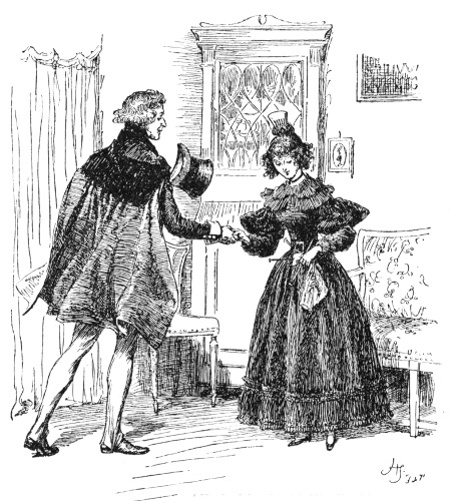
‘He shook hands with Miss Jessie.’
‘Oh yes! certainly!’ said Miss Jessie, as much as to say, this is your house, you may show any visitor where you like. She took up some knitting of Miss Matty’s 39and began to be very busy, though I could see how she trembled all over.
Miss Jenkyns rang the bell, and told the servant who answered it to show Major Gordon upstairs; and, presently, in walked a tall, fine, frank-looking man of forty or upwards. He shook hands with Miss Jessie; but he could not see her eyes, she kept them so fixed on the ground. Miss Jenkyns asked me if I would come and help her to tie up the preserves in the store-room; and, though Miss Jessie plucked at my gown, and even looked up at me with begging eye, I durst not refuse to go where Miss Jenkyns asked. Instead of tying up preserves in the store-room, however, we went to talk in the dining-room; and there Miss Jenkyns told me what Major Gordon had told her;—how he had served in the same regiment with Captain Brown, and had become acquainted with Miss Jessie, then a sweet-looking blooming girl of eighteen; how the acquaintance had grown into love on his part, though it had been some years before he had spoken; how, on becoming possessed, through the will of an uncle, of a good estate in Scotland, he had offered and been refused, though with so much agitation and evident distress that he was sure she was not indifferent to him; and how he had discovered that the obstacle was the fell disease which was, even then, too surely threatening her sister. She had mentioned that the surgeons foretold intense suffering; and there was no one but herself to nurse her poor Mary, or cheer and comfort her father during the time of illness. They had had long discussions; and on her refusal to pledge herself to him as his wife when all should be over, he had grown angry, and broken off entirely, and 40gone abroad, believing that she was a cold-hearted person whom he would do well to forget. He had been travelling in the East, and was on his return home when, at Rome, he saw the account of Captain Brown’s death in Galignani.
Just then Miss Matty, who had been out all the morning, and had only lately returned to the house, burst in with a face of dismay and outraged propriety.
‘Oh, goodness me!’ she said. ‘Deborah, there’s a gentleman sitting in the drawing-room with his arm round Miss Jessie’s waist!’ Miss Matty’s eyes looked large with terror.
Miss Jenkyns snubbed her down in an instant.
‘The most proper place in the world for his arm to be in. Go away, Matilda, and mind your own business.’ This from her sister, who had hitherto been a model of feminine decorum, was a blow for poor Miss Matty, and with a double shock she left the room.
The last time I ever saw poor Miss Jenkyns was many years after this. Mrs. Gordon had kept up a warm and affectionate intercourse with all at Cranford. Miss Jenkyns, Miss Matty, and Miss Pole had all been to visit her, and returned with wonderful accounts of her house, her husband, her dress, and her looks. For, with happiness, something of her early bloom returned; she had been a year or two younger than we had taken her for. Her eyes were always lovely, and, as Mrs. Gordon, her dimples were not out of place. At the time to which I have referred, when I last saw Miss Jenkyns, that lady was old and feeble, and had lost something of her strong mind. Little Flora Gordon was staying with the Misses Jenkyns, and when I came 41in she was reading aloud to Miss Jenkyns, who lay feeble and changed on the sofa. Flora put down The Rambler when I came in.
‘Ah!’ said Miss Jenkyns, ‘you find me changed, my dear. I can’t see as I used to do. If Flora were not here to read to me, I hardly know how I should get through the day. Did you ever read The Rambler? It’s a wonderful book—wonderful! and the most improving reading for Flora’ (which I daresay it would have been if she could have read half the words without spelling, and could have understood the meaning of a third), ‘better than that strange old book, with the queer name, poor Captain Brown was killed for reading—that book by Mr. Boz, you know—Old Poz; when I was a girl—but that’s a long time ago—I acted Lucy in Old Poz.’ She babbled on long enough for Flora to get a good long spell at The Christmas Carol, which Miss Matty had left on the table.
42
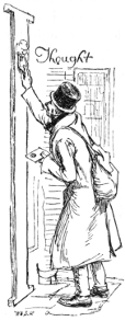
I thought probably my connection with Cranford would cease after Miss Jenkyns’s death; at least, that it would have to be kept up by correspondence, which bears much the same relation to personal intercourse that the books of dried plants I sometimes see (‘Hortus Siccus,’ I think they call the thing) do to the living and fresh flowers in the lanes and meadows. I was pleasantly surprised, therefore, by receiving a letter from Miss Pole (who had always come in for a supplementary week after my annual visit to Miss Jenkyns) proposing that I should go and stay with her; and then, in a couple of days after my acceptance, came a note from Miss Matty, in which, in a rather 43circuitous and very humble manner, she told me how much pleasure I should confer if I could spend a week or two with her, either before or after I had been at Miss Pole’s; ‘for,’ she said, ‘since my dear sister’s death I am well aware I have no attractions to offer; it is only to the kindness of my friends that I can owe their company.’
Of course I promised to come to dear Miss Matty as soon as I had ended my visit to Miss Pole; and the day after my arrival at Cranford I went to see her, much wondering what the house would be like without Miss Jenkyns, and rather dreading the changed aspect of things. Miss Matty began to cry as soon as she saw me. She was evidently nervous from having anticipated my call. I comforted her as well as I could; and I found the best consolation I could give was the honest praise that came from my heart as I spoke of the deceased. Miss Matty slowly shook her head over each virtue as it was named and attributed to her sister; and at last she could not restrain the tears which had long been silently flowing, but hid her face behind her handkerchief, and sobbed aloud.
‘Dear Miss Matty!’ said I, taking her hand—for indeed I did not know in what way to tell her how sorry I was for her, left deserted in the world. She put down her handkerchief, and said—
‘My dear, I’d rather you did not call me Matty. She did not like it; but I did many a thing she did not like, I’m afraid—and now she’s gone! If you please, my love, will you call me Matilda?’
I promised faithfully, and began to practise the new name with Miss Pole that very day; and, by degrees, Miss Matilda’s feeling on the subject was known through Cranford, and we all tried to drop the more familiar 44name, but with so little success that by and by we gave up the attempt.