Front matter (continued 2)
Reading edition · Edition 2
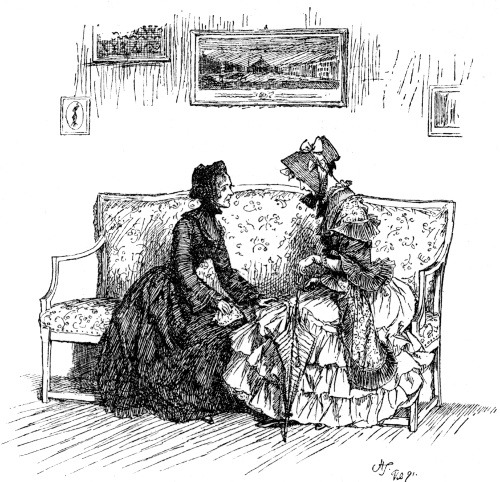
‘If you please, my love, will you call me Matilda?’
My visit to Miss Pole was very quiet. Miss Jenkyns had so long taken the lead in Cranford that, now she was gone, they hardly knew how to give a party. The Honourable Mrs. Jamieson, to whom Miss Jenkyns herself had always yielded the post of honour, was fat and inert, and very much at the mercy of her old servants. If they chose that she should give a party, they reminded her of the necessity for so doing; if not, she let it alone. There was all the more time for me 45to hear old-world stories from Miss Pole, while she sat knitting, and I making my father’s shirts. I always took a quantity of plain sewing to Cranford; for, as we did not read much, or walk much, I found it a capital time to get through my work. One of Miss Pole’s stories related to a shadow of a love affair that was dimly perceived or suspected long years before.
Presently, the time arrived when I was to remove to Miss Matilda’s house. I found her timid and anxious about the arrangements for my comfort. Many a time, while I was unpacking, did she come backwards and forwards to stir the fire, which burned all the worse for being so frequently poked.
‘Have you drawers enough, dear?’ asked she. ‘I don’t know exactly how my sister used to arrange them. She had capital methods. I am sure she would have trained a servant in a week to make a better fire than this, and Fanny has been with me four months.’
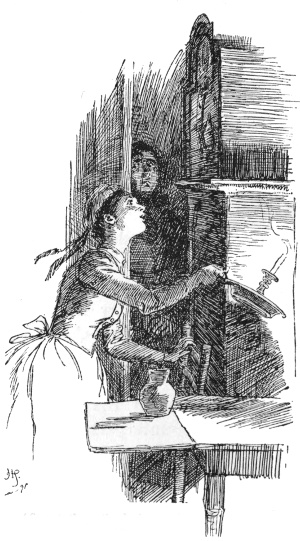
‘So as to throw the shadow on the clock face.’
This subject of servants was a standing grievance, and I could not wonder much at it; for if gentlemen were scarce, and almost unheard of in the ‘genteel society’ of Cranford, they or their counterparts—handsome young men—abounded in the lower classes. The pretty neat servant-maids had their choice of desirable ‘followers’; and their mistresses, without having the sort of mysterious dread of men and matrimony that Miss Matilda had, might well feel a little anxious lest the heads of their comely maids should be turned by the joiner, or the butcher, or the gardener, who were obliged, by their callings, to come to the house, and who, as ill-luck would have it, were generally handsome and unmarried. Fanny’s lovers, if she had any—and Miss Matilda suspected her of so many flirtations that, 46if she had not been very pretty, I should have doubted her having one—were a constant anxiety to her mistress. She was forbidden, by the articles of her engagement, to have ‘followers’; and though she had answered, innocently enough, doubling up the hem of her apron as she spoke, ‘Please, ma’am, I never had more than one at a time,’ Miss Matty prohibited that one. But a vision of a man seemed to haunt the kitchen. Fanny assured me that it was all fancy, or else I should have said myself that I had seen a man’s coat-tails whisk into the scullery once, when I went on an errand into the store-room at night; and another evening, when, our watches having stopped, I went to look at the clock, there was a very odd appearance, singularly like a young man squeezed up between the clock and the back of the open kitchen door; and I thought Fanny snatched up the candle very hastily, so as to throw the shadow on the clock face, while she very positively told me the time half an 47hour too early, as we found out afterwards by the church clock. But I did not add to Miss Matty’s anxieties by naming my suspicions, especially as Fanny said to me, the next day, that it was such a queer kitchen for having odd shadows about it, she really was almost afraid to stay; ‘for you know, miss,’ she added,‘I don’t see a creature from six o’clock tea till Missus rings the bell for prayers at ten.’
However, it so fell out that Fanny had to leave; and Miss Matilda begged me to stay and ‘settle her’ with the new maid; to which I consented, after I had heard from my father that he did not want me at home. The new servant was a rough, honest-looking country girl, who had only lived in a farm place before; but I liked her looks when she came to be hired; and I promised Miss Matilda to put her in the ways of the house. The said ways were religiously such as Miss Matilda thought her sister would approve. Many a domestic rule and regulation had been a subject of plaintive whispered murmur to me during Miss Jenkyns’s life; but now that she was gone, I do not think that even I, who was a favourite, durst have suggested an alteration. To give an instance: we constantly adhered to the forms which were observed, at meal times, in ‘my father, the rector’s house.’ Accordingly, we had always wine and dessert; but the decanters were only filled when there was a party, and what remained was seldom touched, though we had two wine glasses apiece every day after dinner, until the next festive occasion arrived, when the state of the remainder wine was examined into in a family council. The dregs were often given to the poor; but occasionally, when a good deal had been left at the last party (five months ago, it might be), 48it was added to some of a fresh bottle, brought up from the cellar. I fancy poor Captain Brown did not much like wine, for I noticed he never finished his first glass, and most military men take several. Then, as to our dessert, Miss Jenkyns used to gather currants and gooseberries for it herself, which I sometimes thought would have tasted better fresh from the trees; but then, as Miss Jenkyns observed, there would have been nothing for dessert in summer-time. As it was, we felt very genteel with our two glasses apiece, and a dish of gooseberries at the top, of currants and biscuits at the sides, and two decanters at the bottom. When oranges came in, a curious proceeding was gone through. Miss Jenkyns did not like to cut the fruit; for, as she observed, the juice all ran out nobody knew where; sucking (only I think she used some more recondite word) was in fact the only way of enjoying oranges; but then there was the unpleasant association with a ceremony frequently gone through by little babies; and so, after dessert, in orange season, Miss Jenkyns and Miss Matty used to rise up, possess themselves each of an orange in silence, and withdraw to the privacy of their own rooms to indulge in sucking oranges.
I had once or twice tried, on such occasions, to prevail on Miss Matty to stay, and had succeeded in her sister’s lifetime. I held up a screen, and did not look, and, as she said, she tried not to make the noise very offensive; but now that she was left alone, she seemed quite horrified when I begged her to remain with me in the warm dining-parlour, and enjoy her orange as she liked best. And so it was in everything. Miss Jenkyns’s rules were made more stringent than ever, because the framer of them was gone where there 49could be no appeal. In all things else Miss Matilda was meek and undecided to a fault. I have heard Fanny turn her round twenty times in a morning about dinner, just as the little hussy chose; and I sometimes fancied she worked on Miss Matilda’s weakness in order to bewilder her, and to make her feel more in the power of her clever servant. I determined that I would not leave her till I had seen what sort of a person Martha was; and, if I found her trustworthy, I would tell her not to trouble her mistress with every little decision.
Martha was blunt and plain-spoken to a fault; otherwise she was a brisk, well-meaning, but very ignorant girl. She had not been with us a week before Miss Matilda and I were astounded one morning by the receipt of a letter from a cousin of hers, who had been twenty or thirty years in India, and who had lately, as we had seen by the ‘Army List,’ returned to England, bringing with him an invalid wife who had never been introduced to her English relations. Major Jenkyns wrote to propose that he and his wife should spend a night at Cranford, on his way to Scotland—at the inn, if it did not suit Miss Matilda to receive them into her house; in which case they should hope to be with her as much as possible during the day. Of course, it must suit her, as she said; for all Cranford knew that she had her sister’s bedroom at liberty; but I am sure she wished the major had stopped in India and forgotten his cousins out and out.
‘Oh! how must I manage?’ asked she helplessly. ‘If Deborah had been alive she would have known what to do with a gentleman-visitor. Must I put razors in his dressing-room? Dear! dear! and I’ve got none. Deborah would have had them. And 50slippers, and coat-brushes?’ I suggested that probably he would bring all these things with him. ‘And after dinner, how am I to know when to get up and leave him to his wine? Deborah would have done it so well; she would have been quite in her element. Will he want coffee, do you think?’ I undertook the management of the coffee, and told her I would instruct Martha in the art of waiting—in which, it must be owned, she was terribly deficient—and that I had no doubt Major and Mrs. Jenkyns would understand the quiet mode in which a lady lived by herself in a country town. But she was sadly fluttered. I made her empty her decanters and bring up two fresh bottles of wine. I wished I could have prevented her from being present at my instructions to Martha, for she frequently cut in with some fresh direction, muddling the poor girl’s mind, as she stood open-mouthed, listening to us both.
‘Hand the vegetables round,’ said I (foolishly, I see now—for it was aiming at more than we could accomplish with quietness and simplicity); and then, seeing her look bewildered, I added, ‘Take the vegetables round to people, and let them help themselves.’
‘And mind you go first to the ladies,’ put in Miss Matilda. ‘Always go to the ladies before gentlemen when you are waiting.’
‘I’ll do it as you tell me, ma’am,’ said Martha; ‘but I like lads best.’
We felt very uncomfortable and shocked at this speech of Martha’s, yet I don’t think she meant any harm; and, on the whole, she attended very well to our directions, except that she ‘nudged’ the major when he did not help himself as soon as she expected to the potatoes, while she was handing them round.
51
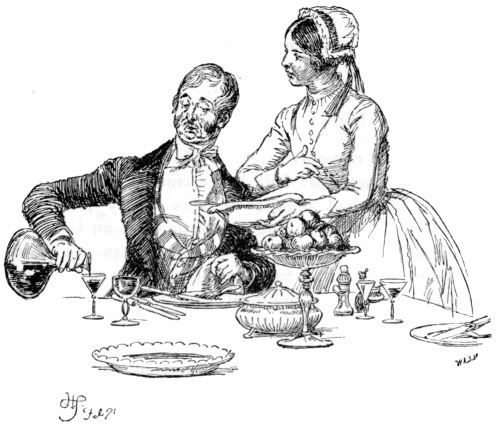
‘She “nudged” the major.’
The major and his wife were quiet, unpretending people enough when they did come; languid, as all East Indians are, I suppose. We were rather dismayed at their bringing two servants with them, a Hindoo body-servant for the major, and a steady elderly maid for his wife; but they slept at the inn, and took off a good deal of the responsibility by attending carefully to their master’s and mistress’s comfort. Martha, to be sure, had never ended her staring at the East Indian’s white turban and brown complexion, and I saw that Miss Matilda shrunk away from him a little as he waited at dinner. Indeed, she asked me, when they 52were gone, if he did not remind me of Blue Beard? On the whole, the visit was most satisfactory, and is a subject of conversation even now with Miss Matilda; at the time it greatly excited Cranford, and even stirred up the apathetic and Honourable Mrs. Jamieson to some expression of interest, when I went to call and thank her for the kind answers she had vouchsafed to Miss Matilda’s inquiries as to the arrangement of a gentleman’s dressing-room—answers which, I must confess, she had given in the wearied manner of the Scandinavian prophetess—
Leave me, leave me to repose.
And now I come to the love affair.
It seems that Miss Pole had a cousin, once or twice removed, who had offered to Miss Matty long ago. Now this cousin lived four or five miles from Cranford on his own estate; but his property was not large enough to entitle him to rank higher than a yeoman; or rather, with something of the ‘pride which apes humility,’ he had refused to push himself on, as so many of his class had done, into the ranks of the squires. He would not allow himself to be called Thomas Holbrook, Esq.; he even sent back letters with this address, telling the postmistress at Cranford that his name was Mr. Thomas Holbrook, yeoman. He rejected all domestic innovations; he would have the house-door stand open in summer and shut in winter, without knocker or bell to summon a servant. The closed fist or the knob of the stick did this office for him if he found the door locked. He despised every refinement which had not its root deep down in humanity. If people were not ill, he saw no necessity 53for moderating his voice. He spoke the dialect of the country in perfection, and constantly used it in conversation; although Miss Pole (who gave me these particulars) added, that he read aloud more beautifully and with more feeling than any one she had ever heard, except the late rector.
‘And how came Miss Matilda not to marry him?’ asked I.
‘Oh, I don’t know. She was willing enough, I think; but you know cousin Thomas would not have been enough of a gentleman for the rector and Miss Jenkyns.’
‘Well! but they were not to marry him,’ said I impatiently.
‘No; but they did not like Miss Matty to marry below her rank. You know she was the rector’s daughter, and somehow they are related to Sir Peter Arley: Miss Jenkyns thought a deal of that.’
‘Poor Miss Matty!’ said I.
‘Nay, now, I don’t know anything more than that he offered and was refused. Miss Matty might not like him—and Miss Jenkyns might never have said a word—it is only a guess of mine.’
‘Has she never seen him since?’ I inquired.
‘No, I think not. You see Woodley, cousin Thomas’s house, lies half-way between Cranford and Misselton; and I know he made Misselton his market-town very soon after he had offered to Miss Matty; and I don’t think he has been into Cranford above once or twice since—once, when I was walking with Miss Matty, in High Street, and suddenly she darted from me, and went up Shire Lane. A few minutes after I was startled by meeting cousin Thomas.’
54‘How old is he?’ I asked, after a pause of castle-building.
‘He must be about seventy, I think, my dear,’ said Miss Pole, blowing up my castle, as if by gunpowder, into small fragments.
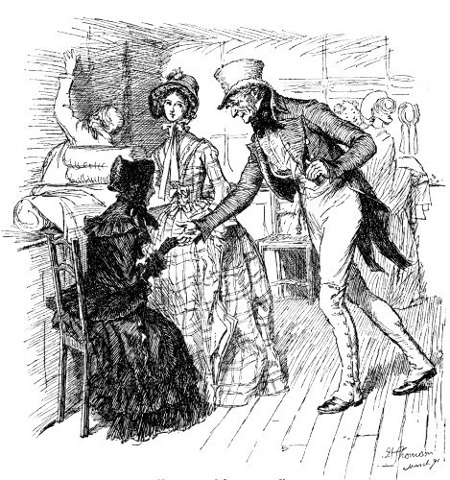
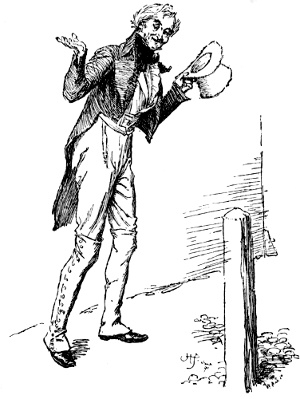
‘How are you? how are you?’
Very soon after—at least during my long visit to Miss Matilda—I had the opportunity of seeing Mr. Holbrook; seeing, too, his first encounter with his 55former love, after thirty or forty years’ separation. I was helping to decide whether any of the new assortment of coloured silks which they had just received at the shop would do to match a gray and black mousseline-de-laine that wanted a new breadth, when a tall, thin, Don Quixote-looking old man came into the shop for some woollen gloves. I had never seen the person (who was rather striking) before, and I watched him rather attentively while Miss Matty listened to the shopman. The stranger wore a blue coat with brass buttons, drab breeches, and gaiters, and drummed with his fingers on the counter until he was attended to. When he answered the shop-boy’s question, ‘What can I have the pleasure of showing you to-day, sir?’ I saw Miss Matilda start, and then suddenly sit down; and instantly I guessed who it was. She had made some inquiry which had to be carried round to the other shopman.
‘Miss Jenkyns wants the black sarsenet two-and-twopence the yard;’ and Mr. Holbrook had caught the name, and was across the shop in two strides.
‘Matty—Miss Matilda—Miss Jenkyns! God bless my soul! I should not have known you. How are you? how are you?’ He kept shaking her hand in a way which proved the warmth of his friendship; but he repeated so often, as if to himself, ‘I should not have known you!’ that any sentimental romance which I might be inclined to build was quite done away with by his manner.
However, he kept talking to us all the time we were in the shop; and then waving the shopman with the unpurchased gloves on one side, with ‘Another time, sir! another time!’ he walked home with us. I am 56happy to say my client, Miss Matilda, also left the shop in an equally bewildered state, not having purchased either green or red silk. Mr. Holbrook was evidently full with honest loud-spoken joy at meeting his old love again; he touched on the changes that had taken place; he even spoke of Miss Jenkyns as ‘Your poor sister! Well, well! we have all our faults;’ and bade us good-bye with many a hope that he should soon see Miss Matty again. She went straight to her room, and never came back till our early tea-time, when I thought she looked as if she had been crying.
57
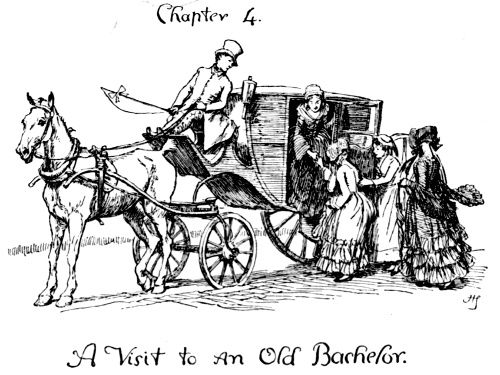

A few days after, a note came from Mr. Holbrook, asking us—impartially asking both of us—in a formal, old-fashioned style, to spend a day at his house—a long June day—for it was June now. He named that he had also invited his cousin, Miss Pole; so that we might join in a fly, which could be put up at his house.
I expected Miss Matty to jump at this invitation; but, no! Miss Pole and I had the greatest difficulty in persuading her to go. She thought it was improper; and was even half annoyed when we utterly ignored the idea of any impropriety in her going with two other 58ladies to see her old lover. Then came a more serious difficulty. She did not think Deborah would have liked her to go. This took us half a day’s good hard talking to get over; but, at the first sentence of relenting, I seized the opportunity, and wrote and despatched an acceptance in her name—fixing day and hour, that all might be decided and done with.
The next morning she asked me if I would go down to the shop with her; and there, after much hesitation, we chose out three caps to be sent home and tried on, that the most becoming might be selected to take with us on Thursday.
She was in a state of silent agitation all the way to Woodley. She had evidently never been there before; and, although she little dreamt I knew anything of her early story, I could perceive she was in a tremor at the thought of seeing the place which might have been her home, and round which it is probable that many of her innocent girlish imaginations had clustered. It was a long drive there, through paved jolting lanes. Miss Matilda sat bolt upright, and looked wistfully out of the windows as we drew near the end of our journey. The aspect of the country was quiet and pastoral. Woodley stood among fields; and there was an old-fashioned garden where roses and currant-bushes touched each other, and where the feathery asparagus formed a pretty background to the pinks and gilly-flowers; there was no drive up to the door. We got out at a little gate, and walked up a straight box-edged path.
‘My cousin might make a drive, I think,’ said Miss Pole, who was afraid of ear-ache, and had only her cap on.
‘I think it is very pretty,’ said Miss Matty, with a 59soft plaintiveness in her voice, and almost in a whisper, for just then Mr. Holbrook appeared at the door, rubbing his hands in very effervescence of hospitality. He looked more like my idea of Don Quixote than ever, and yet the likeness was only external. His respectable housekeeper stood modestly at the door to bid us welcome; and, while she led the elder ladies upstairs to a bedroom, I begged to look about the garden. My request evidently pleased the old gentleman, who took me all round the place, and showed me his six and twenty cows, named after the different letters of the alphabet. As we went along, he surprised me occasionally by repeating apt and beautiful quotations from the poets, ranging easily from Shakespeare and George Herbert to those of our own day. He did this as naturally as if he were thinking aloud, and their true and beautiful words were the best expression he could find for what he was thinking or feeling. To be sure he called Byron ‘my Lord Byrron,’ and pronounced the name of Goethe strictly in accordance with the English sound of the letters—‘As Goethe says, “Ye ever-verdant palaces,”’ etc. Altogether, I never met with a man, before or since, who had spent so long a life in a secluded and not impressive country, with ever-increasing delight in the daily and yearly change of season and beauty.
When he and I went in, we found that dinner was nearly ready in the kitchen—for so I suppose the room ought to be called, as there were oak dressers and cupboards all round, all over by the side of the fireplace, and only a small Turkey carpet in the middle of the flag-floor. The room might have been easily made into a handsome dark oak dining-parlour by removing 60the oven and a few other appurtenances of a kitchen, which were evidently never used, the real cooking-place being at some distance. The room in which we were expected to sit was a stiffly-furnished, ugly apartment; but that in which we did sit was what Mr. Holbrook called the counting-house, when he paid his labourers their weekly wages at a great desk near the door. The rest of the pretty sitting-room—looking into the orchard, and all covered over with dancing tree-shadows—was filled with books. They lay on the ground, they covered the walls, they strewed the table. He was evidently half-ashamed and half-proud of his extravagance in this respect. They were of all kinds—poetry and wild weird tales prevailing. He evidently chose his books in accordance with his own tastes, not because such and such were classical or established favourites.
‘Ah!’ he said, ‘we farmers ought not to have much time for reading; yet somehow one can’t help it.’
‘What a pretty room!’ said Miss Matty, sotto voce.
‘What a pleasant place!’ said I aloud, almost simultaneously.
‘Nay! if you like it,’ replied he; ‘but can you sit on these great black-leather three-cornered chairs? I like it better than the best parlour; but I thought ladies would take that for the smarter place.’
It was the smarter place, but, like most smart things, not at all pretty, or pleasant, or home-like; so, while we were at dinner, the servant-girl dusted and scrubbed the counting-house chairs, and we sat there all the rest of the day.
We had pudding before meat; and I thought Mr. Holbrook was going to make some apology for his old-fashioned ways, for he began—
61‘I don’t know whether you like new-fangled ways.’
‘Oh, not at all!’ said Miss Matty.
‘No more do I,’ said he. ‘My housekeeper will have these in her new fashion; or else I tell her that, when I was a young man, we used to keep strictly to my father’s rule, “No broth, no ball; no ball, no beef;” and always began dinner with broth. Then we had suet puddings, boiled in the broth with the beef; and then the meat itself. If we did not sup our broth, we had no ball, which we liked a deal better; and the beef came last of all, and only those had it who had done justice to the broth and the ball. Now folks begin with sweet things, and turn their dinners topsy-turvy.’
When the ducks and green peas came, we looked at each other in dismay; we had only two-pronged black-handled forks. It is true the steel was as bright as silver; but what were we to do? Miss Matty picked up her peas, one by one, on the point of the prongs, much as Aminé ate her grains of rice after her previous feast with the Ghoul. Miss Pole sighed over her delicate young peas as she left them on one side of her plate untasted, for they would drop between the prongs. I looked at my host: the peas were going wholesale into his capacious mouth, shovelled up by his large round-ended knife. I saw, I imitated, I survived! My friends, in spite of my precedent, could not muster up courage enough to do an ungenteel thing; and, if Mr. Holbrook had not been so heartily hungry, he would probably have seen that the good peas went away almost untouched.
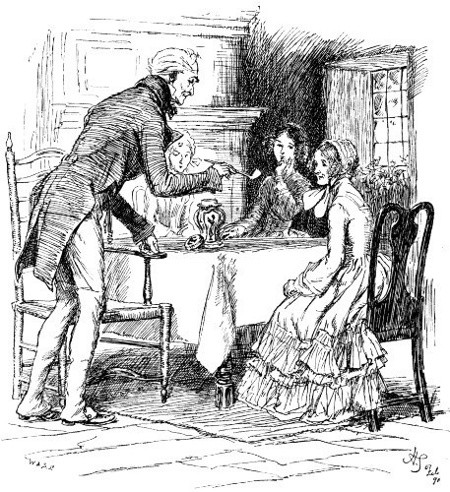
‘Requested her to fill the bowl.’
After dinner a clay pipe was brought in, and a spittoon; and, asking us to retire to another room, 62where he would soon join us, if we disliked tobacco-smoke, he presented his pipe to Miss Matty, and requested her to fill the bowl. This was a compliment to a lady in his youth; but it was rather inappropriate to propose it as an honour to Miss Matty, who had been trained by her sister to hold smoking of every kind in utter abhorrence. But if it was a shock to her refinement, it was also a gratification to her feelings to 63be thus selected; so she daintily stuffed the strong tobacco into the pipe, and then we withdrew.
‘It is very pleasant dining with a bachelor,’ said Miss Matty softly, as we settled ourselves in the counting-house. ‘I only hope it is not improper; so many pleasant things are!’
‘What a number of books he has!’ said Miss Pole, looking round the room. ‘And how dusty they are!’
‘I think it must be like one of the great Dr. Johnson’s rooms,’ said Miss Matty. ‘What a superior man your cousin must be!’
‘Yes!’ said Miss Pole, ‘he’s a great reader; but I am afraid he has got into very uncouth habits with living alone.’
‘Oh! uncouth is too hard a word. I should call him eccentric; very clever people always are!’ replied Miss Matty.
When Mr. Holbrook returned, he proposed a walk in the fields; but the two elder ladies were afraid of damp and dirt, and had only very unbecoming calashes to put on over their caps; so they declined, and I was again his companion in a turn which he said he was obliged to take to see after his men. He strode along, either wholly forgetting my existence, or soothed into silence by his pipe—and yet it was not silence exactly. He walked before me, with a stooping gait, his hands clasped behind him; and, as some tree or cloud, or glimpse of distant upland pastures, struck him, he quoted poetry to himself, saying it out loud in a grand sonorous voice, with just the emphasis that true feeling and appreciation give. We came upon an old cedar-tree, which stood at one end of the house—
The cedar spreads his dark-green layers of shade.
64‘Capital term—“layers!” Wonderful man!’ I did not know whether he was speaking to me or not; but I put in an assenting ‘wonderful,’ although I knew nothing about it, just because I was tired of being forgotten, and of being consequently silent.
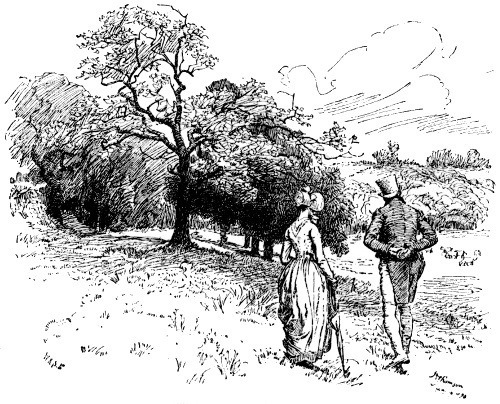
‘Or glimpse of distant upland pastures.’
He turned sharp round. ‘Ay! you may say “wonderful.” Why, when I saw the review of his poems in Blackwood, I set off within an hour, and walked seven miles to Misselton (for the horses were not in the way) and ordered them. Now, what colour are ash-buds in March?’
Is the man going mad? thought I. He is very like Don Quixote.
‘What colour are they, I say?’ repeated he vehemently.
65‘I am sure I don’t know, sir,’ said I, with the meekness of ignorance.
‘I knew you didn’t. No more did I—an old fool that I am!—till this young man comes and tells me. Black as ash-buds in March. And I’ve lived all my life in the country; more shame for me not to know. Black: they are jet-black, madam.’ And he went off again, swinging along to the music of some rhyme he had got hold of.
When we came back, nothing would serve him but he must read us the poems he had been speaking of; and Miss Pole encouraged him in his proposal, I thought, because she wished me to hear his beautiful reading, of which she had boasted; but she afterwards said it was because she had got to a difficult part of her crochet, and wanted to count her stitches without having to talk. Whatever he had proposed would have been right to Miss Matty; although she did fall sound asleep within five minutes after he had begun a long poem, called ‘Locksley Hall,’ and had a comfortable nap, unobserved, till he ended; when the cessation of his voice wakened her up, and she said, feeling that something was expected, and that Miss Pole was counting—
‘What a pretty book!’
‘Pretty, madam! it’s beautiful! Pretty, indeed!’
‘Oh yes! I meant beautiful!’ said she, fluttered at his disapproval of her word. ‘It is so like that beautiful poem of Dr. Johnson’s my sister used to read—I forget the name of it; what was it, my dear?’ turning to me.
‘Which do you mean, ma’am? What was it about?’
‘I don’t remember what it was about, and I’ve quite forgotten what the name of it was; but it was written by Dr. Johnson, and was very beautiful, and very like what Mr. Holbrook has just been reading.’
66‘I don’t remember it,’ said he reflectively. ‘But I don’t know Dr. Johnson’s poems well. I must read them.’
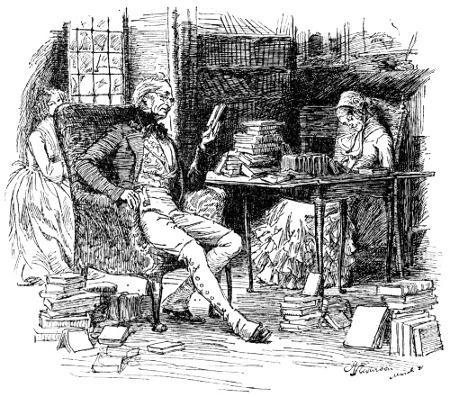
‘He had begun a long poem.’
As we were getting into the fly to return, I heard Mr. Holbrook say he should call on the ladies soon, and inquire how they got home; and this evidently pleased and fluttered Miss Matty at the time he said it; but after we had lost sight of the old house among the trees her sentiments towards the master of it were gradually absorbed into a distressing wonder as to whether Martha had broken her word, and seized on the opportunity of her mistress’s absence to have a ‘follower.’ Martha looked good, and steady, and composed enough, as she came to help us out; she was 67always careful of Miss Matty, and to-night she made use of this unlucky speech—
‘Eh! dear ma’am, to think of your going out in an evening in such a thin shawl! It’s no better than muslin. At your age, ma’am, you should be careful.’
‘My age!’ said Miss Matty, almost speaking crossly, for her, for she was usually gentle—‘my age! Why, how old do you think I am, that you talk about my age?’
‘Well, ma’am, I should say you were not far short of sixty: but folks’ looks is often against them—and I’m sure I meant no harm.’
‘Martha, I’m not yet fifty-two!’ said Miss Matty, with grave emphasis; for probably the remembrance of her youth had come very vividly before her this day, and she was annoyed at finding that golden time so far away in the past.
But she never spoke of any former and more intimate acquaintance with Mr. Holbrook. She had probably met with so little sympathy in her early love that she had shut it up close in her heart; and it was only by a sort of watching, which I could hardly avoid since Miss Pole’s confidence, that I saw how faithful her poor heart had been in its sorrow and its silence.
She gave me some good reason for wearing her best cap every day, and sat near the window, in spite of her rheumatism, in order to see, without being seen, down into the street.
He came. He put his open palms upon his knees, which were far apart, as he sat with his head bent down, whistling, after we had replied to his inquiries about our safe return. Suddenly he jumped up—
‘Well, madam! have you any commands for Paris? I am going there in a week or two.’
68‘To Paris!’ we both exclaimed.
‘Yes, madam! I’ve never been there, and always had a wish to go; and I think if I don’t go soon, I mayn’t go at all; so as soon as the hay is got in I shall go, before harvest time.’
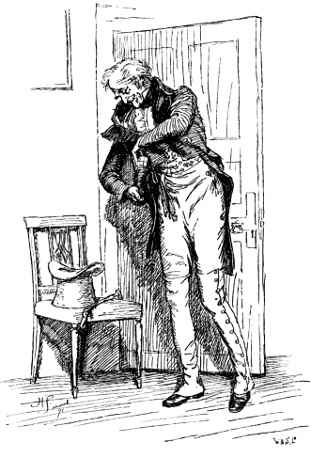
‘Here are the poems for you.’
We were so much astonished that we had no commissions.
Just as he was going out of the room, he turned back, with his favourite exclamation—
69‘God bless my soul, madam! but I nearly forgot half my errand. Here are the poems for you you admired so much the other evening at my house.’ He tugged away at a parcel in his coat-pocket. ‘Good-bye, miss,’ said he; ‘good-bye, Matty! take care of yourself.’ And he was gone. But he had given her a book, and he had called her Matty, just as he used to do thirty years ago.
‘I wish he would not go to Paris,’ said Miss Matilda anxiously. ‘I don’t believe frogs will agree with him; he used to have to be very careful what he ate, which was curious in so strong-looking a young man.’
Soon after this I took my leave, giving many an injunction to Martha to look after her mistress, and to let me know if she thought that Miss Matilda was not so well; in which case I would volunteer a visit to my old friend, without noticing Martha’s intelligence to her.
Accordingly I received a line or two from Martha every now and then; and, about November, I had a note to say her mistress was ‘very low and sadly off her food’; and the account made me so uneasy that, although Martha did not decidedly summon me, I packed up my things and went.
I received a warm welcome, in spite of the little flurry produced by my impromptu visit, for I had only been able to give a day’s notice. Miss Matilda looked miserably ill; and I prepared to comfort and cosset her.
I went down to have a private talk with Martha.
‘How long has your mistress been so poorly?’ I asked, as I stood by the kitchen fire.
‘Well, I think it’s better than a fortnight; it is, I know; it was one Tuesday, after Miss Pole had been, that she went into this moping way. I thought she 70was tired, and it would go off with a night’s rest; but no! she has gone on and on ever since, till I thought it my duty to write to you, ma’am.’
‘You did quite right, Martha. It is a comfort to think she has so faithful a servant about her. And I hope you find your place comfortable?’
‘Well, ma’am, missus is very kind, and there’s plenty to eat and drink, and no more work but what I can do easily,—but——’ Martha hesitated.
‘But what, Martha?’
‘Why, it seems so hard of missus not to let me have any followers; there’s such lots of young fellows in the town; and many a one has as much as offered to keep company with me; and I may never be in such a likely place again, and it’s like wasting an opportunity. Many a girl as I know would have ’em unbeknownst to missus; but I’ve given my word, and I’ll stick to it; or else this is just the house for missus never to be the wiser if they did come: and it’s such a capable kitchen—there’s such good dark corners in it—I’d be bound to hide any one. I counted up last Sunday night—for I’ll not deny I was crying because I had to shut the door in Jem Hearn’s face, and he’s a steady young man, fit for any girl; only I had given missus my word.’ Martha was all but crying again; and I had little comfort to give her, for I knew, from old experience, of the horror with which both the Miss Jenkynses looked upon ‘followers’; and in Miss Matty’s present nervous state this dread was not likely to be lessened.
I went to see Miss Pole the next day, and took her completely by surprise, for she had not been to see Miss Matilda for two days.
71‘And now I must go back with you, my dear, for I promised to let her know how Thomas Holbrook went on; and, I’m sorry to say, his housekeeper has sent me word to-day that he hasn’t long to live. Poor Thomas! that journey to Paris was quite too much for him. His housekeeper says he has hardly ever been round his fields since, but just sits with his hands on his knees in the counting-house, not reading or anything, but only saying what a wonderful city Paris was! Paris has much to answer for if it’s killed my cousin Thomas, for a better man never lived.’
‘Does Miss Matilda know of his illness?’ asked I—a new light as to the cause of her indisposition dawning upon me.
‘Dear! to be sure, yes! Has not she told you? I let her know a fortnight ago, or more, when first I heard of it. How odd she shouldn’t have told you!’
Not at all, I thought; but I did not say anything. I felt almost guilty of having spied too curiously into that tender heart, and I was not going to speak of its secrets—hidden, Miss Matty believed, from all the world. I ushered Miss Pole into Miss Matilda’s little drawing-room, and then left them alone. But I was not surprised when Martha came to my bedroom door, to ask me to go down to dinner alone, for that missus had one of her bad headaches. She came into the drawing-room at tea-time, but it was evidently an effort to her; and, as if to make up for some reproachful feeling against her late sister, Miss Jenkyns, which had been troubling her all the afternoon, and for which she now felt penitent, she kept telling me how good and how clever Deborah was in her youth; how she used to settle what gowns they were to wear at all the 72parties (faint, ghostly ideas of grim parties, far away in the distance, when Miss Matty and Miss Pole were young!); and how Deborah and her mother had started the benefit society for the poor, and taught girls cooking and plain sewing; and how Deborah had once danced with a lord; and how she used to visit at Sir Peter Arley’s, and try to remodel the quiet rectory establishment on the plans of Arley Hall, where they kept thirty servants; and how she had nursed Miss Matty through a long, long illness, of which I had never heard before, but which I now dated in my own mind as following the dismissal of the suit of Mr. Holbrook. So we talked softly and quietly of old times through the long November evening.
The next day Miss Pole brought us word that Mr. Holbrook was dead. Miss Matty heard the news in silence; in fact, from the account of the previous day, it was only what we had to expect. Miss Pole kept calling upon us for some expression of regret, by asking if it was not sad that he was gone, and saying—
‘To think of that pleasant day last June, when he seemed so well! And he might have lived this dozen years if he had not gone to that wicked Paris, where they are always having revolutions.’
She paused for some demonstration on our part. I saw Miss Matty could not speak, she was trembling so nervously; so I said what I really felt: and after a call of some duration—all the time of which I have no doubt Miss Pole thought Miss Matty received the news very calmly—our visitor took her leave.
Miss Matty made a strong effort to conceal her feelings—a concealment she practised even with me, for she has never alluded to Mr. Holbrook again, 73although the book he gave her lies with her Bible on the little table by her bedside. She did not think I heard her when she asked the little milliner of Cranford to make her caps something like the Honourable Mrs. Jamieson’s, or that I noticed the reply—
‘But she wears widows’ caps, ma’am?’
‘Oh? I only meant something in that style; not widows’, of course, but rather like Mrs. Jamieson’s.’
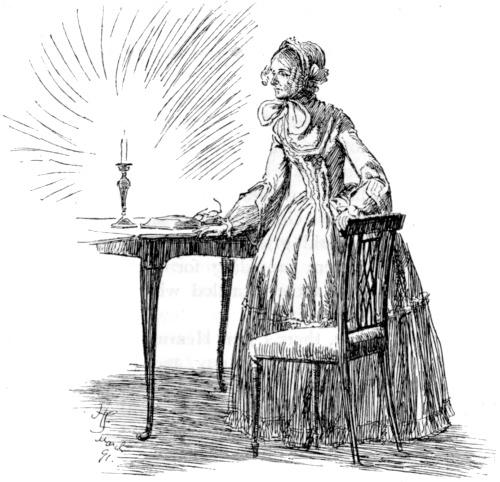
‘God forbid that I should grieve any young hearts.’
This effort at concealment was the beginning of the tremulous motion of head and hands which I have seen ever since in Miss Matty.
74The evening of the day on which we heard of Mr. Holbrook’s death, Miss Matilda was very silent and thoughtful; after prayers she called Martha back, and then she stood, uncertain what to say.
‘Martha!’ she said at last, ‘you are young’—and then she made so long a pause that Martha, to remind her of her half-finished sentence, dropped a curtsey, and said—
‘Yes, please, ma’am; two and twenty last third of October, please, ma’am.’
‘And perhaps, Martha, you may some time meet with a young man you like, and who likes you. I did say you were not to have followers; but if you meet with such a young man, and tell me, and I find he is respectable, I have no objection to his coming to see you once a week. God forbid!’ said she in a low voice, ‘that I should grieve any young hearts.’ She spoke as if she were providing for some distant contingency, and was rather startled when Martha made her ready eager answer.
‘Please, ma’am, there’s Jem Hearn, and he’s a joiner making three-and-sixpence a day, and six foot one in his stocking feet, please, ma’am; and if you’ll ask about him to-morrow morning, every one will give him a character for steadiness; and he’ll be glad enough to come to-morrow night, I’ll be bound.’
Though Miss Matty was startled, she submitted to Fate and Love.
75
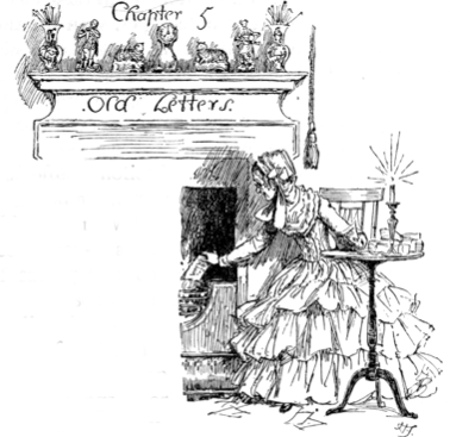
I have often noticed that almost every one has his own individual small economies—careful habits of saving fractions of pennies in some one peculiar direction—any disturbance of which annoys him more than spending shillings or pounds on some real extravagance. An old gentleman of my acquaintance, who took the intelligence of the failure of a Joint-Stock Bank, in which some of his money was invested, with stoical mildness, worried his family all through a long summer’s day, because one of them had torn (instead of cutting) out the written leaves of his now useless bank-book; of course the corresponding pages at the other end came out as well, and this little unnecessary waste of paper (his private economy) chafed him more than all the loss of his money. Envelopes fretted his soul terribly when they first came in; the only way in which he could reconcile himself to such waste of his 76cherished article was by patiently turning inside out all that were sent to him, and so making them serve again. Even now, though tamed by age, I see him casting wistful glances at his daughters when they send a whole inside of a half-sheet of note-paper, with the three lines of acceptance to an invitation, written on only one of the sides. I am not above owning that I have this human weakness myself. String is my foible. My pockets get full of little hanks of it, picked up and twisted together, ready for uses that never come. I am seriously annoyed if any one cuts the string of a parcel instead of patiently and faithfully undoing it fold by fold. How people can bring themselves to use india-rubber rings, which are a sort of deification of string, as lightly as they do, I cannot imagine. To me an india-rubber ring is a precious treasure. I have one which is not new—one that I picked up off the floor nearly six years ago. I have really tried to use it, but my heart failed me, and I could not commit the extravagance.
Small pieces of butter grieve others. They cannot attend to conversation because of the annoyance occasioned by the habit which some people have of invariably taking more butter than they want. Have you not seen the anxious look (almost mesmeric) which such persons fix on the article? They would feel it a relief if they might bury it out of their sight by popping it into their own mouths and swallowing it down; and they are really made happy if the person on whose plate it lies unused suddenly breaks off a piece of toast (which he does not want at all) and eats up his butter. They think that this is not waste.
Now Miss Matty Jenkyns was chary of candles. 77We had many devices to use as few as possible. In the winter afternoons she would sit knitting for two or three hours—she could do this in the dark, or by fire-light—and when I asked if I might not ring for candles to finish stitching my wristbands, she told me to ‘keep blind man’s holiday.’ They were usually brought in with tea; but we only burnt one at a time. As we lived in constant preparation for a friend who might come in any evening (but who never did), it required some contrivance to keep our two candles of the same length, ready to be lighted, and to look as if we burnt two always. The candles took it in turns; and, whatever we might be talking about or doing, Miss Matty’s eyes were habitually fixed upon the candle, ready to jump up and extinguish it and to light the other before they had become too uneven in length to be restored to equality in the course of the evening.
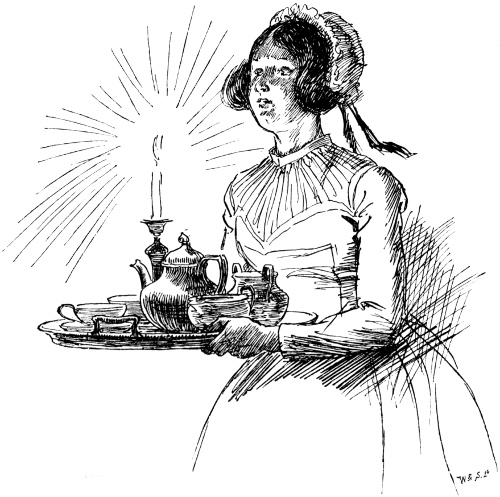
‘When Martha brought in the lighted candle and tea.’
One night, I remember this candle economy particularly annoyed me. I had been very much tired of my compulsory ‘blind man’s holiday,’ especially as Miss Matty had fallen asleep, and I did not like to stir the fire and run the risk of awakening her; so I could not even sit on the rug, and scorch myself with sewing by fire-light, according to my usual custom. I fancied Miss Matty must be dreaming of her early life; for she spoke one or two words in her uneasy sleep bearing reference to persons who were dead long before. When Martha brought in the lighted candle and tea, Miss Matty started into wakefulness, with a strange bewildered look around, as if we were not the people she expected to see about her. There was a little sad expression that shadowed her face as she recognised me; but immediately afterwards she tried to give me 78her usual smile. All through tea-time her talk ran upon the days of her childhood and youth. Perhaps this reminded her of the desirableness of looking over all the old family letters, and destroying such as ought not to be allowed to fall into the hands of strangers; for she had often spoken of the necessity of this task, but had always shrunk from it, with a timid dread of something painful. To-night, however, she rose up after tea and went for them—in the dark; for she piqued herself on the precise neatness of all her chamber arrangements, and used to look uneasily at me when I 79lighted a bed-candle to go to another room for anything. When she returned there was a faint pleasant smell of Tonquin beans in the room. I had always noticed this scent about any of the things which had belonged to her mother; and many of the letters were addressed to her—yellow bundles of love-letters, sixty or seventy years old.
Miss Matty undid the packet with a sigh; but she stifled it directly, as if it were hardly right to regret the flight of time, or of life either. We agreed to look them over separately, each taking a different letter out of the same bundle and describing its contents to the other before destroying it. I never knew what sad work the reading of old letters was before that evening, though I could hardly tell why. The letters were as happy as letters could be—at least those early letters were. There was in them a vivid and intense sense of the present time, which seemed so strong and full, as if it could never pass away, and as if the warm living hearts that so expressed themselves could never die, and be as nothing to the sunny earth. I should have felt less melancholy, I believe, if the letters had been more so. I saw the tears stealing down the well-worn furrows of Miss Matty’s cheeks, and her spectacles often wanted wiping. I trusted at last that she would light the other candle, for my own eyes were rather dim, and I wanted more light to see the pale faded ink; but no, even through her tears, she saw and remembered her little economical ways.
The earliest set of letters were two bundles tied together, and ticketed (in Miss Jenkyns’s handwriting), ‘Letters interchanged between my ever-honoured father and my dearly-beloved mother, prior to their marriage, 80in July 1774.’ I should guess that the rector of Cranford was about twenty-seven years of age when he wrote those letters; and Miss Matty told me that her mother was just eighteen at the time of her wedding. With my idea of the rector, derived from a picture in the dining-parlour, stiff and stately, in a huge full-bottomed wig, with gown, cassock, and bands, and his hand upon a copy of the only sermon he ever published—it was strange to read these letters. They were full of eager passionate ardour; short homely sentences, right fresh from the heart (very different from the grand Latinised, Johnsonian style of the printed sermon, preached before some judge at assize time). His letters were a curious contrast to those of his girl-bride. She was evidently rather annoyed at his demands upon her for expressions of love, and could not quite understand what he meant by repeating the same thing over in so many different ways; but what she was quite clear about was a longing for a white ‘Paduasoy’—whatever that might be; and six or seven letters were principally occupied in asking her lover to use his influence with her parents (who evidently kept her in good order) to obtain this or that article of dress, more especially the white ‘Paduasoy.’ He cared nothing how she was dressed; she was always lovely enough for him, as he took pains to assure her, when she begged him to express in his answers a predilection for particular pieces of finery, in order that she might show what he said to her parents. But at length he seemed to find out that she would not be married till she had a ‘trousseau’ to her mind; and then he sent her a letter, which had evidently accompanied a whole boxful of finery, and in which he requested that she might 81be dressed in everything her heart desired. This was the first letter, ticketed in a frail, delicate hand, ‘From my dearest John.’ Shortly afterwards they were married, I suppose, from the intermission in their correspondence.
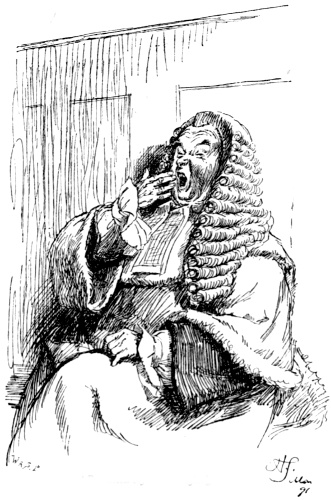
‘Preached before some judge.’
‘We must burn them, I think,’ said Miss Matty, looking doubtfully at me. ‘No one will care for them when I am gone.’ And one by one she dropped them into the middle of the fire, watching each blaze up, die out, and rise away, in faint, white, ghostly semblance, up the chimney, before she gave another to the same fate. The room was light enough now; but I, like 82her, was fascinated into watching the destruction of those letters, into which the honest warmth of a manly heart had been poured forth.
The next letter, likewise docketed by Miss Jenkyns, was endorsed, ‘Letter of pious congratulation and exhortation from my venerable grandfather to my beloved mother, on occasion of my own birth. Also some practical remarks on the desirability of keeping warm the extremities of infants, from my excellent grandmother.’
The first part was, indeed, a severe and forcible picture of the responsibilities of mothers, and a warning against the evils that were in the world, and lying in ghastly wait for the little baby of two days old. His wife did not write, said the old gentleman, because he had forbidden it, she being indisposed with a sprained ankle, which (he said) quite incapacitated her from holding a pen. However, at the foot of the page was a small ‘T.O.,’ and on turning it over, sure enough, there was a letter to ‘my dear, dearest Molly,’ begging her, when she left her room, whatever she did, to go up stairs before going down: and telling her to wrap her baby’s feet up in flannel, and keep it warm by the fire, although it was summer, for babies were so tender.
It was pretty to see from the letters, which were evidently exchanged with some frequency between the young mother and the grandmother, how the girlish vanity was being weeded out of her heart by love for her baby. The white ‘Paduasoy’ figured again in the letters, with almost as much vigour as before. In one, it was being made into a christening cloak for the baby. It decked it when it went with its parents to spend a day or two at Arley Hall. It added to its charms 83when it was ‘the prettiest little baby that ever was seen. Dear mother, I wish you could see her! Without any parshality, I do think she will grow up a regular bewty!’ I thought of Miss Jenkyns, gray, withered, and wrinkled, and I wondered if her mother had known her in the courts of heaven; and then I knew that she had, and that they stood there in angelic guise.
There was a great gap before any of the rector’s letters appeared. And then his wife had changed her mode of endorsement. It was no longer from ‘My dearest John’; it was from ‘My honoured Husband.’ The letters were written on occasion of the publication of the same Sermon which was represented in the picture. The preaching before ‘My Lord Judge,’ and the ‘publishing by request,’ was evidently the culminating point—the event of his life. It had been necessary for him to go up to London to superintend it through the press. Many friends had to be called upon, and consulted, before he could decide on any printer fit for so onerous a task; and at length it was arranged that J. and J. Rivingtons were to have the honourable responsibility. The worthy rector seemed to be strung up by the occasion to a high literary pitch, for he could hardly write a letter to his wife without cropping out into Latin. I remember the end of one of his letters ran thus: ‘I shall ever hold the virtuous qualities of my Molly in remembrance, dum memor ipse mei, dum spiritus regit artus,’ which, considering that the English of his correspondent was sometimes at fault in grammar, and often in spelling, might be taken as a proof of how much he ‘idealised his Molly’; and, as Miss Jenkyns used to say, ‘People talk a great deal about idealising nowadays, whatever that may mean.’ But this was 84nothing to a fit of writing classical poetry which soon seized him, in which his Molly figured away as ‘Maria.’ The letter containing the carmen was endorsed by her, ‘Hebrew verses sent me by my honoured husband. I thowt to have had a letter about killing the pig, but must wait. Mem., to send the poetry to Sir Peter Arley, as my husband desires.’ And in a post-scriptum note in his handwriting it was stated that the Ode had appeared in the Gentleman’s Magazine, December 1782.
Her letters back to her husband (treasured as fondly by him as if they had been M. T. Ciceronis Epistolæ) were more satisfactory to an absent husband and father than his could ever have been to her. She told him how Deborah sewed her seam very neatly every day, and read to her in the books he had set her; how she was a very ‘forrard,’ good child, but would ask questions her mother could not answer, but how she did not let herself down by saying she did not know, but took to stirring the fire, or sending the ‘forrard’ child on an errand. Matty was now the mother’s darling, and promised (like her sister at her age) to be a great beauty. I was reading this aloud to Miss Matty, who smiled and sighed a little at the hope, so fondly expressed, that ‘little Matty might not be vain, even if she were a bewty.’
‘I had very pretty hair, my dear,’ said Miss Matilda; ‘and not a bad mouth.’ And I saw her soon afterwards adjust her cap and draw herself up.
But to return to Mrs. Jenkyns’s letters. She told her husband about the poor in the parish; what homely domestic medicines she had administered; what kitchen physic she had sent. She had evidently held his displeasure as a rod in pickle over the heads of all the 85ne’er-do-wells. She asked for his directions about the cows and pigs; and did not always obtain them, as I have shown before.
The kind old grandmother was dead when a little boy was born, soon after the publication of the Sermon; but there was another letter of exhortation from the grandfather, more stringent and admonitory than ever, now that there was a boy to be guarded from the snares of the world. He described all the various sins into which men might fall, until I wondered how any man ever came to a natural death. The gallows seemed as if it must have been the termination of the lives of most of the grandfather’s friends and acquaintance; and I was not surprised at the way in which he spoke of this life being ‘a vale of tears.’
It seemed curious that I should never have heard of this brother before; but I concluded that he had died young, or else surely his name would have been alluded to by his sisters.
By and by we came to packets of Miss Jenkyns’s letters. These Miss Matty did regret to burn. She said all the others had been only interesting to those who loved the writers, and that it seemed as if it would have hurt her to allow them to fall into the hands of strangers, who had not known her dear mother, and how good she was, although she did not always spell quite in the modern fashion; but Deborah’s letters were so very superior! Any one might profit by reading them. It was a long time since she had read Mrs. Chapone, but she knew she used to think that Deborah could have said the same things quite as well; and as for Mrs. Carter! people thought a deal of her letters, just because she had written Epictetus, but she 86was quite sure Deborah would never have made use of such a common expression as ‘I canna be fashed!’
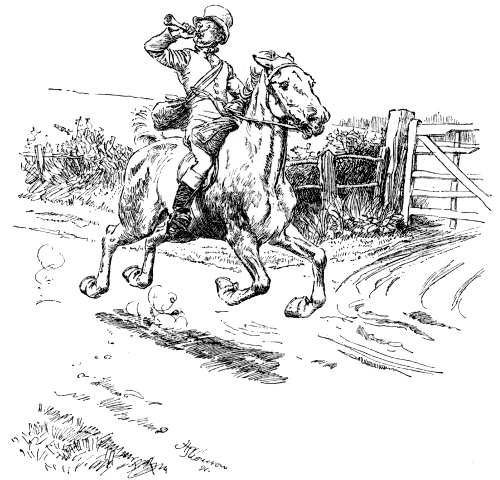
A Post Boy.
Miss Matty did grudge burning these letters, it was evident. She would not let them be carelessly passed over with any quiet reading, and skipping, to myself. She took them from me, and even lighted the second candle in order to read them aloud with a proper emphasis, and without stumbling over the big words. Oh dear! how I wanted facts instead of reflections, before those letters were concluded! They lasted us two nights; and I won’t deny that I made use of the time 87to think of many other things, and yet I was always at my post at the end of each sentence.
The rector’s letters, and those of his wife and mother-in-law, had all been tolerably short and pithy, written in a straight hand, with the lines very close together. Sometimes the whole letter was contained on a mere scrap of paper. The paper was very yellow, and the ink very brown; some of the sheets were (as Miss Matty made me observe) the old original post, with the stamp in the corner representing a post-boy riding for life and twanging his horn. The letters of Mrs. Jenkyns and her mother were fastened with a great round red wafer; for it was before Miss Edgeworth’s Patronage had banished wafers from polite society. It was evident, from the tenor of what was said, that franks were in great request, and were even used as a means of paying debts by needy members of Parliament. The rector sealed his espistles with an immense coat of arms, and showed by the care with which he had performed this ceremony that he expected they should be cut open, not broken by any thoughtless or impatient hand. Now, Miss Jenkyns’s letters were of a later date in form and writing. She wrote on the square sheet which we have learned to call old-fashioned. Her hand was admirably calculated, together with her use of many-syllabled words, to fill up a sheet, and then came the pride and delight of crossing. Poor Miss Matty got sadly puzzled with this, for the words gathered size like snowballs, and towards the end of her letter Miss Jenkyns used to become quite sesquipedalian. In one to her father, slightly theological and controversial in its tone, she had spoken of Herod, Tetrarch of Idumea. Miss Matty read it ‘Herod, 88Petrarch of Etruria,’ and was just as well pleased as if she had been right.
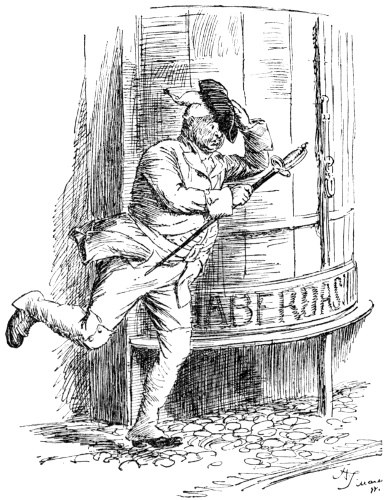
‘Turning out of the volunteers.’
I can’t quite remember the date, but I think it was in 1805 that Miss Jenkyns wrote the longest series of letters—on occasion of her absence on a visit to some friends near Newcastle-upon-Tyne. These friends were intimate with the commandant of the garrison there, and heard from him of all the preparations that were being made to repel the invasion of Buonaparte, which some people imagined might take place at the mouth of the Tyne. Miss Jenkyns was evidently very much alarmed; and the first part of her letters was often 89written in pretty intelligible English, conveying particulars of the preparations which were made in the family with whom she was residing against the dreaded event; the bundles of clothes that were packed up ready for a flight to Alston Moor (a wild hilly piece of ground between Northumberland and Cumberland); the signal that was to be given for this flight, and for the simultaneous turning out of the volunteers under arms—which said signal was to consist (if I remember rightly) in ringing the church bells in a particular and ominous manner. One day, when Miss Jenkyns and her hosts were at a dinner party in Newcastle, this warning summons was actually given (not a very wise proceeding, if there be any truth in the moral attached to the fable of the Boy and the Wolf; but so it was), and Miss Jenkyns, hardly recovered from her fright, wrote the next day to describe the sound, the breathless shock, the hurry and alarm; and then, taking breath, she added, ‘How trivial, my dear father, do all our apprehensions of the last evening appear, at the present moment, to calm and inquiring minds!’ And here Miss Matty broke in with—
‘But, indeed, my dear, they were not at all trivial or trifling at the time. I know I used to wake up in the night many a time and think I heard the tramp of the French entering Cranford. Many people talked of hiding themselves in the salt mines—and meat would have kept capitally down there, only perhaps we should have been thirsty. And my father preached a whole set of sermons on the occasion; one set in the mornings, all about David and Goliath, to spirit up the people to fighting with spades or bricks, if need were; and the other set in the afternoons, proving that 90Napoleon (that was another name for Bony, as we used to call him) was all the same as an Apollyon and Abaddon. I remember my father rather thought he should be asked to print this last set; but the parish had, perhaps, had enough of them with hearing.’
Peter Marmaduke Arley Jenkyns (‘poor Peter!’ as Miss Matty began to call him) was at school at Shrewsbury by this time. The rector took up his pen, and rubbed up his Latin once more, to correspond with his boy. It was very clear that the lad’s were what are called show letters. They were of a highly mental description, giving an account of his studies, and his intellectual hopes of various kinds, with an occasional quotation from the classics; but, now and then, the animal nature broke out in such a little sentence as this, evidently written in a trembling hurry, after the letter had been inspected: ‘Mother dear, do send me a cake, and put plenty of citron in.’ The ‘mother dear’ probably answered her boy in the form of cakes and ‘goody,’ for there were none of her letters among this set; but a whole collection of the rector’s, to whom the Latin in his boy’s letters was like a trumpet to the old war-horse. I do not know much about Latin, certainly, and it is, perhaps, an ornamental language, but not very useful, I think—at least to judge from the bits I remember out of the rector’s letters. One was, ‘You have not got that town in your map of Ireland; but Bonus Bernardus non videt omnia, as the Proverbia say.’ Presently it became very evident that ‘poor Peter’ got himself into many scrapes. There were letters of stilted penitence to his father, for some wrong-doing; and, among them all was a badly-written, badly-sealed, badly-directed, blotted note—‘My dear, 91dear, dear, dearest mother, I will be a better boy; I will, indeed; but don’t, please, be ill for me; I am not worth it; but I will be good, darling mother.’
Miss Matty could not speak for crying, after she had read this note. She gave it to me in silence, and then got up and took it to her sacred recesses in her own room, for fear, by any chance, it might get burnt. ‘Poor Peter!’ she said; ‘he was always in scrapes; he was too easy. They led him wrong, and then left him in the lurch. But he was too fond of mischief. He could never resist a joke. Poor Peter!’
92
Poor Peter’s career lay before him rather pleasantly mapped out by kind friends, but Bonus Bernardus non videt omnia, in this map too. He was to win honours at Shrewsbury School, and carry them thick to Cambridge, and after that, a living awaited him, the gift of his godfather, Sir Peter Arley. Poor Peter! his lot in life was very different to what his friends had hoped and planned. Miss Matty told me all about it, and I think it was a relief to her when she had done so.
He was the darling of his mother, who seemed to dote on all her children, though she was, perhaps, a little afraid of Deborah’s superior acquirements. Deborah was the favourite of her father, and when Peter disappointed him she became his pride. The sole honour Peter brought away from Shrewsbury was the reputation of being the best good fellow that ever was, and of being the captain of the school in the art 93of practical joking. His father was disappointed, but set about remedying the matter in a manly way. He could not afford to send Peter to read with any tutor, but he could read with him himself; and Miss Matty told me much of the awful preparations in the way of dictionaries and lexicons that were made in her father’s study the morning Peter began.
‘My poor mother!’ said she. ‘I remember how she used to stand in the hall, just near enough the study-door, to catch the tone of my father’s voice. I could tell in a moment if all was going right, by her face. And it did go right for a long time.’
‘What went wrong at last?’ said I. ‘That tiresome Latin, I daresay.’
‘No! it was not the Latin. Peter was in high favour with my father, for he worked up well for him. But he seemed to think that the Cranford people might be joked about, and made fun of, and they did not like it; nobody does. He was always hoaxing them; “hoaxing” is not a pretty word, my dear, and I hope you won’t tell your father I used it, for I should not like him to think that I was not choice in my language, after living with such a woman as Deborah. And be sure you never use it yourself. I don’t know how it slipped out of my mouth, except it was that I was thinking of poor Peter, and it was always his expression. But he was a very gentlemanly boy in many things. He was like dear Captain Brown in always being ready to help any old person or a child. Still, he did like joking and making fun; and he seemed to think the old ladies in Cranford would believe anything. There were many old ladies living here then; we are principally ladies now, I know, but we are not so old as the ladies 94used to be when I was a girl. I could laugh to think of some of Peter’s jokes. No, my dear, I won’t tell you of them, because they might not shock you as they ought to do, and they were very shocking. He even took in my father once, by dressing himself up as a lady that was passing through the town and wished to see the Rector of Cranford, “who had published that admirable Assize Sermon.” Peter said he was awfully frightened himself when he saw how my father took it all in, and even offered to copy out all his Napoleon Buonaparte sermons for her—him, I mean—no, her, for Peter was a lady then. He told me he was more terrified than he ever was before, all the time my father was speaking. He did not think my father would have believed him; and yet if he had not, it would have been a sad thing for Peter. As it was, he was none so glad of it, for my father kept him hard at work copying out all those twelve Buonaparte sermons for the lady—that was for Peter himself, you know. He was the lady. And once when he wanted to go fishing, Peter said, “Confound the woman!”—very bad language, my dear, but Peter was not always so guarded as he should have been; my father was so angry with him, it nearly frightened me out of my wits: and yet I could hardly keep from laughing at the little curtseys Peter kept making, quite slyly, whenever my father spoke of the lady’s excellent taste and sound discrimination.’
‘Did Miss Jenkyns know of these tricks?’ said I.
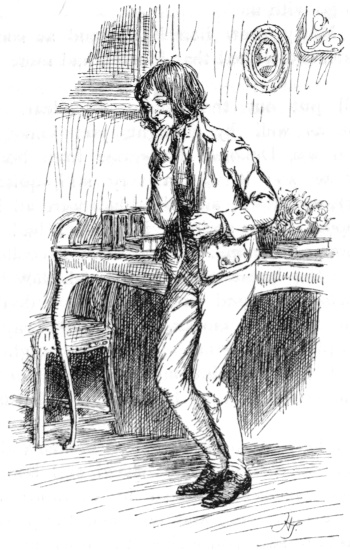
‘The little curtseys.’
‘Oh no! Deborah would have been too much shocked. No, no one knew but me. I wish I had always known of Peter’s plans; but sometimes he did not tell me. He used to say the old ladies in the town wanted something to talk about; but I don’t think 95they did. They had the St. James’s Chronicle three times a week, just as we have now, and we have plenty to say; and I remember the clacking noise there always was when some of the ladies got together. But, probably, schoolboys talk more than ladies. At last there was a terrible, sad thing happened.’ Miss Matty got up, went to the door, and opened it; no one was there. She rang the bell for Martha, and 96when Martha came, her mistress told her to go for eggs to a farm at the other end of the town.
‘I will lock the door after you, Martha. You are not afraid to go, are you?’
‘No, ma’am, not at all; Jem Hearn will be only too proud to go with me.’
Miss Matty drew herself up, and as soon as we were alone, she wished that Martha had more maidenly reserve.
‘We’ll put out the candle, my dear. We can talk just as well by firelight, you know. There! Well, you see, Deborah had gone from home for a fortnight or so; it was a very still, quiet day, I remember, overhead; and the lilacs were all in flower, so I suppose it was spring. My father had gone out to see some sick people in the parish; I recollect seeing him leave the house with his wig and shovel-hat and cane. What possessed our poor Peter I don’t know; he had the sweetest temper, and yet he always seemed to like to plague Deborah. She never laughed at his jokes, and thought him ungenteel, and not careful enough about improving his mind; and that vexed him.
‘Well! he went to her room, it seems, and dressed himself in her old gown, and shawl, and bonnet; just the things she used to wear in Cranford, and was known by everywhere; and he made the pillow into a little—you are sure you locked the door, my dear, for I should not like any one to hear—into—into—a little baby, with white long clothes. It was only, as he told me afterwards, to make something to talk about in the town; he never thought of it as affecting Deborah, and he went and walked up and down in the Filbert 97walk—just half-hidden by the rails, and half-seen; and he cuddled his pillow, just like a baby, and talked to it all the nonsense people do. Oh dear! and my father came stepping stately up the street, as he always did; and what should he see but a little black crowd of people—I daresay as many as twenty—all peeping through his garden rails. So he thought, at first, they were only looking at a new rhododendron that was in full bloom, and that he was very proud of; and he walked slower, that they might have more time to admire. And he wondered if he could make out a sermon from the occasion, and thought, perhaps, there was some relation between the rhododendrons and the lilies of the field. My poor father! When he came nearer, he began to wonder that they did not see him; but their heads were all so close together, peeping and peeping! My father was amongst them, meaning, he said, to ask them to walk into the garden with him, and admire the beautiful vegetable production, when—oh, my dear! I tremble to think of it—he looked through the rails himself, and saw—I don’t know what he thought he saw, but old Clare told me his face went quite gray-white with anger, and his eyes blazed out under his frowning black brows; and he spoke out—oh, so terribly!—and bade them all stop where they were—not one of them to go, not one to stir a step; and, swift as light, he was in at the garden door, and down the Filbert walk, and seized hold of poor Peter, and tore his clothes off his back—bonnet, shawl, gown, and all—and threw the pillow among the people over the railings: and then he was very, very angry indeed, and before all the people he lifted up his cane and flogged Peter!
98
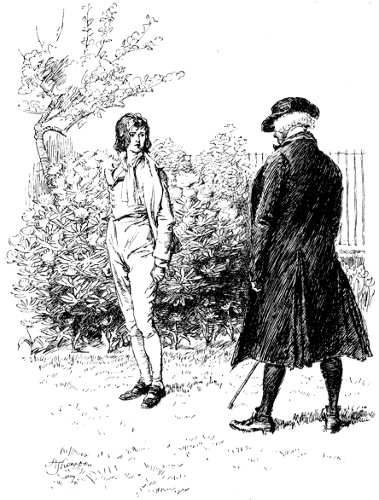
‘Have you done enough, sir?’
‘My dear, that boy’s trick, on that sunny day, when all seemed going straight and well, broke my mother’s heart, and changed my father for life. It did, indeed. Old Clare said, Peter looked as white as my father; 99and stood as still as a statue to be flogged; and my father struck hard! When my father stopped to take breath, Peter said, “Have you done enough, sir?” quite hoarsely, and still standing quite quiet. I don’t know what my father said—or if he said anything. But old Clare said, Peter turned to where the people outside the railing were, and made them a low bow, as grand and as grave as any gentleman; and then walked slowly into the house. I was in the store-room helping my mother to make cowslip wine. I cannot abide the wine now, nor the scent of the flowers; they turn me sick and faint, as they did that day, when Peter came in, looking as haughty as any man—indeed, looking like a man, not like a boy. “Mother!” he said, “I am come to say, God bless you for ever.” I saw his lips quiver as he spoke; and I think he durst not say anything more loving, for the purpose that was in his heart. She looked at him rather frightened, and wondering, and asked him what was to do. He did not smile or speak, but put his arms round her and kissed her as if he did not know how to leave off; and before she could speak again, he was gone. We talked it over, and could not understand it, and she bade me go and seek my father, and ask what it was all about. I found him walking up and down, looking very highly displeased.
‘“Tell your mother I have flogged Peter, and that he richly deserved it.”
‘I durst not ask any more questions. When I told my mother, she sat down, quite faint, for a minute. I remember, a few days after, I saw the poor, withered cowslip flowers thrown out to the leaf heap, to decay and die there. There was no making of cowslip-wine that year at the rectory—nor, indeed, ever after.
100‘Presently my mother went to my father. I know I thought of Queen Esther and King Ahasuerus; for my mother was very pretty and delicate-looking, and my father looked as terrible as King Ahasuerus. Some time after they came out together; and then my mother told me what had happened, and that she was going up to Peter’s room at my father’s desire—though she was not to tell Peter this—to talk the matter over with him. But no Peter was there. We looked over the house; no Peter was there! Even my father, who had not liked to join in the search at first, helped us before long. The rectory was a very old house—steps up into a room, steps down into a room, all through. At first, my mother went calling low and soft, as if to reassure the poor boy, “Peter! Peter, dear! it’s only me;” but, by and by, as the servants came back from the errands my father had sent them, in different directions, to find where Peter was—as we found he was not in the garden, nor the hayloft, nor anywhere about—my mother’s cry grew louder and wilder, “Peter! Peter, my darling! where are you?” for then she felt and understood that that long kiss meant some sad kind of “good-bye.” The afternoon went on—my mother never resting, but seeking again and again in every possible place that had been looked into twenty times before, nay, that she had looked into over and over again herself. My father sat with his head in his hands, not speaking except when his messengers came in, bringing no tidings; then he lifted up his face, so strong and sad, and told them to go again in some new direction. My mother kept passing from room to room, in and out of the house, moving noiselessly, but never ceasing. Neither she nor my father durst leave the 101house, which was the meeting-place for all the messengers. At last (and it was nearly dark) my father rose up. He took hold of my mother’s arm as she came with wild, sad pace through one door, and quickly towards another. She started at the touch of his hand, for she had forgotten all in the world but Peter.
“Molly!” said he, “I did not think all this would happen.” He looked into her face for comfort—her poor face, all wild and white; for neither she nor my father had dared to acknowledge—much less act upon—the terror that was in their hearts, lest Peter should have made away with himself. My father saw no conscious look in his wife’s hot, dreary eyes, and he missed the sympathy that she had always been ready to give him—strong man as he was, and at the dumb despair in her face his tears began to flow. But when she saw this, a gentle sorrow came over her countenance, and she said, “Dearest John! don’t cry; come with me, and we’ll find him,” almost as cheerfully as if she knew where he was. And she took my father’s great hand in her little soft one and led him along, the tears dropping as he walked on that same unceasing, weary walk, from room to room, through house and garden.
‘Oh, how I wished for Deborah! I had no time for crying, for now all seemed to depend on me. I wrote for Deborah to come home. I sent a message privately to that same Mr. Holbrook’s house—poor Mr. Holbrook!—you know who I mean. I don’t mean I sent a message to him, but I sent one that I could trust to know if Peter was at his house. For at one time Mr. Holbrook was an occasional visitor at the rectory—you know he was Miss Pole’s cousin—and he 102had been very kind to Peter, and taught him how to fish—he was very kind to everybody, and I thought Peter might have gone off there. But Mr. Holbrook was from home, and Peter had never been seen. It was night now; but the doors were all wide open, and my father and mother walked on and on; it was more than an hour since he had joined her, and I don’t believe they had ever spoken all that time. I was getting the parlour fire lighted, and one of the servants was preparing tea, for I wanted them to have something to eat and drink and warm them, when Old Clare asked to speak to me.
‘“I have borrowed the nets from the weir, Miss Matty. Shall we drag the ponds to-night, or wait for the morning?”
‘I remember staring in his face to gather his meaning; and when I did, I laughed out loud. The horror of that new thought—our bright, darling Peter, cold, and stark, and dead! I remember the ring of my own laugh now.
‘The next day Deborah was at home before I was myself again. She would not have been so weak as to give way as I had done; but my screams (my horrible laughter had ended in crying) had roused my sweet dear mother, whose poor wandering wits were called back and collected as soon as a child needed her care. She and Deborah sat by my bedside; I knew by the looks of each that there had been no news of Peter—no awful, ghastly news, which was what I most had dreaded in my dull state between sleeping and waking.
‘The same result of all the searching had brought something of the same relief to my mother, to whom, I 103am sure, the thought that Peter might even then be hanging dead in some of the familiar home places had caused that never-ending walk of yesterday. Her soft eyes never were the same again after that; they had always a restless, craving look, as if seeking for what they could not find. Oh! it was an awful time; coming down like a thunderbolt on the still sunny day when the lilacs were all in bloom.’
‘Where was Mr. Peter?’ said I.
‘He had made his way to Liverpool; and there was war then; and some of the king’s ships lay off the mouth of the Mersey; and they were only too glad to have a fine likely boy such as him (five foot nine he was) come to offer himself. The captain wrote to my father, and Peter wrote to my mother. Stay! those letters will be somewhere here.’
We lighted the candle, and found the captain’s letter and Peter’s too. And we also found a little simple begging letter from Mrs. Jenkyns to Peter, addressed to him at the house of an old schoolfellow, whither she fancied he might have gone. They had returned it unopened; and unopened it had remained ever since, having been inadvertently put by among the other letters of that time. This is it—
‘My dearest Peter—You did not think we should be so sorry as we are, I know, or you would never have gone away. You are too good. Your father sits and sighs till my heart aches to hear him. He cannot hold up his head for grief; and yet he only did what he thought was right. Perhaps he has been too severe, and perhaps I have not been kind enough; but God knows how we love you, my dear only boy. Don looks so 104sorry you are gone. Come back, and make us happy, who love you so much. I know you will come back.’
But Peter did not come back. That spring day was the last time he ever saw his mother’s face. The writer of the letter—the last—the only person who had ever seen what was written in it, was dead long ago; and I, a stranger, not born at the time when this occurrence took place, was the one to open it.
The captain’s letter summoned the father and mother to Liverpool instantly, if they wished to see their boy; and, by some of the wild chances of life, the captain’s letter had been detained somewhere, somehow.
Miss Matty went on, ‘And it was race-time, and all the post-horses at Cranford were gone to the races; but my father and mother set off in our own gig—and oh! my dear, they were too late—the ship was gone! And now read Peter’s letter to my mother!’
It was full of love, and sorrow, and pride in his new profession, and a sore sense of his disgrace in the eyes of the people at Cranford; but ending with a passionate entreaty that she would come and see him before he left the Mersey: ‘Mother! we may go into battle. I hope we shall, and lick those French; but I must see you again before that time.’
‘And she was too late,’ said Miss Matty; ‘too late!’
We sat in silence, pondering on the full meaning of those sad, sad words. At length I asked Miss Matty to tell me how her mother bore it.
‘Oh!’ she said, ‘she was patience itself. She had never been strong, and this weakened her terribly. My father used to sit looking at her: far more sad than 105she was. He seemed as if he could look at nothing else when she was by; and he was so humble—so very gentle now. He would, perhaps, speak in his old way—laying down the law, as it were—and then, in a minute or two, he would come round and put his hand on our shoulders, and ask us in a low voice if he had said anything to hurt us. I did not wonder at his speaking so to Deborah, for she was so clever; but I could not bear to hear him talking so to me.
‘But, you see, he saw what we did not—that it was killing my mother. Yes! killing her (put out the candle, my dear; I can talk better in the dark), for she was but a frail woman, and ill fitted to stand the fright and shock she had gone through; and she would smile at him and comfort him, not in words, but in her looks and tones, which were always cheerful when he was there. And she would speak of how she thought Peter stood a good chance of being admiral very soon—he was so brave and clever; and how she thought of seeing him in his navy uniform, and what sort of hats admirals wore; and how much more fit he was to be a sailor than a clergyman; and all in that way, just to make my father think she was quite glad of what came of that unlucky morning’s work, and the flogging which was always in his mind, as we all knew. But oh, my dear! the bitter, bitter crying she had when she was alone; and at last, as she grew weaker, she could not keep her tears in when Deborah or me was by, and would give us message after message for Peter (his ship had gone to the Mediterranean, or somewhere down there, and then he was ordered off to India, and there was no overland route then); but she still said that no one knew where their death lay in wait, and 106that we were not to think hers was near. We did not think it, but we knew it, as we saw her fading away.
‘Well, my dear, it’s very foolish of me, I know, when in all likelihood I am so near seeing her again.
‘And only think, love! the very day after her death—for she did not live quite a twelvemonth after Peter went away—the very day after—came a parcel for her from India—from her poor boy. It was a large, soft, white India shawl, with just a little narrow border all round; just what my mother would have liked.
‘We thought it might rouse my father, for he had sat with her hand in his all night long; so Deborah took it in to him, and Peter’s letter to her, and all. At first, he took no notice; and we tried to make a kind of light careless talk about the shawl, opening it out and admiring it. Then, suddenly, he got up, and spoke: “She shall be buried in it,” he said; “Peter shall have that comfort; and she would have liked it.”
‘Well, perhaps it was not reasonable, but what could we do or say? One gives people in grief their own way. He took it up and felt it: “It is just such a shawl as she wished for when she was married, and her mother did not give it her. I did not know of it till after, or she should have had it—she should; but she shall have it now.”
‘My mother looked so lovely in her death! She was always pretty, and now she looked fair, and waxen, and young—younger than Deborah, as she stood trembling and shivering by her. We decked her in the long soft folds; she lay smiling, as if pleased; and people came—all Cranford came—to beg to see her, for they had loved her dearly, as well they might; and the countrywomen brought posies; old Clare’s wife 107brought some white violets, and begged they might lie on her breast.
‘Deborah said to me, the day of my mother’s funeral, that if she had a hundred offers she never would marry and leave my father. It was not very likely she would have so many—I don’t know that she had one; but it was not less to her credit to say so. She was such a daughter to my father as I think there never was before or since. His eyes failed him, and she read book after book, and wrote, and copied, and was always at his service in any parish business. She could do many more things than my poor mother could; she even once wrote a letter to the bishop for my father. But he missed my mother sorely; the whole parish noticed it. Not that he was less active; I think he was more so, and more patient in helping every one. I did all I could to set Deborah at liberty to be with him; for I knew I was good for little, and that my best work in the world was to do odd jobs quietly, and set others at liberty. But my father was a changed man.’
‘Did Mr. Peter ever come home?’
‘Yes, once. He came home a lieutenant; he did not get to be admiral. And he and my father were such friends! My father took him into every house in the parish, he was so proud of him. He never walked out without Peter’s arm to lean upon. Deborah used to smile (I don’t think we ever laughed again after my mother’s death), and say she was quite put in a corner. Not but what my father always wanted her when there was letter-writing or reading to be done, or anything to be settled.’
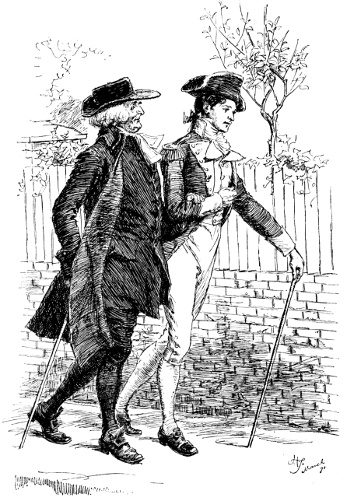
‘He and my father were such friends!’
‘And then?’ said I, after a pause.
108‘Then Peter went to sea again; and, by and by, my father died, blessing us both, and thanking Deborah 109for all she had been to him; and, of course, our circumstances were changed; and, instead of living at the rectory, and keeping three maids and a man, we had to come to this small house, and be content with a servant-of-all-work; but, as Deborah used to say, we have always lived genteelly, even if circumstances have compelled us to simplicity. Poor Deborah!’
‘And Mr. Peter?’ asked I.
‘Oh, there was some great war in India—I forget what they call it—and we have never heard of Peter since then. I believe he is dead myself; and it sometimes fidgets me that we have never put on mourning for him. And then again, when I sit by myself, and all the house is still, I think I hear his step coming up the street, and my heart begins to flutter and beat; but the sound always goes past—and Peter never comes.’
‘That’s Martha back? No! I’ll go, my dear; I can always find my way in the dark, you know. And a blow of fresh air at the door will do my head good, and it’s rather got a trick of aching.’
So she pattered off. I had lighted the candle, to give the room a cheerful appearance against her return.