Front matter (continued 3)
Reading edition
This snake-pattern is very singular and striking. The markings are fewer in number than the vertebræ, yet their true vertebral character is most obvious.
In Snakes, again, we find the dorsal region is darker than the ventral.
In the Lizards there are patches of colour placed axially, while each patch covers a number of scales.
Birds. Birds have their whole economy modified to subserve their great functional peculiarity of flight.
Immense muscles are required for the downward stroke of the wing, and to give attachment to these the sternum has a strongly developed keel. To bring the centre of gravity low, even the muscles which raise the wing are attached to the sternum, or breastbone, instead of to the dorsal region, as might be expected; and to brace the wings back a strong furculum—the merry-thought—is attached. The breast, then, is the seat of the greatest functional activity in birds, and, consequently, we find in a vast number of birds that the breast is the seat of vivid colour.
As many birds are modified for protective purposes, the brightest species were selected to test our views, namely, the Birds of Paradise (Paradisea), Humming Birds (Trochilidæ), and Sun Birds (Nectarinidæ). In these birds it is clear that colour has had full sway, untramelled by any necessity for modification.
Nothing is more striking than the mapping out of the surface of these birds into regions of colour, and these regions are always bounded by structural lines.
Take, for instance, Paradisea regia. In this bird we find the following regions mapped in colour:—
Sternum brown.
Clavicle yellow.
Pelvis yellow.
Band brown.
Frontal bone black.
Parietal bones green.
Occiput yellow.
A beautiful ruff emphasizes the pectoral muscles, and the tail appendages emphasize the share-like caudal vertebræ.
If we turn to the other species of this genus, we find in P. Papuana the claret breast suddenly change to green at the furculum; and similar changes take place in P. speciosa, while in P. Wallacei and Wilsoni this region is decorated with a wonderful apron of metallic green.
The region of the furculum is equally well marked in the Toucans and Sun-birds.
If now we observe the back of a bird, and view the skeleton with the wings at rest, we shall find it falls into three morphological tracts. First, the shoulder, or scapular track; second, the thigh, or pelvic; third, the tail, or caudal region; and in all these birds the several tracts are beautifully marked by sudden and contrasted change of colour. In P. Wilsoni all the tracts are brilliant red, but they are separated by jet-black borders. In Nectarinea chloropygia the scapular region is red, the pelvic yellow, and the caudal green.
Plate X.
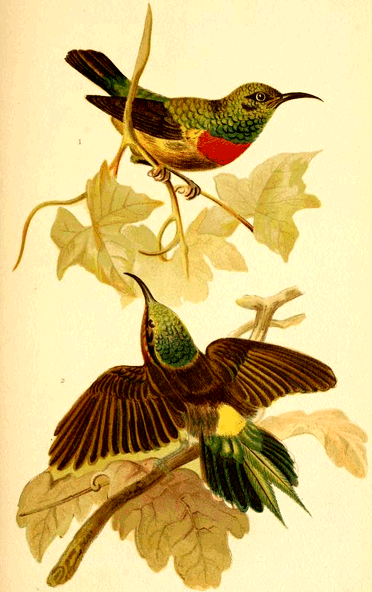
SUN BIRDS.
In P. Wilsoni we have a wonderful example of morphological emphasis. The head is bare of feathers, and coloured blue, except along the sutures of the skull, where lines of tiny black feathers map out the various bones.
But morphological emphasis exists everywhere in birds. The wing-primaries, which attach to the hand, are frequently differently decorated from the secondaries, which feathers spring from the ulna; and the spur-feathers of the thumb, or pollux, are different in shape, and often in colour, from the others, as every fly-fisher who has used woodcock spur-feathers knows full well. The wing-coverts and tail-coverts are frequently mapped in colour; and the brain case is marked by coloured crests. The eye and ear are marked by lines and stripes; and so we might go on throughout the whole bird. We may remark that these very tracts are most valuable for the description and detection of species, and among ornithologists receive special names.
Now, this distribution of colour is the more remarkable inasmuch as the feathers which cover the surface—the contour feathers—are not evenly distributed over the body, but are confined to certain limited tracts, as shown by Nitzsch; and though these tracts have a morphological origin, they are rendered quite subsidiary to the colouration, which affects the whole bird, and not these regions in particular. In fact, the colouration is dependent upon the regions on which the feathers lie, and not upon the area from which they spring. In other words, we seem to have in birds evidence of the direct action of underlying parts upon the surface.
In more obscurely coloured birds, and those which seem to be evenly spotted, close examination shows that even here the decoration is not uniform, but the sizes and axes of the spots change slightly as they occupy different regions; as may be seen in Woodpeckers and Guinea-fowl.
Although the same tone of colour may prevail throughout the plumage, as in the Argus Pheasant, great variety is obtained by the fusion of spots into stripes. A symmetrical effect is produced by the grouping of unsymmetrical feathers; as is so often seen in plants, where irregular branches and leaves produce a regular contour.
Sometimes, especially on the breast and back, the feathers of one region seem to unite so as to form one tract, so far as colour is concerned. Thus, if in P. Wilsoni the black borders of the dorsal regions were suppressed, all three areas would be of one hue. This seems to have been the case in the breast region of Humming Birds, where only the throat is highly coloured. In the Toucans the breast and throat regions are often marked with colour; but sometimes the hue is the same and the boundaries of the regions marked with a band of another colour; if this boundary band be increased, the regions do not seem so well shown, for the boundary becomes as broad as the area; yet, in all these cases the dependence upon regional decoration is manifest. No doubt the few uniformly coloured birds were derived from species which were once variously hued; the gradation of colour being lost in transmission.
Mammalia. The axial decoration of the mammalia is very definite, and nearly all species have a dorsal tract marked with colour. The dark bands on the back of the horse, ox, and ass, are cases in point. In nearly every case the dorsal is darker than the ventral surface.
If we take highly decorated species, that is, animals marked by alternate dark and light bands, or spots, such as the zebra, some deer, or the carnivora, we find, first, that the region of the spinal column is marked by a dark stripe (Figs. 9 & 16); secondly, that the regions of the appendages, or limbs, are differently marked; thirdly, that the flanks are striped, or spotted, along or between the regions of the lines of the ribs; fourthly, that the shoulder and hip regions are marked by curved lines; fifthly, that the pattern changes, and the direction of the lines, or spots, at the head, neck, and every joint of the limbs; and lastly, that the tips of the ears, nose, tail, and feet, and the eye are emphasized in colour. In spotted animals the greatest length of the spot is generally in the direction of the largest development of the skeleton.
This morphological arrangement can be traced even when the decoration has been modified. Thus, in the carnivora we have the lion and puma, which live in open country, with plain skins, the tiger with stripes, an inhabitant of the jungle, and the leopard, ocelot, and jaguar with spots, inhabiting the forests.
But the lion has a dark dorsal stripe, and the nose, etc., are emphasized in colour, and, moreover, the lion has probably lost its marked decoration for protective purposes, for young lions are spotted. The tiger's stripes start from the vertebræ, and still follow the lines of the ribs. In the tiger the decoration changes at the neck, and on the head, and the cervical vertebræ are often indicated by seven stripes. See Fig. 5.
The markings over the vertebræ are not in continuous lines, as in many mammals, but form a series of vertebra-like spots. This plan of decoration is continued even on the tail, which is coloured more on the upper than on the lower surface.
The spotted cats have their spot-groups arranged on the flanks in the direction of the ribs, at the shoulder and haunch in curves, at the neck in another pattern, on the back of the head in another; and the pattern changes as each limb-joint is reached, the spots decreasing in size as the distance is greater from the spine. See Figs. 9-15.
There is in tigers, and the cat-tribe generally, a dark stripe over the dental nerve; and the zygoma, or cheek-bone, is often marked by colour. Even the supraorbital nerve is shown in the forehead, and there are dark rings round the ears. In dissecting an ocelot at the Zoological Gardens in 1883, a forked line was found immediately over the fork of the jugular vein.
The colouration in these animals seems often to be determined by the great nerves and nerve-centres, and the change from spots, or stripes, to wrinkled lines on the head are strikingly suggestive of the convolutions of the brain, falling, as they do, into two lateral masses, corresponding with the cerebral hemispheres, separated by a straight line, corresponding with the median fissure. This is well shown in the ocelot, Fig. 15, and in many other cats.
That the nerves can affect the skin has already been pointed out in Chapter VI., in the case of herpes, and that it can affect colour is shown in the Hindoo described in the same place.
So marked, indeed, is this emphasis of sensitive parts that every hair of the movable feelers of a cat is shown by colour to be different in function from the hairs of the neck, or from the stationary mass of hair from which the single longer hair starts.
In the Badger, Fig. 16, there is a bulge-shaped mass of coloured hair near the dorsal and lumbar regions, but it is axially placed. The shoulder and loins are well marked, although in a different manner from other species. In some species of deer, and other mammalia, there are white or coloured lines parallel to the spine, and also, as in birds, spots coalesce and form lines, and lines break up into spots.
The great anteater has what at first seems an exceptional marking on the shoulder, but a careful examination of the fine specimen which died at the Zoological Gardens in 1883, we were struck with the abnormal character of the scapula, and we must remember that, as Wallace and Darwin have pointed out, all abnormal changes of the teeth are correlated with changes in the hair. Moreover the muscles of the shoulder region are so enormously developed as to render this otherwise defenceless animal so formidable that even the jaguar avoids an embrace which tightens to a death-grip. This region is, therefore, precisely the one we should expect to be strongly emphasized. This being the case, we have really no exception in this creature.
Certain mammals are banded horizontally along their sides, thus losing most of their axial decoration, and this is well shown among the Viverridæ, and smaller rodents. Now, however conspicuous such animals may appear in collections, they are in their native haunts very difficult to detect. In all cases there is a marked dorsal line; and we suggest that the mature decoration is due to a suppression of the axial decoration for protective purposes, and a repetition of the dorsal decoration according to the law before enunciated. Indeed, in one case we were able to trace this pretty clearly, in the beautiful series of Sus vittatus in the museum at Leyden. This pig, an inhabitant of Java, when mature is a dark brown animal, but in the very young state it is clearly marked in yellow and brown, with a dark dorsal stripe, and spots, taking the line of the ribs, and over the shoulder and thigh. As the animal grows older, the spots run into stripes, and it becomes as clearly banded horizontally as the viverridæ. Finally the dark bands increase in width, until they unite, and the creature becomes almost uniformly brown.
We have not been able to see young specimens of the viverridæ, but a similar change may there occur, or it may have occurred in former times. We must also remember that these creatures are long-bodied, like the weasels, and hence they may have a tendency to produce long stripes.
In the case of our domestic animals, especially the oxen, the decoration seems often to have become irregular, but even here the emphasis of the extremities is generally clearly made out, and that of the limbs can often be traced. In horses this is better shown, and dappled varieties often well illustrate the points. Most horses at some time show traces of spots.
Sufficient has now been said to point out the laws we believe to have regulated the decoration of the animal kingdom. The full working out of the question must be left to the future, but it is hoped that a solid groundwork has been laid down.
Plate XI.
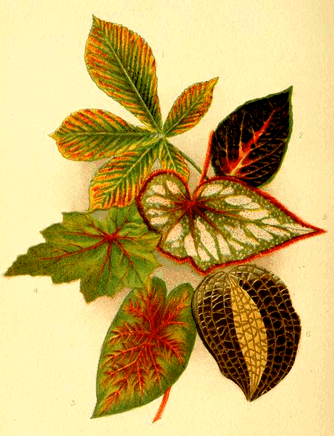
LEAVES.
CHAPTER XV. The Colouration of Plants.
T
THE general structure of plants is so simple in comparison with that of animals that our remarks upon this sub-kingdom need only be short.
With regard to leaves, especially such as are brightly coloured, like the Begonias, Caladiums, Coleus, and Anœchtochilus, Plate XI., the colour follows pretty closely the lines of structure. We have border decoration, marking out the vein-pattern of the border; the veins are frequently the seat of vivid colour, and when decolouration takes place, as in variegated plants, we find it running along the interspaces of the veins. These facts are too patent to need much illustration; for our zonale geraniums, ribbon grasses, and beautiful-leaved plants generally, are now so common that everyone knows their character. When decay sets in, and oxidation gives rise to the vivid hues of autumn, we find the tints taking structural lines, as is well shown in dying vine and horse-chestnut leaves, Fig. 1, Plate XI. This shows us that there is a structural possibility of acquiring regional colouration.
We must remember, too, that the negative colouration of these dying leaves is of very much the same character as the positive colouration of flowers, for flowers are modified leaves, and their hues are due to the oxidation of the valuable chlorophyll.
In leaves the tendency of spots to elongate in the direction of the leaf is very marked, as may be well seen in Begonia. Fig. 17, drawn to illustrate another point, shows this partly. When leaves are unsymmetrical, like the begonias, the pattern is unsymmetrical also.
Among parallel veined leaves we find parallel decoration. Thus, in the Calatheas we have dark marks running along the veins. In Dracæna ferrea we have a dark green leaf, with a red border and tip, the red running downwards along the veins. This action may be continued until the leaf is all red except the mid-rib, which remains green. In long net-veined leaves we may cite Pavetta Borbonica, whose dark green blade has a crimson mid-rib. Of unsymmetrical leaves those in the plate may suffice.
When we come to flowers, the same general law prevails, and is generally more marked in wild than in cultivated forms, which have been much, and to some extent unnaturally, modified. Broadly speaking, when a flower is regular the decoration is alike on all the parts; the petals are alike in size, the decoration is similar in each, but where they differ in size the decoration changes. Thus, in Pelargoniums we may find all five petals alike, or the two upper petals may be longer or shorter than the lower three. In the first case each is coloured similarly, in the other the colour pattern varies with the size of the petal. The same may be seen in Rhododendron.
Where the petals are united the same law holds good. In regular flowers, like the lilies, the colouration is equal. In irregular flowers, like the snapdragon and foxglove, the decoration is irregular. In Gloxinia the petals may be either regular or irregular, and the decoration changes in concert.
A very instructive case was noticed by one of us in Lamium galeobdolon, or yellow Archangel. This plant is normally a labiate with the usual irregular corolla, but we have found it regular, and in this instance the normal irregular decoration was changed to a regular pattern on each petal.
In gamopetalous flowers the line of junction of the petals is frequently marked with colour, and we know of no case in which a pattern runs deliberately across this structure line, though a blotch may spread from it.
When we remember that flowers are absolutely the result of the efforts of plants to secure the fertilizing attention of insects, and that they are supreme efforts, put forth at the expense of a great deal of vegetable energy—that they are sacrifices to the necessity for offspring—it does strike us forcibly when we see that even under these circumstances the great law of structural decoration has to be adhered to.
Plate XII.
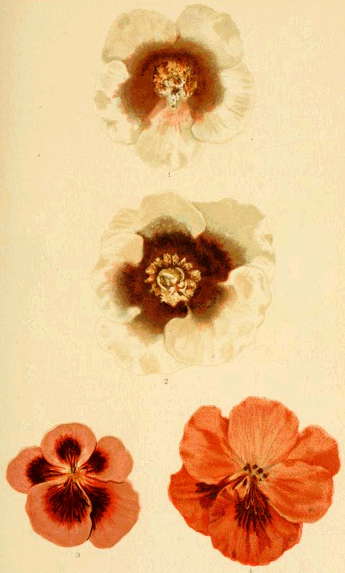
FLOWERS.
CHAPTER XVI. Conclusions.
W
WE have now, more or less fully, examined into the system of colouration in the living world, and have drawn certain inferences from the facts observed.
It appears that colouration began—perhaps as a product of digestion—by the application of pigment to the organs of transparent creatures. Supposing that evolution be true—and, if we may not accept this theory there is no use in induction whatever—it must follow that even the highest animals have in the past been transparent objects. This was admirably illustrated by Prof. Ray Lankester in a lecture on the development of the eyes of certain animals, before the British Association meeting at Sheffield, in which it was shown that the eyes commenced below the surface, and were useful even then, for its "body was full of light."
Granting this, it follows that the fundamental law of decoration is a structural one. Assuming, as we do, that memory has played a most important part in evolution, it follows that all living matter has a profound experience in decorating its organs—it is knowledge just as anciently acquired, and as perfectly, as the power of digestion. This colour was produced under the influence of light—so it is even in opaque animals.
With a knowledge so far reaching, we might expect that even in opaque animals the colouring would still follow structural lines, and there should still be traces of this, more or less distinct.
This is precisely what we do find; and, moreover, we sometimes get a very fair drawing of the important hidden parts, even where least expected, as in a cat's head, a snake's body, a dragon-fly's thorax, a spider's abdomen, a bird's skull.
But if animals thus learned to paint themselves in definite patterns, we might expect that when called upon to decorate for the sake of beauty certain parts not structurally emphatic, they would adopt well-known patterns, and hence arose the law of repetition.
But with wider experience came greater powers, and the necessity for protection arising, the well-known patterns were enlarged, till an uniform tint is produced, as in the Java pig, or some repeated at the expense of others, as in the civets. But so ingrained is the tendency to structural decoration that even where modification has reached its highest level, as in the leaf-butterflies, some trace of the plan that the new pattern was founded on is recognisable, just as the rectangular basis can be traced in the arabesque ornaments of the Alhambra.
The pointing out of this great fact has seemed to us a useful addition to the great law of evolution. It supplements it; it gives a reason why.
Could he who first saw these points have read these final pages, it would have lightened the responsibility of the one upon whom the completion of the work has fallen. But he died when the work was nearly finished. The investigation is of necessity incomplete, but nothing bears such misstatements as truth, and though specialists may demur to certain points, the fundamental arguments will probably remain intact.
GLOSSARY.
Acetabula. Lat. acetabulum, a little vessel. Sucking discs as on the tentacles of Physalia.
Aorta. Gr. The chief artery.
Cephalothorax. Gr. kephale, head; thorax, chest. The anterior division of the body in Crustacea and Arachnida, composed of the amalgamated segments of the head and thorax.
Cilia. Lat. cilium, an eyelash. Microscopic filaments having the power of vibratory movement.
Cœnosarc. Gr. Koinos, common; sarx, flesh. The common stem uniting the separate animals of compound hydrozoa, &c.
Corpuscle. Lat. corpusculum, a little body. Small coloured bodies, as in the endoderm of hydra, p. 59.
Differentiated. Modified into definite organs, or parts; as distinct from structureless protoplasm.
Ectoderm. Gr. ektos, outside; derma, skin. The internal layer or skin of the Cœlenterata.
Efferent. Lat. effero, to carry out. A vessel which carries fluids out of the body is said to be efferent.
Endoderm. Gr. endon, within; derma, skin. The inner layer or skin of Cœlenterata. See Ectoderm.
Endosarc. Gr. endon, within; sarx, flesh. The inner layer of sponges.
Epidermal. Gr. epi, upon; derma, skin. Relating to the outer layer of skin. As applied to colour, surface pigment as distinct from hypodermal, or deep-seated colour.
Gastrovascular Canal. Gr. gaster, belly; Lat. vasculum, a little vessel. The canals or vessels in the umbrella (manubrium) of hydrozoa.
Gonidia. Gr. gonos, offspring; oidos, like. Reproductive bodies in Sea-anemones.
Hydranth. Gr. hudor, water; anthos, flower. The bodies or polypes of hydroids which exercise nutritive functions. They were called polypites by Huxley.
Hydrophyllia. Gr. hudor and phyllon, a leaf. Leaf-like organs protecting the polypites of hydrozoa.
Hydrosoma. Gr. hudor and soma, body. The entire organism of a hydrozöon.
Hypodermal. Gr. hypo, beneath; derma, skin. In colour, such as lies beneath the surface, as distinct from epidermal.
Lythocysts. Gr. lythos, stone, kystis, a bladder. Sense organs in hydroids, consisting of transparent capsules inclosing round transparent concretions.
Manubrium. Lat. a handle. The central polypite suspended from the interior of the umbrella of hydroids.
Mesoderm. Gr. mesos, intermediate; derma, skin. The middle layer of sponges, &c.
Mesothorax. Gr. mesos and thorax. The middle division of the thorax in insects, carrying the second pair of legs.
Peristome. Gr. peri, about; stoma, a mouth. The area surrounding the mouth in sea-anemones.
Pneumatocyst. Gr. pneuma, air; kystis a bladder. The air-sac contained in the pneumatophore, see below.
Pneumatophore. Gr. pneuma; phero, to carry. The float of certain hydrozoa (Physophoridæ.)
Polypite. Gr. polus, many; pous, foot. The separate animal or zöoid of a hydrozöon. See Hydranth.
Protoplasm. Gr. protos, first; plasso, I mould. The jelly-like matter which forms the basis of all tissues. It is identical with the sarcode or flesh of protozoa.
Sac. Lat. saccus, a bag, a small cell.
Sarcode. Gr. sarx, flesh; eidos, form. The protoplasm of protozoa, &c., which see.
Spadix. Lat. spadix, a broken palm branch. In zoology a hollow process occupying the axis of the generative buds of hydrozoa.
Sporosac. Gr. spora, a seed, and sac. The body containing the ova of hydrozoa.
Somatic Fluid. Gr. soma, the body. The fluid which contains digested food, and taking the place of blood, circulates through the body of hydrozoa.
Tentacles. Lat. tentaculus, a little arm. The arms or prehensile organs of Sea-anemones, &c.
Thread Cells. Cells containing an extensible microscopic thread, possessing stinging properties, common among the Cœlenterata.
Thorax. Gr. a breastplate. The chest.
INDEX.

PAGE
Abyla 63
Acanthometra 57
Actinea Cari, varieties of 66
—— mesembryanthemum 54
Acanthostratus 57
Actinozoa 51, 52
Æschna 77
Agalma breve 64
Agrion puella 77
Aiptasia mutabilis 67
Albinism in butterflies 79
Alcyonariæ 54
Allman, Prof., on Hydroids 59, 60
"Alps and Sanctuaries" quoted 36
Amœba 56
Amphibia 89
Amphilonche 57
Andres, Dr., on Hydrozoa 65
Anemonia sulcata 67
Anemones, Sea 52
Animals and Plants, origin of 36
—— classification of 49
Anœchtochilus 95
Anteater 93
Anthocaris belemia 41
—— belia 42
—— cardamines 41, 42
—— euphemoides 43
—— eupheno 42
—— simplonia 42
Apatura iris 46
—— larvæ of 81
Arachnida 82
Araschnia Levana 43, 45
—— porima 43, 45, 79
—— prorsa 43, 45
Arctia 69
Arachnocorys 57
Argus Pheasant 6, 39, 91
Argynnis Lathonia 69
Armadillo 84
Arthropoda, colouration of 85
Ascidians 35
Automatic habits 9
Arthorybia rosacea 64
Badger 93
Begonia 95
Birds, colouration of 89
—— of Paradise 90
Biston betularia 79
Black and White, production of 28
Blackwell, J., on British Spiders 82
Blatta 14
Bougainvillea 16
Bower Birds 5
Bunodes crassicornis 54
—— gemmaceus, varieties of 66
—— rigidus 67
Burnet Moths 5, 69
Butler S., on inherited memory 9, 10, 11, 15
—— on origin of animals and plants 36
Butterflies, albinism in 79
—— classification of 74
—— sense organs of 30
—— varieties of 77
Caladium 95
Calathea 96
Calycophoridæ 63
Carcinus mœnas 4
Carcinus mœnas 4
Carpocanium 57
Cats, colouration of 17, 92
—— recognising form 32
Caterpillars, colours of 81
—— spiracular markings 22
Cephalopoda 87
Cerithium 86
Char 88
Chlorophyll in hydra 59
Cicada 77
Cladococeus 57
Classification of animals 49
—— of butterflies 74
Cœlenterata 20
—— colouration in 51
Cœlodendrum 57
Cœnonympha davus 79
—— pamphilus 79
Cœnosarc 55
Coleus 95
Colour and form 32
—— and transparency 53
—— epidermal 72
—— following structure 83, 91
—— hypodermal 53, 73
—— nature of 25
—— of day-and-night flying insects 47, 69
—— opaque 53
—— perception of 5, 23, 25, 32
—— uniform, why rare 28
Colouration 3
—— laws of 21, 51
—— of desert animals 4
—— of arthropoda 85
—— of cœlenterata 51, 59
—— of insects 68
—— of invertebrata 49
—— of molluscs 85
—— of plants 94
—— of protozoa 51
—— of spiders 82
—— of vertebrata 88
—— sexual 5
—— varieties of 3
Contour feathers 91
Conus 86
Coppinia arcta 60
Corallium rubrum 54
Corals 54
Correlation of teeth and hair 94
Corynida 52
Cowries 86
Crab, shore 4
Croton 46
Cuttle-fishes 19, 87
Cyllo leda 45
Cynthia cardui 68
Cypræa 86
Cyrtidosphæra 57
Dallas, W. S., on butterflies 71
Danais 72
—— niavius 30, 80
Darwin, C. 1, 2, 5, 9, 11, 14, 45, 47, 94
Darwin, Dr. E., cited 37
Deer 92
Deformity, antipathy to 32
Deilephila Euphorbiæ 81
—— galii 81
Descent with modification 1
Desert animals, colour of 4
Dictyoceras 57
Dictyophimus 57
Diphyes 63
Disease, markings in 39, 44
Distant, W. L., on Malayan butterflies 80
Distinctive Colouration 3
Dogs recognising portraits 32
Dracæna ferrea 96
Elephant, increase of 2
Engelmann on Euglena 34
Epidermal colour 72
Eresus cinnabarinus 82
Eucecryphalus 57
Eucrytidium 57
Euglena viridis 34
Evolution 1-98
Eye-spots 45, 47
Fayrer, Sir W., on snakes 89
Feathers 91
Fishes, colours of 88
Foal, stripes on 46
Foraminiferæ 56
Fuller, W. J., on aquatic larvæ 77
Gamopetalous flowers 96
Gegenbaur's "Comparative Anatomy" cited 82
General colouration 3
Gloxinia 96
Gomphina 77
Gonepteryx Cleopatra 41, 42
—— rhamni 40, 42
Gonophores 52
Grapta interrogationis 79
Gregarinidæ 56
Guinea-fowl 91
Haagen, Dr., on colour 53, 72
Habits 8
Haeckel, Prof., on Radiolaria 57
Hair and teeth, correlation of 94
Hawk moths 69
Hebrides, colours of insects in 80
Heredity 2
Herpes 40, 93
Heteromorphism 78
Higgins, Rev. H. H. 39
Hoverer flies 84
Humming birds 90, 92
Hutchinson, Mr., on herpes 40
Huxley, Prof., on hydrozoa 63
Hydra viridis 59
Hydrida 59
Hydrozoa 51, 59
Hypodermal colour 53, 72
Identity of offspring and parent 11
Identity, personal 10
Inherited memory 8
Insects, colour in 68, 75
John Dory 89
Kallima inachus 30, 80
Kentish Glory Moth 30
Lamium galeobdolon 96
Lankester, Prof. Ray, on development of eyes 97
Large Copper Butterfly 68
Larvæ, colours of 45, 81
Laws of emphasis 21
—— exposure 18
—— heredity 2
—— multiplication 2
—— repetition 21, 22
—— structure 18
—— variation 2
Leaf-butterfly 16, 30
Leidy, Prof., on Rhizopoda 56
Leopard 17, 92
Leucophasia diniensis 41
—— sinapis 41
"Life and Habit" cited 9
Light, reflected 26
—— sensibility to 33
—— waves 25
Liminitis sibilla 43
Lion 17, 92
—— stripes on young 46
Lithocysts of hydroids 62
Lucernaria auricula 65
Lycæna dispar 68
Lycosa agretyca 83
—— allodroma 83
—— andrenivora 83
—— cambria 84
—— campestris 83
—— latitans 84
—— picta 84
—— piratica 84
—— rapax 83
Mackerel 88
Mactra 86
—— stultorum 87
Madrepores 54
Mammalia, colouration in 92
Margarita catenata 87
Measles 39
Medusæ 52, 65
Melanism in insects 79
Meldola, Prof. R., on Melanism 79
Melitæa artemis 43
—— athalia 43
Mimicry 3, 4
Mollusca 21
—— colouration in 85
Monstrosities, antipathy to 32
Morphinæ 72
Morpho 4
Murex 86
Muscles of insects 71
Nectarinea chloropygea 90
Newman, Mr., on varieties of butterflies 77
Newts 89
Nitzsch on feather-tracts 91
Nudibranchs 85
Nymphalidæ 74
Oak Egger Moth 30
Ocelli 47
Ocelot 93
Oliva 86
Opaque colouring 53
Organ-pipe coral 54
Origin of animals and plants 36
—— — species 1
Orthopœcilism 78
Oxen 94
Painted Lady Butterfly 68
Pangenesis 12
Papilio Ajax 79
—— machaon 43, 68, 76, 78
—— —— larva of 81
—— merope 30, 76, 80
—— nireus 14
—— podalirius 43
Paradisea Papuana 90
—— regia 90
—— speciosa 90
—— Wallacei 90
—— Wilsoni 90, 91
Pavetta Borbonica 96
Pecten 86
Pelargonium 96
Perch 88
Personal identity 10
Physalia 63
—— caravilla 64
—— pelagica 64
—— utriculus 64
Physophoridæ 63
Plaice 88
Plants and animals, origin of 36
—— colour in 95
Pneumatophores 63
Portuguese Man o' War 63
Protective resemblance 3
Protista 34
Protozoa 20
—— colouration in 51, 56
Python 89
Radiolaria 57
Rarity of uniform colour 28
Ray Lankester, Prof., on Ascidians 35
Red Admiral Butterfly 29
Repetition, effects of 8
Reptilia, colouration in 89
Resemblance, Protective 3
Rhizophora filiformis 64
Rhizopoda 56
Rhododendron 96
Ringlet Butterflies, eye-spots of 47
Roach 88
Romanes, Prof., cited 33, 34
Satyrus hyperanthus 79
Scales of insects, structure of 72
Scarlet Tiger Moth 5
Sea anemones 52
—— —— colours of 67
Seasonal dimorphism 70
Sea squirts 35
Segestria senoculata 83
Selection, sexual 5
Self-coloured flowers 28
Sense organs of Butterflies 30
Sertularidæ 63
Sexual colours 4
—— selection 5
—— dimorphism 70
Shell, Structure of 85
Shore Crab 4
Simple variation in Butterflies 77
Siphonophora 63
Small pox 39
Snakes, patterns of 89
Sollas, Prof., on Sponges 58
Soles 88
Sparassus smaragdulus 82
Species, origin of 1
Sphæronectes 63
Sphingidæ 45, 69
Spiders, structure and colour of 82
Spiracles of larvæ 22
Spondylus 86
Sponges 57
Spongida 57
Spongocyclia 57
Spots and Stripes 39
Stephanomia amphitridis 63
Struggle for existence 2
Sun-birds 90
Sus vittatus 46, 94
Sutton, Mr. Bland, on Herpes 40
Swallow-tailed Butterflies 68
Syncoryne pulchella 62
Systems of colouration 51
Teeth and Hair, correlation of 94
Thomisus cinereus 82
—— floricolens 82
Thomisus luctuosus 84
—— trux 82
Thrush, increase of 2
Tiger 17, 92
—— Moths 69
Tipula 33
Toucans 90, 92
Transparency and colour 53
Trigonia 86
Tubipora musica 54
Tubularida 59
Tylor, A., on Specific change 10
Vanessa Antiopa 76
—— atalanta 29, 43, 69
—— urticæ 77
Variation in insects 70
—— law of 2
—— simple, in Butterflies 77
Velella 52, 65
Vertebrata, colouration of 88
Viverridæ 94
Wallace, A. R., on sexual selection 5, 6, 14, 15
—— on colour 29
—— on abnormal structures 94
Warning colours 4
Wasps 84
Weir, J. Jenner, on variation in insects 78
Weismann, Dr., on Caterpillars 81
Wing of Butterfly, typical 70
—— patterns of 76
Woodpecker 91
Yellow Archangel 96
Zebra 92
Zygæna 69

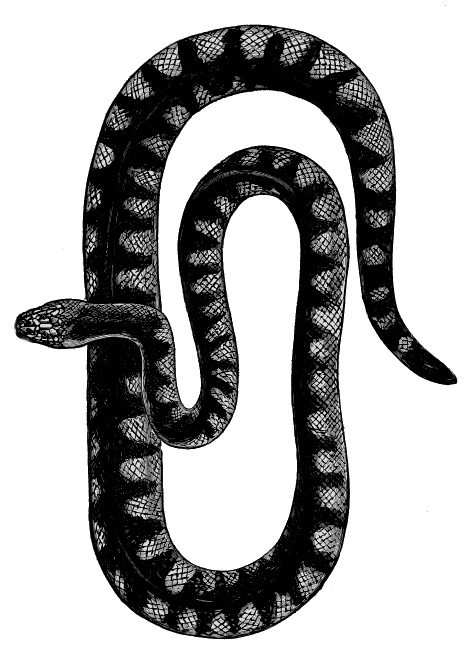
Fig. 4.—Python. Showing vertebra-like markings.
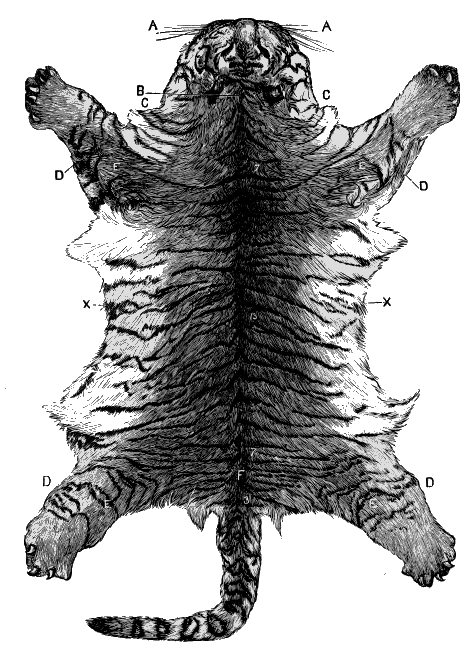
Fig. 5.—Tiger. The pattern changes at the points lettered.
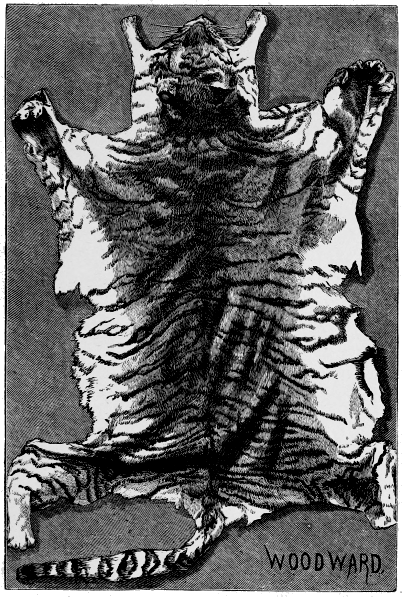
Fig. 6.—Tiger.
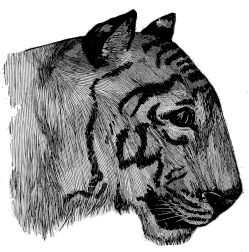
Fig. 7.—Tiger. Showing supra-orbital nerve mark.
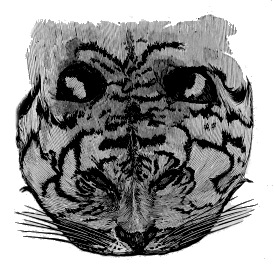
Fig. 8.—Tiger. Showing cerebral markings, and markings over nerves near the eyes.
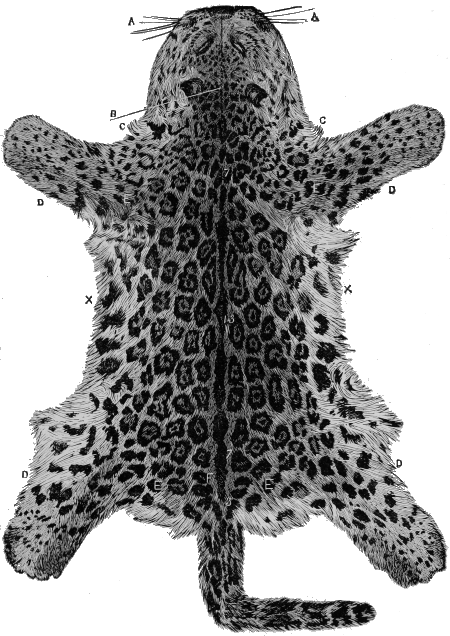
Fig. 9.—Leopard. The pattern changes at the points lettered.
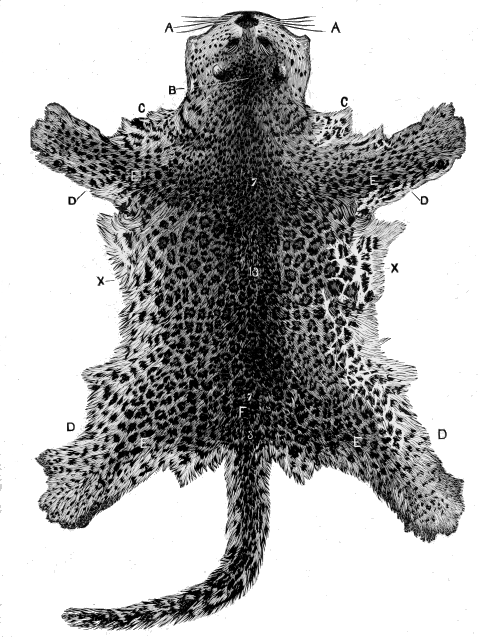
Fig. 10.—Leopard. The pattern changes at the points lettered.
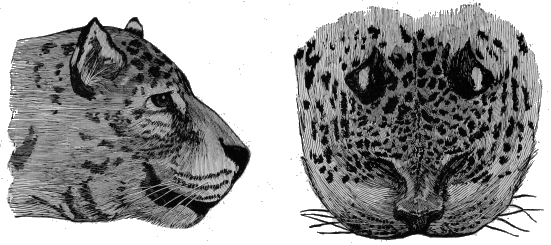
Figs. 11, 12.—Leopards' Heads.
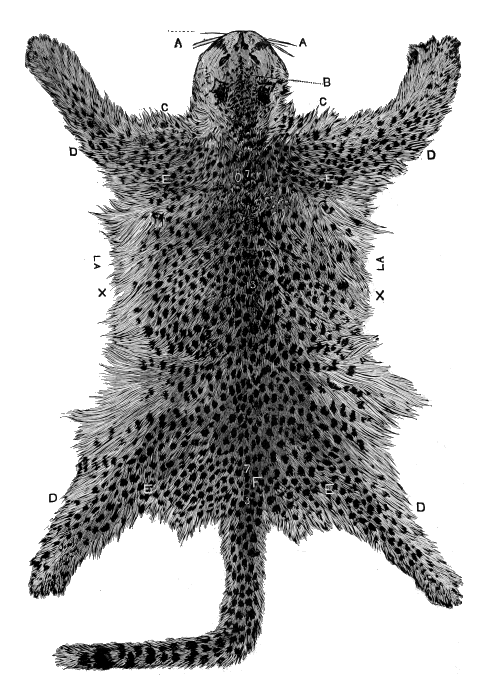
Fig. 13.—Lynx. The colour changes at the points lettered.
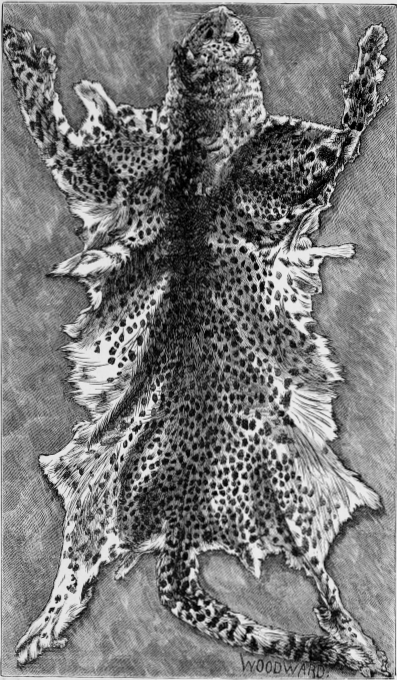
Fig. 14.—Lynx.
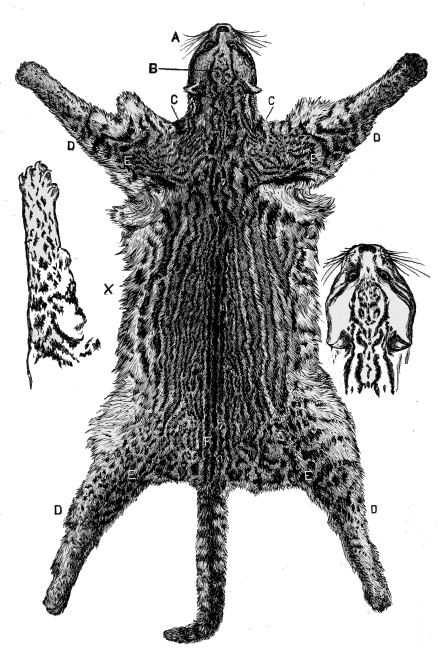
Fig. 15.—Ocelot. Showing changes of pattern at the joints, &c., with enlargement of head-pattern.
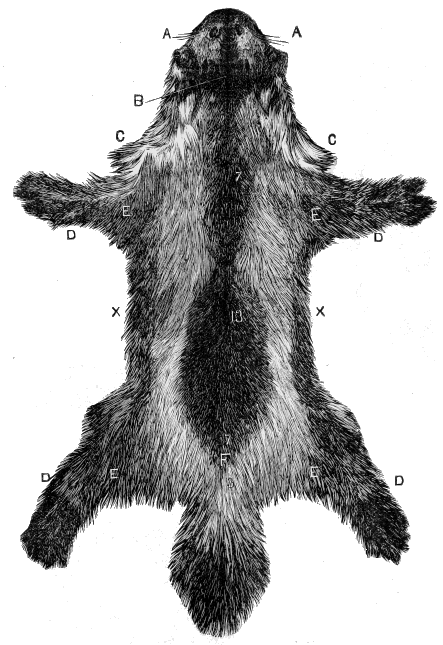
Fig. 16.—Badger. The colour changes at the points lettered.
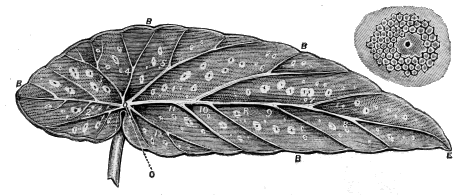
Fig. 17.—Begonia Leaf.
Footnotes