REVENGE
Reading edition
MISS ATTERBURY put the paper she was reading carefully and slowly down upon the table. It was the Boston —— , and there was a long article upon the first page marked ostentatiously around with a blue lead-pencil, and headed in glaring letters, “Athletics in Girls’ Colleges.”
There was a dangerous gleam in Miss Atterbury’s dark-gray eyes, and she seemed a trifle more than her ordinary five feet eight inches as she drew herself up and turned, with that careful repression of irritation which always denotes the extreme limit of self-control, upon an inoffensive freshman, comfortably installed in the window-seat, playing a mandolin.
“I was in Antwerp two weeks last summer,” she remarked, with careful emphasis, “and I heard the cathedral chimes play ‘La Mandolinata’ twice every five minutes, I think. I would be obliged if you would play something else, or even stop altogether for a while—I have something important to talk about just now.”
The freshman stuck her pick guiltily in the strings, and shifted her position upon the cushions into one of extreme and flattering attention, while the four girls who had been playing whist over in a corner turned hastily around toward Miss Atterbury.
“What is it now, Katharine?” inquired Miss Yale, reproachfully, laying down her cards. “She always takes things so terribly au grand sérieux,” she explained plaintively to the rest. Miss Yale had her rooms with Miss Atterbury, and stood rather in awe of that young woman, and was very proud of her athletic prowess, and could always be relied upon to tell her friends “that Katharine Atterbury was the captain of the senior crew, and could pull an oar as well as a ’Varsity stroke, and that the champion tennis-player of a certain year had said that she was an antagonist to be feared and respected.”
“This is what is the matter,” said Miss Atterbury, in a tragic voice, picking up the paper. “I don’t know who it is that writes such absurd, such wilfully misleading articles about us, but I do know that if I could get at him I would——”
What Miss Atterbury would do was apparently too awful to speak of just then.
One of the girls got up and went over to her.
“But what is it?—what have they said about us now?” she inquired, impatiently.
“What they are always doing—poking fun at us,” replied Miss Atterbury, hotly, and with a fine disregard of grammar. “To read this article one would imagine that we were imbecile babies. One would think that a girl was as weak as a kitten, and didn’t know a boat from an elevator, or a five-lap running track from an ice-wagon, or a golf club from a sewing-machine. He—whoever the man is who wrote this ridiculous article—seems to think that all our training and physical development is a huge joke. He don’t even know how stupid he is. That’s the worst of it—he isn’t even aware of his unutterable, his colossal ignorance!”
“Wouldn’t it be fun to have him drawn and quartered, as an awful example, a sort of warning to the other newspaper men not to write about what they are totally ignorant of, and to leave us alone,” suggested the inoffensive little freshman, with a base but entirely successful attempt to get back into Miss Atterbury’s good graces.
The senior gave her a brief but cordial glance, and then ran on:
“Something must be done about it. I’m tired of reading this sort of trash about women’s colleges. It is time the public was learning the true state of things—that girls can and do swim, and row and play golf and tennis, and run and walk about, just as their brothers do, and that we have courage and muscle enough to go in for football even, except that we have some little regard for our personal appearance!”
“And it’s so degrading and irritating to go home in the vacations, and have one’s brother tease one to death about it all, and try to be funny, and ask one if the color of one’s gymnasium suit is becoming, and if the golf captain knows the caddie from a cleek,” interposed Miss Thayer, a pretty blond girl who got up slowly and sauntered over to Miss Atterbury, putting her face over that young lady’s shoulder to get a look at the unfortunate paper. As she did so she gave a little cry of surprise.
“Why, I know the man who wrote that,” she gasped. “There! J. E. N.—see those initials at the end?—they mean Jack Newbold. I remember now he is writing for that paper. He told me this summer at the sea-shore that he was going in for newspaper work. His grandfather owns this paper, you know, and has promised him half a million when he is twenty-five if he will go through the whole thing—learn everything a newspaper man must know. He didn’t want to do it much, but, of course, he would go in for almost anything sooner than lose all that pile of money.”
Miss Atterbury looked thoughtfully and intently at Miss Thayer.
“You say he is a friend of yours?” she demanded, slowly.
“Oh, yes; we got to be very good friends this summer. He taught me how to play fifteen-ball pool—that’s about all he knows,” went on the girl, scornfully. “He’s an awful duffer about everything else. You ought to see him play tennis! It’s not very edifying, but it’s awfully funny.”
Miss Atterbury gave a little gasp of delight.
“That’s too good to be true,” she said, enthusiastically.
Miss Thayer rather stared. “Why?” she demanded, and then, without waiting for a reply, she swept on. “You wouldn’t think so if you had to play doubles with him! And he simply can’t walk—gets awfully tired, he says. I think it’s his clothes. Gets ’em in London, and they are terribly swell and uncomfortable. And he is always afraid his collar is going to melt; it’s quite painful to be with him on a warm day. And I couldn’t induce him to come out in my cat-boat with me. Said he didn’t think a girl could learn to handle one with any degree of safety. Did you ever hear of anything so unjust? I think he was afraid.”
Miss Atterbury was leaning on the table now, and her countenance had assumed such a cheerful look that the freshman felt quite relieved and ventured to pick up her mandolin again.
“Go on!” demanded the senior, delightedly.
“Well, I don’t know anything more,” declared Miss Thayer, impatiently. “Isn’t that enough for you? He’s no good at out-door sports, and what he is doing writing us up or down is more than I can imagine. He oughtn’t to be allowed to do so. He don’t know anything about it at all, and I should think he would be ashamed of himself. I suppose his editor told him to do it, and he simply ‘made up’ and put down everything he had ever heard about us, and worked in all the old jokes about girls’ colleges.”
Miss Atterbury got up slowly.
“Well!” she said, impressively, to Miss Thayer, “I’m sorry if that young man is much of a friend of yours, for we have got to make an example of him. I suppose you know him well enough to invite him out here Monday afternoon?—for you’ve got to do it,” she added, with calm decision.
Miss Thayer said she thought she might venture on that simple act of courtesy, though she could not quite understand why Miss Atterbury was so anxious to see him since she disapproved of him so entirely; to which that young woman replied that she wished to see him once, so that she might never see him again, and that the next day she would explain her plans, in which she expected their hearty co-operation.
Mr. Jack Newbold had just comfortably installed himself in the 1.50 B. and A. train, when it occurred to him that he might possibly have made a mistake as to the time Miss Thayer expected him. He pulled out the note which he had received from her, and read it again.
“My Dear Mr. Newbold: I have been so interested in what you have written about athletics in girls’ colleges! I saw the article in your paper and knew immediately by the initials that it was your work. Ever since seeing it I have been wishing to redeem my promise to have you come out here and see our college.
“All the girls are anxious to see you. I hope you won’t mind receiving a great deal of attention! You know how enthusiastic and unconventional college girls are, and you are of the greatest interest to us just now. Miss Atterbury, a charming girl, is especially eager to meet you. Don’t be too flattered! But we shall all be delighted to see the man who has so ably written up girls’ colleges, and unless I hear from you to the contrary, shall look for you out Monday afternoon by the 1.50 train.
“Of course I shall expect you to take dinner and go to the concert in the evening. I tell you this now, so you can wear just the right ‘dress’—men are so ridiculously particular about their clothes!
“Very cordially yours, “Eleanor Thayer.”
Mr. Jack Newbold was not a particularly vain youth, but he had a slight feeling of satisfaction on perusing that note which made him settle himself even more comfortably in his seat and resign himself cheerfully to the short journey.
“Had no idea that article would make such a sensation,” he was saying to himself, “and I’m glad she expects me by this train. Of course she will bring her trap to the station for me. I believe the college is quite a little distance from the town. Nice little trap—she drives well for a girl, I remember.” And then he fell to wondering whether he had selected just the right things to wear. “Girls are so deucedly critical,” he soliloquized, and it had been rather hard to decide on just what would be in good taste for an afternoon call and would still do without change for the concert in the evening, and he rather complimented himself on his judicious selection, and was assuring himself that the particular shade of his gloves had not been a mistake, when he found that he was at the station.
Miss Thayer welcomed him effusively.
“I knew you wouldn’t have the vaguest idea of how to get up to the college,” she was saying, “and so I came down for you myself. No, I didn’t bring my trap. I knew you would enjoy the walk up, and I wanted to show you it myself. I remember how fond you were of walking, last summer,” she added, with a bright smile at him.
Newbold stared a little.
“I don’t think,” he began doubtfully; but Miss Thayer interrupted him quickly—
“You cannot imagine how anxious the girls are to see you. Each one wants to show you what she is particularly interested in. Really you are quite a martyr—I mean a hero—in our eyes! We will go up this way,” she ran on. “It’s a little longer and there is a pretty bad hill, but of course a man doesn’t mind a little extra exertion, and it’s even more beautiful than the other way.”
Newbold said he would be charmed to go any way that Miss Thayer might choose, but that he didn’t want to lose any of his visit at the college, and that perhaps it would be wiser to take the short cut. But Miss Thayer said that if they walked a little faster they would get there just as soon, and he would see the finer view, too. So they started off briskly, and Newbold wished that he had worn the other pair of patent leathers, and finally, when he felt ready to drop, and thought they must have walked about five miles, and she told him they had only two more to go, he blamed himself most severely for not having firmly refused anything but the short cut and a cab. One of Miss Thayer’s friends who met her told her the next day that she was glad to see that she had joined the Pedestrian Club, and that she had often wondered why she had not done so before.
“I hardly think it is worth while to go into the drawing-room now,” remarked Miss Thayer, argumentatively, as they strolled up the broad drive to the college. “I see Miss Atterbury down there on the campus playing tennis, and I promised to bring you to her immediately,” she went on. Newbold felt a horrible inclination to say that he didn’t care if he never met Miss Atterbury, and that personally he would very
“YOU CANNOT IMAGINE HOW ANXIOUS THE GIRLS ARE TO SEE YOU”
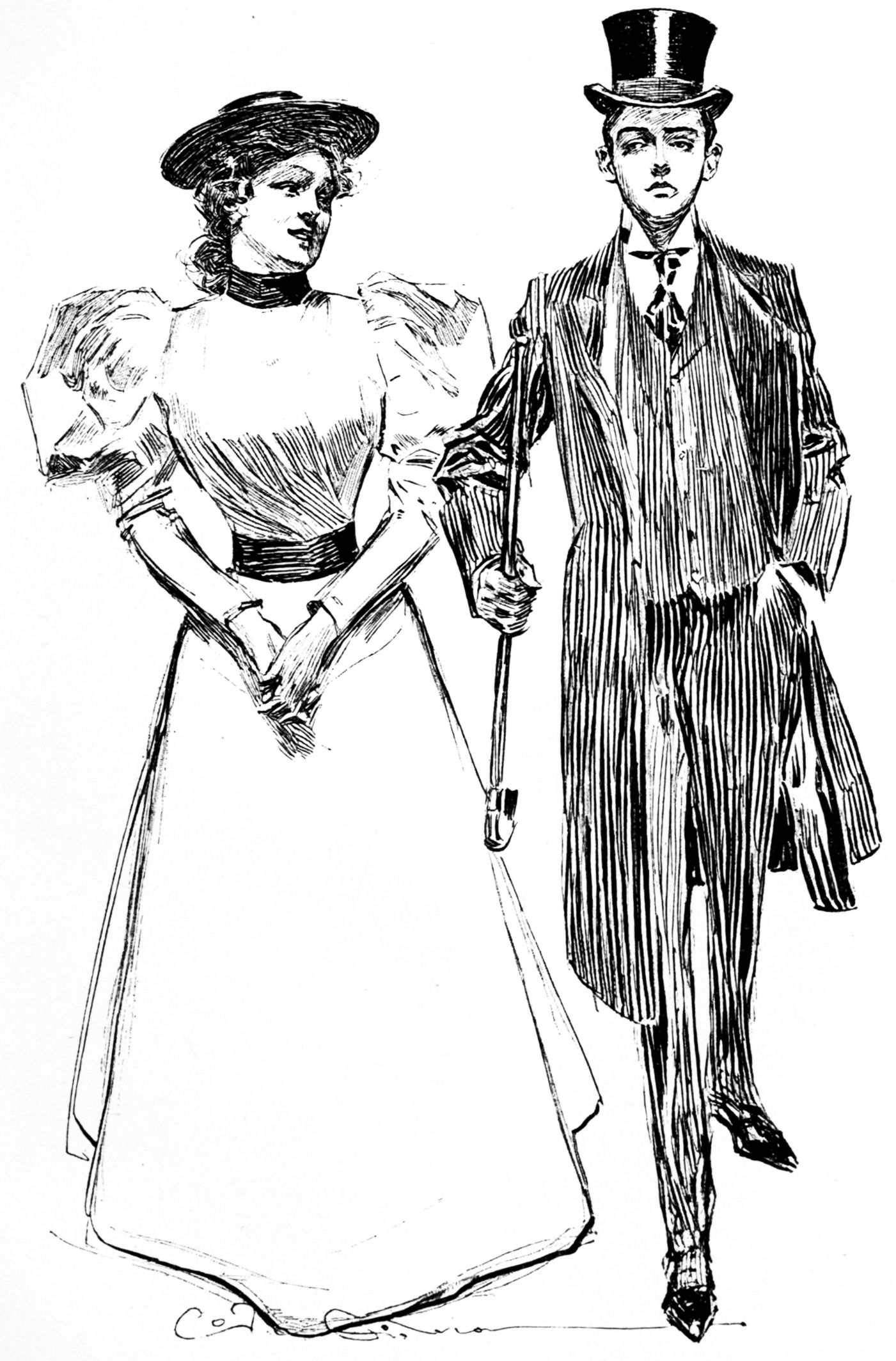
much prefer going into the drawing-room and stopping there for the rest of the afternoon, in the most comfortable chair to be found; but he managed to murmur a weary assent to Miss Thayer’s proposition, and together they started down the steep hill at the bottom of which stretched the campus. But he could not seem to keep up with Miss Thayer, and by the time he had reached the tennis grounds and had decided that in all probability his heart would never beat normally again, he was conscious that he was bowing, and that Miss Atterbury, flushed from playing, was standing before him and was laughing and saying—“I don’t often give acquaintances such a warm welcome!” The next thing he knew was that someone had thrust a racket into his hand, and he heard, as in a dream, Miss Thayer telling her friend that Mr. Newbold was a splendid tennis-player, and that she would have to do her best to beat him, but that she hoped she would for the honor of the college. And then he found himself, somehow, walking over to the court, and, before he could protest, Miss Atterbury was on the other side, and was asking him kindly but briskly if he were ready to play. He thought he was as near ready as he ever would be, so he said “Play!” and waited resignedly for her serve.
It was just after Miss Atterbury had piled up an appalling number of games against him, and he had come to the conclusion that he knew what it would be like to stand fire from a Krupp gun, and had decided that tight patent leathers and a long coat were not just what he would have chosen to play tennis in, that he saw Miss Atterbury, to his intense relief, throw down her racket and run up the hill a little way. She was back in an instant with Miss Thayer and a tall, handsome girl, carrying a lot of golf clubs. When young Newbold saw the golf clubs he felt so tired that he thought he would sit down on the cold ground, although he knew how dangerous such a proceeding was, especially when he was so painfully aware of how hot his head was and how clammy his linen felt.
“Mr. Newbold!” he heard Miss Atterbury say, “I want to present you to Miss Yale. She is the captain of the Golf Club, and I knew you would want to meet her. Anyone who is such an authority on the subject as you proved yourself to be in that article would, of course, want to see the links out here.”
“Ah! thank you!” murmured Newbold; “but I play very little, you know, and I wouldn’t interrupt your game for the world!”
But Miss Yale told him how interested she
“PLAY!”
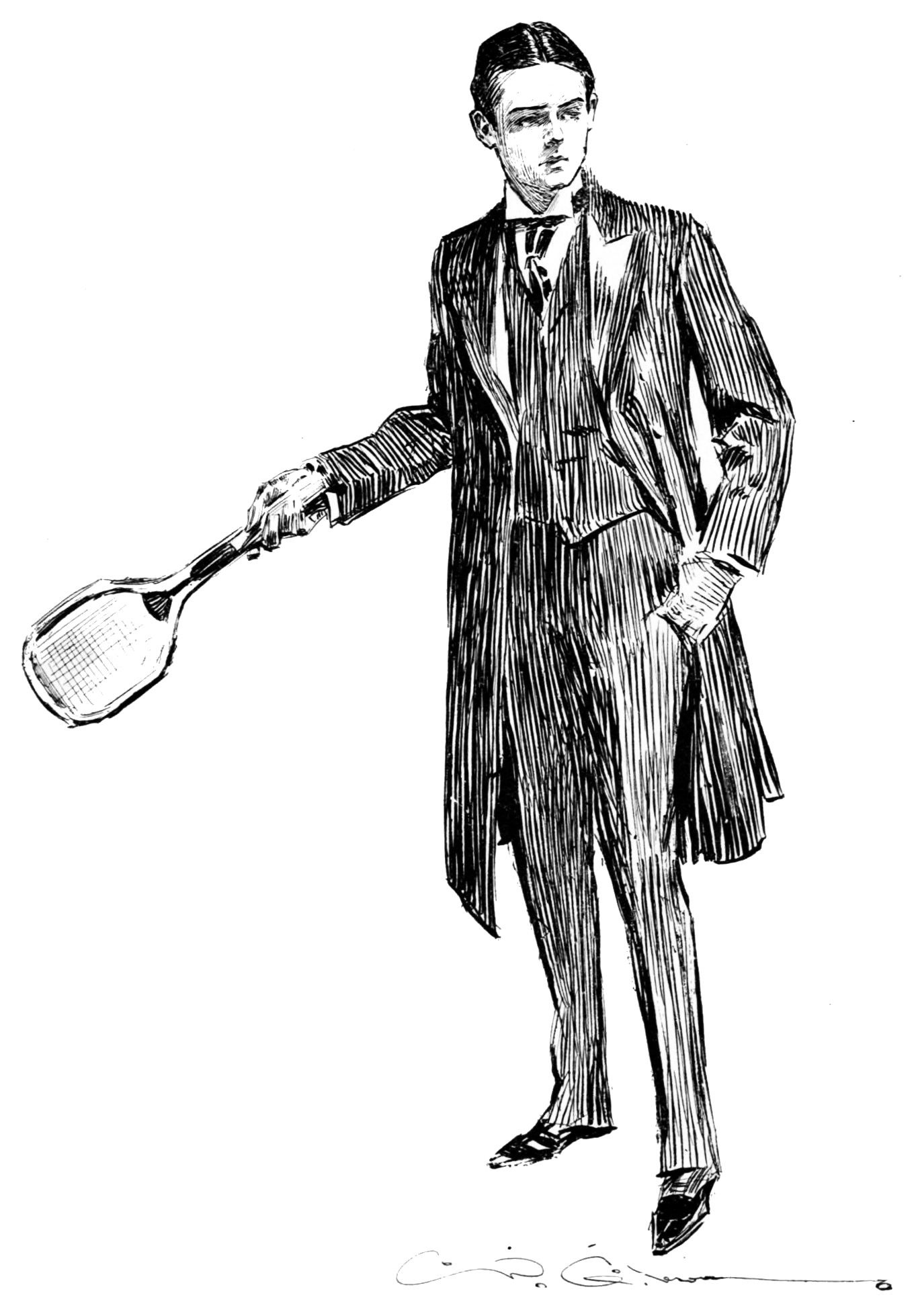
had been in his article, and that she wouldn’t feel that she had done her duty by the college unless she showed him the links, and that he really must come with them and tell them whether the meadow-land was too stiff a bit of ground to be gone over. And so Newbold found himself trudging wearily along again between Miss Atterbury and Miss Yale, who seemed as fresh as though they hadn’t moved that day. The links seemed distressingly far off, and the holes absurdly distant from each other. His arms ached so from tennis that he could scarcely hold the driver Miss Yale gave him.
“I wish you would drive off this tee once—men do that sort of thing so much better than girls,” she was saying, admiringly. “They don’t seem to need any practice at all—just comes natural to them.” Newbold had a very distinct impression that it hadn’t come at all natural to him, and he would greatly have preferred not trying before Miss Yale and the knot of young women who had drawn together at some little distance, and were very obviously watching him under the shallowest pretence of hunting for a lost ball. He felt desperately nervous, and his nervousness did not tend to disappear when he made a frantic try at the ball, digging a hole in the ground about a foot in front of the tee, and almost hitting Miss Atterbury, who jumped back with a little cry very unlike her ordinary calm self.
“I—I beg your pardon,” he began, desperately; but Miss Atterbury assured him that she was all right, and urged him to try again. He did so, and although he balanced himself cautiously on one foot and then on the other, and snapped at the ball several times before trying to hit it, and wobbled his driver after the most approved methods, he topped his ball miserably, and had the mortification of seeing it land in a most difficult hazard. And then he watched Miss Yale drive off with a good backward swing of her club, which hit the ball “sweet and clean,” and sent it a good ninety yards.
“Of course, as you said in your article,” remarked that young woman, picking up her clubs and starting off energetically after the ball, “this is no game for women. It is pre-eminently a man’s game, and a woman’s short collar-bone is never such an obvious mistake as in golf. A man can do so much with a driver or a cleek or a lofter, and the walking is so easy for him, and he is so entirely independent of the weather.” Newbold murmured inarticulate assents as he walked wearily by her. He wondered if she could keep up that pace all around the course, and he especially wondered how far around it was. He had a great deal of difficulty in getting his ball out of the hazard and lofting it up a steep hill, and he savagely wished that he had joined that golf club all his friends were urging him to join, and decided firmly to do so before he slept that night, and to engage the professional’s services for himself, and to practise till he could drive a ball off without utterly destroying all the turf in the vicinity.
They were on the second round, and Newbold was roughly calculating that his erratic plays had made him walk about three miles, and was wondering if he could live to get up the hill in front of him, when he saw Miss Thayer and Miss Yale, who were three holes ahead of him, coming back toward him.
“You look awfully tired and hot,” said Miss Thayer, sympathetically. “What’s the matter? Don’t you like golf? But what an absurd question! Anyone who could write the article on athletics you did must like it. Only, I suppose, girls seem such duffers at it, to you!”
Newbold looked at her sharply. He had an uneasy suspicion that she was laughing at him, but he was too tired to think of any way of finding out whether she was or not, and so he walked on taciturnly and sufferingly.
“I have such a nice surprise for you,” ran on Miss Thayer. “But I won’t tell you what it is yet.” She pulled out her watch. “It is just a quarter to four now, and I think the surprise will not be ready until a quarter after. Can you possibly wait that long?”
Newbold said he thought he might if he could sit down; but Miss Thayer said she disapproved of getting over-heated and then cooling off rapidly, and that she thought they had better keep moving until it was time to see the “surprise.” So they strolled across the grounds, and the two girls seemed to meet an astonishing number of friends, all going their way. And while Newbold was vaguely wondering what their destination might be, and what new torture was in store for him, he heard Miss Yale say, in what sounded to him like the voice of an avenging angel:
“I think we had better show Mr. Newbold our new running-track while we are waiting. He is so interested in such things, and he might suggest some improvements.” And then Newbold felt himself irresistibly compelled to walk on farther and farther. He wondered sadly why they thought he knew anything about running-tracks for girls, and decided that his humorous remarks on the subject in his article had been a great mistake.
“Do you think it’s a fair track?” inquired Miss Yale, anxiously, as they came in sight of it. “It is an eight-lap track, you see, and of course a great many girls only go around four times at first—girls get tired so absurdly easy! Now I suppose men think nothing of making two miles at a time—it is just play for them. Men are so strong—that is their greatest fascination, I think,” she ran on enthusiastically. “Haven’t you seen foot-ball players after a hard practice game start off and run two miles around the track, and seem to think absolutely nothing of it?”
“Oh, that’s nothing,” said Newbold, unwarily and warmly. “Fellows are so different from girls, you know. A girl cries when she’s tired, doesn’t she? Well, a man just keeps going, you know, and doesn’t let it make any difference to him.”
“I am so glad to hear that, Mr. Newbold,” said Miss Yale, with prompt and suspicious sympathy, and a sudden firmness of tone, “because I wanted dreadfully to ask you to try the track, but hated to do so, for I knew you were tired—at least you look so. But since you just keep going, and it doesn’t make any difference to you, why I would be so awfully obliged if you would run around three or four times. I want to see just how you hold your head and arms. I don’t believe we do it in the best way, you know.”
It was a rare and pleasingly curious sight that Miss Yale and Miss Thayer and a great many other young women assembled near the track, apparently by a strange coincidence, looked upon. It is not often that one has the chance of seeing an immaculately dressed youth, with flushed and desperate countenance, tear madly around an eight-lap track in the presence of a number of flatteringly attentive young women. It occurred to Newbold as he dashed around and around that it would be far preferable to keep going until he fainted away or dropped dead, than to stop and encounter the remarks and glances of those young women. They would at least feel sorry for him in that case, he thought, gloomily. But even that modest and simple desire was not granted him. As he started on the fifth lap he heard Miss Yale call to him to stop. He had a wild inclination to pay no attention to her, but to keep going on and on, but as he got nearer he saw her step out toward him and put up a warning hand.
“Thank you so much,” she said, warmly. “I think we have all had a lesson in running which we shall not forget soon. I hope you are not tired?” she went on, anxiously.
Newbold said, “Oh, no!” but he felt very tired indeed. His feet ached horribly and his head felt hot and dizzy, and there were queer, sharp pains shooting through his body which made him think forebodingly of pneumonia.
“The surprise is ready—Miss Atterbury is going to have the crew out for your especial benefit!” went on Miss Yale, triumphantly. “Don’t you feel complimented? And you are to pull Miss Thayer and myself about while they go through a little practice for you. Not much, you know, but just enough to show you the stroke and speed we get. The boat is a beauty—but then, of course, you know so much more about it than we do! I imagine from your article that you must pull an oar capitally. Miss Thayer says a cat-boat is your especial hobby, though.”
“Did Miss Thayer say that?” began Newbold, hotly. “Beastly things, I think—hate ’em!”
Miss Yale smiled incredulously and brightly at him.
“How modest you are!” she said, admiringly. “Ah! there is Miss Atterbury!”
Newbold saw some one waving frantically at them.
“Come on!” exclaimed Miss Yale; “we want to see them start off—that’s the best part.”
Newbold never remembered afterward how he got across the intervening space, or how he got into a boat with the two young women. The first thing he heard was Miss Atterbury asking him anxiously how he liked the new sliding-seats, and what he thought of the proportions of the boat, and about outriggers in general, and where he thought they could be built best and cheapest. Newbold felt about as capable of instructing her on such points as of judging the pictures at a Salon exhibit, and he longed, with a longing born of utter exhaustion and desperation, to get away. As he wearily pulled the heavy, unwieldy boat about after the light practice-barge, which kept an appalling distance ahead of him, he decided within himself that the physical development of women had been carried to an absurd and alarming extent, and that men simply were not in it with them when it came to endurance and enthusiasm, and that he had made the mistake of his life when he wrote that article on athletics in girls’ colleges, and that his chief might talk until he was blue in the face before he would ever consent again to write about anything of which he knew so little.
They were very disappointed when he told them firmly that he could not stay to dinner or to the concert, but that he had a pressing engagement that would take him back to the city. And they said that there were still the Swedish gymnastics and basket-ball and pole-vaulting to see, and that they were afraid he had not enjoyed himself or he would have got rid of that engagement in some way; but he assured them impressively that he had never spent a more instructive or peculiarly interesting afternoon in his life.
Miss Thayer took him back to the station in her trap, and remarked on how much shorter the way seemed with a good horse; and when she bade him good-by she told him that she would be looking out for another article in his paper, and that she would be much disappointed if his visit had not inspired him to write something. To which Newbold replied that that was his pressing engagement—he was going back to the city to write another article on athletics in girls’ colleges, and that he thought it would be different and better than the former one, but that he would not put his initials to it this time.