A SHORT STUDY IN EVOLUTION
Reading edition
A COLLEGE for women is generally looked upon by the outside world and the visiting preachers as a haven of rest, a sort of oasis in the desert of life, a Paradise with a large and flourishing Tree of Knowledge of which one is commanded to eat, and where one is happily ignorant of the “struggle for life,” and the woes and evils of the world.
Such views have been so often expressed and inculcated that it appears a little ungracious and stubborn to insist that the bishop who comes out and delivers a sermon once a year, or the brilliant young graduate from a neighboring seminary—who is sent because the dean has been suddenly called away and who is quaking with fear at the ordeal—cannot possibly know all about a girl’s college life and its temptations and its trials and its vanities.
When the heterogeneous mass of humanity which makes up a big college is got together and in close relation for ten months at a time, there is bound to be action and reaction. When New York society girls and missionaries’ daughters from India, and Boston Latin-school girls and native Japanese, and Westerners and Georgians and Australians and “Teacher Specials,” and very young preparatory-school girls, are all mixed up together, it inevitably happens that there is some friction and many unexpected and interesting results. One of these is that it not infrequently happens that a young woman leaves college an entirely different person from the girl who took her entrance examinations, and sometimes the change is for the better and sometimes for the worse, or it may be unimportant and relate only to the way she has got to wearing her hair, or the amount of extra money she considers necessary. At any rate, a noticeable change of some sort always operates in a girl during her four or five years’ stay at a college, and when she goes home “for good” her friends will criticise her from their different points of view, and will be sure to tell her whether she is improved or not.
When Miss Eva Hungerford returned for her senior year at college, having been greatly disappointed in one of her friends, she determined to make no new ones, but to work very hard and keep a great deal to herself. She succeeded so well in her efforts that, after she had been there three months, she became aware that she knew absolutely none of the new students. They were an indistinguishable mass to her, with the exception of two or three noticeably pretty, and about the same number of extremely homely young women whose physique rendered them conspicuous. To her uninterested gaze the large majority seemed to be distressingly like all previous freshman classes, and endowed with the same modest amount of good looks and intellectual foreheads.
But in college life it is a strange fact that while upper classes find it rather difficult to become acquainted among the lower ones, owing, of course, to the unwritten code which prevents a senior from appearing interested in any but those of her own class, yet the incoming students are allowed and take every opportunity of ingratiating themselves with upper-class girls, without injury to their dignity. But Miss Hungerford, who had surrounded herself with quite an impenetrable air of seniority, and who was so extremely handsome and distant-looking, by her appearance and bearing had exercised a rather chilling influence on young aspirants for an introduction, and was secretly very much looked up to and feared.
She was not entirely unconscious of the effect she produced, and was therefore decidedly surprised one day to receive a call from a freshman who lived only a few doors from her, but of whose existence she had not been aware. She thought the child—she was very young, not more than sixteen—uninteresting, and that it was an evidence of extremely bad taste, and unconventionality on her part to call in that unprovoked way. But she was very polite to her uninvited guest, and asked her the usual questions, and the girl, who was very naïve, replied with a loquacity quite trying to her hostess.
Miss Hungerford was rather indignant after her visitor had gone, and wondered why she had had to be interrupted in an analytical study of “Prometheus Unbound,” to listen to a child tell her that she had never been out of Iowa before, and that her mother had not wanted her to come to college, but that her father had always said she should have “a higher education,” and so, after presumably much domestic wrangling, she was there. Miss Hungerford could not remember much else of what the young girl had told her, having listened rather absently to her replies, but she had a distinct impression that her visitor was not at all good-looking, with only a fine pair of eyes to redeem her pale face, and that her clothes were atrocious, and that she was
A RATHER CHILLING INFLUENCE
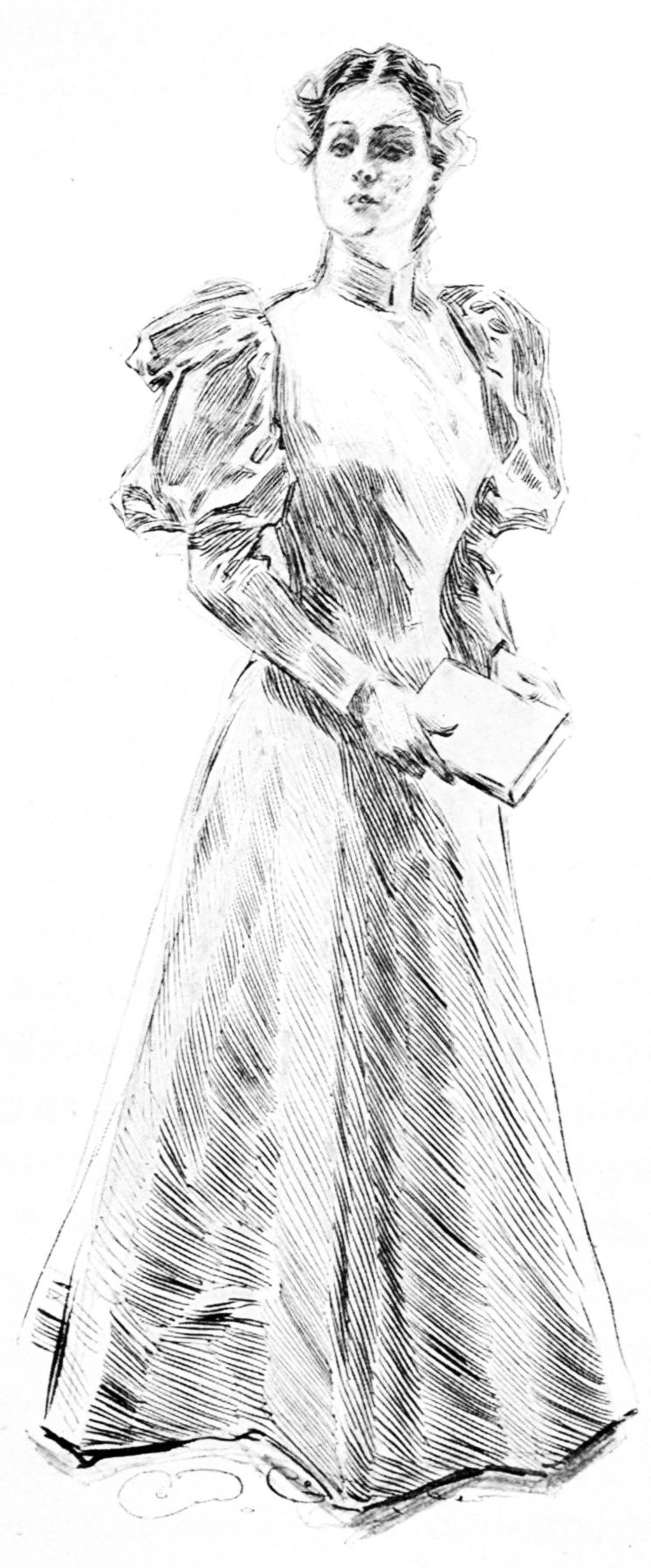
gauche and decidedly of a social class that Miss Hungerford was not in the habit of mingling with away from college. For even in a very democratic college there are social grades, and although it is the thing to meet in a most friendly way at all class functions, still, a narrow line of distinction may be perceived on social occasions.
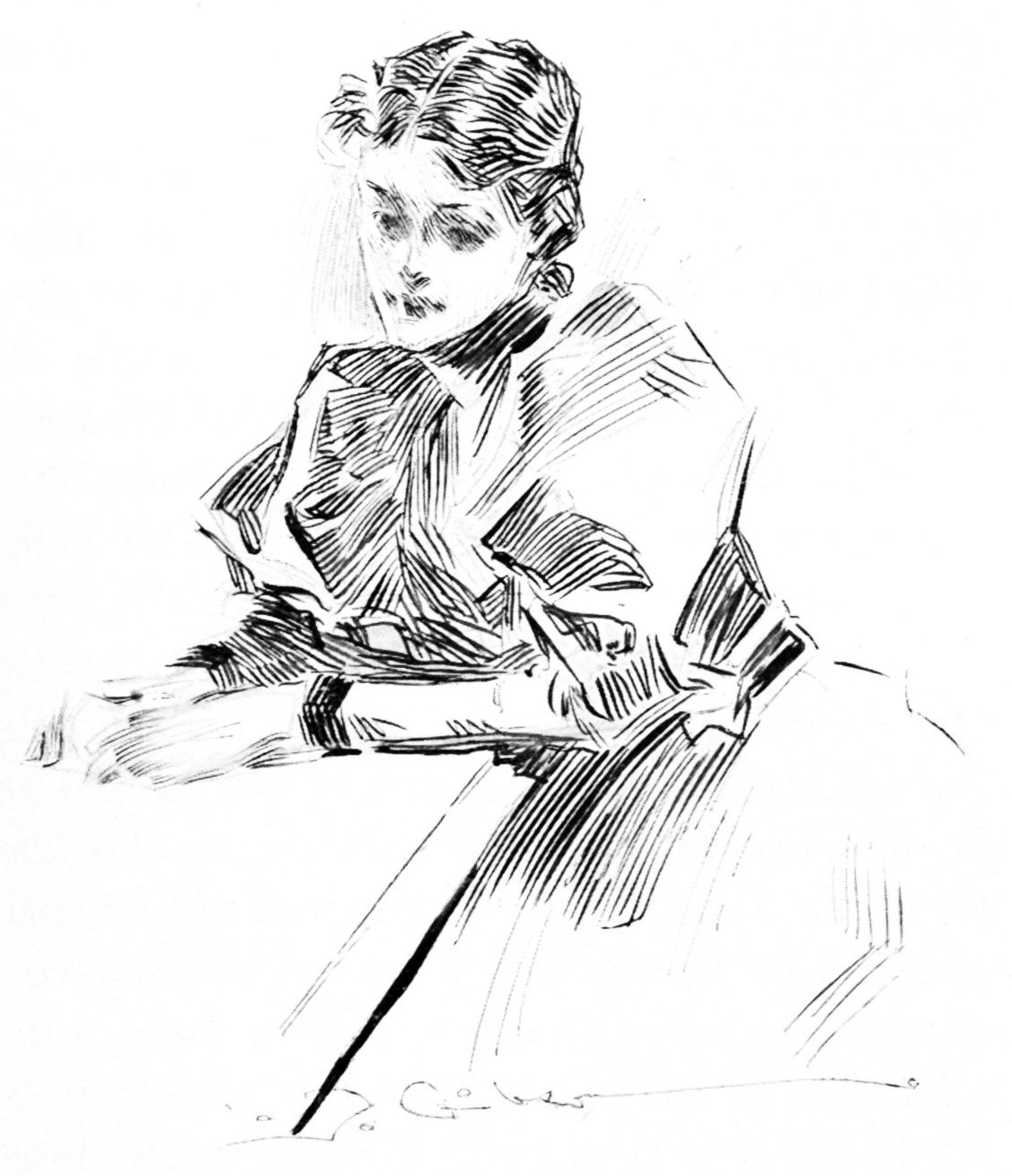
Altogether Miss Hungerford felt rather aggrieved and hoped she would not be bothered again. But she was. Miss Betty Harmon, of Sioux City, Ia., had had a fearful struggle with her timidity and retiring nature, when she called on Miss Hungerford, and having gained a victory over herself, she had no intention of resigning the benefits. So she would smile first when they met in the corridors, and was not above showing how much she appreciated a few words from Miss Hungerford in praise of her tennis serve, and that young woman was even uncomfortably conscious that her youthful admirer had more than once followed her to the library, where, under pretence of reading, she had stolen furtive glances at her. Later there were notes, and roses, and requests to go boating.
Miss Hungerford strongly objected to such proceedings, not only because she did not wish to be rendered ridiculous by an insignificant freshman from Iowa, but also because she was a very sensible girl, and entirely disapproved of the “eclectic affinity” business, and she had no intention of allowing the young girl’s admiration for herself to develop into that abnormal sort of attraction that exists between girls in so many schools and colleges.
The temptation to exalt some upper-class girl into an ideal and lavish upon her an affection which in society would naturally fall to the lot of some very unideal boy, or man, is one of the greatest ordeals a college girl goes through, and one who successfully resists all inducements to become a “divinity student,” or who gets out of the entanglement without damage to herself, is as successfully “proven” as was Lieutenant Ouless after his little affair with Private Ortheris. Even the least romantic girl is apt to find unexpected possibilities in her nature in the way of romantic devotion, so that it was not surprising that Miss Betty Harmon, unimaginative and unsentimental as she was, should have admired so extravagantly as handsome and interesting a girl as Eva Hungerford. The crude Western girl found something extremely attractive in the senior—grace, a social ease and distinction, and that indefinable magnetism which a wealthy, consciously beautiful girl possesses.
SHE HAD STOLEN FURTIVE GLANCES AT HER
But Miss Hungerford, who had no notion of getting herself talked about, and whose Eastern sensitiveness and prejudices were continually being shocked by the younger girl’s crudities, so persistently frowned down upon and ignored her under-class admirer, that even Miss Harmon’s devotion paled, and the roses and notes and boating excursions ceased. She began to perceive that the faint line of social distinction, so rarely perceptible in the college, had been drawn in her case.
During the last semestre of the year Miss Hungerford, who was very tired and busy, seemed almost oblivious of the young girl’s existence, and even forgot to smile at her when they met on the campus. And when on her Baccalaureate Sunday a box of white roses—the last mute expression of Miss Harmon’s expiring affection—was handed her without any card, she wondered who had sent them and concluded they must have been ordered by a man she knew.
Three years after leaving college Miss Hungerford married, much to her friends’ surprise, and a year after that she and her husband went abroad. Of course they went to Paris, where Mrs. Stanhope, who had spent much time there after leaving college, had a great many friends, and innumerable dinners were given to them and they enjoyed themselves very much, until it got so cold that Mrs. Stanhope said she must go to Cannes. Of course it immediately struck Stanhope, who adored his wife, that it was entirely too cold to stay in Paris, and so they went south, though their friends made a great fuss over their departure.
They stayed away much longer than they had intended, having been enticed into going to Malta by some American acquaintances, and when they got back to Paris hundreds of interesting things seemed to have happened in their absence, and a great many people and events were being talked about of which they knew nothing. But the wife of the American minister, who was an old friend, went to see Mrs. Stanhope immediately to invite her to an informal dinner the next evening, and stayed the entire afternoon, telling her of everything that had happened and who all the new people were—the New American Beauty for instance. She could not believe that her friend had not heard of nor seen the New Beauty.
“Why, haven’t you ever seen her pictures—and the notices of her?”
Mrs. Stanhope was slightly aggrieved. She knew absolutely nothing about her.
“And I am completely astonished that they aren’t talking of her at Cannes.”
Mrs. Stanhope reminded her friend that she had been immured at Malta since leaving the Riviera.
“Oh, well, of course her fame has reached there by this time. Why, all Paris is talking about her—and you know yourself”—observed that astute lady, impressively—“how much it takes to make Paris stop and look at you.” Mrs. Stanhope said “Yes,” and wanted to know who The Beauty’s people were, and where she had come from.
“Oh, I don’t know,” declared her friend. “No one seems to inquire. She is so beautiful and sufficient in herself that one does not care much for the rest. They are immensely rich—recently, I believe—though you would never know it from her manner. She is charming and thoroughly well-bred. Her father, I hear, is a typical American business man—not much en évidence, you know. He leaves that to his daughter, and she does it very well. He is a Senator—or something—from the West, and made such a name for himself at Washington that they thought he was too bright to stay there, so they sent him over here to help settle that international treaty affair—you know perhaps—I don’t, I only pretend to.”
“How did she do it?” demanded Mrs. Stanhope, in that simply comprehensive way women have when talking about another woman.
“Oh, she just started right in. Courtelais raved over her, and her father paid him twenty thousand dollars to have her painted. The Colony took her up, and the rest just followed naturally. The portrait is really charming, though she was dressed—well, I don’t think any French girl would have sat in that costume.”
“Is she really so beautiful?”
“Well—not regularly beautiful, perhaps—but charming and fascinating, and awfully clever, they say—so clever that very few people suspect her of it, and—oh! well, you can judge for yourself to-morrow evening. By the way, everyone says she is engaged already—Comte de la Tour. You used to know him, I think.” She rose to go. “He is very much in love with her, that is evident.” She thought it best to let Mrs. Stanhope have that piece of news from herself. She did not wish her friend to be taken at a disadvantage, especially in her own house.
Mrs. Stanhope felt the least bit startled. She had known the Comte de la Tour very well indeed in Paris, several years before, and he had been very much in love with her, and had appeared quite genuinely broken-hearted when she refused him. She had not seen him—he had not been in Paris when she was there during the earlier part of the season—but with the comforting faith of people who have never been in love, she had always believed that he would get over his devotion to her, though she felt a rather curious sensation on hearing that her expectations had been so fully realized, and she felt a pardonable curiosity to see the girl who had made him forget her.
She dressed very carefully for the American Minister’s the next evening, and looked a little more than her usual handsome self, when her carriage turned rapidly into the Avenue Hoche. She was somewhat late, and although the Minister and his wife were old friends, she felt worried with herself, for she had made it a rule to be punctual at all social functions, and when she entered the rooms she could see that the guests wore that rather expectant air which signifies that dinner is already slightly behind time. She hurried forward and denounced herself in polite fashion, but her hostess assured her that several others had not yet arrived, and, much relieved, she turned to speak to a bright newspaper man, an old acquaintance, who had arrived in Paris during her absence.
“I am so glad to find you again,” he murmured in his drawl; “they tell me you have been to Malta. How fortunate for you! I suppose now you have been happy in an idyllic, out-of-the-world way, and have not heard a word about Brice’s accident, nor the newspaper duel, nor the New Beauty——”
“But I am not happy, and shall not be until I see your Beauty,” protested Mrs. Stanhope. “I’ve heard about her until I have an all-devouring curiosity to behold her. I haven’t even seen the portrait, or a photograph!”
He fell away from her in mock surprise and despair, and was about to reply, when the portières were drawn aside and Mrs. Stanhope saw coming into the room a very beautiful young girl, with a rather childish, mobile face, and magnificent eyes. She seemed to know everyone, and bowed and smiled right and left in an easy, bright sort of way. Mrs. Stanhope would have known this was The Beauty, even if her entrance had not been accompanied by that significant hush and rather ridiculous closing up of the men in her wake. There was a special charm about the soft contour of her face, and the heavy white satin of her gown, though rather old for such a young girl, set off her beauty admirably.
“Looks just like one of Goodrich’s girls, doesn’t she?” murmured the man at Mrs. Stanhope’s elbow. But that lady was not paying any attention to his remarks. She was looking in a puzzled fashion at the girl’s face, and wondering what there was about it so familiar.
“Isn’t she deliciously beautiful?” he insisted, “and clever! I found it out quite by accident. She’s very careful about letting people know how well informed she is. She’s been to a college somewhere,” he ran on. Mrs. Stanhope was not listening. She was still looking, in a rather abstracted way, at the young girl who was holding a little court on the other side of the room. Her hostess rustled up.
“I am going to send my husband to bring The Beauty to you,” she said, laughingly, and swept across the room. In a moment Mrs. Stanhope saw the girl take the Minister’s arm, and, followed on the other side by the Comte de la Tour, start toward her. For some inexplicable reason she felt annoyed, and half wished to avoid the introduction. The newspaper man was interested. Mrs. Stanhope had never posed as a professional beauty, and she was too noble a woman to have her head turned by flattery, but that did not alter the fact that she had been considered the handsomest woman in the American colony at Paris, and, of course, she knew it. He thought it would be interesting to see how the acknowledged beauty received the younger one.
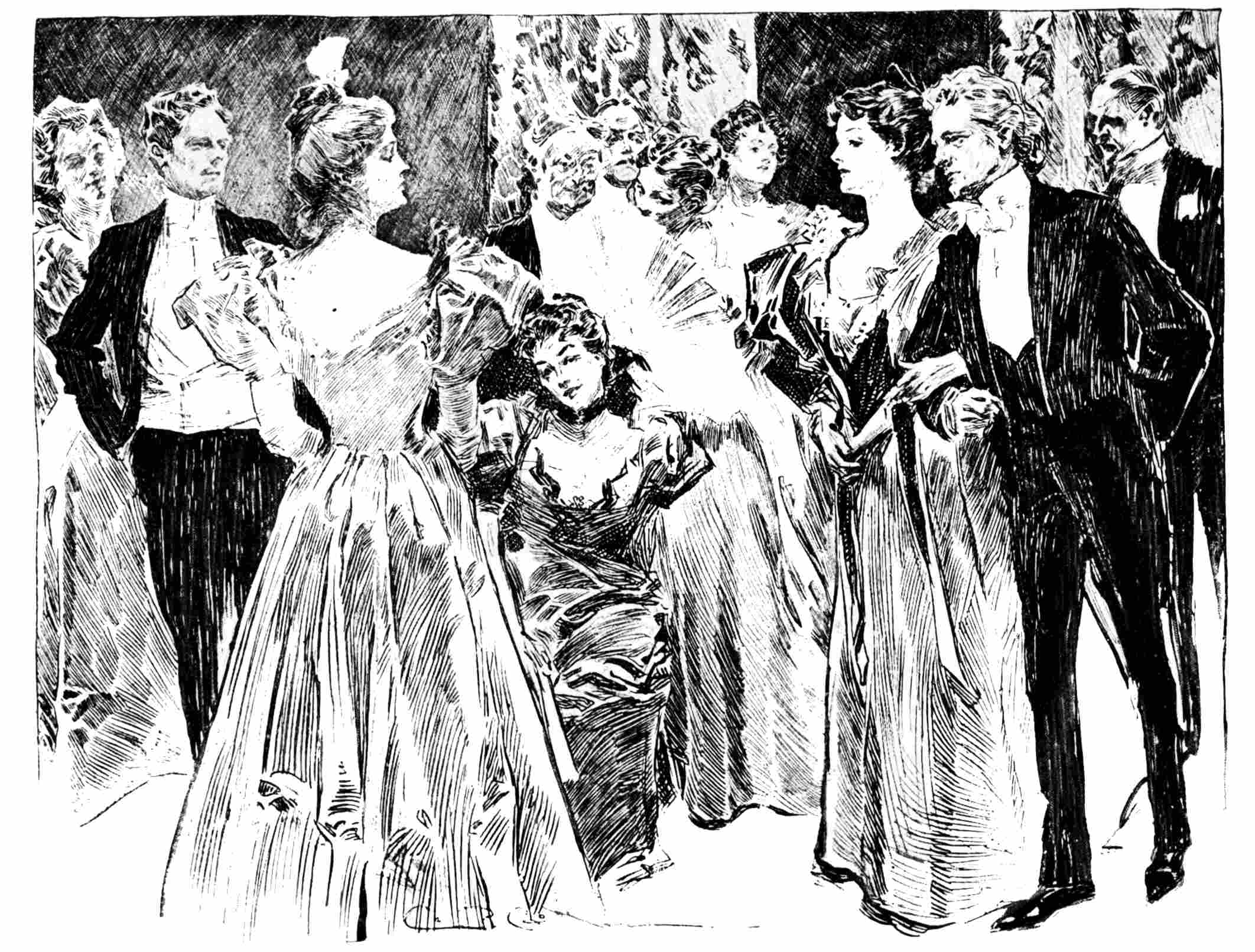
When the two women were within a few feet of each other, and before the American Minister could say “Mrs. Stanhope,” they each gave a little cry of recognition, and it was the younger one who first regained her composure and extended her hand. She stood there, flushed and smiling, the lights falling on her dark hair and gleaming shoulders, making of her, as the newspaper man had said, one of “Goodrich’s girls.” The childish look had gone out of her eyes, and a little gleam of conscious triumph was in them. There was just a shade of coldness, almost of condescension, in her manner. While the Comte was looking from one to the other, in a rather mystified way, and the American Minister was saying, “Why, I didn’t know—I thought—” Mrs. Stanhope’s mind was running quickly back to her first meeting with the girl before her, and she could only remember, in a confused sort of way, what this girl had once been like. And so they stood for a moment—it seemed an interminably long time to the men—looking a little constrainedly at each other and smiling vaguely. But the older woman quickly recovered herself. She had no notion of being outdone
WHEN THE TWO WOMEN WERE WITHIN A FEW FEET OF EACH OTHER
by the girl before her, and spoke brightly.
“I did not recognize you! How stupid of me! But you see the ‘Beatrice’ confused me, and then the French way everyone has of pronouncing H-a-r-m-ö-n completely put me off the track!”
She tried to be very friendly, and the young girl smiled and looked easily—the newspaper man thought almost defiantly—at her, but it was plain to the three onlookers that in some inscrutable way the meeting had been unfortunate, and they each felt relieved, in an inexplicable fashion, when dinner was announced and the snowy, gleaming length of damask and silver and wax lights stretched between the two women.
. . . . . . .
That night the Comte thought a good deal about the reception of his fiancée by the woman he had once loved, and decided that the American woman was a trifle exigeante, and wondered whether Mrs. Stanhope had really expected him never to marry.
The American Minister confided to his wife that he was disappointed in Eva Stanhope, and that she had always appeared so free from vanity and so superior to the little meannesses of women that he was very much surprised at the way she had acted.
The newspaper man, being exceedingly wise in his generation, smoked three cigars over it on the way to his hotel, and then—gave it up.