Why Ordinary Trusses Do More Harm Than Good
Reading edition
The country is full of trusses which are nothing but more or less worthless makeshifts. Some with so little merit that they try to hide under other names.
Like the junk handed out at drug-stores. Like the traps peddled by the quacks who pose as Hernia "Specialists."
Trusses and appliances with belts, bands or springs around the waist, trusses with leg-straps, etc.
Some of these trusses cost little more to make than a pair of good suspenders or garters. A little leather, a few pieces of elastic or web band, a cloth-covered pad with sawdust in it, is about all there is to them.
So, like suspenders or garters, they absorb perspiration; that rots them so they soon give out.
But their greatest weakness isn't in their cheap materials; it's in their unscientific construction, in the fact that they usually do more harm than good.
Your Suspenders Would Do As Much Good As Some Trusses
A rubber band around your waist would do as much good as some of these makeshift trusses and "appliances"; and not be so apt to do harm.
Might just as well wear your suspenders or garters over your rupture as some of the trusses and devices with which this country is overrun. Some of these trusses would hold your rupture just about as well if you left them hanging in the closet instead of wearing them.
During the many years The Cluthe Rupture Institute was located in New York City, we had daily evidence of the utter worthlessness of all such trusses.
Every day, one after another of the victims of such appliances were coming to us for relief.
When we examined these patients, we usually found that the rupture had pushed the pads aside and worked out above or below them.
Sometimes we found that the pads had worked away from the rupture opening, worked down against the pelvic bone. And the ruptured parts had slipped out and were being squeezed between the pads and the bone. A condition apt to result in strangulation.
Some of these patients came to us suffering intense torture from the terrific pressure of such trusses—pressure perhaps ten times greater than needed—and this cruel pressure is exerted from the wrong direction, in the wrong place.
Perhaps merely a slight sneeze or cough is enough to push the pads out of position. And then the pressure of these pads forces the ruptured parts out, instead of holding them in.
Sometimes the pads had slipped down so far on the pelvic bone—or had been pulled down by the leg-straps—that there was no support for the rupture whatever.
And this constant pressure against the pelvic bone saps the vitality. Often causing sexual weakness and mental failing. For between this bone and the outer skin is the sensitive life-giving spermatic cord.
Ordinary Trusses May Bring On Other Ailments
Also, we have found in hundreds of cases that these belt and spring trusses press against the femoral artery so severely that heart disorders result. Causing dizziness, headaches, irritability, etc. Yet the patient seldom associates his truss with these troubles, seldom knows their cause.
And constipation and stomach troubles are often brought on by these trusses. Gas on the stomach is a common result.
These troubles can be remedied only by removing the cause—only by discarding the harmful truss.
The Cluthe Truss soon overcomes such complications. We have countless letters—from people formerly suffering from such troubles brought on by wrong trusses—telling how the Cluthe Truss has given them a new lease on life—made them feel many years younger.
Among patients who came to us wearing spring trusses, we have often found evidence of injury to the spine.
For such trusses press against the spine—the delicate center of the nervous system—just as cruelly as they dig into the abdomen and the pelvic bone in front.
And frequently, when patients came to us wearing belt trusses, we have found the tender skin all cut and bruised where the belt fits around the body. And nearly always the cruel leg-straps had made the wearer's legs raw and sore.
The sufferer who wears a truss like these can scarcely have a moment's comfort.
Thousands of belt and spring trusses have been thrown away by new patients at our Institute, after we had fitted them with Cluthe Trusses.
And among all these discarded trusses we have never found one that could be properly adjusted—the pressure couldn't be properly regulated.
There is by far too much pressure at times when only slight pressure is needed.
And, at times of strain, when more pressure is needed, there is no increase in pressure to meet that need.
This unregulated pressure tends to stretch the weakened muscles at the point of rupture—distends and enlarges the opening.
That is one reason why a rupture grows constantly worse when a leg-strap or spring truss is worn. Such trusses are a crime—wearing them is simply slow suicide.
We keep a record showing the history of every rupture we treat.
This record shows that every severe rupture with which we have had to deal has grown into a serious case solely through the wear of some form of the belt or spring truss.
Just judge of all this by your own experience. Probably, in spite of the trusses you've been wearing, your rupture has grown constantly worse instead of better.
And then—for the sake of comparison—just read some of the letters you'll find at the back of this book; see the verdicts of people who have had experience with both the Cluthe Truss and with other kinds.
Trusses Like These Are A Crime
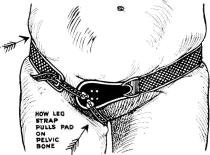

So-called "Appliances" are Usually Merely a Slight Adaptation of this Style of Truss—Merely the Most Worthless Kinds of Trusses Masquerading under Misleading Names.
The only way to give leverage to the pad is to tighten up the belt and the leg-straps. The tighter they are, the farther they pull the pad away from the rupture opening. The leg-straps pull the pad down on the pelvic bone, where its pressure squeezes the life-giving spermatic cord.
Whenever the wearer coughs, sneezes or is under strain, the bowels leave their natural position, working out and in through the rupture opening (due to flexibility and stretching of straps), and the bowels when out are repeatedly pressed between the pelvic bone and the pad.
The Cruel Spring Truss It is impossible to keep the spring truss in position. Due to the force of the springs around the waist, the pads dig against the pelvic bone with terrible pressure, sapping the vitality. The previous chapter shows how most ruptures grow constantly worse when trusses like these are worn.
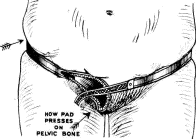

Dotted lines in lower illustration show Spring Truss coiled up before applied. Try to hold springs apart as when on the body as shown for half a minute. Then you will know what criminal pressure the spring truss gives. full page (thumbnail)