Law Should Stop the Sale of Drug Store Trusses
Reading edition
We believe the day will soon come when laws will be passed forbidding any one either to fit or sell trusses without a legal license.
Just as physicians, surgeons and dentists must all have licenses. So must oculists and opticians, in most states. Also druggists, before they can fill prescriptions.
And, unless a man has made a specialized study of rupture—unless he has a thorough knowledge of it—he should no more be allowed to sell or fit trusses than a schoolboy should be allowed to practice medicine.
Ruptured people seriously risk their health when they trust their cases to any one who hasn't made a thorough, specialized study of rupture. That is almost as dangerous as having a prescription filled by an inexperienced clerk, instead of by a registered pharmacist. For a wrong truss can cause immense harm.
Trusses Should Be Sold Only Under License
When the time comes when trusses can be sold only under license, we'll see most of the self-styled "Hernia Specialists" driven out of business.
We'll also see an end to the selling of "stock" trusses by general Mail-Order houses where an order for a truss is handled in exactly the same way—and often by the same man—as an order for groceries or hardware.
And, when that time comes, mighty few drug-stores will be able to sell trusses.
Let us show why.
Take the following as an example:
A man might think he had only a bad cold.
And might go to a drug-store.
Now, a druggist doesn't pretend to know disease—he simply knows drugs.
So about all the druggist could do would be to hand out some patent medicine—some cure-all.
But if the man went out to a good physician—
The physician might find, after asking a few questions and thus making a diagnosis, that the patient had La Grippe, or Pneumonia, or Pleurisy (instead of merely a cold, as the patient thought).
The physician would find out what the patient needed, then write a specific prescription—and seldom the same prescription for any two patients. For the requirements would always differ.
Or a man might have poor eyesight.
He might go to an optician.
Now, an optician doesn't know much about eyes—he has made a special study of lenses—he merely fits glasses—just as a druggist merely fills prescriptions—neither pretends to diagnose or prescribe.
And an optician is just as likely as not to fit a near-sighted man with far-sighted glasses.
A Truss Fitter Should Know as Much About Rupture as an Oculist About the Eyes
But if the man with poor eyesight goes to an oculist—
The oculist finds out what the trouble is—and what kind of glasses are needed—then prescribes that kind of glasses.
And then the optician fits the man according to the oculist's prescription. Just as a druggist fills a physician's prescription.
Now our method of fitting you by mail is precisely like the physician's method.
From your answers to the simple questions we ask on our information blank, we first decide the needs of your case—then we prescribe—then we fill our prescription by making especially for your case exactly the kind of truss you need.
A physician never asks you what kind of medicine you want—he prescribes for you the kind which he knows you need.
But if you go to a drug-store for a truss, the clerk behind the counter asks you what kind of truss you want!
You must be your own doctor.
Druggists Know Nothing about Rupture
Neither the drug clerk nor the druggist knows enough about rupture to know what kind of truss you need.
And, usually, his knowledge of trusses is confined to the difference in prices—he'd rather sell you a $10 truss than a $3 truss.
His knowledge of fitting is not much greater.
If you measure 36 inches around the hips, he gives you a 36-inch truss—which, in everything except size, would be exactly like the truss he'd sell at the same price, to a man with a rupture only half as bad as yours, or to a man with a rupture twice as bad as yours.
A drug-store sells trusses in exactly the same way that the old-fashioned shoe store sold shoes.
It was solely a matter of how much the customer wanted to pay, and the style the customer wanted—not what the customer needed.
Thousands of people have been "all crippled up" because their shoes were too short, or too narrow, or the wrong shape. The old-fashioned shoe clerk knew his stock, but he didn't know enough about the customer's feet to know when the customer was properly fitted.
Just as thousands of people have trouble with their glasses because they were fitted by an optician—"over the counter,"—instead of having an oculist prescribe for them.
And, partly because improperly fitted at drug-stores, and partly because drug-store trusses are usually mere makeshifts, thousands of people are to-day wearing trusses which are doing immense harm instead of good—trusses which cause the rupture to grow constantly worse.
Even if there is any druggist in the country who does happen to know much about rupture and about fitting trusses, he'd have to be a mighty bright man to be able to fit you at all properly with the kind of trusses sold in the average drug-store.
Practically all the drug-store trusses are simply some form of the old belt or springs and leg-strap truss—though sold under hundreds of different names as "improvements." They are usually cheaply constructed—turned out by machinery in immense quantities.
And they are always ready-made "stock" trusses. Each kind made in only one model or style, and the pads in only a few different shapes and sizes.
Making mighty scant provision for the wide variation between the ruptures of different people; making mighty little allowance for the fact that what will do for one man won't do at all for another.
Each Man Requires Something Different
Your rupture, when out, may be the size of a hen's egg; your neighbor may have a protrusion almost as big as his head; and a lot of other men with protrusions ranging all the way from one extreme to the other. To say nothing of big differences in other ways besides size.
Each of you should have a size and shape of holding pad especially adapted to the needs of your case—each should have a truss put together especially for you. Else there can be no such thing as continuous, comfortable holding of the rupture.
So you see the absurdity of trying to get a comfortably fitting truss at a drug-store, or of expecting to get one that will do much good.
Might as well expect all men to be properly fitted in a shoe store which carries only one size and shape of shoe. Or in a hat store which carries only one size of hat. Might as well expect both near-sighted and far-sighted men to see better if both wore the same kind of glasses. And might as well expect common window-glass to improve the eye-sight as to expect common drug-store trusses to do any good.
Just Like Getting Glasses
There is just as much difference in different men's ruptures as in the size and shape of their feet or heads.
Just as much variation in rupture as in failing eyesight. And everybody knows that one man may need very powerful glasses, while another needs glasses which magnify only slightly; one may need a double lens, while another needs only a single lens; one may need convex lenses, while another needs concave.
All this doesn't mean that it is hard to fit ruptured people, but merely that ample provision must be made for the different requirements. As a shoe store does for men's feet.
We have found it necessary to make the Cluthe Holding Pads in 115 different styles, shapes and sizes. And frequently we have to make a special style or size.
Thus, no matter what your rupture is like, we can fit you with a Cluthe Truss—one put together especially for you—one that will meet your requirements just as well as a shoe store can fit you with shoes, or an oculist fit you with exactly the kind of glasses you need.
*****
It is for these reasons—their ignorance of rupture—that we have never sold the Cluthe Truss through druggists.
Trusses are simply a side-line in the average drug-store. Just as cigars are, or "soft drinks."
A druggist knows all about drugs.
He has made them his special study.
But he doesn't know much about rupture—doesn't pretend to—and can't be expected to. Because he hasn't made a study of it.
It took us, here at the Cluthe Rupture Institute, over forty years to learn all that we now know about Rupture.
Forty years of day-after-day concentration on the study and treatment of Rupture.
And during those forty years, we have learned things about Rupture which no one else has ever learned—we have gained knowledge which is exclusively our own.
And it took many years of scientific study and experiment to perfect the Cluthe Truss, and to design the hundreds of different kinds, sizes, and shapes of Holding Pads which adapt this truss to every form and condition of Rupture known to-day.
We have told you this, Reader, to show that placing yourself in our care is vastly different from going to a drug-store, or to a mere dealer in trusses or manufacturer of them.
And the following chapters will show that even more conclusively.
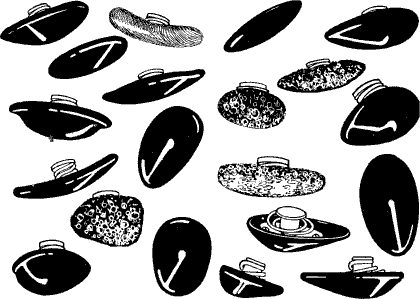
Showing a few of the different sizes and shapes in which the Cluthe Holding Pads are made.